

Handheld Laser Barcode Scanners
Introduction Purpose To introduce a solution for handheld laser barcode scanner and recommended some related components suitable for the application. Outline Barcode overview Barcode scanner basics Laser barcode scanner Our solution Core chip solution Peripheral solution Content 17 pages
What is Barcode? From Wikipedia, a barcode is an optical machine-readable representation of data, which shows certain data on certain products. The data in a barcode is just a reference number. A barcode is a series of varying width vertical lines (called bars) and spaces   A Barcode Symbology defines the technical details of a particular type of barcode: The width of the bar Character set Method of encoding Check sum specifications There are lots of different barcodes. Numeric-only barcodes Alpha-numeric barcodes Numeric only barcode Alpha-numeric barcode
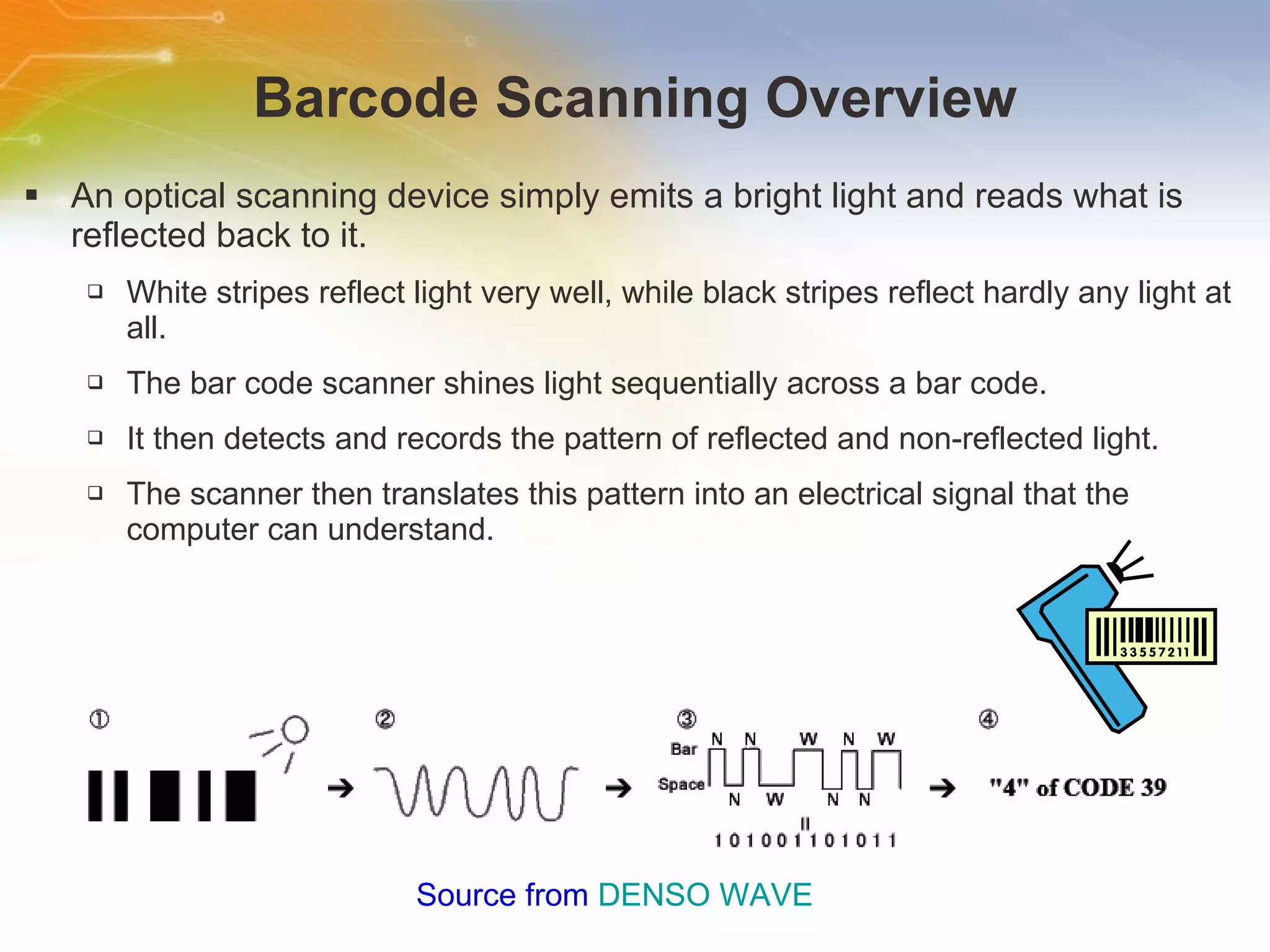
Barcode Scanning Overview An optical scanning device simply emits a bright light and reads what is reflected back to it. White stripes reflect light very well, while black stripes reflect hardly any light at all. The bar code scanner shines light sequentially across a bar code. It then detects and records the pattern of reflected and non-reflected light.  The scanner then translates this pattern into an electrical signal that the computer can understand. Source from  DENSO WAVE
Types of Barcode Scanners Wand Scanner Simplest and least cheap device available Durable and no moving parts Need to be held at proper angle an moved at the proper speed. Charge Couple Device (CCD) Scanner Able to read bar codes quickly and easily Durable and no moving parts Short read range Limited barcode width Laser Scanner Most popular barcode scanner Long read range Using moving mirrors More expensive
Handheld  Laser Barcode Scanners A handheld laser barcode scanner is an active contactless type. The laser beam is used as the light source. The rotating  optical components, like lens, polygon mirror, and transparent mirror,  scan the laser beam back and forth across the bar code.  The captured data is converted into electrical signals and are then processed by a MCU. The handheld device usually has wireless communication capability. Common Applications Point of sales Warehouse Industrial Retailer Libraries Medical facilities Legal office
Solution for A Handheld Laser Barcode Scanner
Laser Diode Selection Guide Manufacturer Part Number Wavelength  Power  Operating  Voltage Operating Current Laser Components ADL-63054TL 635nm 5mW 2.2V 33mA Laser Components ADL-63055TL 655nm 5mW 2.2V 25mA Laser Components ADL-65074TR  655nm 7mW 2.2V 30mA Laser Components ADL-65075TA2 650nm 7mW 3V 27mA MELLES GRIOT  58SDM103 635nm 3mW 6V 70mA MELLES GRIOT  58SDM303 670nm 3mW 6V 70mA IMATRONIC LDM115/633/1 633nm 900uW 5V 75mA IMATRONIC LDM115/670/1 670nm 900uW 5V 75mA HERO PLP6501FR 650nm 1mW 6V 45mA HERO PLP6501AR 650nm 1mW 6V 45mA
Laser Diode Driver Selection Guide Manufacturer Part Number Description Supply Voltage Laser Drive Current Laser Components IC-WKL 2.4V CW Laser Diode Driver 2.4 to 6V 70mA Laser Components IC-WKM M-TYPE CW Laser Diode Driver 3.6 to 15V 70mA Laser Components IC-WKN 15V CW Laser Diode Driver 2.4 to 15V 300mA ADI ADN2531 Differential Laser Diode Driver 3 to 3.6V 100mA ADI ADN2841 Laser Diode Driver 5V 100mA ADI ADN2870 Laser Diode Driver 5V 100mA TI ONET1101L 11.3 Gbps Laser Diode Driver 3.3V 100mA TI ONET4211LD 155 Mbps to 4.25 Gbps Laser Driver  3.3V 100mA
TI’s  ONET4211LD Laser Driver Multirate Operation From 155 Mbps up to 4.25 Gbps Bias Current Programmable From 1 mA to 100 mA Modulation Current Programmable From 5 mA to 85 mA APC and Fault Detection Fault Mode Selection Bias and Photodiode Current Monitors CML Data Inputs Temperature Compensation of Modulation Current Single 3.3-V Supply Surface-Mount, Small-Footprint, 4 mm × 4 mm 24-Lead QFN Package
Motor Driver Selection Guide Manufacturer Part Number Description Supply Voltage Output Current Intersil HIP4020IBZ Full Bridge Driver with Integrated 0.5A Power FETs for Small 3V, 5V and 12V DC Motors 3 to 12V 0.5A Linear LTC1157 3.3V Dual Micropower High-Side/Low-Side MOSFET Driver 3.3/5V -- Linear LT1910 Protected High Side MOSFET Driver 8 to 48V -- Linear LTC1156 Quad High Side Micropower MOSFET Driver 4.5 to 18V -- Linear LTC1154 High-Side Micropower MOSFET Driver 4.5 to 18V -- Linear LT1161 Quad Protected High-Side MOSFET Driver 8 to 48V -- NS LM5109 High Voltage 1A Peak Half Bridge Gate Driver 8 to 14V 1A TI TPS2811D Inverting Dual High-Speed MOSFET Drivers 4to 40V 2A TI TPS2814 Inverting Dual High-Speed MOSFET Drivers 4to 14V 2A TI TPS2816 Inverting High Speed MOSFET Driver 4to 14V 2A
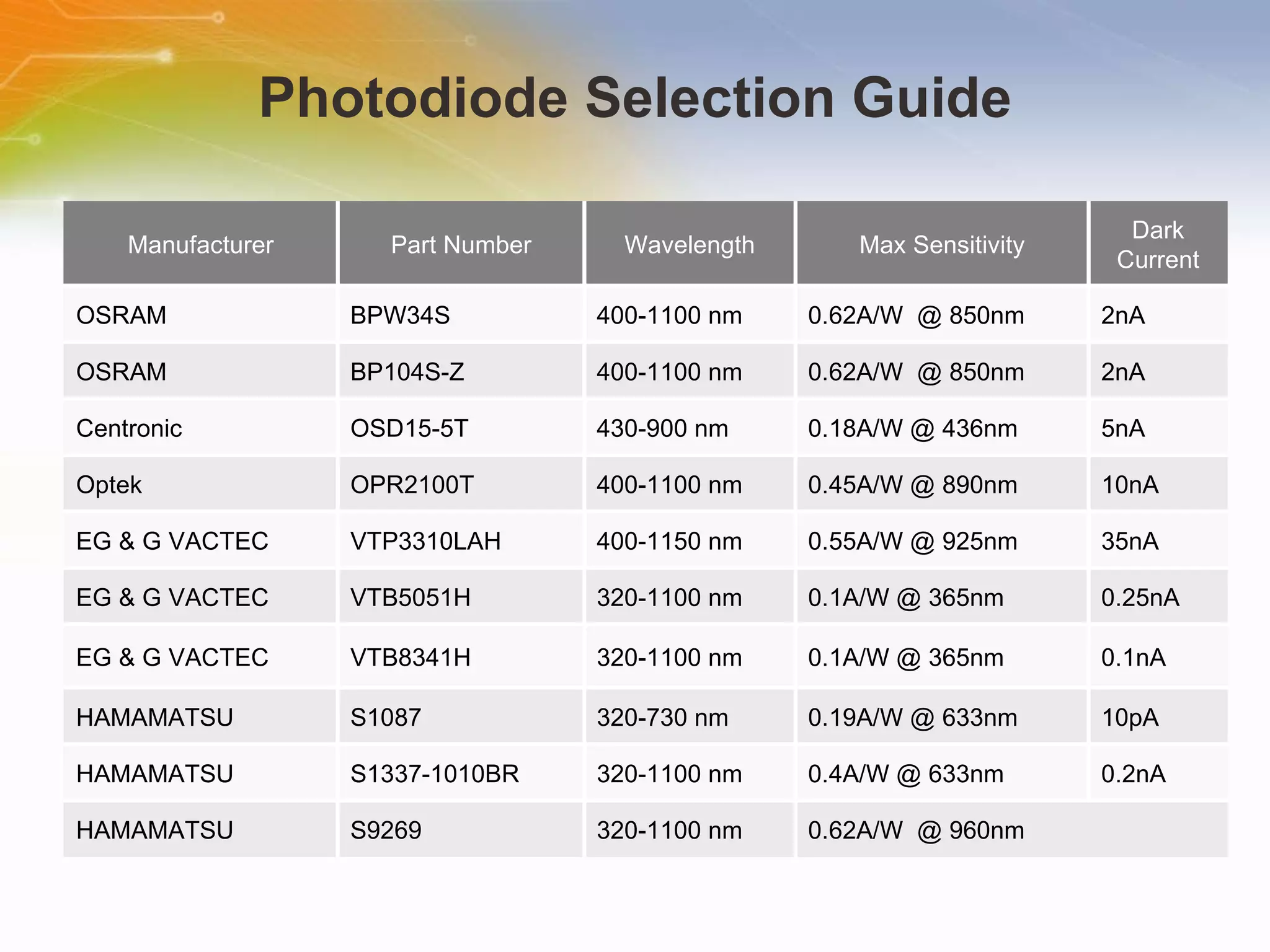
Photodiode Selection Guide Manufacturer Part Number Wavelength Max Sensitivity Dark Current OSRAM BPW34S 400-1100 nm 0.62A/W  @ 850nm 2nA OSRAM BP104S-Z 400-1100 nm 0.62A/W  @ 850nm 2nA Centronic OSD15-5T 430-900 nm 0.18A/W @ 436nm 5nA Optek OPR2100T  400-1100 nm 0.45A/W @ 890nm 10nA EG & G VACTEC  VTP3310LAH  400-1150 nm 0.55A/W @ 925nm 35nA EG & G VACTEC  VTB5051H  320-1100 nm 0.1A/W @ 365nm 0.25nA EG & G VACTEC  VTB8341H  320-1100 nm 0.1A/W @ 365nm 0.1nA HAMAMATSU  S1087  320-730 nm 0.19A/W @ 633nm 10pA HAMAMATSU  S1337-1010BR  320-1100 nm 0.4A/W @ 633nm 0.2nA HAMAMATSU  S9269  320-1100 nm 0.62A/W  @ 960nm
OSRAM BPW34S Photodiode Especially suitable for applications from 400 nm to 1100 nm Short switching time (typ. 20 ns) DIL plastic package with high packing density Suitable for reflow soldering photosensitive area
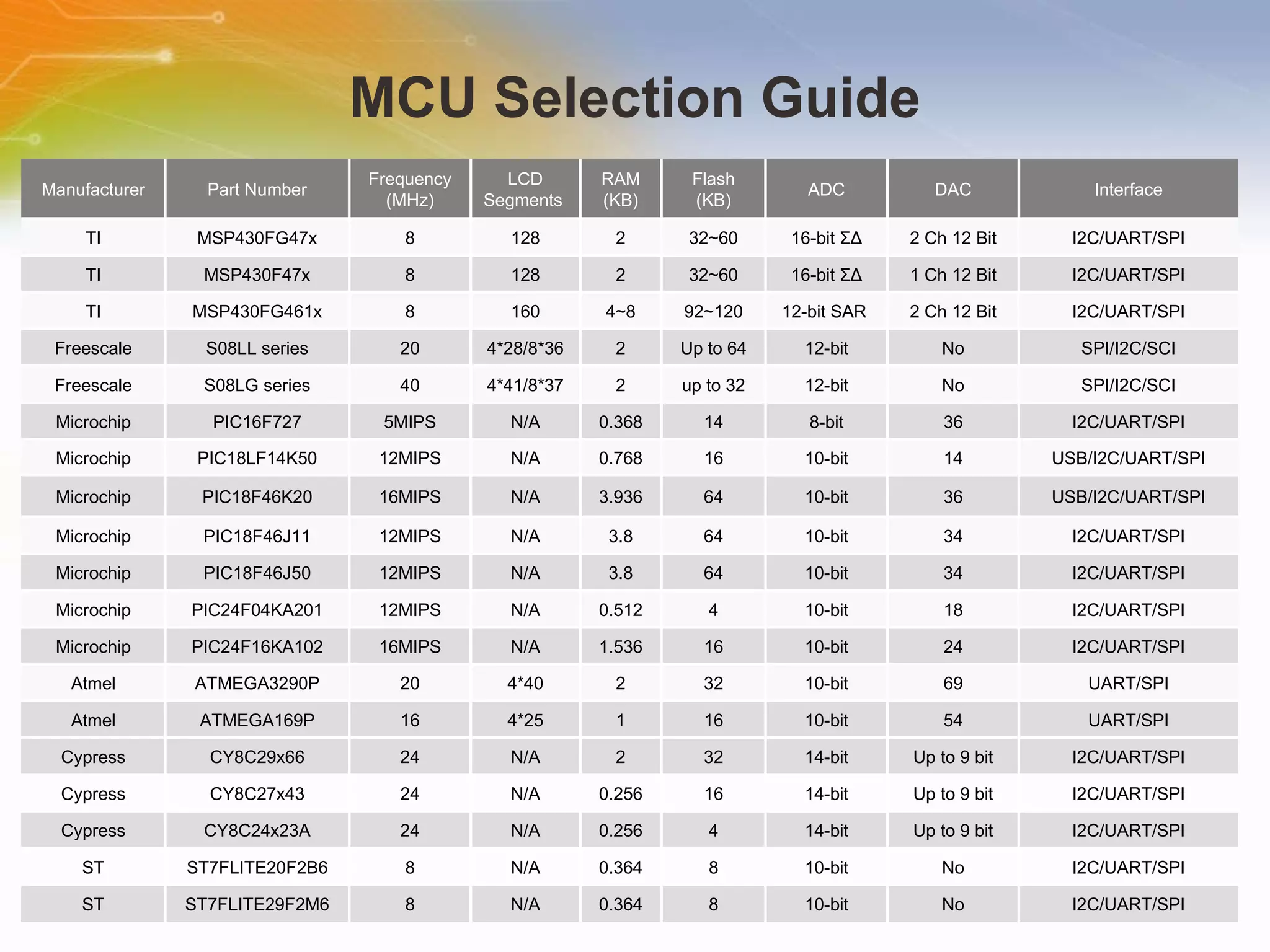
MCU Selection Guide Manufacturer Part Number Frequency (MHz) LCD Segments  RAM (KB) Flash (KB) ADC DAC Interface TI MSP430FG47x 8 128 2 32~60 16-bit  ΣΔ 2 Ch 12 Bit I2C/UART/SPI TI MSP430F47x 8 128 2 32~60 16-bit  ΣΔ 1 Ch 12 Bit I2C/UART/SPI TI MSP430FG461x 8 160 4~8 92~120 12-bit SAR  2 Ch 12 Bit I2C/UART/SPI Freescale S08LL series 20 4*28/8*36 2 Up to 64 12-bit No SPI/I2C/SCI Freescale S08LG series 40 4*41/8*37 2 up to 32 12-bit No SPI/I2C/SCI Microchip PIC16F727 5MIPS N/A 0.368 14 8-bit 36 I2C/UART/SPI Microchip PIC18LF14K50 12MIPS N/A 0.768 16 10-bit 14 USB/I2C/UART/SPI Microchip PIC18F46K20 16MIPS N/A 3.936 64 10-bit 36 USB/I2C/UART/SPI Microchip PIC18F46J11 12MIPS N/A 3.8 64 10-bit 34 I2C/UART/SPI Microchip PIC18F46J50 12MIPS N/A 3.8 64 10-bit 34 I2C/UART/SPI Microchip PIC24F04KA201 12MIPS N/A 0.512 4 10-bit 18 I2C/UART/SPI Microchip PIC24F16KA102 16MIPS N/A 1.536 16 10-bit 24 I2C/UART/SPI Atmel ATMEGA3290P 20 4*40 2 32 10-bit 69 UART/SPI Atmel ATMEGA169P 16 4*25 1 16 10-bit 54 UART/SPI Cypress CY8C29x66 24 N/A 2 32 14-bit Up to 9 bit I2C/UART/SPI Cypress CY8C27x43 24 N/A 0.256 16 14-bit Up to 9 bit I2C/UART/SPI Cypress CY8C24x23A 24 N/A 0.256 4 14-bit Up to 9 bit I2C/UART/SPI ST ST7FLITE20F2B6 8 N/A 0.364 8 10-bit No I2C/UART/SPI ST ST7FLITE29F2M6 8 N/A 0.364 8 10-bit No I2C/UART/SPI
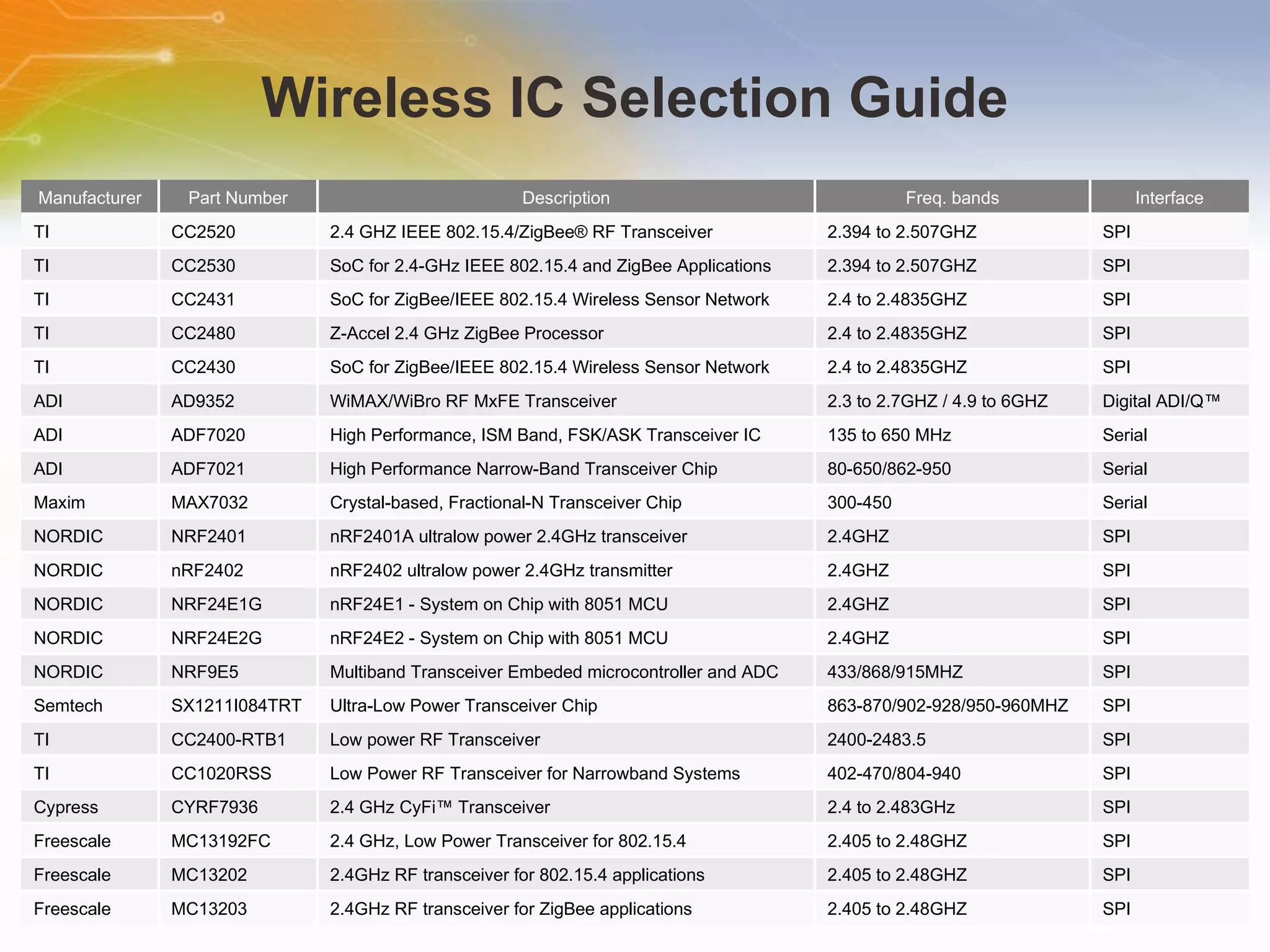
Wireless IC Selection Guide Manufacturer Part Number Description Freq. bands Interface TI CC2520 2.4 GHZ IEEE 802.15.4/ZigBee® RF Transceiver 2.394 to 2.507GHZ SPI TI CC2530 SoC for 2.4-GHz IEEE 802.15.4 and ZigBee Applications 2.394 to 2.507GHZ SPI TI CC2431 SoC for ZigBee/IEEE 802.15.4 Wireless Sensor Network 2.4 to 2.4835GHZ SPI TI CC2480 Z-Accel 2.4 GHz ZigBee Processor 2.4 to 2.4835GHZ SPI TI CC2430 SoC for ZigBee/IEEE 802.15.4 Wireless Sensor Network 2.4 to 2.4835GHZ SPI ADI AD9352 WiMAX/WiBro RF MxFE Transceiver 2.3 to 2.7GHZ / 4.9 to 6GHZ Digital ADI/Q™ ADI ADF7020 High Performance, ISM Band, FSK/ASK Transceiver IC 135 to 650 MHz Serial ADI ADF7021 High Performance Narrow-Band Transceiver Chip 80-650/862-950 Serial Maxim MAX7032 Crystal-based, Fractional-N Transceiver Chip 300-450 Serial NORDIC  NRF2401 nRF2401A ultralow power 2.4GHz transceiver  2.4GHZ SPI NORDIC  nRF2402  nRF2402 ultralow power 2.4GHz transmitter  2.4GHZ SPI NORDIC  NRF24E1G nRF24E1 - System on Chip with 8051 MCU  2.4GHZ SPI NORDIC  NRF24E2G nRF24E2 - System on Chip with 8051 MCU  2.4GHZ SPI NORDIC  NRF9E5  Multiband Transceiver Embeded microcontroller and ADC 433/868/915MHZ SPI Semtech SX1211I084TRT Ultra-Low Power Transceiver Chip 863-870/902-928/950-960MHZ SPI TI CC2400-RTB1  Low power RF Transceiver 2400-2483.5 SPI TI CC1020RSS Low Power RF Transceiver for Narrowband Systems 402-470/804-940 SPI Cypress CYRF7936 2.4 GHz CyFi™ Transceiver 2.4 to 2.483GHz SPI Freescale MC13192FC 2.4 GHz, Low Power Transceiver for 802.15.4 2.405 to 2.48GHZ SPI Freescale MC13202 2.4GHz RF transceiver for 802.15.4 applications 2.405 to 2.48GHZ SPI Freescale MC13203 2.4GHz RF transceiver for ZigBee applications 2.405 to 2.48GHZ SPI
Peripheral Solution Block Farnell Newark Power Management ICS Click Click EEPROM Click Click Flash Memory Click Click Battery Click Click Amplifier Click Click DC Motor Click Click DC Motor Driver Click Click Laser Diode Click Click Laser Driver Click Click Interface & Driver Click Click
Additional Resource For ordering solution related products, please click the part list or Call our sales hotline For more design resources go to http://www.element-14.com/community/docs/DOC-22832 Visit Element 14 to post your question   www.element-14.com For additional inquires contact our technical service hotline or even use our “Live Technical Chat” online facility Newark	 Farnell

Handheld Laser Barcode Scanners

  • 1.
  • 2.
    Introduction Purpose Tointroduce a solution for handheld laser barcode scanner and recommended some related components suitable for the application. Outline Barcode overview Barcode scanner basics Laser barcode scanner Our solution Core chip solution Peripheral solution Content 17 pages
  • 3.
    What is Barcode?From Wikipedia, a barcode is an optical machine-readable representation of data, which shows certain data on certain products. The data in a barcode is just a reference number. A barcode is a series of varying width vertical lines (called bars) and spaces A Barcode Symbology defines the technical details of a particular type of barcode: The width of the bar Character set Method of encoding Check sum specifications There are lots of different barcodes. Numeric-only barcodes Alpha-numeric barcodes Numeric only barcode Alpha-numeric barcode
  • 4.
    Barcode Scanning OverviewAn optical scanning device simply emits a bright light and reads what is reflected back to it. White stripes reflect light very well, while black stripes reflect hardly any light at all. The bar code scanner shines light sequentially across a bar code. It then detects and records the pattern of reflected and non-reflected light.  The scanner then translates this pattern into an electrical signal that the computer can understand. Source from DENSO WAVE
  • 5.
    Types of BarcodeScanners Wand Scanner Simplest and least cheap device available Durable and no moving parts Need to be held at proper angle an moved at the proper speed. Charge Couple Device (CCD) Scanner Able to read bar codes quickly and easily Durable and no moving parts Short read range Limited barcode width Laser Scanner Most popular barcode scanner Long read range Using moving mirrors More expensive
  • 6.
    Handheld LaserBarcode Scanners A handheld laser barcode scanner is an active contactless type. The laser beam is used as the light source. The rotating optical components, like lens, polygon mirror, and transparent mirror, scan the laser beam back and forth across the bar code. The captured data is converted into electrical signals and are then processed by a MCU. The handheld device usually has wireless communication capability. Common Applications Point of sales Warehouse Industrial Retailer Libraries Medical facilities Legal office
  • 7.
    Solution for AHandheld Laser Barcode Scanner
  • 8.
    Laser Diode SelectionGuide Manufacturer Part Number Wavelength Power Operating Voltage Operating Current Laser Components ADL-63054TL 635nm 5mW 2.2V 33mA Laser Components ADL-63055TL 655nm 5mW 2.2V 25mA Laser Components ADL-65074TR 655nm 7mW 2.2V 30mA Laser Components ADL-65075TA2 650nm 7mW 3V 27mA MELLES GRIOT 58SDM103 635nm 3mW 6V 70mA MELLES GRIOT 58SDM303 670nm 3mW 6V 70mA IMATRONIC LDM115/633/1 633nm 900uW 5V 75mA IMATRONIC LDM115/670/1 670nm 900uW 5V 75mA HERO PLP6501FR 650nm 1mW 6V 45mA HERO PLP6501AR 650nm 1mW 6V 45mA
  • 9.
    Laser Diode DriverSelection Guide Manufacturer Part Number Description Supply Voltage Laser Drive Current Laser Components IC-WKL 2.4V CW Laser Diode Driver 2.4 to 6V 70mA Laser Components IC-WKM M-TYPE CW Laser Diode Driver 3.6 to 15V 70mA Laser Components IC-WKN 15V CW Laser Diode Driver 2.4 to 15V 300mA ADI ADN2531 Differential Laser Diode Driver 3 to 3.6V 100mA ADI ADN2841 Laser Diode Driver 5V 100mA ADI ADN2870 Laser Diode Driver 5V 100mA TI ONET1101L 11.3 Gbps Laser Diode Driver 3.3V 100mA TI ONET4211LD 155 Mbps to 4.25 Gbps Laser Driver 3.3V 100mA
  • 10.
    TI’s ONET4211LDLaser Driver Multirate Operation From 155 Mbps up to 4.25 Gbps Bias Current Programmable From 1 mA to 100 mA Modulation Current Programmable From 5 mA to 85 mA APC and Fault Detection Fault Mode Selection Bias and Photodiode Current Monitors CML Data Inputs Temperature Compensation of Modulation Current Single 3.3-V Supply Surface-Mount, Small-Footprint, 4 mm × 4 mm 24-Lead QFN Package
  • 11.
    Motor Driver SelectionGuide Manufacturer Part Number Description Supply Voltage Output Current Intersil HIP4020IBZ Full Bridge Driver with Integrated 0.5A Power FETs for Small 3V, 5V and 12V DC Motors 3 to 12V 0.5A Linear LTC1157 3.3V Dual Micropower High-Side/Low-Side MOSFET Driver 3.3/5V -- Linear LT1910 Protected High Side MOSFET Driver 8 to 48V -- Linear LTC1156 Quad High Side Micropower MOSFET Driver 4.5 to 18V -- Linear LTC1154 High-Side Micropower MOSFET Driver 4.5 to 18V -- Linear LT1161 Quad Protected High-Side MOSFET Driver 8 to 48V -- NS LM5109 High Voltage 1A Peak Half Bridge Gate Driver 8 to 14V 1A TI TPS2811D Inverting Dual High-Speed MOSFET Drivers 4to 40V 2A TI TPS2814 Inverting Dual High-Speed MOSFET Drivers 4to 14V 2A TI TPS2816 Inverting High Speed MOSFET Driver 4to 14V 2A
  • 12.
    Photodiode Selection GuideManufacturer Part Number Wavelength Max Sensitivity Dark Current OSRAM BPW34S 400-1100 nm 0.62A/W @ 850nm 2nA OSRAM BP104S-Z 400-1100 nm 0.62A/W @ 850nm 2nA Centronic OSD15-5T 430-900 nm 0.18A/W @ 436nm 5nA Optek OPR2100T 400-1100 nm 0.45A/W @ 890nm 10nA EG & G VACTEC VTP3310LAH 400-1150 nm 0.55A/W @ 925nm 35nA EG & G VACTEC VTB5051H 320-1100 nm 0.1A/W @ 365nm 0.25nA EG & G VACTEC VTB8341H 320-1100 nm 0.1A/W @ 365nm 0.1nA HAMAMATSU S1087 320-730 nm 0.19A/W @ 633nm 10pA HAMAMATSU S1337-1010BR 320-1100 nm 0.4A/W @ 633nm 0.2nA HAMAMATSU S9269 320-1100 nm 0.62A/W @ 960nm
  • 13.
    OSRAM BPW34S PhotodiodeEspecially suitable for applications from 400 nm to 1100 nm Short switching time (typ. 20 ns) DIL plastic package with high packing density Suitable for reflow soldering photosensitive area
  • 14.
    MCU Selection GuideManufacturer Part Number Frequency (MHz) LCD Segments RAM (KB) Flash (KB) ADC DAC Interface TI MSP430FG47x 8 128 2 32~60 16-bit ΣΔ 2 Ch 12 Bit I2C/UART/SPI TI MSP430F47x 8 128 2 32~60 16-bit ΣΔ 1 Ch 12 Bit I2C/UART/SPI TI MSP430FG461x 8 160 4~8 92~120 12-bit SAR 2 Ch 12 Bit I2C/UART/SPI Freescale S08LL series 20 4*28/8*36 2 Up to 64 12-bit No SPI/I2C/SCI Freescale S08LG series 40 4*41/8*37 2 up to 32 12-bit No SPI/I2C/SCI Microchip PIC16F727 5MIPS N/A 0.368 14 8-bit 36 I2C/UART/SPI Microchip PIC18LF14K50 12MIPS N/A 0.768 16 10-bit 14 USB/I2C/UART/SPI Microchip PIC18F46K20 16MIPS N/A 3.936 64 10-bit 36 USB/I2C/UART/SPI Microchip PIC18F46J11 12MIPS N/A 3.8 64 10-bit 34 I2C/UART/SPI Microchip PIC18F46J50 12MIPS N/A 3.8 64 10-bit 34 I2C/UART/SPI Microchip PIC24F04KA201 12MIPS N/A 0.512 4 10-bit 18 I2C/UART/SPI Microchip PIC24F16KA102 16MIPS N/A 1.536 16 10-bit 24 I2C/UART/SPI Atmel ATMEGA3290P 20 4*40 2 32 10-bit 69 UART/SPI Atmel ATMEGA169P 16 4*25 1 16 10-bit 54 UART/SPI Cypress CY8C29x66 24 N/A 2 32 14-bit Up to 9 bit I2C/UART/SPI Cypress CY8C27x43 24 N/A 0.256 16 14-bit Up to 9 bit I2C/UART/SPI Cypress CY8C24x23A 24 N/A 0.256 4 14-bit Up to 9 bit I2C/UART/SPI ST ST7FLITE20F2B6 8 N/A 0.364 8 10-bit No I2C/UART/SPI ST ST7FLITE29F2M6 8 N/A 0.364 8 10-bit No I2C/UART/SPI
  • 15.
    Wireless IC SelectionGuide Manufacturer Part Number Description Freq. bands Interface TI CC2520 2.4 GHZ IEEE 802.15.4/ZigBee® RF Transceiver 2.394 to 2.507GHZ SPI TI CC2530 SoC for 2.4-GHz IEEE 802.15.4 and ZigBee Applications 2.394 to 2.507GHZ SPI TI CC2431 SoC for ZigBee/IEEE 802.15.4 Wireless Sensor Network 2.4 to 2.4835GHZ SPI TI CC2480 Z-Accel 2.4 GHz ZigBee Processor 2.4 to 2.4835GHZ SPI TI CC2430 SoC for ZigBee/IEEE 802.15.4 Wireless Sensor Network 2.4 to 2.4835GHZ SPI ADI AD9352 WiMAX/WiBro RF MxFE Transceiver 2.3 to 2.7GHZ / 4.9 to 6GHZ Digital ADI/Q™ ADI ADF7020 High Performance, ISM Band, FSK/ASK Transceiver IC 135 to 650 MHz Serial ADI ADF7021 High Performance Narrow-Band Transceiver Chip 80-650/862-950 Serial Maxim MAX7032 Crystal-based, Fractional-N Transceiver Chip 300-450 Serial NORDIC NRF2401 nRF2401A ultralow power 2.4GHz transceiver 2.4GHZ SPI NORDIC nRF2402 nRF2402 ultralow power 2.4GHz transmitter 2.4GHZ SPI NORDIC NRF24E1G nRF24E1 - System on Chip with 8051 MCU 2.4GHZ SPI NORDIC NRF24E2G nRF24E2 - System on Chip with 8051 MCU 2.4GHZ SPI NORDIC NRF9E5 Multiband Transceiver Embeded microcontroller and ADC 433/868/915MHZ SPI Semtech SX1211I084TRT Ultra-Low Power Transceiver Chip 863-870/902-928/950-960MHZ SPI TI CC2400-RTB1 Low power RF Transceiver 2400-2483.5 SPI TI CC1020RSS Low Power RF Transceiver for Narrowband Systems 402-470/804-940 SPI Cypress CYRF7936 2.4 GHz CyFi™ Transceiver 2.4 to 2.483GHz SPI Freescale MC13192FC 2.4 GHz, Low Power Transceiver for 802.15.4 2.405 to 2.48GHZ SPI Freescale MC13202 2.4GHz RF transceiver for 802.15.4 applications 2.405 to 2.48GHZ SPI Freescale MC13203 2.4GHz RF transceiver for ZigBee applications 2.405 to 2.48GHZ SPI
  • 16.
    Peripheral Solution BlockFarnell Newark Power Management ICS Click Click EEPROM Click Click Flash Memory Click Click Battery Click Click Amplifier Click Click DC Motor Click Click DC Motor Driver Click Click Laser Diode Click Click Laser Driver Click Click Interface & Driver Click Click
  • 17.
    Additional Resource Forordering solution related products, please click the part list or Call our sales hotline For more design resources go to http://www.element-14.com/community/docs/DOC-22832 Visit Element 14 to post your question www.element-14.com For additional inquires contact our technical service hotline or even use our “Live Technical Chat” online facility Newark Farnell

Editor's Notes

  • #2 Handheld Laser Barcode Scanners
  • #3 Welcome to the training module on Handheld Laser Barcode Scanners. This training module will introduce a solution for handheld laser barcode scanner and recommended some related components.
  • #4 Barcodes allow you to easily and accurately track items and reference data associated with those items. From Wikipedia, a barcode is an optical machine-readable representation of data, which shows certain data on certain products. The barcode doesn't contain descriptive data, but just a reference number. A barcode is a series of varying width vertical lines (called bars) and spaces. This Symbology defines the technical details of a particular type of barcode: the width of the bars, character set, method of encoding, checksum specifications, etc. There are lots of different bar codes. Some bar codes are numeric only whiles other have both letters and numbers. Some bar codes are fixed length whils others are not. 2D barcode, also called matrix code, is a two-dimensional way of representing information. This barcode has more data representation capability.
  • #5 A barcode scanner is designed specially to read barcodes printed on various surfaces. As we said before, a barcode is an optical machine readable data, so it is read by an optical scanner that measures the relative widths of the bars and spaces, translates the different patterns back into regular characters. The black lines of a barcode reflect less light, and more light is reflected by the white spaces. Many different types of bar code scanning machines exist, but they all work on the same fundamental principles. A optical sensor receives reflections to obtain analog waveforms. Then the analog signal is converted into a digital signal via an ADC. Finally, the digital signal is sent to microcontroller for further process.
  • #6 There are three basic types of bar code scanners: wand, charge couple device, and laser. The wand scanner is the simplest and least expensive scanner available. It is durable and contains no moving parts. It must, however, come into contact with the bar code, which can present a challenge. So it must be held at the proper angle and moved at the proper speed. The CCD, or "Charge Couple Device," is another common scanner. Similarly, the CCD scanner does not have any moving parts thus it is reliable and less prone to failure. It is able to read bar codes quickly and easily, but it has a short read range, and must be held no more than 1 to 3 inches from the bar code. The laser scanner is perhaps the most popular bar code input device. A laser scanner need not be close to the bar code to do its job. A standard range laser scanner can read a bar code from about 6 to 24 inches away. But compared to other two scanners, it is more expensive.
  • #7 Handheld laser barcode scanners are portable barcode scanning devices featured with advantages such as long scanning distance, fast scanning speed, high motion tolerance and wide scanning range because of its laser light source. It is widely used in commodity circulation, library management, mail management, warehouses, factories, supermarkets and other business. Now let us look at how a laser barcode scanner works. The laser scanner works by sending a low energy light beam or laser beam to read the spacing between a pattern on the image one space at a time. The beam is moving back and forth by using a mobile mirror which causes a blinking effect. You can usually see the red line moving over the barcode. The reflection comes back and is then read by the fixed mirror in the scanner. The scanner then generates analog and digital signals that match the pattern. A barcode reader decoder then processes the information and sends it through the data communications interface.
  • #8 A handheld laser barcode scanner has a switch button. When the switch is triggered by a user, it sends out a trigger signal to MCU. Then the MCU instruct the driver circuit to drive a laser diode. Meanwhile, the motor driver is also activated to drive the motor to rotate the polygon mirror. Laser beams emitted from the laser diode hit the polygon mirror and scan a barcode. The light-receiving element (photodiode) receives the light of diffuse reflection from the barcode. The diffuse reflection looks like an analog waveform. The barcode scanner amplifies the analog signal using an amplifier and converts the waveform from analog to digital (A/D conversion). The barcode scanner identifies the narrow/wide bars and narrow/wide spaces using digital signals. The barcode scanner converts the signal combination of the bars and spaces into data according to the barcode rules (decoding). It outputs the decoded data to the external unit through RS-232C or a wireless interface.
  • #9 A hand held barcode scanner employs a laser diode as its light source for an efficient and compact construction. The advantage of laser light is that it can be focused and collimated to a very small beam. Because the light is coherent, the beam will not spread much over a given distance. Therefore, the diameter of the beam will remain small enough to resolve the wide and narrow bars of the bar code even if the reading distance varies. The visible laser diodes are selected with the wavelength from 630nm to 670nm, so the color of the light beam is red. Because we design a handheld device, the power consumption of the laser diodes is one of requirements.
  • #10 For driving a laser diode, a suitable circuit is required. A laser diodes behaves like usual PN-diode which is biased in the forward direction, so the driver must provide proper biased current. The excessive reverse voltage or forward current can easily destroy it. In our design, the laser diode is driven by a microcontroller through an integrated driver. The laser diode driver should be able to protect the laser diode against transients and keeps the output power stable over a wide supply voltage range.
  • #11 The ONET4211LD is a laser driver for multiple fiber optic applications up to 4.25 Gbps. The device accepts CML input data and provides bias and modulation currents for driving a laser diode. Also provided are automatic power control (APC), temperature compensation of modulation current, fault detection, and current monitor features. This laser driver circuit consists of a high-speed data path and a bias-and-control block. The function of the data path is to buffer the input data and then modulate the laser diode current according to the input data stream. The bias-and-control block generates the laser diode bias current, maintains constant optical output power, generates a modulation current that can be temperature compensated, and controls power on during start-up and shutdown after failure detection.
  • #12 In our solution, a small DC motor controls to rotate the polygon mirror. Then a motor drive is used to drive the small DC motor.
  • #13 The photo detector can be a silicon photovoltaic cell, a photodiode or an optical transistor, used to convert the light reflected by the barcode into electric signals. In our design, we select a photodiode. The photodiode generates voltage waveform to represents the bar and space pattern in the barcode. We select the parts based on three parameters, wavelength, maximum sensitivity, and dark current.
  • #14 Here is overview of BPW34S photodiode from OSRAM.
  • #15 A handheld laser scanner can use an 8/16-bit low-power microcontroller to analyze barcode information. The MCU analyzes the datastream from the photo detector, isolates any section that appears to be valid data, decodes the barcode symbols, and sends the result to the host computer via a RS232 interface or wireless interface.I 2 C
  • #16 The wireless transmitter is an optional module. It is used to transmit barcode information to a computer through wireless connection.
  • #17 The tale lists out some additional components which are used in laser barcode scanner solution. The power management part can be a DC/DC converter or LDO regulator that provides a wide range of input voltage, stable output voltage, and low standby current. EEPROM or flash memory is used to store barcode information. As it is a handheld device, battery is used as power source which may be a a rechargeable battery with small size, low weight, large capacity and long service life. The amplifier is used to amplify the small signals coming from the photo detector. The interface and driver component is used to communicate the barcode scanner with the host computer.
  • #18 Thank you for taking the time to view this presentation on Handheld Laser Barcode Scanners. If you would like to learn more or go on to purchase some of these devices, you may either click on the part list link, or simply call our sales hotline. For more design resources you may either visit the element14 site, or if you would prefer to speak to someone live, please call our hotline number, or even use our ‘live chat’ online facility. You may visit Element 14 e-community to post your questions.