DATA LOGGER
PRESENTED BY:
DILIP
MATHURIA
 The term ‘Data Logging' refers to collecting or gathering data
over a period of time.
 A data logger is a device that can be used to store and retrieve
the data.
 Data loggers capture, measure, and analyze physical
phenomena from the real world.
 Light, temperature and pressure are examples of the different
types of signals that a Data logger can measure.
 A data logger is often a hand-held battery operated device
which has a large amount of memory.
INTRODUCTION
How Data is Collected?
 The objective of this work is to use data logging for
temperature measurement. In order to meet the above
requirements, a low cost, portable data logger is designed
 A microcontroller based data logger has been developed for
measuring temperature at different input channels of ADC
 Sensors are used to take readings or measurements at regular
intervals of their environment.
 The sensors may be either analogue or digital. If they take
analogue readings, an Analogue to Digital Converter will be
needed to convert the signal into digital data which the
computer can understand.
 As the sensor takes a reading, the data is sent though a cable or
wireless link to the data logger.
 The device is designed to receive data from sensors and to store
the results on external non-volatile flash memory for post
process analysis.
 An integrated Liquid crystal display (LCD) is also used for real
time display of data acquired from various sensors.
 The sensors can be collected data on a wide range of things
such as temperature, humidity, pressure, wind speed, water
currents, electrical voltage, pH readings etc.
CONTINUED
• Dr. Saul Greenburg has described the concept of logging and
how logging is done is in detail, Logging is a process to record
events with the use of data loggers during a test or field use of a
system or a product
• Andrew Thompson, John L. Bahr and Neil Thomson have
described low cost, very low power consumption, self-
contained; digital data logger capable of independent operation
for long periods of time has been developed.
• Peter Roberson has reviewed the use of data loggers.
• H S kalsi has defined a data logger is a comprehensive and
highly advanced data acquisition system.
LITERATURE REVIEW
Sensor 1
Sensor 2
STORAGE
DISPLA
Y
ADC
MICRO
CONTROLLE
R
ADC DISPLA
Y
Block Diagram
Building blocks of a data logger
 Transducer or Sensors: A device that converts a physical
phenomenon such as light, temperature, pressure, or sound into a
measurable electrical signal such as voltage or current.
 Analog to Digital Converter: The data logger senses only digital
signals and hence analog signals, it may converted to digital signal.
 Microcontroller & Storage: Microcontroller is used to convert
digital signals into binary form, storage used to store the converted
digital signal.
 Display: Some data loggers interface with a personal computer and
utilize software to activate the data logger and view and analyze the
collected data, while others have a local interface device (keypad,
LCD) and can be used as a stand-alone device.
Implementation and System Design
 System Definition: Broad definition of system hardware including
microcontroller and its interface with display, ADC, memory, keypad etc.
 Circuit Design: Selection of 8051 microcontroller and other
interfacing devices, as per system definition. Design of hardware
circuit and its testing on laboratory kits with some simple microcontroller
software routines.
 PCB Design and Fabrication: Generation of schematic diagrams and
the production of circuit board layout data for the procurement of the
circuit board.
 Software Design: Developing algorithm for the system, allocating
memory blocks as per functionality, coding and testing.
 Integration and Final Testing: Integrating the entire hardware and
software modules and its final testing for data logging operation.
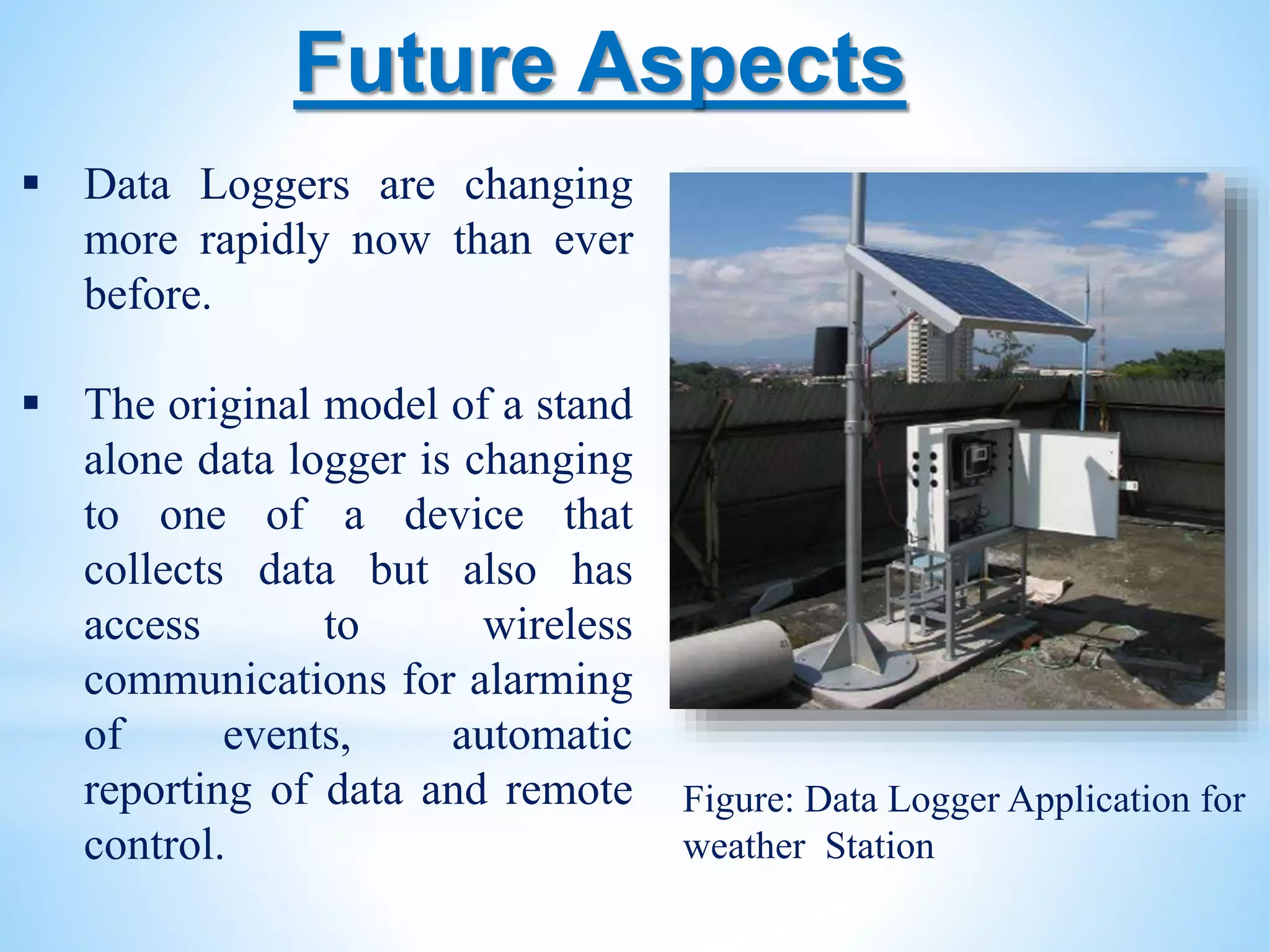
Stand Alone
 Stand alone hardware can
continuously measure and log data
without connection to a PC.
Data Logger Topologies
PC Based
 Operation requires full time
connection to a PC over any
appropriate bus technology.
Current Scenario
 Nowadays, it is required to control the temperature,
pressure, humidity, displacement, etc. in a plant, hence
demand of data logger is increasing rapidly since it finds a
wide application in industries.
 The cost of data loggers has been declining over the years
as technology improves and costs are reduced.
 Simple single channel data loggers cost as little as $25.
More complicated loggers may costs hundreds or
thousands of dollars.
Future Aspects
 Data Loggers are changing
more rapidly now than ever
before.
 The original model of a stand
alone data logger is changing
to one of a device that
collects data but also has
access to wireless
communications for alarming
of events, automatic
reporting of data and remote
control.
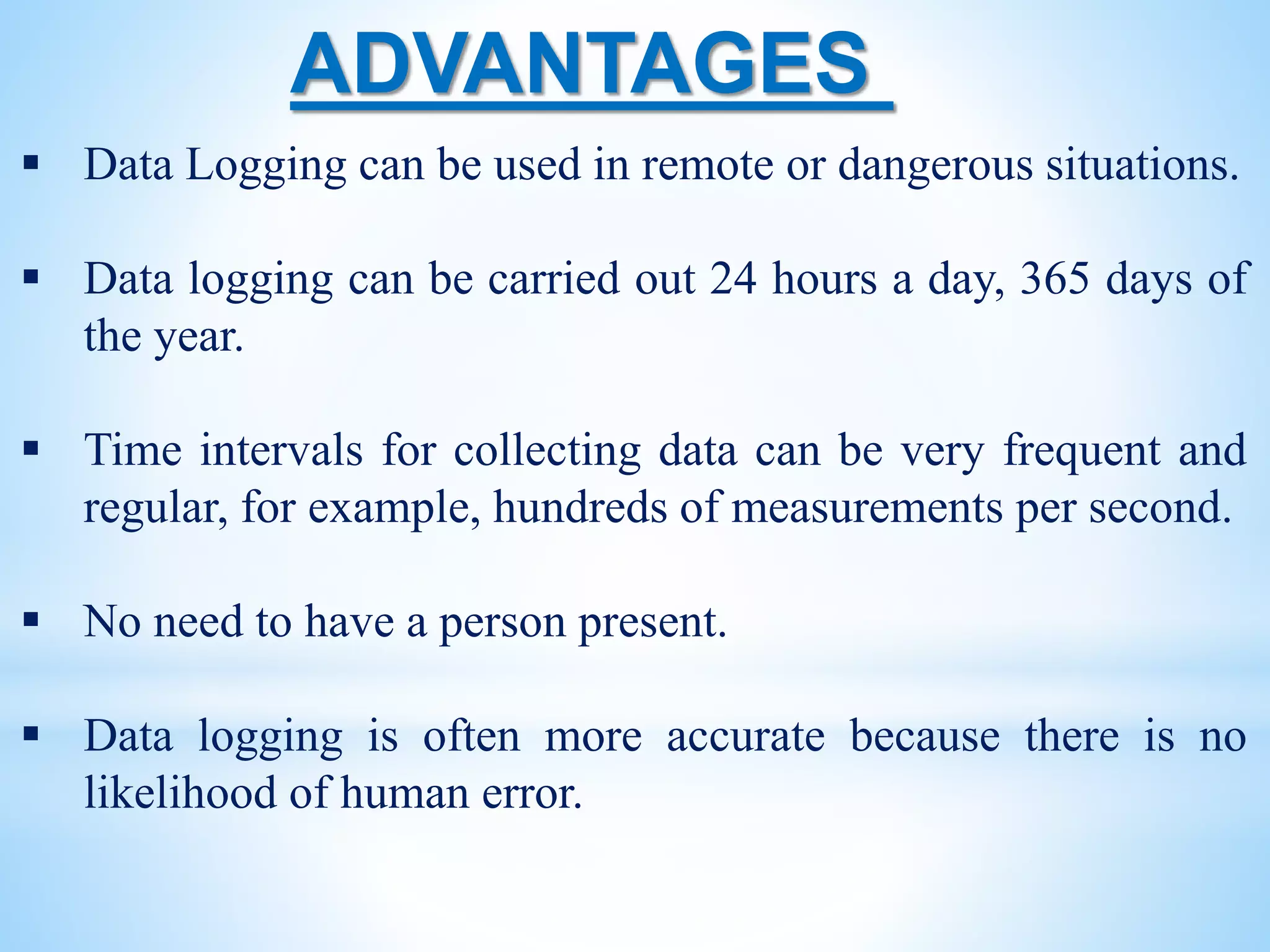
Figure: Data Logger Application for
weather Station
ADVANTAGES
 Data Logging can be used in remote or dangerous situations.
 Data logging can be carried out 24 hours a day, 365 days of
the year.
 Time intervals for collecting data can be very frequent and
regular, for example, hundreds of measurements per second.
 No need to have a person present.
 Data logging is often more accurate because there is no
likelihood of human error.
DISADVANTAGES
 If the data logging equipment breaks down or malfunctions,
some data could be lost or not recorded.
 Equipment can be expensive for small tasks.
 The equipment will only take readings at the logging
interval which has been set up. If something unexpected
happens between recordings, the data will not be collected.
 Data loggers typically have slower sample rates than Data
Acquisition System.
APPLICATIONS
They can be used in the following applications such as:
 In unattended recording at weather stations to record parameters
like temperature, wind speed / direction, solar radiation and
relative humidity.
 For hydrographic recording of water flow, water pH, water
conductivity, water level and water depth.
 In the recording of soil moisture levels.
 To record gas pressure and to monitor tank levels.
 Vehicle Testing (including crash testing)
CONCLUSION
 They are designed to operate continuously without interruption
even in the worst industrial environments.
 It is a portable measurement instrument, has a wide application
in industries.
 The digital data can be retrieved, viewed and evaluated after it
has been recorded.
 Data loggers can be taken to diverse locations include:
mountains, deserts, jungles, mines, etc.
 The specified accuracy is maintained throughout the period of
use.
THANK YOU !!!
Any Query??

Data logger

  • 1.
  • 2.
     The term‘Data Logging' refers to collecting or gathering data over a period of time.  A data logger is a device that can be used to store and retrieve the data.  Data loggers capture, measure, and analyze physical phenomena from the real world.  Light, temperature and pressure are examples of the different types of signals that a Data logger can measure.  A data logger is often a hand-held battery operated device which has a large amount of memory. INTRODUCTION
  • 3.
    How Data isCollected?  The objective of this work is to use data logging for temperature measurement. In order to meet the above requirements, a low cost, portable data logger is designed  A microcontroller based data logger has been developed for measuring temperature at different input channels of ADC  Sensors are used to take readings or measurements at regular intervals of their environment.  The sensors may be either analogue or digital. If they take analogue readings, an Analogue to Digital Converter will be needed to convert the signal into digital data which the computer can understand.
  • 4.
     As thesensor takes a reading, the data is sent though a cable or wireless link to the data logger.  The device is designed to receive data from sensors and to store the results on external non-volatile flash memory for post process analysis.  An integrated Liquid crystal display (LCD) is also used for real time display of data acquired from various sensors.  The sensors can be collected data on a wide range of things such as temperature, humidity, pressure, wind speed, water currents, electrical voltage, pH readings etc. CONTINUED
  • 5.
    • Dr. SaulGreenburg has described the concept of logging and how logging is done is in detail, Logging is a process to record events with the use of data loggers during a test or field use of a system or a product • Andrew Thompson, John L. Bahr and Neil Thomson have described low cost, very low power consumption, self- contained; digital data logger capable of independent operation for long periods of time has been developed. • Peter Roberson has reviewed the use of data loggers. • H S kalsi has defined a data logger is a comprehensive and highly advanced data acquisition system. LITERATURE REVIEW
  • 6.
  • 7.
    Building blocks ofa data logger  Transducer or Sensors: A device that converts a physical phenomenon such as light, temperature, pressure, or sound into a measurable electrical signal such as voltage or current.  Analog to Digital Converter: The data logger senses only digital signals and hence analog signals, it may converted to digital signal.  Microcontroller & Storage: Microcontroller is used to convert digital signals into binary form, storage used to store the converted digital signal.  Display: Some data loggers interface with a personal computer and utilize software to activate the data logger and view and analyze the collected data, while others have a local interface device (keypad, LCD) and can be used as a stand-alone device.
  • 8.
    Implementation and SystemDesign  System Definition: Broad definition of system hardware including microcontroller and its interface with display, ADC, memory, keypad etc.  Circuit Design: Selection of 8051 microcontroller and other interfacing devices, as per system definition. Design of hardware circuit and its testing on laboratory kits with some simple microcontroller software routines.  PCB Design and Fabrication: Generation of schematic diagrams and the production of circuit board layout data for the procurement of the circuit board.  Software Design: Developing algorithm for the system, allocating memory blocks as per functionality, coding and testing.  Integration and Final Testing: Integrating the entire hardware and software modules and its final testing for data logging operation.
  • 9.
    Stand Alone  Standalone hardware can continuously measure and log data without connection to a PC. Data Logger Topologies PC Based  Operation requires full time connection to a PC over any appropriate bus technology.
  • 10.
    Current Scenario  Nowadays,it is required to control the temperature, pressure, humidity, displacement, etc. in a plant, hence demand of data logger is increasing rapidly since it finds a wide application in industries.  The cost of data loggers has been declining over the years as technology improves and costs are reduced.  Simple single channel data loggers cost as little as $25. More complicated loggers may costs hundreds or thousands of dollars.
  • 11.
    Future Aspects  DataLoggers are changing more rapidly now than ever before.  The original model of a stand alone data logger is changing to one of a device that collects data but also has access to wireless communications for alarming of events, automatic reporting of data and remote control. Figure: Data Logger Application for weather Station
  • 12.
    ADVANTAGES  Data Loggingcan be used in remote or dangerous situations.  Data logging can be carried out 24 hours a day, 365 days of the year.  Time intervals for collecting data can be very frequent and regular, for example, hundreds of measurements per second.  No need to have a person present.  Data logging is often more accurate because there is no likelihood of human error.
  • 13.
    DISADVANTAGES  If thedata logging equipment breaks down or malfunctions, some data could be lost or not recorded.  Equipment can be expensive for small tasks.  The equipment will only take readings at the logging interval which has been set up. If something unexpected happens between recordings, the data will not be collected.  Data loggers typically have slower sample rates than Data Acquisition System.
  • 14.
    APPLICATIONS They can beused in the following applications such as:  In unattended recording at weather stations to record parameters like temperature, wind speed / direction, solar radiation and relative humidity.  For hydrographic recording of water flow, water pH, water conductivity, water level and water depth.  In the recording of soil moisture levels.  To record gas pressure and to monitor tank levels.  Vehicle Testing (including crash testing)
  • 15.
    CONCLUSION  They aredesigned to operate continuously without interruption even in the worst industrial environments.  It is a portable measurement instrument, has a wide application in industries.  The digital data can be retrieved, viewed and evaluated after it has been recorded.  Data loggers can be taken to diverse locations include: mountains, deserts, jungles, mines, etc.  The specified accuracy is maintained throughout the period of use.
  • 16.
  • 17.