DIRECT INSTRUCTIONHIMANSU BHUSANA SAMARATHM.ED.SCHOOL OF EDUCATIONPONDICHERRY UNIVERSITY,PUDUCHERRY
MEANINGCommon teaching strategy, relying on strict lesson plans and lectures with little or no room for variation.
Does not include activities like discussion, recitation, seminars, workshops, case studies, or internships.
Teacher Directed definite structure with specific steps to guide pupils toward achieving clearly defined learning outcomes.Continued…….delivering large amounts of information in a timely manner
based on the learning theories of behaviourism and developmentalism. BASIC CHARACTERISTICSOF DI:Academic Focus  -  Content driven -
Whole Class  or Small group Delivery;.
Constant monitoring to Check for Understanding (CFU)
Controlled Classroom Practice
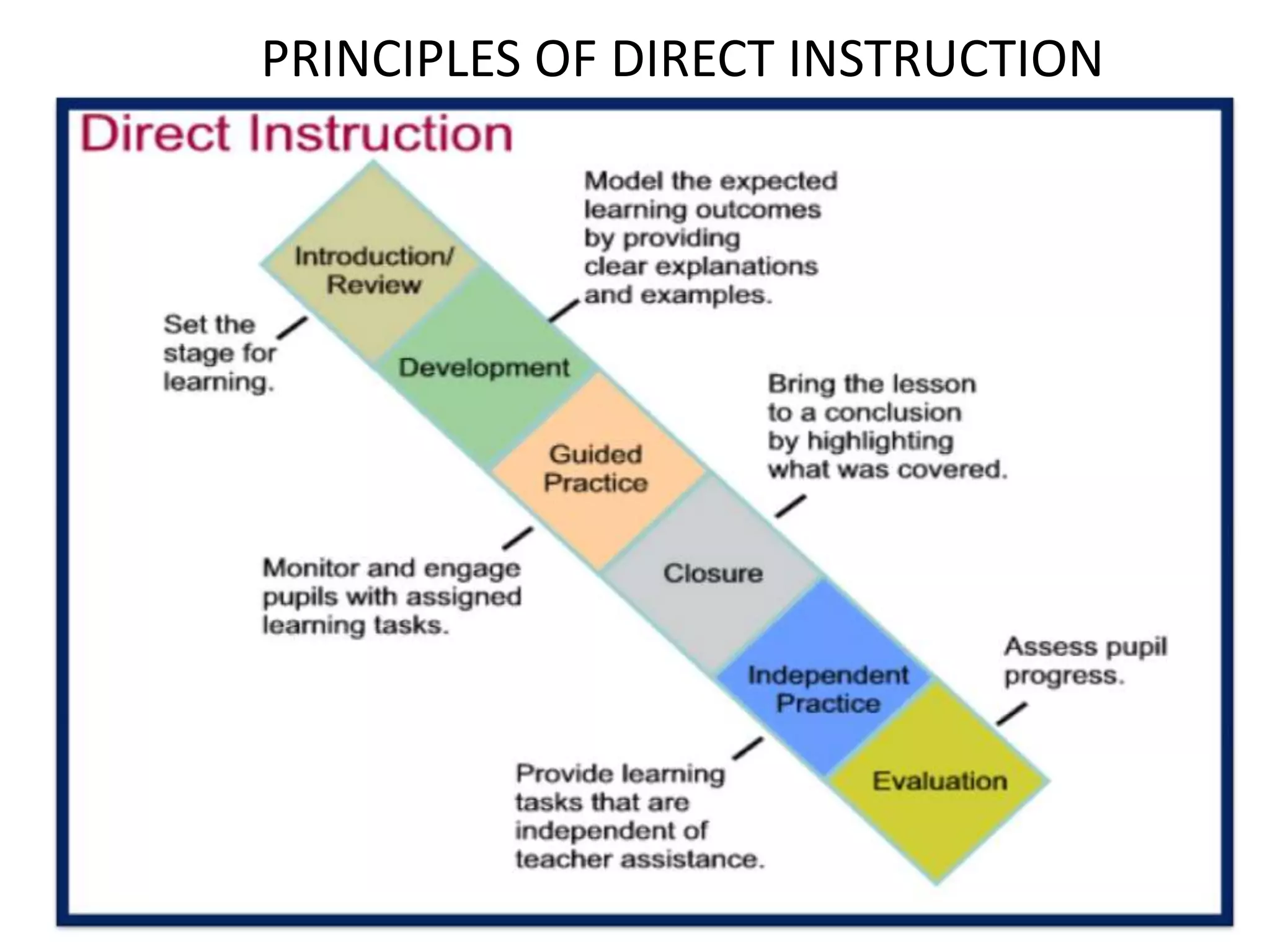
 Teacher-centered/ Transmission of Information one way – from Teacher to students.PRINCIPLES OF DIRECT INSTRUCTION
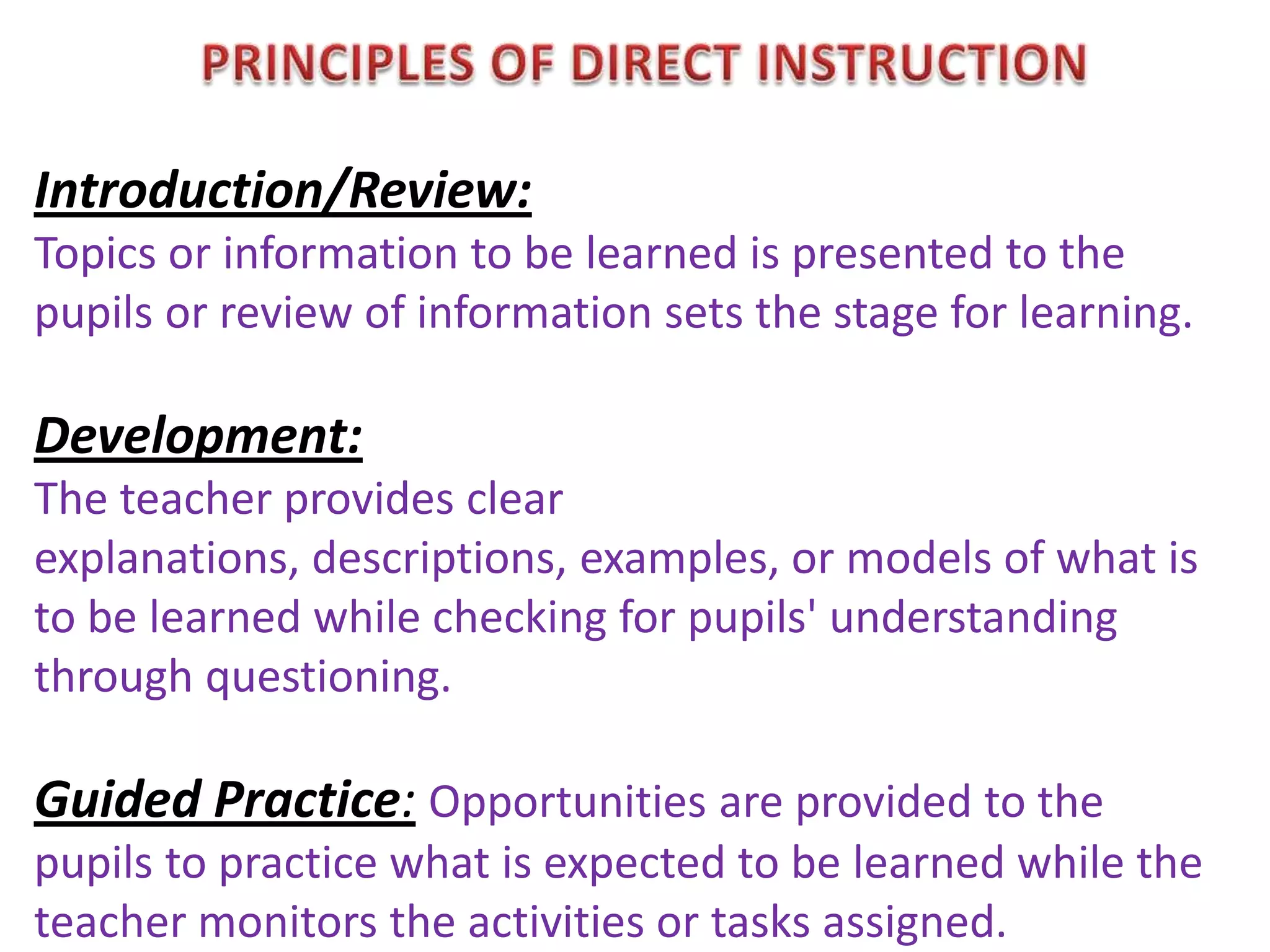
PRINCIPLES OF DIRECT INSTRUCTIONIntroduction/Review:Topics or information to be learned is presented to the pupils or review of information sets the stage for learning.Development:The teacher provides clear explanations, descriptions, examples, or models of what is to be learned while checking for pupils' understanding through questioning.Guided Practice:Opportunities are provided to the pupils to practice what is expected to be learned while the teacher monitors the activities or tasks assigned.
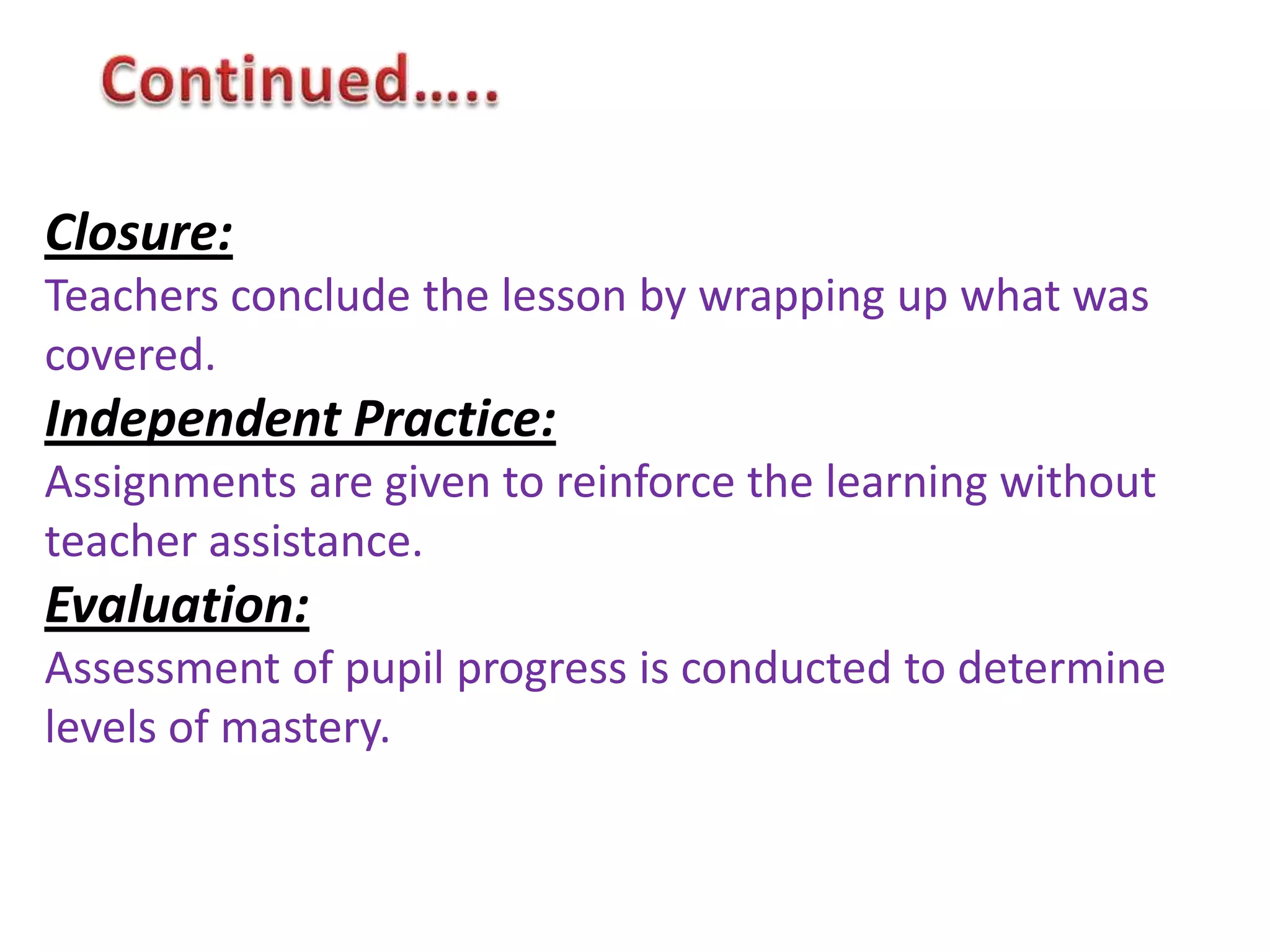
Continued…..Closure:Teachers conclude the lesson by wrapping up what was covered.Independent Practice:Assignments are given to reinforce the learning without teacher assistance.Evaluation:Assessment of pupil progress is conducted to determine levels of mastery.
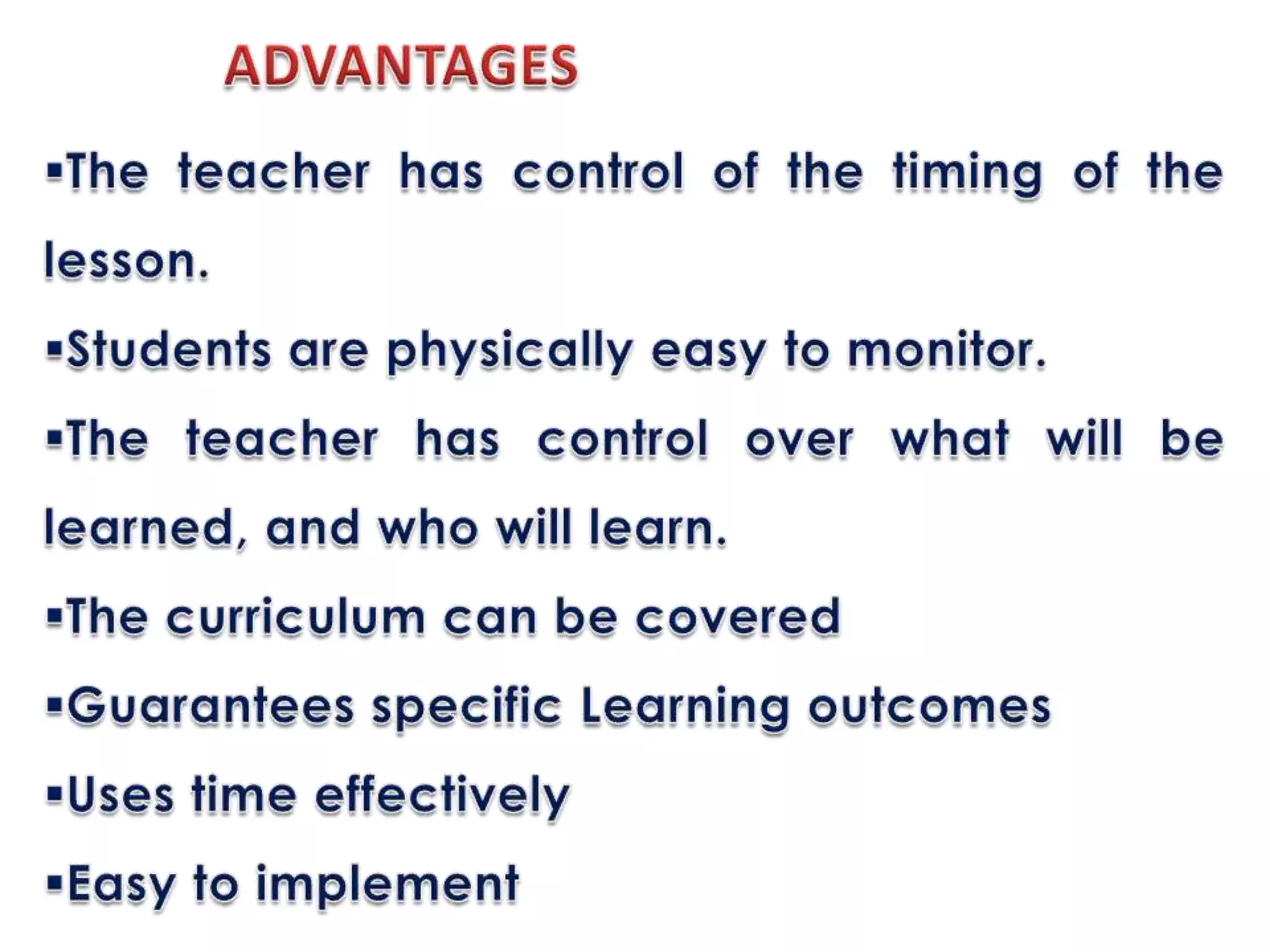
ADVANTAGESThe teacher has control of the timing of the lesson.

Direct instruction

  • 1.
    DIRECT INSTRUCTIONHIMANSU BHUSANASAMARATHM.ED.SCHOOL OF EDUCATIONPONDICHERRY UNIVERSITY,PUDUCHERRY
  • 2.
    MEANINGCommon teaching strategy,relying on strict lesson plans and lectures with little or no room for variation.
  • 3.
    Does not includeactivities like discussion, recitation, seminars, workshops, case studies, or internships.
  • 4.
    Teacher Directed definitestructure with specific steps to guide pupils toward achieving clearly defined learning outcomes.Continued…….delivering large amounts of information in a timely manner
  • 5.
    based on thelearning theories of behaviourism and developmentalism. BASIC CHARACTERISTICSOF DI:Academic Focus - Content driven -
  • 6.
    Whole Class or Small group Delivery;.
  • 7.
    Constant monitoring toCheck for Understanding (CFU)
  • 8.
  • 9.
    Teacher-centered/ Transmissionof Information one way – from Teacher to students.PRINCIPLES OF DIRECT INSTRUCTION
  • 10.
    PRINCIPLES OF DIRECTINSTRUCTIONIntroduction/Review:Topics or information to be learned is presented to the pupils or review of information sets the stage for learning.Development:The teacher provides clear explanations, descriptions, examples, or models of what is to be learned while checking for pupils' understanding through questioning.Guided Practice:Opportunities are provided to the pupils to practice what is expected to be learned while the teacher monitors the activities or tasks assigned.
  • 11.
    Continued…..Closure:Teachers conclude thelesson by wrapping up what was covered.Independent Practice:Assignments are given to reinforce the learning without teacher assistance.Evaluation:Assessment of pupil progress is conducted to determine levels of mastery.
  • 12.
    ADVANTAGESThe teacher hascontrol of the timing of the lesson.
  • 13.
    Students are physicallyeasy to monitor.
  • 14.
    The teacher hascontrol over what will be learned, and who will learn.
  • 15.
  • 16.
  • 17.
  • 18.
    Easy to implementDISADVANTAGESItis based on old learning theories
  • 19.
    Students do nothave a sense of the overall purpose of the simple steps.
  • 20.
    Teachers cannot assesswhat the students’ prior knowledge is.
  • 21.
    Retention of howto solve the problems is low, because the students have not struggled with the problem themselves.DISADVANTAGES continued Low Transfer rate
  • 22.
  • 23.
  • 24.
  • 25.
    Direct instruction asan instructional method works for only a small per- centage of students, not for a great variety. HOW TO USE DIRECT INSTRUCTION WELL ?Choose a concept for which direct instruction is appropriate.
  • 26.
    The students mustknow what is coming. Give them an advance organizer ­ what they will be learning, in what order, and how much time each aspect will take.
  • 27.
    Speak clearly, witha varied tone and speed. If you do not have a really interesting voice, use as little direct instruction as possible, or have speeches written out for your students, or use supplementary materials such as videos, etc. Continued…..Enhance what you are saying with visuals. Overheads or power point relieve the monotony of one person’s voice. Also, not all students are auditory learners.
  • 28.
    Vary your lessonsby not always speaking, but bring in activities, and other audio-visuals.