RATIONAL ROOT
THEOREM
Unit 6: Polynomials
Finding All Factors
Recap
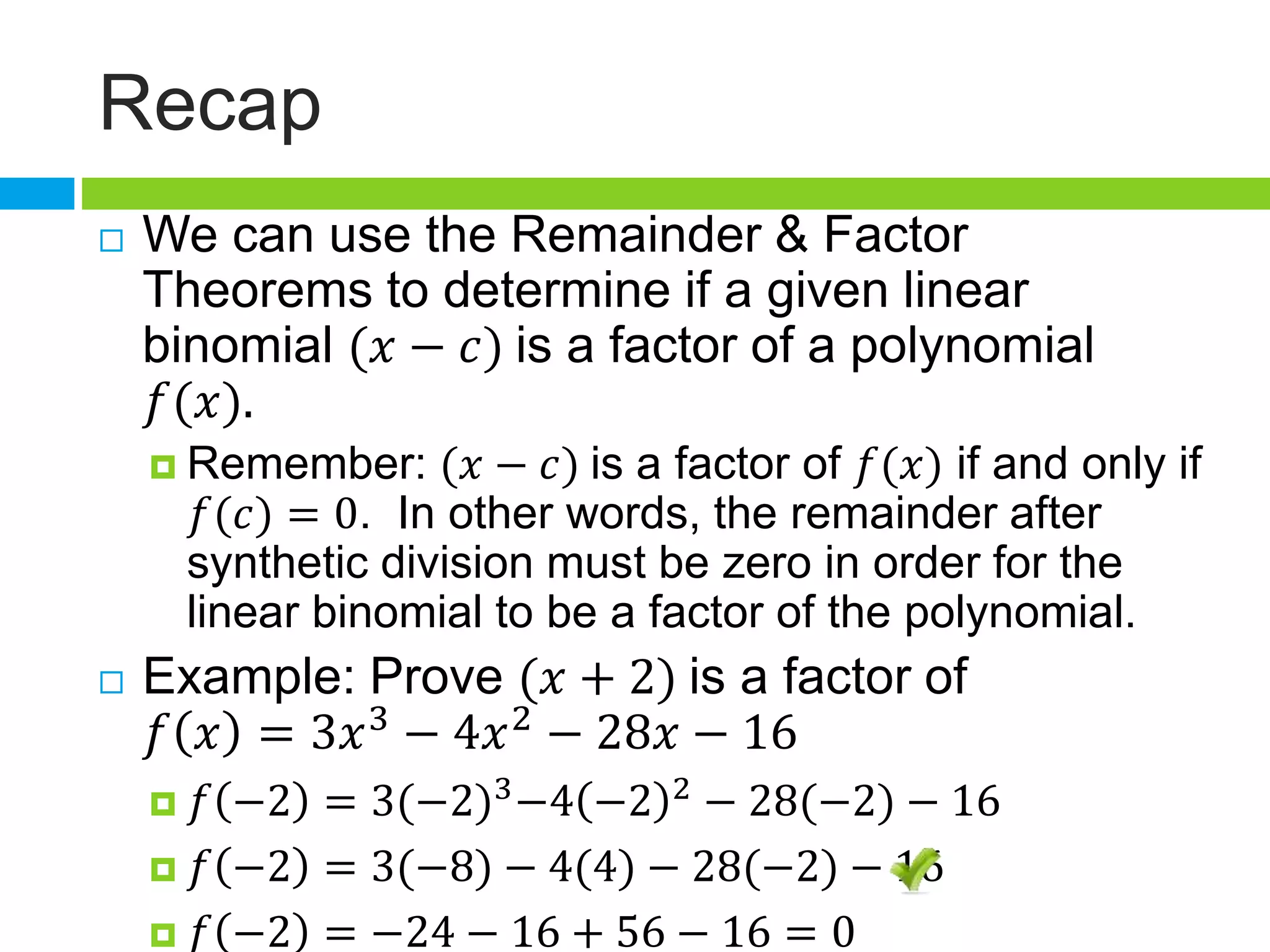
 We can use the Remainder & Factor
Theorems to determine if a given linear
binomial (𝑥 − 𝑐) is a factor of a polynomial
𝑓(𝑥).
 Remember: (𝑥 − 𝑐) is a factor of 𝑓(𝑥) if and only if
𝑓(𝑐) = 0. In other words, the remainder after
synthetic division must be zero in order for the
linear binomial to be a factor of the polynomial.
 Example: Prove (𝑥 + 2) is a factor of
𝑓 𝑥 = 3𝑥3
− 4𝑥2
− 28𝑥 − 16
 𝑓 −2 = 3(−2)3
−4 −2 2
− 28(−2) − 16
 𝑓 −2 = 3(−8) − 4(4) − 28(−2) − 16
 𝑓 −2 = −24 − 16 + 56 − 16 = 0
How do we find the other
factors?
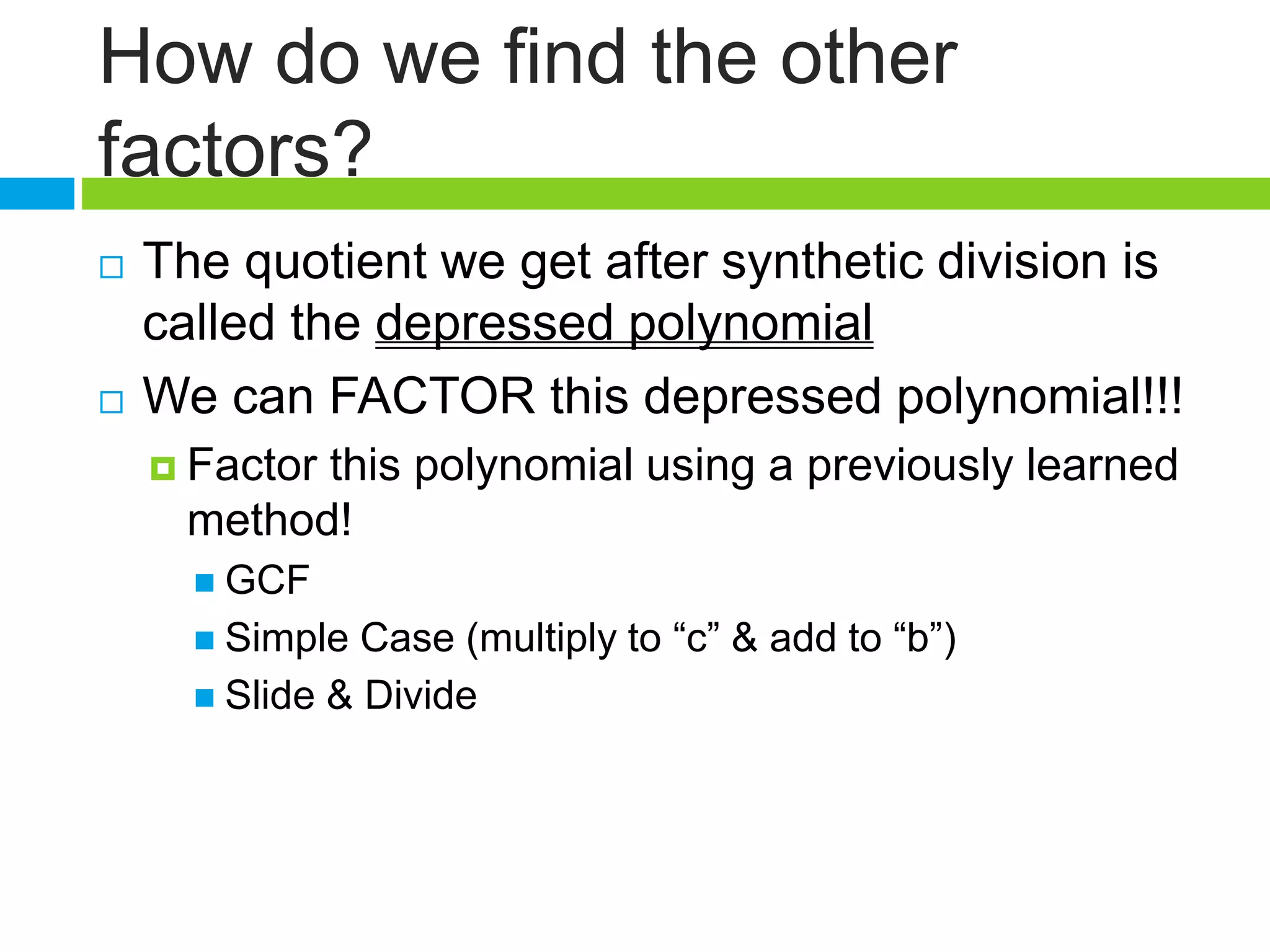
 The quotient we get after synthetic division is
called the depressed polynomial
 We can FACTOR this depressed polynomial!!!
 Factor this polynomial using a previously learned
method!
 GCF
 Simple Case (multiply to “c” & add to “b”)
 Slide & Divide
Example
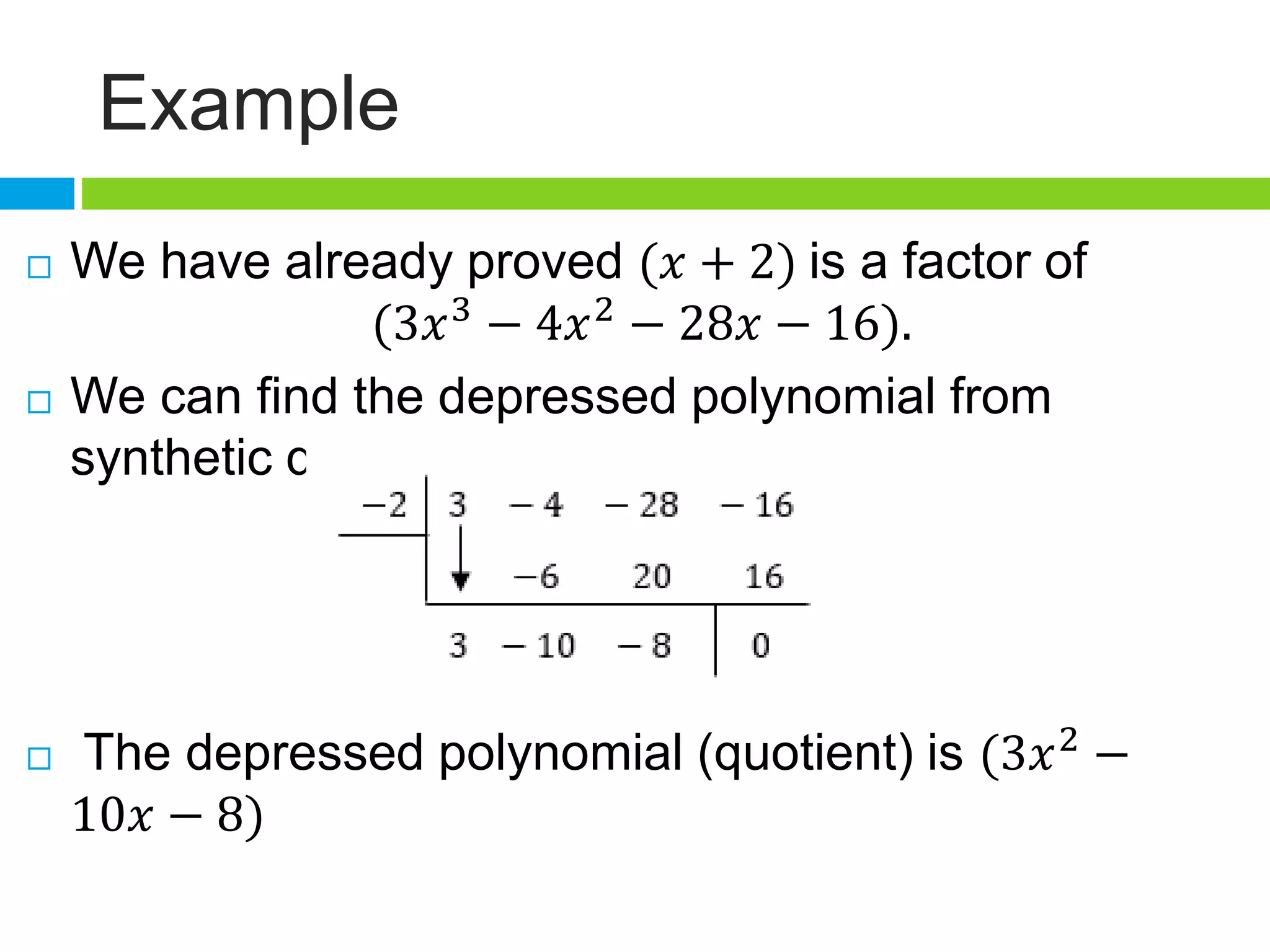
 We have already proved (𝑥 + 2) is a factor of
(3𝑥3
− 4𝑥2
− 28𝑥 − 16).
 We can find the depressed polynomial from
synthetic division.
 The depressed polynomial (quotient) is (3𝑥2
−
10𝑥 − 8)
Example (Cont.)
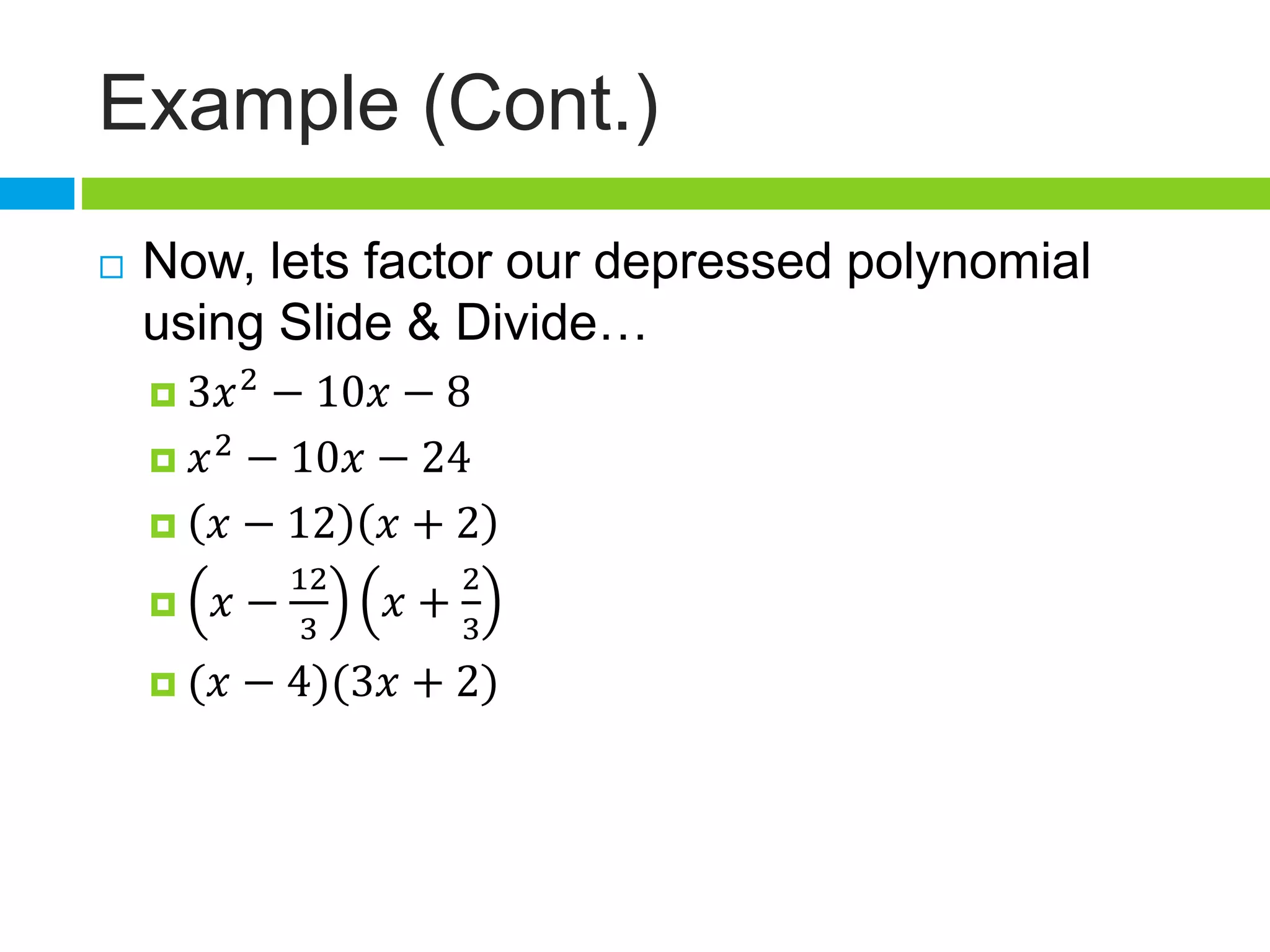
 Now, lets factor our depressed polynomial
using Slide & Divide…
 3𝑥2
− 10𝑥 − 8
 𝑥2
− 10𝑥 − 24
 𝑥 − 12 𝑥 + 2
 𝑥 −
12
3
𝑥 +
2
3
 (𝑥 − 4)(3𝑥 + 2)
Example (Cont.)
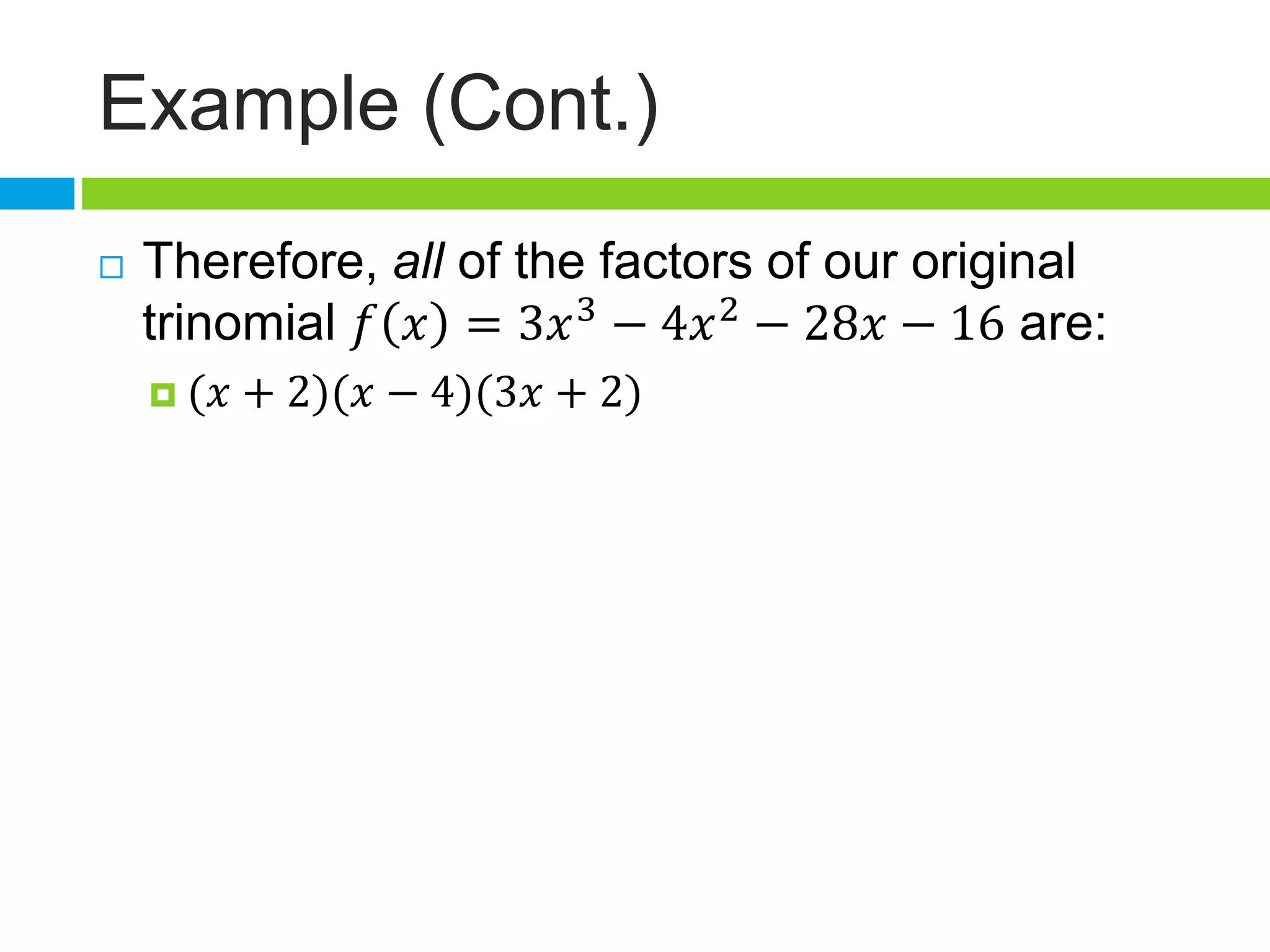
 Therefore, all of the factors of our original
trinomial 𝑓 𝑥 = 3𝑥3
− 4𝑥2
− 28𝑥 − 16 are:
 (𝑥 + 2)(𝑥 − 4)(3𝑥 + 2)
Try #’s 1-4 from your worksheet on your
own!
PRACTICE
What happens when you must factor a
polynomial of degree ≥ 3 and you do not
know any factors?!
Rational Root Theorem
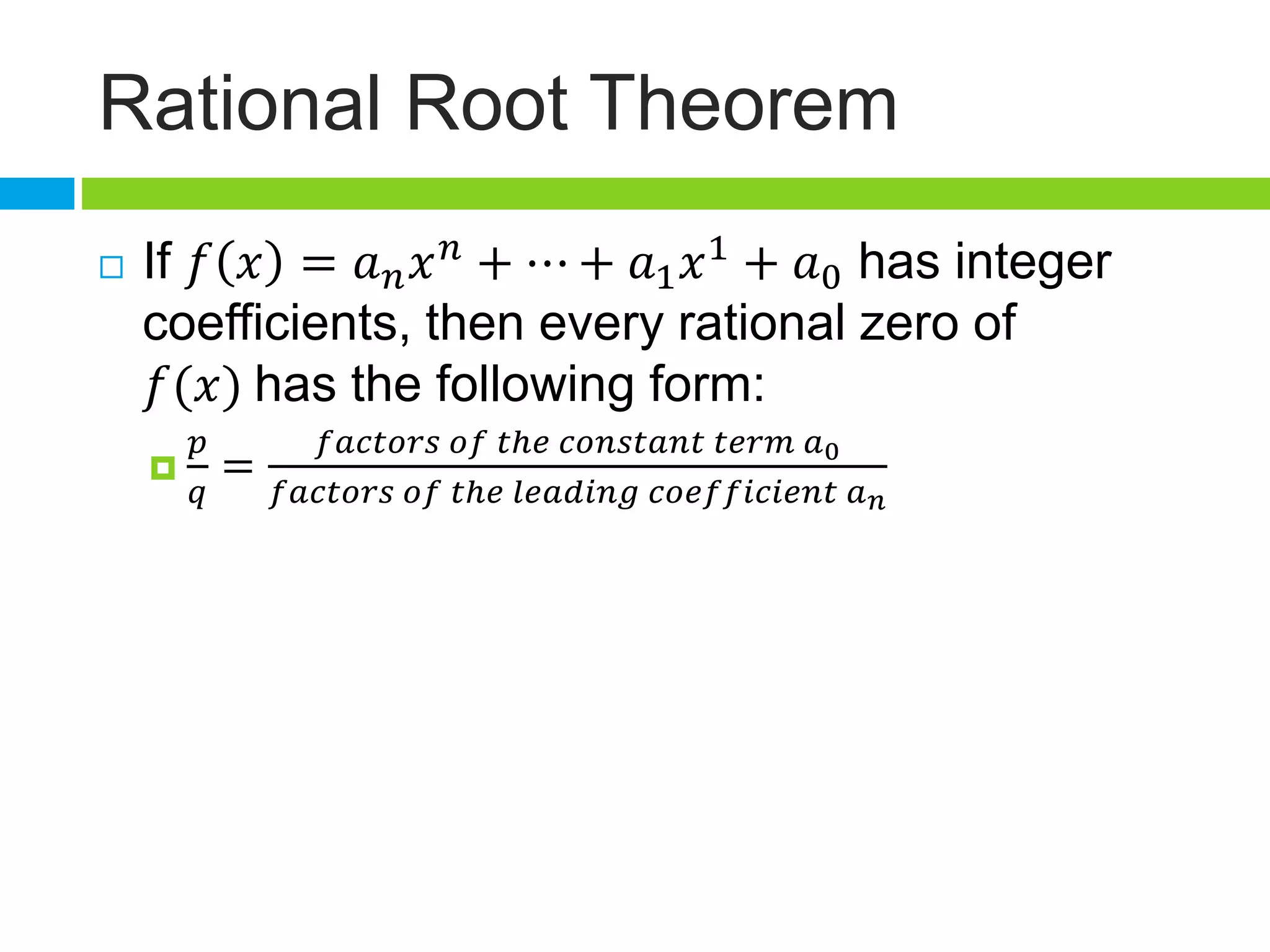
 If 𝑓 𝑥 = 𝑎 𝑛 𝑥 𝑛
+ ⋯ + 𝑎1 𝑥1
+ 𝑎0 has integer
coefficients, then every rational zero of
𝑓(𝑥) has the following form:

𝑝
𝑞
=
𝑓𝑎𝑐𝑡𝑜𝑟𝑠 𝑜𝑓 𝑡ℎ𝑒 𝑐𝑜𝑛𝑠𝑡𝑎𝑛𝑡 𝑡𝑒𝑟𝑚 𝑎0
𝑓𝑎𝑐𝑡𝑜𝑟𝑠 𝑜𝑓 𝑡ℎ𝑒 𝑙𝑒𝑎𝑑𝑖𝑛𝑔 𝑐𝑜𝑒𝑓𝑓𝑖𝑐𝑖𝑒𝑛𝑡 𝑎 𝑛
Example
 Find all possible rational roots of 𝑓(𝑥) using
the Rational Root Theorem
 𝑓(𝑥) = 4𝑥4
− 𝑥3
− 3𝑥2
+ 9𝑥 − 10
 Factors of the constant term: ±1, ±2, ±5, ±10
 Factors of the leading coefficient: ±1, ±2, ±4
 Possible rational zeros:
±
1
1
, ±
2
1
, ±
5
1
, ±
10
1
, ±
1
2
, ±
2
2
, ±
5
2
, ±
10
2
, ±
1
4
, ±
2
4
, ±
5
4
, ±
10
4
 Simplified list: ±1, ±2, ±5, ±10, ±
1
2
, ±
5
2
, ±
1
4
, ±
5
4
Try #’s 5-8 from your worksheet on your
own!
PRACTICE
Example 1
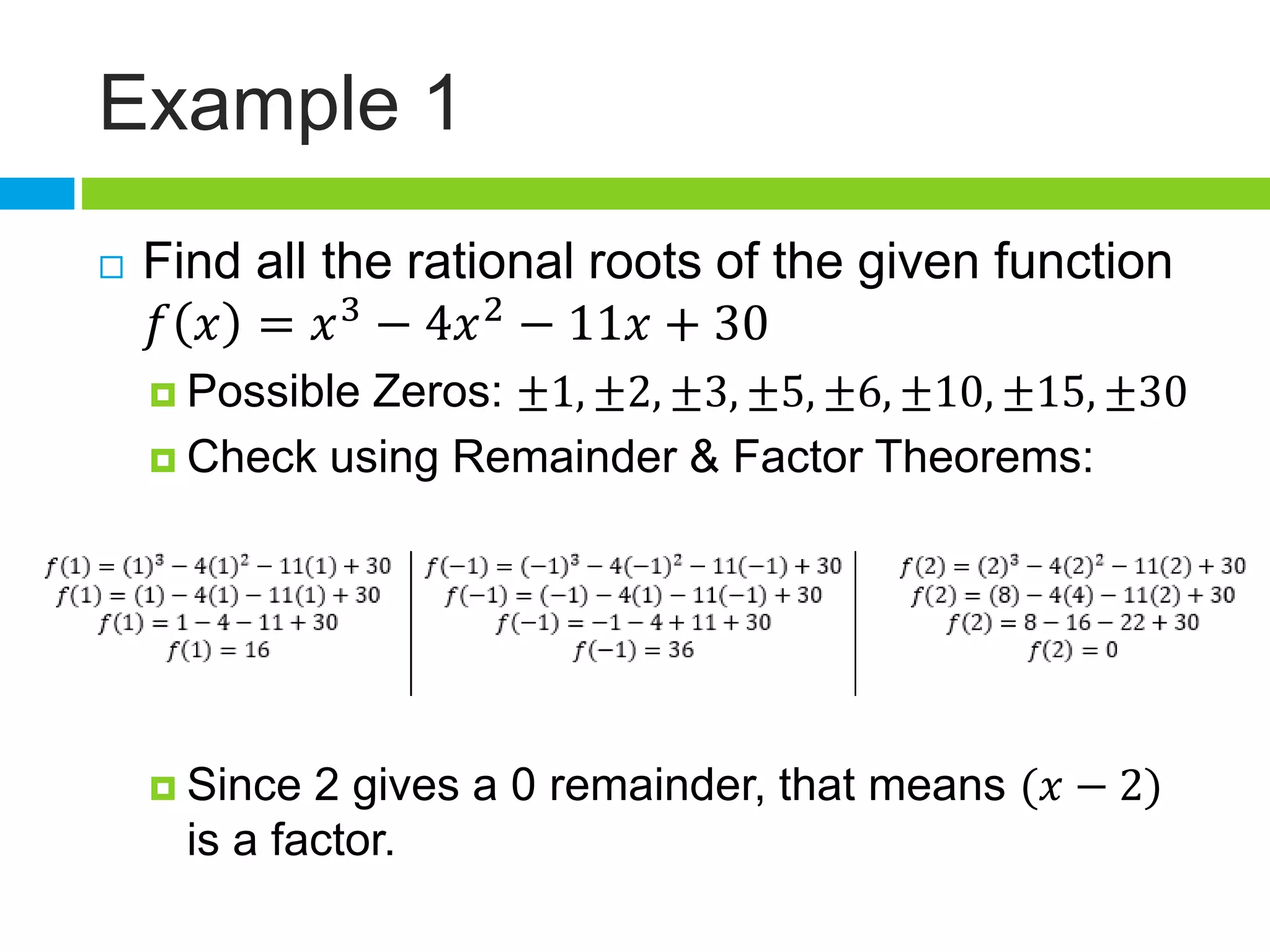
 Find all the rational roots of the given function
𝑓 𝑥 = 𝑥3
− 4𝑥2
− 11𝑥 + 30
 Possible Zeros: ±1, ±2, ±3, ±5, ±6, ±10, ±15, ±30
 Check using Remainder & Factor Theorems:
 Since 2 gives a 0 remainder, that means (𝑥 − 2)
is a factor.
Example 1 (Cont.)
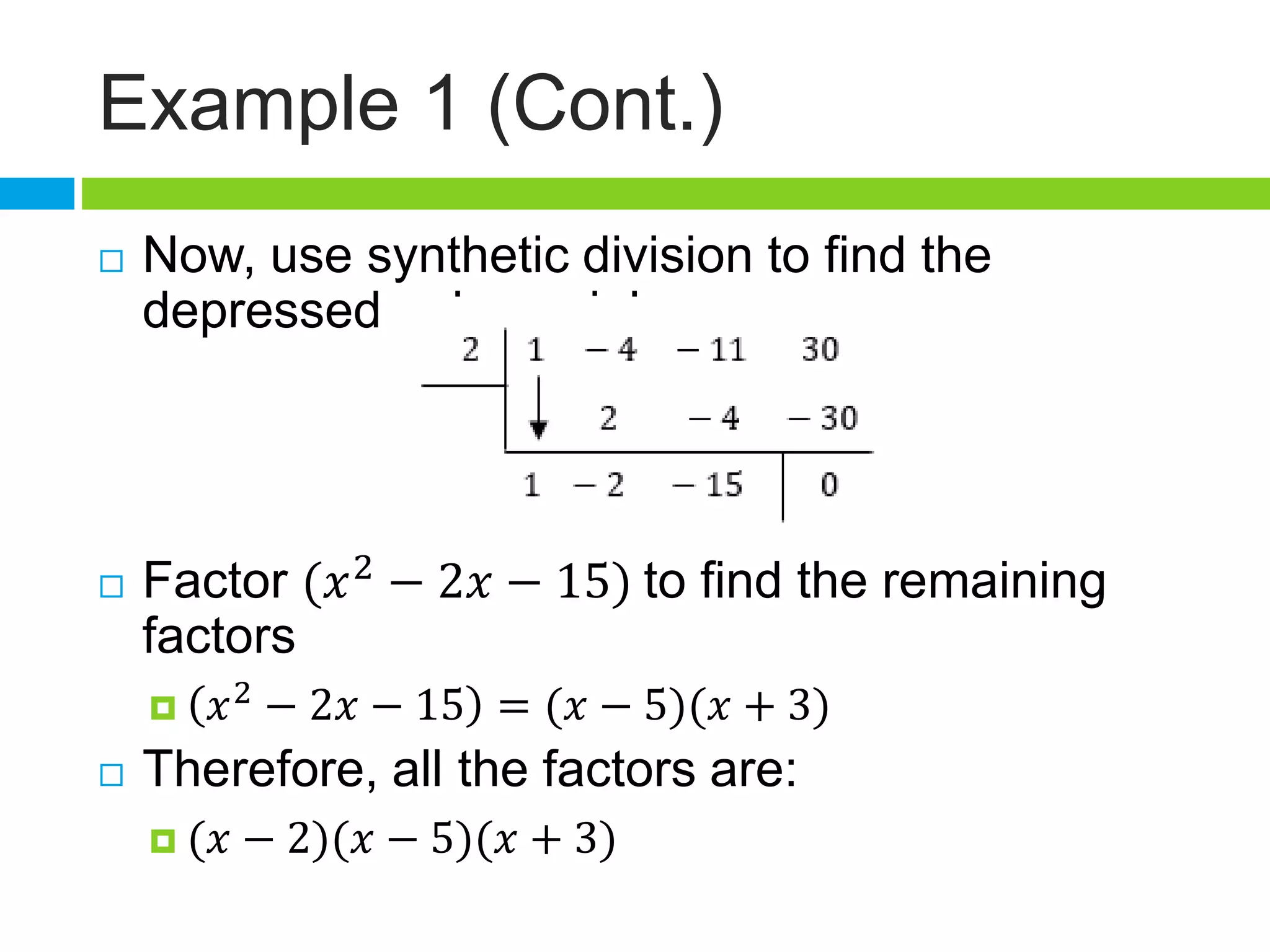
 Now, use synthetic division to find the
depressed polynomial
 Factor (𝑥2
− 2𝑥 − 15) to find the remaining
factors
 𝑥2 − 2𝑥 − 15 = (𝑥 − 5)(𝑥 + 3)
 Therefore, all the factors are:
 (𝑥 − 2)(𝑥 − 5)(𝑥 + 3)
Example 2
 Find all the rational roots of the given function
𝑓 𝑥 = 2𝑥4
− 5𝑥3
− 28𝑥2
+ 15𝑥
 Notice that this polynomial has a GCF of x!
 Factor out the GCF: 𝑓 𝑥 = 𝑥(2𝑥3 − 5𝑥2 − 28𝑥 +
15)
 Possible Zeros: ±1, ±3, ±5, ±15, ±
1
2
, ±
3
2
, ±
5
2
, ±
15
2
 Check using Remainder & Factor Theorems:
Example 2 (Cont.)
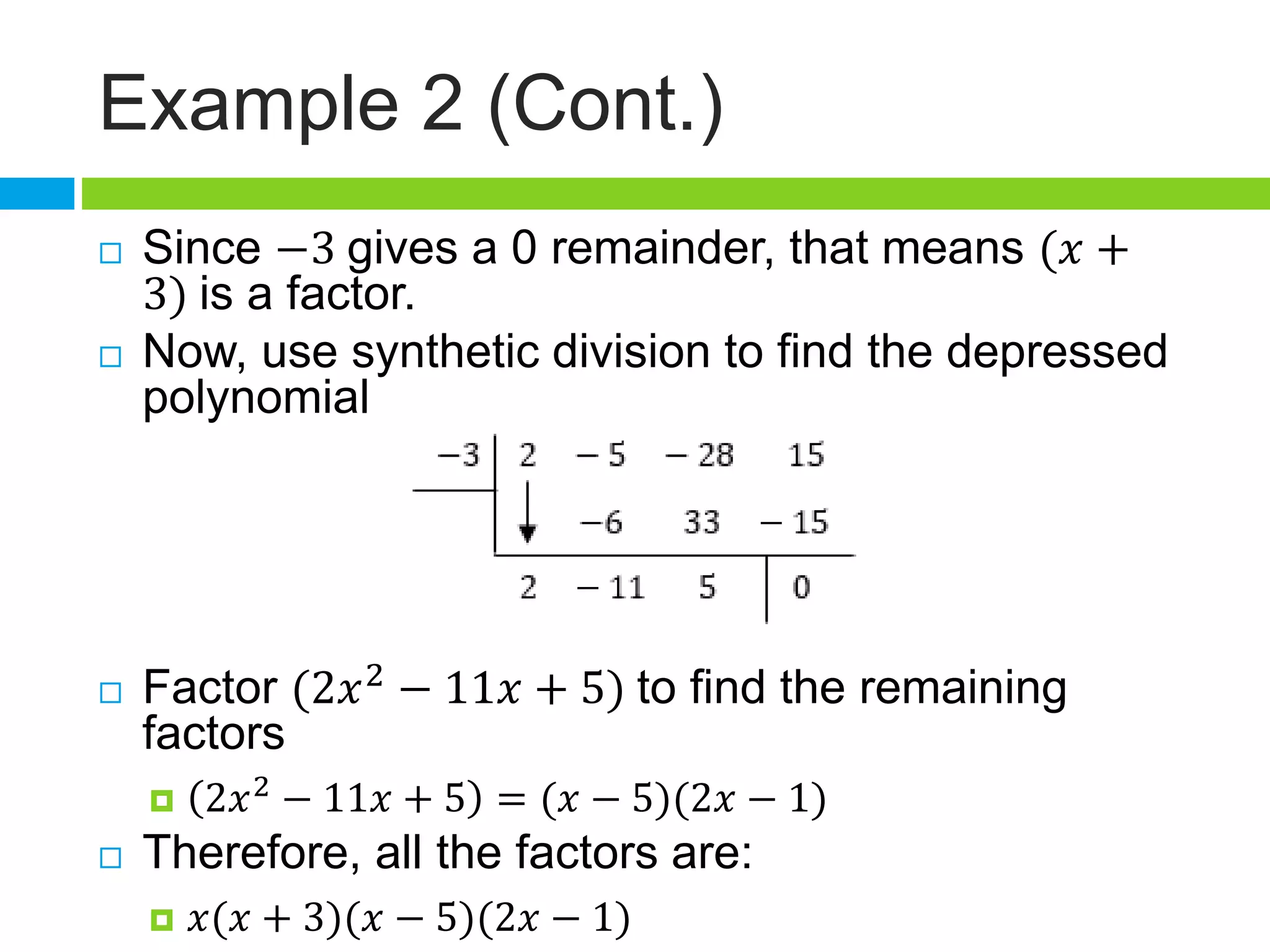
 Since −3 gives a 0 remainder, that means (𝑥 +
3) is a factor.
 Now, use synthetic division to find the depressed
polynomial
 Factor (2𝑥2
− 11𝑥 + 5) to find the remaining
factors
 2𝑥2 − 11𝑥 + 5 = (𝑥 − 5)(2𝑥 − 1)
 Therefore, all the factors are:
 𝑥(𝑥 + 3)(𝑥 − 5)(2𝑥 − 1)
Try #’s 9-10 from your worksheet on your
own!
PRACTICE

Rational Root Theorem

  • 1.
  • 2.
  • 3.
    Recap  We canuse the Remainder & Factor Theorems to determine if a given linear binomial (𝑥 − 𝑐) is a factor of a polynomial 𝑓(𝑥).  Remember: (𝑥 − 𝑐) is a factor of 𝑓(𝑥) if and only if 𝑓(𝑐) = 0. In other words, the remainder after synthetic division must be zero in order for the linear binomial to be a factor of the polynomial.  Example: Prove (𝑥 + 2) is a factor of 𝑓 𝑥 = 3𝑥3 − 4𝑥2 − 28𝑥 − 16  𝑓 −2 = 3(−2)3 −4 −2 2 − 28(−2) − 16  𝑓 −2 = 3(−8) − 4(4) − 28(−2) − 16  𝑓 −2 = −24 − 16 + 56 − 16 = 0
  • 4.
    How do wefind the other factors?  The quotient we get after synthetic division is called the depressed polynomial  We can FACTOR this depressed polynomial!!!  Factor this polynomial using a previously learned method!  GCF  Simple Case (multiply to “c” & add to “b”)  Slide & Divide
  • 5.
    Example  We havealready proved (𝑥 + 2) is a factor of (3𝑥3 − 4𝑥2 − 28𝑥 − 16).  We can find the depressed polynomial from synthetic division.  The depressed polynomial (quotient) is (3𝑥2 − 10𝑥 − 8)
  • 6.
    Example (Cont.)  Now,lets factor our depressed polynomial using Slide & Divide…  3𝑥2 − 10𝑥 − 8  𝑥2 − 10𝑥 − 24  𝑥 − 12 𝑥 + 2  𝑥 − 12 3 𝑥 + 2 3  (𝑥 − 4)(3𝑥 + 2)
  • 7.
    Example (Cont.)  Therefore,all of the factors of our original trinomial 𝑓 𝑥 = 3𝑥3 − 4𝑥2 − 28𝑥 − 16 are:  (𝑥 + 2)(𝑥 − 4)(3𝑥 + 2)
  • 8.
    Try #’s 1-4from your worksheet on your own! PRACTICE
  • 9.
    What happens whenyou must factor a polynomial of degree ≥ 3 and you do not know any factors?! Rational Root Theorem
  • 10.
    Rational Root Theorem If 𝑓 𝑥 = 𝑎 𝑛 𝑥 𝑛 + ⋯ + 𝑎1 𝑥1 + 𝑎0 has integer coefficients, then every rational zero of 𝑓(𝑥) has the following form:  𝑝 𝑞 = 𝑓𝑎𝑐𝑡𝑜𝑟𝑠 𝑜𝑓 𝑡ℎ𝑒 𝑐𝑜𝑛𝑠𝑡𝑎𝑛𝑡 𝑡𝑒𝑟𝑚 𝑎0 𝑓𝑎𝑐𝑡𝑜𝑟𝑠 𝑜𝑓 𝑡ℎ𝑒 𝑙𝑒𝑎𝑑𝑖𝑛𝑔 𝑐𝑜𝑒𝑓𝑓𝑖𝑐𝑖𝑒𝑛𝑡 𝑎 𝑛
  • 11.
    Example  Find allpossible rational roots of 𝑓(𝑥) using the Rational Root Theorem  𝑓(𝑥) = 4𝑥4 − 𝑥3 − 3𝑥2 + 9𝑥 − 10  Factors of the constant term: ±1, ±2, ±5, ±10  Factors of the leading coefficient: ±1, ±2, ±4  Possible rational zeros: ± 1 1 , ± 2 1 , ± 5 1 , ± 10 1 , ± 1 2 , ± 2 2 , ± 5 2 , ± 10 2 , ± 1 4 , ± 2 4 , ± 5 4 , ± 10 4  Simplified list: ±1, ±2, ±5, ±10, ± 1 2 , ± 5 2 , ± 1 4 , ± 5 4
  • 12.
    Try #’s 5-8from your worksheet on your own! PRACTICE
  • 13.
    Example 1  Findall the rational roots of the given function 𝑓 𝑥 = 𝑥3 − 4𝑥2 − 11𝑥 + 30  Possible Zeros: ±1, ±2, ±3, ±5, ±6, ±10, ±15, ±30  Check using Remainder & Factor Theorems:  Since 2 gives a 0 remainder, that means (𝑥 − 2) is a factor.
  • 14.
    Example 1 (Cont.) Now, use synthetic division to find the depressed polynomial  Factor (𝑥2 − 2𝑥 − 15) to find the remaining factors  𝑥2 − 2𝑥 − 15 = (𝑥 − 5)(𝑥 + 3)  Therefore, all the factors are:  (𝑥 − 2)(𝑥 − 5)(𝑥 + 3)
  • 15.
    Example 2  Findall the rational roots of the given function 𝑓 𝑥 = 2𝑥4 − 5𝑥3 − 28𝑥2 + 15𝑥  Notice that this polynomial has a GCF of x!  Factor out the GCF: 𝑓 𝑥 = 𝑥(2𝑥3 − 5𝑥2 − 28𝑥 + 15)  Possible Zeros: ±1, ±3, ±5, ±15, ± 1 2 , ± 3 2 , ± 5 2 , ± 15 2  Check using Remainder & Factor Theorems:
  • 16.
    Example 2 (Cont.) Since −3 gives a 0 remainder, that means (𝑥 + 3) is a factor.  Now, use synthetic division to find the depressed polynomial  Factor (2𝑥2 − 11𝑥 + 5) to find the remaining factors  2𝑥2 − 11𝑥 + 5 = (𝑥 − 5)(2𝑥 − 1)  Therefore, all the factors are:  𝑥(𝑥 + 3)(𝑥 − 5)(2𝑥 − 1)
  • 17.
    Try #’s 9-10from your worksheet on your own! PRACTICE