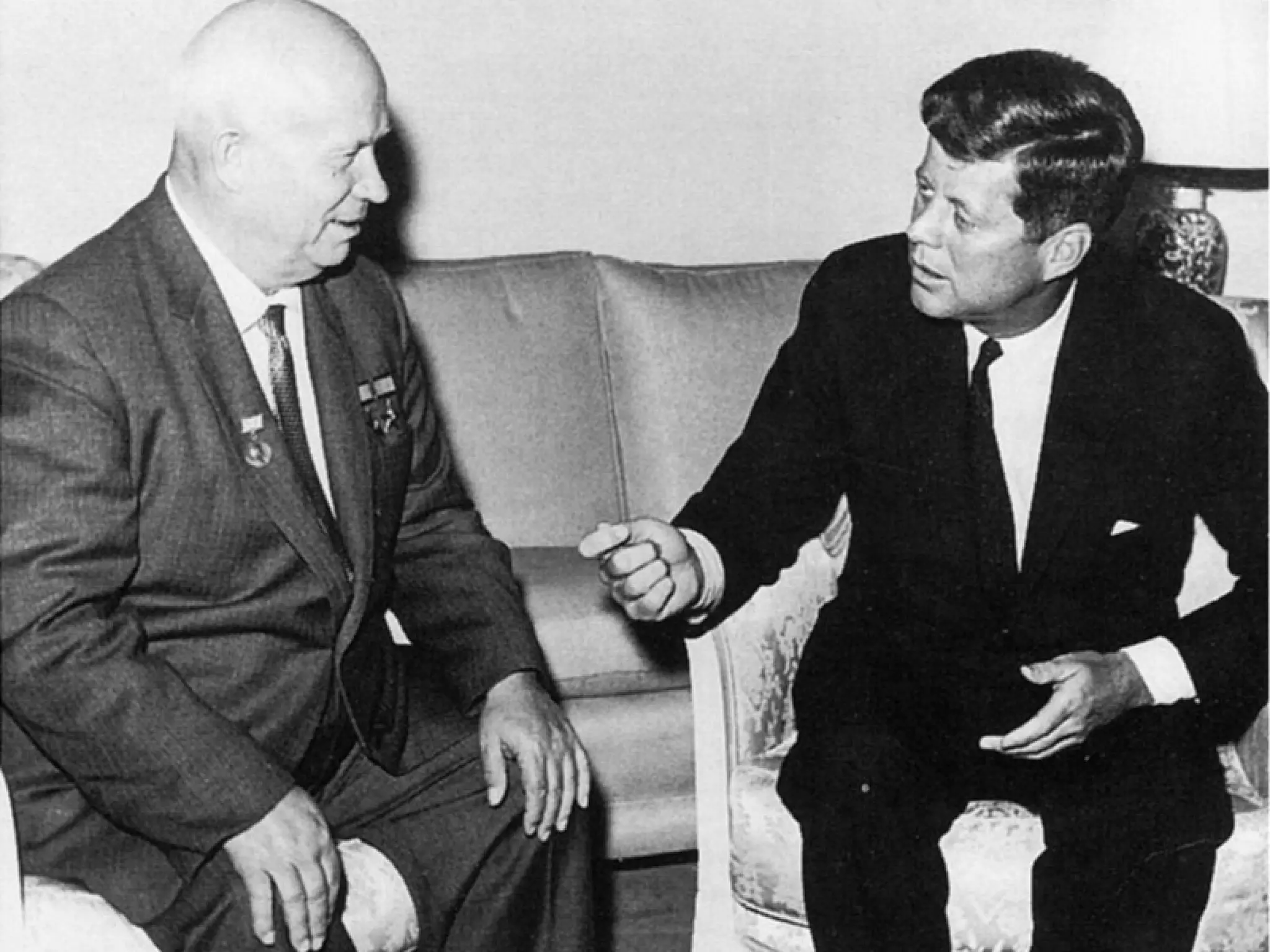

Mastering Difficult Conversations Dan Brown & Chris Detzi EightShapes, LLC IA Summit 2009, Memphis, TN
Introductions
About Us Who we are Why we’re here
About You Your Name Your Occupation Why you’re here
Our Agenda Introductions  done! Best Practices  15 minutes A Model  15 minutes The People  60 minutes The Situations  60 minutes Sample Scenarios  30 minutes Summary of Techniques  30 minutes
Let’s Start with the Basics the Basics Communication Best Practices
Be Positive Engage Your Audience Empathize Lighten Up
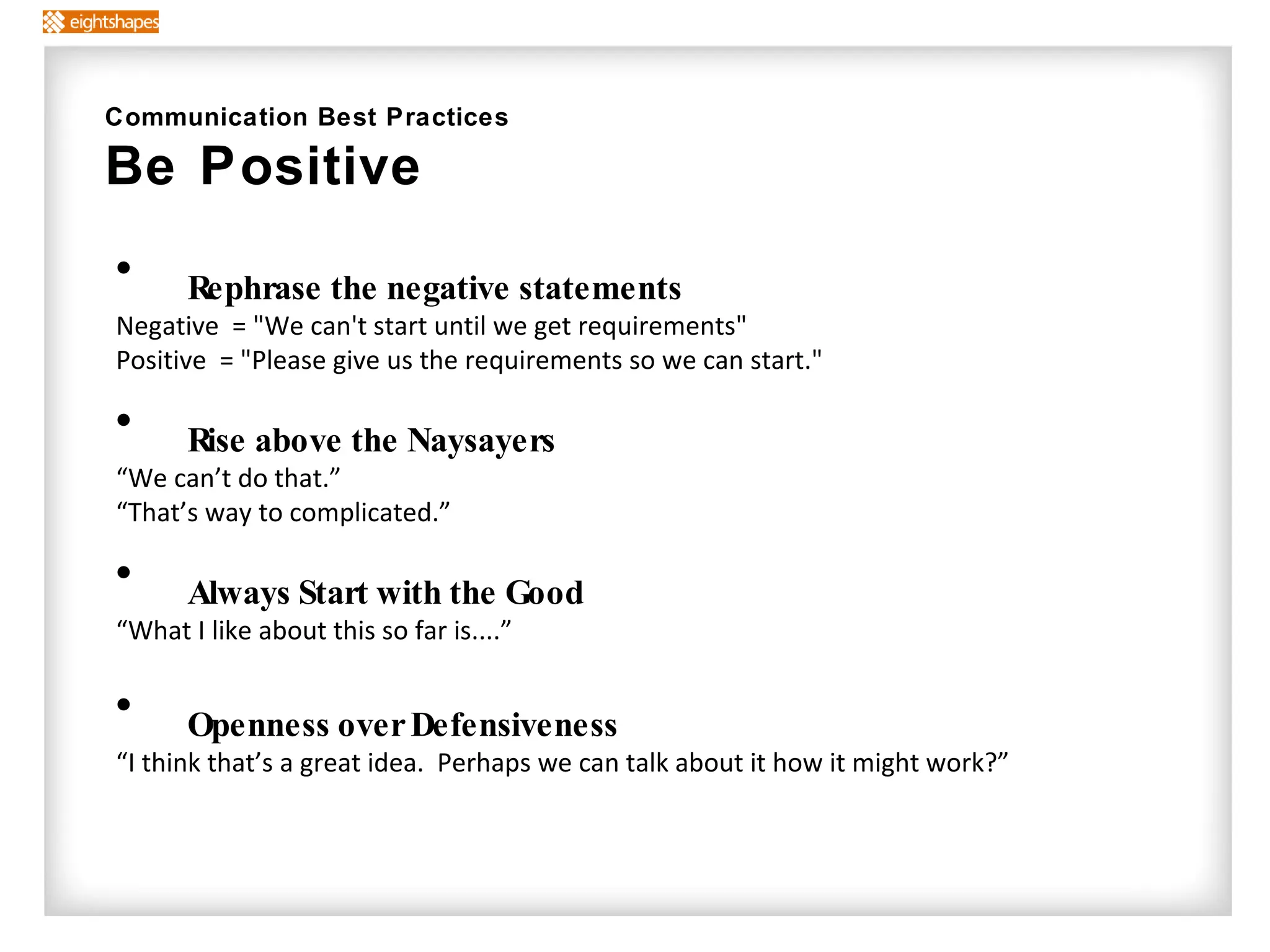
Rephrase the negative statements Negative  = "We can't start until we get requirements" Positive  = "Please give us the requirements so we can start." Rise above the Naysayers “ We can’t do that.”  “ That’s way to complicated.” Always Start with the Good “ What I like about this so far is....” Openness over Defensiveness “ I think that’s a great idea.  Perhaps we can talk about it how it might work?” Communication Best Practices Be Positive
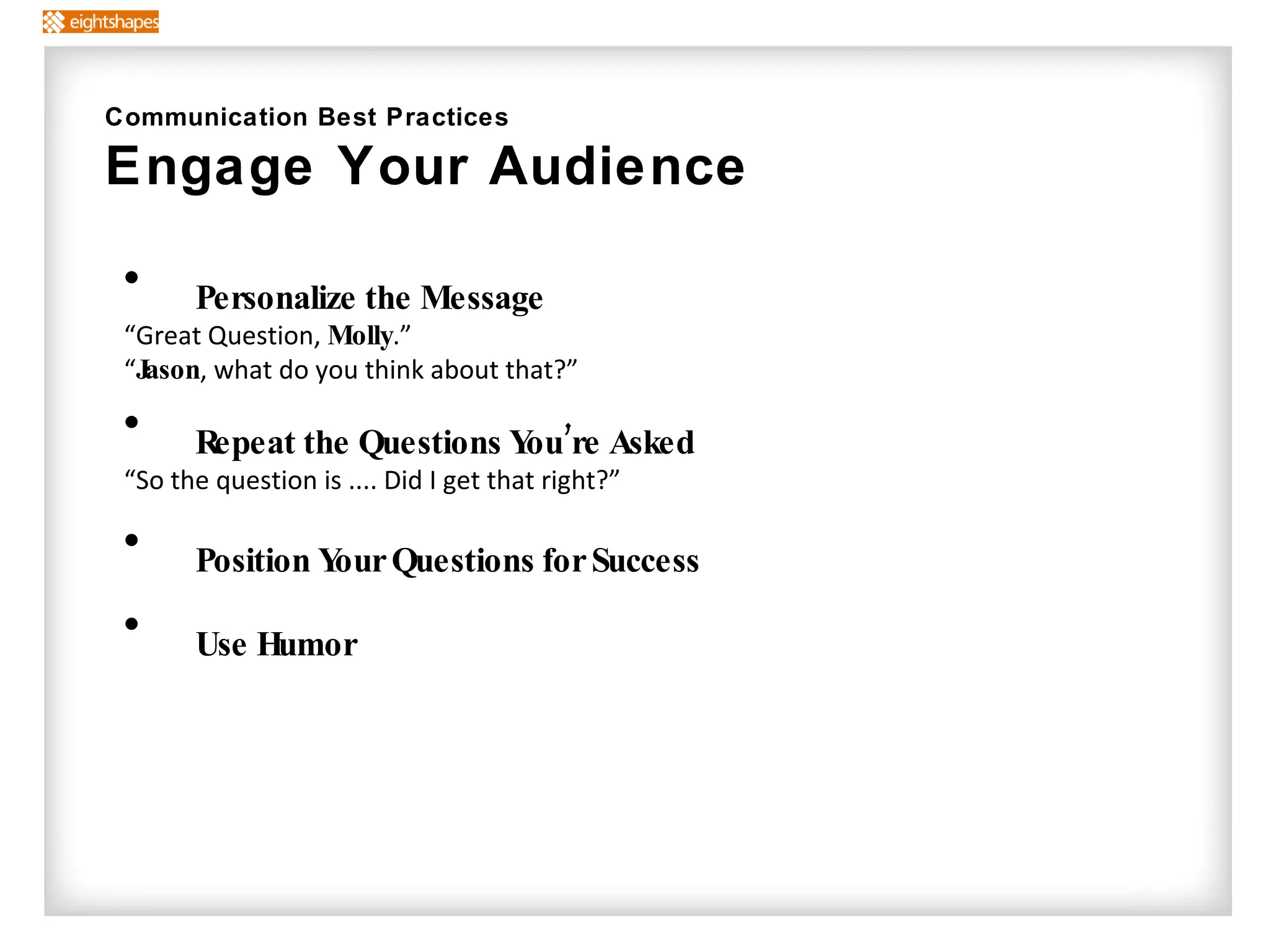
Personalize the Message “ Great Question,  Molly .”  “ Jason , what do you think about that?” Repeat the Questions You’re Asked “ So the question is .... Did I get that right?” Position Your Questions for Success Use Humor Communication Best Practices Engage Your Audience
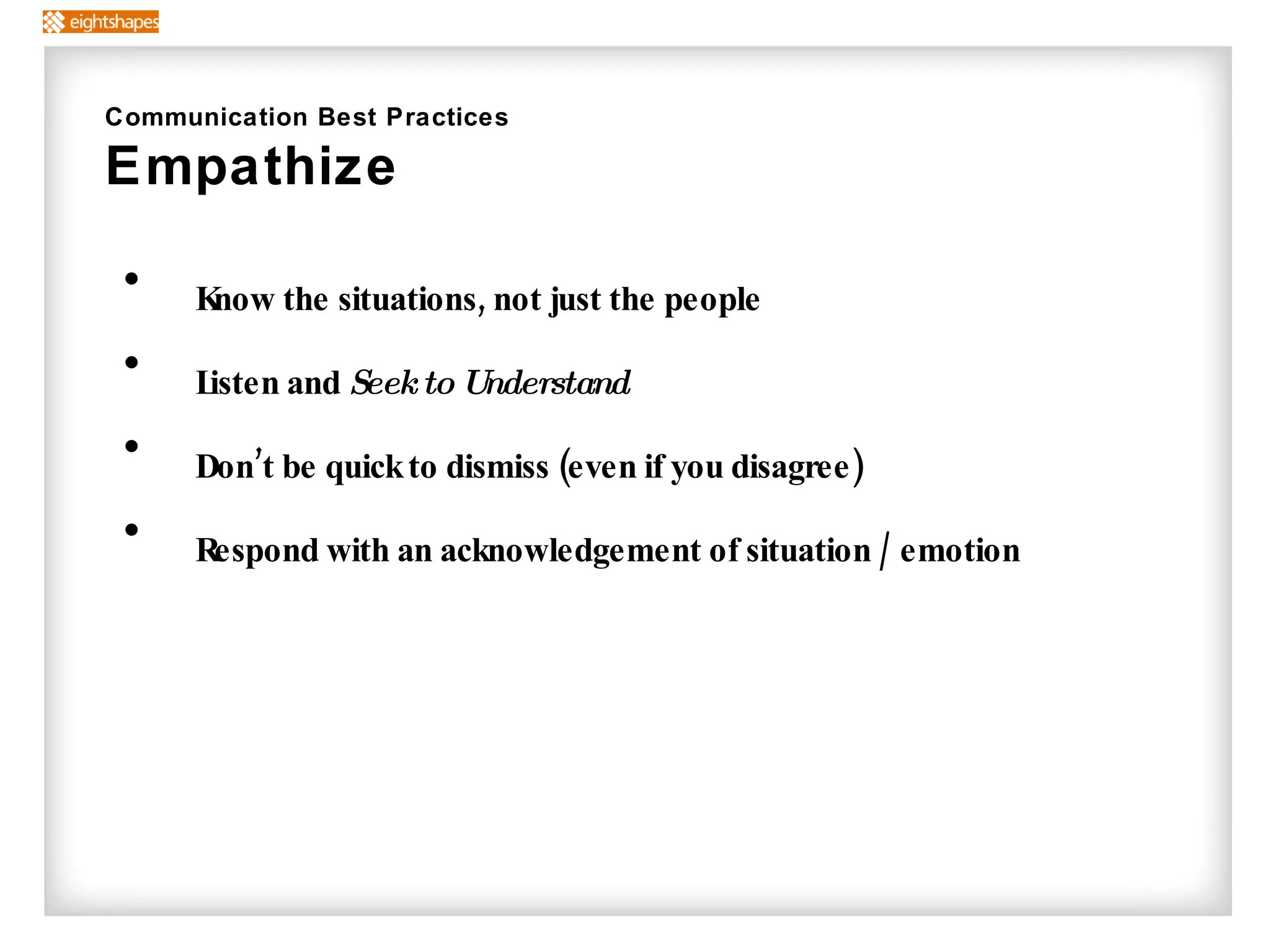
Know the situations, not just the people Listen and  Seek to Understand Don’t be quick to dismiss (even if you disagree) Respond with an acknowledgement of situation / emotion Communication Best Practices Empathize
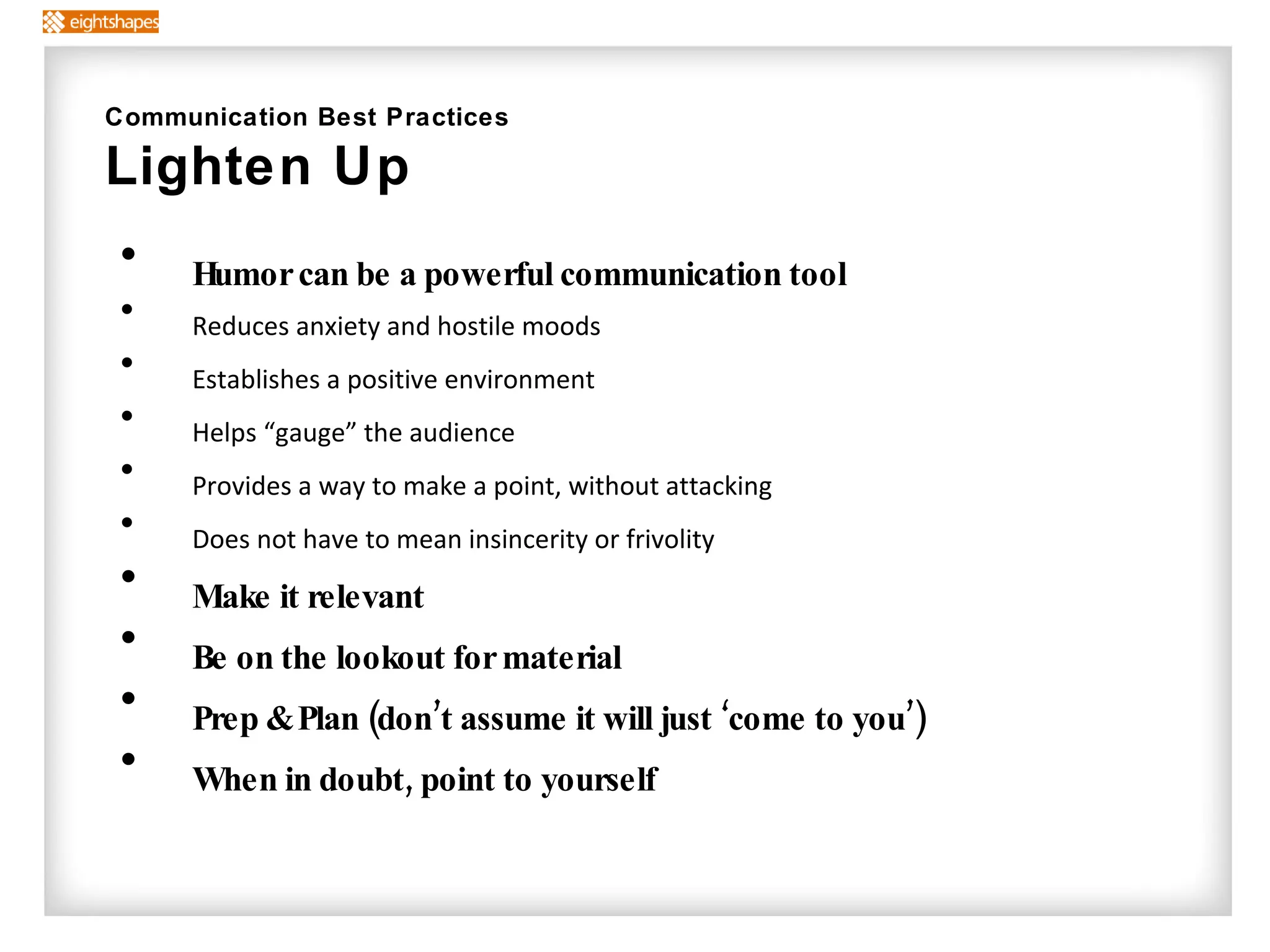
Humor can be a powerful communication tool Reduces anxiety and hostile moods Establishes a positive environment Helps “gauge” the audience Provides a way to make a point, without attacking Does not have to mean insincerity or frivolity Make it relevant Be on the lookout for material  Prep & Plan (don’t assume it will just ‘come to you’) When in doubt, point to yourself Communication Best Practices Lighten Up
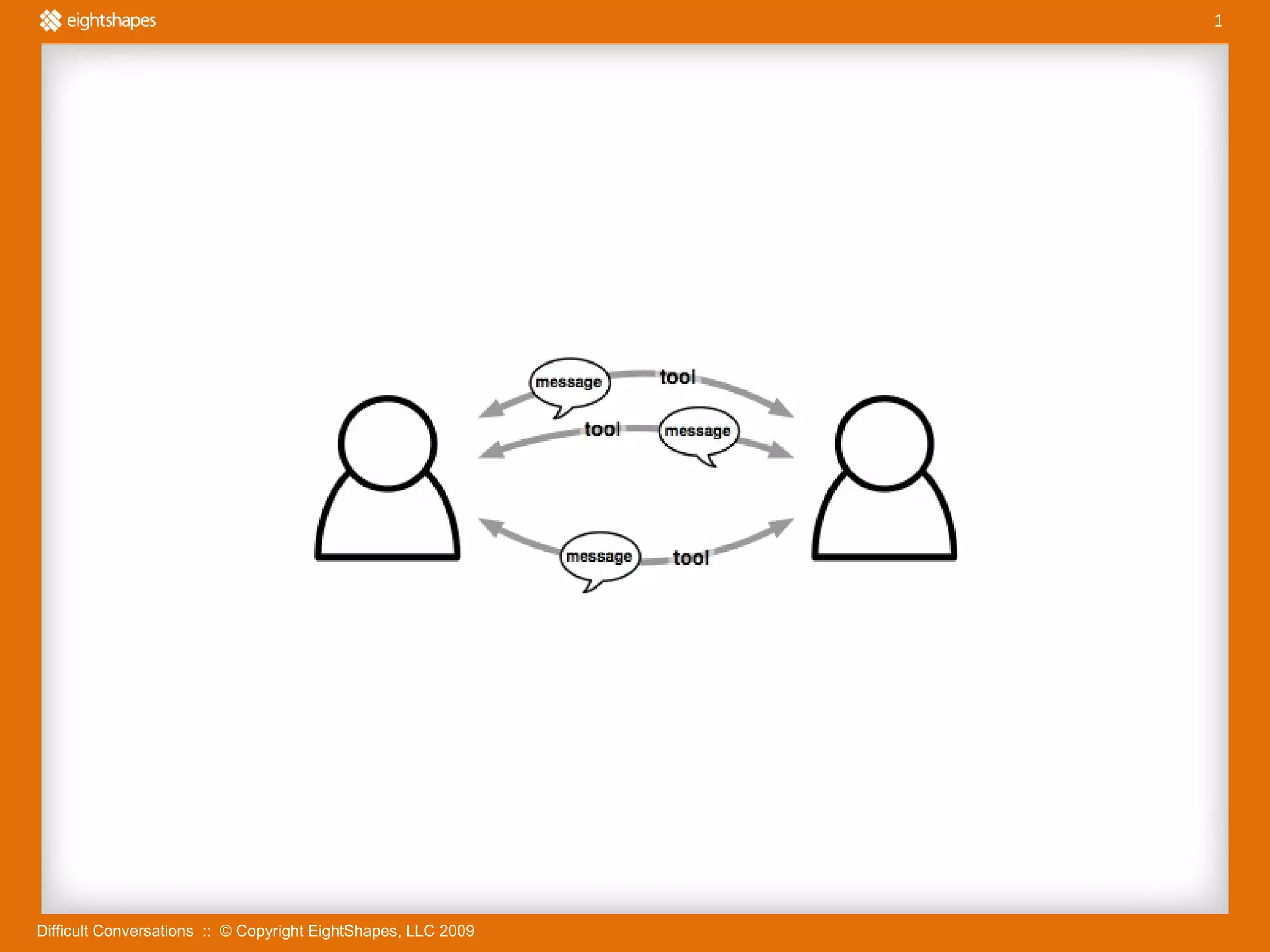
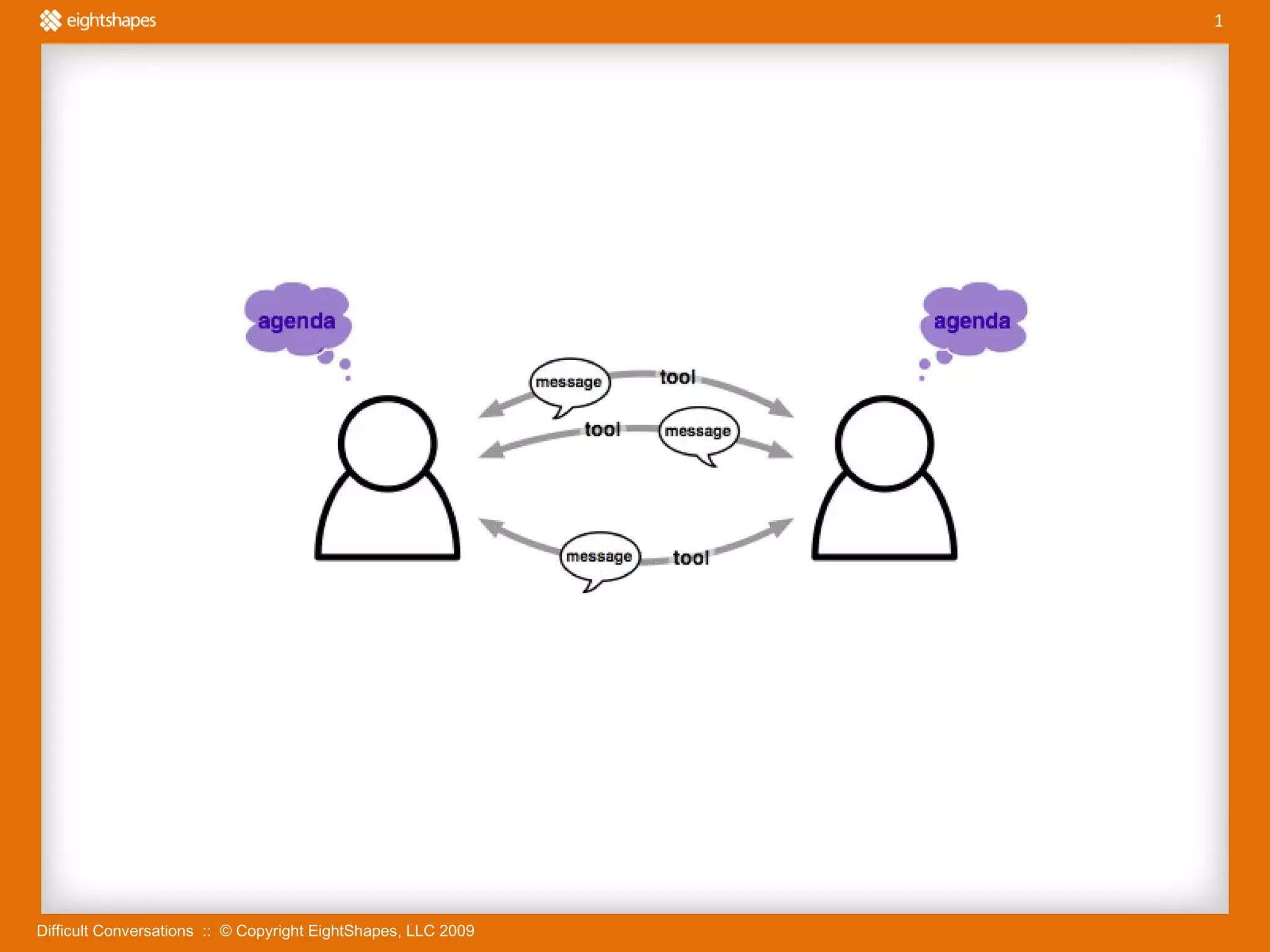
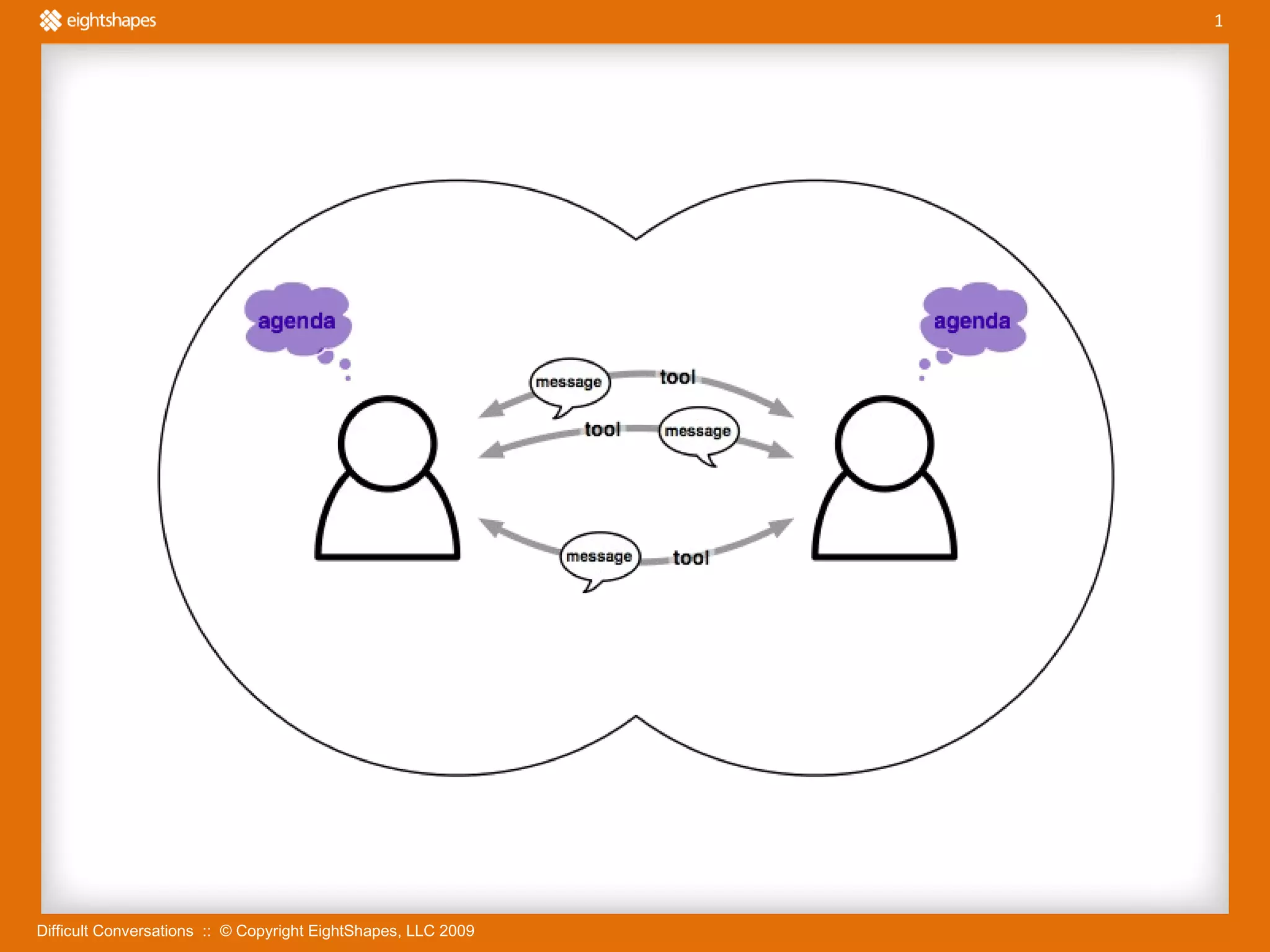
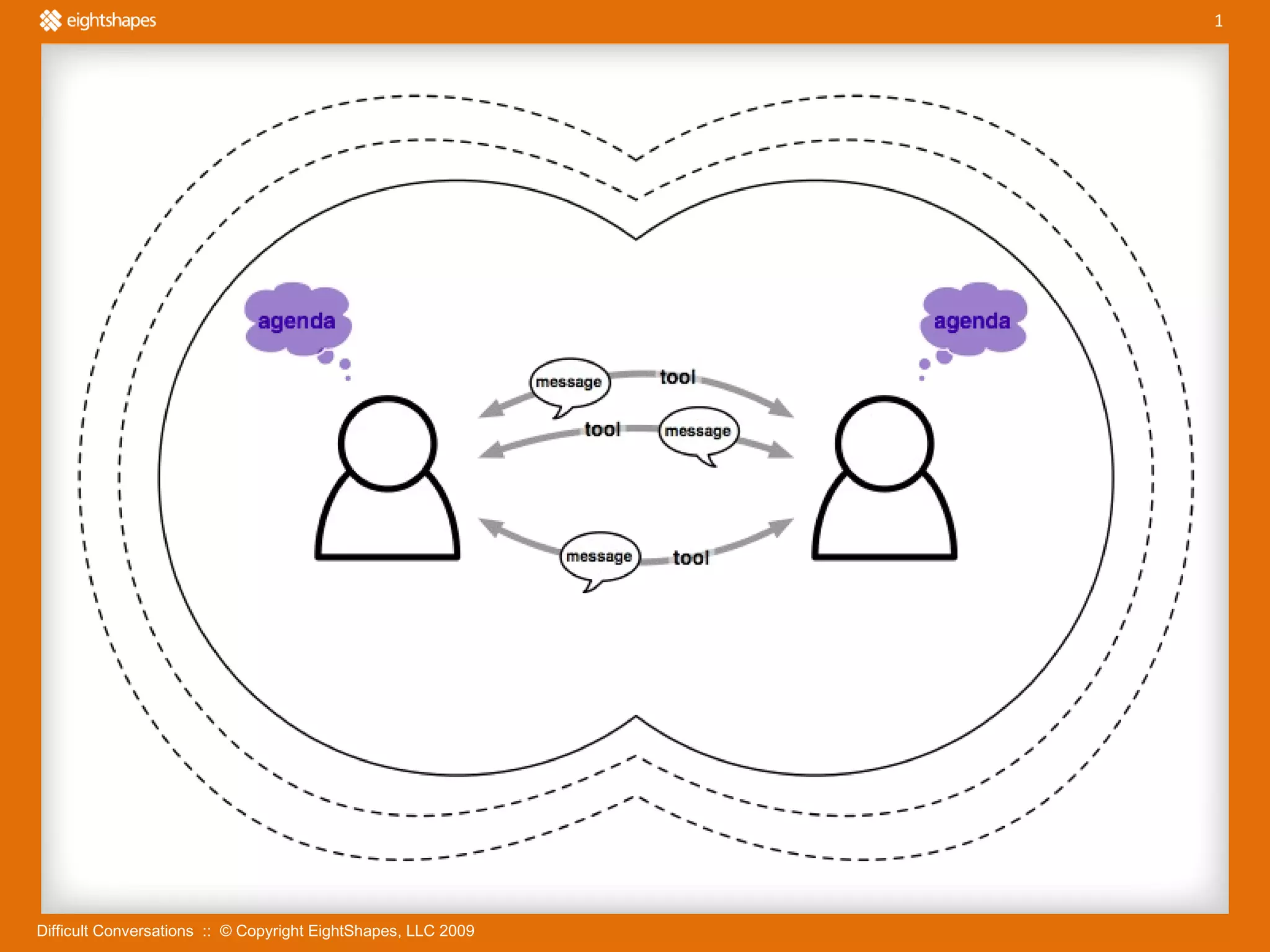
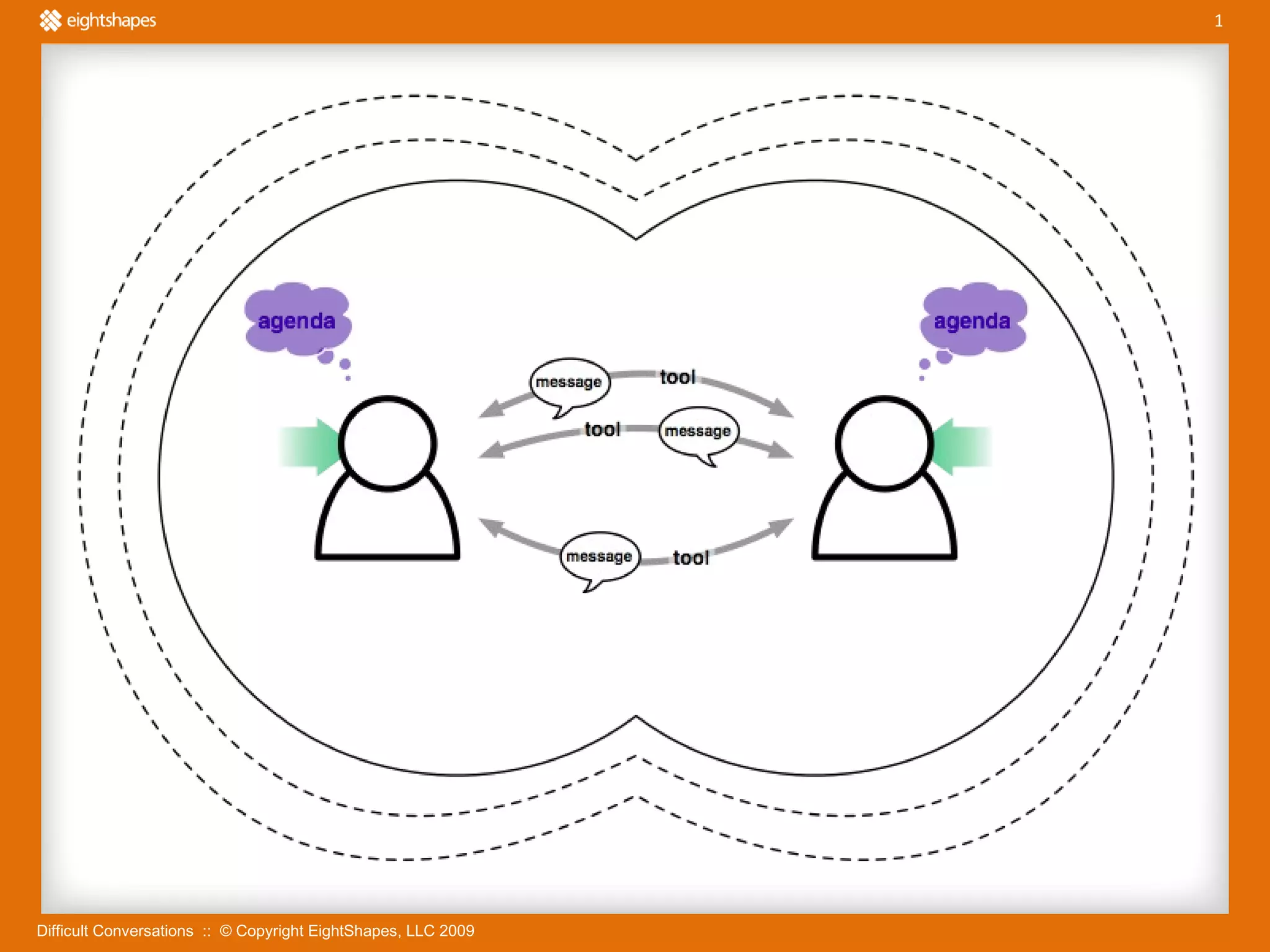
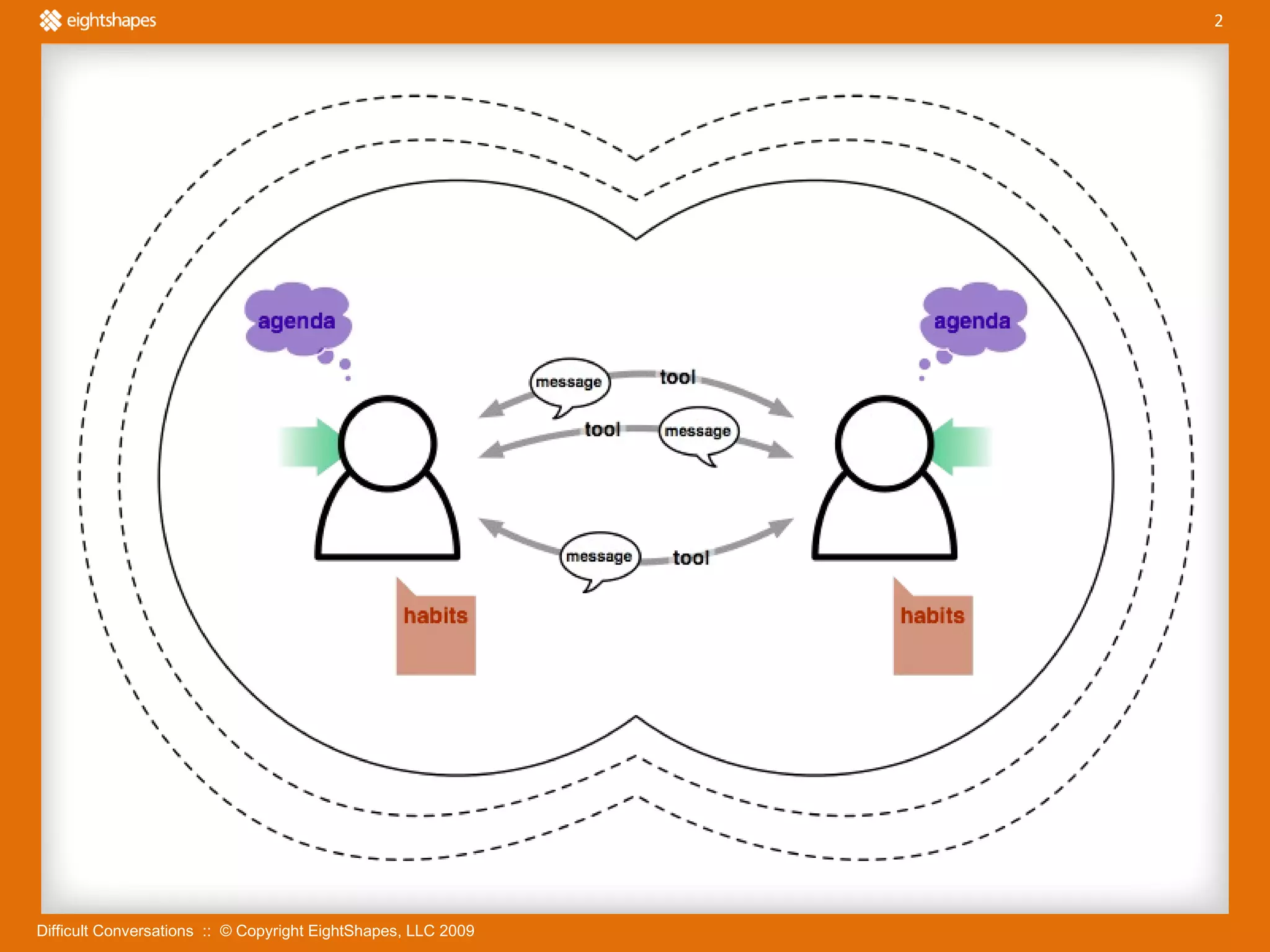
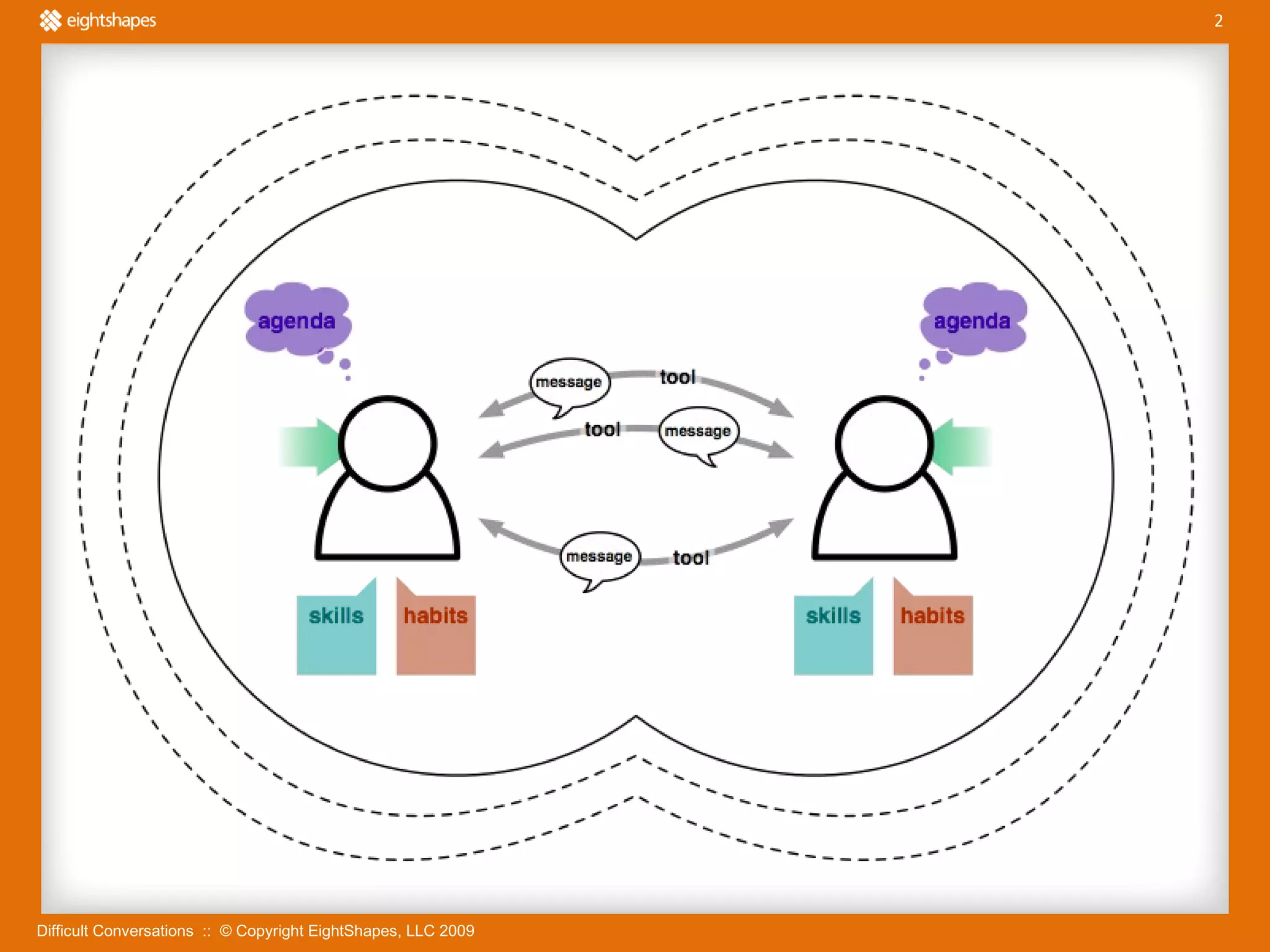
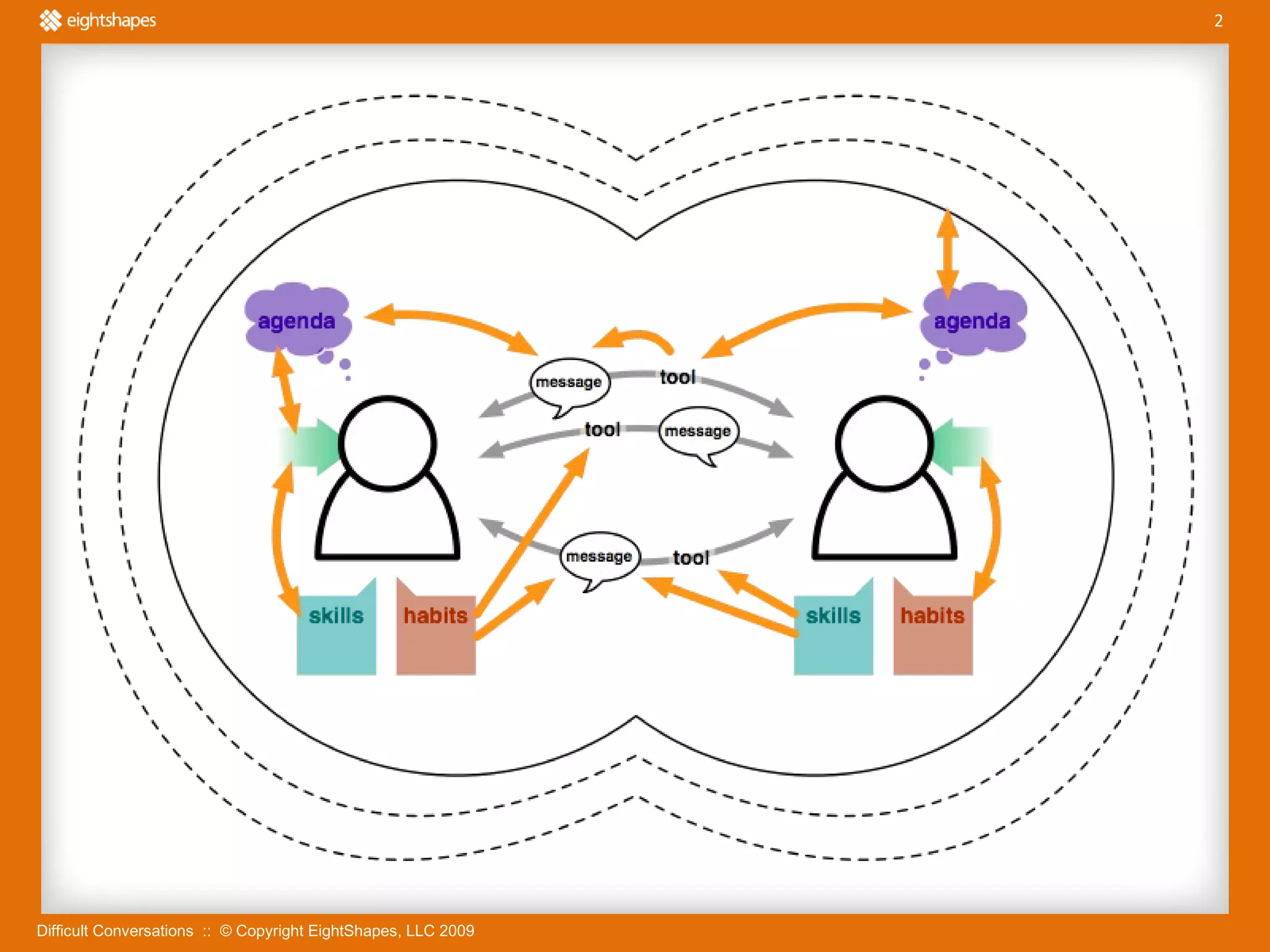
A Site Map of Communications A model for interpersonal interactions
Difficult Conversations  ::  © Copyright EightShapes, LLC 2009
Common behaviors in creative environments They’re the People that You Meet that You Meet
What makes people hard to work with?
No Direction They can’t tell you what’s wrong Symptoms Float with the wind Broad, non-specific or emotional feedback Fear conflict Techniques Be mindful of goals Separate yourself from the issue Ask good, specific questions
Misdirected Passion They feel strongly about the strangest things Symptoms reaction not commensurate with issue taking things personally Techniques See other perspectives/agendas Pick your battles Let others have their say Set expectations and explain context
Inconsistent messaging They talk out of both sides of their mouth Symptoms “That’s not what we discussed...” “I don’t recall saying that specifically....” “Well he told me...” Techniques Bite your tongue (well, nibble it) Pick your battles  Validate and capture messages
Unwilling to admit ignorance They get stuff wrong Symptoms outputs show misunderstanding “Let me try that again!” Techniques Deflect responsibility  Avoid distractions
No Vision They don’t know where they want to go Symptoms Willing to listen to any direction Can’t separate good from bad Techniques  Ask good questions Find out what stifles their vision
No Structure They are disorganized Symptoms unaware of project plan missing deadlines Techniques Define action items Set expectations and explain context
No Strength They are easily taken off course Symptoms a new problem every week Techniques Avoid distractions Set expectations and explain context Remind of implications
Not Available Eighty percent of success is showing up Symptoms missing meetings not responding to email Techniques Set action items Set expectations and explain context
Tunnel Vision Other things get in the way of their view Symptoms refusal to compromise Techniques Ask good questions Let others have their say Tell a good story and align it with audience Deflect responsibility Set expectations and explain context
Prioritize reputation Rather save face than admit they're wrong Symptoms (might come with other habits, like lack of focus) Techniques Letting others be right Picking your battles Setting action items: how do we fix this?
Poor communication skills They can't articulate concerns Symptoms rambling messages difficult to map/contextualize messages Techniques Ask good questions Define action items Find out what’s stifling
Poor use of communications tools They love love love love love email Symptoms long emails detailed project correspondence in IM tangents in meetings Techniques See other people's perspectives Find out what stifles them Redirect to another tool
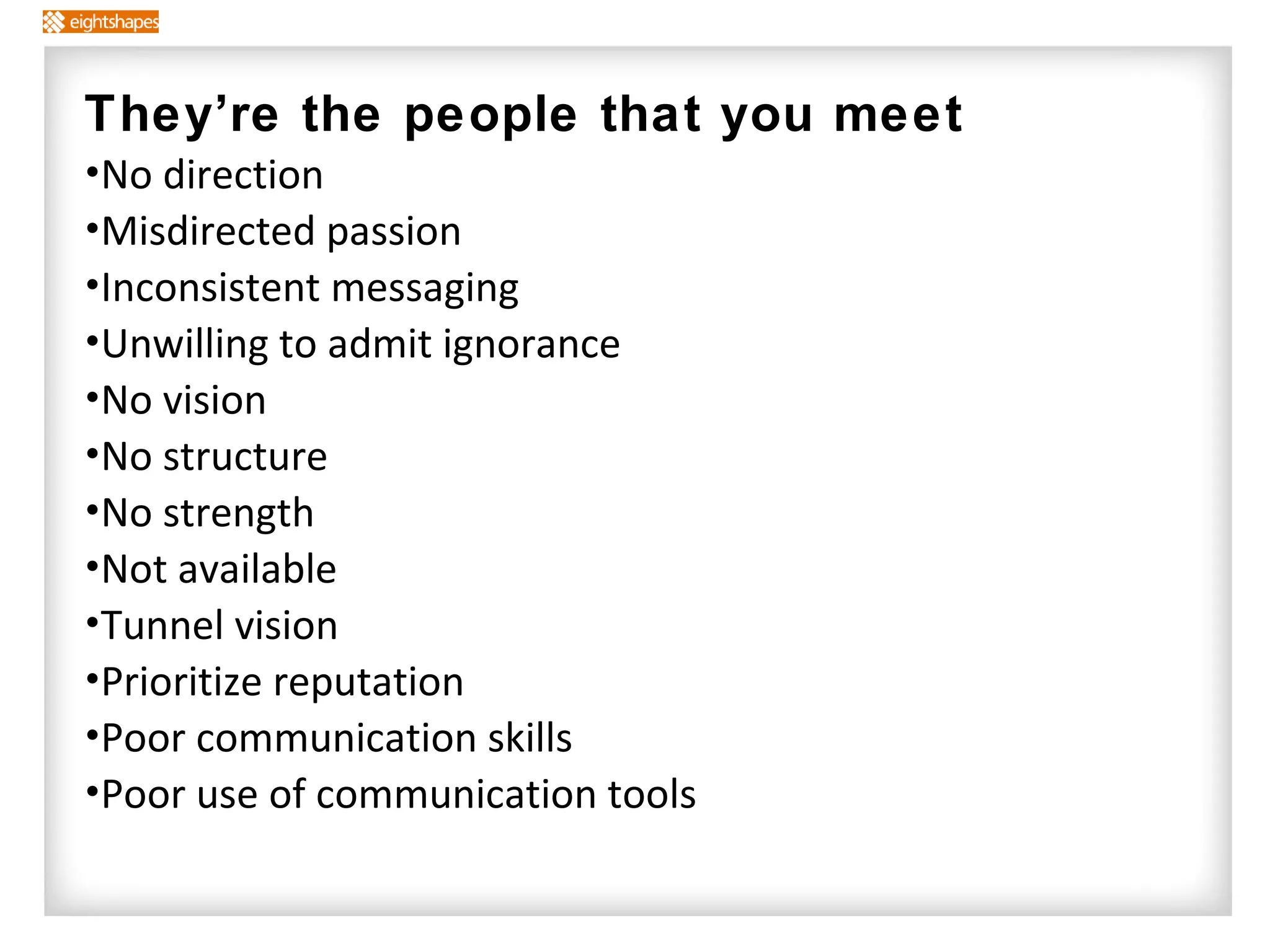
They’re the people that you meet No direction Misdirected passion Inconsistent messaging Unwilling to admit ignorance No vision No structure No strength Not available Tunnel vision Prioritize reputation Poor communication skills Poor use of communication tools
The situations we face and techniques to master them It’s Called Work Work
What situations do you face?
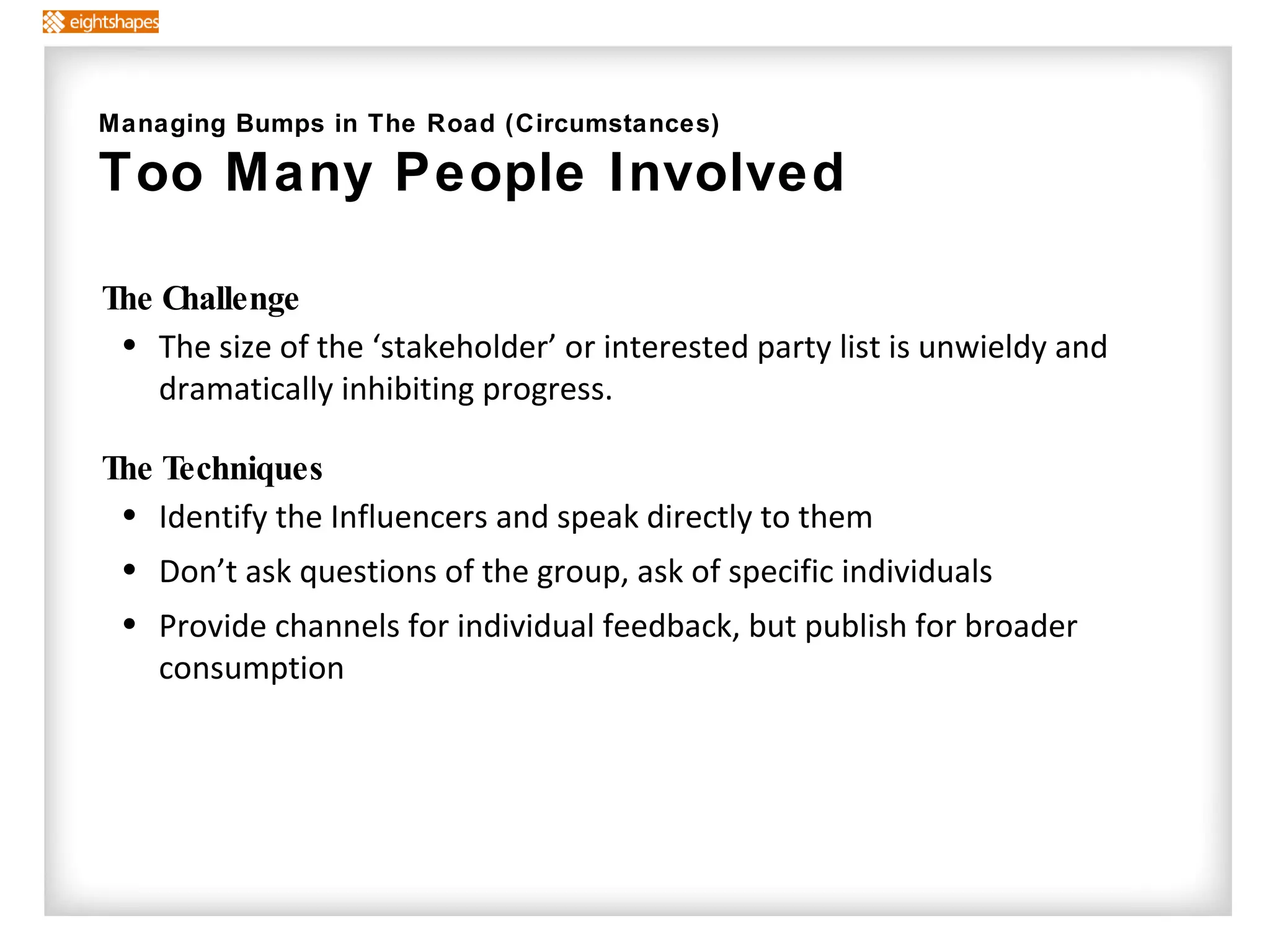
The Challenge The size of the ‘stakeholder’ or interested party list is unwieldy and dramatically inhibiting progress. The Techniques   Identify the Influencers and speak directly to them Don’t ask questions of the group, ask of specific individuals Provide channels for individual feedback, but publish for broader consumption Managing Bumps in The Road (Circumstances) Too Many People Involved
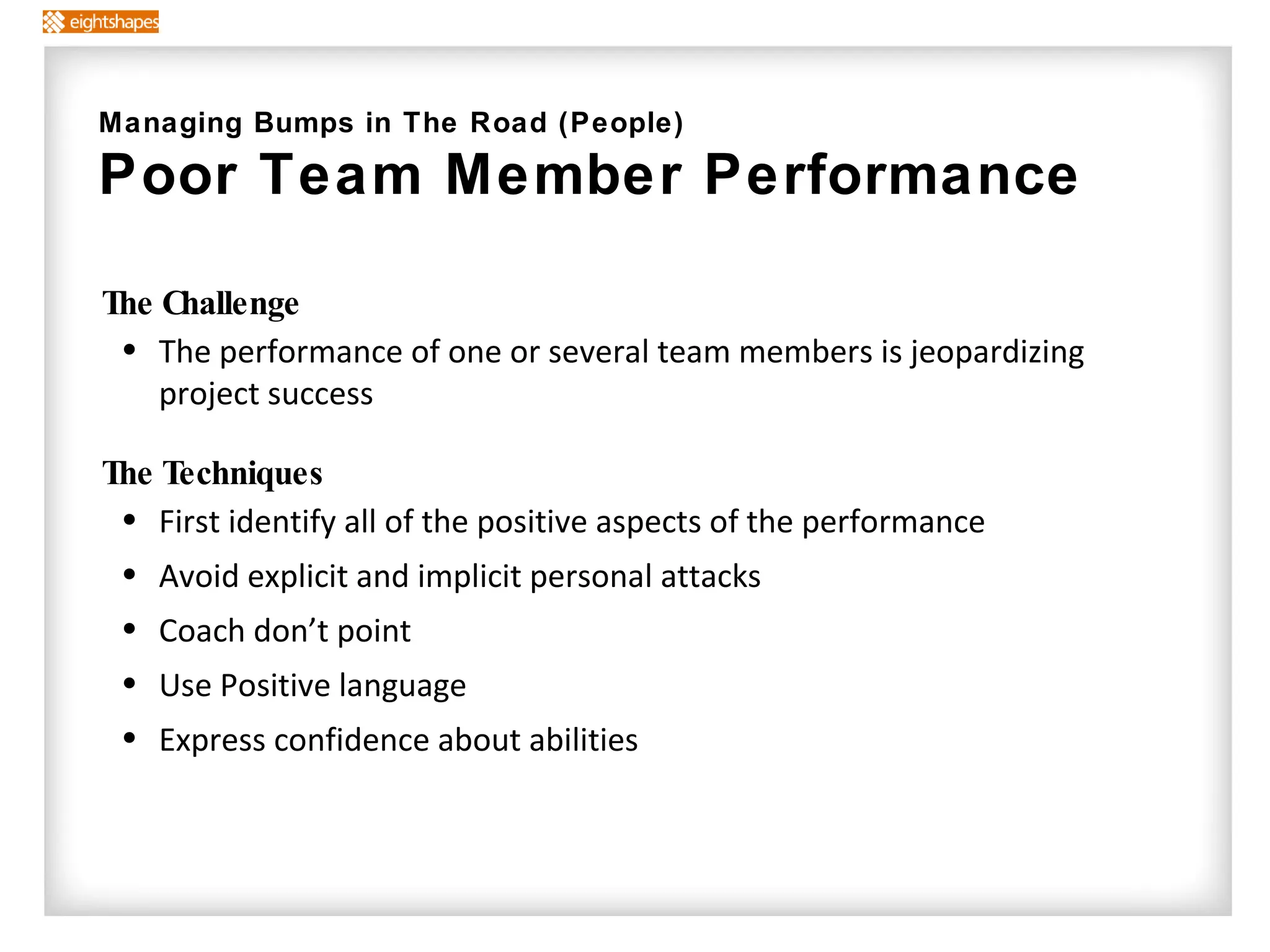
The Challenge The performance of one or several team members is jeopardizing project success The Techniques   First identify all of the positive aspects of the performance Avoid explicit and implicit personal attacks  Coach don’t point Use Positive language  Express confidence about abilities Managing Bumps in The Road (People) Poor Team Member Performance
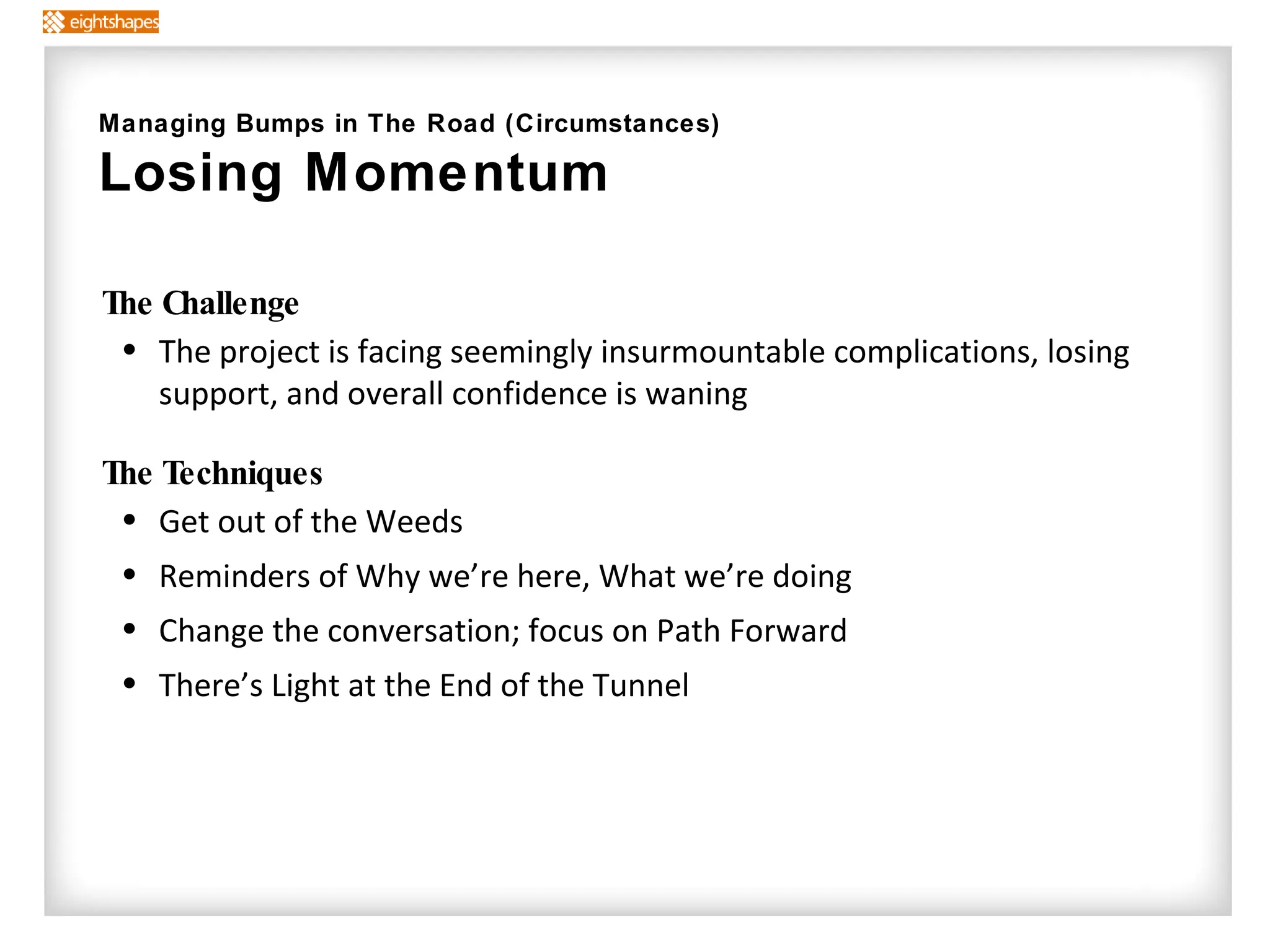
The Challenge The project is facing seemingly insurmountable complications, losing support, and overall confidence is waning The Techniques   Get out of the Weeds Reminders of Why we’re here, What we’re doing Change the conversation; focus on Path Forward  There’s Light at the End of the Tunnel Managing Bumps in The Road (Circumstances) Losing Momentum
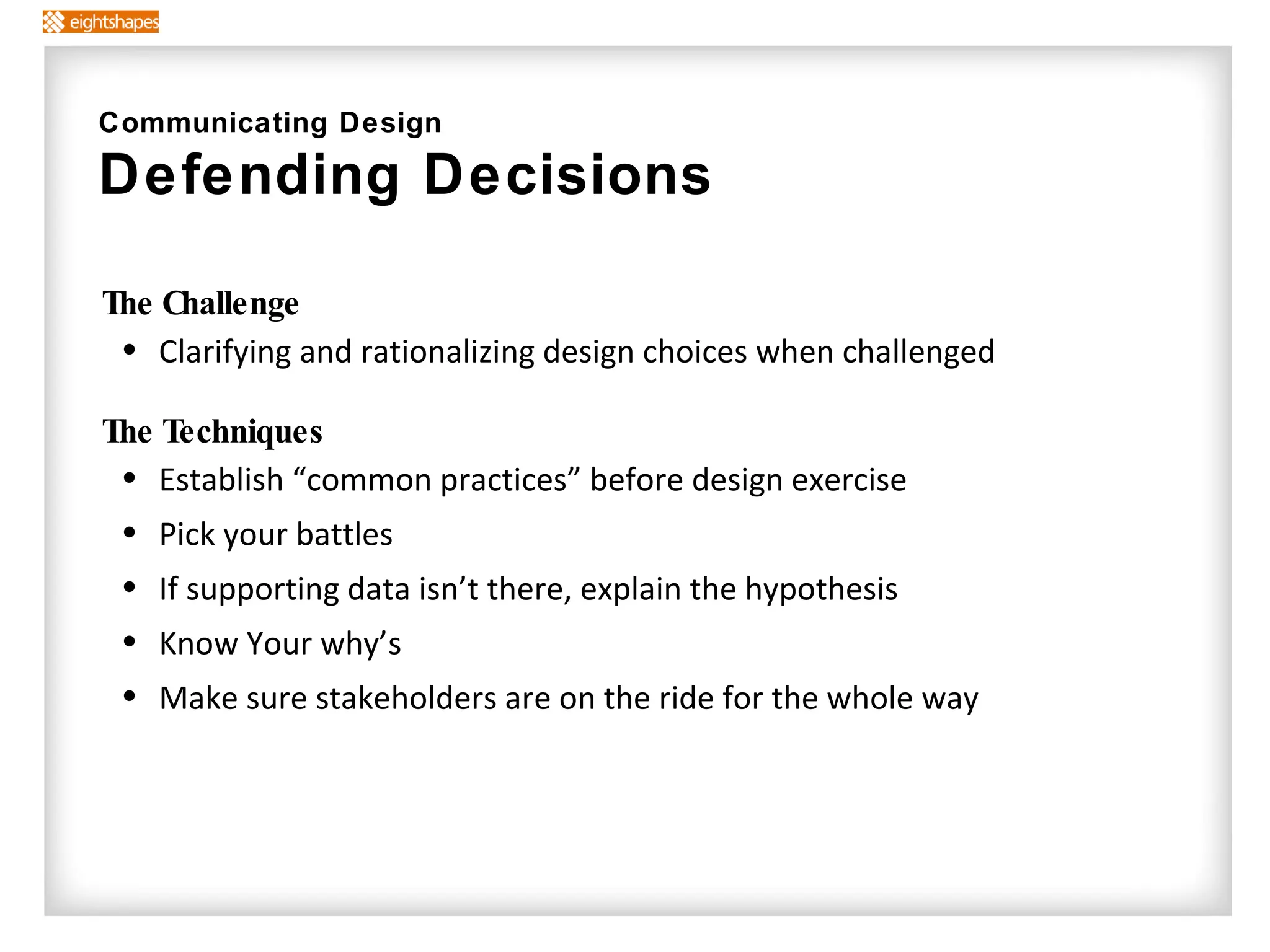
The Challenge Clarifying and rationalizing design choices when challenged The Techniques   Establish “common practices” before design exercise Pick your battles If supporting data isn’t there, explain the hypothesis Know Your why’s Make sure stakeholders are on the ride for the whole way Communicating Design Defending Decisions
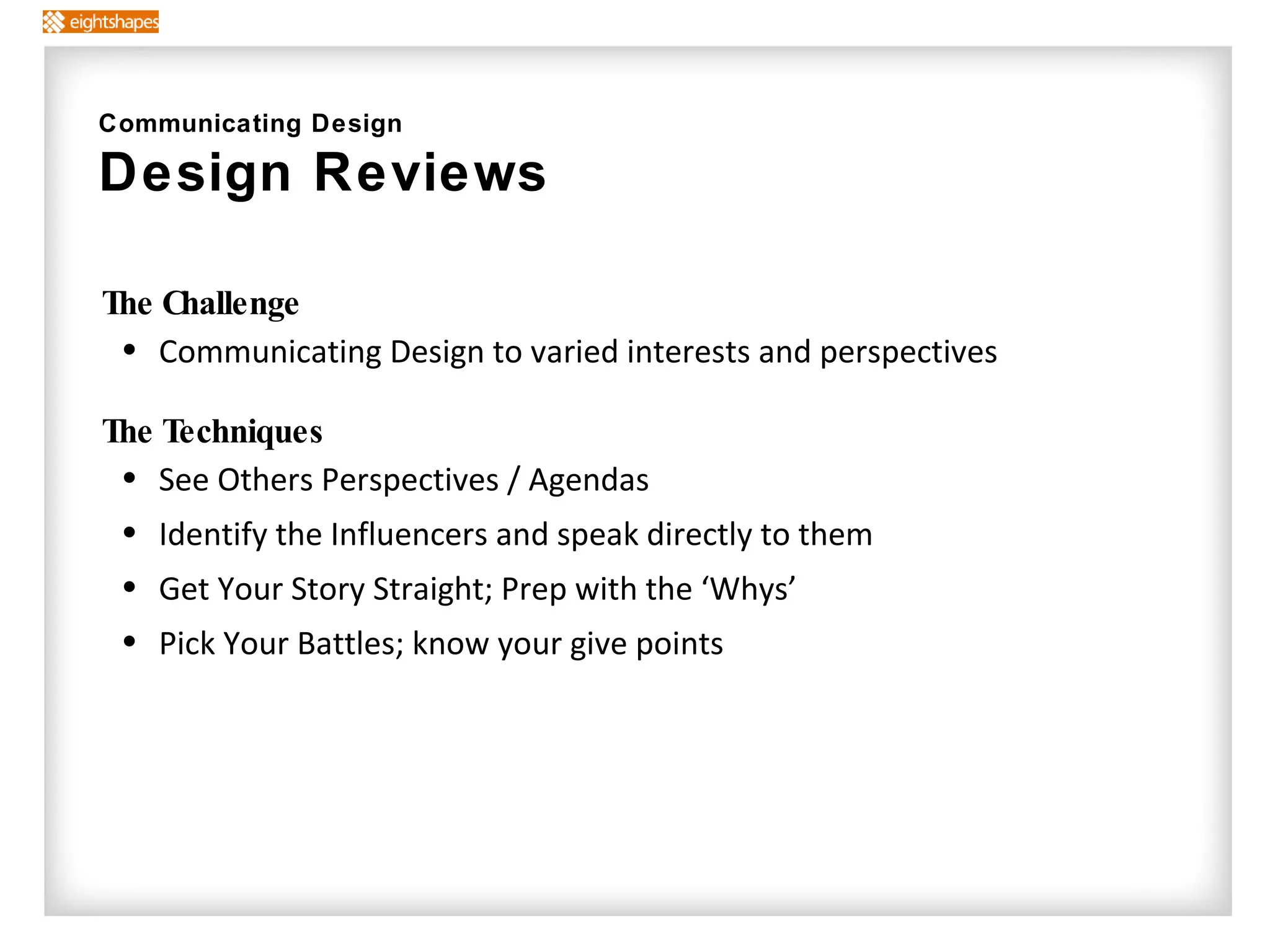
The Challenge Communicating Design to varied interests and perspectives The Techniques   See Others Perspectives / Agendas Identify the Influencers and speak directly to them  Get Your Story Straight; Prep with the ‘Whys’ Pick Your Battles; know your give points Communicating Design Design Reviews
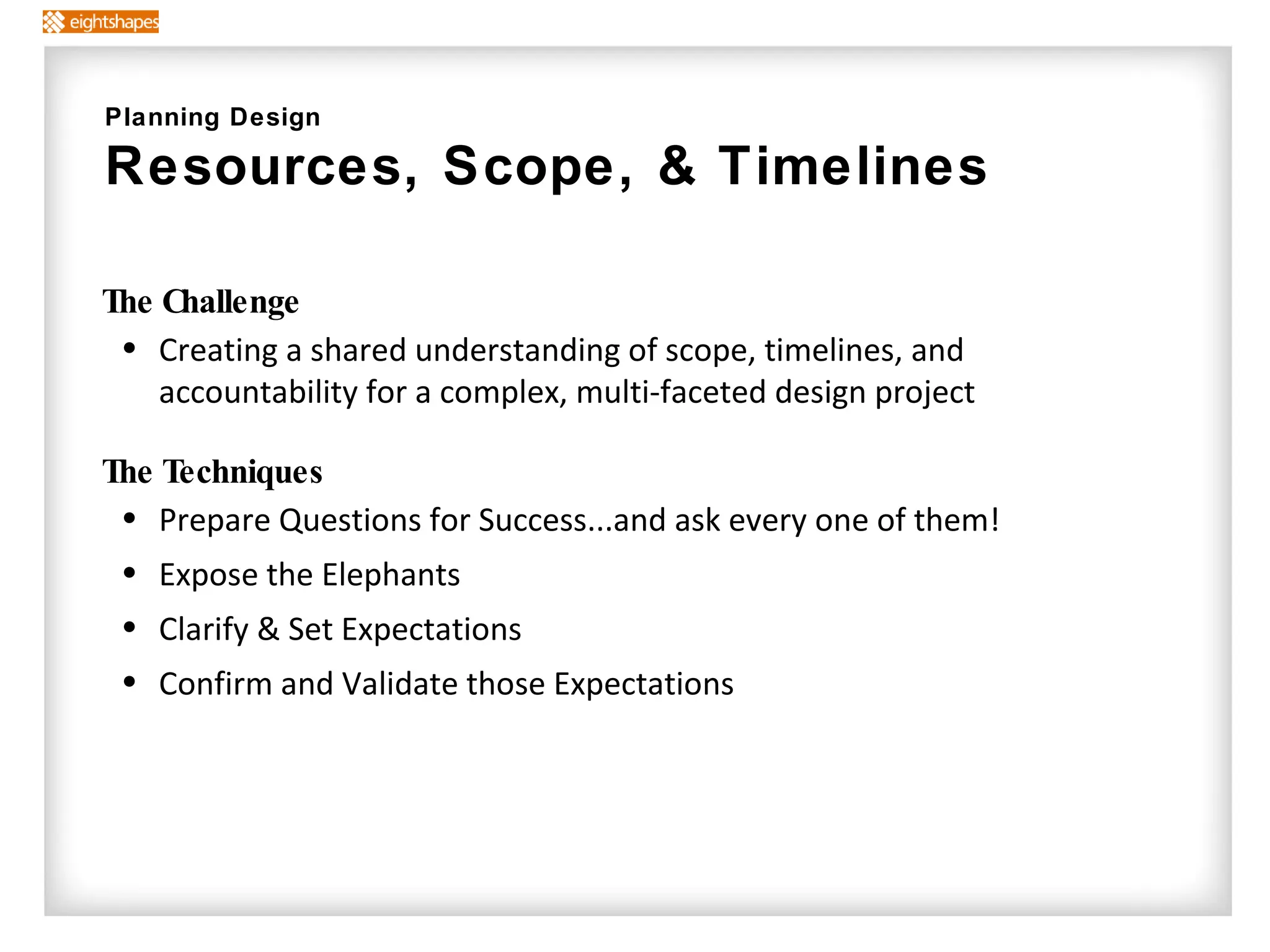
The Challenge Creating a shared understanding of scope, timelines, and accountability for a complex, multi-faceted design project The Techniques  Prepare Questions for Success...and ask every one of them!  Expose the Elephants Clarify & Set Expectations Confirm and Validate those Expectations Planning Design Resources, Scope, & Timelines
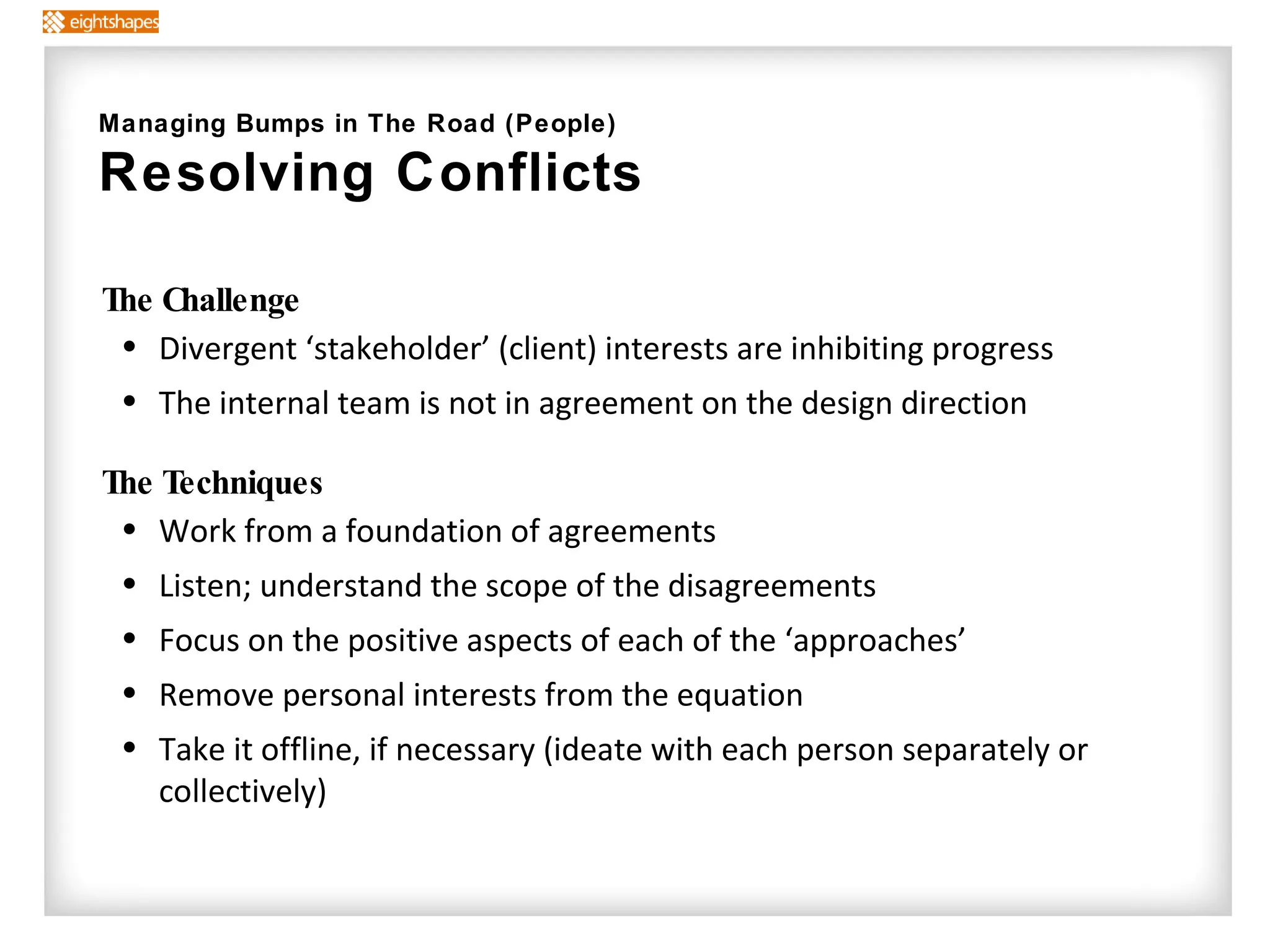
The Challenge Divergent ‘stakeholder’ (client) interests are inhibiting progress  The internal team is not in agreement on the design direction The Techniques   Work from a foundation of agreements Listen; understand the scope of the disagreements  Focus on the positive aspects of each of the ‘approaches’ Remove personal interests from the equation Take it offline, if necessary (ideate with each person separately or collectively) Managing Bumps in The Road (People) Resolving Conflicts
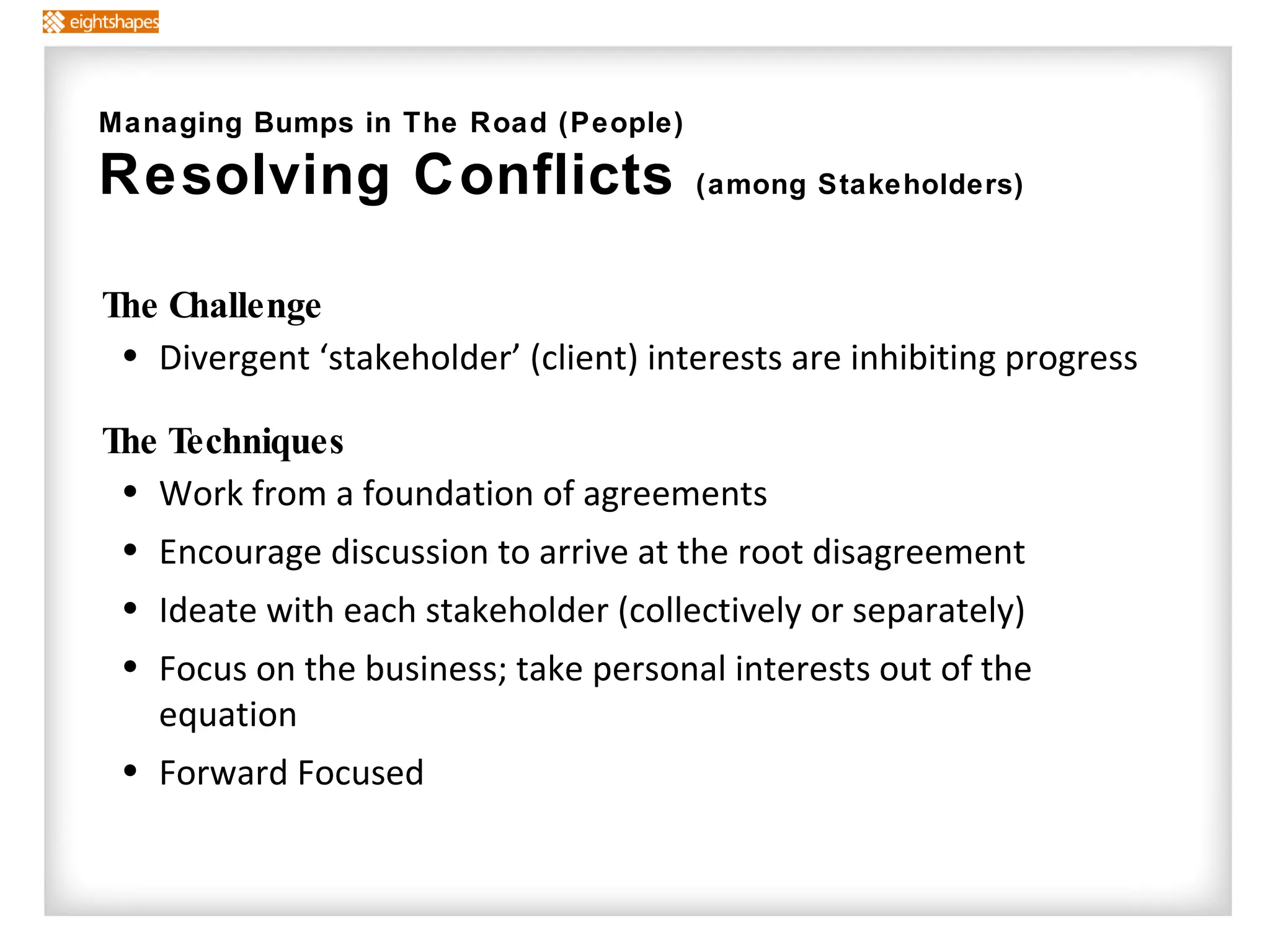
The Challenge Divergent ‘stakeholder’ (client) interests are inhibiting progress  The Techniques   Work from a foundation of agreements Encourage discussion to arrive at the root disagreement  Ideate with each stakeholder (collectively or separately) Focus on the business; take personal interests out of the equation Forward Focused Managing Bumps in The Road (People) Resolving Conflicts  (among Stakeholders)
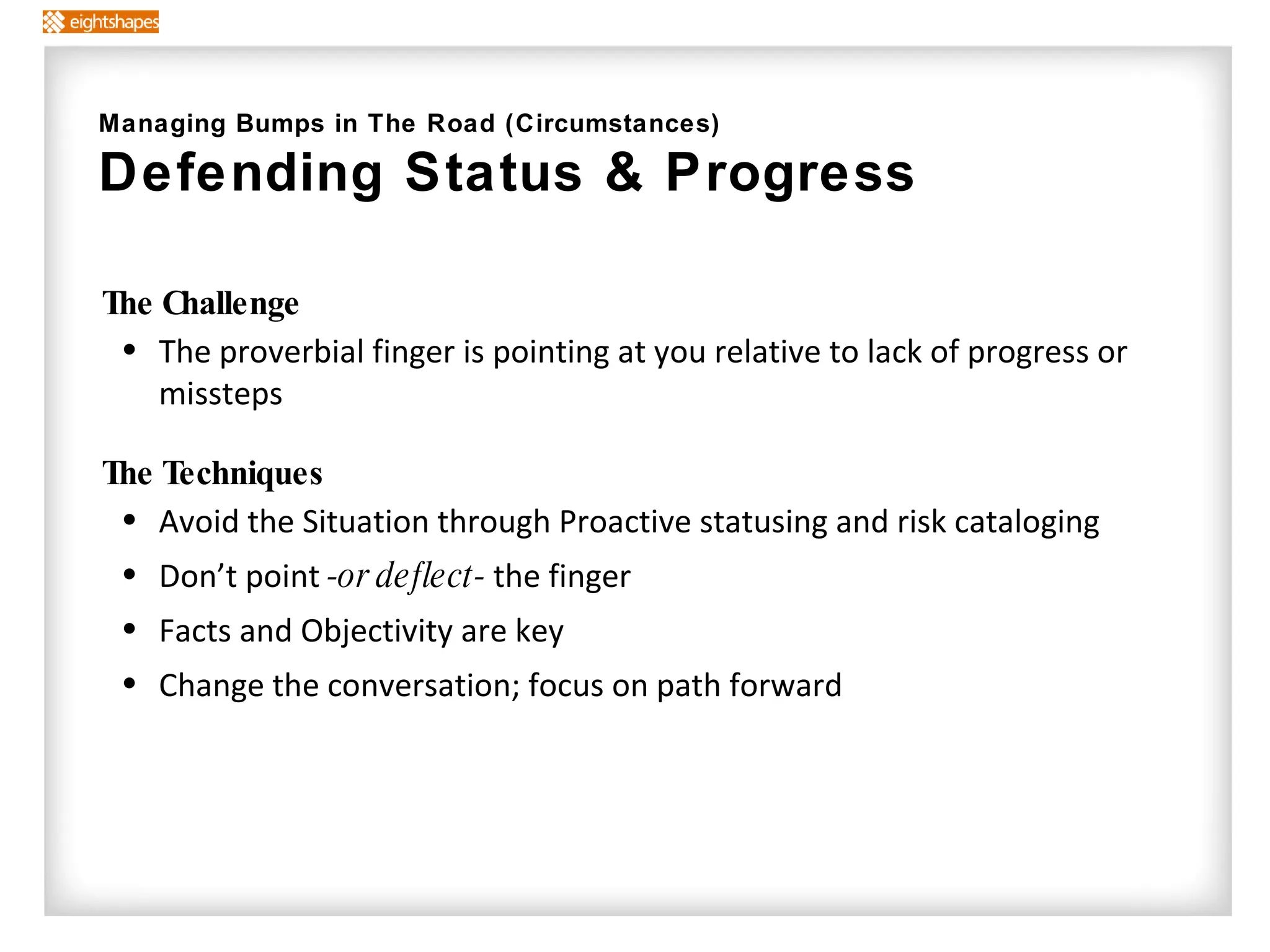
The Challenge The proverbial finger is pointing at you relative to lack of progress or missteps The Techniques   Avoid the Situation through Proactive statusing and risk cataloging Don’t point  -or deflect-  the finger Facts and Objectivity are key Change the conversation; focus on path forward Managing Bumps in The Road (Circumstances) Defending Status & Progress
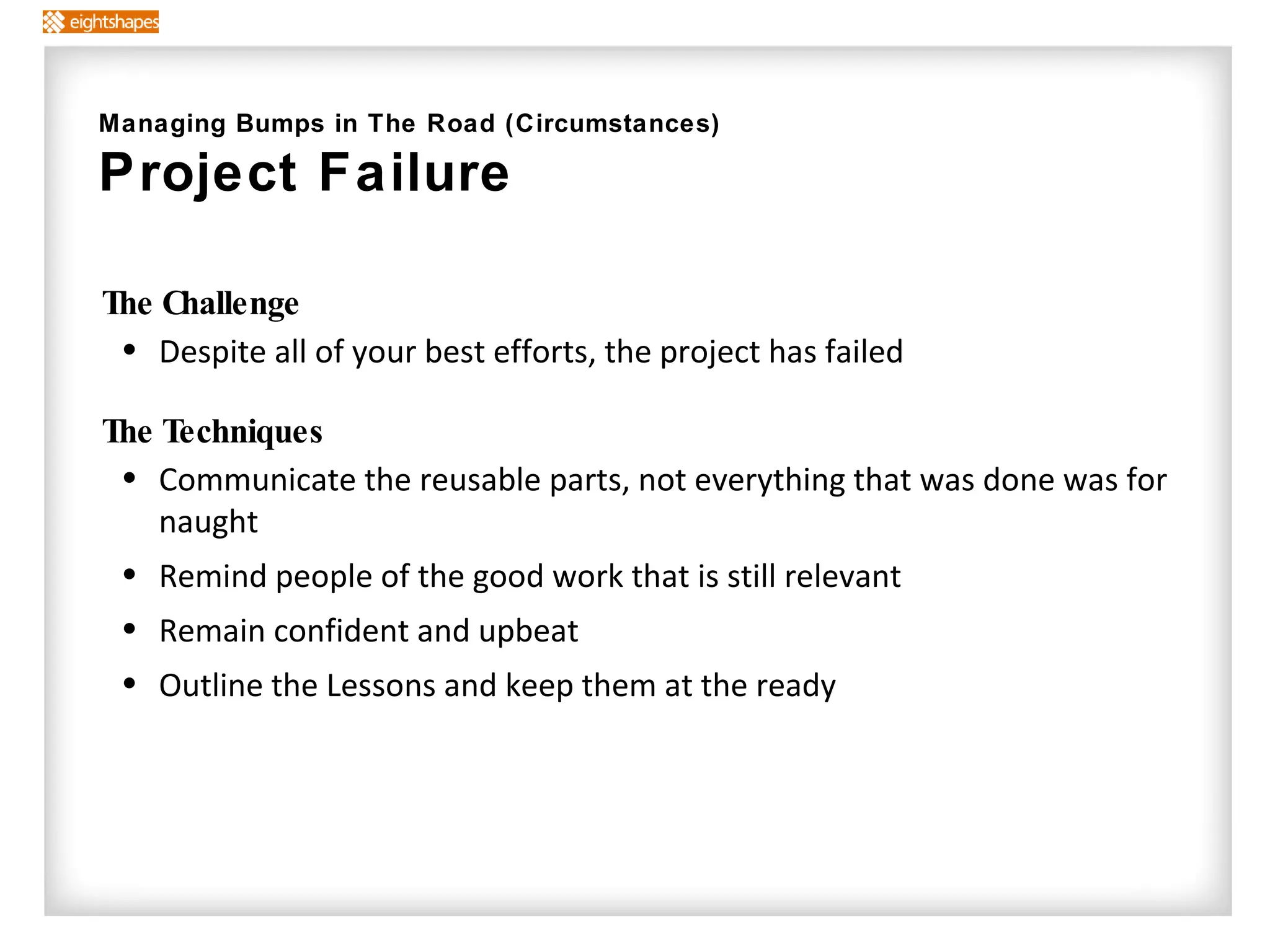
The Challenge Despite all of your best efforts, the project has failed The Techniques   Communicate the reusable parts, not everything that was done was for naught Remind people of the good work that is still relevant Remain confident and upbeat Outline the Lessons and keep them at the ready Managing Bumps in The Road (Circumstances) Project Failure
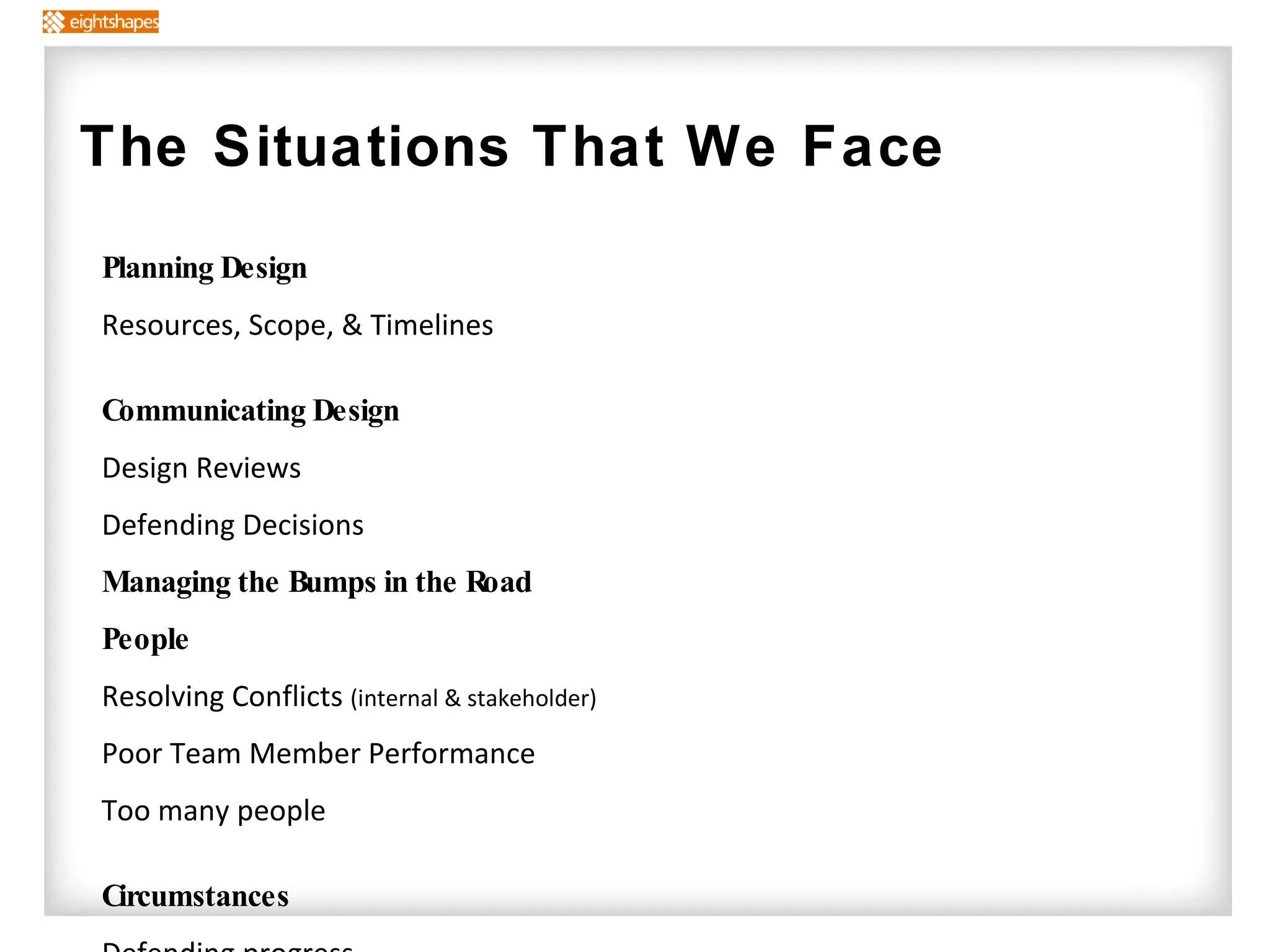
Planning Design Resources, Scope, & Timelines Communicating Design Design Reviews Defending Decisions Managing the Bumps in the Road People Resolving Conflicts  (internal & stakeholder) Poor Team Member Performance Too many people Circumstances Defending progress Losing Momentum  Project Failure The Situations That We Face
Sample Scenarios
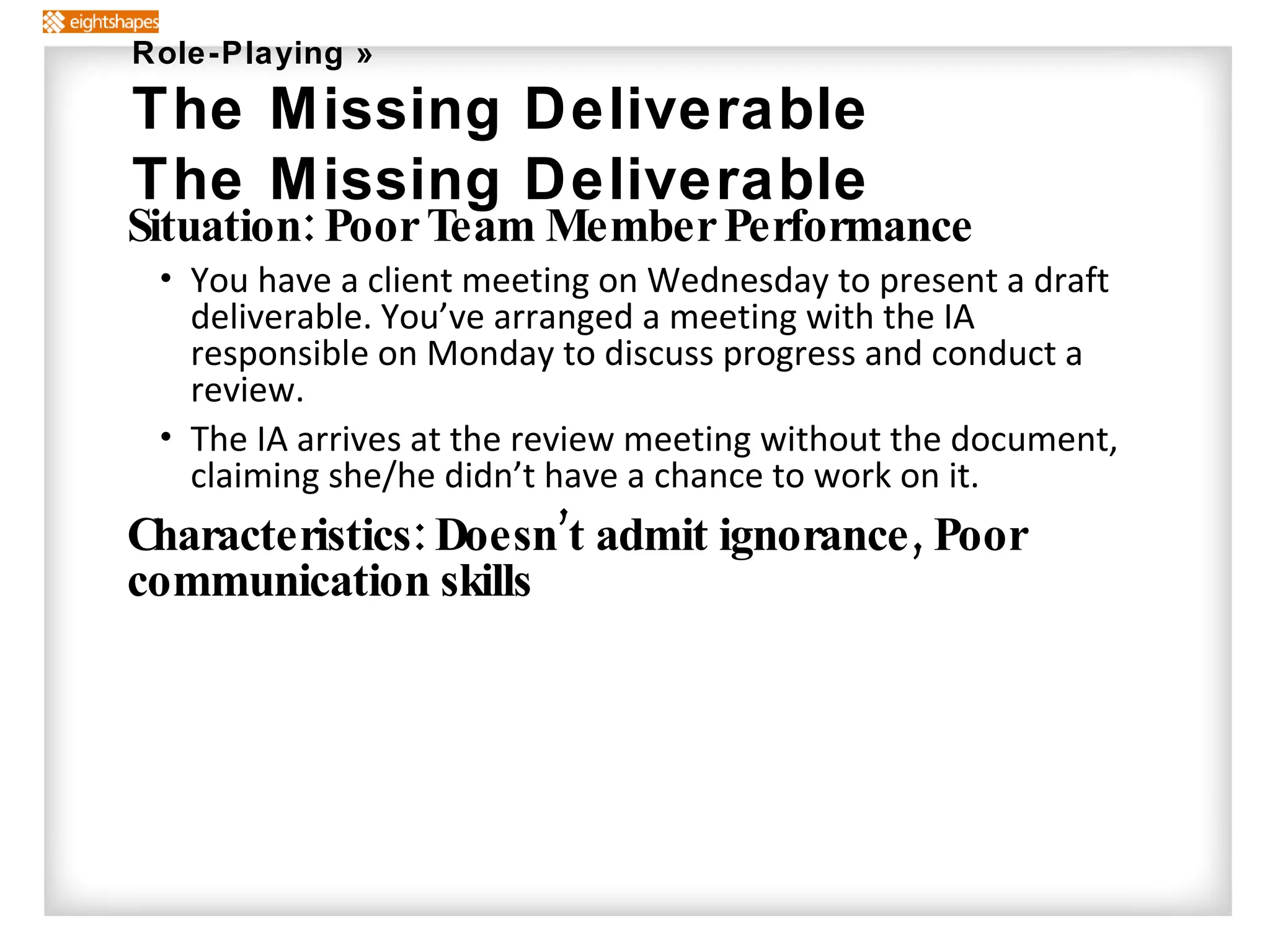
Situation: Poor Team Member Performance You have a client meeting on Wednesday to present a draft deliverable. You’ve arranged a meeting with the IA responsible on Monday to discuss progress and conduct a review. The IA arrives at the review meeting without the document, claiming she/he didn’t have a chance to work on it. Characteristics: Doesn’t admit ignorance, Poor communication skills Role-Playing » The Missing Deliverable The Missing Deliverable
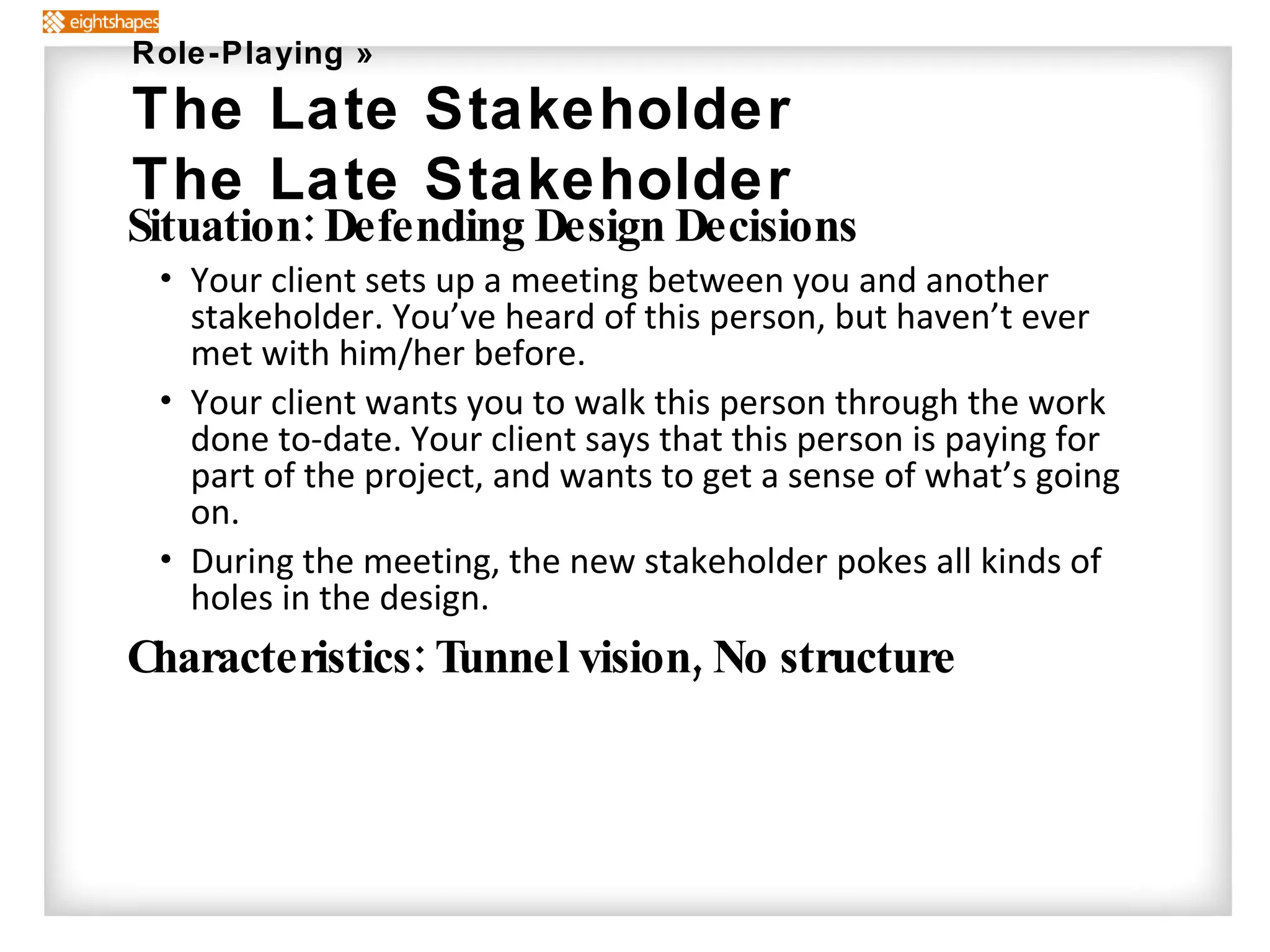
Situation: Defending Design Decisions Your client sets up a meeting between you and another stakeholder. You’ve heard of this person, but haven’t ever met with him/her before. Your client wants you to walk this person through the work done to-date. Your client says that this person is paying for part of the project, and wants to get a sense of what’s going on. During the meeting, the new stakeholder pokes all kinds of holes in the design. Characteristics: Tunnel vision, No structure Role-Playing » The Late Stakeholder The Late Stakeholder
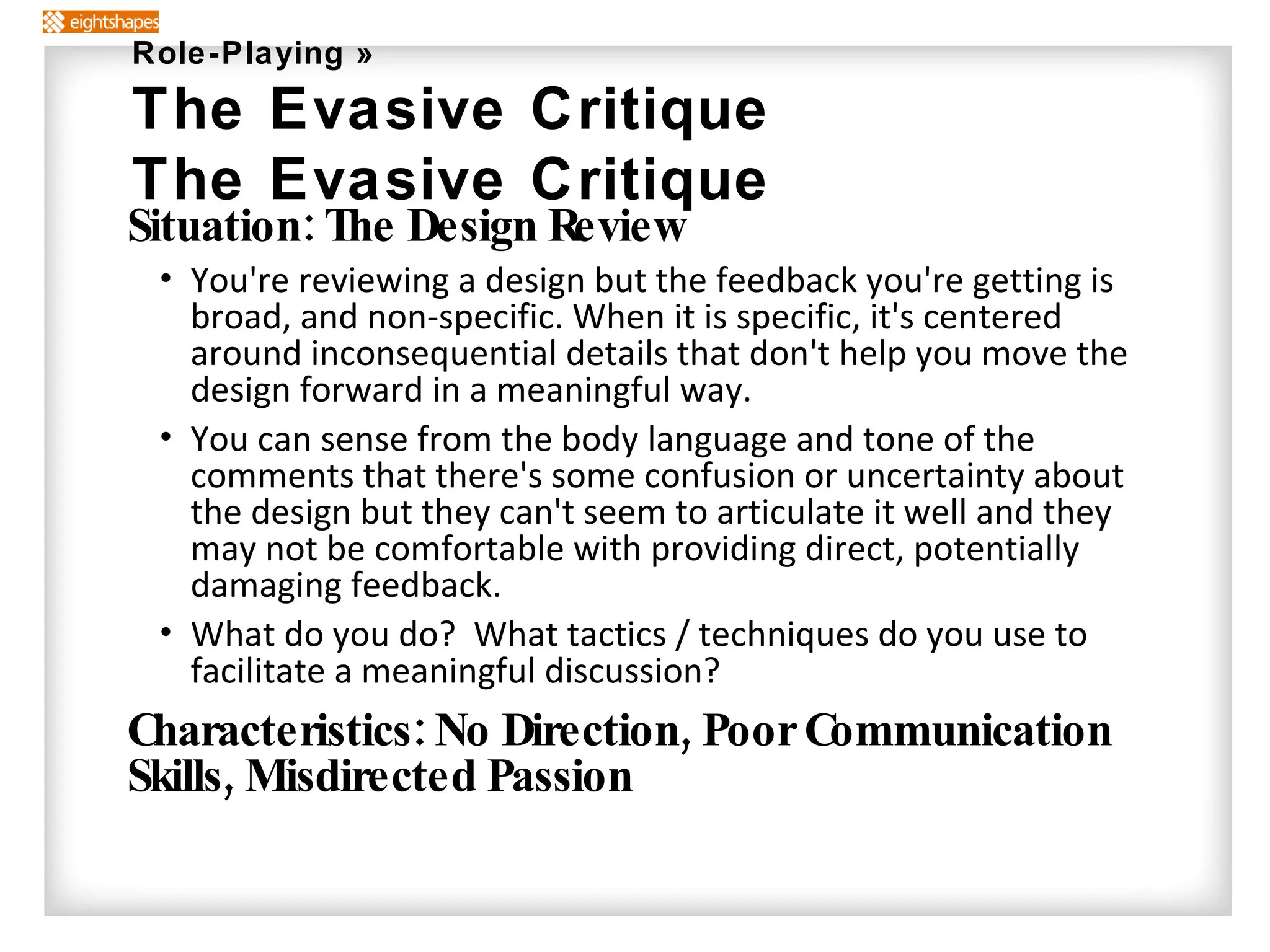
Situation: The Design Review You're reviewing a design but the feedback you're getting is broad, and non-specific. When it is specific, it's centered around inconsequential details that don't help you move the design forward in a meaningful way. You can sense from the body language and tone of the comments that there's some confusion or uncertainty about the design but they can't seem to articulate it well and they may not be comfortable with providing direct, potentially damaging feedback. What do you do?  What tactics / techniques do you use to facilitate a meaningful discussion? Characteristics: No Direction, Poor Communication Skills, Misdirected Passion Role-Playing » The Evasive Critique The Evasive Critique
A summary of skills and techniques discussed Tricks of the Trade the Trade
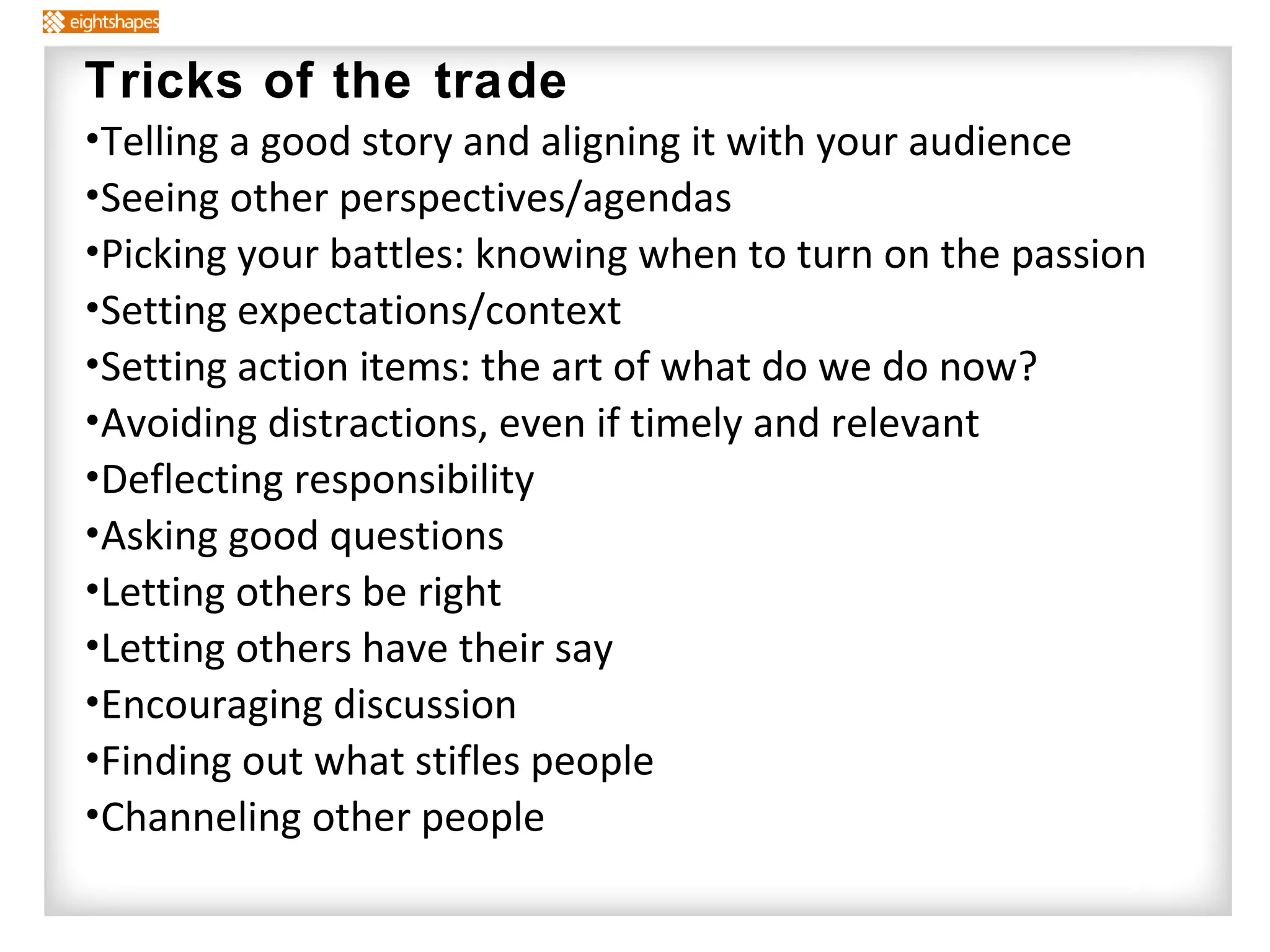
Tricks of the trade Telling a good story and aligning it with your audience Seeing other perspectives/agendas Picking your battles: knowing when to turn on the passion Setting expectations/context Setting action items: the art of what do we do now? Avoiding distractions, even if timely and relevant Deflecting responsibility Asking good questions Letting others be right Letting others have their say Encouraging discussion Finding out what stifles people Channeling other people
Thanks! Dan Brown • dan@eightshapes.com Chris Detzi • chris@eightshapes.com

Difficult Conversations in Creative Environments ~ IA Summit 2009

  • 1.
    Mastering Difficult ConversationsDan Brown & Chris Detzi EightShapes, LLC IA Summit 2009, Memphis, TN
  • 2.
  • 3.
    About Us Whowe are Why we’re here
  • 4.
    About You YourName Your Occupation Why you’re here
  • 5.
    Our Agenda Introductions done! Best Practices 15 minutes A Model 15 minutes The People 60 minutes The Situations 60 minutes Sample Scenarios 30 minutes Summary of Techniques 30 minutes
  • 6.
    Let’s Start withthe Basics the Basics Communication Best Practices
  • 7.
    Be Positive EngageYour Audience Empathize Lighten Up
  • 8.
    Rephrase the negativestatements Negative = "We can't start until we get requirements" Positive = "Please give us the requirements so we can start." Rise above the Naysayers “ We can’t do that.” “ That’s way to complicated.” Always Start with the Good “ What I like about this so far is....” Openness over Defensiveness “ I think that’s a great idea. Perhaps we can talk about it how it might work?” Communication Best Practices Be Positive
  • 9.
    Personalize the Message“ Great Question, Molly .” “ Jason , what do you think about that?” Repeat the Questions You’re Asked “ So the question is .... Did I get that right?” Position Your Questions for Success Use Humor Communication Best Practices Engage Your Audience
  • 10.
    Know the situations,not just the people Listen and Seek to Understand Don’t be quick to dismiss (even if you disagree) Respond with an acknowledgement of situation / emotion Communication Best Practices Empathize
  • 11.
    Humor can bea powerful communication tool Reduces anxiety and hostile moods Establishes a positive environment Helps “gauge” the audience Provides a way to make a point, without attacking Does not have to mean insincerity or frivolity Make it relevant Be on the lookout for material Prep & Plan (don’t assume it will just ‘come to you’) When in doubt, point to yourself Communication Best Practices Lighten Up
  • 12.
    A Site Mapof Communications A model for interpersonal interactions
  • 13.
    Difficult Conversations :: © Copyright EightShapes, LLC 2009
  • 14.
    Difficult Conversations :: © Copyright EightShapes, LLC 2009
  • 15.
    Difficult Conversations :: © Copyright EightShapes, LLC 2009
  • 16.
    Difficult Conversations :: © Copyright EightShapes, LLC 2009
  • 17.
    Difficult Conversations :: © Copyright EightShapes, LLC 2009
  • 18.
    Difficult Conversations :: © Copyright EightShapes, LLC 2009
  • 19.
    Difficult Conversations :: © Copyright EightShapes, LLC 2009
  • 20.
    Difficult Conversations :: © Copyright EightShapes, LLC 2009
  • 21.
    Difficult Conversations :: © Copyright EightShapes, LLC 2009
  • 22.
    Difficult Conversations :: © Copyright EightShapes, LLC 2009
  • 23.
    Common behaviors increative environments They’re the People that You Meet that You Meet
  • 24.
    What makes peoplehard to work with?
  • 25.
    No Direction Theycan’t tell you what’s wrong Symptoms Float with the wind Broad, non-specific or emotional feedback Fear conflict Techniques Be mindful of goals Separate yourself from the issue Ask good, specific questions
  • 26.
    Misdirected Passion Theyfeel strongly about the strangest things Symptoms reaction not commensurate with issue taking things personally Techniques See other perspectives/agendas Pick your battles Let others have their say Set expectations and explain context
  • 27.
    Inconsistent messaging Theytalk out of both sides of their mouth Symptoms “That’s not what we discussed...” “I don’t recall saying that specifically....” “Well he told me...” Techniques Bite your tongue (well, nibble it) Pick your battles Validate and capture messages
  • 28.
    Unwilling to admitignorance They get stuff wrong Symptoms outputs show misunderstanding “Let me try that again!” Techniques Deflect responsibility Avoid distractions
  • 29.
    No Vision Theydon’t know where they want to go Symptoms Willing to listen to any direction Can’t separate good from bad Techniques Ask good questions Find out what stifles their vision
  • 30.
    No Structure Theyare disorganized Symptoms unaware of project plan missing deadlines Techniques Define action items Set expectations and explain context
  • 31.
    No Strength Theyare easily taken off course Symptoms a new problem every week Techniques Avoid distractions Set expectations and explain context Remind of implications
  • 32.
    Not Available Eightypercent of success is showing up Symptoms missing meetings not responding to email Techniques Set action items Set expectations and explain context
  • 33.
    Tunnel Vision Otherthings get in the way of their view Symptoms refusal to compromise Techniques Ask good questions Let others have their say Tell a good story and align it with audience Deflect responsibility Set expectations and explain context
  • 34.
    Prioritize reputation Rathersave face than admit they're wrong Symptoms (might come with other habits, like lack of focus) Techniques Letting others be right Picking your battles Setting action items: how do we fix this?
  • 35.
    Poor communication skillsThey can't articulate concerns Symptoms rambling messages difficult to map/contextualize messages Techniques Ask good questions Define action items Find out what’s stifling
  • 36.
    Poor use ofcommunications tools They love love love love love email Symptoms long emails detailed project correspondence in IM tangents in meetings Techniques See other people's perspectives Find out what stifles them Redirect to another tool
  • 37.
    They’re the peoplethat you meet No direction Misdirected passion Inconsistent messaging Unwilling to admit ignorance No vision No structure No strength Not available Tunnel vision Prioritize reputation Poor communication skills Poor use of communication tools
  • 38.
    The situations weface and techniques to master them It’s Called Work Work
  • 39.
  • 40.
    The Challenge Thesize of the ‘stakeholder’ or interested party list is unwieldy and dramatically inhibiting progress. The Techniques Identify the Influencers and speak directly to them Don’t ask questions of the group, ask of specific individuals Provide channels for individual feedback, but publish for broader consumption Managing Bumps in The Road (Circumstances) Too Many People Involved
  • 41.
    The Challenge Theperformance of one or several team members is jeopardizing project success The Techniques First identify all of the positive aspects of the performance Avoid explicit and implicit personal attacks Coach don’t point Use Positive language Express confidence about abilities Managing Bumps in The Road (People) Poor Team Member Performance
  • 42.
    The Challenge Theproject is facing seemingly insurmountable complications, losing support, and overall confidence is waning The Techniques Get out of the Weeds Reminders of Why we’re here, What we’re doing Change the conversation; focus on Path Forward There’s Light at the End of the Tunnel Managing Bumps in The Road (Circumstances) Losing Momentum
  • 43.
    The Challenge Clarifyingand rationalizing design choices when challenged The Techniques Establish “common practices” before design exercise Pick your battles If supporting data isn’t there, explain the hypothesis Know Your why’s Make sure stakeholders are on the ride for the whole way Communicating Design Defending Decisions
  • 44.
    The Challenge CommunicatingDesign to varied interests and perspectives The Techniques See Others Perspectives / Agendas Identify the Influencers and speak directly to them Get Your Story Straight; Prep with the ‘Whys’ Pick Your Battles; know your give points Communicating Design Design Reviews
  • 45.
    The Challenge Creatinga shared understanding of scope, timelines, and accountability for a complex, multi-faceted design project The Techniques Prepare Questions for Success...and ask every one of them! Expose the Elephants Clarify & Set Expectations Confirm and Validate those Expectations Planning Design Resources, Scope, & Timelines
  • 46.
    The Challenge Divergent‘stakeholder’ (client) interests are inhibiting progress The internal team is not in agreement on the design direction The Techniques Work from a foundation of agreements Listen; understand the scope of the disagreements Focus on the positive aspects of each of the ‘approaches’ Remove personal interests from the equation Take it offline, if necessary (ideate with each person separately or collectively) Managing Bumps in The Road (People) Resolving Conflicts
  • 47.
    The Challenge Divergent‘stakeholder’ (client) interests are inhibiting progress The Techniques Work from a foundation of agreements Encourage discussion to arrive at the root disagreement Ideate with each stakeholder (collectively or separately) Focus on the business; take personal interests out of the equation Forward Focused Managing Bumps in The Road (People) Resolving Conflicts (among Stakeholders)
  • 48.
    The Challenge Theproverbial finger is pointing at you relative to lack of progress or missteps The Techniques Avoid the Situation through Proactive statusing and risk cataloging Don’t point -or deflect- the finger Facts and Objectivity are key Change the conversation; focus on path forward Managing Bumps in The Road (Circumstances) Defending Status & Progress
  • 49.
    The Challenge Despiteall of your best efforts, the project has failed The Techniques Communicate the reusable parts, not everything that was done was for naught Remind people of the good work that is still relevant Remain confident and upbeat Outline the Lessons and keep them at the ready Managing Bumps in The Road (Circumstances) Project Failure
  • 50.
    Planning Design Resources,Scope, & Timelines Communicating Design Design Reviews Defending Decisions Managing the Bumps in the Road People Resolving Conflicts (internal & stakeholder) Poor Team Member Performance Too many people Circumstances Defending progress Losing Momentum Project Failure The Situations That We Face
  • 51.
  • 52.
    Situation: Poor TeamMember Performance You have a client meeting on Wednesday to present a draft deliverable. You’ve arranged a meeting with the IA responsible on Monday to discuss progress and conduct a review. The IA arrives at the review meeting without the document, claiming she/he didn’t have a chance to work on it. Characteristics: Doesn’t admit ignorance, Poor communication skills Role-Playing » The Missing Deliverable The Missing Deliverable
  • 53.
    Situation: Defending DesignDecisions Your client sets up a meeting between you and another stakeholder. You’ve heard of this person, but haven’t ever met with him/her before. Your client wants you to walk this person through the work done to-date. Your client says that this person is paying for part of the project, and wants to get a sense of what’s going on. During the meeting, the new stakeholder pokes all kinds of holes in the design. Characteristics: Tunnel vision, No structure Role-Playing » The Late Stakeholder The Late Stakeholder
  • 54.
    Situation: The DesignReview You're reviewing a design but the feedback you're getting is broad, and non-specific. When it is specific, it's centered around inconsequential details that don't help you move the design forward in a meaningful way. You can sense from the body language and tone of the comments that there's some confusion or uncertainty about the design but they can't seem to articulate it well and they may not be comfortable with providing direct, potentially damaging feedback. What do you do?  What tactics / techniques do you use to facilitate a meaningful discussion? Characteristics: No Direction, Poor Communication Skills, Misdirected Passion Role-Playing » The Evasive Critique The Evasive Critique
  • 55.
    A summary ofskills and techniques discussed Tricks of the Trade the Trade
  • 56.
    Tricks of thetrade Telling a good story and aligning it with your audience Seeing other perspectives/agendas Picking your battles: knowing when to turn on the passion Setting expectations/context Setting action items: the art of what do we do now? Avoiding distractions, even if timely and relevant Deflecting responsibility Asking good questions Letting others be right Letting others have their say Encouraging discussion Finding out what stifles people Channeling other people
  • 57.
    Thanks! Dan Brown• dan@eightshapes.com Chris Detzi • chris@eightshapes.com