


EXPERT GUIDANCE: CONFLICT
RESOLUTION & DIFFICULT CLIENTS
Facilitated By: Richard Harbridge (@RHarbridge)
RICHARD
HARBRIDGE
My twitter is @RHarbridge, I’m super friendly & I am proud to work at 2toLead.
CTO & MVP | SPEAKER & AUTHOR | SUPER FRIENDLY
OUR GOAL TODAY…
Is basically to help you feel more confident and capable when it comes to managing, resolving
and tackling conflicts and difficult clients.
From Here To Here
MANAGERS DON’T ALWAYS RESOLVE…
The reality is that the vast majority of conflicts are not resolved by managers or account managers
etc. They are resolved by people working on projects or trying to build their network.
Three Quick Stories
1. Hostility & Aggression
2. Style & Management
3. Blame & Risk Aversion
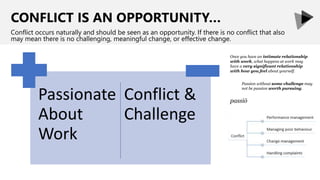
CONFLICT IS AN OPPORTUNITY…
Conflict occurs naturally and should be seen as an opportunity. If there is no conflict that also
may mean there is no challenging, meaningful change, or effective change.
Passionate
About
Work
Conflict &
Challenge
Once you have an intimate relationship
with work, what happens at work may
have a very significant relationship
with how you feel about yourself.
Passion without some challenge may
not be passion worth pursuing.
passiō
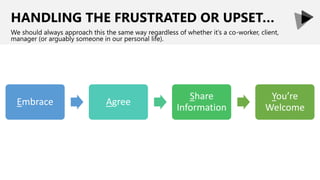
HANDLING THE FRUSTRATED OR UPSET…
We should always approach this the same way regardless of whether it’s a co-worker, client,
manager (or arguably someone in our personal life).
Embrace Agree
Share
Information
You’re
Welcome
HANDLING FRUSTRATED OR UPSET…
We should always approach this the same way regardless of whether it’s a co-worker, client,
manager (or arguably someone in our personal life).
1. If they come to you with an issue, frustration, or fear –
you want them to feel their feedback is embraced.
2. First appearances and initial reactions are often the cause
of most conflict escalation.
3. Don’t fold arms or be defensive, don’t lean back and be
‘taken aback’, instead take a welcoming posture, tone, and
expression.
HANDLING FRUSTRATED OR UPSET…
We should always approach this the same way regardless of whether it’s a co-worker, client,
manager (or arguably someone in our personal life).
1. You cannot win if it becomes an argument so never let it
become one.
2. What someone feels is never wrong.
3. If they don't feel like you understand how they feel, then
they will focus on communicating how they feel instead of
focusing on what is causing them to feel that way.
4. Facts, insights or interpretation can be wrong but we
always start from agreement “I can understand”, “You
have the right to be frustrated”, I would be frustrated if
that happened to me” etc.
HANDLING FRUSTRATED OR UPSET…
We should always approach this the same way regardless of whether it’s a co-worker, client,
manager (or arguably someone in our personal life).
1. Remember that you want them to share information, so prioritize listening
first, and then you can probe for more.
• "Would you mind if we take a step back for a moment? I would love to retrace how this might have
happened so that we can avoid things like this in the future."
• "I wonder; sometimes we see issues like this that come up because of X. Do you think that maybe..."
2. If you don’t fully understand it, then you should not try to convince them
of anything yet, as you might not resolve or address the issue even if you
resolve the conflict.
3. Complex conflicts are the ones A) where you will need to do further
exploration, or B) where the frustration is not accurately aligned with the
real root or cause of the problem.
4. The best way to convince a person is to get them to convince themselves.
Explore the causes with them, don’t confront.
HANDLING FRUSTRATED OR UPSET…
We should always approach this the same way regardless of whether it’s a co-worker, client,
manager (or arguably someone in our personal life).
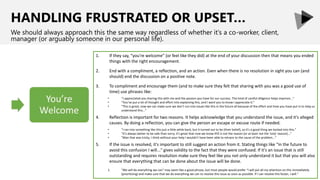
1. If they say, “you're welcome” (or feel like they did) at the end of your discussion then that means you ended
things with the right encouragement.
2. End with a compliment, a reflection, and an action. Even when there is no resolution in sight you can (and
should) end the discussion on a positive note.
3. To compliment and encourage them (and to make sure they felt that sharing with you was a good use of
time) use phrases like:
• “I appreciated you sharing this with me and the passion you have for our success. This kind of careful diligence helps improve..."
• “You’ve put a lot of thought and effort into explaining this, and I want you to know I appreciate it.”
• “This is great; now we can make sure we don’t run into issues like this in the future all because of the effort and time you have put in to help us
understand this...”
4. Reflection is important for two reasons. It helps acknowledge that you understand the issue, and it's alleged
causes. By doing a reflection, you can give the person an escape or excuse route if needed.
• "I ran into something like this just a little while back, but it turned out to be (their belief), so it's a good thing we looked into this."
• "It's always better to be safe than sorry; it's great that now we know XYZ is not the reason (or at least not the 'only' reason)..."
• "Man that was tricky, I think without your help I wouldn't have been able to retrace to the cause of the problem..."
5. If the issue is resolved, it's important to still suggest an action from it. Stating things like "In the future to
avoid this confusion I will..." gives validity to the fact that they were confused. If it's an issue that is still
outstanding and requires resolution make sure they feel like you not only understand it but that you will also
ensure that everything that can be done about the issue will be done.
1. “We will do everything we can” may seem like a good phrase, but most people would prefer “I will put all my attention on this immediately
(prioritizing) and make sure that we do everything we can to resolve this issue as soon as possible. If I can resolve this faster, I will.”
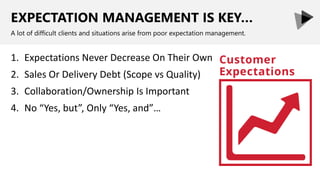
EXPECTATION MANAGEMENT IS KEY…
A lot of difficult clients and situations arise from poor expectation management.
1. Expectations Never Decrease On Their Own
2. Sales Or Delivery Debt (Scope vs Quality)
3. Collaboration/Ownership Is Important
4. No “Yes, but”, Only “Yes, and”…
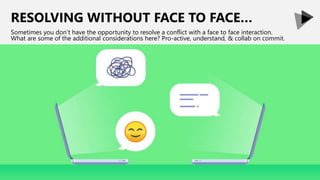
RESOLVING WITHOUT FACE TO FACE…
Sometimes you don’t have the opportunity to resolve a conflict with a face to face interaction.
What are some of the additional considerations here? Pro-active, understand, & collab on commit.
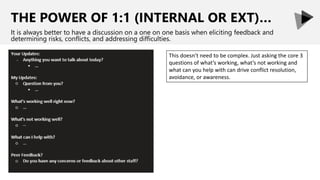
THE POWER OF 1:1 (INTERNAL OR EXT)…
It is always better to have a discussion on a one on one basis when eliciting feedback and
determining risks, conflicts, and addressing difficulties.
This doesn’t need to be complex. Just asking the core 3
questions of what’s working, what’s not working and
what can you help with can drive conflict resolution,
avoidance, or awareness.
THE POWER OF 1:1 (EXTERNAL)…
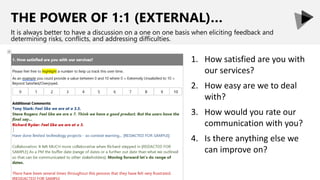
It is always better to have a discussion on a one on one basis when eliciting feedback and
determining risks, conflicts, and addressing difficulties.
1. How satisfied are you with
our services?
2. How easy are we to deal
with?
3. How would you rate our
communication with you?
4. Is there anything else we
can improve on?
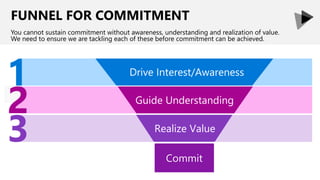
FUNNEL FOR COMMITMENT
You cannot sustain commitment without awareness, understanding and realization of value.
We need to ensure we are tackling each of these before commitment can be achieved.
1
3
Drive Interest/Awareness
Guide Understanding
Realize Value
2
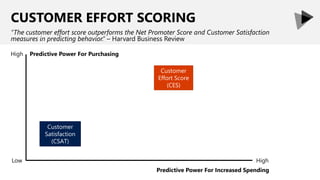
CUSTOMER EFFORT SCORING
“The customer effort score outperforms the Net Promoter Score and Customer Satisfaction
measures in predicting behavior.” – Harvard Business Review
High
Low High
Predictive Power For Increased Spending
Predictive Power For Purchasing
Customer
Satisfaction
(CSAT)
Customer
Effort Score
(CES)
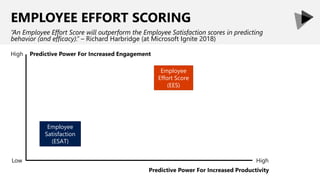
EMPLOYEE EFFORT SCORING
“An Employee Effort Score will outperform the Employee Satisfaction scores in predicting
behavior (and efficacy).” – Richard Harbridge (at Microsoft Ignite 2018)
High
Low High
Predictive Power For Increased Productivity
Predictive Power For Increased Engagement
Employee
Satisfaction
(ESAT)
Employee
Effort Score
(EES)
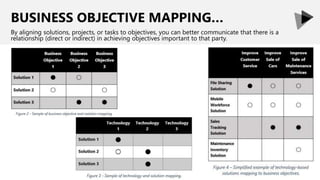
BUSINESS OBJECTIVE MAPPING…
By aligning solutions, projects, or tasks to objectives, you can better communicate that there is a
relationship (direct or indirect) in achieving objectives important to that party.
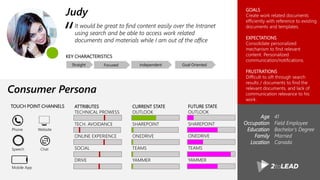
It would be great to find content easily over the Intranet
using search and be able to access work related
documents and materials while I am out of the office
GOALS
Create work related documents
efficiently with reference to existing
documents and templates.
EXPECTATIONS
Consolidate personalized
mechanism to find relevant
content. Personalized
communication/notifications.
FRUSTRATIONS
Difficult to sift through search
results / documents to find the
relevant documents, and lack of
communication relevance to his
work.
“
KEY CHARACTERISTICS
Age
Occupation
Education
Family
Location
41
Field Employee
Bachelor’s Degree
Married
Canada
FUTURE STATE
OUTLOOK
SHAREPOINT
ONEDRIVE
TEAMS
YAMMER
CURRENT STATE
OUTLOOK
SHAREPOINT
ONEDRIVE
TEAMS
YAMMER
Judy
Consumer Persona
Straight Focused independent
ATTRIBUTES
TECHNICAL PROWESS
TECH. AVOIDANCE
ONLINE EXPERIENCE
SOCIAL
DRIVE
TOUCH POINT CHANNELS
Phone Website
Speech Chat
Mobile App
Goal Oriented
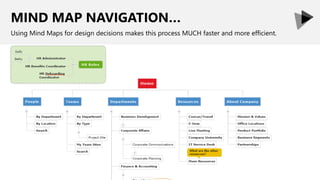
MIND MAP NAVIGATION…
Using Mind Maps for design decisions makes this process MUCH faster and more efficient.
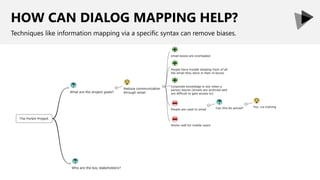
HOW CAN DIALOG MAPPING HELP?
Techniques like information mapping via a specific syntax can remove biases.
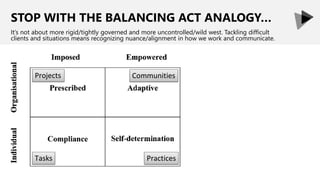
STOP WITH THE BALANCING ACT ANALOGY…
It’s not about more rigid/tightly governed and more uncontrolled/wild west. Tackling difficult
clients and situations means recognizing nuance/alignment in how we work and communicate.
Projects
Tasks
Communities
Practices
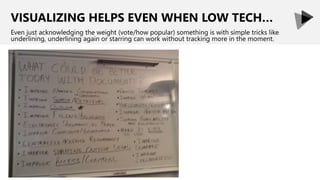
VISUALIZING HELPS EVEN WHEN LOW TECH…
Even just acknowledging the weight (vote/how popular) something is with simple tricks like
underlining, underlining again or starring can work without tracking more in the moment.
“SO WHAT” OR CONTEXT MATTERS A LOT…
Throughout the discussion ask – “So what” – why is this important?
THE POWER OF A STORY
Whether it be about the clever use of words or the power of misinformation.
Workshop Rules
Thank You!
Conestoga,Kate,&YouForMakingThisPossible…
200+AwesomePresentationsAt.. Slideshare.Net/RHarbridge
300+PagesOfWhitepapersAt.. 2toLead.com/Whitepapers
WhenToUseWhat.com Office365Intranets.com
Office365Metrics.com Office365Campaigns.com
Office365Extranets.com Office365Resources.com
Message Me On LinkedIn or Email Richard@2toLead.com
CTO & MVP | SPEAKER & AUTHOR | SUPER FRIENDLY
Let’s connect and find ways to do more and work together.

EXPERT GUIDANCE: CONFLICT RESOLUTION & DIFFICULT CLIENTS

  • 1.
    EXPERT GUIDANCE: CONFLICT RESOLUTION& DIFFICULT CLIENTS Facilitated By: Richard Harbridge (@RHarbridge)
  • 2.
    RICHARD HARBRIDGE My twitter is@RHarbridge, I’m super friendly & I am proud to work at 2toLead. CTO & MVP | SPEAKER & AUTHOR | SUPER FRIENDLY
  • 3.
    OUR GOAL TODAY… Isbasically to help you feel more confident and capable when it comes to managing, resolving and tackling conflicts and difficult clients. From Here To Here
  • 4.
    MANAGERS DON’T ALWAYSRESOLVE… The reality is that the vast majority of conflicts are not resolved by managers or account managers etc. They are resolved by people working on projects or trying to build their network. Three Quick Stories 1. Hostility & Aggression 2. Style & Management 3. Blame & Risk Aversion
  • 5.
    CONFLICT IS ANOPPORTUNITY… Conflict occurs naturally and should be seen as an opportunity. If there is no conflict that also may mean there is no challenging, meaningful change, or effective change. Passionate About Work Conflict & Challenge Once you have an intimate relationship with work, what happens at work may have a very significant relationship with how you feel about yourself. Passion without some challenge may not be passion worth pursuing. passiō
  • 6.
    HANDLING THE FRUSTRATEDOR UPSET… We should always approach this the same way regardless of whether it’s a co-worker, client, manager (or arguably someone in our personal life). Embrace Agree Share Information You’re Welcome
  • 7.
    HANDLING FRUSTRATED ORUPSET… We should always approach this the same way regardless of whether it’s a co-worker, client, manager (or arguably someone in our personal life). 1. If they come to you with an issue, frustration, or fear – you want them to feel their feedback is embraced. 2. First appearances and initial reactions are often the cause of most conflict escalation. 3. Don’t fold arms or be defensive, don’t lean back and be ‘taken aback’, instead take a welcoming posture, tone, and expression.
  • 8.
    HANDLING FRUSTRATED ORUPSET… We should always approach this the same way regardless of whether it’s a co-worker, client, manager (or arguably someone in our personal life). 1. You cannot win if it becomes an argument so never let it become one. 2. What someone feels is never wrong. 3. If they don't feel like you understand how they feel, then they will focus on communicating how they feel instead of focusing on what is causing them to feel that way. 4. Facts, insights or interpretation can be wrong but we always start from agreement “I can understand”, “You have the right to be frustrated”, I would be frustrated if that happened to me” etc.
  • 9.
    HANDLING FRUSTRATED ORUPSET… We should always approach this the same way regardless of whether it’s a co-worker, client, manager (or arguably someone in our personal life). 1. Remember that you want them to share information, so prioritize listening first, and then you can probe for more. • "Would you mind if we take a step back for a moment? I would love to retrace how this might have happened so that we can avoid things like this in the future." • "I wonder; sometimes we see issues like this that come up because of X. Do you think that maybe..." 2. If you don’t fully understand it, then you should not try to convince them of anything yet, as you might not resolve or address the issue even if you resolve the conflict. 3. Complex conflicts are the ones A) where you will need to do further exploration, or B) where the frustration is not accurately aligned with the real root or cause of the problem. 4. The best way to convince a person is to get them to convince themselves. Explore the causes with them, don’t confront.
  • 10.
    HANDLING FRUSTRATED ORUPSET… We should always approach this the same way regardless of whether it’s a co-worker, client, manager (or arguably someone in our personal life). 1. If they say, “you're welcome” (or feel like they did) at the end of your discussion then that means you ended things with the right encouragement. 2. End with a compliment, a reflection, and an action. Even when there is no resolution in sight you can (and should) end the discussion on a positive note. 3. To compliment and encourage them (and to make sure they felt that sharing with you was a good use of time) use phrases like: • “I appreciated you sharing this with me and the passion you have for our success. This kind of careful diligence helps improve..." • “You’ve put a lot of thought and effort into explaining this, and I want you to know I appreciate it.” • “This is great; now we can make sure we don’t run into issues like this in the future all because of the effort and time you have put in to help us understand this...” 4. Reflection is important for two reasons. It helps acknowledge that you understand the issue, and it's alleged causes. By doing a reflection, you can give the person an escape or excuse route if needed. • "I ran into something like this just a little while back, but it turned out to be (their belief), so it's a good thing we looked into this." • "It's always better to be safe than sorry; it's great that now we know XYZ is not the reason (or at least not the 'only' reason)..." • "Man that was tricky, I think without your help I wouldn't have been able to retrace to the cause of the problem..." 5. If the issue is resolved, it's important to still suggest an action from it. Stating things like "In the future to avoid this confusion I will..." gives validity to the fact that they were confused. If it's an issue that is still outstanding and requires resolution make sure they feel like you not only understand it but that you will also ensure that everything that can be done about the issue will be done. 1. “We will do everything we can” may seem like a good phrase, but most people would prefer “I will put all my attention on this immediately (prioritizing) and make sure that we do everything we can to resolve this issue as soon as possible. If I can resolve this faster, I will.”
  • 11.
    EXPECTATION MANAGEMENT ISKEY… A lot of difficult clients and situations arise from poor expectation management. 1. Expectations Never Decrease On Their Own 2. Sales Or Delivery Debt (Scope vs Quality) 3. Collaboration/Ownership Is Important 4. No “Yes, but”, Only “Yes, and”…
  • 12.
    RESOLVING WITHOUT FACETO FACE… Sometimes you don’t have the opportunity to resolve a conflict with a face to face interaction. What are some of the additional considerations here? Pro-active, understand, & collab on commit.
  • 13.
    THE POWER OF1:1 (INTERNAL OR EXT)… It is always better to have a discussion on a one on one basis when eliciting feedback and determining risks, conflicts, and addressing difficulties. This doesn’t need to be complex. Just asking the core 3 questions of what’s working, what’s not working and what can you help with can drive conflict resolution, avoidance, or awareness.
  • 14.
    THE POWER OF1:1 (EXTERNAL)… It is always better to have a discussion on a one on one basis when eliciting feedback and determining risks, conflicts, and addressing difficulties. 1. How satisfied are you with our services? 2. How easy are we to deal with? 3. How would you rate our communication with you? 4. Is there anything else we can improve on?
  • 15.
    FUNNEL FOR COMMITMENT Youcannot sustain commitment without awareness, understanding and realization of value. We need to ensure we are tackling each of these before commitment can be achieved. 1 3 Drive Interest/Awareness Guide Understanding Realize Value 2
  • 16.
    CUSTOMER EFFORT SCORING “Thecustomer effort score outperforms the Net Promoter Score and Customer Satisfaction measures in predicting behavior.” – Harvard Business Review High Low High Predictive Power For Increased Spending Predictive Power For Purchasing Customer Satisfaction (CSAT) Customer Effort Score (CES)
  • 17.
    EMPLOYEE EFFORT SCORING “AnEmployee Effort Score will outperform the Employee Satisfaction scores in predicting behavior (and efficacy).” – Richard Harbridge (at Microsoft Ignite 2018) High Low High Predictive Power For Increased Productivity Predictive Power For Increased Engagement Employee Satisfaction (ESAT) Employee Effort Score (EES)
  • 18.
    BUSINESS OBJECTIVE MAPPING… Byaligning solutions, projects, or tasks to objectives, you can better communicate that there is a relationship (direct or indirect) in achieving objectives important to that party.
  • 19.
    It would begreat to find content easily over the Intranet using search and be able to access work related documents and materials while I am out of the office GOALS Create work related documents efficiently with reference to existing documents and templates. EXPECTATIONS Consolidate personalized mechanism to find relevant content. Personalized communication/notifications. FRUSTRATIONS Difficult to sift through search results / documents to find the relevant documents, and lack of communication relevance to his work. “ KEY CHARACTERISTICS Age Occupation Education Family Location 41 Field Employee Bachelor’s Degree Married Canada FUTURE STATE OUTLOOK SHAREPOINT ONEDRIVE TEAMS YAMMER CURRENT STATE OUTLOOK SHAREPOINT ONEDRIVE TEAMS YAMMER Judy Consumer Persona Straight Focused independent ATTRIBUTES TECHNICAL PROWESS TECH. AVOIDANCE ONLINE EXPERIENCE SOCIAL DRIVE TOUCH POINT CHANNELS Phone Website Speech Chat Mobile App Goal Oriented
  • 20.
    MIND MAP NAVIGATION… UsingMind Maps for design decisions makes this process MUCH faster and more efficient.
  • 21.
    HOW CAN DIALOGMAPPING HELP? Techniques like information mapping via a specific syntax can remove biases.
  • 22.
    STOP WITH THEBALANCING ACT ANALOGY… It’s not about more rigid/tightly governed and more uncontrolled/wild west. Tackling difficult clients and situations means recognizing nuance/alignment in how we work and communicate. Projects Tasks Communities Practices
  • 23.
    VISUALIZING HELPS EVENWHEN LOW TECH… Even just acknowledging the weight (vote/how popular) something is with simple tricks like underlining, underlining again or starring can work without tracking more in the moment.
  • 24.
    “SO WHAT” ORCONTEXT MATTERS A LOT… Throughout the discussion ask – “So what” – why is this important?
  • 25.
    THE POWER OFA STORY Whether it be about the clever use of words or the power of misinformation.
  • 26.
  • 27.
    Thank You! Conestoga,Kate,&YouForMakingThisPossible… 200+AwesomePresentationsAt.. Slideshare.Net/RHarbridge 300+PagesOfWhitepapersAt..2toLead.com/Whitepapers WhenToUseWhat.com Office365Intranets.com Office365Metrics.com Office365Campaigns.com Office365Extranets.com Office365Resources.com Message Me On LinkedIn or Email Richard@2toLead.com CTO & MVP | SPEAKER & AUTHOR | SUPER FRIENDLY Let’s connect and find ways to do more and work together.

Editor's Notes

  • #3 Richard Harbridge is the Chief Technology Officer and an owner at 2toLead. Richard works as a trusted advisor with hundreds of organizations, helping them understand their current needs, their Soon needs, and what actions they should take in order to grow and achieve their bold ambitions.   Richard remains hands on in his work and has led, architected, and implemented hundreds of business and technology solutions that have helped organizations transform both digitally and organizationally. Richard has a passion for helping organizations achieve more; whether it is helping an organization build beautiful websites to support great content and social strategy, or helping an organization leverage emerging cloud and mobile technology to better service their members or the communities that they serve.   Richard is an author and an internationally recognized expert in Microsoft technology, marketing and professional services. As a sought-after speaker, Richard has often had the opportunity to share his insights, experiences, and advice around branding, partner management, social networking, collaboration, ROI,  technology/process adoption, and business development at numerous industry events in around the globe. When not speaking at industry events, Richard works with Microsoft, partners, and customers as an advisor around business and technology, and serves on multiple committees, leads user groups, and is a Board Member of the Microsoft Community Leadership Board.
  • #20 Provide personalized information and content to users based on employee groupings Dynamic, personalized Navigation that is driven by my usage patterns  personalize company and team news based on my interests
  • #26 Having a small card that asks someone to reuse their towel due to the benefits can have a positive impact. 35% of people typically do this as a result. 75% of people checking in for 4 nights or longer re-use their towel during their stay. “Please do so as well” – Towel use rises by 26%. 75% of people staying in this room reused their towel… ‘33% increase‘ in re-use. Leads to even more re-use. Point to what similar ‘other people’ are doing. When Radar was invented in the 1940’s – the british royal airforce created a rumour that the pilots ate lots of carrots to see better at night. That’s where it comes from…
  • #27  There is no authority in Discovery – everyone is equal