
INTRODUCTION TO WAVES
IGCSE Physics Notes
By Allen Tobve
SYLLABUS CONTENT
1. WAVES
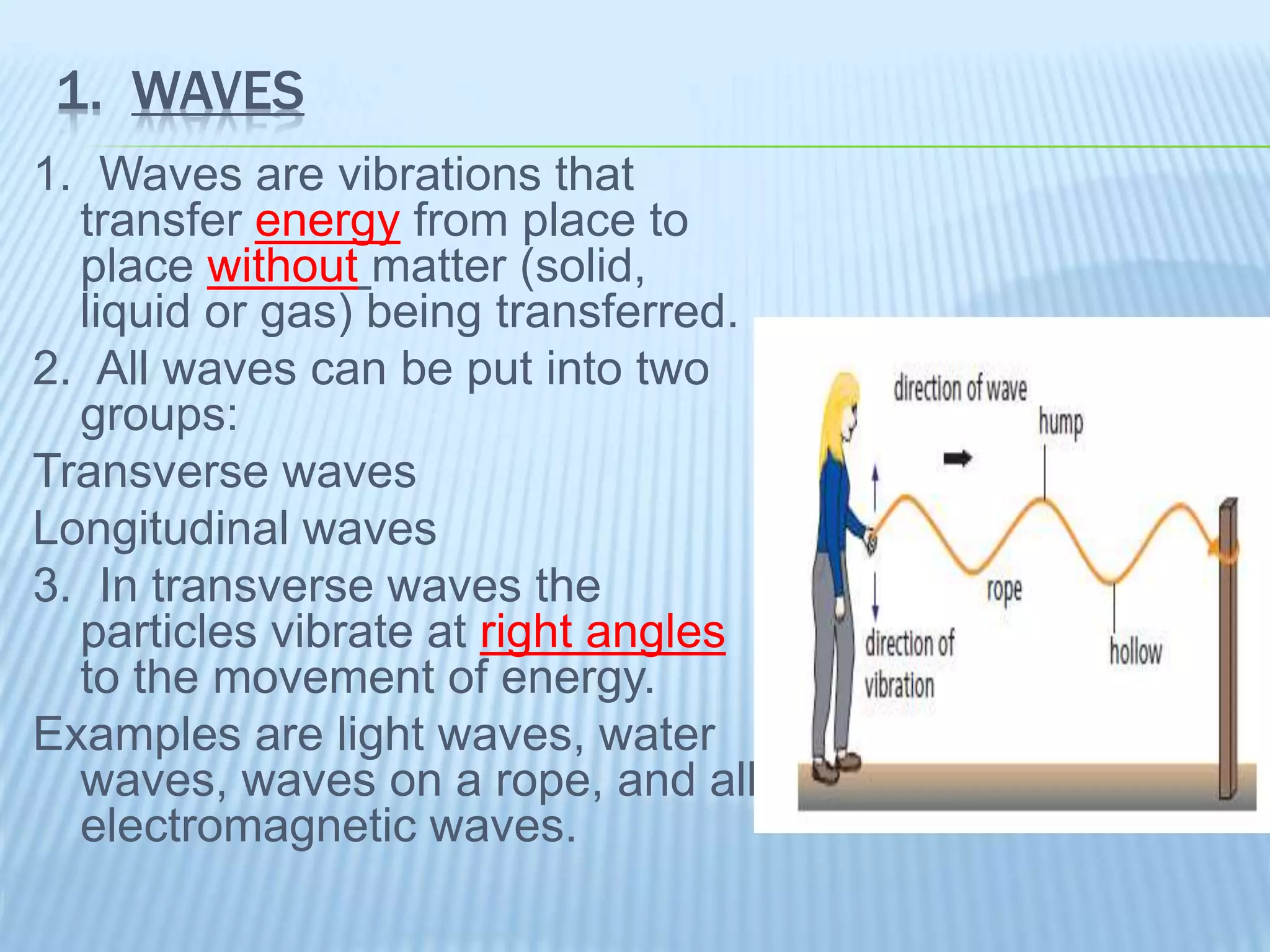
1. Waves are vibrations that
transfer energy from place to
place without matter (solid,
liquid or gas) being transferred.
2. All waves can be put into two
groups:
Transverse waves
Longitudinal waves
3. In transverse waves the
particles vibrate at right angles
to the movement of energy.
Examples are light waves, water
waves, waves on a rope, and all
electromagnetic waves.
GENERAL PROPERTIES OF WAVES
In a longitudinal wave, the vibrations are parallel to the direction in which the wave
is travelling e.g. waves on a slinky, or sound waves.
(a) Shows a longitudinal wave in a slinky, the hand moves left and right, making the
coils move left and right.
(b) Shows a transverse wave in a slinky, the hand moves up and down, making the
coils move up and down.
Energy is transported from left to right.
http://www.absorblearning.com/media/attachment.action?quick=88&att=584
http://www.absorblearning.com/media/attachment.action?quick=86&att=580
http://www.absorblearning.com/media/attachment.action?quick=14x&att=2935
http://www.absorblearning.com/media/attachment.action?quick=151&att=2943
Links
2. DESCRIBING WAVES
A displacement-distance graph and a displacement-
time graph may be drawn for a transverse wave.
A displacement-distance graph shows
how the particles of the medium are
displaced from their undisturbed positions
with distance along the wave at a
particular moment in time.
A displacement-time graph shows the
displacement of one particle in the
medium with time, as the wave travels
through it.
This is similar to a cork moving up and
down as waves pass under it.
(a) Displacement is how far a particle has moved from its rest or
undisturbed position in a specified direction.
(b) Amplitude is the maximum displacement of a particle from
its undisturbed position.
(c) Wavelength λ is the distance between successive crests or
between successive troughs, (or the distance between two
consecutive particles in a wave moving in phase).
(d) Phase
Two identical masses vibrating on two identical springs oscillate
in phase when they are moving in the same direction and are
always at the same point in the oscillation.
If one of the masses starts to oscillate half a cycle behind the
other, the masses oscillate out of phase by 180° , and are
moving in opposite directions.
(a) The period T is the time taken to make one
complete wave.
(b) Frequency f is the number of waves produced
per second, or the number of waves passing a
point in one second. Frequency is measured in
hertz (Hz).
A wave-front is a surface on a wave joining points
which are moving in phase, e.g. a line along the
crest of a wave as it moves forward.
A line drawn at right angles to a wavefront, which
shows its direction of travel, is called a ray.
THE WAVE EQUATION
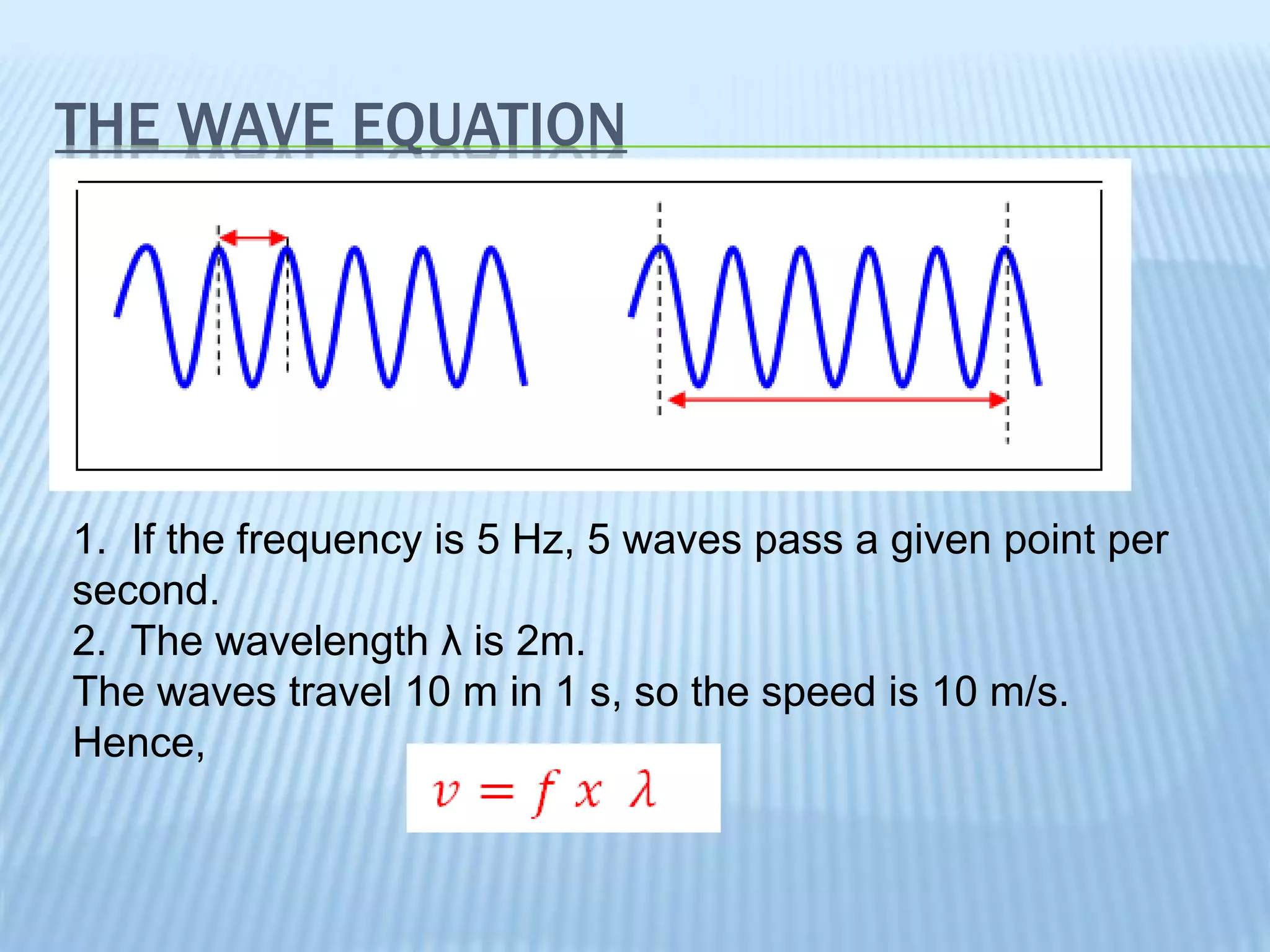
1. If the frequency is 5 Hz, 5 waves pass a given point per
second.
2. The wavelength λ is 2m.
The waves travel 10 m in 1 s, so the speed is 10 m/s.
Hence,
THE RIPPLE TANK
The behaviour of
water waves can be
studied in a ripple
tank.
A vibrating straight
wooden bar produces
straight waves when it
touches the water.
Circular waves are
produced by a
vibrating ball dipper
touching the water
surface.
THE RIPPLE TANK
Reflection
Waves bounce away from the surface at the
same angle they strike it, (angle of incidence
= angle of reflection).
The perpendicular to the strip at the point
where the incident ray strikes is called the
Normal.
REFLECTION
Circular waves are
reflected from a
straight surface as if
they come from a
point behind the
surface which is the
same distance behind
the surface as the
source is in front of the
surface.
REFRACTION
A glass plate is placed in a
ripple tank so that the water
over the glass plate is about
1 mm deep but is 5 mm deep
elsewhere
The direction of the waves
changes when the waves strike
the water at an angle of
incidence other than 0°.
The wavelength and speed are
reduced in the shallow water but
the frequency is unchanged.
DIFFRACTION
This is the spreading of waves
when they pass through a gap,
or when they pass by the edge
of an obstacle.
Diffraction is increased if the
size of the gap is about the
same as the wavelength.
There is no change in
wavelength and speed.
QUESTIONS
1. What do waves do?
2. Explain the difference between a transverse wave and a
longitudinal wave. Give two examples of each type of wave.
3. Define
(a) displacement,
(b) amplitude,
(c) wavelength,
(d) the frequency of a wave.
4. (a) Draw a side view of two complete waves of amplitude
1.5cm and wavelength 3 cm.
(b) If the speed of the wave is 15 cm/s, find the frequency.
5. A displacement-distance graph of a water wave is shown.
(a) What is the amplitude?
(b) What is the wavelength?
(c) If the frequency 5 Hz, find the speed of
the wave.
6. Draw a diagram to show how circular waves are reflected from a
straight surface. Label the incident and reflected wavefronts.
7. The distance across 5 waves in a ripple tank is 15 cm and the
waves travel 25.2 cm in 1.2 s. Calculate
(a) the wavelength
(b) the speed and
(c) the frequency of the waves.
8. Water waves are passing from shallow water to deep water.
The waves meet the surface at an angle. Draw a diagram to
show how the waves are refracted.
THE
END

Topic 3 waves

  • 1.
    INTRODUCTION TO WAVES IGCSEPhysics Notes By Allen Tobve
  • 2.
  • 3.
    1. WAVES 1. Wavesare vibrations that transfer energy from place to place without matter (solid, liquid or gas) being transferred. 2. All waves can be put into two groups: Transverse waves Longitudinal waves 3. In transverse waves the particles vibrate at right angles to the movement of energy. Examples are light waves, water waves, waves on a rope, and all electromagnetic waves.
  • 4.
    GENERAL PROPERTIES OFWAVES In a longitudinal wave, the vibrations are parallel to the direction in which the wave is travelling e.g. waves on a slinky, or sound waves. (a) Shows a longitudinal wave in a slinky, the hand moves left and right, making the coils move left and right. (b) Shows a transverse wave in a slinky, the hand moves up and down, making the coils move up and down. Energy is transported from left to right.
  • 5.
  • 6.
    2. DESCRIBING WAVES Adisplacement-distance graph and a displacement- time graph may be drawn for a transverse wave. A displacement-distance graph shows how the particles of the medium are displaced from their undisturbed positions with distance along the wave at a particular moment in time. A displacement-time graph shows the displacement of one particle in the medium with time, as the wave travels through it. This is similar to a cork moving up and down as waves pass under it.
  • 7.
    (a) Displacement ishow far a particle has moved from its rest or undisturbed position in a specified direction. (b) Amplitude is the maximum displacement of a particle from its undisturbed position. (c) Wavelength λ is the distance between successive crests or between successive troughs, (or the distance between two consecutive particles in a wave moving in phase). (d) Phase Two identical masses vibrating on two identical springs oscillate in phase when they are moving in the same direction and are always at the same point in the oscillation. If one of the masses starts to oscillate half a cycle behind the other, the masses oscillate out of phase by 180° , and are moving in opposite directions.
  • 8.
    (a) The periodT is the time taken to make one complete wave. (b) Frequency f is the number of waves produced per second, or the number of waves passing a point in one second. Frequency is measured in hertz (Hz). A wave-front is a surface on a wave joining points which are moving in phase, e.g. a line along the crest of a wave as it moves forward. A line drawn at right angles to a wavefront, which shows its direction of travel, is called a ray.
  • 9.
    THE WAVE EQUATION 1.If the frequency is 5 Hz, 5 waves pass a given point per second. 2. The wavelength λ is 2m. The waves travel 10 m in 1 s, so the speed is 10 m/s. Hence,
  • 10.
    THE RIPPLE TANK Thebehaviour of water waves can be studied in a ripple tank. A vibrating straight wooden bar produces straight waves when it touches the water. Circular waves are produced by a vibrating ball dipper touching the water surface.
  • 11.
    THE RIPPLE TANK Reflection Wavesbounce away from the surface at the same angle they strike it, (angle of incidence = angle of reflection). The perpendicular to the strip at the point where the incident ray strikes is called the Normal.
  • 12.
    REFLECTION Circular waves are reflectedfrom a straight surface as if they come from a point behind the surface which is the same distance behind the surface as the source is in front of the surface.
  • 13.
    REFRACTION A glass plateis placed in a ripple tank so that the water over the glass plate is about 1 mm deep but is 5 mm deep elsewhere The direction of the waves changes when the waves strike the water at an angle of incidence other than 0°. The wavelength and speed are reduced in the shallow water but the frequency is unchanged.
  • 14.
    DIFFRACTION This is thespreading of waves when they pass through a gap, or when they pass by the edge of an obstacle. Diffraction is increased if the size of the gap is about the same as the wavelength. There is no change in wavelength and speed.
  • 15.
    QUESTIONS 1. What dowaves do? 2. Explain the difference between a transverse wave and a longitudinal wave. Give two examples of each type of wave. 3. Define (a) displacement, (b) amplitude, (c) wavelength, (d) the frequency of a wave. 4. (a) Draw a side view of two complete waves of amplitude 1.5cm and wavelength 3 cm. (b) If the speed of the wave is 15 cm/s, find the frequency.
  • 16.
    5. A displacement-distancegraph of a water wave is shown. (a) What is the amplitude? (b) What is the wavelength? (c) If the frequency 5 Hz, find the speed of the wave.
  • 17.
    6. Draw adiagram to show how circular waves are reflected from a straight surface. Label the incident and reflected wavefronts. 7. The distance across 5 waves in a ripple tank is 15 cm and the waves travel 25.2 cm in 1.2 s. Calculate (a) the wavelength (b) the speed and (c) the frequency of the waves. 8. Water waves are passing from shallow water to deep water. The waves meet the surface at an angle. Draw a diagram to show how the waves are refracted.
  • 18.