This document provides an overview of cluster computing. It defines a cluster as a group of loosely coupled computers that work together closely to function as a single computer. Clusters improve speed and reliability over a single computer and are more cost-effective. Each node has its own operating system, memory, and sometimes file system. Programs use message passing to transfer data and execution between nodes. Clusters can provide low-cost parallel processing for applications that can be distributed. The document discusses cluster architecture, components, applications, and compares clusters to grids and cloud computing.
Overview of the presentation and key topics: introduction, history, architecture, types, components, and applications of cluster computing.
Cluster computing involves interconnected computers enhancing speed and reliability. Nodes communicate via message passing, making it cost-effective for parallel processing.
Tracks developments in cluster computing from early products like ARCnet in 1977 to modern packages from major tech companies.
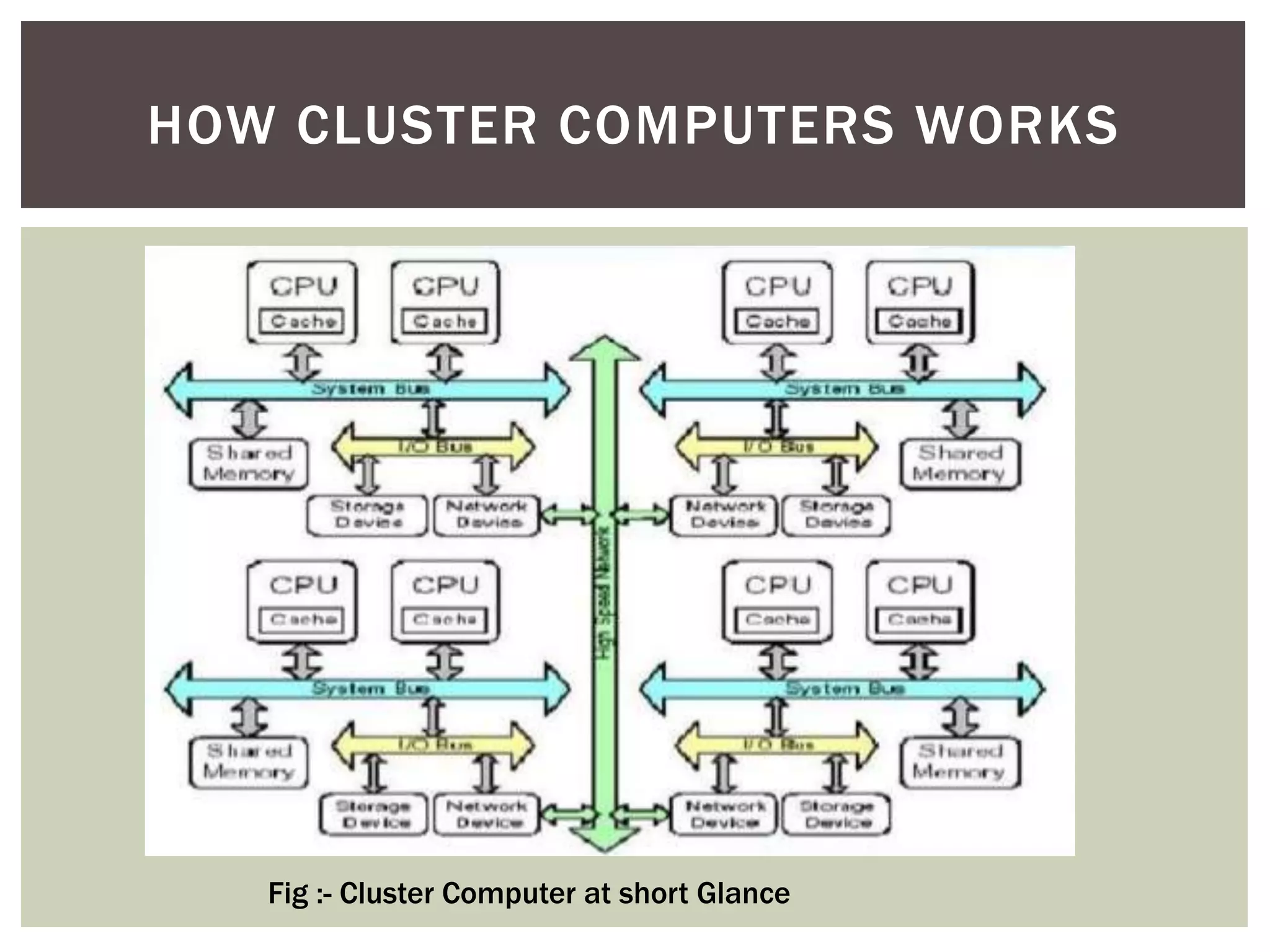
Clusters comprise interconnected stand-alone computers. A node contains its own systems creating a unified computing resource.
Clusters employ high-speed connections allowing inter-machine communication, enhancing processing and data exchange.
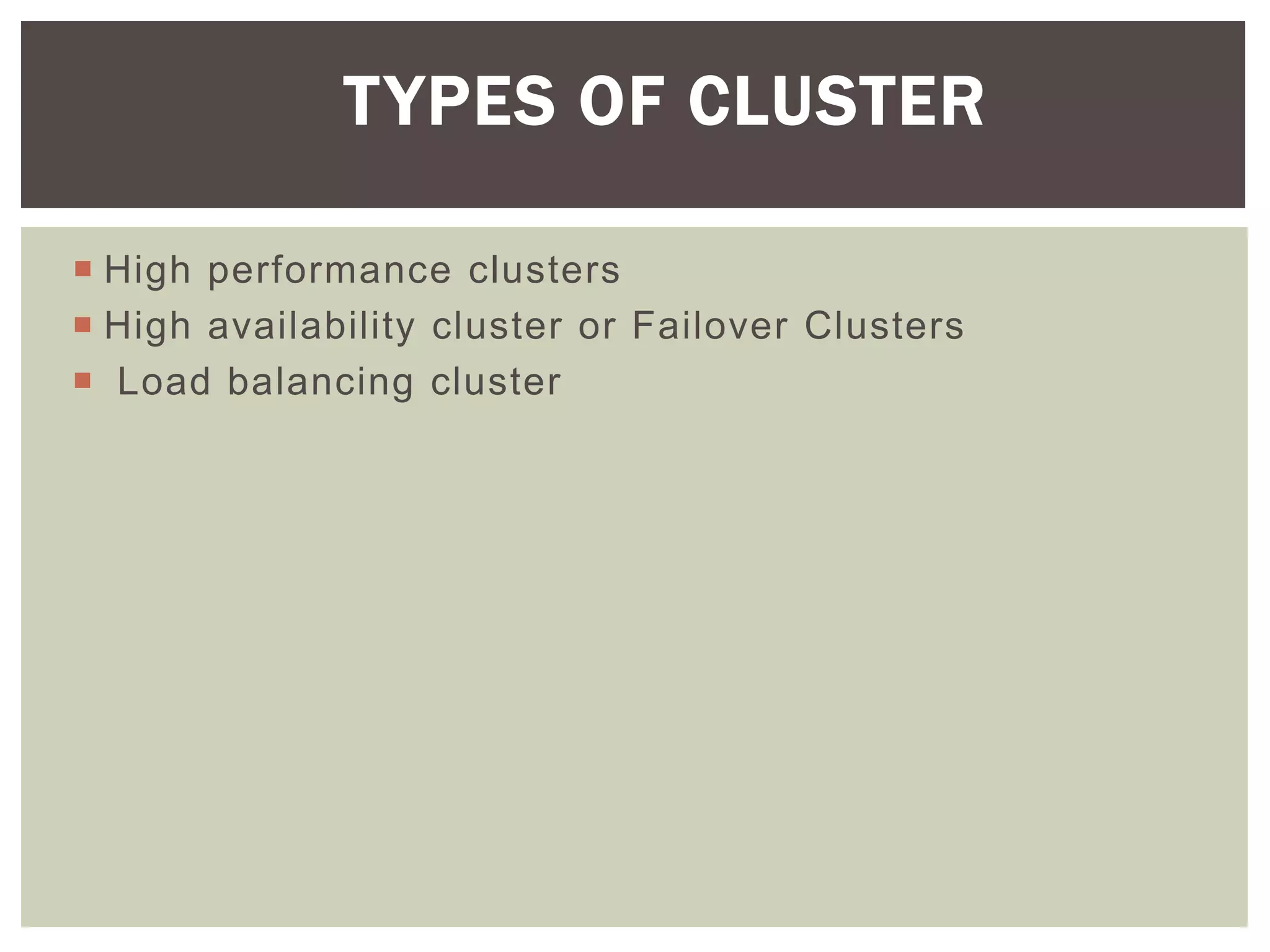
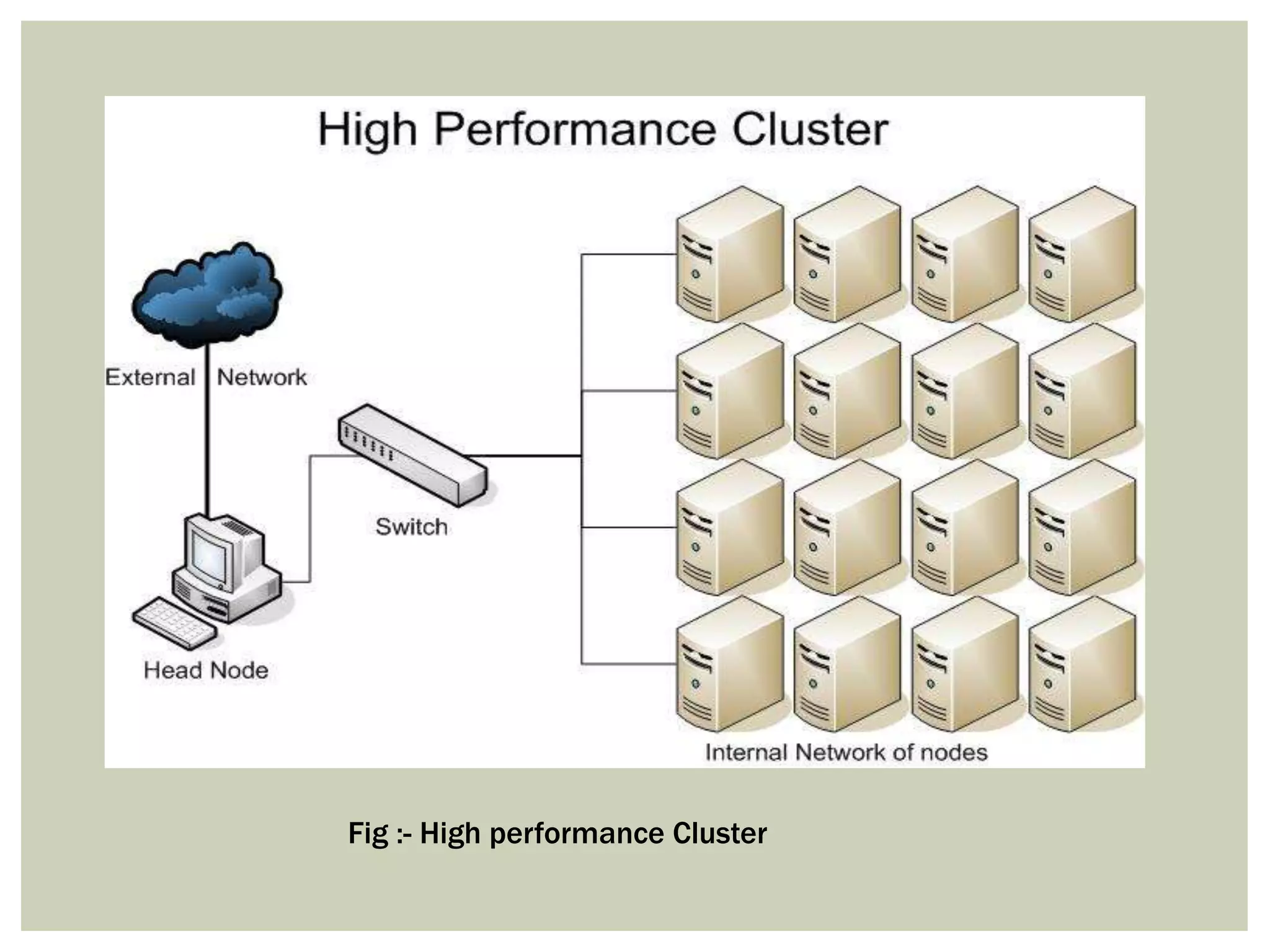
Different cluster types: high-performance clusters, high availability clusters, and load balancing clusters.
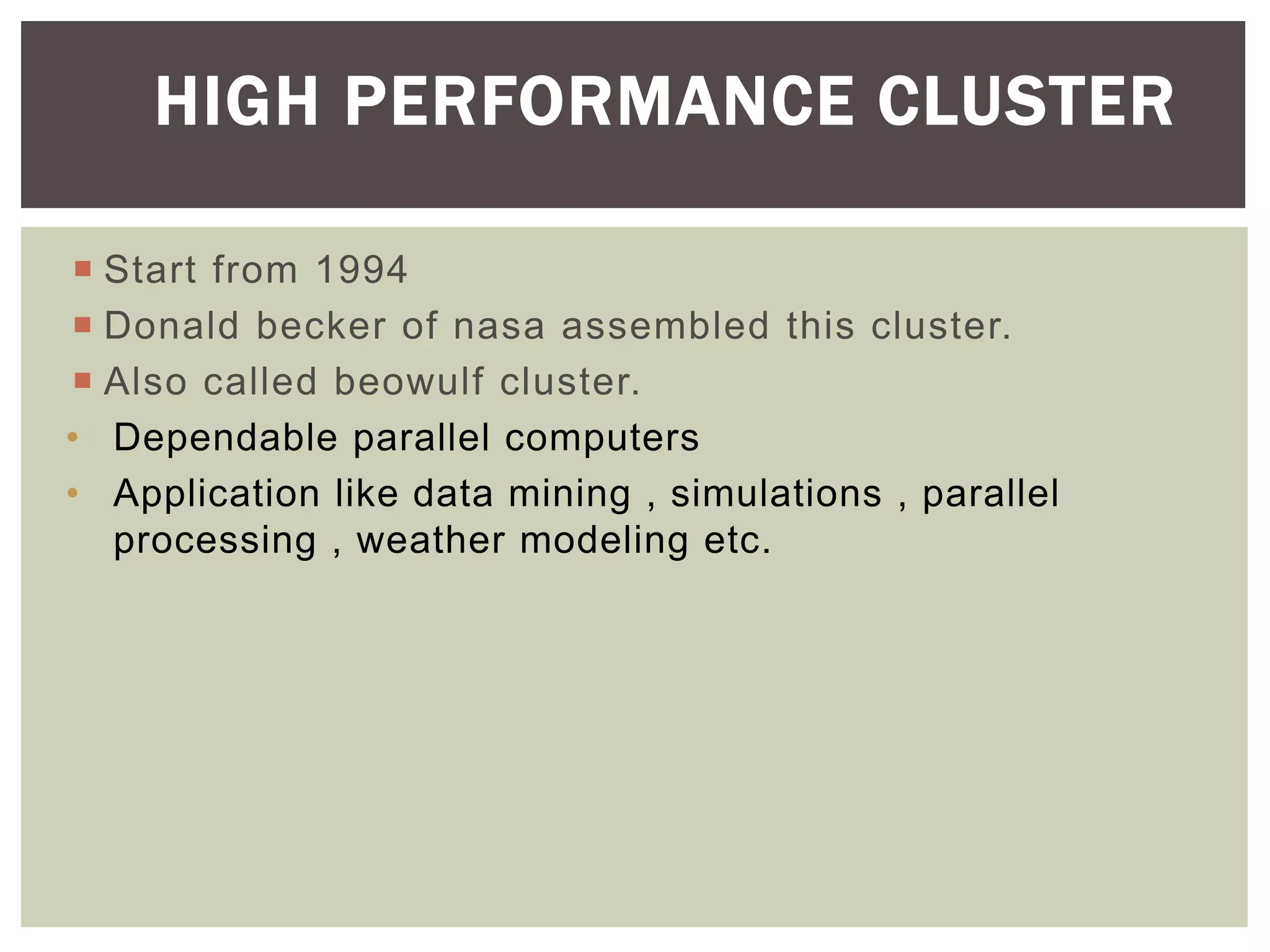
Introduces Beowulf clusters established for parallel applications like data mining and simulations since 1994.
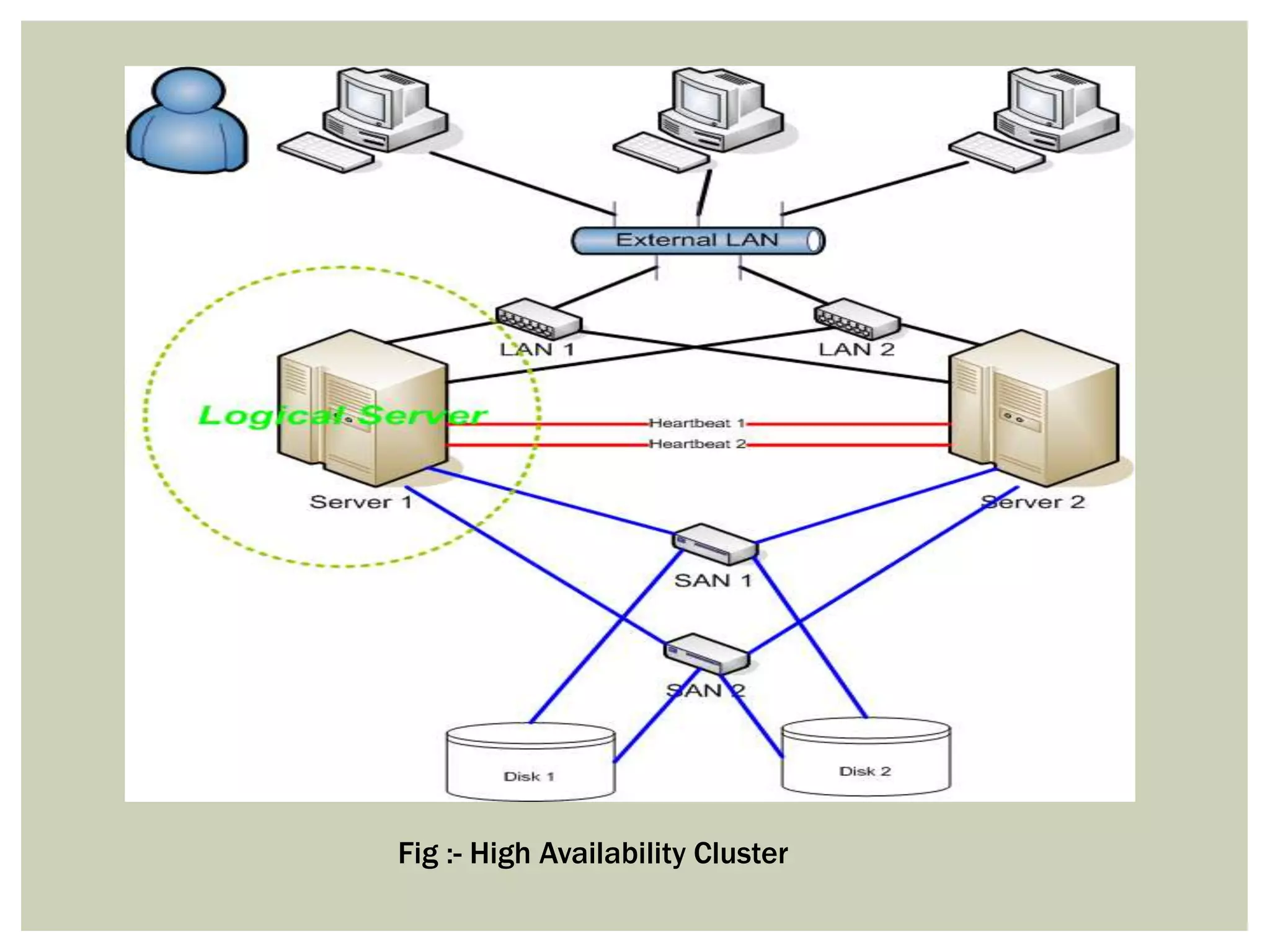
Focus on uninterrupted service through redundancy, comprising primary and backup nodes to avoid single points of failure.
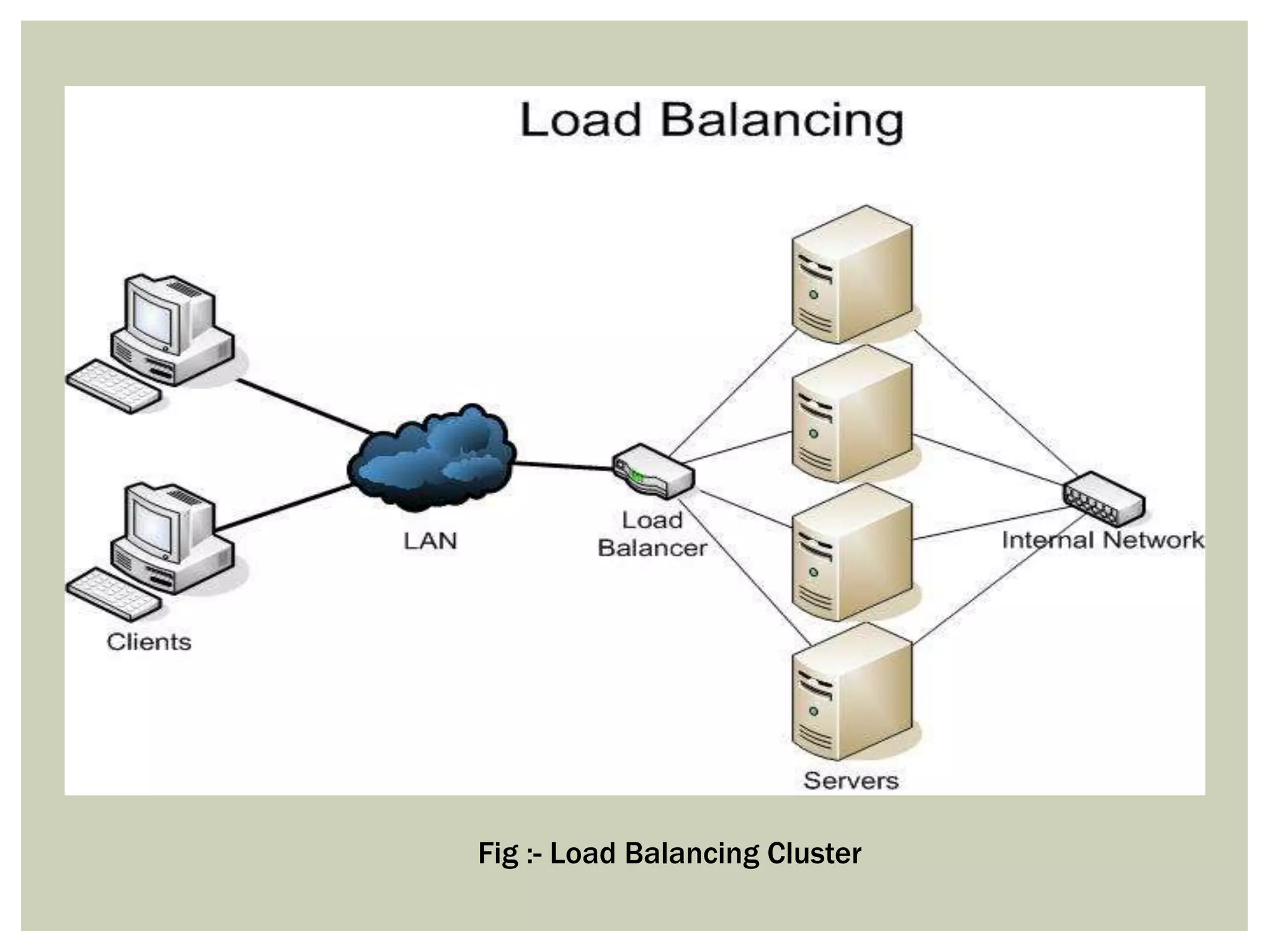
Clusters ensure performance through load balancing, distributing requests among multiple nodes to handle the same application.
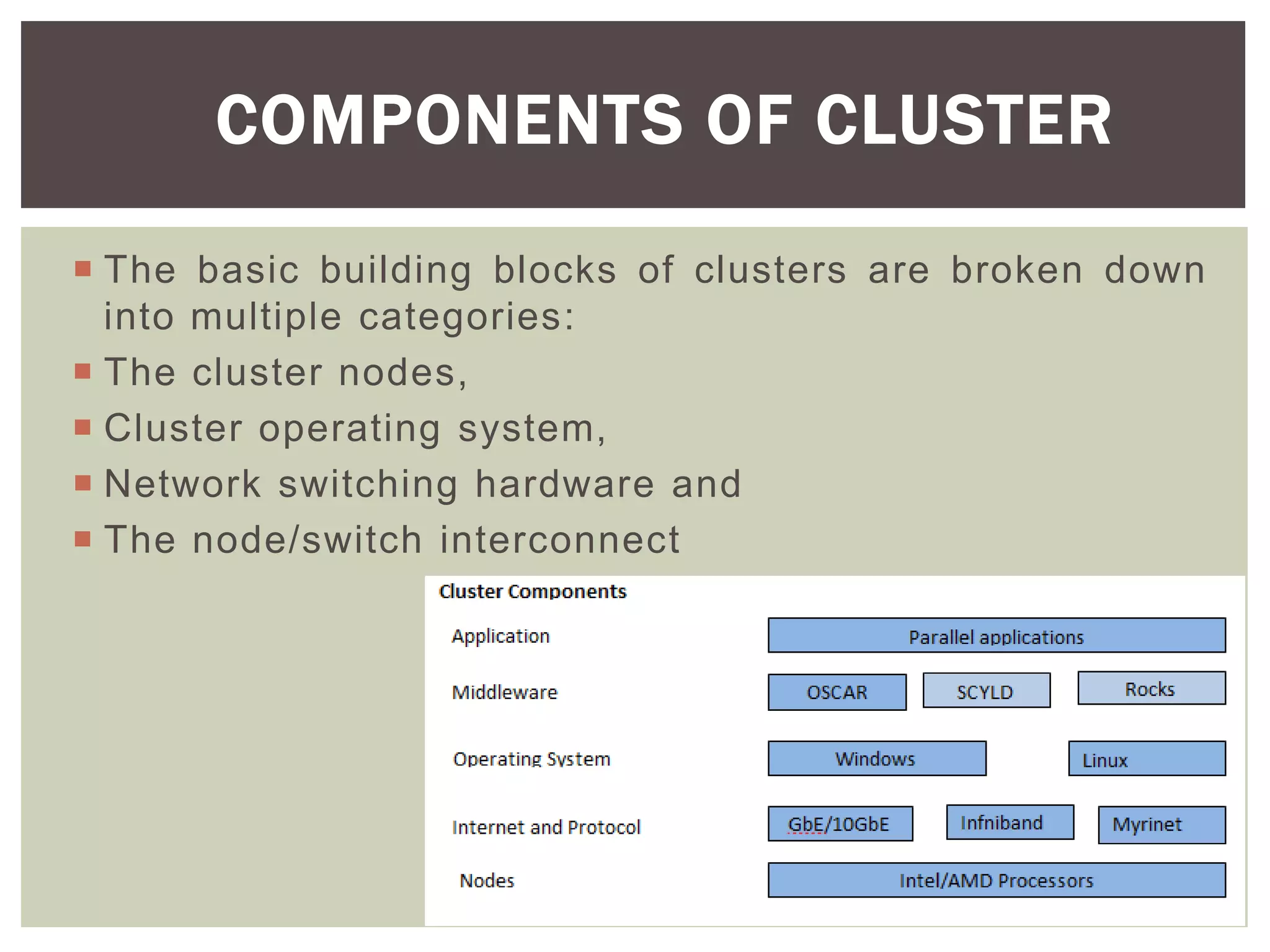
Essential elements of clusters include nodes, operating systems, network switching hardware, and node interconnects.
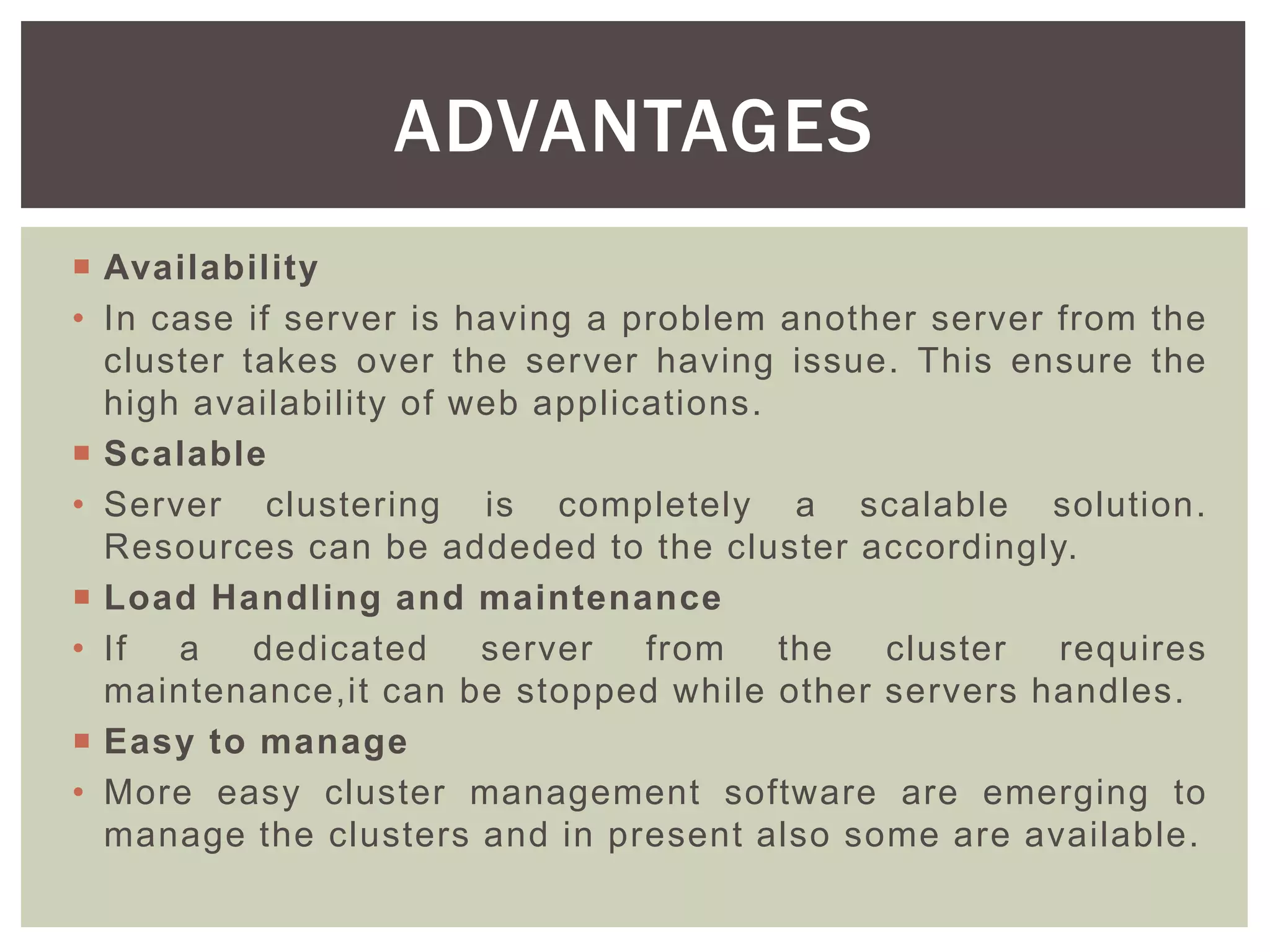
Benefits include high availability, scalability, and simplified management, ensuring continuous operation and resource handling.
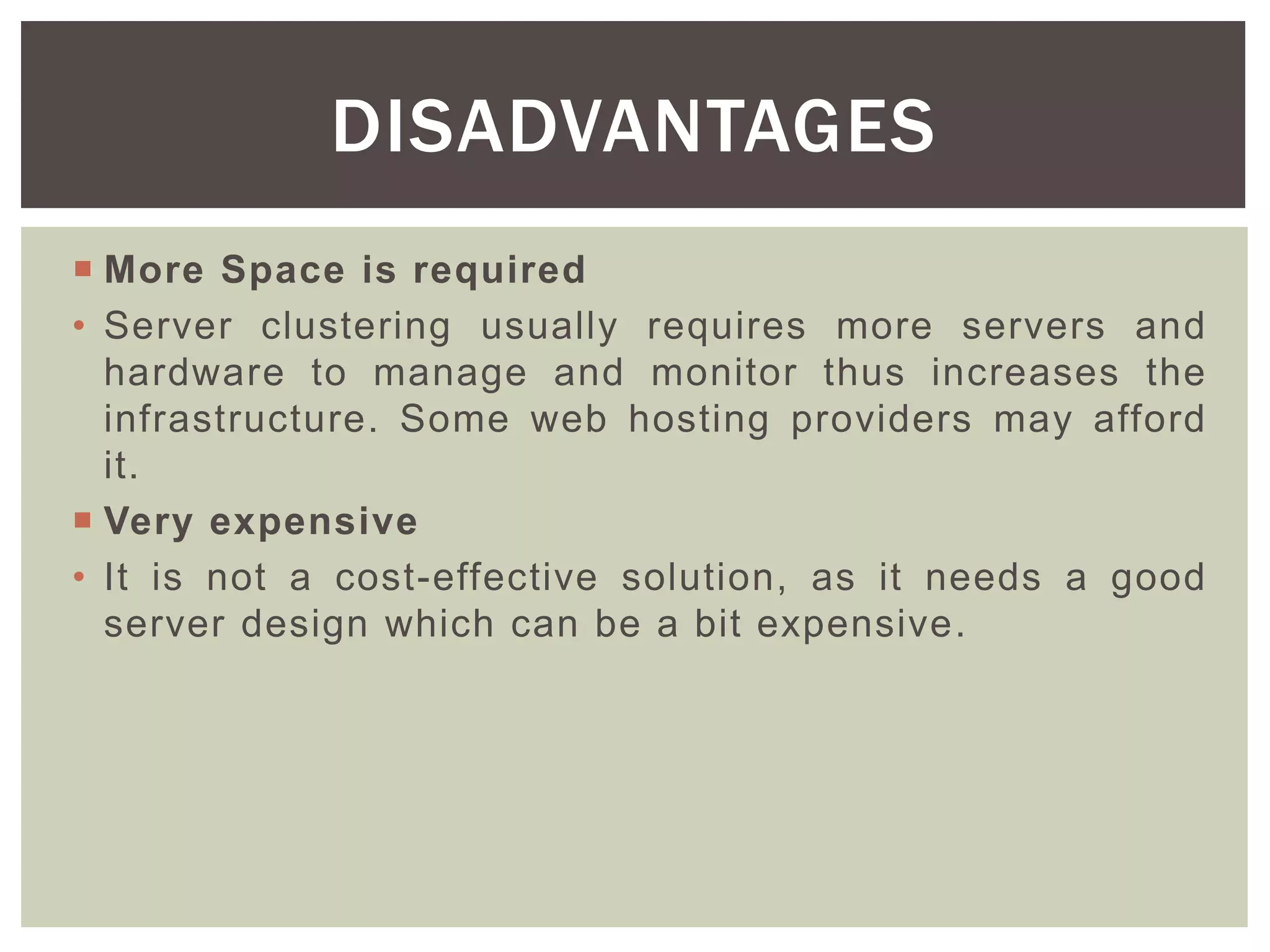
Challenges include increased hardware requirements leading to higher costs and complex infrastructure for monitoring.
Key considerations encompass networking, software, programming, timing, and speed in cluster deployments.
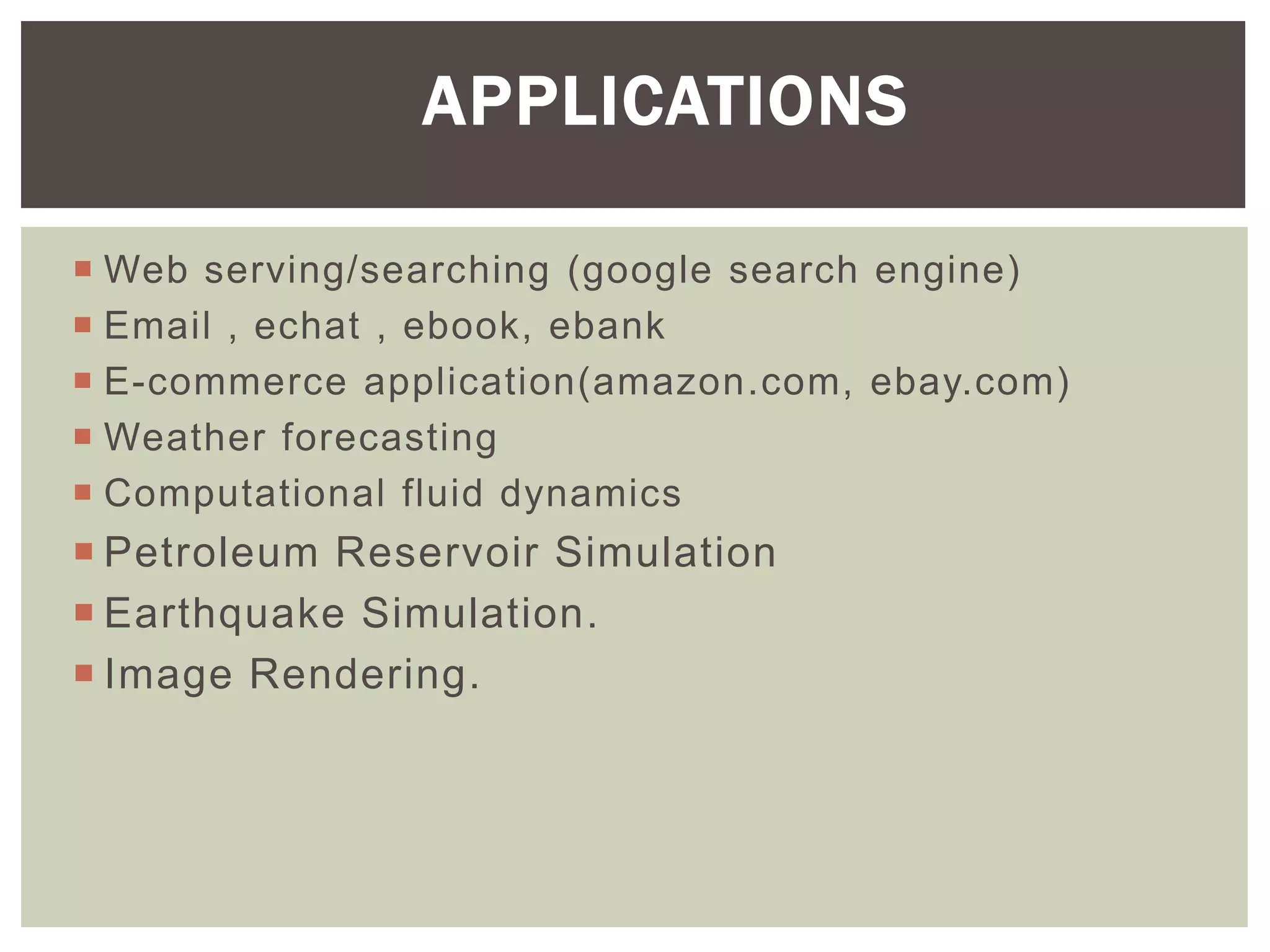
Common applications include web services, email, e-commerce, weather forecasting, and simulations in various fields.
Comparative analysis of cluster, grid, and cloud computing on characteristics such as ownership, security, and resource management.
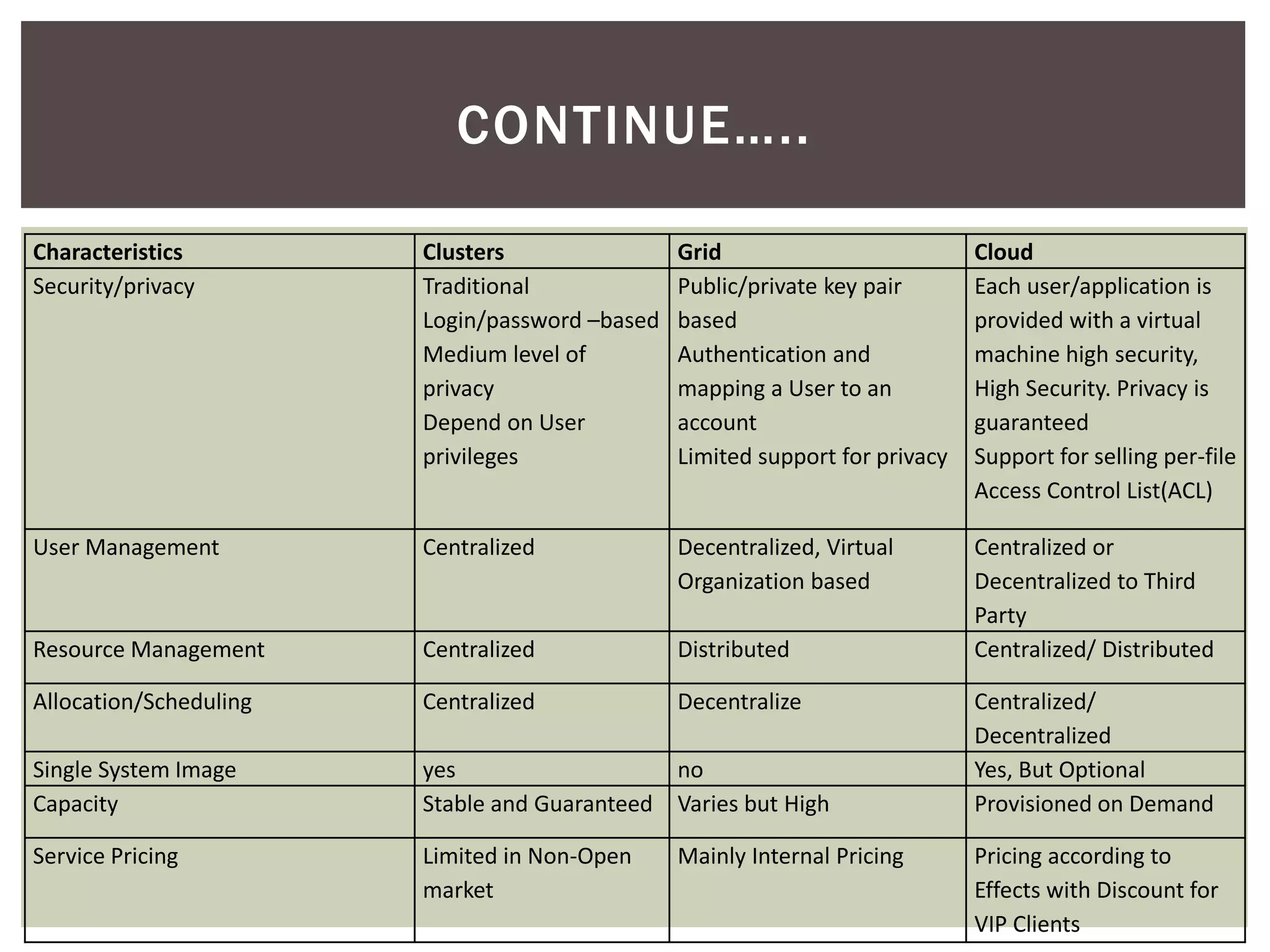
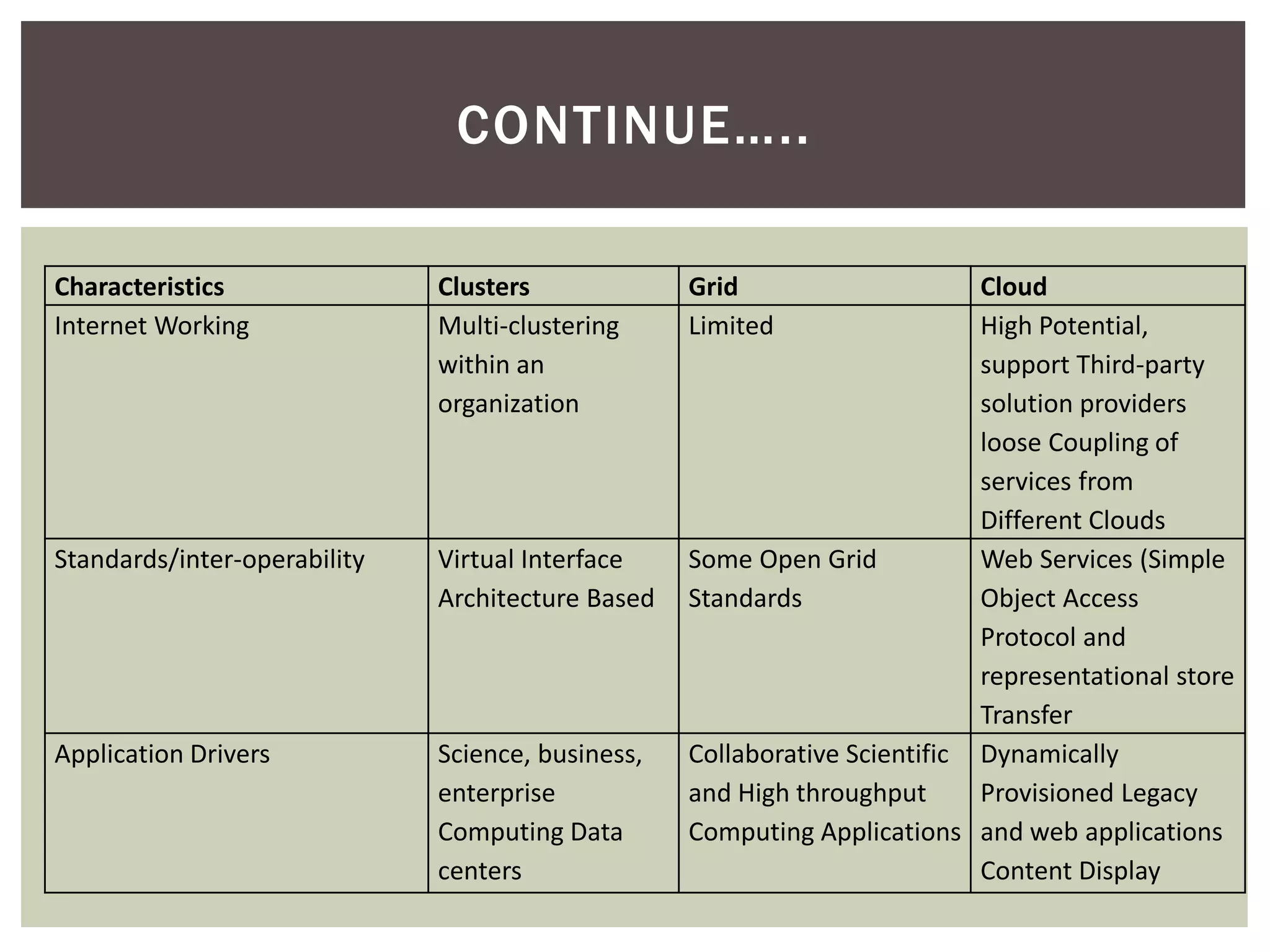
Further exploration of differences in privacy, resource allocation, and application types between clusters, grids, and clouds.
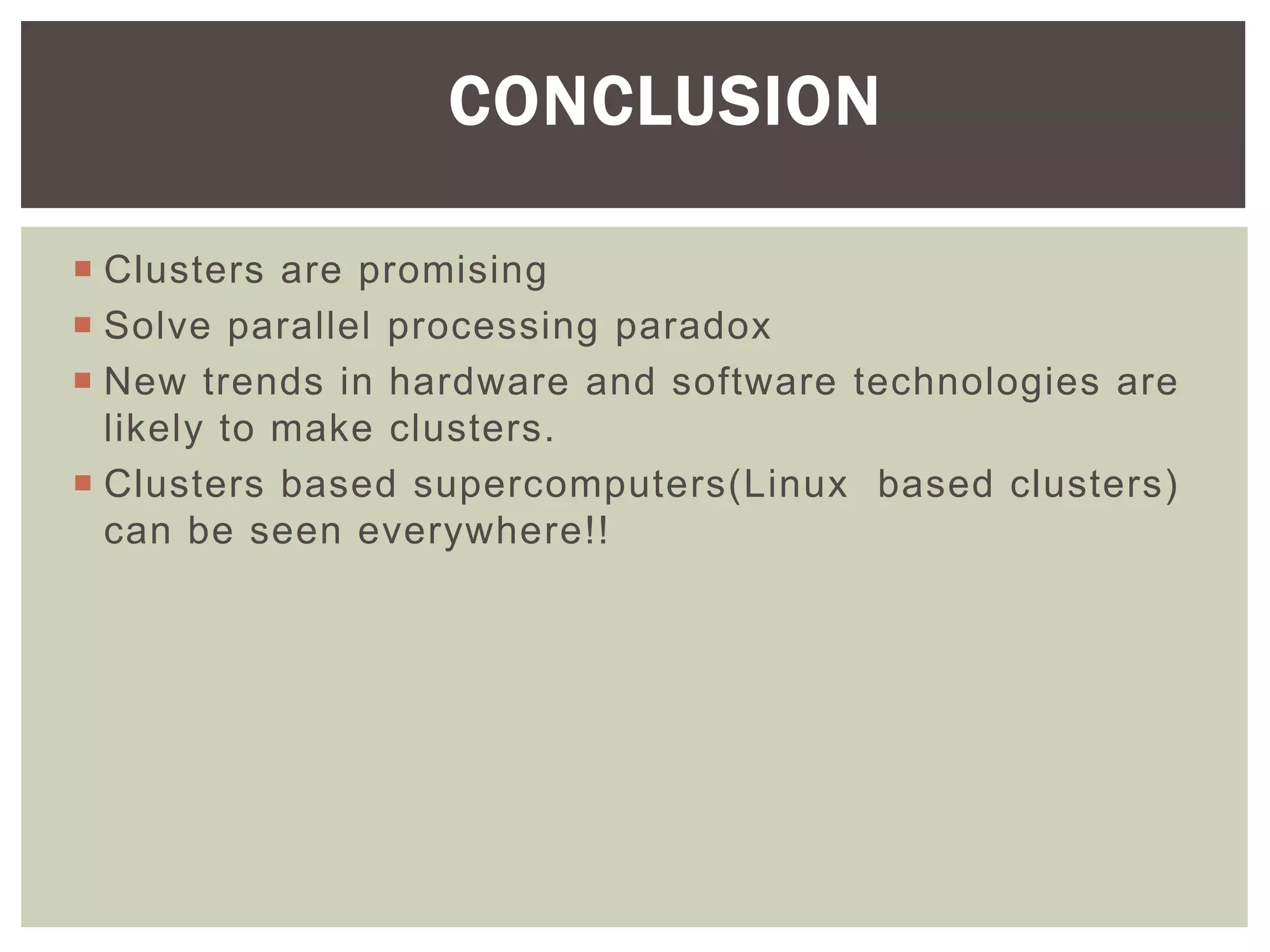
Clusters present innovative solutions in parallel processing with evolving technologies, ushering in new supercomputing trends.
Introduction
History
Cluster architecture
How Clusters Computer works ?
Types of cluster
Components of clusters
Advantages
Disadvantages
Issuse to be considered
Application
Difference Between Cluster, Grid and cloud
Computing
Conclusion
OVERVIEW
3.
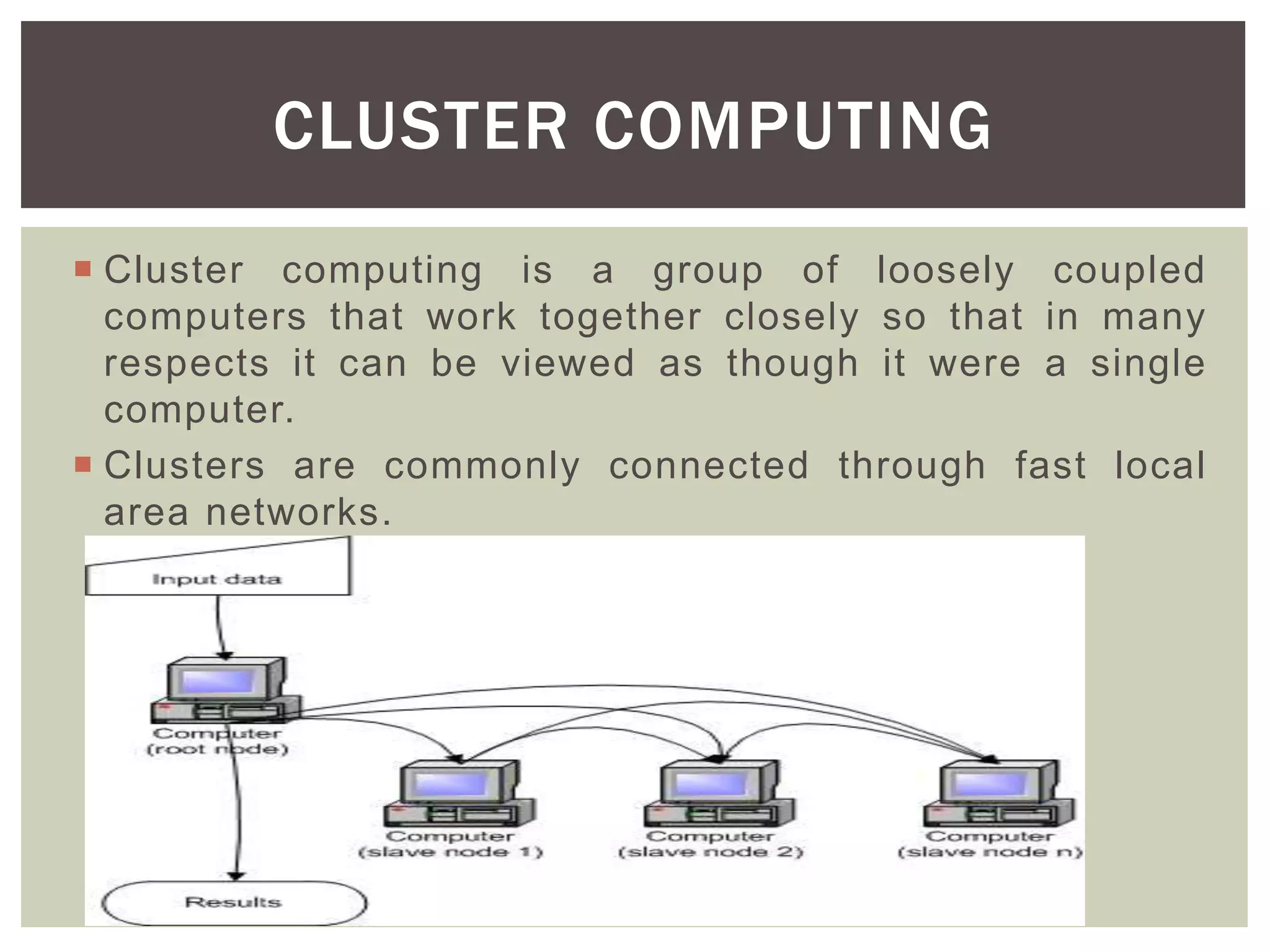
Cluster computingis a group of loosely coupled
computers that work together closely so that in many
respects it can be viewed as though it were a single
computer.
Clusters are commonly connected through fast local
area networks.
CLUSTER COMPUTING
4.
Clusters areusually deployed to improve speed and/or
reliability over that provided by a single computer, while
typically being much more cost effective than single
computer the of comparable speed or reliability .
In cluster computing each node within a cluster is an
independent system, with its own operating system,
private memory, and, in some cases, its own file
system.
CONTINUE...
5.
Because theprocessors on one node cannot directly
access the memory on the other nodes, programs or
software run on clusters usually employ a procedure
called "message passing" to get data and execution
code from one node to another.
Cluster computing can also be used as a relatively low-
cost form of parallel processing for scientific and other
applications that lend themselves to parallel
operations.
CONTINUE...
6.
Greg Pfisteris a computer scientist and worked a lot
for cluster computing, according to him clusters were
not invented by any specific vendor but by customers.
The first commodity clustering product was ARC
net(Attached Resource Computer Network), developed
by Datapoint in 1977.
The next product was VAXcluster,released by DEC in
1980’s.
Microsoft, sun microsystems, and other leading
hardware and software companies offer clustering
packages.
HISTORY
7.
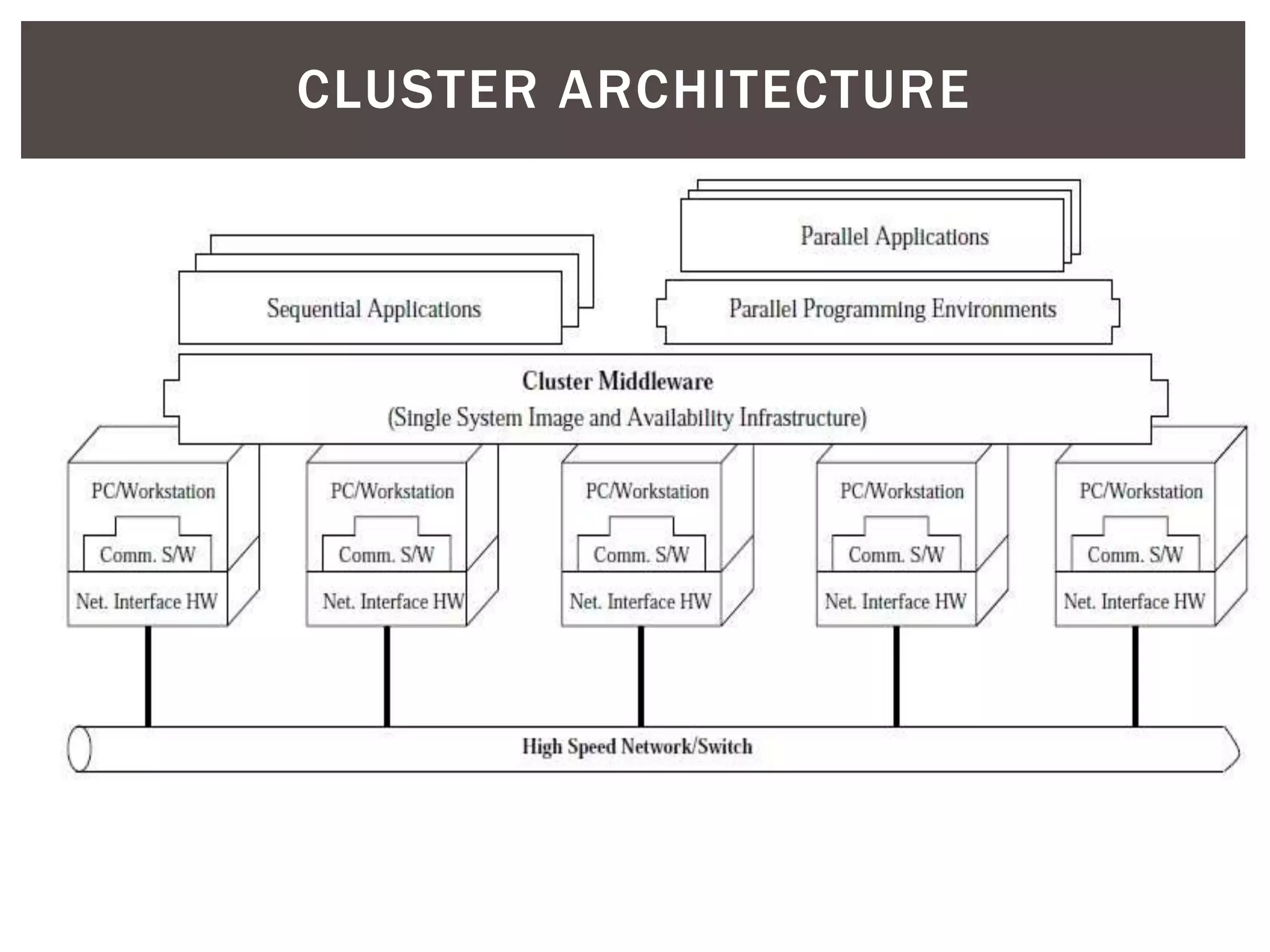
A clusteris a type of parallel /distributed processing system,
which consists of a collection of interconnected stand-alone
computers cooperatively working together a single,
integrated computing resource.
A node:
• A single or multiprocessor system with memory, I/O
facilities, &OS
• Generally 2 or more computers (nodes) connected together
• In a single cabinet, or physically separated & connected via
a LAN
• Appear as a single system to users and applications
• Provide a cost-effective way to gain features and benefits
CLUSTERS ARCHITECTURE
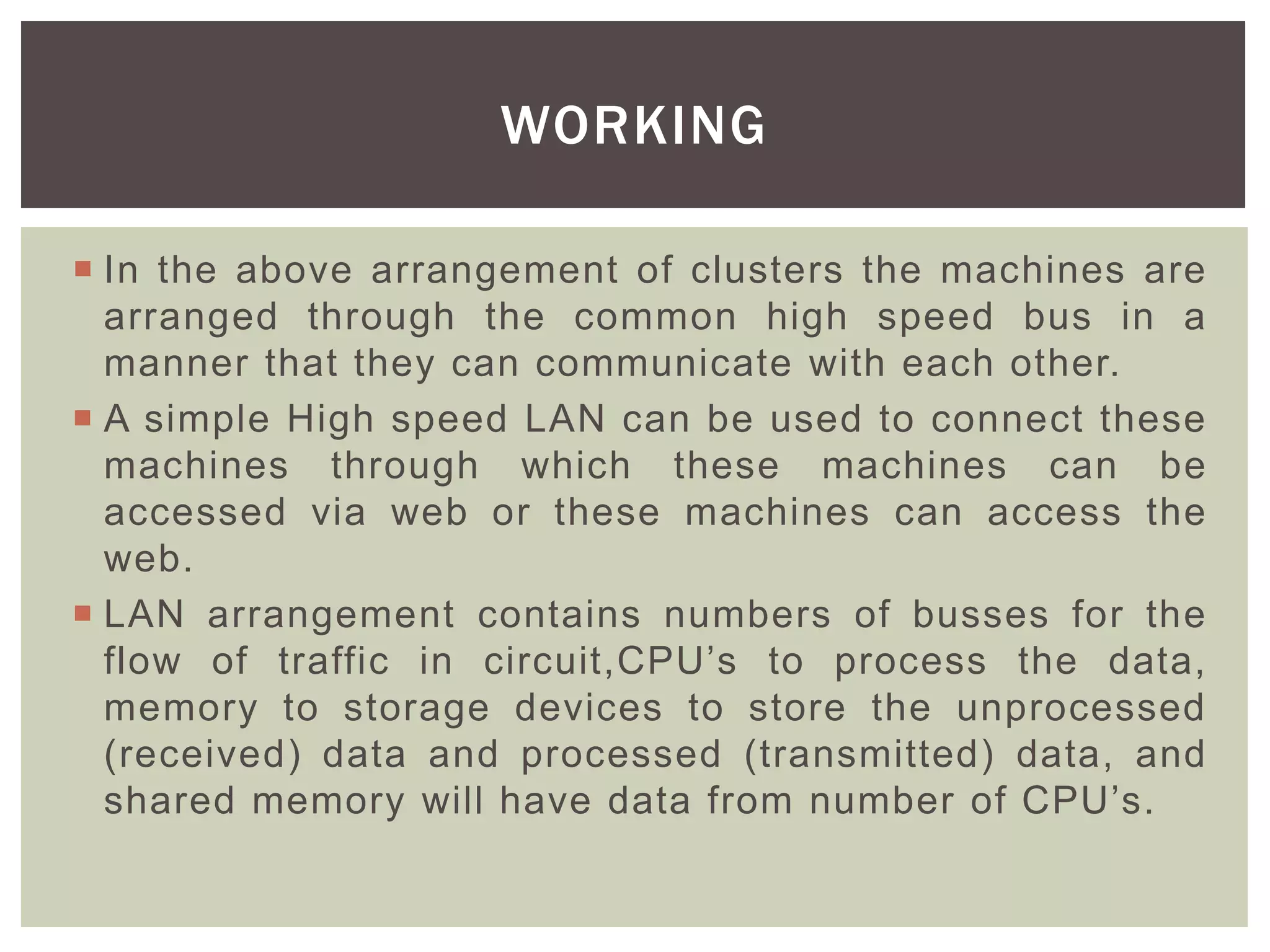
In theabove arrangement of clusters the machines are
arranged through the common high speed bus in a
manner that they can communicate with each other.
A simple High speed LAN can be used to connect these
machines through which these machines can be
accessed via web or these machines can access the
web.
LAN arrangement contains numbers of busses for the
flow of traffic in circuit,CPU’s to process the data,
memory to storage devices to store the unprocessed
(received) data and processed (transmitted) data, and
shared memory will have data from number of CPU’s.
WORKING
11.
High performanceclusters
High availability cluster or Failover Clusters
Load balancing cluster
TYPES OF CLUSTER
12.
Start from1994
Donald becker of nasa assembled this cluster.
Also called beowulf cluster.
• Dependable parallel computers
• Application like data mining , simulations , parallel
processing , weather modeling etc.
HIGH PERFORMANCE CLUSTER
Avoid singlepoint of failure.
Designed to provide uninterrupted availability of data or
services to the end
This requires atleast two nodes a primary and a
backup.
Always with redundancy.
Almost all load balancing cluster are with HA capability.
Used to implement database, mail, file print, web
application servers.
HIGH AVAILABILITY CLUSTERS OR
FAILOVER CLUSTERS
Pc clusterdeliver load balancing performance.
It distributes incoming requests for resources or content
among multiple nodes running the same programs or
having the same content
Each node in cluster is able to handle requests for the
same content or application.
Both the high availability and load balancing cluster
technologies can be combined to increase the reliability,
availability , and scalability of application and data
resources that are widely deployed for web , mail or FTP
services.
LOAD BALANCING CLUSTER
The basicbuilding blocks of clusters are broken down
into multiple categories:
The cluster nodes,
Cluster operating system,
Network switching hardware and
The node/switch interconnect
COMPONENTS OF CLUSTER
19.
Availability
• Incase if server is having a problem another server from the
cluster takes over the server having issue. This ensure the
high availability of web applications.
Scalable
• Server clustering is completely a scalable solution.
Resources can be addeded to the cluster accordingly.
Load Handling and maintenance
• If a dedicated server from the cluster requires
maintenance,it can be stopped while other servers handles.
Easy to manage
• More easy cluster management software are emerging to
manage the clusters and in present also some are available.
ADVANTAGES
20.
More Spaceis required
• Server clustering usually requires more servers and
hardware to manage and monitor thus increases the
infrastructure. Some web hosting providers may afford
it.
Very expensive
• It is not a cost-effective solution, as it needs a good
server design which can be a bit expensive.
DISADVANTAGES
21.
Cluster networking
Cluster software
Programming
Timing
Network selection
Speed selection
ISSUSE TO BE CONSIDERED
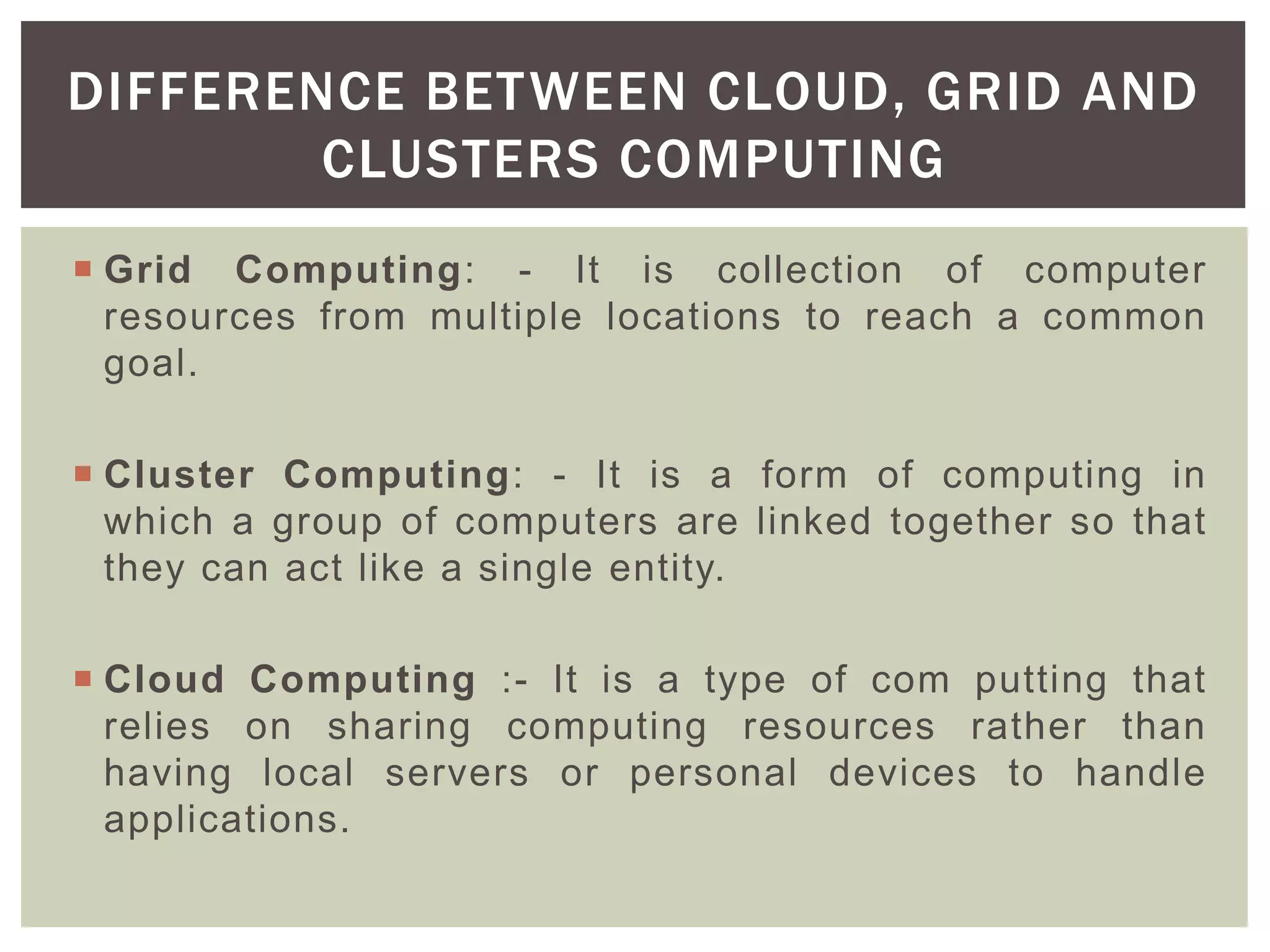
Grid Computing:- It is collection of computer
resources from multiple locations to reach a common
goal.
Cluster Computing: - It is a form of computing in
which a group of computers are linked together so that
they can act like a single entity.
Cloud Computing :- It is a type of com putting that
relies on sharing computing resources rather than
having local servers or personal devices to handle
applications.
DIFFERENCE BETWEEN CLOUD, GRID AND
CLUSTERS COMPUTING
24.
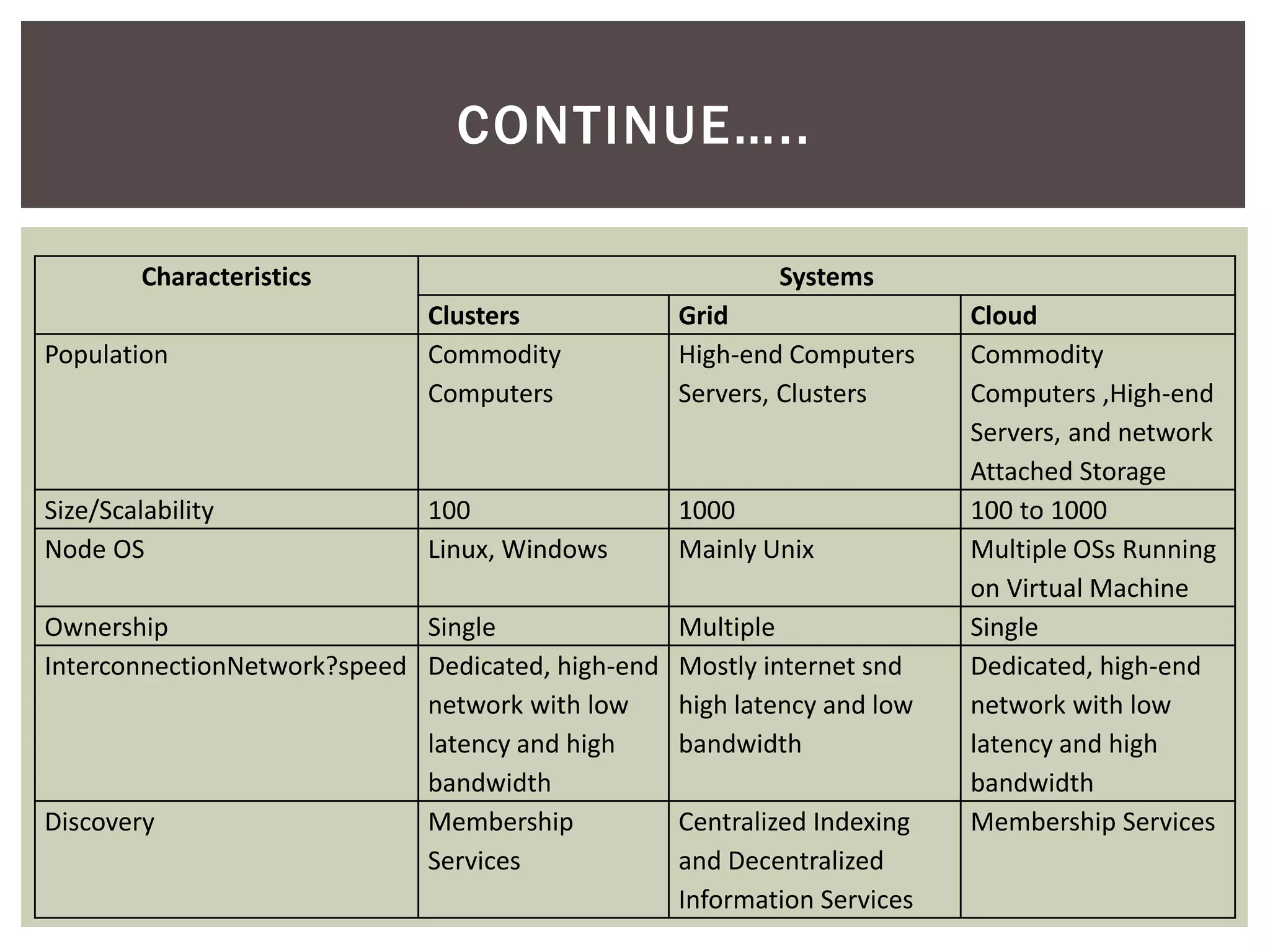
Characteristics Systems
Clusters GridCloud
Population Commodity
Computers
High-end Computers
Servers, Clusters
Commodity
Computers ,High-end
Servers, and network
Attached Storage
Size/Scalability 100 1000 100 to 1000
Node OS Linux, Windows Mainly Unix Multiple OSs Running
on Virtual Machine
Ownership Single Multiple Single
InterconnectionNetwork?speed Dedicated, high-end
network with low
latency and high
bandwidth
Mostly internet snd
high latency and low
bandwidth
Dedicated, high-end
network with low
latency and high
bandwidth
Discovery Membership
Services
Centralized Indexing
and Decentralized
Information Services
Membership Services
CONTINUE…..
25.
Characteristics Clusters GridCloud
Security/privacy Traditional
Login/password –based
Medium level of
privacy
Depend on User
privileges
Public/private key pair
based
Authentication and
mapping a User to an
account
Limited support for privacy
Each user/application is
provided with a virtual
machine high security,
High Security. Privacy is
guaranteed
Support for selling per-file
Access Control List(ACL)
User Management Centralized Decentralized, Virtual
Organization based
Centralized or
Decentralized to Third
Party
Resource Management Centralized Distributed Centralized/ Distributed
Allocation/Scheduling Centralized Decentralize Centralized/
Decentralized
Single System Image yes no Yes, But Optional
Capacity Stable and Guaranteed Varies but High Provisioned on Demand
Service Pricing Limited in Non-Open
market
Mainly Internal Pricing Pricing according to
Effects with Discount for
VIP Clients
CONTINUE…..
26.
Characteristics Clusters GridCloud
Internet Working Multi-clustering
within an
organization
Limited High Potential,
support Third-party
solution providers
loose Coupling of
services from
Different Clouds
Standards/inter-operability Virtual Interface
Architecture Based
Some Open Grid
Standards
Web Services (Simple
Object Access
Protocol and
representational store
Transfer
Application Drivers Science, business,
enterprise
Computing Data
centers
Collaborative Scientific
and High throughput
Computing Applications
Dynamically
Provisioned Legacy
and web applications
Content Display
CONTINUE…..
27.
Clusters arepromising
Solve parallel processing paradox
New trends in hardware and software technologies are
likely to make clusters.
Clusters based supercomputers(Linux based clusters)
can be seen everywhere!!
CONCLUSION