CLUSTER COMPUTING
A Seminar on
Presented by :
Name – Balvant V. Biradar
Roll No. – 001
Class – M.Sc. C.S. – S.Y. (IV - Semester)
This Seminar Covers…
• Introduction to Cluster Computing
• Types of Clusters
• Cluster Components
• Cluster Operation
• Cluster Applications
• References
ABSTRACT
• A computer cluster is a group of linked computers,
working together closely so that in many respects they
form a single computer
• The major objective in the cluster is utilizing a group of
processing nodes so as to complete the assigned job
in a minimum amount of time by working
cooperatively. The main and important strategy to
achieve such objective is by transferring the extra
loads from busy nodes to idle nodes.
• The seminar will contain the concepts of cluster
computing and the principles involved in it.
Introduction
• Background Study
– Super , Mainframe computers are not cost
effective
– Cluster technologies have been developed
that allow multiple low cost computers to
work in a coordinated fashion to process
applications
– These are cost effective and provides
performance and flexibility
What is cluster computing
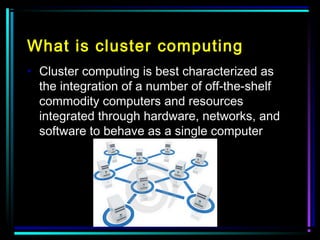
• Cluster computing is best characterized as
the integration of a number of off-the-shelf
commodity computers and resources
integrated through hardware, networks, and
software to behave as a single computer
Cluster Benefits
• Scalability, a cluster uses the combined
processing power of compute nodes to run
cluster-enabled applications
• Availability, within the cluster is assured as
nodes within the cluster provide backup to
each other in the event of a failure
• Performance, an additional benefit comes
with the existence of a single system image
and the ease of manageability of the cluster
TYPES OF CLUSTER
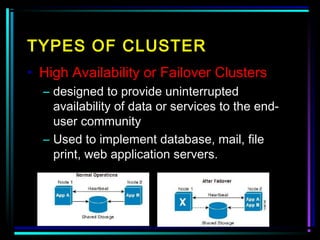
• High Availability or Failover Clusters
– designed to provide uninterrupted
availability of data or services to the end-
user community
– Used to implement database, mail, file
print, web application servers.
TYPES OF CLUSTER cont..
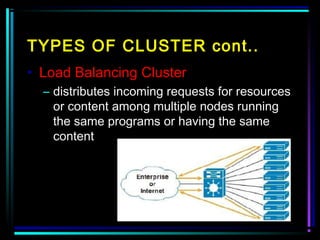
• Load Balancing Cluster
– distributes incoming requests for resources
or content among multiple nodes running
the same programs or having the same
content
TYPES OF CLUSTER cont..
• Parallel/Distributed Processing Clusters
– A parallel cluster is a system that uses a
number of nodes to simultaneously solve a
specific computational or data-mining task
– typically used for- mathematical
computation, scientific analysis and
financial data analysis
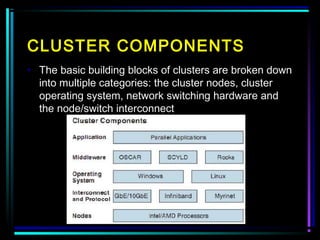
CLUSTER COMPONENTS
• The basic building blocks of clusters are broken down
into multiple categories: the cluster nodes, cluster
operating system, network switching hardware and
the node/switch interconnect
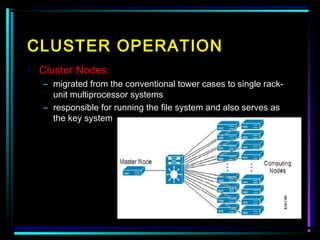
CLUSTER OPERATION
• Cluster Nodes:
– migrated from the conventional tower cases to single rack-
unit multiprocessor systems
– responsible for running the file system and also serves as
the key system
CLUSTER OPERATION Cont…
• Cluster Network:
– availability of high speed, low-latency network switch
technologies that provide the inter-nodal communications
• Network Characterization: Two primary Characteristics – bandwidth and
delay,
• Ethernet, Fast Ethernet, Gigabit Ethernet and 10-Gigabit Ethernet
CLUSTER OPERATION Cont…
• Cluster Applications:
– Parallel applications exhibit a wide range of communication
behaviours and impose various requirements on the
underlying network
– Compute Intensive Applications: applies to any computer application
that demands a lot of computation cycles, are very sensitive to end-to-end
message latency
– Data or I/O Intensive Applications: applies to any application that has
high demands of attached storage facilities
– Transaction Intensive Applications: applies to any application that
has a high-level of interactive transactions between an application resource
and the cluster resources
CLUSTER OPERATION Cont…
• Message Latency:
– defined as the time it takes to send a zero-length message from
one processor to another (in ms)
– is made up of aggregate latency incurred at each element within
the cluster network, including within the cluster nodes themselves
CLUSTER OPERATION Cont…
• CPU Utilization:
– To use computer resources as efficiently as possible
CLUSTER APPLICATIONS
• Few important cluster applications are:
– Google Search Engine.
– Petroleum Reservoir Simulation.
– Protein Explorer.
– Earthquake Simulation.
– Image Rendering.
REFERENCES
• [1]. http://icl.cs.utk.edu/iter-ref
• [2]. M. Baker, A. Apon, R. Buyya, H. Jin, “Cluster
Computing and Applications”, Encyclopedia of
Computer Science and Technology, Vol.45, Marcel
Dekker, Aug. 2006.
• [3]. D. Butenhof, Programming with POSIX Threads,
Addison-Wesley, 2000.
• [4]. R. Buyya (ed.), High Performance Cluster
Computing: Systems and Architectures, Prentice
Hall, 2007.
Thank you...
Presented by :
Name – Balvant V. Biradar
Roll No. – 001
Class – M.Sc. C.S. – S.Y. (IV - Semester)

Cluster Computing Seminar.

  • 1.
    CLUSTER COMPUTING A Seminaron Presented by : Name – Balvant V. Biradar Roll No. – 001 Class – M.Sc. C.S. – S.Y. (IV - Semester)
  • 2.
    This Seminar Covers… •Introduction to Cluster Computing • Types of Clusters • Cluster Components • Cluster Operation • Cluster Applications • References
  • 3.
    ABSTRACT • A computercluster is a group of linked computers, working together closely so that in many respects they form a single computer • The major objective in the cluster is utilizing a group of processing nodes so as to complete the assigned job in a minimum amount of time by working cooperatively. The main and important strategy to achieve such objective is by transferring the extra loads from busy nodes to idle nodes. • The seminar will contain the concepts of cluster computing and the principles involved in it.
  • 4.
    Introduction • Background Study –Super , Mainframe computers are not cost effective – Cluster technologies have been developed that allow multiple low cost computers to work in a coordinated fashion to process applications – These are cost effective and provides performance and flexibility
  • 5.
    What is clustercomputing • Cluster computing is best characterized as the integration of a number of off-the-shelf commodity computers and resources integrated through hardware, networks, and software to behave as a single computer
  • 6.
    Cluster Benefits • Scalability,a cluster uses the combined processing power of compute nodes to run cluster-enabled applications • Availability, within the cluster is assured as nodes within the cluster provide backup to each other in the event of a failure • Performance, an additional benefit comes with the existence of a single system image and the ease of manageability of the cluster
  • 7.
    TYPES OF CLUSTER •High Availability or Failover Clusters – designed to provide uninterrupted availability of data or services to the end- user community – Used to implement database, mail, file print, web application servers.
  • 8.
    TYPES OF CLUSTERcont.. • Load Balancing Cluster – distributes incoming requests for resources or content among multiple nodes running the same programs or having the same content
  • 9.
    TYPES OF CLUSTERcont.. • Parallel/Distributed Processing Clusters – A parallel cluster is a system that uses a number of nodes to simultaneously solve a specific computational or data-mining task – typically used for- mathematical computation, scientific analysis and financial data analysis
  • 10.
    CLUSTER COMPONENTS • Thebasic building blocks of clusters are broken down into multiple categories: the cluster nodes, cluster operating system, network switching hardware and the node/switch interconnect
  • 11.
    CLUSTER OPERATION • ClusterNodes: – migrated from the conventional tower cases to single rack- unit multiprocessor systems – responsible for running the file system and also serves as the key system
  • 12.
    CLUSTER OPERATION Cont… •Cluster Network: – availability of high speed, low-latency network switch technologies that provide the inter-nodal communications • Network Characterization: Two primary Characteristics – bandwidth and delay, • Ethernet, Fast Ethernet, Gigabit Ethernet and 10-Gigabit Ethernet
  • 13.
    CLUSTER OPERATION Cont… •Cluster Applications: – Parallel applications exhibit a wide range of communication behaviours and impose various requirements on the underlying network – Compute Intensive Applications: applies to any computer application that demands a lot of computation cycles, are very sensitive to end-to-end message latency – Data or I/O Intensive Applications: applies to any application that has high demands of attached storage facilities – Transaction Intensive Applications: applies to any application that has a high-level of interactive transactions between an application resource and the cluster resources
  • 14.
    CLUSTER OPERATION Cont… •Message Latency: – defined as the time it takes to send a zero-length message from one processor to another (in ms) – is made up of aggregate latency incurred at each element within the cluster network, including within the cluster nodes themselves
  • 15.
    CLUSTER OPERATION Cont… •CPU Utilization: – To use computer resources as efficiently as possible
  • 16.
    CLUSTER APPLICATIONS • Fewimportant cluster applications are: – Google Search Engine. – Petroleum Reservoir Simulation. – Protein Explorer. – Earthquake Simulation. – Image Rendering.
  • 17.
    REFERENCES • [1]. http://icl.cs.utk.edu/iter-ref •[2]. M. Baker, A. Apon, R. Buyya, H. Jin, “Cluster Computing and Applications”, Encyclopedia of Computer Science and Technology, Vol.45, Marcel Dekker, Aug. 2006. • [3]. D. Butenhof, Programming with POSIX Threads, Addison-Wesley, 2000. • [4]. R. Buyya (ed.), High Performance Cluster Computing: Systems and Architectures, Prentice Hall, 2007.
  • 18.
    Thank you... Presented by: Name – Balvant V. Biradar Roll No. – 001 Class – M.Sc. C.S. – S.Y. (IV - Semester)