Seminar
On
CLUSTER
COMPUTING
 Introduction
 Cluster Categorization
 Cluster Component
 How Does It Work?
 Cluster Architecture
 Cluster Benefits
 Cluster Features
 Cluster Application
 Limitations
 Conclusion
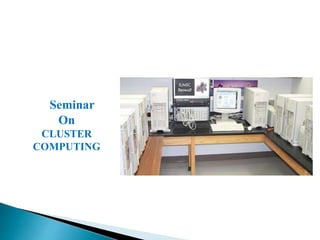
Cluster is a widely used term meaning
independent computers combined into a unified
system through software and networking
Clusters are typically used for High Availability
(HA) for greater reliability or High Performance
Computing (HPC) to provide greater
computational power than a single computer can
provide.
Clusters are composed of many commodity
computers, linked together by a high-speed
dedicated network
 High-availability (HA) clusters
 Load balancing clusters
 High-performance (HPC) clusters
 Grid Cluster
 These clusters are designed to provide uninterrupted
availability of data or services (typically web services)
to the end-user community.
 if a node fails, the service can be restored without
affecting the availability of the services provided by
the cluster. While the application will still be available,
there will be a performance drop due to the missing
node.
 The purpose of these clusters is to ensure that a
single instance of an application is only ever running
on one cluster member at a time but if and when that
cluster member is no longer available, the application
will failover to another cluster member.
 High-availability clusters implementations are
best for mission-critical applications or
databases, mail, file and print, web, or
application servers.
 This type of cluster distributes incoming requests for
resources or content among multiple nodes running
the same programs or having the same content.
 Both the high availability and load-balancing cluster
technologies can be combined to increase the
reliability, availability, and scalability of application
and data resources that are widely deployed for web,
mail, news, or FTP services.
 Every node in the cluster is able to handle requests
for the same content or application.
 This type of distribution is typically seen in a web-
hosting environment.
 parallel processing was performed by multiple
processors in a specially designed parallel
computer. These are systems in which multiple
processors share a single memory and bus
interface within a single computer.
 These types of cluster increase availability,
performance, and scalability for applications,
particularly computationally or data intensive
tasks.
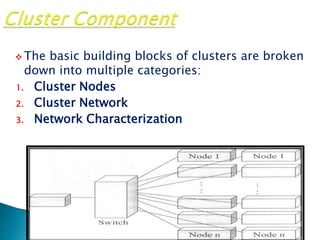
 The basic building blocks of clusters are broken
down into multiple categories:
1. Cluster Nodes
2. Cluster Network
3. Network Characterization
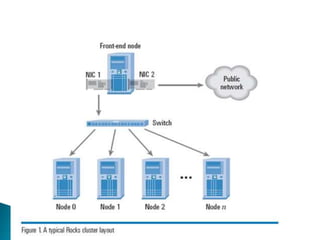
 A user submits a job to the head node. The job
identifies the application to run on the cluster.
The job scheduler on the head node assigns
each task defined by the job to a node and then
starts each application instance on the assigned
node. Results from each of the application
instances are returned to the client via files or
databases.
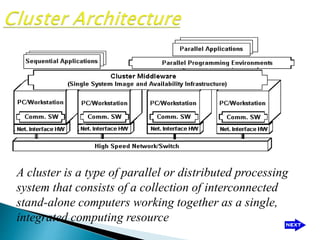
A cluster is a type of parallel or distributed processing
system that consists of a collection of interconnected
stand-alone computers working together as a single,
integrated computing resource
 Network technologies
 Network Types
 Communication Protocols
 Operating system
 Single System Image (SSI)
 Quorum
 The main benefits of clusters are:
1. Availability
2. Performance
3. Scalability
 These benefits map to needs of today's
enterprise business, education, military and
scientific community infrastructures.
 There are three primary categories of
applications that use parallel clusters:
1. Compute Intensive Application.
2. Data or I/O Intensive Applications.
3. Transaction Intensive Applications.
 Typically latency is very high and bandwidth
relatively low.
 Currently there is very little software support for
treating a cluster as a single system.
 Problems exist in the interactions between
mixed application workloads on a single time-
shared computer
Cluster computing has become a major part
of many research programs because the price
to performance ratio of commodity clusters is
very good. Also, because the nodes in a
cluster are clones, there is no single point of
failure, which enhances the reliability to the
cluster.
THANK
YOU

Cluster computing

  • 1.
  • 2.
     Introduction  ClusterCategorization  Cluster Component  How Does It Work?  Cluster Architecture  Cluster Benefits  Cluster Features  Cluster Application  Limitations  Conclusion
  • 3.
    Cluster is awidely used term meaning independent computers combined into a unified system through software and networking Clusters are typically used for High Availability (HA) for greater reliability or High Performance Computing (HPC) to provide greater computational power than a single computer can provide. Clusters are composed of many commodity computers, linked together by a high-speed dedicated network
  • 4.
     High-availability (HA)clusters  Load balancing clusters  High-performance (HPC) clusters  Grid Cluster
  • 5.
     These clustersare designed to provide uninterrupted availability of data or services (typically web services) to the end-user community.  if a node fails, the service can be restored without affecting the availability of the services provided by the cluster. While the application will still be available, there will be a performance drop due to the missing node.  The purpose of these clusters is to ensure that a single instance of an application is only ever running on one cluster member at a time but if and when that cluster member is no longer available, the application will failover to another cluster member.
  • 7.
     High-availability clustersimplementations are best for mission-critical applications or databases, mail, file and print, web, or application servers.
  • 8.
     This typeof cluster distributes incoming requests for resources or content among multiple nodes running the same programs or having the same content.  Both the high availability and load-balancing cluster technologies can be combined to increase the reliability, availability, and scalability of application and data resources that are widely deployed for web, mail, news, or FTP services.  Every node in the cluster is able to handle requests for the same content or application.  This type of distribution is typically seen in a web- hosting environment.
  • 11.
     parallel processingwas performed by multiple processors in a specially designed parallel computer. These are systems in which multiple processors share a single memory and bus interface within a single computer.  These types of cluster increase availability, performance, and scalability for applications, particularly computationally or data intensive tasks.
  • 12.
     The basicbuilding blocks of clusters are broken down into multiple categories: 1. Cluster Nodes 2. Cluster Network 3. Network Characterization
  • 13.
     A usersubmits a job to the head node. The job identifies the application to run on the cluster. The job scheduler on the head node assigns each task defined by the job to a node and then starts each application instance on the assigned node. Results from each of the application instances are returned to the client via files or databases.
  • 15.
    A cluster isa type of parallel or distributed processing system that consists of a collection of interconnected stand-alone computers working together as a single, integrated computing resource
  • 16.
     Network technologies Network Types  Communication Protocols  Operating system  Single System Image (SSI)  Quorum
  • 17.
     The mainbenefits of clusters are: 1. Availability 2. Performance 3. Scalability  These benefits map to needs of today's enterprise business, education, military and scientific community infrastructures.
  • 18.
     There arethree primary categories of applications that use parallel clusters: 1. Compute Intensive Application. 2. Data or I/O Intensive Applications. 3. Transaction Intensive Applications.
  • 19.
     Typically latencyis very high and bandwidth relatively low.  Currently there is very little software support for treating a cluster as a single system.  Problems exist in the interactions between mixed application workloads on a single time- shared computer
  • 20.
    Cluster computing hasbecome a major part of many research programs because the price to performance ratio of commodity clusters is very good. Also, because the nodes in a cluster are clones, there is no single point of failure, which enhances the reliability to the cluster.
  • 21.