Under the guidance of: Submitted By:
Dr.CH.SURESH KUMAR M.Tech(PhD) N.Karthik
H.No:20631A0515
TECHNICAL SEMINAR ON
CLUSTER COMPUTING
DEPARTMENT OF COMPUTER SCIENCE
AND ENGINEERING
Suryapet- 508213
CONTENT
 Introduction
 Types of Cluster Computing
 Cluster Component
 Cluster Architecture
 Cluster Benefits
 Cluster Features
 Cluster Application
 Advantages of cluster
 Limitations
 Conclusion
INTRODUCTION
 Cluster is a widely used term meaning independent computers
combined into a unified system through software and networking
 Clusters are typically used for High Availability (HA) for
greater reliability or High Performance Computing (HPC) to
provide greater computational power than a single computer can
provide.
 Clusters are composed of many commodity computers, linked
together by a high-speed dedicated network.
High-availability (HA) clusters
Load balancing clusters
High-performance (HPC) clusters
HIGH AVAILABILITY OR
FAILOVER CLUSTERS
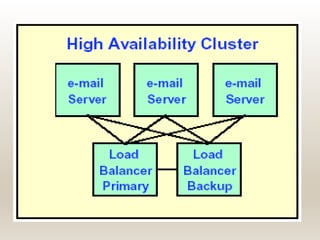
HA clusters are designed to maintain redundant nodes
that can act as backup systems in case any failure occurs.
if a node fails, the service can be restored without
affecting the availability of the services provided by the
cluster.
They are designed to give uninterrupted data availability
to the customers.
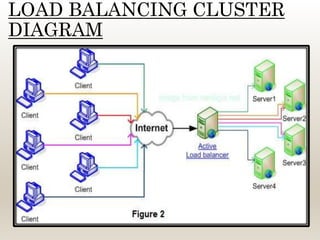
LOAD BALANCING CLUSTER
Load balancing enables the distribution of messages
received across the API Gateway nodes.
 Both the high availability and load-balancing cluster
technologies can be combined to increase the reliability,
availability, and scalability of application.
Every node in the cluster is able to handle requests for
the same content or application.
This type of distribution is typically seen in a web-hosting
environment.
LOAD BALANCING CLUSTER
DIAGRAM
 HP clusters use computer clusters and supercomputers to
solve advance computational problems.
They are used to performing functions that need nodes to
communicate as they perform their jobs.
They are designed to take benefit of the parallel
processing power of several nodes.
CLUSTER COMPONENT
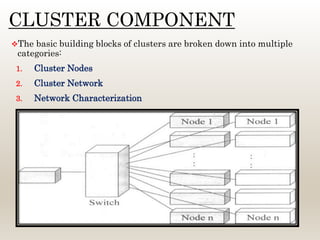
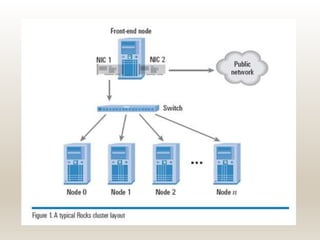
The basic building blocks of clusters are broken down into multiple
categories:
1. Cluster Nodes
2. Cluster Network
3. Network Characterization
CLUSTER ARCHITECTURE
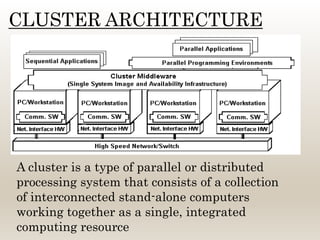
A cluster is a type of parallel or distributed
processing system that consists of a collection
of interconnected stand-alone computers
working together as a single, integrated
computing resource
CLUSTER COMPUTING
FEATURES
 Network technologies
 Network Types
 Communication Protocols
 Operating system
 Single System Image (SSI)
 Quorum
CLUSTER BENEFITS
The main benefits of clusters are:
1. Availability
2. Performance
3. Scalability
 These benefits map to needs of today's enterprise business,
education, military and scientific community infrastructures.
CLUSTER APPLICATION
There are three primary categories of applications that use parallel
clusters:
1. Compute Intensive Application.
2. Data or I/O Intensive Applications.
3. Transaction Intensive Applications.
ADVANTAGES OF CLUSTER
COMPUTING
1. High Performance : The systems offer better and enhanced
performance than that of mainframe computer networks.
2. Easy to manage :Cluster Computing is manageable and easy
to implement.
3. Scalable :Resources can be added to the clusters accordingly.
4. Flexibility :It can be upgraded to the superior specification
or additional nodes can be added.
5. Expandability :Computer clusters can be expanded easily by
adding additional computers to the network.
6. Availability :The other nodes will be active when one node gets
failed and will function as a proxy for the failed node.
LIMITATIONS
 Typically latency is very high and bandwidth relatively
low.
 Currently there is very little software support for treating
a cluster as a single system.
 Problems exist in the interactions between mixed
application workloads on a single time-shared computer.
CONCLUSION
Cluster computing has become a major part of many
research programs because the price to performance ratio
of commodity clusters is very good. Also, because the
nodes in a cluster are clones, there is no single point of
failure, which enhances the reliability to the cluster.
REFERENCE
 www.google.com
 www.wikipedia.com
 www.studymafia.org
Any queries..?
&
THANK YOU..

Cluster Computing ppt.pptx

  • 1.
    Under the guidanceof: Submitted By: Dr.CH.SURESH KUMAR M.Tech(PhD) N.Karthik H.No:20631A0515 TECHNICAL SEMINAR ON CLUSTER COMPUTING DEPARTMENT OF COMPUTER SCIENCE AND ENGINEERING Suryapet- 508213
  • 2.
    CONTENT  Introduction  Typesof Cluster Computing  Cluster Component  Cluster Architecture  Cluster Benefits  Cluster Features  Cluster Application  Advantages of cluster  Limitations  Conclusion
  • 3.
    INTRODUCTION  Cluster isa widely used term meaning independent computers combined into a unified system through software and networking  Clusters are typically used for High Availability (HA) for greater reliability or High Performance Computing (HPC) to provide greater computational power than a single computer can provide.  Clusters are composed of many commodity computers, linked together by a high-speed dedicated network.
  • 4.
    High-availability (HA) clusters Loadbalancing clusters High-performance (HPC) clusters
  • 5.
    HIGH AVAILABILITY OR FAILOVERCLUSTERS HA clusters are designed to maintain redundant nodes that can act as backup systems in case any failure occurs. if a node fails, the service can be restored without affecting the availability of the services provided by the cluster. They are designed to give uninterrupted data availability to the customers.
  • 7.
    LOAD BALANCING CLUSTER Loadbalancing enables the distribution of messages received across the API Gateway nodes.  Both the high availability and load-balancing cluster technologies can be combined to increase the reliability, availability, and scalability of application. Every node in the cluster is able to handle requests for the same content or application. This type of distribution is typically seen in a web-hosting environment.
  • 8.
  • 9.
     HP clustersuse computer clusters and supercomputers to solve advance computational problems. They are used to performing functions that need nodes to communicate as they perform their jobs. They are designed to take benefit of the parallel processing power of several nodes.
  • 10.
    CLUSTER COMPONENT The basicbuilding blocks of clusters are broken down into multiple categories: 1. Cluster Nodes 2. Cluster Network 3. Network Characterization
  • 12.
    CLUSTER ARCHITECTURE A clusteris a type of parallel or distributed processing system that consists of a collection of interconnected stand-alone computers working together as a single, integrated computing resource
  • 13.
    CLUSTER COMPUTING FEATURES  Networktechnologies  Network Types  Communication Protocols  Operating system  Single System Image (SSI)  Quorum
  • 14.
    CLUSTER BENEFITS The mainbenefits of clusters are: 1. Availability 2. Performance 3. Scalability  These benefits map to needs of today's enterprise business, education, military and scientific community infrastructures.
  • 15.
    CLUSTER APPLICATION There arethree primary categories of applications that use parallel clusters: 1. Compute Intensive Application. 2. Data or I/O Intensive Applications. 3. Transaction Intensive Applications.
  • 16.
    ADVANTAGES OF CLUSTER COMPUTING 1.High Performance : The systems offer better and enhanced performance than that of mainframe computer networks. 2. Easy to manage :Cluster Computing is manageable and easy to implement. 3. Scalable :Resources can be added to the clusters accordingly. 4. Flexibility :It can be upgraded to the superior specification or additional nodes can be added.
  • 17.
    5. Expandability :Computerclusters can be expanded easily by adding additional computers to the network. 6. Availability :The other nodes will be active when one node gets failed and will function as a proxy for the failed node.
  • 18.
    LIMITATIONS  Typically latencyis very high and bandwidth relatively low.  Currently there is very little software support for treating a cluster as a single system.  Problems exist in the interactions between mixed application workloads on a single time-shared computer.
  • 19.
    CONCLUSION Cluster computing hasbecome a major part of many research programs because the price to performance ratio of commodity clusters is very good. Also, because the nodes in a cluster are clones, there is no single point of failure, which enhances the reliability to the cluster.
  • 20.
  • 21.