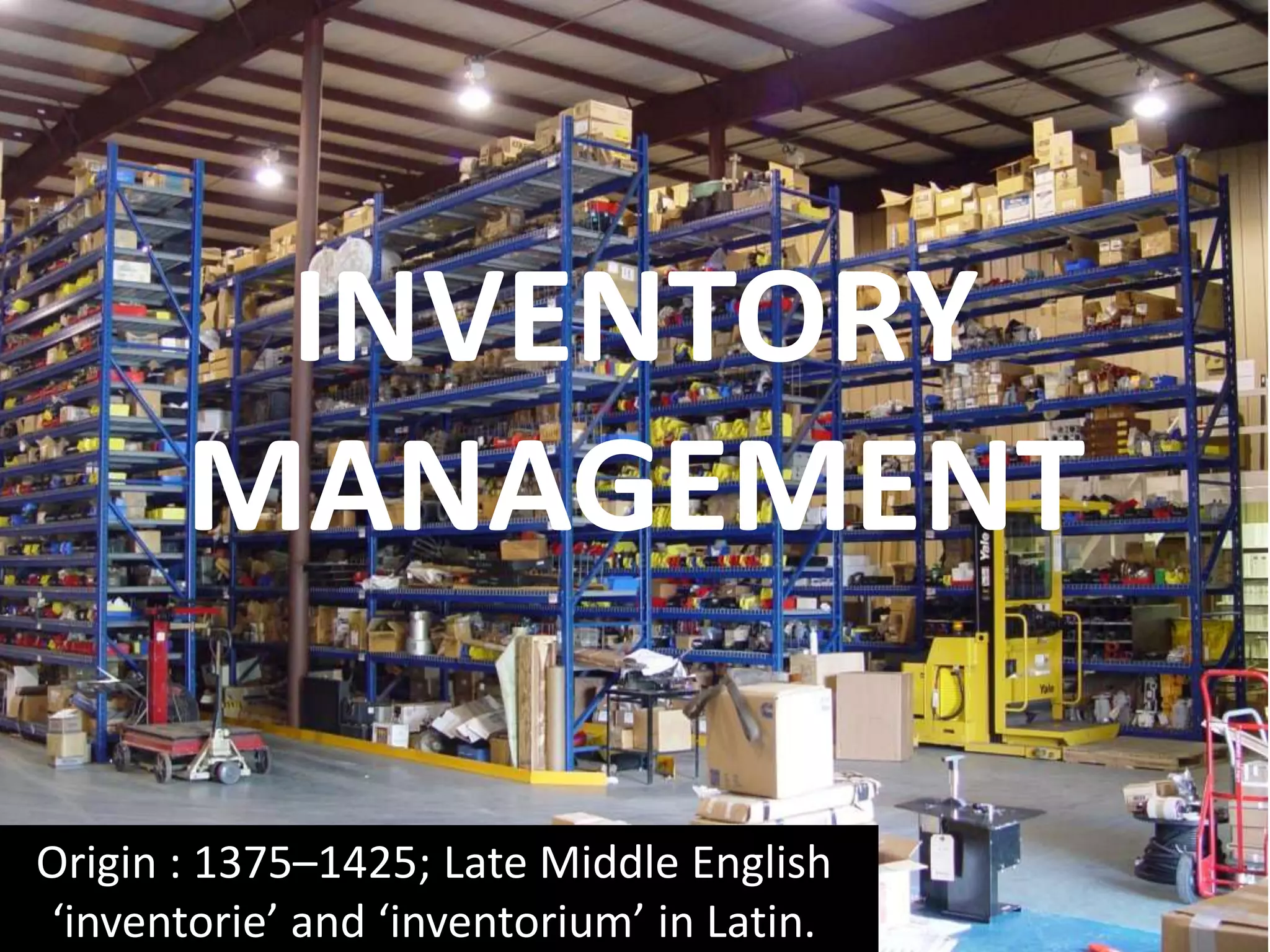
INVENTORY
MANAGEMENT
Origin : 1375–1425; Late Middle English
‘inventorie’ and ‘inventorium’ in Latin.
AIM
• Aim of this presentation is to introduce the
topic of Inventory Management to an already
stressed, hard-pressed and unsuspecting class
of students.
(presented by Sneha, Atul & Ajay K Raina)
SCOPE
• Part 1 – Basic Concepts.
• Part 2 – Systems and Methods.
• Part 3 – Miscellaneous Aspects.

• Interactive Session and Conclusion.
PART 1 – BASIC CONCEPTS
INVENTORY : FIN ACCTG
• The assets that are:– Held for sale in the ordinary course of business; or
– In the process of production for such a sale; or
– In the form of materials or supplies to be
consumed in the production process; or
– In the rendering of services.

• Relevance : Trading concern & Manufacturing
unit.
• Loose tools v/s spares.
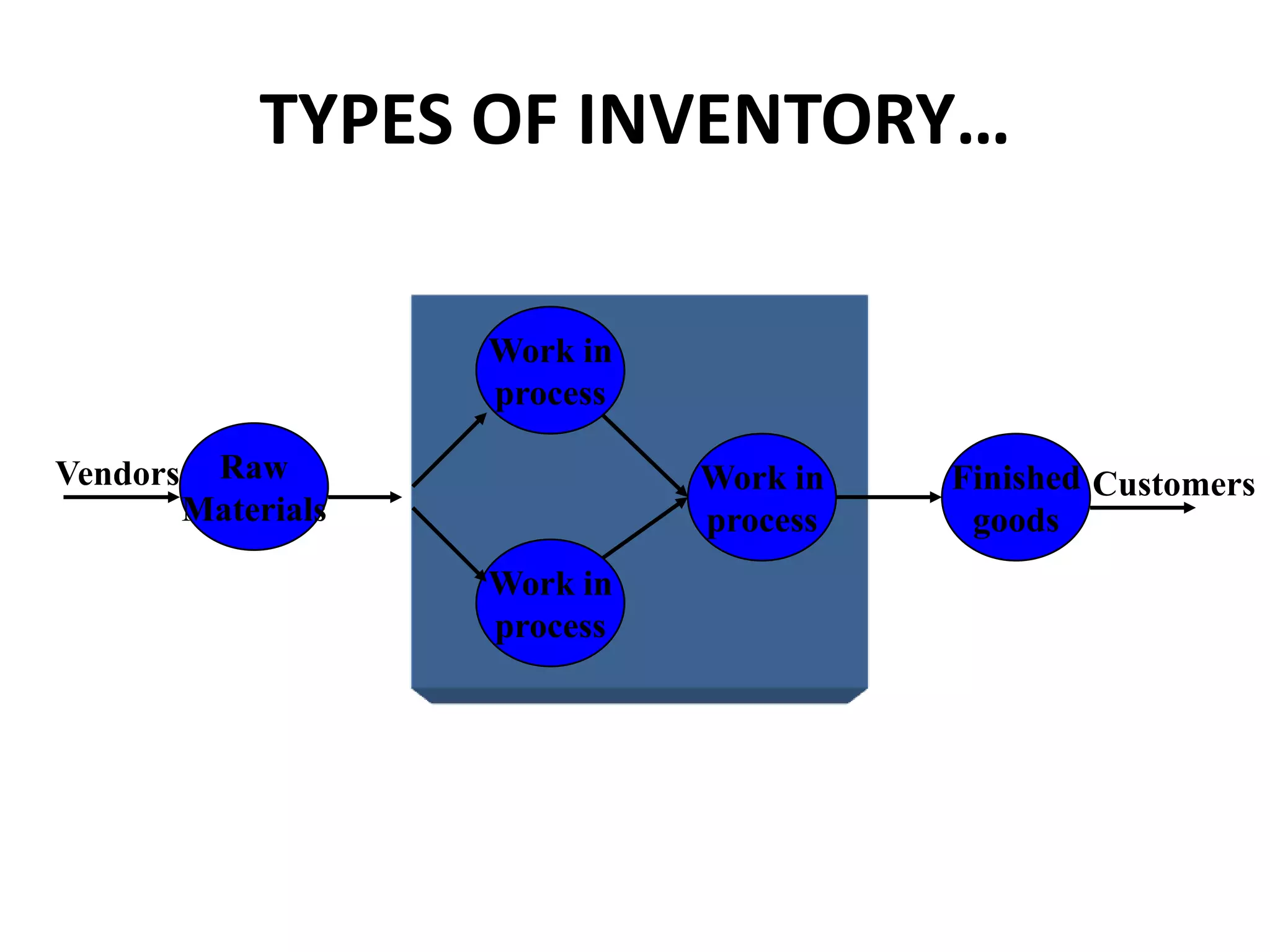
TYPES OF INVENTORY…
Work in
process
Vendors

Raw
Materials

Work in
process
Work in
process

Finished Customers
goods
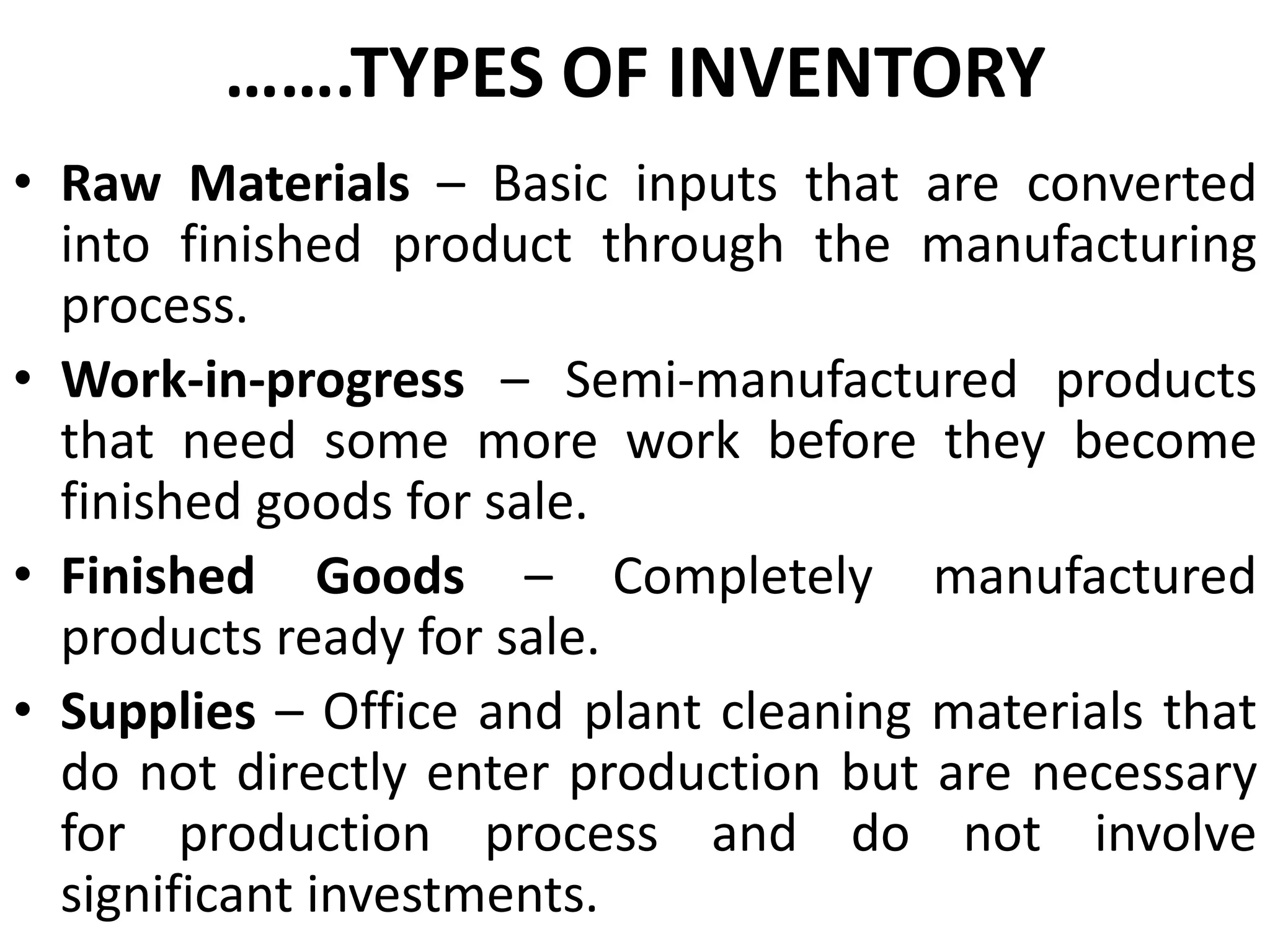
…….TYPES OF INVENTORY
• Raw Materials – Basic inputs that are converted
into finished product through the manufacturing
process.
• Work-in-progress – Semi-manufactured products
that need some more work before they become
finished goods for sale.
• Finished Goods – Completely manufactured
products ready for sale.
• Supplies – Office and plant cleaning materials that
do not directly enter production but are necessary
for production process and do not involve
significant investments.
RELEVANCE : INVENTORY
• Constitute significant part of current assets.
CURRENT ASSETS
• Realised or consumed in the operating cycle.
• Held primarily for trading.
• Cash or cash-equivalent.
(An asset which is not a current asset is classified as a non current asset)
RELEVANCE: INVENTORY
• Constitute significant part of current assets.
• On an average, inventory forms approx 60% of
current assets in Public Limited Companies in India.
• Huge financial implications.
• Effective and efficient management is imperative to
avoid unnecessary investment.
• Improper inventory management affects long term
profitability and may cause failure ultimately.
• 10 to 20% of inventory can be reduced without any
adverse effect on production and sales by using
simple inventory planning and control techniques.
INVENTORY MGT

 The act or manner of managing, handling, directing or
controlling the flow of inventory.

NEED :• Demand related:-

– Meet unexpected demands.
– Smooth seasonal or cyclical demands.

• Pricing related:– Hedge against price increases.
– Take advantage of quantity discounts.

• Process and supply surprises related:– Internal – upsets in parts of or our own processes.
– External – delays in incoming goods.
OBJECTIVES: INVENTORY MGT
• To maintain an optimum size of inventory for
efficient and smooth production and sales
operations.
• To maintain a minimum investment in inventories to
maximize the profitability.

• Effort should be made to place an order at the right
time with right source to acquire the right quantity
at the right price and right quality.
SUCCESS MANTRA
• Ensure a continuous supply of raw materials to
facilitate uninterrupted production.
• Maintain sufficient stocks of raw materials in
periods of short supply and anticipate price
changes.
• Maintain sufficient finished goods inventory for
smooth sales operation, and efficient customer
service.
• Minimize the carrying cost and time.
• Control investment in inventories and keep it at an
optimum level.
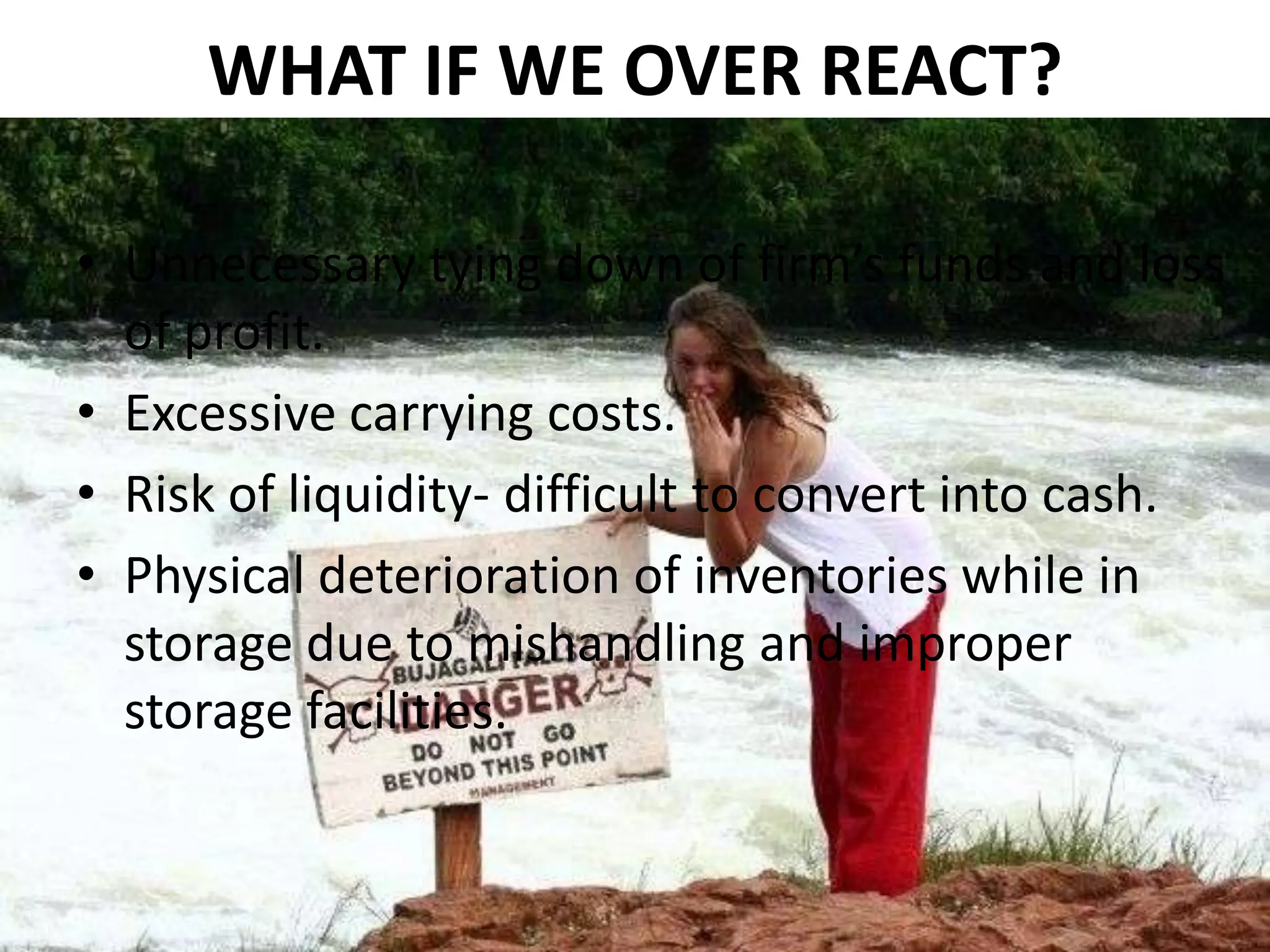
WHAT IF WE OVER REACT?
• Unnecessary tying down of firm’s funds and loss
of profit.
• Excessive carrying costs.
• Risk of liquidity- difficult to convert into cash.
• Physical deterioration of inventories while in
storage due to mishandling and improper
storage facilities.
WHAT IF ONE IS TOO COOL!
• Production hold-ups – loss of labour hours.
• Failure to meet delivery commitments.
• Customers may shift to competitors which will
amount to a permanent loss to the firm.
• May affect the goodwill and image of the firm.
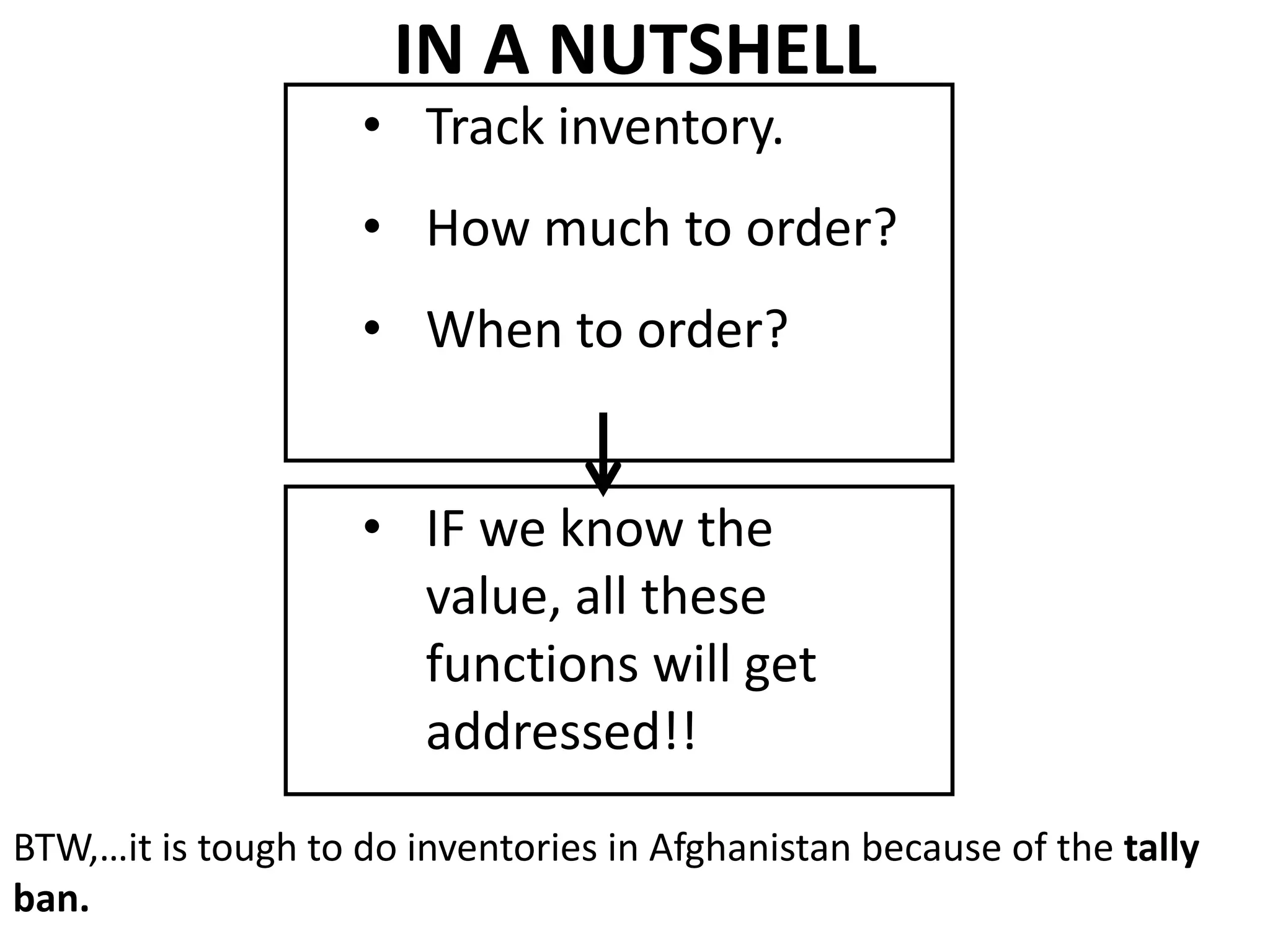
IN A NUTSHELL

• Track inventory.

• How much to order?
• When to order?

• IF we know the
value, all these
functions will get
addressed!!
BTW,…it is tough to do inventories in Afghanistan because of the tally
ban.
PART 2 – SYSTEMS & METHODS
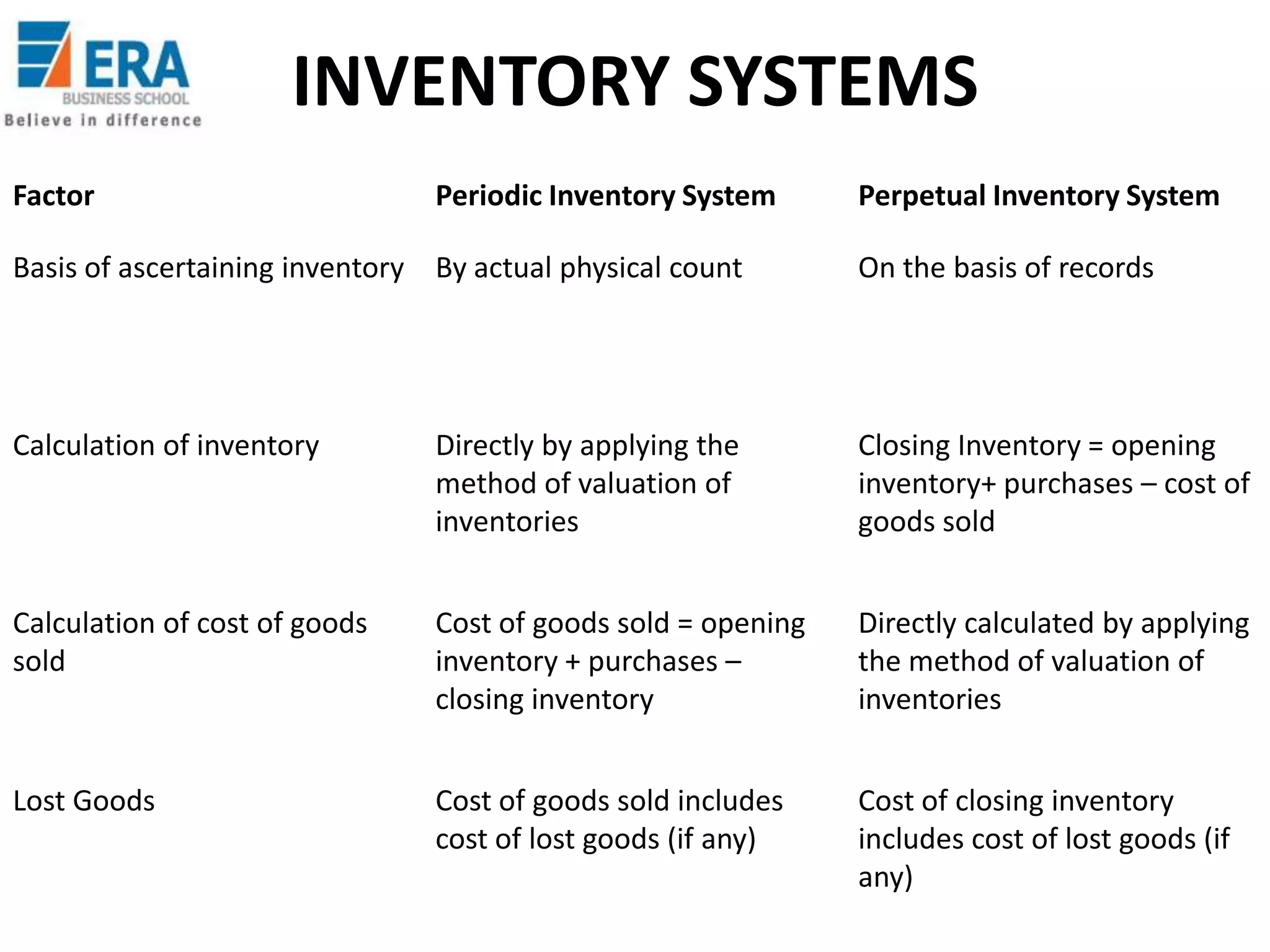
INVENTORY SYSTEMS
Factor

Periodic Inventory System

Perpetual Inventory System

Basis of ascertaining inventory By actual physical count

On the basis of records

Calculation of inventory

Directly by applying the
method of valuation of
inventories

Closing Inventory = opening
inventory+ purchases – cost of
goods sold

Calculation of cost of goods
sold

Cost of goods sold = opening
inventory + purchases –
closing inventory

Directly calculated by applying
the method of valuation of
inventories

Lost Goods

Cost of goods sold includes
cost of lost goods (if any)

Cost of closing inventory
includes cost of lost goods (if
any)
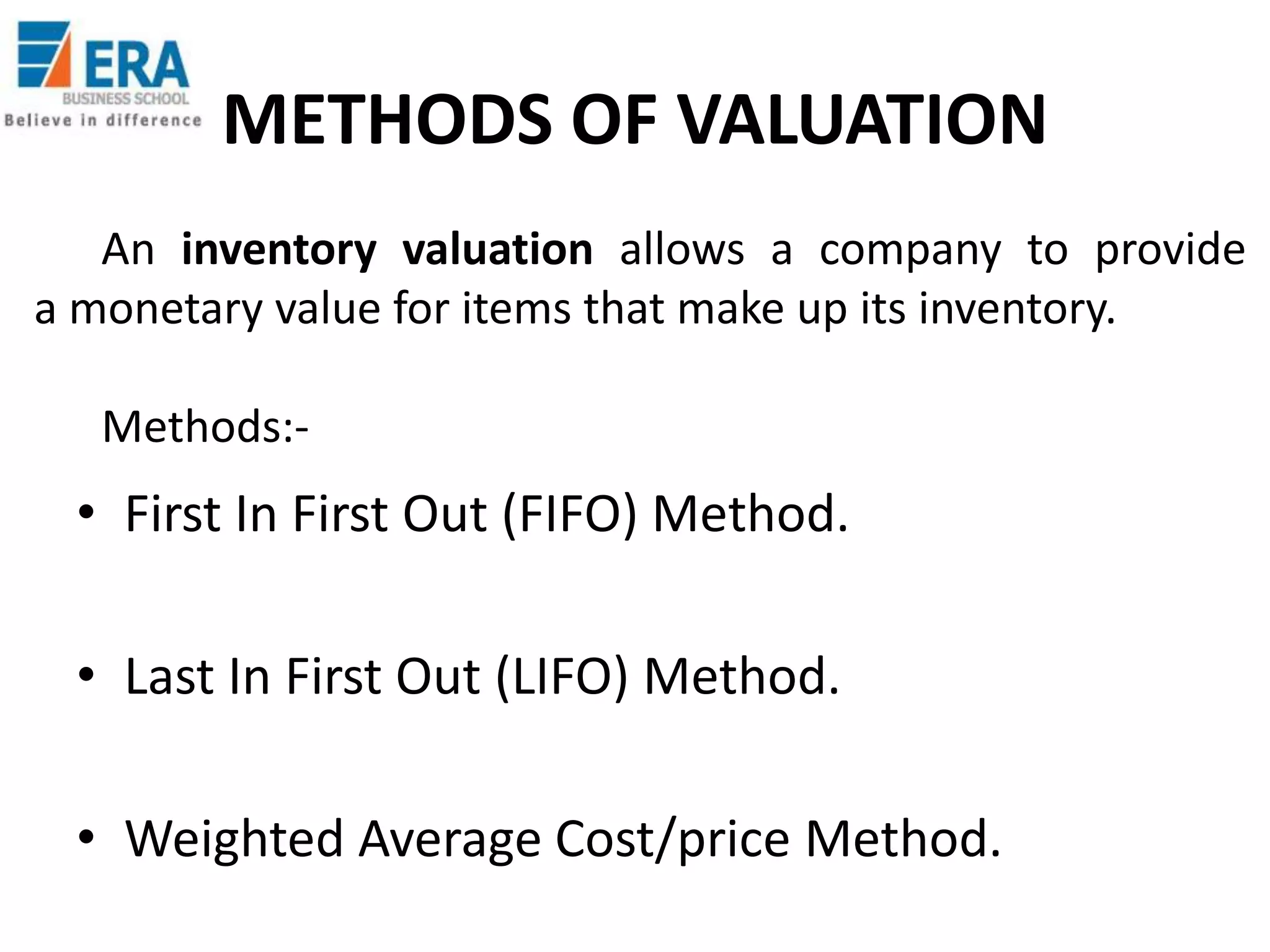
METHODS OF VALUATION
An inventory valuation allows a company to provide
a monetary value for items that make up its inventory.
Methods:-

• First In First Out (FIFO) Method.
• Last In First Out (LIFO) Method.
• Weighted Average Cost/price Method.
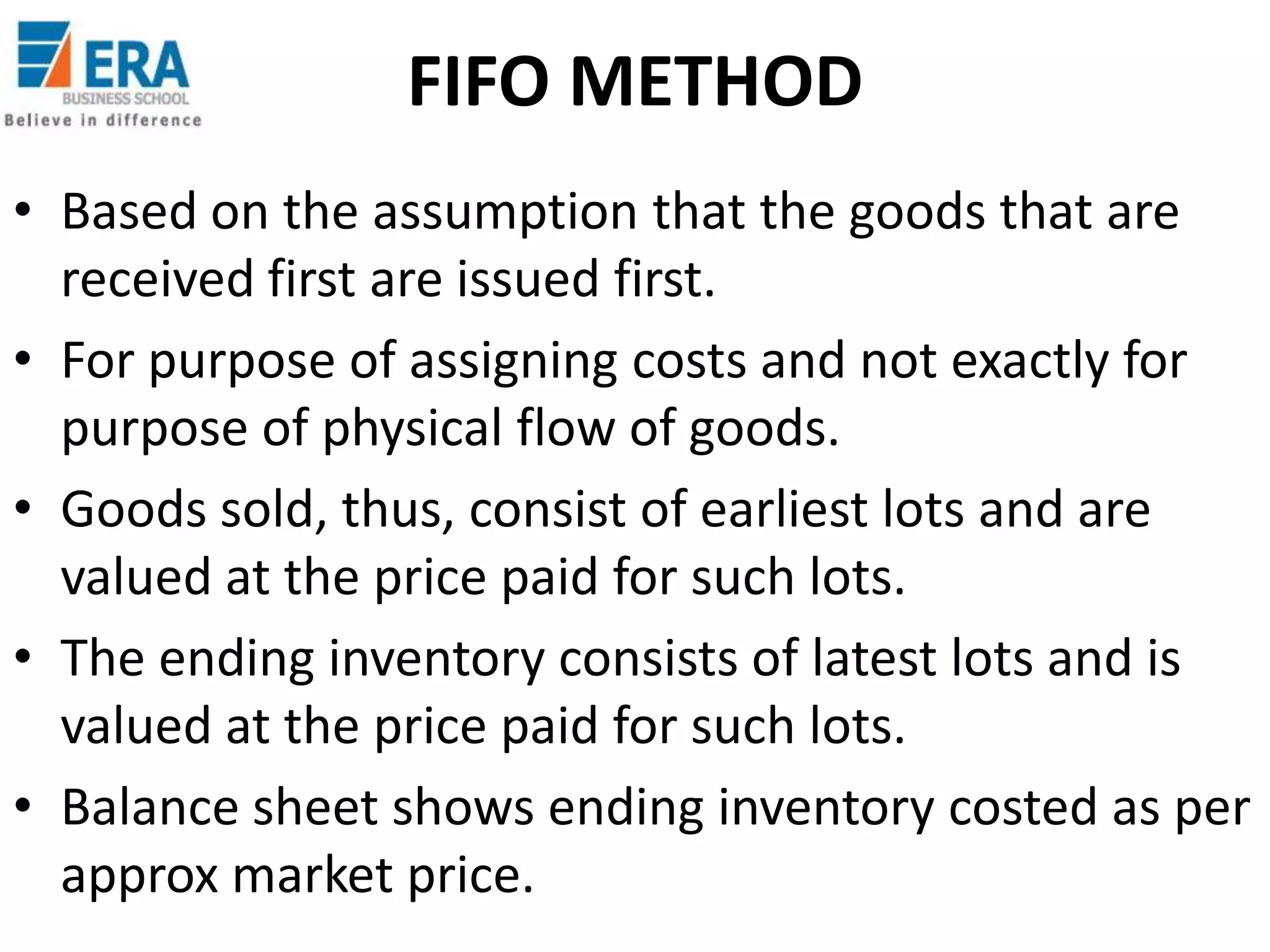
FIFO METHOD
• Based on the assumption that the goods that are
received first are issued first.
• For purpose of assigning costs and not exactly for
purpose of physical flow of goods.
• Goods sold, thus, consist of earliest lots and are
valued at the price paid for such lots.
• The ending inventory consists of latest lots and is
valued at the price paid for such lots.
• Balance sheet shows ending inventory costed as per
approx market price.
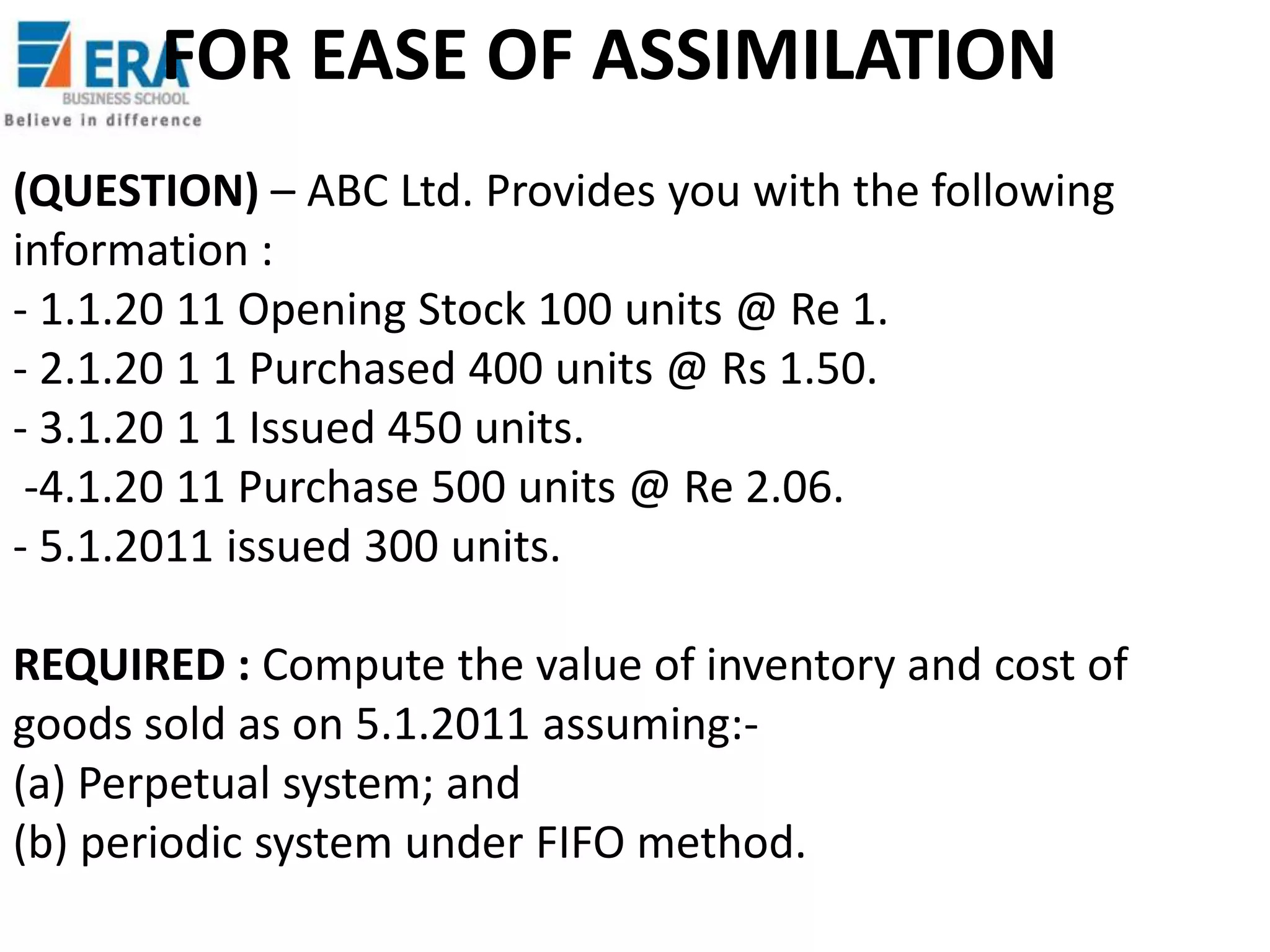
FOR EASE OF ASSIMILATION
(QUESTION) – ABC Ltd. Provides you with the following
information :
- 1.1.20 11 Opening Stock 100 units @ Re 1.
- 2.1.20 1 1 Purchased 400 units @ Rs 1.50.
- 3.1.20 1 1 Issued 450 units.
-4.1.20 11 Purchase 500 units @ Re 2.06.
- 5.1.2011 issued 300 units.
REQUIRED : Compute the value of inventory and cost of
goods sold as on 5.1.2011 assuming:(a) Perpetual system; and
(b) periodic system under FIFO method.
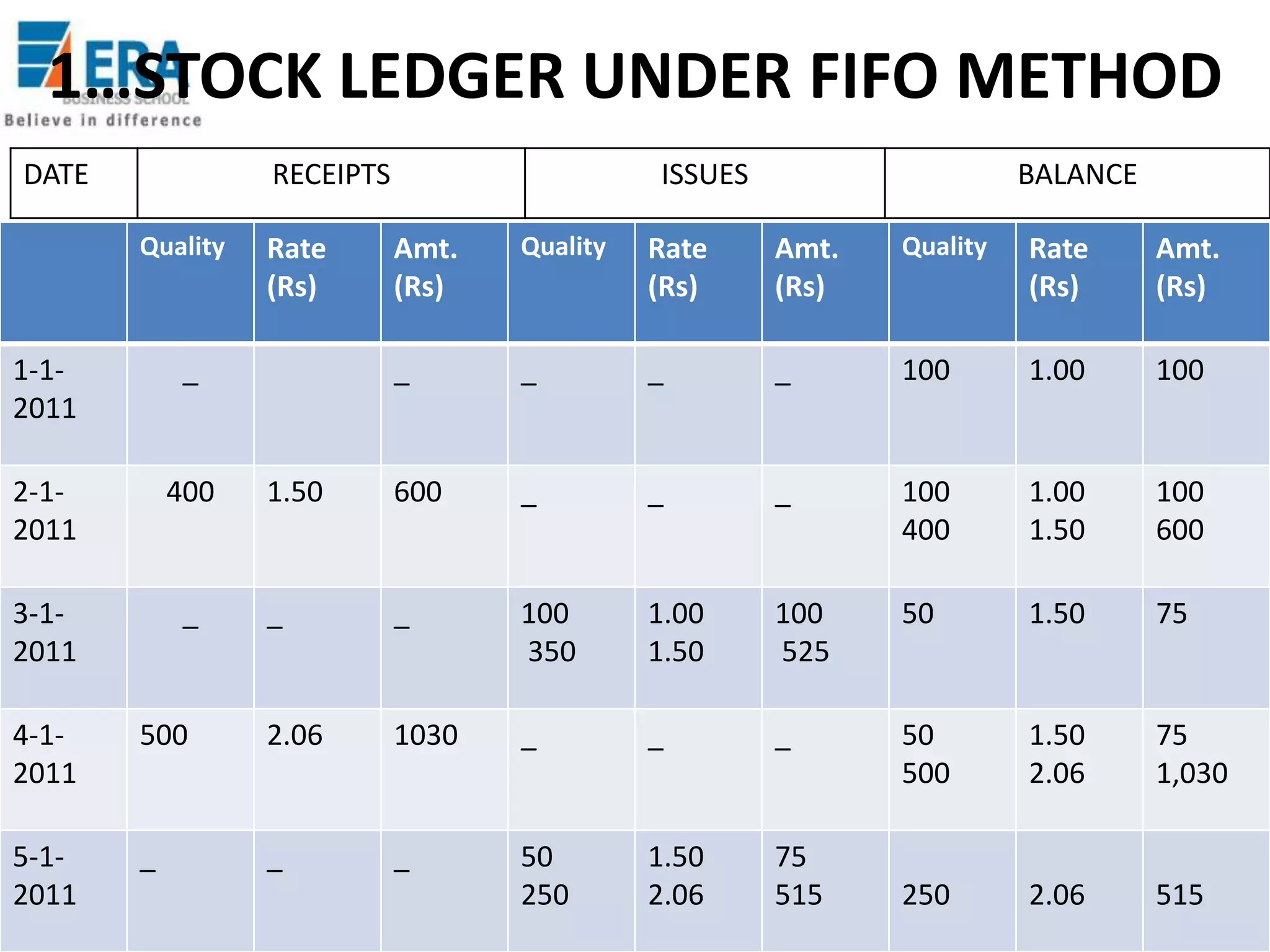
1…STOCK LEDGER UNDER FIFO METHOD
DATE

RECEIPTS
Quality

1-12011

400

3-12011

_

BALANCE

Amt.
(Rs)

Quality

Rate
(Rs)

Amt.
(Rs)

Quality

Rate
(Rs)

Amt.
(Rs)

_

_

_

_

100

1.00

100

1.50

600

_

_

_

100
400

1.00
1.50

100
600

_

_

100
350

1.00
1.50

100
525

50

1.50

75

50
500

1.50
2.06

75
1,030

250

2.06

515

Rate
(Rs)

_

2-12011

ISSUES

4-12011

500

2.06

1030

_

_

_

5-12011

_

_

_

50
250

1.50
2.06

75
515
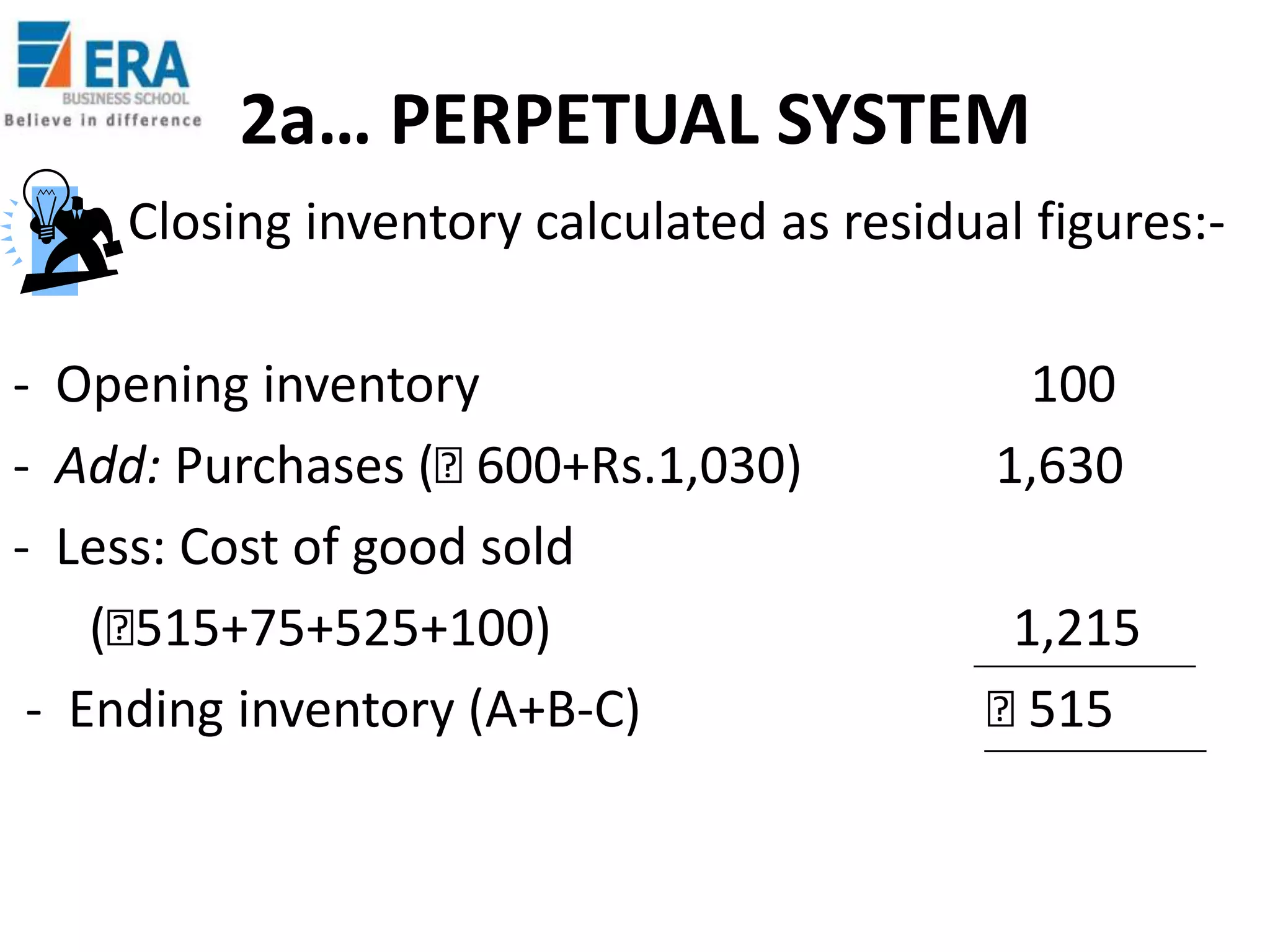
2a… PERPETUAL SYSTEM
Closing inventory calculated as residual figures:- Opening inventory
- Add: Purchases (₹
600+Rs.1,030)
- Less: Cost of good sold
(₹
515+75+525+100)
- Ending inventory (A+B-C)

100
1,630
1,215
₹
515
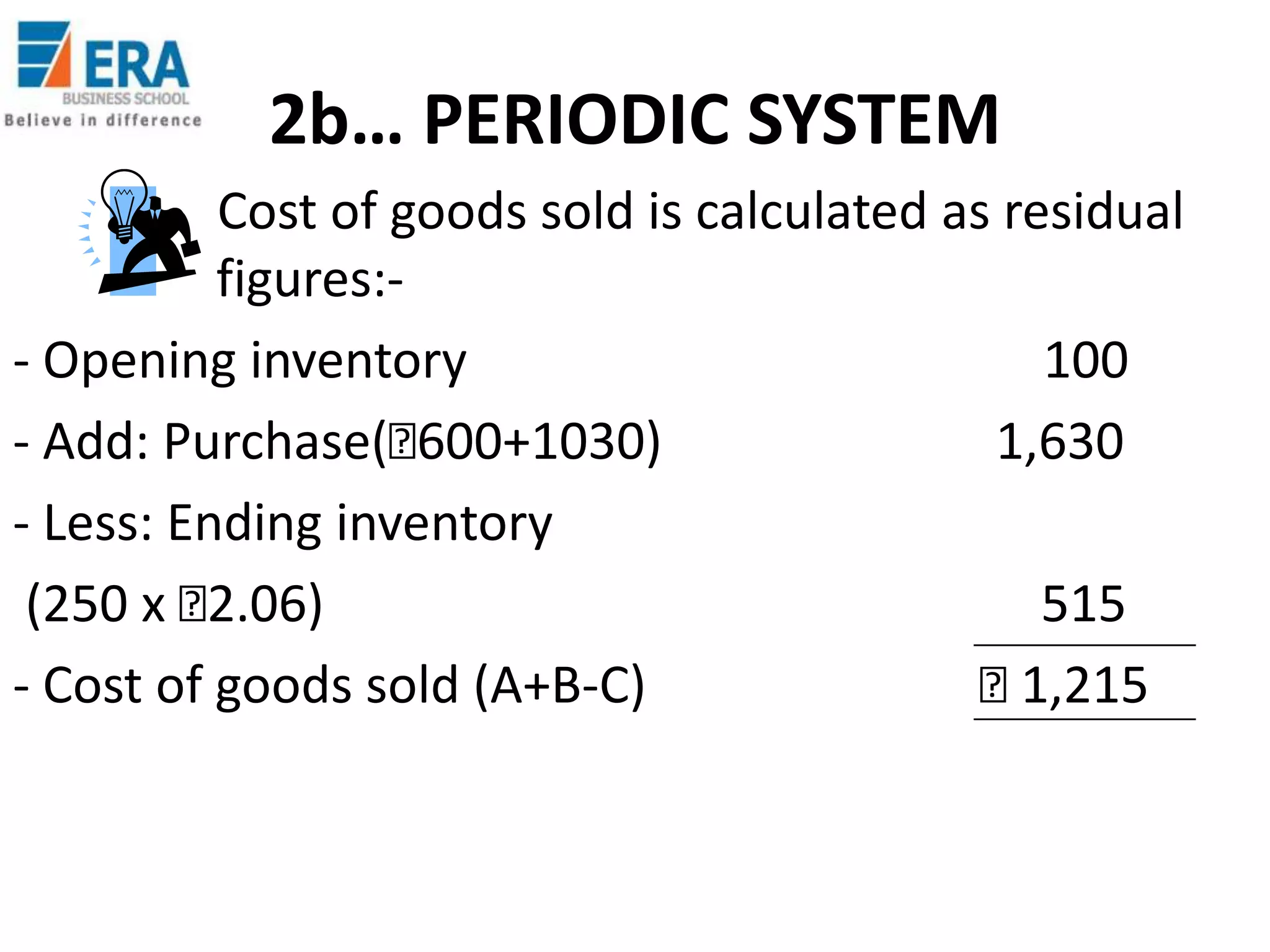
2b… PERIODIC SYSTEM
Cost of goods sold is calculated as residual
figures:- Opening inventory
100
- Add: Purchase(₹
600+1030)
1,630
- Less: Ending inventory
(250 x ₹
2.06)
515
- Cost of goods sold (A+B-C)
₹
1,215
LIFO METHOD
• Based on assumption that goods that are received
last are issued first.
• Assumption made for purposes of assigning costs
and not for actual physical flow of goods.
• Flows of goods and costs may not coincide.
• Goods sold, thus, consist of the latest lots and are
valued at the price paid for such lots.
• The ending inventory consists of the earliest lots
and is valued as such.
• Balance sheet has an inventory costed at old prices.
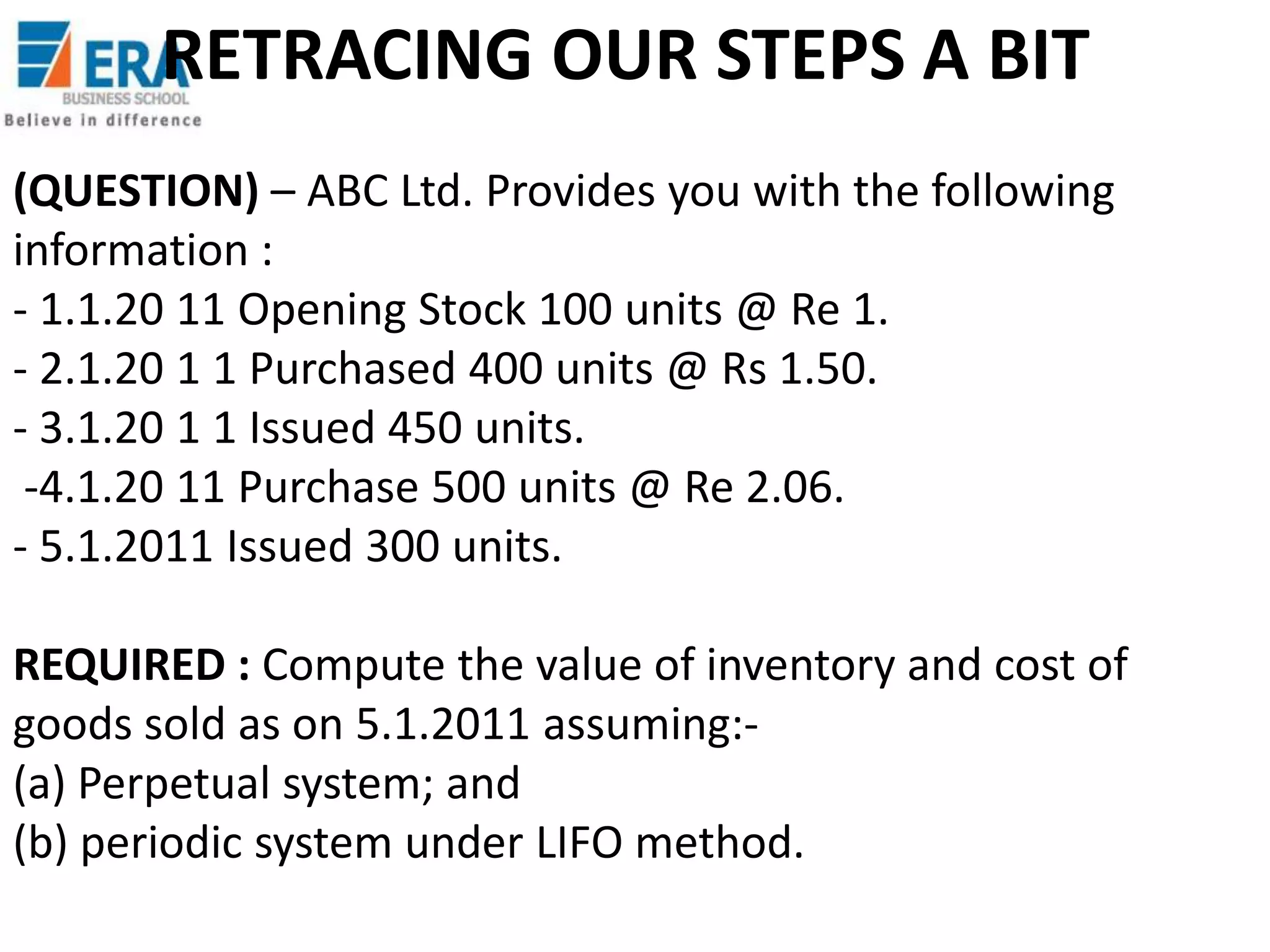
RETRACING OUR STEPS A BIT
(QUESTION) – ABC Ltd. Provides you with the following
information :
- 1.1.20 11 Opening Stock 100 units @ Re 1.
- 2.1.20 1 1 Purchased 400 units @ Rs 1.50.
- 3.1.20 1 1 Issued 450 units.
-4.1.20 11 Purchase 500 units @ Re 2.06.
- 5.1.2011 Issued 300 units.
REQUIRED : Compute the value of inventory and cost of
goods sold as on 5.1.2011 assuming:(a) Perpetual system; and
(b) periodic system under LIFO method.
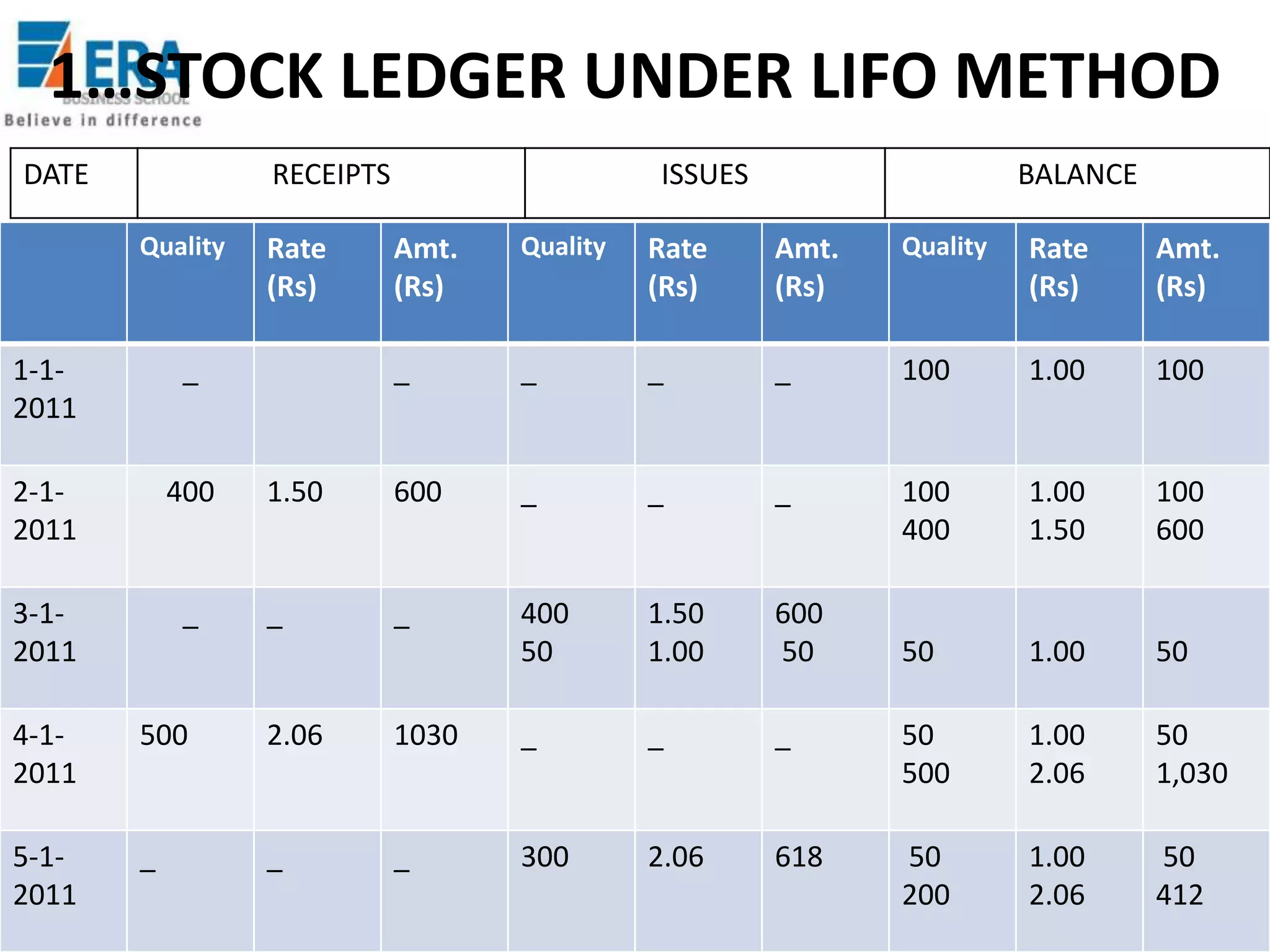
1…STOCK LEDGER UNDER LIFO METHOD
DATE

RECEIPTS
Quality

1-12011

400

3-12011

_

BALANCE

Amt.
(Rs)

Quality

Rate
(Rs)

Amt.
(Rs)

Quality

Rate
(Rs)

Amt.
(Rs)

_

_

_

_

100

1.00

100

1.50

600

_

_

_

100
400

1.00
1.50

100
600

_

_

400
50

1.50
1.00

600
50

50

1.00

50

Rate
(Rs)

_

2-12011

ISSUES

4-12011

500

2.06

1030

_

_

_

50
500

1.00
2.06

50
1,030

5-12011

_

_

_

300

2.06

618

50
200

1.00
2.06

50
412
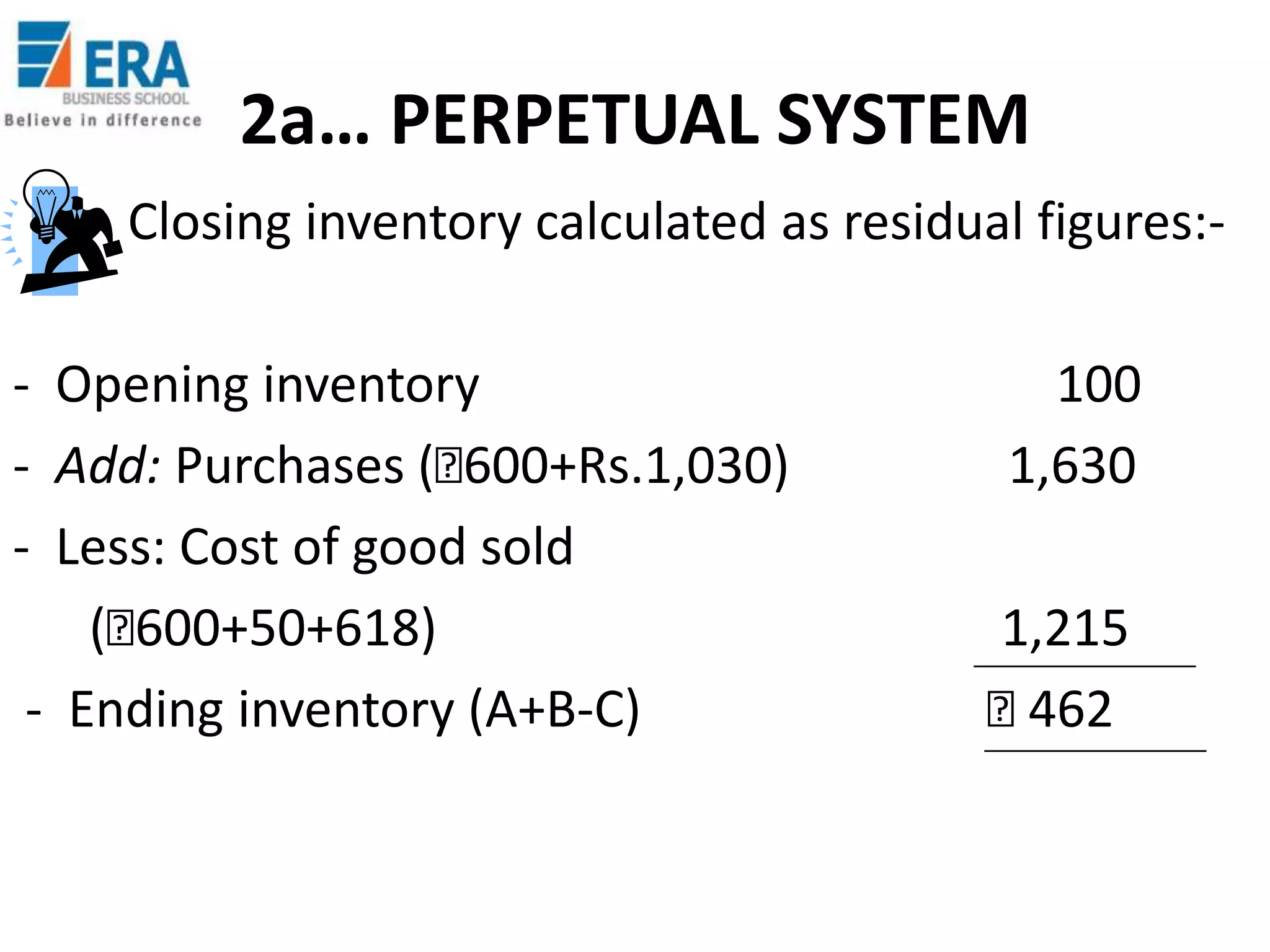
2a… PERPETUAL SYSTEM
Closing inventory calculated as residual figures:- Opening inventory
- Add: Purchases (₹
600+Rs.1,030)
- Less: Cost of good sold
(₹
600+50+618)
- Ending inventory (A+B-C)

100
1,630
1,215
₹
462
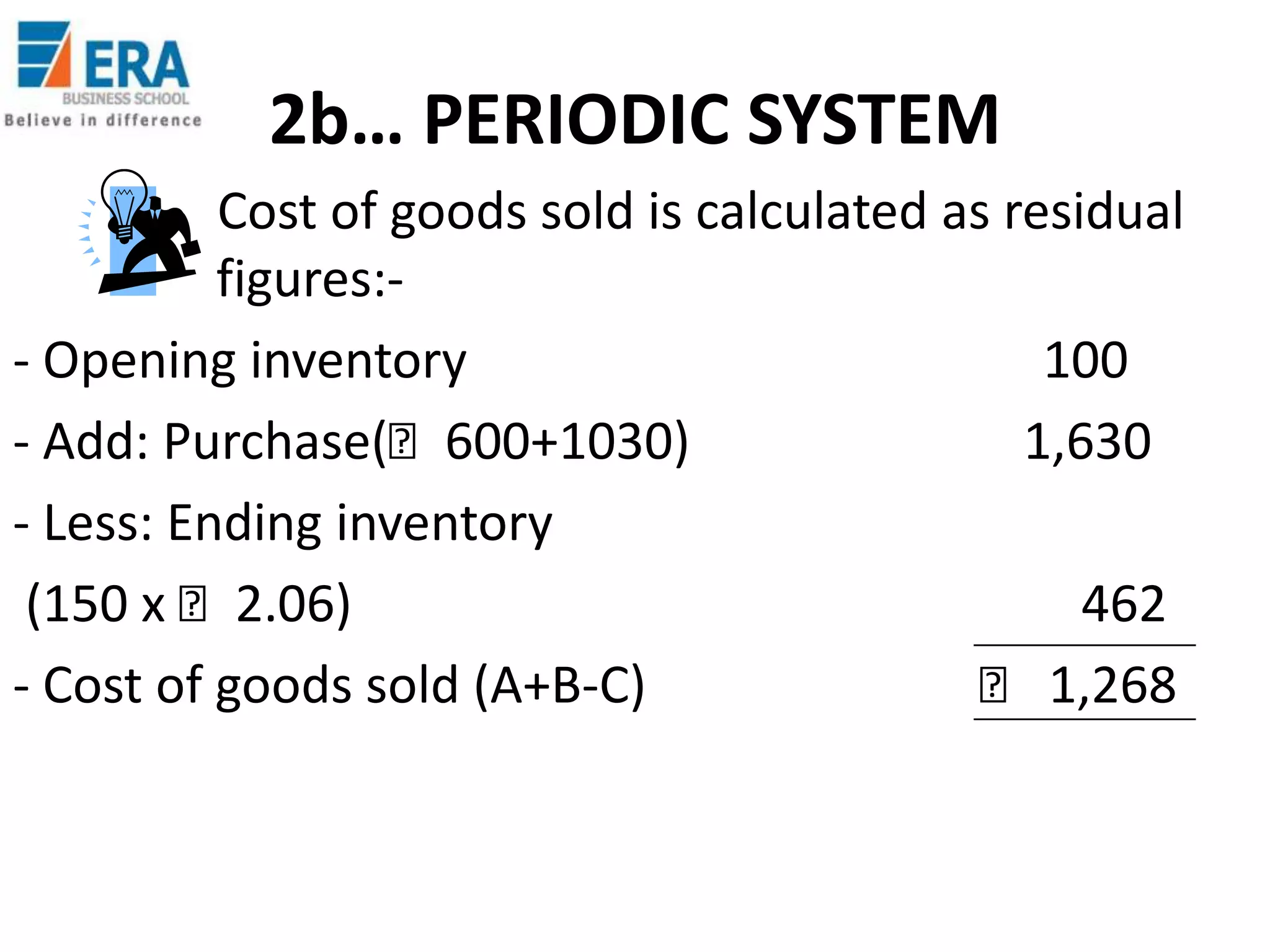
2b… PERIODIC SYSTEM
Cost of goods sold is calculated as residual
figures:- Opening inventory
100
- Add: Purchase(₹600+1030)
1,630
- Less: Ending inventory
(150 x ₹2.06)
462
- Cost of goods sold (A+B-C)
₹ 1,268
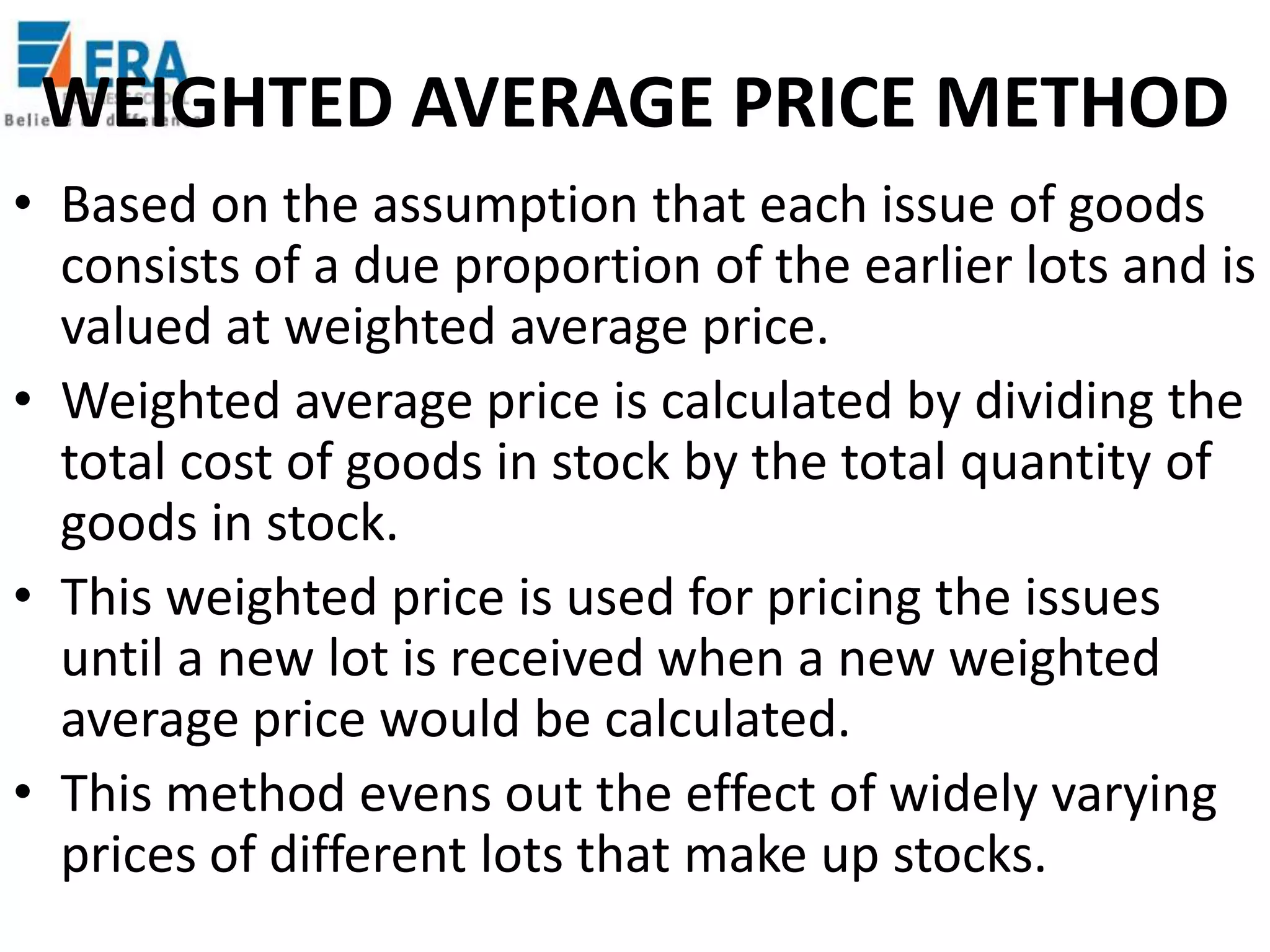
WEIGHTED AVERAGE PRICE METHOD
• Based on the assumption that each issue of goods
consists of a due proportion of the earlier lots and is
valued at weighted average price.
• Weighted average price is calculated by dividing the
total cost of goods in stock by the total quantity of
goods in stock.
• This weighted price is used for pricing the issues
until a new lot is received when a new weighted
average price would be calculated.
• This method evens out the effect of widely varying
prices of different lots that make up stocks.
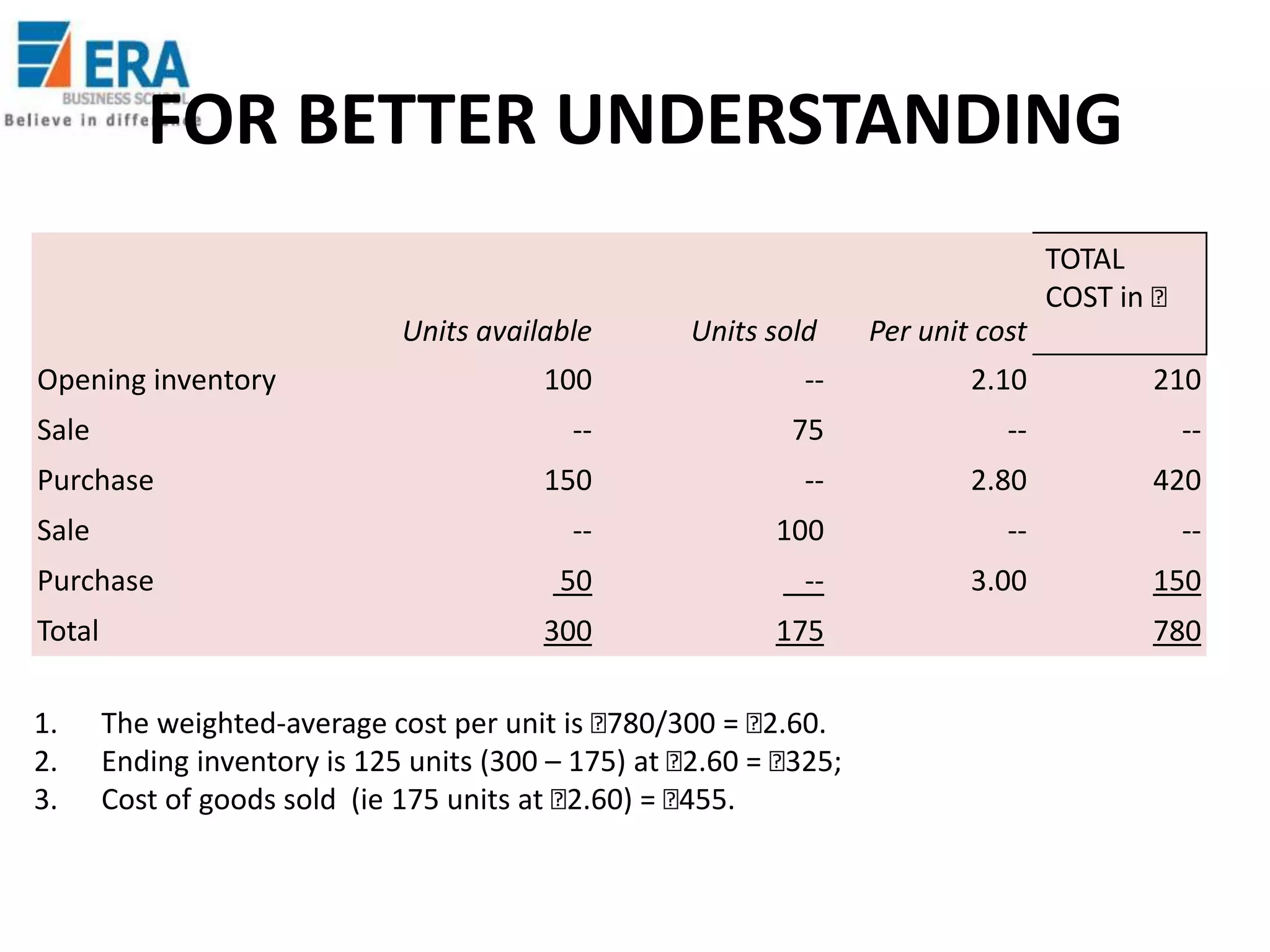
FOR BETTER UNDERSTANDING
TOTAL
COST in ₹
Units available

Sale
Purchase
Total
1.
2.
3.

--

2.10

210

75

--

--

150

--

2.80

420

100

--

--

50

--

3.00

150

300

Purchase

100

--

Sale

Per unit cost

--

Opening inventory

Units sold

175

The weighted-average cost per unit is ₹
780/300 = ₹
2.60.
Ending inventory is 125 units (300 – 175) at ₹
2.60 = ₹
325;
Cost of goods sold (ie 175 units at ₹
2.60) = ₹
455.

780
PART 3 – MISCELLANEOUS ASPECTS
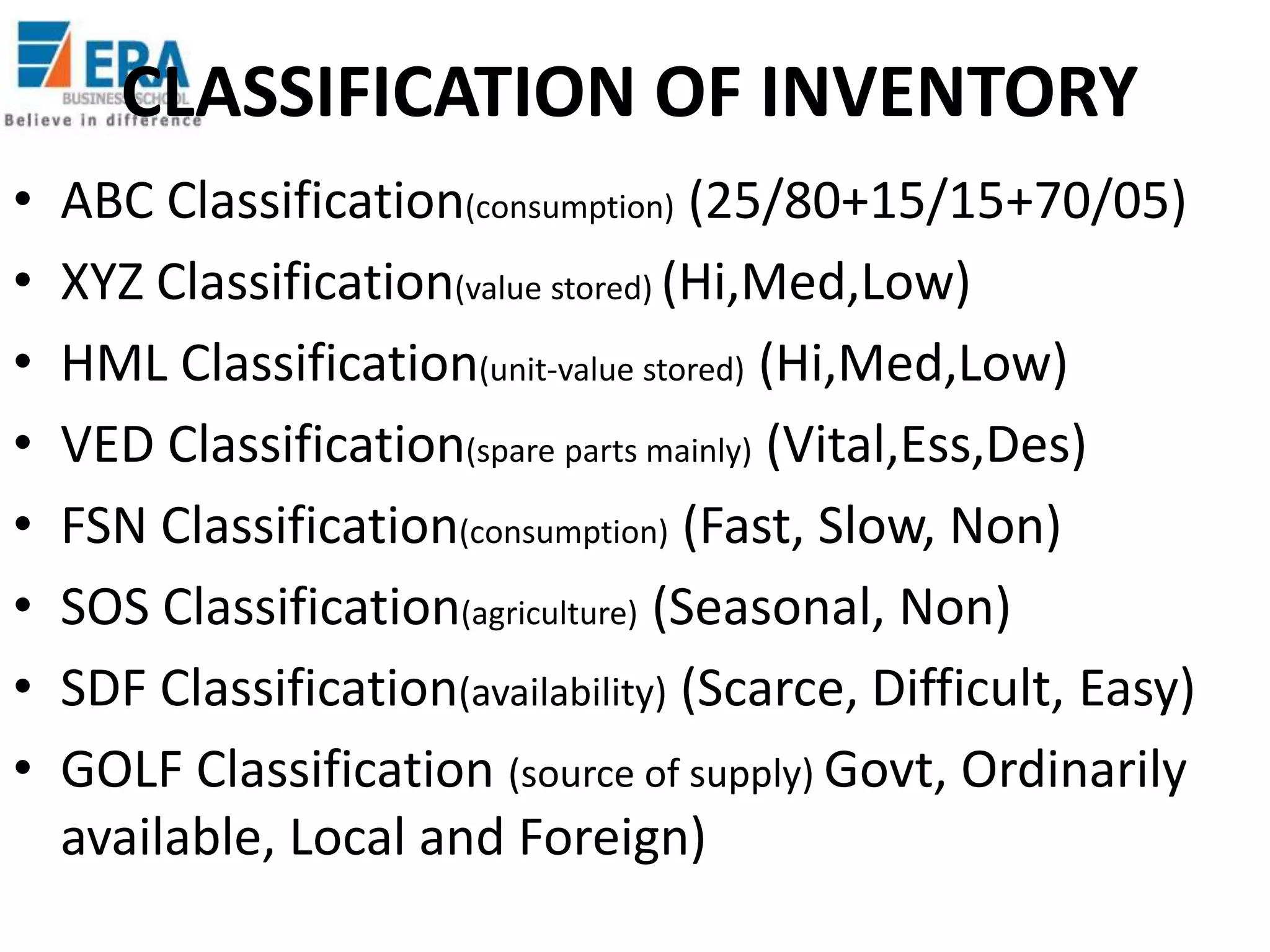
CLASSIFICATION OF INVENTORY
•
•
•
•
•
•
•
•

ABC Classification(consumption) (25/80+15/15+70/05)
XYZ Classification(value stored) (Hi,Med,Low)
HML Classification(unit-value stored) (Hi,Med,Low)
VED Classification(spare parts mainly) (Vital,Ess,Des)
FSN Classification(consumption) (Fast, Slow, Non)
SOS Classification(agriculture) (Seasonal, Non)
SDF Classification(availability) (Scarce, Difficult, Easy)
GOLF Classification (source of supply) Govt, Ordinarily
available, Local and Foreign)
EMERGING TRENDS IN INVENTORY
MANAGEMENT
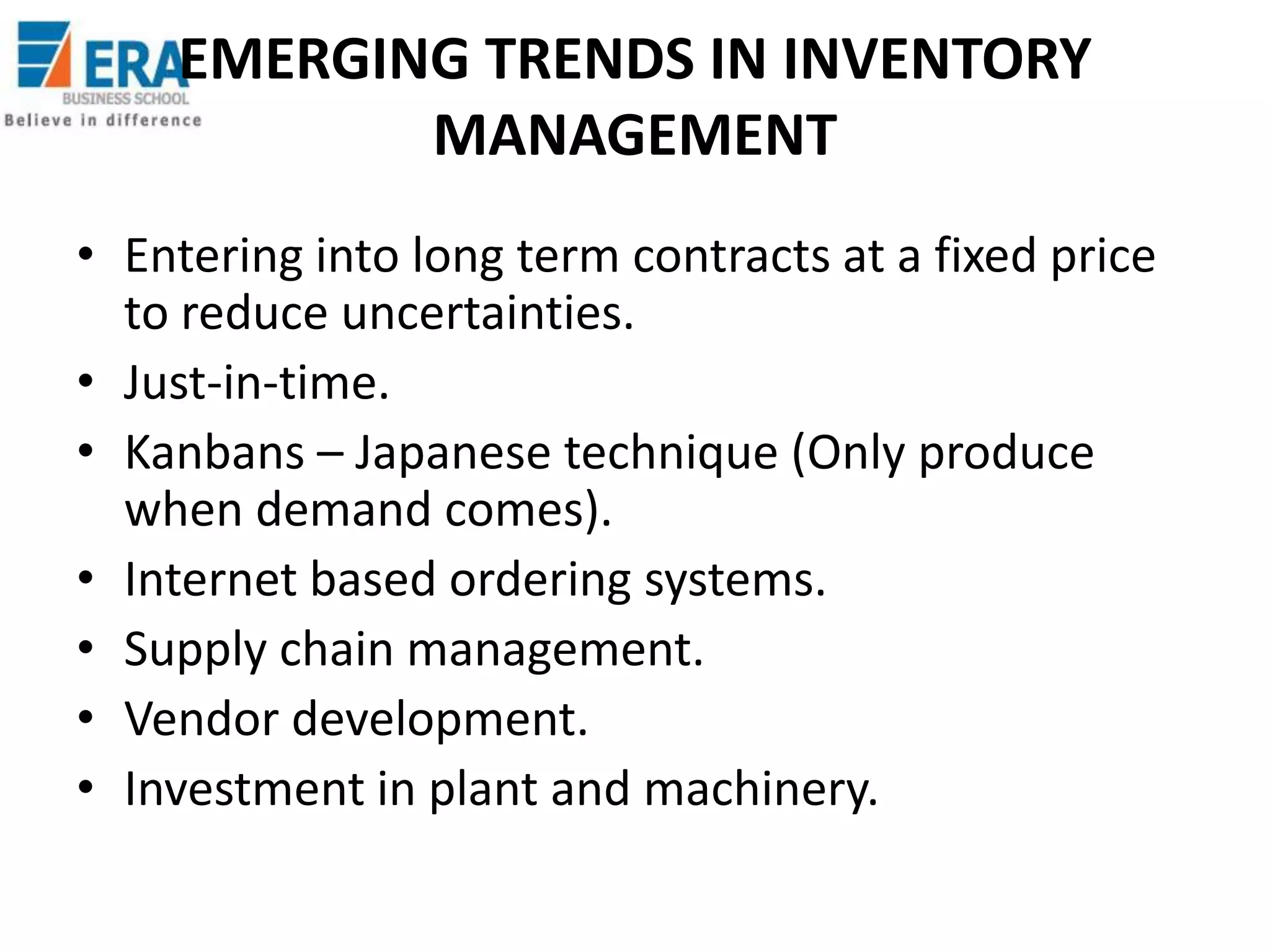
• Entering into long term contracts at a fixed price
to reduce uncertainties.
• Just-in-time.
• Kanbans – Japanese technique (Only produce
when demand comes).
• Internet based ordering systems.
• Supply chain management.
• Vendor development.
• Investment in plant and machinery.
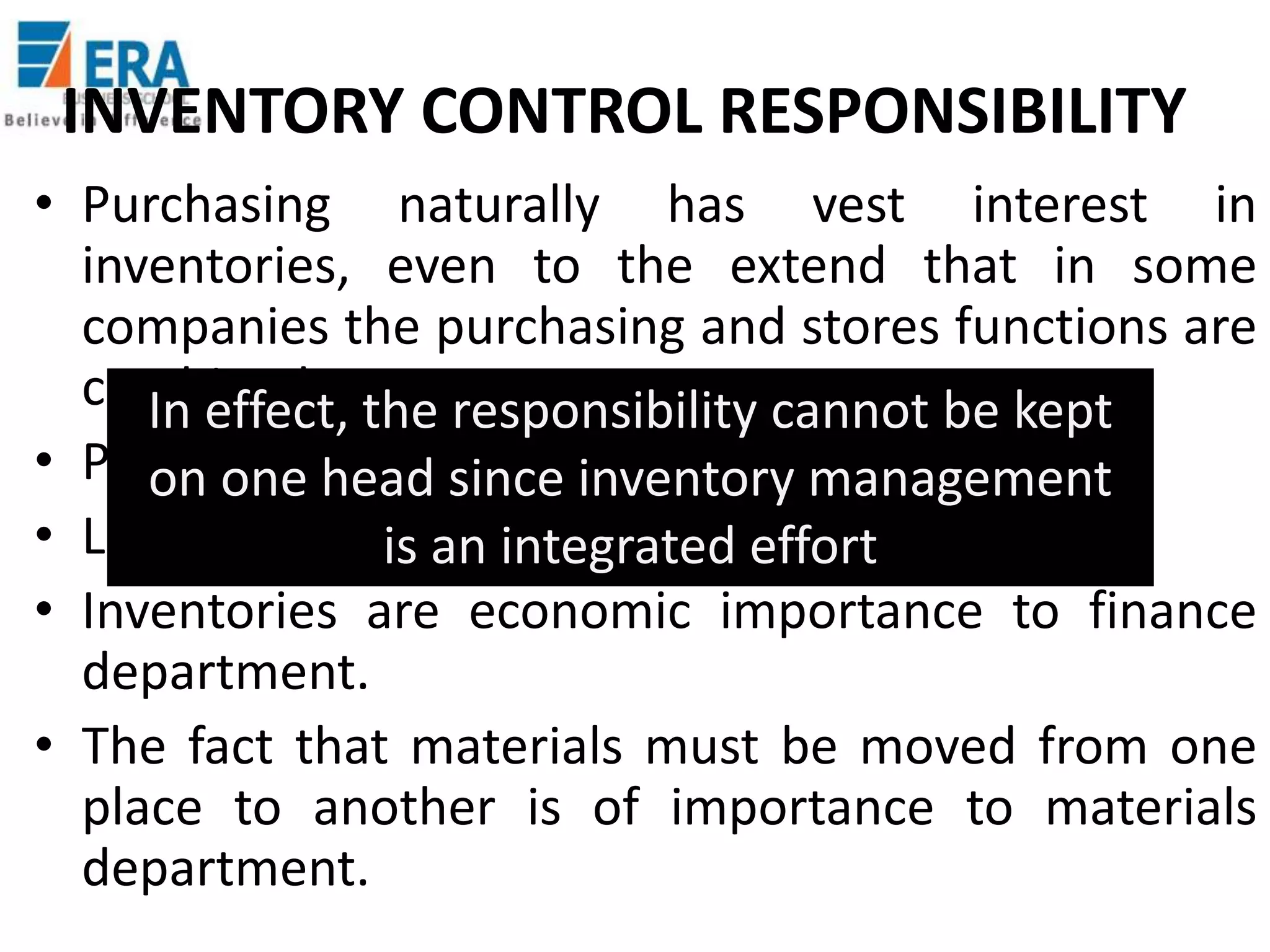
INVENTORY CONTROL RESPONSIBILITY
• Purchasing naturally has vest interest in
inventories, even to the extend that in some
companies the purchasing and stores functions are
combined. the responsibility cannot be kept
In effect,
• Production looks after the workmanagement
on one head since inventory in progress.
• Logistics plays a major role ineffort
is an integrated inventory control
• Inventories are economic importance to finance
department.
• The fact that materials must be moved from one
place to another is of importance to materials
department.
ANY QUESTIONS?
THANK YOU

Inventory Management - a ppt for PGDM/MBA

  • 1.
    INVENTORY MANAGEMENT Origin : 1375–1425;Late Middle English ‘inventorie’ and ‘inventorium’ in Latin.
  • 2.
    AIM • Aim ofthis presentation is to introduce the topic of Inventory Management to an already stressed, hard-pressed and unsuspecting class of students. (presented by Sneha, Atul & Ajay K Raina)
  • 3.
    SCOPE • Part 1– Basic Concepts. • Part 2 – Systems and Methods. • Part 3 – Miscellaneous Aspects. • Interactive Session and Conclusion.
  • 4.
    PART 1 –BASIC CONCEPTS
  • 5.
    INVENTORY : FINACCTG • The assets that are:– Held for sale in the ordinary course of business; or – In the process of production for such a sale; or – In the form of materials or supplies to be consumed in the production process; or – In the rendering of services. • Relevance : Trading concern & Manufacturing unit. • Loose tools v/s spares.
  • 6.
    TYPES OF INVENTORY… Workin process Vendors Raw Materials Work in process Work in process Finished Customers goods
  • 7.
    …….TYPES OF INVENTORY •Raw Materials – Basic inputs that are converted into finished product through the manufacturing process. • Work-in-progress – Semi-manufactured products that need some more work before they become finished goods for sale. • Finished Goods – Completely manufactured products ready for sale. • Supplies – Office and plant cleaning materials that do not directly enter production but are necessary for production process and do not involve significant investments.
  • 8.
    RELEVANCE : INVENTORY •Constitute significant part of current assets.
  • 9.
    CURRENT ASSETS • Realisedor consumed in the operating cycle. • Held primarily for trading. • Cash or cash-equivalent. (An asset which is not a current asset is classified as a non current asset)
  • 10.
    RELEVANCE: INVENTORY • Constitutesignificant part of current assets. • On an average, inventory forms approx 60% of current assets in Public Limited Companies in India. • Huge financial implications. • Effective and efficient management is imperative to avoid unnecessary investment. • Improper inventory management affects long term profitability and may cause failure ultimately. • 10 to 20% of inventory can be reduced without any adverse effect on production and sales by using simple inventory planning and control techniques.
  • 11.
    INVENTORY MGT  Theact or manner of managing, handling, directing or controlling the flow of inventory. NEED :• Demand related:- – Meet unexpected demands. – Smooth seasonal or cyclical demands. • Pricing related:– Hedge against price increases. – Take advantage of quantity discounts. • Process and supply surprises related:– Internal – upsets in parts of or our own processes. – External – delays in incoming goods.
  • 12.
    OBJECTIVES: INVENTORY MGT •To maintain an optimum size of inventory for efficient and smooth production and sales operations. • To maintain a minimum investment in inventories to maximize the profitability. • Effort should be made to place an order at the right time with right source to acquire the right quantity at the right price and right quality.
  • 13.
    SUCCESS MANTRA • Ensurea continuous supply of raw materials to facilitate uninterrupted production. • Maintain sufficient stocks of raw materials in periods of short supply and anticipate price changes. • Maintain sufficient finished goods inventory for smooth sales operation, and efficient customer service. • Minimize the carrying cost and time. • Control investment in inventories and keep it at an optimum level.
  • 14.
    WHAT IF WEOVER REACT? • Unnecessary tying down of firm’s funds and loss of profit. • Excessive carrying costs. • Risk of liquidity- difficult to convert into cash. • Physical deterioration of inventories while in storage due to mishandling and improper storage facilities.
  • 15.
    WHAT IF ONEIS TOO COOL! • Production hold-ups – loss of labour hours. • Failure to meet delivery commitments. • Customers may shift to competitors which will amount to a permanent loss to the firm. • May affect the goodwill and image of the firm.
  • 16.
    IN A NUTSHELL •Track inventory. • How much to order? • When to order? • IF we know the value, all these functions will get addressed!! BTW,…it is tough to do inventories in Afghanistan because of the tally ban.
  • 17.
    PART 2 –SYSTEMS & METHODS
  • 18.
    INVENTORY SYSTEMS Factor Periodic InventorySystem Perpetual Inventory System Basis of ascertaining inventory By actual physical count On the basis of records Calculation of inventory Directly by applying the method of valuation of inventories Closing Inventory = opening inventory+ purchases – cost of goods sold Calculation of cost of goods sold Cost of goods sold = opening inventory + purchases – closing inventory Directly calculated by applying the method of valuation of inventories Lost Goods Cost of goods sold includes cost of lost goods (if any) Cost of closing inventory includes cost of lost goods (if any)
  • 19.
    METHODS OF VALUATION Aninventory valuation allows a company to provide a monetary value for items that make up its inventory. Methods:- • First In First Out (FIFO) Method. • Last In First Out (LIFO) Method. • Weighted Average Cost/price Method.
  • 20.
    FIFO METHOD • Basedon the assumption that the goods that are received first are issued first. • For purpose of assigning costs and not exactly for purpose of physical flow of goods. • Goods sold, thus, consist of earliest lots and are valued at the price paid for such lots. • The ending inventory consists of latest lots and is valued at the price paid for such lots. • Balance sheet shows ending inventory costed as per approx market price.
  • 21.
    FOR EASE OFASSIMILATION (QUESTION) – ABC Ltd. Provides you with the following information : - 1.1.20 11 Opening Stock 100 units @ Re 1. - 2.1.20 1 1 Purchased 400 units @ Rs 1.50. - 3.1.20 1 1 Issued 450 units. -4.1.20 11 Purchase 500 units @ Re 2.06. - 5.1.2011 issued 300 units. REQUIRED : Compute the value of inventory and cost of goods sold as on 5.1.2011 assuming:(a) Perpetual system; and (b) periodic system under FIFO method.
  • 22.
    1…STOCK LEDGER UNDERFIFO METHOD DATE RECEIPTS Quality 1-12011 400 3-12011 _ BALANCE Amt. (Rs) Quality Rate (Rs) Amt. (Rs) Quality Rate (Rs) Amt. (Rs) _ _ _ _ 100 1.00 100 1.50 600 _ _ _ 100 400 1.00 1.50 100 600 _ _ 100 350 1.00 1.50 100 525 50 1.50 75 50 500 1.50 2.06 75 1,030 250 2.06 515 Rate (Rs) _ 2-12011 ISSUES 4-12011 500 2.06 1030 _ _ _ 5-12011 _ _ _ 50 250 1.50 2.06 75 515
  • 23.
    2a… PERPETUAL SYSTEM Closinginventory calculated as residual figures:- Opening inventory - Add: Purchases (₹ 600+Rs.1,030) - Less: Cost of good sold (₹ 515+75+525+100) - Ending inventory (A+B-C) 100 1,630 1,215 ₹ 515
  • 24.
    2b… PERIODIC SYSTEM Costof goods sold is calculated as residual figures:- Opening inventory 100 - Add: Purchase(₹ 600+1030) 1,630 - Less: Ending inventory (250 x ₹ 2.06) 515 - Cost of goods sold (A+B-C) ₹ 1,215
  • 25.
    LIFO METHOD • Basedon assumption that goods that are received last are issued first. • Assumption made for purposes of assigning costs and not for actual physical flow of goods. • Flows of goods and costs may not coincide. • Goods sold, thus, consist of the latest lots and are valued at the price paid for such lots. • The ending inventory consists of the earliest lots and is valued as such. • Balance sheet has an inventory costed at old prices.
  • 26.
    RETRACING OUR STEPSA BIT (QUESTION) – ABC Ltd. Provides you with the following information : - 1.1.20 11 Opening Stock 100 units @ Re 1. - 2.1.20 1 1 Purchased 400 units @ Rs 1.50. - 3.1.20 1 1 Issued 450 units. -4.1.20 11 Purchase 500 units @ Re 2.06. - 5.1.2011 Issued 300 units. REQUIRED : Compute the value of inventory and cost of goods sold as on 5.1.2011 assuming:(a) Perpetual system; and (b) periodic system under LIFO method.
  • 27.
    1…STOCK LEDGER UNDERLIFO METHOD DATE RECEIPTS Quality 1-12011 400 3-12011 _ BALANCE Amt. (Rs) Quality Rate (Rs) Amt. (Rs) Quality Rate (Rs) Amt. (Rs) _ _ _ _ 100 1.00 100 1.50 600 _ _ _ 100 400 1.00 1.50 100 600 _ _ 400 50 1.50 1.00 600 50 50 1.00 50 Rate (Rs) _ 2-12011 ISSUES 4-12011 500 2.06 1030 _ _ _ 50 500 1.00 2.06 50 1,030 5-12011 _ _ _ 300 2.06 618 50 200 1.00 2.06 50 412
  • 28.
    2a… PERPETUAL SYSTEM Closinginventory calculated as residual figures:- Opening inventory - Add: Purchases (₹ 600+Rs.1,030) - Less: Cost of good sold (₹ 600+50+618) - Ending inventory (A+B-C) 100 1,630 1,215 ₹ 462
  • 29.
    2b… PERIODIC SYSTEM Costof goods sold is calculated as residual figures:- Opening inventory 100 - Add: Purchase(₹600+1030) 1,630 - Less: Ending inventory (150 x ₹2.06) 462 - Cost of goods sold (A+B-C) ₹ 1,268
  • 30.
    WEIGHTED AVERAGE PRICEMETHOD • Based on the assumption that each issue of goods consists of a due proportion of the earlier lots and is valued at weighted average price. • Weighted average price is calculated by dividing the total cost of goods in stock by the total quantity of goods in stock. • This weighted price is used for pricing the issues until a new lot is received when a new weighted average price would be calculated. • This method evens out the effect of widely varying prices of different lots that make up stocks.
  • 31.
    FOR BETTER UNDERSTANDING TOTAL COSTin ₹ Units available Sale Purchase Total 1. 2. 3. -- 2.10 210 75 -- -- 150 -- 2.80 420 100 -- -- 50 -- 3.00 150 300 Purchase 100 -- Sale Per unit cost -- Opening inventory Units sold 175 The weighted-average cost per unit is ₹ 780/300 = ₹ 2.60. Ending inventory is 125 units (300 – 175) at ₹ 2.60 = ₹ 325; Cost of goods sold (ie 175 units at ₹ 2.60) = ₹ 455. 780
  • 32.
    PART 3 –MISCELLANEOUS ASPECTS
  • 33.
    CLASSIFICATION OF INVENTORY • • • • • • • • ABCClassification(consumption) (25/80+15/15+70/05) XYZ Classification(value stored) (Hi,Med,Low) HML Classification(unit-value stored) (Hi,Med,Low) VED Classification(spare parts mainly) (Vital,Ess,Des) FSN Classification(consumption) (Fast, Slow, Non) SOS Classification(agriculture) (Seasonal, Non) SDF Classification(availability) (Scarce, Difficult, Easy) GOLF Classification (source of supply) Govt, Ordinarily available, Local and Foreign)
  • 34.
    EMERGING TRENDS ININVENTORY MANAGEMENT • Entering into long term contracts at a fixed price to reduce uncertainties. • Just-in-time. • Kanbans – Japanese technique (Only produce when demand comes). • Internet based ordering systems. • Supply chain management. • Vendor development. • Investment in plant and machinery.
  • 35.
    INVENTORY CONTROL RESPONSIBILITY •Purchasing naturally has vest interest in inventories, even to the extend that in some companies the purchasing and stores functions are combined. the responsibility cannot be kept In effect, • Production looks after the workmanagement on one head since inventory in progress. • Logistics plays a major role ineffort is an integrated inventory control • Inventories are economic importance to finance department. • The fact that materials must be moved from one place to another is of importance to materials department.
  • 36.
  • 37.

Editor's Notes

  • #6 Trading concern – consists of finished goods purchased for resaleMfr unit – raw mtrl, wk in prog, finished goods, stores n spares.Loose tools used in production r part of inventory while spares for machinery and irregularly used are not!
  • #13 Objectives of IM
  • #35 HML sanctioning powers