WELCOME
INTRODUCTION
 An inventory valuation allows a company to provide a monetary
value for items that make up their inventory.
 Inventories are usually the largest current asset of a business, and
proper measurement of them is necessary to assure accurate financial
statements.
 If inventory is not properly measured, expenses and revenues can not
be properly matched and a company could make poor business
decisions.
WHAT IS INVENTORY?
 Inventory is the raw materials, work-in-process products and finished
goods that are considered to be the portion of a business's assets that
are ready or will be ready for sale.
 Inventory represents one of the most important assets of a business
because the turnover of inventory represents one of the primary
sources of revenue generation and subsequent earnings for the
company's shareholders
For example, motherboards warehoused at a computer company to be
used in the assembling of its computer systems are inventory.
INVENTORY ACCOUNT
The cost of the merchandise purchased but not yet sold is reported in
the account Inventory or Merchandise Inventory. Inventory is reported
as a current asset on the company's balance sheet. Inventory is a
significant asset that needs to be monitored closely.
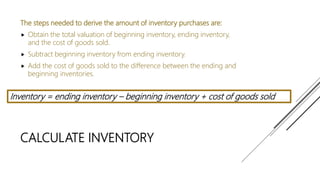
CALCULATE INVENTORY
The steps needed to derive the amount of inventory purchases are:
 Obtain the total valuation of beginning inventory, ending inventory,
and the cost of goods sold.
 Subtract beginning inventory from ending inventory.
 Add the cost of goods sold to the difference between the ending and
beginning inventories.
Inventory = ending inventory – beginning inventory + cost of goods sold
INVENTORY SYSTEM
 Inventory systems are tracking systems that inform you of the amount
of raw materials, supplies or final products you have readily available.
 The inventory system is updated each time you sell an item or use raw
materials to create a product.
 The two most widely used inventory accounting systems are the
periodic and the perpetual.
PERPETUAL INVENTORY SYSTEM
 The perpetual inventory system requires accounting records to show
the amount of inventory on hand at all times.
 It maintains a separate account in the subsidiary ledger for each good
in stock, and the account is updated each time a quantity is added or
taken out.
PERPETUAL INVENTORY SYSTEM
 The calculation of closing inventory can be done as under:
 The perpetual system records revenue each time a sale is made.
Determining the cost of goods sold requires taking inventory.
Inventory at the Beginning + Receipts – Issues = Inventory at the end
PERIODIC INVENTORY SYSTEM
 In the periodic inventory system, sales are recorded as they occur but
the inventory is not updated.
 A physical inventory must be taken at the end of the year to
determine the cost of goods.
PERIODIC INVENTORY SYSTEM
 This differs from perpetual inventory systems, where updates are
made as seen fit.
 This physical count determines the amount of inventory appearing in
the balance sheet.
 The cost of goods sold for the entire year then is determined by a
short computation.
PERIODIC INVENTORY SYSTEM
 The following formula is used to track the cost of goods sold during
the year:
Inventory at the Beginning + Purchases – Inventory at the end = Cost of Goods Sold
COMPARISONCHART
INVENTORY VALUATION METHODS
The most commonly used inventory valuation methods under system
are:
 First-in first-out (FIFO)
 Last-in first-out (LIFO)
 Highest in first out (HIFO)
 Average cost or weighted average cost
FIRST IN FIRST OUT (FIFO)
 "FIFO" stands for first-in, first-out, meaning that the oldest inventory
items are recorded as sold first.
 But, do not necessarily mean that the exact oldest physical object has
been tracked and sold.
LAST IN FIRST OUT (LIFO)
 Last in, first out (LIFO) is an asset management and valuation method
that assumes assets produced or acquired last are the ones used, sold
or disposed of first.
 LIFO assumes an entity sells, uses or disposes of its newest
inventory first.
HIGHEST IN FIRST OUT (HIFO)
 “HIFO” is an inventory distribution method in which the inventory with
the highest cost of purchase is the first to be used or taken out of
stock.
AVG. COST OR WEIGHTED AVG. COST
 Under the 'Average Cost Method', it is assumed that the cost of
inventory is based on the average cost of the goods available for sale
during the period.
 Avg. Cost = The Total Cost of Goods Available for Sale / The Total
Units Available for Sale.
This gives a weighted-average unit cost that is applied to the units in the
ending inventory.
CONCLUSION
 Inventory is a portion of a company asset & it is in the form of raw material,
work in progress goods & finished goods.
 The turnover of inventory represents one of the primary sources of revenue
generation and subsequent earnings for the company's shareholders.
 Every manufacturing concern keeps a track of its inventory purchased,
returned and issued during the year, through the inventory record system.
 The Periodic Inventory System is less costly than the Perpetual Inventory
System, but it gives more accurate information because ongoing recording
and timely verification of inventory are done.
 Each of the accounting systems can use costing methods to determine
which inventory has been sold and therefore the cost of the sale and the
value of the inventory remaining.
REFERENCES
 Inventory valuation, Wikipedia – Free encyclopaedia,
en.wikipedia.org/wiki/Inventory_valuation
 Periodic inventory, Wikipedia – Free encyclopaedia,
en.wikipedia.org/wiki/Periodic_inventory
 Perpetual inventory, Wikipedia – Free encyclopaedia,
en.wikipedia.org/wiki/Perpetual_inventory
 Difference Between Perpetual and Periodic Inventory System, June 27,
2015 By Surbhi S, www.keydifferences.com/difference-between-perpetual-
and-periodic-inventory-system.html
 Inventory Accounting System, Double entry book keeping, www.double-
entry-bookkeeping.com/inventory/inventory-accounting-system/
THANK YOU

Inventory System

  • 1.
  • 3.
    INTRODUCTION  An inventoryvaluation allows a company to provide a monetary value for items that make up their inventory.  Inventories are usually the largest current asset of a business, and proper measurement of them is necessary to assure accurate financial statements.  If inventory is not properly measured, expenses and revenues can not be properly matched and a company could make poor business decisions.
  • 4.
    WHAT IS INVENTORY? Inventory is the raw materials, work-in-process products and finished goods that are considered to be the portion of a business's assets that are ready or will be ready for sale.  Inventory represents one of the most important assets of a business because the turnover of inventory represents one of the primary sources of revenue generation and subsequent earnings for the company's shareholders For example, motherboards warehoused at a computer company to be used in the assembling of its computer systems are inventory.
  • 5.
    INVENTORY ACCOUNT The costof the merchandise purchased but not yet sold is reported in the account Inventory or Merchandise Inventory. Inventory is reported as a current asset on the company's balance sheet. Inventory is a significant asset that needs to be monitored closely.
  • 6.
    CALCULATE INVENTORY The stepsneeded to derive the amount of inventory purchases are:  Obtain the total valuation of beginning inventory, ending inventory, and the cost of goods sold.  Subtract beginning inventory from ending inventory.  Add the cost of goods sold to the difference between the ending and beginning inventories. Inventory = ending inventory – beginning inventory + cost of goods sold
  • 7.
    INVENTORY SYSTEM  Inventorysystems are tracking systems that inform you of the amount of raw materials, supplies or final products you have readily available.  The inventory system is updated each time you sell an item or use raw materials to create a product.  The two most widely used inventory accounting systems are the periodic and the perpetual.
  • 8.
    PERPETUAL INVENTORY SYSTEM The perpetual inventory system requires accounting records to show the amount of inventory on hand at all times.  It maintains a separate account in the subsidiary ledger for each good in stock, and the account is updated each time a quantity is added or taken out.
  • 9.
    PERPETUAL INVENTORY SYSTEM The calculation of closing inventory can be done as under:  The perpetual system records revenue each time a sale is made. Determining the cost of goods sold requires taking inventory. Inventory at the Beginning + Receipts – Issues = Inventory at the end
  • 10.
    PERIODIC INVENTORY SYSTEM In the periodic inventory system, sales are recorded as they occur but the inventory is not updated.  A physical inventory must be taken at the end of the year to determine the cost of goods.
  • 11.
    PERIODIC INVENTORY SYSTEM This differs from perpetual inventory systems, where updates are made as seen fit.  This physical count determines the amount of inventory appearing in the balance sheet.  The cost of goods sold for the entire year then is determined by a short computation.
  • 12.
    PERIODIC INVENTORY SYSTEM The following formula is used to track the cost of goods sold during the year: Inventory at the Beginning + Purchases – Inventory at the end = Cost of Goods Sold
  • 13.
  • 14.
    INVENTORY VALUATION METHODS Themost commonly used inventory valuation methods under system are:  First-in first-out (FIFO)  Last-in first-out (LIFO)  Highest in first out (HIFO)  Average cost or weighted average cost
  • 15.
    FIRST IN FIRSTOUT (FIFO)  "FIFO" stands for first-in, first-out, meaning that the oldest inventory items are recorded as sold first.  But, do not necessarily mean that the exact oldest physical object has been tracked and sold.
  • 16.
    LAST IN FIRSTOUT (LIFO)  Last in, first out (LIFO) is an asset management and valuation method that assumes assets produced or acquired last are the ones used, sold or disposed of first.  LIFO assumes an entity sells, uses or disposes of its newest inventory first.
  • 17.
    HIGHEST IN FIRSTOUT (HIFO)  “HIFO” is an inventory distribution method in which the inventory with the highest cost of purchase is the first to be used or taken out of stock.
  • 18.
    AVG. COST ORWEIGHTED AVG. COST  Under the 'Average Cost Method', it is assumed that the cost of inventory is based on the average cost of the goods available for sale during the period.  Avg. Cost = The Total Cost of Goods Available for Sale / The Total Units Available for Sale. This gives a weighted-average unit cost that is applied to the units in the ending inventory.
  • 19.
    CONCLUSION  Inventory isa portion of a company asset & it is in the form of raw material, work in progress goods & finished goods.  The turnover of inventory represents one of the primary sources of revenue generation and subsequent earnings for the company's shareholders.  Every manufacturing concern keeps a track of its inventory purchased, returned and issued during the year, through the inventory record system.  The Periodic Inventory System is less costly than the Perpetual Inventory System, but it gives more accurate information because ongoing recording and timely verification of inventory are done.  Each of the accounting systems can use costing methods to determine which inventory has been sold and therefore the cost of the sale and the value of the inventory remaining.
  • 20.
    REFERENCES  Inventory valuation,Wikipedia – Free encyclopaedia, en.wikipedia.org/wiki/Inventory_valuation  Periodic inventory, Wikipedia – Free encyclopaedia, en.wikipedia.org/wiki/Periodic_inventory  Perpetual inventory, Wikipedia – Free encyclopaedia, en.wikipedia.org/wiki/Perpetual_inventory  Difference Between Perpetual and Periodic Inventory System, June 27, 2015 By Surbhi S, www.keydifferences.com/difference-between-perpetual- and-periodic-inventory-system.html  Inventory Accounting System, Double entry book keeping, www.double- entry-bookkeeping.com/inventory/inventory-accounting-system/
  • 21.