INVENTORY
MANAGEMENT
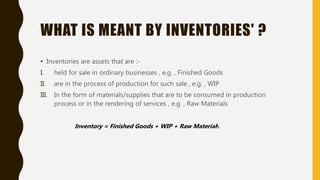
WHAT IS MEANT BY INVENTORIES' ?
• Inventories are assets that are :-
I. held for sale in ordinary businesses , e.g. , Finished Goods
II. are in the process of production for such sale , e.g. , WIP
III. In the form of materials/supplies that are to be consumed in production
process or in the rendering of services , e.g. , Raw Materials
Inventory = Finished Goods + WIP + Raw Materials
COST OF INVENTORIES INCLUDES =>
1. Cost of Purchase[ INCLUDES Purchase Price + Duties & Taxes(which are not
subsequently recoverable) + other expenditure directly attributable to
acquisition(Like Freight Inward) ] BUT [ EXCLUDES Trade Discount , Rebates ,
Duty Drawbacks Subsidies and Taxes(which are subsequently recoverable) ]
2. Cost of Conversion [ INCLUDES Direct Labour , Direct Expenses , Sub
Contracted Work and Production Overheads absorbed on the basis of Normal
Capacity]
3. Other costs incurred in bringing the inventories to their present location and
condition , e.g. , cost incurred in designing products for specific customers.
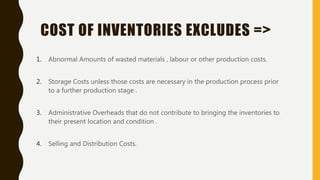
COST OF INVENTORIES EXCLUDES =>
1. Abnormal Amounts of wasted materials , labour or other production costs.
2. Storage Costs unless those costs are necessary in the production process prior
to a further production stage .
3. Administrative Overheads that do not contribute to bringing the inventories to
their present location and condition .
4. Selling and Distribution Costs.
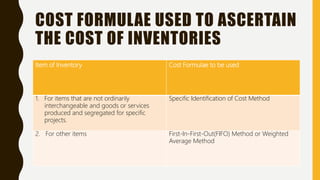
COST FORMULAE USED TO ASCERTAIN
THE COST OF INVENTORIES
Item of Inventory Cost Formulae to be used
1. For items that are not ordinarily
interchangeable and goods or services
produced and segregated for specific
projects.
Specific Identification of Cost Method
2. For other items First-In-First-Out(FIFO) Method or Weighted
Average Method
INVENTORY SYSTEM'S =>
• There are two types of Inventory Systems :
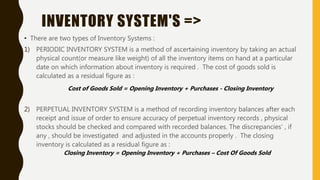
1) PERIODIC INVENTORY SYSTEM is a method of ascertaining inventory by taking an actual
physical count(or measure like weight) of all the inventory items on hand at a particular
date on which information about inventory is required . The cost of goods sold is
calculated as a residual figure as :
2) PERPETUAL INVENTORY SYSTEM is a method of recording inventory balances after each
receipt and issue of order to ensure accuracy of perpetual inventory records , physical
stocks should be checked and compared with recorded balances. The discrepancies’ , if
any , should be investigated and adjusted in the accounts properly . The closing
inventory is calculated as a residual figure as :
Cost of Goods Sold = Opening Inventory + Purchases - Closing Inventory
Closing Inventory = Opening Inventory + Purchases – Cost Of Goods Sold
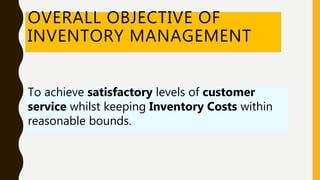
OVERALL OBJECTIVE OF
INVENTORY MANAGEMENT
To achieve satisfactory levels of customer
service whilst keeping Inventory Costs within
reasonable bounds.
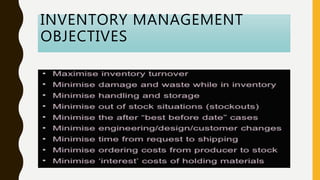
INVENTORY MANAGEMENT
OBJECTIVES
SPECIFIC IDENTIFICATION
METHOD
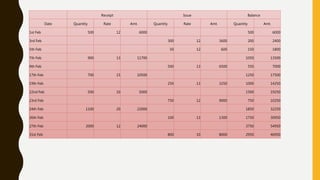
Receipt Issue Balance
Date Quantity Rate Amt. Quantity Rate Amt. Quantity Amt.
1st Feb 500 12 6000 500 6000
3rd Feb 300 12 3600 200 2400
5th Feb 50 12 600 150 1800
7th Feb 900 13 11700 1050 13500
9th Feb 500 13 6500 550 7000
17th Feb 700 15 10500 1250 17500
19th Feb 250 13 3250 1000 14250
22nd Feb 500 10 5000 1500 19250
23rd Feb 750 12 9000 750 10250
24th Feb 1100 20 22000 1850 32250
26th Feb 100 13 1300 1750 30950
27th Feb 2000 12 24000 3750 54950
31st Feb 800 10 8000 2950 46950
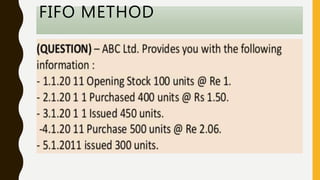
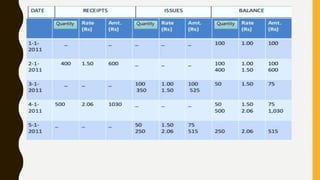
FIFO METHOD
Quantity Quantity Quantity
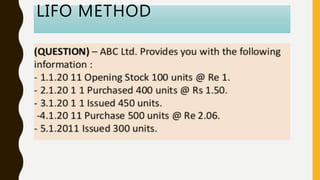
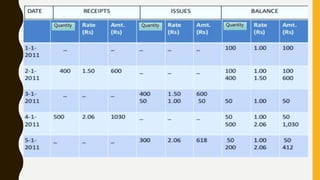
LIFO METHOD
Quantity Quantity Quantity
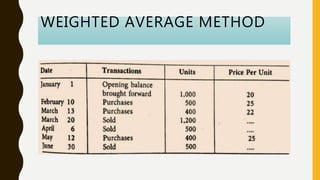
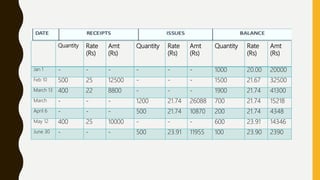
WEIGHTED AVERAGE METHOD
Quantity Rate
(Rs)
Amt
(Rs)
Quantity Rate
(Rs)
Amt
(Rs)
Quantity Rate
(Rs)
Amt
(Rs)
Jan 1 - - - - - - 1000 20.00 20000
Feb 10 500 25 12500 - - - 1500 21.67 32500
March 13 400 22 8800 - - - 1900 21.74 41300
March - - - 1200 21.74 26088 700 21.74 15218
April 6 - - - 500 21.74 10870 200 21.74 4348
May 12 400 25 10000 - - - 600 23.91 14346
June 30 - - - 500 23.91 11955 100 23.90 2390

Inventory Management

  • 1.
  • 2.
    WHAT IS MEANTBY INVENTORIES' ? • Inventories are assets that are :- I. held for sale in ordinary businesses , e.g. , Finished Goods II. are in the process of production for such sale , e.g. , WIP III. In the form of materials/supplies that are to be consumed in production process or in the rendering of services , e.g. , Raw Materials Inventory = Finished Goods + WIP + Raw Materials
  • 3.
    COST OF INVENTORIESINCLUDES => 1. Cost of Purchase[ INCLUDES Purchase Price + Duties & Taxes(which are not subsequently recoverable) + other expenditure directly attributable to acquisition(Like Freight Inward) ] BUT [ EXCLUDES Trade Discount , Rebates , Duty Drawbacks Subsidies and Taxes(which are subsequently recoverable) ] 2. Cost of Conversion [ INCLUDES Direct Labour , Direct Expenses , Sub Contracted Work and Production Overheads absorbed on the basis of Normal Capacity] 3. Other costs incurred in bringing the inventories to their present location and condition , e.g. , cost incurred in designing products for specific customers.
  • 4.
    COST OF INVENTORIESEXCLUDES => 1. Abnormal Amounts of wasted materials , labour or other production costs. 2. Storage Costs unless those costs are necessary in the production process prior to a further production stage . 3. Administrative Overheads that do not contribute to bringing the inventories to their present location and condition . 4. Selling and Distribution Costs.
  • 5.
    COST FORMULAE USEDTO ASCERTAIN THE COST OF INVENTORIES Item of Inventory Cost Formulae to be used 1. For items that are not ordinarily interchangeable and goods or services produced and segregated for specific projects. Specific Identification of Cost Method 2. For other items First-In-First-Out(FIFO) Method or Weighted Average Method
  • 6.
    INVENTORY SYSTEM'S => •There are two types of Inventory Systems : 1) PERIODIC INVENTORY SYSTEM is a method of ascertaining inventory by taking an actual physical count(or measure like weight) of all the inventory items on hand at a particular date on which information about inventory is required . The cost of goods sold is calculated as a residual figure as : 2) PERPETUAL INVENTORY SYSTEM is a method of recording inventory balances after each receipt and issue of order to ensure accuracy of perpetual inventory records , physical stocks should be checked and compared with recorded balances. The discrepancies’ , if any , should be investigated and adjusted in the accounts properly . The closing inventory is calculated as a residual figure as : Cost of Goods Sold = Opening Inventory + Purchases - Closing Inventory Closing Inventory = Opening Inventory + Purchases – Cost Of Goods Sold
  • 7.
    OVERALL OBJECTIVE OF INVENTORYMANAGEMENT To achieve satisfactory levels of customer service whilst keeping Inventory Costs within reasonable bounds.
  • 8.
  • 9.
  • 10.
    Receipt Issue Balance DateQuantity Rate Amt. Quantity Rate Amt. Quantity Amt. 1st Feb 500 12 6000 500 6000 3rd Feb 300 12 3600 200 2400 5th Feb 50 12 600 150 1800 7th Feb 900 13 11700 1050 13500 9th Feb 500 13 6500 550 7000 17th Feb 700 15 10500 1250 17500 19th Feb 250 13 3250 1000 14250 22nd Feb 500 10 5000 1500 19250 23rd Feb 750 12 9000 750 10250 24th Feb 1100 20 22000 1850 32250 26th Feb 100 13 1300 1750 30950 27th Feb 2000 12 24000 3750 54950 31st Feb 800 10 8000 2950 46950
  • 11.
  • 12.
  • 13.
  • 14.
  • 15.
  • 16.
    Quantity Rate (Rs) Amt (Rs) Quantity Rate (Rs) Amt (Rs) QuantityRate (Rs) Amt (Rs) Jan 1 - - - - - - 1000 20.00 20000 Feb 10 500 25 12500 - - - 1500 21.67 32500 March 13 400 22 8800 - - - 1900 21.74 41300 March - - - 1200 21.74 26088 700 21.74 15218 April 6 - - - 500 21.74 10870 200 21.74 4348 May 12 400 25 10000 - - - 600 23.91 14346 June 30 - - - 500 23.91 11955 100 23.90 2390