&
ITS DIVERSIFICATION STRATEGIES FOR
MARKET LEADERSHIP
Team Members
•
•
•
•
•
•
•

Abhinav
DISCLAIMER
Aman
Hemraj
No member of this team endorses
use
Kavish of tobacco or any such
products.
Amit
Paritosh
Viewers’ discretion is
Col Ajay K Raina, SM
recommended.
2
Case Study : Vital Stats
• Vintage – Early 2005.
• Focus – Corporate Strategy
• Ingredients:– Need to diversify.
– Strategies adopted.
– Future possibilities.

• Our Approach:–
–
–
–

An overview.
Analysis.
Recommendations.
Real time benchmarking.

• Limitations.

3
Overview
• Incorporated in 1910 as Imperial
Tobacco Company.
• Ownership shifted from British to
Indian management team in 1974;
rechristened as India Tobacco
Company Limited.
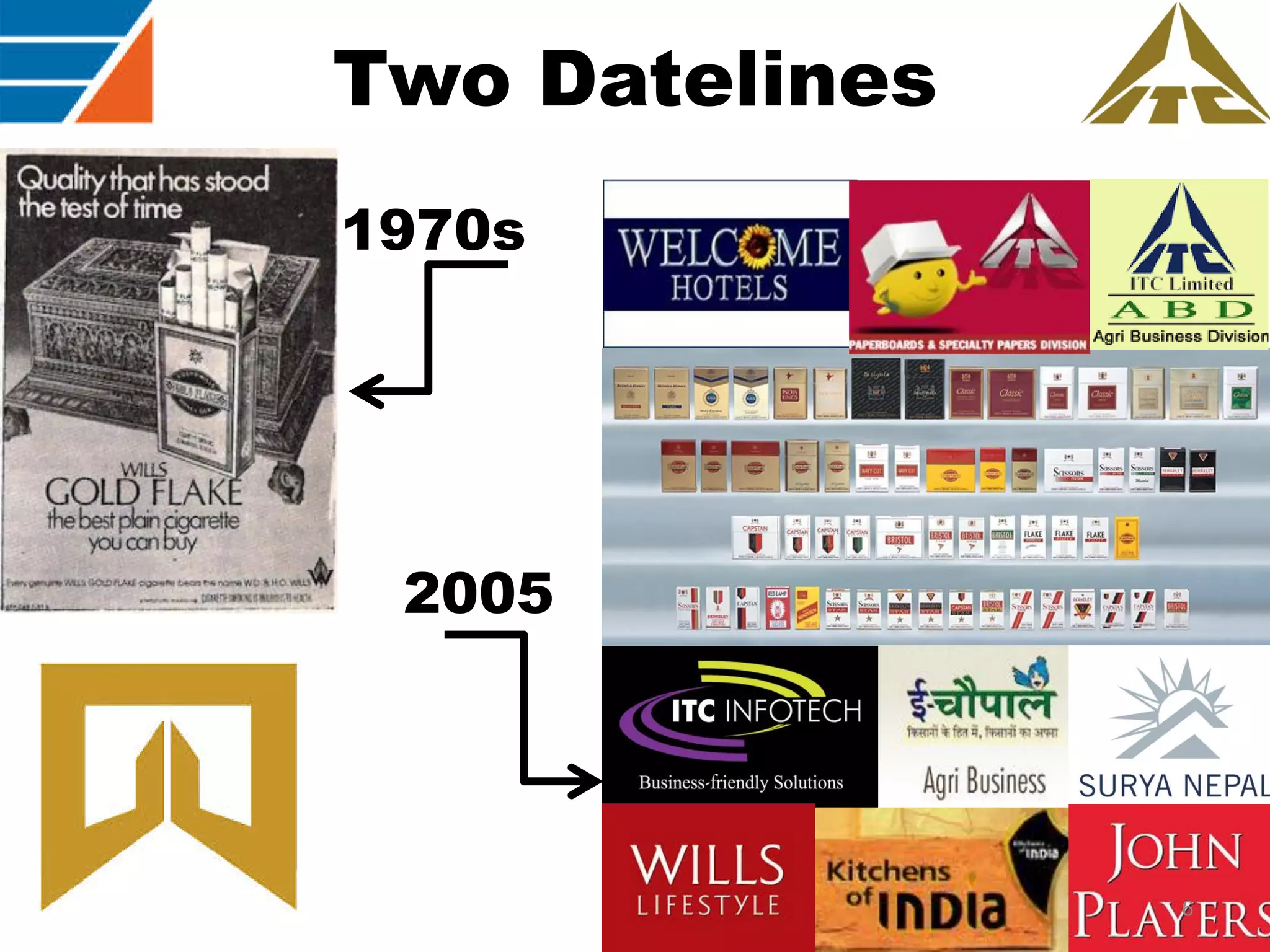
• Strategic diversification started in
1970s into related as well as unrelated
businesses.
• Has successfully spread its business
and market risks.
4
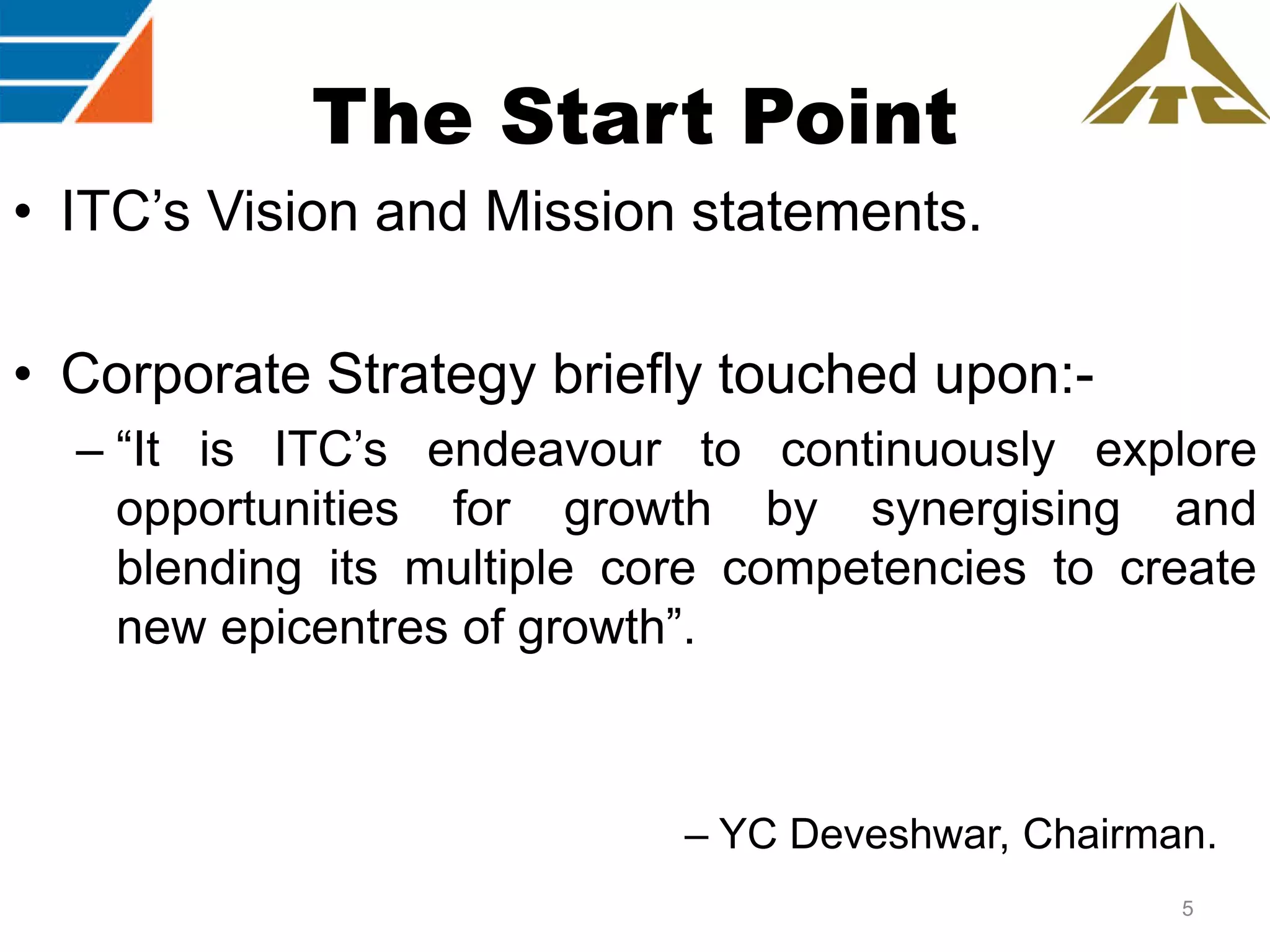
The Start Point
• ITC‟s Vision and Mission statements.
• Corporate Strategy briefly touched upon:– “It is ITC‟s endeavour to continuously explore
opportunities for growth by synergising and
blending its multiple core competencies to create
new epicentres of growth”.

– YC Deveshwar, Chairman.
5
Two Datelines
1970s

2005

6
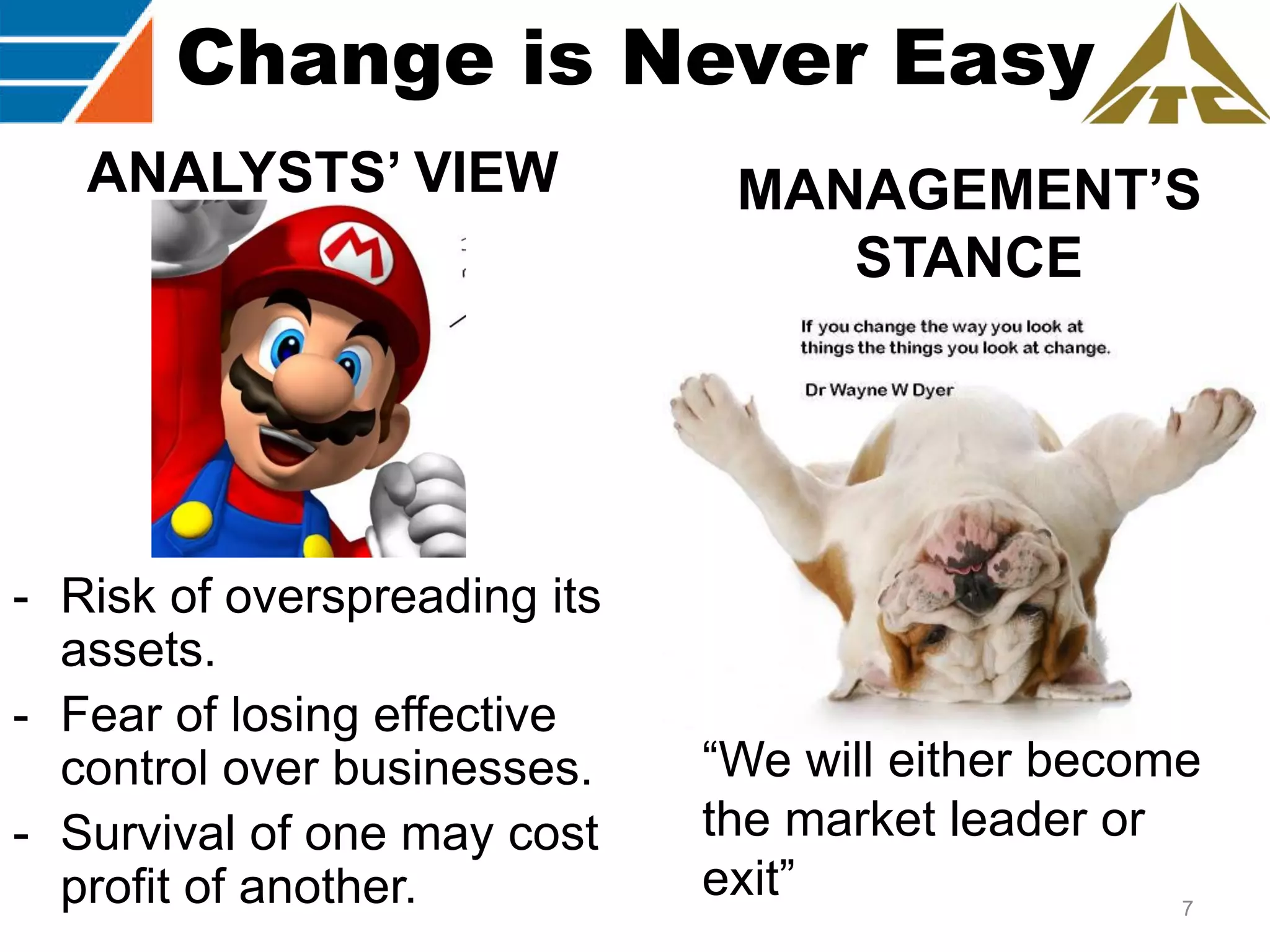
Change is Never Easy
ANALYSTS’ VIEW

- Risk of overspreading its
assets.
- Fear of losing effective
control over businesses.
- Survival of one may cost
profit of another.

MANAGEMENT’S
STANCE

“We will either become
the market leader or
exit”
7
Changing Ambitions
• Core business – cigarette & tobacco.
– Market share of 60%.
– Revenue contribution of 78%.
– Profit margins of 40%.

• Among top five private sector
companies in India; aiming to be a global entity.
• Early 2000s – India amongst economic boom.
• Anti-tobacco campaign & regulatory restrictions.
• “Everyone still refers to us as a cigarette
company….one of the largest hotel chains,
largest print shop…..” YC Deveshwar.
8
What Did
ITC
Do?
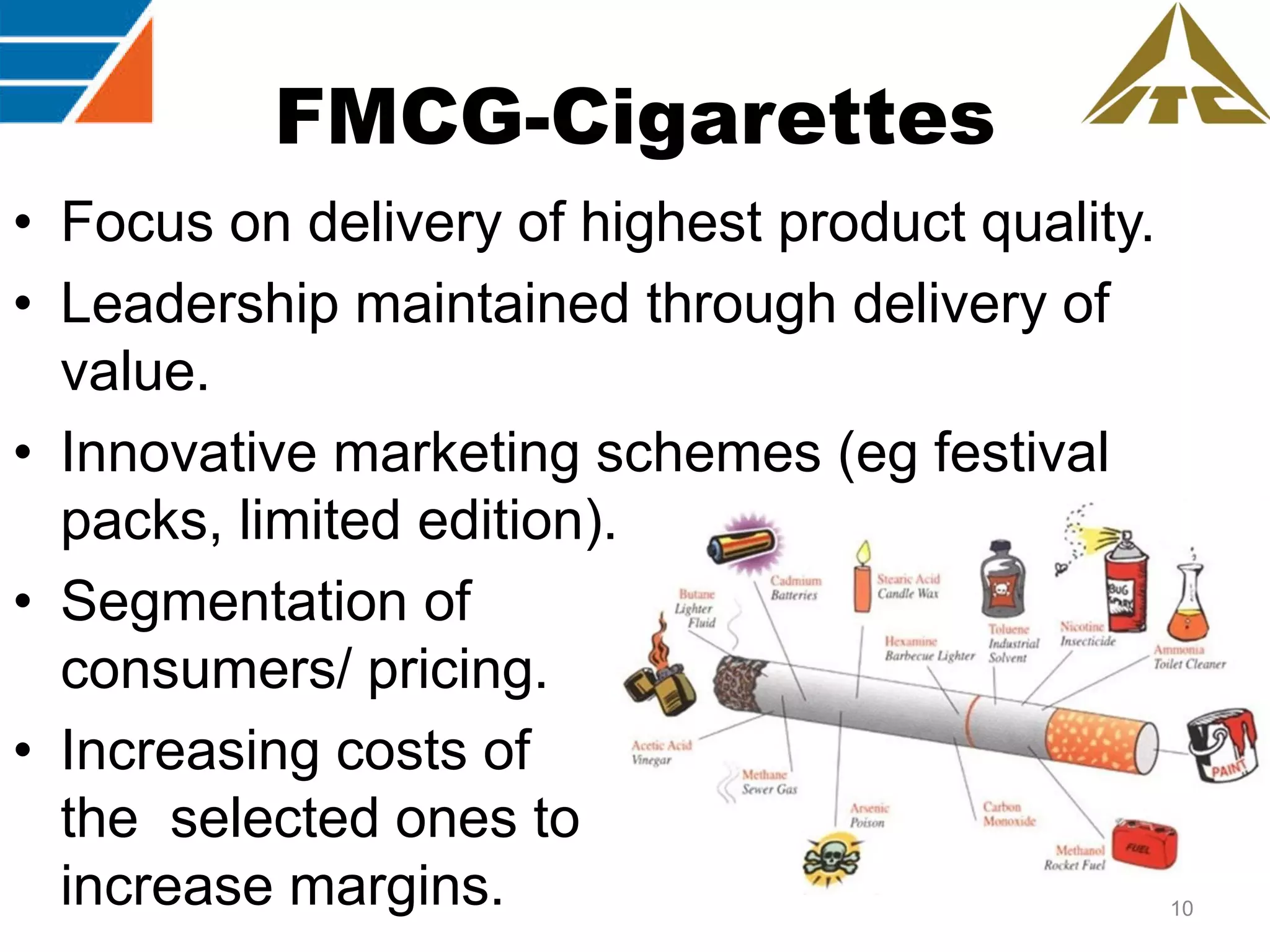
FMCG-Cigarettes
• Focus on delivery of highest product quality.
• Leadership maintained through delivery of
value.
• Innovative marketing schemes (eg festival
packs, limited edition).
• Segmentation of
consumers/ pricing.
• Increasing costs of
the selected ones to
increase margins.

10
FMCG-Other
•
•
•
•
•
•
•

Bukhara‟s popularity – Kitchens of India.
Agro products – Aashirvaad – Sunfeast.
Consumer quest for healthier snacks and food.
Innovative additions (eg orange Marie).
Exporting Mint-O-Fresh & Eclairs.
Wills and John Players- secondary advertising.
Lifestyle stores – international shopping
experience.
• Expressions, Regalia and Matrubhasha.
• AIM (120 hits) & Mangal Deep – the leaders.
11
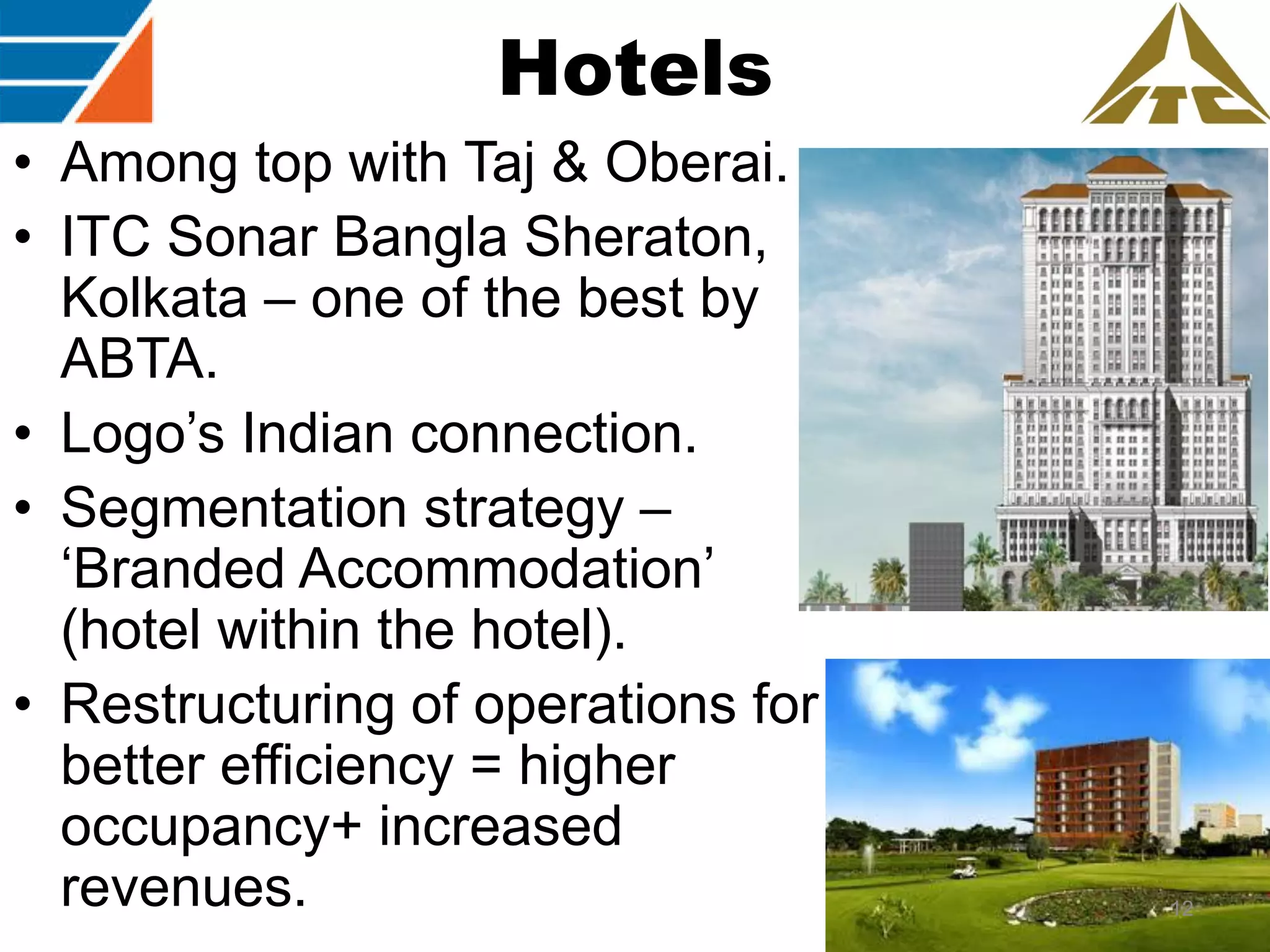
Hotels
• Among top with Taj & Oberai.
• ITC Sonar Bangla Sheraton,
Kolkata – one of the best by
ABTA.
• Logo‟s Indian connection.
• Segmentation strategy –
„Branded Accommodation‟
(hotel within the hotel).
• Restructuring of operations for
better efficiency = higher
occupancy+ increased
revenues.

12
ANALYSIS OF STRATEGY
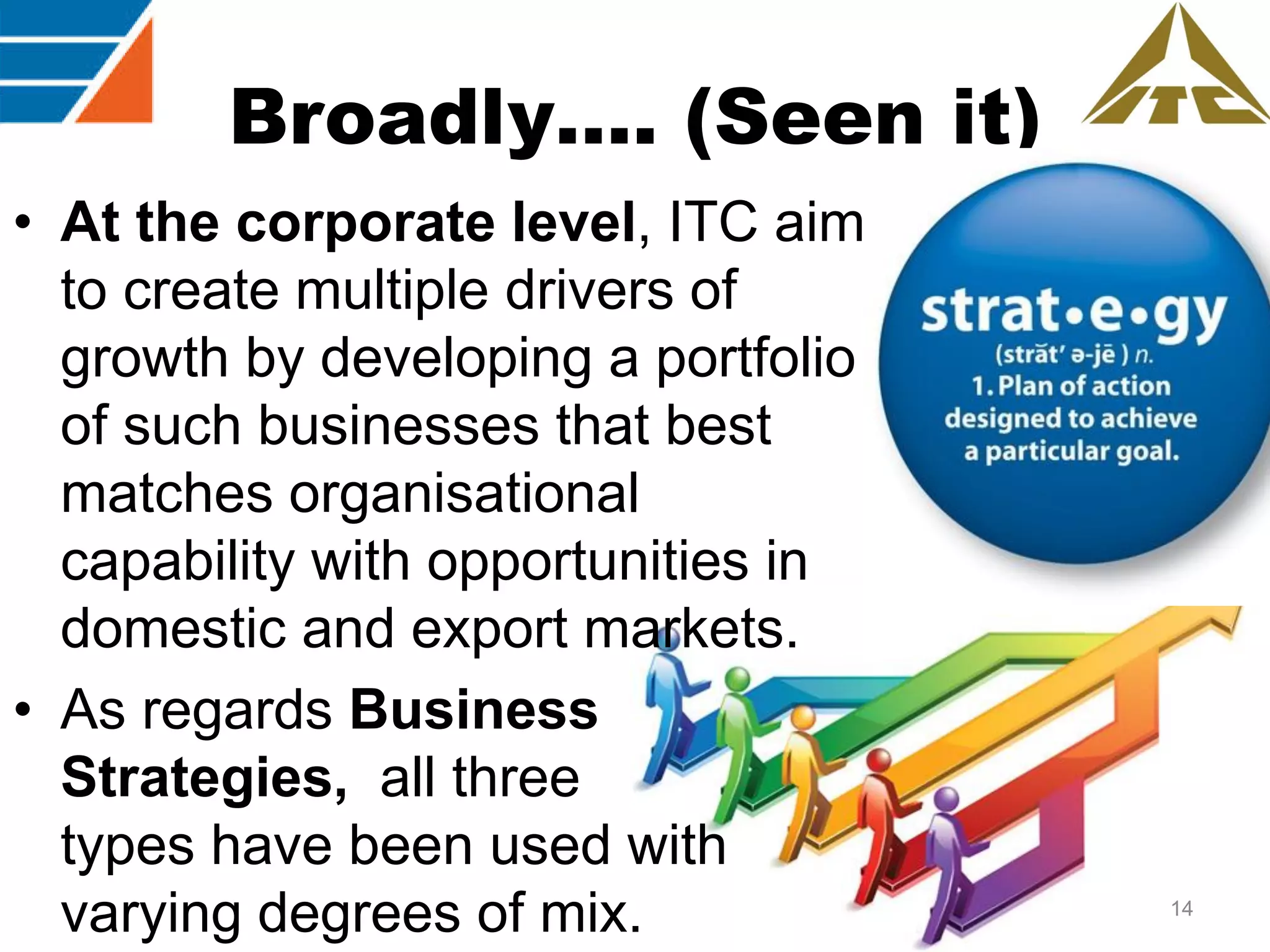
Broadly…. (Seen it)
• At the corporate level, ITC aims
to create multiple drivers of
growth by developing a portfolio
of such businesses that best
matches organisational
capability with opportunities in
domestic and export markets.
• As regards Business
Strategies, all three
types have been used with
varying degrees of mix.

14
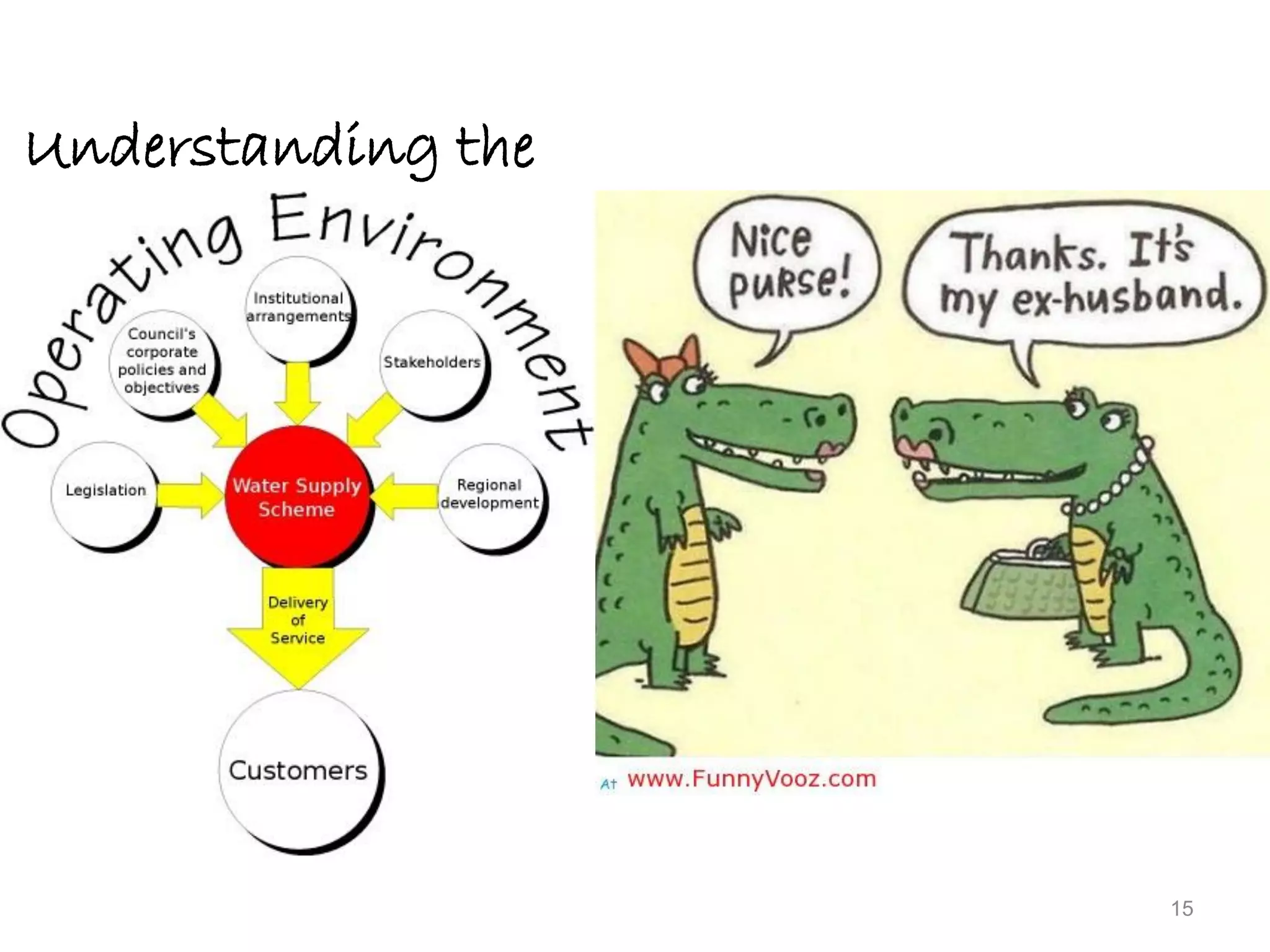
Understanding the

15
16
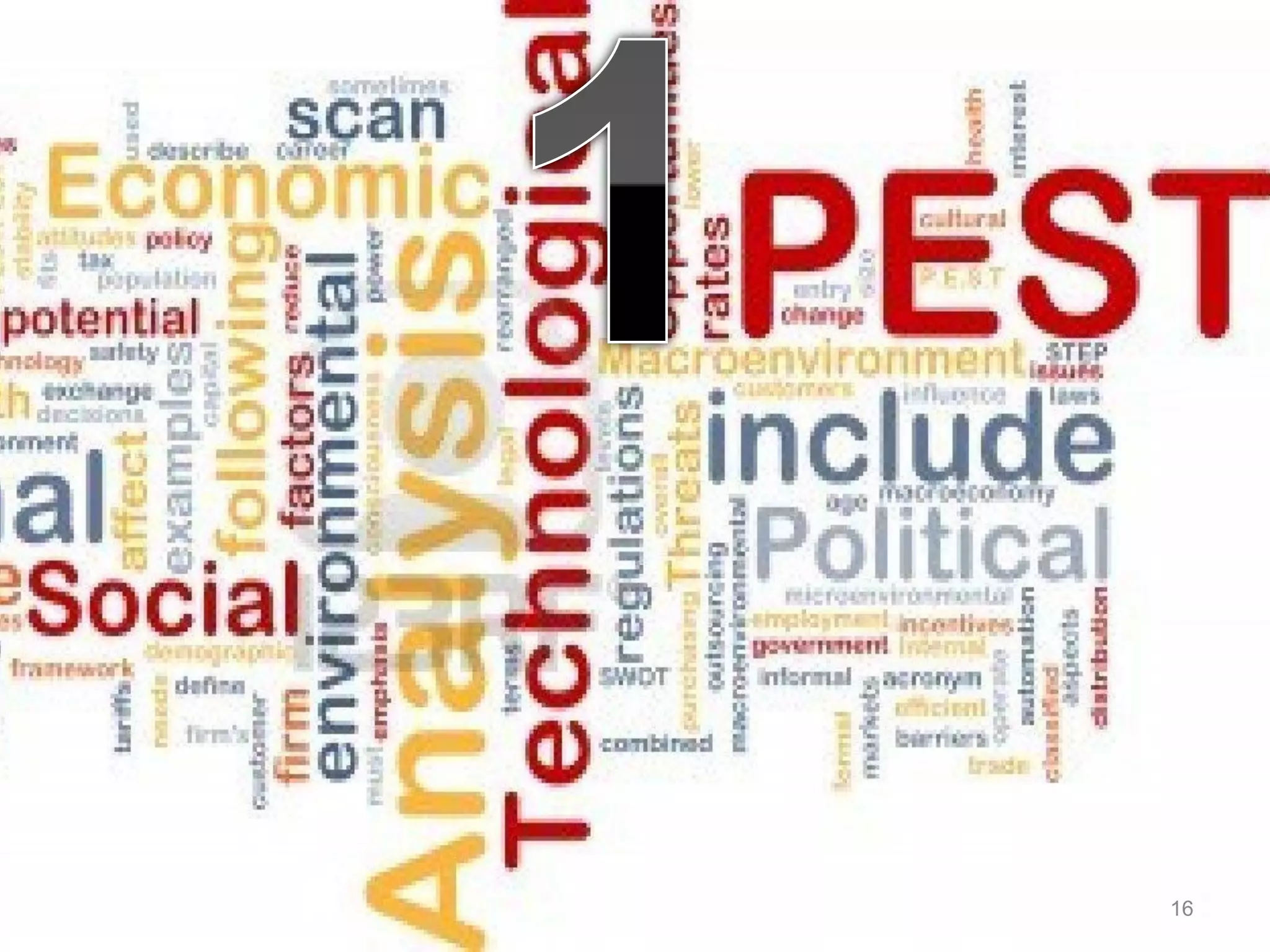
PEST Analysis….
• Political Aspects.
–
–
–
–

Crusaders.
2001 ban on the advertising.
Increased excise duties.
Economic reforms, de-licensing
and liberalisation.
– New technologies in agriculture,
manufacturing…. Tax incentives
on R&D and technology upgradation.
– State governments and luxury
tax.
– Focus on rural sector
development.

17
…..PEST Analysis…
• Economical Aspects
– A growing economy = A growing
portfolio of businesses… already
seen.
– Offshore businesses, especially
IT industry.
– Era of international tie-ups.
– Huge commercial spaces
available.
– Corporate culture and associated
needs.
– Rising small town aspirations.
– National imperatives.

18
…..PEST Analysis…
• Social Aspects
–
–
–
–
–
–
–
–
–
–
–
–
–

Younger demographic profile.
Increased PCI and spending power.
Lifestyle & brand consciousness.
Desire for high end international products.
Changing definition of luxury and necessity.
Health/nutrition consciousness.
Leaning back on mother tongue.
Yearning for Personalised products.
Averse to smoking.
Elite among equals.
Less leisure time.
Need for innovative gifting options.
CSR prism.
19
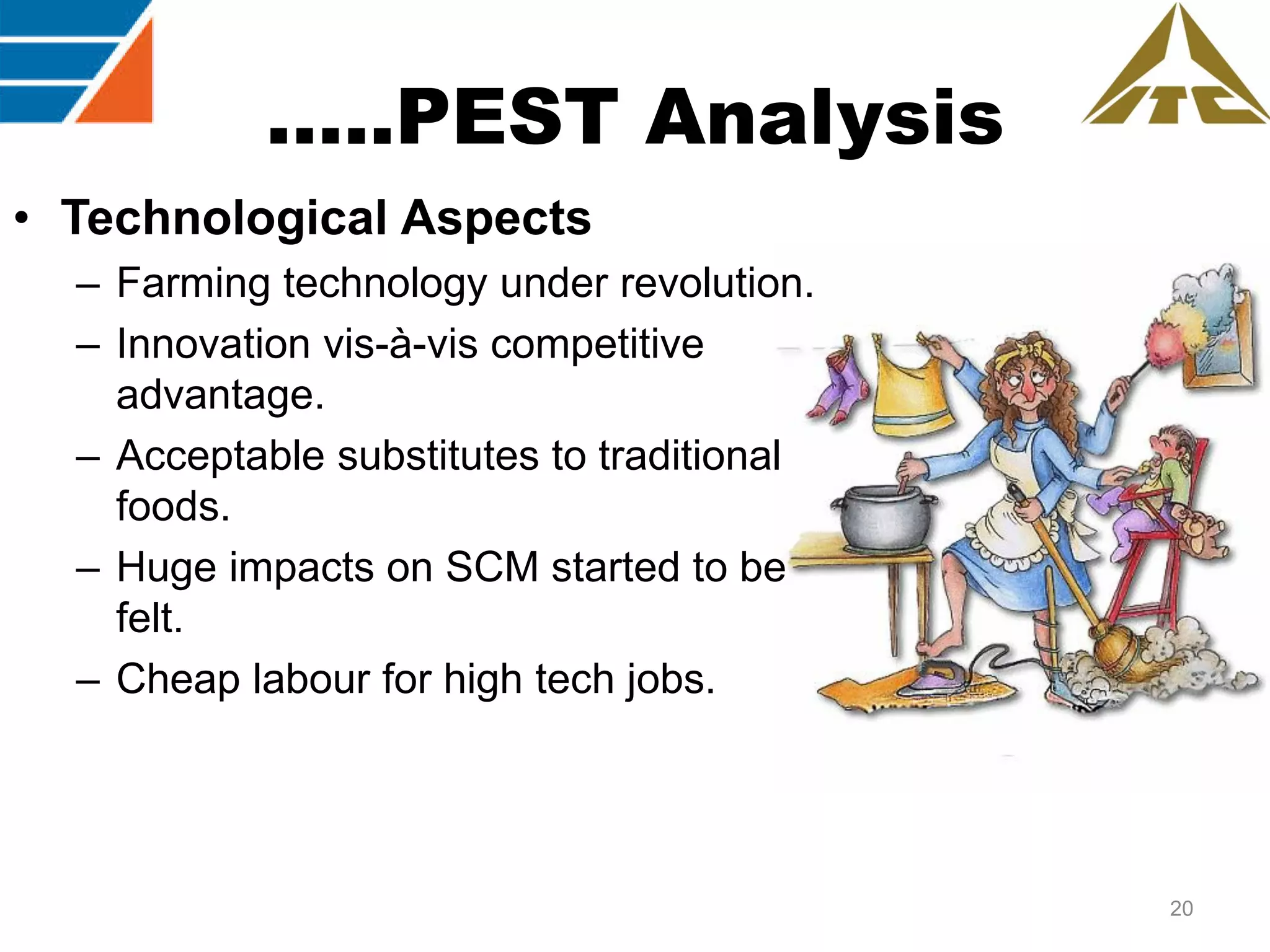
…..PEST Analysis
• Technological Aspects
– Farming technology under revolution.
– Innovation vis-à-vis competitive
advantage.
– Acceptable substitutes to traditional
foods.
– Huge impacts on SCM started to be
felt.
– Cheap labour for high tech jobs.

20
21
Strengths
• Brand Image.
• Largest selling Tobacco brand
in India; regulations.
• Illustrated ability to leverage
traditional businesses to
develop new brands (Chefs +
Cigarette =FMCG; paper+
package = Greeting cards).
• Diversification profile and track
record.
• Distribution network.
• Strong financial performance.
• R&D.
• CSR programmes and
success therein.

22
Weaknesses
• Too much reliance on tobacco
revenues.
• Miles to go.
• Essentially “Desi”.
• Unrelated diversifications.
• Heavy taxation prone products.
• Brand name‟s association with
tobacco.
• Other businesses subsidized by
tobacco segment.

23
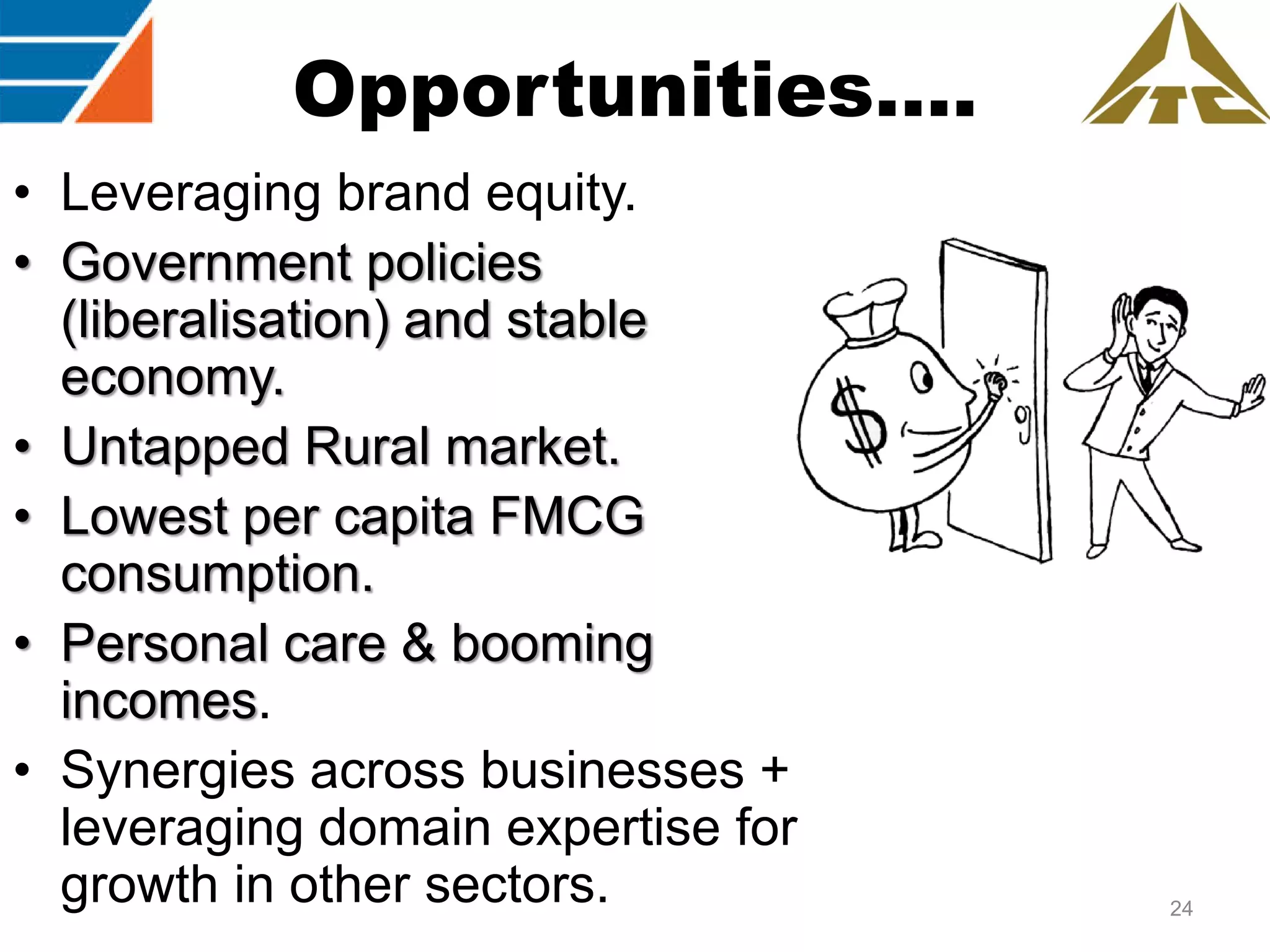
Opportunities….
• Leveraging brand equity.
• Government policies
(liberalisation) and stable
economy.
• Untapped Rural market.
• Lowest per capita FMCG
consumption.
• Personal care & booming
incomes.
• Synergies across businesses +
leveraging domain expertise for
growth in other sectors.

24
……Opportunities
• The enviable reach and distribution
network of e-choupal.
• Taking IT business to USA; 60% in
Europe.

25
Threats
• Competition – domestic+
international.
• Increasingly hostile attitude
towards smoking in general.
• Government policies towards
tobacco= tax, regulations.
• Systematic threats.
• IT bubble (assumed).
26
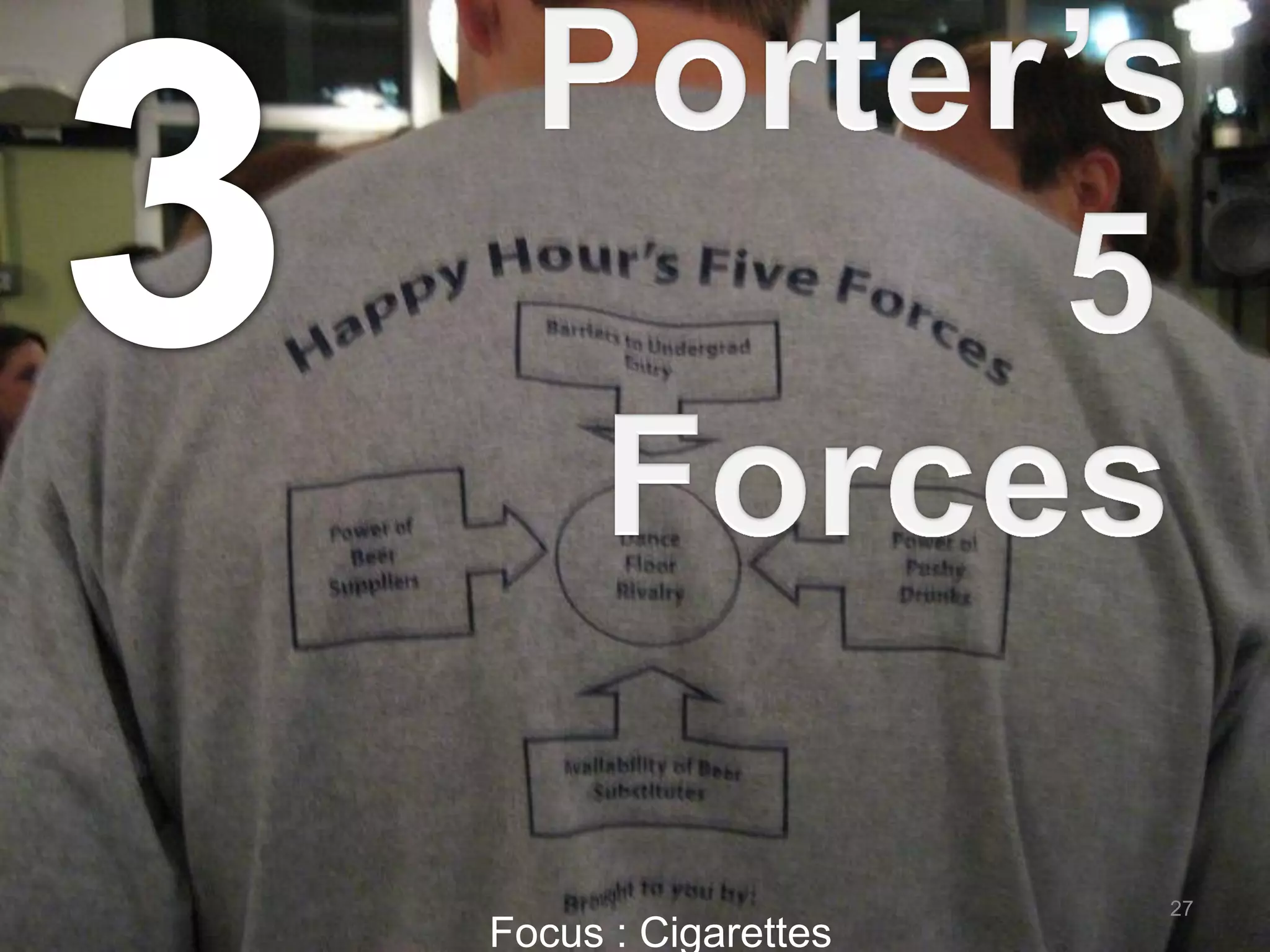
Focus : Cigarettes

27
Porter’s 5 Forces:
Cigarettes…

• Bargaining Power of
Buyers=LOW

– Addicted customers .
– Symbolic and emotional
values.
– Product quality not much
important to smokers.
– Low switching costs.
– Brand loyalty insignificant.
28
….Porter’s 5 Forces…
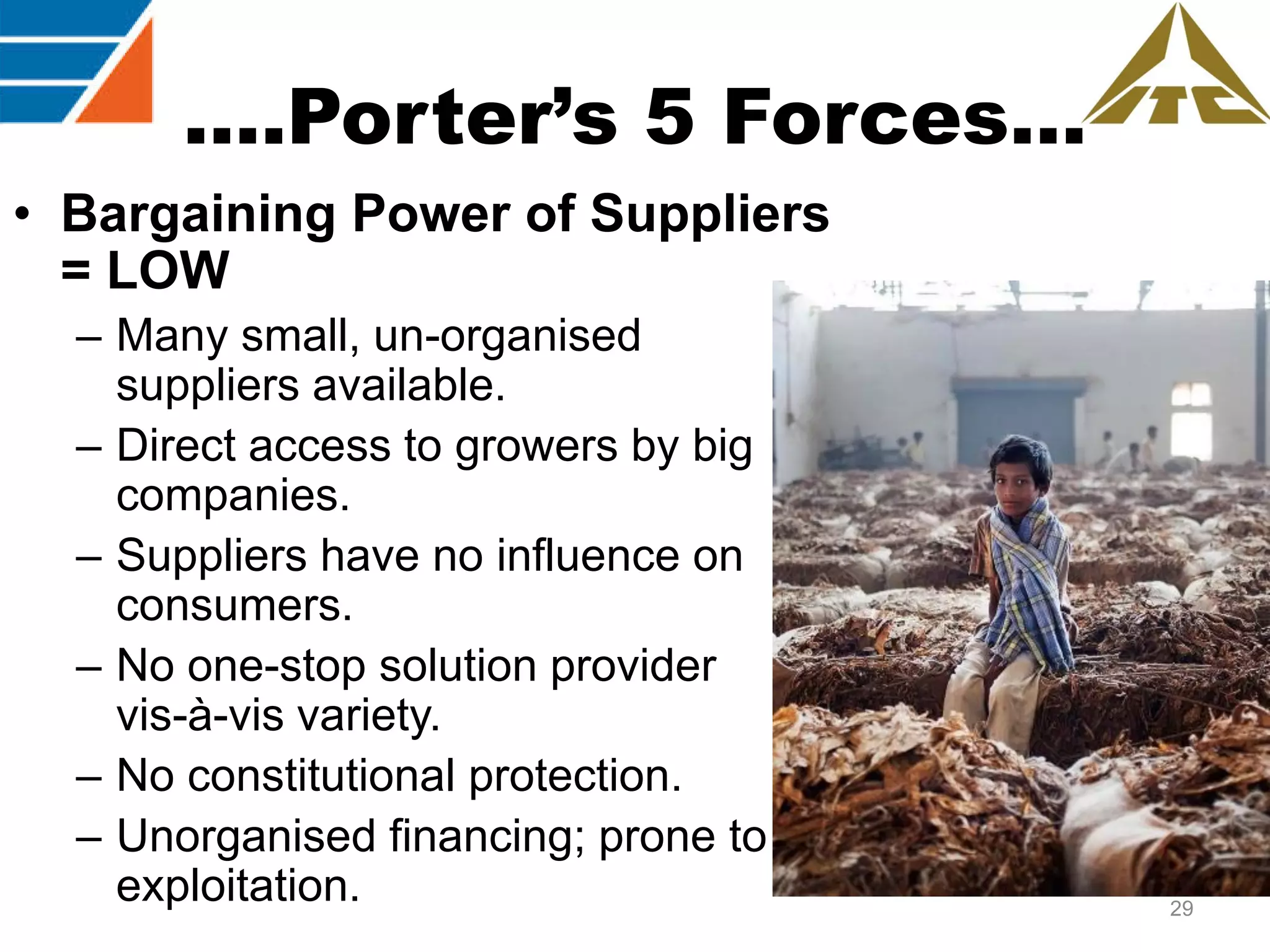
• Bargaining Power of Suppliers
= LOW
– Many small, un-organised
suppliers available.
– Direct access to growers by big
companies.
– Suppliers have no influence on
consumers.
– No one-stop solution provider
vis-à-vis variety.
– No constitutional protection.
– Unorganised financing; prone to
exploitation.

29
….Porter’s 5 Forces…
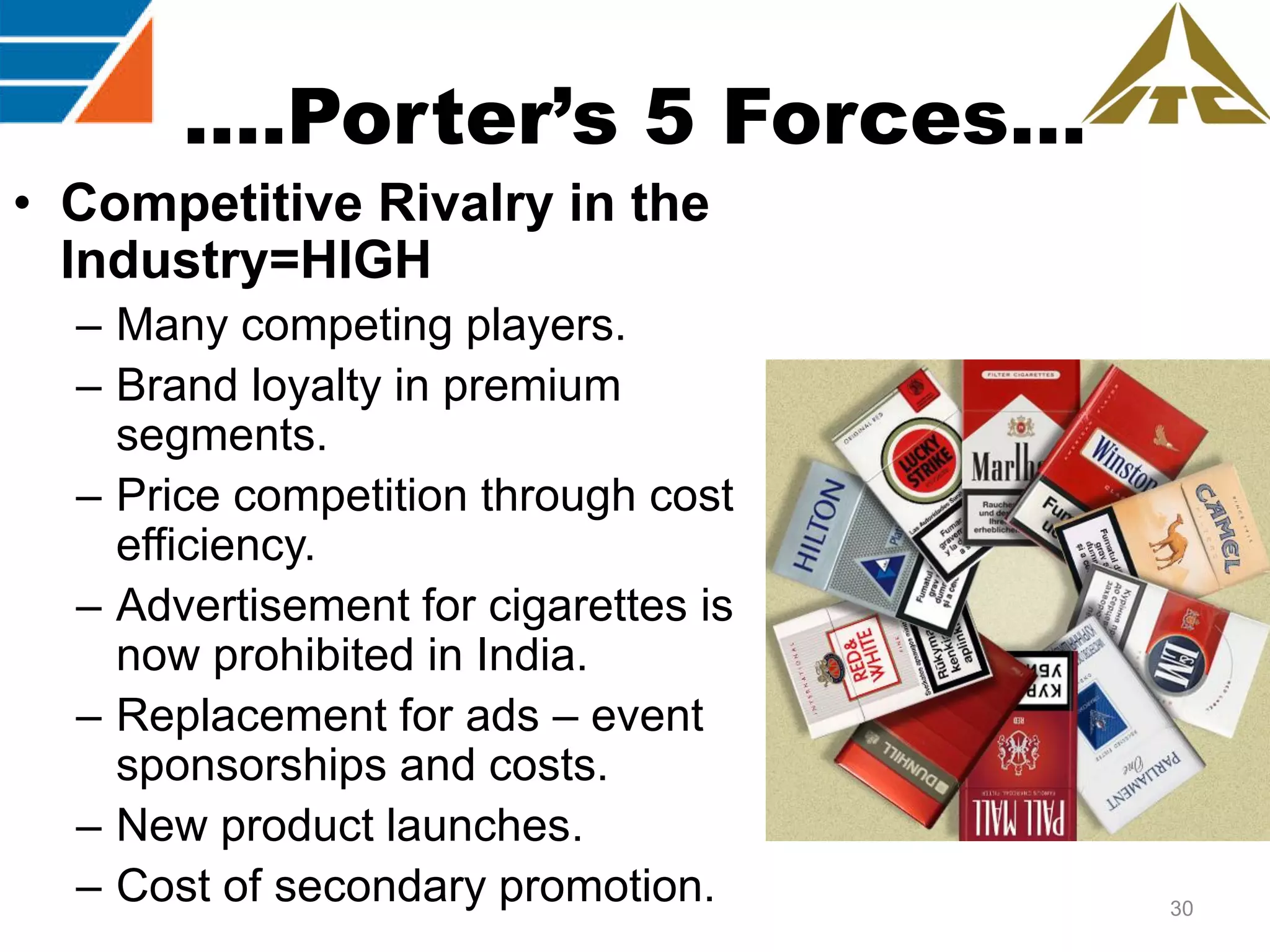
• Competitive Rivalry in the
Industry=HIGH
– Many competing players.
– Brand loyalty in premium
segments.
– Price competition through cost
efficiency.
– Advertisement for cigarettes is
now prohibited in India.
– Replacement for ads – event
sponsorships and costs.
– New product launches.
– Cost of secondary promotion.

30
….Porter’s 5 Forces…
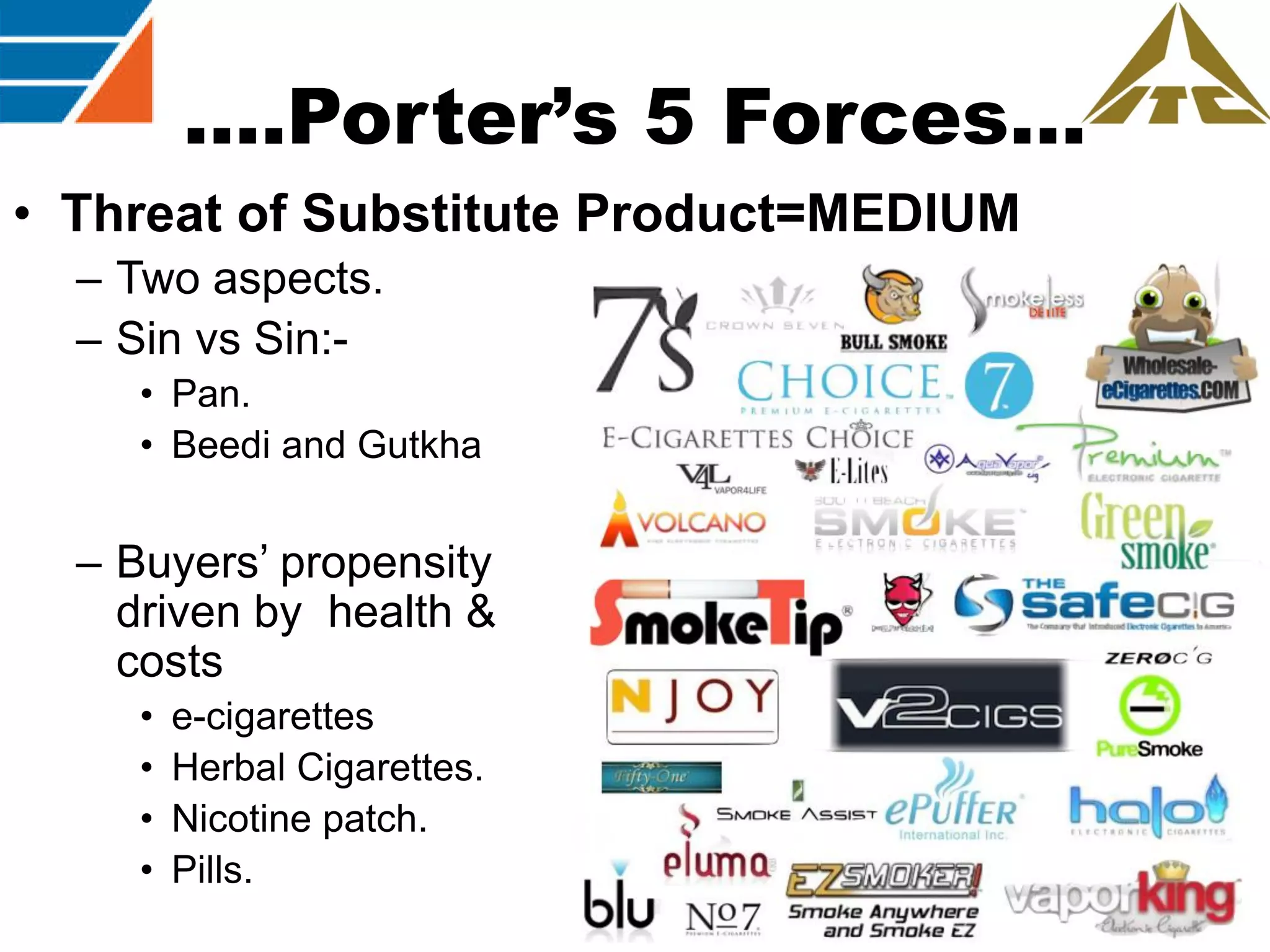
• Threat of Substitute Product=MEDIUM
– Two aspects.
– Sin vs Sin:• Pan.
• Beedi and Gutkha

– Buyers‟ propensity
driven by health &
costs
•
•
•
•

e-cigarettes
Herbal Cigarettes.
Nicotine patch.
Pills.
31
….Porter’s 5 Forces
• Barriers to Entry = HIGH
– New product differentiation very difficult; huge
variety available.
– Local launches can not achieve economies of
scale.
– Govt regulations.
• No fresh licenses for setting up new plants.
• No incentives permitted.

– Huge capital required to manufacture for an all India
presence. Ban on advertisements & brand identity.

• SUMMARY – High Barriers, Stiff competition,
Low powers and Medium for substitutes.

32
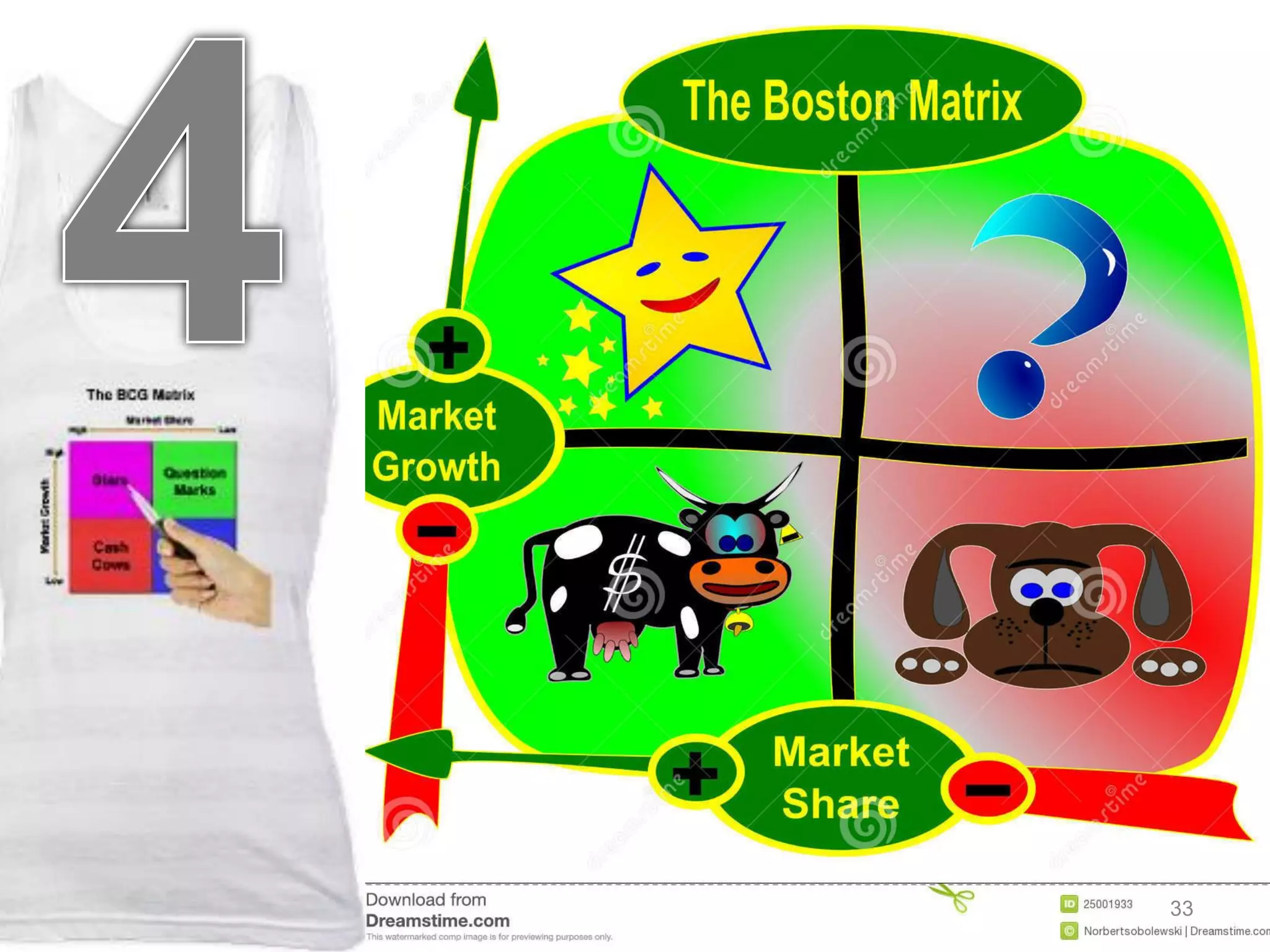
33
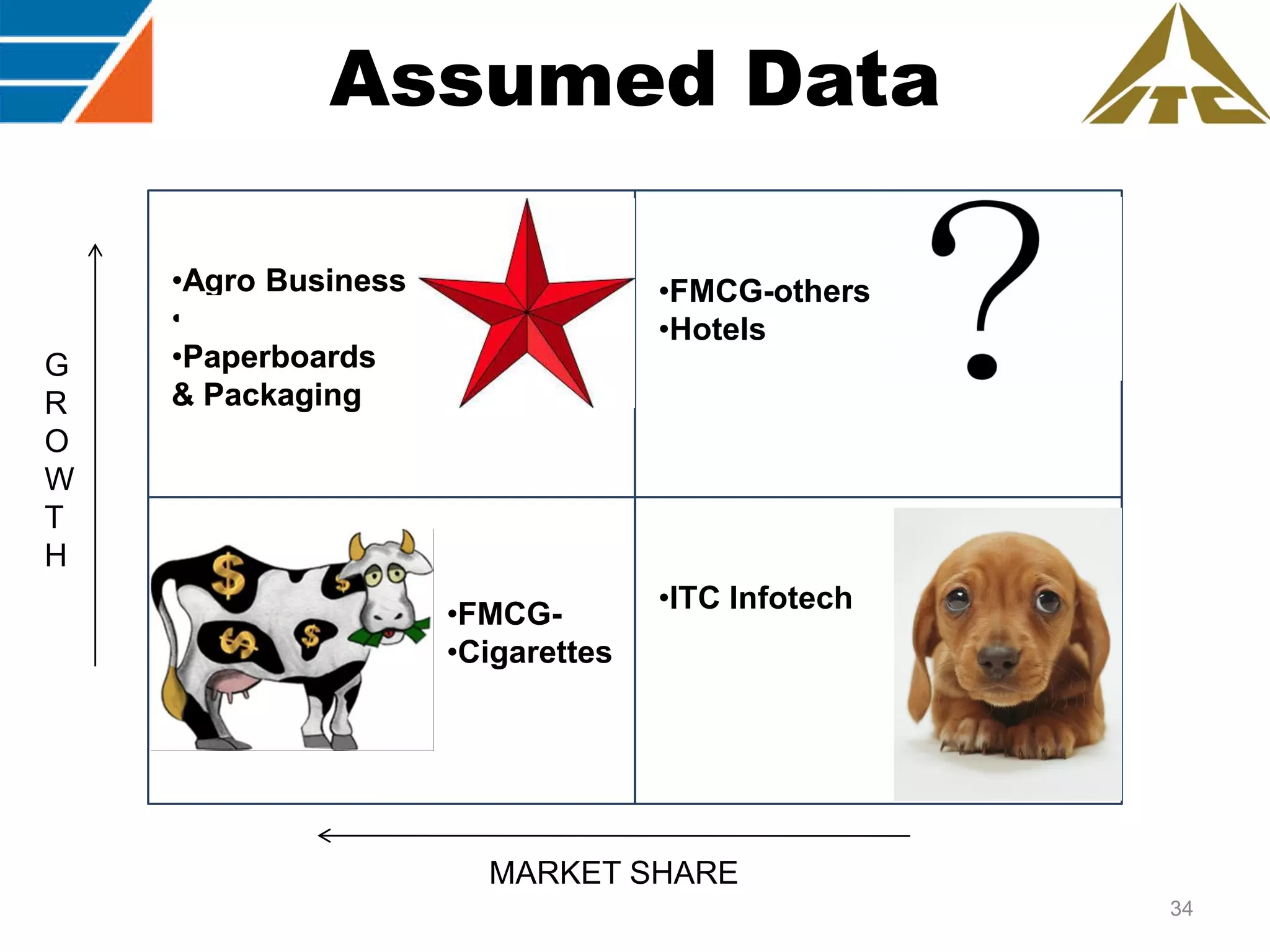
Assumed Data

G
R
O
W
T
H

•Agro Business
•Hotels
•Paperboards
& Packaging

•FMCG-others
•Hotels

•FMCG•Cigarettes

•ITC Infotech

MARKET SHARE
34
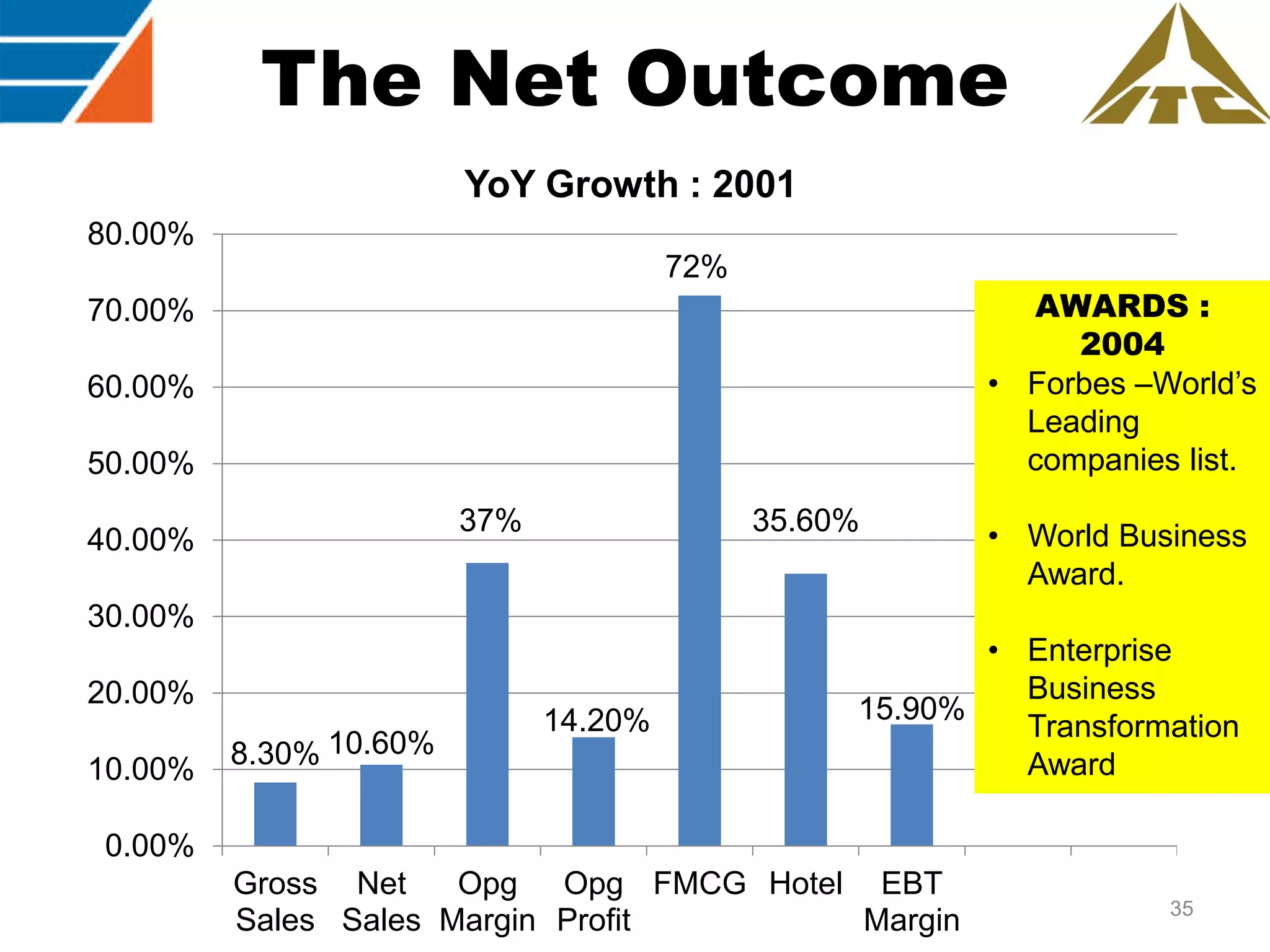
The Net Outcome
YoY Growth : 2001
80.00%
72%

AWARDS :
2004
• Forbes –World‟s
Leading
companies list.

70.00%
60.00%

50.00%
37%

40.00%

35.60%

30.00%
20.00%
10.00%

8.30% 10.60%

14.20%

• World Business
Award.

• Enterprise
Business
15.90%
Transformation
Award

0.00%
Gross Net
Opg Opg FMCG Hotel EBT
Sales Sales Margin Profit
Margin

35
36
37
Broad Diversification
Strategies
• Aimed at synergising both backward and
forward integration.
• Convergence of multiple core competencies.
• Value derived from diversified portfolio of
related businesses through efficient value
chains.
• Brand management + Understanding markets +
Consumer tastes.
• Selection criterions:– Good likely ROI.
– Potential for future expansion.
38
Analysis of Strategies
• Entering into less competitive or unexplored
markets (ready to eat, staples, wafers).
• Maintaining a well-managed supply chain network.
• Innovation-Regular introduction of new products,
duly supported by R & D.
• Mix of more than one business strategies.
• Extensive advertising (biscuits, confectionary,
wafers)
• Multiple drivers of growth - matching internal
capabilities with emerging market opportunities
• Pursue World class competitiveness in the entire
value chain
• Transformational strategy (e-choupal).
39
Challenges
for Strategies
• Capability of organisation to manage multiple
businesses indefinitely.
• ITC has been trying to develop a capacity to
manage their large portfolio which will result in
a need of huge funds.
• ITC needs to maintain a proper flow of cash
and proper project budget control.
• Investing in people.
40
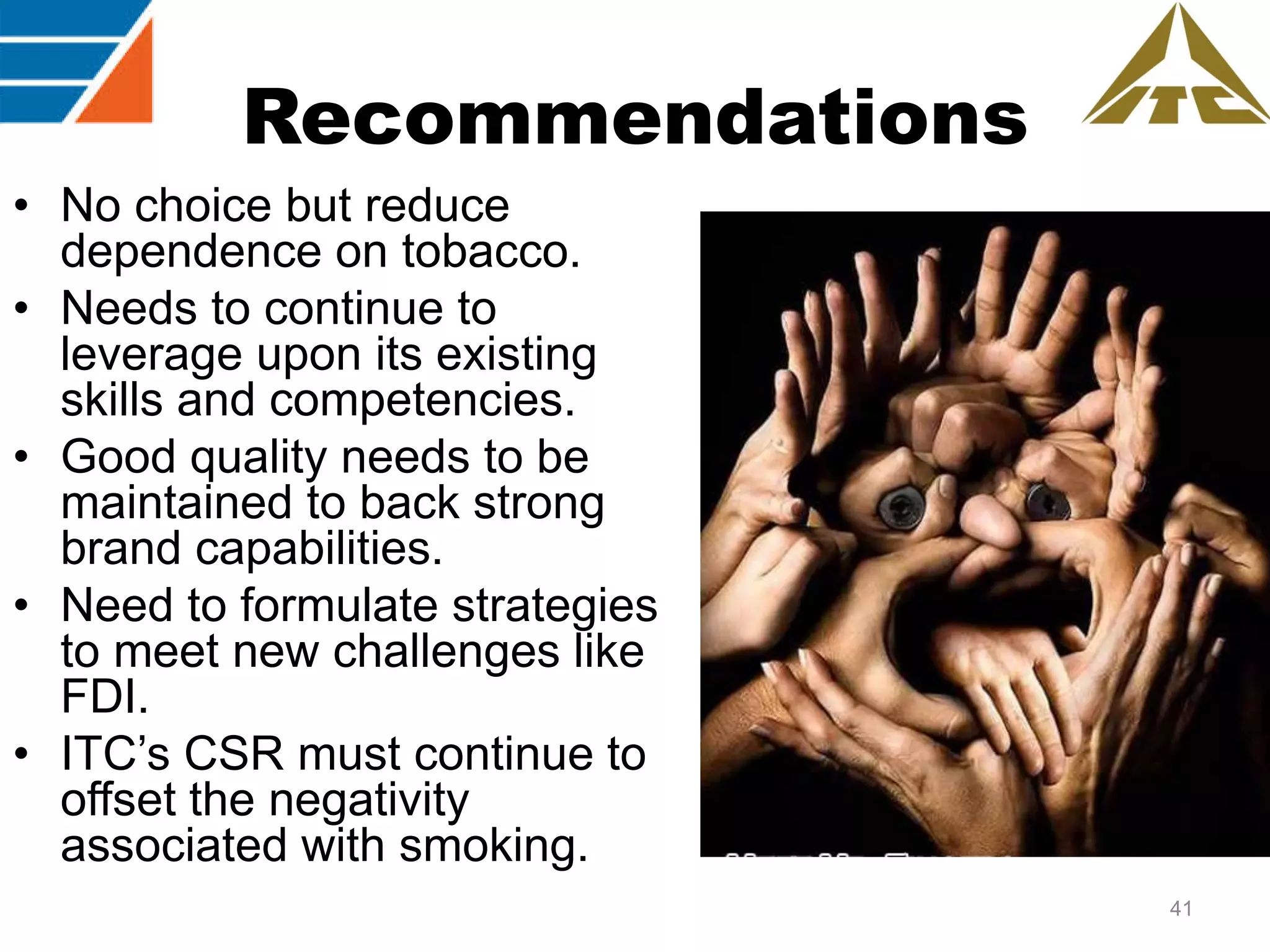
Recommendations
• No choice but reduce
dependence on tobacco.
• Needs to continue to
leverage upon its existing
skills and competencies.
• Good quality needs to be
maintained to back strong
brand capabilities.
• Need to formulate strategies
to meet new challenges like
FDI.
• ITC‟s CSR must continue to
offset the negativity
associated with smoking.
41
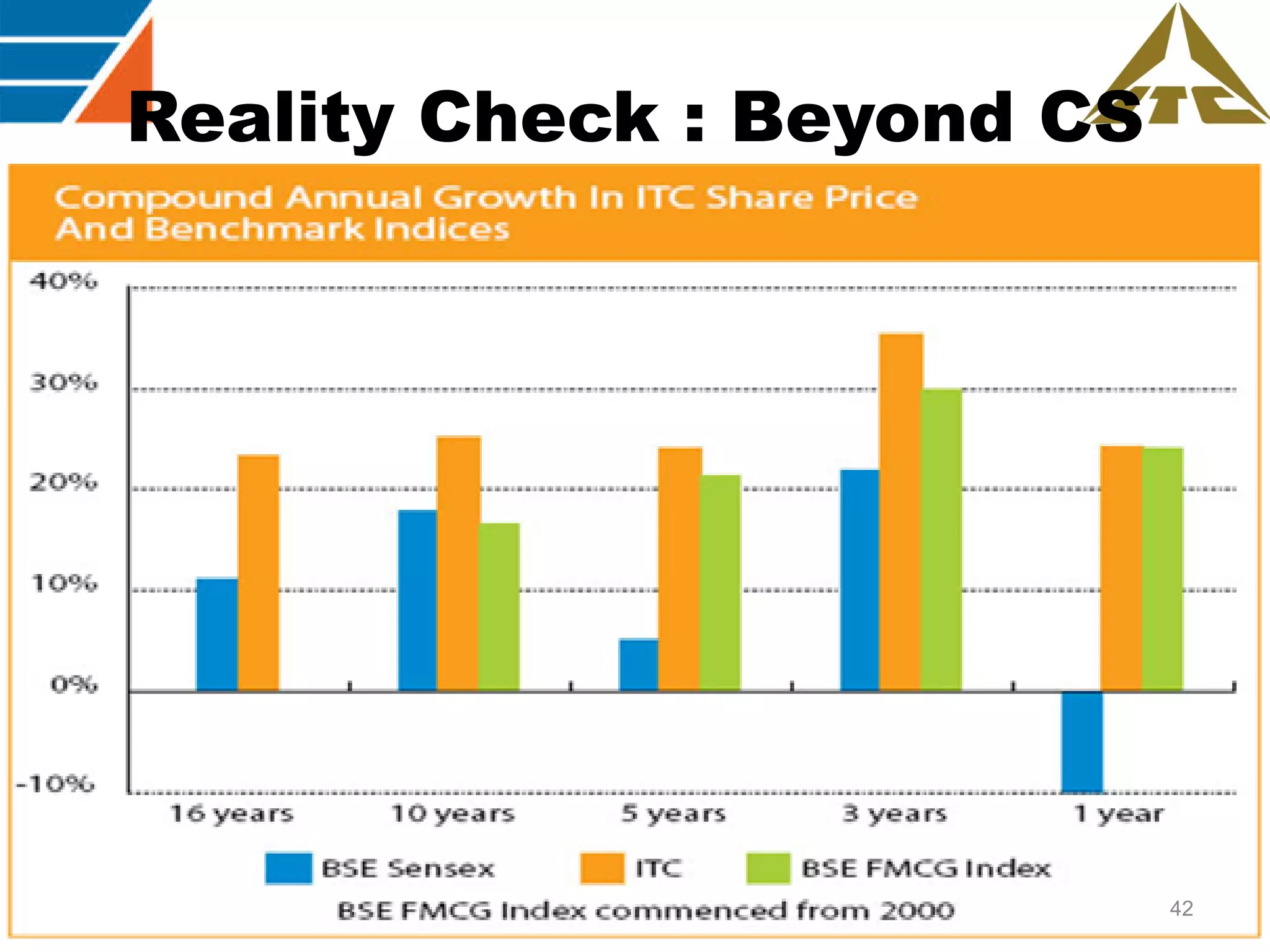
Reality Check : Beyond CS

42
It pays to be Competent
– A turnover of over US $ 5 billion and a market capitalization
of over US$ 18 billion.
– Total shareholder returns grew at a compound rate of over
24% per annum over the last 5 years.
– Reputed to be one of the world‟s most successfully
diversified companies.
– Direct employment to more than 26,000people.
– e-choupal initiative is the world‟s largest rural digital
infrastructure benefiting over 4 million farmers.
– Watershed Development initiative brings water to over
46,000 hectares of dry lands and moisture-stressed areas.
– ITC‟s sustainable community development initiatives include
women‟s empowerment, supplementary education.
43
44

ITC : Diversification

  • 1.
    & ITS DIVERSIFICATION STRATEGIESFOR MARKET LEADERSHIP
  • 2.
    Team Members • • • • • • • Abhinav DISCLAIMER Aman Hemraj No memberof this team endorses use Kavish of tobacco or any such products. Amit Paritosh Viewers’ discretion is Col Ajay K Raina, SM recommended. 2
  • 3.
    Case Study :Vital Stats • Vintage – Early 2005. • Focus – Corporate Strategy • Ingredients:– Need to diversify. – Strategies adopted. – Future possibilities. • Our Approach:– – – – An overview. Analysis. Recommendations. Real time benchmarking. • Limitations. 3
  • 4.
    Overview • Incorporated in1910 as Imperial Tobacco Company. • Ownership shifted from British to Indian management team in 1974; rechristened as India Tobacco Company Limited. • Strategic diversification started in 1970s into related as well as unrelated businesses. • Has successfully spread its business and market risks. 4
  • 5.
    The Start Point •ITC‟s Vision and Mission statements. • Corporate Strategy briefly touched upon:– “It is ITC‟s endeavour to continuously explore opportunities for growth by synergising and blending its multiple core competencies to create new epicentres of growth”. – YC Deveshwar, Chairman. 5
  • 6.
  • 7.
    Change is NeverEasy ANALYSTS’ VIEW - Risk of overspreading its assets. - Fear of losing effective control over businesses. - Survival of one may cost profit of another. MANAGEMENT’S STANCE “We will either become the market leader or exit” 7
  • 8.
    Changing Ambitions • Corebusiness – cigarette & tobacco. – Market share of 60%. – Revenue contribution of 78%. – Profit margins of 40%. • Among top five private sector companies in India; aiming to be a global entity. • Early 2000s – India amongst economic boom. • Anti-tobacco campaign & regulatory restrictions. • “Everyone still refers to us as a cigarette company….one of the largest hotel chains, largest print shop…..” YC Deveshwar. 8
  • 9.
  • 10.
    FMCG-Cigarettes • Focus ondelivery of highest product quality. • Leadership maintained through delivery of value. • Innovative marketing schemes (eg festival packs, limited edition). • Segmentation of consumers/ pricing. • Increasing costs of the selected ones to increase margins. 10
  • 11.
    FMCG-Other • • • • • • • Bukhara‟s popularity –Kitchens of India. Agro products – Aashirvaad – Sunfeast. Consumer quest for healthier snacks and food. Innovative additions (eg orange Marie). Exporting Mint-O-Fresh & Eclairs. Wills and John Players- secondary advertising. Lifestyle stores – international shopping experience. • Expressions, Regalia and Matrubhasha. • AIM (120 hits) & Mangal Deep – the leaders. 11
  • 12.
    Hotels • Among topwith Taj & Oberai. • ITC Sonar Bangla Sheraton, Kolkata – one of the best by ABTA. • Logo‟s Indian connection. • Segmentation strategy – „Branded Accommodation‟ (hotel within the hotel). • Restructuring of operations for better efficiency = higher occupancy+ increased revenues. 12
  • 13.
  • 14.
    Broadly…. (Seen it) •At the corporate level, ITC aims to create multiple drivers of growth by developing a portfolio of such businesses that best matches organisational capability with opportunities in domestic and export markets. • As regards Business Strategies, all three types have been used with varying degrees of mix. 14
  • 15.
  • 16.
  • 17.
    PEST Analysis…. • PoliticalAspects. – – – – Crusaders. 2001 ban on the advertising. Increased excise duties. Economic reforms, de-licensing and liberalisation. – New technologies in agriculture, manufacturing…. Tax incentives on R&D and technology upgradation. – State governments and luxury tax. – Focus on rural sector development. 17
  • 18.
    …..PEST Analysis… • EconomicalAspects – A growing economy = A growing portfolio of businesses… already seen. – Offshore businesses, especially IT industry. – Era of international tie-ups. – Huge commercial spaces available. – Corporate culture and associated needs. – Rising small town aspirations. – National imperatives. 18
  • 19.
    …..PEST Analysis… • SocialAspects – – – – – – – – – – – – – Younger demographic profile. Increased PCI and spending power. Lifestyle & brand consciousness. Desire for high end international products. Changing definition of luxury and necessity. Health/nutrition consciousness. Leaning back on mother tongue. Yearning for Personalised products. Averse to smoking. Elite among equals. Less leisure time. Need for innovative gifting options. CSR prism. 19
  • 20.
    …..PEST Analysis • TechnologicalAspects – Farming technology under revolution. – Innovation vis-à-vis competitive advantage. – Acceptable substitutes to traditional foods. – Huge impacts on SCM started to be felt. – Cheap labour for high tech jobs. 20
  • 21.
  • 22.
    Strengths • Brand Image. •Largest selling Tobacco brand in India; regulations. • Illustrated ability to leverage traditional businesses to develop new brands (Chefs + Cigarette =FMCG; paper+ package = Greeting cards). • Diversification profile and track record. • Distribution network. • Strong financial performance. • R&D. • CSR programmes and success therein. 22
  • 23.
    Weaknesses • Too muchreliance on tobacco revenues. • Miles to go. • Essentially “Desi”. • Unrelated diversifications. • Heavy taxation prone products. • Brand name‟s association with tobacco. • Other businesses subsidized by tobacco segment. 23
  • 24.
    Opportunities…. • Leveraging brandequity. • Government policies (liberalisation) and stable economy. • Untapped Rural market. • Lowest per capita FMCG consumption. • Personal care & booming incomes. • Synergies across businesses + leveraging domain expertise for growth in other sectors. 24
  • 25.
    ……Opportunities • The enviablereach and distribution network of e-choupal. • Taking IT business to USA; 60% in Europe. 25
  • 26.
    Threats • Competition –domestic+ international. • Increasingly hostile attitude towards smoking in general. • Government policies towards tobacco= tax, regulations. • Systematic threats. • IT bubble (assumed). 26
  • 27.
  • 28.
    Porter’s 5 Forces: Cigarettes… •Bargaining Power of Buyers=LOW – Addicted customers . – Symbolic and emotional values. – Product quality not much important to smokers. – Low switching costs. – Brand loyalty insignificant. 28
  • 29.
    ….Porter’s 5 Forces… •Bargaining Power of Suppliers = LOW – Many small, un-organised suppliers available. – Direct access to growers by big companies. – Suppliers have no influence on consumers. – No one-stop solution provider vis-à-vis variety. – No constitutional protection. – Unorganised financing; prone to exploitation. 29
  • 30.
    ….Porter’s 5 Forces… •Competitive Rivalry in the Industry=HIGH – Many competing players. – Brand loyalty in premium segments. – Price competition through cost efficiency. – Advertisement for cigarettes is now prohibited in India. – Replacement for ads – event sponsorships and costs. – New product launches. – Cost of secondary promotion. 30
  • 31.
    ….Porter’s 5 Forces… •Threat of Substitute Product=MEDIUM – Two aspects. – Sin vs Sin:• Pan. • Beedi and Gutkha – Buyers‟ propensity driven by health & costs • • • • e-cigarettes Herbal Cigarettes. Nicotine patch. Pills. 31
  • 32.
    ….Porter’s 5 Forces •Barriers to Entry = HIGH – New product differentiation very difficult; huge variety available. – Local launches can not achieve economies of scale. – Govt regulations. • No fresh licenses for setting up new plants. • No incentives permitted. – Huge capital required to manufacture for an all India presence. Ban on advertisements & brand identity. • SUMMARY – High Barriers, Stiff competition, Low powers and Medium for substitutes. 32
  • 33.
  • 34.
    Assumed Data G R O W T H •Agro Business •Hotels •Paperboards &Packaging •FMCG-others •Hotels •FMCG•Cigarettes •ITC Infotech MARKET SHARE 34
  • 35.
    The Net Outcome YoYGrowth : 2001 80.00% 72% AWARDS : 2004 • Forbes –World‟s Leading companies list. 70.00% 60.00% 50.00% 37% 40.00% 35.60% 30.00% 20.00% 10.00% 8.30% 10.60% 14.20% • World Business Award. • Enterprise Business 15.90% Transformation Award 0.00% Gross Net Opg Opg FMCG Hotel EBT Sales Sales Margin Profit Margin 35
  • 36.
  • 37.
  • 38.
    Broad Diversification Strategies • Aimedat synergising both backward and forward integration. • Convergence of multiple core competencies. • Value derived from diversified portfolio of related businesses through efficient value chains. • Brand management + Understanding markets + Consumer tastes. • Selection criterions:– Good likely ROI. – Potential for future expansion. 38
  • 39.
    Analysis of Strategies •Entering into less competitive or unexplored markets (ready to eat, staples, wafers). • Maintaining a well-managed supply chain network. • Innovation-Regular introduction of new products, duly supported by R & D. • Mix of more than one business strategies. • Extensive advertising (biscuits, confectionary, wafers) • Multiple drivers of growth - matching internal capabilities with emerging market opportunities • Pursue World class competitiveness in the entire value chain • Transformational strategy (e-choupal). 39
  • 40.
    Challenges for Strategies • Capabilityof organisation to manage multiple businesses indefinitely. • ITC has been trying to develop a capacity to manage their large portfolio which will result in a need of huge funds. • ITC needs to maintain a proper flow of cash and proper project budget control. • Investing in people. 40
  • 41.
    Recommendations • No choicebut reduce dependence on tobacco. • Needs to continue to leverage upon its existing skills and competencies. • Good quality needs to be maintained to back strong brand capabilities. • Need to formulate strategies to meet new challenges like FDI. • ITC‟s CSR must continue to offset the negativity associated with smoking. 41
  • 42.
    Reality Check :Beyond CS 42
  • 43.
    It pays tobe Competent – A turnover of over US $ 5 billion and a market capitalization of over US$ 18 billion. – Total shareholder returns grew at a compound rate of over 24% per annum over the last 5 years. – Reputed to be one of the world‟s most successfully diversified companies. – Direct employment to more than 26,000people. – e-choupal initiative is the world‟s largest rural digital infrastructure benefiting over 4 million farmers. – Watershed Development initiative brings water to over 46,000 hectares of dry lands and moisture-stressed areas. – ITC‟s sustainable community development initiatives include women‟s empowerment, supplementary education. 43
  • 44.