Akanksha

A PRESENTATION BY
Robin
Ajay

Nitish Business School, New Kavish
Era
Era Business School, New Delhi

Vatan

AJ/ Ajay K K Raina,Archit
AJ/ Ajay Raina, PGDM
PGDM 2012-14
The Overview
 Case study about alliances in airline industry
and issues therein.
 Built around the fact that selling abroad by
exporting home-country production may not be
advantageous because of cost differentials,

changes/modifications that are necessitated,
trade barriers and such like factors.

Era Business School, New

AJ/ Ajay K Raina, PGDM
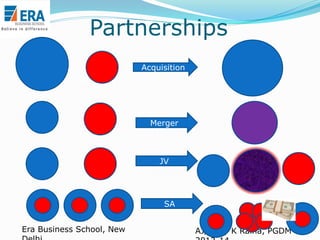
Partnerships
Acquisition

Merger

JV

SA
Era Business School, New

AJ/ Ajay K Raina, PGDM
What is it? A, M, JV or a SA?

Era Business School, New

AJ/ Ajay K Raina, PGDM
The Case: Introduction
 Airlines alliances involve combining of routes,
sales, terminal services and frequent flier
programmes.
 Most of the leading airlines of the world have
such alliances.

 Many airlines own stakes in other airlines too.
 There have been mergers too even though

original identities have been retained in certain
Era Business School, New
cases.
AJ/ Ajay K Raina, PGDM
Analysis of the Case
 Intend covering this part in the following

sequence:-

 General issues.
 PEST analysis to understand emerging trends in the

industry.
 Forces 5 Forces Model Analysis to understand the
complexity and challenges faced by any single airline
to compete in the industry(generic; Singapore
Airlines).
 Alliances as strategy.
 Spectrum of alliances.
 Governance issues.
Era Business School, New
Conclusion with questions.
AJ/ Ajay K Raina, PGDM
General….
 Alliances between airlines on international markets have become a










dominant feature of the airline industry.
Many customers today, particularly those travelling on business,
demand a seamless service on international markets „from
anywhere to anywhere‟.
However, no airline is able to efficiently provide such a service on
its own aircraft, and few city pairs can generate sufficient traffic to
justify a daily non-stop service.
In order to meet customer demands at an efficient cost, airlines
have had to seek commercial partners to help them provide the
network and service coverage required.
Passengers have always been able to arrange an itinerary on two or
more airlines, through the interlining mechanism managed by IATA.
However, this arms-length cooperation did not allow the integration
and efficiencies that were possible.
Cross border mergers, which would be typical in other industries,
are prohibited for airlines by restrictions on foreign ownership.
Nevertheless, since the early 1990s, the need for network
cooperation led to a rapid expansion of alliance relationships, as a
close Business School, New
Era substitute for mergers.
AJ/ Ajay K Raina, PGDM
…General
 Alliance formation is typically associated with high-tech

firms and R&D intensive manufacturing industries but
the airline industry is an example of a service-oriented
sector where various kinds of alliances have also
proliferated.
 One of the most important developments in the
international airline industry in recent years has been
the rapid expansion of global airline alliances among
airline competitors.
 Large airlines are spreading their wings by including
airlines of various sizes from all parts of the world into
their alliances.
 These have involved cooperation between two or more
airlines in a wide range of commercial and operational
areas, for example, scheduling, purchasing, marketing,
and frequent flyer programs.
Era Business School, New

AJ/ Ajay K Raina, PGDM
The Issues…..
 Historically, air transport has always been seen to have

an inherently strategic role. It has obvious direct
military applications, but it is also highly visible and, for
a period, and in some countries still, was seen as a
“flag carrier”, a symbol of international commercial
presence.
 The modern air transport industry is one that
increasingly operates within a liberal market context.
 There is a further aspect to liberalizing international
services stemming from the interaction of domestic air
transport with international markets.
 Globalization inevitably means higher demands for the
movement of people and goods between countries
which, given the largely commercial orientation of
modern air transport, will bring forth additional supply.
Era Business School, New

AJ/ Ajay K Raina, PGDM
….The Issues…..
 Forces

in the global marketplace increasingly
require companies to collaborate with local and
overseas partners for market efficiency and
responsiveness.
 This trend is echoed in the development of alliance
activities within the airline industry. Nowadays most
airlines participate in some form of strategic
alliance.
 An airline alliance is an agreement between
multiple independent partners to collaborate in
various activities to streamline costs (e.g., by
sharing sales offices, maintenance facilities, ground
handling personnel, check-in and boarding staff
etc) while expanding global reach and market
penetration.
Era Business School, New

AJ/ Ajay K Raina, PGDM
Why Alliances?
 Such alliances blur competitions.
 Why Necessitated?
 Regulations and Trade Barriers.
 Costs.
 Competition.
 Sluggish economies.
 Terrorist threats.
 High oil prices.
Era Business School, New

AJ/ Ajay K Raina, PGDM
Regulatory Controls
 Regulatory controls in place to have domestic

control even in developed countries.
 Activities regulated: Landing rights.

 Specific aircraft and airports.
 Frequency of flights.
 Fly beyond.

 Over flight.
 Fares.

 IATA – uniformity of fares, meal charges, baggage

allowance and safety.
 Privatisation andNew
Era Business School, deregulation of industry. PGDM
AJ/ Ajay K Raina,
Cost & Competition
 High cost of running; ways to spread costs: Ownership of critical capabilities.
 Use of gates, generators and ground

transport.
 Sub-leasing.
 Alternate flying days.
 Reservation systems.

 Competitiveness

affected when travellers
find the need to change two different
(though allied) airlines during a journey.
Era Business School, New

AJ/ Ajay K Raina, PGDM
PEST Analysis




















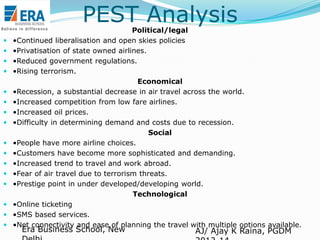
Political/legal
•Continued liberalisation and open skies policies
•Privatisation of state owned airlines.
•Reduced government regulations.
•Rising terrorism.
Economical
•Recession, a substantial decrease in air travel across the world.
•Increased competition from low fare airlines.
•Increased oil prices.
•Difficulty in determining demand and costs due to recession.
Social
•People have more airline choices.
•Customers have become more sophisticated and demanding.
•Increased trend to travel and work abroad.
•Fear of air travel due to terrorism threats.
•Prestige point in under developed/developing world.
Technological
•Online ticketing
•SMS based services.
•Net connectivity and ease of planning the travel with multiple options available.

Era Business School, New

AJ/ Ajay K Raina, PGDM
Inferences from PEST
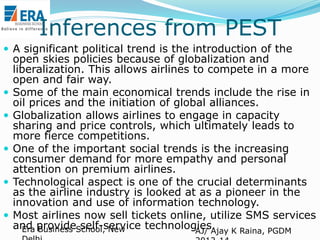
 A significant political trend is the introduction of the








open skies policies because of globalization and
liberalization. This allows airlines to compete in a more
open and fair way.
Some of the main economical trends include the rise in
oil prices and the initiation of global alliances.
Globalization allows airlines to engage in capacity
sharing and price controls, which ultimately leads to
more fierce competitions.
One of the important social trends is the increasing
consumer demand for more empathy and personal
attention on premium airlines.
Technological aspect is one of the crucial determinants
as the airline industry is looked at as a pioneer in the
innovation and use of information technology.
Most airlines now sell tickets online, utilize SMS services
and provideSchool, New
Era Business self-service technologies.
AJ/ Ajay K Raina, PGDM
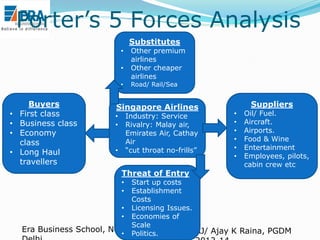
Porter‟s 5 Forces Analysis
Substitutes
•
•
•

•
•
•
•

Buyers
First class
Business class
Economy
class
Long Haul
travellers

Other premium
airlines
Other cheaper
airlines
Road/ Rail/Sea

Singapore Airlines
Industry: Service
Rivalry: Malay air,
Emirates Air, Cathay
Air
“cut throat no-frills”

•
•
•

Threat of Entry

Suppliers

•
•
•
•
•
•

Oil/ Fuel.
Aircraft.
Airports.
Food & Wine
Entertainment
Employees, pilots,
cabin crew etc

Start up costs
Establishment
Costs
• Licensing Issues.
• Economies of
Scale
Era Business School, New Politics.
AJ/ Ajay K Raina, PGDM
•
•
•
Inferences from 5F Analysis
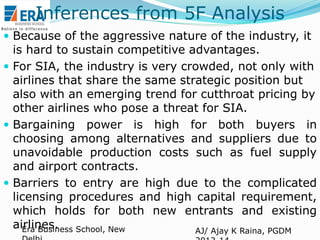
 Because of the aggressive nature of the industry, it

is hard to sustain competitive advantages.
 For SIA, the industry is very crowded, not only with
airlines that share the same strategic position but
also with an emerging trend for cutthroat pricing by
other airlines who pose a threat for SIA.
 Bargaining power is high for both buyers in
choosing among alternatives and suppliers due to
unavoidable production costs such as fuel supply
and airport contracts.
 Barriers to entry are high due to the complicated
licensing procedures and high capital requirement,
which holds for both new entrants and existing
airlines. School, New
Era Business
AJ/ Ajay K Raina, PGDM
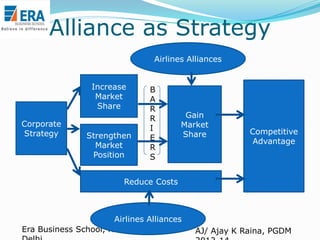
Alliance as Strategy
Airlines Alliances
Increase
Market
Share
Corporate
Strategy

Strengthen
Market
Position

B
A
R
R
I
E
R
S

Gain
Market
Share

Competitive
Advantage

Reduce Costs

Airlines Alliances
Era Business School, New

AJ/ Ajay K Raina, PGDM
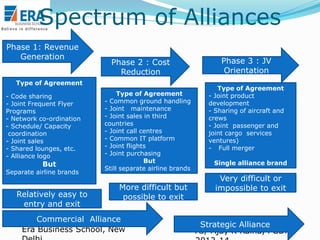
Spectrum of Alliances
Phase 1: Revenue
Generation

Phase 2 : Cost
Reduction

Type of Agreement
- Code sharing
- Joint Frequent Flyer
Programs
- Network co-ordination
- Schedule/ Capacity
coordination
- Joint sales
- Shared lounges, etc.
- Alliance logo

But

Separate airline brands

Relatively easy to
entry and exit

Type of Agreement
- Common ground handling
- Joint maintenance
- Joint sales in third
countries
- Joint call centres
- Common IT platform
- Joint flights
- Joint purchasing
But
Still separate airline brands

More difficult but
possible to exit

Commercial Alliance
Era Business School, New

Phase 3 : JV
Orientation
Type of Agreement
- Joint product
development
- Sharing of aircraft and
crews
- Joint passenger and
joint cargo services
ventures)
- Full merger

Single alliance brand

Very difficult or
impossible to exit

Strategic Alliance
AJ/ Ajay K Raina, PGDM
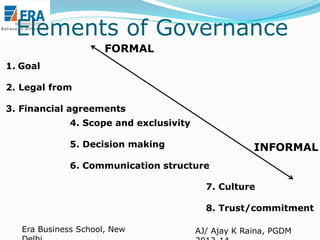
Elements of Governance
FORMAL
1. Goal
2. Legal from
3. Financial agreements
4. Scope and exclusivity
5. Decision making

INFORMAL

6. Communication structure
7. Culture
8. Trust/commitment
Era Business School, New

AJ/ Ajay K Raina, PGDM
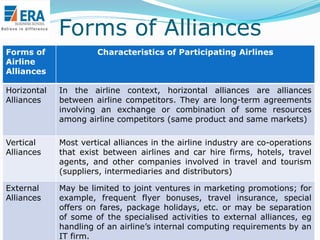
Forms of Alliances
Forms of
Airline
Alliances

Characteristics of Participating Airlines

Horizontal
Alliances

In the airline context, horizontal alliances are alliances
between airline competitors. They are long-term agreements
involving an exchange or combination of some resources
among airline competitors (same product and same markets)

Vertical
Alliances

Most vertical alliances in the airline industry are co-operations
that exist between airlines and car hire firms, hotels, travel
agents, and other companies involved in travel and tourism
(suppliers, intermediaries and distributors)

External
Alliances

May be limited to joint ventures in marketing promotions; for
example, frequent flyer bonuses, travel insurance, special
offers on fares, package holidays, etc. or may be separation
of some of the specialised activities to external alliances, eg
handling of New
requirements by
Era Business School, an airline‟s internal computing K Raina, PGDM an
AJ/ Ajay
IT firm.
Era Business School, New

AJ/ Ajay K Raina, PGDM
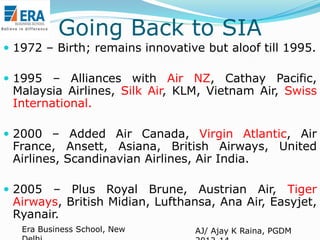
Going Back to SIA
 1972 – Birth; remains innovative but aloof till 1995.
 1995 – Alliances with Air NZ, Cathay Pacific,

Malaysia Airlines, Silk Air, KLM, Vietnam Air, Swiss
International.

 2000 – Added Air Canada, Virgin Atlantic, Air

France, Ansett, Asiana, British Airways, United
Airlines, Scandinavian Airlines, Air India.

 2005

– Plus Royal Brune, Austrian Air, Tiger
Airways, British Midian, Lufthansa, Ana Air, Easyjet,
Ryanair.
Era Business School, New

AJ/ Ajay K Raina, PGDM
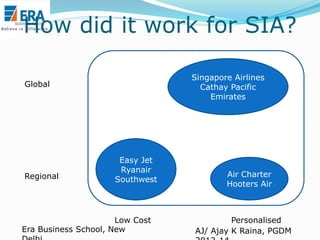
How did it work for SIA?
Singapore Airlines
Cathay Pacific
Emirates

Global

Regional

Easy Jet
Ryanair
Southwest

Low Cost
Era Business School, New

Air Charter
Hooters Air

Personalised
AJ/ Ajay K Raina, PGDM
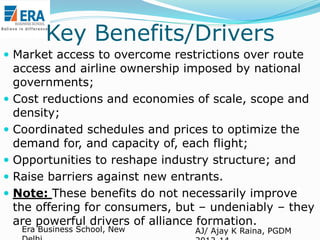
Key Benefits/Drivers
 Market access to overcome restrictions over route







access and airline ownership imposed by national
governments;
Cost reductions and economies of scale, scope and
density;
Coordinated schedules and prices to optimize the
demand for, and capacity of, each flight;
Opportunities to reshape industry structure; and
Raise barriers against new entrants.
Note: These benefits do not necessarily improve
the offering for consumers, but – undeniably – they
are powerful drivers of alliance formation.
Era Business School, New

AJ/ Ajay K Raina, PGDM
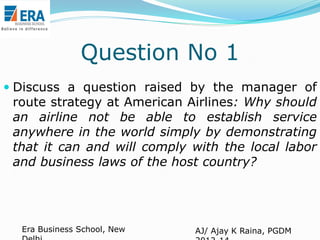
Question No 1
 Discuss a question raised by the manager of
route strategy at American Airlines: Why should

an airline not be able to establish service
anywhere in the world simply by demonstrating
that it can and will comply with the local labor
and business laws of the host country?

Era Business School, New

AJ/ Ajay K Raina, PGDM
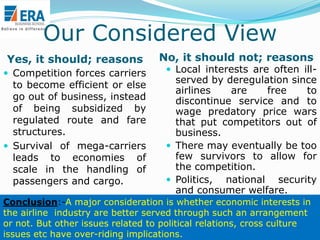
Our Considered View
Yes, it should; reasons
 Competition forces carriers

to become efficient or else
go out of business, instead
of being subsidized by
regulated route and fare
structures.
 Survival of mega-carriers
leads to economies of
scale in the handling of
passengers and cargo.

No, it should not; reasons

 Local interests are often ill-

served by deregulation since
airlines
are
free
to
discontinue service and to
wage predatory price wars
that put competitors out of
business.
 There may eventually be too
few survivors to allow for
the competition.
 Politics, national security
and consumer welfare.

Conclusion:-A major consideration is whether economic interests in
the airline industry are better served through such an arrangement
or not. But other issues related to political relations, cross culture
Era Business School, New
issues etc have over-riding implications. AJ/ Ajay K Raina, PGDM
Question No 2
 The president of Japan Air Lines has claimed

that U.S. airlines are dumping air services on
routes between the United States and Europe,
meaning they are selling below their costs
because of the money they are losing. Should
governments set prices so that carriers make
money on routes?

Era Business School, New

AJ/ Ajay K Raina, PGDM
Issues
 It is very difficult to separate profits and losses on a

route-by-route basis. While fares and loads on
certain routes may seem to be low, they may in
fact be generating marginal revenues that make
major routes profitable.
 If governments were to set prices above a certain
level, traffic and revenues, and hence profitability,
may all fall.
 The issue of profitability raises the question of
subsidies. It is nearly impossible to determine
whether dumping is taking place when competitors
receive so many direct and indirect subsidies.
 Conclusion. Not favoured.
Era Business School, New
AJ/ Ajay K Raina, PGDM
Question No 3
 What will be the consequences if a few large

airlines or networks come to dominate global
air service?

Era Business School, New

AJ/ Ajay K Raina, PGDM
Likely Implications
 The consequences would be both positive and negative.
 On the positive side, passengers should be able to

travel almost anywhere in the world on a single airline
(or network).
 That in turn should minimize the risk of missed

connections and lost baggage.
 Operating economies should be realized as a result of the
higher utilization of airport gates and ground equipment.

 Consequent savings may or may not be passed along

to passengers through lower prices.
 On the negative side, it is quite possible that

 Minimal competition would lead to poor service and/or

high prices.
 In addition, competition among the destinations
associated with particular airlines may decline, as would
the special services
niche K Raina,
Era Business School, Newoffered by the AJ/ Ajayairlines. PGDM
Question No 4
 Some airlines, such as Southwest and Alaska

Air, have survived as niche players without
going international or developing alliances
with international airlines. Can they continue
this strategy?

Era Business School, New

AJ/ Ajay K Raina, PGDM
Assessment
 When there is sufficient traffic on a route, there is little

need to have feeder or connecting routes for an airline
to be profitable.
 Without the need for hubs to make connections, such
airlines can operate from smaller/isolated airports.
 They avoid the costs associated with the transfer of
bags to connecting flights and the payment of overnight
expenses to passengers who miss connections on
bigger hubs.
 Such airlines can overcome disadvantages from smallscale operations by targeting their promotion to
regional and niche groups and by running low-cost
operations that charge low fares.
 Conclusion.

Niche operators can survive in an
operational mode that does not attempt to expand
and/or modify their operations too much.



Era Business School, New

AJ/ Ajay K Raina, PGDM

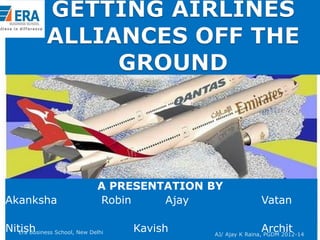
Case Study on GETTING AIRLINES ALLIANCES OFF THE GROUND

  • 1.
    Akanksha A PRESENTATION BY Robin Ajay NitishBusiness School, New Kavish Era Era Business School, New Delhi Vatan AJ/ Ajay K K Raina,Archit AJ/ Ajay Raina, PGDM PGDM 2012-14
  • 2.
    The Overview  Casestudy about alliances in airline industry and issues therein.  Built around the fact that selling abroad by exporting home-country production may not be advantageous because of cost differentials, changes/modifications that are necessitated, trade barriers and such like factors. Era Business School, New AJ/ Ajay K Raina, PGDM
  • 3.
  • 4.
    What is it?A, M, JV or a SA? Era Business School, New AJ/ Ajay K Raina, PGDM
  • 5.
    The Case: Introduction Airlines alliances involve combining of routes, sales, terminal services and frequent flier programmes.  Most of the leading airlines of the world have such alliances.  Many airlines own stakes in other airlines too.  There have been mergers too even though original identities have been retained in certain Era Business School, New cases. AJ/ Ajay K Raina, PGDM
  • 6.
    Analysis of theCase  Intend covering this part in the following sequence:-  General issues.  PEST analysis to understand emerging trends in the industry.  Forces 5 Forces Model Analysis to understand the complexity and challenges faced by any single airline to compete in the industry(generic; Singapore Airlines).  Alliances as strategy.  Spectrum of alliances.  Governance issues. Era Business School, New Conclusion with questions. AJ/ Ajay K Raina, PGDM
  • 7.
    General….  Alliances betweenairlines on international markets have become a       dominant feature of the airline industry. Many customers today, particularly those travelling on business, demand a seamless service on international markets „from anywhere to anywhere‟. However, no airline is able to efficiently provide such a service on its own aircraft, and few city pairs can generate sufficient traffic to justify a daily non-stop service. In order to meet customer demands at an efficient cost, airlines have had to seek commercial partners to help them provide the network and service coverage required. Passengers have always been able to arrange an itinerary on two or more airlines, through the interlining mechanism managed by IATA. However, this arms-length cooperation did not allow the integration and efficiencies that were possible. Cross border mergers, which would be typical in other industries, are prohibited for airlines by restrictions on foreign ownership. Nevertheless, since the early 1990s, the need for network cooperation led to a rapid expansion of alliance relationships, as a close Business School, New Era substitute for mergers. AJ/ Ajay K Raina, PGDM
  • 8.
    …General  Alliance formationis typically associated with high-tech firms and R&D intensive manufacturing industries but the airline industry is an example of a service-oriented sector where various kinds of alliances have also proliferated.  One of the most important developments in the international airline industry in recent years has been the rapid expansion of global airline alliances among airline competitors.  Large airlines are spreading their wings by including airlines of various sizes from all parts of the world into their alliances.  These have involved cooperation between two or more airlines in a wide range of commercial and operational areas, for example, scheduling, purchasing, marketing, and frequent flyer programs. Era Business School, New AJ/ Ajay K Raina, PGDM
  • 9.
    The Issues…..  Historically,air transport has always been seen to have an inherently strategic role. It has obvious direct military applications, but it is also highly visible and, for a period, and in some countries still, was seen as a “flag carrier”, a symbol of international commercial presence.  The modern air transport industry is one that increasingly operates within a liberal market context.  There is a further aspect to liberalizing international services stemming from the interaction of domestic air transport with international markets.  Globalization inevitably means higher demands for the movement of people and goods between countries which, given the largely commercial orientation of modern air transport, will bring forth additional supply. Era Business School, New AJ/ Ajay K Raina, PGDM
  • 10.
    ….The Issues…..  Forces inthe global marketplace increasingly require companies to collaborate with local and overseas partners for market efficiency and responsiveness.  This trend is echoed in the development of alliance activities within the airline industry. Nowadays most airlines participate in some form of strategic alliance.  An airline alliance is an agreement between multiple independent partners to collaborate in various activities to streamline costs (e.g., by sharing sales offices, maintenance facilities, ground handling personnel, check-in and boarding staff etc) while expanding global reach and market penetration. Era Business School, New AJ/ Ajay K Raina, PGDM
  • 11.
    Why Alliances?  Suchalliances blur competitions.  Why Necessitated?  Regulations and Trade Barriers.  Costs.  Competition.  Sluggish economies.  Terrorist threats.  High oil prices. Era Business School, New AJ/ Ajay K Raina, PGDM
  • 12.
    Regulatory Controls  Regulatorycontrols in place to have domestic control even in developed countries.  Activities regulated: Landing rights.  Specific aircraft and airports.  Frequency of flights.  Fly beyond.  Over flight.  Fares.  IATA – uniformity of fares, meal charges, baggage allowance and safety.  Privatisation andNew Era Business School, deregulation of industry. PGDM AJ/ Ajay K Raina,
  • 13.
    Cost & Competition High cost of running; ways to spread costs: Ownership of critical capabilities.  Use of gates, generators and ground transport.  Sub-leasing.  Alternate flying days.  Reservation systems.  Competitiveness affected when travellers find the need to change two different (though allied) airlines during a journey. Era Business School, New AJ/ Ajay K Raina, PGDM
  • 14.
    PEST Analysis                 Political/legal •Continued liberalisationand open skies policies •Privatisation of state owned airlines. •Reduced government regulations. •Rising terrorism. Economical •Recession, a substantial decrease in air travel across the world. •Increased competition from low fare airlines. •Increased oil prices. •Difficulty in determining demand and costs due to recession. Social •People have more airline choices. •Customers have become more sophisticated and demanding. •Increased trend to travel and work abroad. •Fear of air travel due to terrorism threats. •Prestige point in under developed/developing world. Technological •Online ticketing •SMS based services. •Net connectivity and ease of planning the travel with multiple options available. Era Business School, New AJ/ Ajay K Raina, PGDM
  • 15.
    Inferences from PEST A significant political trend is the introduction of the      open skies policies because of globalization and liberalization. This allows airlines to compete in a more open and fair way. Some of the main economical trends include the rise in oil prices and the initiation of global alliances. Globalization allows airlines to engage in capacity sharing and price controls, which ultimately leads to more fierce competitions. One of the important social trends is the increasing consumer demand for more empathy and personal attention on premium airlines. Technological aspect is one of the crucial determinants as the airline industry is looked at as a pioneer in the innovation and use of information technology. Most airlines now sell tickets online, utilize SMS services and provideSchool, New Era Business self-service technologies. AJ/ Ajay K Raina, PGDM
  • 16.
    Porter‟s 5 ForcesAnalysis Substitutes • • • • • • • Buyers First class Business class Economy class Long Haul travellers Other premium airlines Other cheaper airlines Road/ Rail/Sea Singapore Airlines Industry: Service Rivalry: Malay air, Emirates Air, Cathay Air “cut throat no-frills” • • • Threat of Entry Suppliers • • • • • • Oil/ Fuel. Aircraft. Airports. Food & Wine Entertainment Employees, pilots, cabin crew etc Start up costs Establishment Costs • Licensing Issues. • Economies of Scale Era Business School, New Politics. AJ/ Ajay K Raina, PGDM • • •
  • 17.
    Inferences from 5FAnalysis  Because of the aggressive nature of the industry, it is hard to sustain competitive advantages.  For SIA, the industry is very crowded, not only with airlines that share the same strategic position but also with an emerging trend for cutthroat pricing by other airlines who pose a threat for SIA.  Bargaining power is high for both buyers in choosing among alternatives and suppliers due to unavoidable production costs such as fuel supply and airport contracts.  Barriers to entry are high due to the complicated licensing procedures and high capital requirement, which holds for both new entrants and existing airlines. School, New Era Business AJ/ Ajay K Raina, PGDM
  • 18.
    Alliance as Strategy AirlinesAlliances Increase Market Share Corporate Strategy Strengthen Market Position B A R R I E R S Gain Market Share Competitive Advantage Reduce Costs Airlines Alliances Era Business School, New AJ/ Ajay K Raina, PGDM
  • 19.
    Spectrum of Alliances Phase1: Revenue Generation Phase 2 : Cost Reduction Type of Agreement - Code sharing - Joint Frequent Flyer Programs - Network co-ordination - Schedule/ Capacity coordination - Joint sales - Shared lounges, etc. - Alliance logo But Separate airline brands Relatively easy to entry and exit Type of Agreement - Common ground handling - Joint maintenance - Joint sales in third countries - Joint call centres - Common IT platform - Joint flights - Joint purchasing But Still separate airline brands More difficult but possible to exit Commercial Alliance Era Business School, New Phase 3 : JV Orientation Type of Agreement - Joint product development - Sharing of aircraft and crews - Joint passenger and joint cargo services ventures) - Full merger Single alliance brand Very difficult or impossible to exit Strategic Alliance AJ/ Ajay K Raina, PGDM
  • 20.
    Elements of Governance FORMAL 1.Goal 2. Legal from 3. Financial agreements 4. Scope and exclusivity 5. Decision making INFORMAL 6. Communication structure 7. Culture 8. Trust/commitment Era Business School, New AJ/ Ajay K Raina, PGDM
  • 21.
    Forms of Alliances Formsof Airline Alliances Characteristics of Participating Airlines Horizontal Alliances In the airline context, horizontal alliances are alliances between airline competitors. They are long-term agreements involving an exchange or combination of some resources among airline competitors (same product and same markets) Vertical Alliances Most vertical alliances in the airline industry are co-operations that exist between airlines and car hire firms, hotels, travel agents, and other companies involved in travel and tourism (suppliers, intermediaries and distributors) External Alliances May be limited to joint ventures in marketing promotions; for example, frequent flyer bonuses, travel insurance, special offers on fares, package holidays, etc. or may be separation of some of the specialised activities to external alliances, eg handling of New requirements by Era Business School, an airline‟s internal computing K Raina, PGDM an AJ/ Ajay IT firm.
  • 22.
    Era Business School,New AJ/ Ajay K Raina, PGDM
  • 23.
    Going Back toSIA  1972 – Birth; remains innovative but aloof till 1995.  1995 – Alliances with Air NZ, Cathay Pacific, Malaysia Airlines, Silk Air, KLM, Vietnam Air, Swiss International.  2000 – Added Air Canada, Virgin Atlantic, Air France, Ansett, Asiana, British Airways, United Airlines, Scandinavian Airlines, Air India.  2005 – Plus Royal Brune, Austrian Air, Tiger Airways, British Midian, Lufthansa, Ana Air, Easyjet, Ryanair. Era Business School, New AJ/ Ajay K Raina, PGDM
  • 24.
    How did itwork for SIA? Singapore Airlines Cathay Pacific Emirates Global Regional Easy Jet Ryanair Southwest Low Cost Era Business School, New Air Charter Hooters Air Personalised AJ/ Ajay K Raina, PGDM
  • 25.
    Key Benefits/Drivers  Marketaccess to overcome restrictions over route      access and airline ownership imposed by national governments; Cost reductions and economies of scale, scope and density; Coordinated schedules and prices to optimize the demand for, and capacity of, each flight; Opportunities to reshape industry structure; and Raise barriers against new entrants. Note: These benefits do not necessarily improve the offering for consumers, but – undeniably – they are powerful drivers of alliance formation. Era Business School, New AJ/ Ajay K Raina, PGDM
  • 26.
    Question No 1 Discuss a question raised by the manager of route strategy at American Airlines: Why should an airline not be able to establish service anywhere in the world simply by demonstrating that it can and will comply with the local labor and business laws of the host country? Era Business School, New AJ/ Ajay K Raina, PGDM
  • 27.
    Our Considered View Yes,it should; reasons  Competition forces carriers to become efficient or else go out of business, instead of being subsidized by regulated route and fare structures.  Survival of mega-carriers leads to economies of scale in the handling of passengers and cargo. No, it should not; reasons  Local interests are often ill- served by deregulation since airlines are free to discontinue service and to wage predatory price wars that put competitors out of business.  There may eventually be too few survivors to allow for the competition.  Politics, national security and consumer welfare. Conclusion:-A major consideration is whether economic interests in the airline industry are better served through such an arrangement or not. But other issues related to political relations, cross culture Era Business School, New issues etc have over-riding implications. AJ/ Ajay K Raina, PGDM
  • 28.
    Question No 2 The president of Japan Air Lines has claimed that U.S. airlines are dumping air services on routes between the United States and Europe, meaning they are selling below their costs because of the money they are losing. Should governments set prices so that carriers make money on routes? Era Business School, New AJ/ Ajay K Raina, PGDM
  • 29.
    Issues  It isvery difficult to separate profits and losses on a route-by-route basis. While fares and loads on certain routes may seem to be low, they may in fact be generating marginal revenues that make major routes profitable.  If governments were to set prices above a certain level, traffic and revenues, and hence profitability, may all fall.  The issue of profitability raises the question of subsidies. It is nearly impossible to determine whether dumping is taking place when competitors receive so many direct and indirect subsidies.  Conclusion. Not favoured. Era Business School, New AJ/ Ajay K Raina, PGDM
  • 30.
    Question No 3 What will be the consequences if a few large airlines or networks come to dominate global air service? Era Business School, New AJ/ Ajay K Raina, PGDM
  • 31.
    Likely Implications  Theconsequences would be both positive and negative.  On the positive side, passengers should be able to travel almost anywhere in the world on a single airline (or network).  That in turn should minimize the risk of missed connections and lost baggage.  Operating economies should be realized as a result of the higher utilization of airport gates and ground equipment.  Consequent savings may or may not be passed along to passengers through lower prices.  On the negative side, it is quite possible that  Minimal competition would lead to poor service and/or high prices.  In addition, competition among the destinations associated with particular airlines may decline, as would the special services niche K Raina, Era Business School, Newoffered by the AJ/ Ajayairlines. PGDM
  • 32.
    Question No 4 Some airlines, such as Southwest and Alaska Air, have survived as niche players without going international or developing alliances with international airlines. Can they continue this strategy? Era Business School, New AJ/ Ajay K Raina, PGDM
  • 33.
    Assessment  When thereis sufficient traffic on a route, there is little need to have feeder or connecting routes for an airline to be profitable.  Without the need for hubs to make connections, such airlines can operate from smaller/isolated airports.  They avoid the costs associated with the transfer of bags to connecting flights and the payment of overnight expenses to passengers who miss connections on bigger hubs.  Such airlines can overcome disadvantages from smallscale operations by targeting their promotion to regional and niche groups and by running low-cost operations that charge low fares.  Conclusion. Niche operators can survive in an operational mode that does not attempt to expand and/or modify their operations too much.  Era Business School, New AJ/ Ajay K Raina, PGDM