HIGH PERFORMANCE THIN LAYER
CHROMATOGRAPHY(HPTLC)
Presented By :
Swati .V. Sahani
First Year M.Pharm(sem-1)
Orential College Of Pharmacy
Under the guidance of
Mr Sayyed Mateen Sayyed Moin
1
CONTENTS
 Introduction.
 Principle of HPTLC.
 Difference between TLC & HPTLC.
 Steps involved in HPTLC.
 Materials used for HPTLC plates.
 Mobile phase.
 Sample application.
 HPTLC plate development.
 Application of HPTLC.
2
INTRODUCTION
 Chromatography is physical method of separation in
which the components to be separated are distributed
between two phase, one of which is stationary phase
while the other mobile phase moves in a definite
direction
 Types of Chromatographic Techniques
3
 HPTLC- sophisticated form of thin layer
chromatography it involves the same theoretical
principle of thin layer chromatography .
 Traditional thin layer chromatography & its
modern instrumental quantitative analysis version
HPTLC are very popular for many reason such as
 Visual chromatogram.
 Simplicity.
 Multiple sample handling.
4
Principle
 Separation my result due to adsorption or partition or
by both phenomenon depending upon the nature of
adsorbents used on plates and solvents system used for
development.
 The mobile phase flows through the plate because of
capillary action. the components move according to
their affinites toward the adsorbent .
 The component with more affinity towards stationary
phase travels slower. the component lesser affinity
towards stationary phase travel faster
5
Difference between TLC & HPTLC
6
Features of HPTLC
 Simultaneous processing of sample and standard –better analytical.
precision and accuracy, less need of internal standard.
 Low analysis time and less cost per analysis
 Low maintenance cost.
 Simple sample preparation.
 Low mobile phase consumption per sample .
 No interference for previous analysis –fresh stationary and mobile.
phase for each analysis-no contamination.
 Visual detection possible.
7
Steps involved in HPTLC
Selection of chromatographic plates (HPTLC plates)
Selection of chromatographic layer
Pre washing of plates
Activation of HPTLC plates
Layer pre-conditioning
Application of sample and standard
Chromatographic development
Detection of spots
scanning
8
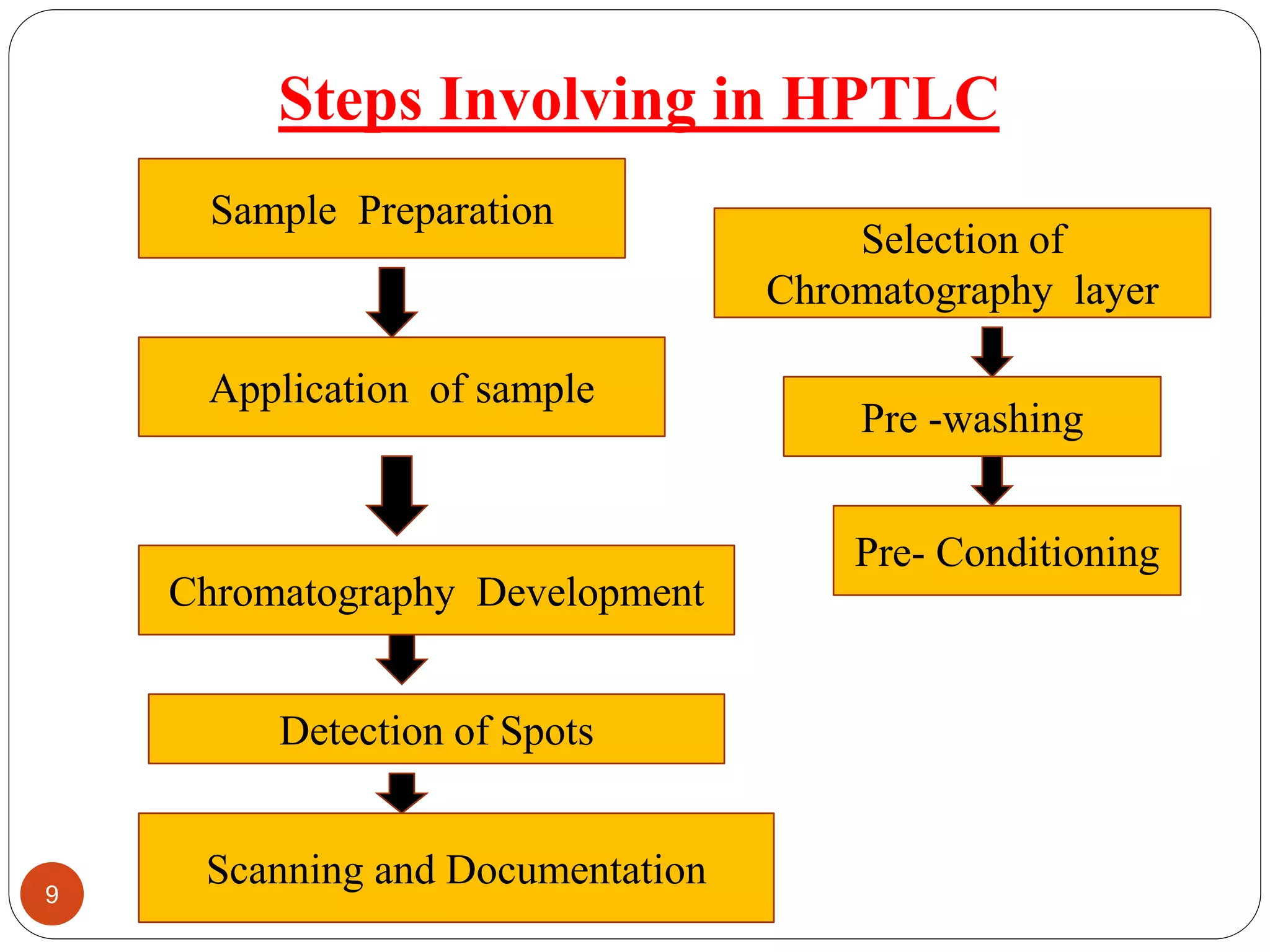
Steps Involving in HPTLC
Sample Preparation
Application of sample
Chromatography Development
Detection of Spots
Selection of
Chromatography layer
Pre -washing
Pre- Conditioning
Scanning and Documentation9
Selection Of Chromatography Plates
 Hand Made Plates
 Pre Coated Plates
 Hand Made Plates
 Cellulose
 Cellulose with binder starch
 Silica gel with starch
 Acetylated cellulose + CaSO4 ½ H2O
10
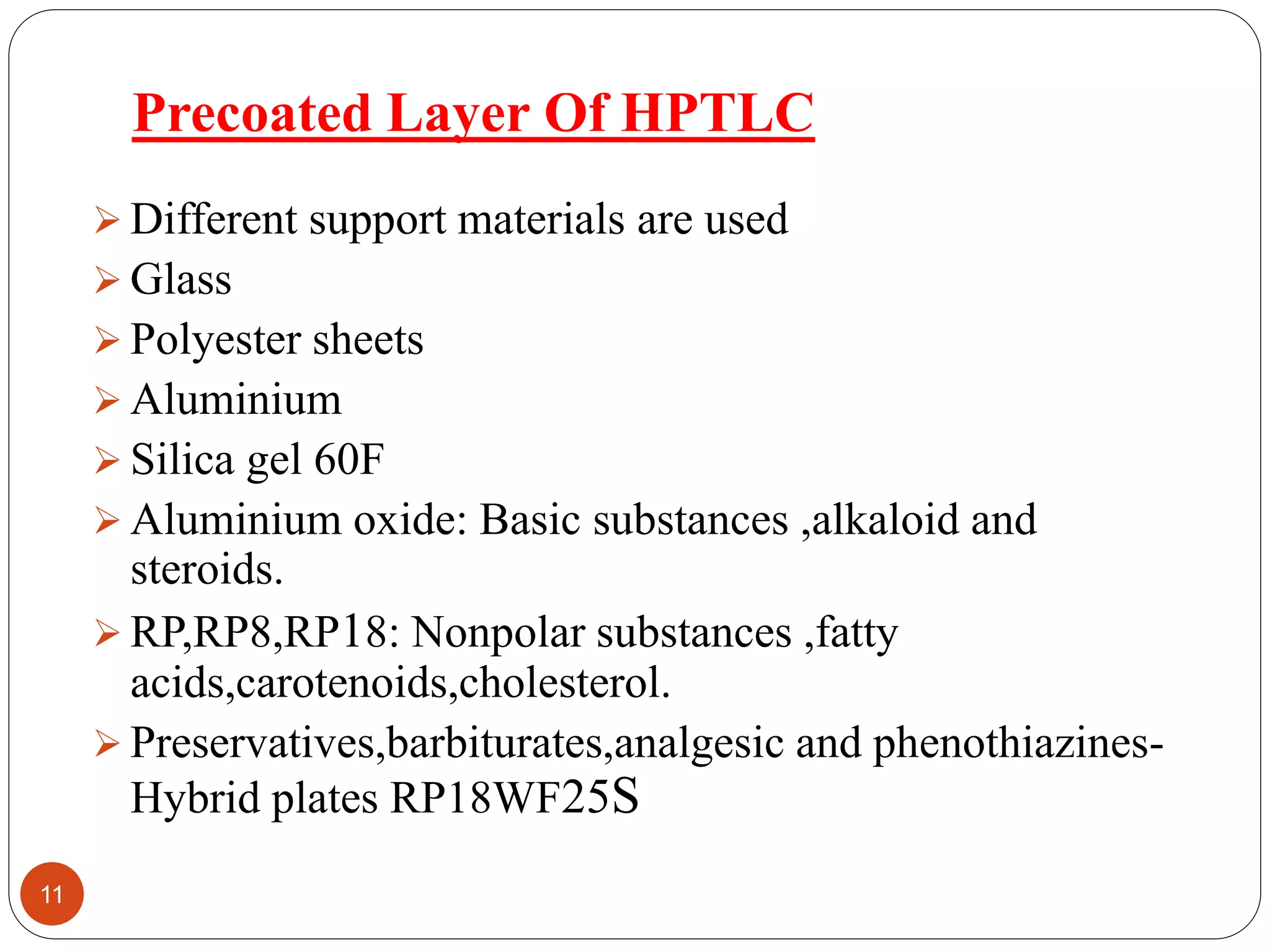
Precoated Layer Of HPTLC
 Different support materials are used
 Glass
 Polyester sheets
 Aluminium
 Silica gel 60F
 Aluminium oxide: Basic substances ,alkaloid and
steroids.
 RP,RP8,RP18: Nonpolar substances ,fatty
acids,carotenoids,cholesterol.
 Preservatives,barbiturates,analgesic and phenothiazines-
Hybrid plates RP18WF25S
11
Sample And Standard Preparation
Sample and standard should dissolved in the same
solvent to ensure comparable distribution at
stationary zones.
For normal phase chromatography solvent for
dissolving the sample should be non polar.
For reverse phase chromatography polar solvents
are used.
12
Pre Washing Of Pre Coated Plates
 To avoid any possible interference due to impurities it
is recommended to wash the plates is called pre washing.
Methods used for pre washing are : Dipping
Ascending
Continous
 Solvents used for washing are:
 Chloroform in methanol(1:1)
 Methylene chloride – methanol(1:1)
 1%ammonia or 1% acetic acid13
Activation Of Pre-coated Plates
 Freshly open box of plates do not require activation.
 Plates exposed to high humidity or kept on hand for long time
to be activated
 By placing in oven at 110-120ºc for 30 minutes prior to
spotting.
 Aluminium sheets should be kept in between two glass plates
and placing in oven at 110-115ºc for 15 minutes.
14
Application of standard and sample
15
Application Of Standard And Sample
Selection of sample application and devices used
depends on
 Sample volume
 Number of samples to be applied
Samples is applied by use of automatic devices and
graduated capillaries.
Volume recommended for HPTLC 0.5-5μl
Sample should not excess or not low
Over loading can be over come by applying sample as
band.
16
NANOMAT AND CAPILLARY DEVICES
 The Nanomat serves for easy application
of samples in the form of spots on
HPTLC plates.
 The Nanomat is suitable for HPTLC
plates 1Х10 cm and 20Х10 cm.
 capillaries of 0.5, 1.2 and 5μl volume
available.
17
Selection Of Mobile Phase
 Normal phase –
 Stationary phase is polar
 Mobile phase is non polar
 Non polar compounds eluted first because of lower
affinity with stationary phase .
 polar compound retained because of higher affinity
with the stationary phase
 Reversed phase
 Stationary phase is non polar
 Mobile phase is polar
 polar compound eluted first because of lower affinity
with stationary phase non polar compounds retained
because of higher affinity with the stationary phase.
18
 Pre Conditioning ( Chamber Saturation)
Un-saturated chamber causes high Rf values
Saturated chamber by lining with filter paper
for 30 minutes prior to development.
Lead to uniform distribution of solvent vapours
and low Rf value
19
Chromatographic Development And Drying
20
Chromatographic Development And
Drying
 After development remove the
plate and mobile phase is
removed from the plate –to avoid
contamination of lab atmosphere.
 Dry in vacuum desiccator
21
Chamber Development
 Twin trough and flat bottom chamber
 Horizontal development chamber
 HPTLC various system
 Automatic developing chamber(ADC2)
 Automated multiple development (AMD)
22
Twin Trough Chambers
23
Horizontal Developing
Chamber
It is developed from both opposing
sides towards the middle.
HPTLC Various System
Development with six different
solvents can be tested side by
side.
Six different conditions of pre-
equilibration , including relative
humidity , can be tested
simultaneously.
24
Automatic Developing
Chamber (ADC2)
The Automatic Developing Chamber
offers convenience , safety and
reproducibility for isocratic
development of TLC/HPTLC plates.
Automated Multiple
Development (AMD)
Employed for reproducible
gradient elution.
25
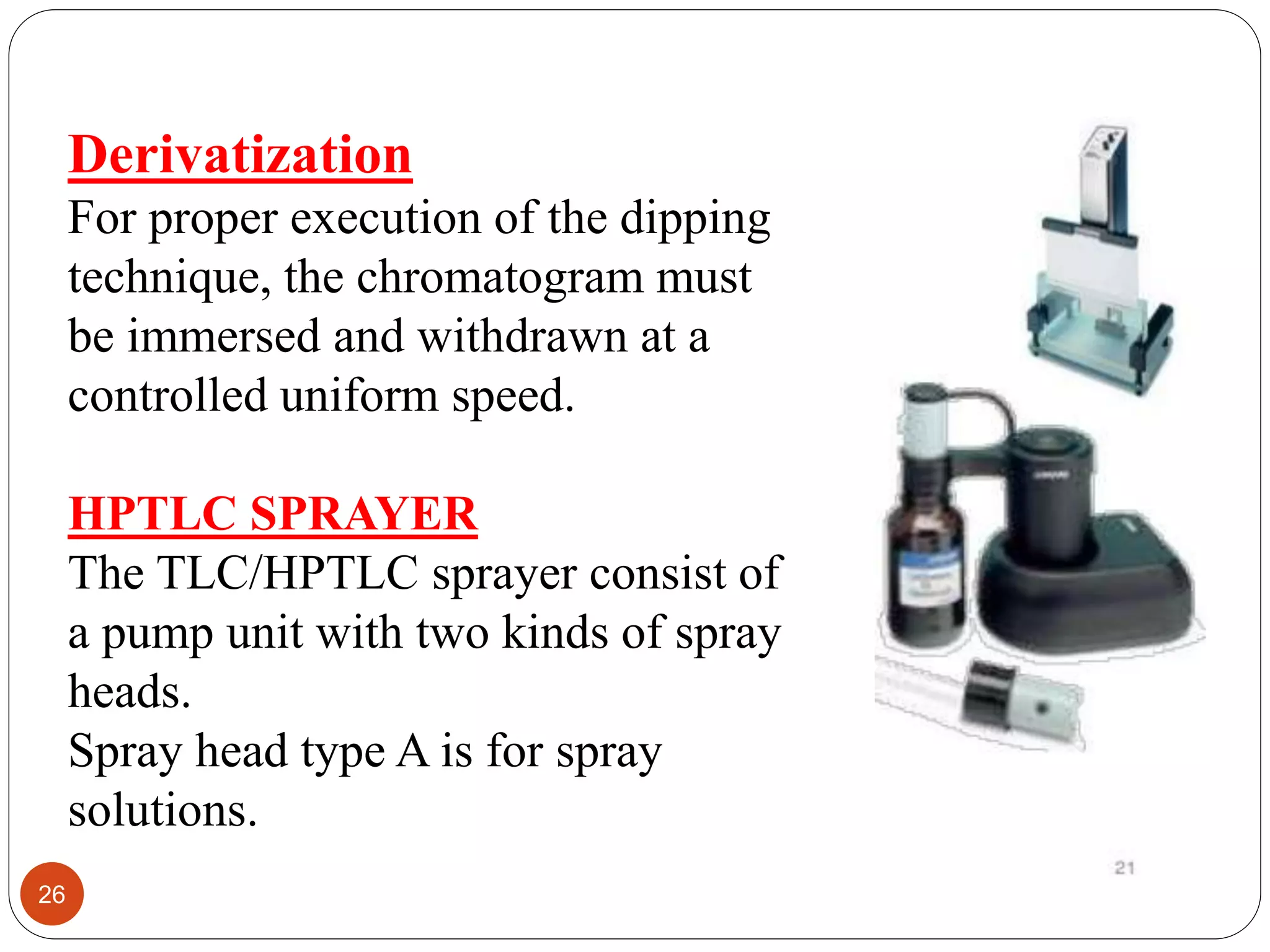
Derivatization
For proper execution of the dipping
technique, the chromatogram must
be immersed and withdrawn at a
controlled uniform speed.
HPTLC SPRAYER
The TLC/HPTLC sprayer consist of
a pump unit with two kinds of spray
heads.
Spray head type A is for spray
solutions.
26
Detection and visualization
 Detection under UV light is first
choice –non destructive spots of
fluorescent compounds can be
seen at 254nm(near UV range)
27
Quantification
 Sample and standard should be chromatographed on
sample plate after development chromatogram is scanned
 Camag TLC scanner III scan the chromatogram in
reflectance or in transmittance mode by absorbance or by
fluorescent mode.
 Scanning speed is selectable up to 100 mm/s –spectra
recording is fast -36 tracks with up to 100 peak windows
can be evaluated.
 Calibration of single and multiple levels with linear or
nonlinear regressions are possible. When target values
are to be verified such as stability testing and dissolution
profile single level calibration is suitable.
28
 TLC Scanner 3
 It can also be used for densitometer
measurements of other planar objects
such as electrophoresis gels.
 Key features
 Scanning speed 1-100mm/s
 Spectrum recording up to 100 mm/s.
29
Application of HPTLC
Pharmaceutical Industry : quality control, content
uniformity, identity/purity check.
Food Analysis: quality control, additives, pesticides,
stability testing.
Clinical Application :metabolism studies, drug
screening, stability testing etc.
Industrial Application: process development and
optimization, In-process check, validation etc.
Forensic : poisoning investigation.
Finger print analysis.
30
Reference:-
 Sethi PD HPTLC High performance thin layer
chromatography, First edition, CBS Publisher and
Distrributers.
 Reich, E.and Schhibli A.(2007)High performance liquid
chromatography for analysis of medicinal plant, Thieme.
 Sherma J.Review of HPTLC in Drug Analysis:1996-2009. J
AOAC Int.2010;93:754-64.
 Arup U, Ekman S , Lindblom L, Mattsson JE.High
performance Thin Layer
Chromatography(HPTLC),1993;25:61-71.
31
32

High Performance Thin Layer Chromatography(HPTLC)

  • 1.
    HIGH PERFORMANCE THINLAYER CHROMATOGRAPHY(HPTLC) Presented By : Swati .V. Sahani First Year M.Pharm(sem-1) Orential College Of Pharmacy Under the guidance of Mr Sayyed Mateen Sayyed Moin 1
  • 2.
    CONTENTS  Introduction.  Principleof HPTLC.  Difference between TLC & HPTLC.  Steps involved in HPTLC.  Materials used for HPTLC plates.  Mobile phase.  Sample application.  HPTLC plate development.  Application of HPTLC. 2
  • 3.
    INTRODUCTION  Chromatography isphysical method of separation in which the components to be separated are distributed between two phase, one of which is stationary phase while the other mobile phase moves in a definite direction  Types of Chromatographic Techniques 3
  • 4.
     HPTLC- sophisticatedform of thin layer chromatography it involves the same theoretical principle of thin layer chromatography .  Traditional thin layer chromatography & its modern instrumental quantitative analysis version HPTLC are very popular for many reason such as  Visual chromatogram.  Simplicity.  Multiple sample handling. 4
  • 5.
    Principle  Separation myresult due to adsorption or partition or by both phenomenon depending upon the nature of adsorbents used on plates and solvents system used for development.  The mobile phase flows through the plate because of capillary action. the components move according to their affinites toward the adsorbent .  The component with more affinity towards stationary phase travels slower. the component lesser affinity towards stationary phase travel faster 5
  • 6.
  • 7.
    Features of HPTLC Simultaneous processing of sample and standard –better analytical. precision and accuracy, less need of internal standard.  Low analysis time and less cost per analysis  Low maintenance cost.  Simple sample preparation.  Low mobile phase consumption per sample .  No interference for previous analysis –fresh stationary and mobile. phase for each analysis-no contamination.  Visual detection possible. 7
  • 8.
    Steps involved inHPTLC Selection of chromatographic plates (HPTLC plates) Selection of chromatographic layer Pre washing of plates Activation of HPTLC plates Layer pre-conditioning Application of sample and standard Chromatographic development Detection of spots scanning 8
  • 9.
    Steps Involving inHPTLC Sample Preparation Application of sample Chromatography Development Detection of Spots Selection of Chromatography layer Pre -washing Pre- Conditioning Scanning and Documentation9
  • 10.
    Selection Of ChromatographyPlates  Hand Made Plates  Pre Coated Plates  Hand Made Plates  Cellulose  Cellulose with binder starch  Silica gel with starch  Acetylated cellulose + CaSO4 ½ H2O 10
  • 11.
    Precoated Layer OfHPTLC  Different support materials are used  Glass  Polyester sheets  Aluminium  Silica gel 60F  Aluminium oxide: Basic substances ,alkaloid and steroids.  RP,RP8,RP18: Nonpolar substances ,fatty acids,carotenoids,cholesterol.  Preservatives,barbiturates,analgesic and phenothiazines- Hybrid plates RP18WF25S 11
  • 12.
    Sample And StandardPreparation Sample and standard should dissolved in the same solvent to ensure comparable distribution at stationary zones. For normal phase chromatography solvent for dissolving the sample should be non polar. For reverse phase chromatography polar solvents are used. 12
  • 13.
    Pre Washing OfPre Coated Plates  To avoid any possible interference due to impurities it is recommended to wash the plates is called pre washing. Methods used for pre washing are : Dipping Ascending Continous  Solvents used for washing are:  Chloroform in methanol(1:1)  Methylene chloride – methanol(1:1)  1%ammonia or 1% acetic acid13
  • 14.
    Activation Of Pre-coatedPlates  Freshly open box of plates do not require activation.  Plates exposed to high humidity or kept on hand for long time to be activated  By placing in oven at 110-120ºc for 30 minutes prior to spotting.  Aluminium sheets should be kept in between two glass plates and placing in oven at 110-115ºc for 15 minutes. 14
  • 15.
  • 16.
    Application Of StandardAnd Sample Selection of sample application and devices used depends on  Sample volume  Number of samples to be applied Samples is applied by use of automatic devices and graduated capillaries. Volume recommended for HPTLC 0.5-5μl Sample should not excess or not low Over loading can be over come by applying sample as band. 16
  • 17.
    NANOMAT AND CAPILLARYDEVICES  The Nanomat serves for easy application of samples in the form of spots on HPTLC plates.  The Nanomat is suitable for HPTLC plates 1Х10 cm and 20Х10 cm.  capillaries of 0.5, 1.2 and 5μl volume available. 17
  • 18.
    Selection Of MobilePhase  Normal phase –  Stationary phase is polar  Mobile phase is non polar  Non polar compounds eluted first because of lower affinity with stationary phase .  polar compound retained because of higher affinity with the stationary phase  Reversed phase  Stationary phase is non polar  Mobile phase is polar  polar compound eluted first because of lower affinity with stationary phase non polar compounds retained because of higher affinity with the stationary phase. 18
  • 19.
     Pre Conditioning( Chamber Saturation) Un-saturated chamber causes high Rf values Saturated chamber by lining with filter paper for 30 minutes prior to development. Lead to uniform distribution of solvent vapours and low Rf value 19
  • 20.
  • 21.
    Chromatographic Development And Drying After development remove the plate and mobile phase is removed from the plate –to avoid contamination of lab atmosphere.  Dry in vacuum desiccator 21
  • 22.
    Chamber Development  Twintrough and flat bottom chamber  Horizontal development chamber  HPTLC various system  Automatic developing chamber(ADC2)  Automated multiple development (AMD) 22
  • 23.
  • 24.
    Horizontal Developing Chamber It isdeveloped from both opposing sides towards the middle. HPTLC Various System Development with six different solvents can be tested side by side. Six different conditions of pre- equilibration , including relative humidity , can be tested simultaneously. 24
  • 25.
    Automatic Developing Chamber (ADC2) TheAutomatic Developing Chamber offers convenience , safety and reproducibility for isocratic development of TLC/HPTLC plates. Automated Multiple Development (AMD) Employed for reproducible gradient elution. 25
  • 26.
    Derivatization For proper executionof the dipping technique, the chromatogram must be immersed and withdrawn at a controlled uniform speed. HPTLC SPRAYER The TLC/HPTLC sprayer consist of a pump unit with two kinds of spray heads. Spray head type A is for spray solutions. 26
  • 27.
    Detection and visualization Detection under UV light is first choice –non destructive spots of fluorescent compounds can be seen at 254nm(near UV range) 27
  • 28.
    Quantification  Sample andstandard should be chromatographed on sample plate after development chromatogram is scanned  Camag TLC scanner III scan the chromatogram in reflectance or in transmittance mode by absorbance or by fluorescent mode.  Scanning speed is selectable up to 100 mm/s –spectra recording is fast -36 tracks with up to 100 peak windows can be evaluated.  Calibration of single and multiple levels with linear or nonlinear regressions are possible. When target values are to be verified such as stability testing and dissolution profile single level calibration is suitable. 28
  • 29.
     TLC Scanner3  It can also be used for densitometer measurements of other planar objects such as electrophoresis gels.  Key features  Scanning speed 1-100mm/s  Spectrum recording up to 100 mm/s. 29
  • 30.
    Application of HPTLC PharmaceuticalIndustry : quality control, content uniformity, identity/purity check. Food Analysis: quality control, additives, pesticides, stability testing. Clinical Application :metabolism studies, drug screening, stability testing etc. Industrial Application: process development and optimization, In-process check, validation etc. Forensic : poisoning investigation. Finger print analysis. 30
  • 31.
    Reference:-  Sethi PDHPTLC High performance thin layer chromatography, First edition, CBS Publisher and Distrributers.  Reich, E.and Schhibli A.(2007)High performance liquid chromatography for analysis of medicinal plant, Thieme.  Sherma J.Review of HPTLC in Drug Analysis:1996-2009. J AOAC Int.2010;93:754-64.  Arup U, Ekman S , Lindblom L, Mattsson JE.High performance Thin Layer Chromatography(HPTLC),1993;25:61-71. 31
  • 32.