Chapter 10
©2010, Prentice Hall
Organic Chemistry, 7th
Edition
L. G. Wade, Jr.
Structure and Synthesis
of Alcohols
Chapter 10 2
Structure of Water and Methanol
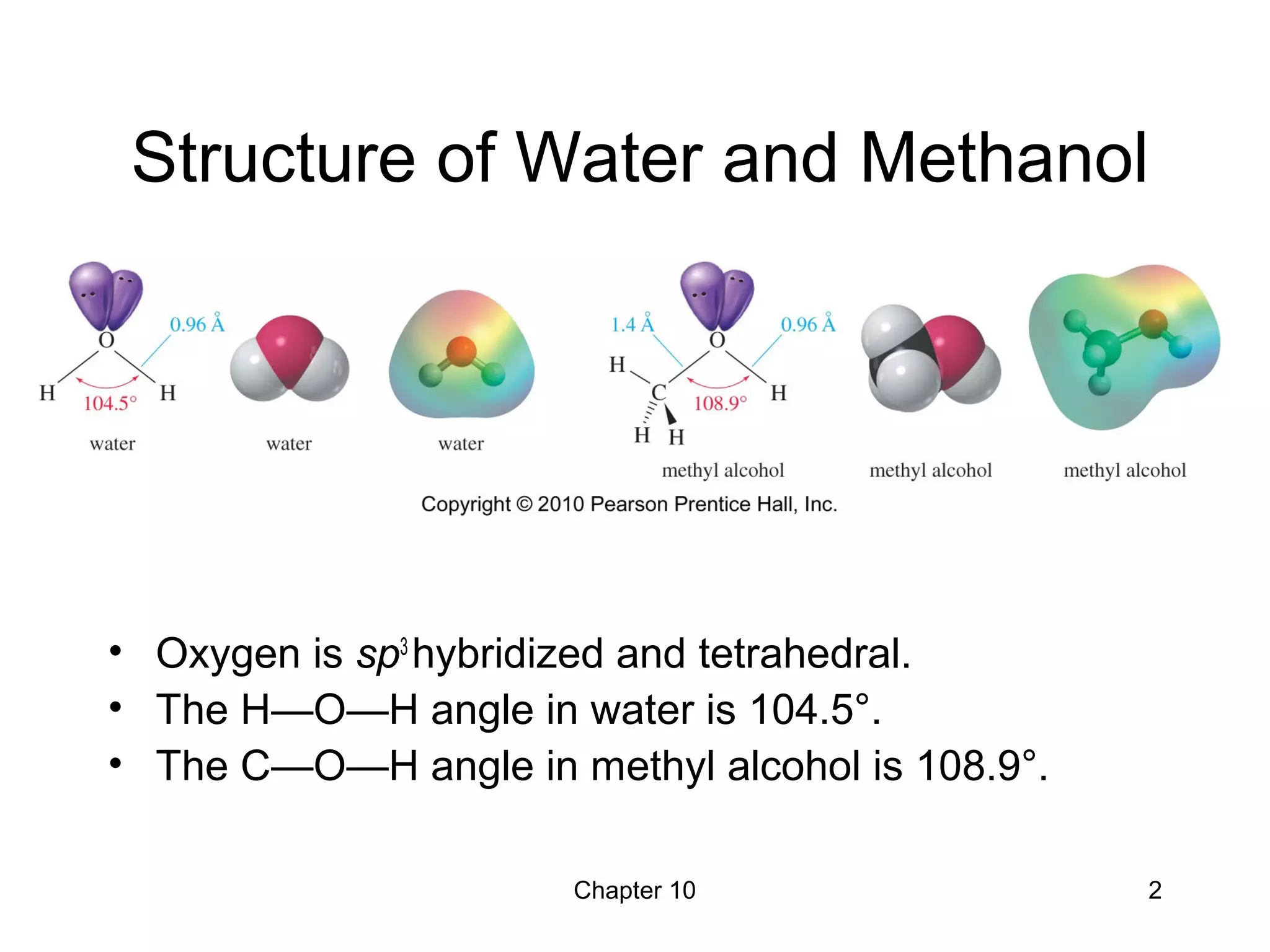
• Oxygen is sp3
hybridized and tetrahedral.
• The H—O—H angle in water is 104.5°.
• The C—O—H angle in methyl alcohol is 108.9°.
Chapter 10 3
Classification of Alcohols
• Primary: carbon with —OH is bonded to
one other carbon.
• Secondary: carbon with —OH is bonded
to two other carbons.
• Tertiary: carbon with —OH is bonded to
three other carbons.
• Aromatic (phenol): —OH is bonded to a
benzene ring.
Chapter 10 4
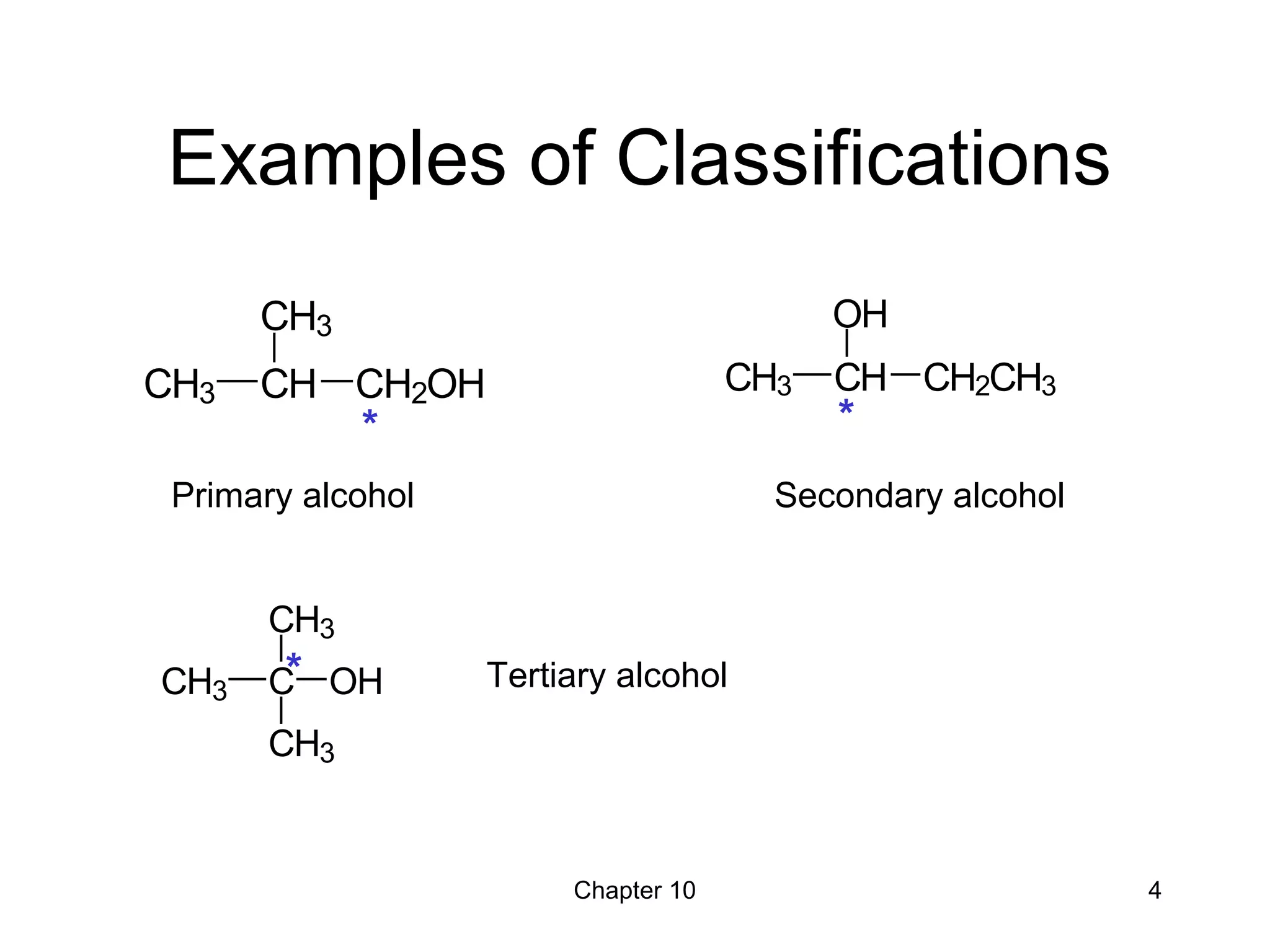
Examples of Classifications
CH3 C
CH3
CH3
OH*
CH3 CH
OH
CH2CH3
*
CH3 CH
CH3
CH2OH
*
Primary alcohol Secondary alcohol
Tertiary alcohol
Chapter 10 5
IUPAC Nomenclature
• Find the longest carbon chain containing the
carbon with the —OH group.
• Drop the -e from the alkane name, add -ol.
• Number the chain giving the —OH group the
lowest number possible.
• Number and name all substituents and write
them in alphabetical order.
Chapter 10 6
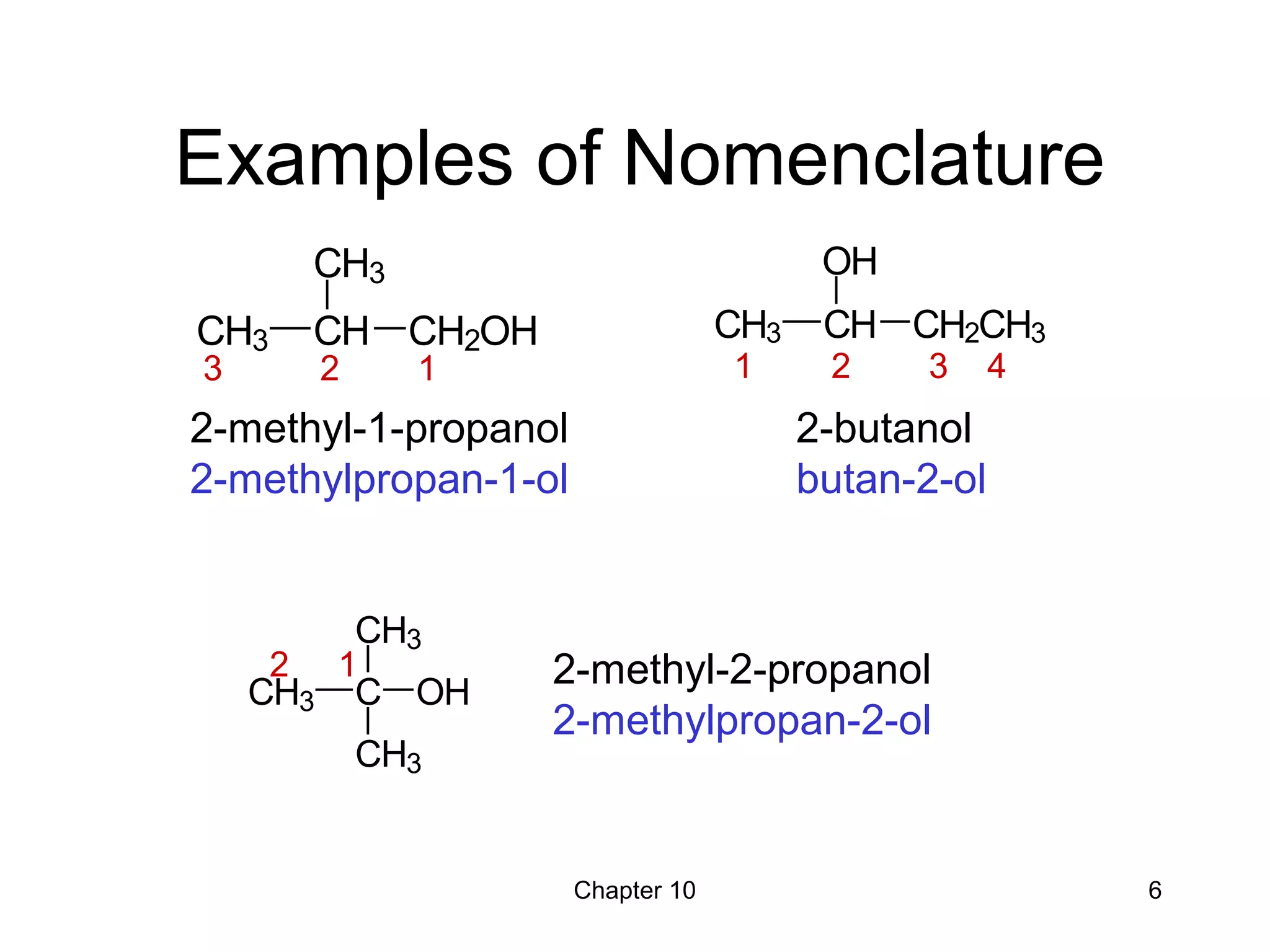
Examples of Nomenclature
2-methyl-1-propanol
2-methylpropan-1-ol
2-methyl-2-propanol
2-methylpropan-2-ol
2-butanol
butan-2-ol
CH3 C
CH3
CH3
OH
CH3 CH
CH3
CH2OH CH3 CH
OH
CH2CH3
3 2 1 1 2 3 4
2 1
Chapter 10 7
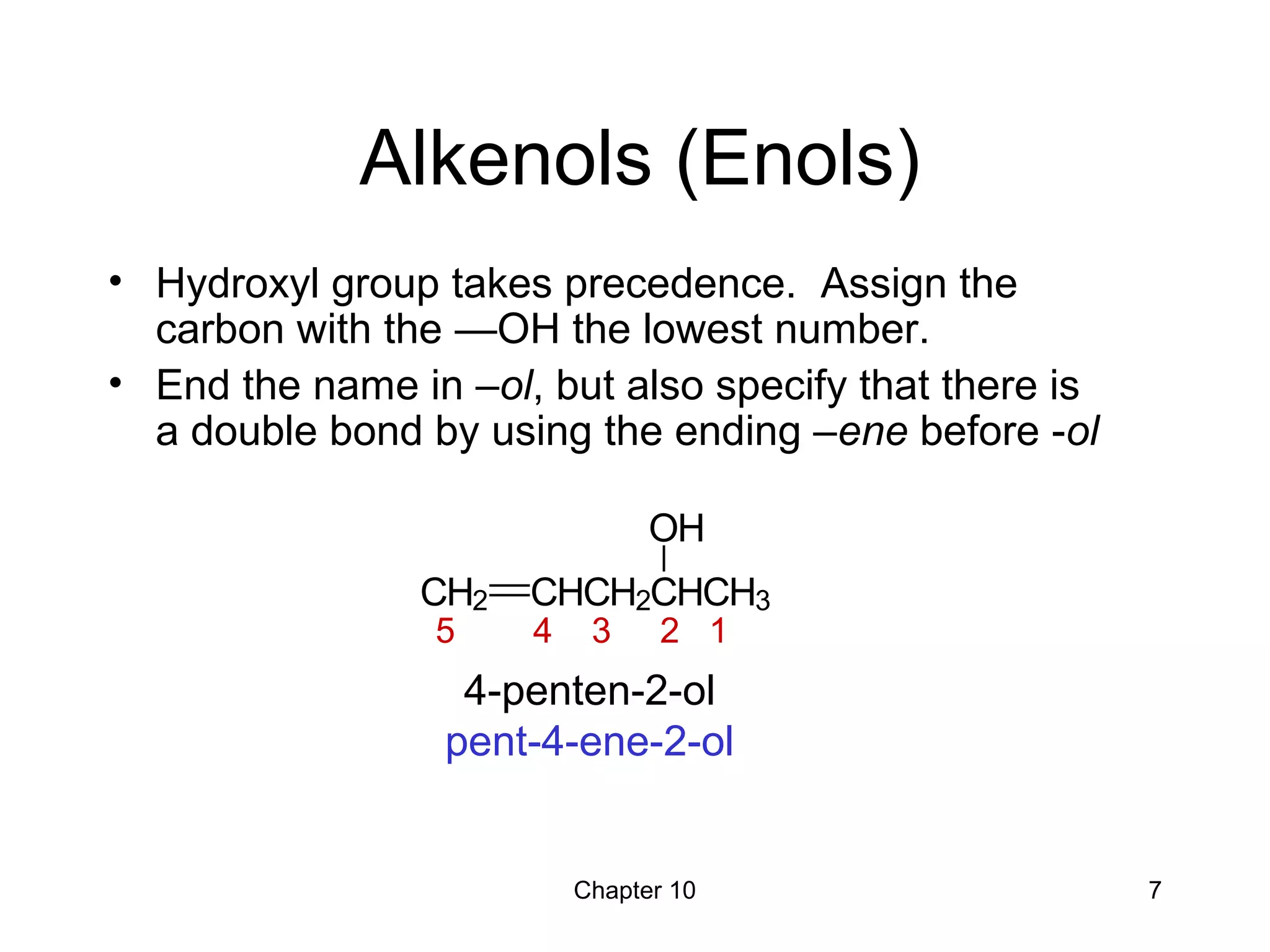
Alkenols (Enols)
• Hydroxyl group takes precedence. Assign the
carbon with the —OH the lowest number.
• End the name in –ol, but also specify that there is
a double bond by using the ending –ene before -ol
4-penten-2-ol
pent-4-ene-2-ol
CH2 CHCH2CHCH3
OH
5 4 3 2 1
Chapter 10 8
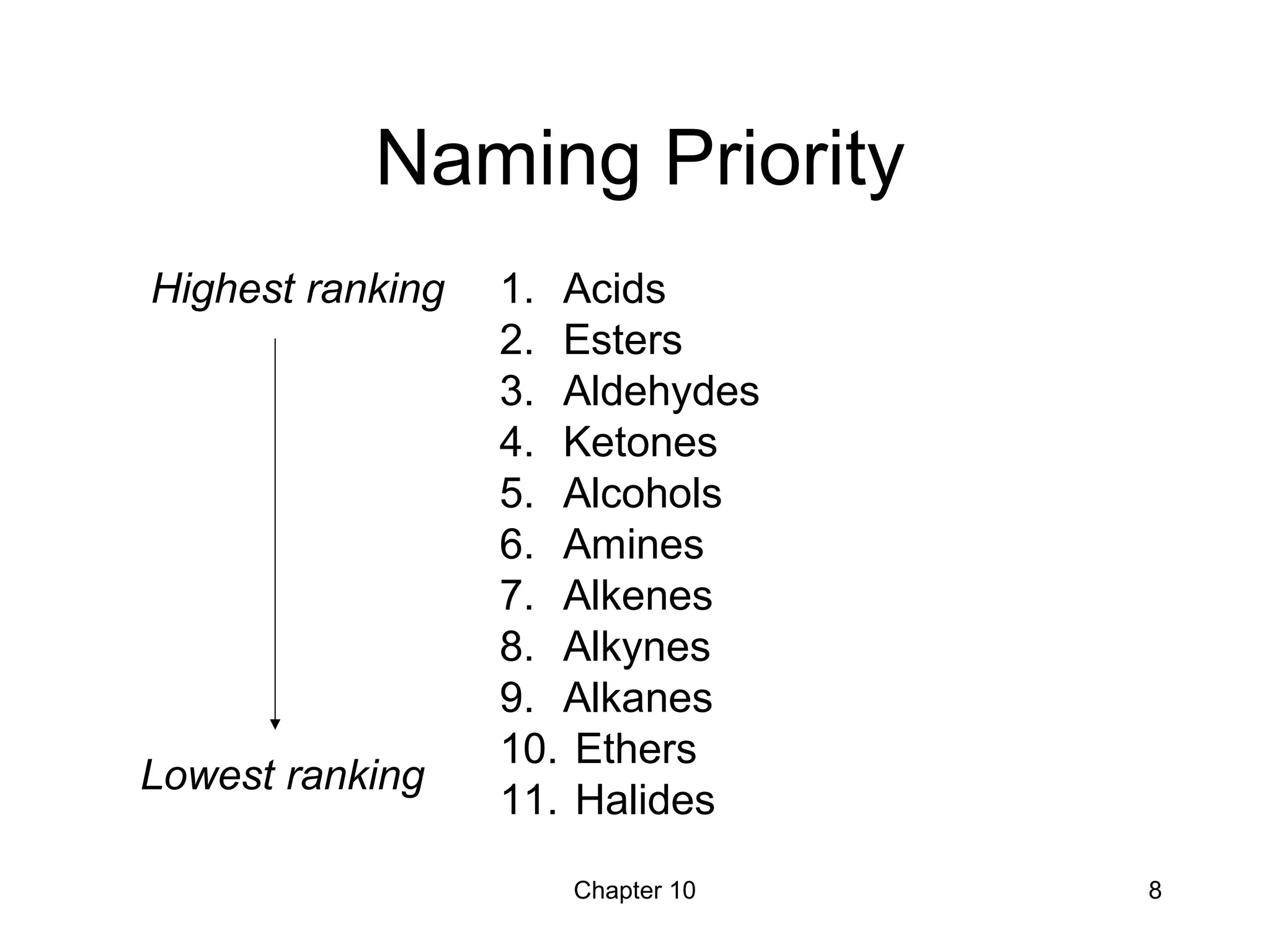
Naming Priority
1. Acids
2. Esters
3. Aldehydes
4. Ketones
5. Alcohols
6. Amines
7. Alkenes
8. Alkynes
9. Alkanes
10. Ethers
11. Halides
Highest ranking
Lowest ranking
Chapter 10 9
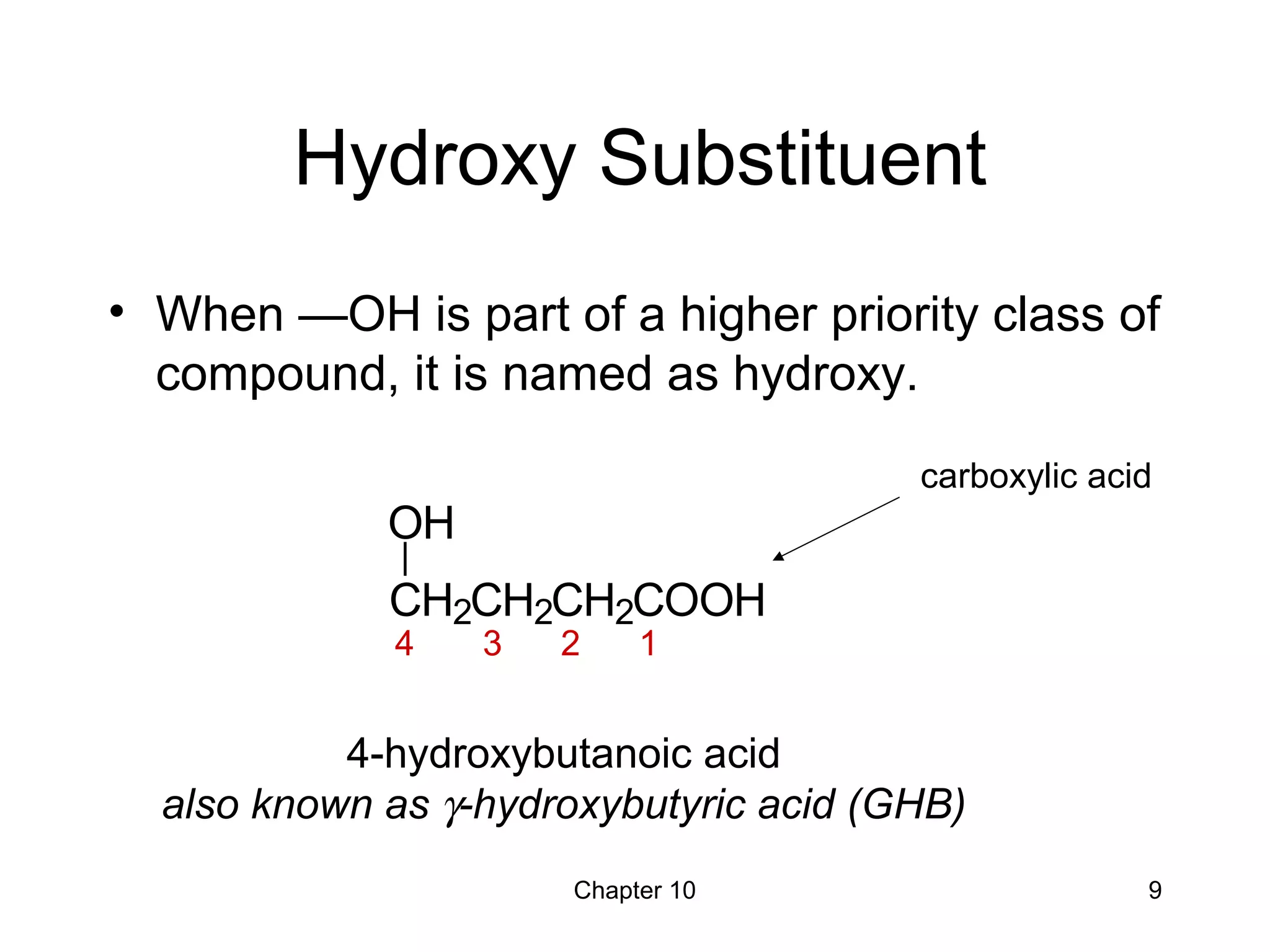
Hydroxy Substituent
• When —OH is part of a higher priority class of
compound, it is named as hydroxy.
4-hydroxybutanoic acid
also known as γ-hydroxybutyric acid (GHB)
CH2CH2CH2COOH
OH
carboxylic acid
4 3 2 1
Chapter 10 10
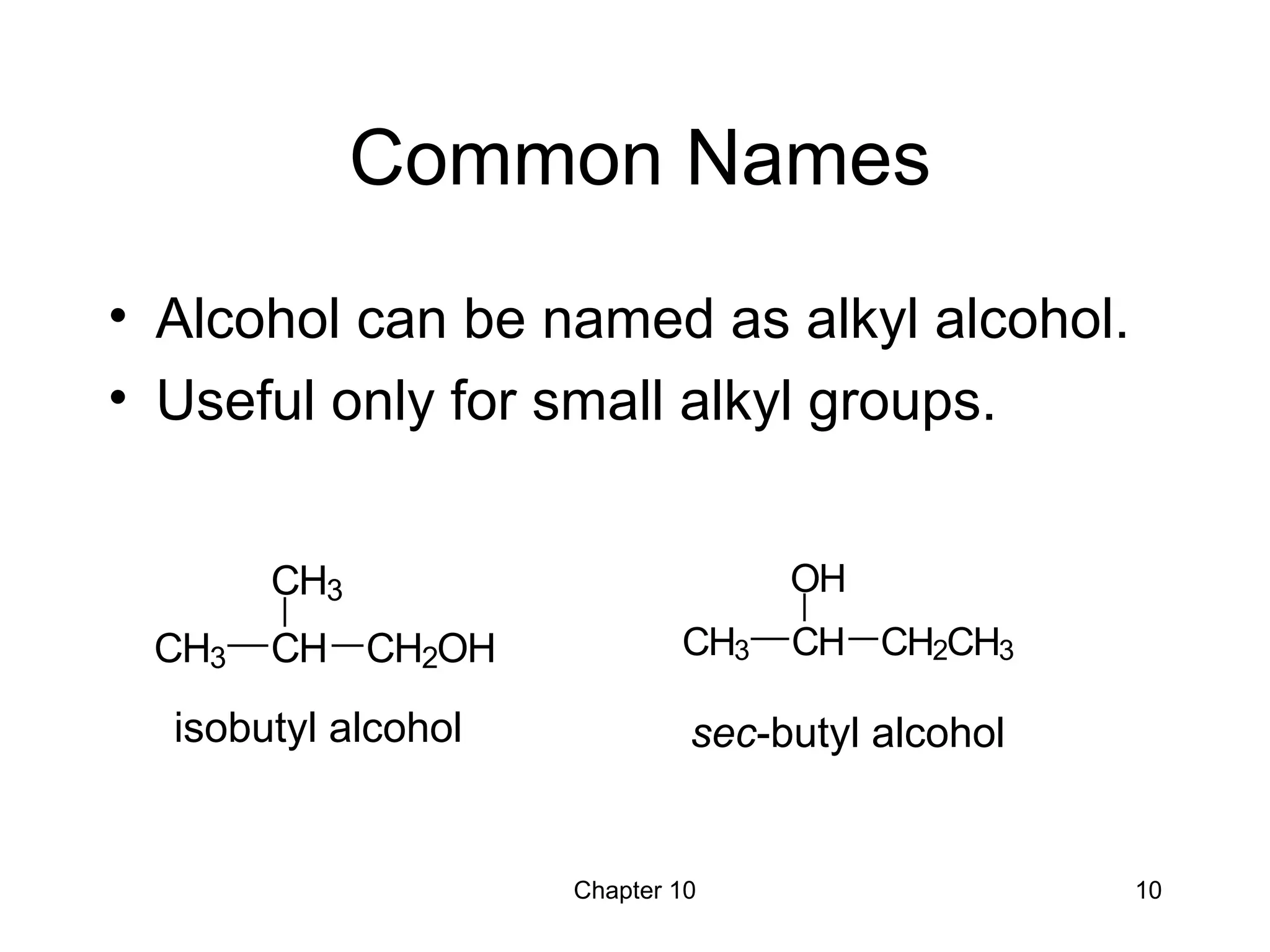
Common Names
• Alcohol can be named as alkyl alcohol.
• Useful only for small alkyl groups.
isobutyl alcohol sec-butyl alcohol
CH3 CH
CH3
CH2OH CH3 CH
OH
CH2CH3
Chapter 10 11
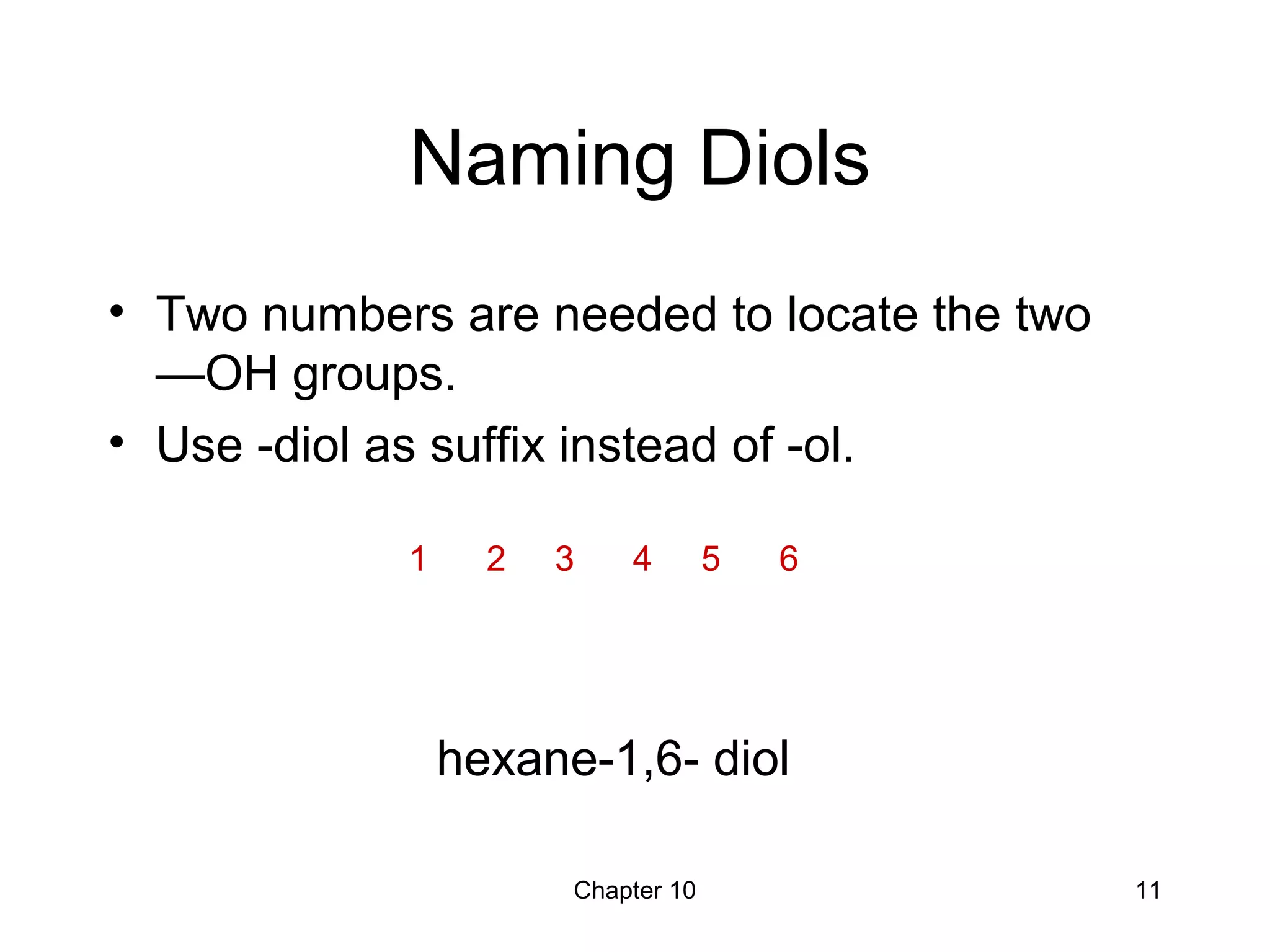
Naming Diols
• Two numbers are needed to locate the two
—OH groups.
• Use -diol as suffix instead of -ol.
hexane-1,6- diol
1 2 3 4 5 6
Chapter 10 12
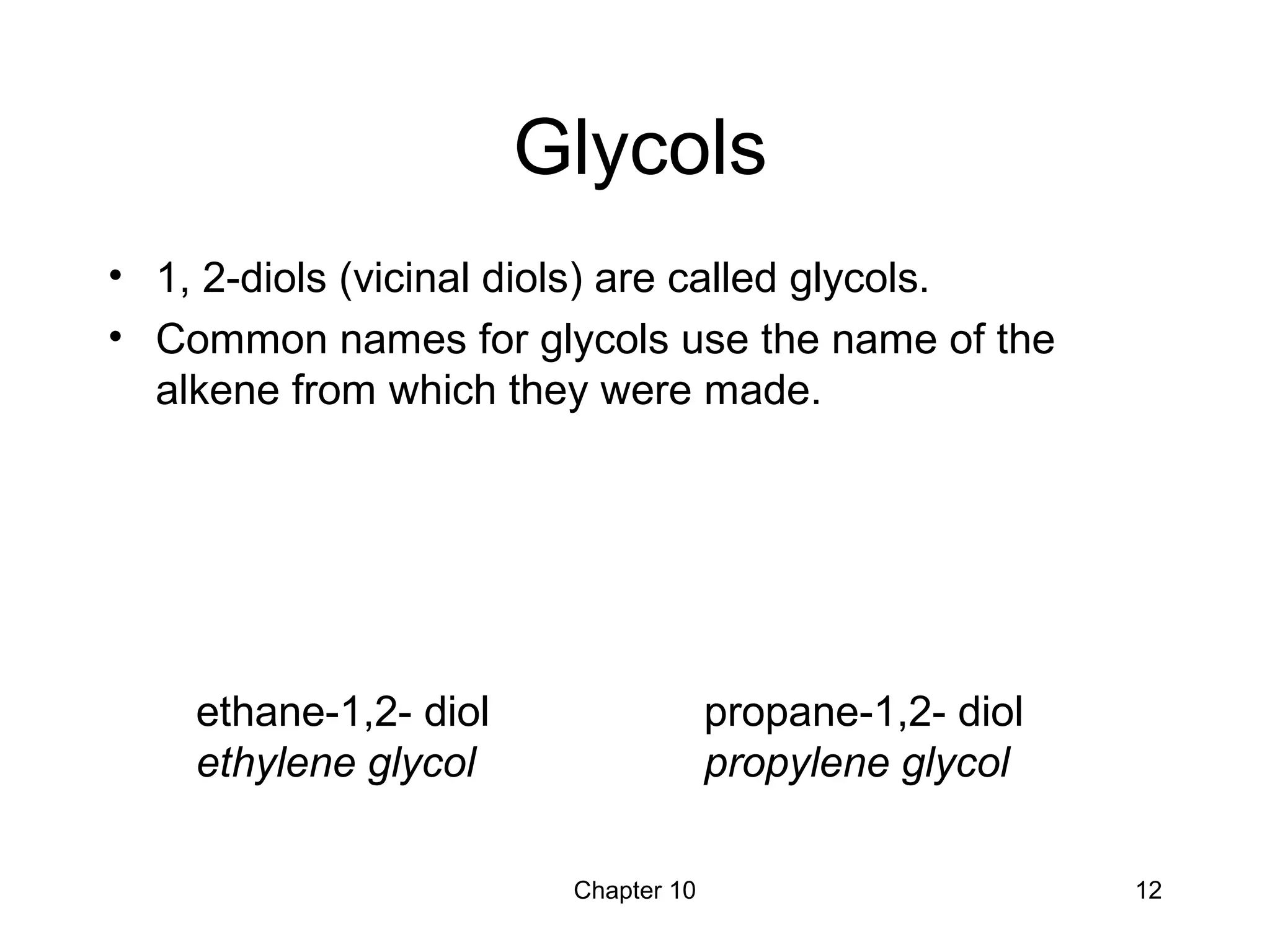
Glycols
• 1, 2-diols (vicinal diols) are called glycols.
• Common names for glycols use the name of the
alkene from which they were made.
ethane-1,2- diol
ethylene glycol
propane-1,2- diol
propylene glycol
Chapter 10 13
Phenol Nomenclature
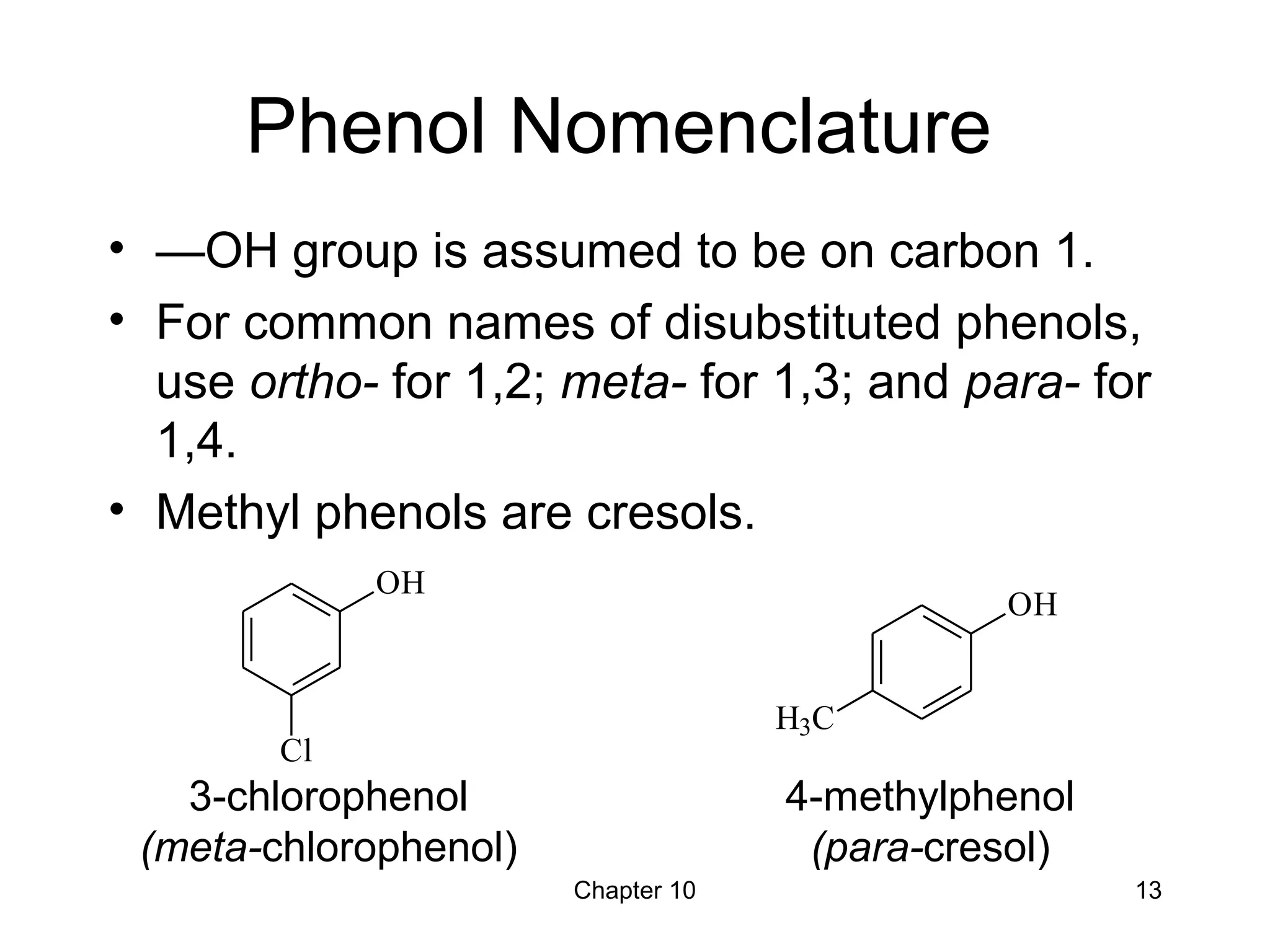
• —OH group is assumed to be on carbon 1.
• For common names of disubstituted phenols,
use ortho- for 1,2; meta- for 1,3; and para- for
1,4.
• Methyl phenols are cresols.
3-chlorophenol
(meta-chlorophenol)
4-methylphenol
(para-cresol)
OH
Cl
OH
H3C
Chapter 10 14
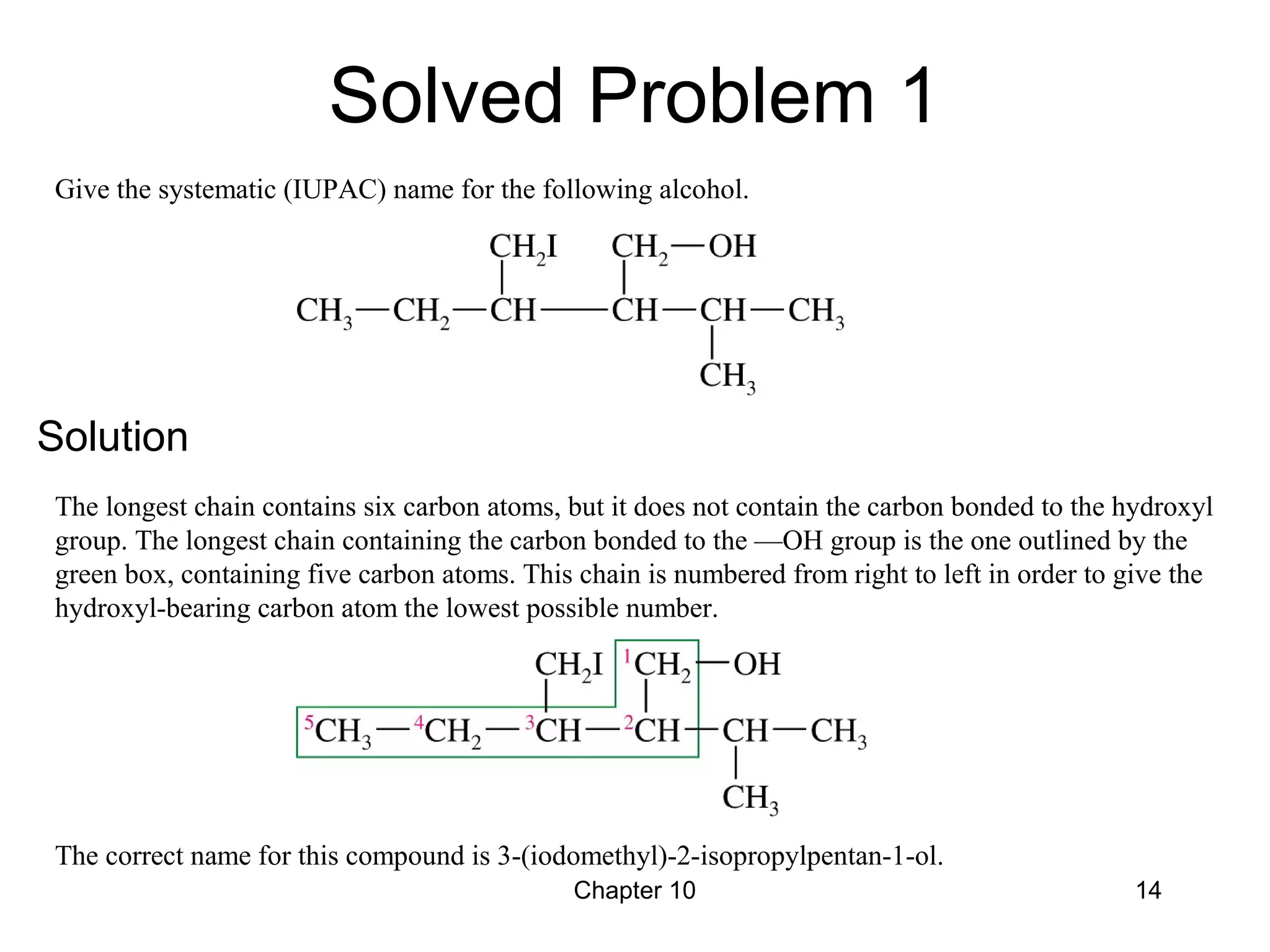
Give the systematic (IUPAC) name for the following alcohol.
The longest chain contains six carbon atoms, but it does not contain the carbon bonded to the hydroxyl
group. The longest chain containing the carbon bonded to the —OH group is the one outlined by the
green box, containing five carbon atoms. This chain is numbered from right to left in order to give the
hydroxyl-bearing carbon atom the lowest possible number.
The correct name for this compound is 3-(iodomethyl)-2-isopropylpentan-1-ol.
Solved Problem 1
Solution
Chapter 10 15
Physical Properties
• Alcohols have high boiling points due to
hydrogen bonding between molecules.
• Small alcohols are miscible in water, but
solubility decreases as the size of the
alkyl group increases.
Chapter 10 16
Boiling Points of alcohols
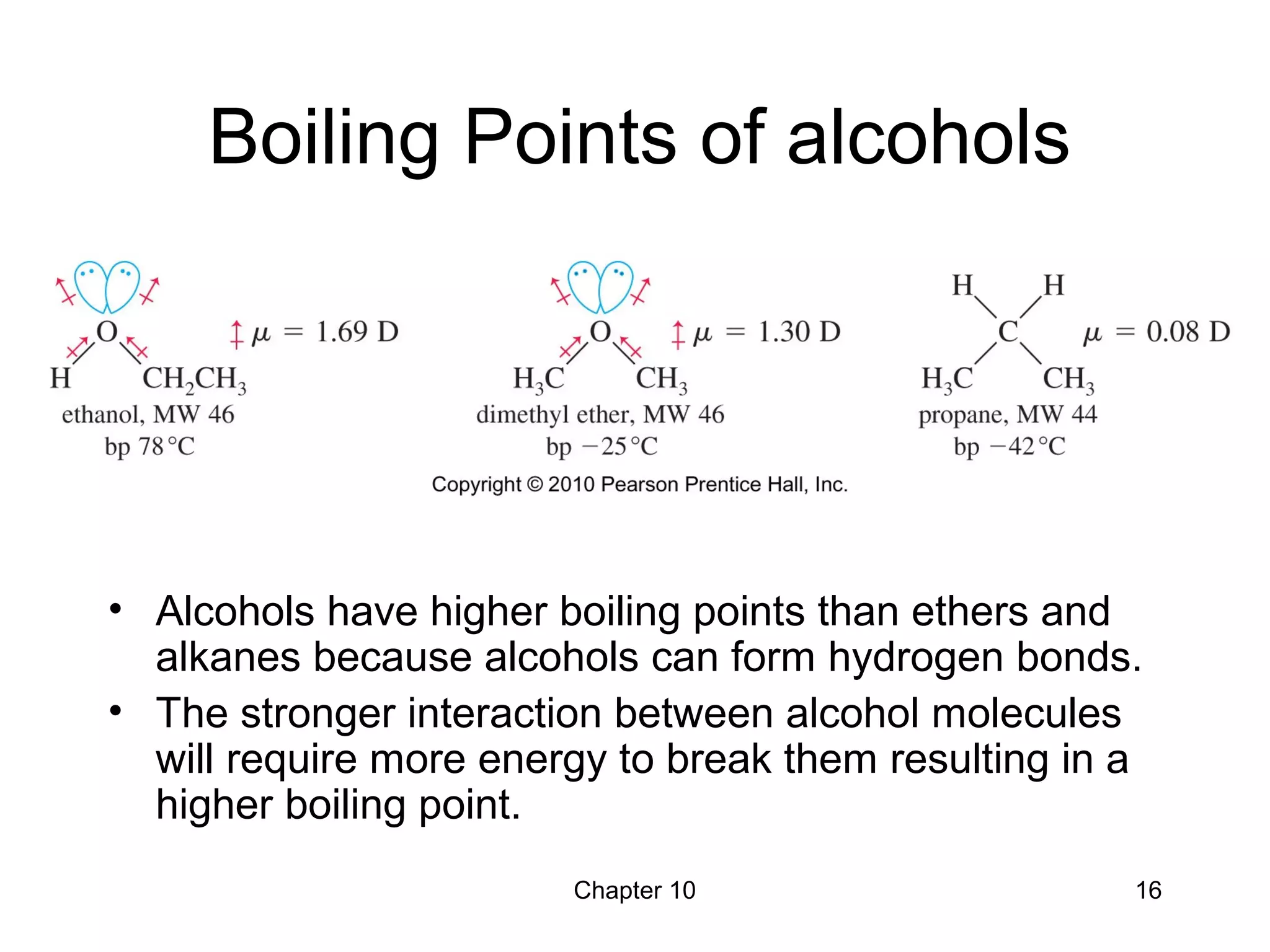
• Alcohols have higher boiling points than ethers and
alkanes because alcohols can form hydrogen bonds.
• The stronger interaction between alcohol molecules
will require more energy to break them resulting in a
higher boiling point.
Chapter 10 17
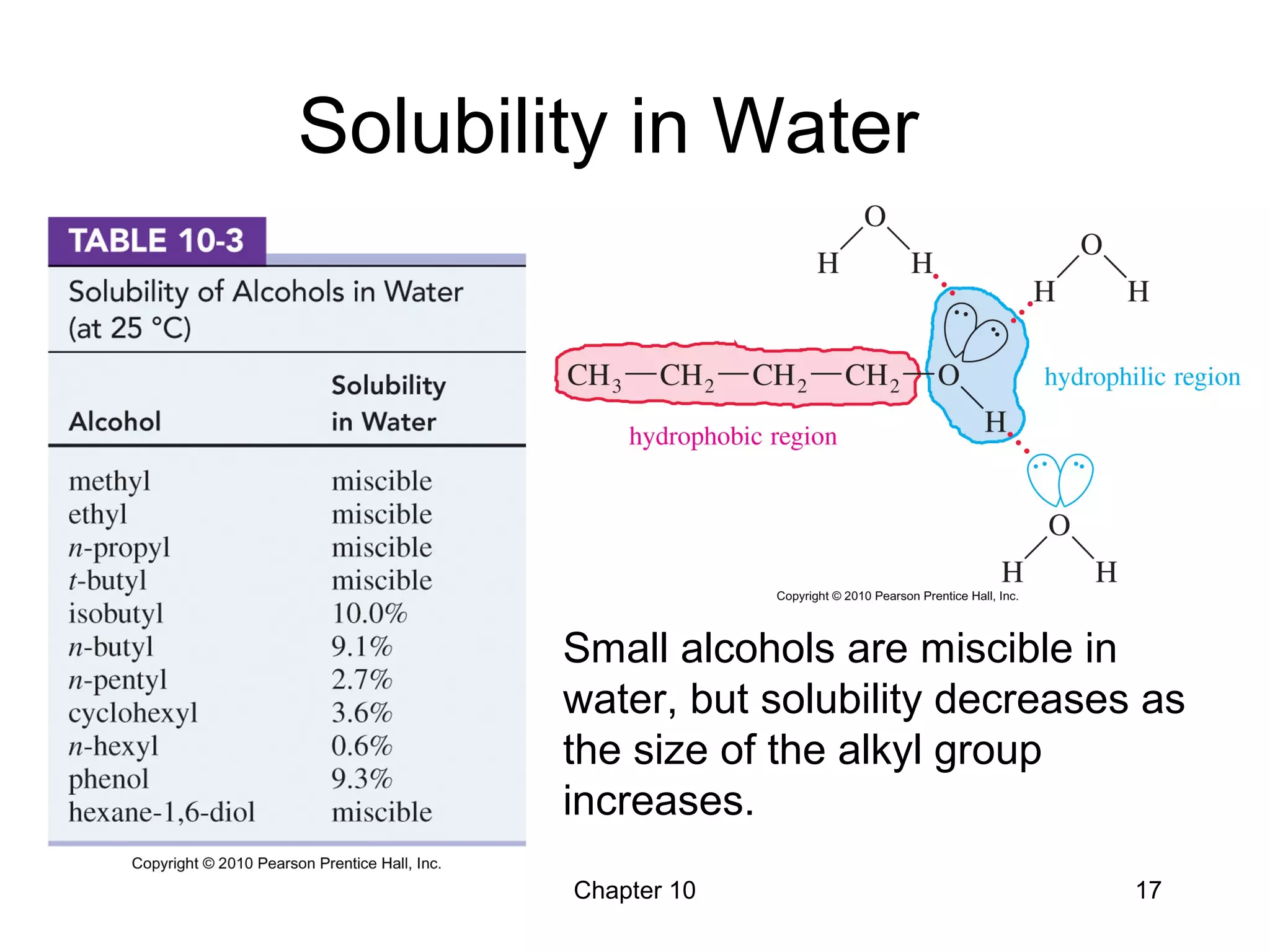
Solubility in Water
Small alcohols are miscible in
water, but solubility decreases as
the size of the alkyl group
increases.
Chapter 10 18
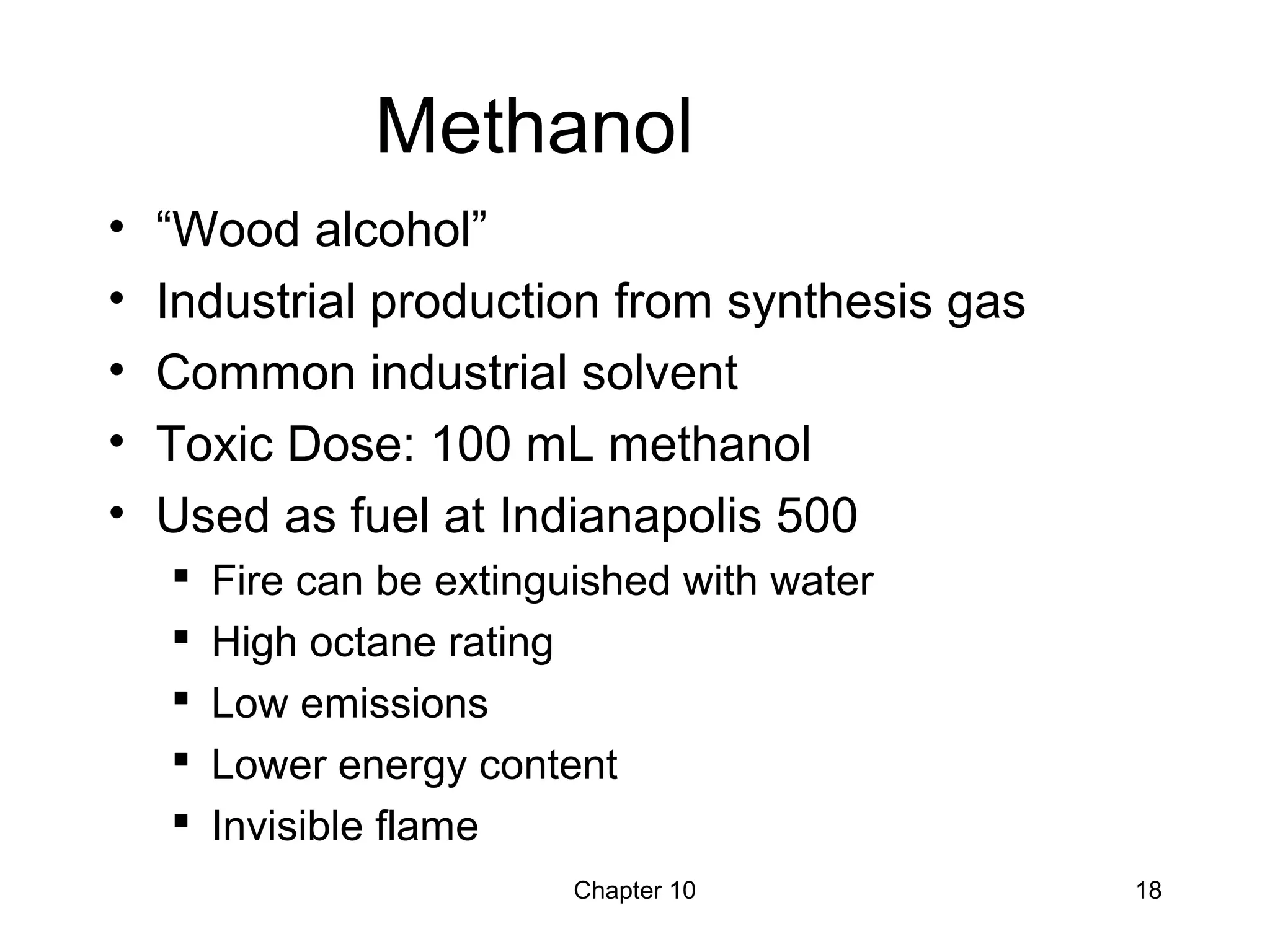
Methanol
• “Wood alcohol”
• Industrial production from synthesis gas
• Common industrial solvent
• Toxic Dose: 100 mL methanol
• Used as fuel at Indianapolis 500
 Fire can be extinguished with water
 High octane rating
 Low emissions
 Lower energy content
 Invisible flame
Chapter 10 19
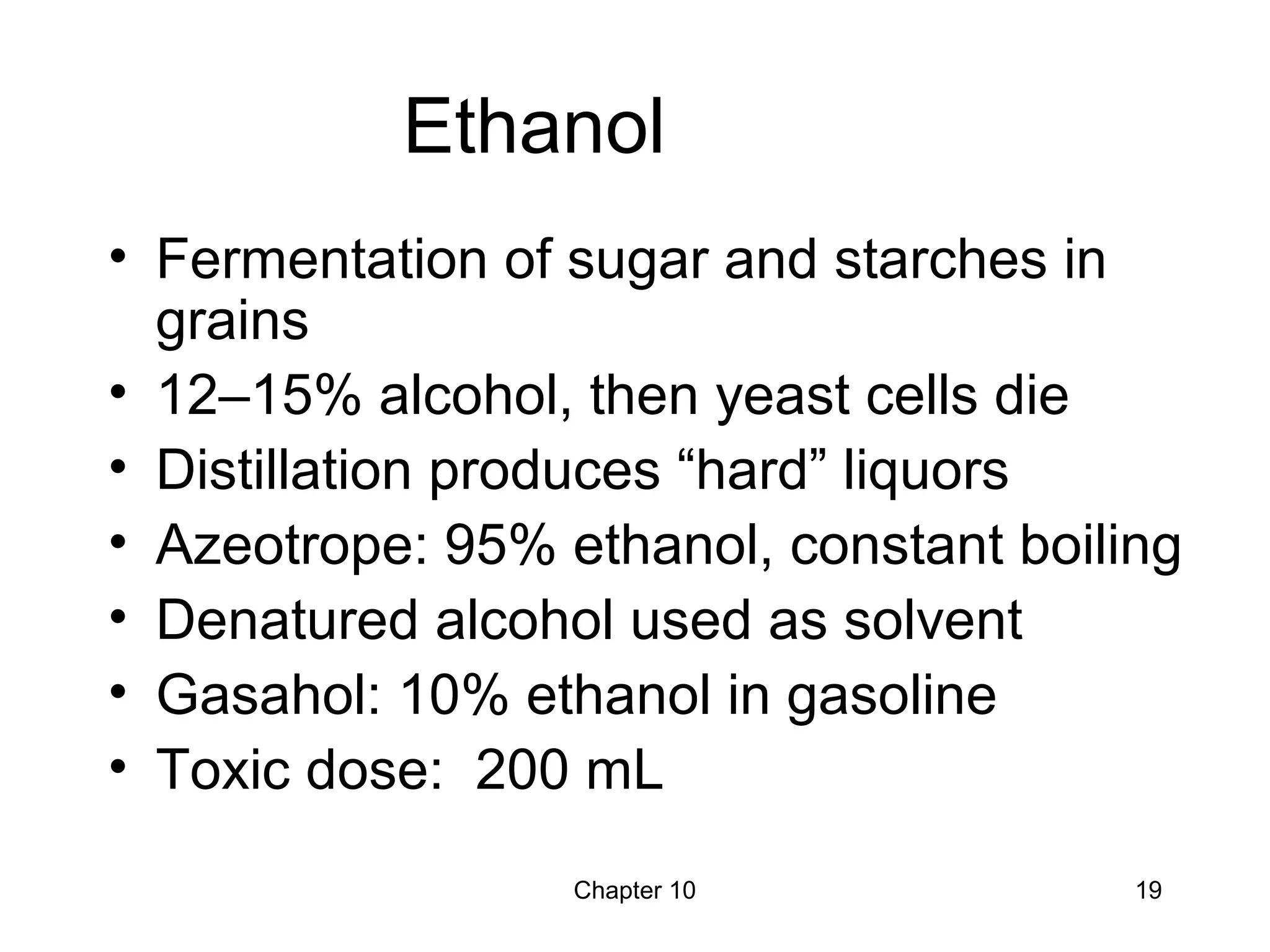
Ethanol
• Fermentation of sugar and starches in
grains
• 12–15% alcohol, then yeast cells die
• Distillation produces “hard” liquors
• Azeotrope: 95% ethanol, constant boiling
• Denatured alcohol used as solvent
• Gasahol: 10% ethanol in gasoline
• Toxic dose: 200 mL
Chapter 10 20
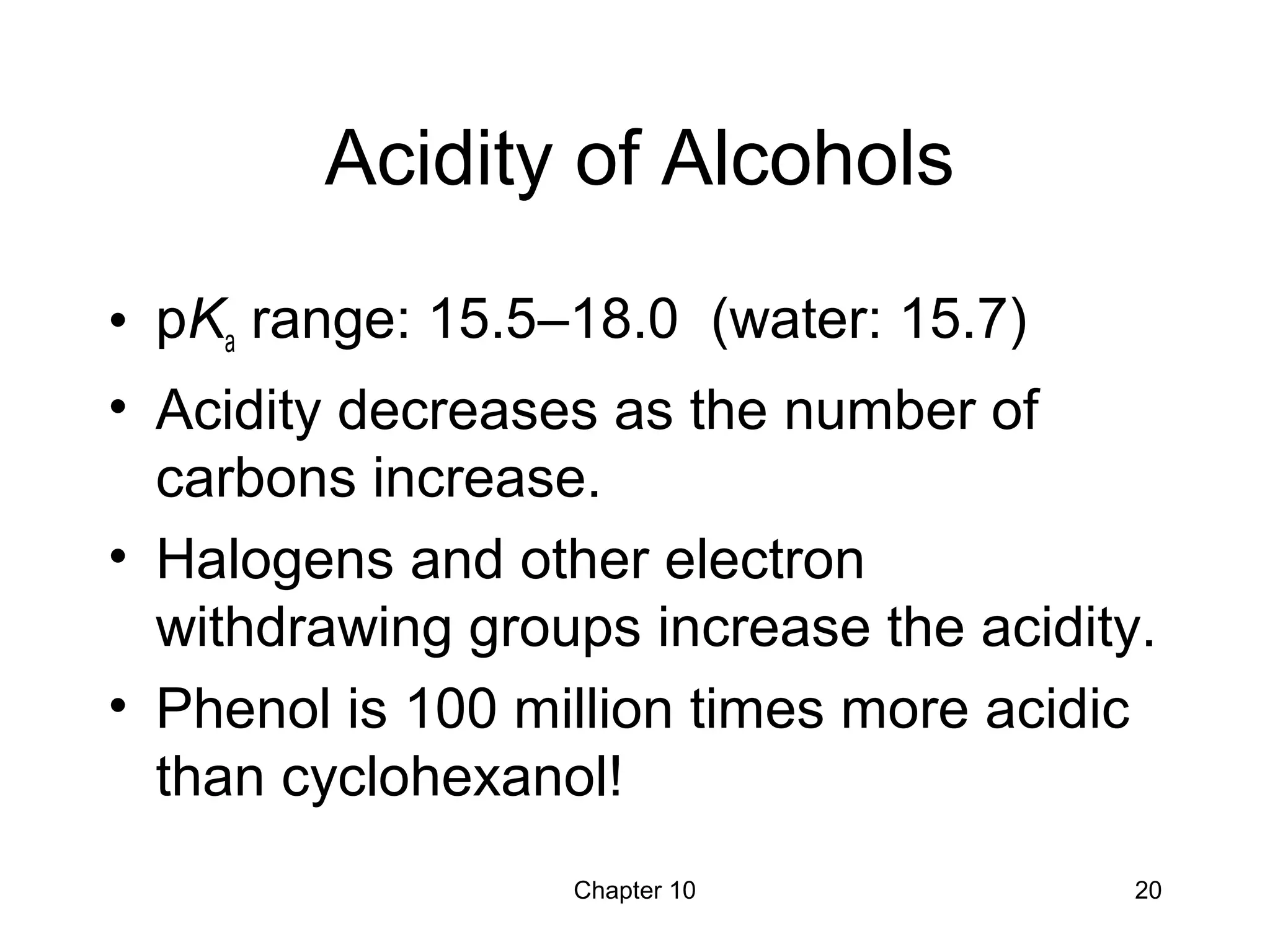
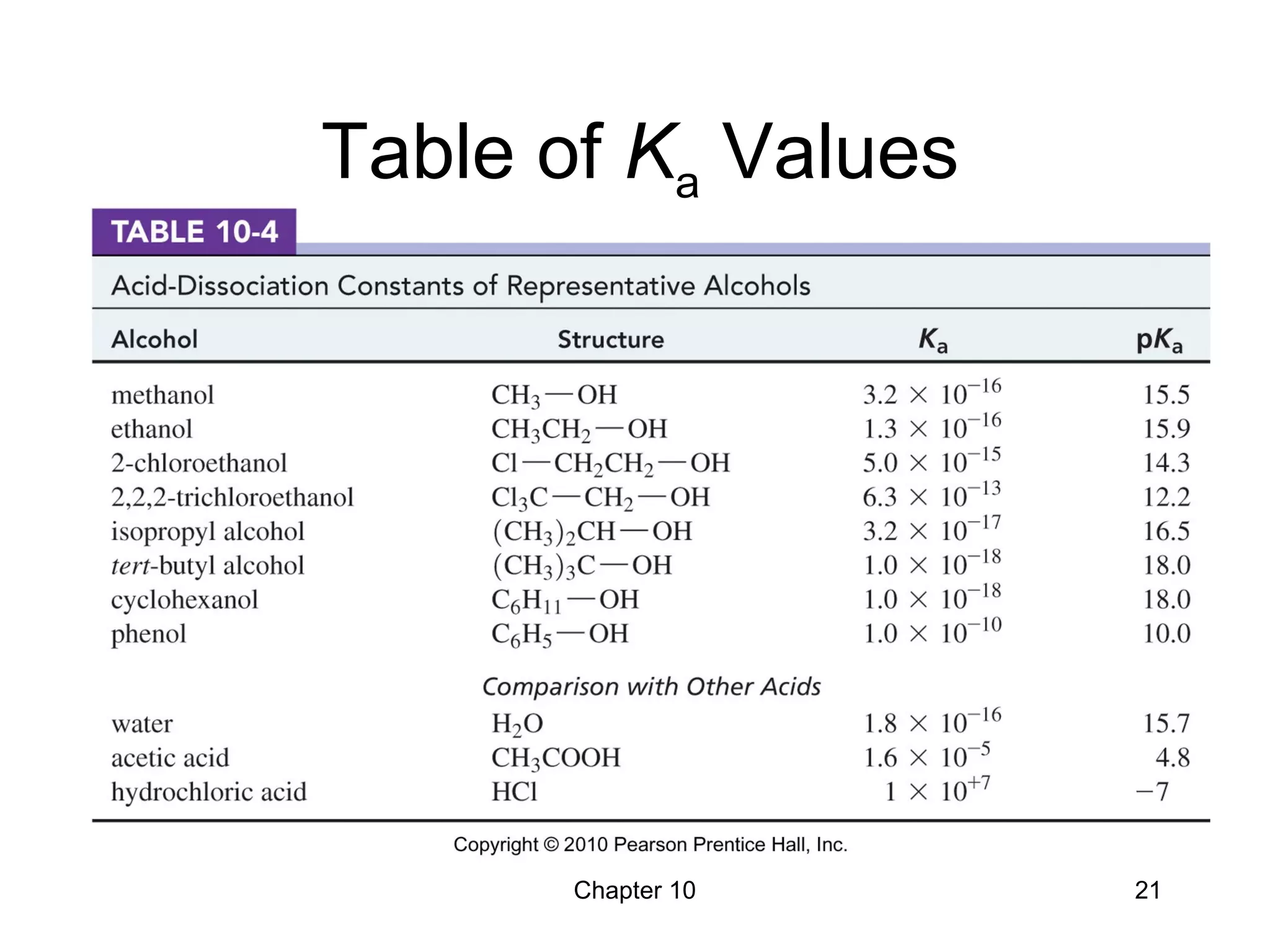
Acidity of Alcohols
• pKa range: 15.5–18.0 (water: 15.7)
• Acidity decreases as the number of
carbons increase.
• Halogens and other electron
withdrawing groups increase the acidity.
• Phenol is 100 million times more acidic
than cyclohexanol!
Chapter 10 21
Table of Ka Values
Chapter 10 22
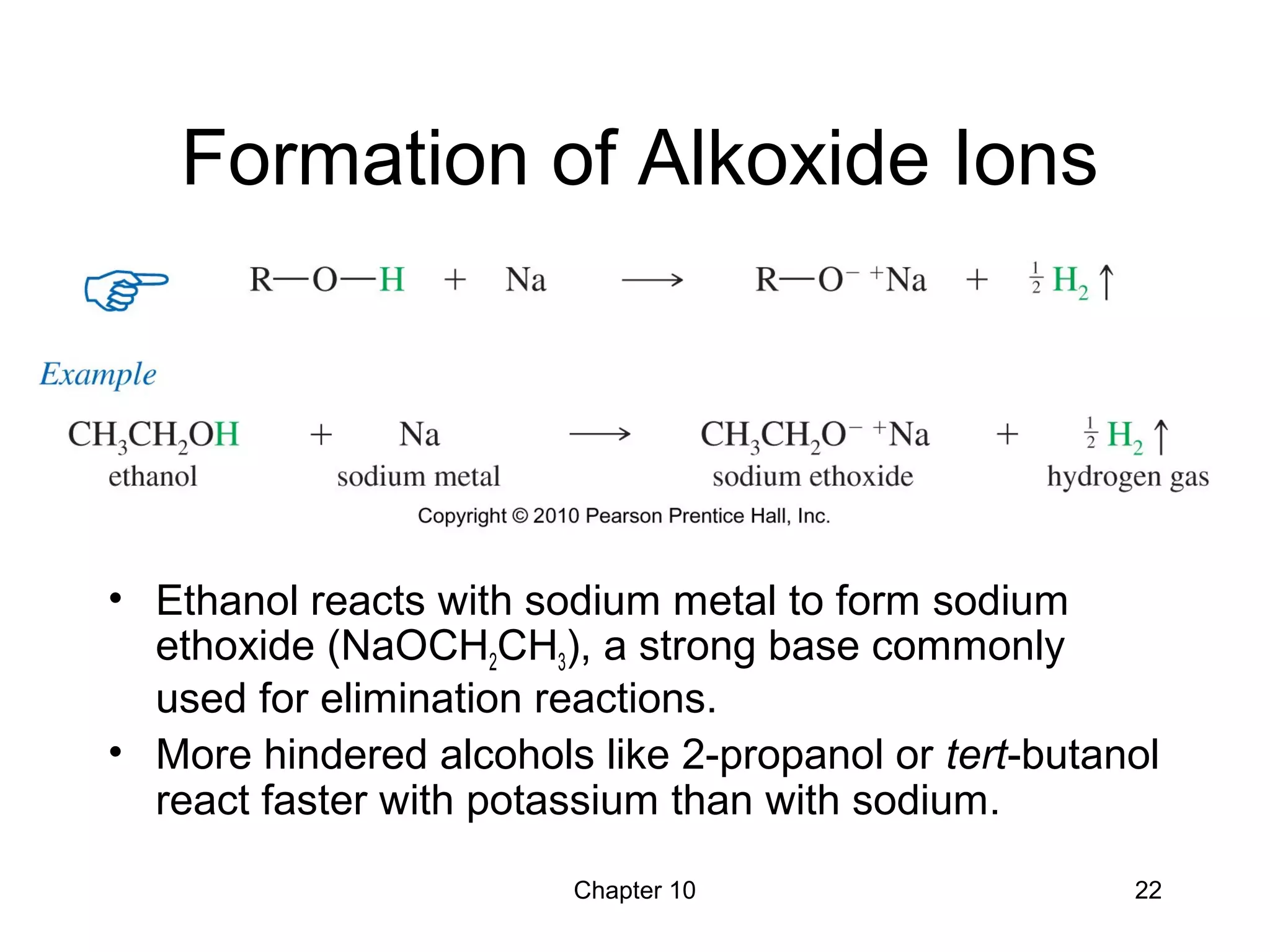
Formation of Alkoxide Ions
• Ethanol reacts with sodium metal to form sodium
ethoxide (NaOCH2CH3), a strong base commonly
used for elimination reactions.
• More hindered alcohols like 2-propanol or tert-butanol
react faster with potassium than with sodium.
Chapter 10 23
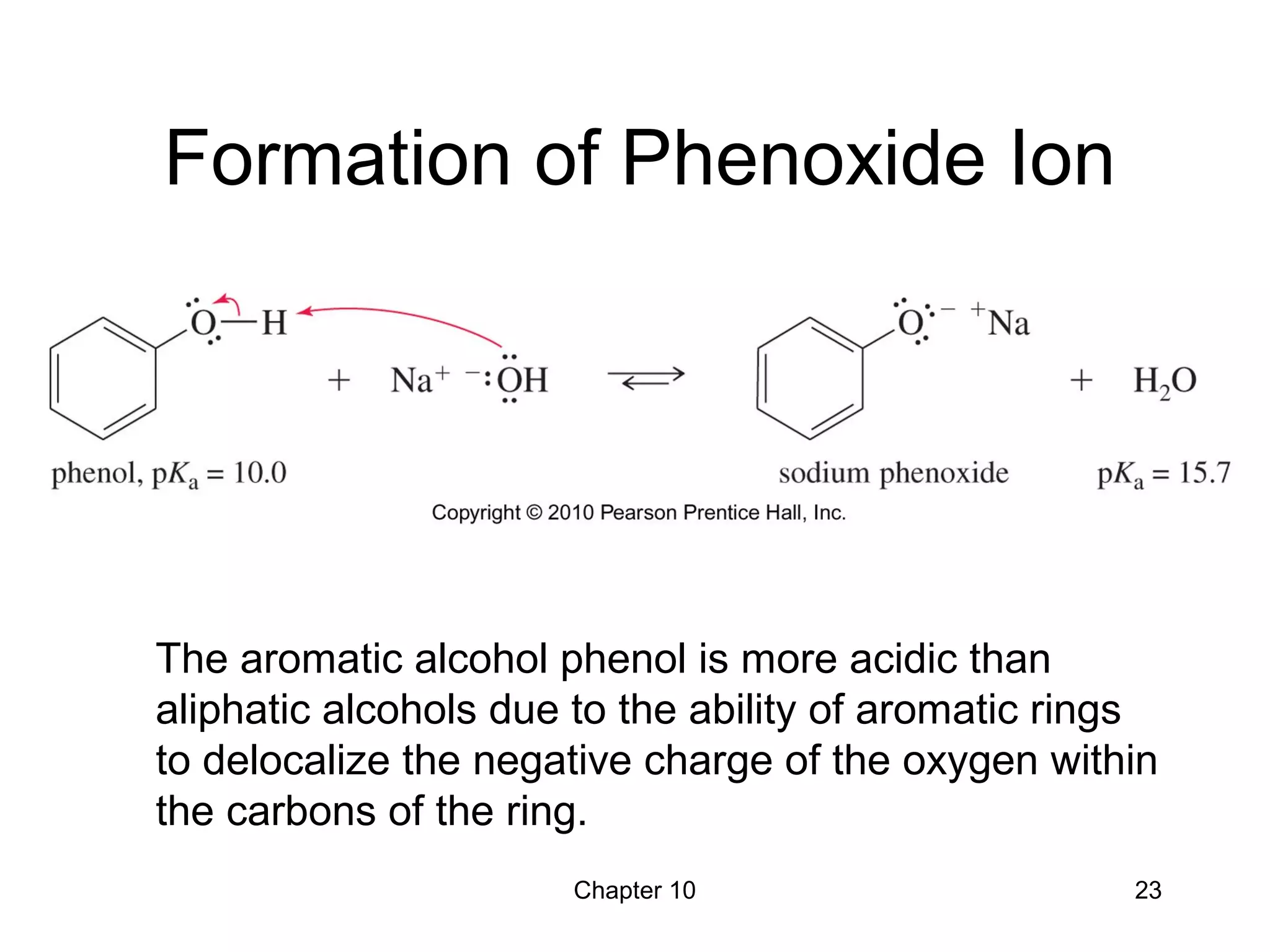
Formation of Phenoxide Ion
The aromatic alcohol phenol is more acidic than
aliphatic alcohols due to the ability of aromatic rings
to delocalize the negative charge of the oxygen within
the carbons of the ring.
Chapter 10 24
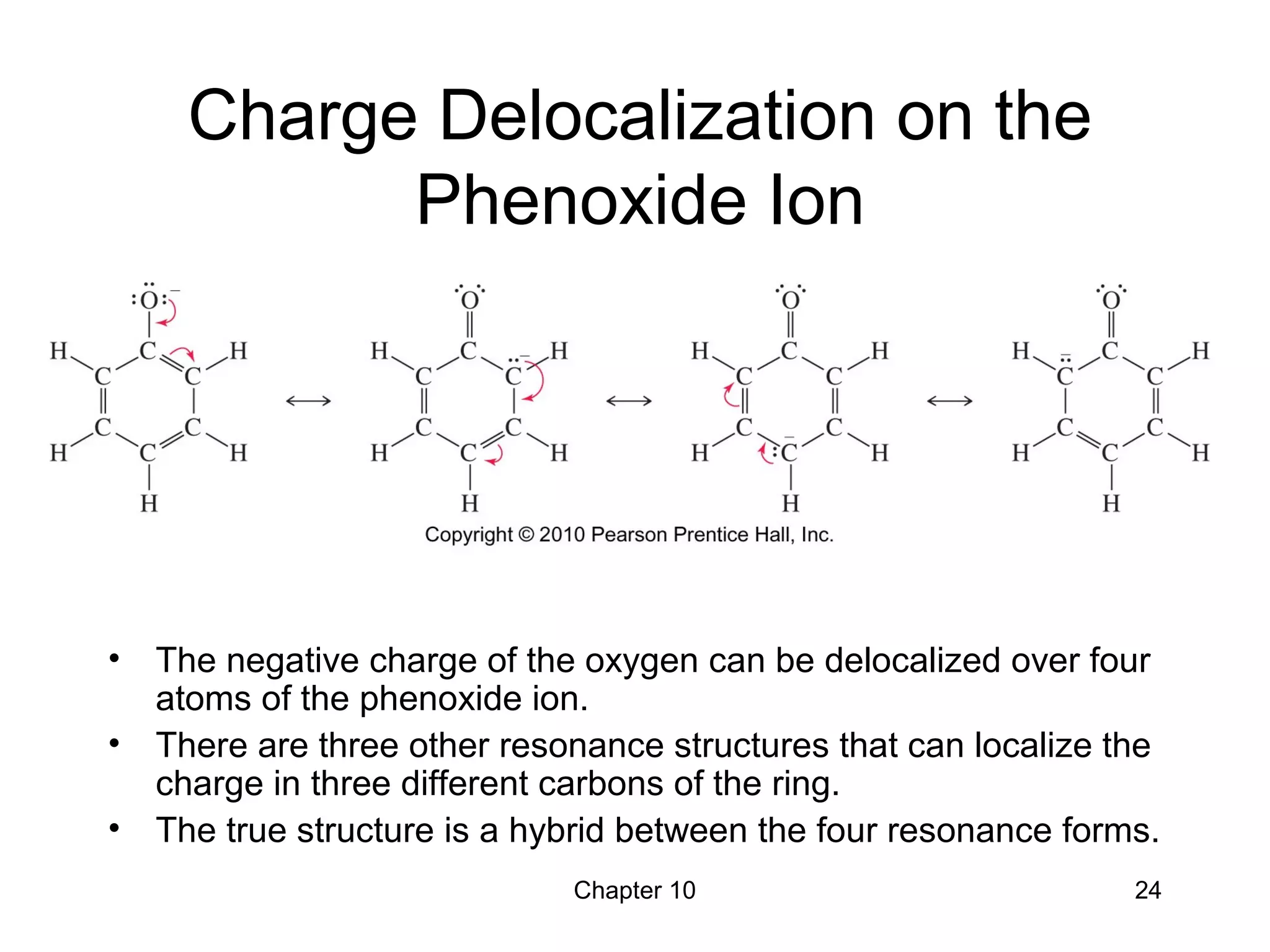
Charge Delocalization on the
Phenoxide Ion
• The negative charge of the oxygen can be delocalized over four
atoms of the phenoxide ion.
• There are three other resonance structures that can localize the
charge in three different carbons of the ring.
• The true structure is a hybrid between the four resonance forms.
Chapter 10 25
Synthesis of Alcohols
(Review)
• Alcohols can be synthesized by
nucleophilic substitution of alkyl halide.
• Hydration of alkenes also produce
alcohols:
 Water in acid solution (suffers from
rearragements)
 Oxymercuration–demercuration
 Hydroboration–oxidation
Chapter 10 26
Synthesis of Vicinal Diols
Vicinal diols can be synthesized by two
different methods:
• Syn hydroxylation of alkenes
 Osmium tetroxide, hydrogen peroxide
 Cold, dilute, basic potassium
permanganate
• Anti hydroxylation of alkenes
 Peroxyacids followed by hydrolysis
Chapter 10 27
Organometallic Reagents
• Carbon is negatively charged so it is
bonded to a metal (usually Mg or Li).
• It will attack a partially positive carbon.
 C—X
 C═O
• Good for forming carbon–carbon bonds.
Chapter 10 28
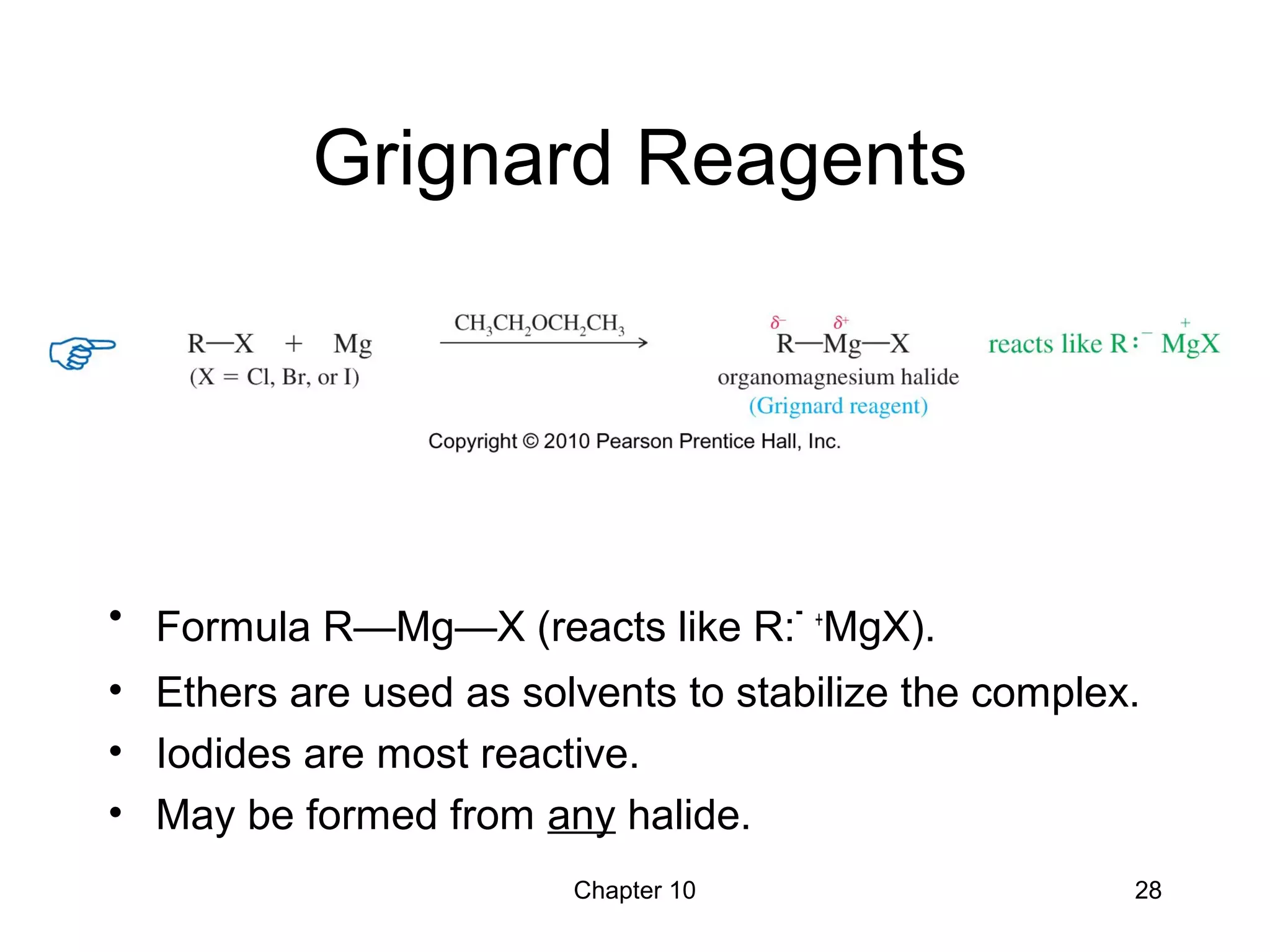
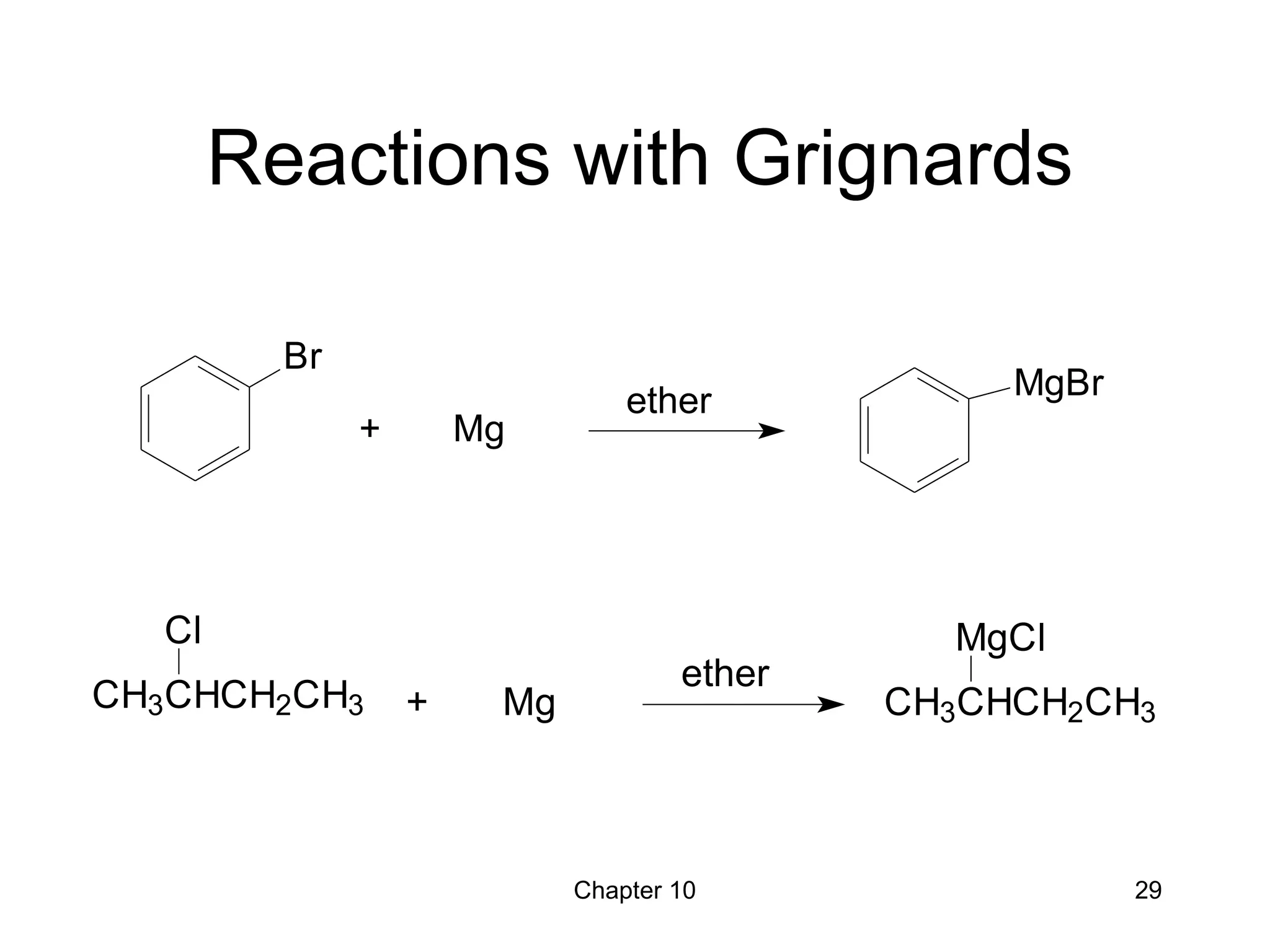
Grignard Reagents
• Formula R—Mg—X (reacts like R:- +
MgX).
• Ethers are used as solvents to stabilize the complex.
• Iodides are most reactive.
• May be formed from any halide.
Chapter 10 29
Reactions with Grignards
Br
+ Mg
ether MgBr
CH3CHCH2CH3
Cl
ether
+ Mg CH3CHCH2CH3
MgCl
Chapter 10 30
Organolithium Reagents
• Formula R—Li (reacts like R:- +
Li)
• Can be produced from alkyl, vinyl, or
aryl halides, just like Grignard reagents.
• Ether not necessary, wide variety of
solvents can be used.
Chapter 10 31
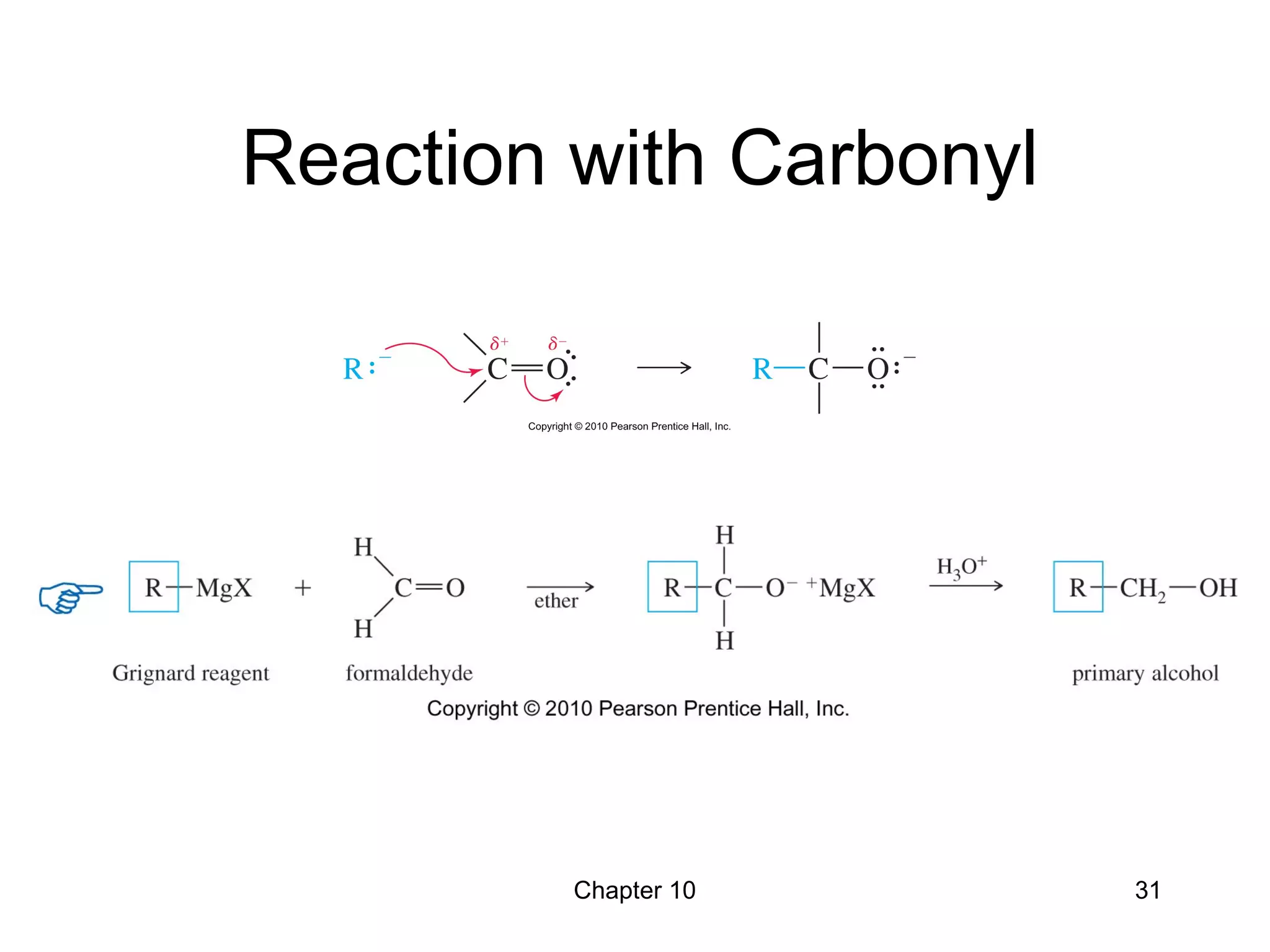
Reaction with Carbonyl
Chapter 10 32
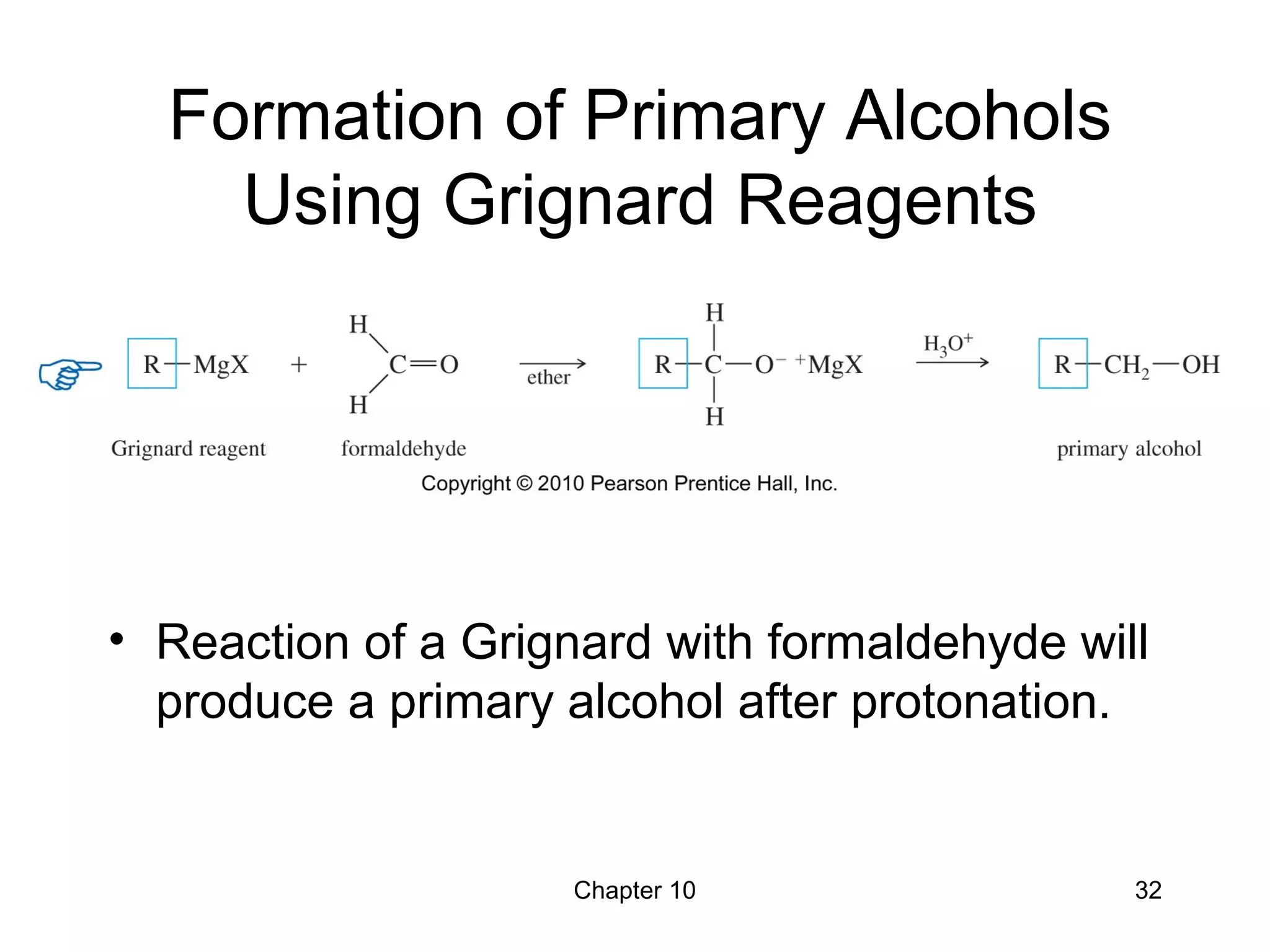
Formation of Primary Alcohols
Using Grignard Reagents
• Reaction of a Grignard with formaldehyde will
produce a primary alcohol after protonation.
Chapter 10 33
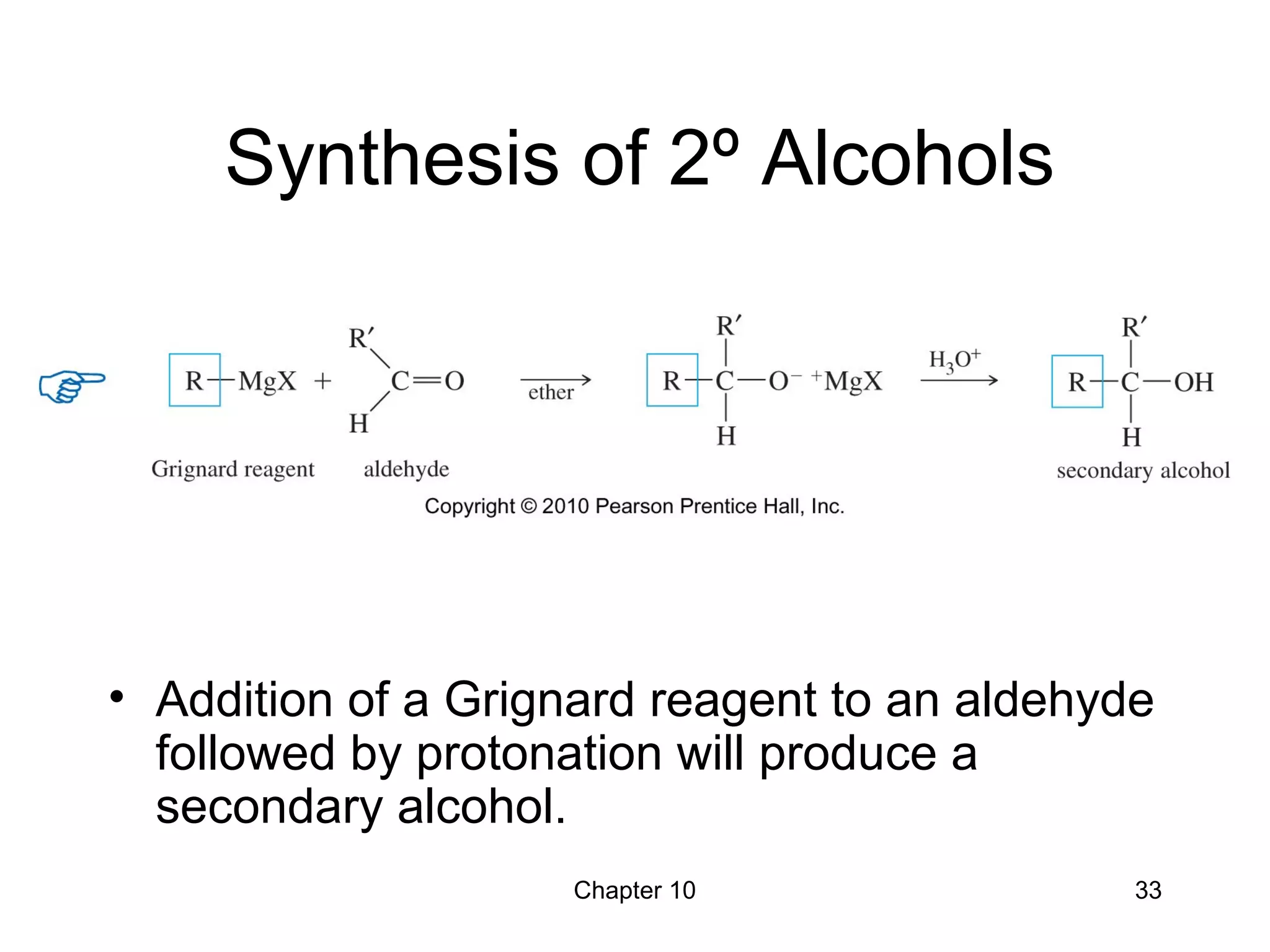
Synthesis of 2º Alcohols
• Addition of a Grignard reagent to an aldehyde
followed by protonation will produce a
secondary alcohol.
Chapter 10 34
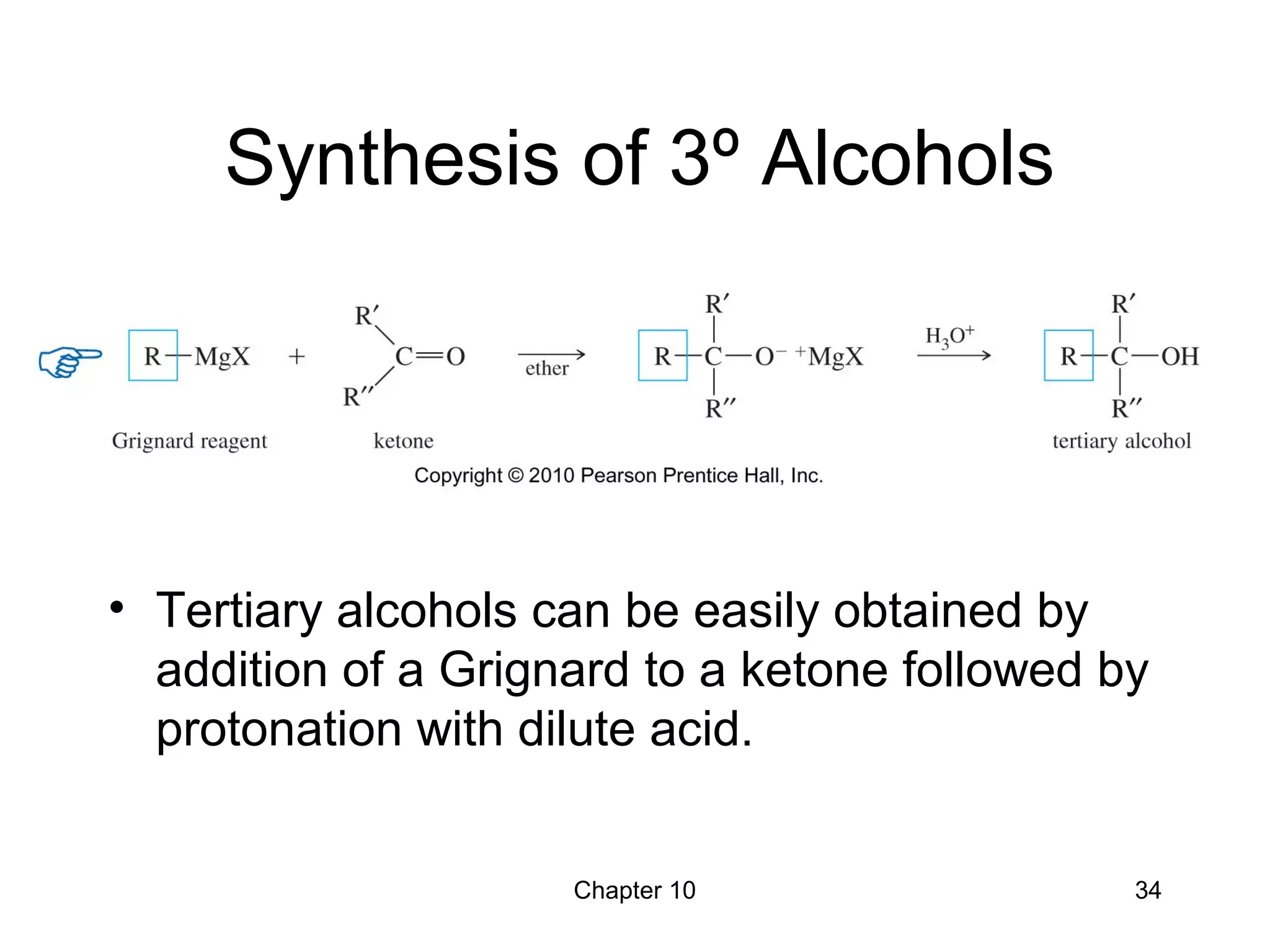
Synthesis of 3º Alcohols
• Tertiary alcohols can be easily obtained by
addition of a Grignard to a ketone followed by
protonation with dilute acid.
Chapter 10 35
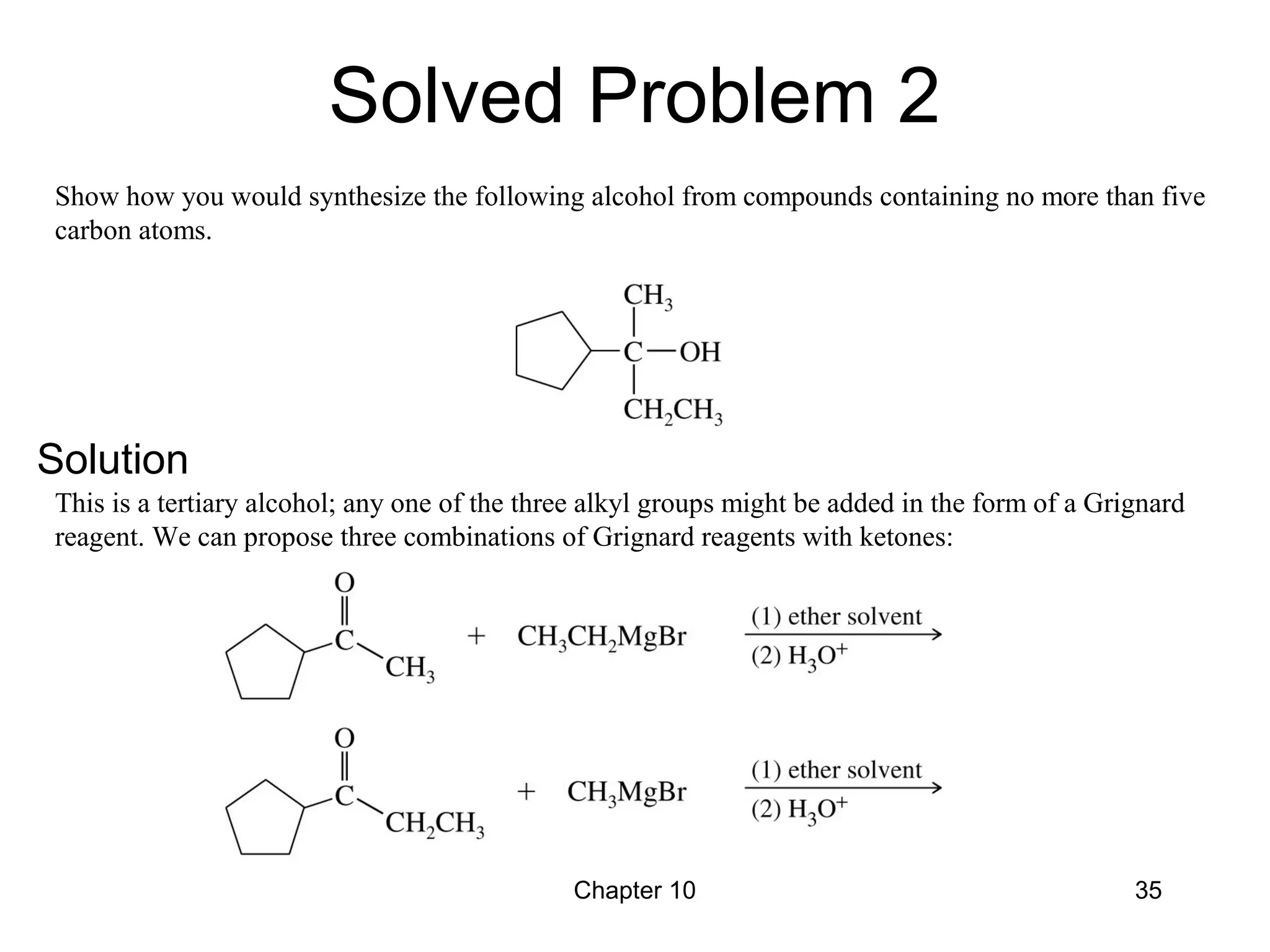
Show how you would synthesize the following alcohol from compounds containing no more than five
carbon atoms.
This is a tertiary alcohol; any one of the three alkyl groups might be added in the form of a Grignard
reagent. We can propose three combinations of Grignard reagents with ketones:
Solved Problem 2
Solution
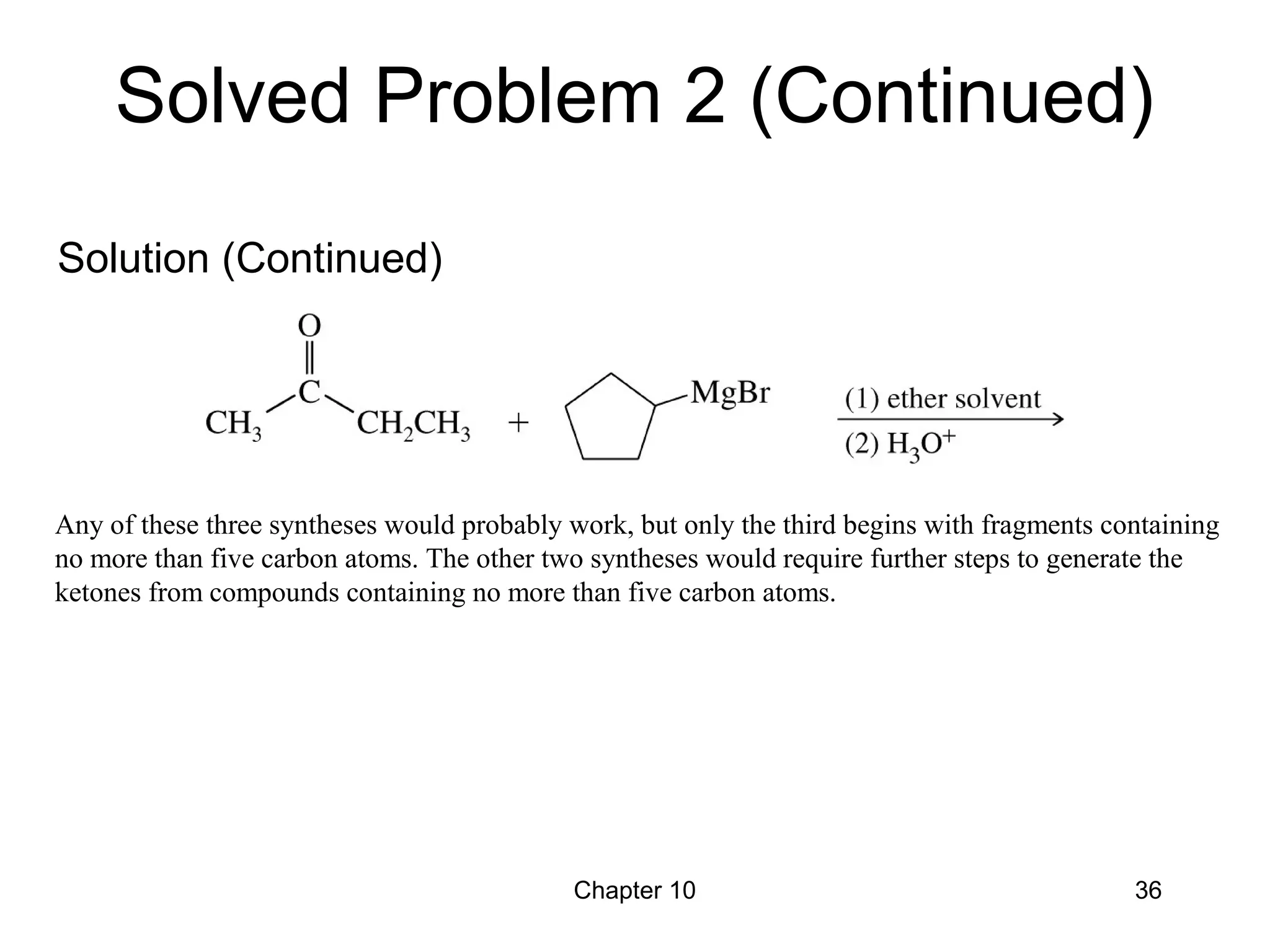
Chapter 10 36
Any of these three syntheses would probably work, but only the third begins with fragments containing
no more than five carbon atoms. The other two syntheses would require further steps to generate the
ketones from compounds containing no more than five carbon atoms.
Solved Problem 2 (Continued)
Solution (Continued)
Chapter 10 37
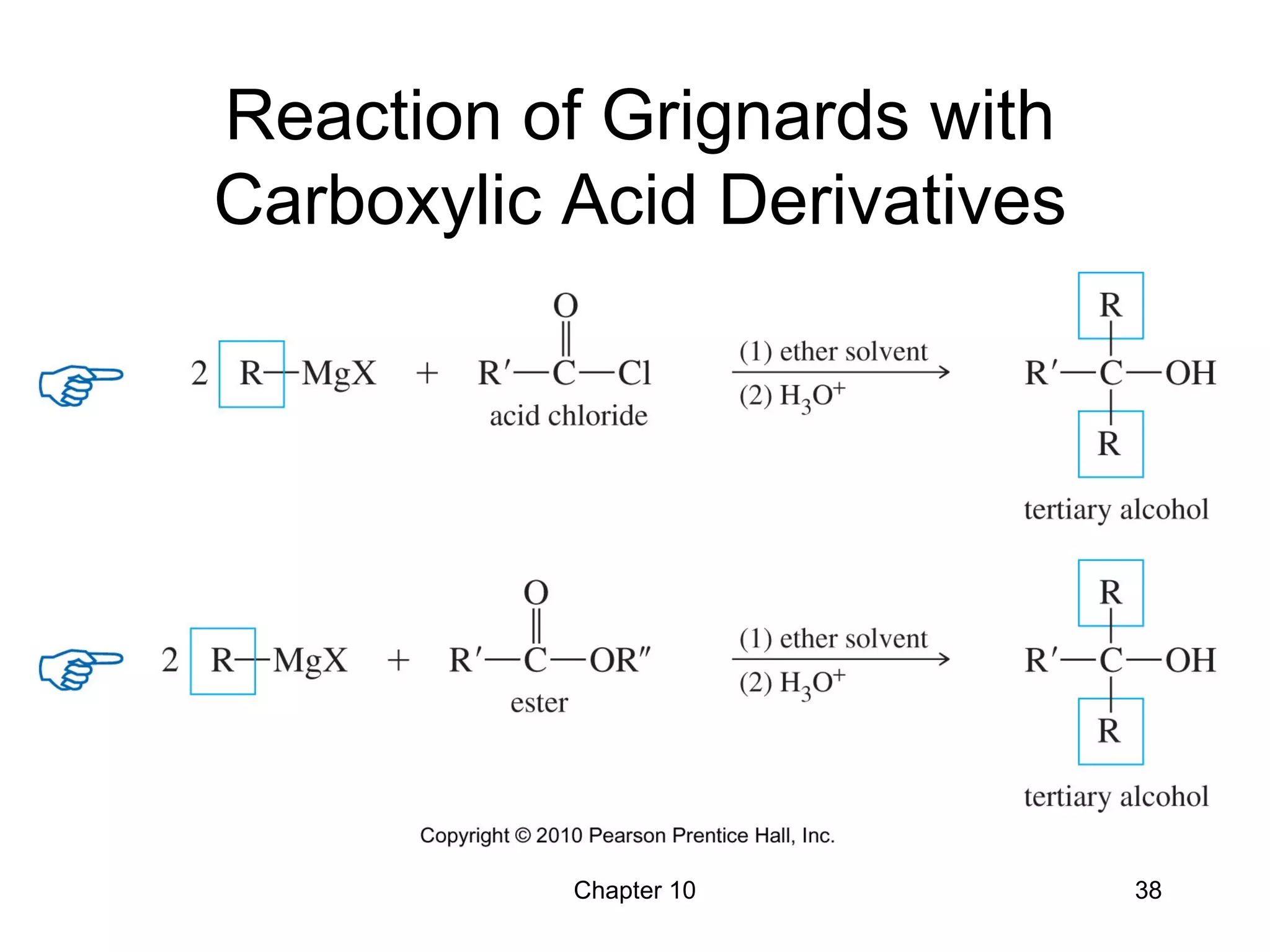
Grignard Reactions with
Acid Chlorides and Esters
• Use two moles of Grignard reagent.
• The product is a tertiary alcohol with
two identical alkyl groups.
• Reaction with one mole of Grignard
reagent produces a ketone
intermediate, which reacts with the
second mole of Grignard reagent.
Chapter 10 38
Reaction of Grignards with
Carboxylic Acid Derivatives
Chapter 10 39
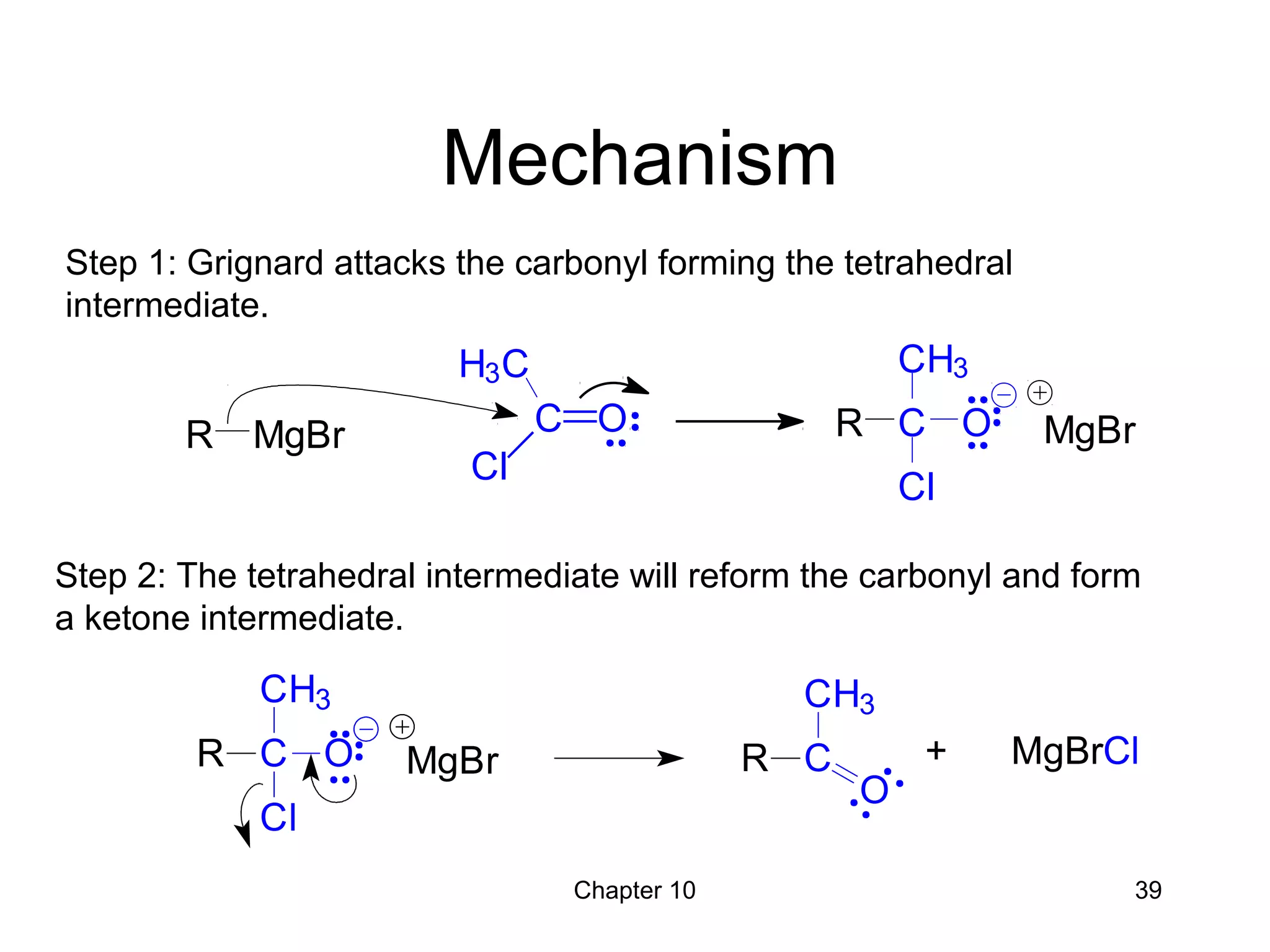
Mechanism
C
CH3
Cl
OR MgBr C
CH3
R
O
+ MgBrCl
C O
Cl
H3C
MgBrR MgBr C
CH3
Cl
OR
Step 1: Grignard attacks the carbonyl forming the tetrahedral
intermediate.
Step 2: The tetrahedral intermediate will reform the carbonyl and form
a ketone intermediate.
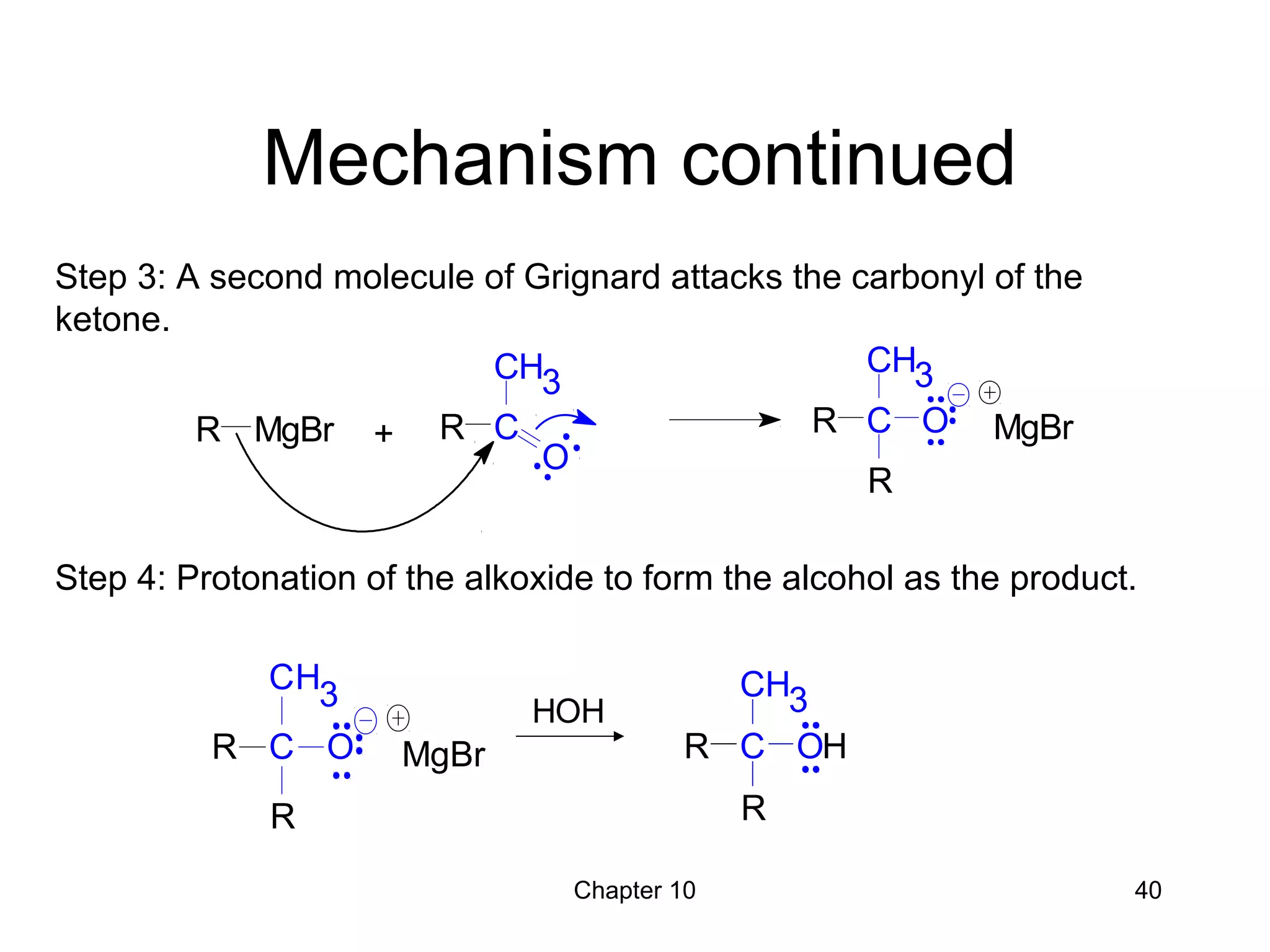
Chapter 10 40
Mechanism continued
HOH
C
CH3
R
OHRC
CH3
R
OR MgBr
C
CH3
R
O
R MgBr + C
CH3
R
OR MgBr
Step 3: A second molecule of Grignard attacks the carbonyl of the
ketone.
Step 4: Protonation of the alkoxide to form the alcohol as the product.
Chapter 10 41
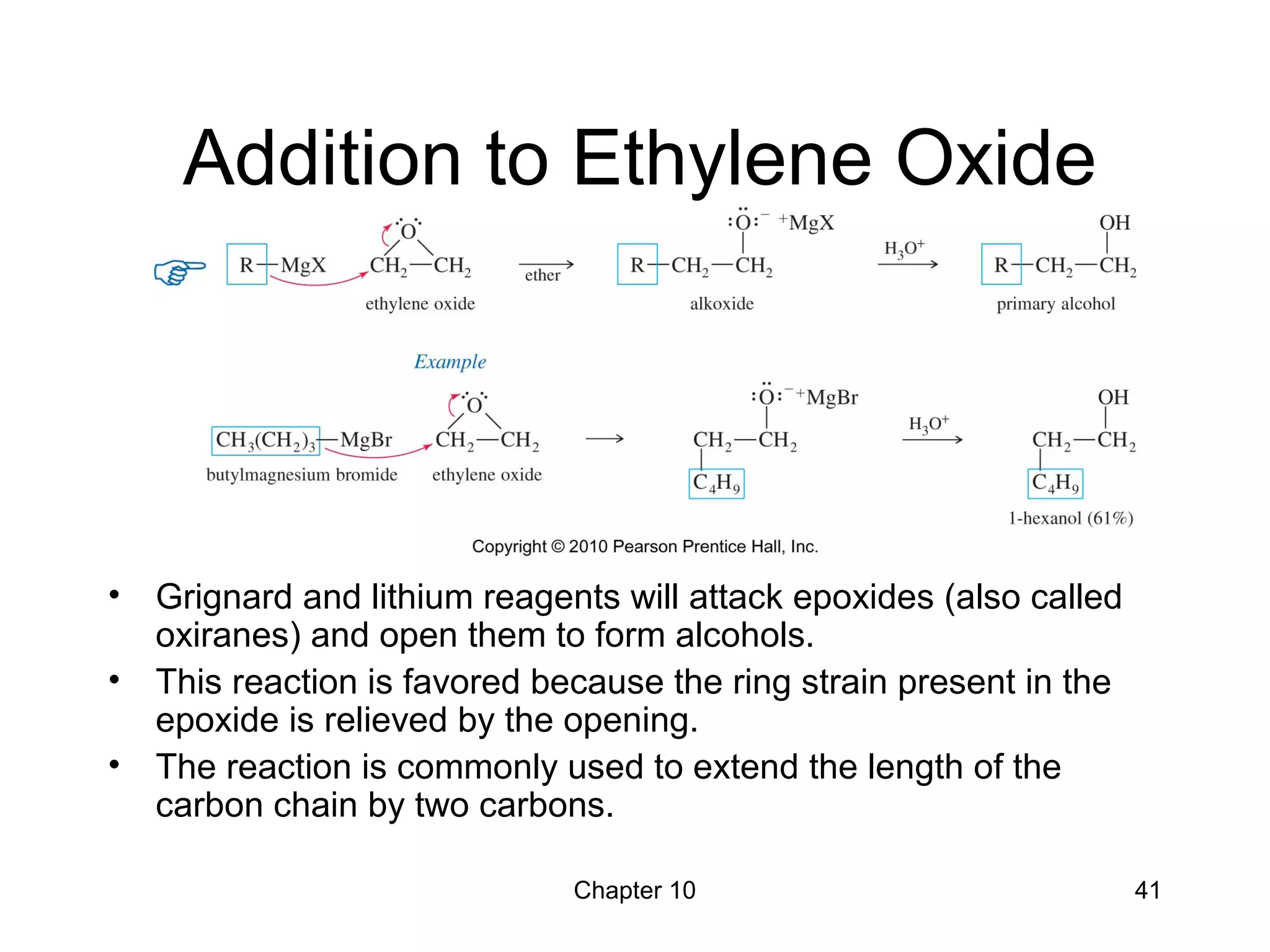
Addition to Ethylene Oxide
• Grignard and lithium reagents will attack epoxides (also called
oxiranes) and open them to form alcohols.
• This reaction is favored because the ring strain present in the
epoxide is relieved by the opening.
• The reaction is commonly used to extend the length of the
carbon chain by two carbons.
Chapter 10 42
Limitations of Grignard
• Grignards are good nucleophiles but in
the presence of acidic protons it will
acts as a strong base.
• No water or other acidic protons like
O—H, N—H, S—H, or terminal alkynes.
• No other electrophilic multiple bonds,
like C═N, C≡N, S═O, or N═O.
Chapter 10 43
Reduction of Carbonyl
• Reduction of aldehyde yields 1º alcohol.
• Reduction of ketone yields 2º alcohol.
• Reagents:
 Sodium borohydride, NaBH4
 Lithium aluminum hydride, LiAlH4
 Raney nickel
Chapter 10 44
Sodium Borohydride
• NaBH4 is a source of hydrides (H-
)
• Hydride attacks the carbonyl carbon,
forming an alkoxide ion.
• Then the alkoxide ion is protonated by
dilute acid.
• Only reacts with carbonyl of aldehyde or
ketone, not with carbonyls of esters or
carboxylic acids.
Chapter 10 45
Mechanism of Hydride Reduction
• The hydride attacks the carbonyl of the aldehyde or
the ketone.
• A tetrahedral intermediate forms.
• Protonation of the intermediate forms the alcohols.
Chapter 10 46
Lithium Aluminum Hydride
• LiAlH4 is source of hydrides (H-
)
• Stronger reducing agent than sodium
borohydride, but dangerous to work with.
• Reduces ketones and aldehydes into the
corresponding alcohol.
• Converts esters and carboxylic acids to 1º
alcohols.
Chapter 10 47
Reduction with LiAlH4
• The LiAlH4 (or LAH) will add two hydrides to
the ester to form the primary alkyl halide.
• The mechanism is similar to the attack of
Grignards on esters.
Chapter 10 48
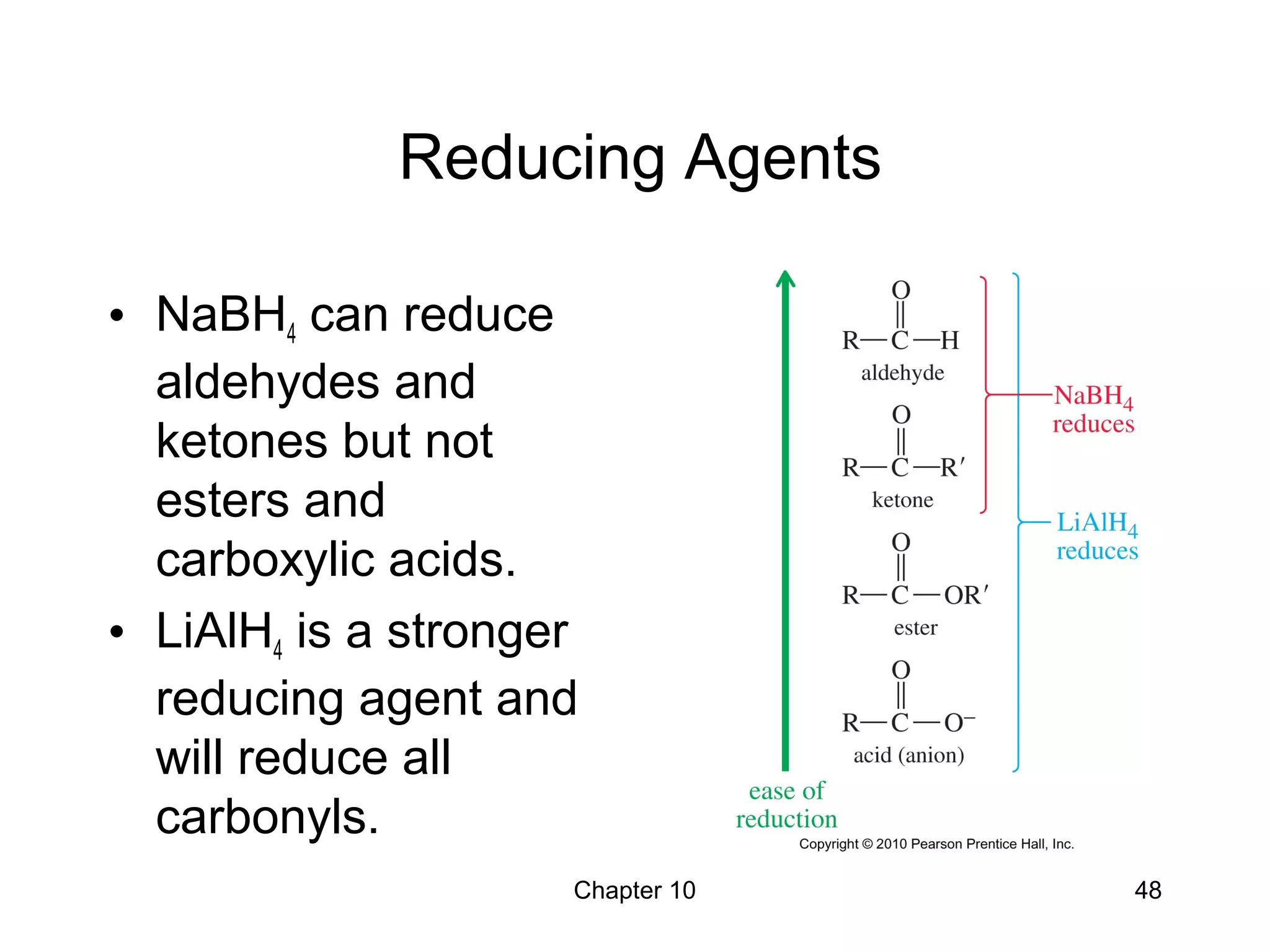
Reducing Agents
• NaBH4 can reduce
aldehydes and
ketones but not
esters and
carboxylic acids.
• LiAlH4 is a stronger
reducing agent and
will reduce all
carbonyls.
Chapter 10 49
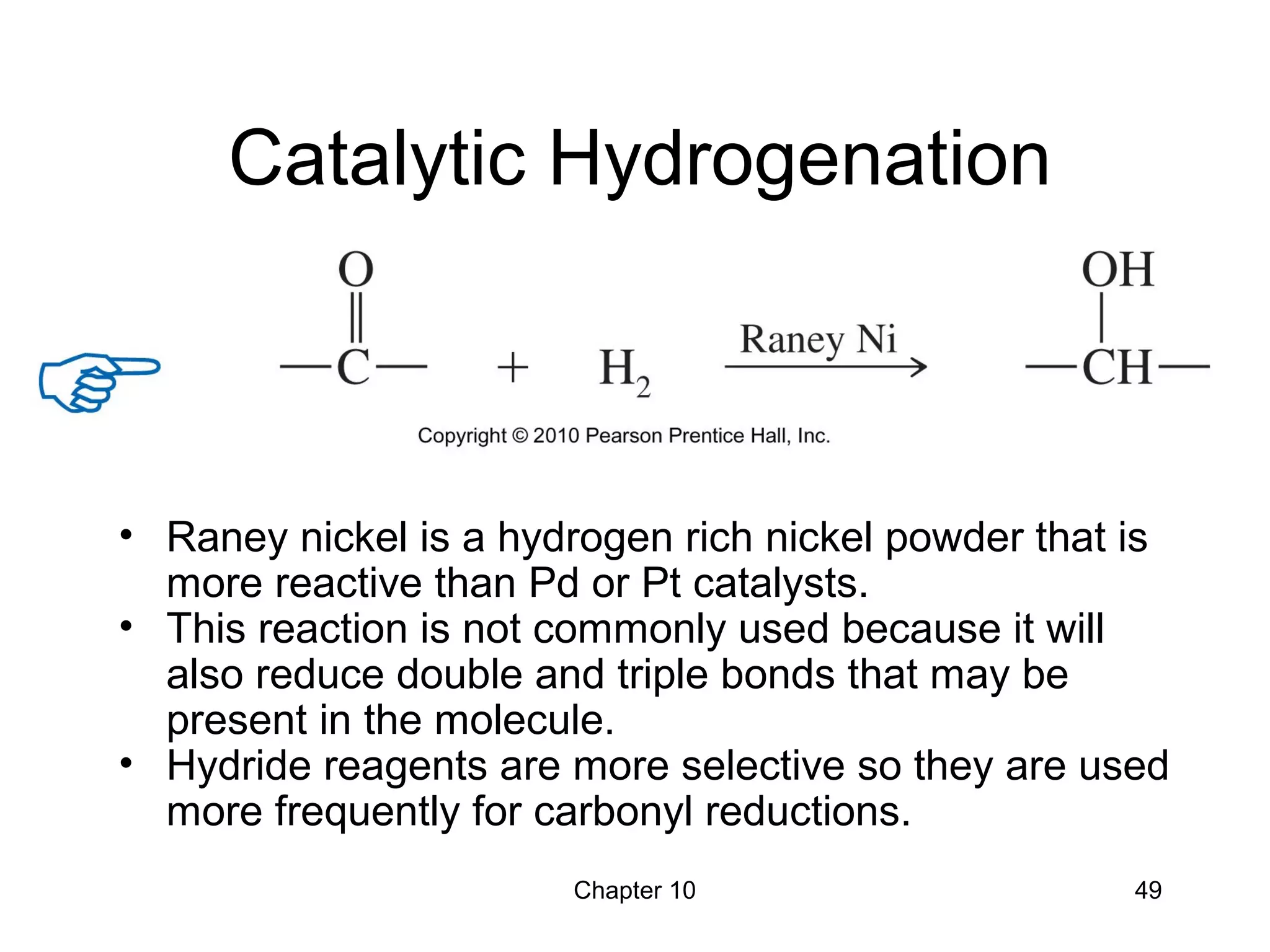
Catalytic Hydrogenation
• Raney nickel is a hydrogen rich nickel powder that is
more reactive than Pd or Pt catalysts.
• This reaction is not commonly used because it will
also reduce double and triple bonds that may be
present in the molecule.
• Hydride reagents are more selective so they are used
more frequently for carbonyl reductions.
Chapter 10 50
Thiols (Mercaptans)
• Sulfur analogues of alcohols are called
thiols.
• The —SH group is called a mercapto
group.
• Named by adding the suffix -thiol to the
alkane name.
• They are commonly made by an SN2
reaction so primary alkyl halides work
better.
Chapter 10 51
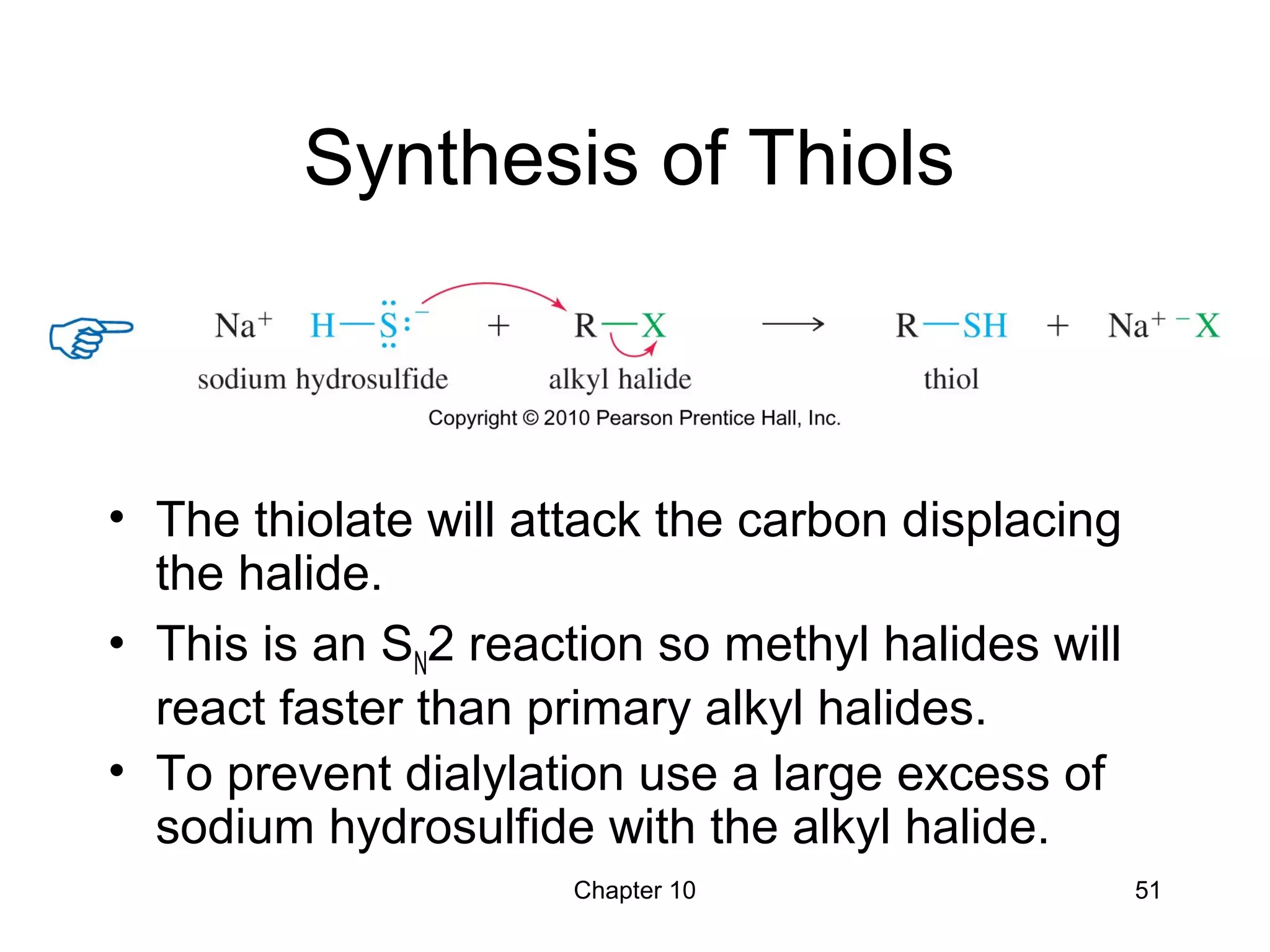
Synthesis of Thiols
• The thiolate will attack the carbon displacing
the halide.
• This is an SN2 reaction so methyl halides will
react faster than primary alkyl halides.
• To prevent dialylation use a large excess of
sodium hydrosulfide with the alkyl halide.
Chapter 10 52
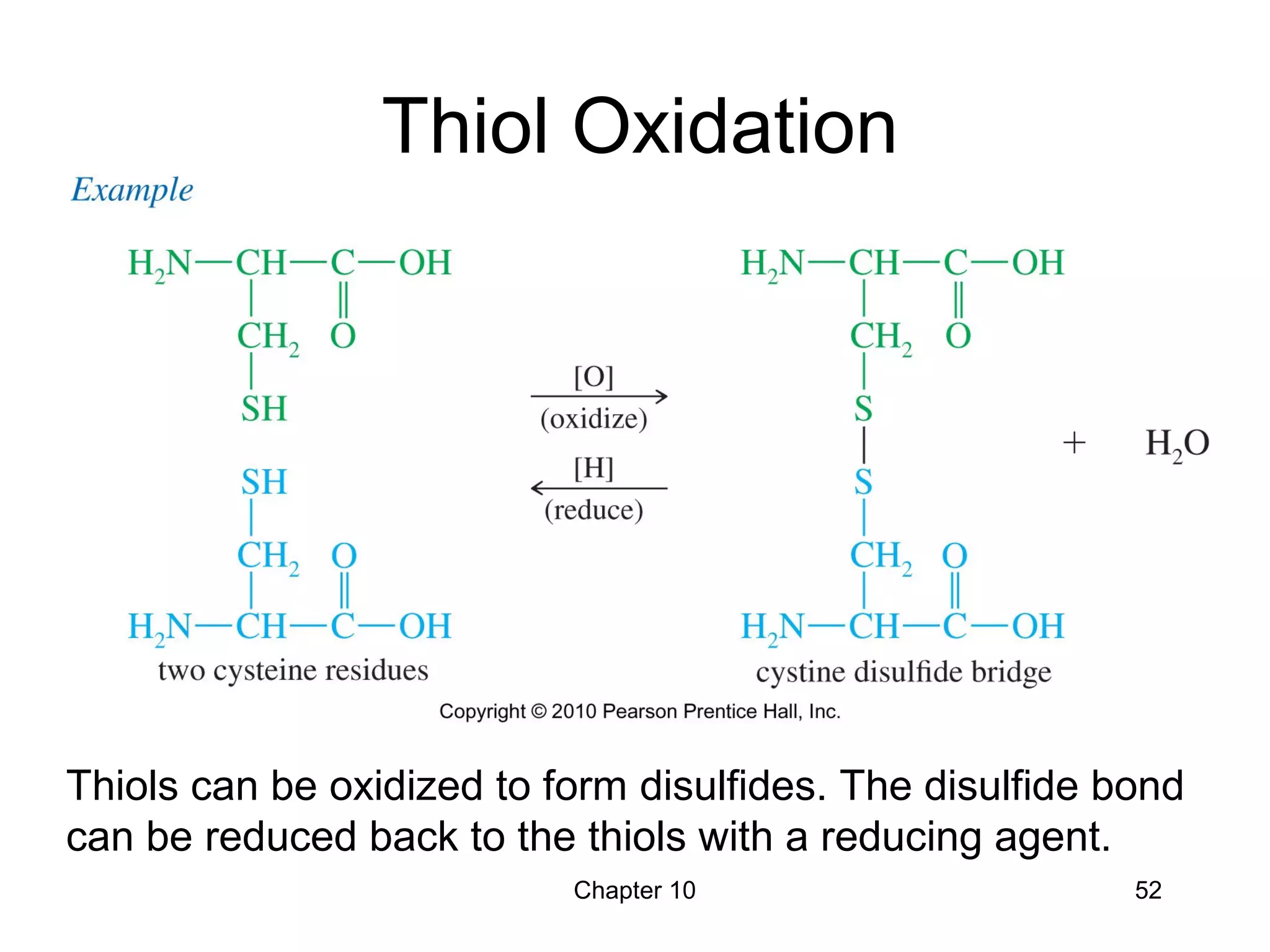
Thiol Oxidation
Thiols can be oxidized to form disulfides. The disulfide bond
can be reduced back to the thiols with a reducing agent.

10 - Structure and Synthesis of Alcohols - Wade 7th

  • 1.
    Chapter 10 ©2010, PrenticeHall Organic Chemistry, 7th Edition L. G. Wade, Jr. Structure and Synthesis of Alcohols
  • 2.
    Chapter 10 2 Structureof Water and Methanol • Oxygen is sp3 hybridized and tetrahedral. • The H—O—H angle in water is 104.5°. • The C—O—H angle in methyl alcohol is 108.9°.
  • 3.
    Chapter 10 3 Classificationof Alcohols • Primary: carbon with —OH is bonded to one other carbon. • Secondary: carbon with —OH is bonded to two other carbons. • Tertiary: carbon with —OH is bonded to three other carbons. • Aromatic (phenol): —OH is bonded to a benzene ring.
  • 4.
    Chapter 10 4 Examplesof Classifications CH3 C CH3 CH3 OH* CH3 CH OH CH2CH3 * CH3 CH CH3 CH2OH * Primary alcohol Secondary alcohol Tertiary alcohol
  • 5.
    Chapter 10 5 IUPACNomenclature • Find the longest carbon chain containing the carbon with the —OH group. • Drop the -e from the alkane name, add -ol. • Number the chain giving the —OH group the lowest number possible. • Number and name all substituents and write them in alphabetical order.
  • 6.
    Chapter 10 6 Examplesof Nomenclature 2-methyl-1-propanol 2-methylpropan-1-ol 2-methyl-2-propanol 2-methylpropan-2-ol 2-butanol butan-2-ol CH3 C CH3 CH3 OH CH3 CH CH3 CH2OH CH3 CH OH CH2CH3 3 2 1 1 2 3 4 2 1
  • 7.
    Chapter 10 7 Alkenols(Enols) • Hydroxyl group takes precedence. Assign the carbon with the —OH the lowest number. • End the name in –ol, but also specify that there is a double bond by using the ending –ene before -ol 4-penten-2-ol pent-4-ene-2-ol CH2 CHCH2CHCH3 OH 5 4 3 2 1
  • 8.
    Chapter 10 8 NamingPriority 1. Acids 2. Esters 3. Aldehydes 4. Ketones 5. Alcohols 6. Amines 7. Alkenes 8. Alkynes 9. Alkanes 10. Ethers 11. Halides Highest ranking Lowest ranking
  • 9.
    Chapter 10 9 HydroxySubstituent • When —OH is part of a higher priority class of compound, it is named as hydroxy. 4-hydroxybutanoic acid also known as γ-hydroxybutyric acid (GHB) CH2CH2CH2COOH OH carboxylic acid 4 3 2 1
  • 10.
    Chapter 10 10 CommonNames • Alcohol can be named as alkyl alcohol. • Useful only for small alkyl groups. isobutyl alcohol sec-butyl alcohol CH3 CH CH3 CH2OH CH3 CH OH CH2CH3
  • 11.
    Chapter 10 11 NamingDiols • Two numbers are needed to locate the two —OH groups. • Use -diol as suffix instead of -ol. hexane-1,6- diol 1 2 3 4 5 6
  • 12.
    Chapter 10 12 Glycols •1, 2-diols (vicinal diols) are called glycols. • Common names for glycols use the name of the alkene from which they were made. ethane-1,2- diol ethylene glycol propane-1,2- diol propylene glycol
  • 13.
    Chapter 10 13 PhenolNomenclature • —OH group is assumed to be on carbon 1. • For common names of disubstituted phenols, use ortho- for 1,2; meta- for 1,3; and para- for 1,4. • Methyl phenols are cresols. 3-chlorophenol (meta-chlorophenol) 4-methylphenol (para-cresol) OH Cl OH H3C
  • 14.
    Chapter 10 14 Givethe systematic (IUPAC) name for the following alcohol. The longest chain contains six carbon atoms, but it does not contain the carbon bonded to the hydroxyl group. The longest chain containing the carbon bonded to the —OH group is the one outlined by the green box, containing five carbon atoms. This chain is numbered from right to left in order to give the hydroxyl-bearing carbon atom the lowest possible number. The correct name for this compound is 3-(iodomethyl)-2-isopropylpentan-1-ol. Solved Problem 1 Solution
  • 15.
    Chapter 10 15 PhysicalProperties • Alcohols have high boiling points due to hydrogen bonding between molecules. • Small alcohols are miscible in water, but solubility decreases as the size of the alkyl group increases.
  • 16.
    Chapter 10 16 BoilingPoints of alcohols • Alcohols have higher boiling points than ethers and alkanes because alcohols can form hydrogen bonds. • The stronger interaction between alcohol molecules will require more energy to break them resulting in a higher boiling point.
  • 17.
    Chapter 10 17 Solubilityin Water Small alcohols are miscible in water, but solubility decreases as the size of the alkyl group increases.
  • 18.
    Chapter 10 18 Methanol •“Wood alcohol” • Industrial production from synthesis gas • Common industrial solvent • Toxic Dose: 100 mL methanol • Used as fuel at Indianapolis 500  Fire can be extinguished with water  High octane rating  Low emissions  Lower energy content  Invisible flame
  • 19.
    Chapter 10 19 Ethanol •Fermentation of sugar and starches in grains • 12–15% alcohol, then yeast cells die • Distillation produces “hard” liquors • Azeotrope: 95% ethanol, constant boiling • Denatured alcohol used as solvent • Gasahol: 10% ethanol in gasoline • Toxic dose: 200 mL
  • 20.
    Chapter 10 20 Acidityof Alcohols • pKa range: 15.5–18.0 (water: 15.7) • Acidity decreases as the number of carbons increase. • Halogens and other electron withdrawing groups increase the acidity. • Phenol is 100 million times more acidic than cyclohexanol!
  • 21.
    Chapter 10 21 Tableof Ka Values
  • 22.
    Chapter 10 22 Formationof Alkoxide Ions • Ethanol reacts with sodium metal to form sodium ethoxide (NaOCH2CH3), a strong base commonly used for elimination reactions. • More hindered alcohols like 2-propanol or tert-butanol react faster with potassium than with sodium.
  • 23.
    Chapter 10 23 Formationof Phenoxide Ion The aromatic alcohol phenol is more acidic than aliphatic alcohols due to the ability of aromatic rings to delocalize the negative charge of the oxygen within the carbons of the ring.
  • 24.
    Chapter 10 24 ChargeDelocalization on the Phenoxide Ion • The negative charge of the oxygen can be delocalized over four atoms of the phenoxide ion. • There are three other resonance structures that can localize the charge in three different carbons of the ring. • The true structure is a hybrid between the four resonance forms.
  • 25.
    Chapter 10 25 Synthesisof Alcohols (Review) • Alcohols can be synthesized by nucleophilic substitution of alkyl halide. • Hydration of alkenes also produce alcohols:  Water in acid solution (suffers from rearragements)  Oxymercuration–demercuration  Hydroboration–oxidation
  • 26.
    Chapter 10 26 Synthesisof Vicinal Diols Vicinal diols can be synthesized by two different methods: • Syn hydroxylation of alkenes  Osmium tetroxide, hydrogen peroxide  Cold, dilute, basic potassium permanganate • Anti hydroxylation of alkenes  Peroxyacids followed by hydrolysis
  • 27.
    Chapter 10 27 OrganometallicReagents • Carbon is negatively charged so it is bonded to a metal (usually Mg or Li). • It will attack a partially positive carbon.  C—X  C═O • Good for forming carbon–carbon bonds.
  • 28.
    Chapter 10 28 GrignardReagents • Formula R—Mg—X (reacts like R:- + MgX). • Ethers are used as solvents to stabilize the complex. • Iodides are most reactive. • May be formed from any halide.
  • 29.
    Chapter 10 29 Reactionswith Grignards Br + Mg ether MgBr CH3CHCH2CH3 Cl ether + Mg CH3CHCH2CH3 MgCl
  • 30.
    Chapter 10 30 OrganolithiumReagents • Formula R—Li (reacts like R:- + Li) • Can be produced from alkyl, vinyl, or aryl halides, just like Grignard reagents. • Ether not necessary, wide variety of solvents can be used.
  • 31.
  • 32.
    Chapter 10 32 Formationof Primary Alcohols Using Grignard Reagents • Reaction of a Grignard with formaldehyde will produce a primary alcohol after protonation.
  • 33.
    Chapter 10 33 Synthesisof 2º Alcohols • Addition of a Grignard reagent to an aldehyde followed by protonation will produce a secondary alcohol.
  • 34.
    Chapter 10 34 Synthesisof 3º Alcohols • Tertiary alcohols can be easily obtained by addition of a Grignard to a ketone followed by protonation with dilute acid.
  • 35.
    Chapter 10 35 Showhow you would synthesize the following alcohol from compounds containing no more than five carbon atoms. This is a tertiary alcohol; any one of the three alkyl groups might be added in the form of a Grignard reagent. We can propose three combinations of Grignard reagents with ketones: Solved Problem 2 Solution
  • 36.
    Chapter 10 36 Anyof these three syntheses would probably work, but only the third begins with fragments containing no more than five carbon atoms. The other two syntheses would require further steps to generate the ketones from compounds containing no more than five carbon atoms. Solved Problem 2 (Continued) Solution (Continued)
  • 37.
    Chapter 10 37 GrignardReactions with Acid Chlorides and Esters • Use two moles of Grignard reagent. • The product is a tertiary alcohol with two identical alkyl groups. • Reaction with one mole of Grignard reagent produces a ketone intermediate, which reacts with the second mole of Grignard reagent.
  • 38.
    Chapter 10 38 Reactionof Grignards with Carboxylic Acid Derivatives
  • 39.
    Chapter 10 39 Mechanism C CH3 Cl ORMgBr C CH3 R O + MgBrCl C O Cl H3C MgBrR MgBr C CH3 Cl OR Step 1: Grignard attacks the carbonyl forming the tetrahedral intermediate. Step 2: The tetrahedral intermediate will reform the carbonyl and form a ketone intermediate.
  • 40.
    Chapter 10 40 Mechanismcontinued HOH C CH3 R OHRC CH3 R OR MgBr C CH3 R O R MgBr + C CH3 R OR MgBr Step 3: A second molecule of Grignard attacks the carbonyl of the ketone. Step 4: Protonation of the alkoxide to form the alcohol as the product.
  • 41.
    Chapter 10 41 Additionto Ethylene Oxide • Grignard and lithium reagents will attack epoxides (also called oxiranes) and open them to form alcohols. • This reaction is favored because the ring strain present in the epoxide is relieved by the opening. • The reaction is commonly used to extend the length of the carbon chain by two carbons.
  • 42.
    Chapter 10 42 Limitationsof Grignard • Grignards are good nucleophiles but in the presence of acidic protons it will acts as a strong base. • No water or other acidic protons like O—H, N—H, S—H, or terminal alkynes. • No other electrophilic multiple bonds, like C═N, C≡N, S═O, or N═O.
  • 43.
    Chapter 10 43 Reductionof Carbonyl • Reduction of aldehyde yields 1º alcohol. • Reduction of ketone yields 2º alcohol. • Reagents:  Sodium borohydride, NaBH4  Lithium aluminum hydride, LiAlH4  Raney nickel
  • 44.
    Chapter 10 44 SodiumBorohydride • NaBH4 is a source of hydrides (H- ) • Hydride attacks the carbonyl carbon, forming an alkoxide ion. • Then the alkoxide ion is protonated by dilute acid. • Only reacts with carbonyl of aldehyde or ketone, not with carbonyls of esters or carboxylic acids.
  • 45.
    Chapter 10 45 Mechanismof Hydride Reduction • The hydride attacks the carbonyl of the aldehyde or the ketone. • A tetrahedral intermediate forms. • Protonation of the intermediate forms the alcohols.
  • 46.
    Chapter 10 46 LithiumAluminum Hydride • LiAlH4 is source of hydrides (H- ) • Stronger reducing agent than sodium borohydride, but dangerous to work with. • Reduces ketones and aldehydes into the corresponding alcohol. • Converts esters and carboxylic acids to 1º alcohols.
  • 47.
    Chapter 10 47 Reductionwith LiAlH4 • The LiAlH4 (or LAH) will add two hydrides to the ester to form the primary alkyl halide. • The mechanism is similar to the attack of Grignards on esters.
  • 48.
    Chapter 10 48 ReducingAgents • NaBH4 can reduce aldehydes and ketones but not esters and carboxylic acids. • LiAlH4 is a stronger reducing agent and will reduce all carbonyls.
  • 49.
    Chapter 10 49 CatalyticHydrogenation • Raney nickel is a hydrogen rich nickel powder that is more reactive than Pd or Pt catalysts. • This reaction is not commonly used because it will also reduce double and triple bonds that may be present in the molecule. • Hydride reagents are more selective so they are used more frequently for carbonyl reductions.
  • 50.
    Chapter 10 50 Thiols(Mercaptans) • Sulfur analogues of alcohols are called thiols. • The —SH group is called a mercapto group. • Named by adding the suffix -thiol to the alkane name. • They are commonly made by an SN2 reaction so primary alkyl halides work better.
  • 51.
    Chapter 10 51 Synthesisof Thiols • The thiolate will attack the carbon displacing the halide. • This is an SN2 reaction so methyl halides will react faster than primary alkyl halides. • To prevent dialylation use a large excess of sodium hydrosulfide with the alkyl halide.
  • 52.
    Chapter 10 52 ThiolOxidation Thiols can be oxidized to form disulfides. The disulfide bond can be reduced back to the thiols with a reducing agent.

Editor's Notes

  • #15 Copyright © 2006 Pearson Prentice Hall, Inc.
  • #36 Copyright © 2006 Pearson Prentice Hall, Inc.
  • #37 Copyright © 2006 Pearson Prentice Hall, Inc.