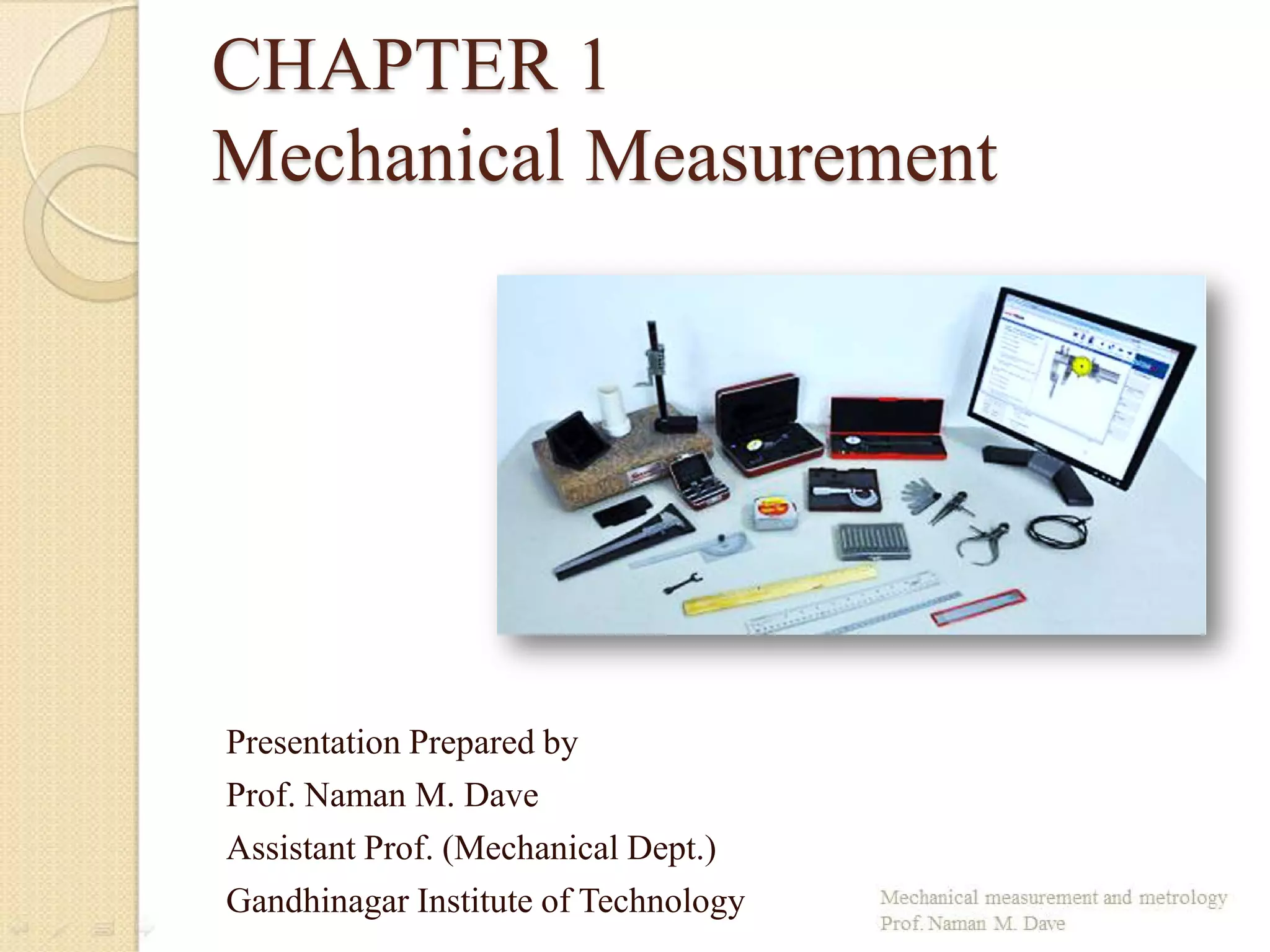
CHAPTER 1
Mechanical Measurement
Presentation Prepared by
Prof. Naman M. Dave
Assistant Prof. (Mechanical Dept.)
Gandhinagar Institute of Technology
Please refer this file just as
reference material. More
concentration should on class
room work and text book
methodology.
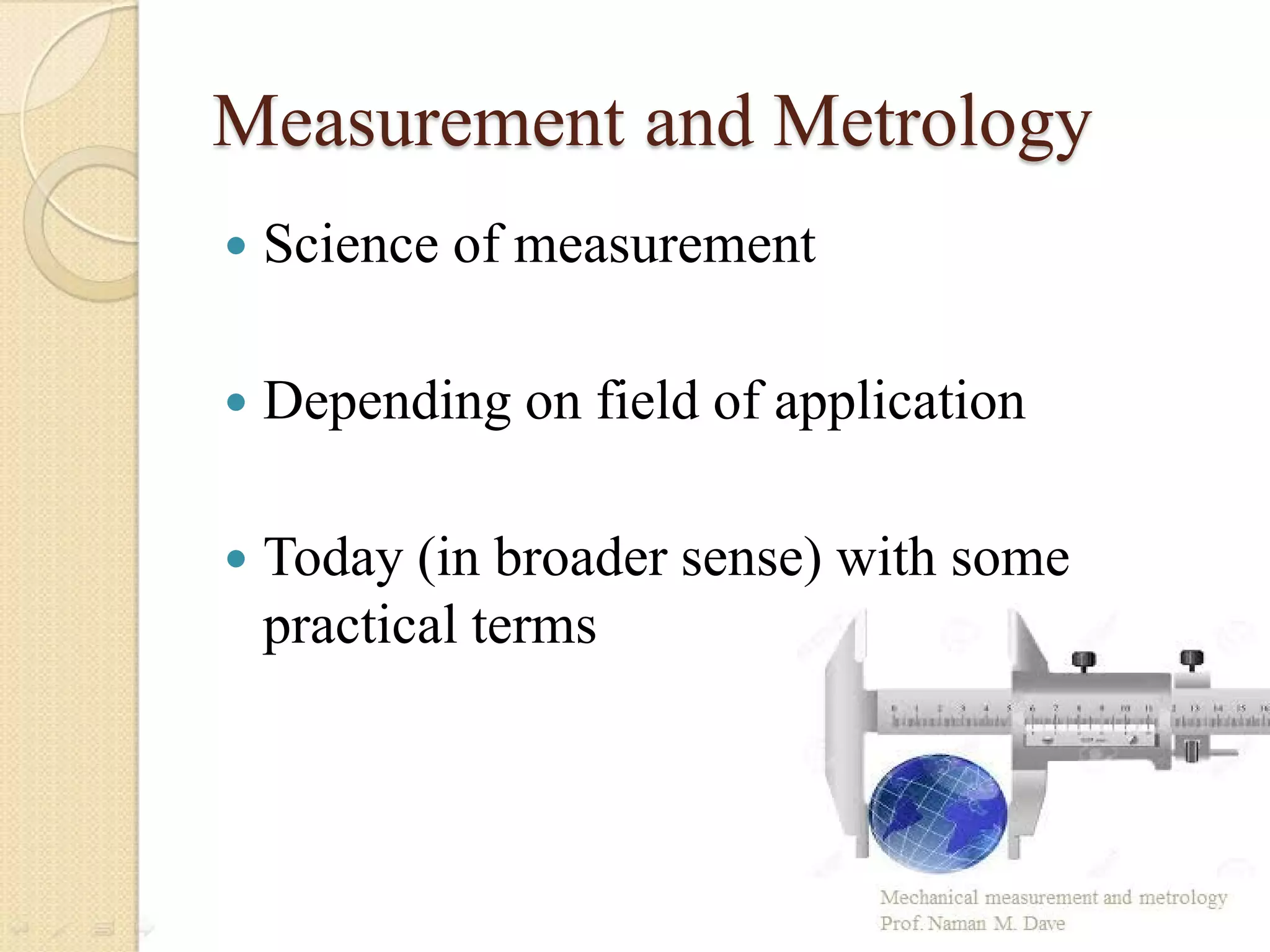
Measurement and Metrology
 Science of measurement
 Depending on field of application
 Today (in broader sense) with some
practical terms
Metrology
 Practical terms related with
measurement:
o Errors in measurements
o Methods of measurements
o Measuring Instruments
o Units of measurement and their standards
o Industrial inspection and its different
techniques
o Measuring instruments and accuracy
Needs of Measurement and
Metrology
 To ensure that the part to be measured conforms
to the established standard.
 To meet the interchangeability of manufacture.
 To provide customer satisfaction by ensuring that
no faulty product reaches the customers.
 To coordinate the functions of quality control,
production, procurement & other departments of
the organization.
 To judge the possibility of making some of the
defective parts acceptable after minor repairs.
Objectives of Measurement and
Metrology
 Although the basic objective of a measurement is to
provide the required accuracy at a minimum cost,
metrology has further objectives in a modem engineering
plant with different shapes which are:
 To minimize the cost of inspection by efficient and
effective use of available facilities,
 To minimize the cost of rejection and re-work through
application of statistical quality control techniques.
 To maintain the accuracies of measurement.
 To determine the process capabilities and ensure that
these are better than relevant component tolerances.
 To do complete evaluation of newly developed products.
Modes of Measurement
 Based upon the number of conversions, three
basic categories of measurements have been
developed.
 They are;
1. Primary measurement
2. Secondary measurement
3. Tertiary measurement
Modes of Measurement
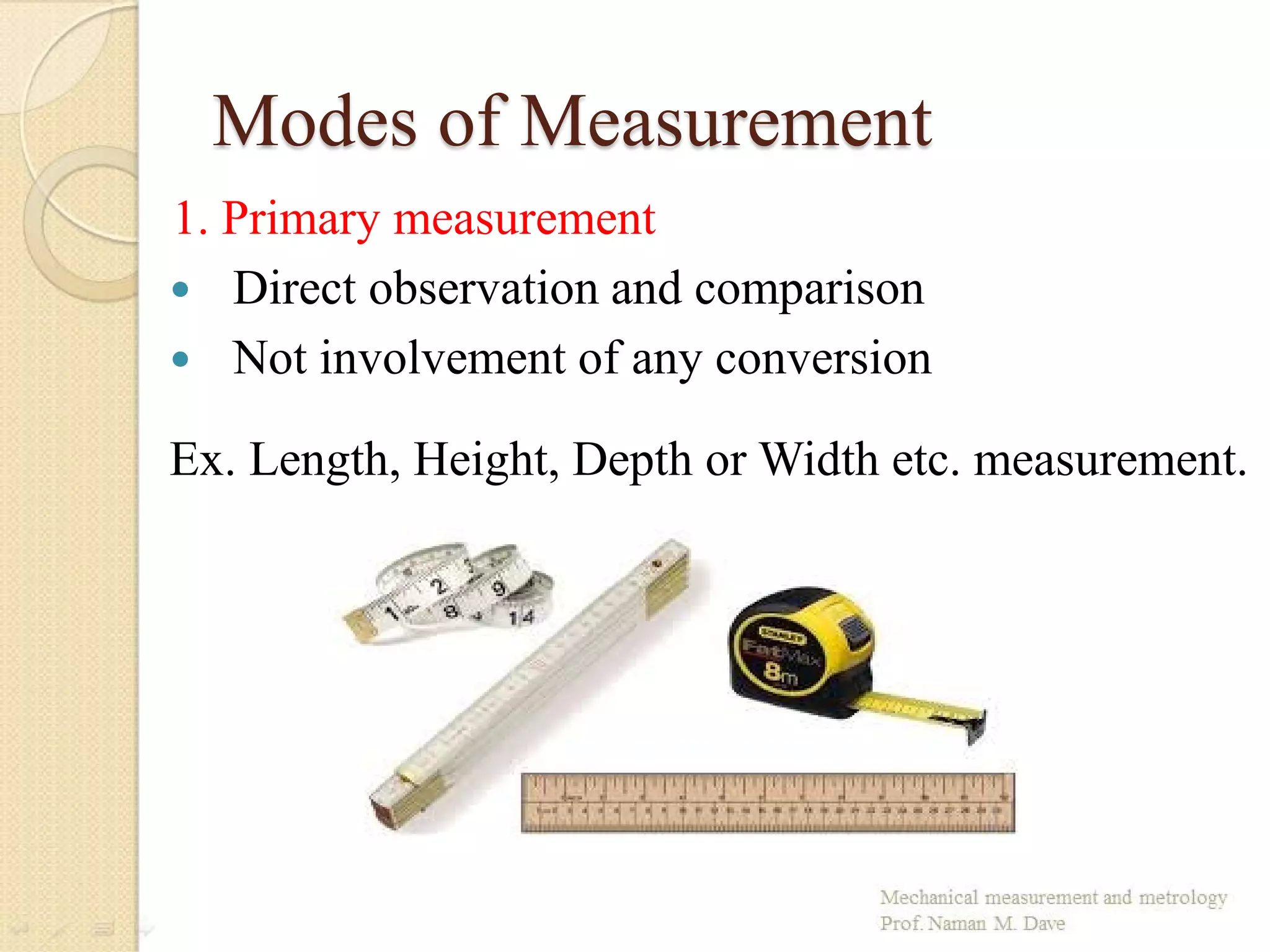
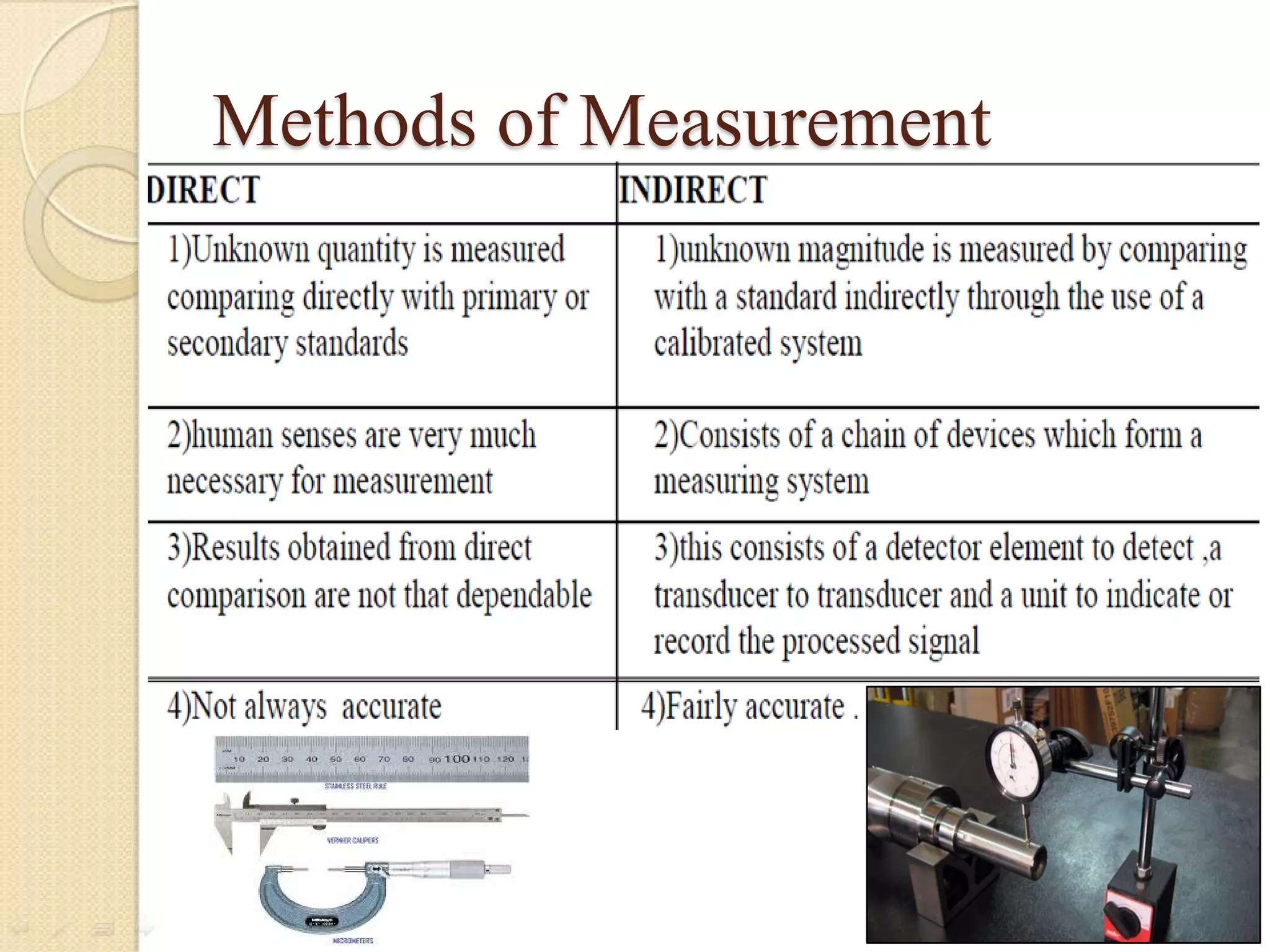
1. Primary measurement
 Direct observation and comparison
 Not involvement of any conversion
Ex. Length, Height, Depth or Width etc. measurement.
Modes of Measurement
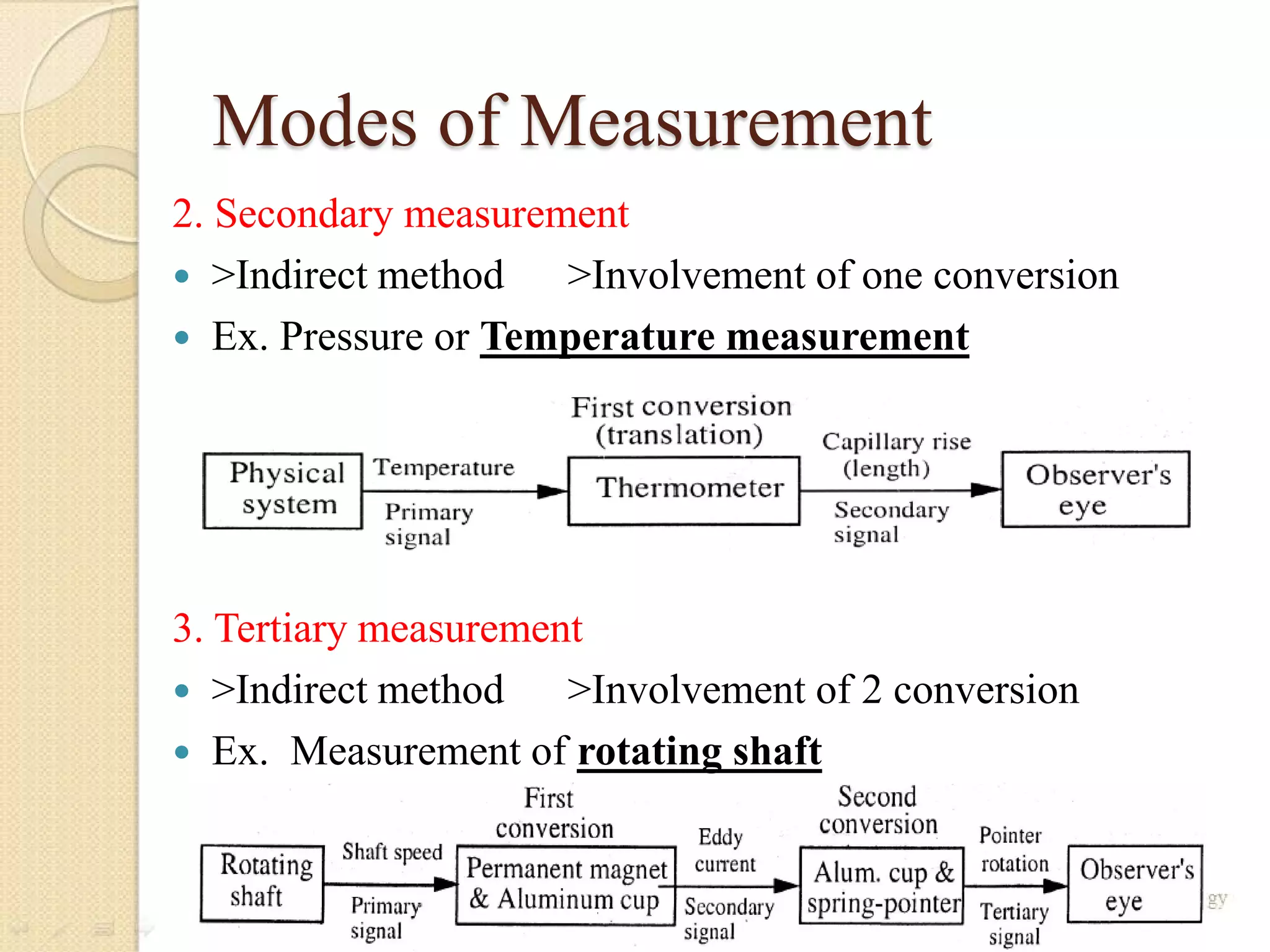
2. Secondary measurement
 >Indirect method >Involvement of one conversion
 Ex. Pressure or Temperature measurement
3. Tertiary measurement
 >Indirect method >Involvement of 2 conversion
 Ex. Measurement of rotating shaft
Methods of Measurement
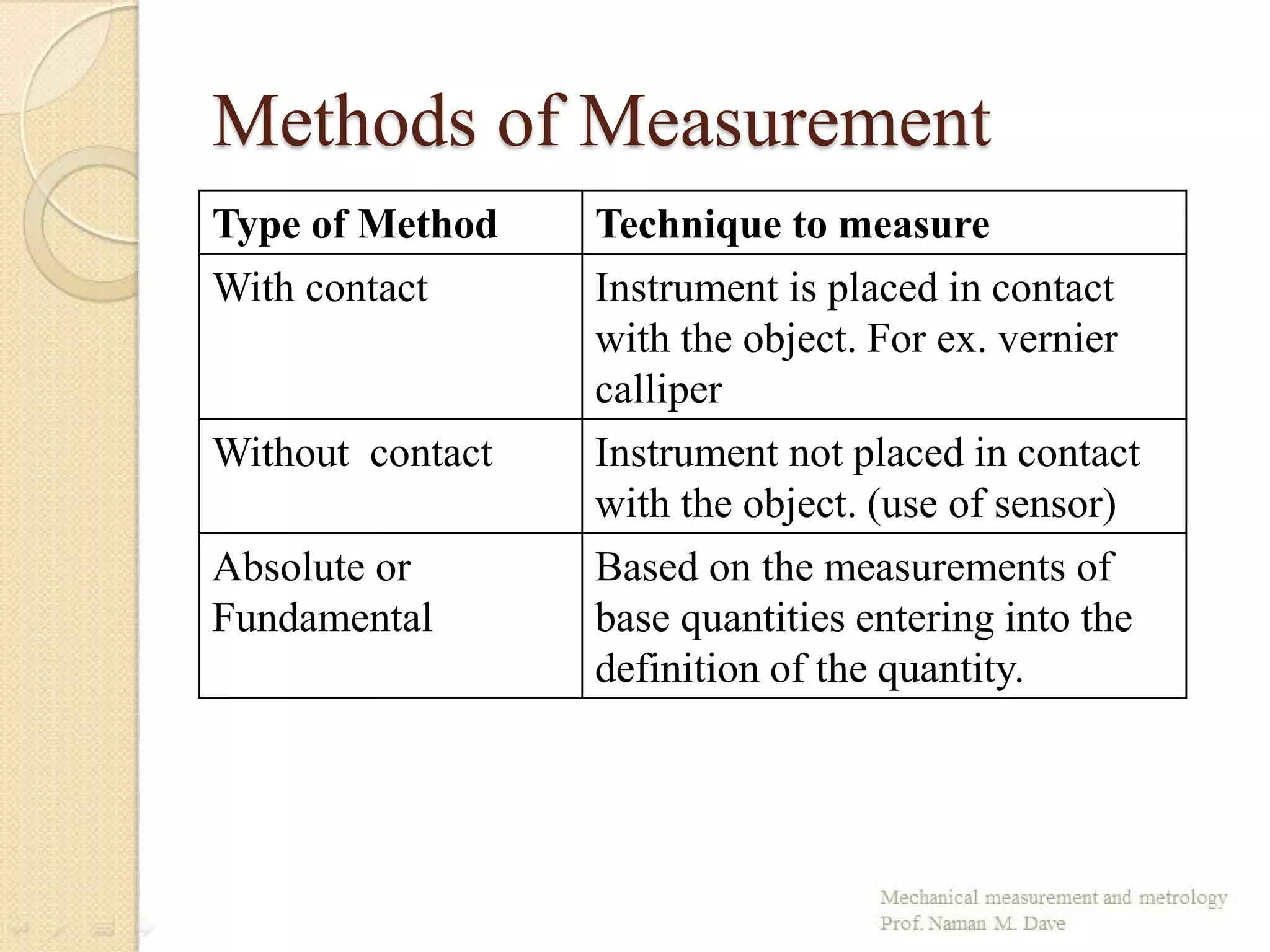
Type of Method Technique to measure
With contact Instrument is placed in contact
with the object. For ex. vernier
calliper
Without contact Instrument not placed in contact
with the object. (use of sensor)
Absolute or
Fundamental
Based on the measurements of
base quantities entering into the
definition of the quantity.
Methods of Measurement
Type of Method Technique to measure
Comparative Based on the comparison of the
value of a quantity to be
measured with a known value of
the same quantity.
Null measurement Here, difference between
measurand value and known
value of same quantity with
which it is compared is brought to
zero.
Methods of Measurement
Type of Method Technique to measure
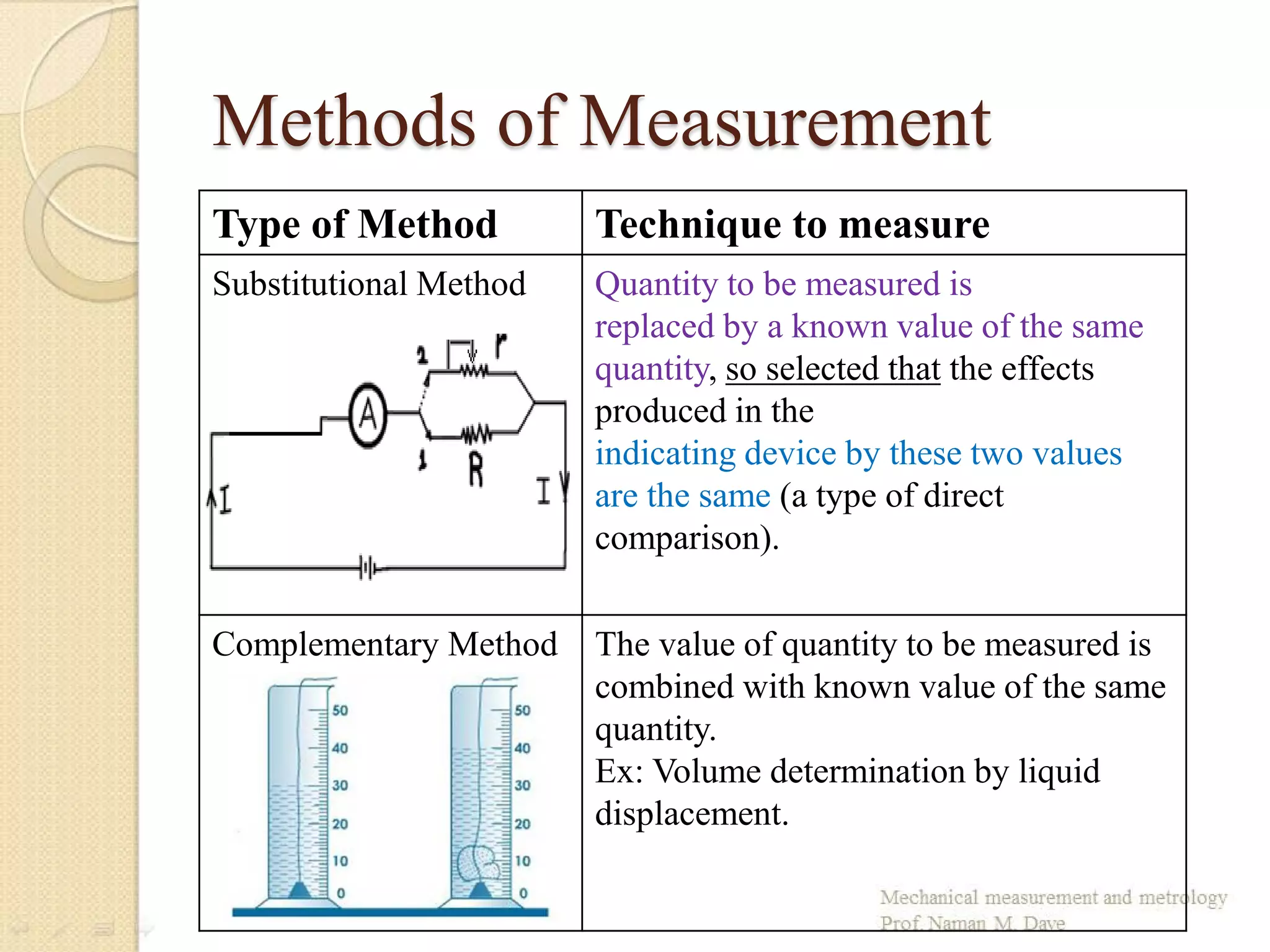
Substitutional Method Quantity to be measured is
replaced by a known value of the same
quantity, so selected that the effects
produced in the
indicating device by these two values
are the same (a type of direct
comparison).
Complementary Method The value of quantity to be measured is
combined with known value of the same
quantity.
Ex: Volume determination by liquid
displacement.
Methods of Measurement
Type of Method Technique to measure
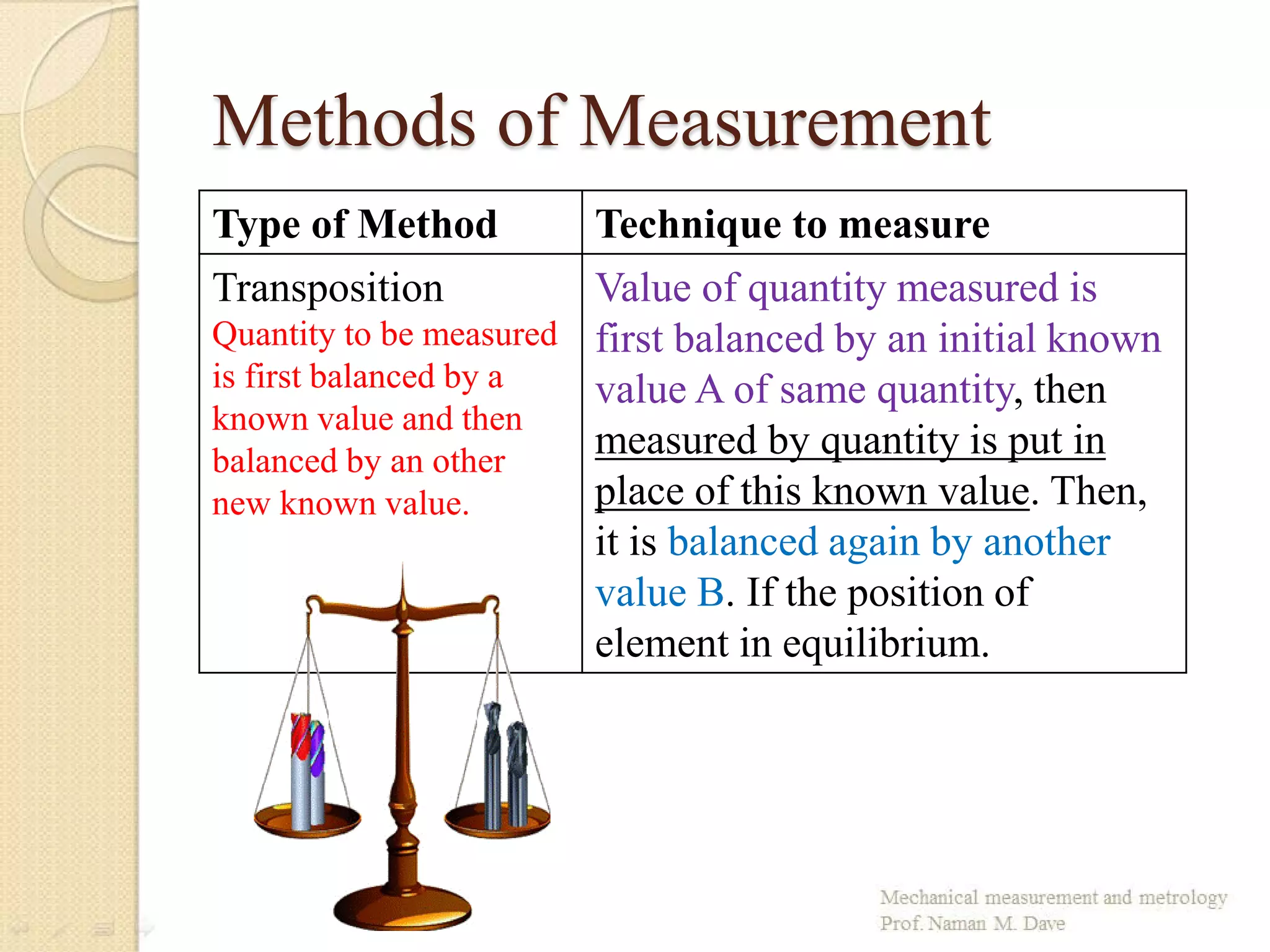
Transposition
Quantity to be measured
is first balanced by a
known value and then
balanced by an other
new known value.
Value of quantity measured is
first balanced by an initial known
value A of same quantity, then
measured by quantity is put in
place of this known value. Then,
it is balanced again by another
value B. If the position of
element in equilibrium.
Methods of Measurement
Type of Method Technique to measure
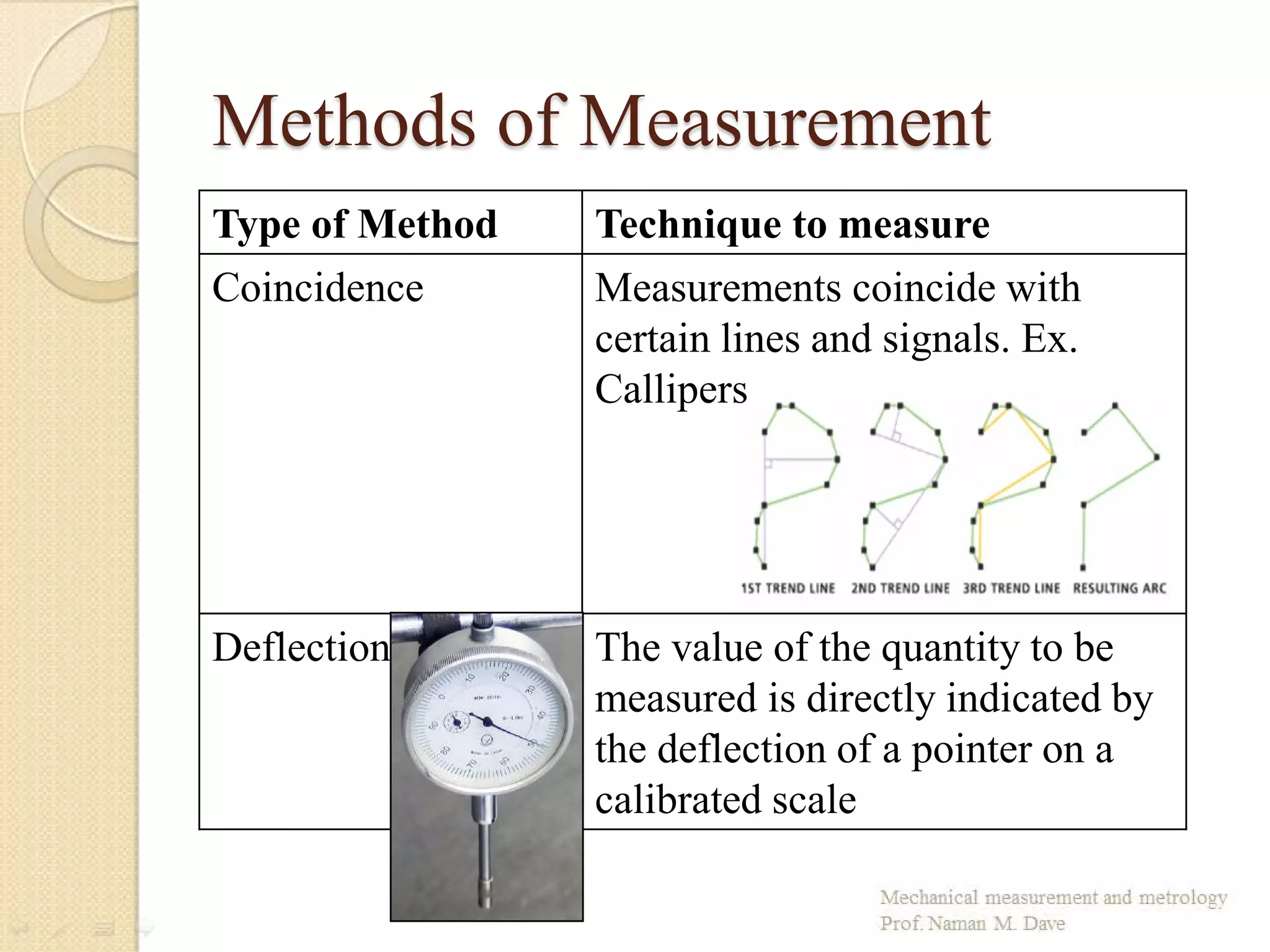
Coincidence Measurements coincide with
certain lines and signals. Ex.
Callipers
Deflection The value of the quantity to be
measured is directly indicated by
the deflection of a pointer on a
calibrated scale
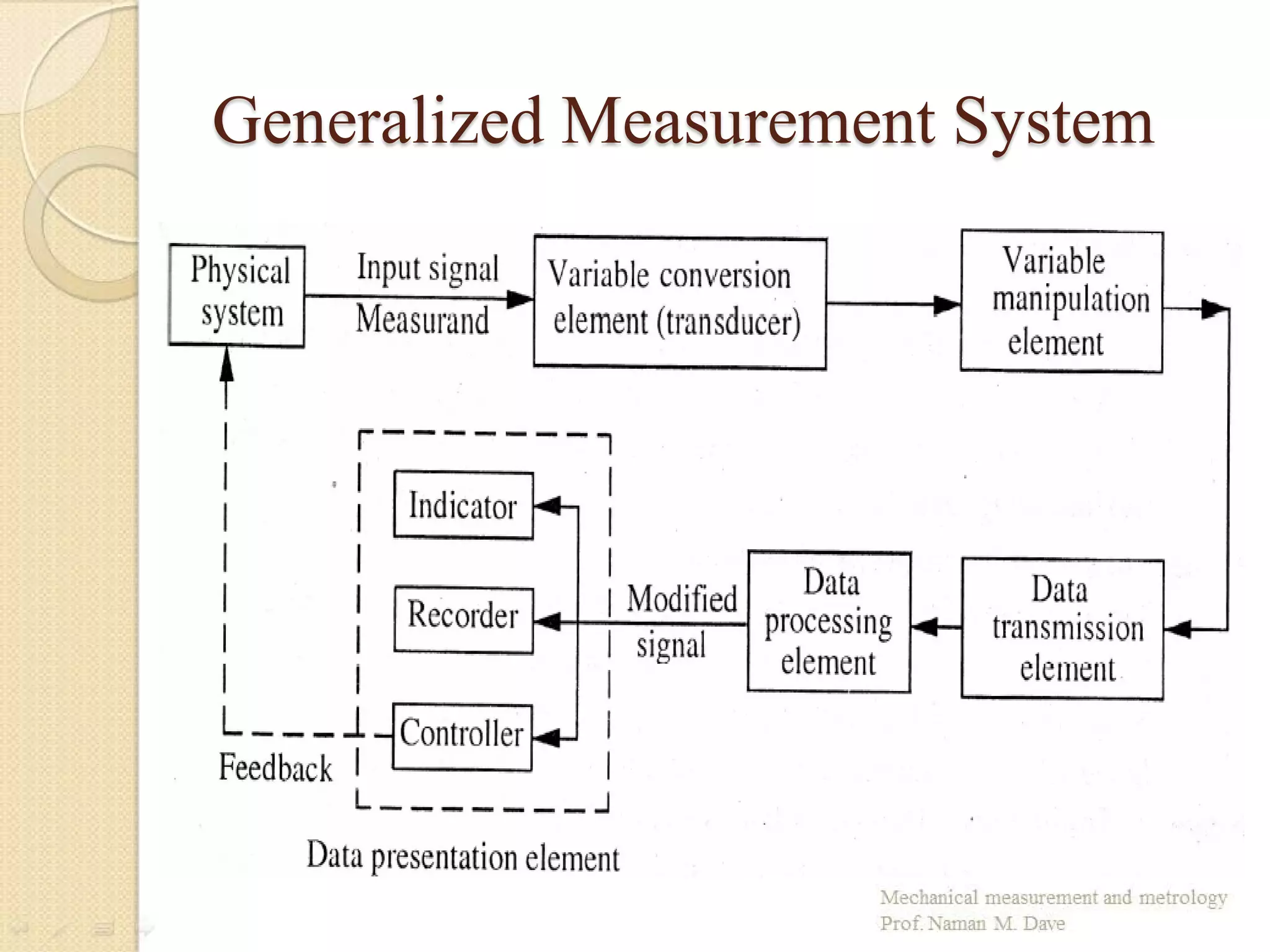
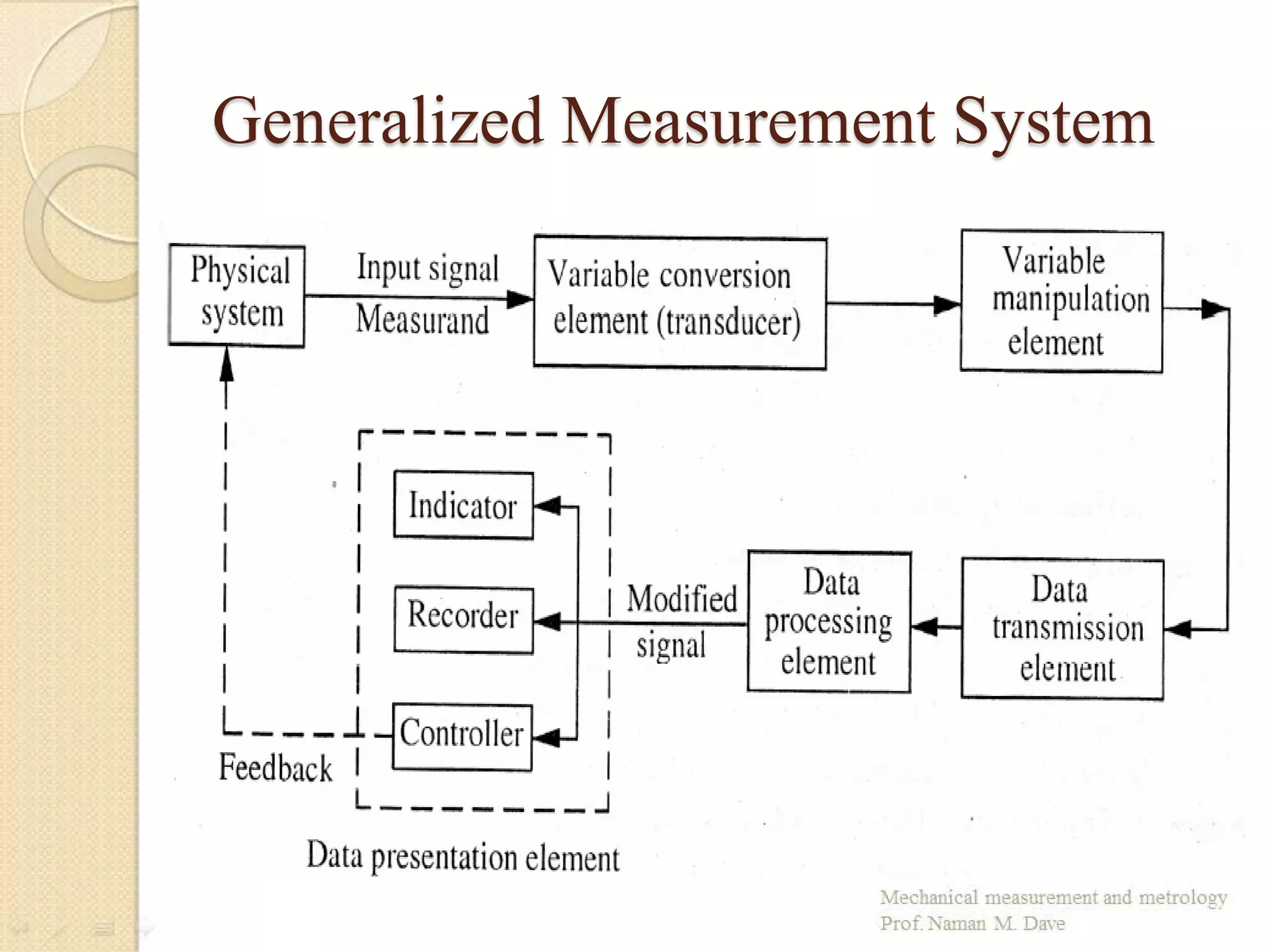
Generalized Measurement System
Elements of measuring system
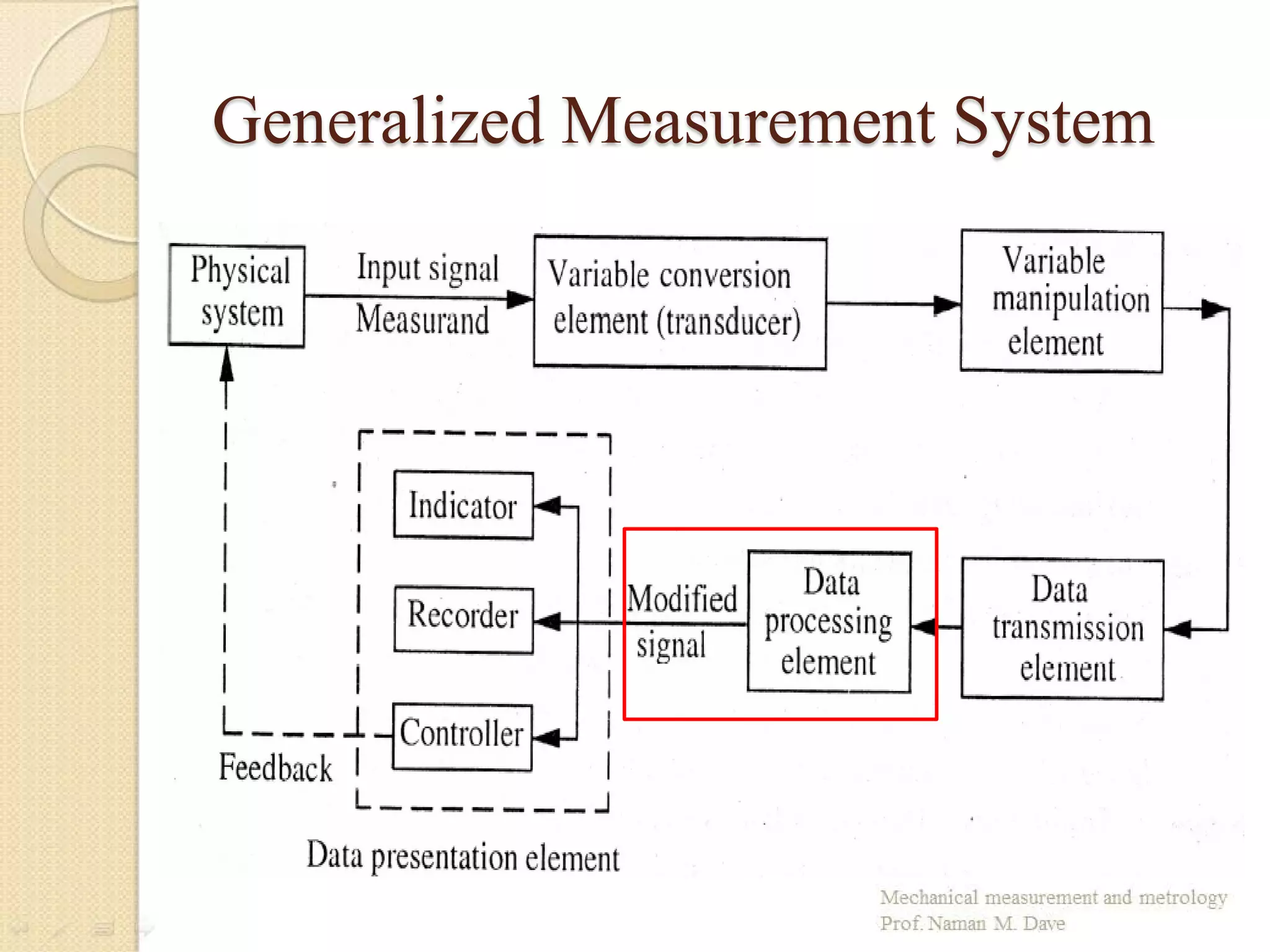
1. Primary sensing element
 Quantity under measurement makes its first
contact with primary sensing element.
 Sense the condition, state or value of the process
variable by extracting a small part of energy
from the measurand,
 and then produce an output which reflects this
condition, state or value of measurand.
Generalized Measurement System
Elements of measuring system
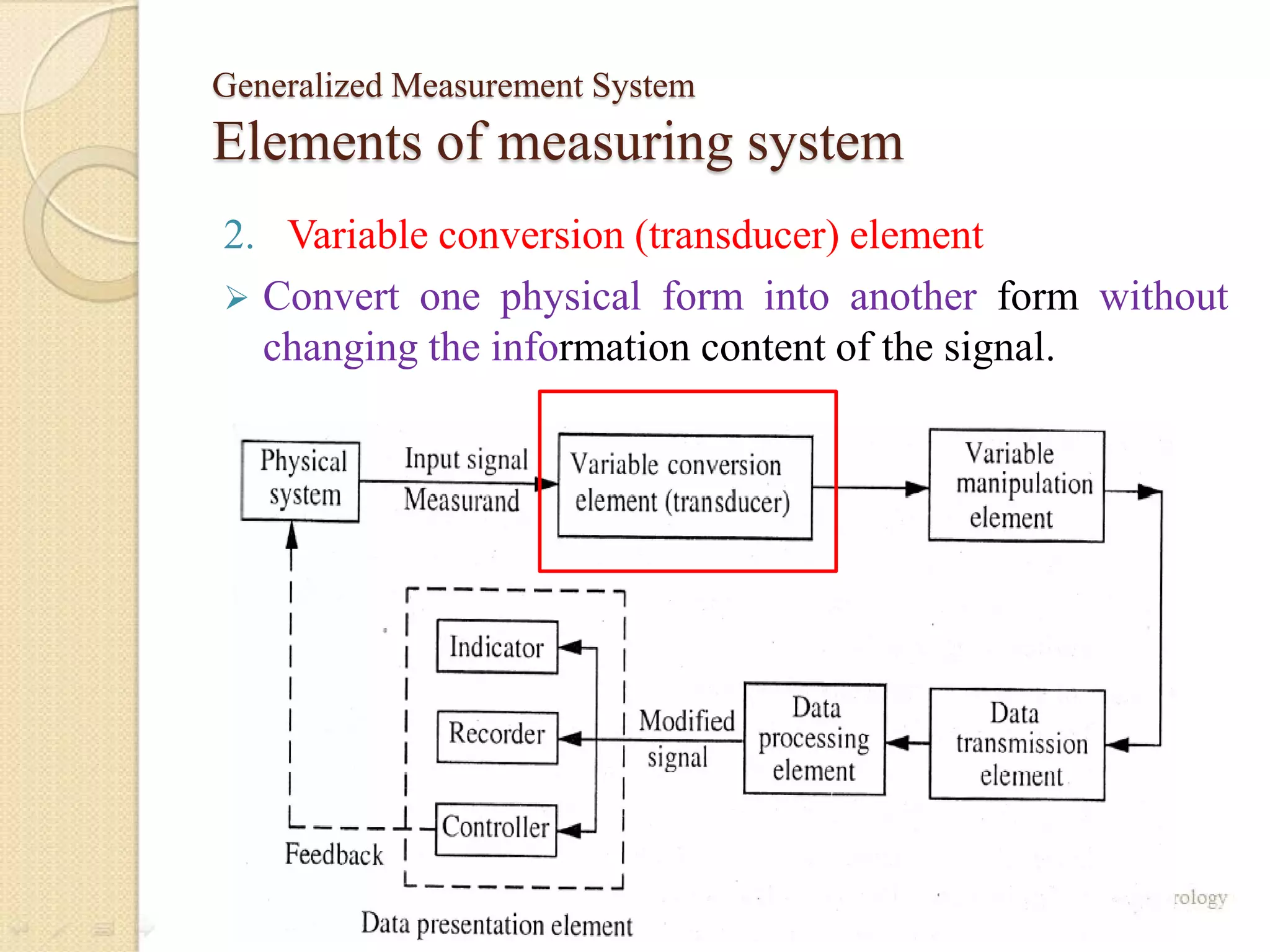
2. Variable conversion (transducer) element
 Convert one physical form into another form without
changing the information content of the signal.
Generalized Measurement System
Elements of measuring system
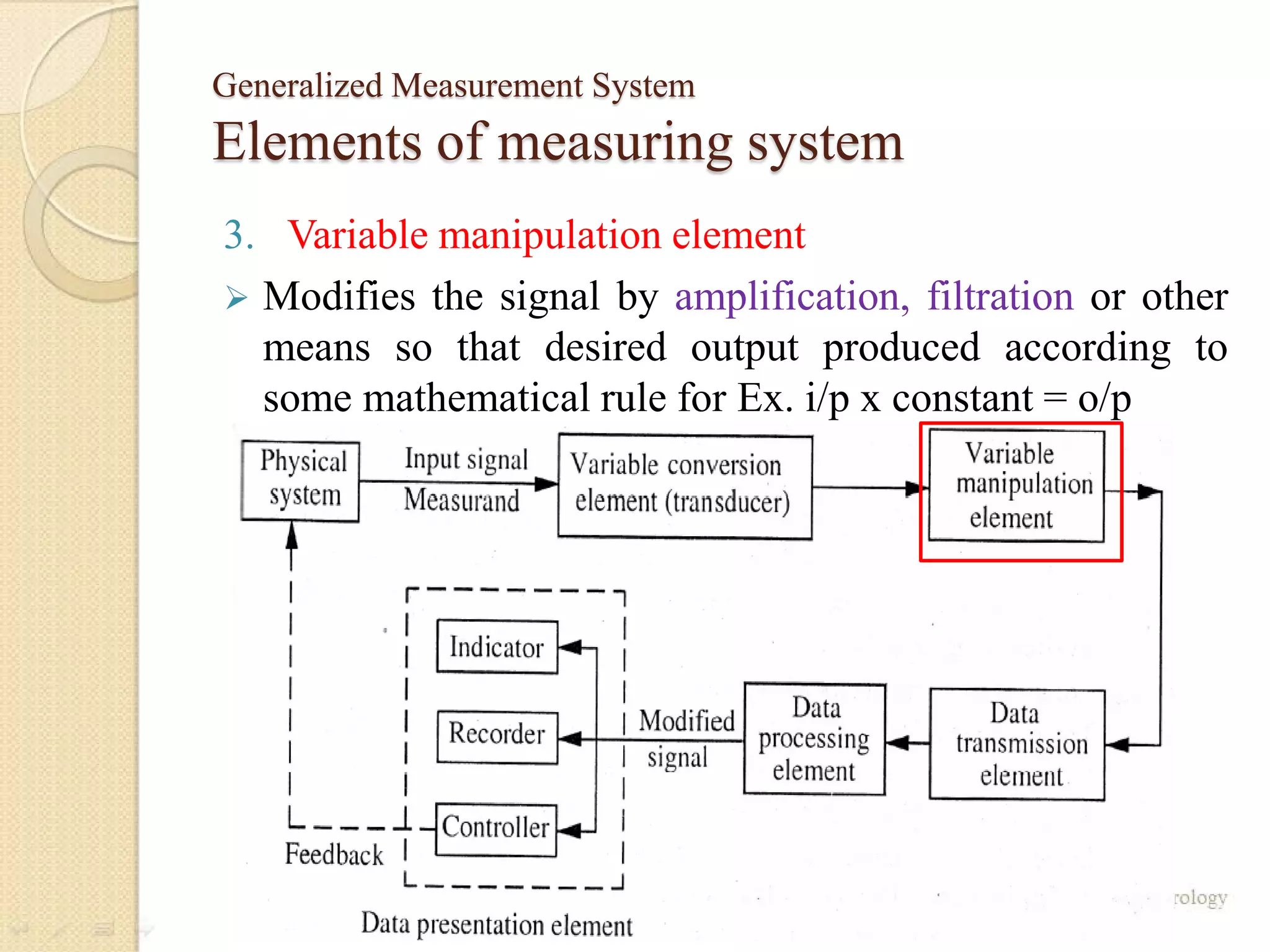
3. Variable manipulation element
 Modifies the signal by amplification, filtration or other
means so that desired output produced according to
some mathematical rule for Ex. i/p x constant = o/p
Generalized Measurement System
Elements of measuring system
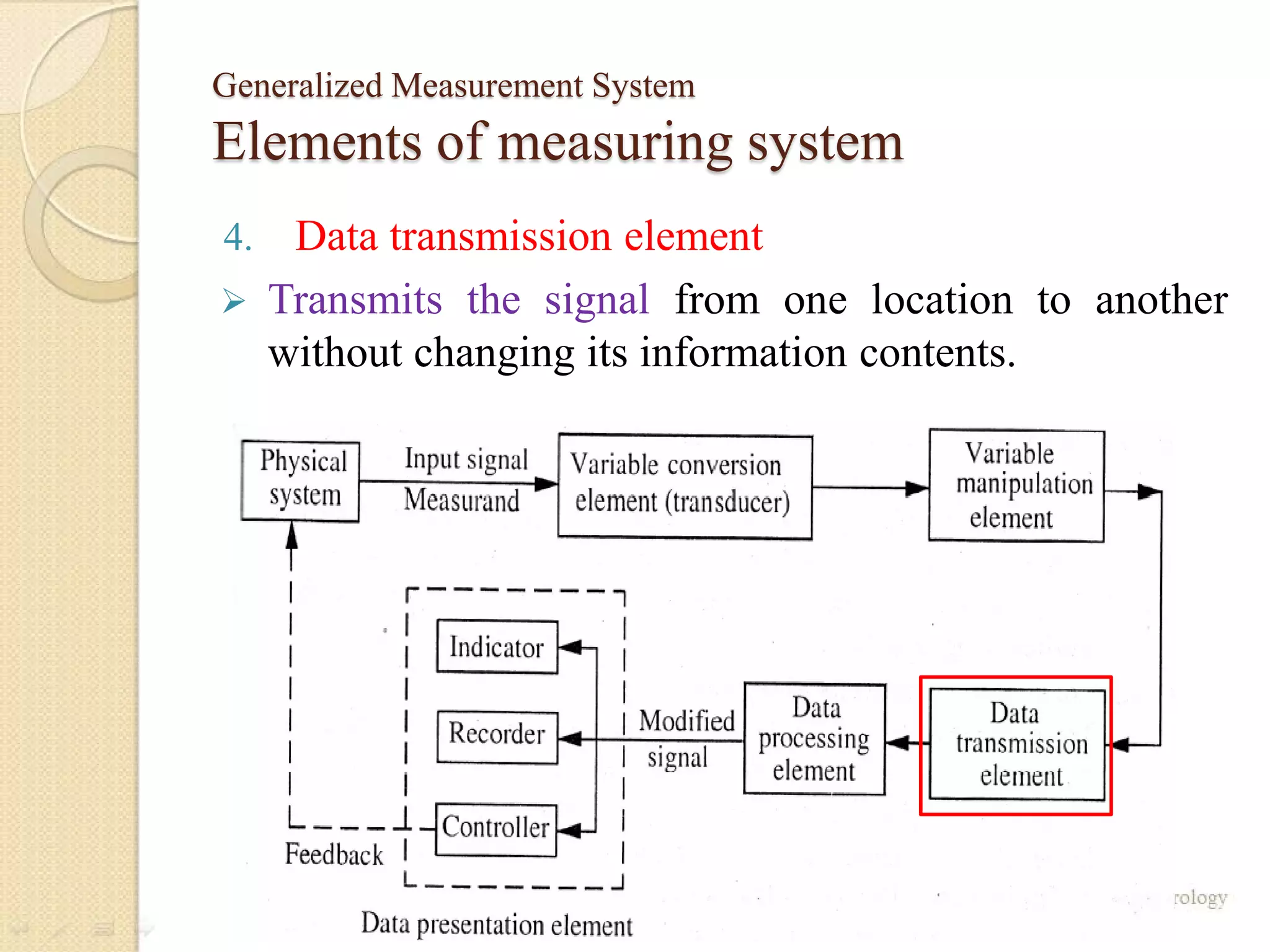
4. Data transmission element
 Transmits the signal from one location to another
without changing its information contents.
Generalized Measurement System
Elements of measuring system
5. Data processing element
 modifies the data before it displayed or finally
recorded
• perform mathematical operation such as addition,
subtraction, multiplication, division, etc.
• to calculate average, statistical and logarithmic values
• to convert data into desired form.
• to separate undesired signal from output signal.
• to provide correction on the output signal.
Generalized Measurement System
Elements of measuring system
6. Data presentation elements
 Provides a record or indication of the output
(i) Transmitting information (measured quantity) to
another location or devices.
(ii) Signaling : To give a signal that the pre-defined
value has been reached.
(iii) Recording : To produce a continuous record of
measured quantity in written form.
(iv) Indicating : To indicate the specific value on
calibrated scale.
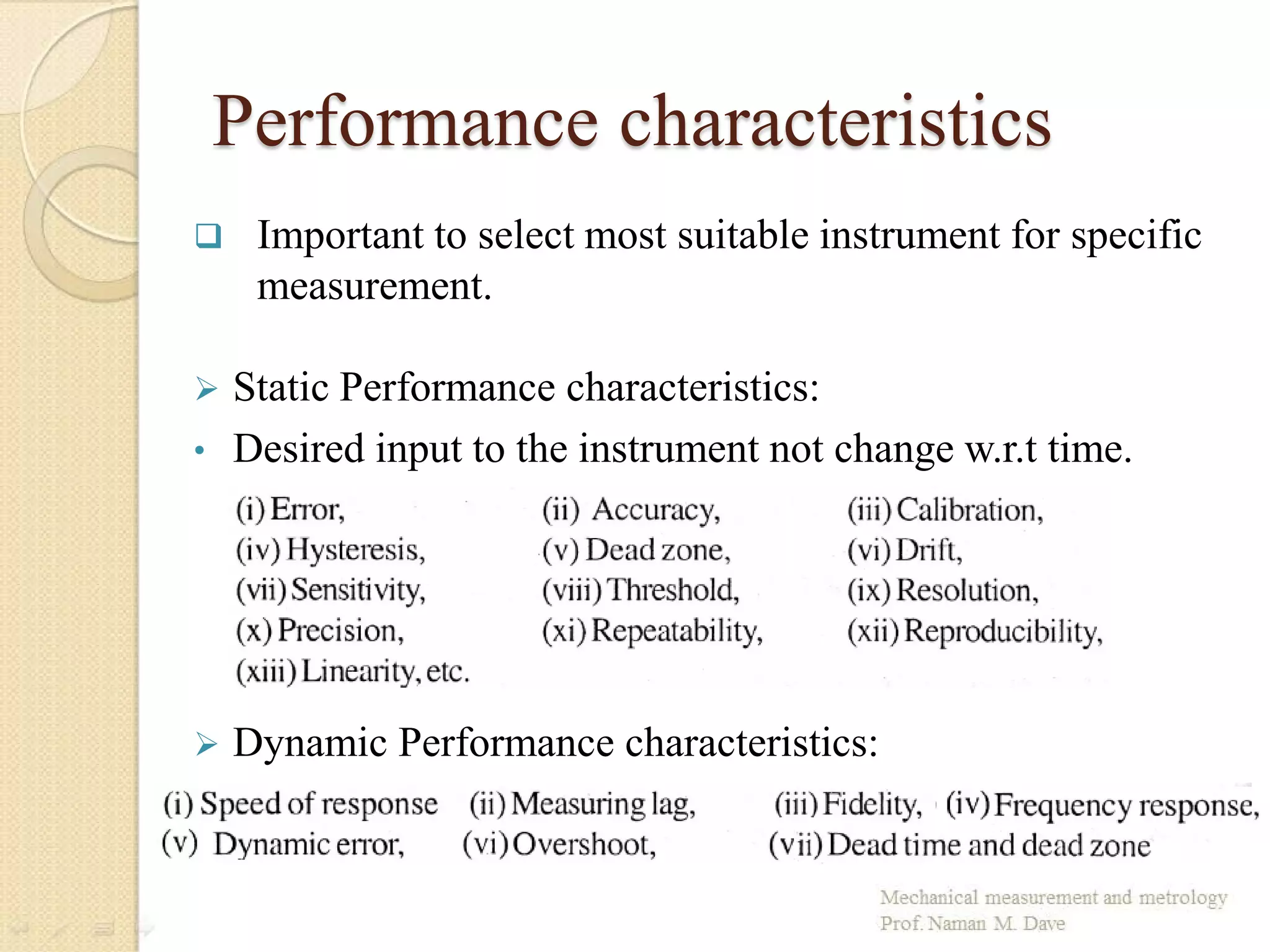
Performance characteristics
 Important to select most suitable instrument for specific
measurement.
 Static Performance characteristics:
• Desired input to the instrument not change w.r.t time.
 Dynamic Performance characteristics:
Static Performance characteristics
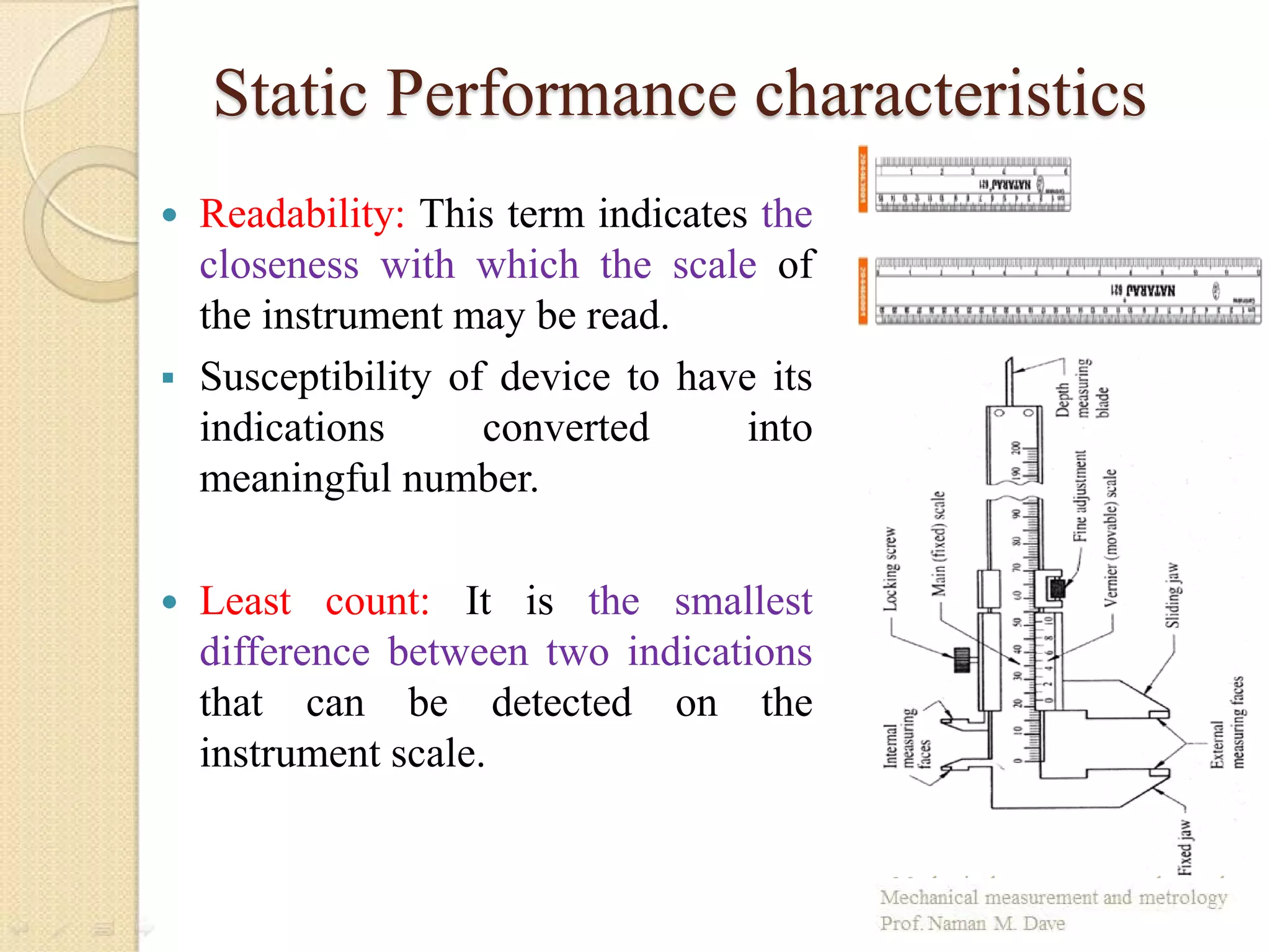
 Readability: This term indicates the
closeness with which the scale of
the instrument may be read.
 Susceptibility of device to have its
indications converted into
meaningful number.
 Least count: It is the smallest
difference between two indications
that can be detected on the
instrument scale.
Static Performance characteristics
 Range: It represents the highest possible value that can be
measured by an instrument or limits within which
instrument is designed to operate.
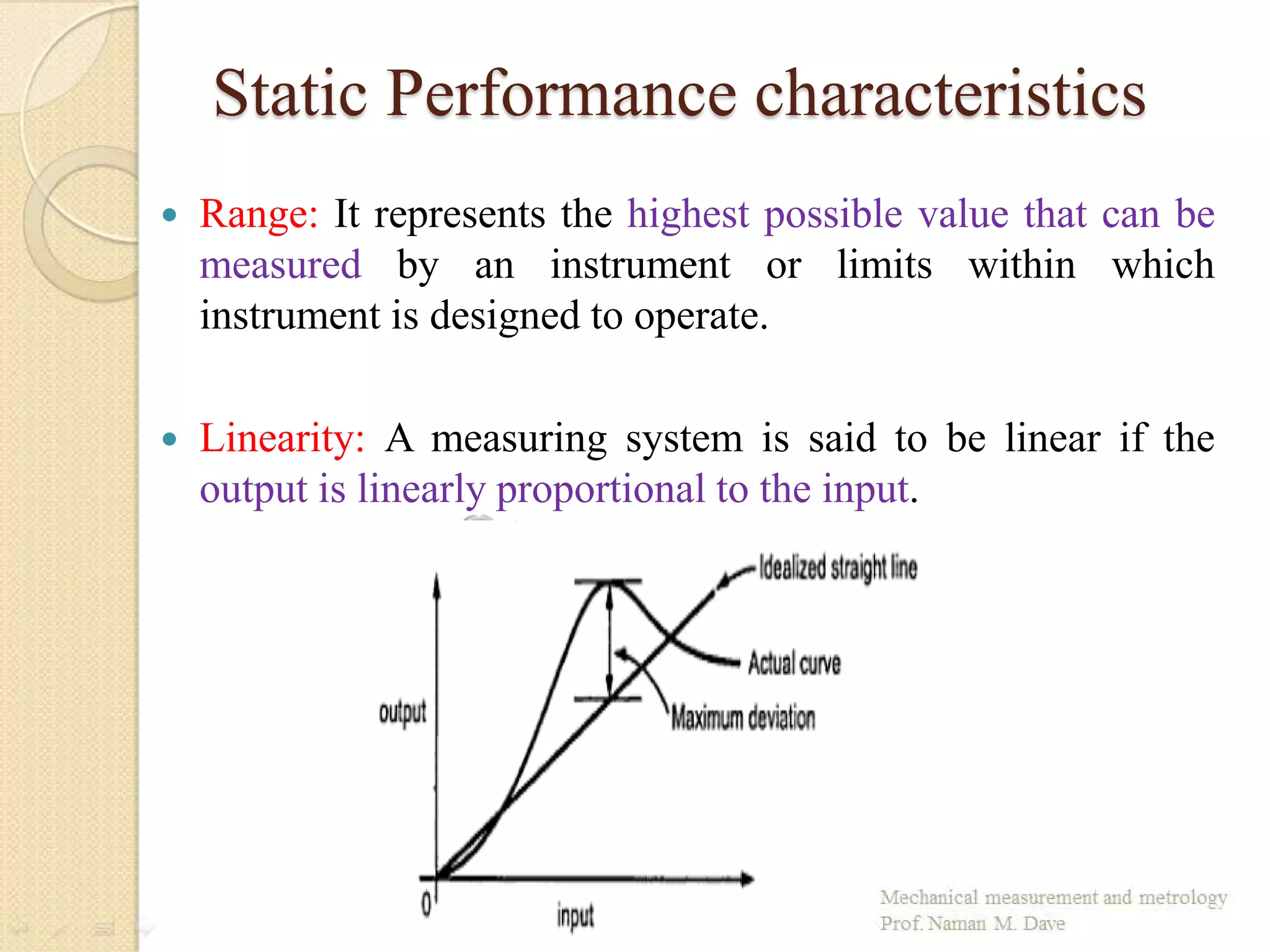
 Linearity: A measuring system is said to be linear if the
output is linearly proportional to the input.
Static Performance characteristics
 Repeatability: It is defined as the ability of a measuring
system to repeat output readings when the same input is
applied to it consecutively, under the same conditions, and
in the same direction.
 Reproducibility: It is defined as the degree of closeness
with which the same value of a variable may be measured
at different times.
 System response: Response of a system may be defined as
the ability of the system to transmit & present all the
relevant information contained in the input signal.
Static Performance characteristics
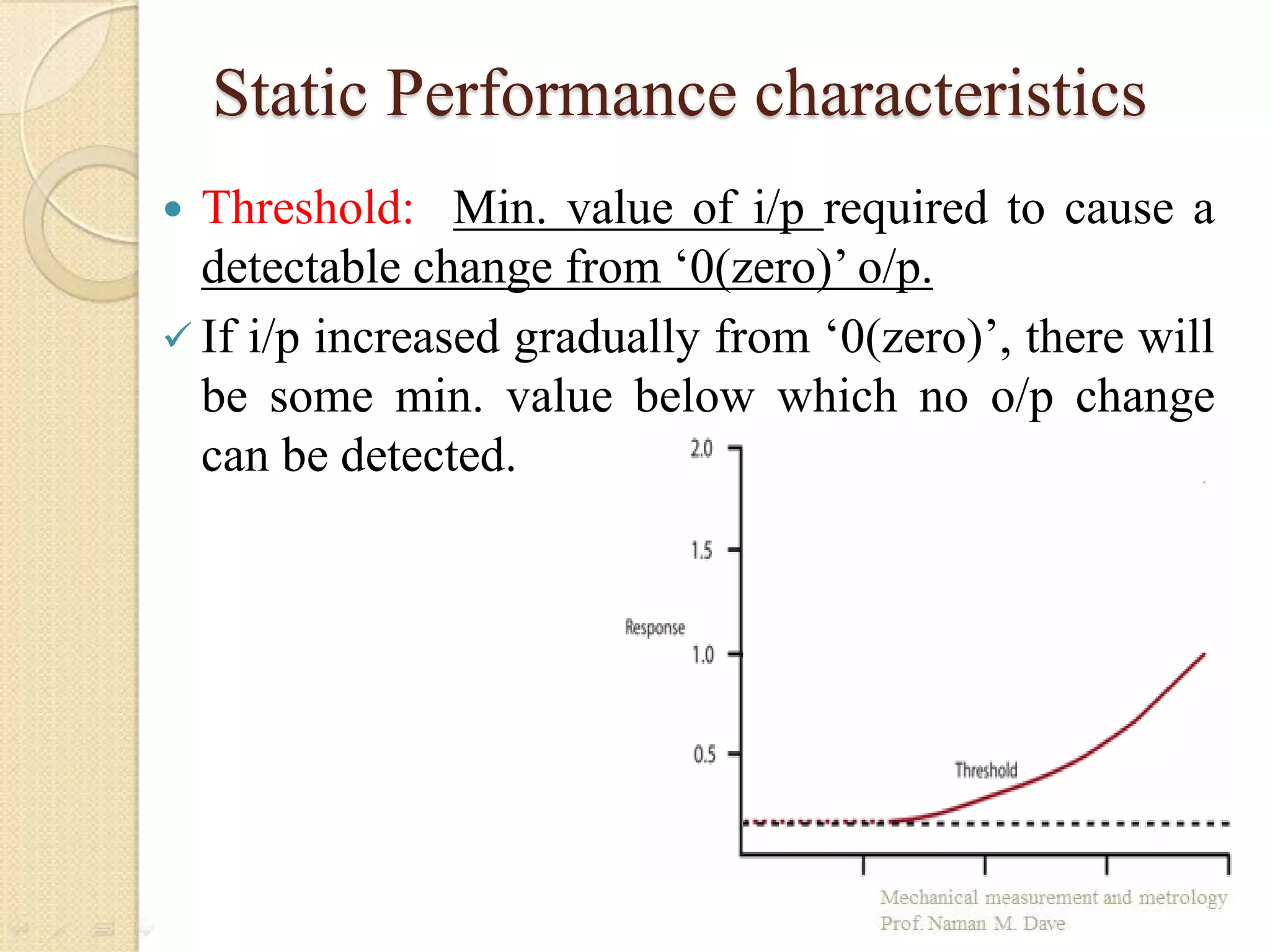
 Threshold: Min. value of i/p required to cause a
detectable change from ‘0(zero)’ o/p.
 If i/p increased gradually from ‘0(zero)’, there will
be some min. value below which no o/p change
can be detected.
Static Performance characteristics
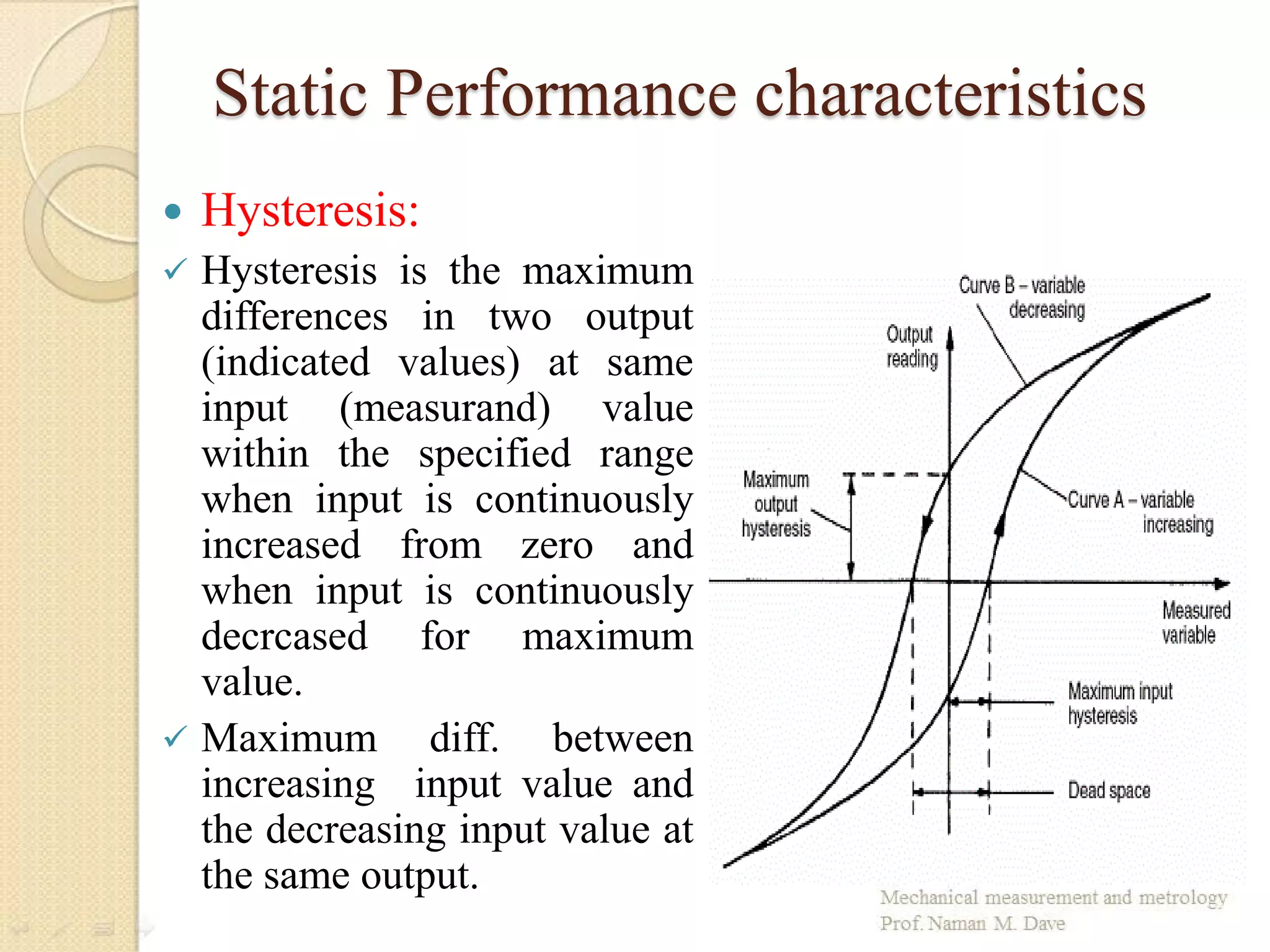
 Hysteresis:
 Hysteresis is the maximum
differences in two output
(indicated values) at same
input (measurand) value
within the specified range
when input is continuously
increased from zero and
when input is continuously
decrcased for maximum
value.
 Maximum diff. between
increasing input value and
the decreasing input value at
the same output.
Static Performance characteristics
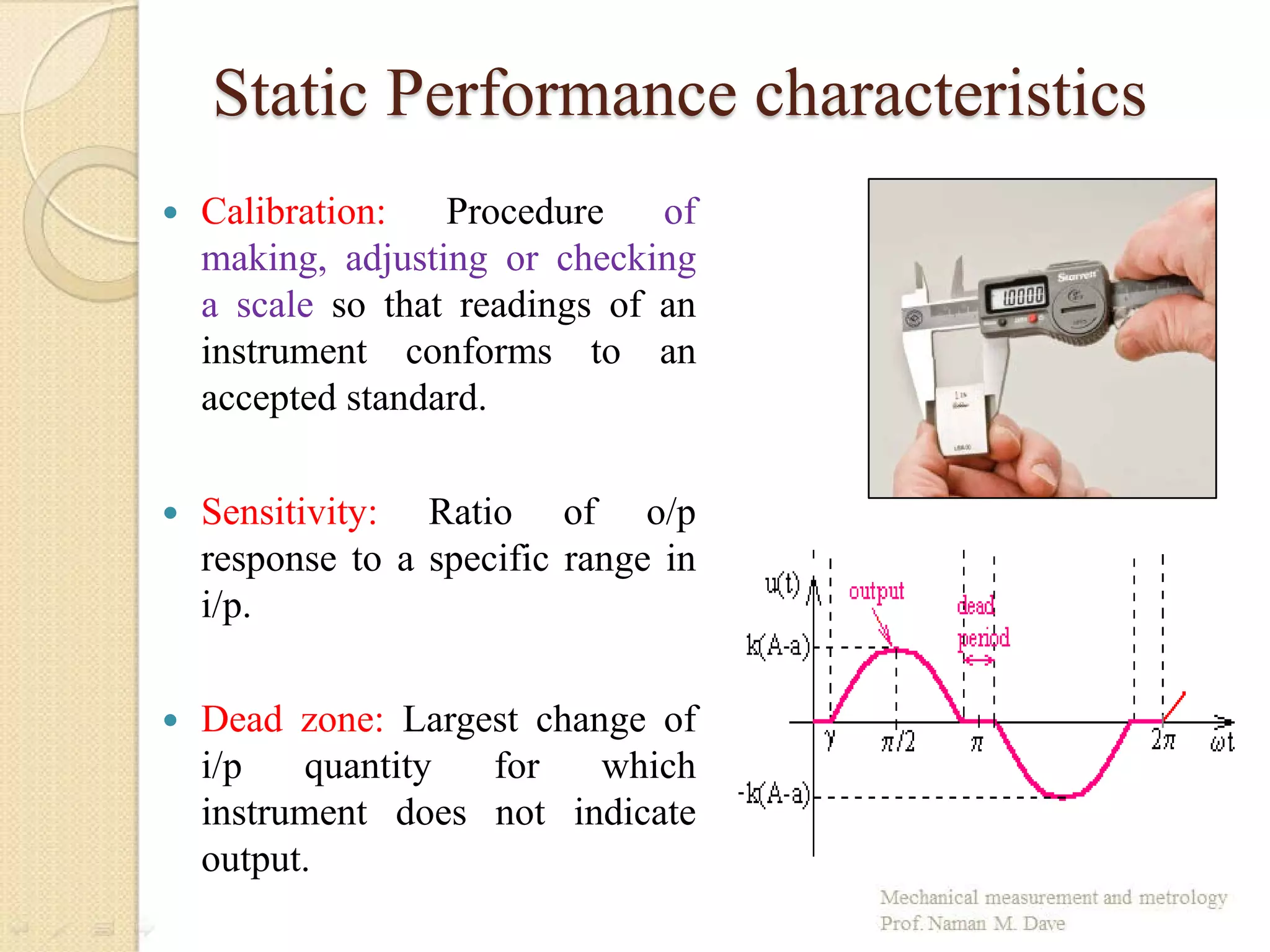
 Calibration: Procedure of
making, adjusting or checking
a scale so that readings of an
instrument conforms to an
accepted standard.
 Sensitivity: Ratio of o/p
response to a specific range in
i/p.
 Dead zone: Largest change of
i/p quantity for which
instrument does not indicate
output.
Static Performance characteristics
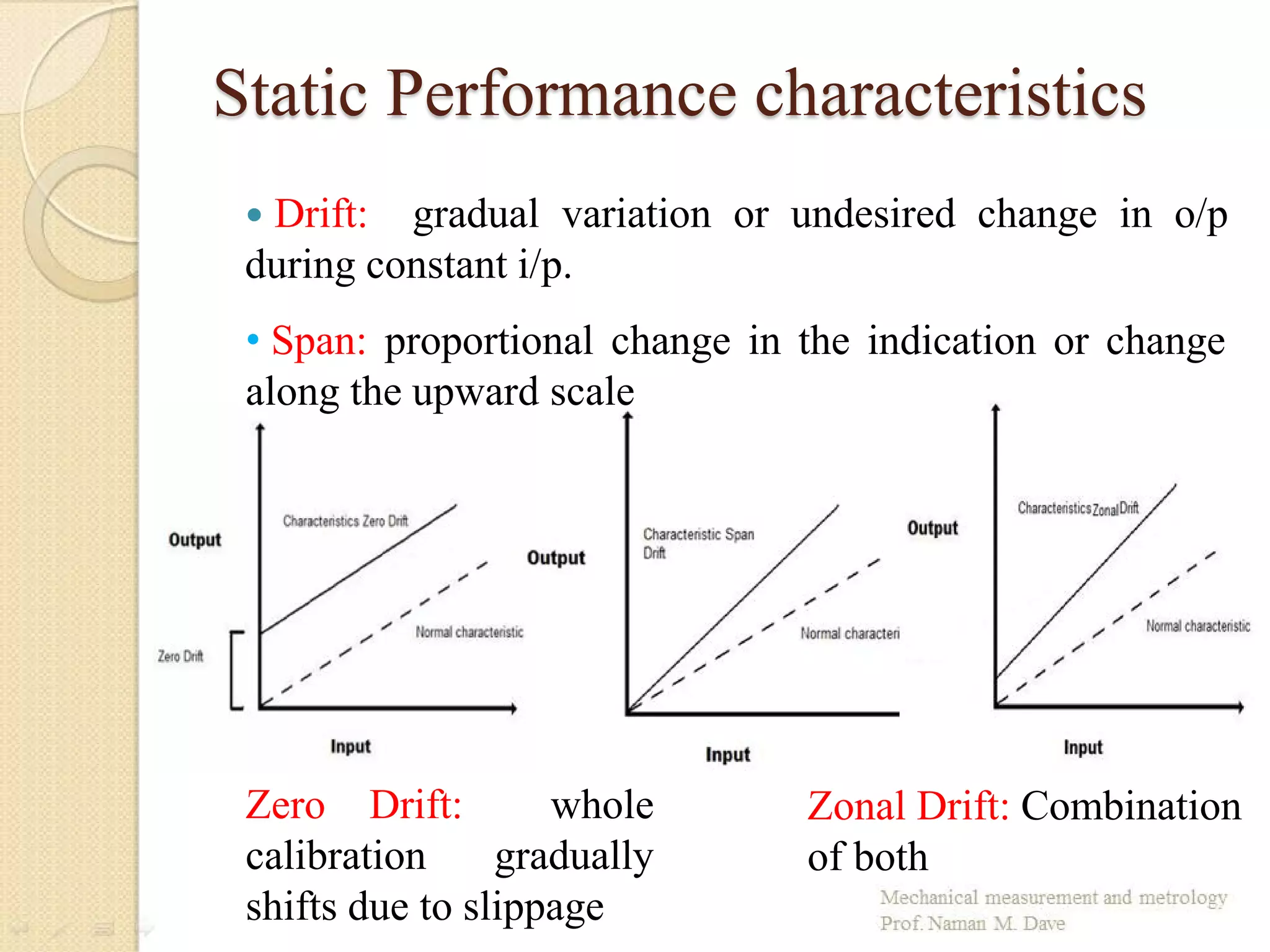
 Drift: gradual variation or undesired change in o/p
during constant i/p.
Zonal Drift: Combination
of both
Zero Drift: whole
calibration gradually
shifts due to slippage
• Span: proportional change in the indication or change
along the upward scale
Static Performance characteristics
 Loading effect:
Any instrument, invariably extracts energy from
system, the original signal should remain
undistorted. This is incapability of system to
faithfully measure signal in undistorted form.
Static Performance characteristics
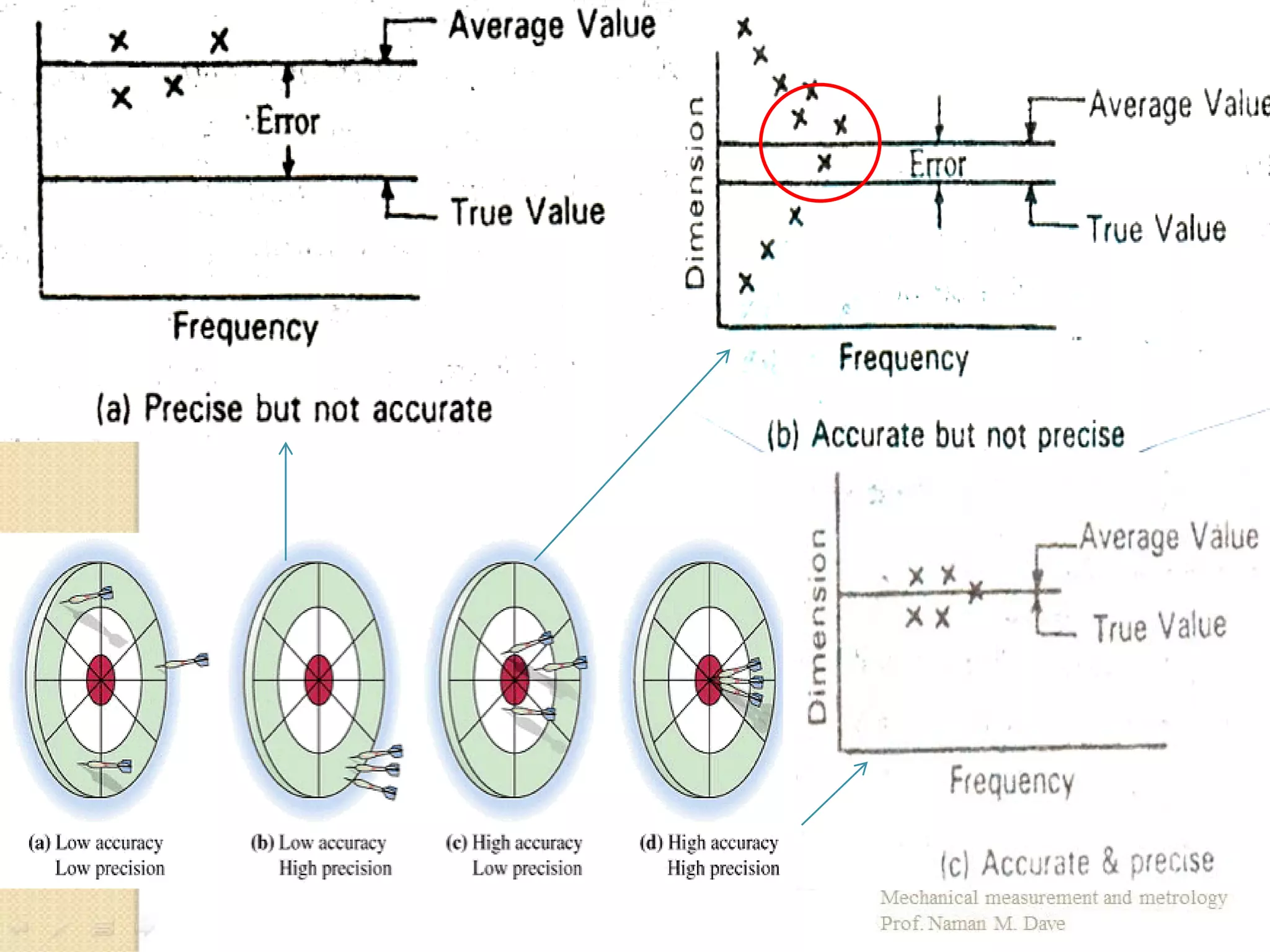
 Accuracy: It is degree to which the measured
value agrees with true value. Max. amount by
which result differs from the true value.
 Precision: It is repeatability or reproducibility of
the measurement. If instrument is not precise,
great difference in dimension measured again
and again.
Measurement Errors
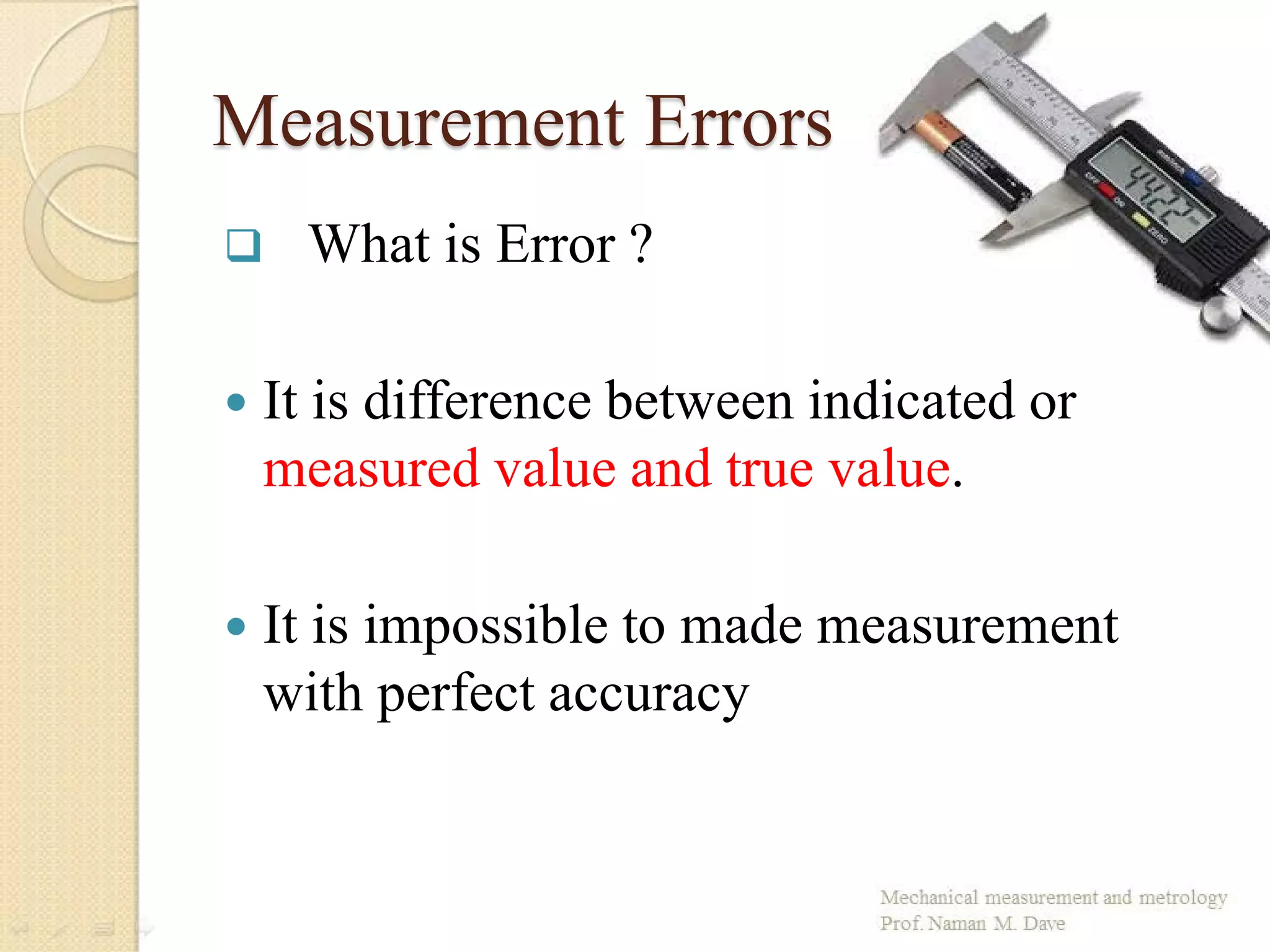
 What is Error ?
 It is difference between indicated or
measured value and true value.
 It is impossible to made measurement
with perfect accuracy
Measurement Errors
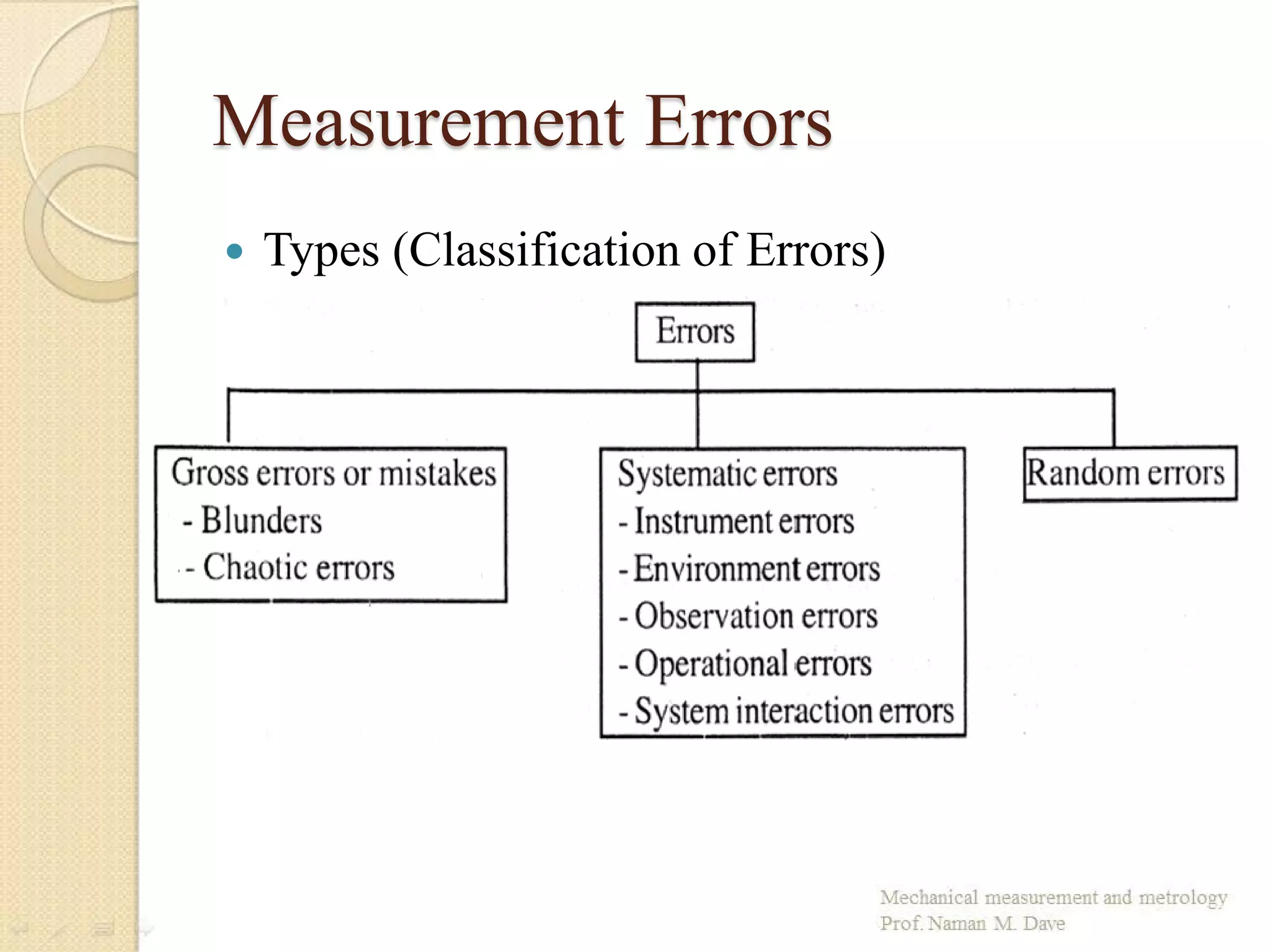
 Types (Classification of Errors)
Measurement Errors
 Gross errors
• Human mistakes
• Careless readings, mistake in recordings,
• improper application of instrument
• Can not treated mathematically
• Can be avoided only by taking care in reading
and recording
Measurement Errors
 Systematic error
• Have definite magnitude and direction.
• Can be repeated consistently with repetition of
experiments.
• To locate these errors: repeated measurements
under different conditions or with different
equipment or possible by an entirely different
methods.
Measurement Errors
 Instrumental error
 Due to design or construction /assembly of
instruments
 Limiting accuracy
 Improper selection of instrument
 Poor maintenance
 For Ex. Errors due to friction, wear, slips,
vibration
 Errors due to incorrect fitting of scale at zero,
non-uniform division of scale, bent pointer.
Measurement Errors
 Operational error
 Misuse of instrument
 Poor operational techniques
 For Ex. Errors in flow measurement if flow-
meter is placed immediately after a valve or
a bend.
Measurement Errors
 Environmental errors
 due to conditions external to the measuring
instrument, including conditions in the area
surrounding the instrument,
 such as effects of change in temperature,
humidity, barometric pressure, or magnetic
or electrostatic fields.
 For ex. Buoyant effect of the wind causes
errors on precise measurement of weights by
pan balance.
Measurement Errors
 These errors may be avoided by
 (i) Use instrument under conditions for
which it was design and calibrated. This
atmospheric condition can be maintain by air
conditioning.
 (ii) Provide sealing certain components in
the instrument.
 (iiii) Make calibration of instrument under
the local atmospheric conditions
 Environmental errors
Measurement Errors
 System interaction errors
 Interaction between system (to be measured)
and instrument body. So it change the
condition of the system.
 For Ex. A ruler pressed against a body
(system) resulting the deformation of the
body.
Measurement Errors
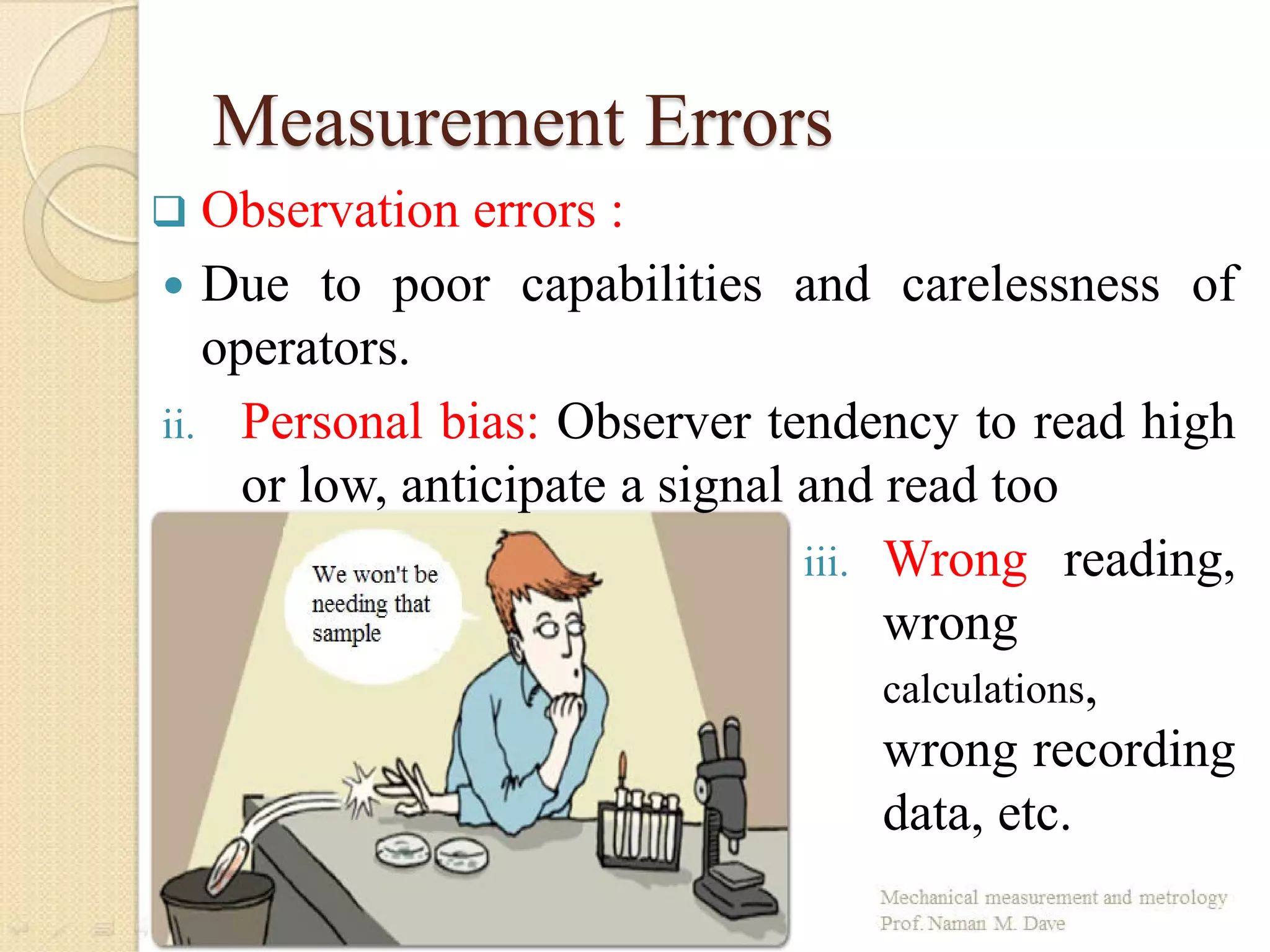
 Observation errors :
 Due to poor capabilities and carelessness of
operators.
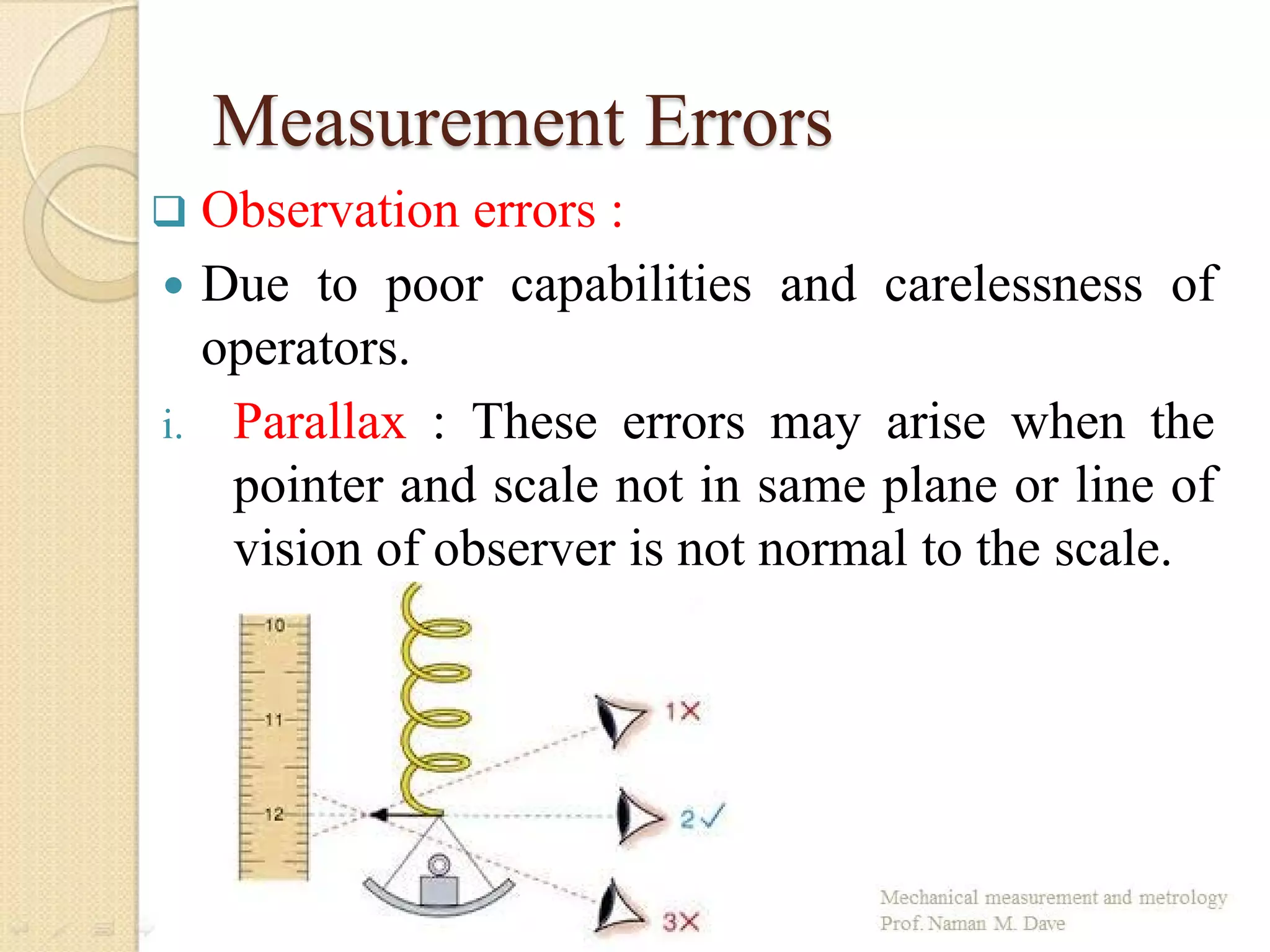
i. Parallax : These errors may arise when the
pointer and scale not in same plane or line of
vision of observer is not normal to the scale.
Measurement Errors
 Observation errors :
 Due to poor capabilities and carelessness of
operators.
ii. Personal bias: Observer tendency to read high
or low, anticipate a signal and read too
iii. Wrong reading,
wrong
calculations,
wrong recording
data, etc.
Measurement Errors
 Random Error
 Accidental in their incidence
 Variable in magnitude and usually follow a
certain statistical (probability) law.
 Friction and stickiness in instrument
 Vibration in instrument frame or supports
 Elastic deformation
 Large dimensional tolerances between the
mating parts.
 Supply power fluctuations
 Backlash in the movement.
CHAPTER 1
Mechanical Measurement

Introduction to Mechanical Measurement

  • 1.
    CHAPTER 1 Mechanical Measurement PresentationPrepared by Prof. Naman M. Dave Assistant Prof. (Mechanical Dept.) Gandhinagar Institute of Technology
  • 2.
    Please refer thisfile just as reference material. More concentration should on class room work and text book methodology.
  • 3.
    Measurement and Metrology Science of measurement  Depending on field of application  Today (in broader sense) with some practical terms
  • 4.
    Metrology  Practical termsrelated with measurement: o Errors in measurements o Methods of measurements o Measuring Instruments o Units of measurement and their standards o Industrial inspection and its different techniques o Measuring instruments and accuracy
  • 5.
    Needs of Measurementand Metrology  To ensure that the part to be measured conforms to the established standard.  To meet the interchangeability of manufacture.  To provide customer satisfaction by ensuring that no faulty product reaches the customers.  To coordinate the functions of quality control, production, procurement & other departments of the organization.  To judge the possibility of making some of the defective parts acceptable after minor repairs.
  • 6.
    Objectives of Measurementand Metrology  Although the basic objective of a measurement is to provide the required accuracy at a minimum cost, metrology has further objectives in a modem engineering plant with different shapes which are:  To minimize the cost of inspection by efficient and effective use of available facilities,  To minimize the cost of rejection and re-work through application of statistical quality control techniques.  To maintain the accuracies of measurement.  To determine the process capabilities and ensure that these are better than relevant component tolerances.  To do complete evaluation of newly developed products.
  • 7.
    Modes of Measurement Based upon the number of conversions, three basic categories of measurements have been developed.  They are; 1. Primary measurement 2. Secondary measurement 3. Tertiary measurement
  • 8.
    Modes of Measurement 1.Primary measurement  Direct observation and comparison  Not involvement of any conversion Ex. Length, Height, Depth or Width etc. measurement.
  • 9.
    Modes of Measurement 2.Secondary measurement  >Indirect method >Involvement of one conversion  Ex. Pressure or Temperature measurement 3. Tertiary measurement  >Indirect method >Involvement of 2 conversion  Ex. Measurement of rotating shaft
  • 10.
  • 11.
    Methods of Measurement Typeof Method Technique to measure With contact Instrument is placed in contact with the object. For ex. vernier calliper Without contact Instrument not placed in contact with the object. (use of sensor) Absolute or Fundamental Based on the measurements of base quantities entering into the definition of the quantity.
  • 12.
    Methods of Measurement Typeof Method Technique to measure Comparative Based on the comparison of the value of a quantity to be measured with a known value of the same quantity. Null measurement Here, difference between measurand value and known value of same quantity with which it is compared is brought to zero.
  • 13.
    Methods of Measurement Typeof Method Technique to measure Substitutional Method Quantity to be measured is replaced by a known value of the same quantity, so selected that the effects produced in the indicating device by these two values are the same (a type of direct comparison). Complementary Method The value of quantity to be measured is combined with known value of the same quantity. Ex: Volume determination by liquid displacement.
  • 14.
    Methods of Measurement Typeof Method Technique to measure Transposition Quantity to be measured is first balanced by a known value and then balanced by an other new known value. Value of quantity measured is first balanced by an initial known value A of same quantity, then measured by quantity is put in place of this known value. Then, it is balanced again by another value B. If the position of element in equilibrium.
  • 15.
    Methods of Measurement Typeof Method Technique to measure Coincidence Measurements coincide with certain lines and signals. Ex. Callipers Deflection The value of the quantity to be measured is directly indicated by the deflection of a pointer on a calibrated scale
  • 16.
  • 17.
    Generalized Measurement System Elementsof measuring system 1. Primary sensing element  Quantity under measurement makes its first contact with primary sensing element.  Sense the condition, state or value of the process variable by extracting a small part of energy from the measurand,  and then produce an output which reflects this condition, state or value of measurand.
  • 18.
  • 19.
    Generalized Measurement System Elementsof measuring system 2. Variable conversion (transducer) element  Convert one physical form into another form without changing the information content of the signal.
  • 20.
    Generalized Measurement System Elementsof measuring system 3. Variable manipulation element  Modifies the signal by amplification, filtration or other means so that desired output produced according to some mathematical rule for Ex. i/p x constant = o/p
  • 21.
    Generalized Measurement System Elementsof measuring system 4. Data transmission element  Transmits the signal from one location to another without changing its information contents.
  • 22.
    Generalized Measurement System Elementsof measuring system 5. Data processing element  modifies the data before it displayed or finally recorded • perform mathematical operation such as addition, subtraction, multiplication, division, etc. • to calculate average, statistical and logarithmic values • to convert data into desired form. • to separate undesired signal from output signal. • to provide correction on the output signal.
  • 23.
  • 24.
    Generalized Measurement System Elementsof measuring system 6. Data presentation elements  Provides a record or indication of the output (i) Transmitting information (measured quantity) to another location or devices. (ii) Signaling : To give a signal that the pre-defined value has been reached. (iii) Recording : To produce a continuous record of measured quantity in written form. (iv) Indicating : To indicate the specific value on calibrated scale.
  • 25.
    Performance characteristics  Importantto select most suitable instrument for specific measurement.  Static Performance characteristics: • Desired input to the instrument not change w.r.t time.  Dynamic Performance characteristics:
  • 26.
    Static Performance characteristics Readability: This term indicates the closeness with which the scale of the instrument may be read.  Susceptibility of device to have its indications converted into meaningful number.  Least count: It is the smallest difference between two indications that can be detected on the instrument scale.
  • 27.
    Static Performance characteristics Range: It represents the highest possible value that can be measured by an instrument or limits within which instrument is designed to operate.  Linearity: A measuring system is said to be linear if the output is linearly proportional to the input.
  • 28.
    Static Performance characteristics Repeatability: It is defined as the ability of a measuring system to repeat output readings when the same input is applied to it consecutively, under the same conditions, and in the same direction.  Reproducibility: It is defined as the degree of closeness with which the same value of a variable may be measured at different times.  System response: Response of a system may be defined as the ability of the system to transmit & present all the relevant information contained in the input signal.
  • 29.
    Static Performance characteristics Threshold: Min. value of i/p required to cause a detectable change from ‘0(zero)’ o/p.  If i/p increased gradually from ‘0(zero)’, there will be some min. value below which no o/p change can be detected.
  • 30.
    Static Performance characteristics Hysteresis:  Hysteresis is the maximum differences in two output (indicated values) at same input (measurand) value within the specified range when input is continuously increased from zero and when input is continuously decrcased for maximum value.  Maximum diff. between increasing input value and the decreasing input value at the same output.
  • 31.
    Static Performance characteristics Calibration: Procedure of making, adjusting or checking a scale so that readings of an instrument conforms to an accepted standard.  Sensitivity: Ratio of o/p response to a specific range in i/p.  Dead zone: Largest change of i/p quantity for which instrument does not indicate output.
  • 32.
    Static Performance characteristics Drift: gradual variation or undesired change in o/p during constant i/p. Zonal Drift: Combination of both Zero Drift: whole calibration gradually shifts due to slippage • Span: proportional change in the indication or change along the upward scale
  • 33.
    Static Performance characteristics Loading effect: Any instrument, invariably extracts energy from system, the original signal should remain undistorted. This is incapability of system to faithfully measure signal in undistorted form.
  • 34.
    Static Performance characteristics Accuracy: It is degree to which the measured value agrees with true value. Max. amount by which result differs from the true value.  Precision: It is repeatability or reproducibility of the measurement. If instrument is not precise, great difference in dimension measured again and again.
  • 36.
    Measurement Errors  Whatis Error ?  It is difference between indicated or measured value and true value.  It is impossible to made measurement with perfect accuracy
  • 37.
    Measurement Errors  Types(Classification of Errors)
  • 38.
    Measurement Errors  Grosserrors • Human mistakes • Careless readings, mistake in recordings, • improper application of instrument • Can not treated mathematically • Can be avoided only by taking care in reading and recording
  • 39.
    Measurement Errors  Systematicerror • Have definite magnitude and direction. • Can be repeated consistently with repetition of experiments. • To locate these errors: repeated measurements under different conditions or with different equipment or possible by an entirely different methods.
  • 40.
    Measurement Errors  Instrumentalerror  Due to design or construction /assembly of instruments  Limiting accuracy  Improper selection of instrument  Poor maintenance  For Ex. Errors due to friction, wear, slips, vibration  Errors due to incorrect fitting of scale at zero, non-uniform division of scale, bent pointer.
  • 41.
    Measurement Errors  Operationalerror  Misuse of instrument  Poor operational techniques  For Ex. Errors in flow measurement if flow- meter is placed immediately after a valve or a bend.
  • 42.
    Measurement Errors  Environmentalerrors  due to conditions external to the measuring instrument, including conditions in the area surrounding the instrument,  such as effects of change in temperature, humidity, barometric pressure, or magnetic or electrostatic fields.  For ex. Buoyant effect of the wind causes errors on precise measurement of weights by pan balance.
  • 43.
    Measurement Errors  Theseerrors may be avoided by  (i) Use instrument under conditions for which it was design and calibrated. This atmospheric condition can be maintain by air conditioning.  (ii) Provide sealing certain components in the instrument.  (iiii) Make calibration of instrument under the local atmospheric conditions  Environmental errors
  • 44.
    Measurement Errors  Systeminteraction errors  Interaction between system (to be measured) and instrument body. So it change the condition of the system.  For Ex. A ruler pressed against a body (system) resulting the deformation of the body.
  • 45.
    Measurement Errors  Observationerrors :  Due to poor capabilities and carelessness of operators. i. Parallax : These errors may arise when the pointer and scale not in same plane or line of vision of observer is not normal to the scale.
  • 46.
    Measurement Errors  Observationerrors :  Due to poor capabilities and carelessness of operators. ii. Personal bias: Observer tendency to read high or low, anticipate a signal and read too iii. Wrong reading, wrong calculations, wrong recording data, etc.
  • 47.
    Measurement Errors  RandomError  Accidental in their incidence  Variable in magnitude and usually follow a certain statistical (probability) law.  Friction and stickiness in instrument  Vibration in instrument frame or supports  Elastic deformation  Large dimensional tolerances between the mating parts.  Supply power fluctuations  Backlash in the movement.
  • 48.