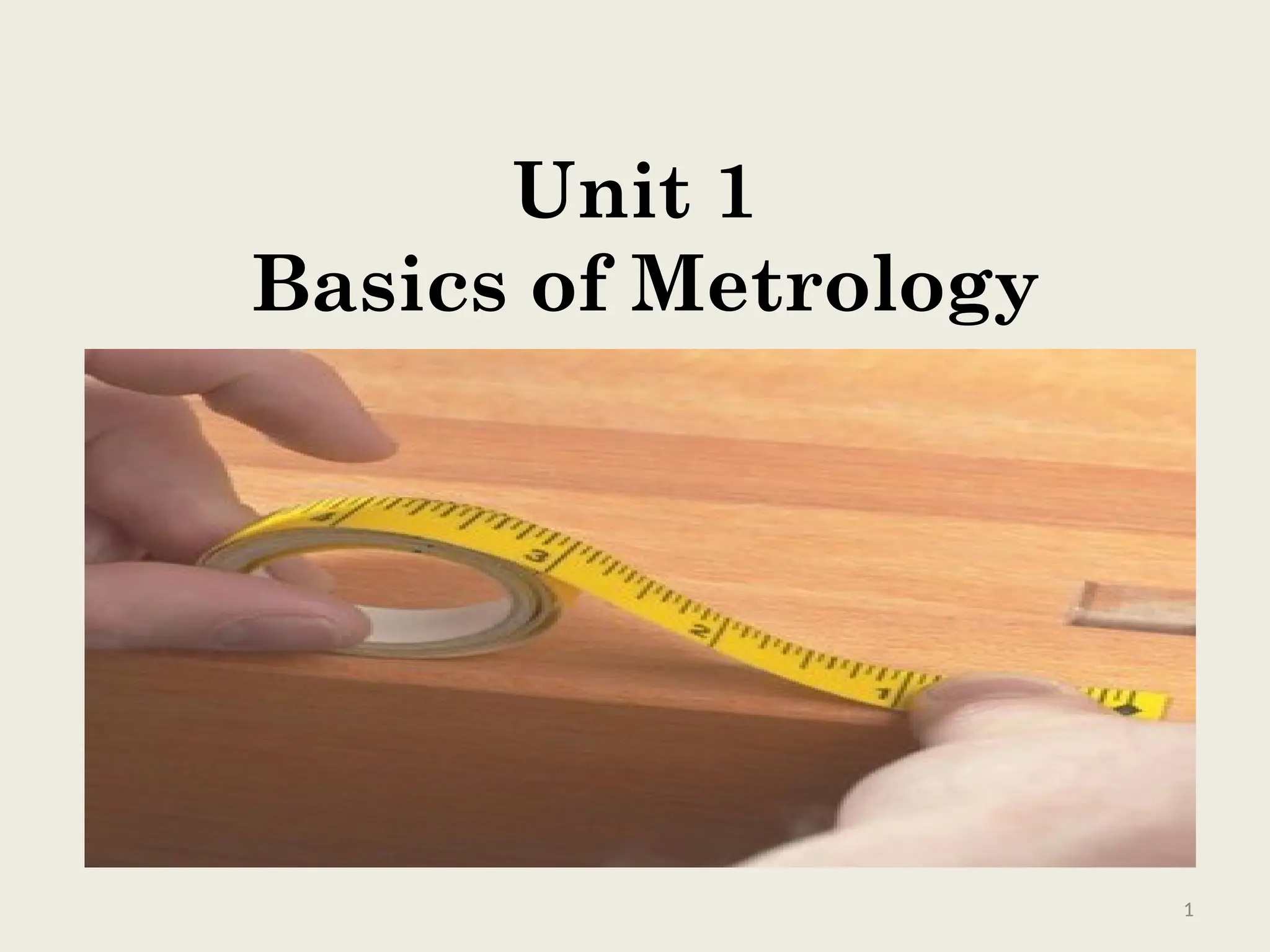
Unit 1
Basics of Metrology
1
Syllabus
Introduction to Metrology – Need – Elements
– Work piece, Instruments – Persons –
Environment –their effect on Precision and
Accuracy – Errors – Errors in Measurements –
Types – Control – Types of standards.
2
Definition
• Metrology is the Greek name given to the
science of pure measurement.
• Measurement is defined as the process of
numerical evaluation of a dimension or the
process of comparison with standard
measuring instruments
3
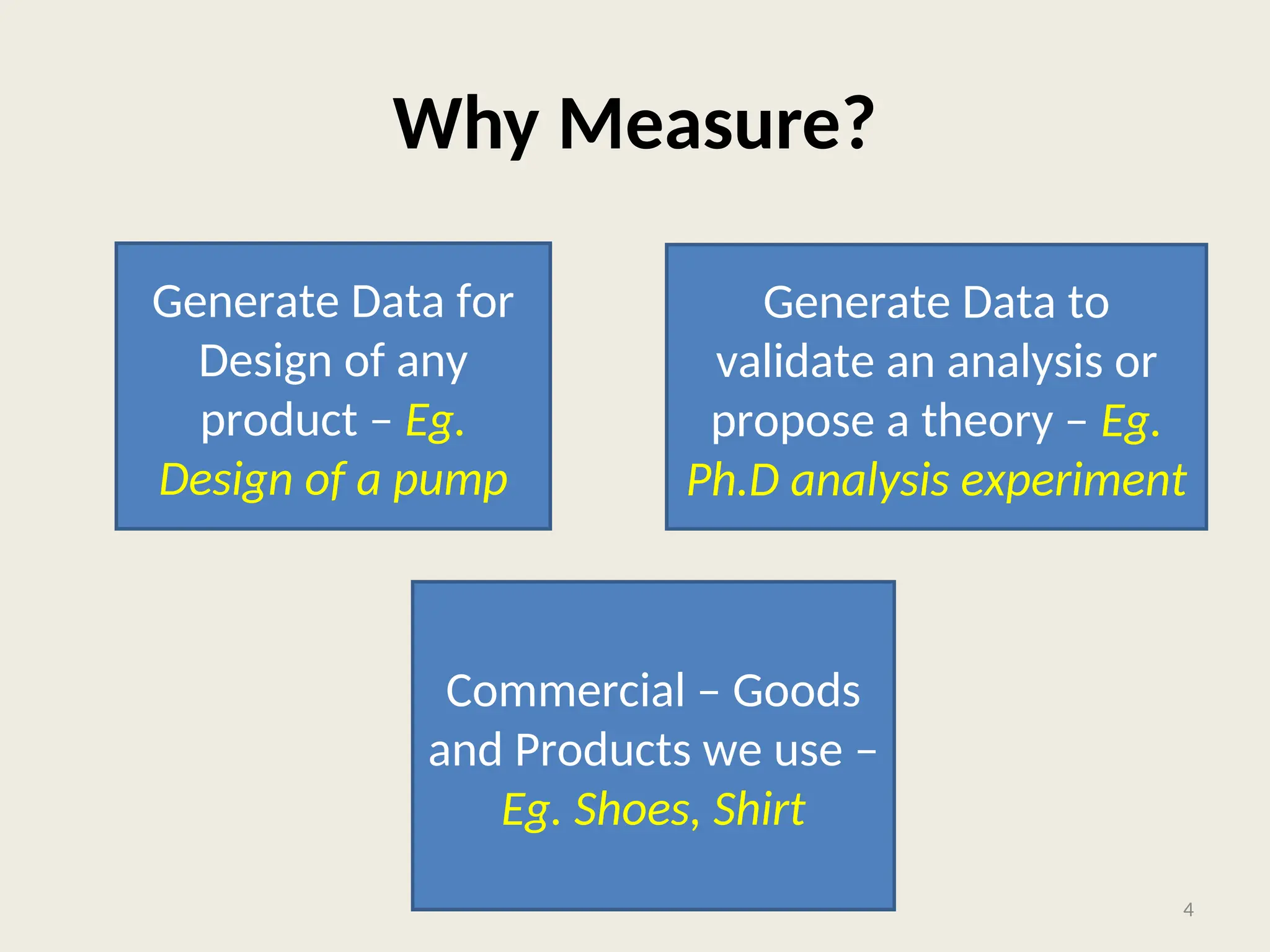
Why Measure?
Generate Data for
Design of any
product – Eg.
Design of a pump
Generate Data to
validate an analysis or
propose a theory – Eg.
Ph.D analysis experiment
Commercial – Goods
and Products we use –
Eg. Shoes, Shirt
4
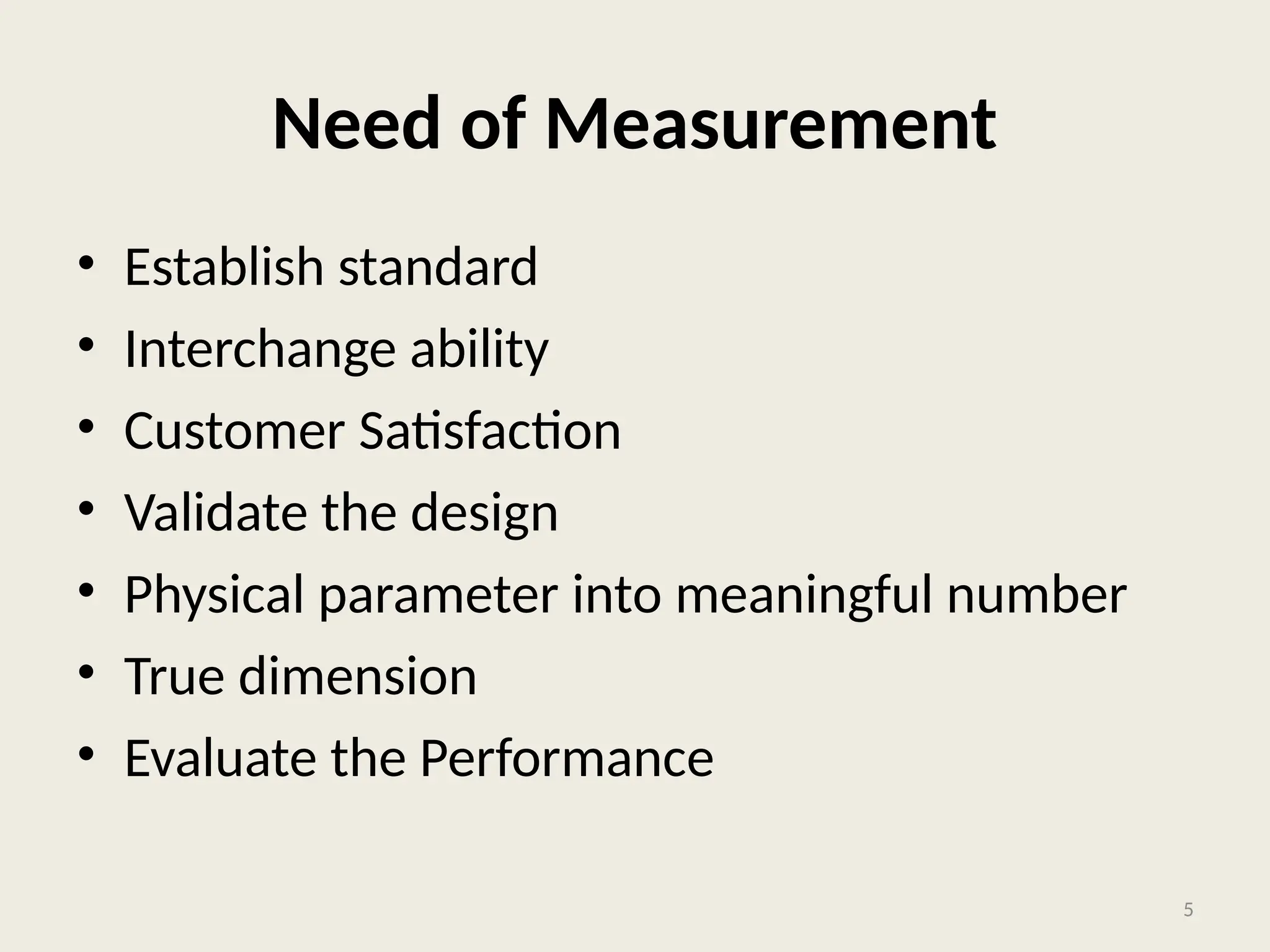
Need of Measurement
• Establish standard
• Interchange ability
• Customer Satisfaction
• Validate the design
• Physical parameter into meaningful number
• True dimension
• Evaluate the Performance
5
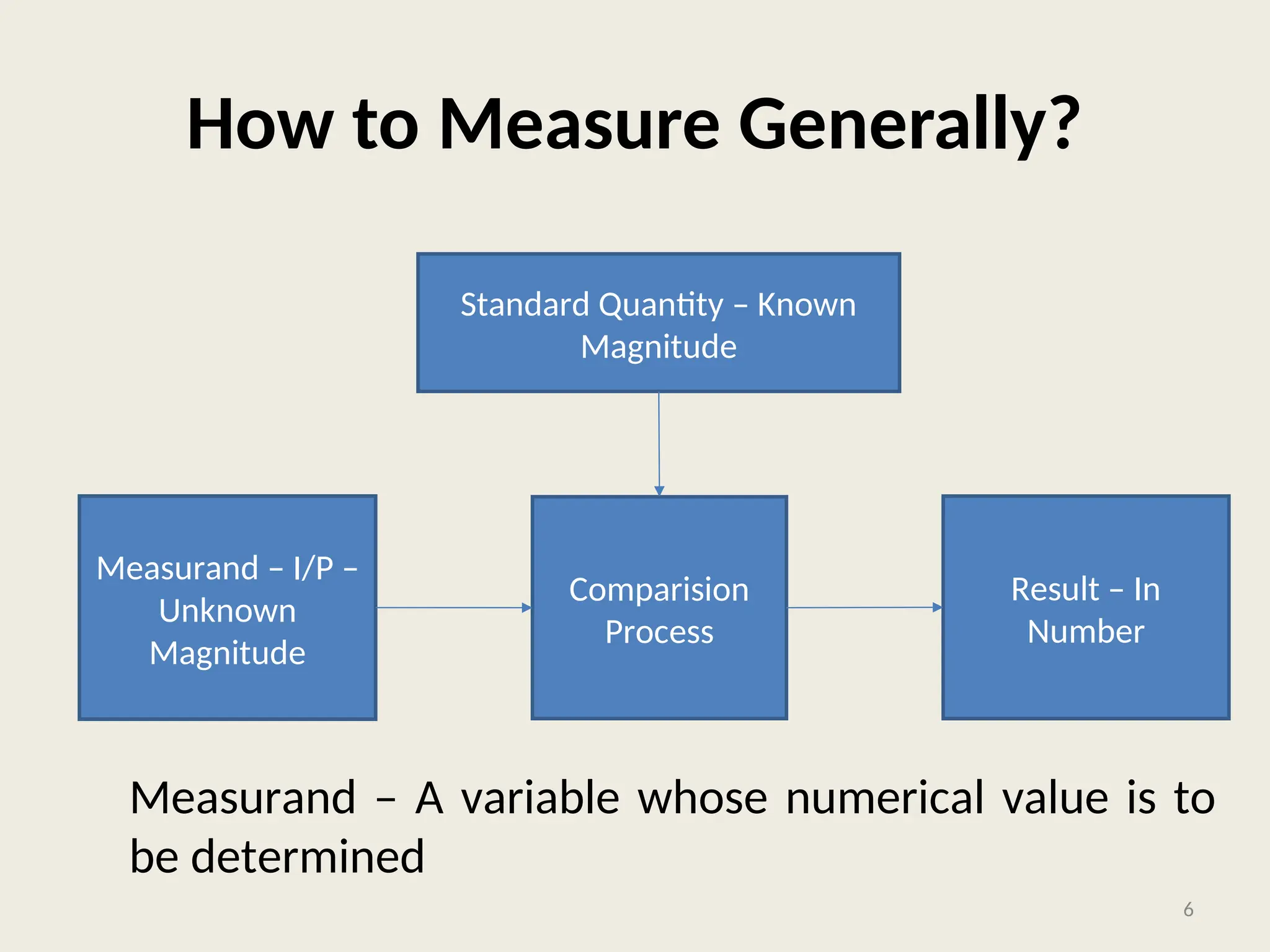
How to Measure Generally?
Measurand – I/P –
Unknown
Magnitude
Result – In
Number
Standard Quantity – Known
Magnitude
Comparision
Process
Measurand – A variable whose numerical value is to
be determined
6
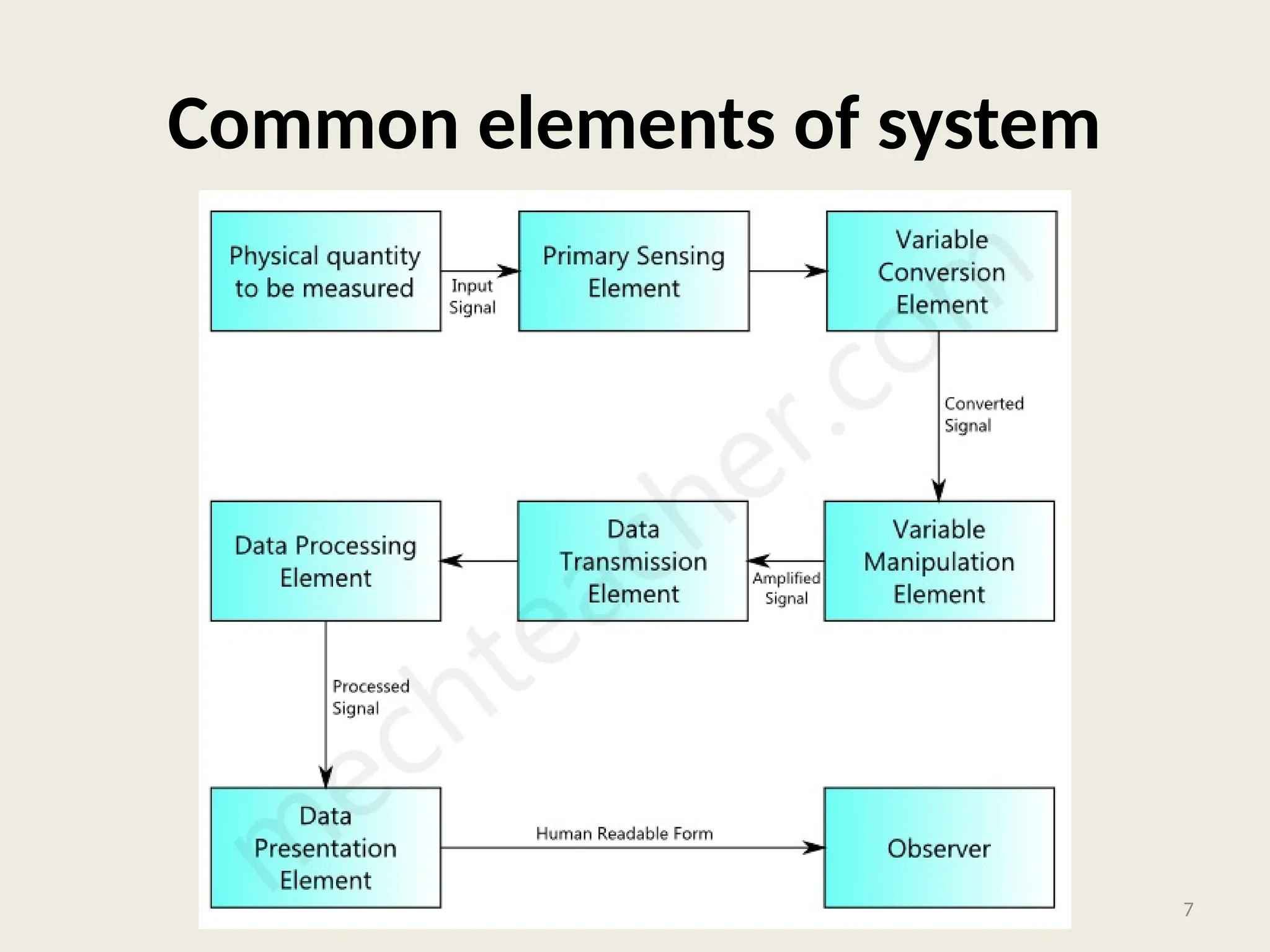
Common elements of system
7
Common elements of system –
Contd…
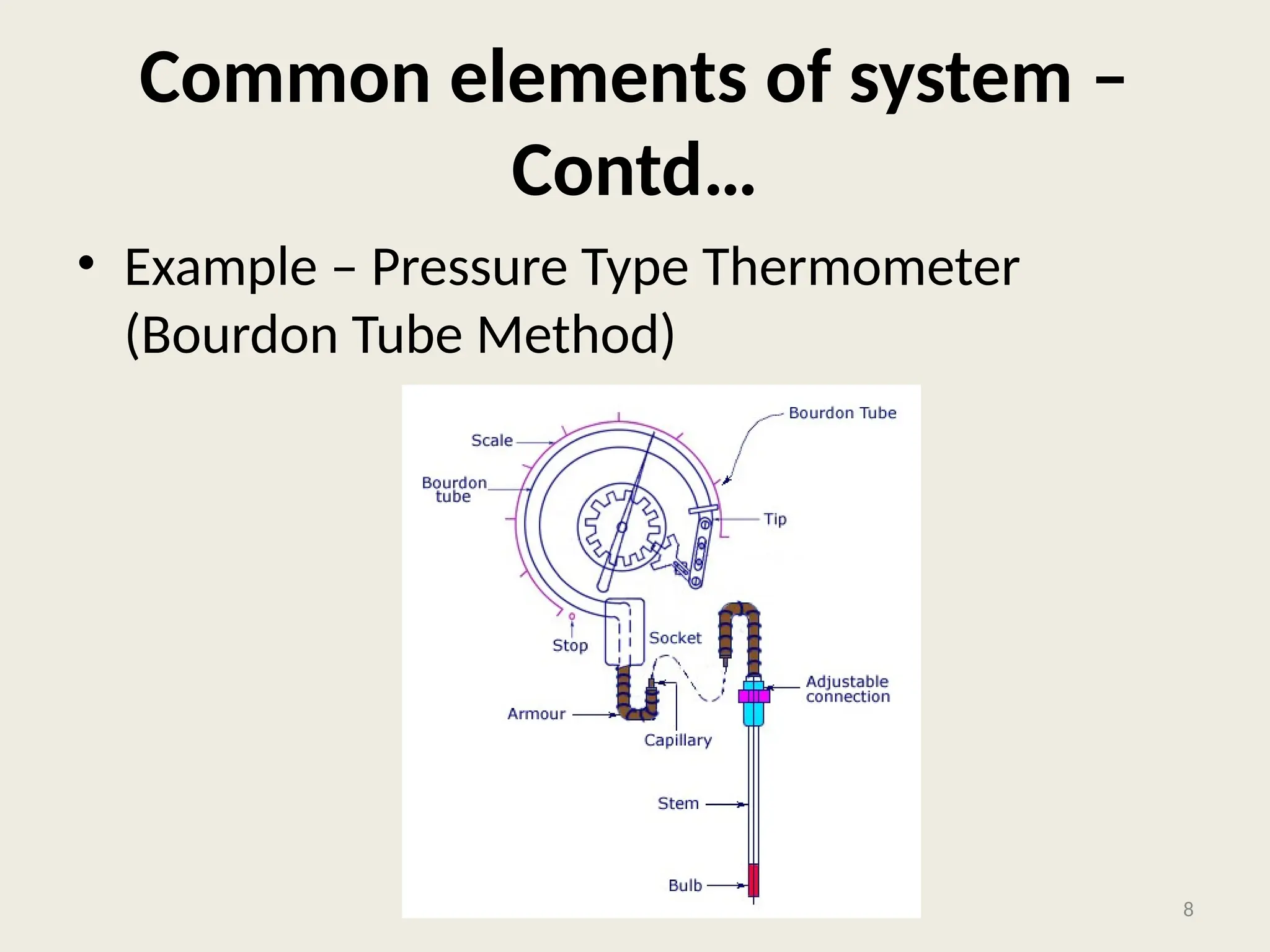
• Example – Pressure Type Thermometer
(Bourdon Tube Method)
8
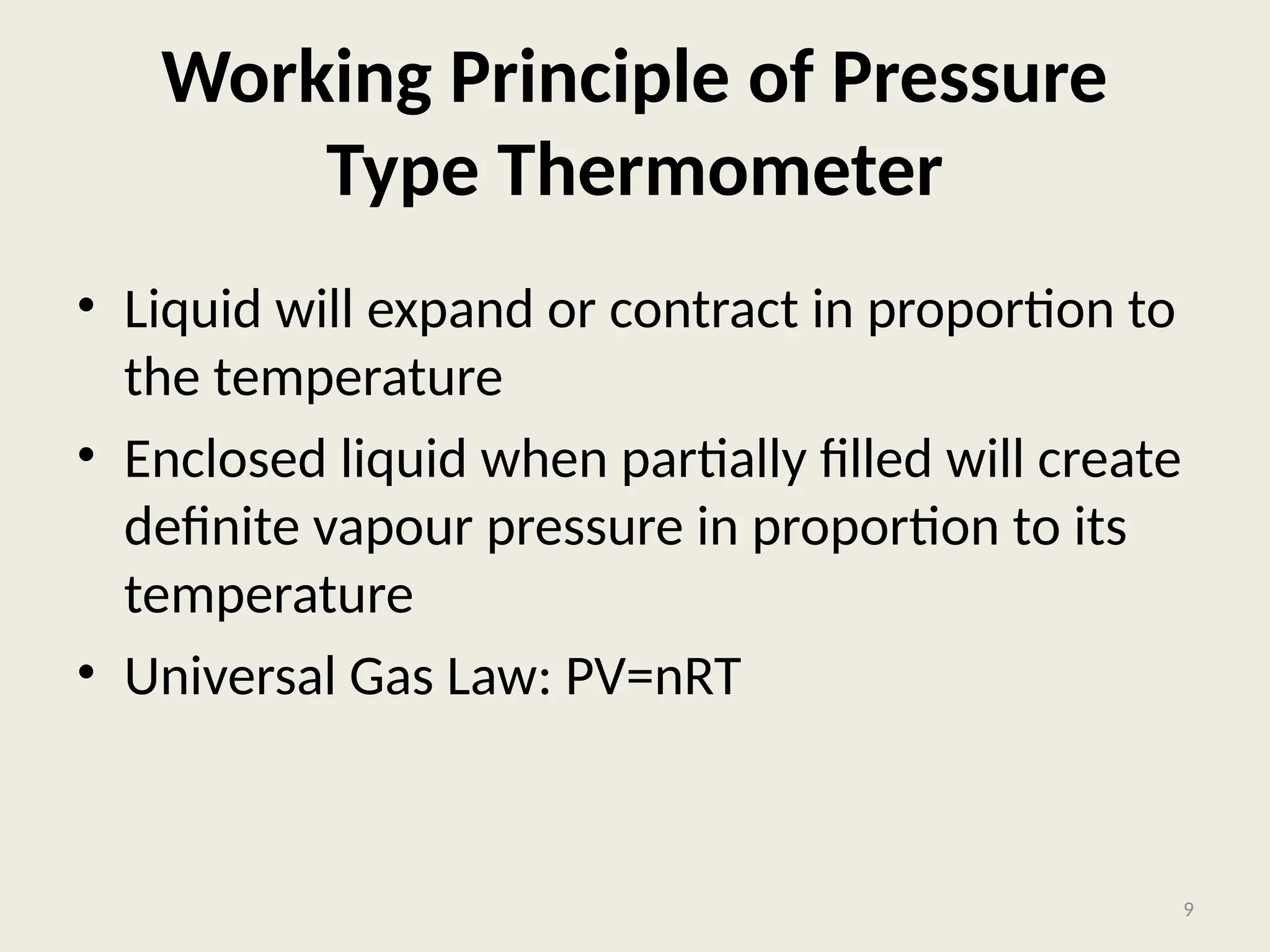
Working Principle of Pressure
Type Thermometer
• Liquid will expand or contract in proportion to
the temperature
• Enclosed liquid when partially filled will create
definite vapour pressure in proportion to its
temperature
• Universal Gas Law: PV=nRT
9
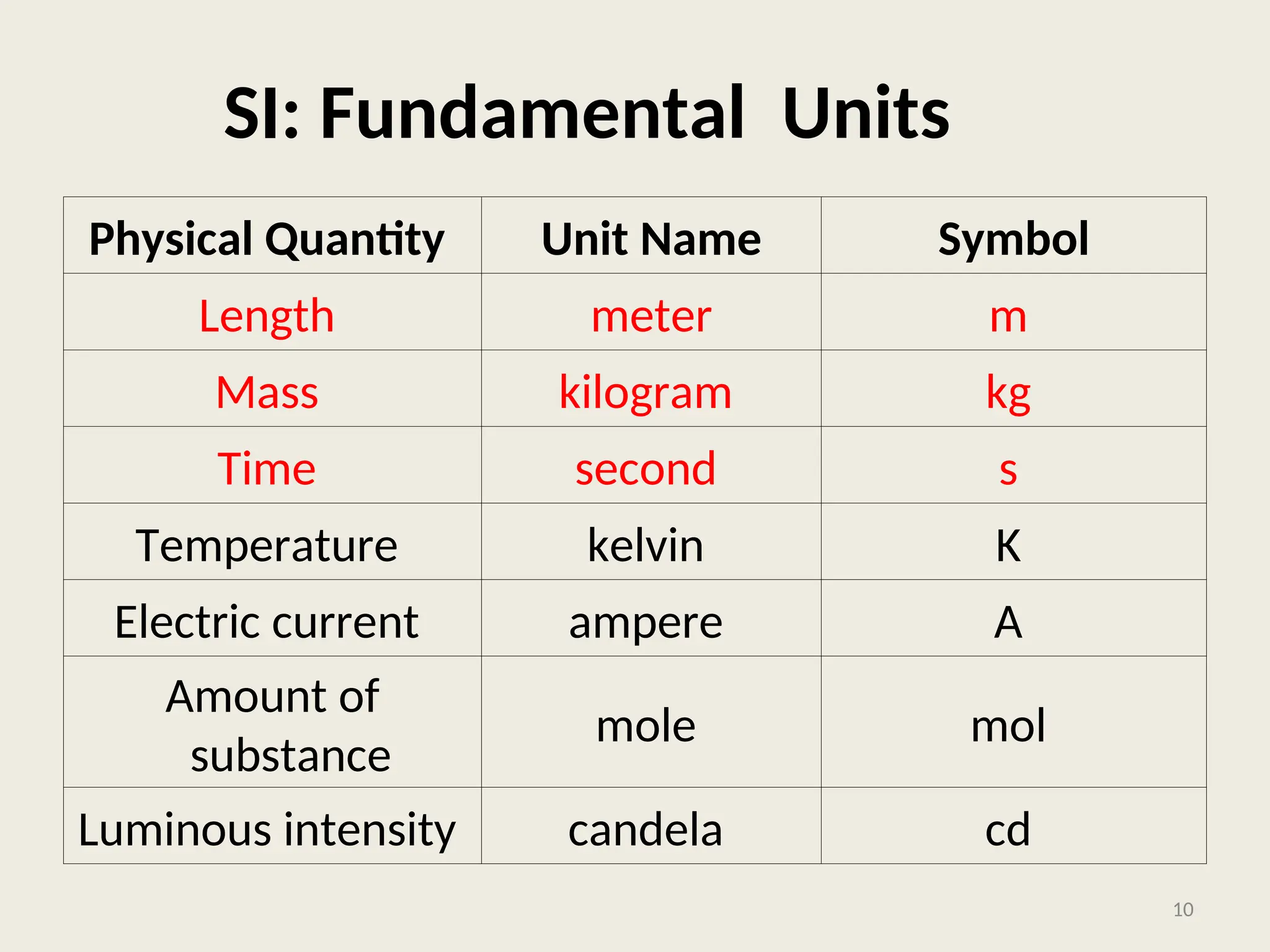
SI: Fundamental Units
Physical Quantity Unit Name Symbol
Length meter m
Mass kilogram kg
Time second s
Temperature kelvin K
Electric current ampere A
Amount of
substance
mole mol
Luminous intensity candela cd
10
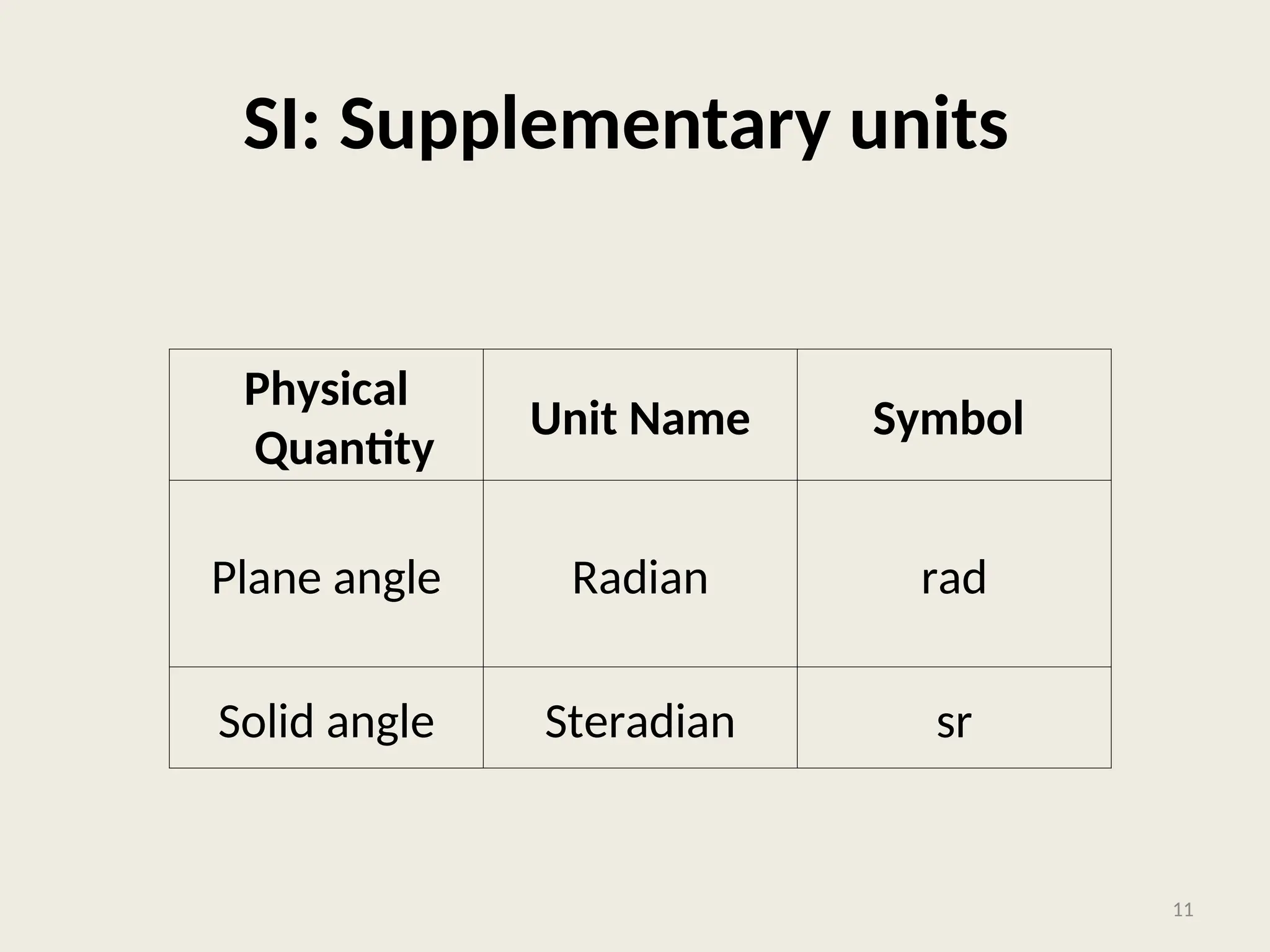
SI: Supplementary units
Physical
Quantity
Unit Name Symbol
Plane angle Radian rad
Solid angle Steradian sr
11
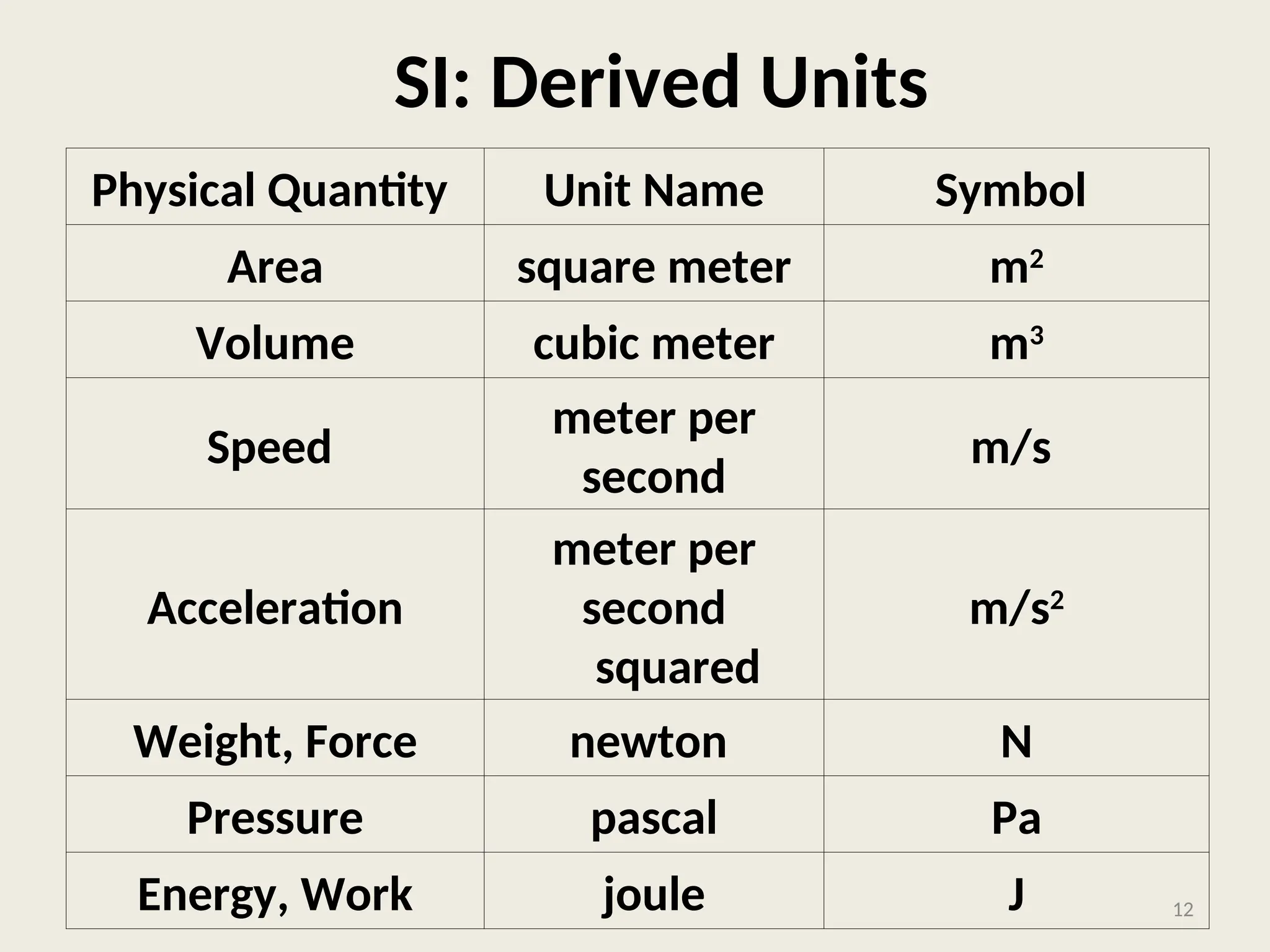
SI: Derived Units
Physical Quantity Unit Name Symbol
Area square meter m2
Volume cubic meter m3
Speed
meter per
second
m/s
Acceleration
meter per
second
squared
m/s2
Weight, Force newton N
Pressure pascal Pa
Energy, Work joule J 12
Methods of Measurement
• Direct method
• Indirect method
• Comparative method
• Coincidence method
• Contact method
• Deflection method
• Complementary method
13
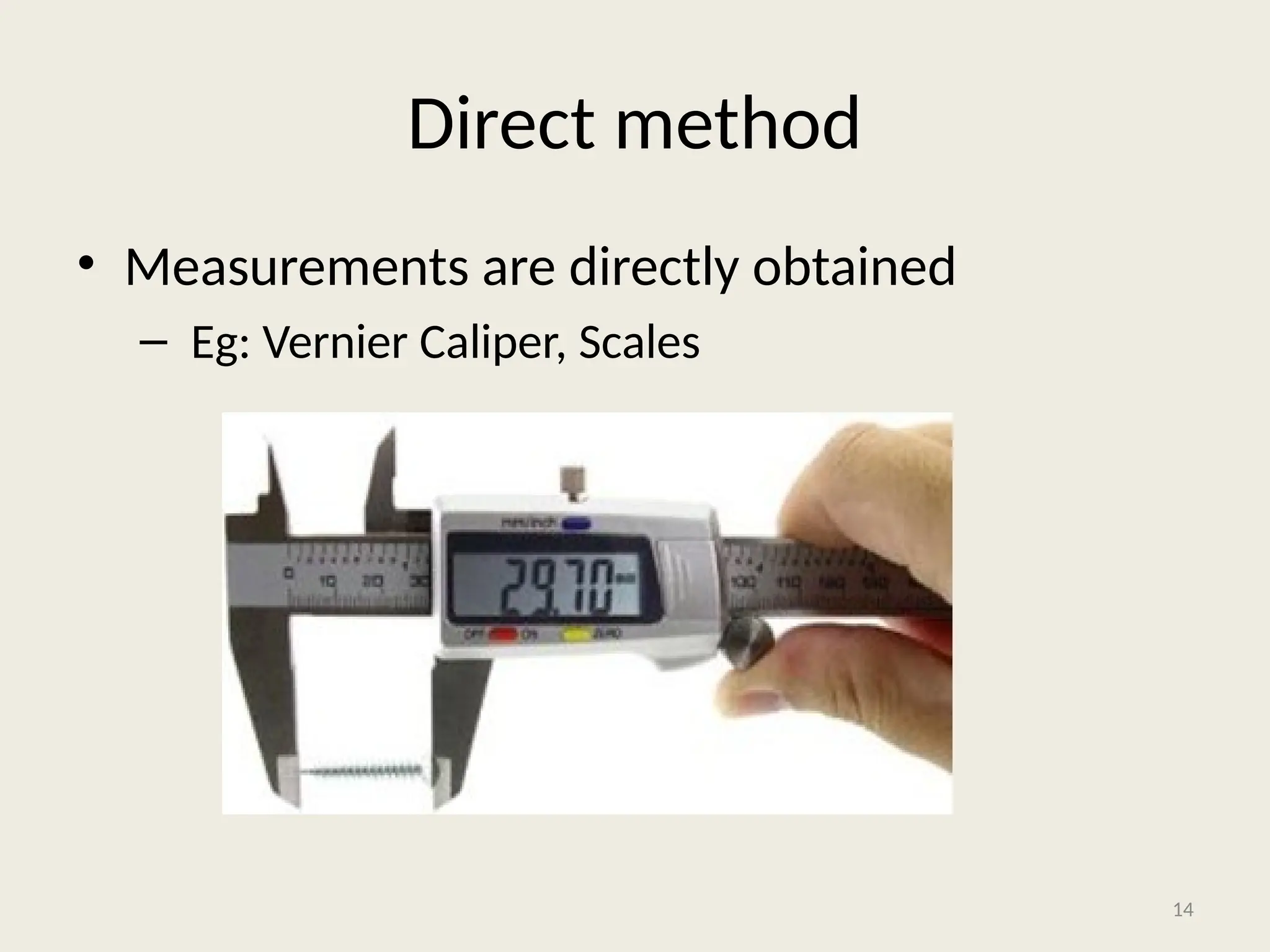
Direct method
• Measurements are directly obtained
– Eg: Vernier Caliper, Scales
14
Indirect method
• Obtained by measuring other quantities
– Eg : Weight = Length x Breadth x Height x Density
15
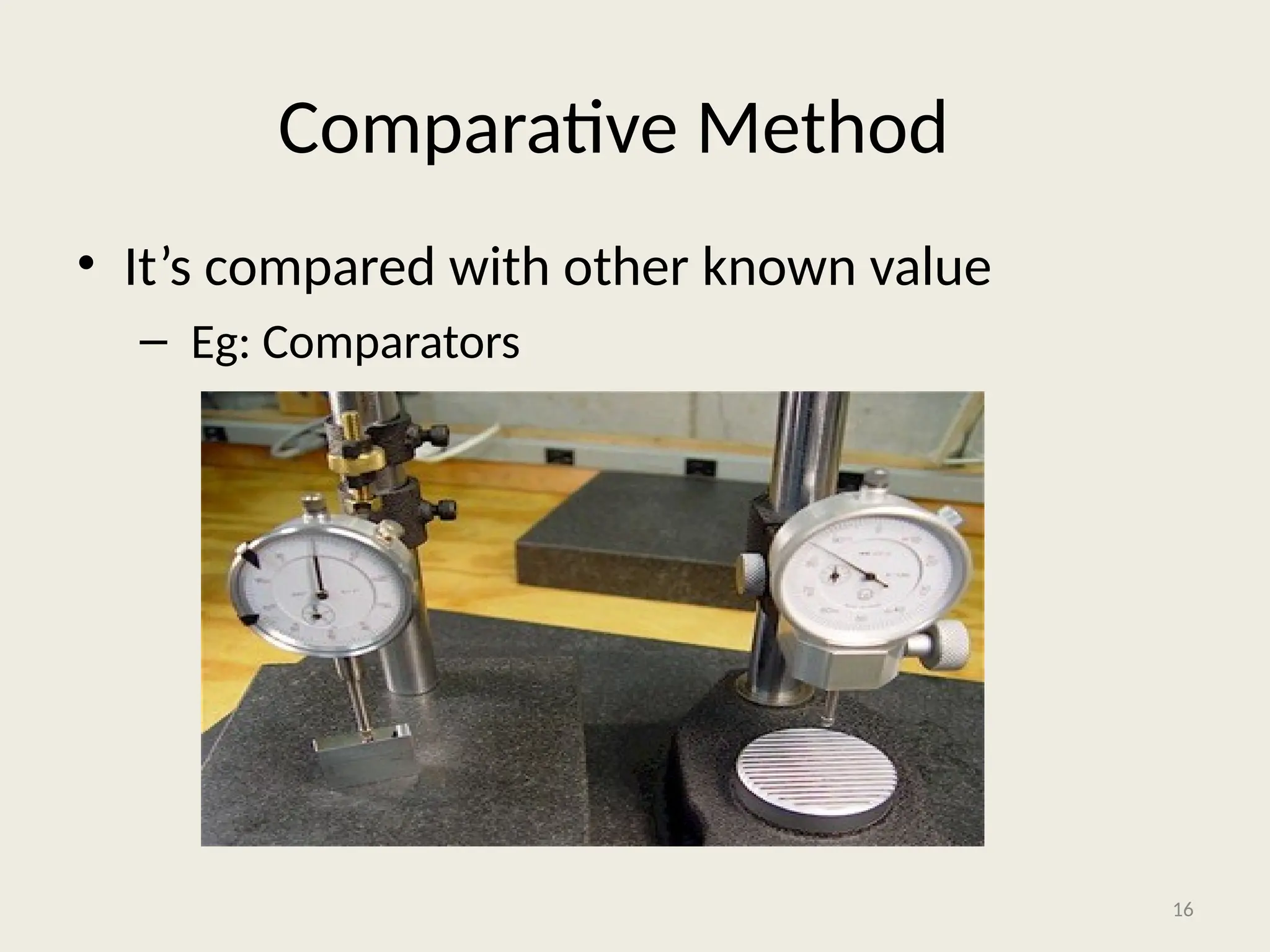
Comparative Method
• It’s compared with other known value
– Eg: Comparators
16
Coincidence method
• Measurements coincide with certain lines and
signals; Eg: Vernier Caliphers
Fundamental method
• Measuring a quantity directly in related with the
definition of that quantity; Eg: Weight using Physical
Balance
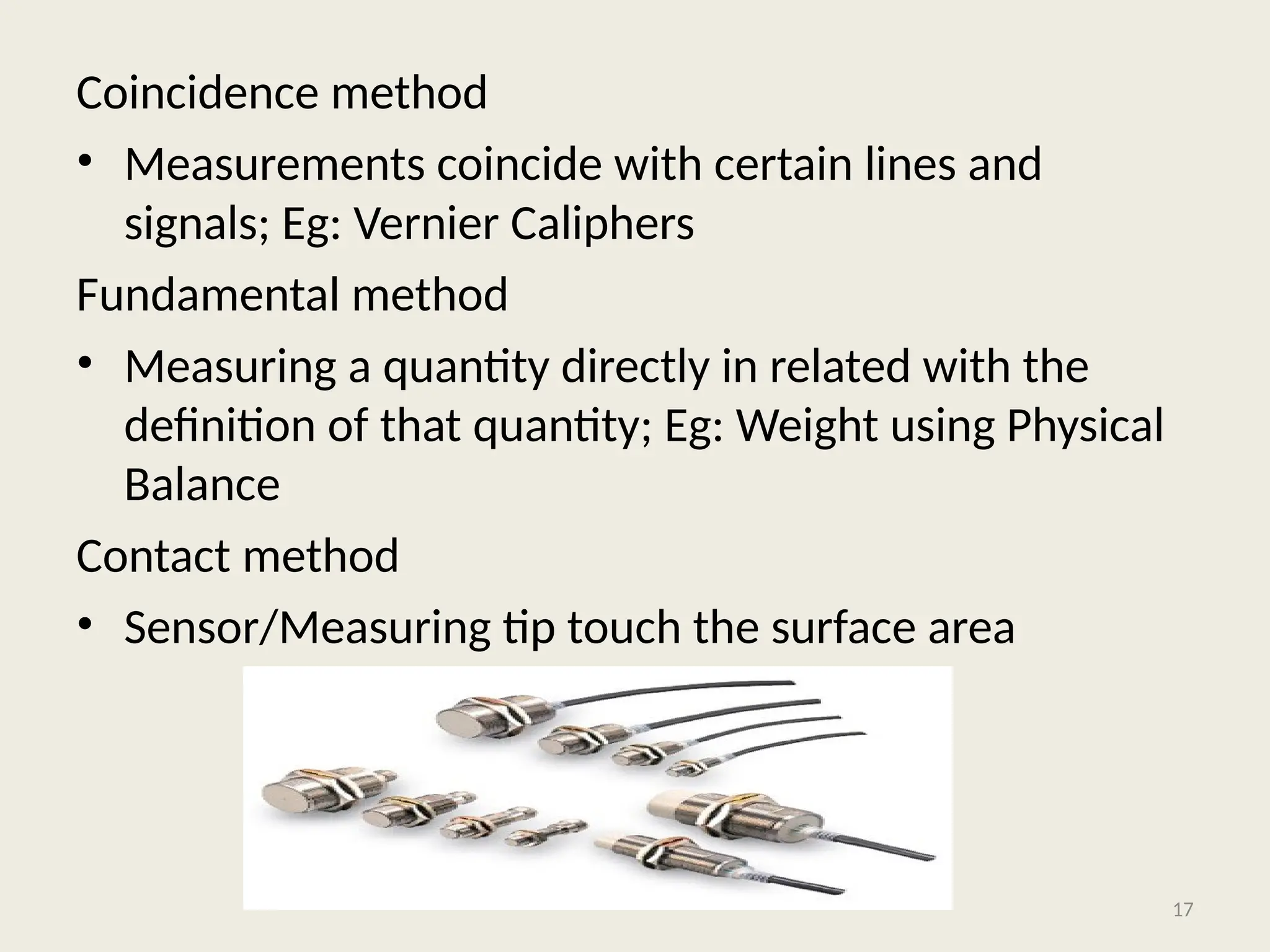
Contact method
• Sensor/Measuring tip touch the surface area
17
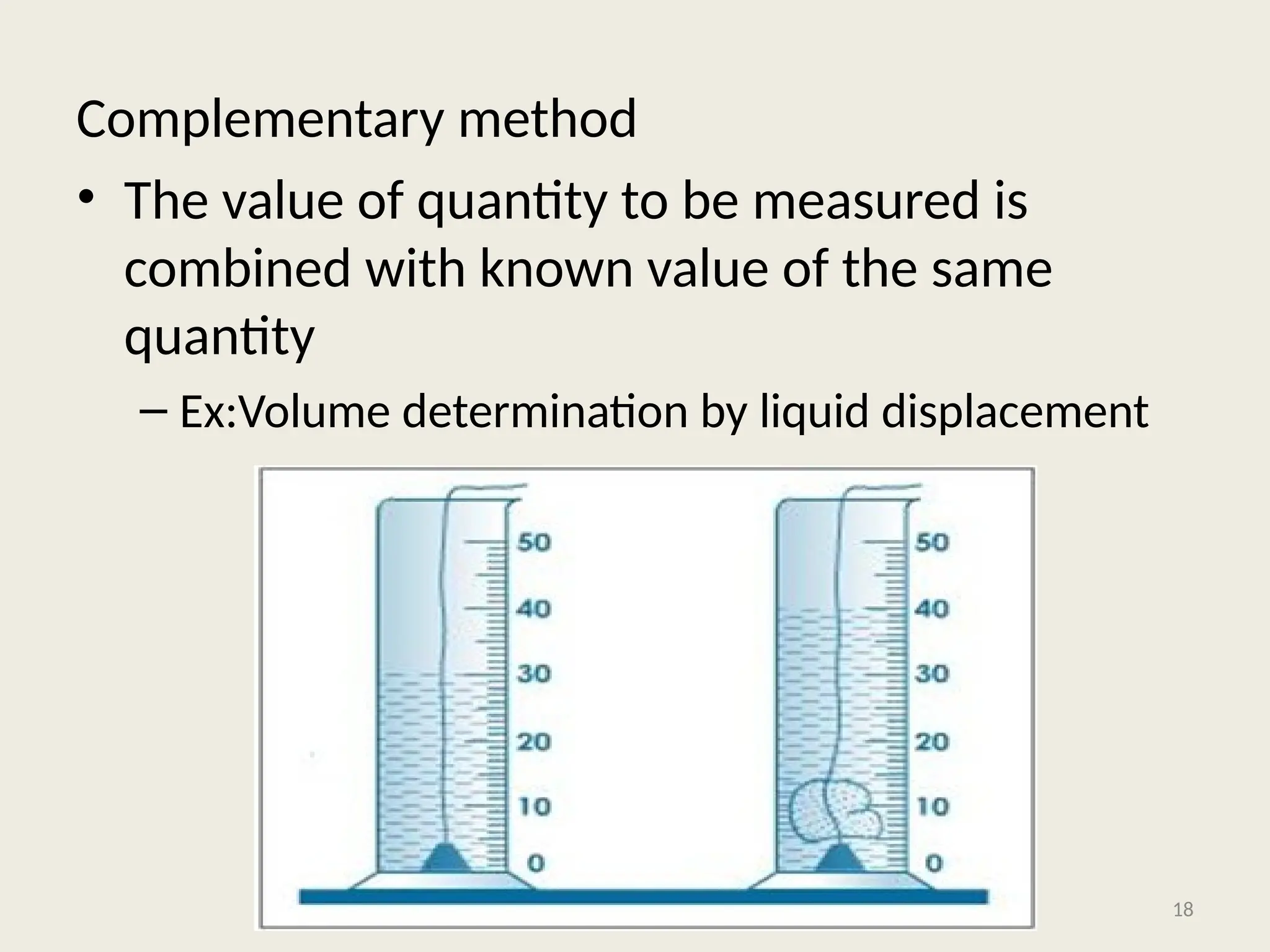
Complementary method
• The value of quantity to be measured is
combined with known value of the same
quantity
– Ex:Volume determination by liquid displacement
18
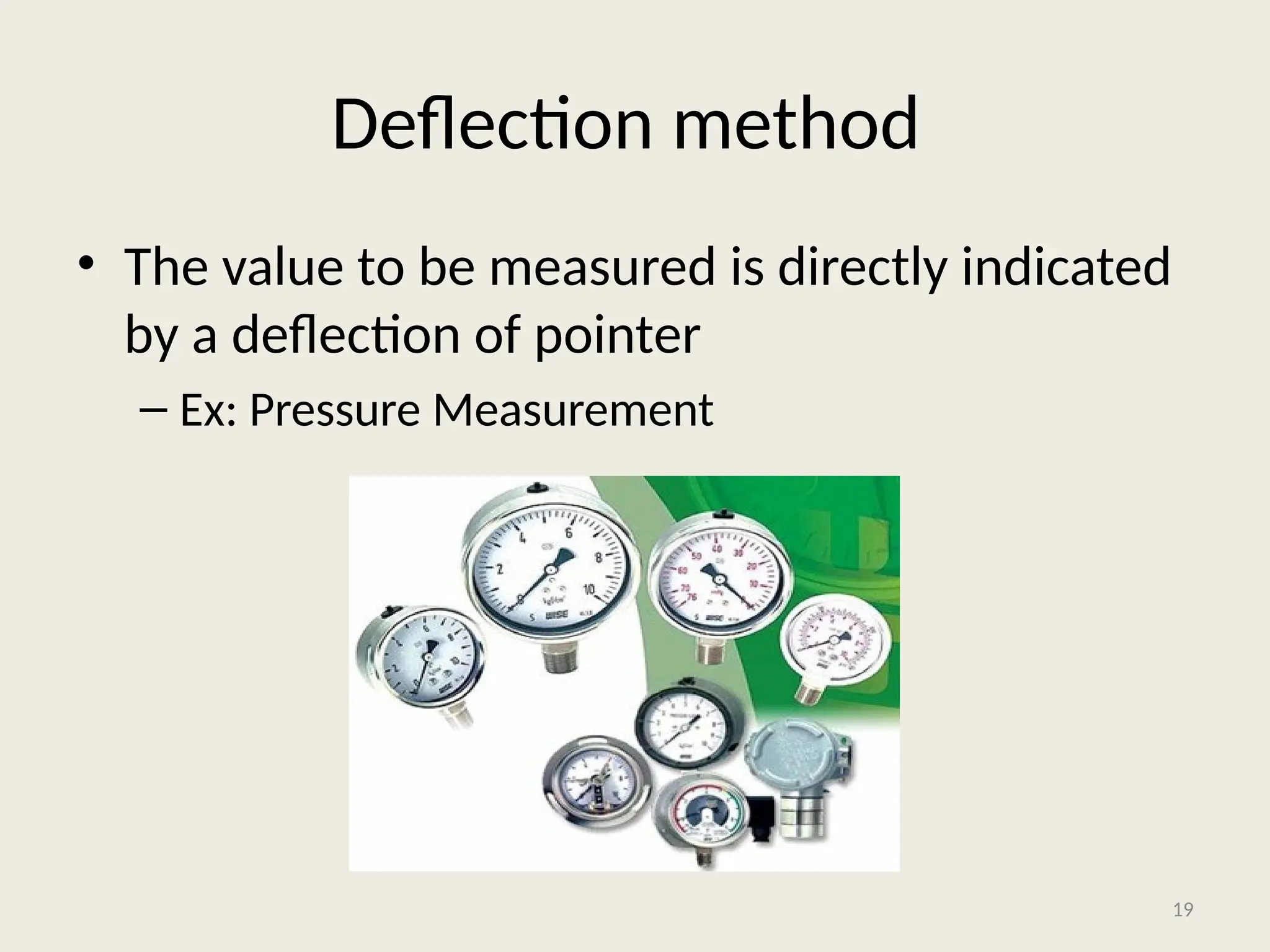
Deflection method
• The value to be measured is directly indicated
by a deflection of pointer
– Ex: Pressure Measurement
19
Measuring Instruments
• Deflection and null type instruments
• Analog and digital instruments
• Active and passive instruments
• Automatic and manually operated
instruments
• Contacting and non contacting instruments
• Absolute and secondary instruments
• Intelligent instruments.
20
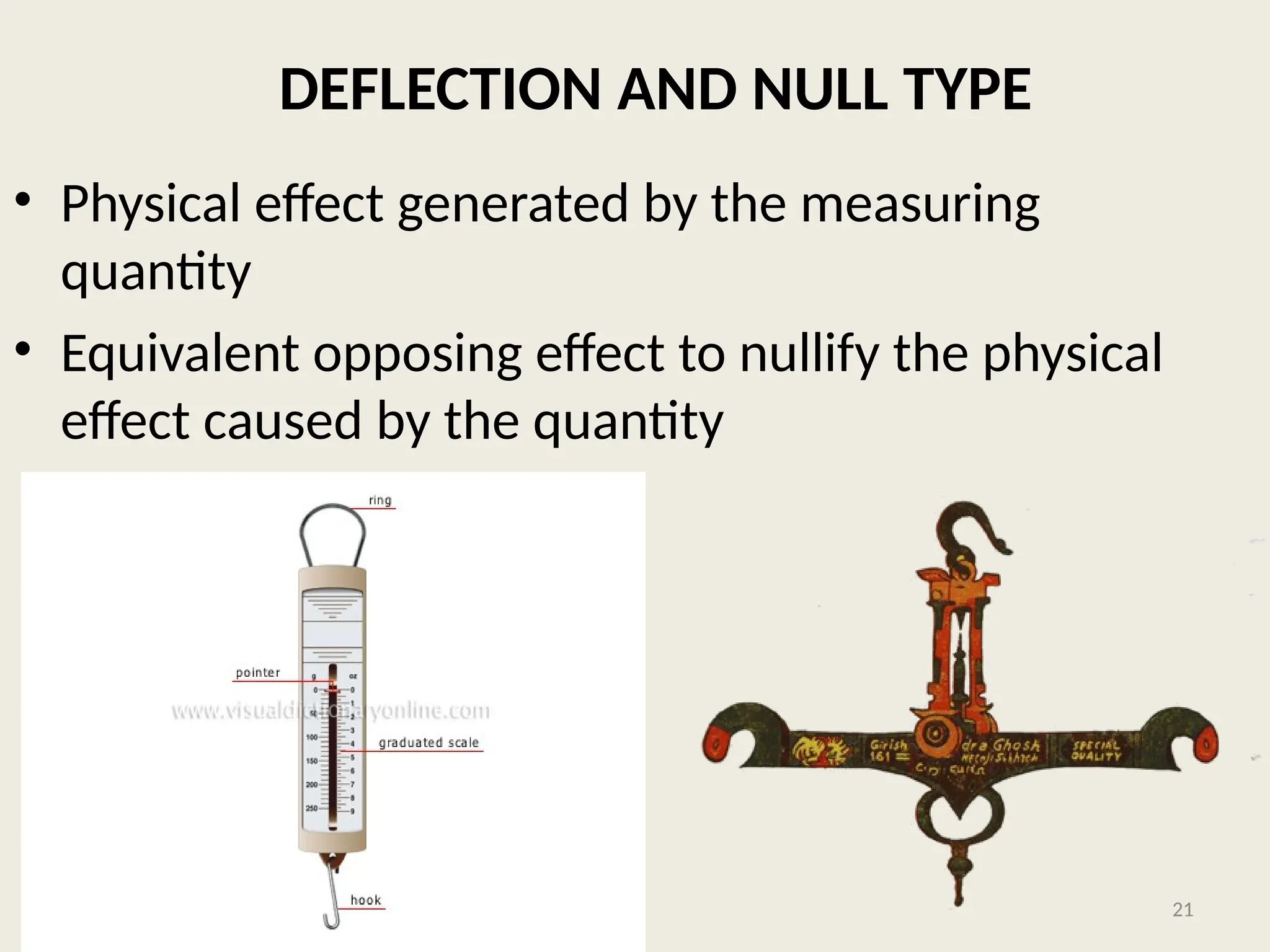
DEFLECTION AND NULL TYPE
• Physical effect generated by the measuring
quantity
• Equivalent opposing effect to nullify the physical
effect caused by the quantity
21
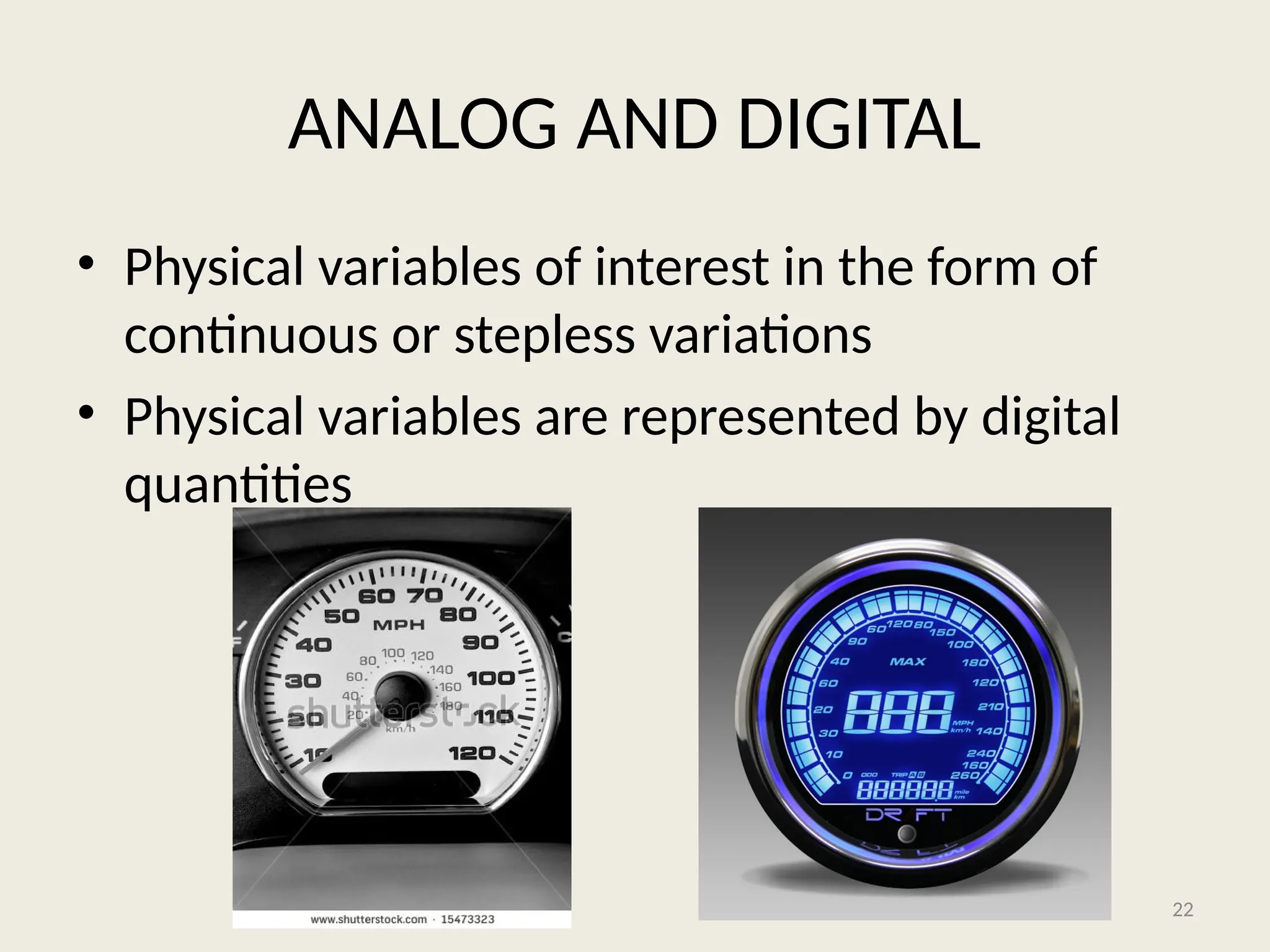
ANALOG AND DIGITAL
• Physical variables of interest in the form of
continuous or stepless variations
• Physical variables are represented by digital
quantities
22
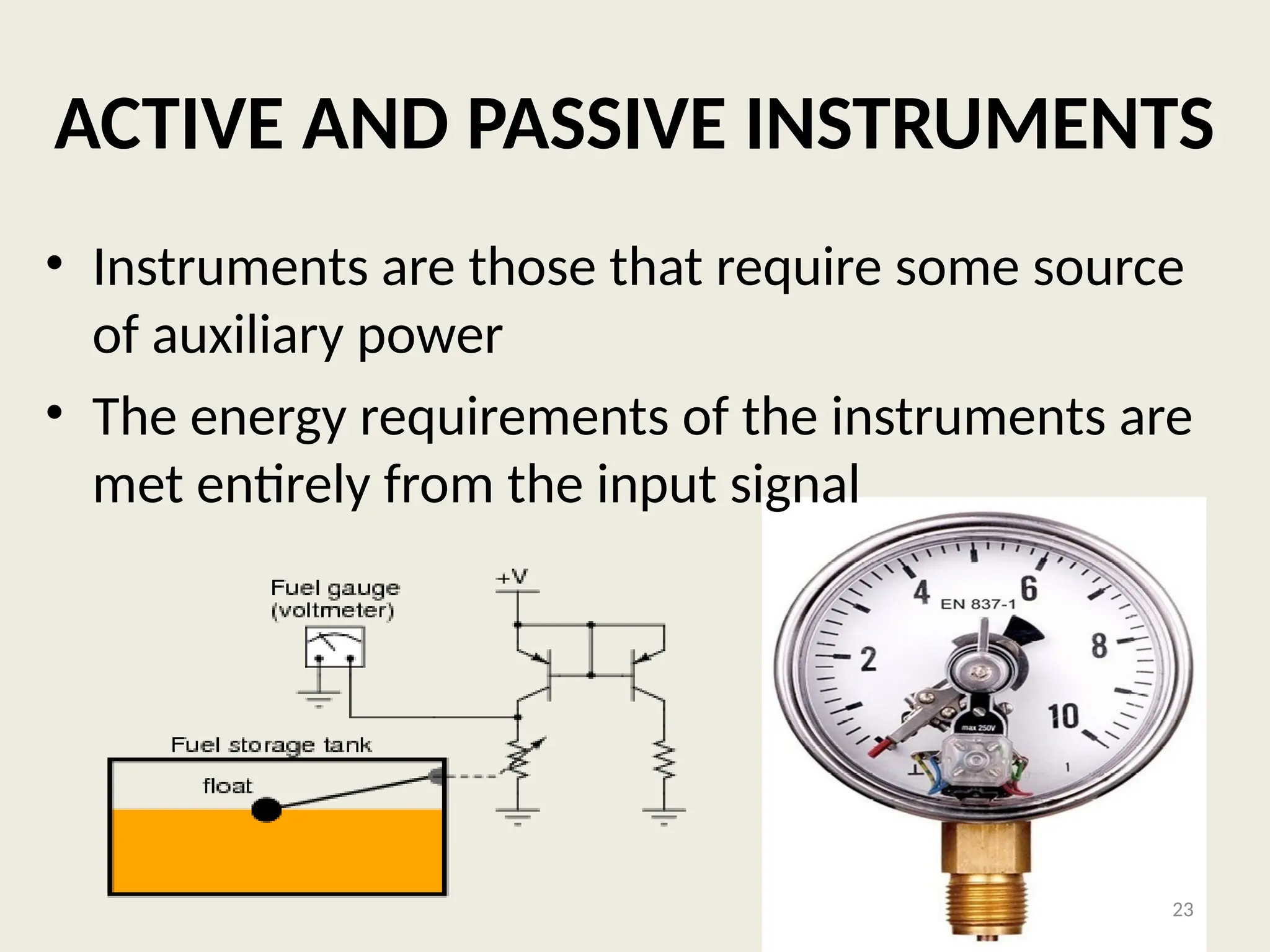
ACTIVE AND PASSIVE INSTRUMENTS
• Instruments are those that require some source
of auxiliary power
• The energy requirements of the instruments are
met entirely from the input signal
23
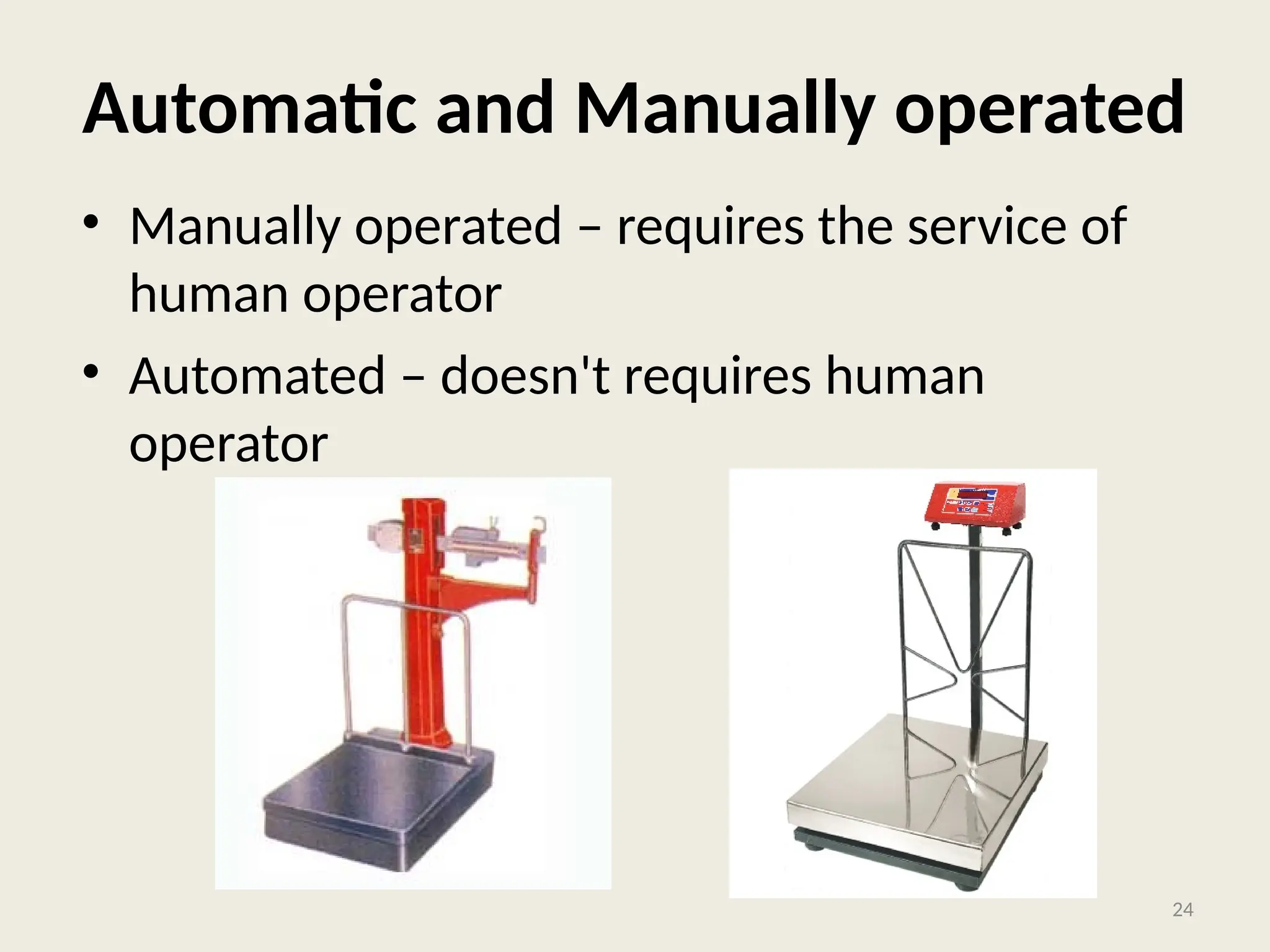
Automatic and Manually operated
• Manually operated – requires the service of
human operator
• Automated – doesn't requires human
operator
24
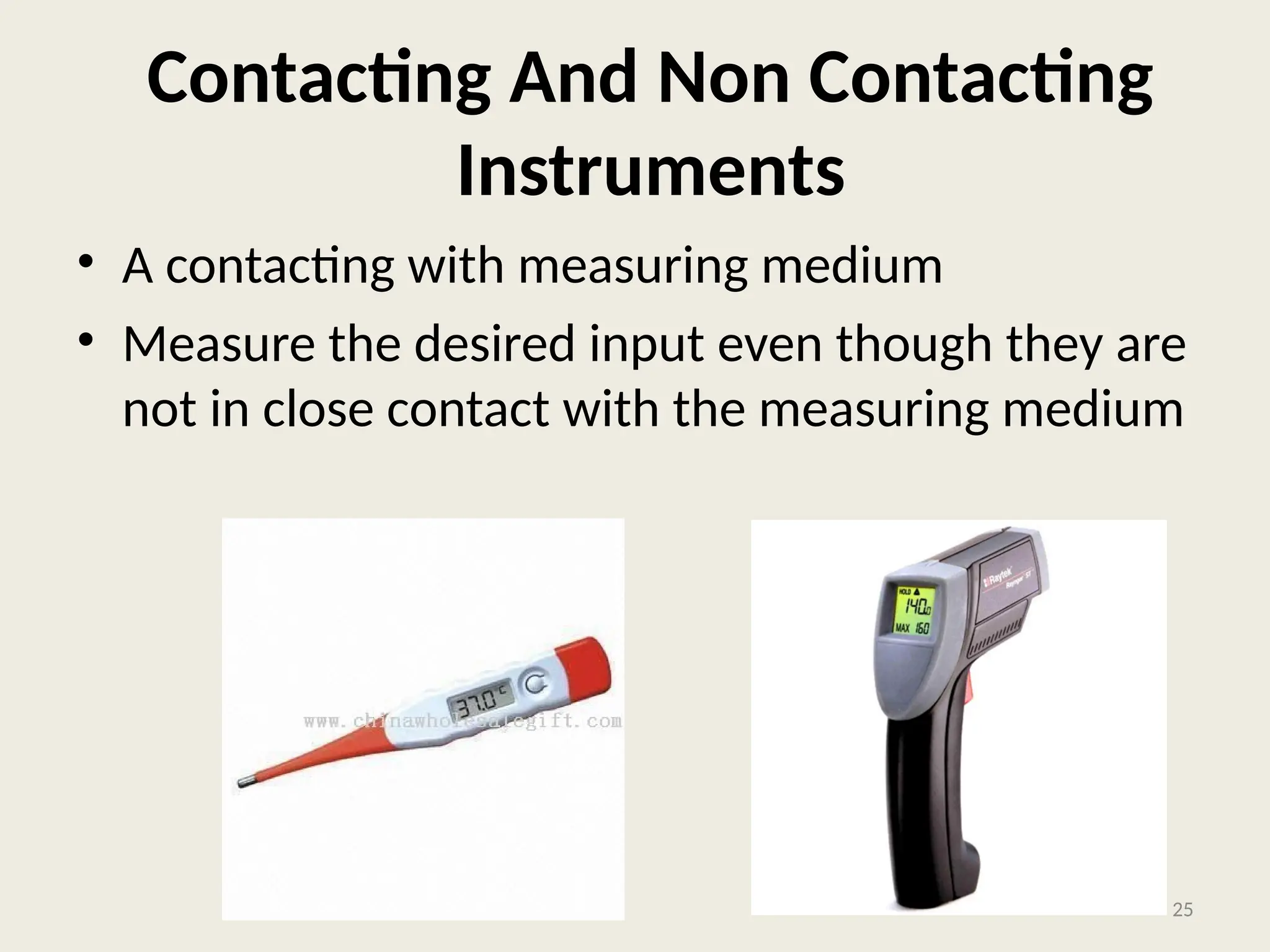
Contacting And Non Contacting
Instruments
• A contacting with measuring medium
• Measure the desired input even though they are
not in close contact with the measuring medium
25
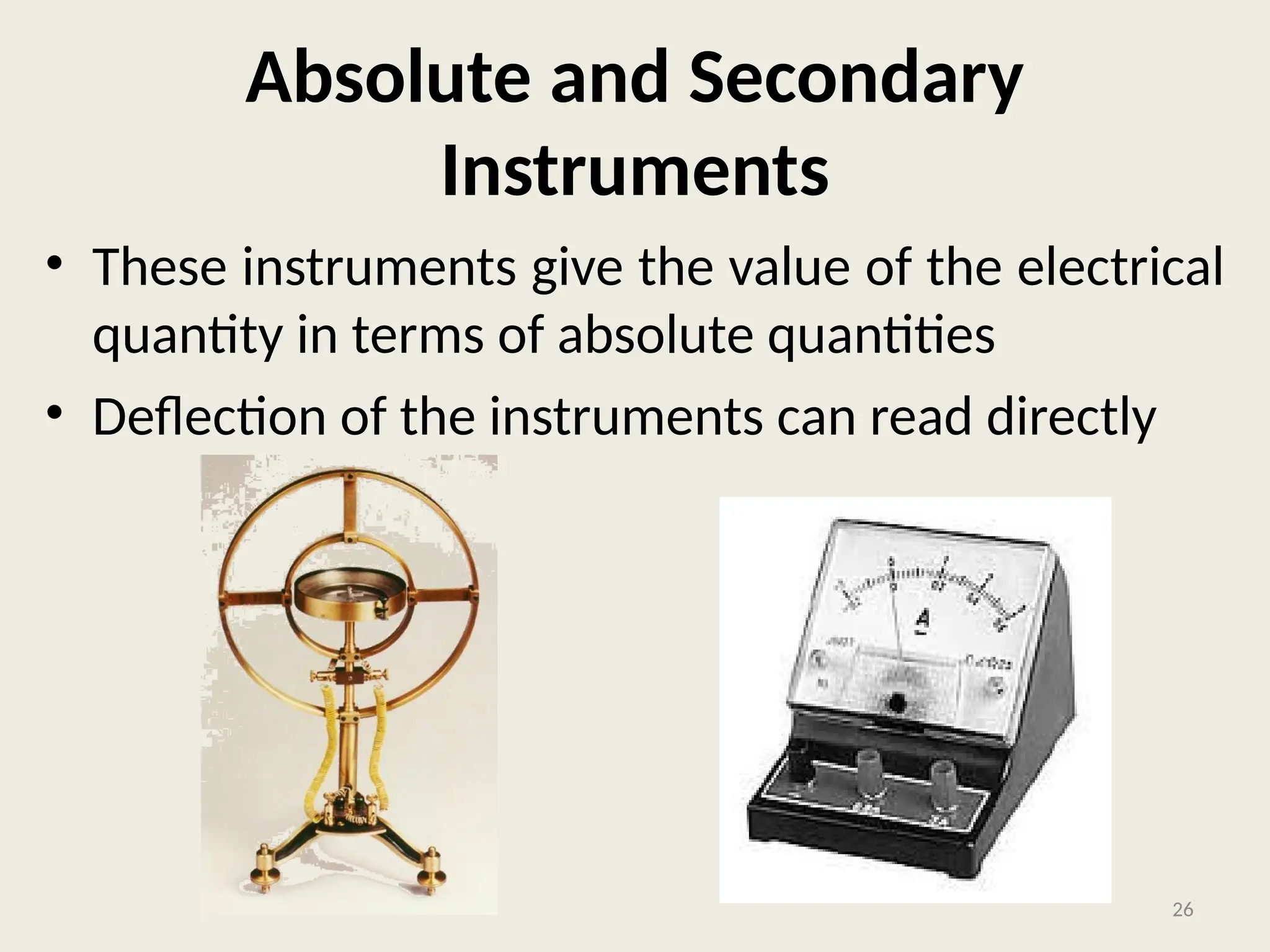
Absolute and Secondary
Instruments
• These instruments give the value of the electrical
quantity in terms of absolute quantities
• Deflection of the instruments can read directly
26
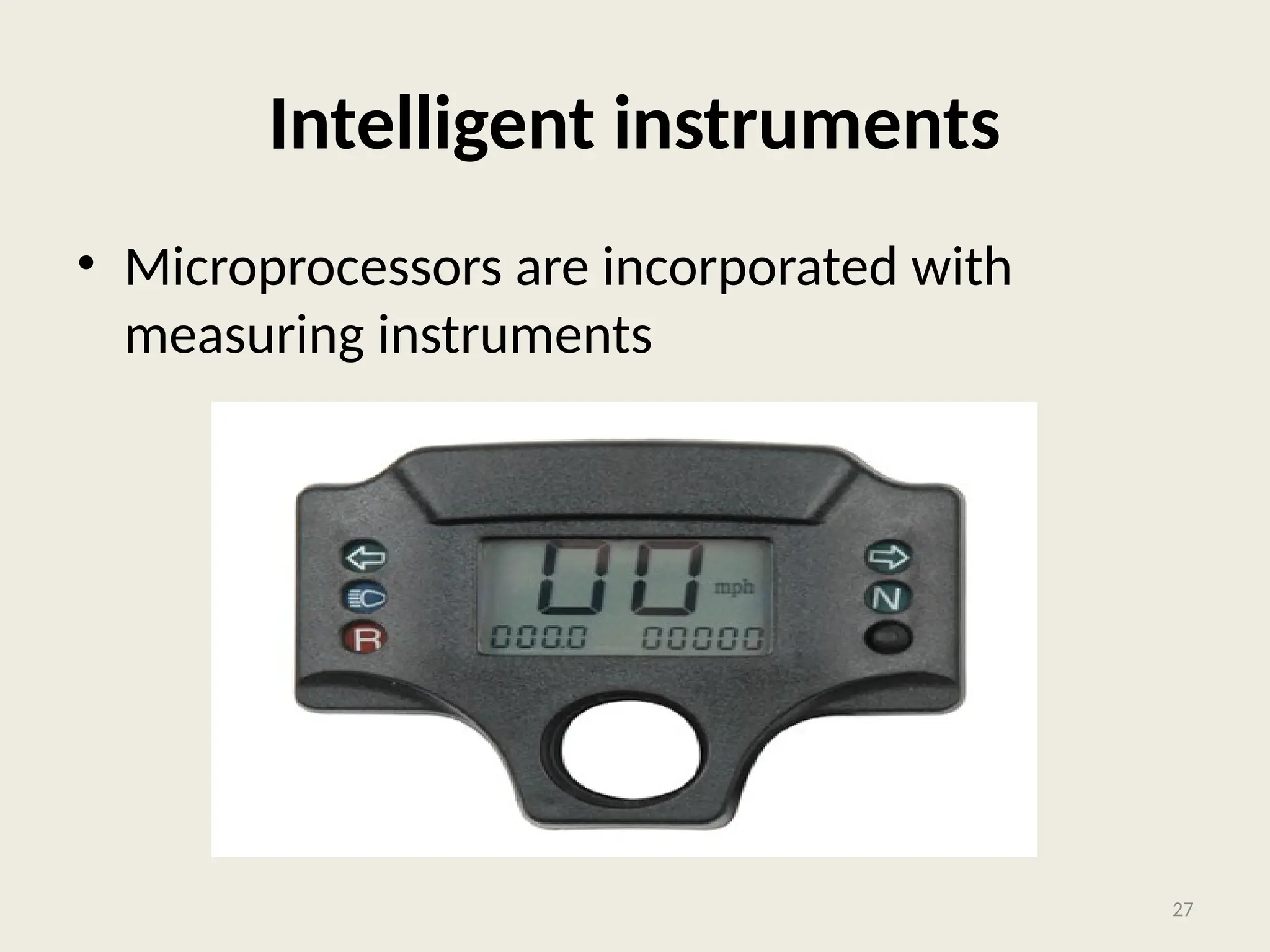
Intelligent instruments
• Microprocessors are incorporated with
measuring instruments
27
Characteristics of Measuring
Instrument
• Sensitivity
• Readability
• Range of accuracy
• Precision
28
Characteristics – Definition
• Sensitivity- Sensitivity is defined as the ratio of the
magnitude of response (output signal) to the
magnitude of the quantity being measured (input
signal)
• Readability- Readability is defined as the closeness with
which the scale of the analog instrument can be read
29
Characteristics – Definition
• Range of accuracy- Accuracy of a measuring
system is defined as the closeness of the
instrument output to the true value of the
measured quantity
• Precision- Precision is defined as the ability of the
instrument to reproduce a certain set of readings
within a given accuracy 30
Sensitivity
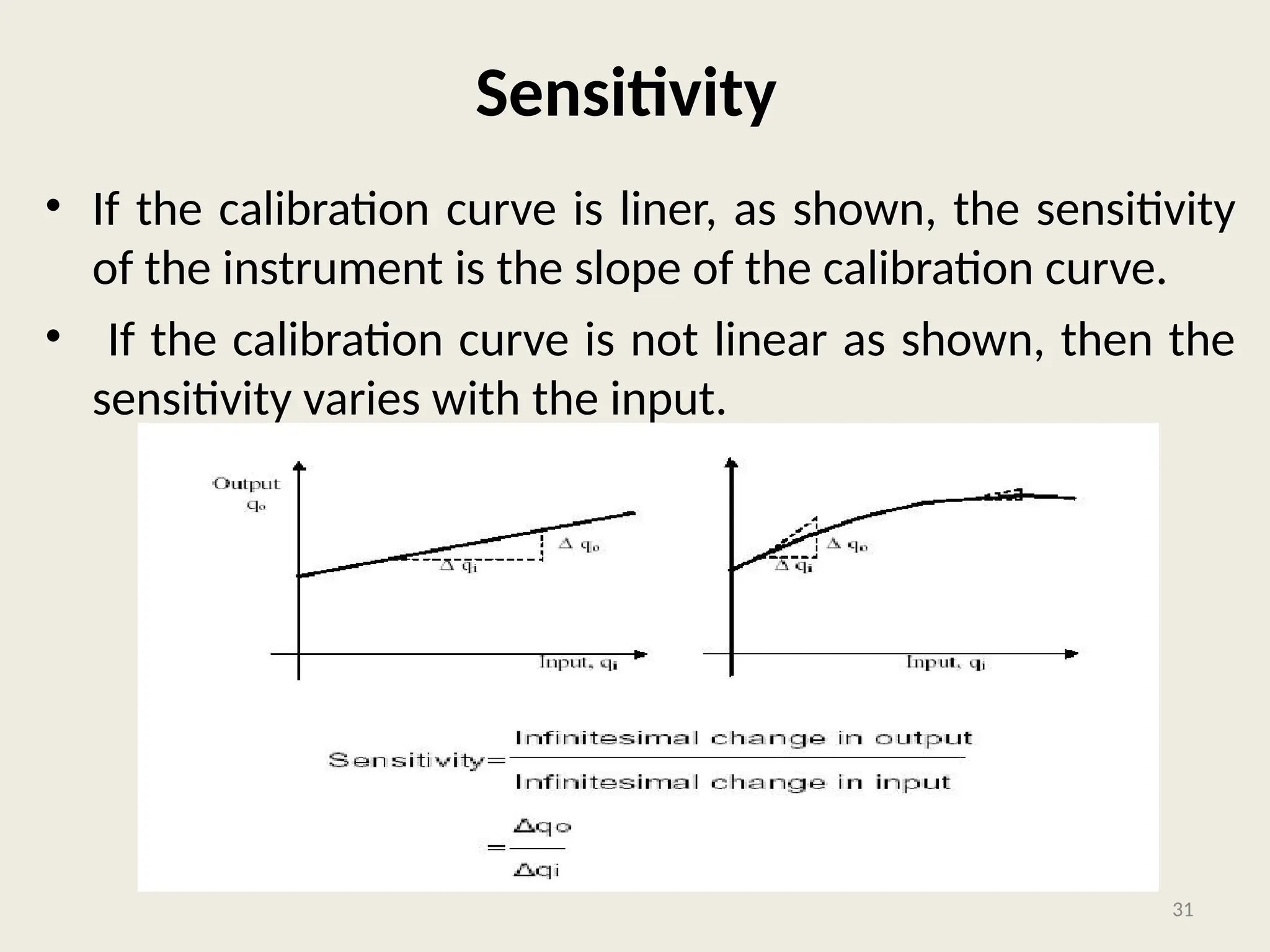
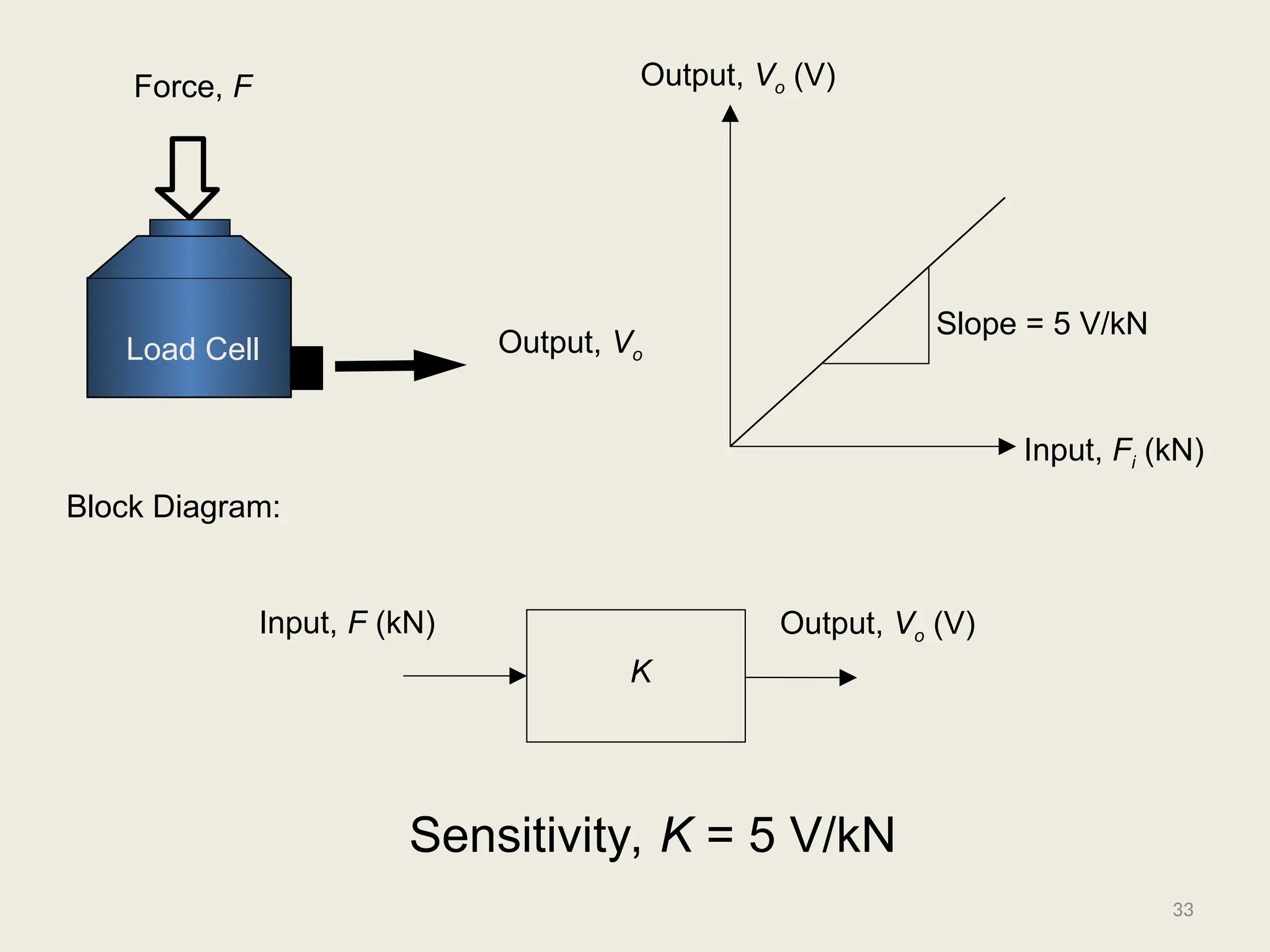
• If the calibration curve is liner, as shown, the sensitivity
of the instrument is the slope of the calibration curve.
• If the calibration curve is not linear as shown, then the
sensitivity varies with the input.
31
Sensitivity
This is the relationship between a change in the
output reading for a given change of the input.
(This relationship may be linear or non-linear.)
Sensitivity is often known as scale factor or
instrument magnification and an instrument with a
large sensitivity (scale factor) will indicate a large
movement of the indicator for a small input
change.
32
Load Cell
Force, F
Output, Vo
Output, Vo (V)
Input, Fi (kN)
Slope = 5 V/kN
K
Input, F (kN) Output, Vo (V)
Sensitivity, K = 5 V/kN
Block Diagram:
33
Readability
• Readability is defined as the ease with which
readings may be taken with an instrument.
• Readability difficulties may often occur due to
parallax errors when an observer is noting the
position of a pointer on a calibrated scale
34
Readability
What is the value ?
What is the value ?
What is the value ?
35
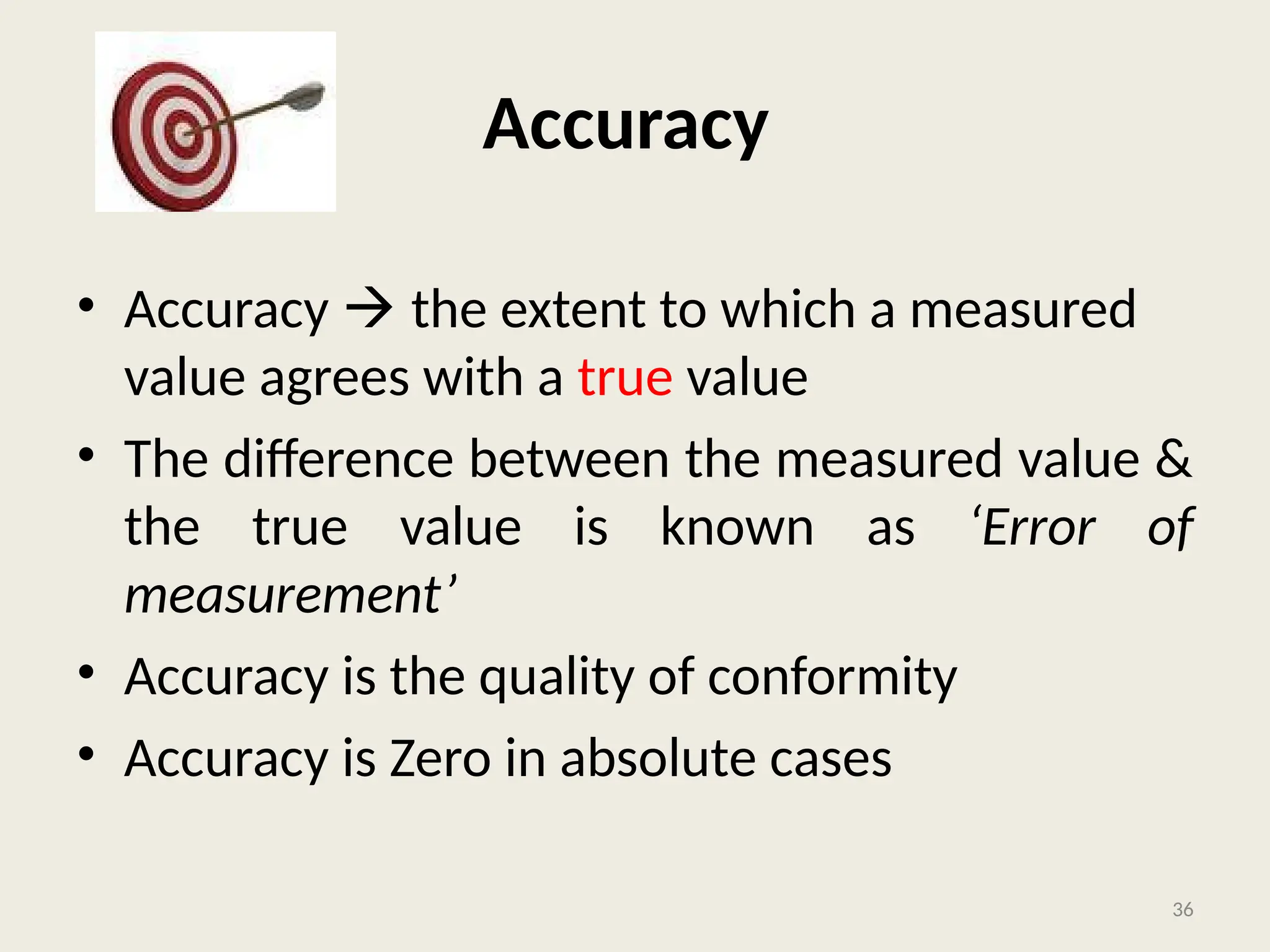
Accuracy
• Accuracy  the extent to which a measured
value agrees with a true value
• The difference between the measured value &
the true value is known as ‘Error of
measurement’
• Accuracy is the quality of conformity
• Accuracy is Zero in absolute cases
36
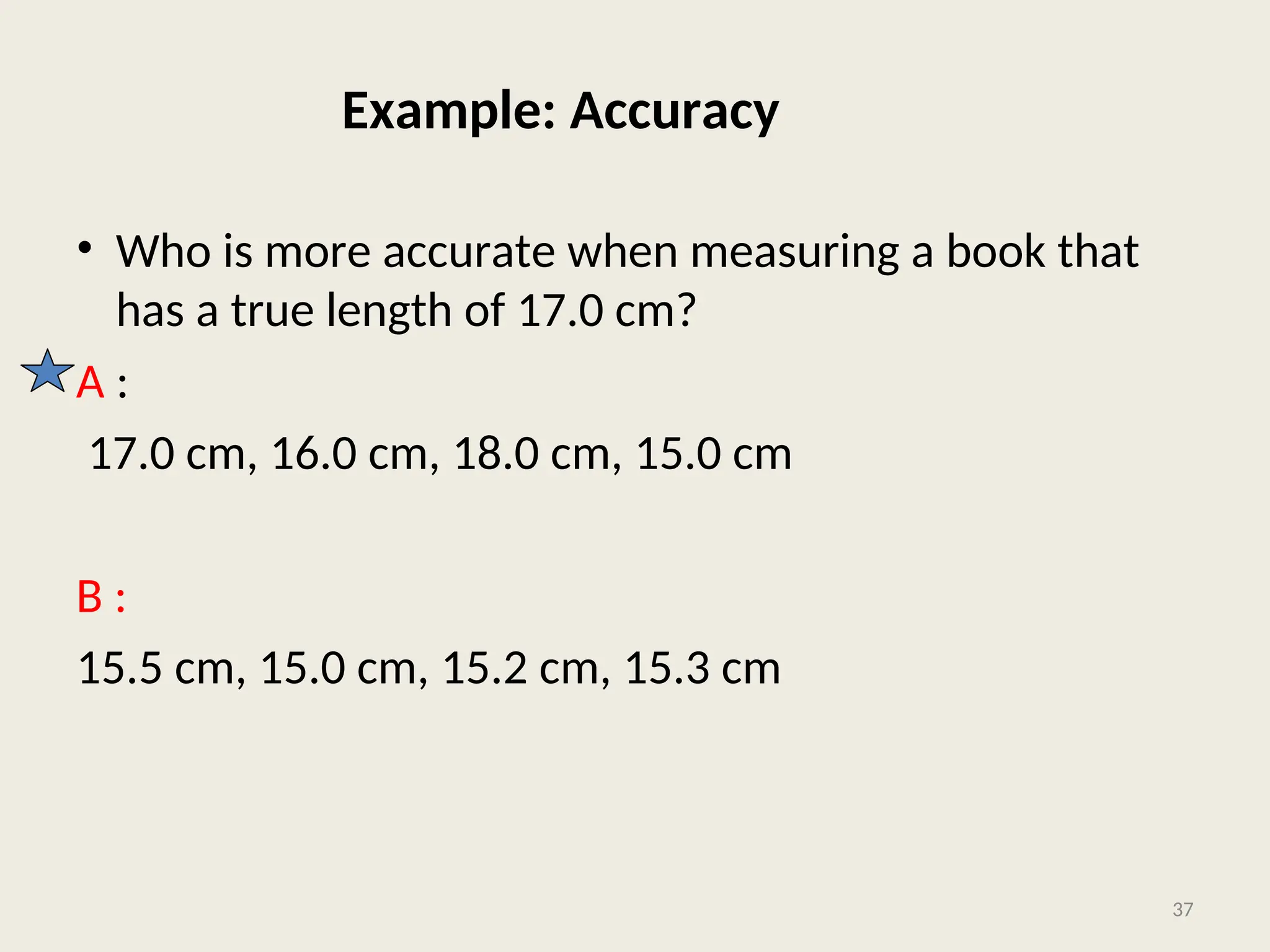
Example: Accuracy
• Who is more accurate when measuring a book that
has a true length of 17.0 cm?
A :
17.0 cm, 16.0 cm, 18.0 cm, 15.0 cm
B ::
15.5 cm, 15.0 cm, 15.2 cm, 15.3 cm
37
Precision
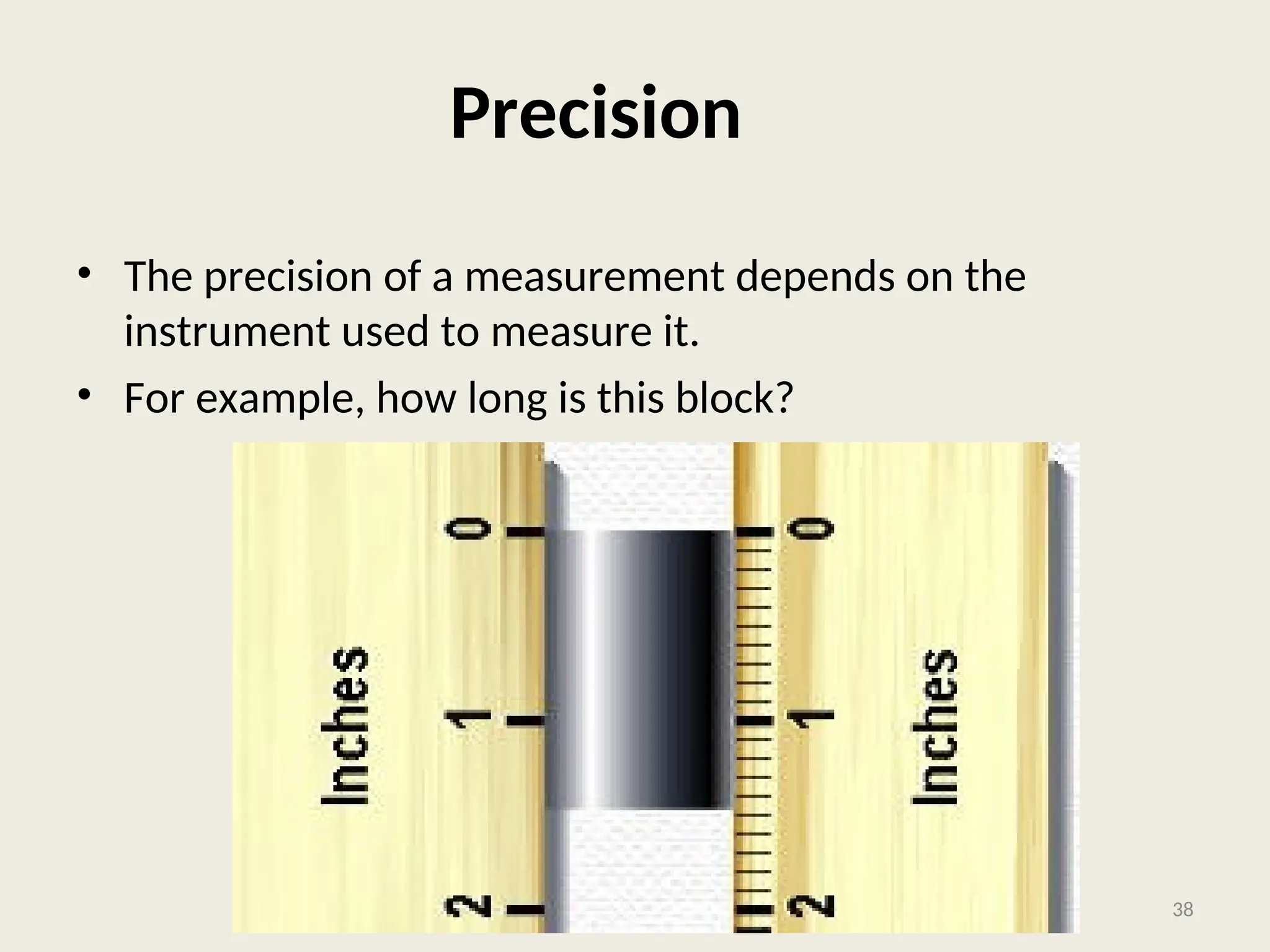
• The precision of a measurement depends on the
instrument used to measure it.
• For example, how long is this block?
38
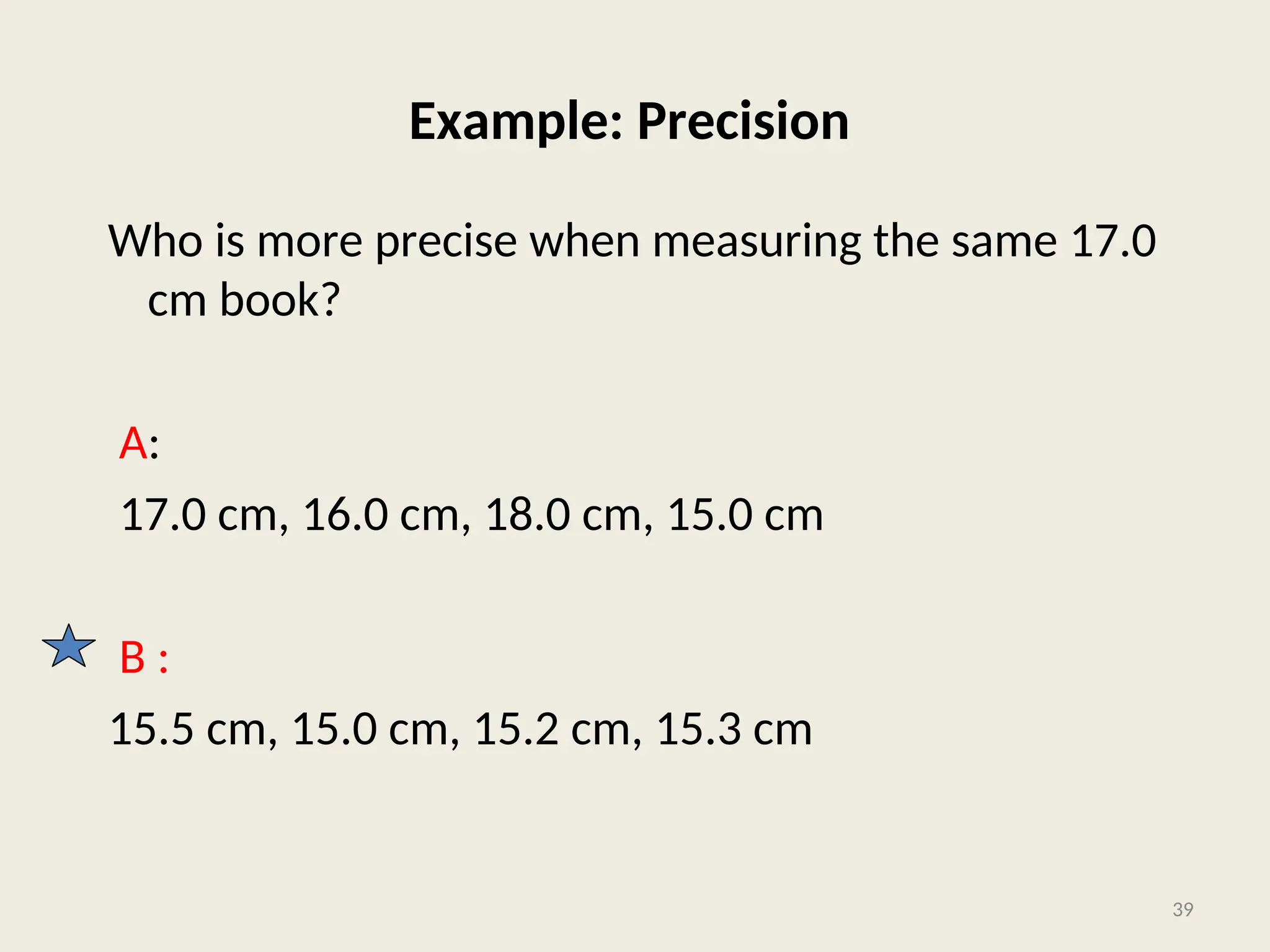
Example: Precision
Who is more precise when measuring the same 17.0
cm book?
A:
17.0 cm, 16.0 cm, 18.0 cm, 15.0 cm
B ::
15.5 cm, 15.0 cm, 15.2 cm, 15.3 cm
39
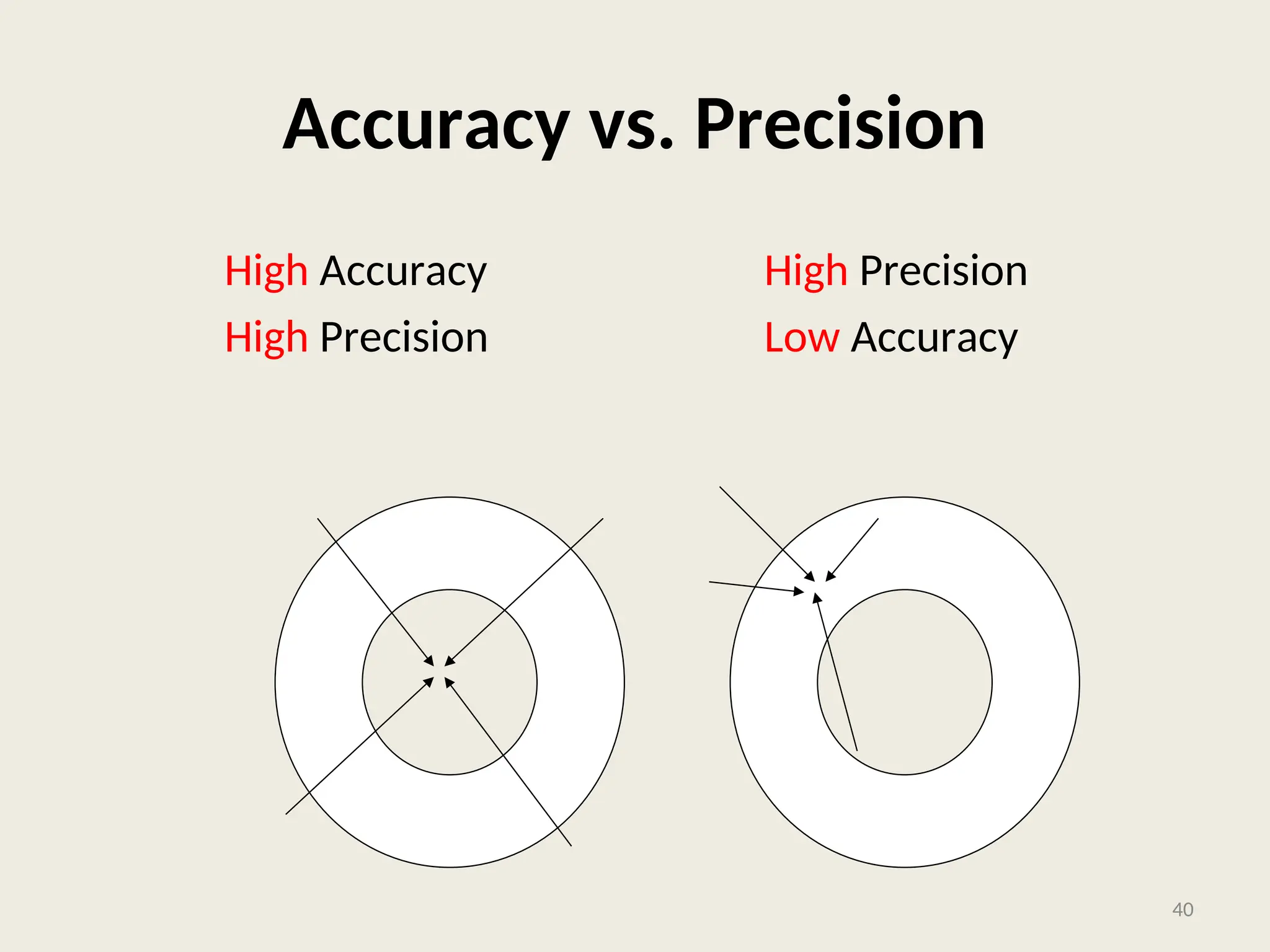
Accuracy vs. Precision
High Accuracy
High Precision
High Precision
Low Accuracy
40
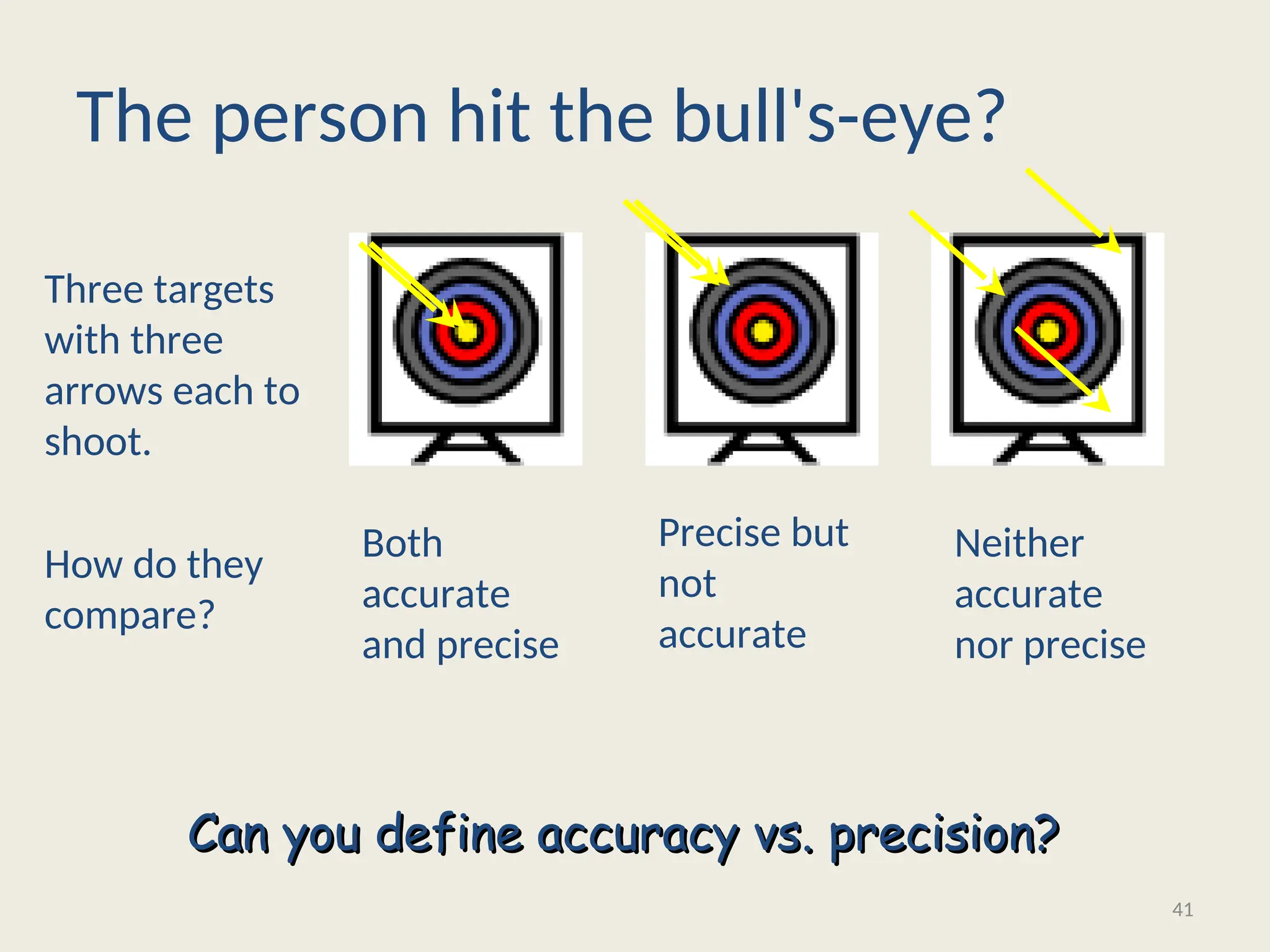
Three targets
with three
arrows each to
shoot.
The person hit the bull's-eye?
Both
accurate
and precise
Precise but
not
accurate
Neither
accurate
nor precise
How do they
compare?
Can you define accuracy vs. precision?
41
Uncertainty
• The word uncertainty casts a doubt about the
exactness of the measurement results
• True value = Estimated value + Uncertainty
42
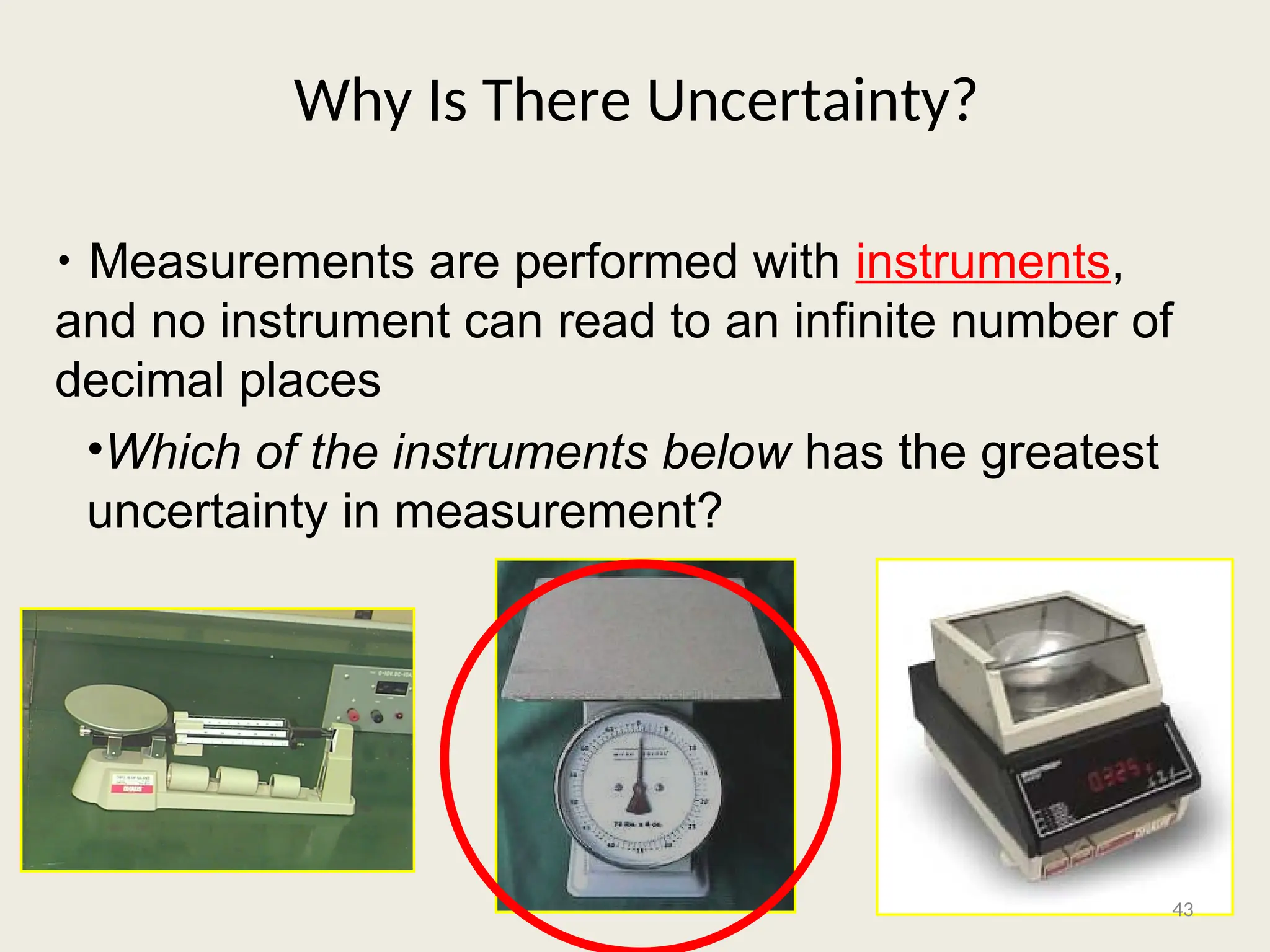
Why Is There Uncertainty?
• Measurements are performed with instruments,
and no instrument can read to an infinite number of
decimal places
•Which of the instruments below has the greatest
uncertainty in measurement?
43
Performance of Instruments
• All instrumentation systems are characterized
by the system characteristics or system
response
• There are two basic characteristics of
Measuring instruments, they are
– Static character
– Dynamic character
44
Static Characteristics
• The instruments, which are used to measure
the quantities which are slowly varying with
time or mostly constant, i.e., do not vary with
time, is called ‘static characteristics’.
45
STATIC CHARACTERISTICS OF AN INSTRUMENTS
• Accuracy
• Precision
• Sensitivity
• Resolution
• Threshold
• Drift
• Error
• Repeatability
• Reproducibility
• Dead zone
• Backlash
• True value
• Hysteresis
• Linearity
• Range or Span
• Bias
• Tolerance
• Stability
46
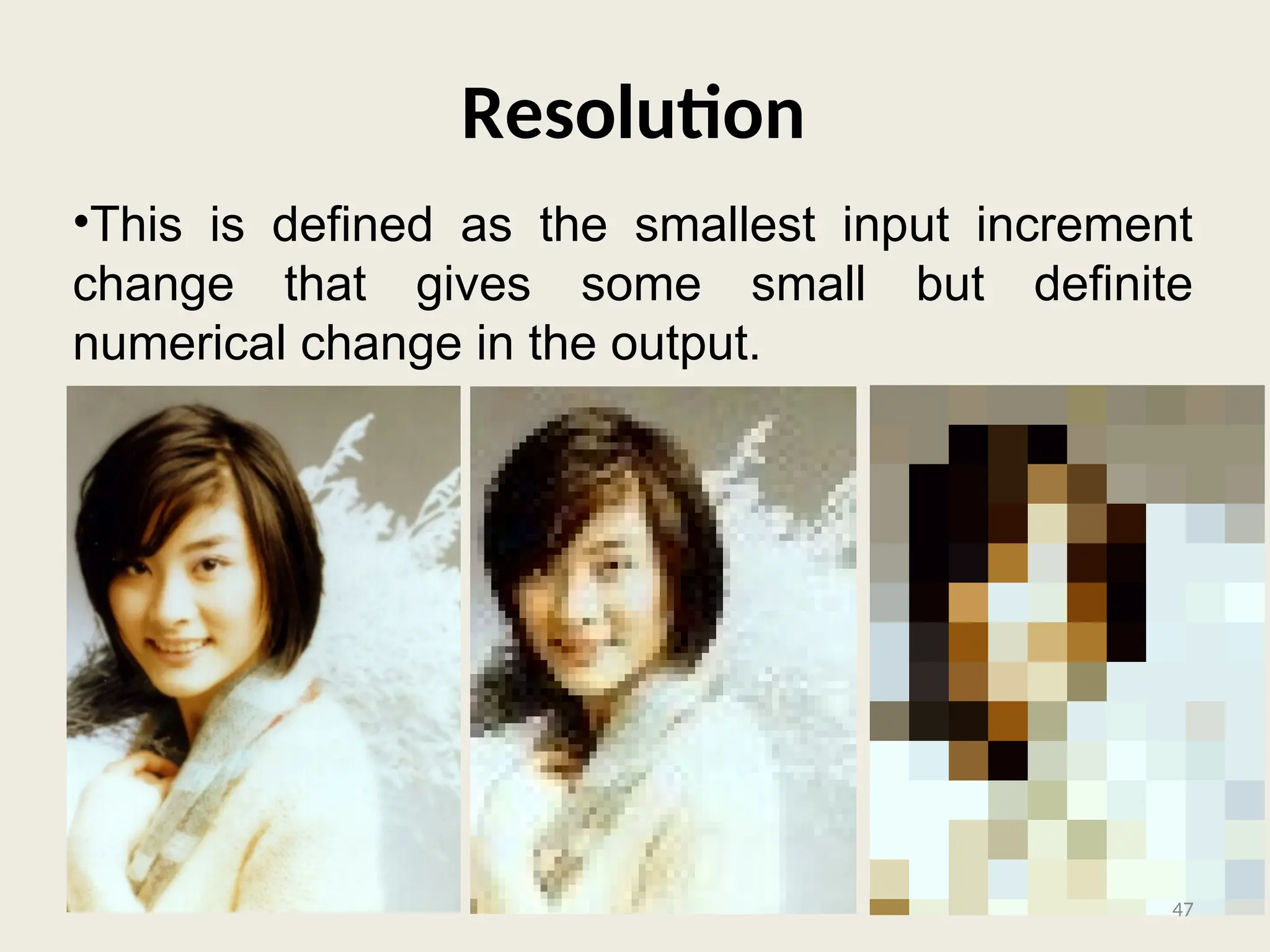
Resolution
•This is defined as the smallest input increment
change that gives some small but definite
numerical change in the output.
47
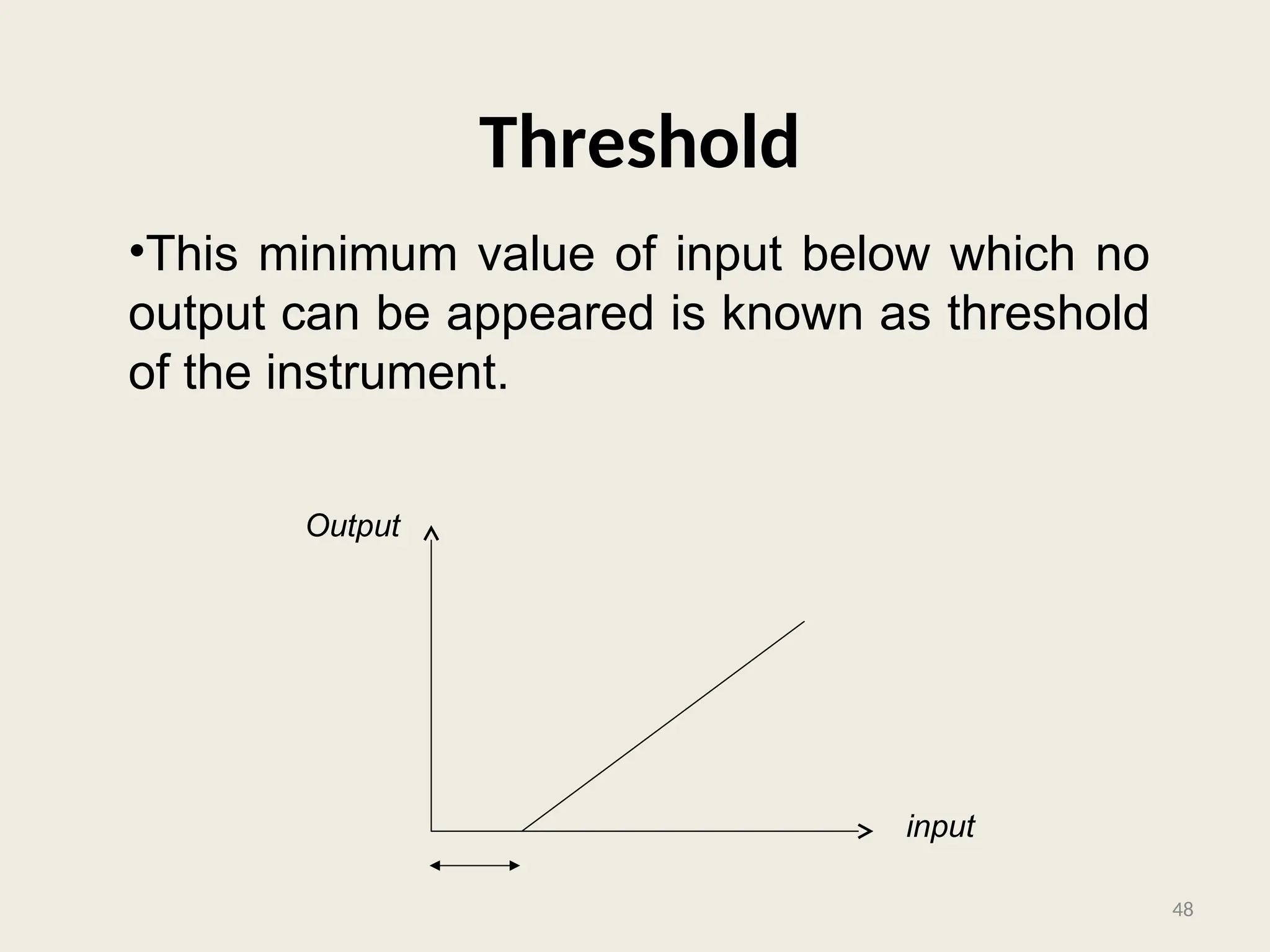
Threshold
•This minimum value of input below which no
output can be appeared is known as threshold
of the instrument.
input
Output
48
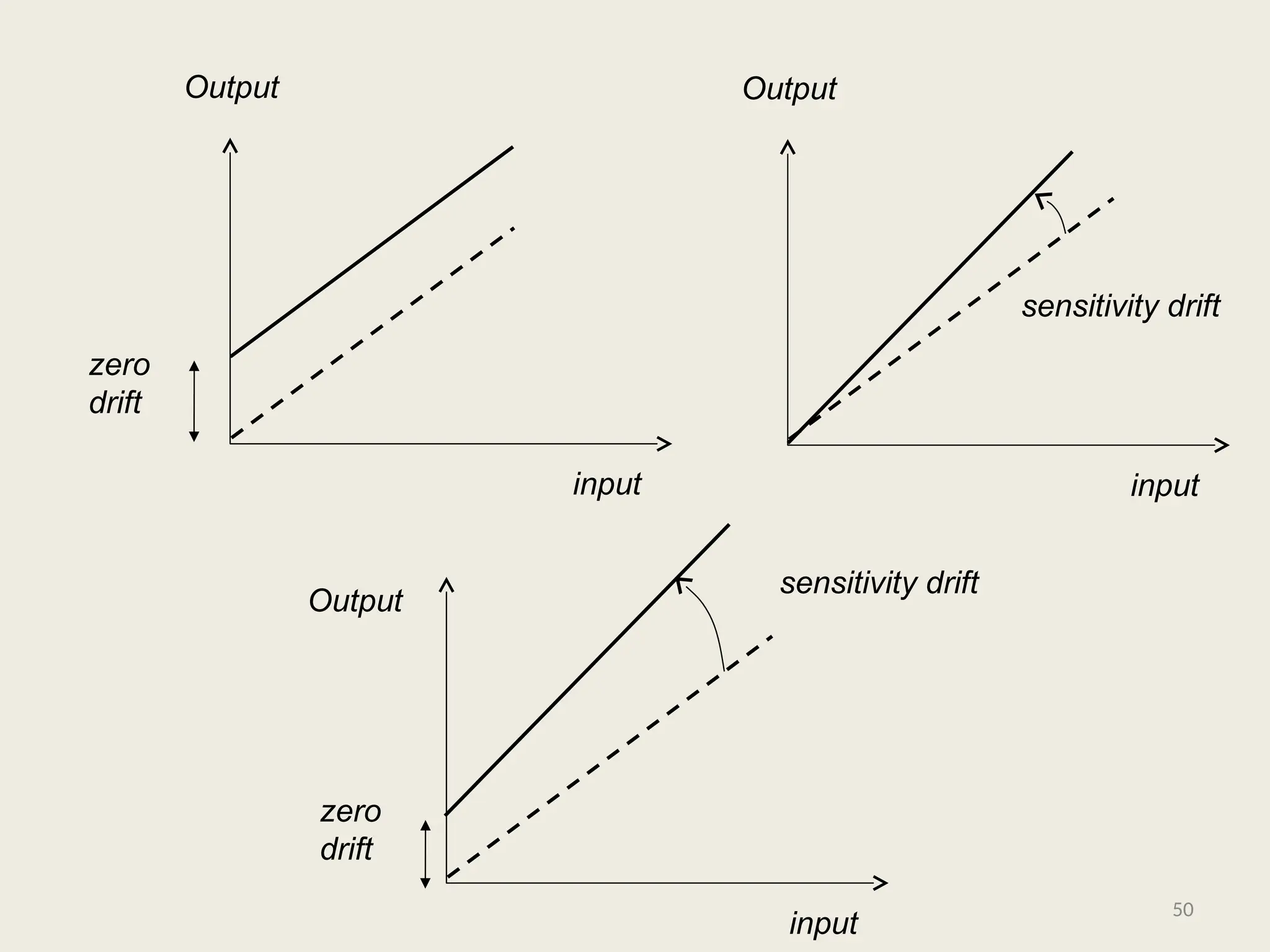
Drift
•Drift or Zero drift is variation in the output of an
instrument which is not caused by any change in
the input; it is commonly caused by internal
temperature changes and component instability.
•Sensitivity drift defines the amount by which
instrument’s sensitivity varies as ambient
conditions change.
49
input
Output
zero
drift
input
Output
sensitivity drift
input
Output
sensitivity drift
zero
drift
50
• Error – The deviation of the true value from the desired
value is called Error
• Repeatability – It is the closeness value of same output
for same input under same operating condition
• Reproducibility - It is the closeness value of same output
for same input under same operating condition over a
period of time
51
Range
• The ‘Range’ is the total range of values which
an instrument is capable of measuring.
52
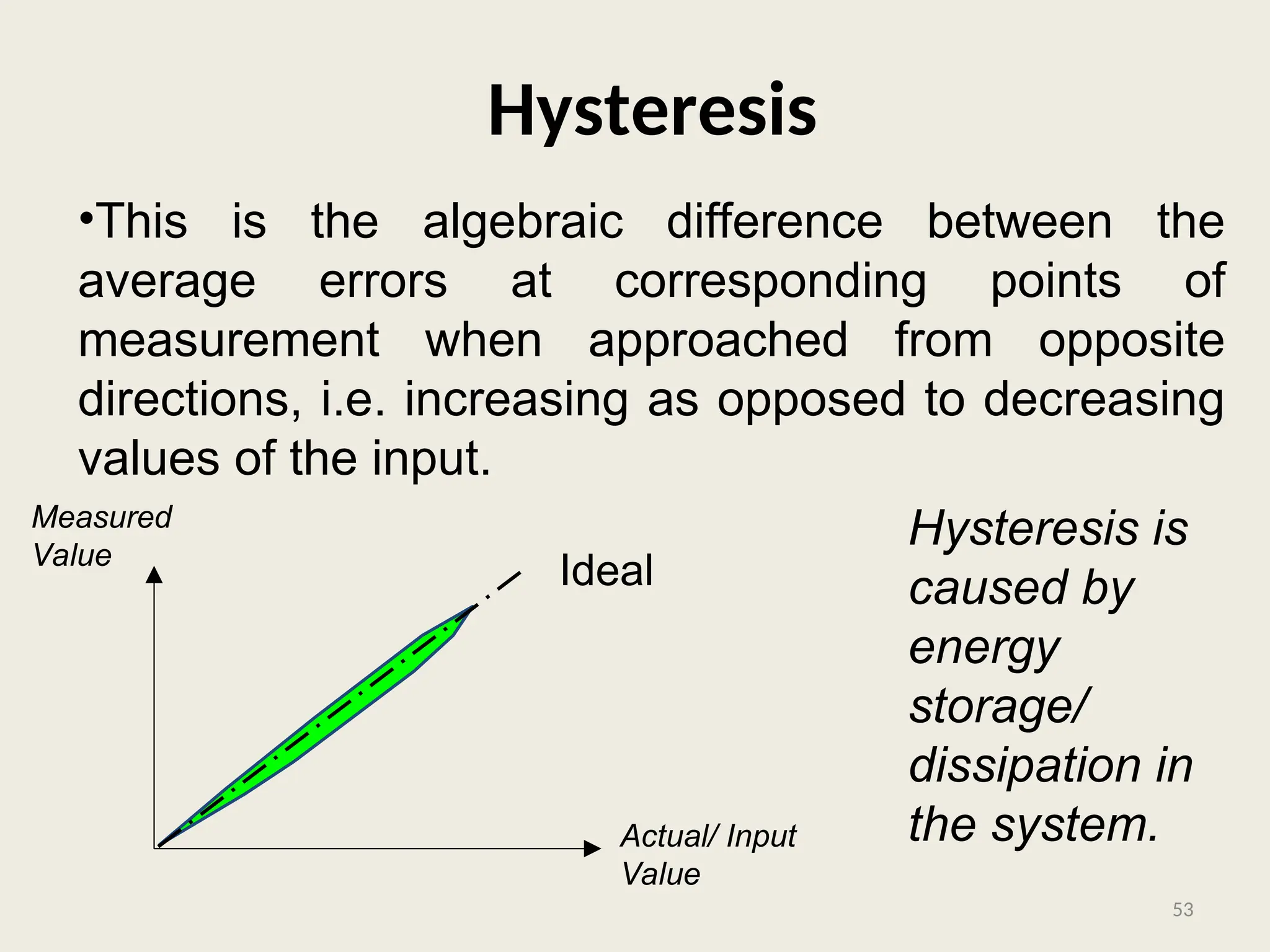
Hysteresis
•This is the algebraic difference between the
average errors at corresponding points of
measurement when approached from opposite
directions, i.e. increasing as opposed to decreasing
values of the input.
Actual/ Input
Value
Measured
Value
Ideal
Hysteresis is
caused by
energy
storage/
dissipation in
the system.
53
Zero Stability
•The ability of the instrument to return to zero
reading after the measured has returned to zero
54
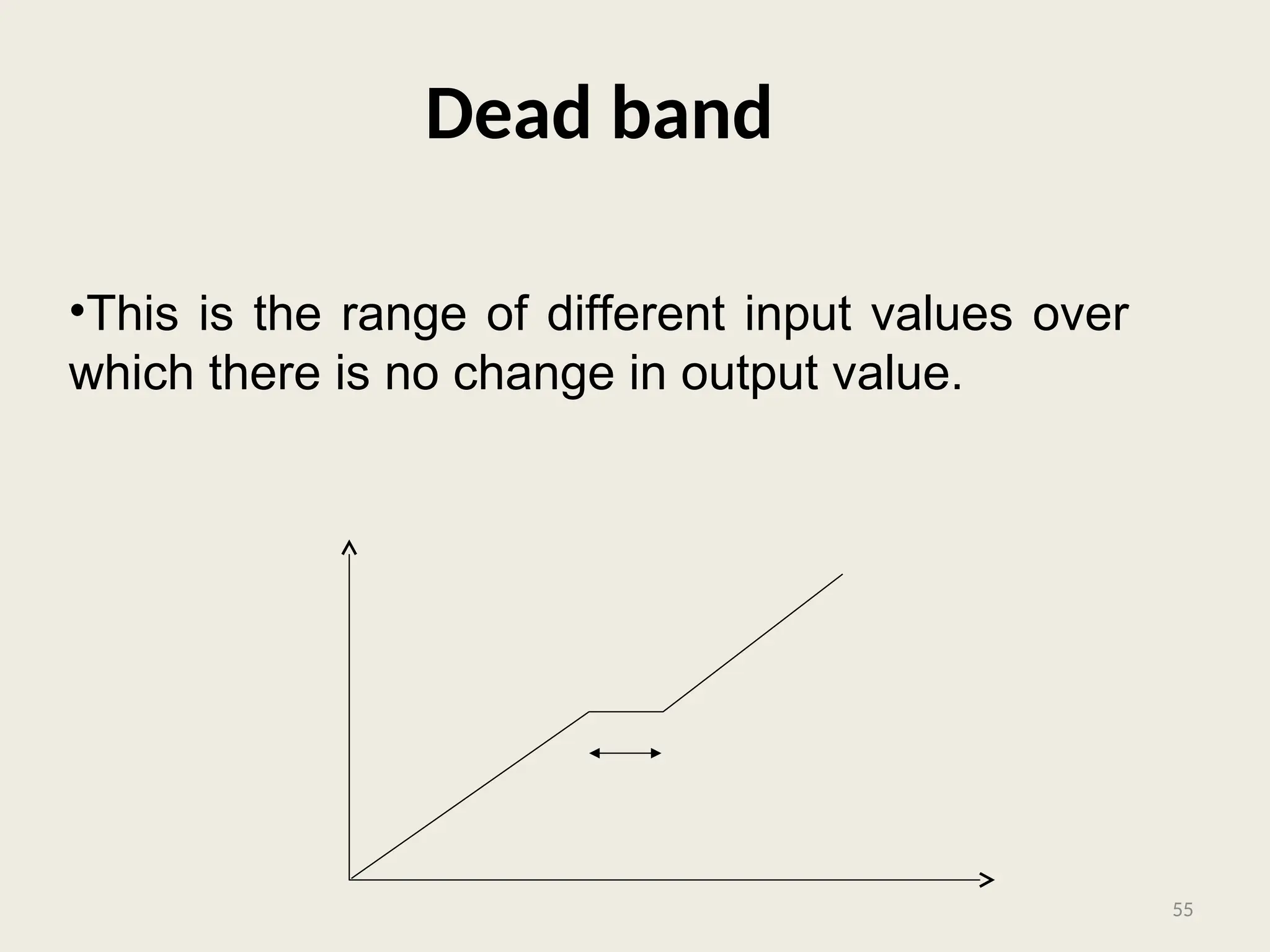
Dead band
•This is the range of different input values over
which there is no change in output value.
55
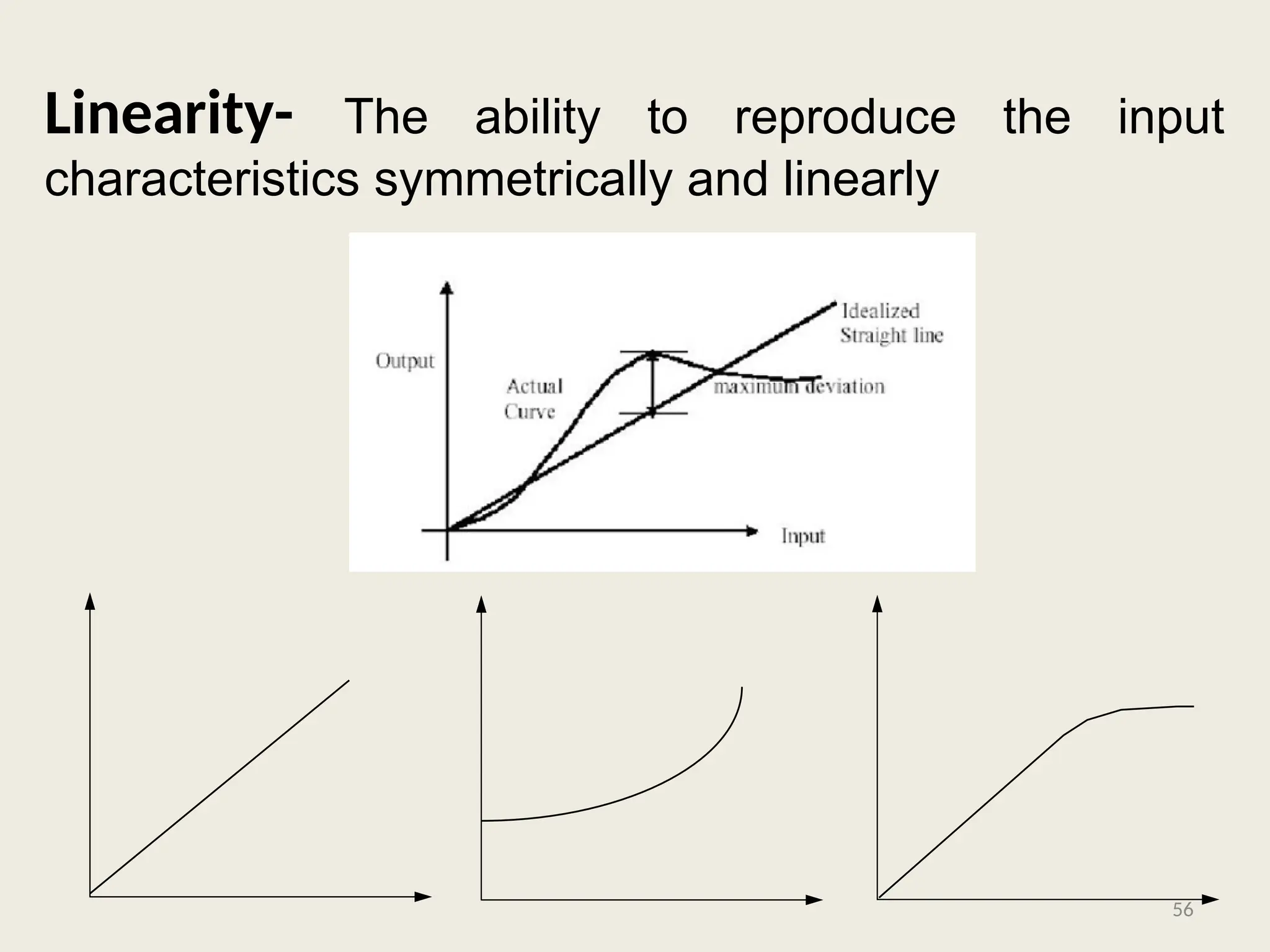
Linearity- The ability to reproduce the input
characteristics symmetrically and linearly
56
• Backlash – Lost motion or free play of
mechanical elements are known as backlash
• True value – The errorless value of measured
variable is known as true value
• Bias – The Constant Error
• Tolerance – Maximum Allowable error in
Measurement
57
Dynamic Characteristics
• The set of criteria defined for the
instruments, which are changes rapidly with
time, is called ‘dynamic characteristics’.
58
Dynamic Characteristics
• Steady state periodic
• Transient
• Speed of response
• Measuring lag
• Fidelity
• Dynamic error
59
• Steady state periodic – Magnitude has a definite
repeating time cycle
• Transient – Magnitude whose output does not
have definite repeating time cycle
• Speed of response- System responds to changes
in the measured quantity
60
• Measuring lag
– Retardation type :Begins immediately after the
change in measured quantity
– Time delay lag : Begins after a dead time after the
application of the input
• Fidelity – The degree to which a measurement
system indicates changes in the measured
quantity without error
• Dynamic error – Difference between the true
value of the quantity changing with time & the
value indicated by the measurement system
61
Errors in Instruments
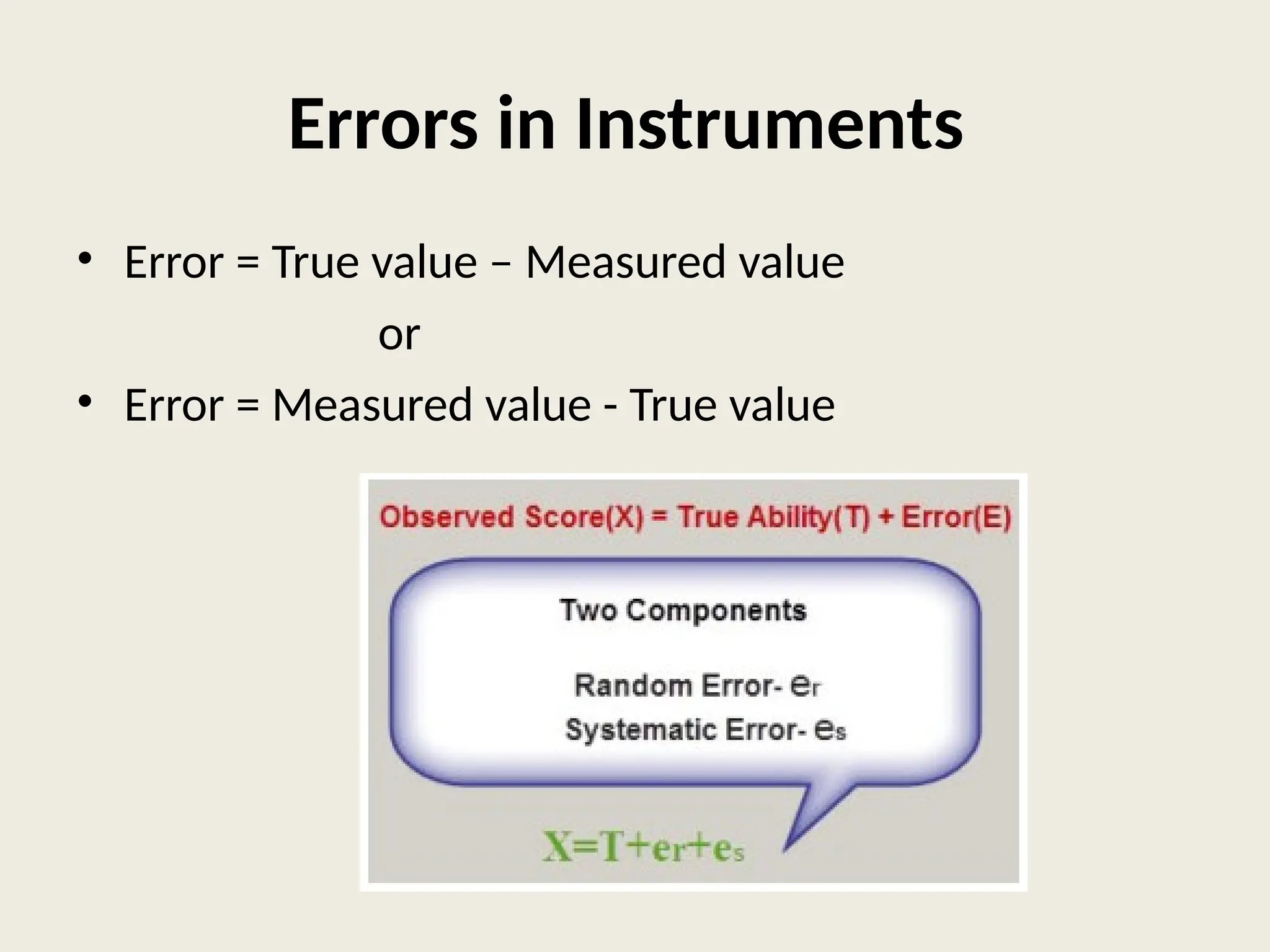
• Error = True value – Measured value
or
• Error = Measured value - True value
Types of Errors
• Classified into 3 types generally based on
Nature of Errors as:
– Gross Errors
– Blunders
– Measurement Errors
Types of Errors – Contd…
• Classified into 2 types based on Control
– Controllable errors
• Calibration errors
• Environmental (Ambient /Atmospheric Condition)
Errors
• Stylus pressure errors
• Avoidable errors
– Non - Controllable errors
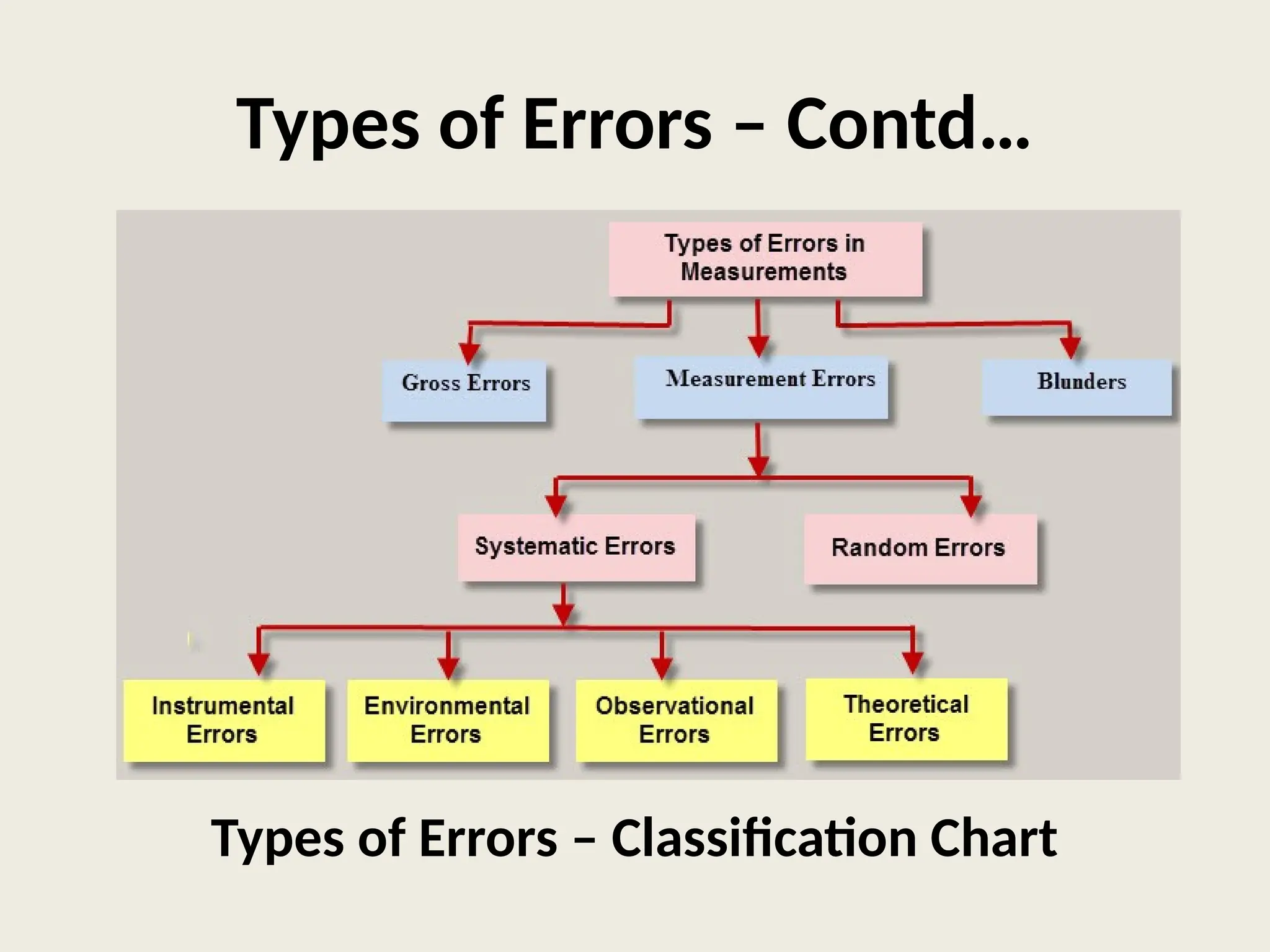
Types of Errors – Contd…
Types of Errors – Classification Chart
Gross Errors
• Errors caused by mistake while:
– Using instrument meters
– Calculating measurements
• Eg: Calculating using the value 1.01 N/m2
instead of 1.10 N/m2
Blunders
• Errors caused by mistake while:
– Faulty recording of data
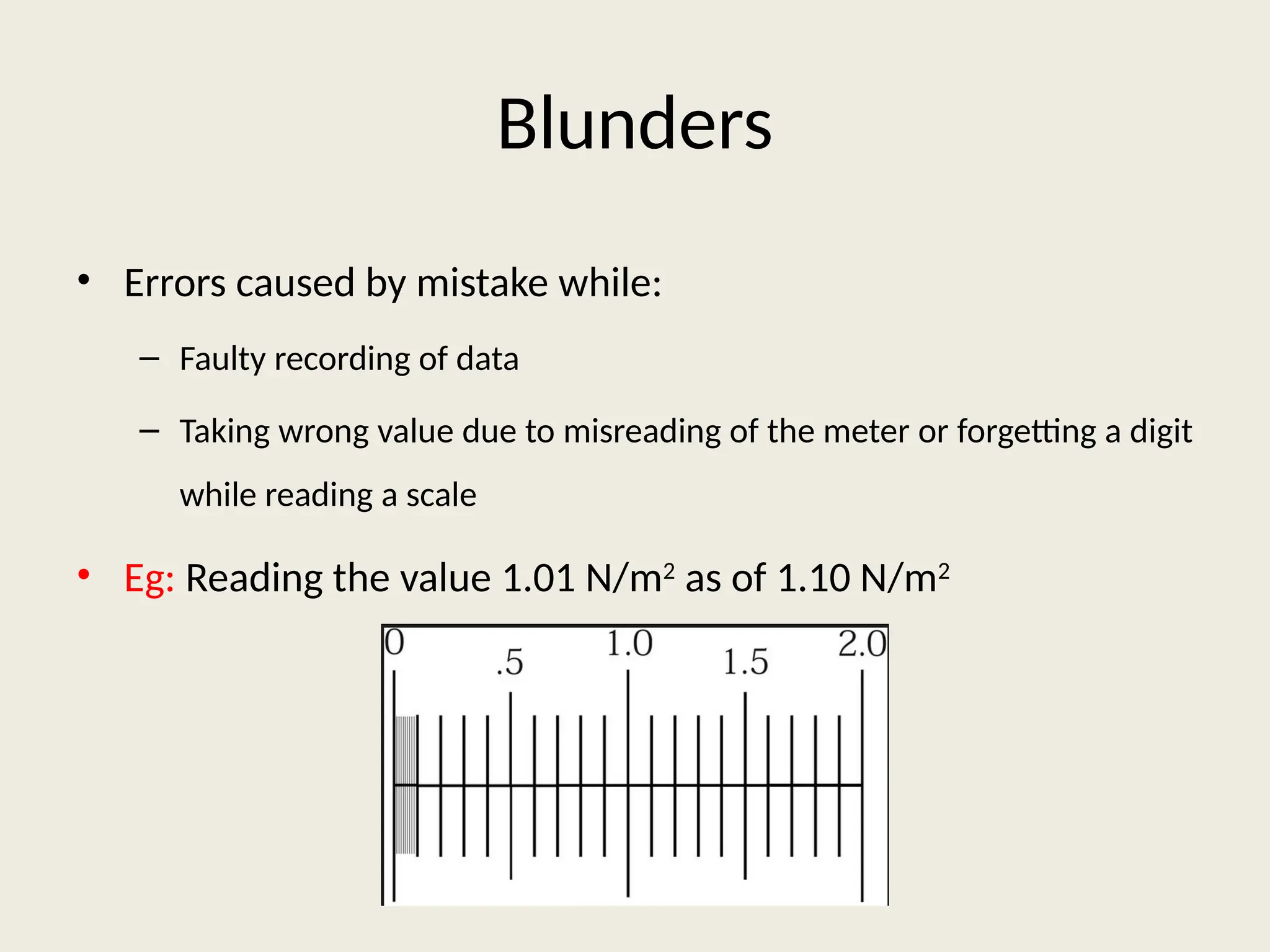
– Taking wrong value due to misreading of the meter or forgetting a digit
while reading a scale
• Eg: Reading the value 1.01 N/m2
as of 1.10 N/m2
Measurement Errors
• Occurs as a result of variation of measurement of a
true value
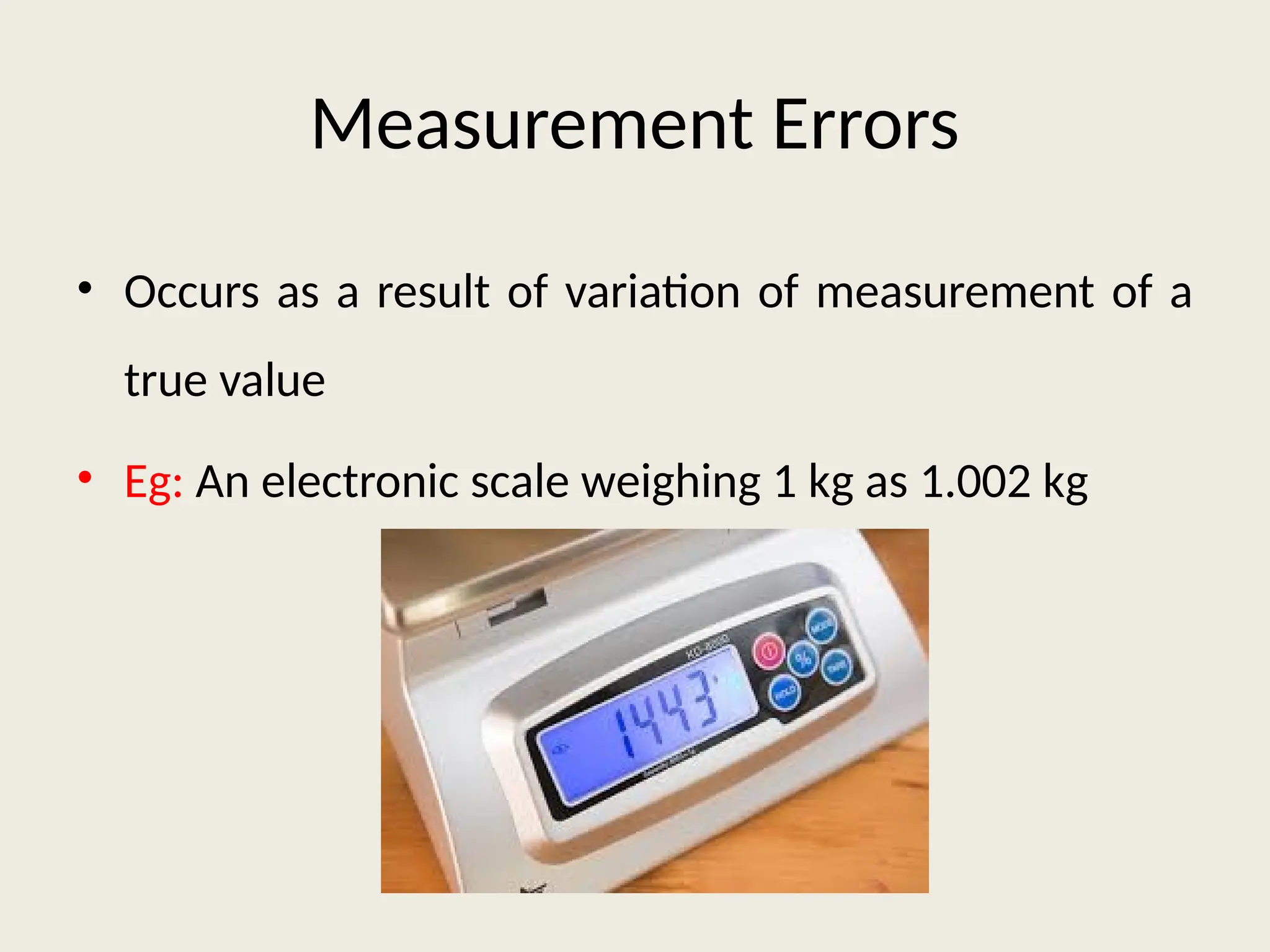
• Eg: An electronic scale weighing 1 kg as 1.002 kg
Measurement Errors - Types
– Systematic error -Predictable way in accordance due to
conditions change
• Instrumental
• Environmental
• Observational
• Theoretical
– Random error - Unpredictable manner
– Parasitic error - Incorrect execution of measurement
Systematic Error
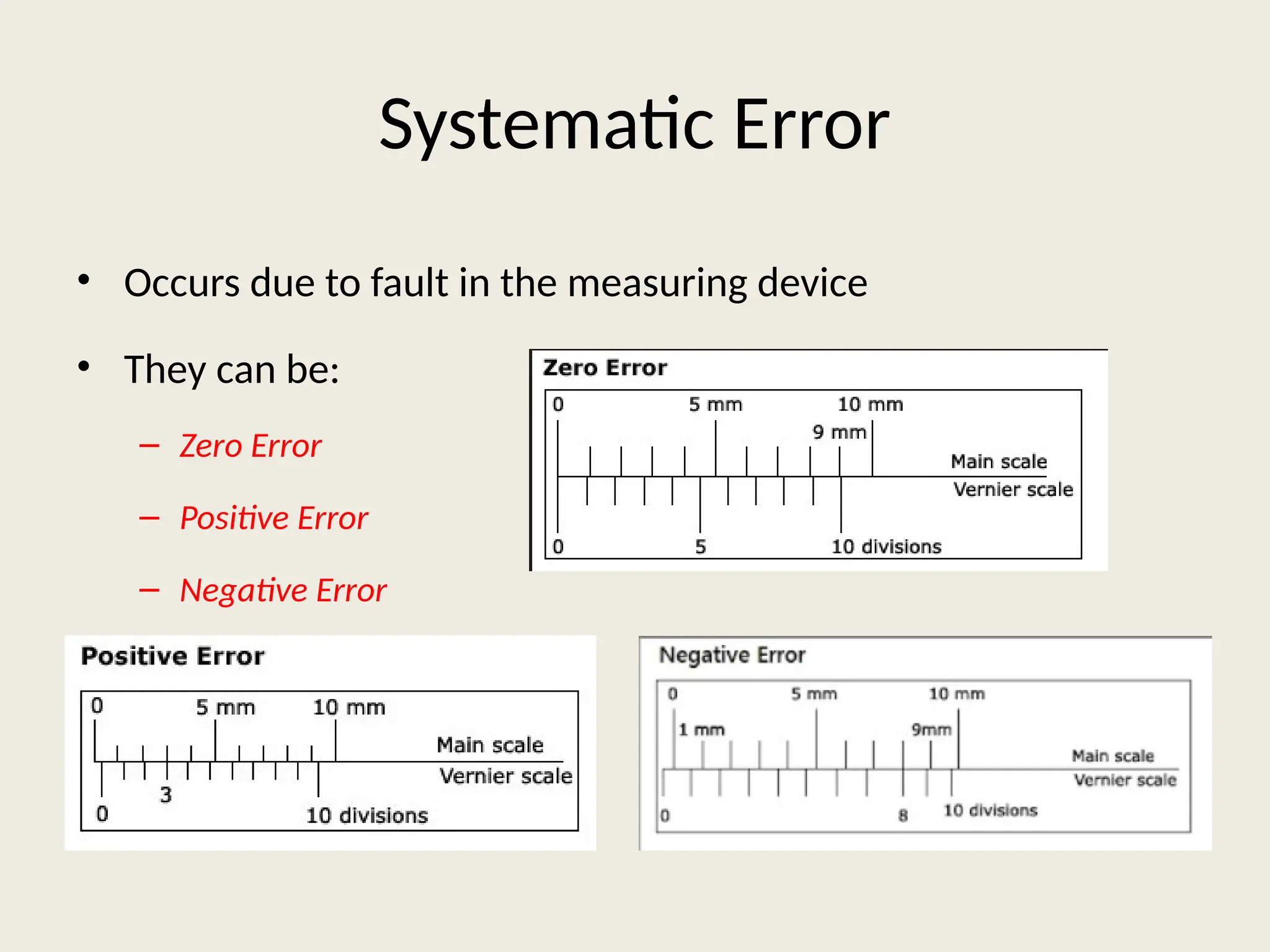
• Occurs due to fault in the measuring device
• They can be:
– Zero Error
– Positive Error
– Negative Error
Instrumental Error
• Occurs due to Incorrect construction of instrument
– Error of a measuring mechanism
– Error in indication of a measuring instrument
– Effect of loading
– Misuse of instruments
– Error due to friction or hysteresis
• Can be corrected to an extent, but in extreme cases
recalibration or reconstruction of the instrument is needed
Environmental Error
• Occurs due to adverse external environmental conditions
– Pressure
– Temperature
– Humidity
– Magnetic Fields
• Can be corrected by
– Maintaining Temperature & Humidity in the laboratory as a constant
– Ensure NO Electrostatic or Magnetic Fields around the instruments
Observational Errors
• Occurs during observation of the reading from the
instruments due to:
– Reading error
– Parallax error
– Interpolation error
Theoretical Errors
• Occurs when theoretical considerations are applied practically
while:
– Simplification of the model/instrument theoretically
• Eg: Measuring temperature of a liquid at its surface compared
to mid section or deep section
Correction
• Correction is defined as a value which is added
algebraically to the uncorrected result of the
measurement to compensate to an assumed
systematic error.
• Eg: Vernier Caliper, Micrometer
75
Calibration
• Calibration is the process of determining and
adjusting an instruments accuracy to make sure its
accuracy is with in manufacturing specifications.
76
Interchangeability
• A part which can be substituted for the component
manufactured to the small shape and dimensions is
known a interchangeable part.
• The operation of substituting the part for similar
manufactured components of the shape and
dimensions is known as interchangeability.
77
Standards
• International standards
• Primary standards
• Secondary standards
• Working standards
78
• International
– International Organization of Legal Metrology, Paris
– International Bureau of Weights and Measures at
Sevres, France
• National
– National Physical Laboratory, New Delhi
79
Thank You!!!
80

Unit_1_Basics_of_Metrology_and_Measurements.ppt

  • 1.
    Unit 1 Basics ofMetrology 1
  • 2.
    Syllabus Introduction to Metrology– Need – Elements – Work piece, Instruments – Persons – Environment –their effect on Precision and Accuracy – Errors – Errors in Measurements – Types – Control – Types of standards. 2
  • 3.
    Definition • Metrology isthe Greek name given to the science of pure measurement. • Measurement is defined as the process of numerical evaluation of a dimension or the process of comparison with standard measuring instruments 3
  • 4.
    Why Measure? Generate Datafor Design of any product – Eg. Design of a pump Generate Data to validate an analysis or propose a theory – Eg. Ph.D analysis experiment Commercial – Goods and Products we use – Eg. Shoes, Shirt 4
  • 5.
    Need of Measurement •Establish standard • Interchange ability • Customer Satisfaction • Validate the design • Physical parameter into meaningful number • True dimension • Evaluate the Performance 5
  • 6.
    How to MeasureGenerally? Measurand – I/P – Unknown Magnitude Result – In Number Standard Quantity – Known Magnitude Comparision Process Measurand – A variable whose numerical value is to be determined 6
  • 7.
  • 8.
    Common elements ofsystem – Contd… • Example – Pressure Type Thermometer (Bourdon Tube Method) 8
  • 9.
    Working Principle ofPressure Type Thermometer • Liquid will expand or contract in proportion to the temperature • Enclosed liquid when partially filled will create definite vapour pressure in proportion to its temperature • Universal Gas Law: PV=nRT 9
  • 10.
    SI: Fundamental Units PhysicalQuantity Unit Name Symbol Length meter m Mass kilogram kg Time second s Temperature kelvin K Electric current ampere A Amount of substance mole mol Luminous intensity candela cd 10
  • 11.
    SI: Supplementary units Physical Quantity UnitName Symbol Plane angle Radian rad Solid angle Steradian sr 11
  • 12.
    SI: Derived Units PhysicalQuantity Unit Name Symbol Area square meter m2 Volume cubic meter m3 Speed meter per second m/s Acceleration meter per second squared m/s2 Weight, Force newton N Pressure pascal Pa Energy, Work joule J 12
  • 13.
    Methods of Measurement •Direct method • Indirect method • Comparative method • Coincidence method • Contact method • Deflection method • Complementary method 13
  • 14.
    Direct method • Measurementsare directly obtained – Eg: Vernier Caliper, Scales 14
  • 15.
    Indirect method • Obtainedby measuring other quantities – Eg : Weight = Length x Breadth x Height x Density 15
  • 16.
    Comparative Method • It’scompared with other known value – Eg: Comparators 16
  • 17.
    Coincidence method • Measurementscoincide with certain lines and signals; Eg: Vernier Caliphers Fundamental method • Measuring a quantity directly in related with the definition of that quantity; Eg: Weight using Physical Balance Contact method • Sensor/Measuring tip touch the surface area 17
  • 18.
    Complementary method • Thevalue of quantity to be measured is combined with known value of the same quantity – Ex:Volume determination by liquid displacement 18
  • 19.
    Deflection method • Thevalue to be measured is directly indicated by a deflection of pointer – Ex: Pressure Measurement 19
  • 20.
    Measuring Instruments • Deflectionand null type instruments • Analog and digital instruments • Active and passive instruments • Automatic and manually operated instruments • Contacting and non contacting instruments • Absolute and secondary instruments • Intelligent instruments. 20
  • 21.
    DEFLECTION AND NULLTYPE • Physical effect generated by the measuring quantity • Equivalent opposing effect to nullify the physical effect caused by the quantity 21
  • 22.
    ANALOG AND DIGITAL •Physical variables of interest in the form of continuous or stepless variations • Physical variables are represented by digital quantities 22
  • 23.
    ACTIVE AND PASSIVEINSTRUMENTS • Instruments are those that require some source of auxiliary power • The energy requirements of the instruments are met entirely from the input signal 23
  • 24.
    Automatic and Manuallyoperated • Manually operated – requires the service of human operator • Automated – doesn't requires human operator 24
  • 25.
    Contacting And NonContacting Instruments • A contacting with measuring medium • Measure the desired input even though they are not in close contact with the measuring medium 25
  • 26.
    Absolute and Secondary Instruments •These instruments give the value of the electrical quantity in terms of absolute quantities • Deflection of the instruments can read directly 26
  • 27.
    Intelligent instruments • Microprocessorsare incorporated with measuring instruments 27
  • 28.
    Characteristics of Measuring Instrument •Sensitivity • Readability • Range of accuracy • Precision 28
  • 29.
    Characteristics – Definition •Sensitivity- Sensitivity is defined as the ratio of the magnitude of response (output signal) to the magnitude of the quantity being measured (input signal) • Readability- Readability is defined as the closeness with which the scale of the analog instrument can be read 29
  • 30.
    Characteristics – Definition •Range of accuracy- Accuracy of a measuring system is defined as the closeness of the instrument output to the true value of the measured quantity • Precision- Precision is defined as the ability of the instrument to reproduce a certain set of readings within a given accuracy 30
  • 31.
    Sensitivity • If thecalibration curve is liner, as shown, the sensitivity of the instrument is the slope of the calibration curve. • If the calibration curve is not linear as shown, then the sensitivity varies with the input. 31
  • 32.
    Sensitivity This is therelationship between a change in the output reading for a given change of the input. (This relationship may be linear or non-linear.) Sensitivity is often known as scale factor or instrument magnification and an instrument with a large sensitivity (scale factor) will indicate a large movement of the indicator for a small input change. 32
  • 33.
    Load Cell Force, F Output,Vo Output, Vo (V) Input, Fi (kN) Slope = 5 V/kN K Input, F (kN) Output, Vo (V) Sensitivity, K = 5 V/kN Block Diagram: 33
  • 34.
    Readability • Readability isdefined as the ease with which readings may be taken with an instrument. • Readability difficulties may often occur due to parallax errors when an observer is noting the position of a pointer on a calibrated scale 34
  • 35.
    Readability What is thevalue ? What is the value ? What is the value ? 35
  • 36.
    Accuracy • Accuracy the extent to which a measured value agrees with a true value • The difference between the measured value & the true value is known as ‘Error of measurement’ • Accuracy is the quality of conformity • Accuracy is Zero in absolute cases 36
  • 37.
    Example: Accuracy • Whois more accurate when measuring a book that has a true length of 17.0 cm? A : 17.0 cm, 16.0 cm, 18.0 cm, 15.0 cm B :: 15.5 cm, 15.0 cm, 15.2 cm, 15.3 cm 37
  • 38.
    Precision • The precisionof a measurement depends on the instrument used to measure it. • For example, how long is this block? 38
  • 39.
    Example: Precision Who ismore precise when measuring the same 17.0 cm book? A: 17.0 cm, 16.0 cm, 18.0 cm, 15.0 cm B :: 15.5 cm, 15.0 cm, 15.2 cm, 15.3 cm 39
  • 40.
    Accuracy vs. Precision HighAccuracy High Precision High Precision Low Accuracy 40
  • 41.
    Three targets with three arrowseach to shoot. The person hit the bull's-eye? Both accurate and precise Precise but not accurate Neither accurate nor precise How do they compare? Can you define accuracy vs. precision? Can you define accuracy vs. precision? 41
  • 42.
    Uncertainty • The worduncertainty casts a doubt about the exactness of the measurement results • True value = Estimated value + Uncertainty 42
  • 43.
    Why Is ThereUncertainty? • Measurements are performed with instruments, and no instrument can read to an infinite number of decimal places •Which of the instruments below has the greatest uncertainty in measurement? 43
  • 44.
    Performance of Instruments •All instrumentation systems are characterized by the system characteristics or system response • There are two basic characteristics of Measuring instruments, they are – Static character – Dynamic character 44
  • 45.
    Static Characteristics • Theinstruments, which are used to measure the quantities which are slowly varying with time or mostly constant, i.e., do not vary with time, is called ‘static characteristics’. 45
  • 46.
    STATIC CHARACTERISTICS OFAN INSTRUMENTS • Accuracy • Precision • Sensitivity • Resolution • Threshold • Drift • Error • Repeatability • Reproducibility • Dead zone • Backlash • True value • Hysteresis • Linearity • Range or Span • Bias • Tolerance • Stability 46
  • 47.
    Resolution •This is definedas the smallest input increment change that gives some small but definite numerical change in the output. 47
  • 48.
    Threshold •This minimum valueof input below which no output can be appeared is known as threshold of the instrument. input Output 48
  • 49.
    Drift •Drift or Zerodrift is variation in the output of an instrument which is not caused by any change in the input; it is commonly caused by internal temperature changes and component instability. •Sensitivity drift defines the amount by which instrument’s sensitivity varies as ambient conditions change. 49
  • 50.
  • 51.
    • Error –The deviation of the true value from the desired value is called Error • Repeatability – It is the closeness value of same output for same input under same operating condition • Reproducibility - It is the closeness value of same output for same input under same operating condition over a period of time 51
  • 52.
    Range • The ‘Range’is the total range of values which an instrument is capable of measuring. 52
  • 53.
    Hysteresis •This is thealgebraic difference between the average errors at corresponding points of measurement when approached from opposite directions, i.e. increasing as opposed to decreasing values of the input. Actual/ Input Value Measured Value Ideal Hysteresis is caused by energy storage/ dissipation in the system. 53
  • 54.
    Zero Stability •The abilityof the instrument to return to zero reading after the measured has returned to zero 54
  • 55.
    Dead band •This isthe range of different input values over which there is no change in output value. 55
  • 56.
    Linearity- The abilityto reproduce the input characteristics symmetrically and linearly 56
  • 57.
    • Backlash –Lost motion or free play of mechanical elements are known as backlash • True value – The errorless value of measured variable is known as true value • Bias – The Constant Error • Tolerance – Maximum Allowable error in Measurement 57
  • 58.
    Dynamic Characteristics • Theset of criteria defined for the instruments, which are changes rapidly with time, is called ‘dynamic characteristics’. 58
  • 59.
    Dynamic Characteristics • Steadystate periodic • Transient • Speed of response • Measuring lag • Fidelity • Dynamic error 59
  • 60.
    • Steady stateperiodic – Magnitude has a definite repeating time cycle • Transient – Magnitude whose output does not have definite repeating time cycle • Speed of response- System responds to changes in the measured quantity 60
  • 61.
    • Measuring lag –Retardation type :Begins immediately after the change in measured quantity – Time delay lag : Begins after a dead time after the application of the input • Fidelity – The degree to which a measurement system indicates changes in the measured quantity without error • Dynamic error – Difference between the true value of the quantity changing with time & the value indicated by the measurement system 61
  • 62.
    Errors in Instruments •Error = True value – Measured value or • Error = Measured value - True value
  • 63.
    Types of Errors •Classified into 3 types generally based on Nature of Errors as: – Gross Errors – Blunders – Measurement Errors
  • 64.
    Types of Errors– Contd… • Classified into 2 types based on Control – Controllable errors • Calibration errors • Environmental (Ambient /Atmospheric Condition) Errors • Stylus pressure errors • Avoidable errors – Non - Controllable errors
  • 65.
    Types of Errors– Contd… Types of Errors – Classification Chart
  • 66.
    Gross Errors • Errorscaused by mistake while: – Using instrument meters – Calculating measurements • Eg: Calculating using the value 1.01 N/m2 instead of 1.10 N/m2
  • 67.
    Blunders • Errors causedby mistake while: – Faulty recording of data – Taking wrong value due to misreading of the meter or forgetting a digit while reading a scale • Eg: Reading the value 1.01 N/m2 as of 1.10 N/m2
  • 68.
    Measurement Errors • Occursas a result of variation of measurement of a true value • Eg: An electronic scale weighing 1 kg as 1.002 kg
  • 69.
    Measurement Errors -Types – Systematic error -Predictable way in accordance due to conditions change • Instrumental • Environmental • Observational • Theoretical – Random error - Unpredictable manner – Parasitic error - Incorrect execution of measurement
  • 70.
    Systematic Error • Occursdue to fault in the measuring device • They can be: – Zero Error – Positive Error – Negative Error
  • 71.
    Instrumental Error • Occursdue to Incorrect construction of instrument – Error of a measuring mechanism – Error in indication of a measuring instrument – Effect of loading – Misuse of instruments – Error due to friction or hysteresis • Can be corrected to an extent, but in extreme cases recalibration or reconstruction of the instrument is needed
  • 72.
    Environmental Error • Occursdue to adverse external environmental conditions – Pressure – Temperature – Humidity – Magnetic Fields • Can be corrected by – Maintaining Temperature & Humidity in the laboratory as a constant – Ensure NO Electrostatic or Magnetic Fields around the instruments
  • 73.
    Observational Errors • Occursduring observation of the reading from the instruments due to: – Reading error – Parallax error – Interpolation error
  • 74.
    Theoretical Errors • Occurswhen theoretical considerations are applied practically while: – Simplification of the model/instrument theoretically • Eg: Measuring temperature of a liquid at its surface compared to mid section or deep section
  • 75.
    Correction • Correction isdefined as a value which is added algebraically to the uncorrected result of the measurement to compensate to an assumed systematic error. • Eg: Vernier Caliper, Micrometer 75
  • 76.
    Calibration • Calibration isthe process of determining and adjusting an instruments accuracy to make sure its accuracy is with in manufacturing specifications. 76
  • 77.
    Interchangeability • A partwhich can be substituted for the component manufactured to the small shape and dimensions is known a interchangeable part. • The operation of substituting the part for similar manufactured components of the shape and dimensions is known as interchangeability. 77
  • 78.
    Standards • International standards •Primary standards • Secondary standards • Working standards 78
  • 79.
    • International – InternationalOrganization of Legal Metrology, Paris – International Bureau of Weights and Measures at Sevres, France • National – National Physical Laboratory, New Delhi 79
  • 80.

Editor's Notes

  • #26 A galvanometer is a type of ammeter: an instrument for detecting and measuring electric current. It is an analog electromechanical transducer that produces a rotary deflection of some type of pointer in response to electric current flowing through its coil in a magnetic field.