Novell ZENworks    ®                             ®


Configuration Management
Design and Implementation Best Practices


Mark Schouls                       Andy Philp
Senior Product Manager             Product Manager
Novell Inc.,/mschouls@novell.com   Novell Inc.,/aphilp@novell.com
Agenda

        Pre-Design activities
        Critical information required for design
        Design activities
        Deploying Novell ZENworks Configuration
                                          ®   ®


        Management
        Best practice recommendations
        Question and answer


2   © Novell, Inc. All rights reserved.
Pre-Design Activities

    •   There are several things you want to cover.
         –   Business Assessment
         –   Technical Assessment
         –   Gather other critical information
         –   Develop a high level design
         –   Complete the documentation based on the above listed
             activities and put it somewhere where people can find it


4   © Novell, Inc. All rights reserved.
Business Assessment

    •   If you do not have a solid understanding of what the
        overall business needs you cannot design a solution
        that will meet them.
    •   The best way to handle this is through a set of informal
        workshops.
         –   The idea of the meeting is to inform them enough so they begin
             to give you feedback as to how they will leverage the system.
         –   Remember, the three main reasons you hold these workshops
             is to...
              >   Inform them of what you are doing
              >   Get their buy-in
              >   Get their feedback in the form of requirements


5   © Novell, Inc. All rights reserved.
Business Assessment
    (cont.)

         Some ideas on how to perform the business
         assessment include:

           –   Hold informal workshops and invite leaders from each
               department to attend.
           –   Survey departmental leaders and find out what they need in
               order to become more effective in their roles – how their staff
               can become more effective given what the software you are
               deploying does.
                 >   Getting them to answer a written survey can be very effective here and can
                     give you a lot of detail that can be used when building the high-level, and
                     more detailed design.


6   © Novell, Inc. All rights reserved.
Technical Assessment

    •   The purpose of the technical assessment is to review what
        you have, identify what you need, and document it all.
    •   The two main outputs from a technical assessment are:
         –   Documentation on your findings.
         –   A set of tasks that you will need to perform.
    •   It is recommended that you perform this after the Business
        Assessment.
    •   The two assessments should take no longer than a week to
        perform, depending on the size and/or complexity of the
        organization and it's infrastructure.


7   © Novell, Inc. All rights reserved.
Technical Assessment
    (cont.)

    •   Know of your existing infrastructure well, before you
        introduce ZENworks Configuration Management (ZCM)
                                          ®


        into the environment.
    •   Workshops work well!!
    •   Things you most definitely need to understand include:
         –   Operating systems which need to be supported.
         –   Number of users that will need to be supported by the solution.
         –   Support for roaming users.
         –   Number of offices/sites, and how many users at each location.
         –   Locations of all data centers.
         –   Network architecture with details on links speeds, etc.

8   © Novell, Inc. All rights reserved.
Technical Assessment
    (cont.)

    •   If you need to apply any updates to your existing
        servers, etc
    •   Structure of the DNS infrastructure
    •   Structure of the DHCP infrastructure
    •   IP subnet design
    •   Network access methods
    •   Network infrastructure components and design
    •   Directory services design


9   © Novell, Inc. All rights reserved.
Gather Other Critical Information

     •   You should also be very familiar with other services that
         are running on the network that rely on the
         infrastructure as well.
     •   It would be best to try and prioritize these services so
         you can start to better understand bandwidth utilization,
         and service levels that have been assigned to specific
         functions.
     •   If the organization is implementing ITIL best practices
         you should know about all disciplines that are currently
         being leveraged.


10   © Novell, Inc. All rights reserved.
Gather Other Critical Information

     •   Other stuff you should consider exploring and asking:
          –   Is there a service desk in place?
          –   Is there an SLA process in place?
          –   Does a disaster recovery plan exist?
          –   What about a CMDB?
          –   Are there formal change management processes in place?
          –   Are there formal packaging processes in place?
          –   Do you have a Definitive Software Library in place?
          –   Any other projects on the go?


11   © Novell, Inc. All rights reserved.
Develop a High Level Design

     •   A high-level design document that outlines the
         general placement of services across the company's
         infrastructure.

     •   As a supplement to the high-level design document you
         should also develop a graphical representation of the
         infrastructure.

          –   This diagram should reflect exactly what you have described in
              the document, and it should be high-level so that everyone can
              see what the infrastructure is going to look like once the
              deployment is complete


12   © Novell, Inc. All rights reserved.
Documentation

     •   It is important that you develop your documentation and
         then discuss this with all parties that have a stake in the
         success of this project.
          –   Documentation is a must-have.
     •   Discussing the findings and recommendations in detail
         are going to be key to the success of this phase of the
         project, and the more detailed design phase.
          –   Incorporate any changes immediately... before you forget!!


13   © Novell, Inc. All rights reserved.
Outputs from Pre-Design Activities

     •   The main outputs include:
          –   Assessment document – This document highlights all of your
              findings from the business and technical assessments that you
              performed.
               >   Requirements gathered during meetings/workshops with department leaders
                   and others inside the organization that will have an influence on what
                   services Novell ZENworks will deliver.
                                           ®   ®


               >   A detailed summary of your technical findings, and what needs to change in
                   order to support ZENworks in the infrastructure.
               >   High-level design information including general placement of services, and
                   other infrastructure components.
          –   High-level design diagram – This diagram is used to visually
              understand what the infrastructure will look like after the
              deployment is complete. This will be refined further.

14   © Novell, Inc. All rights reserved.
Critical Information Required for Design
Know Everything

     •   Design criteria
     •   Scalability of the Primary Server
     •   Scalability of the Satellite Server
     •   Considerations for the Database Server
     •   Virtualization


16   © Novell, Inc. All rights reserved.
Scalability of the Primary Server
     Factors Influencing Scale

     •   There are a number of factors that directly influence the
         scalability of the Primary Server. These include...
          –   RAM: The majority of operations are performed by two
              processes – zenserver and zenloader. These can take up to
              approximately 1.2 GB of RAM each.
          –   Disk I/O: When serving content for applications and updates.
          –   Other non server-hardware related factors, including...
               >   Refresh frequency, what are they being utilized for, number of administrators,
                   frequency, and quantity of uploading content into the content repository,
                   number of reports that are being run by administrators, and are you utilizing
                   load balancing.
               >   There are others, but you get the point.


17   © Novell, Inc. All rights reserved.
Scalability of the Primary Server
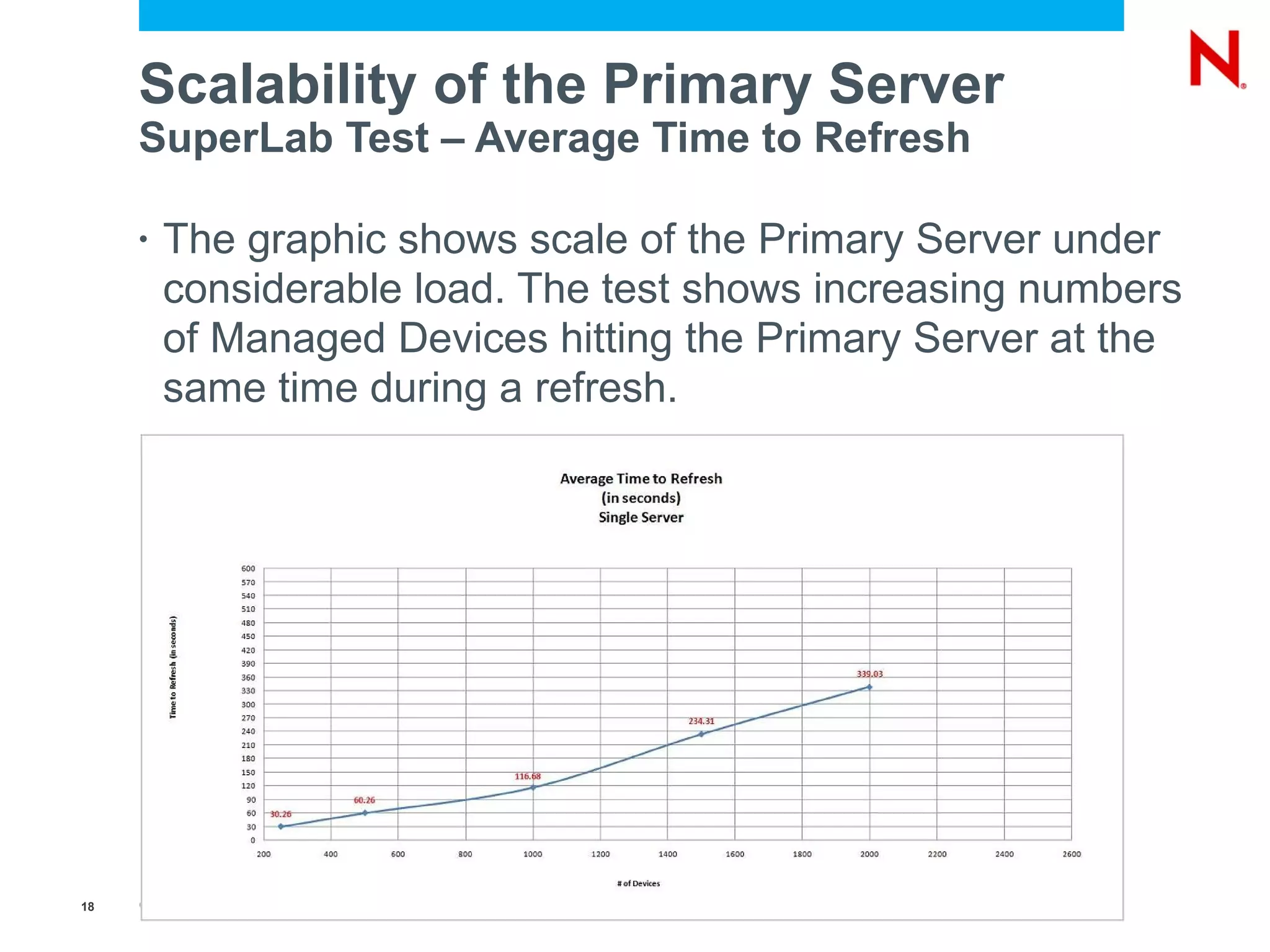
     SuperLab Test – Average Time to Refresh

     •   The graphic shows scale of the Primary Server under
         considerable load. The test shows increasing numbers
         of Managed Devices hitting the Primary Server at the
         same time during a refresh.


18   © Novell, Inc. All rights reserved.
Scalability of the Primary Server
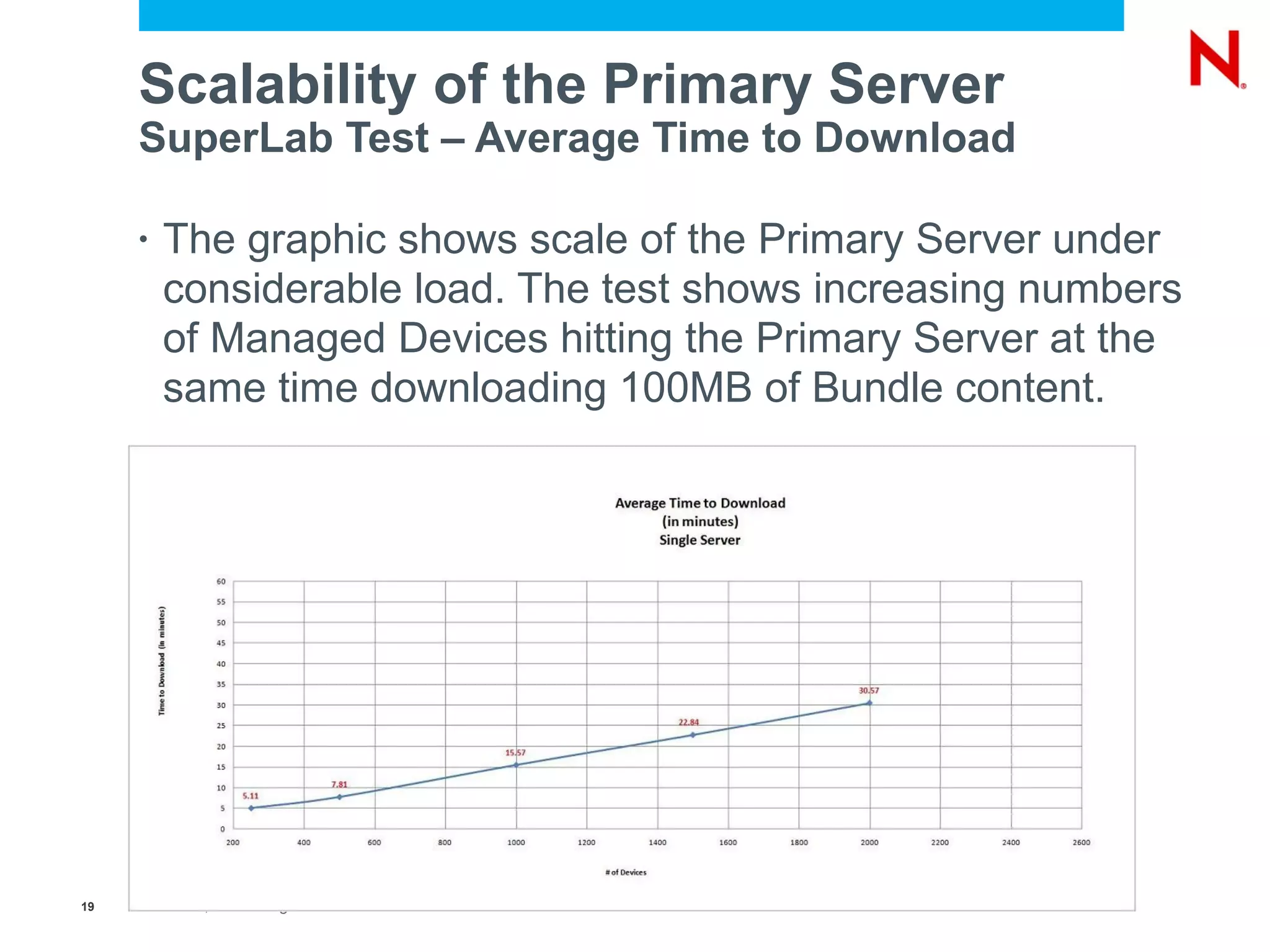
     SuperLab Test – Average Time to Download

     •   The graphic shows scale of the Primary Server under
         considerable load. The test shows increasing numbers
         of Managed Devices hitting the Primary Server at the
         same time downloading 100MB of Bundle content.


19   © Novell, Inc. All rights reserved.
Scalability of the Primary Server
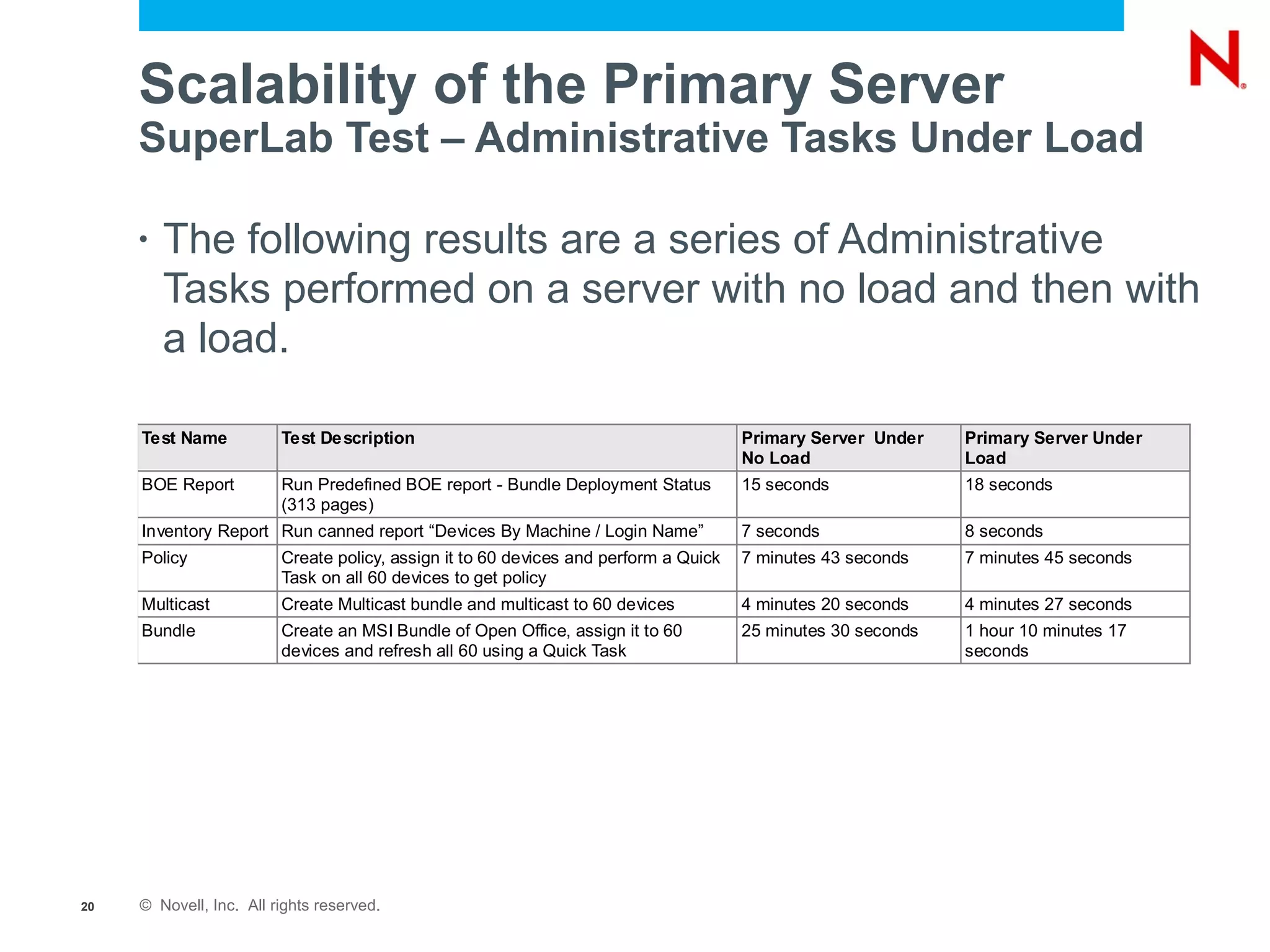
     SuperLab Test – Administrative Tasks Under Load

     •   The following results are a series of Administrative
         Tasks performed on a server with no load and then with
         a load.

     Test Name           Test De scription                                            Primary Server Under    Primary Server Under
                                                                                      No Load                 Load
     BOE Report          Run Predefined BOE report - Bundle Deployment Status         15 seconds              18 seconds
                         (313 pages)
     Inventory Report Run canned report “Devices By Machine / Login Name”             7 seconds               8 seconds
     Policy              Create policy, assign it to 60 devices and perform a Quick   7 minutes 43 seconds    7 minutes 45 seconds
                         Task on all 60 devices to get policy
     Multicast           Create Multicast bundle and multicast to 60 devices          4 minutes 20 seconds    4 minutes 27 seconds
     Bundle              Create an MSI Bundle of Open Office, assign it to 60         25 minutes 30 seconds   1 hour 10 minutes 17
                         devices and refresh all 60 using a Quick Task                                        seconds


20   © Novell, Inc. All rights reserved.
Scalability of the Primary Server
     Description of Daily Use Test

     •   The test environment in the SuperLab consists of the following
         components:
          –   Single server running Windows Server 2003 (64 bit)
          –   Server hardware – Dell 2950, Quad Core 2.0 MHz, 8GB RAM
          –   External Microsoft SQL Server 2005 database
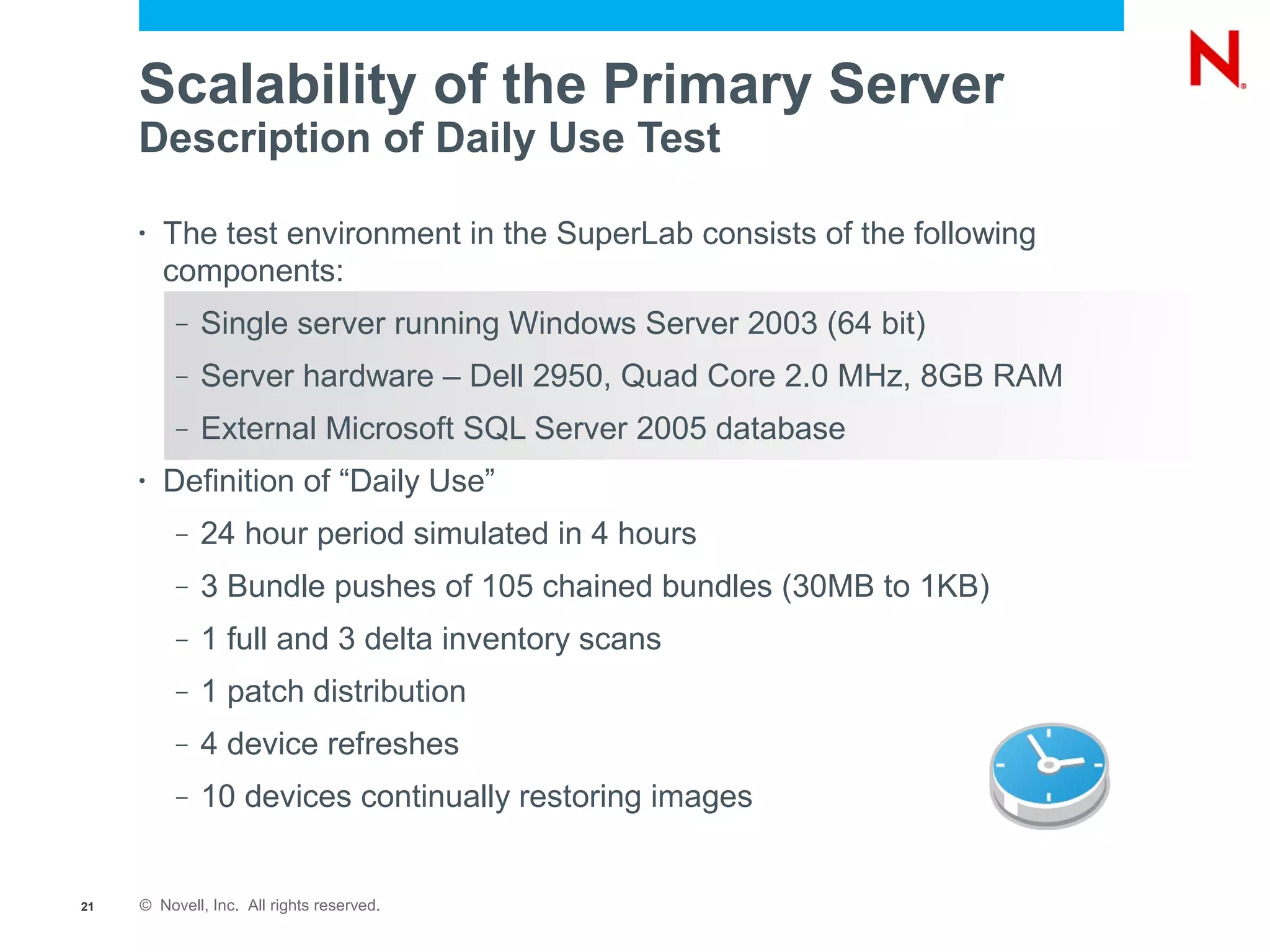
     •   Definition of “Daily Use”
          –   24 hour period simulated in 4 hours
          –   3 Bundle pushes of 105 chained bundles (30MB to 1KB)
          –   1 full and 3 delta inventory scans
          –   1 patch distribution
          –   4 device refreshes
          –   10 devices continually restoring images


21   © Novell, Inc. All rights reserved.
Scalability of the Primary Server
     Achieving Scalability in the Real World

     •   Tests are performed in the SuperLab to find the “breaking point” of the
         system and it's components, real scalability on the other hand is achieved
         through...
          –   The proper placement of services
          –   A well thought out design
          –   The proper configuration of services within the Novell ZENworks
                                                                     ®       ®


              system itself

     •   There is a big difference between what we “find” and what we “suggest”.
          –   For Primary Servers we recommend the following as a starting point:
               >   Three (3) Primary Servers to – load and fault tolerance
               >   A dedicated database server


22   © Novell, Inc. All rights reserved.
Scalability of the Primary Server
     Achieving Scalability in the Real World, (Cont.)

     •   The recommendations on the previous slide would be
         further enhanced by considering the following as well:
          –   Exclude servers to ensure that certain Primary Servers are
              dedicated to specific functions.
          –   Dedicate a Primary Server as the Novell ZENworks Reporting
                                                         ®           ®


              Server.
          –   A dedicated Primary Server for ZENworks Control Center.
          –   The use of Satellite Servers for distribution, collection, and local
              site authentication.


23   © Novell, Inc. All rights reserved.
Scalability of the Primary Server
     Achieving Scalability in the Real World, (Cont.)

     •   Some of the major factors that you need to consider
         with ZCM and Primary Servers are the following:
          –   They can handle between 1,000 and 1,500 concurrent
              connections.
          –   The rule of thumb is a Primary Server for every 3,000 devices
              you will register into the Zone.
          –   A ZENworks Zone will scale to 40,000 devices. This is what has
                                           ®


              been validated in the SuperLab and what Novell recommends
                                                             ®


              is the upper limit to the Zone size.


24   © Novell, Inc. All rights reserved.
Scalability of the Primary Server
     Achieving Scalability in the Real World, (Cont.)

     •   It is recommended that Primary Servers and the
         Database Server be on the same network.
     •   It is NOT recommended (typically) that Primary Servers
         span any WAN links.
     •   Network utilization issues will appear quickly, and this is
         mainly due to...
          –   SQL traffic between Primary Servers and the Database server.
          –   Replication of content in the Primary Servers content repository.
          –   Potential spanning the WAN by Managed Devices.


25   © Novell, Inc. All rights reserved.
Scalability of the Satellite Server
     Factors Influencing Scale

     •   There are a number of factors that directly influence the
         scalability of the Satellite Server. These include...
          –   Physical memory installed on the machine.
          –   Disk I/O from the requests being handled by the machine.
          –   What services are being handled by the Satellite Server
               >   Collection, content, imaging, authentication.
          –   The number of managed devices that are hitting the server, and
              how frequently.
          –   Frequency of distributions.
          –   Class of hardware.
          –   Class of Operating System.


26   © Novell, Inc. All rights reserved.
Scalability of the Satellite Server
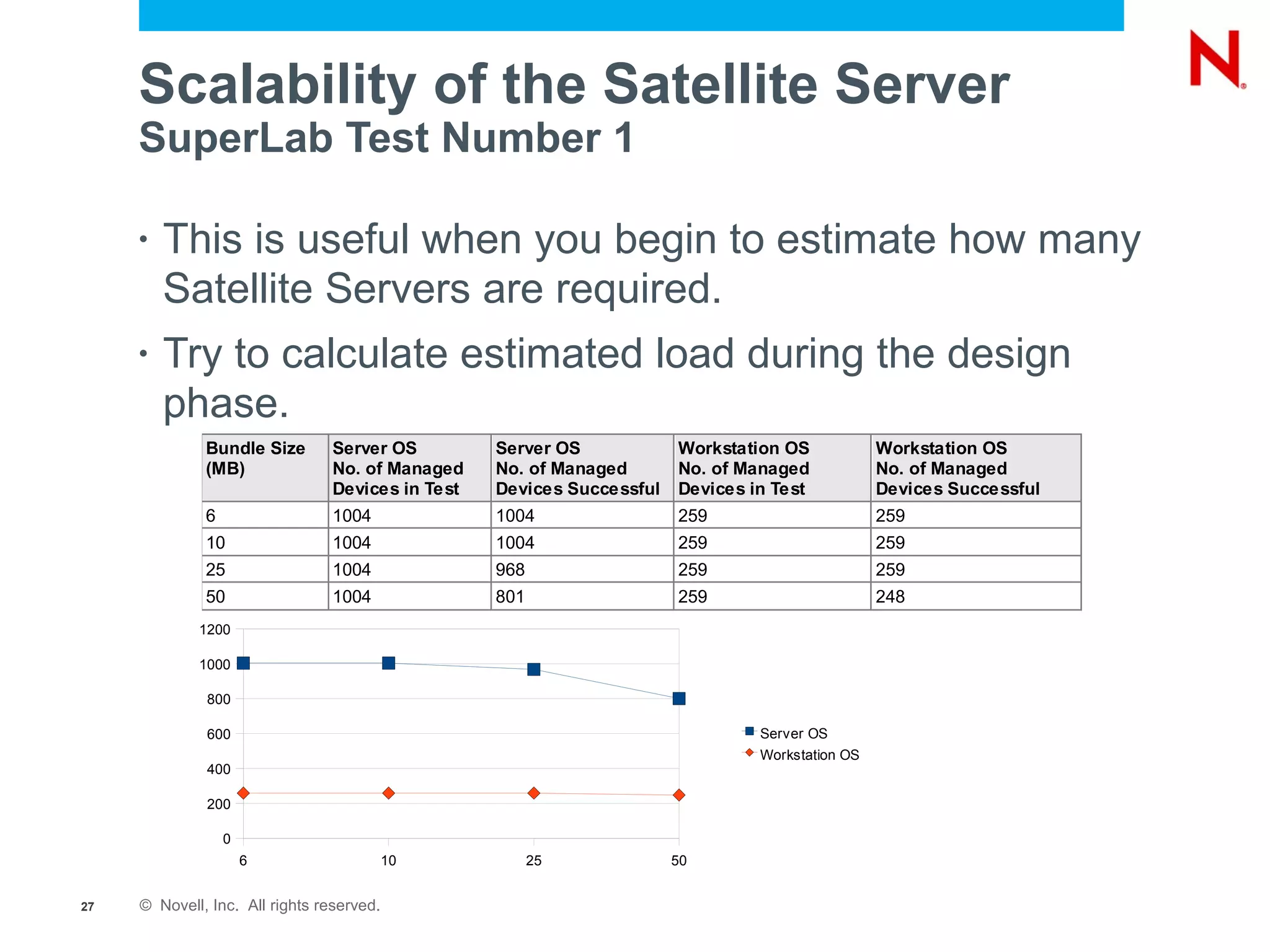
     SuperLab Test Number 1

     •   This is useful when you begin to estimate how many
         Satellite Servers are required.
     •   Try to calculate estimated load during the design
         phase.
              Bundle Size        Server OS         Server OS            Workstation OS            Workstation OS
              (MB)               No. of Managed    No. of Managed       No. of Managed            No. of Managed
                                 Devices in Test   Devices Successful   Devices in Test           Devices Successful
              6                  1004              1004                 259                       259
              10                 1004              1004                 259                       259
              25                 1004              968                  259                       259
              50                 1004              801                  259                       248
             1200

             1000

              800

              600                                                                Server OS
                                                                                 Workstation OS
              400

              200

                  0
                      6                    10            25             50


27   © Novell, Inc. All rights reserved.
Scalability of the Satellite Server
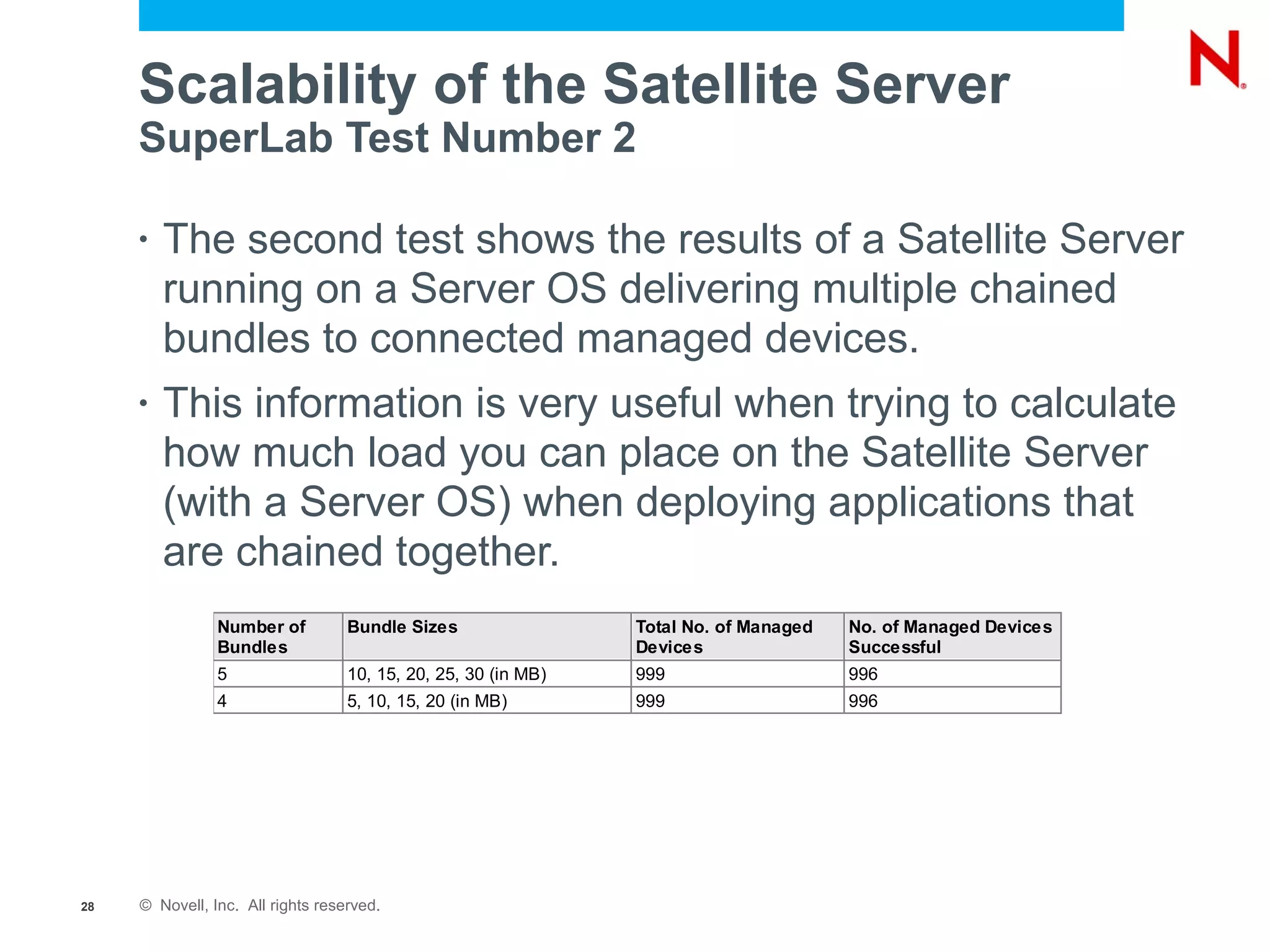
     SuperLab Test Number 2

     •   The second test shows the results of a Satellite Server
         running on a Server OS delivering multiple chained
         bundles to connected managed devices.
     •   This information is very useful when trying to calculate
         how much load you can place on the Satellite Server
         (with a Server OS) when deploying applications that
         are chained together.
                Number of          Bundle Sizes                 Total No. of Managed   No. of Managed Devices
                Bundles                                         Devices                Successful
                5                  10, 15, 20, 25, 30 (in MB)   999                    996
                4                  5, 10, 15, 20 (in MB)        999                    996


28   © Novell, Inc. All rights reserved.
Scalability of the Satellite Server
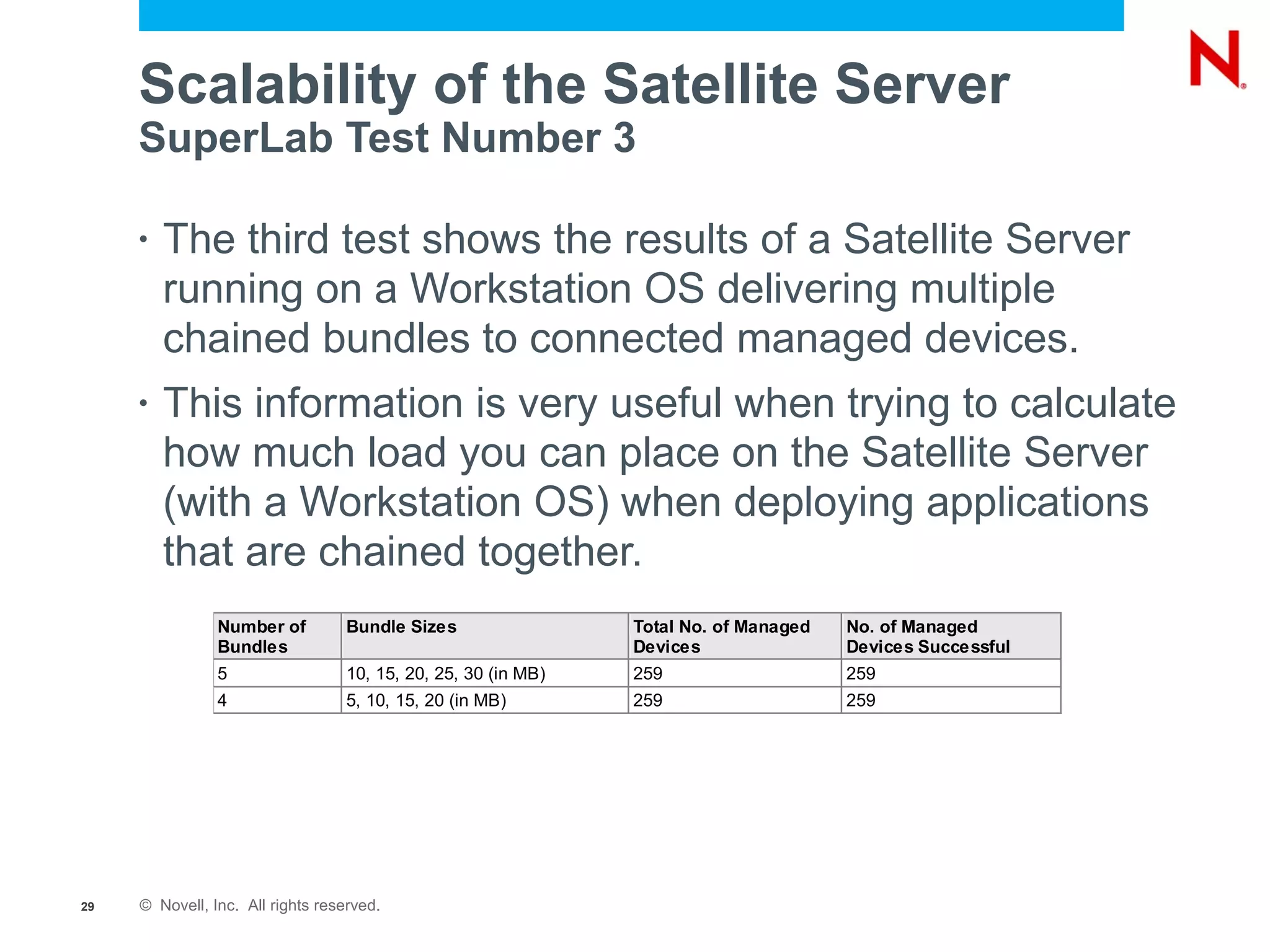
     SuperLab Test Number 3

     •   The third test shows the results of a Satellite Server
         running on a Workstation OS delivering multiple
         chained bundles to connected managed devices.
     •   This information is very useful when trying to calculate
         how much load you can place on the Satellite Server
         (with a Workstation OS) when deploying applications
         that are chained together.
                Number of          Bundle Sizes                 Total No. of Managed   No. of Managed
                Bundles                                         Devices                Devices Successful
                5                  10, 15, 20, 25, 30 (in MB)   259                    259
                4                  5, 10, 15, 20 (in MB)        259                    259


29   © Novell, Inc. All rights reserved.
Scalability of the Satellite Server
     Achieving Scalability in the Real World

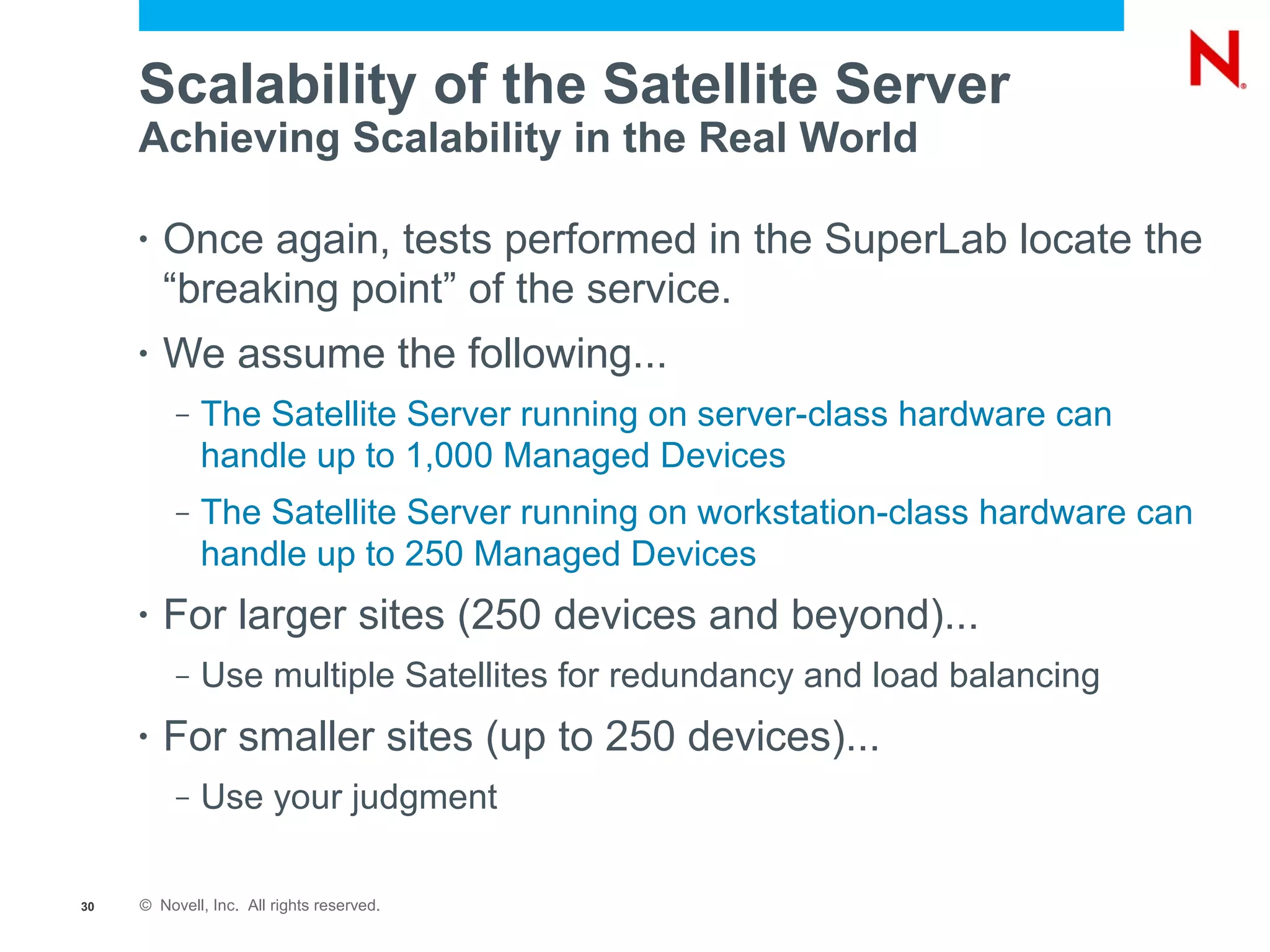
     •   Once again, tests performed in the SuperLab locate the
         “breaking point” of the service.
     •   We assume the following...
          –   The Satellite Server running on server-class hardware can
              handle up to 1,000 Managed Devices
          –   The Satellite Server running on workstation-class hardware can
              handle up to 250 Managed Devices
     •   For larger sites (250 devices and beyond)...
          –   Use multiple Satellites for redundancy and load balancing
     •   For smaller sites (up to 250 devices)...
          –   Use your judgment

30   © Novell, Inc. All rights reserved.
The Database Server
     Scalability

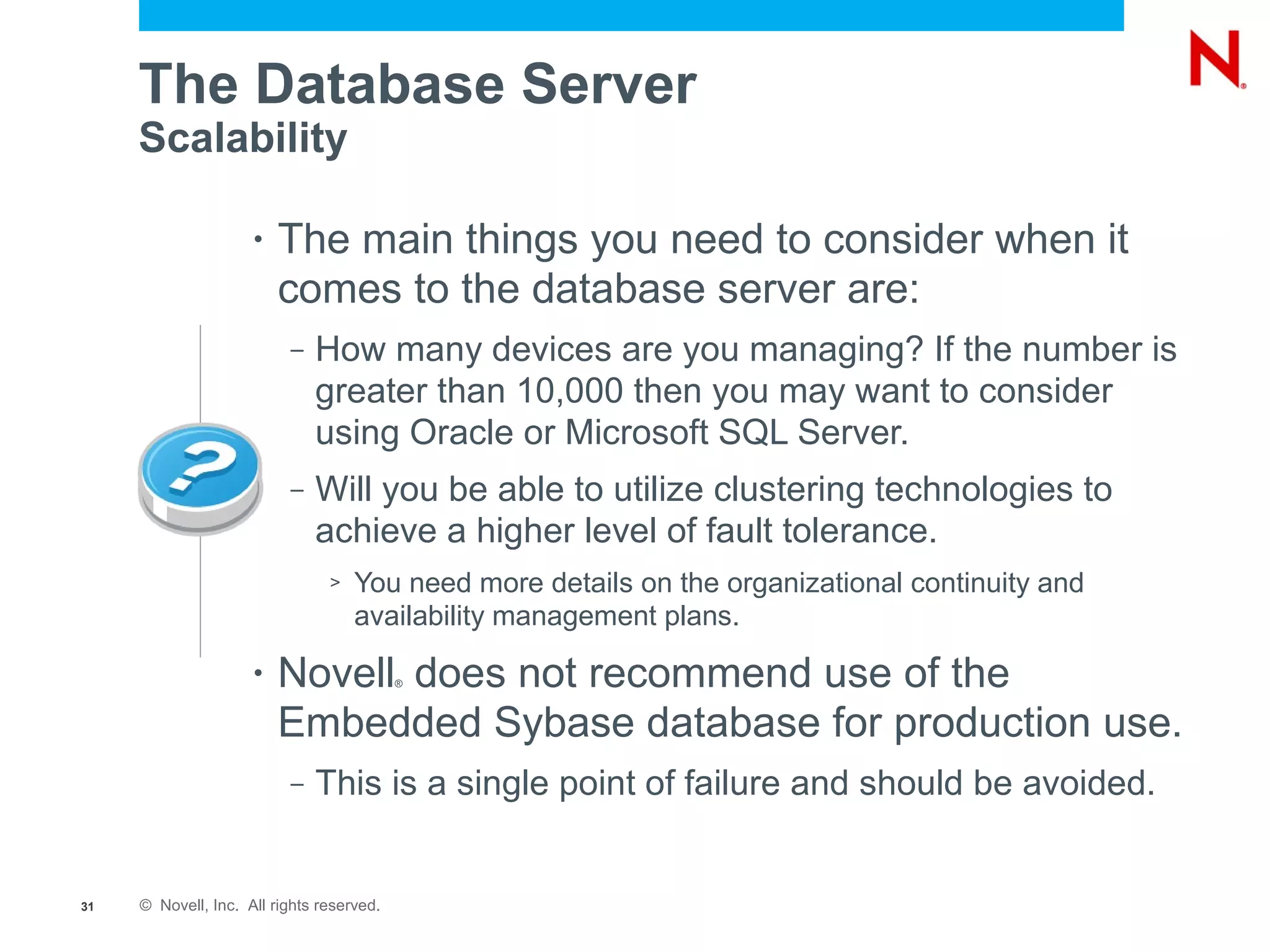
                     •   The main things you need to consider when it
                         comes to the database server are:
                          –   How many devices are you managing? If the number is
                              greater than 10,000 then you may want to consider
                              using Oracle or Microsoft SQL Server.
                          –   Will you be able to utilize clustering technologies to
                              achieve a higher level of fault tolerance.
                                >   You need more details on the organizational continuity and
                                    availability management plans.

                     •   Novell does not recommend use of the
                                           ®


                         Embedded Sybase database for production use.
                          –   This is a single point of failure and should be avoided.


31   © Novell, Inc. All rights reserved.
The Database Server
     Scalability (cont.)

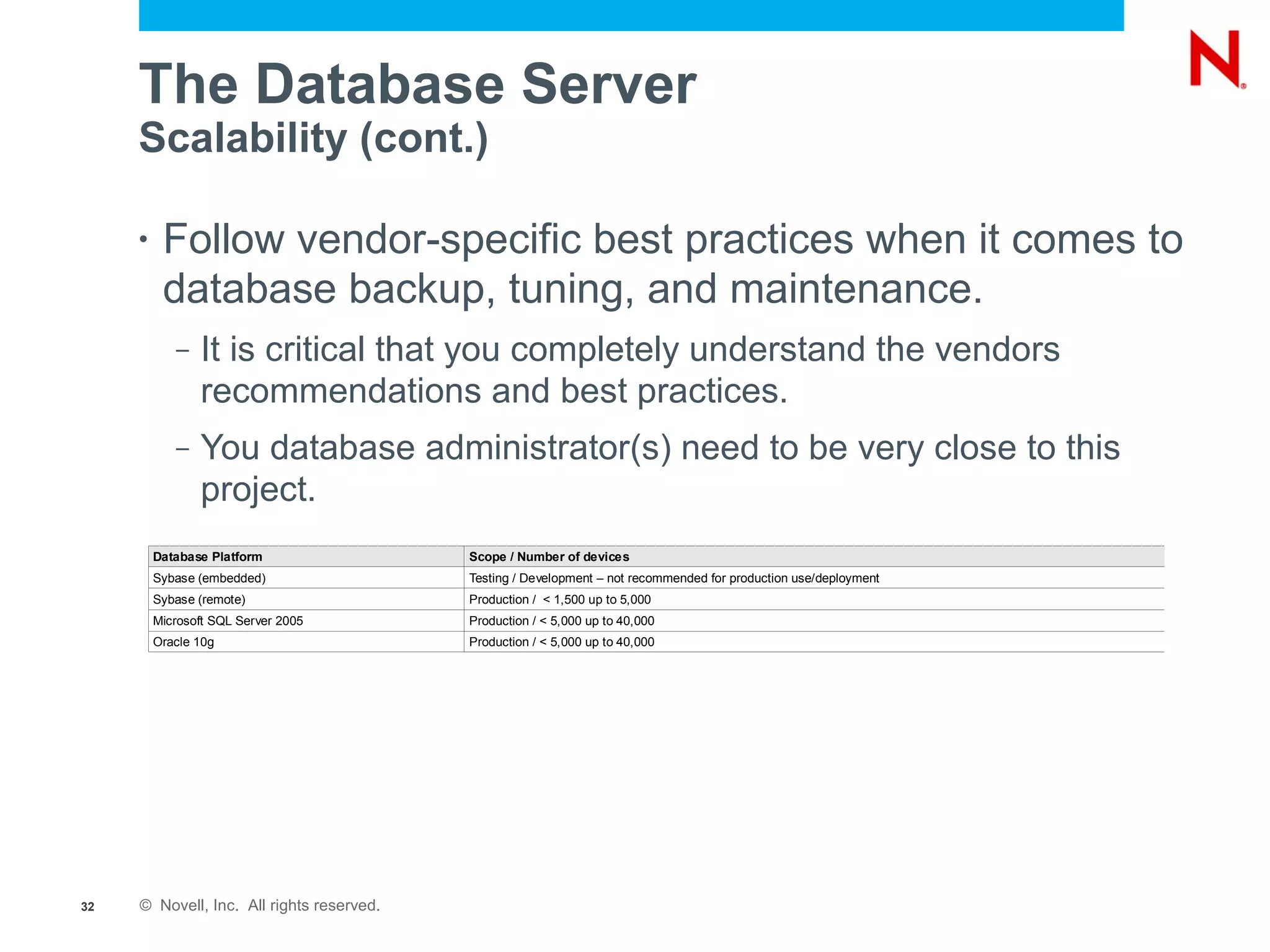
     •    Follow vendor-specific best practices when it comes to
          database backup, tuning, and maintenance.
            –   It is critical that you completely understand the vendors
                recommendations and best practices.
            –   You database administrator(s) need to be very close to this
                project.
         Database Platform                 Scope / Number of devices
         Sybase (embedded)                 Testing / Development – not recommended for production use/deployment
         Sybase (remote)                   Production / < 1,500 up to 5,000
         Microsoft SQL Server 2005         Production / < 5,000 up to 40,000
         Oracle 10g                        Production / < 5,000 up to 40,000


32   © Novell, Inc. All rights reserved.
The Database Server
     Backup – Sybase

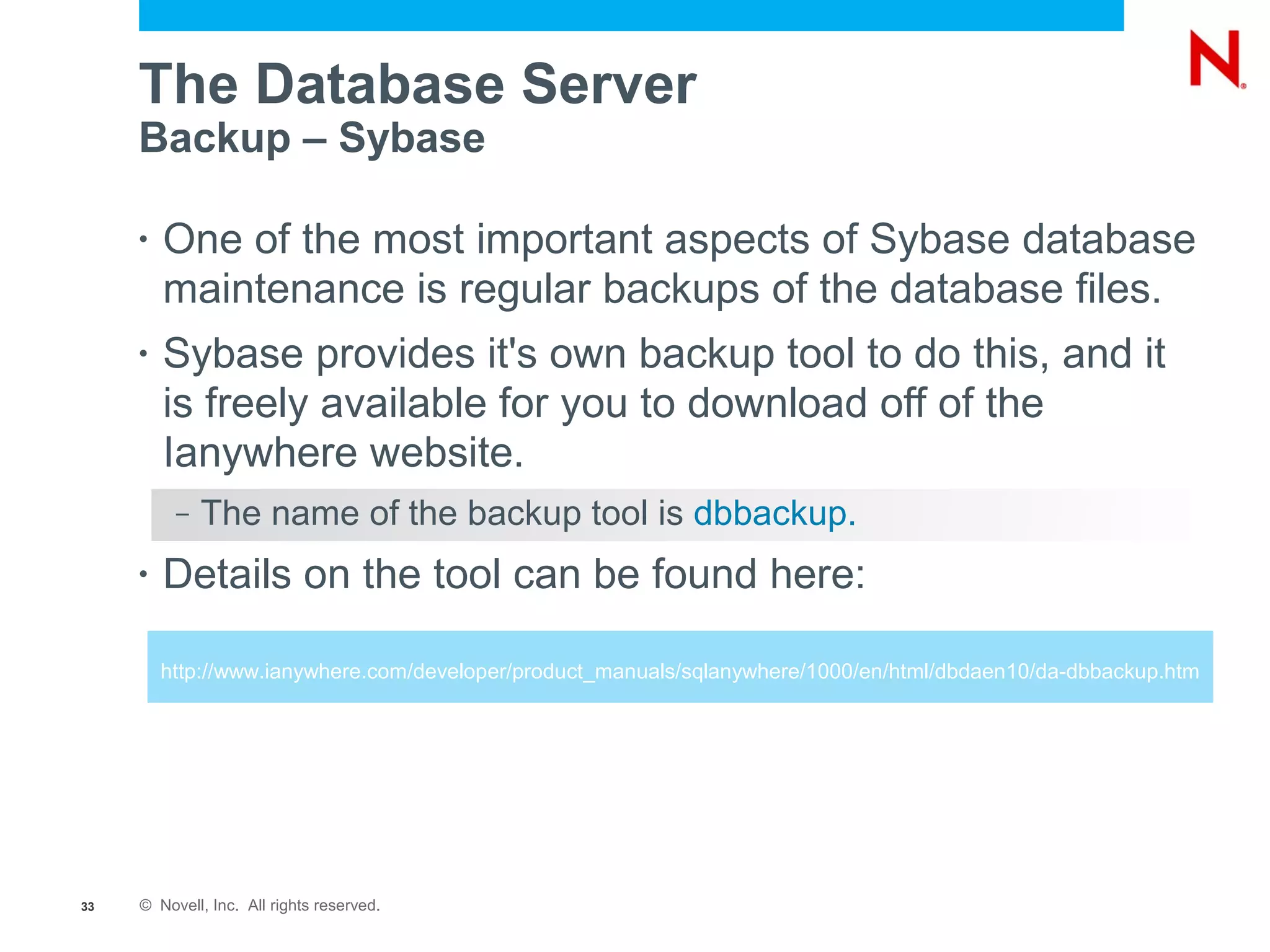
     •   One of the most important aspects of Sybase database
         maintenance is regular backups of the database files.
     •   Sybase provides it's own backup tool to do this, and it
         is freely available for you to download off of the
         Ianywhere website.
          –   The name of the backup tool is dbbackup.
     •   Details on the tool can be found here:

         http://www.ianywhere.com/developer/product_manuals/sqlanywhere/1000/en/html/dbdaen10/da-dbbackup.htm


33   © Novell, Inc. All rights reserved.
The Database Server
     Backup – Sybase (cont.)

     •   Novell does not provide any support for this tool – all
                         ®


         issues related to the use of this tool must be logged
         with Sybase.
     •   The Sybase database can be backed either when it is
         running or shut down.
          –   When it is running you will use dbbackup.
          –   When it is shut down you can perform a simple file copy.


34   © Novell, Inc. All rights reserved.
The Database Server
     Considerations – Microsoft SQL Server

     •   The most important aspects of managing and
         maintaining your database server that is hosted on a
         Microsoft SQL Server are the following:
          –   You must have the skills in-house, or be readily available to
              them (contractor, consultant, or partner) to manage and
              maintain the Microsoft SQL Server based on the best practices
              that Microsoft outlines for regular database management.
          –   There must be regular database backup routines in place. This
              should also be documented or noted in the design document.


35   © Novell, Inc. All rights reserved.
The Database Server
     Considerations – Microsoft SQL Server (cont.)

     •   There must be regular database maintenance routines
         in place. This should also be documented or noted in
         the design document.
     •   Considerations for clustering (high availability) of the
         database server should be made and documented.
     •   The organization needs to be familiar with the tools that
         Microsoft provides to plan, analyze, and maintain their
         Microsoft SQL Server infrastructure.
     •   Check out Microsoft's website for more details –
         there is a wealth of information available to you.


36   © Novell, Inc. All rights reserved.
The Database Server
     Recommendations – Oracle

     •   You must rely on the skills of the in-house database
         administrator(s) to ensure you are installing, updating,
         and maintaining the database properly.
     •   The individual(s) responsible for the day-to-day
         management of the Oracle infrastructure must be
         involved in the ZCM deployment project from day one.
     •   Be familiar with the documents Oracle makes available
         on their website.


37   © Novell, Inc. All rights reserved.
The Database Server
     Database Sizing and Performance

     •   As a general rule of thumb, Novell has seen that the
                                           ®


         database size increases at a rate of approximately 1GB
         per one thousand (1,000) devices in the zone.
     •   Best practices around fault tolerance, maintenance,
         and performance need be considered alongside the
         general calculations for overall database size, and they
         are just as (if not more) important.
     •   For sites with more than 10,000 devices RAID 0+1
         (mirror with stripe) is recommended.


38   © Novell, Inc. All rights reserved.
The Database Server
     Database Sizing and Performance (cont.)

     •   Database servers are very sensitive to disk
         performance.
          –   More smaller disks are always faster than fewer larger disks.
     •   A single 10GB drive for a 10,000 device site may not
         perform adequately, although it may meet the database
         sizing formula.
          –   Ten smaller drives will perform much better.
     •   Testing and monitoring are an essential part of
         database configuration.
     •   It is very important to note that ZCM performs better
         with a dedicated database server, and it is not shared
         with other database applications.
39   © Novell, Inc. All rights reserved.
DNS and DHCP Services

     •   DNS forward and reverse lookup is properly configured
         so that you can resolve servers using both their DNS
         name and IP address.
     •   It helps when workstations are registered in DNS as
         well – DDNS required.
     •   DHCP needs to be properly configured for imaging
         purposes.
     •   PXE may need to be enabled on workstations.


40   © Novell, Inc. All rights reserved.
Time Synchronization

                        •   Everything has a time stamp.
                              –   Ensure everything is time synchronized, it's important.
                        •   All servers in your zone must have time
                            synchronization configured. It is not needed for
                            devices but it is recommended to ensure a well
                            tuned infrastructure.
                        •   For Novell eDirectory customers it may be an
                                            ®
                                                         ™


                            option to point the ZCM servers to eDirectory
                            Time Sources via NTP. Usually all clients use
                            the same time sources via the Novell Client, so ®


                            the system will be in complete harmony.

41   © Novell, Inc. All rights reserved.
Virtualization

     •   Remember to plan your installation carefully, and
         allocate the right amount of resources if you are going
         to install in a virtualized environment.
     •   Currently Novell supports the following platforms:
                                           ®


          –   XEN
          –   VMware ESX
          –   VMware Workstation
          –   Microsoft Virtual Server


42   © Novell, Inc. All rights reserved.
Design Activities
Design Activities

     •   This is where you will spend the bulk of your “planning
         and testing” time.
          –   You will build your design (how and what) and validate it in a lab
              setting to ensure you have built everything correctly and nothing
              is missing.
          –   We will once again stress the importance of solid and accurate
              documentation to back up all of the decisions you have made.
     •   It is estimated that you will spend approximately 80% of
         your time in this planning and testing phase, and the
         remainder of your time will be spent on pilots and the
         wider deployment where you simply are executing
         against your plan.

44   © Novell, Inc. All rights reserved.
Design Activities
     (cont.)

     •   Just because we stress the need for proper design
         activities does not mean that this is, or needs to be
         complex.
          –   It is just good project management in action.
          –   Once again, you want to be successful the first time and avoid
              the need for major design changes after the deployment has
              started.
                   This could be very disruptive for your end users.


45   © Novell, Inc. All rights reserved.
Design Activities
     (cont.)

     •   Three recommendations need to be made:
          –   Hold design workshops with everyone involved, and those that
              have say in how things need to look and feel – these provide
              tremendous value and keep the project organized and running.
          –   Go through every aspect of what the system will look like, and
              all of the features you will leverage.
               >   Document everything along the way.
          –   Test everything in a lab environment – your use cases, features,
              functions, etc., etc.
               >   This does not need to be physical machines – leverage virtualization
                   capabilities to create your lab.
               >   Keep you lab running well after the project – you never know if you'll need it
                   again, and it can provide a lot of testing value down the road (and time).


46   © Novell, Inc. All rights reserved.
Deploying ZENworks Configuration
                  ®


                   Management
Steps to a Successful Deployment

     •   The steps are straight forward – if you follow these
         simple steps you will increase your level of success.
          –   Pre-deployment planning
          –   Pre-deployment documentation
          –   Pre-deployment testing
          –   Pilots
          –   Migration (if applicable)
          –   Wider deployment
          –   Post-deployment documentation and validation


48   © Novell, Inc. All rights reserved.
Best Practice Recommendations
Zone Settings

     •   The topics we will cover today include:

          –   Organized Management
          –   Content Replication
          –   Device Management
          –   Event and Messaging
          –   Infrastructure Management
          –   Inventory
          –   Licensing and administration


50   © Novell, Inc. All rights reserved.
Organized Management

     •   Folder Structures

          –   Functional or geographical?

     •   Static and Dynamic Groups


51   © Novell, Inc. All rights reserved.
Folder Structures

     •   Organize your Bundles in folders, use registration
         rules/keys, and avoid dumping everything in one place
         – be organized and you'll thank us later.
     •   Register devices into specific folders (site/location,
         department, role, etc.) - decide on what makes the
         most sense to you, and stick with it.
     •   Leverage folder structure for content assignment to
         make things as simple as possible.
          –   User based structure from your User Source.
          –   Device based structure from what you've created.


52   © Novell, Inc. All rights reserved.
Using Groups

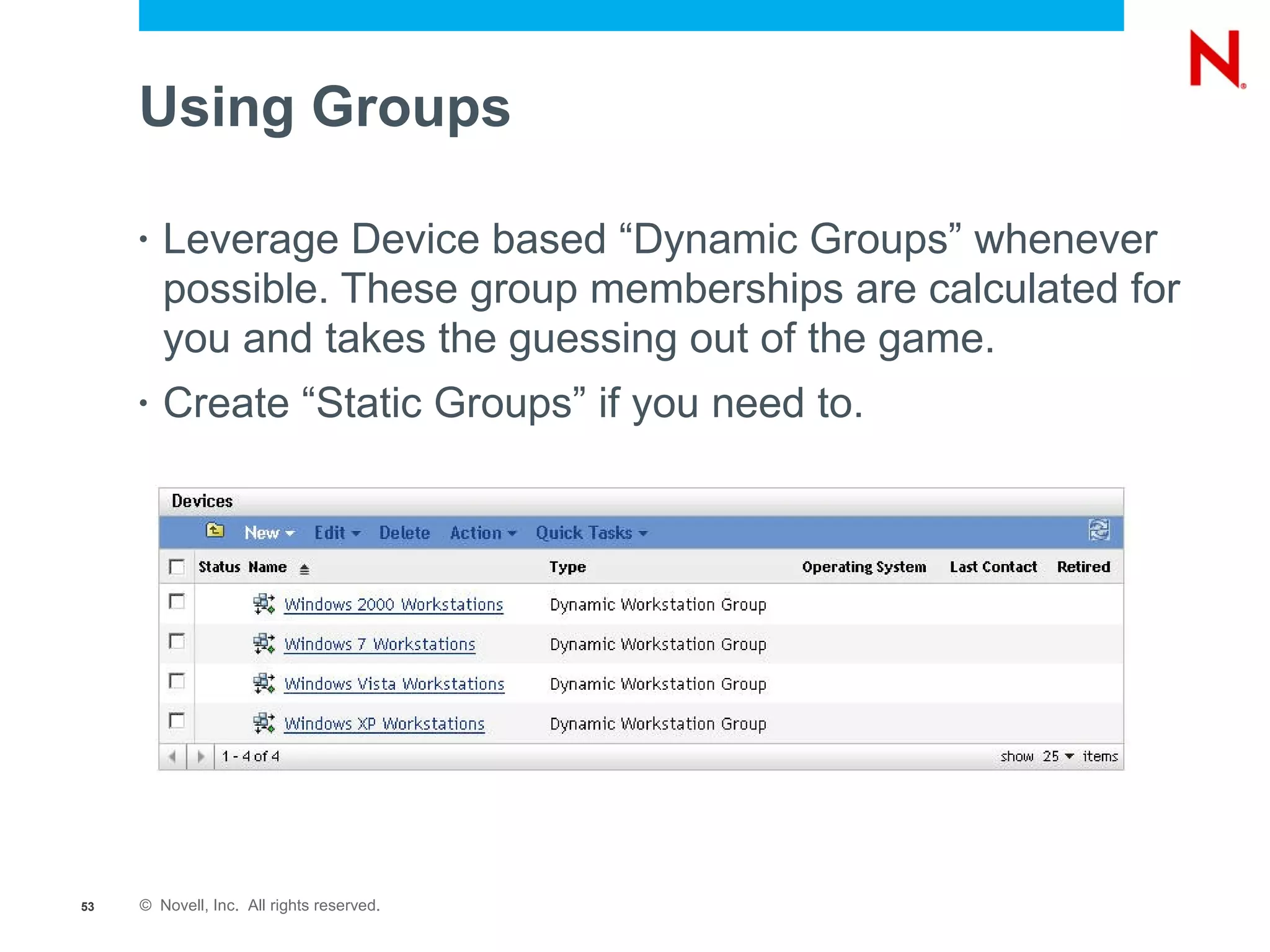
     •   Leverage Device based “Dynamic Groups” whenever
         possible. These group memberships are calculated for
         you and takes the guessing out of the game.
     •   Create “Static Groups” if you need to.


53   © Novell, Inc. All rights reserved.
Content Replication

     •   Define by bundle folders
          –   Good for Patch Management content
     •   Prioritize content deliver between sites based on type
          –   Control schedule, length of window and bandwidth consumption


54   © Novell, Inc. All rights reserved.
Primary Server Replication

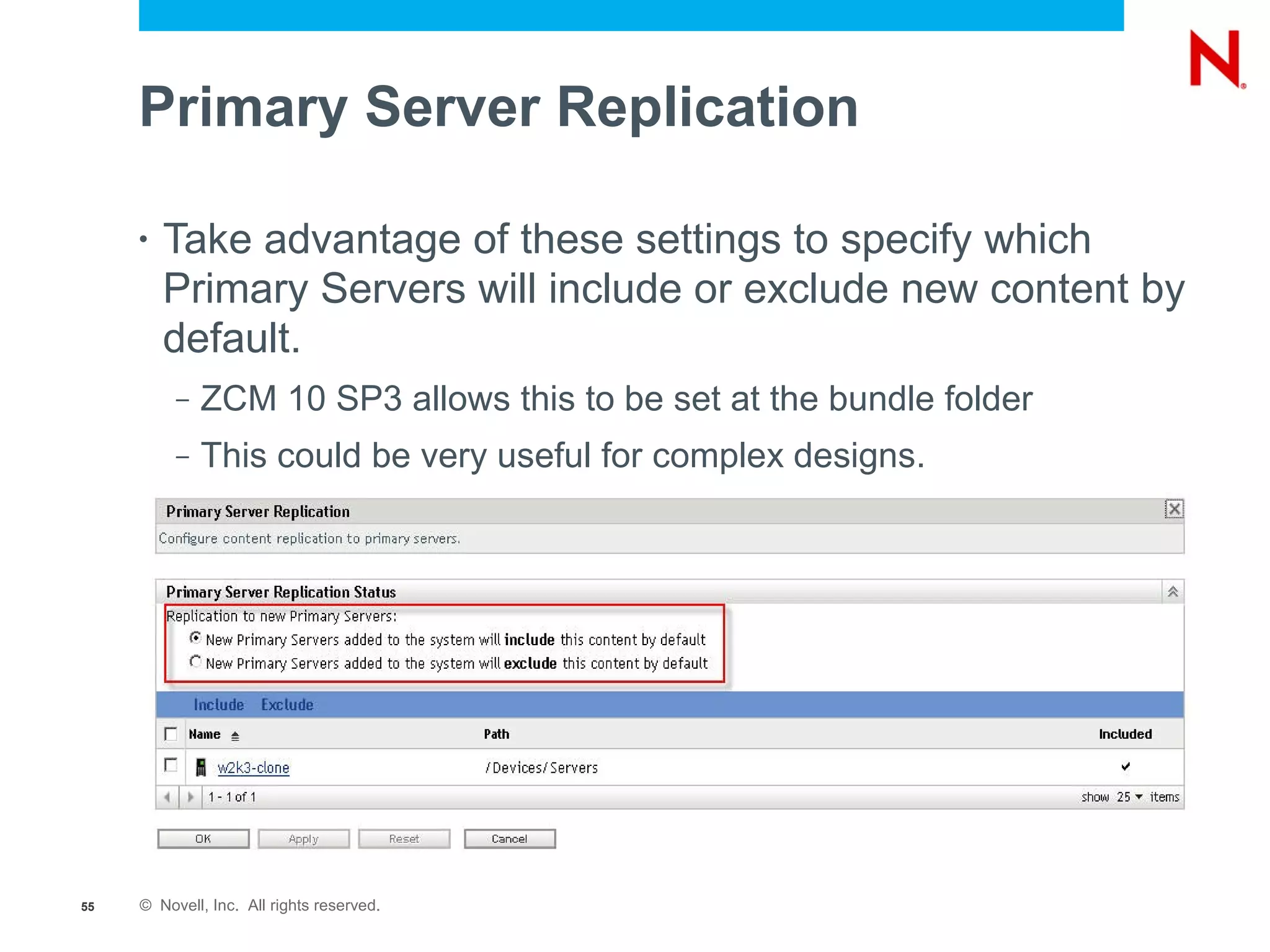
     •   Take advantage of these settings to specify which
         Primary Servers will include or exclude new content by
         default.
          –   ZCM 10 SP3 allows this to be set at the bundle folder
          –   This could be very useful for complex designs.


55   © Novell, Inc. All rights reserved.
Satellite Server Replication

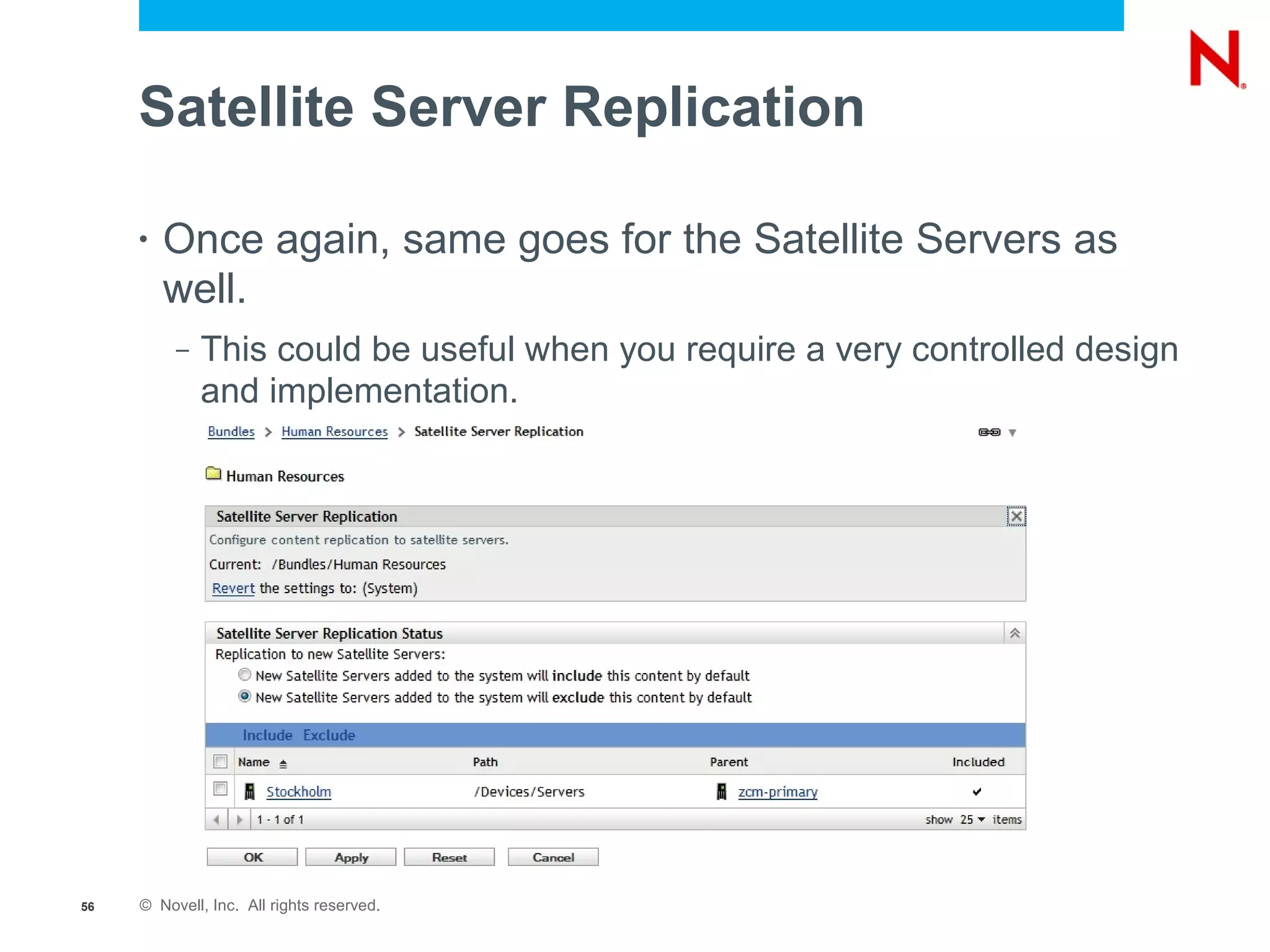
     •   Once again, same goes for the Satellite Servers as
         well.
          –   This could be useful when you require a very controlled design
              and implementation.


56   © Novell, Inc. All rights reserved.
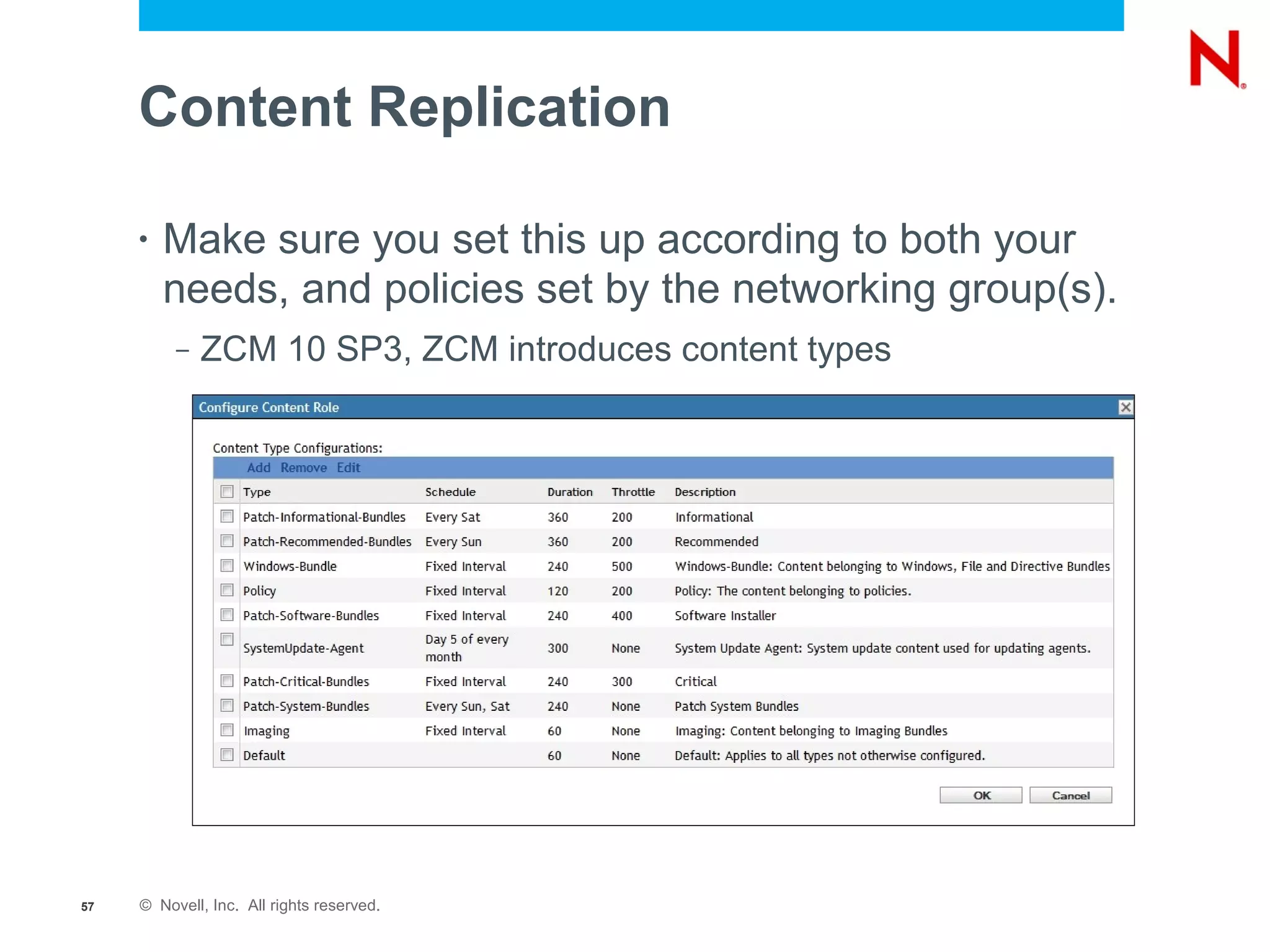
Content Replication

     •   Make sure you set this up according to both your
         needs, and policies set by the networking group(s).
          –   ZCM 10 SP3, ZCM introduces content types


57   © Novell, Inc. All rights reserved.
Satellite Server – Offline Replication

     •   If on-boarding a new remote site, consider content
         export features:
          –   Set content schedule to “None”
          –   Define content requirements
          –   <zman ssec> command to export
          –   <zac cic> command to import


58   © Novell, Inc. All rights reserved.
Device Management

     •   Device refresh schedule
          –   How often do you need to force updates?
     •   Disable unnecessary modules
          –   Different devices have different requirements
     •   Inventory
          –   Tracking your assets
     •   Imaging
          –   Windows 7 anyone?


59   © Novell, Inc. All rights reserved.
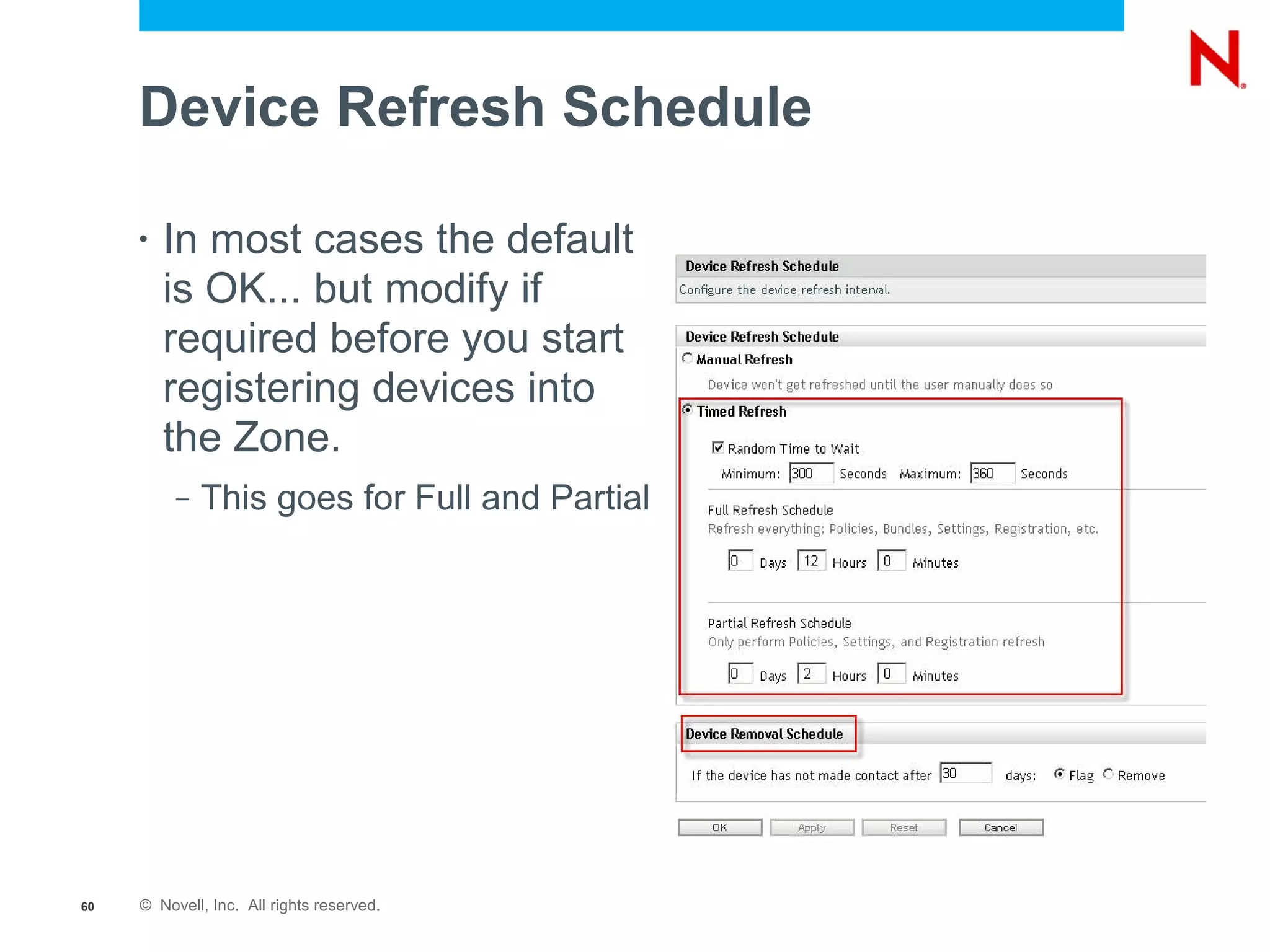
Device Refresh Schedule

     •   In most cases the default
         is OK... but modify if
         required before you start
         registering devices into
         the Zone.
          –   This goes for Full and Partial


60   © Novell, Inc. All rights reserved.
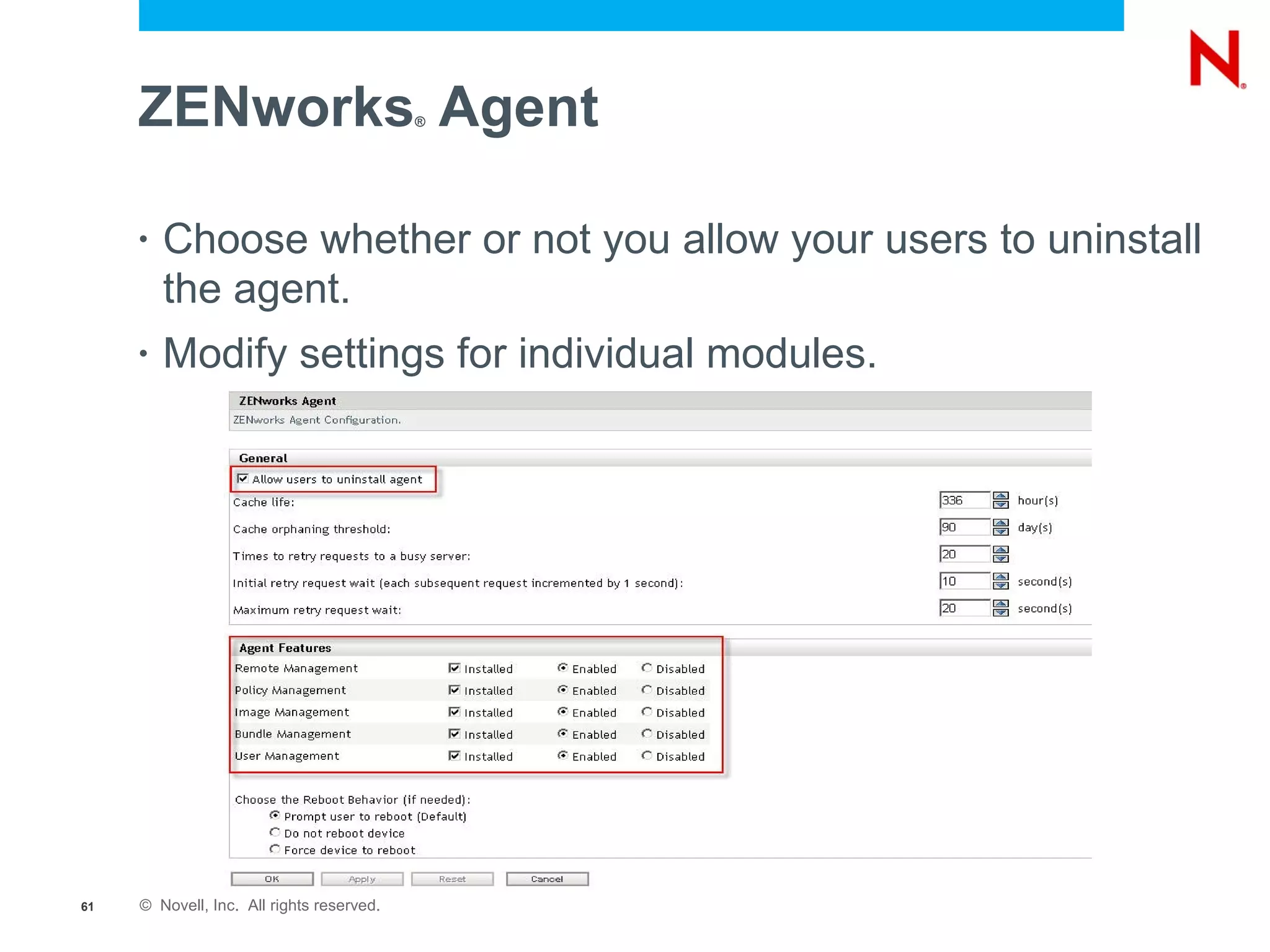
ZENworks Agent                        ®


     •   Choose whether or not you allow your users to uninstall
         the agent.
     •   Modify settings for individual modules.


61   © Novell, Inc. All rights reserved.
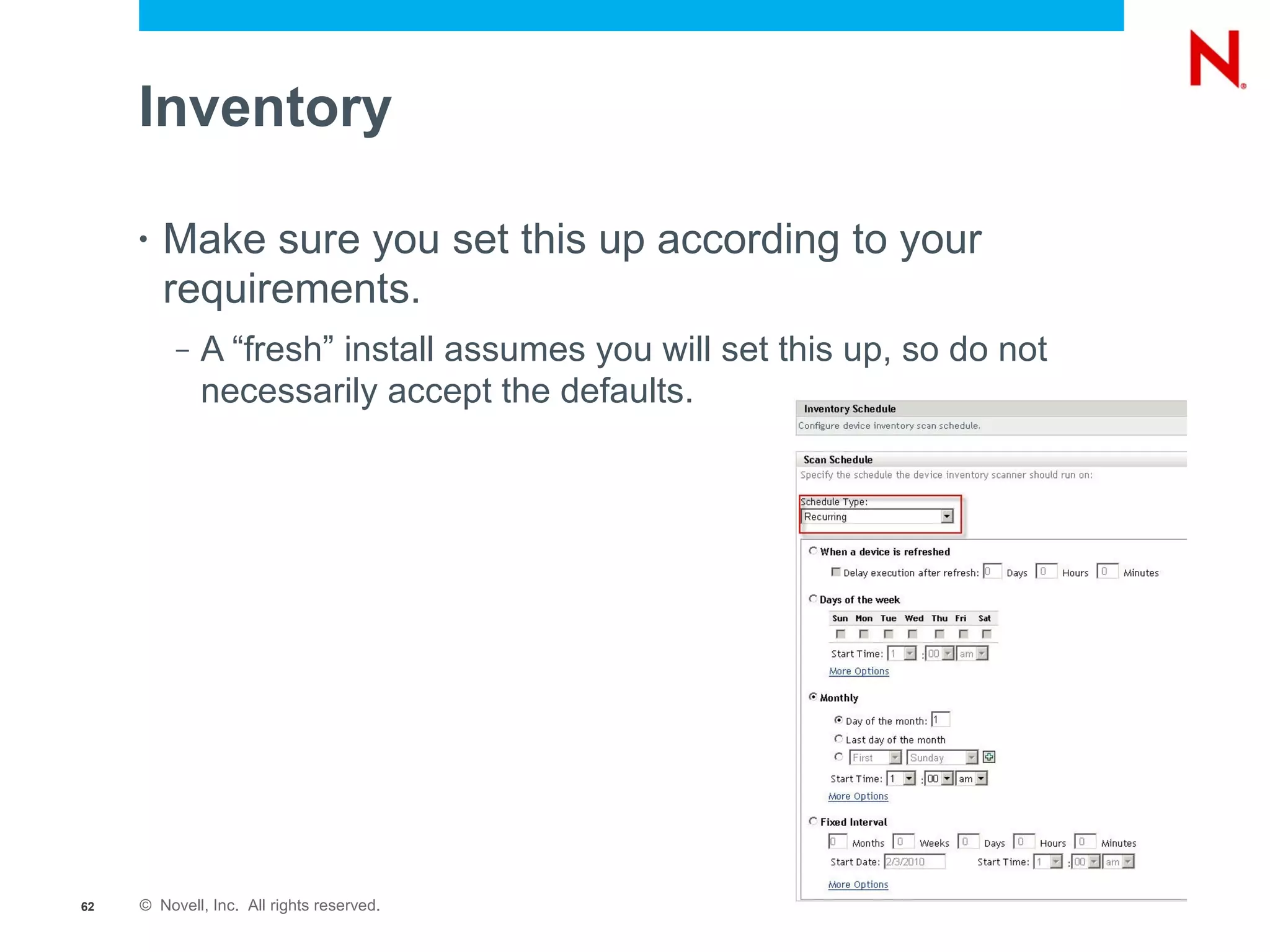
Inventory

     •   Make sure you set this up according to your
         requirements.
          –   A “fresh” install assumes you will set this up, so do not
              necessarily accept the defaults.


62   © Novell, Inc. All rights reserved.
Imaging

     •   Embrace “Universal Imaging” in your organization, and
         cut down on the overhead involved in managing
         multiple images.
          –   Are you moving to Windows 7?
     •   Visit the other sessions covering imaging:
          –   Specifically go see what ENGL have to say in their session:
     EM300 - Windows 7 Deployment with Novell ZENworks        ®             ®


     Configuration Management and ENGL Imaging Toolkit


63   © Novell, Inc. All rights reserved.
Infrastructure Management

     •   Closest Server Rules
          –   Define where devices go for each service type
     •   System Update Settings
          –   Define your update strategy
     •   Event Messaging
          –   Beware – DB growth!
     •   User Sources
          –   Enable user based management
     •   Satellite Device Roles


64   © Novell, Inc. All rights reserved.
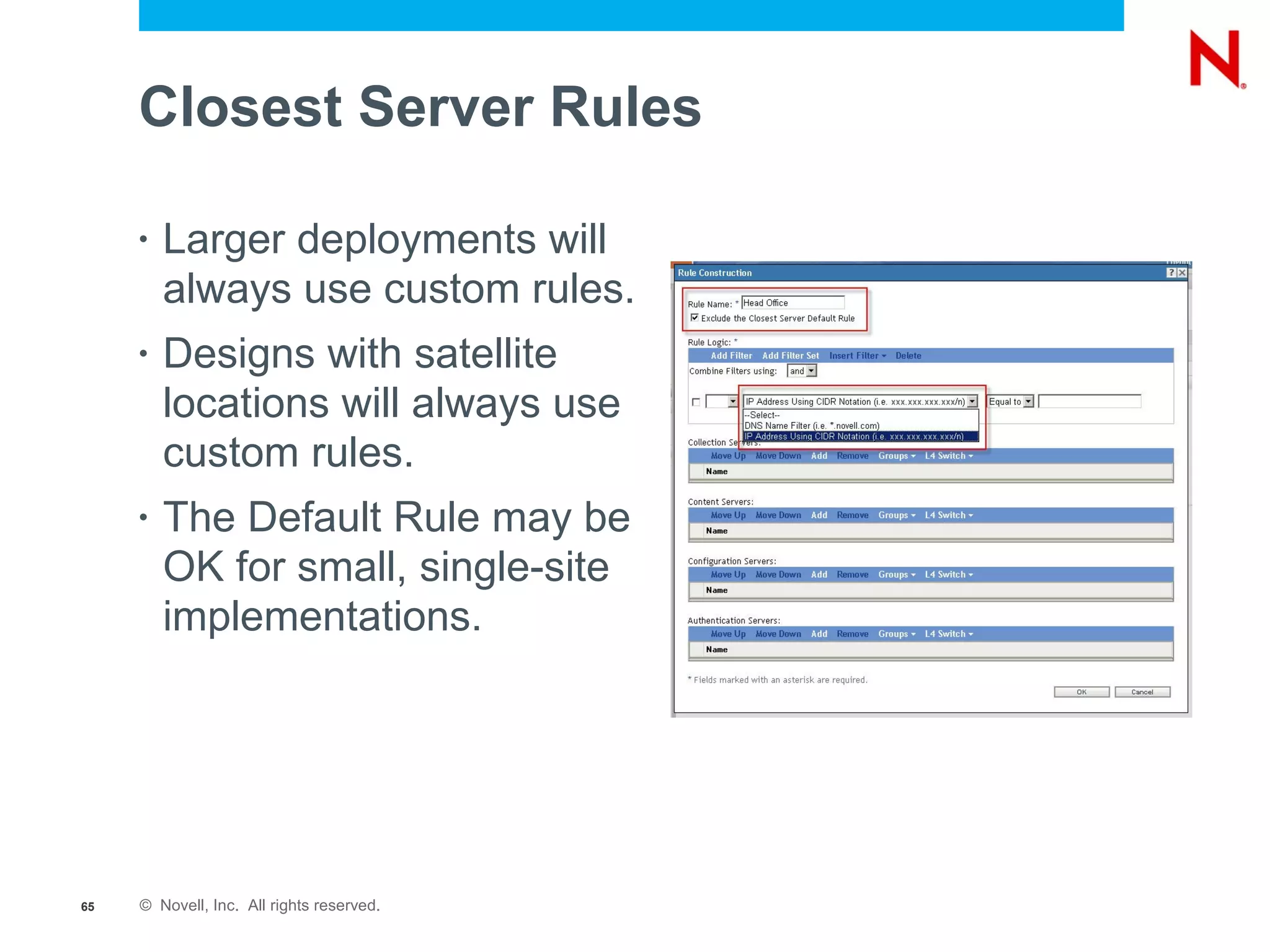
Closest Server Rules

     •   Larger deployments will
         always use custom rules.
     •   Designs with satellite
         locations will always use
         custom rules.
     •   The Default Rule may be
         OK for small, single-site
         implementations.


65   © Novell, Inc. All rights reserved.
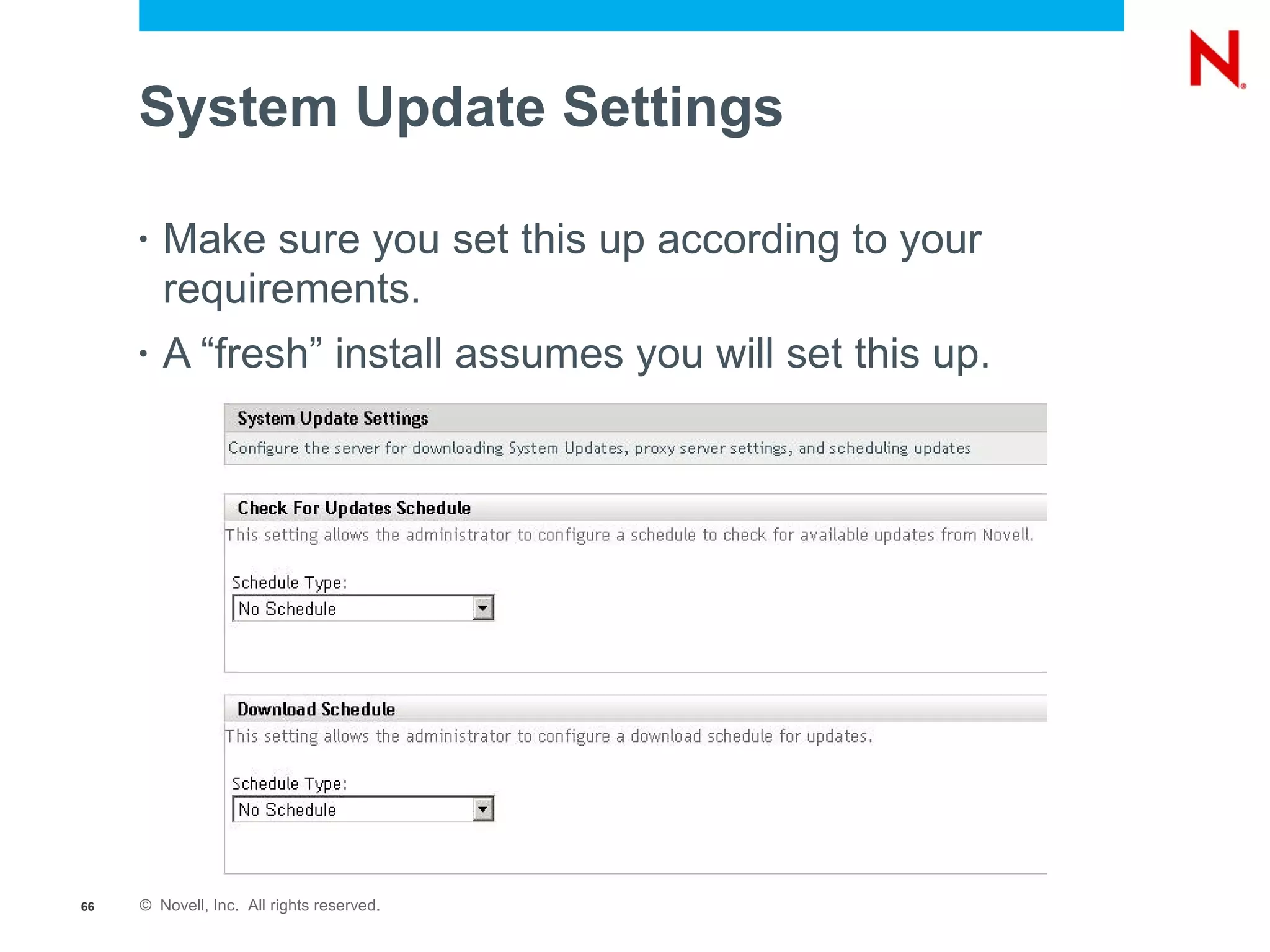
System Update Settings

     •   Make sure you set this up according to your
         requirements.
     •   A “fresh” install assumes you will set this up.


66   © Novell, Inc. All rights reserved.
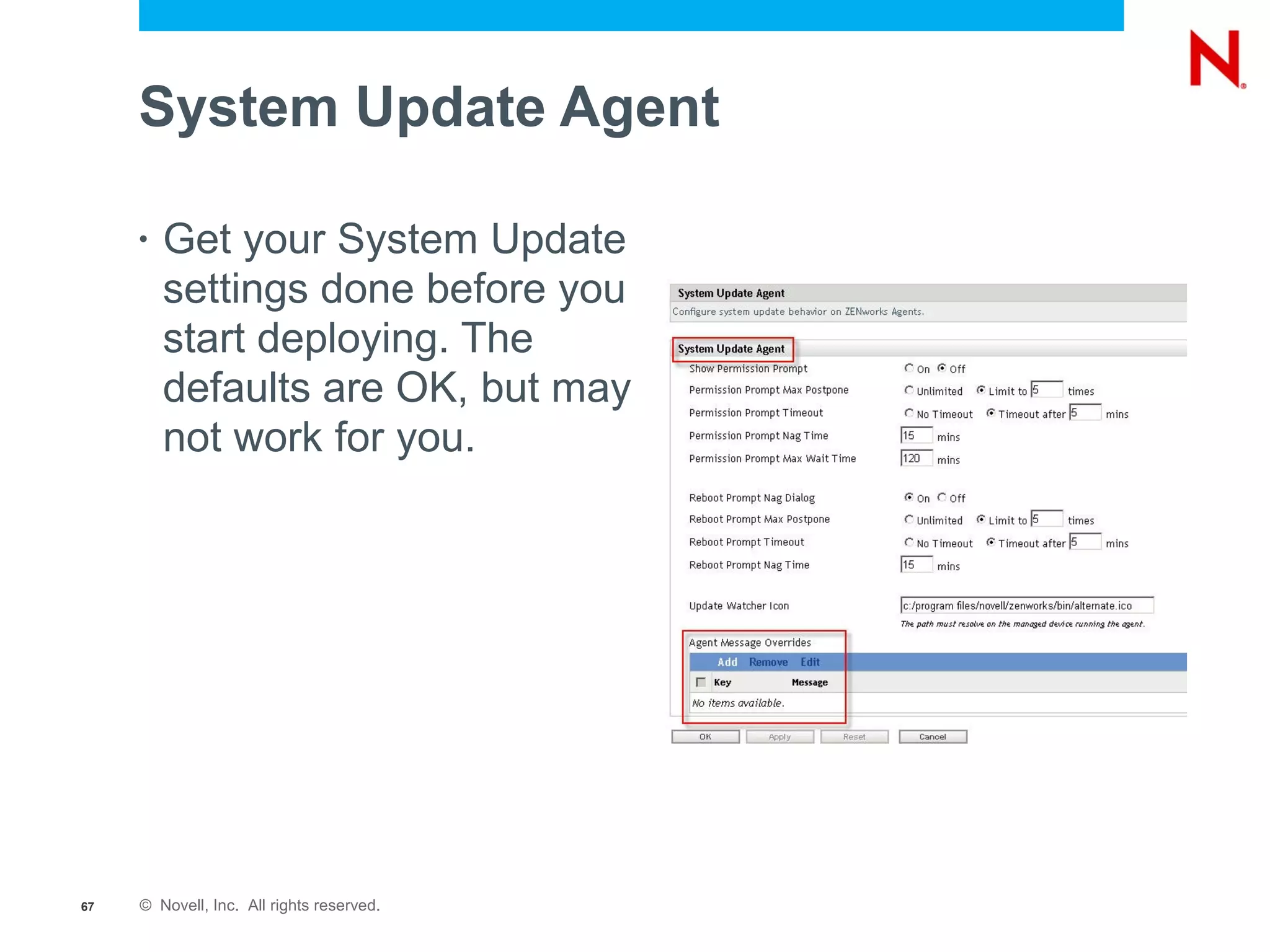
System Update Agent

     •   Get your System Update
         settings done before you
         start deploying. The
         defaults are OK, but may
         not work for you.


67   © Novell, Inc. All rights reserved.
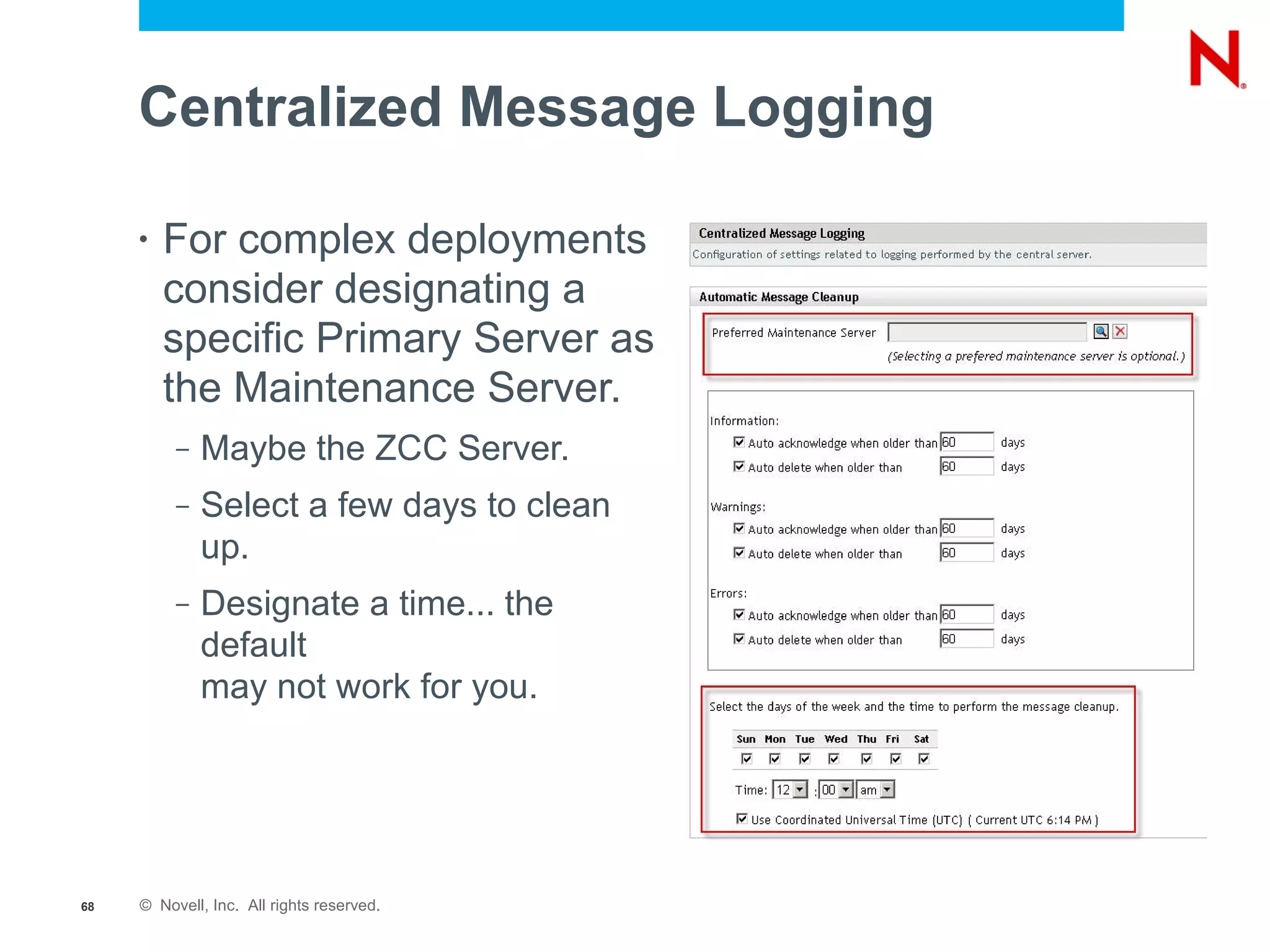
Centralized Message Logging

     •   For complex deployments
         consider designating a
         specific Primary Server as
         the Maintenance Server.
          –   Maybe the ZCC Server.
          –   Select a few days to clean
              up.
          –   Designate a time... the
              default
              may not work for you.


68   © Novell, Inc. All rights reserved.
User Sources

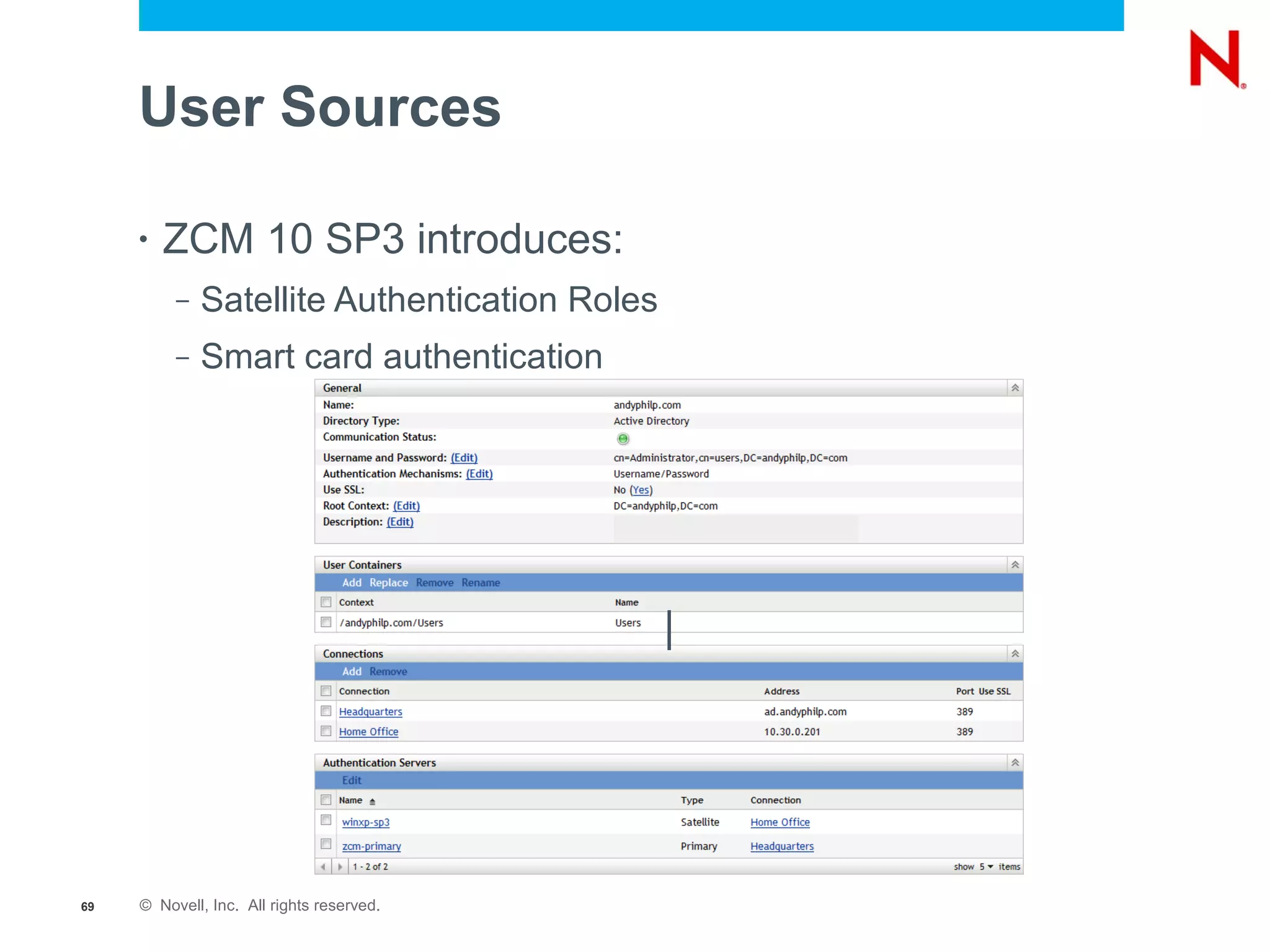
     •   ZCM 10 SP3 introduces:
          –   Satellite Authentication Roles
          –   Smart card authentication


                                               |


69   © Novell, Inc. All rights reserved.
User Sources
     (cont.)

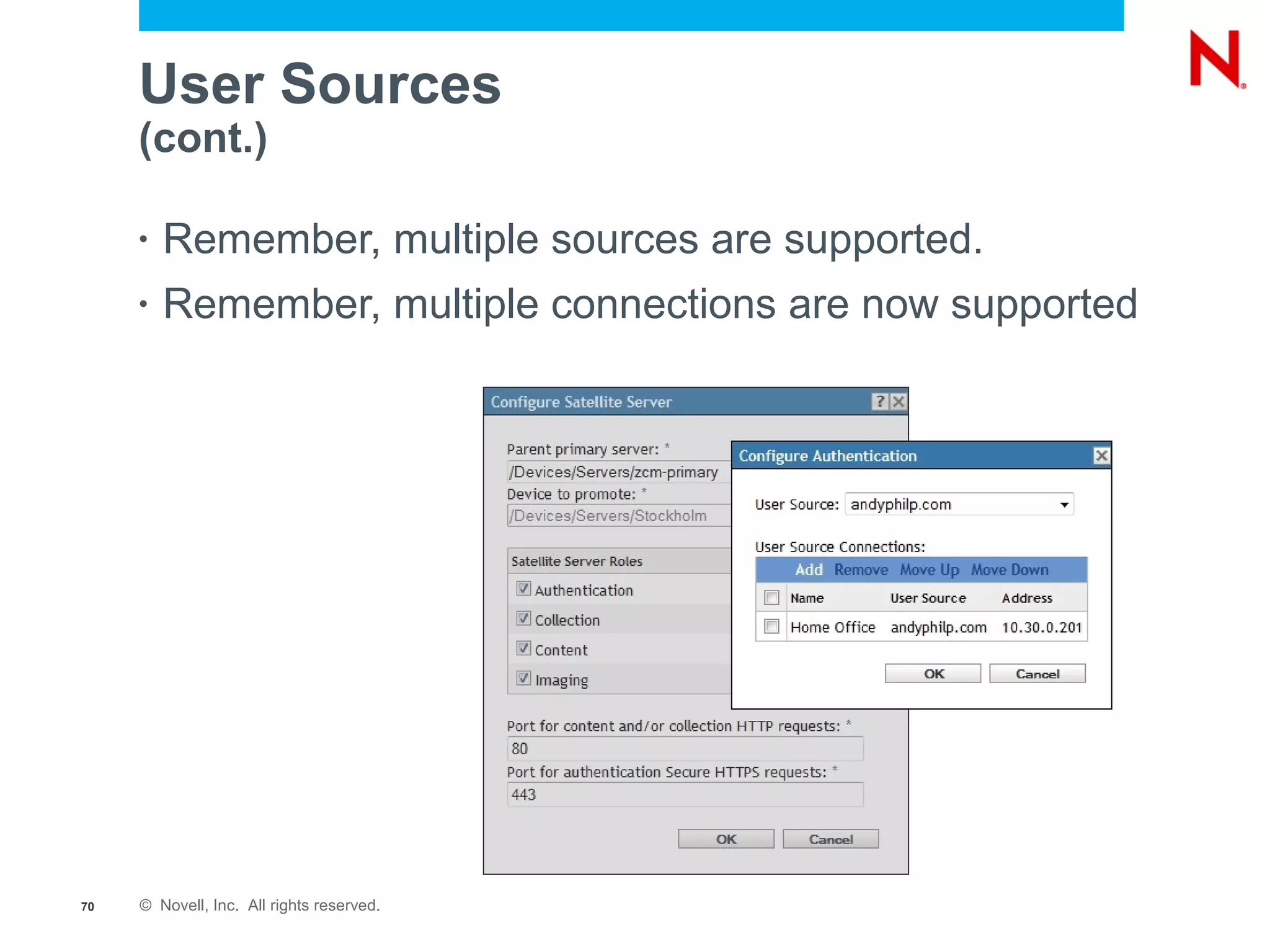
     •   Remember, multiple sources are supported.
     •   Remember, multiple connections are now supported


70   © Novell, Inc. All rights reserved.
Satellite Server Roles

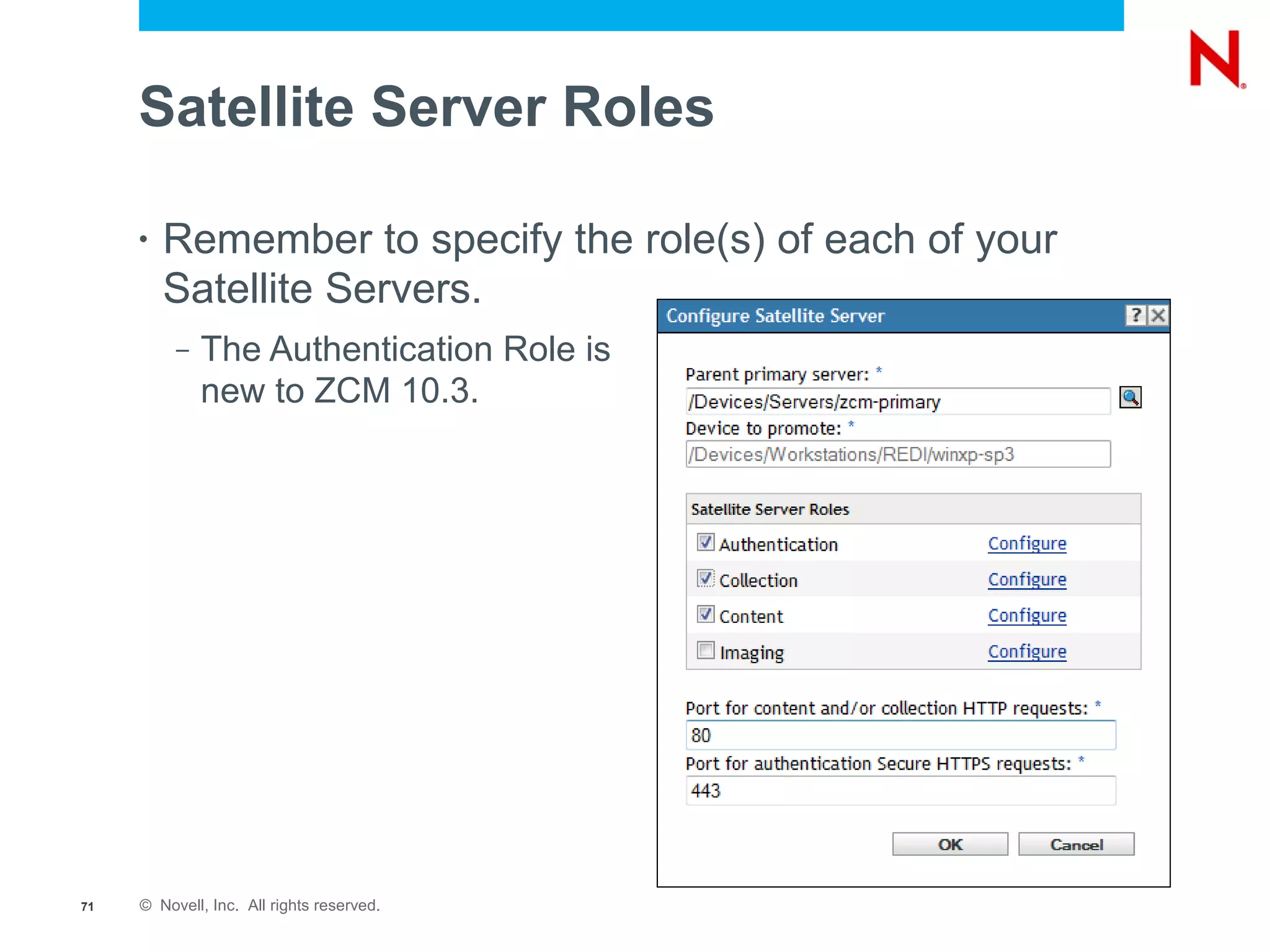
     •   Remember to specify the role(s) of each of your
         Satellite Servers.
          –   The Authentication Role is
              new to ZCM 10.3.


71   © Novell, Inc. All rights reserved.
Licensing and administration

     •   Also found on the “Configuration Page”

          –   Administrators

          –   Roles

          –   License info


72   © Novell, Inc. All rights reserved.
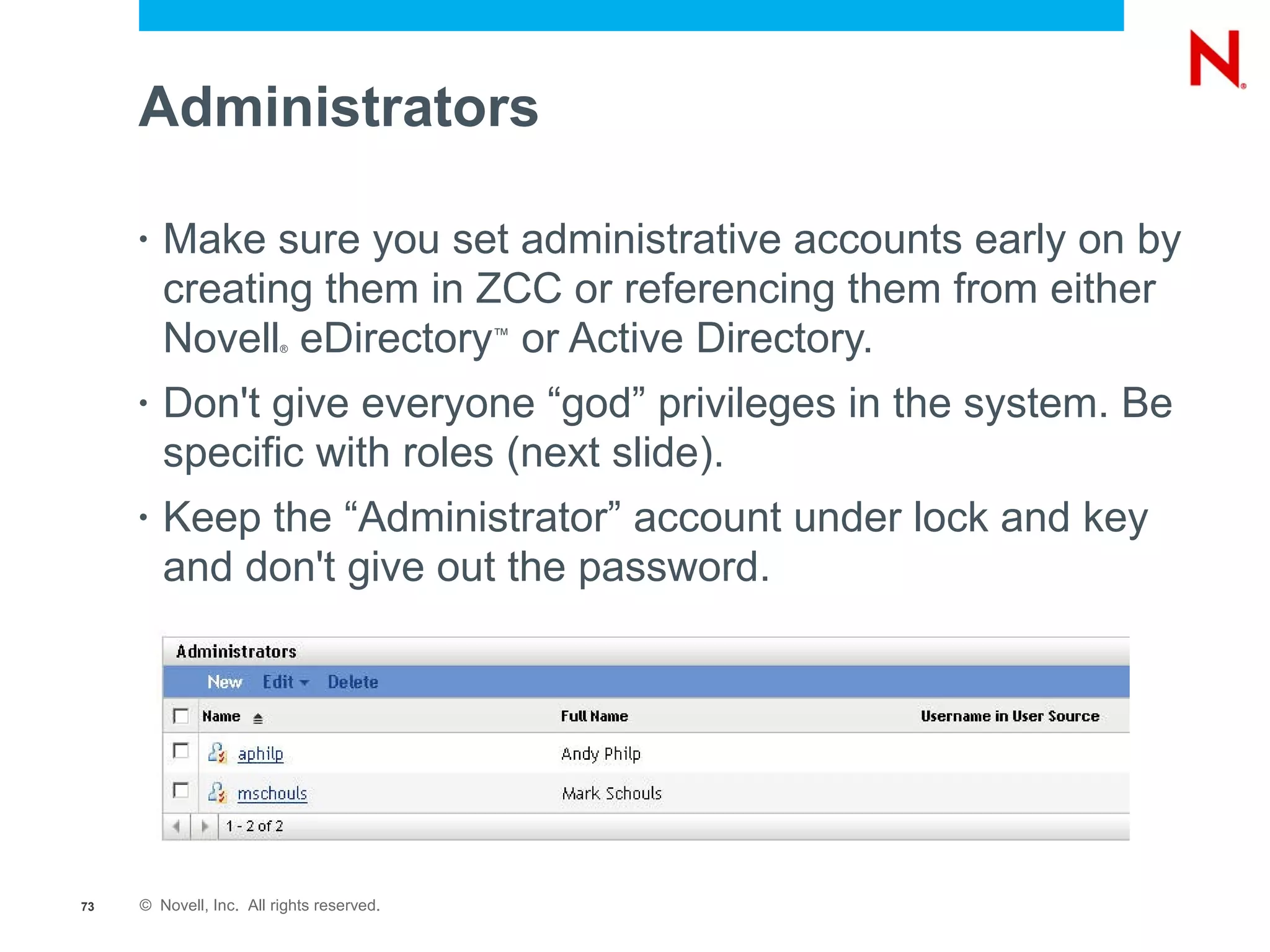
Administrators

     •   Make sure you set administrative accounts early on by
         creating them in ZCC or referencing them from either
         Novell eDirectory or Active Directory.
                         ®
                                           ™


     •   Don't give everyone “god” privileges in the system. Be
         specific with roles (next slide).
     •   Keep the “Administrator” account under lock and key
         and don't give out the password.


73   © Novell, Inc. All rights reserved.
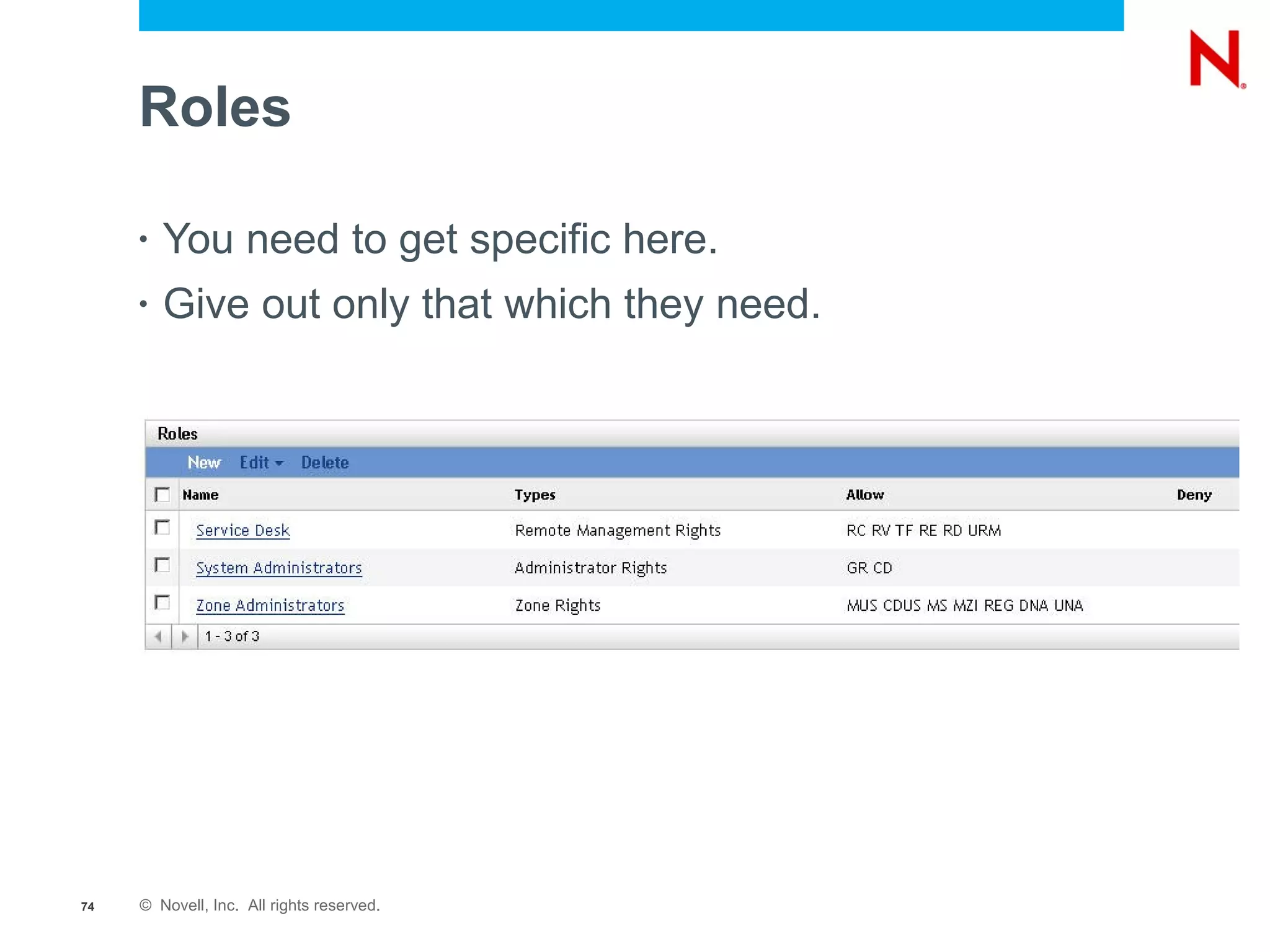
Roles

     •   You need to get specific here.
     •   Give out only that which they need.


74   © Novell, Inc. All rights reserved.
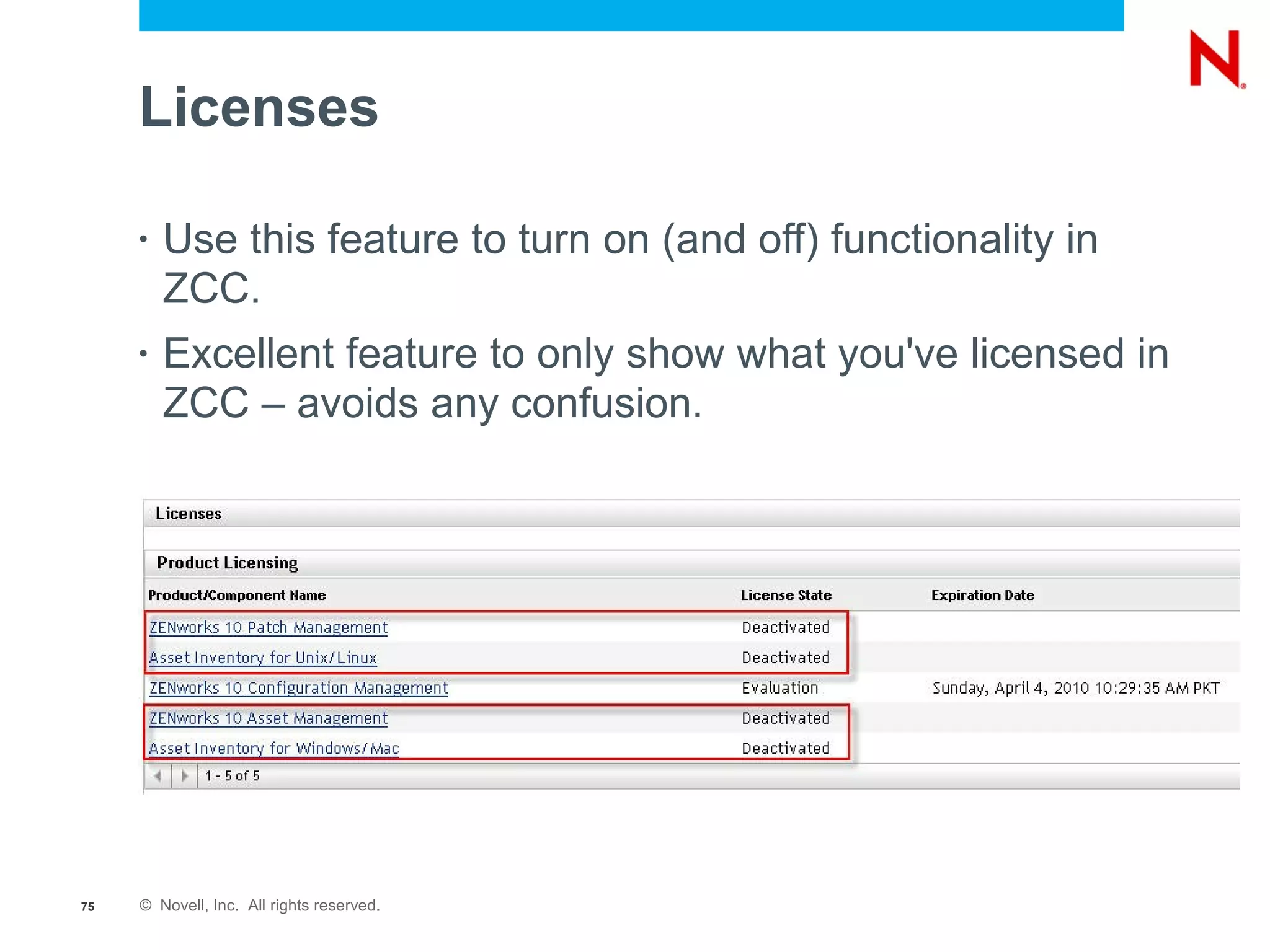
Licenses

     •   Use this feature to turn on (and off) functionality in
         ZCC.
     •   Excellent feature to only show what you've licensed in
         ZCC – avoids any confusion.


75   © Novell, Inc. All rights reserved.
Questions and Answers
Unpublished Work of Novell, Inc. All Rights Reserved.
This work is an unpublished work and contains confidential, proprietary, and trade secret information of Novell, Inc.
Access to this work is restricted to Novell employees who have a need to know to perform tasks within the scope
of their assignments. No part of this work may be practiced, performed, copied, distributed, revised, modified,
translated, abridged, condensed, expanded, collected, or adapted without the prior written consent of Novell, Inc.
Any use or exploitation of this work without authorization could subject the perpetrator to criminal and civil liability.


General Disclaimer
This document is not to be construed as a promise by any participating company to develop, deliver, or market a
product. It is not a commitment to deliver any material, code, or functionality, and should not be relied upon in
making purchasing decisions. Novell, Inc. makes no representations or warranties with respect to the contents
of this document, and specifically disclaims any express or implied warranties of merchantability or fitness for any
particular purpose. The development, release, and timing of features or functionality described for Novell products
remains at the sole discretion of Novell. Further, Novell, Inc. reserves the right to revise this document and to
make changes to its content, at any time, without obligation to notify any person or entity of such revisions or
changes. All Novell marks referenced in this presentation are trademarks or registered trademarks of Novell, Inc.
in the United States and other countries. All third-party trademarks are the property of their respective owners.

Novell ZENworks Configuration Management Design and Implementation Best Practices

  • 1.
    Novell ZENworks ® ® Configuration Management Design and Implementation Best Practices Mark Schouls Andy Philp Senior Product Manager Product Manager Novell Inc.,/mschouls@novell.com Novell Inc.,/aphilp@novell.com
  • 2.
    Agenda Pre-Design activities Critical information required for design Design activities Deploying Novell ZENworks Configuration ® ® Management Best practice recommendations Question and answer 2 © Novell, Inc. All rights reserved.
  • 3.
  • 4.
    Pre-Design Activities • There are several things you want to cover. – Business Assessment – Technical Assessment – Gather other critical information – Develop a high level design – Complete the documentation based on the above listed activities and put it somewhere where people can find it 4 © Novell, Inc. All rights reserved.
  • 5.
    Business Assessment • If you do not have a solid understanding of what the overall business needs you cannot design a solution that will meet them. • The best way to handle this is through a set of informal workshops. – The idea of the meeting is to inform them enough so they begin to give you feedback as to how they will leverage the system. – Remember, the three main reasons you hold these workshops is to... > Inform them of what you are doing > Get their buy-in > Get their feedback in the form of requirements 5 © Novell, Inc. All rights reserved.
  • 6.
    Business Assessment (cont.) Some ideas on how to perform the business assessment include: – Hold informal workshops and invite leaders from each department to attend. – Survey departmental leaders and find out what they need in order to become more effective in their roles – how their staff can become more effective given what the software you are deploying does. > Getting them to answer a written survey can be very effective here and can give you a lot of detail that can be used when building the high-level, and more detailed design. 6 © Novell, Inc. All rights reserved.
  • 7.
    Technical Assessment • The purpose of the technical assessment is to review what you have, identify what you need, and document it all. • The two main outputs from a technical assessment are: – Documentation on your findings. – A set of tasks that you will need to perform. • It is recommended that you perform this after the Business Assessment. • The two assessments should take no longer than a week to perform, depending on the size and/or complexity of the organization and it's infrastructure. 7 © Novell, Inc. All rights reserved.
  • 8.
    Technical Assessment (cont.) • Know of your existing infrastructure well, before you introduce ZENworks Configuration Management (ZCM) ® into the environment. • Workshops work well!! • Things you most definitely need to understand include: – Operating systems which need to be supported. – Number of users that will need to be supported by the solution. – Support for roaming users. – Number of offices/sites, and how many users at each location. – Locations of all data centers. – Network architecture with details on links speeds, etc. 8 © Novell, Inc. All rights reserved.
  • 9.
    Technical Assessment (cont.) • If you need to apply any updates to your existing servers, etc • Structure of the DNS infrastructure • Structure of the DHCP infrastructure • IP subnet design • Network access methods • Network infrastructure components and design • Directory services design 9 © Novell, Inc. All rights reserved.
  • 10.
    Gather Other CriticalInformation • You should also be very familiar with other services that are running on the network that rely on the infrastructure as well. • It would be best to try and prioritize these services so you can start to better understand bandwidth utilization, and service levels that have been assigned to specific functions. • If the organization is implementing ITIL best practices you should know about all disciplines that are currently being leveraged. 10 © Novell, Inc. All rights reserved.
  • 11.
    Gather Other CriticalInformation • Other stuff you should consider exploring and asking: – Is there a service desk in place? – Is there an SLA process in place? – Does a disaster recovery plan exist? – What about a CMDB? – Are there formal change management processes in place? – Are there formal packaging processes in place? – Do you have a Definitive Software Library in place? – Any other projects on the go? 11 © Novell, Inc. All rights reserved.
  • 12.
    Develop a HighLevel Design • A high-level design document that outlines the general placement of services across the company's infrastructure. • As a supplement to the high-level design document you should also develop a graphical representation of the infrastructure. – This diagram should reflect exactly what you have described in the document, and it should be high-level so that everyone can see what the infrastructure is going to look like once the deployment is complete 12 © Novell, Inc. All rights reserved.
  • 13.
    Documentation • It is important that you develop your documentation and then discuss this with all parties that have a stake in the success of this project. – Documentation is a must-have. • Discussing the findings and recommendations in detail are going to be key to the success of this phase of the project, and the more detailed design phase. – Incorporate any changes immediately... before you forget!! 13 © Novell, Inc. All rights reserved.
  • 14.
    Outputs from Pre-DesignActivities • The main outputs include: – Assessment document – This document highlights all of your findings from the business and technical assessments that you performed. > Requirements gathered during meetings/workshops with department leaders and others inside the organization that will have an influence on what services Novell ZENworks will deliver. ® ® > A detailed summary of your technical findings, and what needs to change in order to support ZENworks in the infrastructure. > High-level design information including general placement of services, and other infrastructure components. – High-level design diagram – This diagram is used to visually understand what the infrastructure will look like after the deployment is complete. This will be refined further. 14 © Novell, Inc. All rights reserved.
  • 15.
  • 16.
    Know Everything • Design criteria • Scalability of the Primary Server • Scalability of the Satellite Server • Considerations for the Database Server • Virtualization 16 © Novell, Inc. All rights reserved.
  • 17.
    Scalability of thePrimary Server Factors Influencing Scale • There are a number of factors that directly influence the scalability of the Primary Server. These include... – RAM: The majority of operations are performed by two processes – zenserver and zenloader. These can take up to approximately 1.2 GB of RAM each. – Disk I/O: When serving content for applications and updates. – Other non server-hardware related factors, including... > Refresh frequency, what are they being utilized for, number of administrators, frequency, and quantity of uploading content into the content repository, number of reports that are being run by administrators, and are you utilizing load balancing. > There are others, but you get the point. 17 © Novell, Inc. All rights reserved.
  • 18.
    Scalability of thePrimary Server SuperLab Test – Average Time to Refresh • The graphic shows scale of the Primary Server under considerable load. The test shows increasing numbers of Managed Devices hitting the Primary Server at the same time during a refresh. 18 © Novell, Inc. All rights reserved.
  • 19.
    Scalability of thePrimary Server SuperLab Test – Average Time to Download • The graphic shows scale of the Primary Server under considerable load. The test shows increasing numbers of Managed Devices hitting the Primary Server at the same time downloading 100MB of Bundle content. 19 © Novell, Inc. All rights reserved.
  • 20.
    Scalability of thePrimary Server SuperLab Test – Administrative Tasks Under Load • The following results are a series of Administrative Tasks performed on a server with no load and then with a load. Test Name Test De scription Primary Server Under Primary Server Under No Load Load BOE Report Run Predefined BOE report - Bundle Deployment Status 15 seconds 18 seconds (313 pages) Inventory Report Run canned report “Devices By Machine / Login Name” 7 seconds 8 seconds Policy Create policy, assign it to 60 devices and perform a Quick 7 minutes 43 seconds 7 minutes 45 seconds Task on all 60 devices to get policy Multicast Create Multicast bundle and multicast to 60 devices 4 minutes 20 seconds 4 minutes 27 seconds Bundle Create an MSI Bundle of Open Office, assign it to 60 25 minutes 30 seconds 1 hour 10 minutes 17 devices and refresh all 60 using a Quick Task seconds 20 © Novell, Inc. All rights reserved.
  • 21.
    Scalability of thePrimary Server Description of Daily Use Test • The test environment in the SuperLab consists of the following components: – Single server running Windows Server 2003 (64 bit) – Server hardware – Dell 2950, Quad Core 2.0 MHz, 8GB RAM – External Microsoft SQL Server 2005 database • Definition of “Daily Use” – 24 hour period simulated in 4 hours – 3 Bundle pushes of 105 chained bundles (30MB to 1KB) – 1 full and 3 delta inventory scans – 1 patch distribution – 4 device refreshes – 10 devices continually restoring images 21 © Novell, Inc. All rights reserved.
  • 22.
    Scalability of thePrimary Server Achieving Scalability in the Real World • Tests are performed in the SuperLab to find the “breaking point” of the system and it's components, real scalability on the other hand is achieved through... – The proper placement of services – A well thought out design – The proper configuration of services within the Novell ZENworks ® ® system itself • There is a big difference between what we “find” and what we “suggest”. – For Primary Servers we recommend the following as a starting point: > Three (3) Primary Servers to – load and fault tolerance > A dedicated database server 22 © Novell, Inc. All rights reserved.
  • 23.
    Scalability of thePrimary Server Achieving Scalability in the Real World, (Cont.) • The recommendations on the previous slide would be further enhanced by considering the following as well: – Exclude servers to ensure that certain Primary Servers are dedicated to specific functions. – Dedicate a Primary Server as the Novell ZENworks Reporting ® ® Server. – A dedicated Primary Server for ZENworks Control Center. – The use of Satellite Servers for distribution, collection, and local site authentication. 23 © Novell, Inc. All rights reserved.
  • 24.
    Scalability of thePrimary Server Achieving Scalability in the Real World, (Cont.) • Some of the major factors that you need to consider with ZCM and Primary Servers are the following: – They can handle between 1,000 and 1,500 concurrent connections. – The rule of thumb is a Primary Server for every 3,000 devices you will register into the Zone. – A ZENworks Zone will scale to 40,000 devices. This is what has ® been validated in the SuperLab and what Novell recommends ® is the upper limit to the Zone size. 24 © Novell, Inc. All rights reserved.
  • 25.
    Scalability of thePrimary Server Achieving Scalability in the Real World, (Cont.) • It is recommended that Primary Servers and the Database Server be on the same network. • It is NOT recommended (typically) that Primary Servers span any WAN links. • Network utilization issues will appear quickly, and this is mainly due to... – SQL traffic between Primary Servers and the Database server. – Replication of content in the Primary Servers content repository. – Potential spanning the WAN by Managed Devices. 25 © Novell, Inc. All rights reserved.
  • 26.
    Scalability of theSatellite Server Factors Influencing Scale • There are a number of factors that directly influence the scalability of the Satellite Server. These include... – Physical memory installed on the machine. – Disk I/O from the requests being handled by the machine. – What services are being handled by the Satellite Server > Collection, content, imaging, authentication. – The number of managed devices that are hitting the server, and how frequently. – Frequency of distributions. – Class of hardware. – Class of Operating System. 26 © Novell, Inc. All rights reserved.
  • 27.
    Scalability of theSatellite Server SuperLab Test Number 1 • This is useful when you begin to estimate how many Satellite Servers are required. • Try to calculate estimated load during the design phase. Bundle Size Server OS Server OS Workstation OS Workstation OS (MB) No. of Managed No. of Managed No. of Managed No. of Managed Devices in Test Devices Successful Devices in Test Devices Successful 6 1004 1004 259 259 10 1004 1004 259 259 25 1004 968 259 259 50 1004 801 259 248 1200 1000 800 600 Server OS Workstation OS 400 200 0 6 10 25 50 27 © Novell, Inc. All rights reserved.
  • 28.
    Scalability of theSatellite Server SuperLab Test Number 2 • The second test shows the results of a Satellite Server running on a Server OS delivering multiple chained bundles to connected managed devices. • This information is very useful when trying to calculate how much load you can place on the Satellite Server (with a Server OS) when deploying applications that are chained together. Number of Bundle Sizes Total No. of Managed No. of Managed Devices Bundles Devices Successful 5 10, 15, 20, 25, 30 (in MB) 999 996 4 5, 10, 15, 20 (in MB) 999 996 28 © Novell, Inc. All rights reserved.
  • 29.
    Scalability of theSatellite Server SuperLab Test Number 3 • The third test shows the results of a Satellite Server running on a Workstation OS delivering multiple chained bundles to connected managed devices. • This information is very useful when trying to calculate how much load you can place on the Satellite Server (with a Workstation OS) when deploying applications that are chained together. Number of Bundle Sizes Total No. of Managed No. of Managed Bundles Devices Devices Successful 5 10, 15, 20, 25, 30 (in MB) 259 259 4 5, 10, 15, 20 (in MB) 259 259 29 © Novell, Inc. All rights reserved.
  • 30.
    Scalability of theSatellite Server Achieving Scalability in the Real World • Once again, tests performed in the SuperLab locate the “breaking point” of the service. • We assume the following... – The Satellite Server running on server-class hardware can handle up to 1,000 Managed Devices – The Satellite Server running on workstation-class hardware can handle up to 250 Managed Devices • For larger sites (250 devices and beyond)... – Use multiple Satellites for redundancy and load balancing • For smaller sites (up to 250 devices)... – Use your judgment 30 © Novell, Inc. All rights reserved.
  • 31.
    The Database Server Scalability • The main things you need to consider when it comes to the database server are: – How many devices are you managing? If the number is greater than 10,000 then you may want to consider using Oracle or Microsoft SQL Server. – Will you be able to utilize clustering technologies to achieve a higher level of fault tolerance. > You need more details on the organizational continuity and availability management plans. • Novell does not recommend use of the ® Embedded Sybase database for production use. – This is a single point of failure and should be avoided. 31 © Novell, Inc. All rights reserved.
  • 32.
    The Database Server Scalability (cont.) • Follow vendor-specific best practices when it comes to database backup, tuning, and maintenance. – It is critical that you completely understand the vendors recommendations and best practices. – You database administrator(s) need to be very close to this project. Database Platform Scope / Number of devices Sybase (embedded) Testing / Development – not recommended for production use/deployment Sybase (remote) Production / < 1,500 up to 5,000 Microsoft SQL Server 2005 Production / < 5,000 up to 40,000 Oracle 10g Production / < 5,000 up to 40,000 32 © Novell, Inc. All rights reserved.
  • 33.
    The Database Server Backup – Sybase • One of the most important aspects of Sybase database maintenance is regular backups of the database files. • Sybase provides it's own backup tool to do this, and it is freely available for you to download off of the Ianywhere website. – The name of the backup tool is dbbackup. • Details on the tool can be found here: http://www.ianywhere.com/developer/product_manuals/sqlanywhere/1000/en/html/dbdaen10/da-dbbackup.htm 33 © Novell, Inc. All rights reserved.
  • 34.
    The Database Server Backup – Sybase (cont.) • Novell does not provide any support for this tool – all ® issues related to the use of this tool must be logged with Sybase. • The Sybase database can be backed either when it is running or shut down. – When it is running you will use dbbackup. – When it is shut down you can perform a simple file copy. 34 © Novell, Inc. All rights reserved.
  • 35.
    The Database Server Considerations – Microsoft SQL Server • The most important aspects of managing and maintaining your database server that is hosted on a Microsoft SQL Server are the following: – You must have the skills in-house, or be readily available to them (contractor, consultant, or partner) to manage and maintain the Microsoft SQL Server based on the best practices that Microsoft outlines for regular database management. – There must be regular database backup routines in place. This should also be documented or noted in the design document. 35 © Novell, Inc. All rights reserved.
  • 36.
    The Database Server Considerations – Microsoft SQL Server (cont.) • There must be regular database maintenance routines in place. This should also be documented or noted in the design document. • Considerations for clustering (high availability) of the database server should be made and documented. • The organization needs to be familiar with the tools that Microsoft provides to plan, analyze, and maintain their Microsoft SQL Server infrastructure. • Check out Microsoft's website for more details – there is a wealth of information available to you. 36 © Novell, Inc. All rights reserved.
  • 37.
    The Database Server Recommendations – Oracle • You must rely on the skills of the in-house database administrator(s) to ensure you are installing, updating, and maintaining the database properly. • The individual(s) responsible for the day-to-day management of the Oracle infrastructure must be involved in the ZCM deployment project from day one. • Be familiar with the documents Oracle makes available on their website. 37 © Novell, Inc. All rights reserved.
  • 38.
    The Database Server Database Sizing and Performance • As a general rule of thumb, Novell has seen that the ® database size increases at a rate of approximately 1GB per one thousand (1,000) devices in the zone. • Best practices around fault tolerance, maintenance, and performance need be considered alongside the general calculations for overall database size, and they are just as (if not more) important. • For sites with more than 10,000 devices RAID 0+1 (mirror with stripe) is recommended. 38 © Novell, Inc. All rights reserved.
  • 39.
    The Database Server Database Sizing and Performance (cont.) • Database servers are very sensitive to disk performance. – More smaller disks are always faster than fewer larger disks. • A single 10GB drive for a 10,000 device site may not perform adequately, although it may meet the database sizing formula. – Ten smaller drives will perform much better. • Testing and monitoring are an essential part of database configuration. • It is very important to note that ZCM performs better with a dedicated database server, and it is not shared with other database applications. 39 © Novell, Inc. All rights reserved.
  • 40.
    DNS and DHCPServices • DNS forward and reverse lookup is properly configured so that you can resolve servers using both their DNS name and IP address. • It helps when workstations are registered in DNS as well – DDNS required. • DHCP needs to be properly configured for imaging purposes. • PXE may need to be enabled on workstations. 40 © Novell, Inc. All rights reserved.
  • 41.
    Time Synchronization • Everything has a time stamp. – Ensure everything is time synchronized, it's important. • All servers in your zone must have time synchronization configured. It is not needed for devices but it is recommended to ensure a well tuned infrastructure. • For Novell eDirectory customers it may be an ® ™ option to point the ZCM servers to eDirectory Time Sources via NTP. Usually all clients use the same time sources via the Novell Client, so ® the system will be in complete harmony. 41 © Novell, Inc. All rights reserved.
  • 42.
    Virtualization • Remember to plan your installation carefully, and allocate the right amount of resources if you are going to install in a virtualized environment. • Currently Novell supports the following platforms: ® – XEN – VMware ESX – VMware Workstation – Microsoft Virtual Server 42 © Novell, Inc. All rights reserved.
  • 43.
  • 44.
    Design Activities • This is where you will spend the bulk of your “planning and testing” time. – You will build your design (how and what) and validate it in a lab setting to ensure you have built everything correctly and nothing is missing. – We will once again stress the importance of solid and accurate documentation to back up all of the decisions you have made. • It is estimated that you will spend approximately 80% of your time in this planning and testing phase, and the remainder of your time will be spent on pilots and the wider deployment where you simply are executing against your plan. 44 © Novell, Inc. All rights reserved.
  • 45.
    Design Activities (cont.) • Just because we stress the need for proper design activities does not mean that this is, or needs to be complex. – It is just good project management in action. – Once again, you want to be successful the first time and avoid the need for major design changes after the deployment has started. This could be very disruptive for your end users. 45 © Novell, Inc. All rights reserved.
  • 46.
    Design Activities (cont.) • Three recommendations need to be made: – Hold design workshops with everyone involved, and those that have say in how things need to look and feel – these provide tremendous value and keep the project organized and running. – Go through every aspect of what the system will look like, and all of the features you will leverage. > Document everything along the way. – Test everything in a lab environment – your use cases, features, functions, etc., etc. > This does not need to be physical machines – leverage virtualization capabilities to create your lab. > Keep you lab running well after the project – you never know if you'll need it again, and it can provide a lot of testing value down the road (and time). 46 © Novell, Inc. All rights reserved.
  • 47.
  • 48.
    Steps to aSuccessful Deployment • The steps are straight forward – if you follow these simple steps you will increase your level of success. – Pre-deployment planning – Pre-deployment documentation – Pre-deployment testing – Pilots – Migration (if applicable) – Wider deployment – Post-deployment documentation and validation 48 © Novell, Inc. All rights reserved.
  • 49.
  • 50.
    Zone Settings • The topics we will cover today include: – Organized Management – Content Replication – Device Management – Event and Messaging – Infrastructure Management – Inventory – Licensing and administration 50 © Novell, Inc. All rights reserved.
  • 51.
    Organized Management • Folder Structures – Functional or geographical? • Static and Dynamic Groups 51 © Novell, Inc. All rights reserved.
  • 52.
    Folder Structures • Organize your Bundles in folders, use registration rules/keys, and avoid dumping everything in one place – be organized and you'll thank us later. • Register devices into specific folders (site/location, department, role, etc.) - decide on what makes the most sense to you, and stick with it. • Leverage folder structure for content assignment to make things as simple as possible. – User based structure from your User Source. – Device based structure from what you've created. 52 © Novell, Inc. All rights reserved.
  • 53.
    Using Groups • Leverage Device based “Dynamic Groups” whenever possible. These group memberships are calculated for you and takes the guessing out of the game. • Create “Static Groups” if you need to. 53 © Novell, Inc. All rights reserved.
  • 54.
    Content Replication • Define by bundle folders – Good for Patch Management content • Prioritize content deliver between sites based on type – Control schedule, length of window and bandwidth consumption 54 © Novell, Inc. All rights reserved.
  • 55.
    Primary Server Replication • Take advantage of these settings to specify which Primary Servers will include or exclude new content by default. – ZCM 10 SP3 allows this to be set at the bundle folder – This could be very useful for complex designs. 55 © Novell, Inc. All rights reserved.
  • 56.
    Satellite Server Replication • Once again, same goes for the Satellite Servers as well. – This could be useful when you require a very controlled design and implementation. 56 © Novell, Inc. All rights reserved.
  • 57.
    Content Replication • Make sure you set this up according to both your needs, and policies set by the networking group(s). – ZCM 10 SP3, ZCM introduces content types 57 © Novell, Inc. All rights reserved.
  • 58.
    Satellite Server –Offline Replication • If on-boarding a new remote site, consider content export features: – Set content schedule to “None” – Define content requirements – <zman ssec> command to export – <zac cic> command to import 58 © Novell, Inc. All rights reserved.
  • 59.
    Device Management • Device refresh schedule – How often do you need to force updates? • Disable unnecessary modules – Different devices have different requirements • Inventory – Tracking your assets • Imaging – Windows 7 anyone? 59 © Novell, Inc. All rights reserved.
  • 60.
    Device Refresh Schedule • In most cases the default is OK... but modify if required before you start registering devices into the Zone. – This goes for Full and Partial 60 © Novell, Inc. All rights reserved.
  • 61.
    ZENworks Agent ® • Choose whether or not you allow your users to uninstall the agent. • Modify settings for individual modules. 61 © Novell, Inc. All rights reserved.
  • 62.
    Inventory • Make sure you set this up according to your requirements. – A “fresh” install assumes you will set this up, so do not necessarily accept the defaults. 62 © Novell, Inc. All rights reserved.
  • 63.
    Imaging • Embrace “Universal Imaging” in your organization, and cut down on the overhead involved in managing multiple images. – Are you moving to Windows 7? • Visit the other sessions covering imaging: – Specifically go see what ENGL have to say in their session: EM300 - Windows 7 Deployment with Novell ZENworks ® ® Configuration Management and ENGL Imaging Toolkit 63 © Novell, Inc. All rights reserved.
  • 64.
    Infrastructure Management • Closest Server Rules – Define where devices go for each service type • System Update Settings – Define your update strategy • Event Messaging – Beware – DB growth! • User Sources – Enable user based management • Satellite Device Roles 64 © Novell, Inc. All rights reserved.
  • 65.
    Closest Server Rules • Larger deployments will always use custom rules. • Designs with satellite locations will always use custom rules. • The Default Rule may be OK for small, single-site implementations. 65 © Novell, Inc. All rights reserved.
  • 66.
    System Update Settings • Make sure you set this up according to your requirements. • A “fresh” install assumes you will set this up. 66 © Novell, Inc. All rights reserved.
  • 67.
    System Update Agent • Get your System Update settings done before you start deploying. The defaults are OK, but may not work for you. 67 © Novell, Inc. All rights reserved.
  • 68.
    Centralized Message Logging • For complex deployments consider designating a specific Primary Server as the Maintenance Server. – Maybe the ZCC Server. – Select a few days to clean up. – Designate a time... the default may not work for you. 68 © Novell, Inc. All rights reserved.
  • 69.
    User Sources • ZCM 10 SP3 introduces: – Satellite Authentication Roles – Smart card authentication | 69 © Novell, Inc. All rights reserved.
  • 70.
    User Sources (cont.) • Remember, multiple sources are supported. • Remember, multiple connections are now supported 70 © Novell, Inc. All rights reserved.
  • 71.
    Satellite Server Roles • Remember to specify the role(s) of each of your Satellite Servers. – The Authentication Role is new to ZCM 10.3. 71 © Novell, Inc. All rights reserved.
  • 72.
    Licensing and administration • Also found on the “Configuration Page” – Administrators – Roles – License info 72 © Novell, Inc. All rights reserved.
  • 73.
    Administrators • Make sure you set administrative accounts early on by creating them in ZCC or referencing them from either Novell eDirectory or Active Directory. ® ™ • Don't give everyone “god” privileges in the system. Be specific with roles (next slide). • Keep the “Administrator” account under lock and key and don't give out the password. 73 © Novell, Inc. All rights reserved.
  • 74.
    Roles • You need to get specific here. • Give out only that which they need. 74 © Novell, Inc. All rights reserved.
  • 75.
    Licenses • Use this feature to turn on (and off) functionality in ZCC. • Excellent feature to only show what you've licensed in ZCC – avoids any confusion. 75 © Novell, Inc. All rights reserved.
  • 76.
  • 78.
    Unpublished Work ofNovell, Inc. All Rights Reserved. This work is an unpublished work and contains confidential, proprietary, and trade secret information of Novell, Inc. Access to this work is restricted to Novell employees who have a need to know to perform tasks within the scope of their assignments. No part of this work may be practiced, performed, copied, distributed, revised, modified, translated, abridged, condensed, expanded, collected, or adapted without the prior written consent of Novell, Inc. Any use or exploitation of this work without authorization could subject the perpetrator to criminal and civil liability. General Disclaimer This document is not to be construed as a promise by any participating company to develop, deliver, or market a product. It is not a commitment to deliver any material, code, or functionality, and should not be relied upon in making purchasing decisions. Novell, Inc. makes no representations or warranties with respect to the contents of this document, and specifically disclaims any express or implied warranties of merchantability or fitness for any particular purpose. The development, release, and timing of features or functionality described for Novell products remains at the sole discretion of Novell. Further, Novell, Inc. reserves the right to revise this document and to make changes to its content, at any time, without obligation to notify any person or entity of such revisions or changes. All Novell marks referenced in this presentation are trademarks or registered trademarks of Novell, Inc. in the United States and other countries. All third-party trademarks are the property of their respective owners.