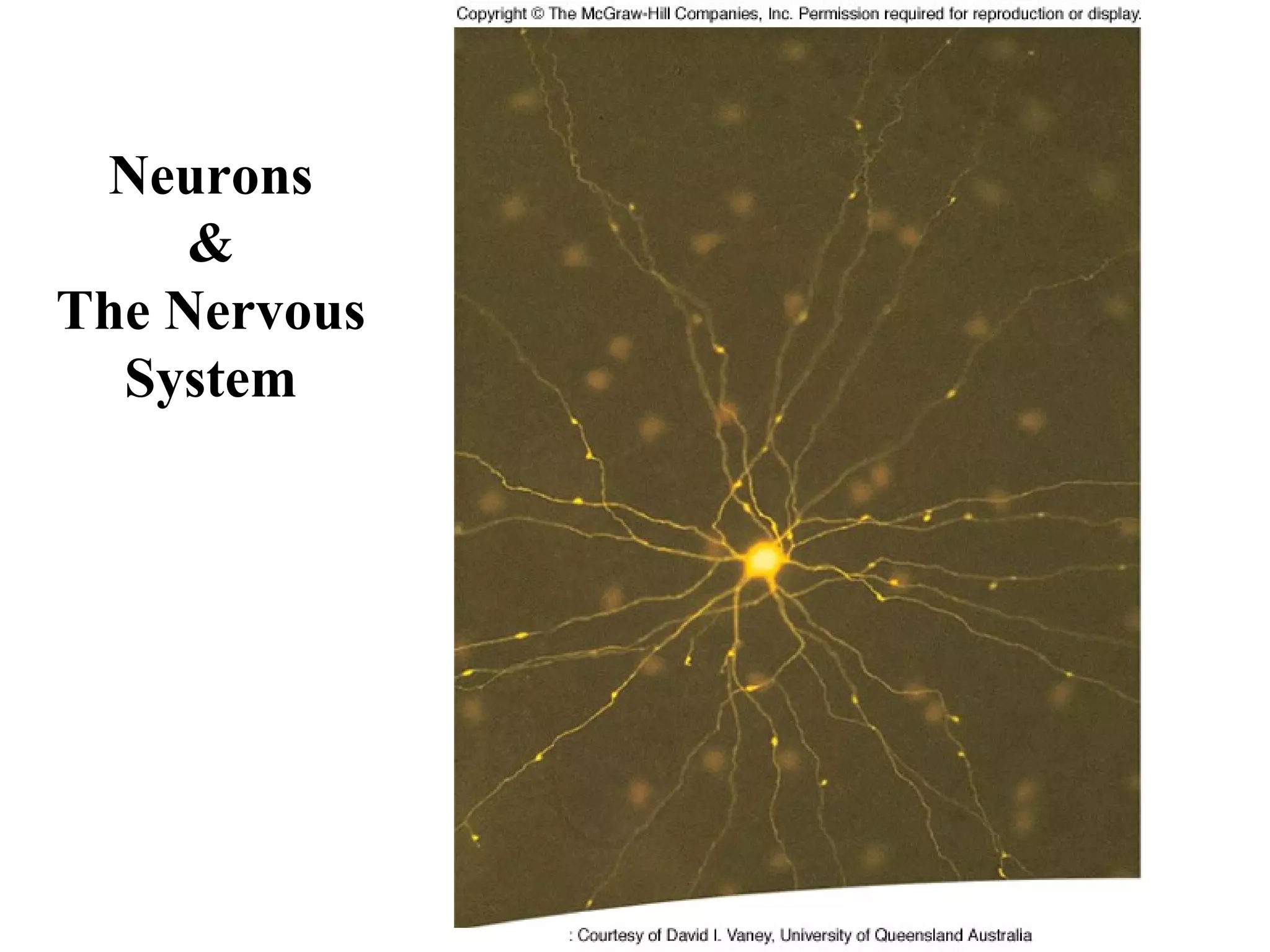
Neurons
&
The Nervous
System
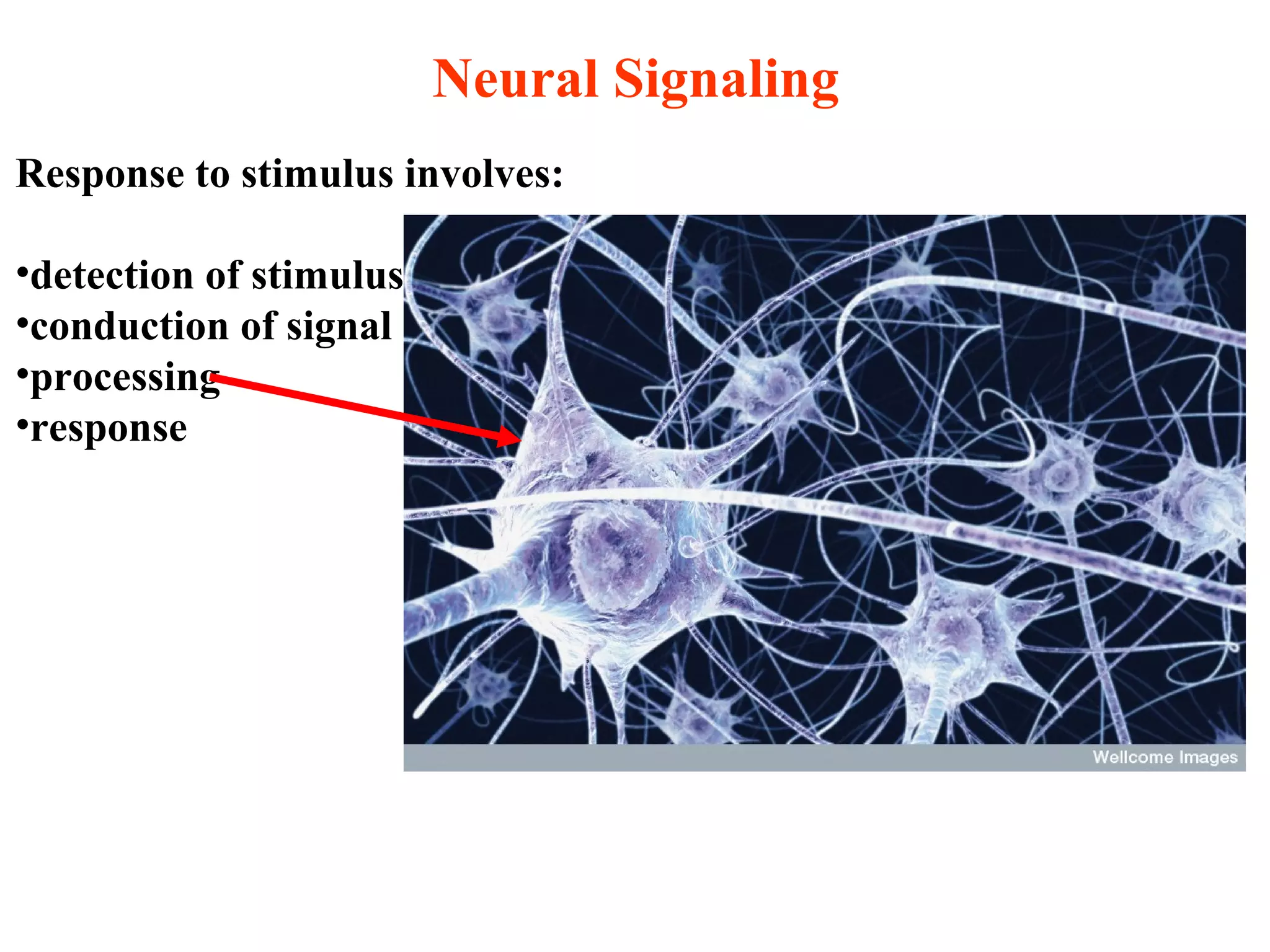
Neural Signaling
Response to stimulus involves:
•detection of stimulus
•conduction of signal
•processing
•response
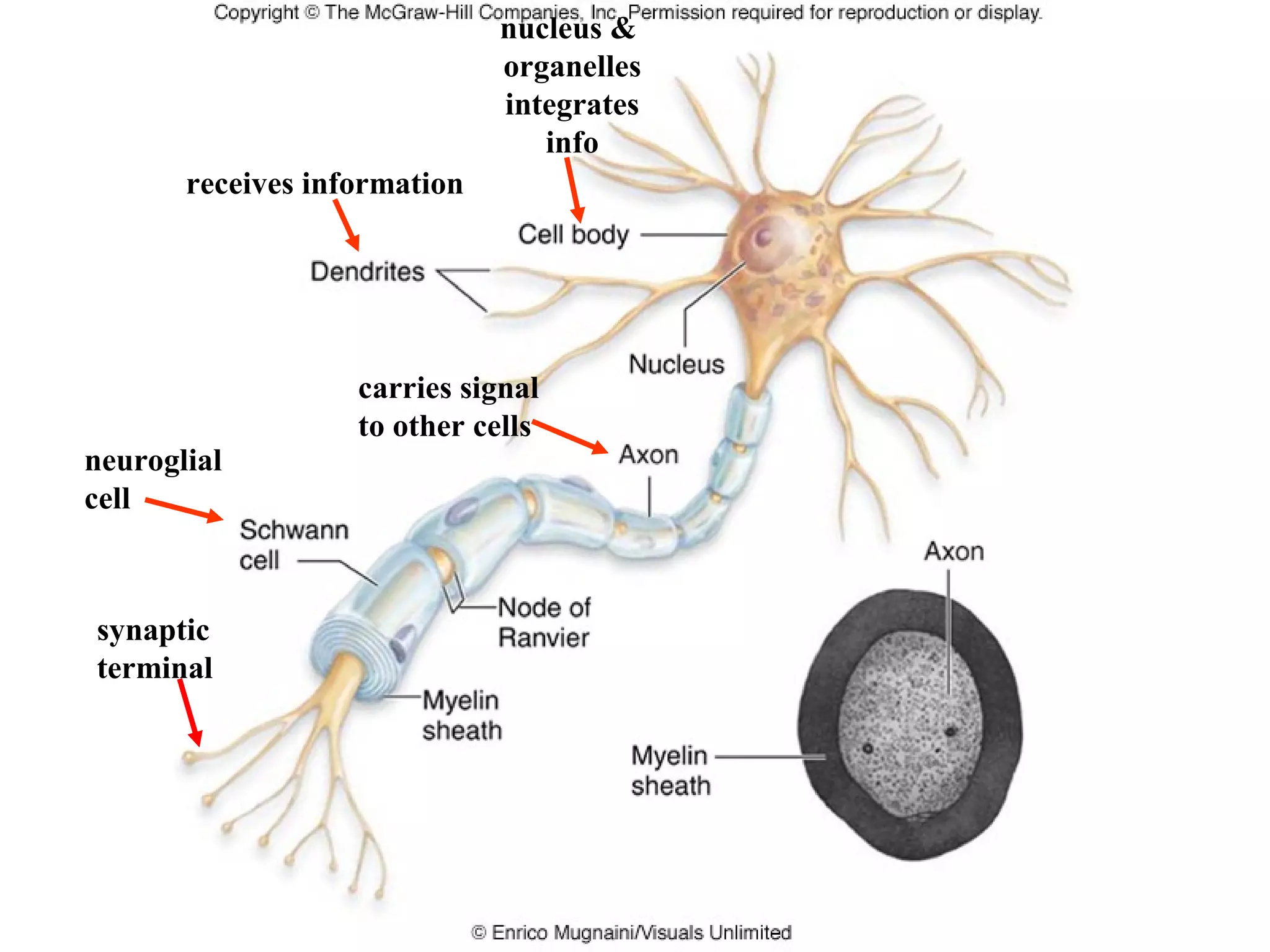
receives information
nucleus &
organelles
integrates
info
carries signal
to other cells
neuroglial
cell
synaptic
terminal
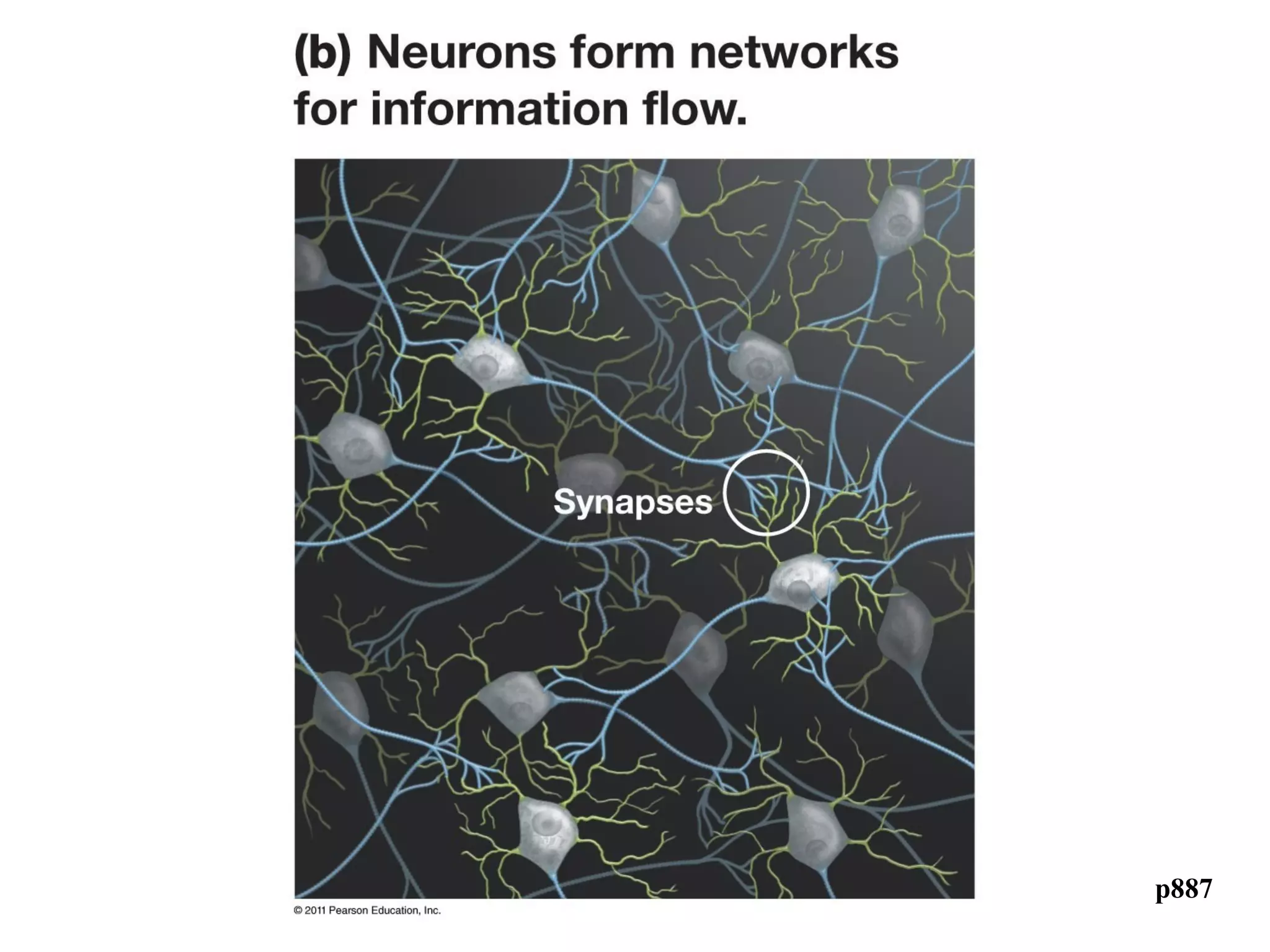
p887
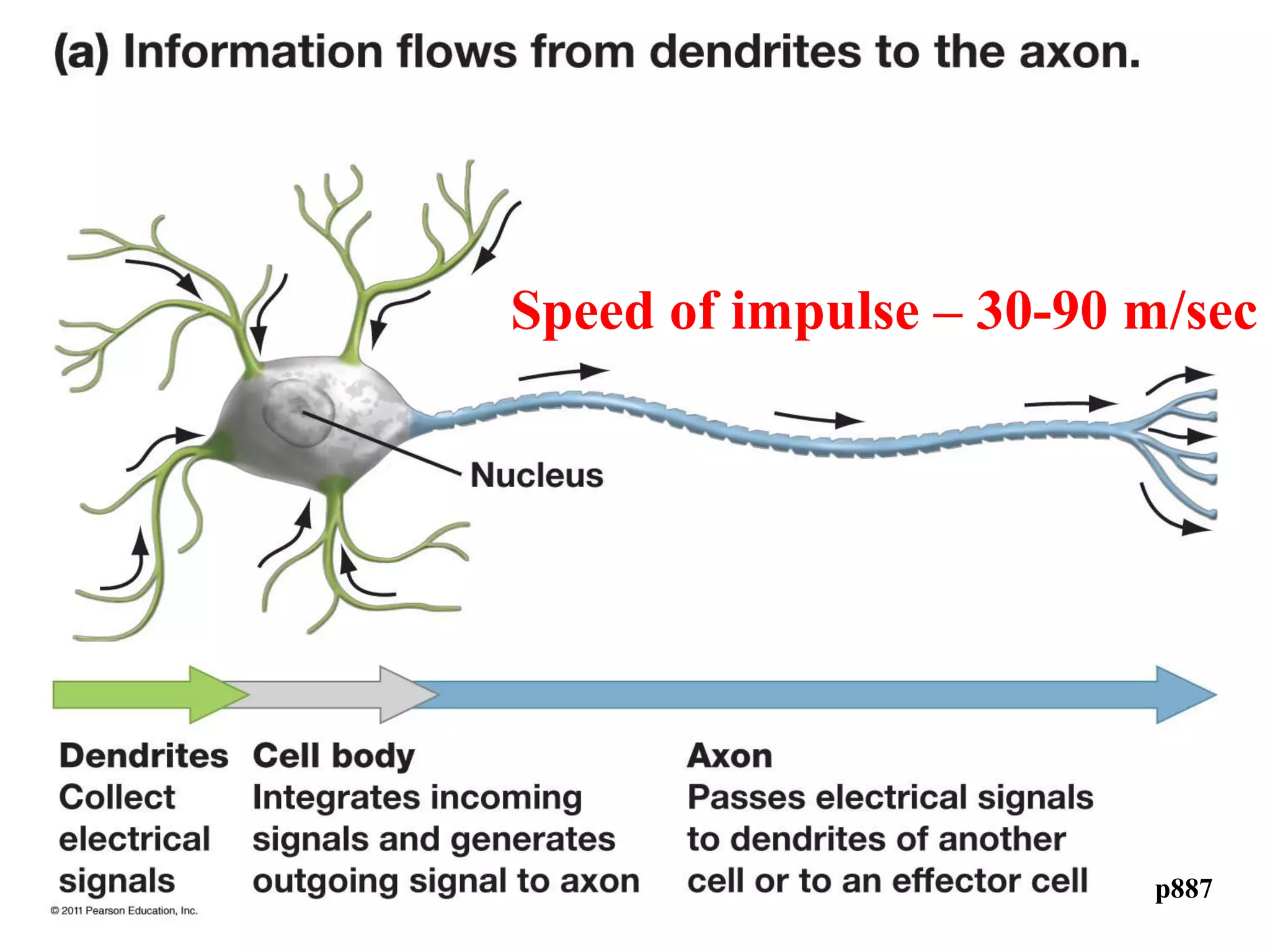
Speed of impulse – 30-90 m/sec
p887
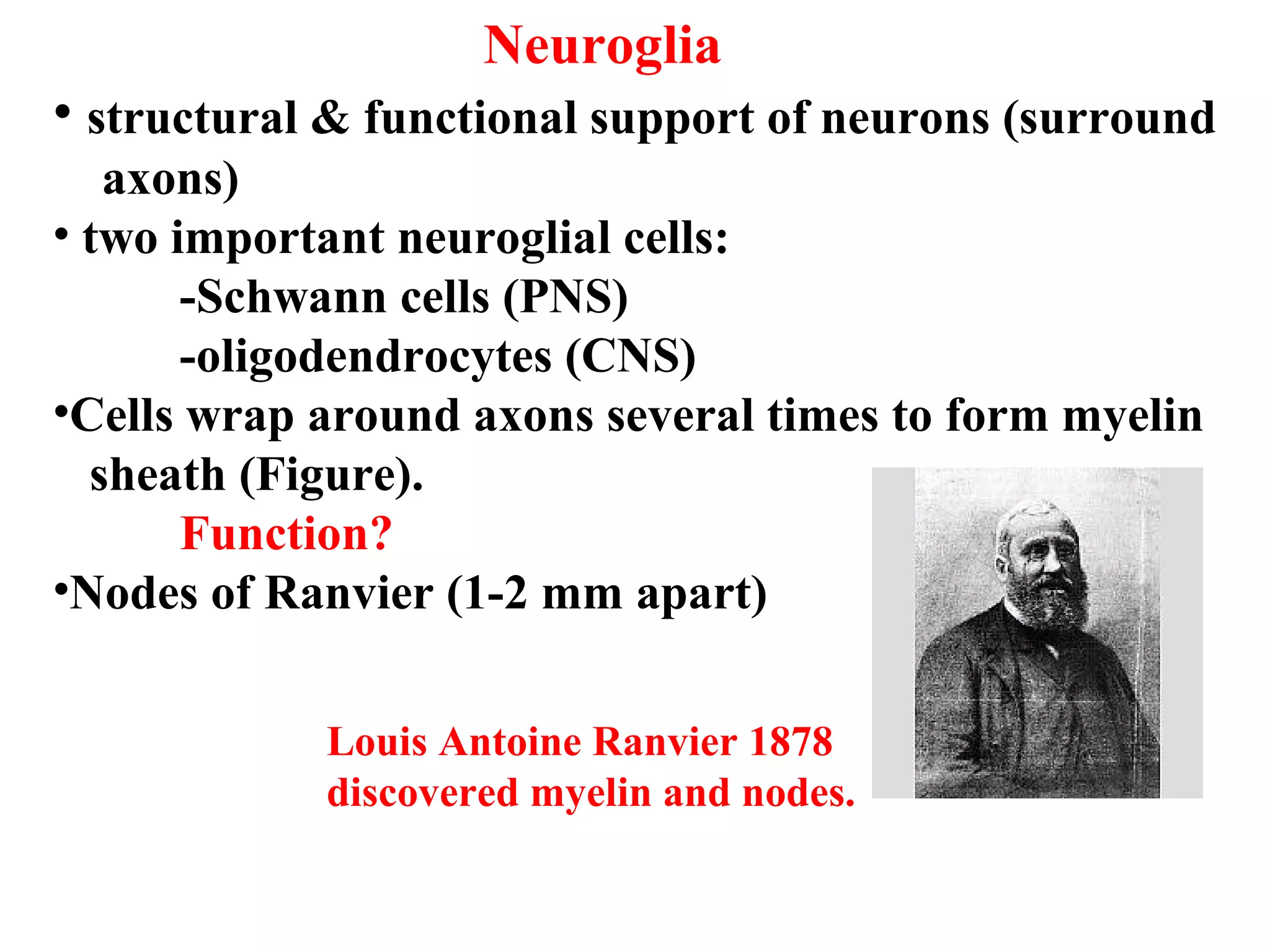
Neuroglia
• structural & functional support of neurons (surround
axons)
• two important neuroglial cells:
-Schwann cells (PNS)
-oligodendrocytes (CNS)
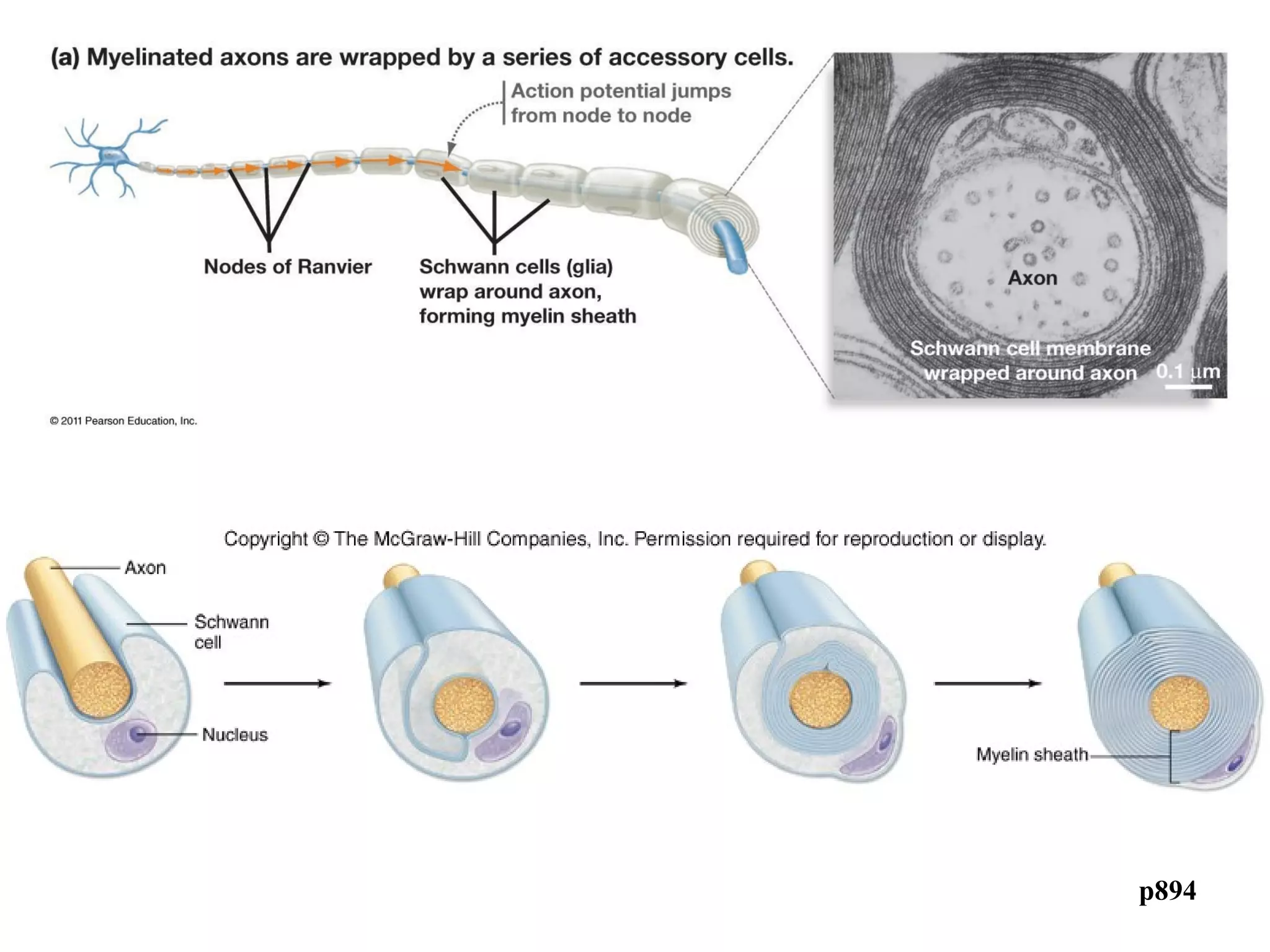
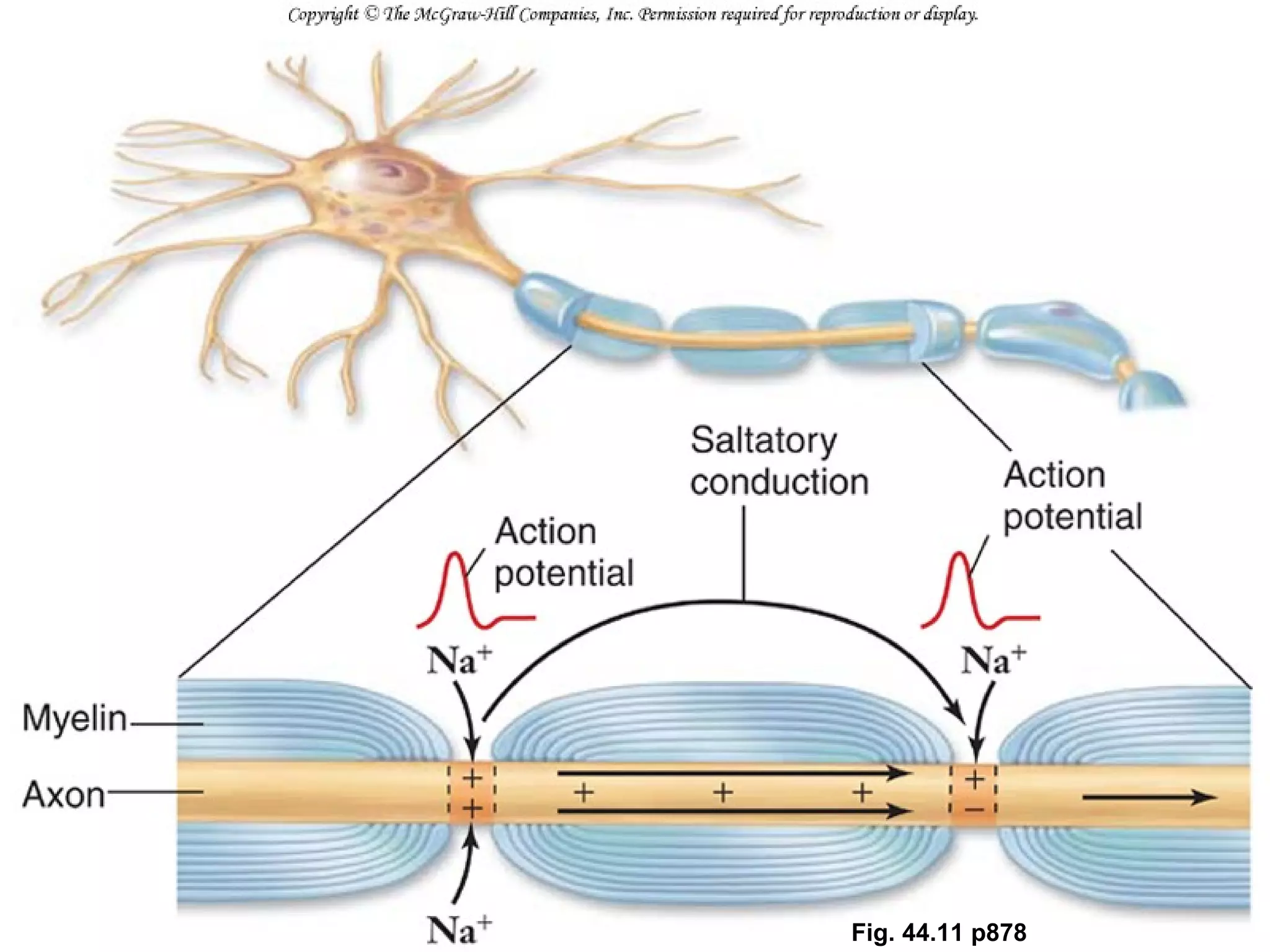
•Cells wrap around axons several times to form myelin
sheath (Figure).
Function?
•Nodes of Ranvier (1-2 mm apart)
Louis Antoine Ranvier 1878
discovered myelin and nodes.
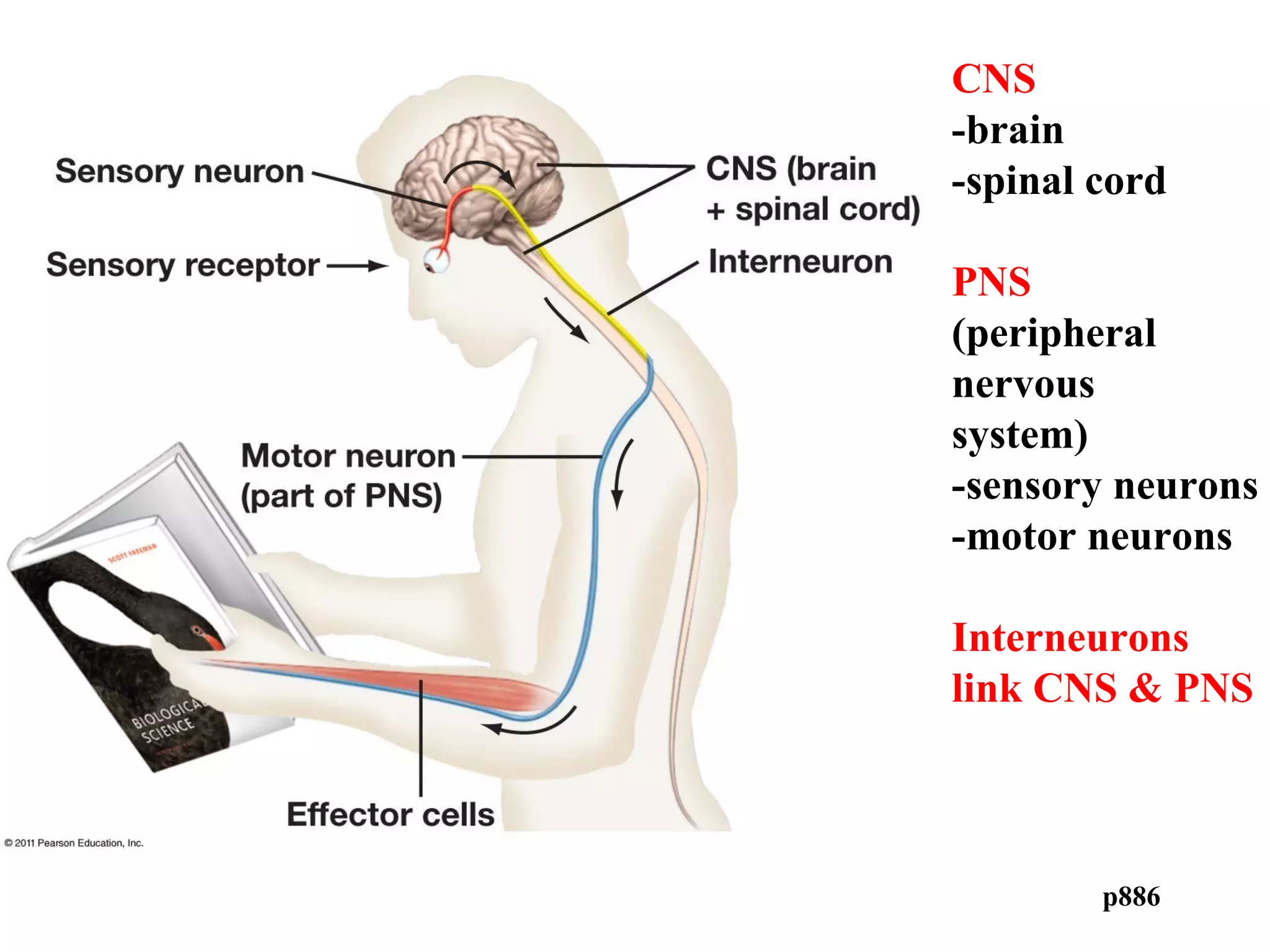
CNS
-brain
-spinal cord
PNS
(peripheral
nervous
system)
-sensory neurons
-motor neurons
Interneurons
link CNS & PNS
p886
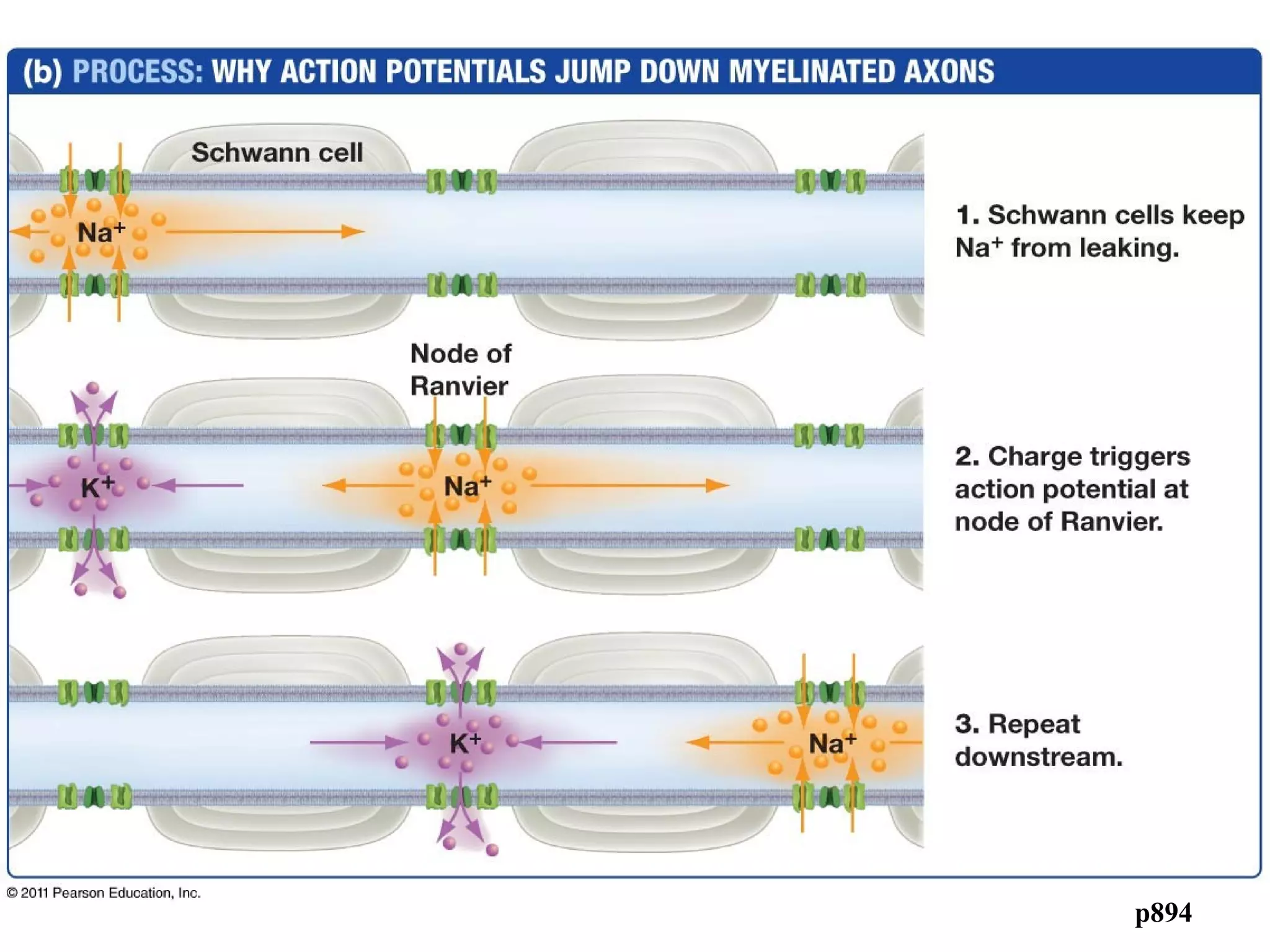
p894
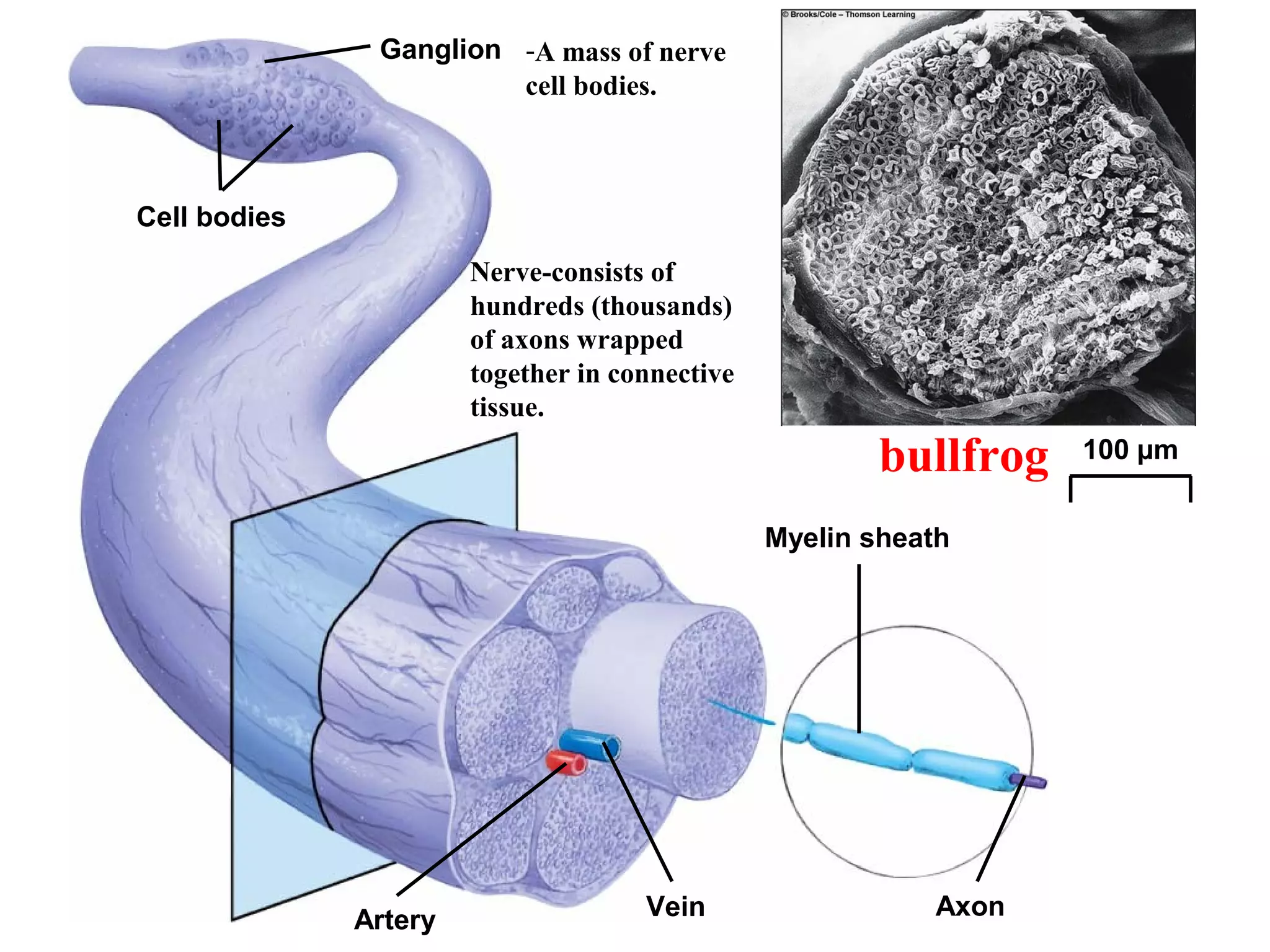
Ganglion
Cell bodies
Myelin sheath
Artery Vein Axon
100 µm
Nerve-consists of
hundreds (thousands)
of axons wrapped
together in connective
tissue.
bullfrog
-A mass of nerve
cell bodies.
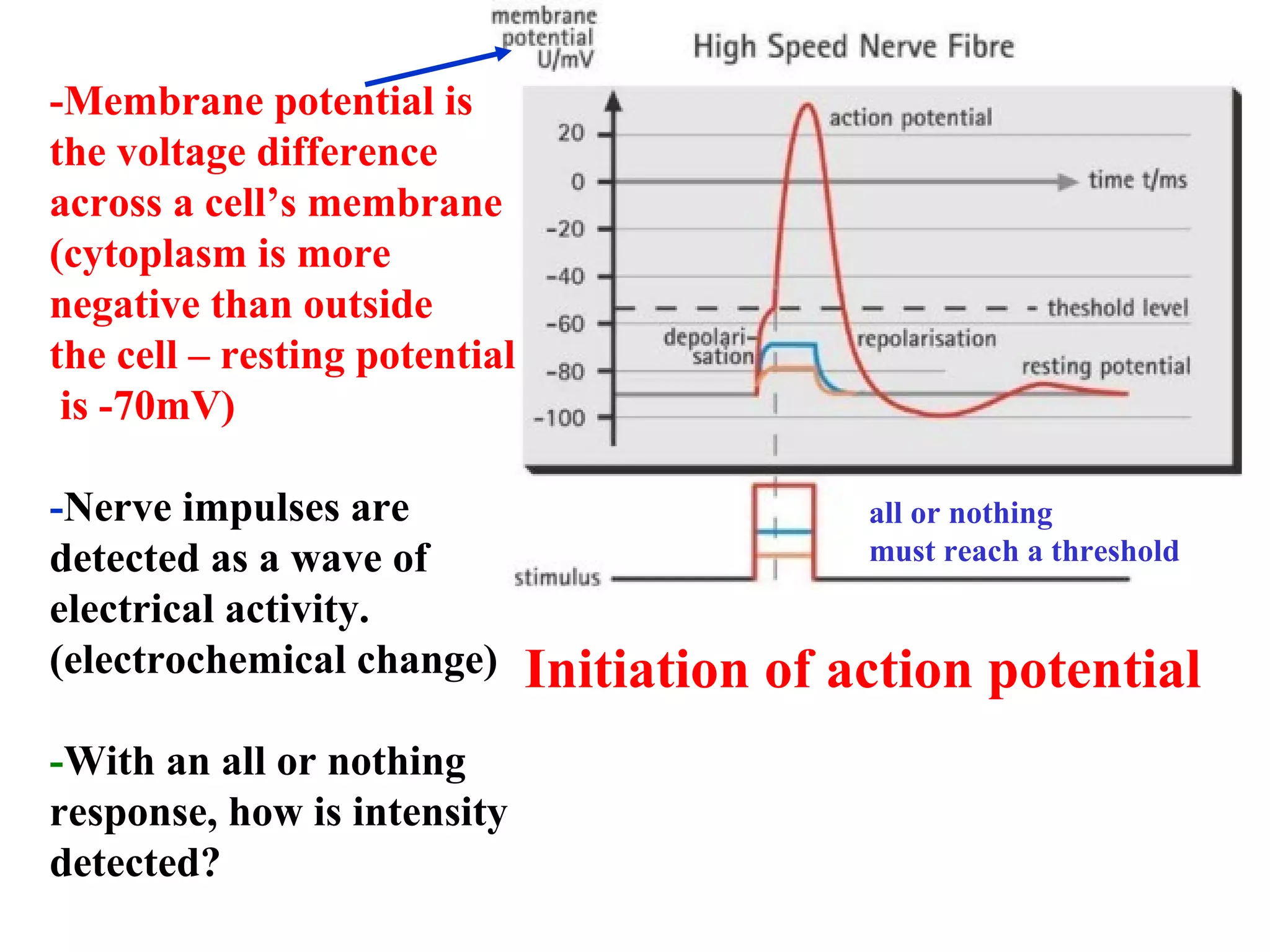
Initiation of action potential
all or nothing
must reach a threshold
-Membrane potential is
the voltage difference
across a cell’s membrane
(cytoplasm is more
negative than outside
the cell – resting potential
is -70mV)
-Nerve impulses are
detected as a wave of
electrical activity.
(electrochemical change)
-With an all or nothing
response, how is intensity
detected?
Resting
Potential
p889
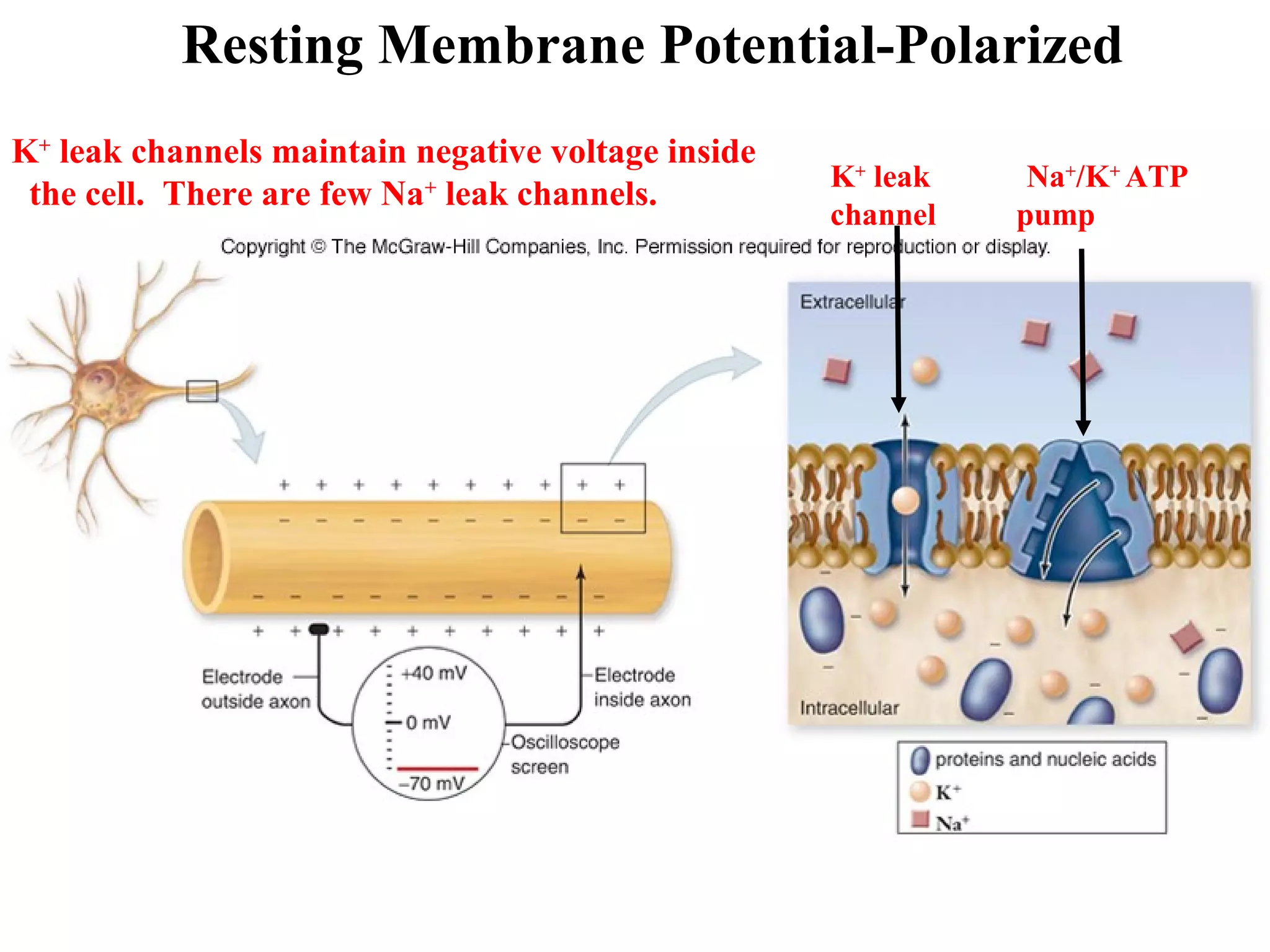
Resting Membrane Potential-Polarized
K+
leak Na+
/K+
ATP
channel pump
K+
leak channels maintain negative voltage inside
the cell. There are few Na+
leak channels.
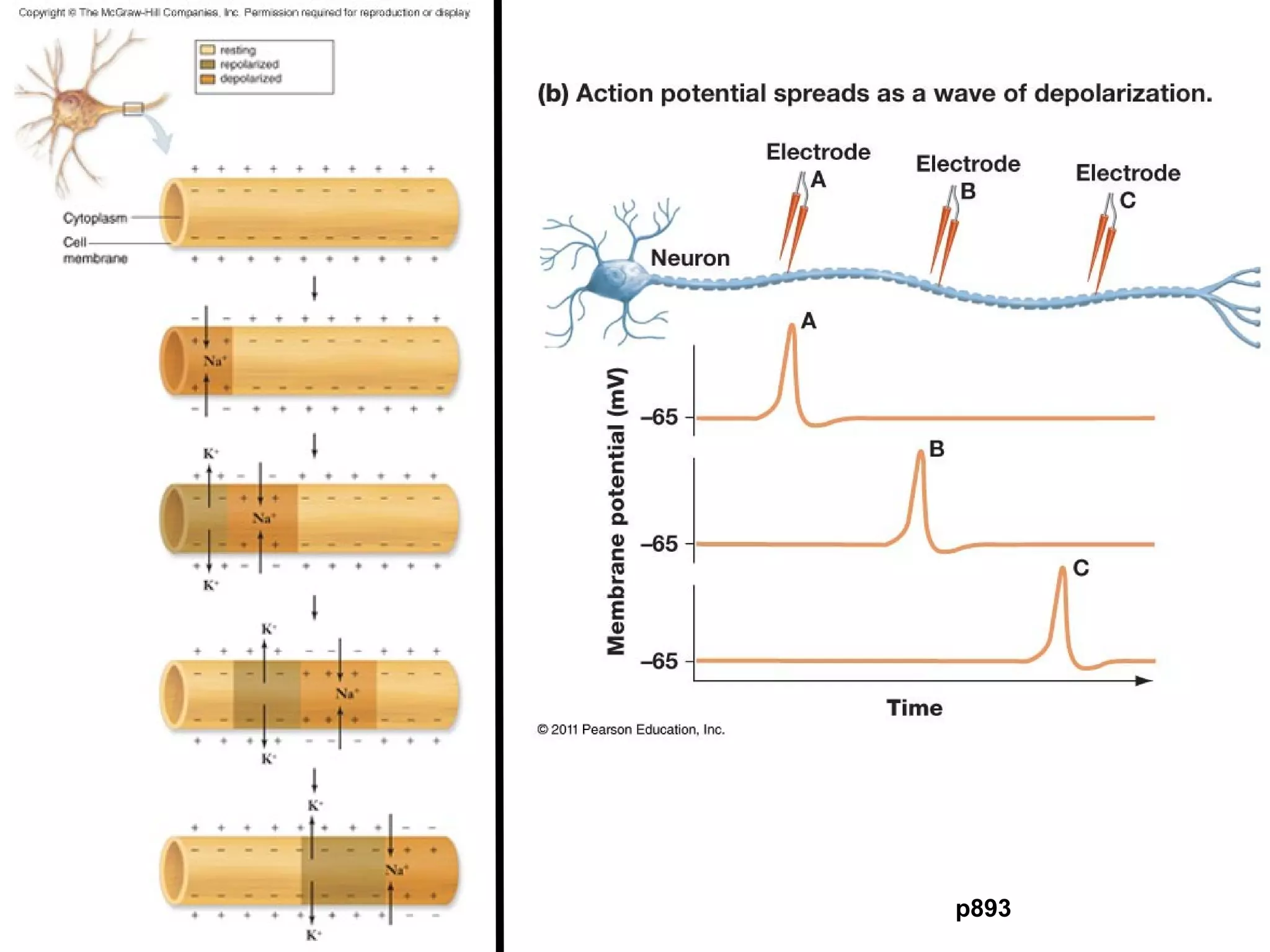
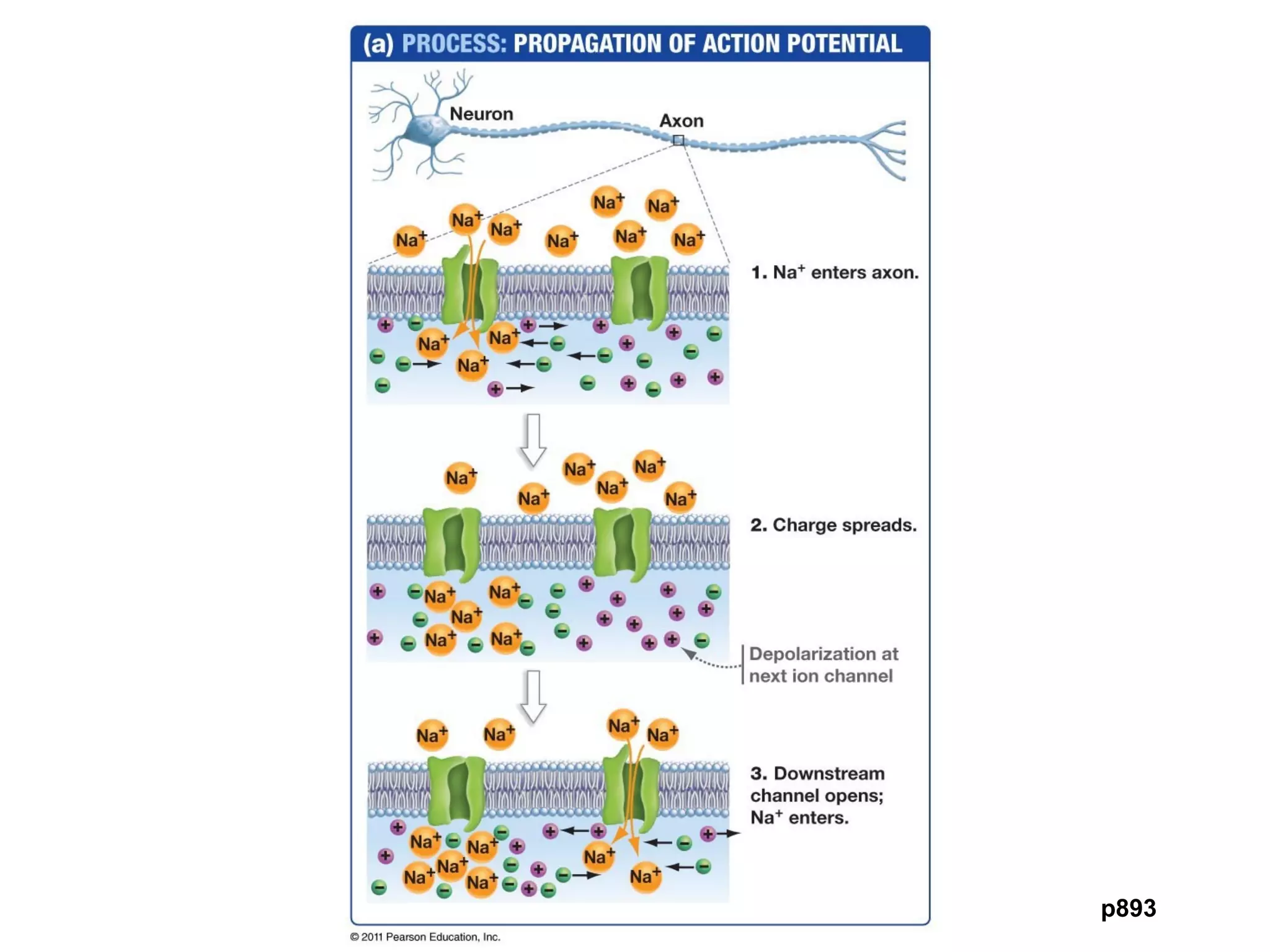
p893
p893
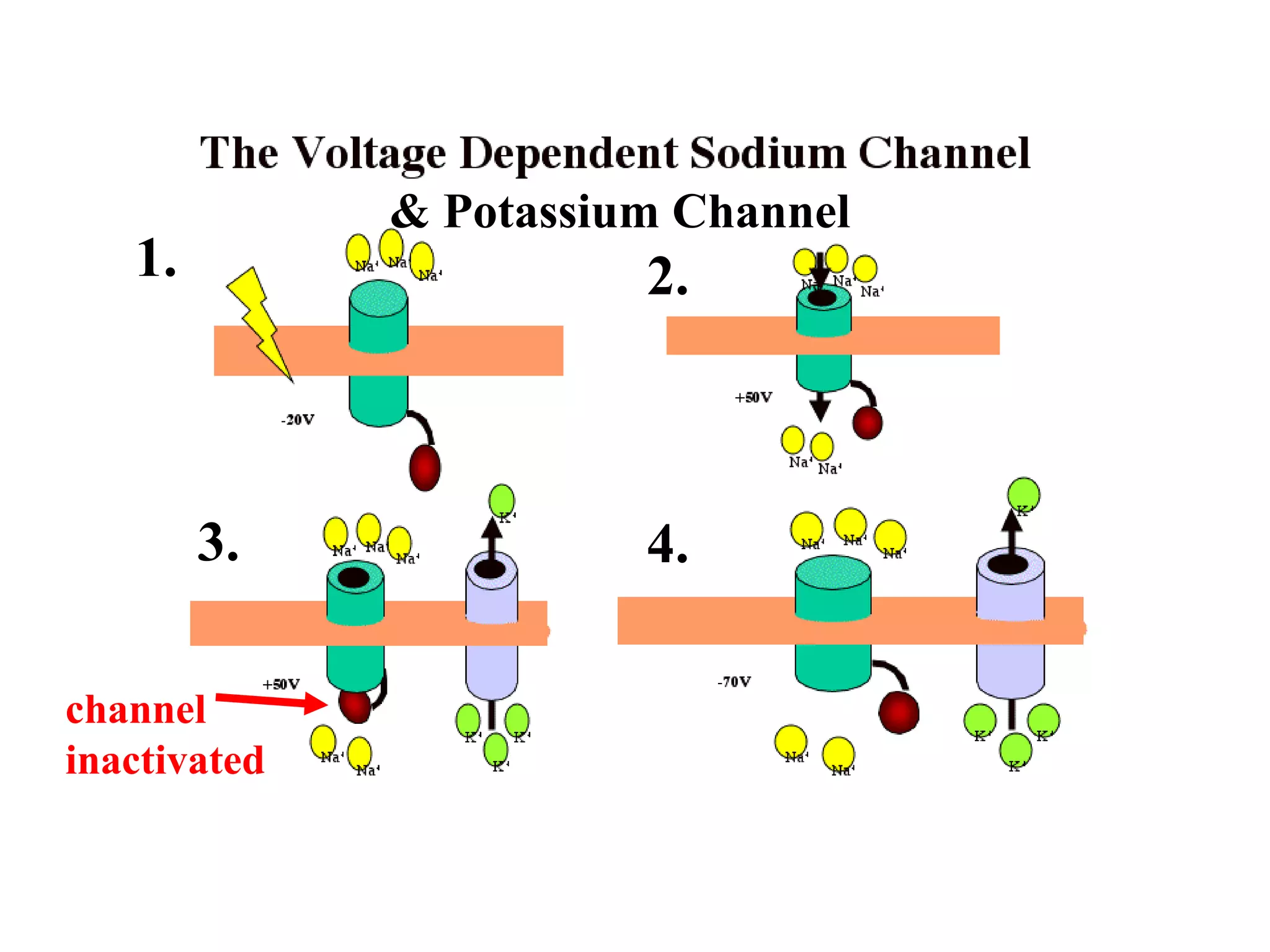
& Potassium Channel
1. 2.
3. 4.
channel
inactivated
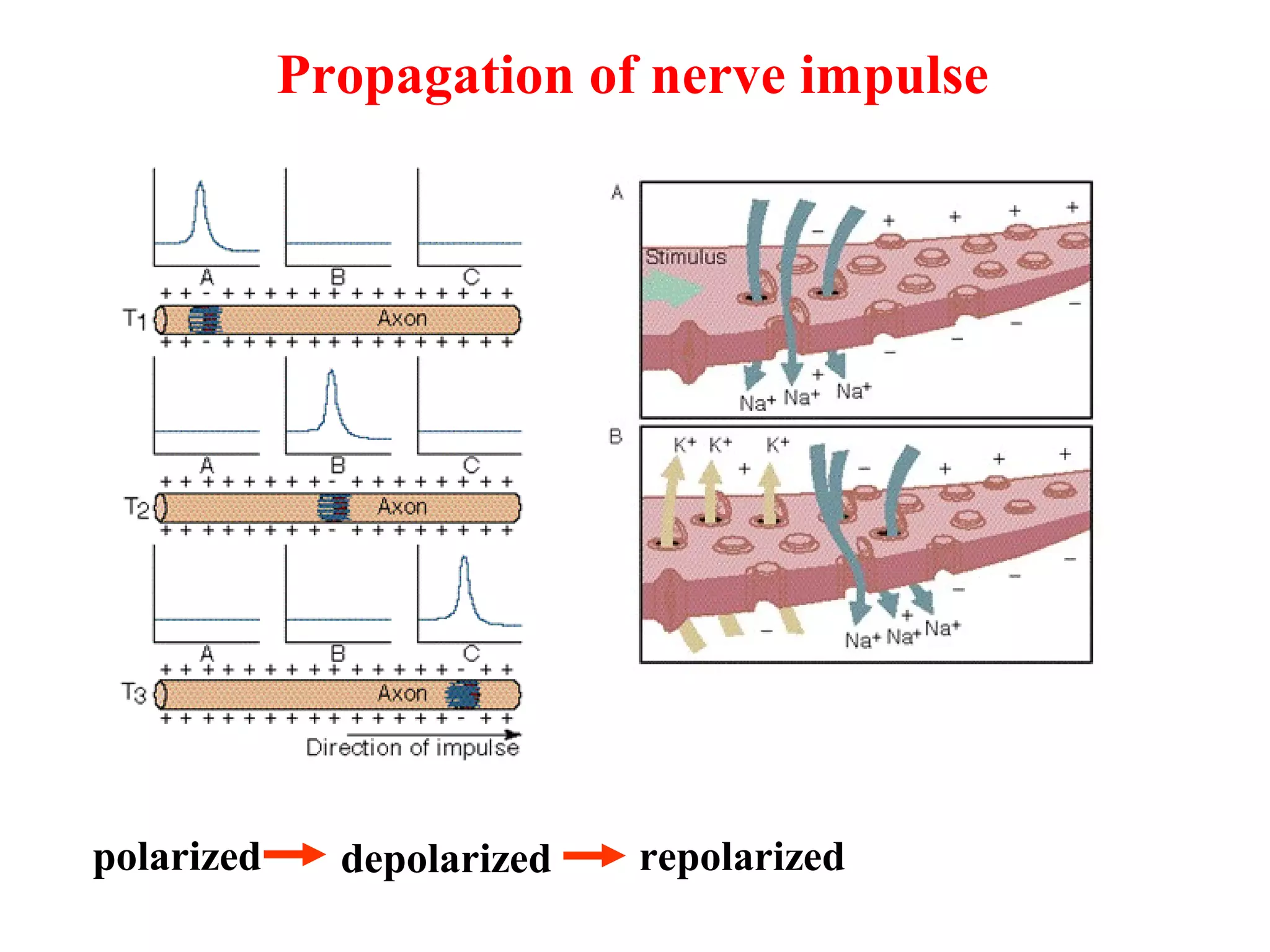
Propagation of nerve impulse
polarized depolarized repolarized
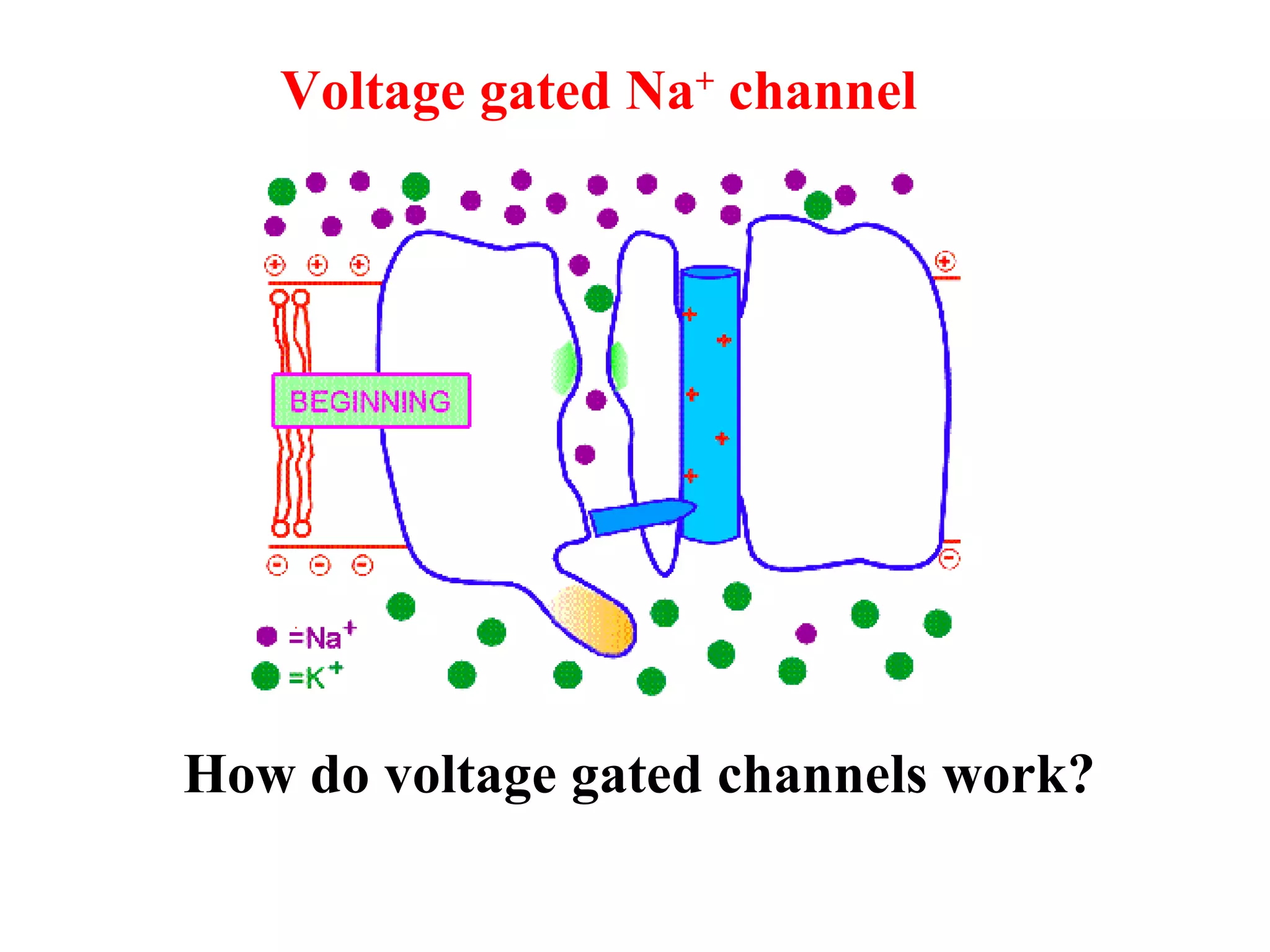
Voltage gated Na+
channel
How do voltage gated channels work?
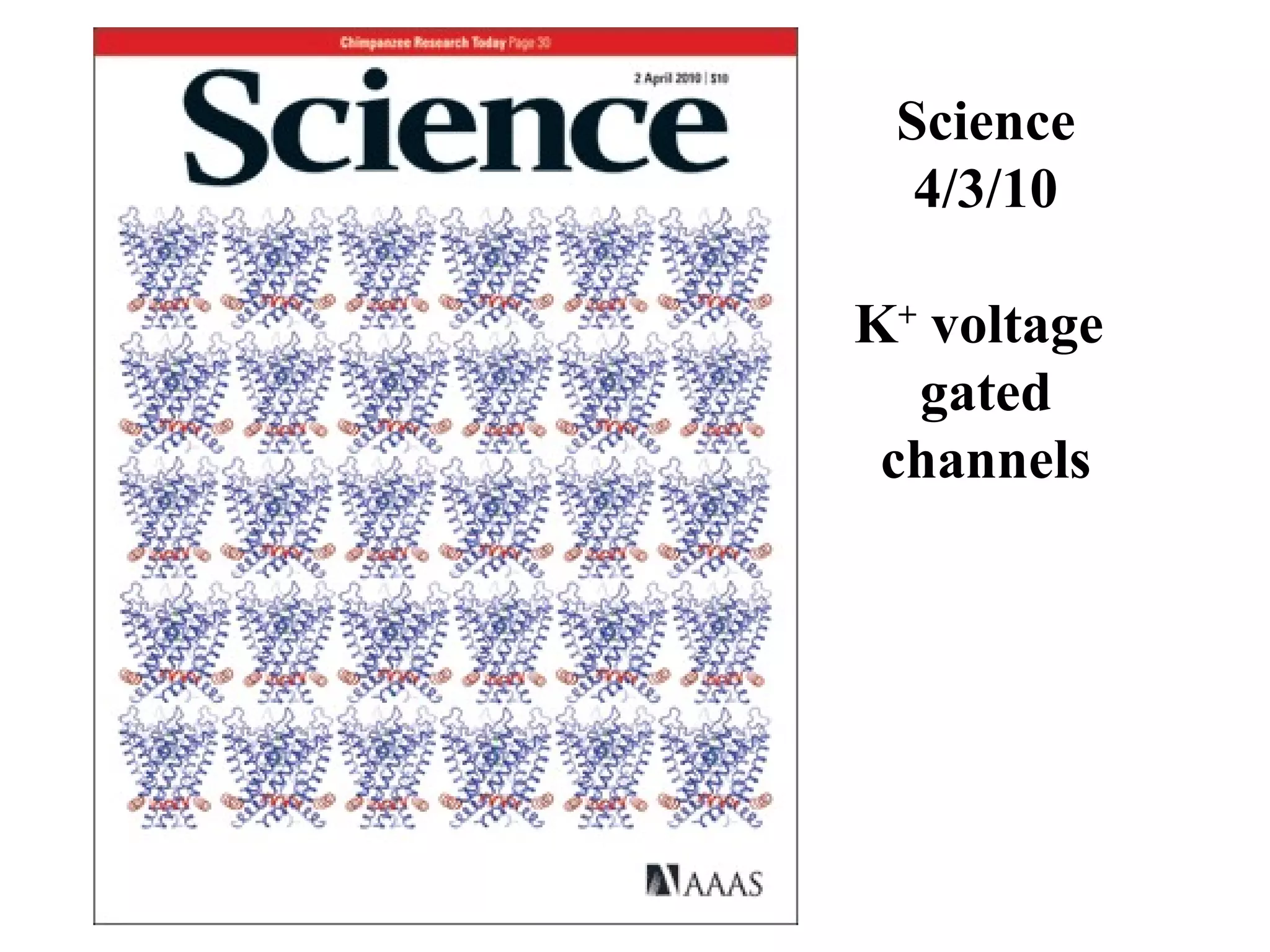
Science
4/3/10
K+
voltage
gated
channels
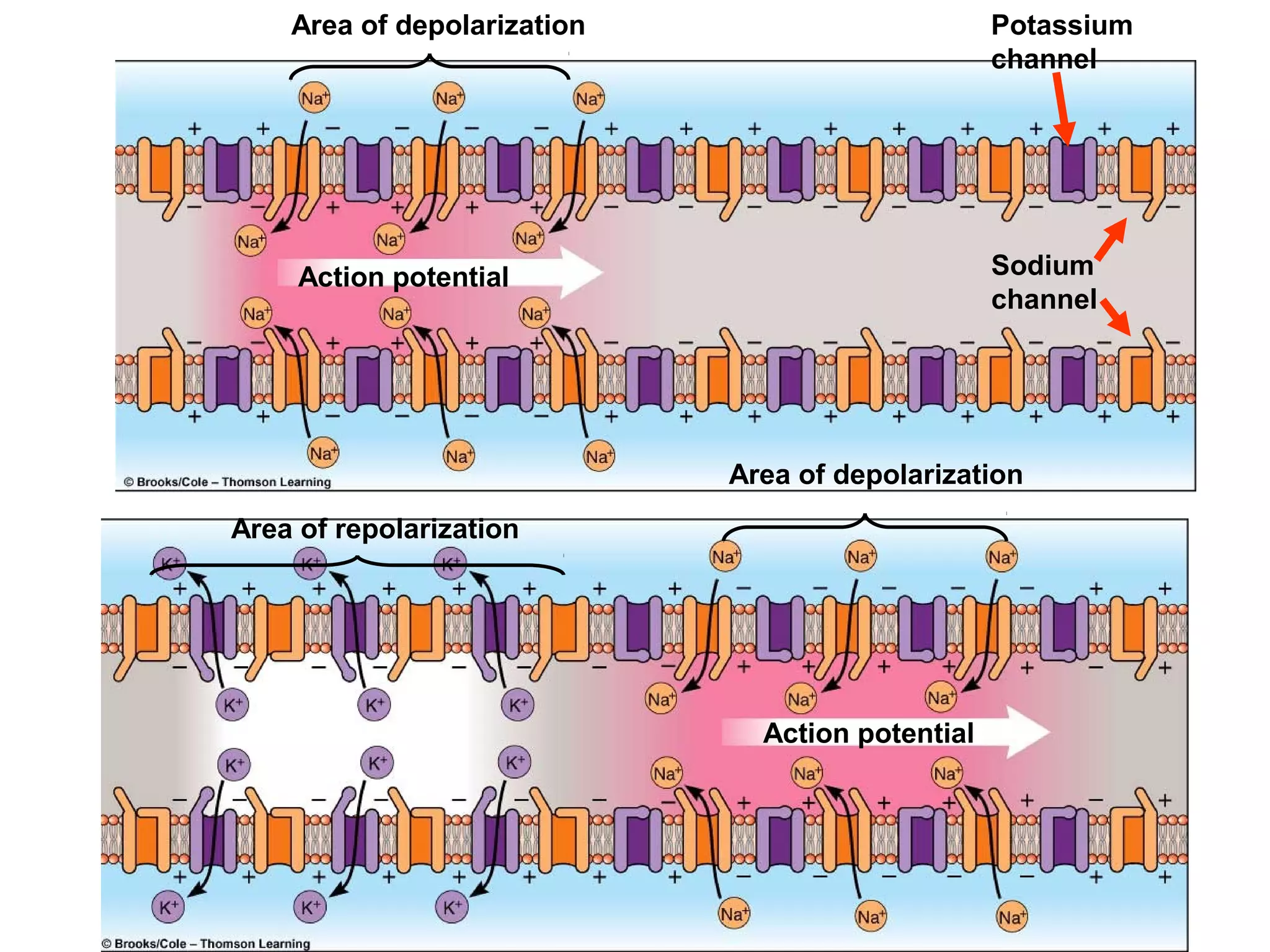
Area of depolarization Potassium
channel
Sodium
channel
Area of repolarization
Area of depolarization
Action potential
Action potential
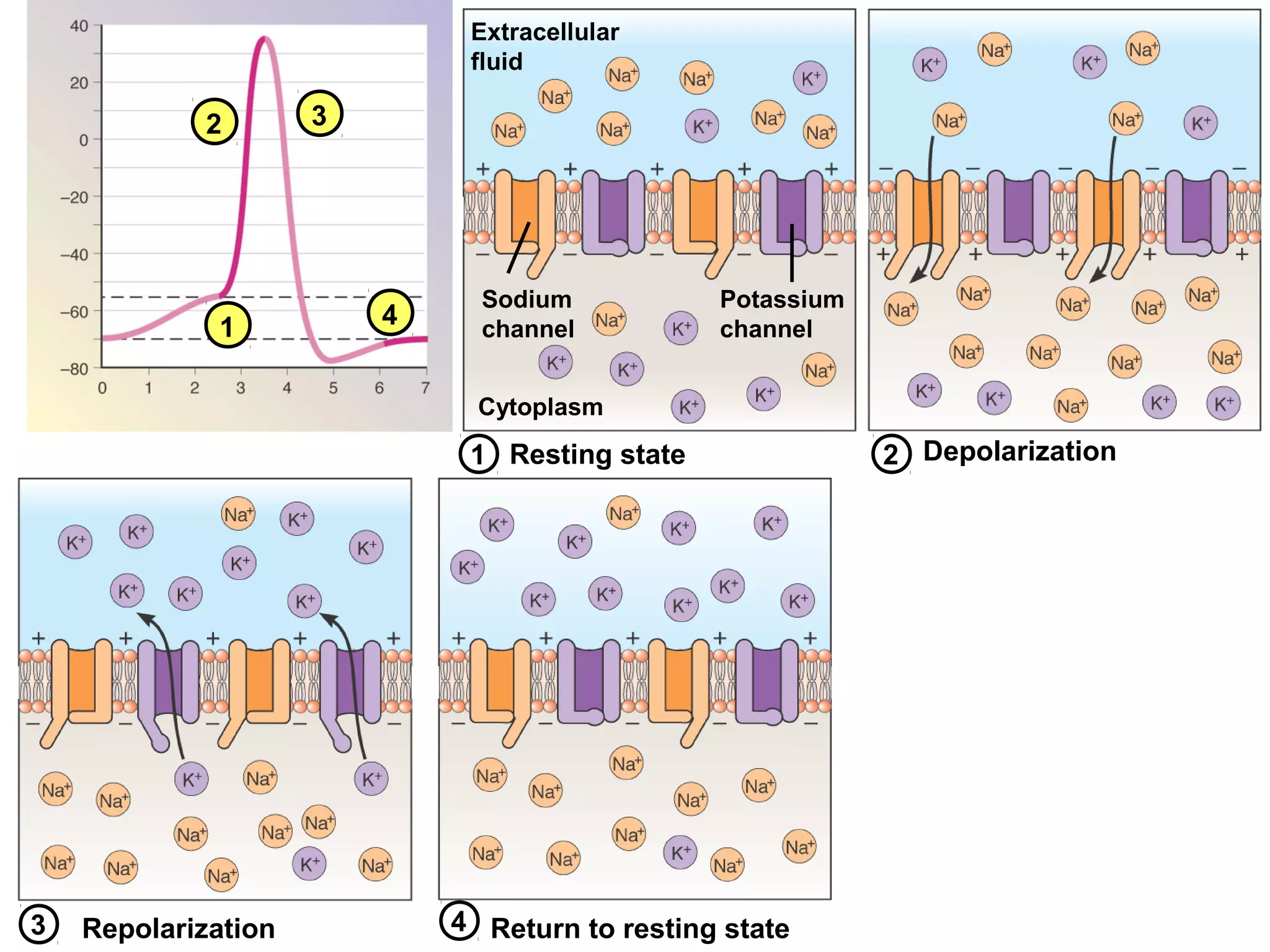
Resting state Depolarization
Repolarization Return to resting state
Extracellular
fluid
Sodium
channel
Potassium
channel
Cytoplasm
1 2
3 4
2
1
3
4
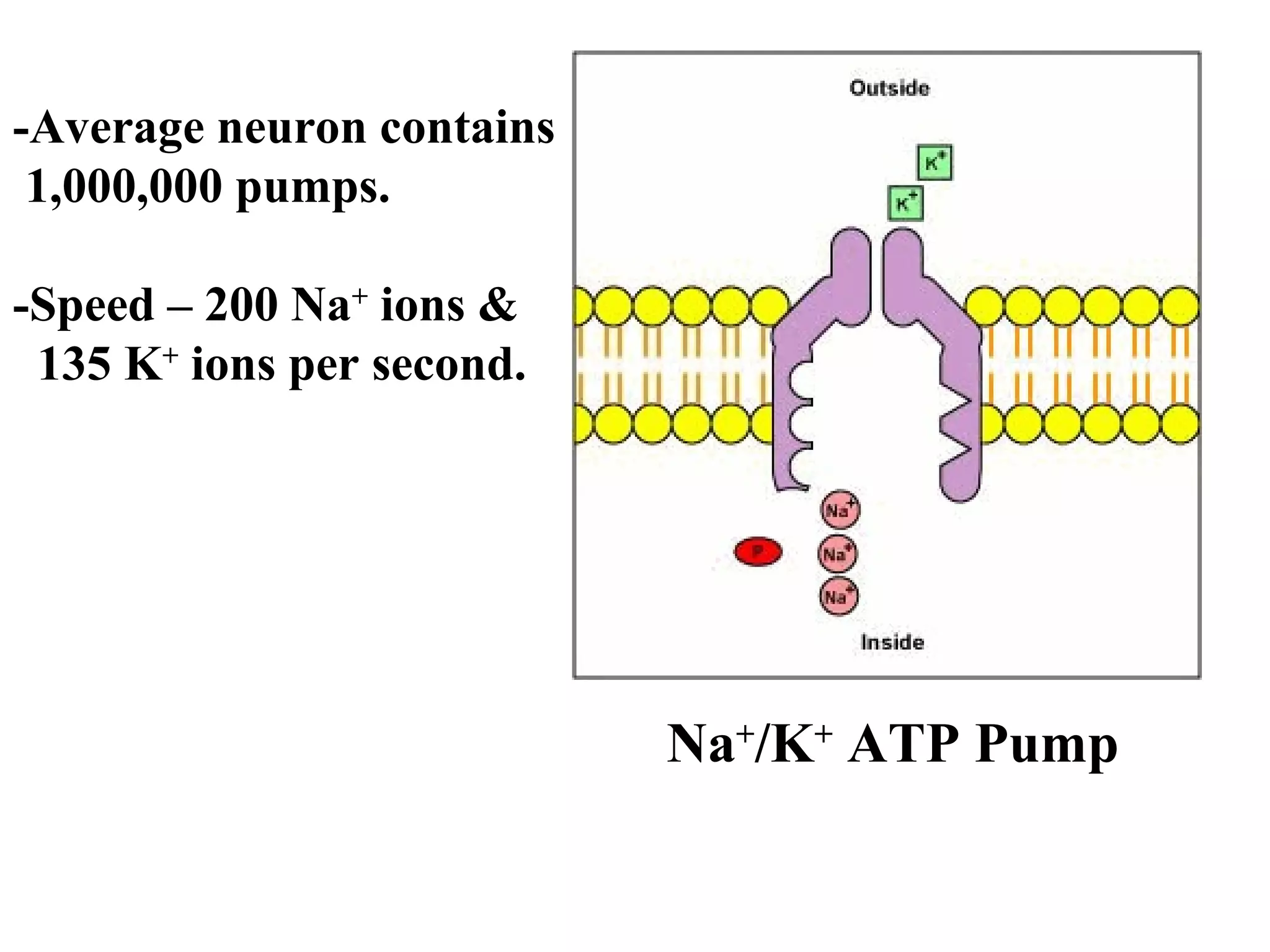
Na+
/K+
ATP Pump
-Average neuron contains
1,000,000 pumps.
-Speed – 200 Na+
ions &
135 K+
ions per second.
Fig. 44.11 p878
p894
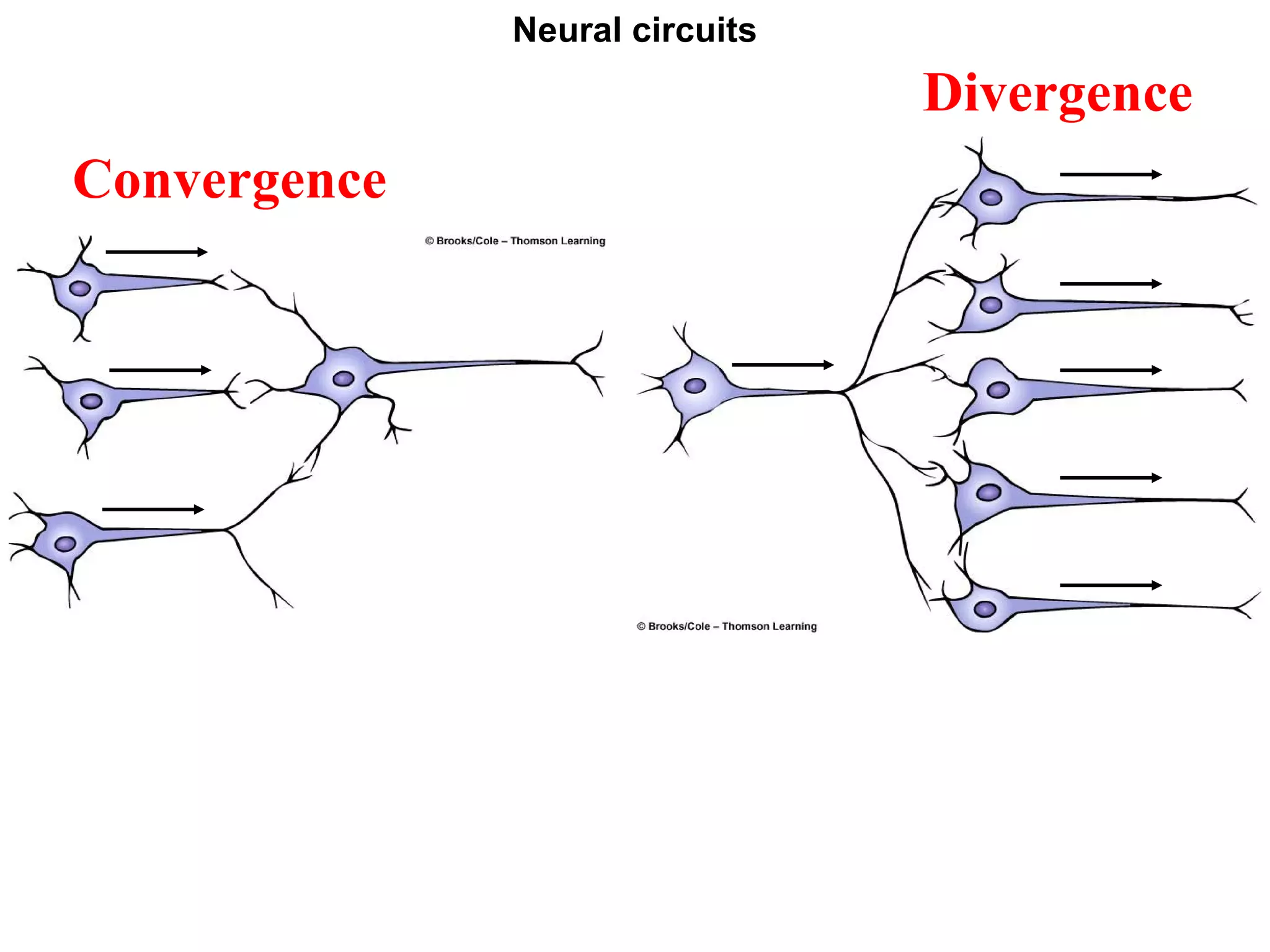
Neural circuits
Convergence
Divergence
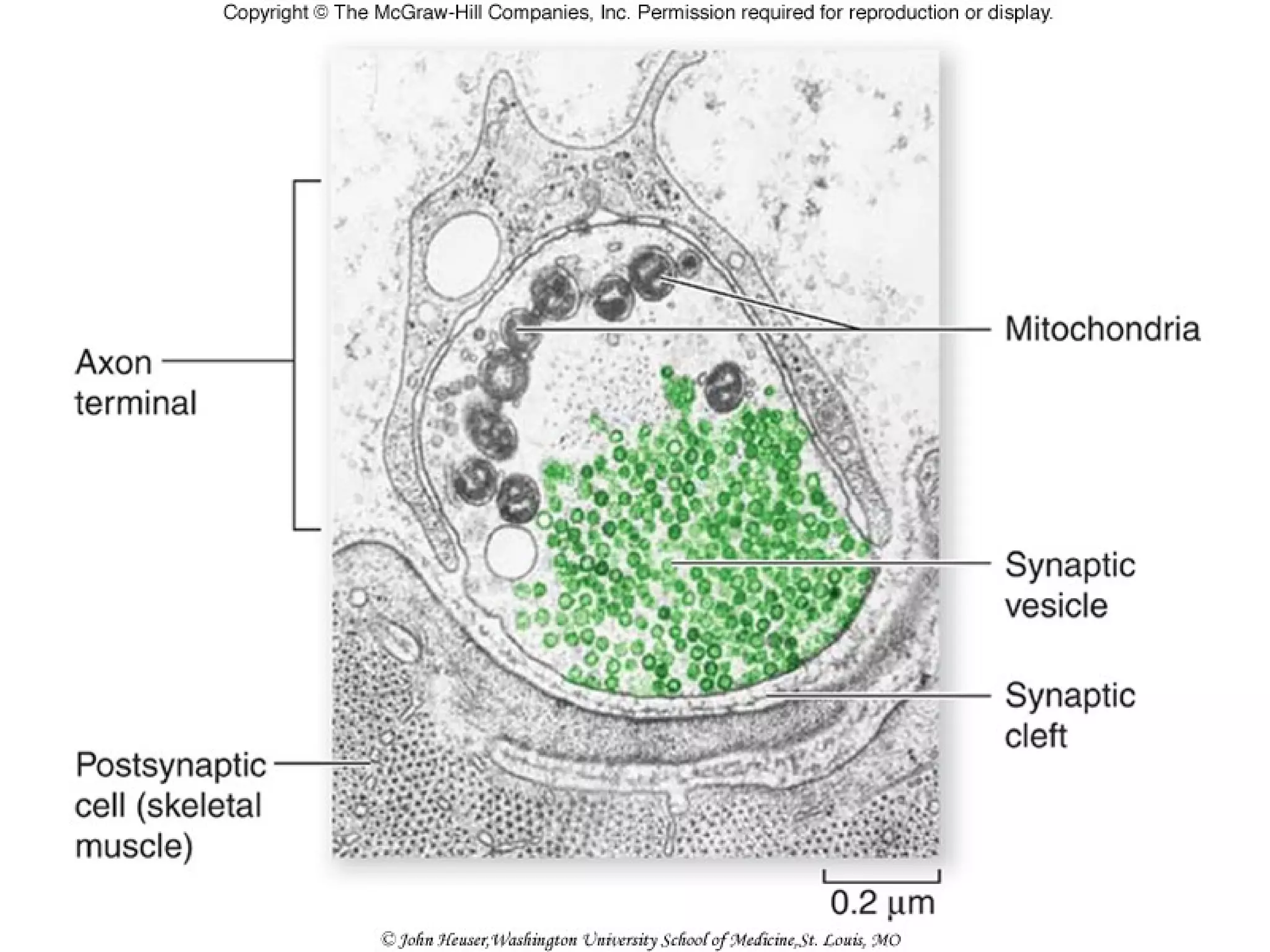
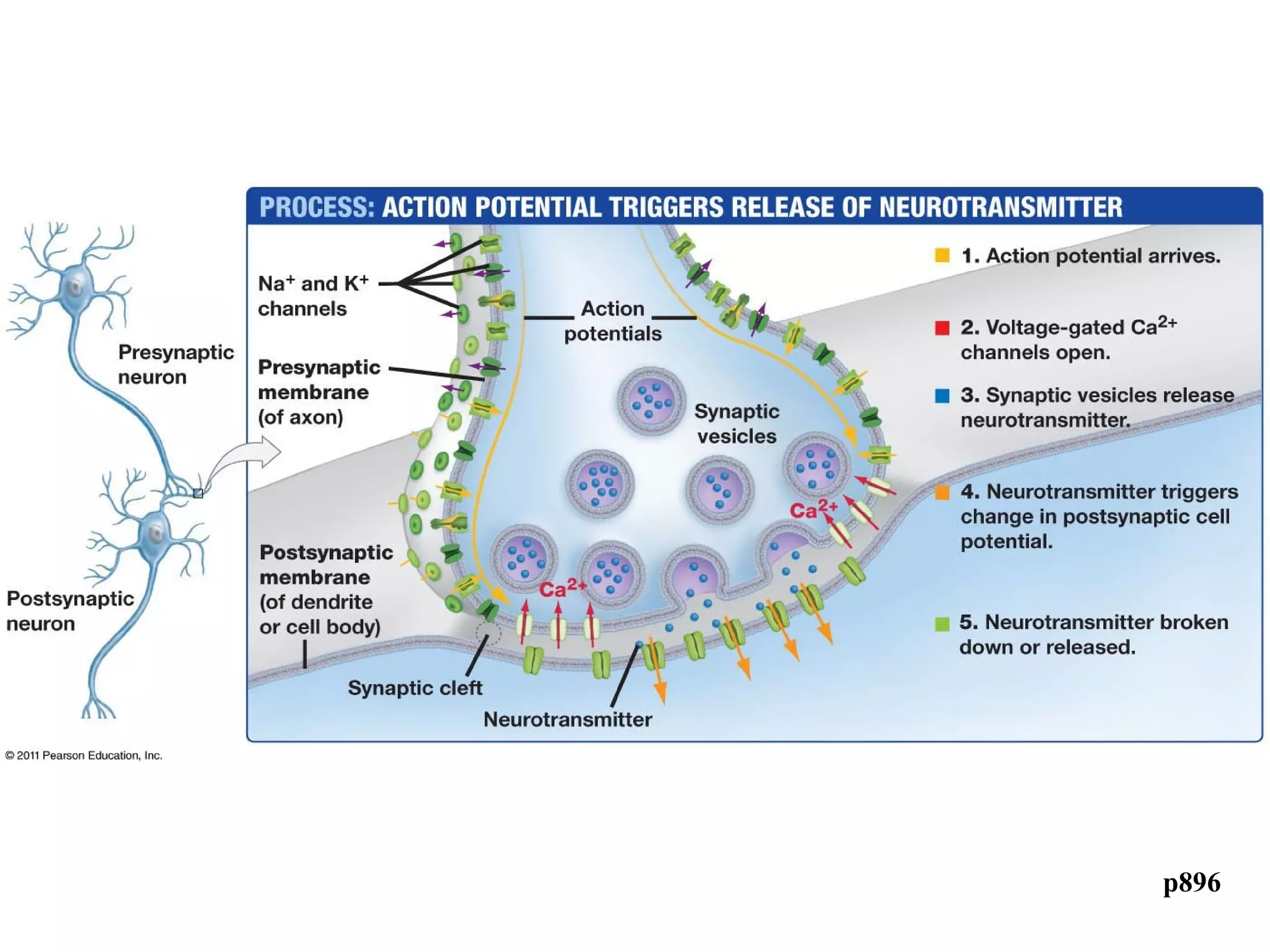
Synaptic
vesicles
Neurotransmitter
molecules
Receptor
Plasma
membrane of
postsynaptic
neuron
Presynaptic
terminal
Synaptic
cleft
Na+
0.25 µm
presynaptic
neuron
postsynaptic
neuron
synaptic
terminal
What happens to the
neural transmitter?
20 nM
(10-9
M)
p896
Excitatory Neurotransmitter
Promotes Depolarization
of Postsynaptic Neuron
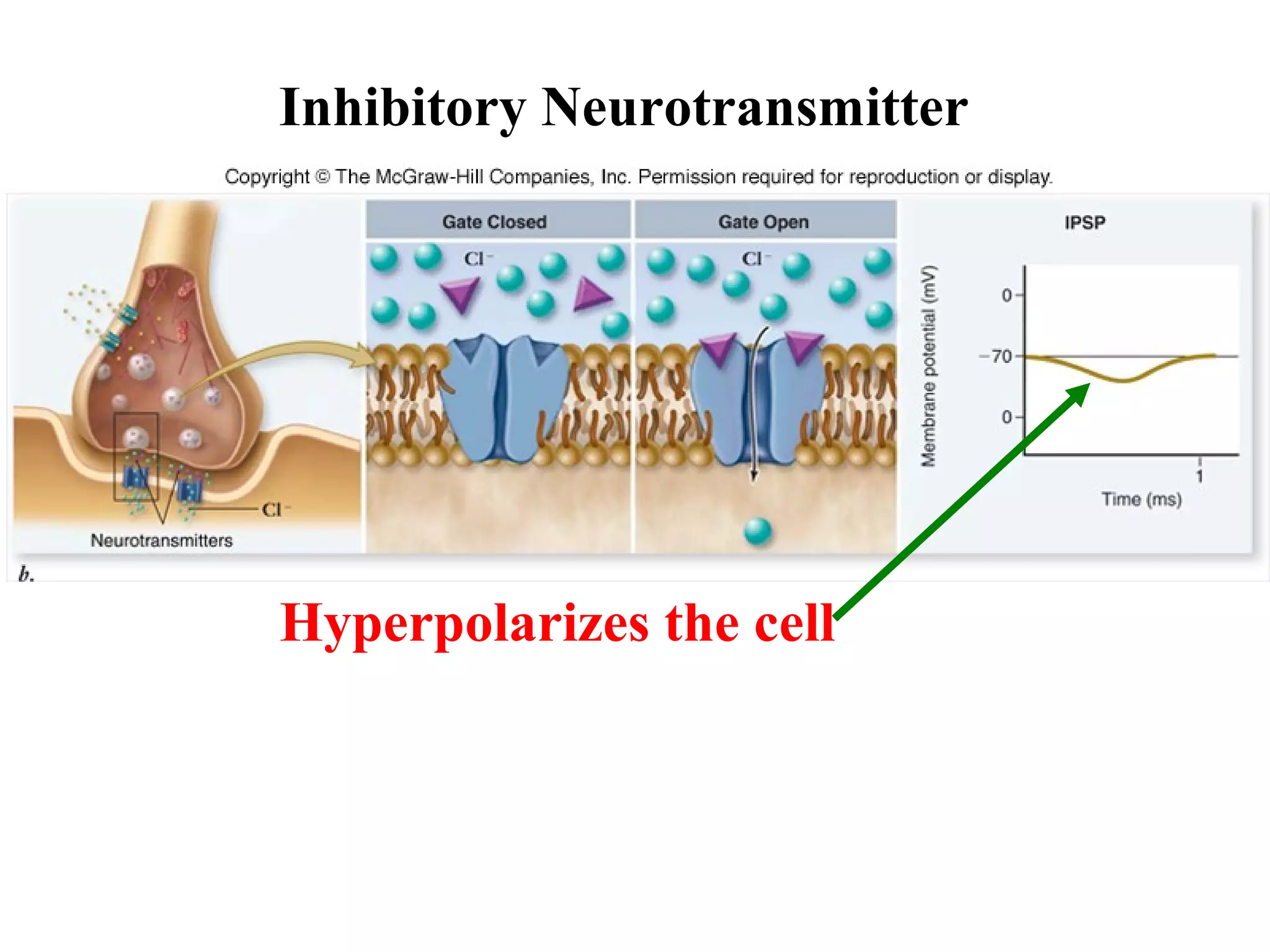
Inhibitory Neurotransmitter
Hyperpolarizes the cell
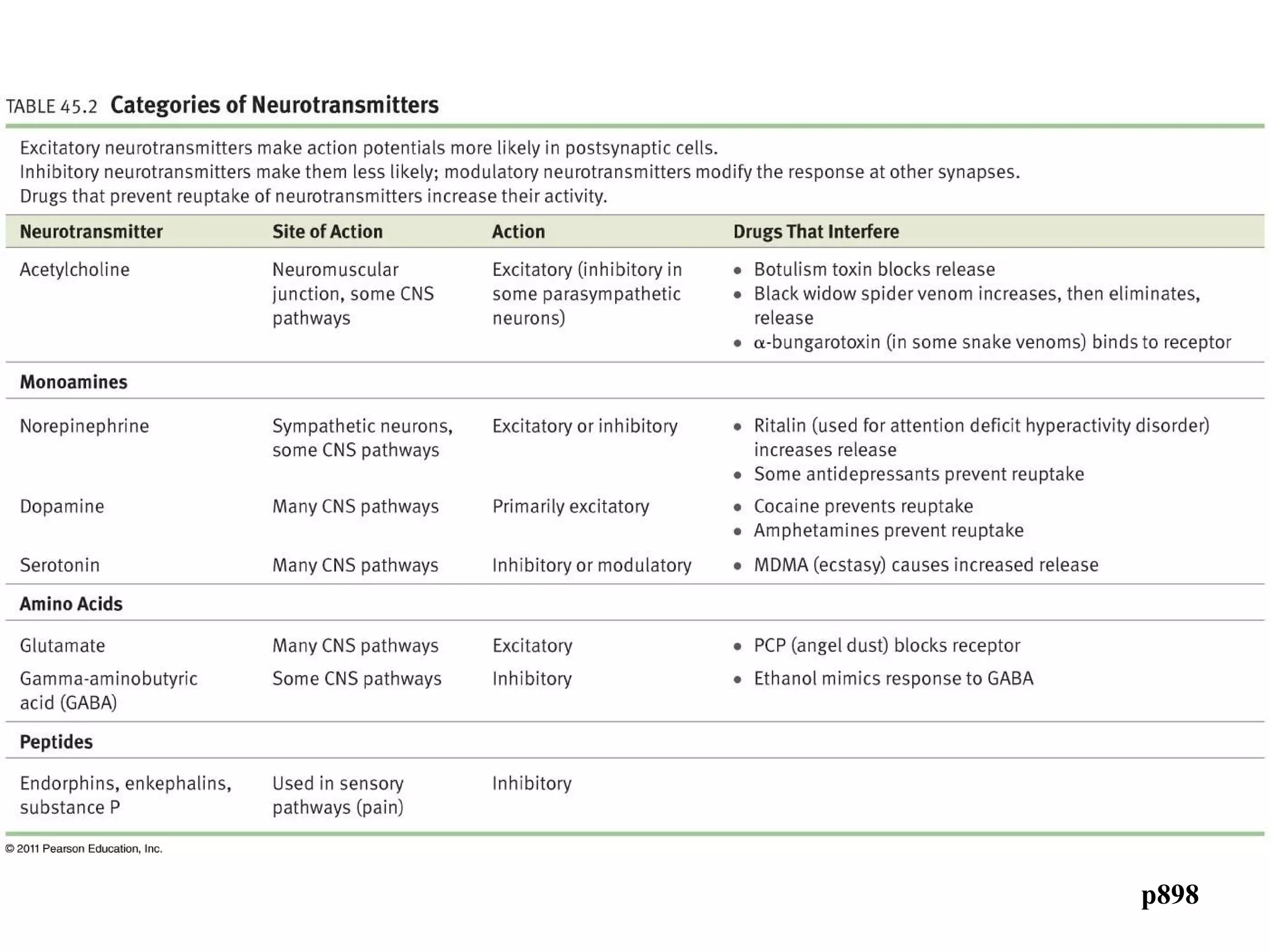
p898
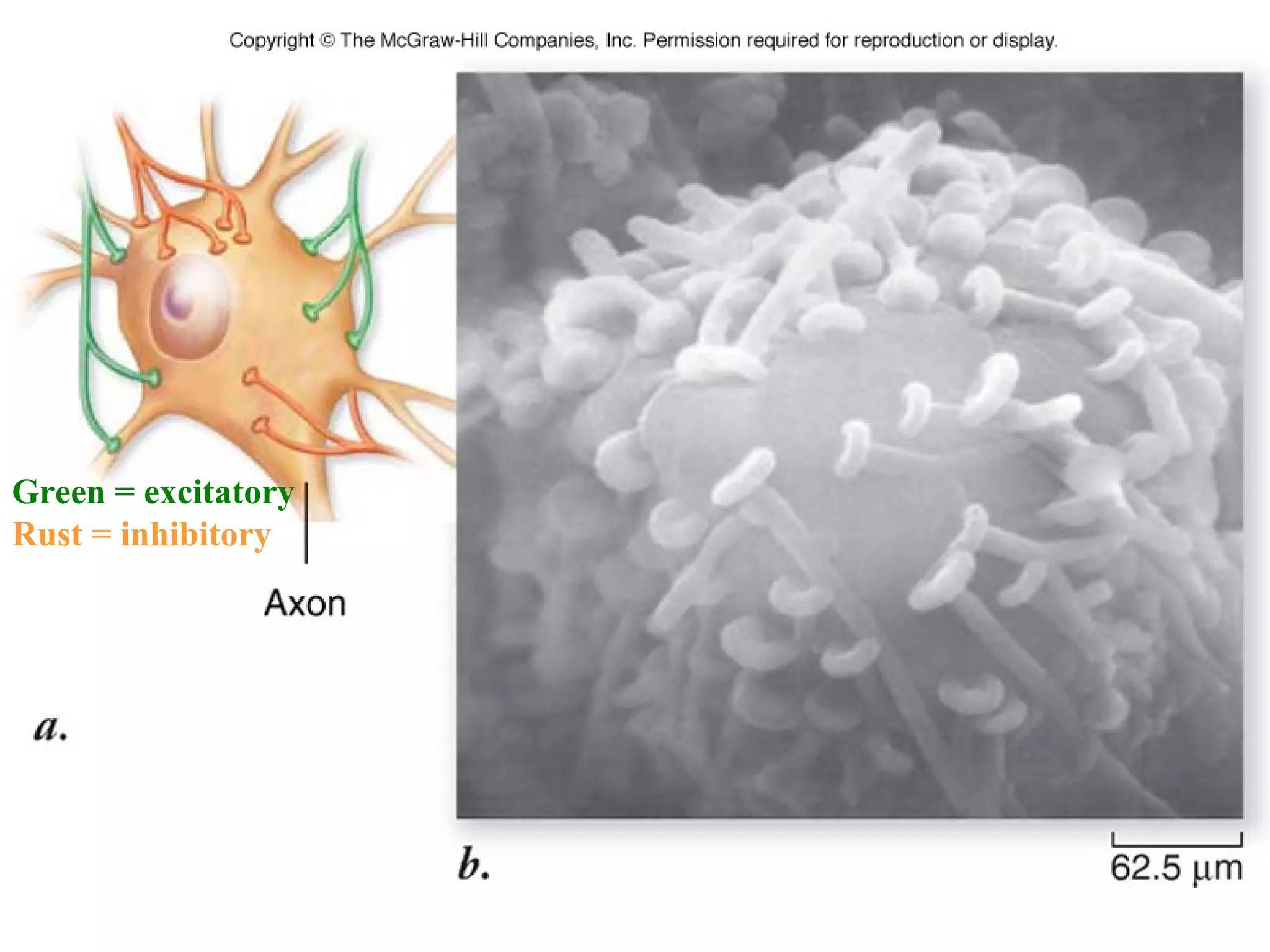
Green = excitatory
Rust = inhibitory
Events at the Synapse
p897
Cocaine
-Binds the dopamine
transporters and
prevents reuptake of
the neurotransmitter.
-Dopamine continues
to stimulate the
postsynaptic cell.
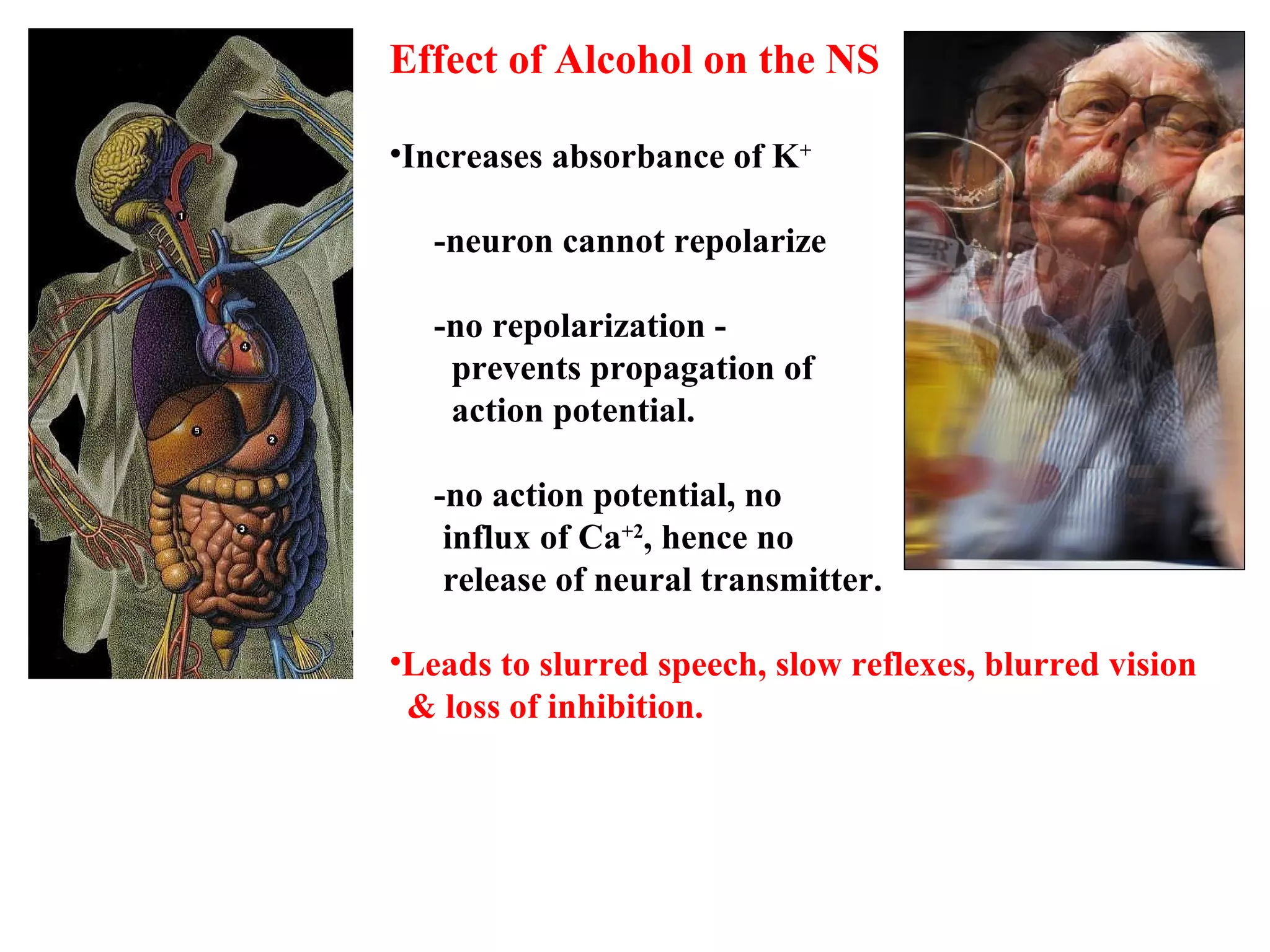
Effect of Alcohol on the NS
•Increases absorbance of K+
-neuron cannot repolarize
-no repolarization -
prevents propagation of
action potential.
-no action potential, no
influx of Ca+2
, hence no
release of neural transmitter.
•Leads to slurred speech, slow reflexes, blurred vision
& loss of inhibition.
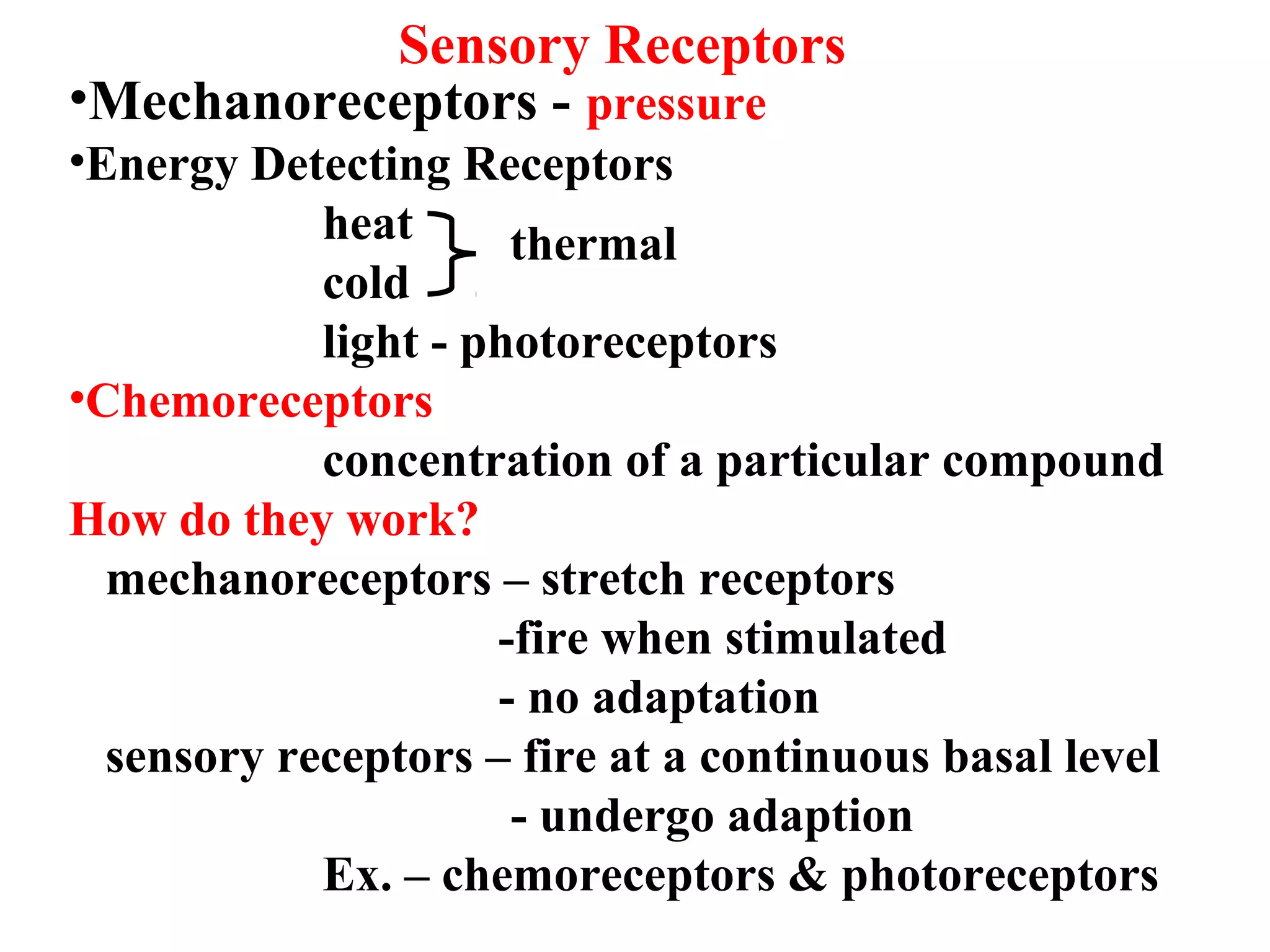
Sensory Receptors
•Mechanoreceptors - pressure
•Energy Detecting Receptors
heat
cold
light - photoreceptors
•Chemoreceptors
concentration of a particular compound
How do they work?
mechanoreceptors – stretch receptors
-fire when stimulated
- no adaptation
sensory receptors – fire at a continuous basal level
- undergo adaption
Ex. – chemoreceptors & photoreceptors
thermal
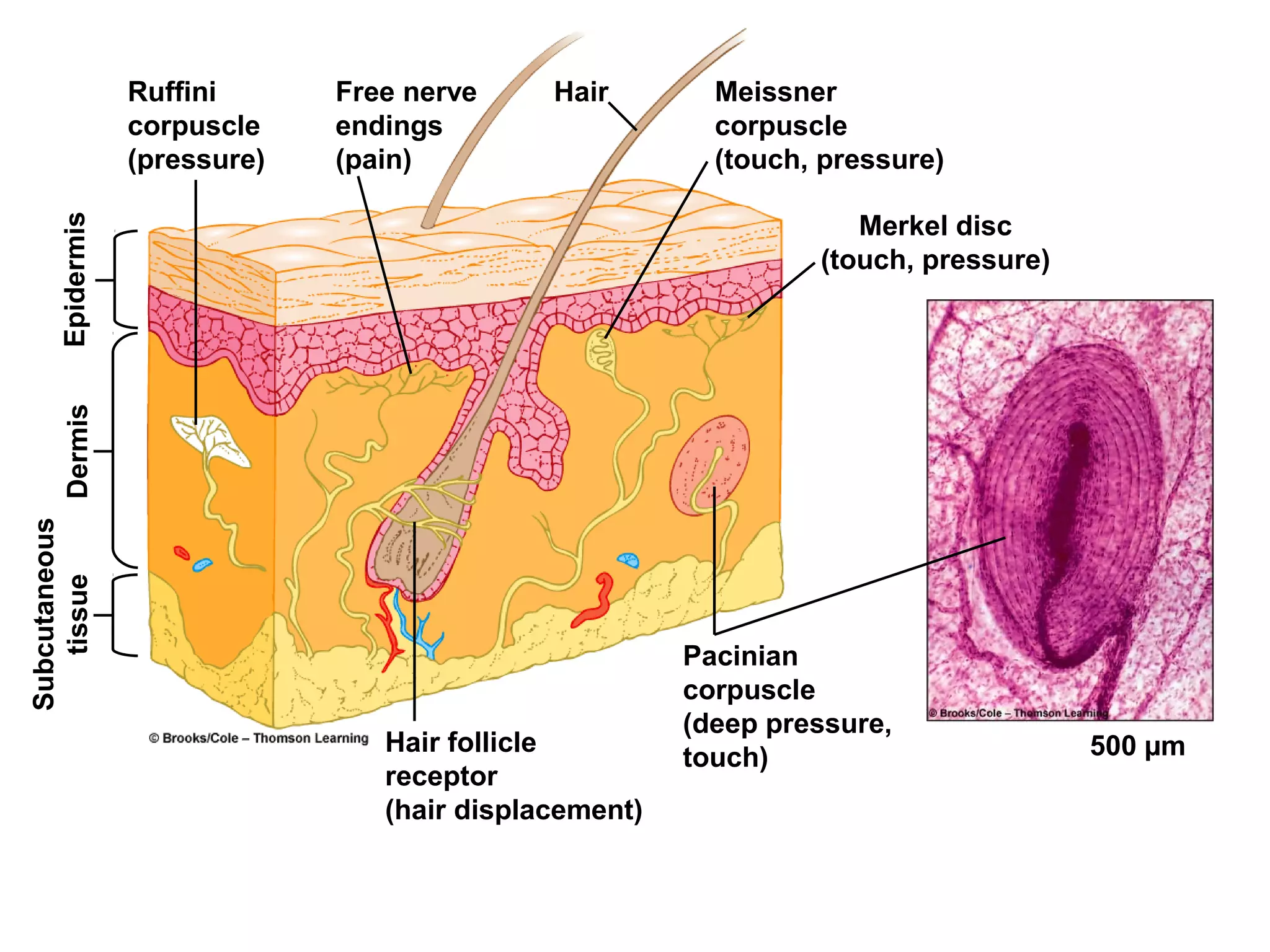
Ruffini
corpuscle
(pressure)
Dermis
500 µm
Pacinian
corpuscle
(deep pressure,
touch)
Hair follicle
receptor
(hair displacement)
Merkel disc
(touch, pressure)
Meissner
corpuscle
(touch, pressure)
HairFree nerve
endings
(pain)
Epidermis
Subcutaneous
tissue
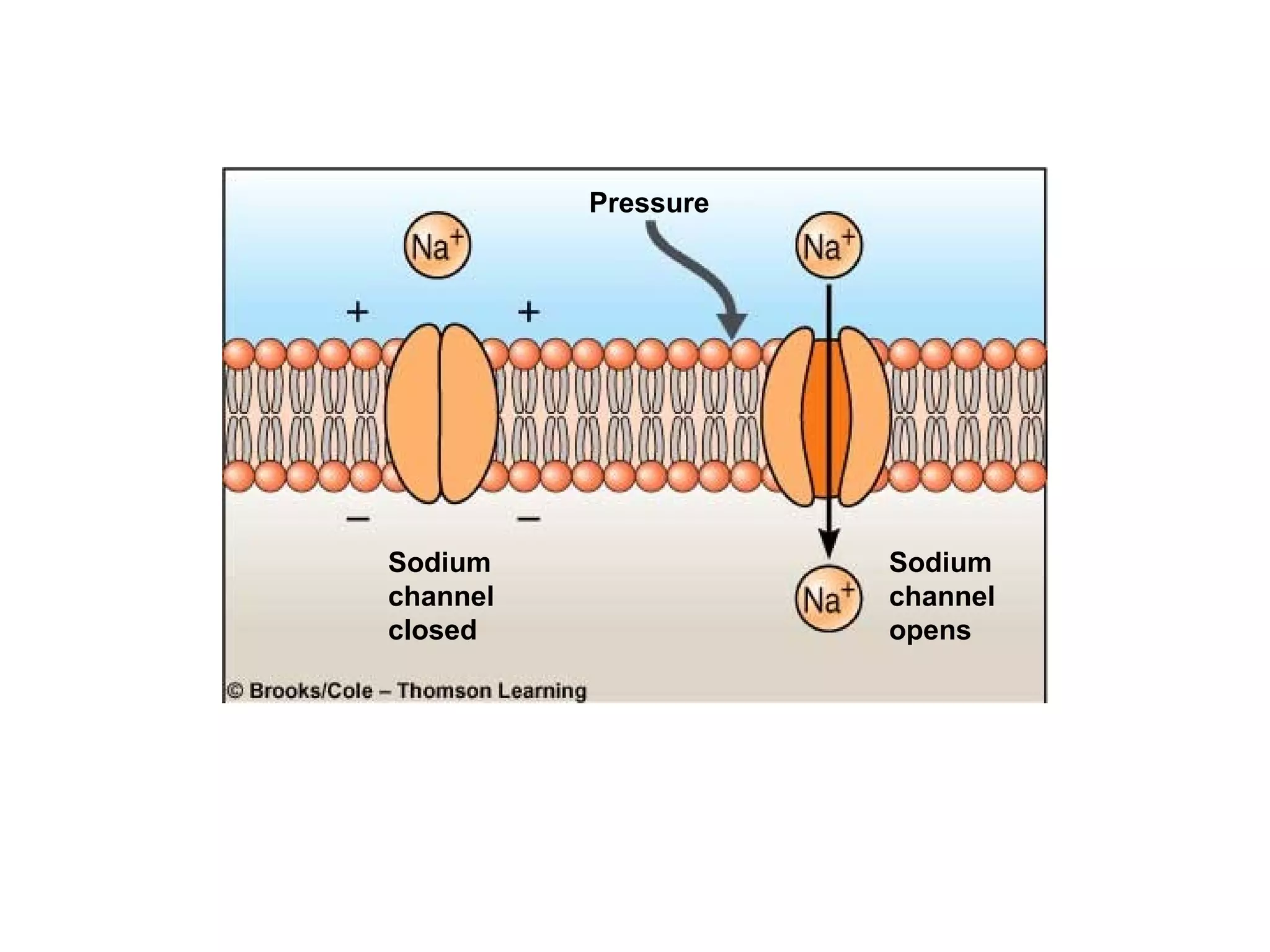
Pressure
Sodium
channel
opens
Sodium
channel
closed
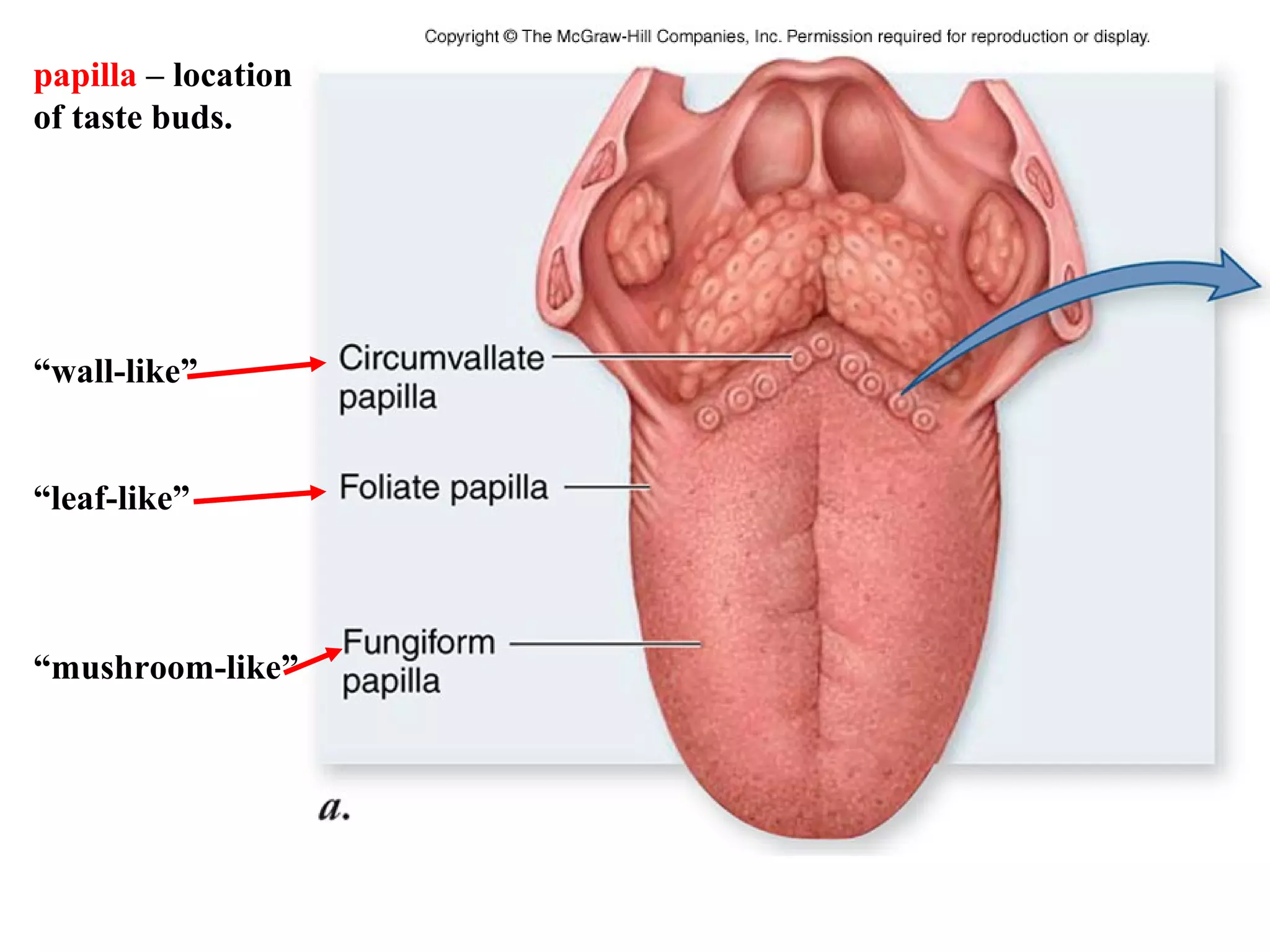
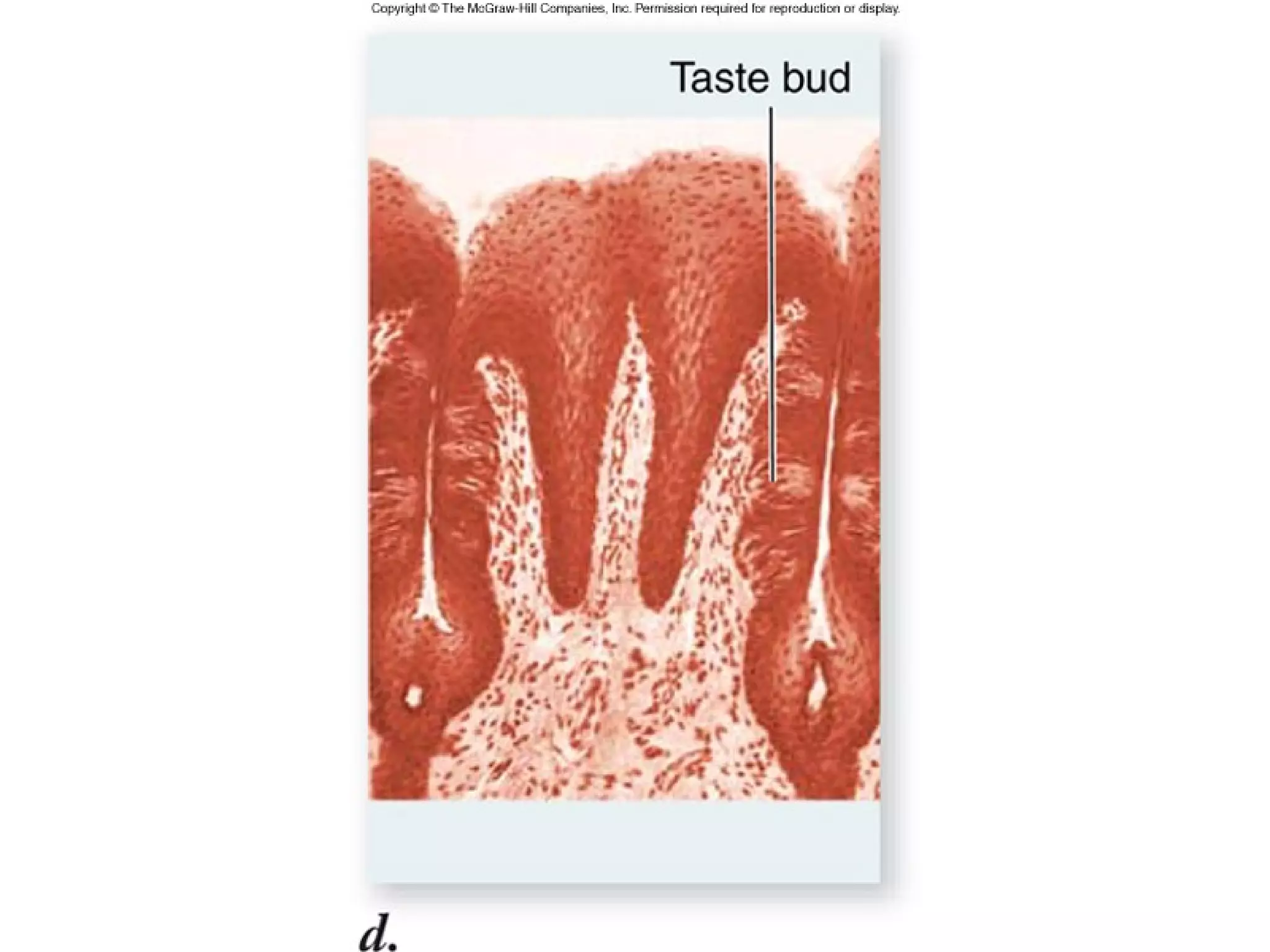
papilla – location
of taste buds.
“wall-like”
“leaf-like”
“mushroom-like”
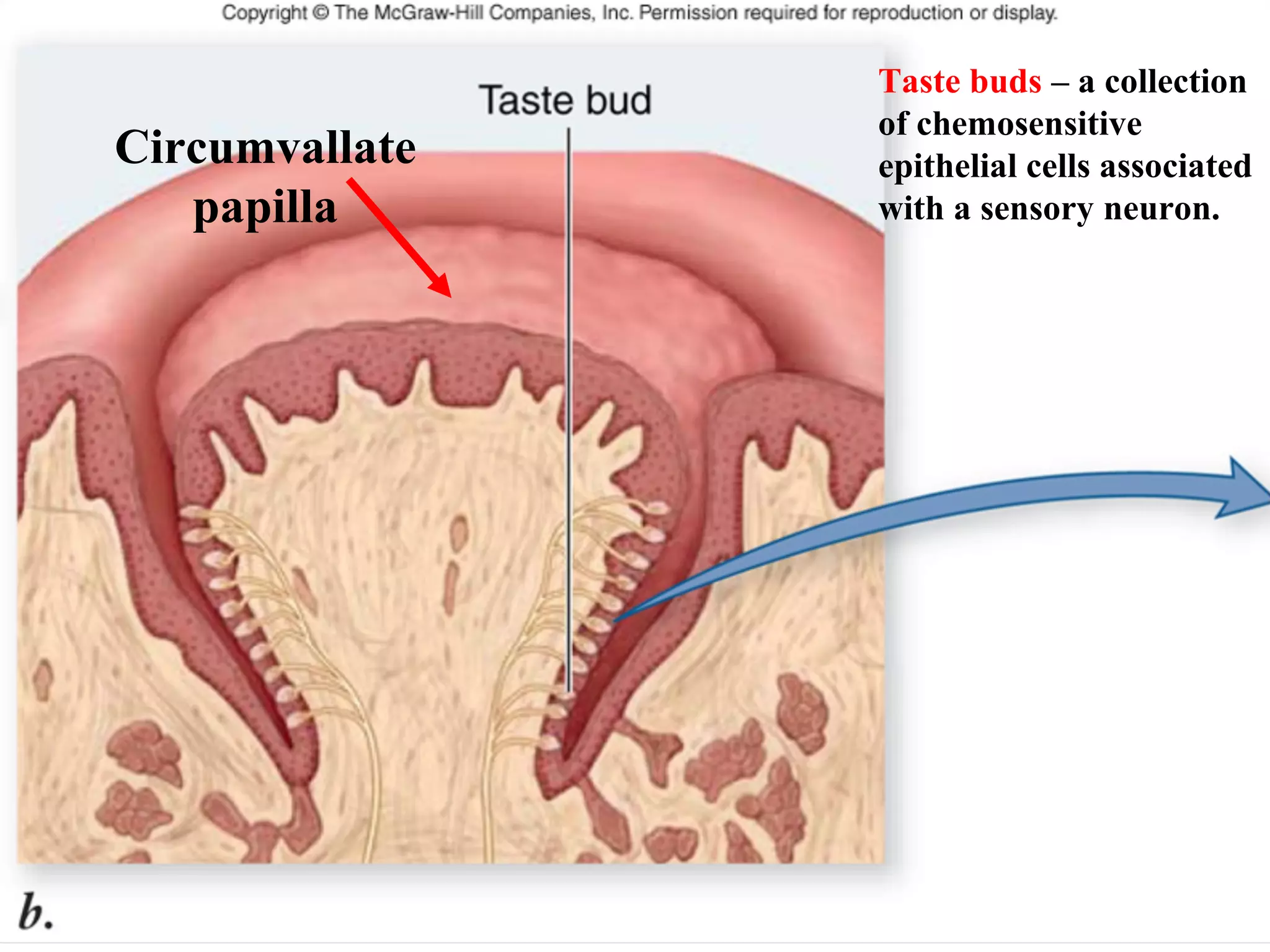
Taste buds – a collection
of chemosensitive
epithelial cells associated
with a sensory neuron.
Circumvallate
papilla
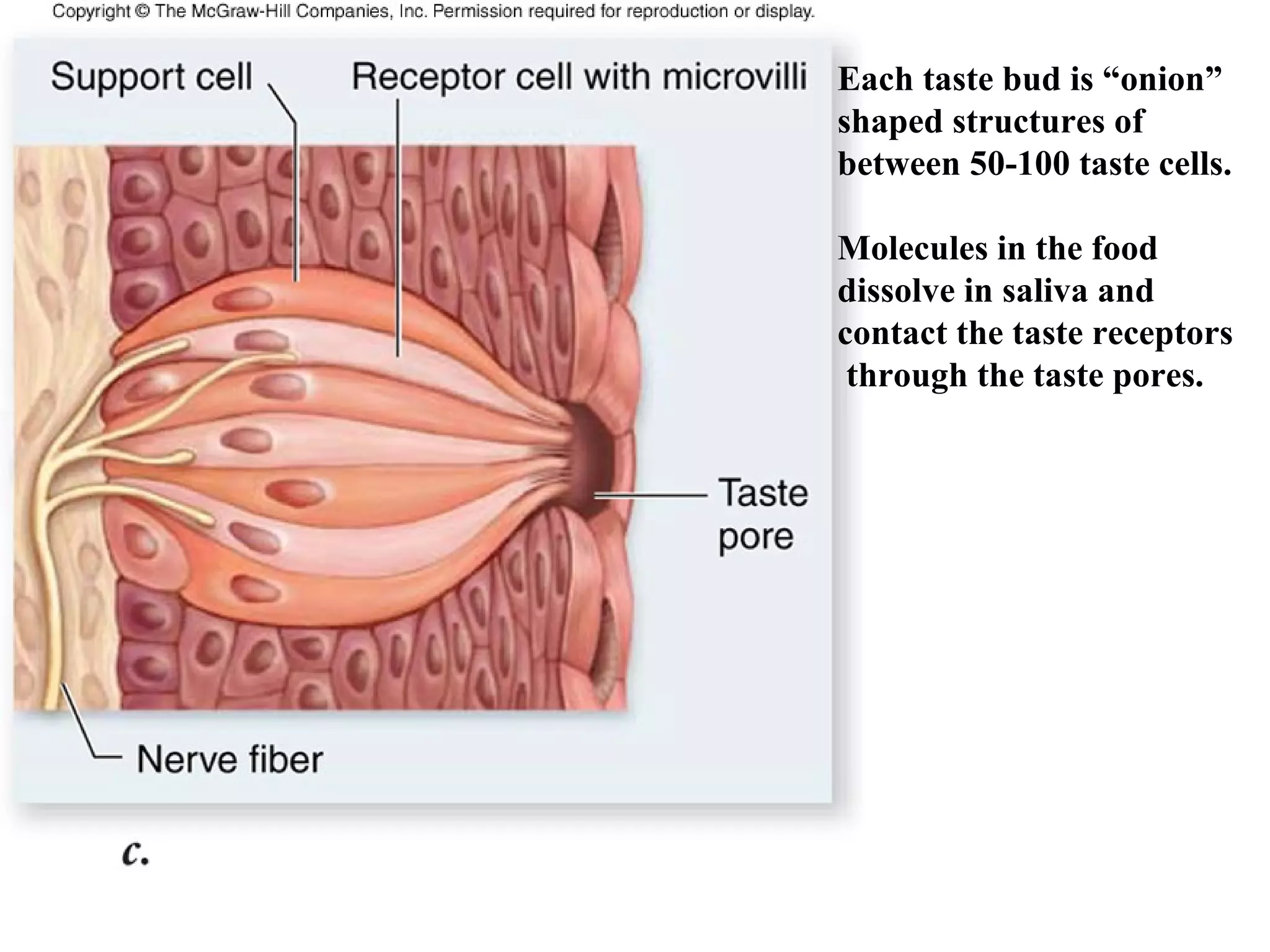
Each taste bud is “onion”
shaped structures of
between 50-100 taste cells.
Molecules in the food
dissolve in saliva and
contact the taste receptors
through the taste pores.
Smith &Margolskee
Scientific American
March 2001
Salts
Na+
ions enter Na+
channels
& depolarize the cell. The
cell repolarizes by opening
K+
gates.
Smith &Margolskee
Scientific American
March 2001
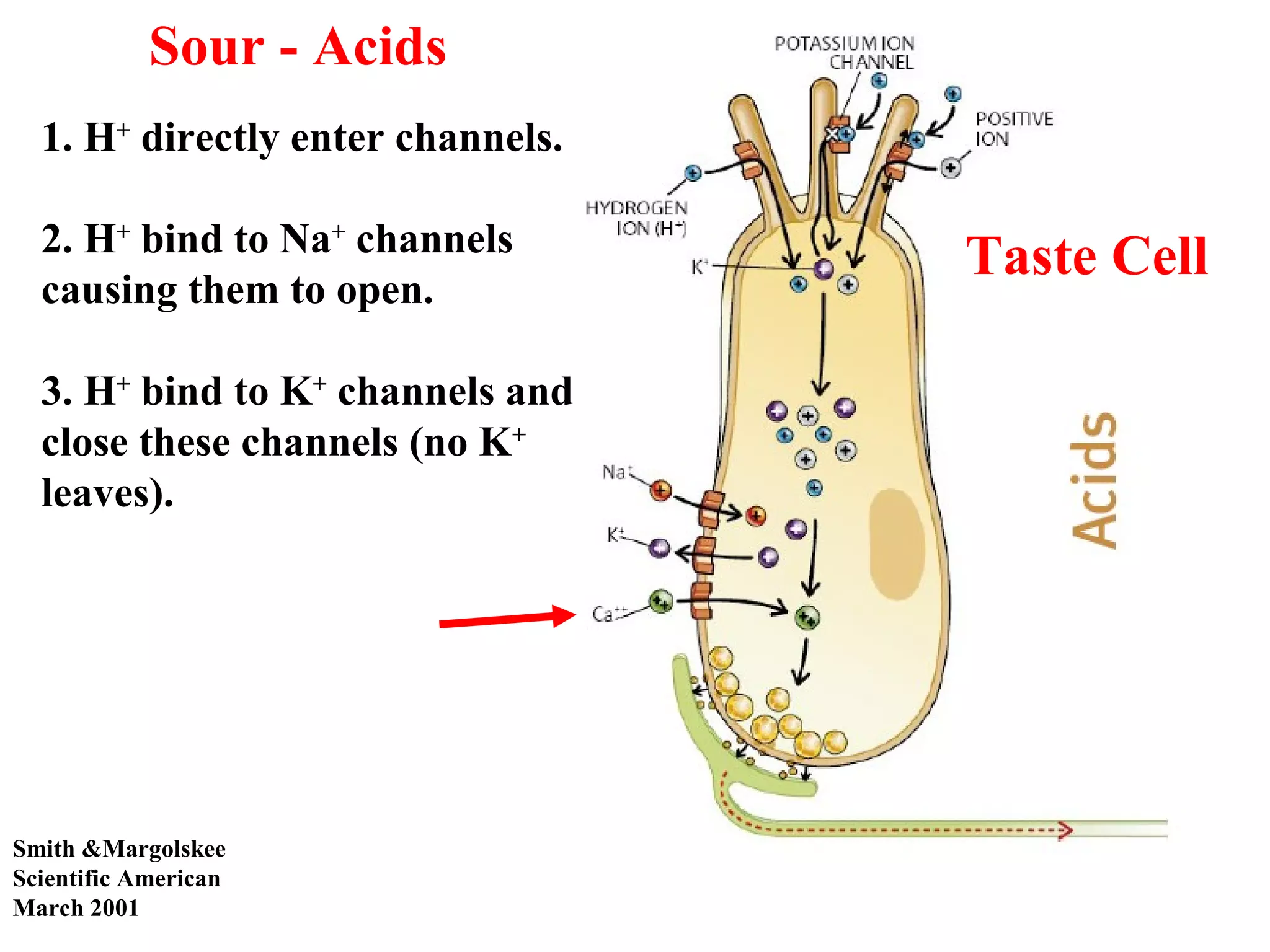
Sour - Acids
1. H+
directly enter channels.
2. H+
bind to Na+
channels
causing them to open.
3. H+
bind to K+
channels and
close these channels (no K+
leaves).
Taste Cell
Smith &Margolskee
Scientific American
March 2001
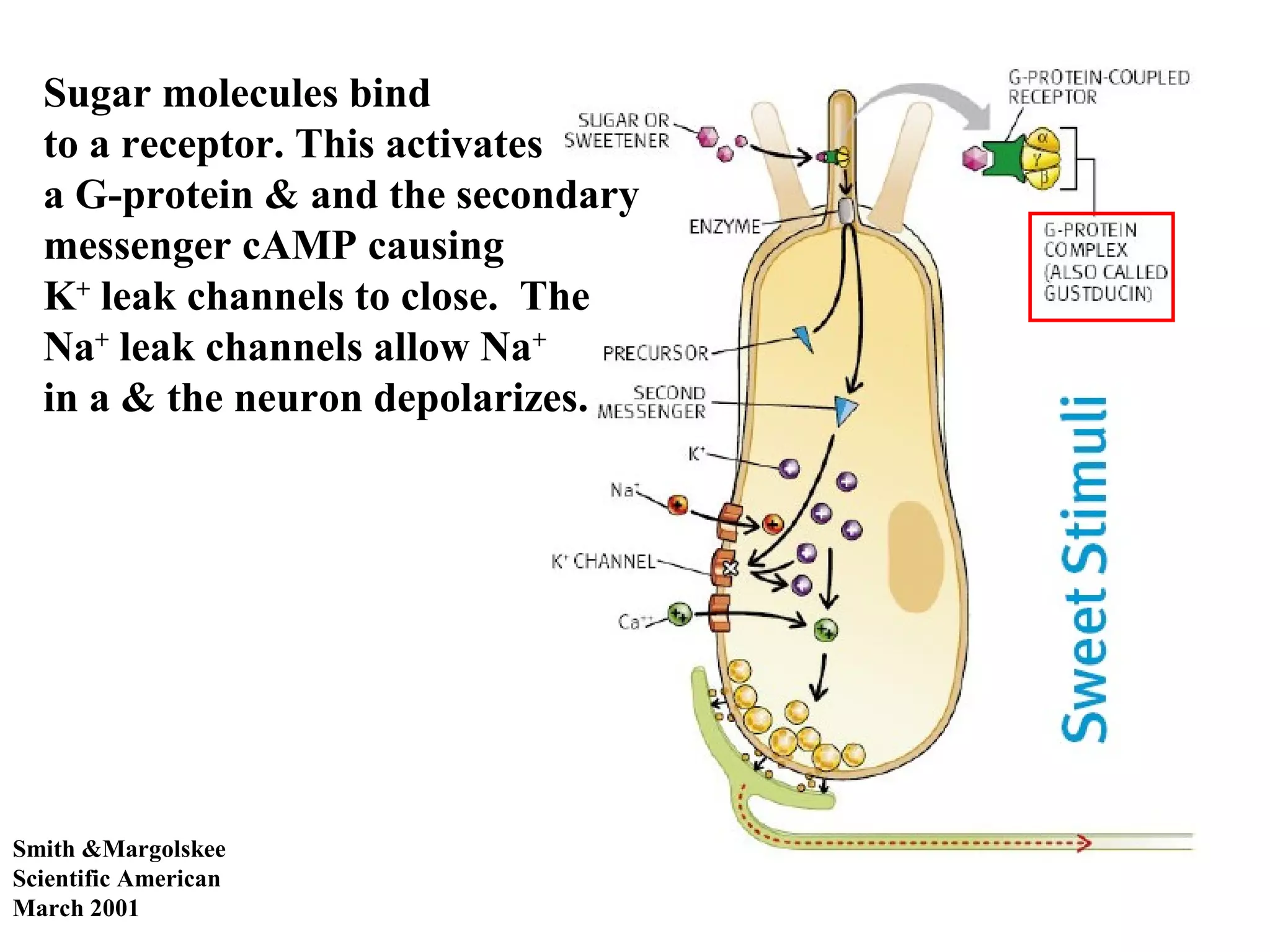
Sugar molecules bind
to a receptor. This activates
a G-protein & and the secondary
messenger cAMP causing
K+
leak channels to close. The
Na+
leak channels allow Na+
in a & the neuron depolarizes.
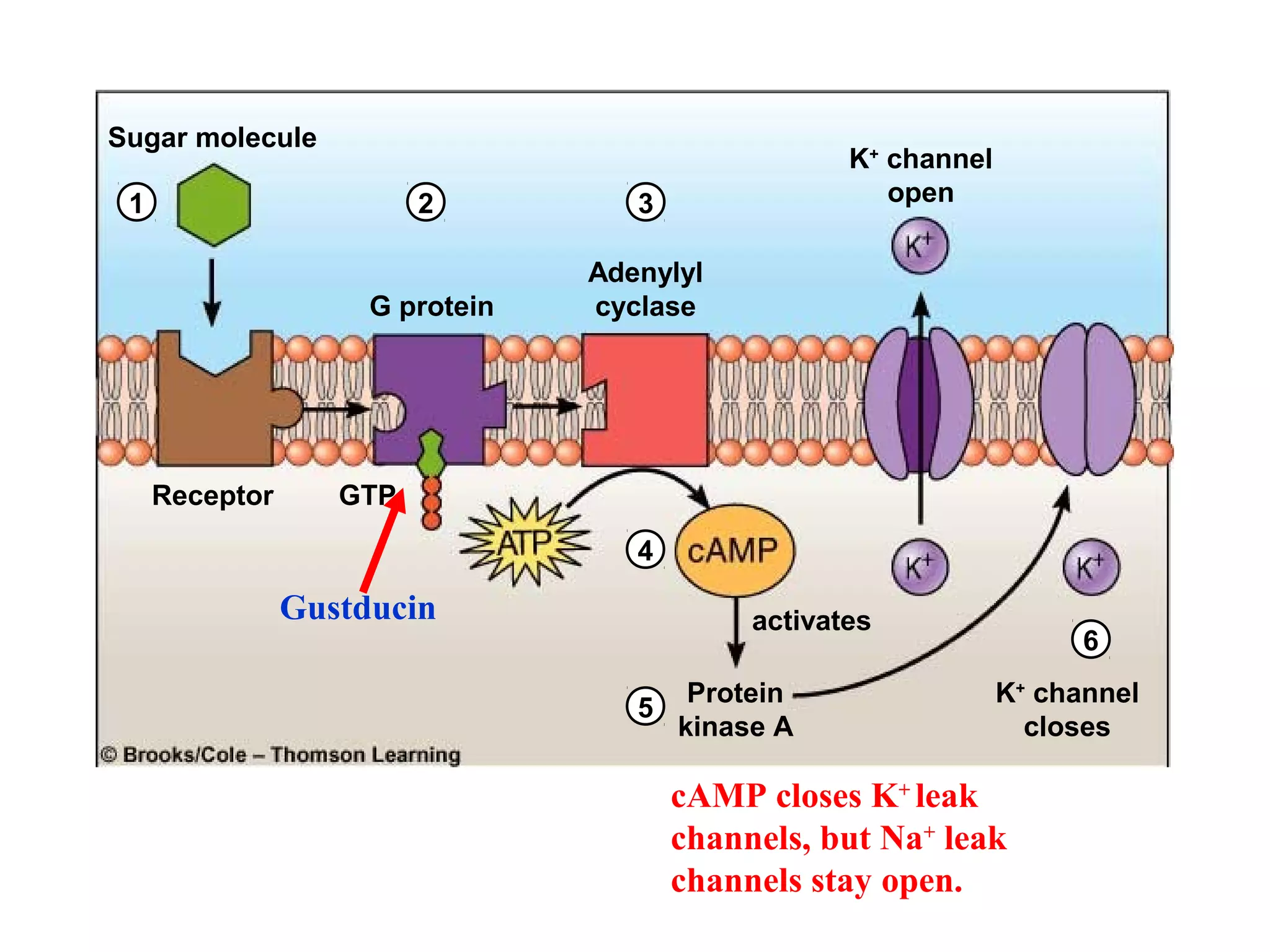
G protein
GTP
K+
channel
open
Adenylyl
cyclase
Protein
kinase A
Sugar molecule
Receptor
K+
channel
closes
activates
1 2 3
4
5
6
Gustducin
cAMP closes K+
leak
channels, but Na+
leak
channels stay open.
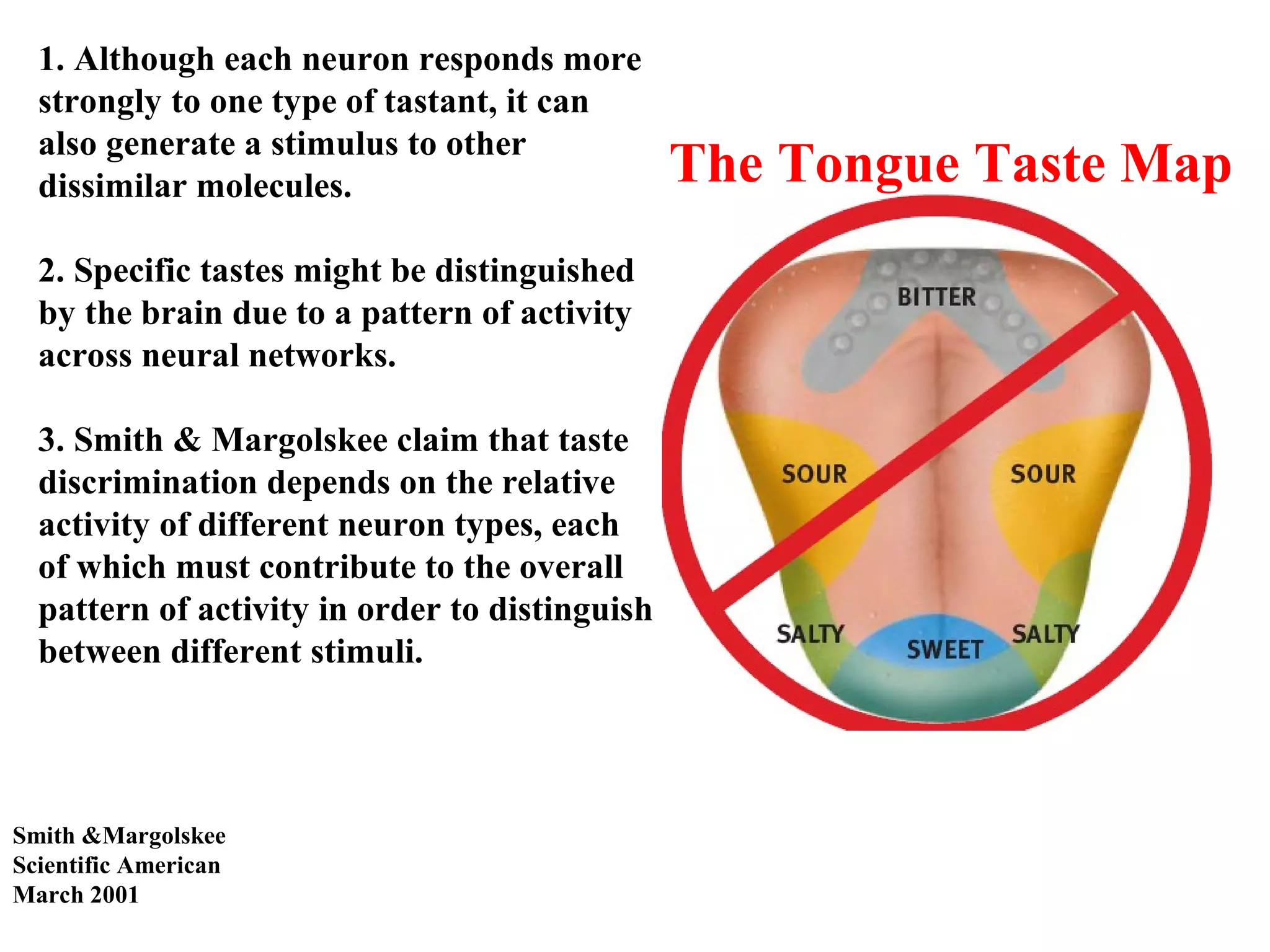
The Tongue Taste Map
Smith &Margolskee
Scientific American
March 2001
1. Although each neuron responds more
strongly to one type of tastant, it can
also generate a stimulus to other
dissimilar molecules.
2. Specific tastes might be distinguished
by the brain due to a pattern of activity
across neural networks.
3. Smith & Margolskee claim that taste
discrimination depends on the relative
activity of different neuron types, each
of which must contribute to the overall
pattern of activity in order to distinguish
between different stimuli.

7 neurons