© 2013 Pearson Education, Inc.
PowerPoint®
Lecture Slides
prepared by
Meg Flemming
Austin Community College
C H A P T E R 8
The Nervous
System
© 2013 Pearson Education, Inc.
Chapter 8 Learning Outcomes
• 8-1
• Describe the anatomical and functional divisions of the nervous
system.
• 8-2
• Distinguish between neurons and neuroglia on the basis of
structure and function.
• 8-3
• Describe the events involved in the generation and propagation of
an action potential.
• 8-4
• Describe the structure of a synapse, and explain the mechanism of
nerve impulse transmission at a synapse.
• 8-5
• Describe the three meningeal layers that surround the central
nervous system.
© 2013 Pearson Education, Inc.
Chapter 8 Learning Outcomes
• 8-6
• Discuss the roles of gray matter and white matter in the spinal cord.
• 8-7
• Name the major regions of the brain, and describe the locations
and functions of each.
• 8-8
• Name the cranial nerves, relate each pair of cranial nerves to its
principal functions, and relate the distribution pattern of spinal
nerves to the regions they innervate.
• 8-9
• Describe the steps in a reflex arc.
• 8-10
• Identify the principal sensory and motor pathways, and explain how
it is possible to distinguish among sensations that originate in
different areas of the body.
© 2013 Pearson Education, Inc.
Chapter 8 Learning Outcomes
• 8-11
• Describe the structures and functions of the sympathetic and
parasympathetic divisions of the autonomic nervous system.
• 8-12
• Summarize the effects of aging on the nervous system.
• 8-13
• Give examples of interactions between the nervous system and
other organ systems.
© 2013 Pearson Education, Inc.
The Nervous System and the Endocrine
System (Introduction)
• The nervous system and endocrine system
coordinate other organ systems to maintain
homeostasis
• The nervous system is fast, short acting
• The endocrine system is slower, but longer lasting
• The nervous system is the most complex system
in the body
© 2013 Pearson Education, Inc.
Functions of the Nervous System (8-1)
• Monitors the body's internal and external
environments
• Integrates sensory information
• Coordinates voluntary and involuntary responses
© 2013 Pearson Education, Inc.
Divisions of the Nervous System (8-1)
• Anatomical divisions are:
• The central nervous system (CNS)
• Made up of the brain and spinal cord
• Integrates and coordinates input and output
• The peripheral nervous system (PNS)
• All the neural tissues outside of the CNS
• The connection between the CNS and the organs
© 2013 Pearson Education, Inc.
Divisions of the Nervous System (8-1)
• Functional divisions are:
• The afferent division
• Includes sensory receptors and neurons that send
information to the CNS
• The efferent division
• Includes neurons that send information to the effectors,
which are the muscles and glands
© 2013 Pearson Education, Inc.
Efferent Division of the Nervous System (8-1)
• Further divided into:
• The somatic nervous system (SNS)
• Controls skeletal muscle
• The autonomic nervous system (ANS)
• Controls smooth and cardiac muscle, and glands
• Has two parts
1. Sympathetic division
2. Parasympathetic division
© 2013 Pearson Education, Inc.
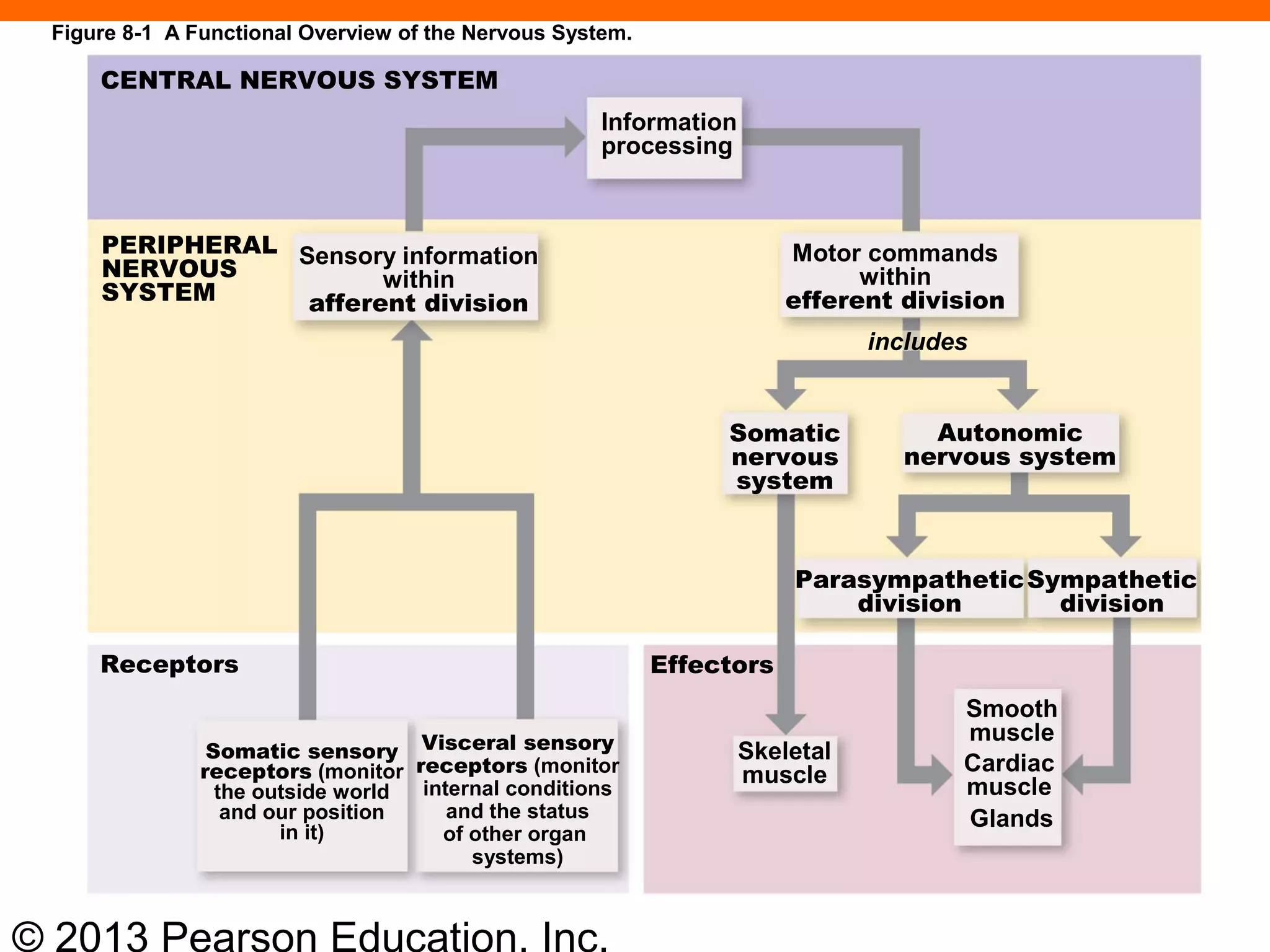
Figure 8-1 A Functional Overview of the Nervous System.
CENTRAL NERVOUS SYSTEM
PERIPHERAL
NERVOUS
SYSTEM
Sensory information
within
afferent division
Information
processing
Motor commands
within
efferent division
includes
Somatic
nervous
system
Autonomic
nervous system
Parasympathetic
division
Sympathetic
division
Receptors Effectors
Somatic sensory
receptors (monitor
the outside world
and our position
in it)
Visceral sensory
receptors (monitor
internal conditions
and the status
of other organ
systems)
Skeletal
muscle
Smooth
muscle
Glands
Cardiac
muscle
© 2013 Pearson Education, Inc.
Checkpoint (8-1)
1. Identify the two anatomical divisions of the
nervous system.
2. Identify the two functional divisions of the
peripheral nervous system, and describe their
primary functions.
3. What would be the effect of damage to the
afferent division of the PNS?
© 2013 Pearson Education, Inc.
Neurons (8-2)
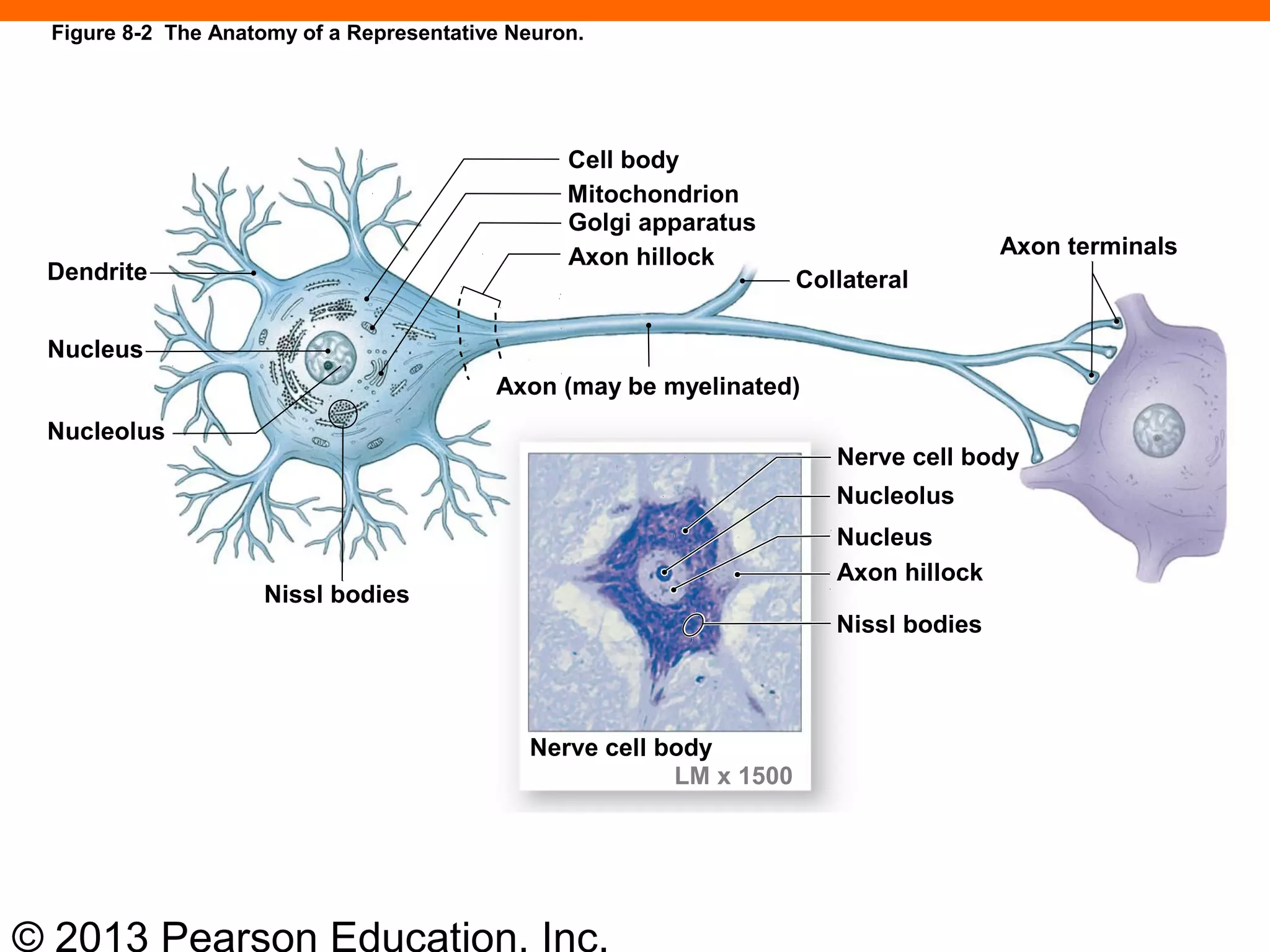
• Cells that communicate with one another and other cells
• Basic structure of a neuron includes:
• Cell body
• Dendrites
• Which receive signals
• Axons
• Which carry signals to the next cell
• Axon terminals
• Bulb-shaped endings that form a synapse with the next cell
© 2013 Pearson Education, Inc.
Neurons (8-2)
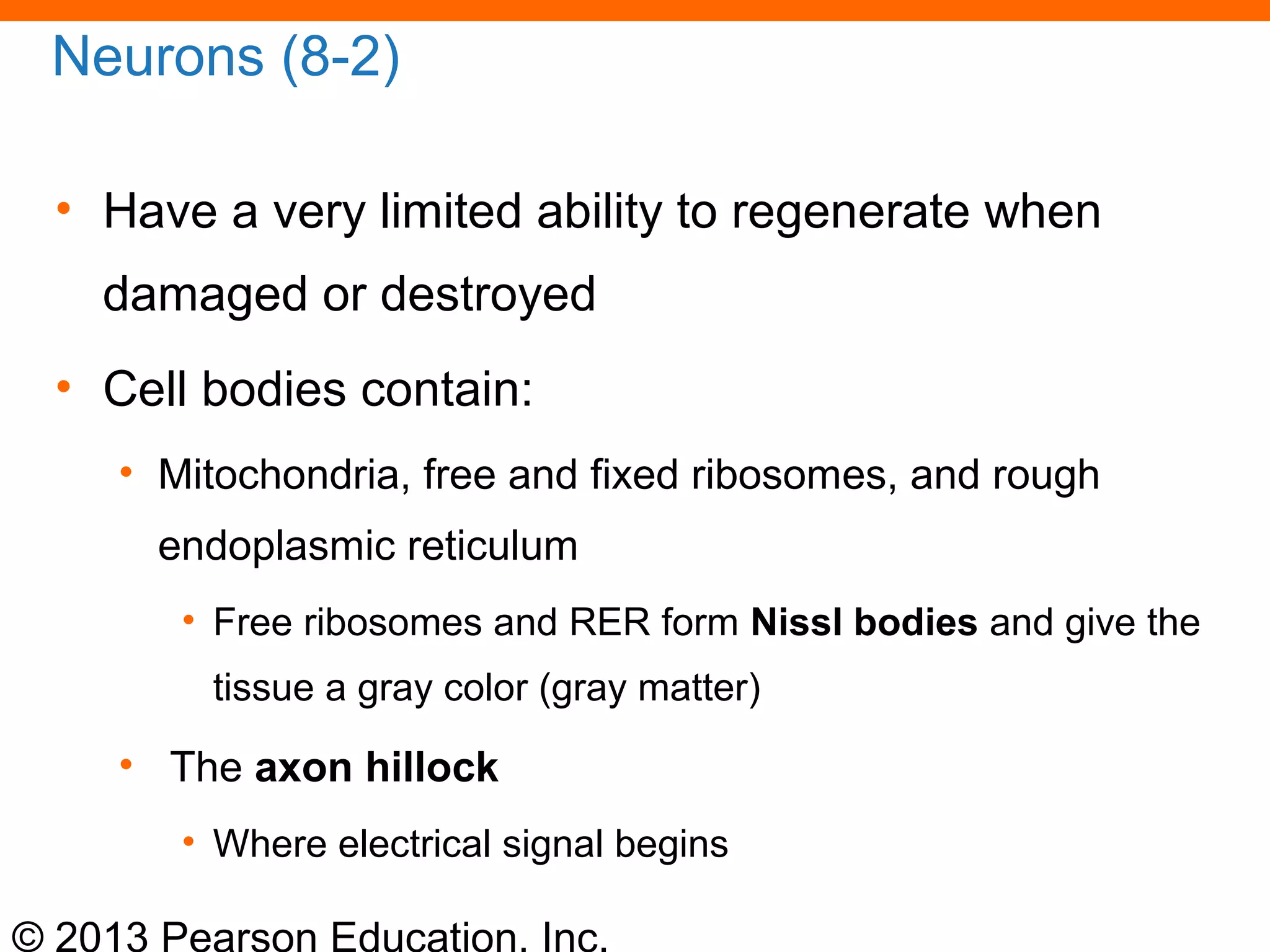
• Have a very limited ability to regenerate when
damaged or destroyed
• Cell bodies contain:
• Mitochondria, free and fixed ribosomes, and rough
endoplasmic reticulum
• Free ribosomes and RER form Nissl bodies and give the
tissue a gray color (gray matter)
• The axon hillock
• Where electrical signal begins
© 2013 Pearson Education, Inc.
Cell body
Mitochondrion
Golgi apparatus
Axon hillock
Dendrite
Nucleus
Nucleolus
Nissl bodies
Axon (may be myelinated)
Collateral
Axon terminals
Nucleolus
Nucleus
Axon hillock
Nissl bodies
Nerve cell body
Nerve cell body
LM x 1500
Figure 8-2 The Anatomy of a Representative Neuron.
© 2013 Pearson Education, Inc.
Structural Classification of Neurons (8-2)
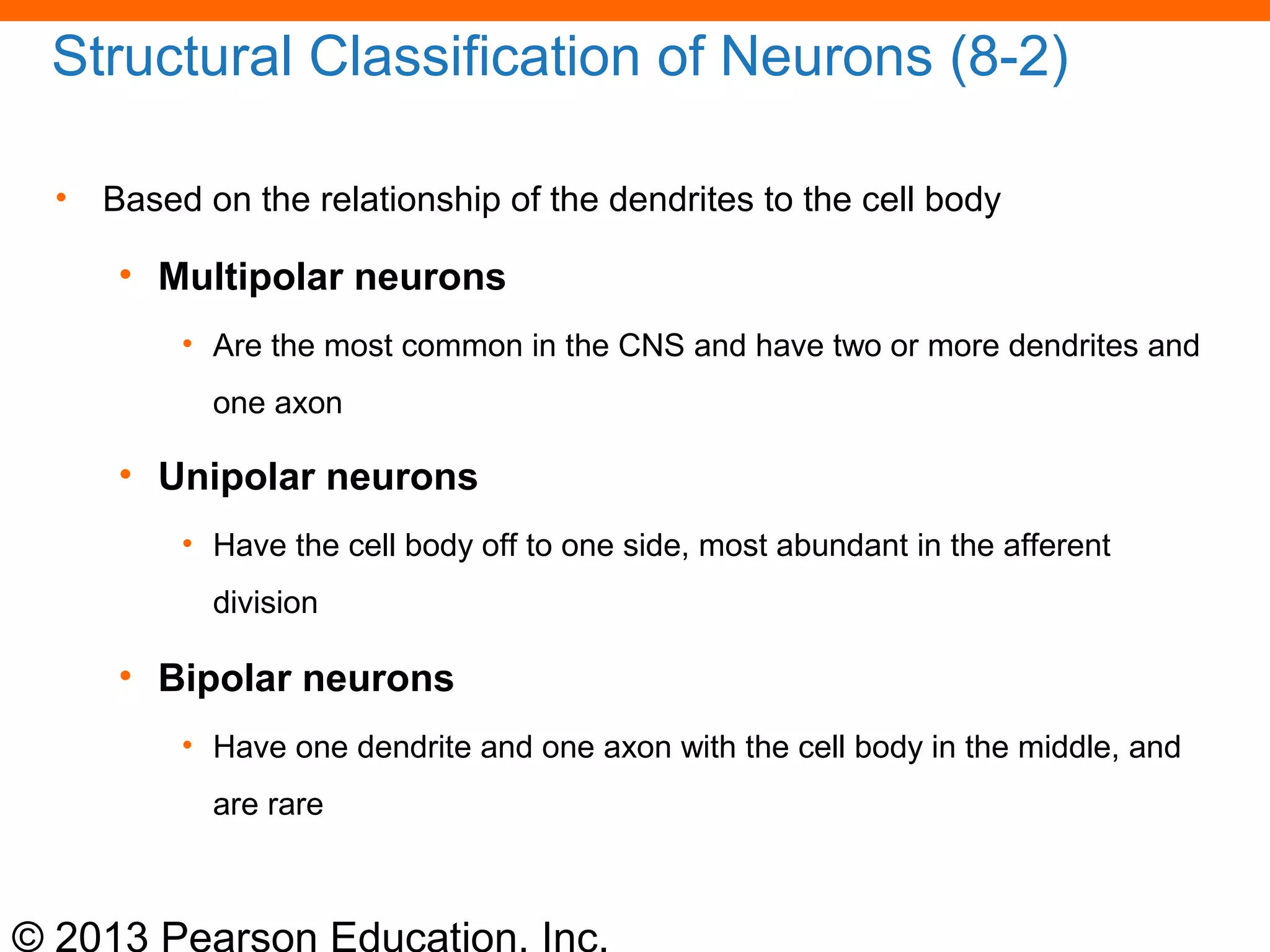
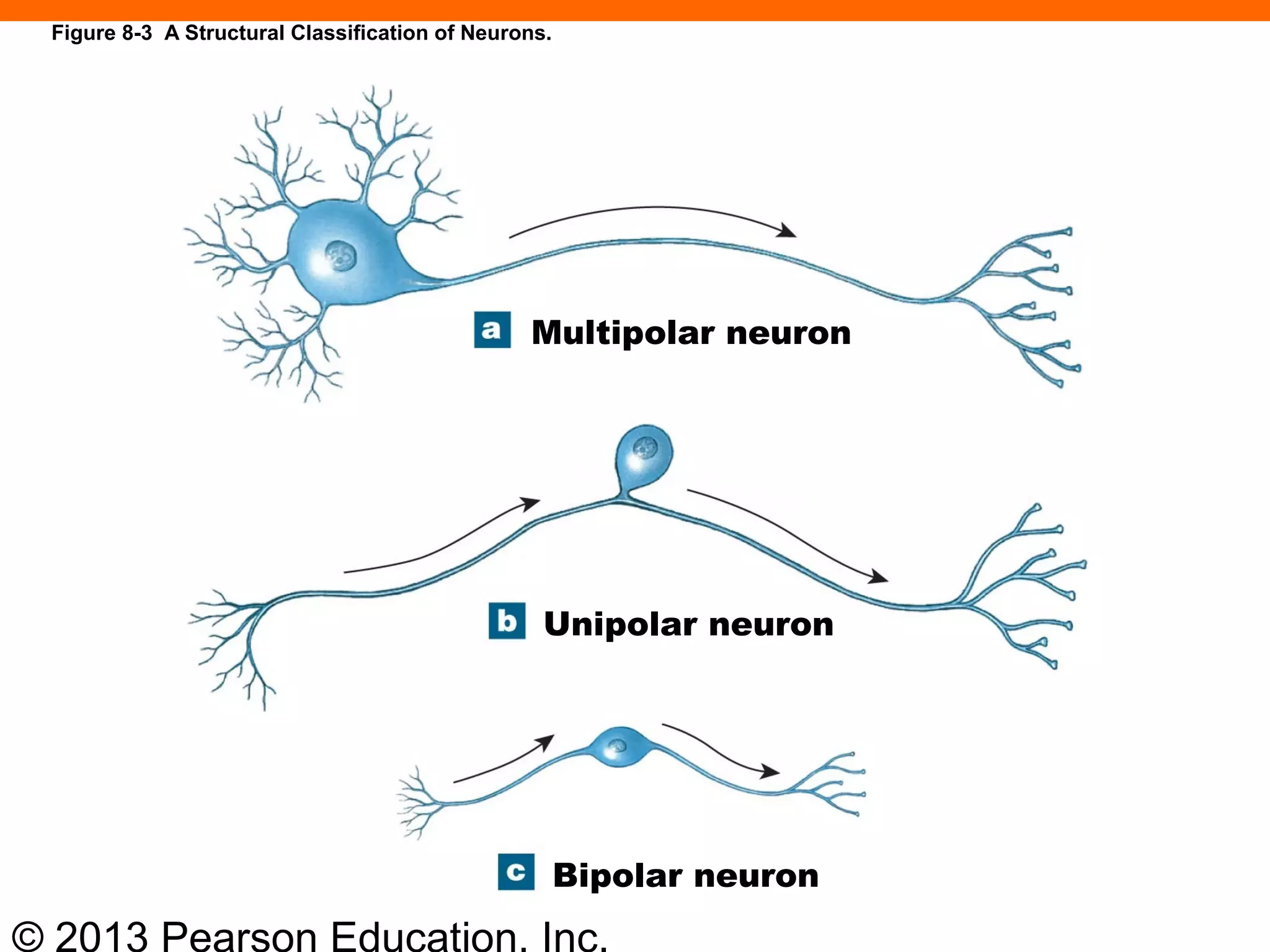
• Based on the relationship of the dendrites to the cell body
• Multipolar neurons
• Are the most common in the CNS and have two or more dendrites and
one axon
• Unipolar neurons
• Have the cell body off to one side, most abundant in the afferent
division
• Bipolar neurons
• Have one dendrite and one axon with the cell body in the middle, and
are rare
© 2013 Pearson Education, Inc.
Multipolar neuron
Unipolar neuron
Bipolar neuron
Figure 8-3 A Structural Classification of Neurons.
© 2013 Pearson Education, Inc.
Sensory Neurons (8-2)
• Also called afferent neurons
• Total 10 million or more
• Receive information from sensory receptors
• Somatic sensory receptors
• Detect stimuli concerning the outside world, in the form of
external receptors
• And our position in it, in the form of proprioceptors
• Visceral or internal receptors
• Monitor the internal organs
© 2013 Pearson Education, Inc.
Motor Neurons (8-2)
• Also called efferent neurons
• Total about half a million in number
• Carry information to peripheral targets called
effectors
• Somatic motor neurons
• Innervate skeletal muscle
• Visceral motor neurons
• Innervate cardiac muscle, smooth muscle, and glands
© 2013 Pearson Education, Inc.
Interneurons (8-2)
• Also called association neurons
• By far the most numerous type at about 20 billion
• Are located in the CNS
• Function as links between sensory and motor
processes
• Have higher functions
• Such as memory, planning, and learning
© 2013 Pearson Education, Inc.
Neuroglial Cells (8-2)
• Are supportive cells and make up about half of all neural
tissue
• Four types are found in the CNS
1. Astrocytes
2. Oligodendrocytes
3. Microglia
4. Ependymal cells
• Two types in the PNS
1. Satellite cells
2. Schwann cells
© 2013 Pearson Education, Inc.
Astrocytes (8-2)
• Large and numerous neuroglia in the CNS
• Maintain the blood–brain barrier
© 2013 Pearson Education, Inc.
Oligodendrocytes (8-2)
• Found in the CNS
• Produce an insulating membranous wrapping
around axons called myelin
• Small gaps between the wrappings called nodes of Ranvier
• Myelinated axons constitute the white matter of
the CNS
• Where cell bodies are gray matter
• Some axons are unmyelinated
© 2013 Pearson Education, Inc.
Microglia (8-2)
• The smallest and least numerous
• Phagocytic cells derived from white blood cells
• Perform essential protective functions such as
engulfing pathogens and cellular waste
© 2013 Pearson Education, Inc.
Ependymal Cells (8-2)
• Line the fluid-filled central canal of the spinal cord
and the ventricles of the brain
• The endothelial lining is called the ependyma
• It is involved in producing and circulating
cerebrospinal fluid around the CNS
© 2013 Pearson Education, Inc.
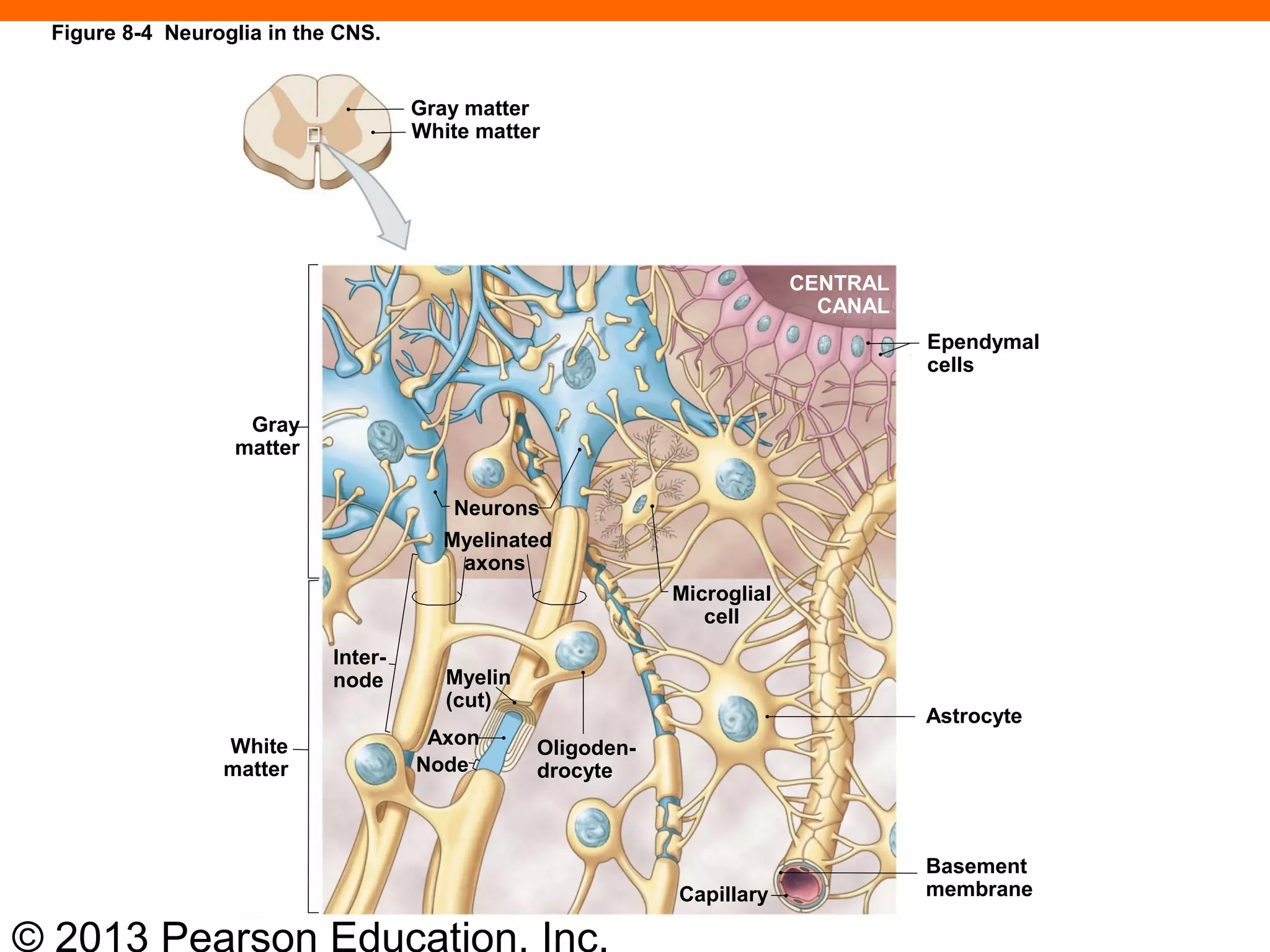
Gray matter
White matter
Gray
matter
Neurons
Myelinated
axons
Ependymal
cells
CENTRAL
CANAL
Microglial
cell
Inter-
node
White
matter
Axon
Node
Oligoden-
drocyte
Astrocyte
Capillary
Basement
membrane
Myelin
(cut)
Figure 8-4 Neuroglia in the CNS.
© 2013 Pearson Education, Inc.
Neuroglial Cells in PNS (8-2)
• Satellite cells
• Surround and support neuron cell bodies
• Similar in function to the astrocytes in the CNS
• Schwann cells
• Cover every axon in PNS
• The surface is the neurilemma
• Produce myelin
© 2013 Pearson Education, Inc.
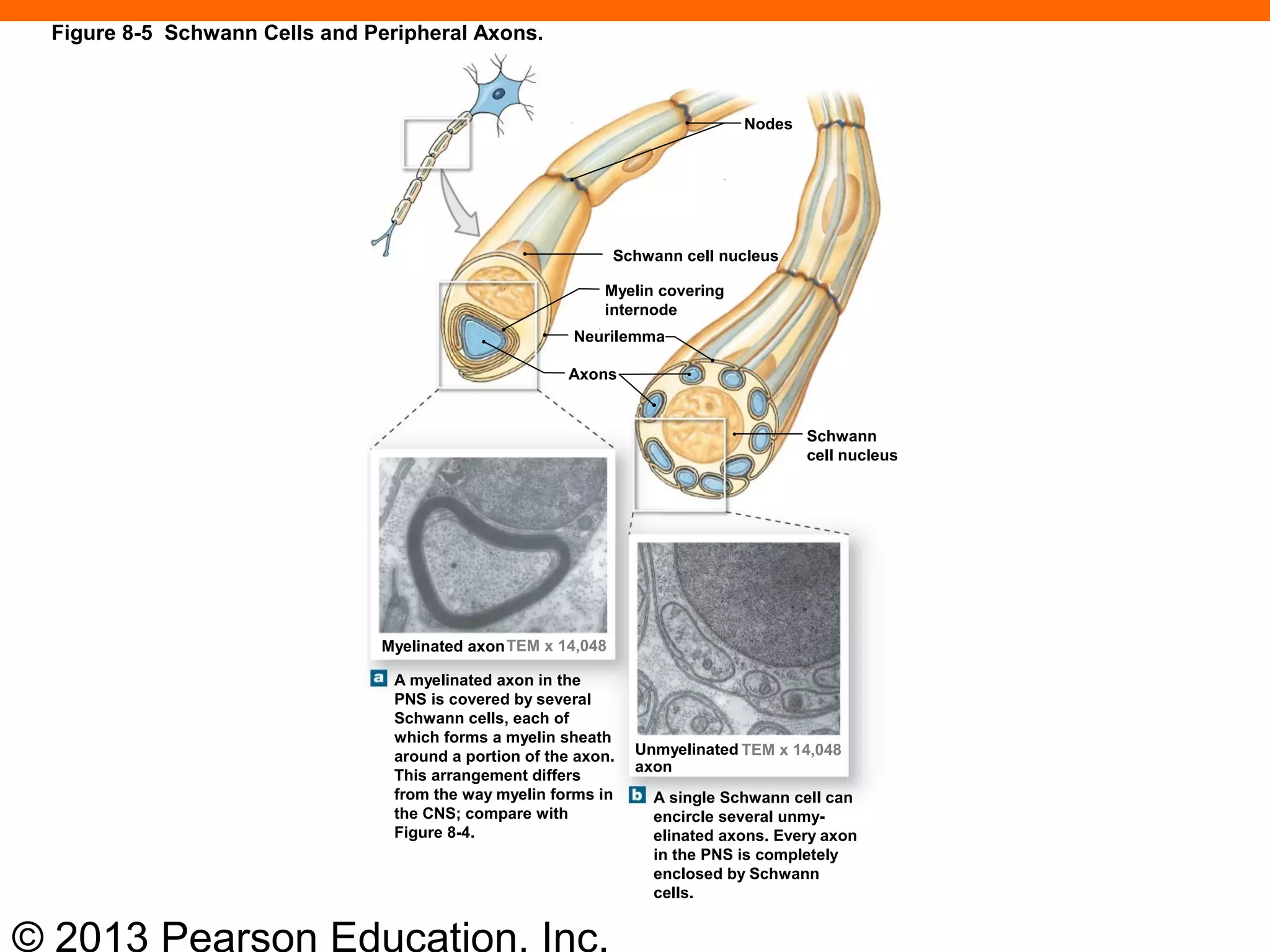
Schwann
cell nucleus
Axons
Neurilemma
Myelin covering
internode
Schwann cell nucleus
Nodes
Myelinated axon
Unmyelinated
axon
A myelinated axon in the
PNS is covered by several
Schwann cells, each of
which forms a myelin sheath
around a portion of the axon.
This arrangement differs
from the way myelin forms in
the CNS; compare with
Figure 8-4.
A single Schwann cell can
encircle several unmy-
elinated axons. Every axon
in the PNS is completely
enclosed by Schwann
cells.
TEM x 14,048
TEM x 14,048
Figure 8-5 Schwann Cells and Peripheral Axons.
© 2013 Pearson Education, Inc.
Organization of the Nervous System (8-2)
• In the PNS:
• Collections of nerve cell bodies are ganglia
• Bundled axons are nerves
• Including spinal nerves and cranial nerves
• Can have both sensory and motor components
© 2013 Pearson Education, Inc.
Organization of the Nervous System (8-2)
• In the CNS:
• Collections of neuron cell bodies are found in centers,
or nuclei
• Neural cortex is a thick layer of gray matter
• White matter in the CNS is formed by bundles of axons
called tracts, and in the spinal cord, form columns
• Pathways are either sensory or ascending tracts, or
motor or descending tracts
© 2013 Pearson Education, Inc.
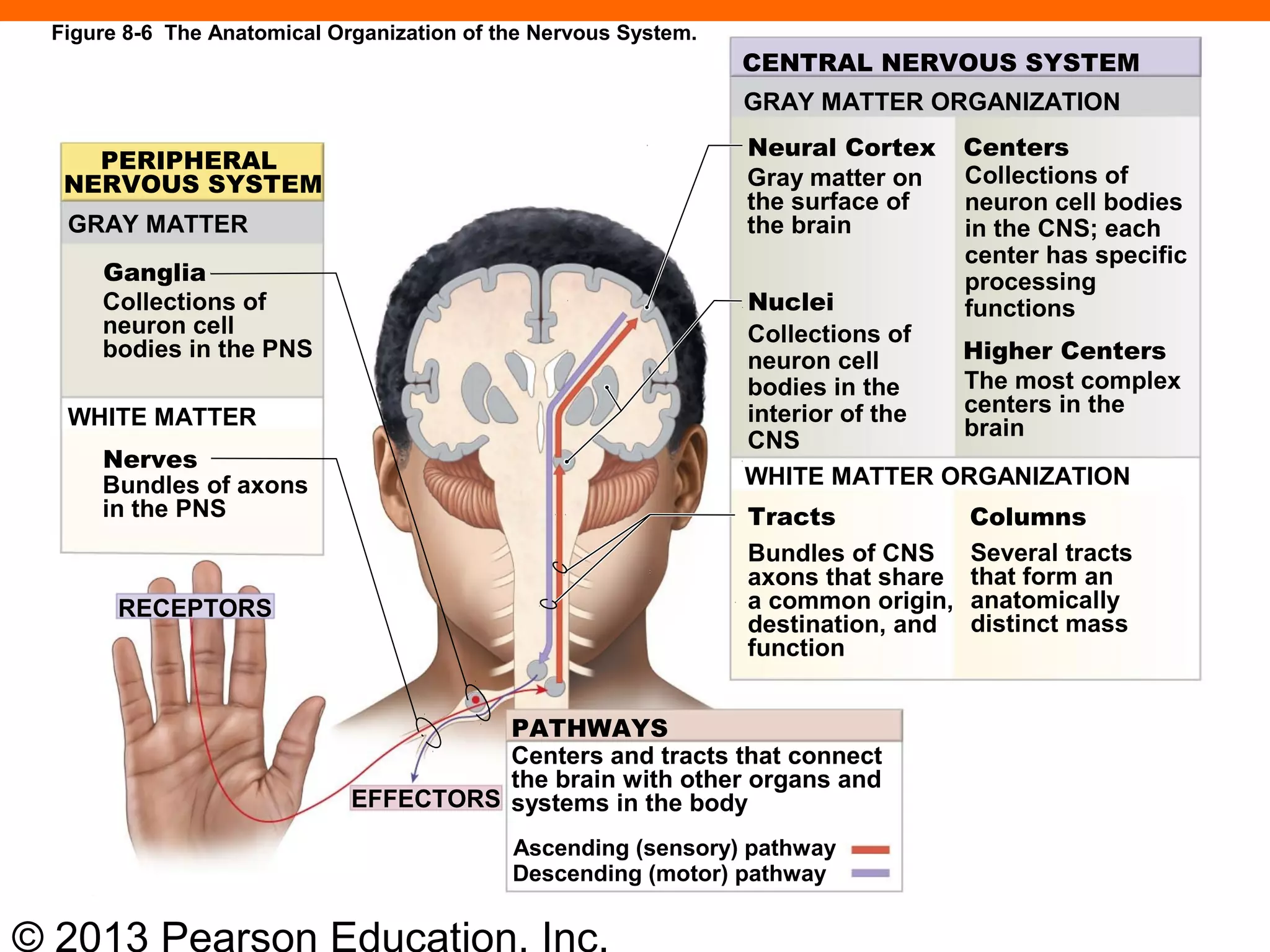
PERIPHERAL
NERVOUS SYSTEM
GRAY MATTER
Ganglia
Collections of
neuron cell
bodies in the PNS
WHITE MATTER
Nerves
Bundles of axons
in the PNS
RECEPTORS
EFFECTORS
PATHWAYS
Centers and tracts that connect
the brain with other organs and
systems in the body
Ascending (sensory) pathway
Descending (motor) pathway
CENTRAL NERVOUS SYSTEM
GRAY MATTER ORGANIZATION
Neural Cortex
Gray matter on
the surface of
the brain
Centers
Collections of
neuron cell bodies
in the CNS; each
center has specific
processing
functionsNuclei
Collections of
neuron cell
bodies in the
interior of the
CNS
Higher Centers
The most complex
centers in the
brain
WHITE MATTER ORGANIZATION
Tracts
Bundles of CNS
axons that share
a common origin,
destination, and
function
Columns
Several tracts
that form an
anatomically
distinct mass
Figure 8-6 The Anatomical Organization of the Nervous System.
© 2013 Pearson Education, Inc.
Checkpoint (8-2)
4. Name the structural components of a typical neuron.
5. Examination of a tissue sample reveals unipolar neurons.
Are these more likely to be sensory neurons or motor
neurons?
6. Identify the neuroglia of the central nervous system.
7. Which type of glial cell would increase in number in the
brain tissue of a person with a CNS infection?
8. In the PNS, neuron cell bodies are located in ________
and surrounded by neuroglial cells called ________ cells.
© 2013 Pearson Education, Inc.
The Membrane Potential (8-3)
• A membrane potential exists because of:
• Excessive positive ionic charges on the outside of the
cell
• Excessive negative charges on the inside, creating a
polarized membrane
• An undisturbed cell has a resting membrane potential
measured in the inside of the cell in millivolts
• The resting membrane potential of neurons is –70 mV
© 2013 Pearson Education, Inc.
Factors Determining Membrane Potential (8-3)
• Extracellular fluid (ECF) is high in Na+
and CI–
• Intracellular fluid (ICF) is high in K+
and negatively charged
proteins (Pr –
)
• Proteins are non-permeating, staying in the ICF
• Some ion channels are always open
• Called leak channels
• Some are open or closed
• Called gated channels
© 2013 Pearson Education, Inc.
Factors Determining Membrane Potential (8-3)
• Na+
can leak in
• But the membrane is more permeable to K+
• Allowing K+
to leak out faster
• Na+
/K+
exchange pump exchanges 3 Na+
for every
2 K+
• Moving Na+
out as fast as it leaks in
• Cell experiences a net loss of positive ions
• Resulting in a resting membrane charge of –70 mV
© 2013 Pearson Education, Inc.
EXTRACELLULAR FLUID
K+
leak
channel
Sodium–
potassium
exchange
pump
Na+
leak
channel
Plasma
membrane
CYTOSOL
Protein
Protein
Sodium ion (Na+
)
Potassium ion (K+
)
Chloride ion (Cl–
)
Protein
–70 –30
+30
0
mV
KEY
Figure 8-7 The Resting Potential Is the Membrane Potential of an Undisturbed Cell.
© 2013 Pearson Education, Inc.
Changes in Membrane Potential (8-3)
• Stimuli alter membrane permeability to Na+
or K+
• Or alter activity of the exchange pump
• Types include:
• Cellular exposure to chemicals
• Mechanical pressure
• Temperature changes
• Changes in the ECF ion concentration
• Result is opening of a gated channel
• Increasing the movement of ions across the membrane
© 2013 Pearson Education, Inc.
Changes in Membrane Potential (8-3)
• Opening of Na+
channels results in an influx of Na+
• Moving the membrane toward 0 mV, a shift called
depolarization
• Opening of K+
channels results in an efflux of K+
• Moving the membrane further away from 0 mV, a shift
called hyperpolarization
• Return to resting from depolarization: repolarizing
© 2013 Pearson Education, Inc.
Graded Potentials (8-3)
• Local changes in the membrane that fade over
distance
• All cells experience graded potentials when
stimulated
• And can result in the activation of smaller cells
• Graded potentials by themselves cannot trigger
activation of large neurons and muscle fibers
• Referred to as having excitable membranes
© 2013 Pearson Education, Inc.
Action Potentials (8-3)
• A change in the membrane that travels the entire
length of neurons
• A nerve impulse
• If a combination of graded potentials causes the
membrane to reach a critical point of
depolarization, it is called the threshold
• Then an action potential will occur
© 2013 Pearson Education, Inc.
Action Potentials (8-3)
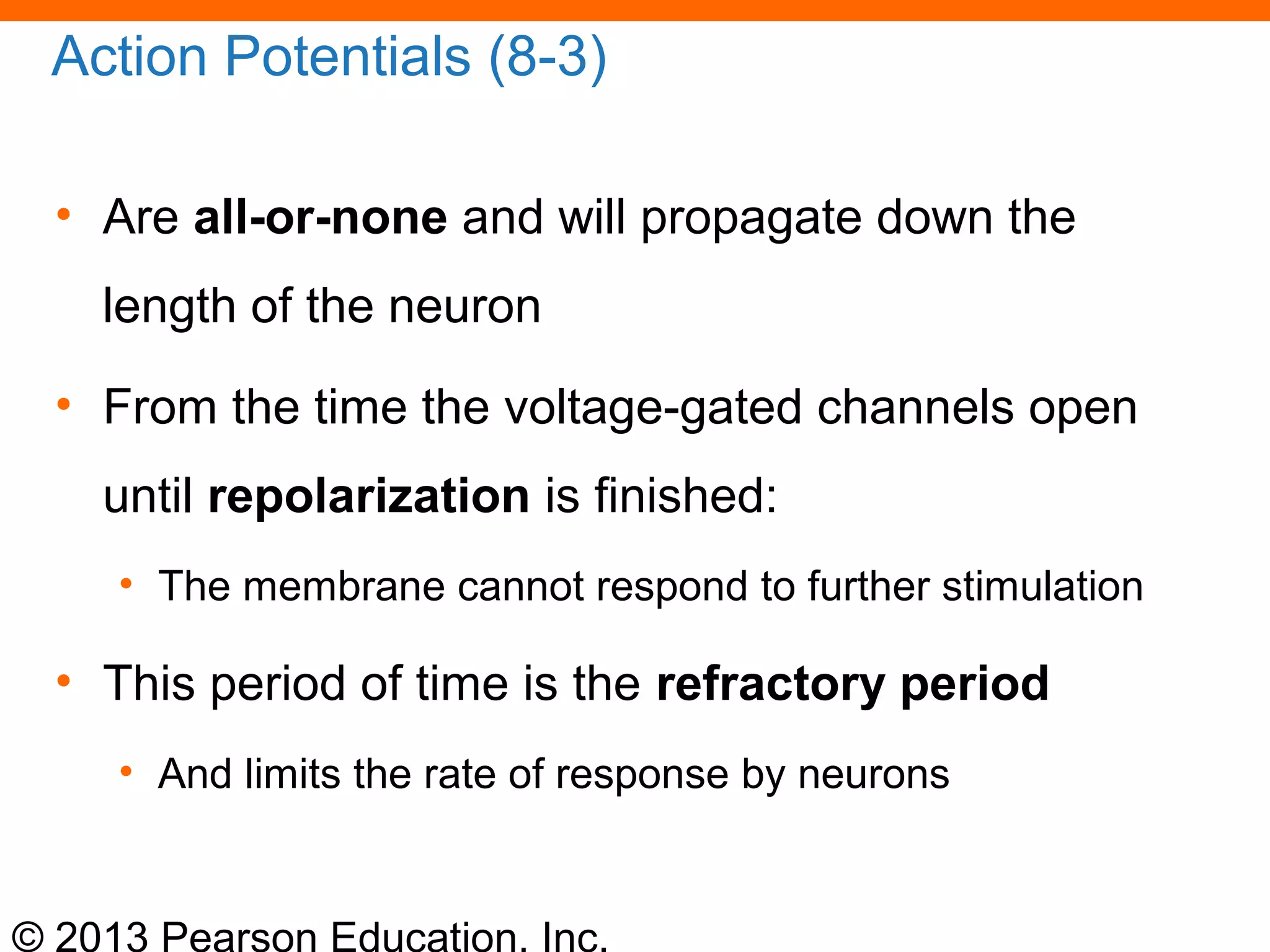
• Are all-or-none and will propagate down the
length of the neuron
• From the time the voltage-gated channels open
until repolarization is finished:
• The membrane cannot respond to further stimulation
• This period of time is the refractory period
• And limits the rate of response by neurons
© 2013 Pearson Education, Inc.
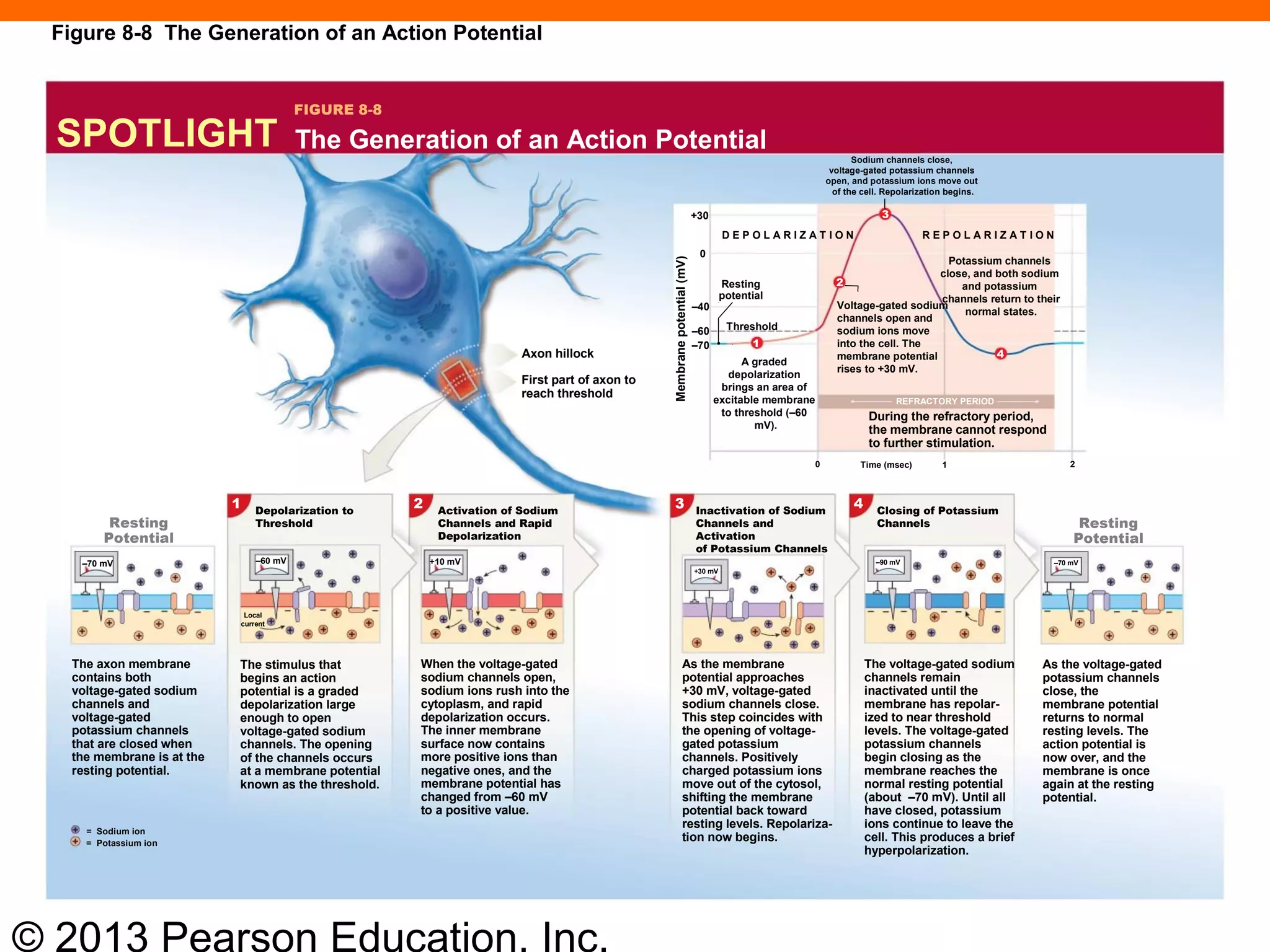
A graded
depolarization
brings an area of
excitable membrane
to threshold (–60
mV).
Voltage-gated sodium
channels open and
sodium ions move
into the cell. The
membrane potential
rises to +30 mV.
Potassium channels
close, and both sodium
and potassium
channels return to their
normal states.
Sodium channels close,
voltage-gated potassium channels
open, and potassium ions move out
of the cell. Repolarization begins.
D E P O L A R I Z A T I O N R E P O L A R I Z A T I O N
Resting
potential
Threshold
During the refractory period,
the membrane cannot respond
to further stimulation.
Axon hillock
First part of axon to
reach threshold
+30
0
–40
–60
–70
Membranepotential(mV)
REFRACTORY PERIOD
Time (msec)0 21
2
3
4
1
The Generation of an Action PotentialSPOTLIGHT
FIGURE 8-8
Closing of Potassium
Channels
Inactivation of Sodium
Channels and
Activation
of Potassium Channels
Activation of Sodium
Channels and Rapid
Depolarization
Depolarization to
ThresholdResting
Potential
Resting
Potential
4321
–60 mV +10 mV
+30 mV
–70 mV –90 mV –70 mV
Local
current
The axon membrane
contains both
voltage-gated sodium
channels and
voltage-gated
potassium channels
that are closed when
the membrane is at the
resting potential.
The stimulus that
begins an action
potential is a graded
depolarization large
enough to open
voltage-gated sodium
channels. The opening
of the channels occurs
at a membrane potential
known as the threshold.
When the voltage-gated
sodium channels open,
sodium ions rush into the
cytoplasm, and rapid
depolarization occurs.
The inner membrane
surface now contains
more positive ions than
negative ones, and the
membrane potential has
changed from –60 mV
to a positive value.
As the membrane
potential approaches
+30 mV, voltage-gated
sodium channels close.
This step coincides with
the opening of voltage-
gated potassium
channels. Positively
charged potassium ions
move out of the cytosol,
shifting the membrane
potential back toward
resting levels. Repolariza-
tion now begins.
The voltage-gated sodium
channels remain
inactivated until the
membrane has repolar-
ized to near threshold
levels. The voltage-gated
potassium channels
begin closing as the
membrane reaches the
normal resting potential
(about –70 mV). Until all
have closed, potassium
ions continue to leave the
cell. This produces a brief
hyperpolarization.
As the voltage-gated
potassium channels
close, the
membrane potential
returns to normal
resting levels. The
action potential is
now over, and the
membrane is once
again at the resting
potential.
= Sodium ion
= Potassium ion
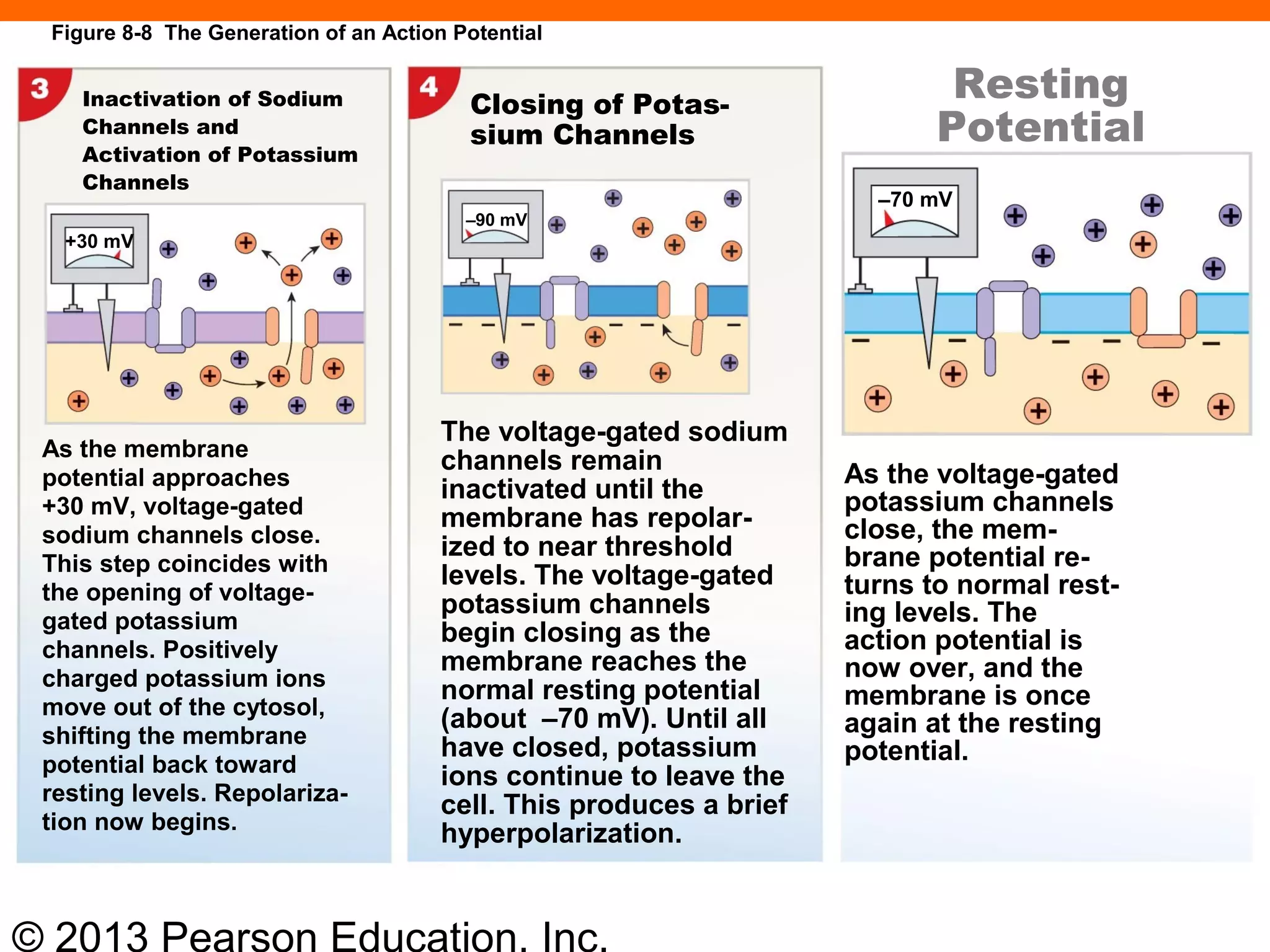
Figure 8-8 The Generation of an Action Potential
© 2013 Pearson Education, Inc.
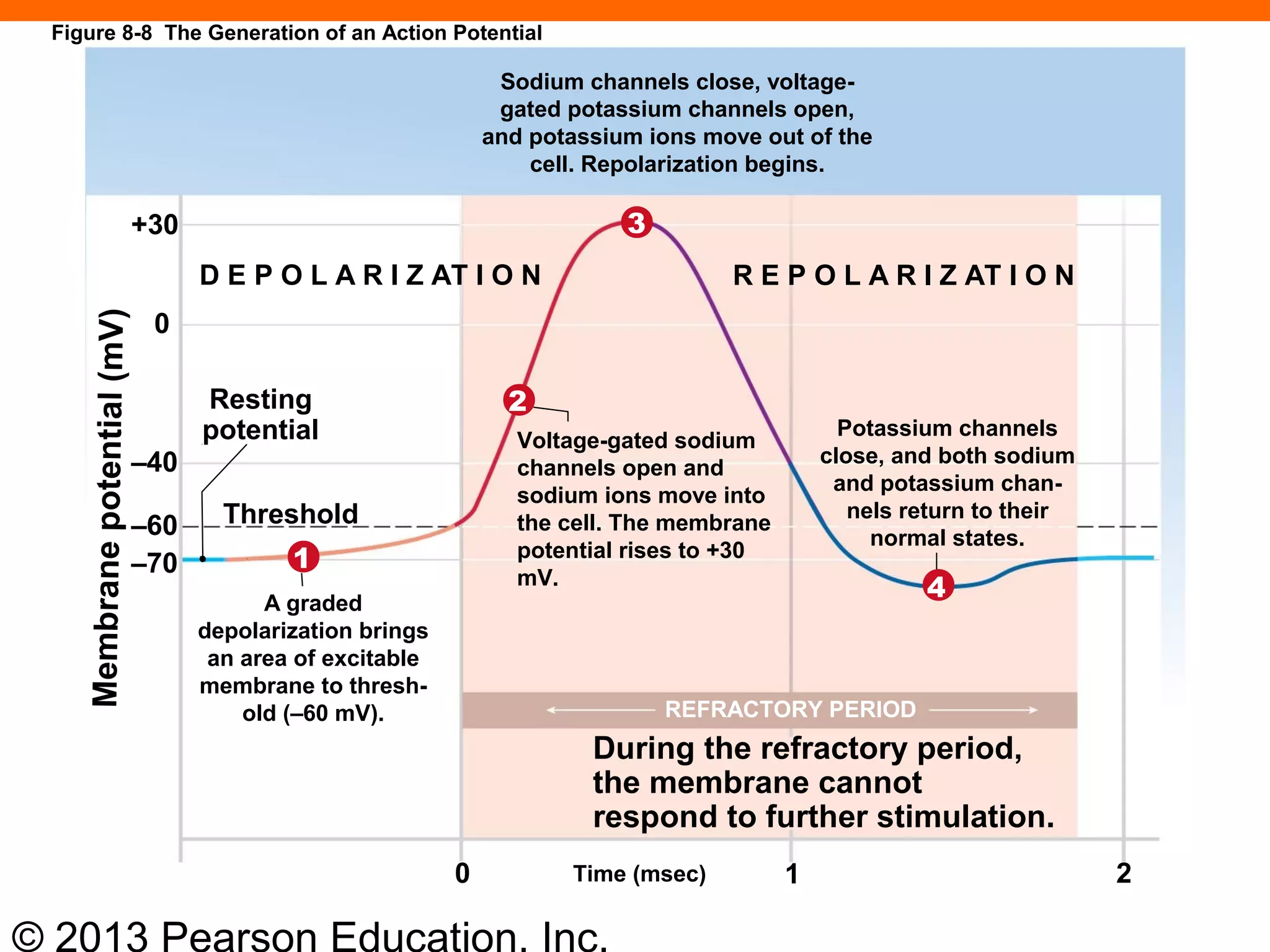
Sodium channels close, voltage-
gated potassium channels open,
and potassium ions move out of the
cell. Repolarization begins.
D E P O L A R I Z AT I O N R E P O L A R I Z AT I O N
Resting
potential
Threshold
Voltage-gated sodium
channels open and
sodium ions move into
the cell. The membrane
potential rises to +30
mV.
Potassium channels
close, and both sodium
and potassium chan-
nels return to their
normal states.
A graded
depolarization brings
an area of excitable
membrane to thresh-
old (–60 mV).
During the refractory period,
the membrane cannot
respond to further stimulation.
REFRACTORY PERIOD
Time (msec)
Membranepotential(mV)
+30
0
–40
–60
–70 1
2
3
4
0 1 2
Figure 8-8 The Generation of an Action Potential
© 2013 Pearson Education, Inc.
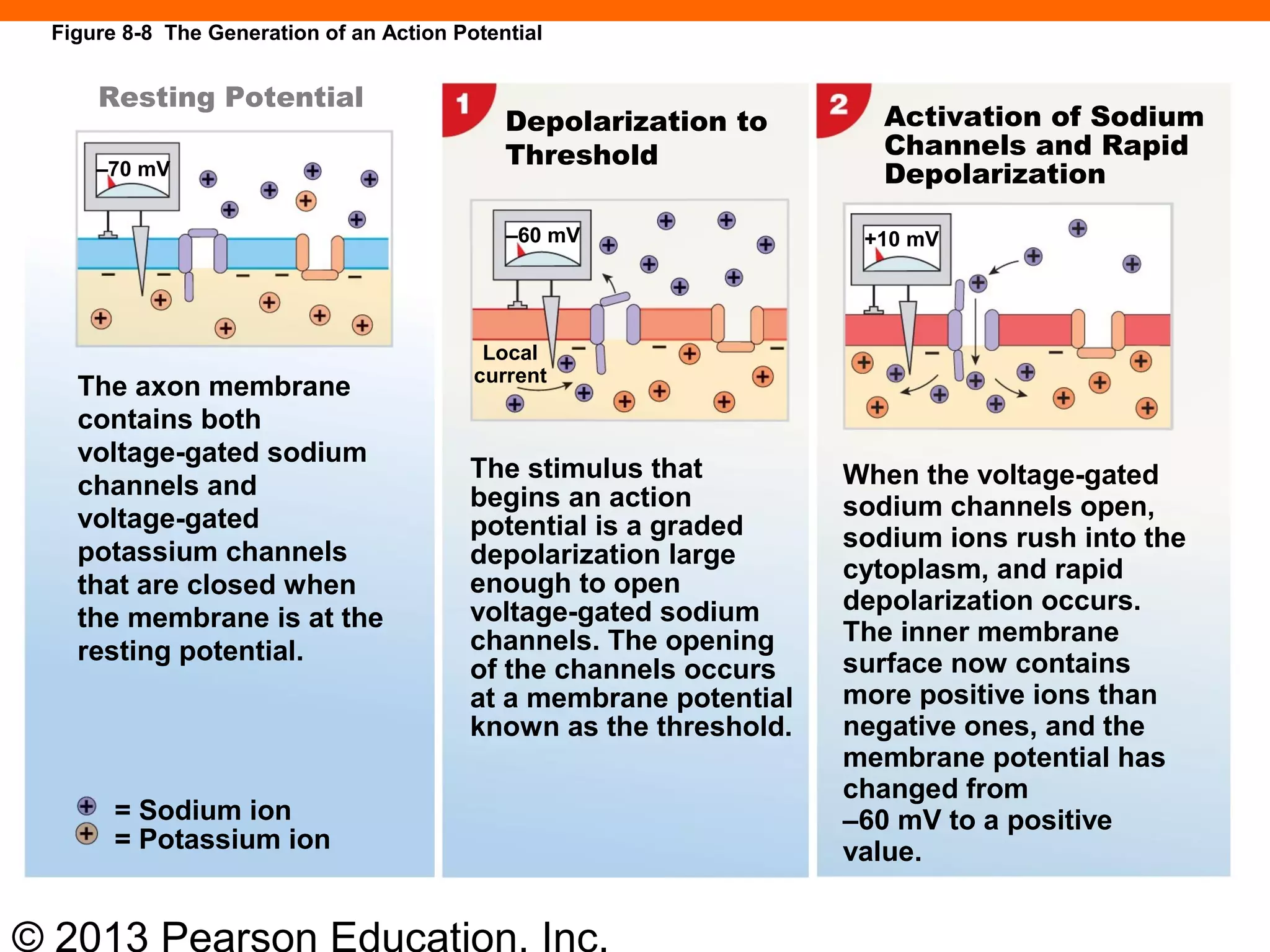
Figure 8-8 The Generation of an Action Potential
The axon membrane
contains both
voltage-gated sodium
channels and
voltage-gated
potassium channels
that are closed when
the membrane is at the
resting potential.
= Sodium ion
= Potassium ion
–70 mV
Resting Potential
The stimulus that
begins an action
potential is a graded
depolarization large
enough to open
voltage-gated sodium
channels. The opening
of the channels occurs
at a membrane potential
known as the threshold.
Local
current
–60 mV
Depolarization to
Threshold
When the voltage-gated
sodium channels open,
sodium ions rush into the
cytoplasm, and rapid
depolarization occurs.
The inner membrane
surface now contains
more positive ions than
negative ones, and the
membrane potential has
changed from
–60 mV to a positive
value.
Activation of Sodium
Channels and Rapid
Depolarization
+10 mV
© 2013 Pearson Education, Inc.
Figure 8-8 The Generation of an Action Potential
Resting
Potential
+30 mV
–90 mV
–70 mV
Inactivation of Sodium
Channels and
Activation of Potassium
Channels
As the membrane
potential approaches
+30 mV, voltage-gated
sodium channels close.
This step coincides with
the opening of voltage-
gated potassium
channels. Positively
charged potassium ions
move out of the cytosol,
shifting the membrane
potential back toward
resting levels. Repolariza-
tion now begins.
Closing of Potas-
sium Channels
The voltage-gated sodium
channels remain
inactivated until the
membrane has repolar-
ized to near threshold
levels. The voltage-gated
potassium channels
begin closing as the
membrane reaches the
normal resting potential
(about –70 mV). Until all
have closed, potassium
ions continue to leave the
cell. This produces a brief
hyperpolarization.
As the voltage-gated
potassium channels
close, the mem-
brane potential re-
turns to normal rest-
ing levels. The
action potential is
now over, and the
membrane is once
again at the resting
potential.
© 2013 Pearson Education, Inc.
Propagation of an Action Potential (8-3)
• Occurs when local changes in the membrane in
one site:
• Result in the activation of voltage-gated channels in the next
adjacent site of the membrane
• This causes a wave of membrane potential
changes
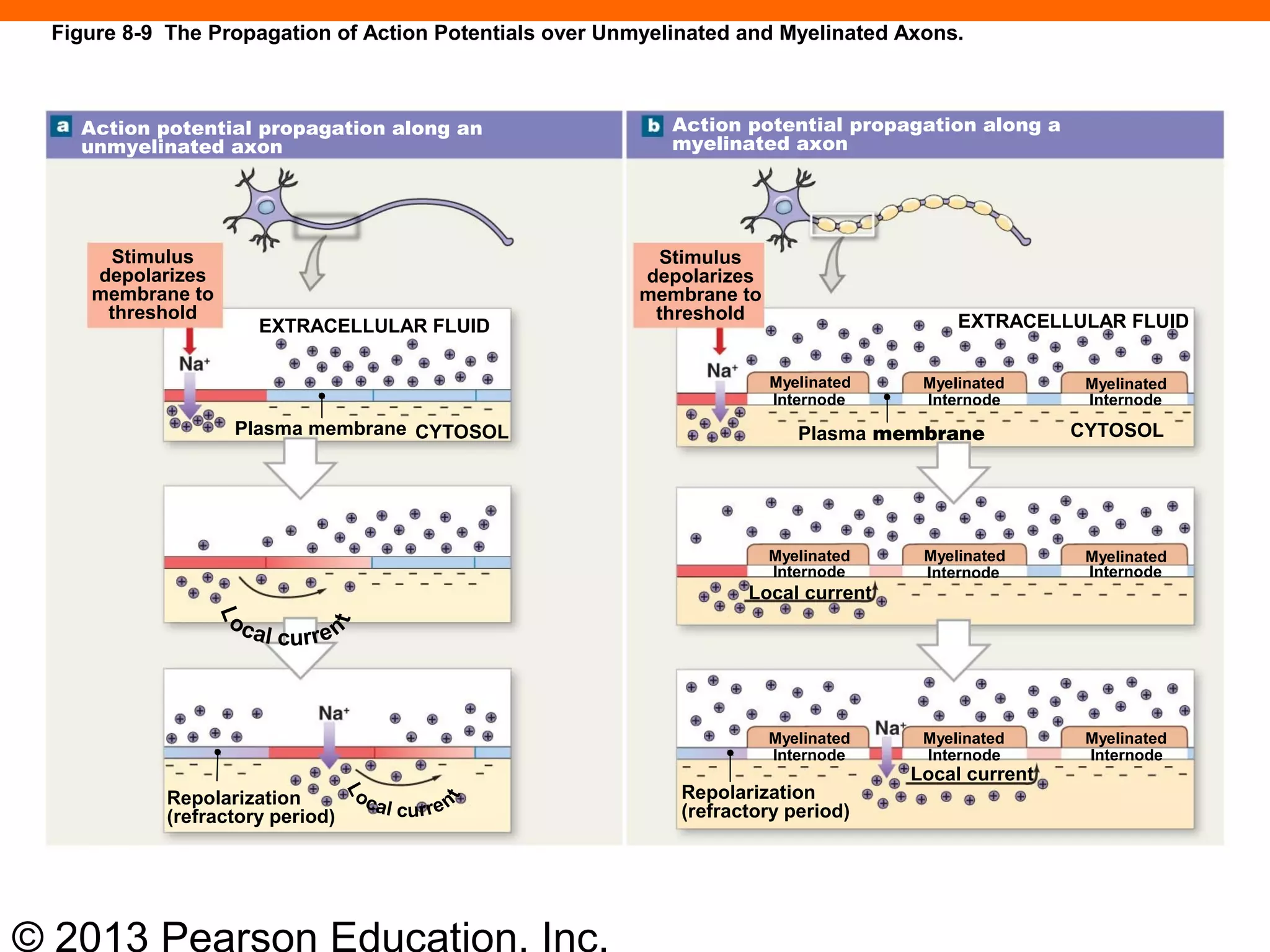
• Continuous propagation
• Occurs in unmyelinated fibers and is relatively slow
• Saltatory propagation
• Is in myelinated axons and is faster
© 2013 Pearson Education, Inc.
Action potential propagation along an
unmyelinated axon
Action potential propagation along a
myelinated axon
Stimulus
depolarizes
membrane to
threshold
Stimulus
depolarizes
membrane to
threshold
EXTRACELLULAR FLUID
Plasma membrane CYTOSOL CYTOSOLPlasma membrane
EXTRACELLULAR FLUID
Repolarization
(refractory period)
Repolarization
(refractory period)
Myelinated
Internode Internode Internode
Myelinated Myelinated
MyelinatedMyelinatedMyelinated
Internode Internode Internode
InternodeInternodeInternode
Myelinated Myelinated Myelinated
Local current
Local current
Figure 8-9 The Propagation of Action Potentials over Unmyelinated and Myelinated Axons.
© 2013 Pearson Education, Inc.
Checkpoint (8-3)
9. What effect would a chemical that blocks the voltage-gated
sodium channels in a neuron's plasma membrane have on the
neuron's ability to depolarize?
10. What effect would decreasing the concentration of extracellular
potassium have on the membrane potential of a neuron?
11. List the steps involved in the generation and propagation of an
action potential.
12. Two axons are tested for propagation velocities. One carries
action potentials at 50 meters per second, the other at 1 meter
per second. Which axon is myelinated?
© 2013 Pearson Education, Inc.
The Synapse (8-4)
• A junction between a neuron and another cell
• Occurs because of chemical messengers called
neurotransmitters
• Communication happens in one direction only
• Between a neuron and another cell type is a neuroeffector
junction
• Such as the neuromuscular junction or neuroglandular junction
© 2013 Pearson Education, Inc.
A Synapse between Two Neurons (8-4)
• Occurs:
• Between the axon terminals of the presynaptic neuron
• Across the synaptic cleft
• To the dendrite or cell body of the postsynaptic neuron
• Neurotransmitters
• Stored in vesicles of the axon terminals
• Released into the cleft and bind to receptors on the
postsynaptic membrane
PLAYPLAY ANIMATION Neurophysiology: Synapse
© 2013 Pearson Education, Inc.
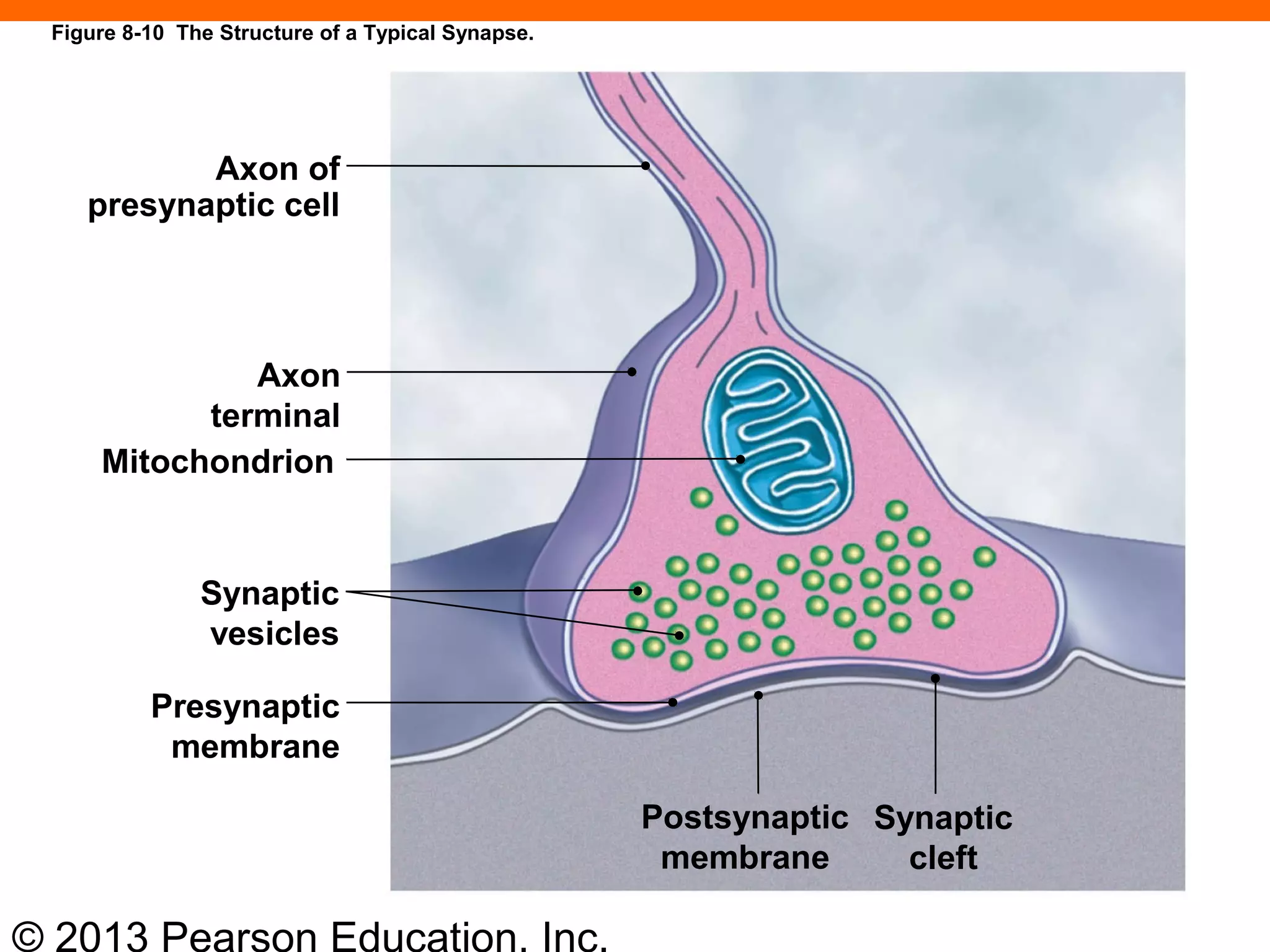
Axon of
presynaptic cell
Axon
terminal
Mitochondrion
Synaptic
vesicles
Presynaptic
membrane
Postsynaptic
membrane
Synaptic
cleft
Figure 8-10 The Structure of a Typical Synapse.
© 2013 Pearson Education, Inc.
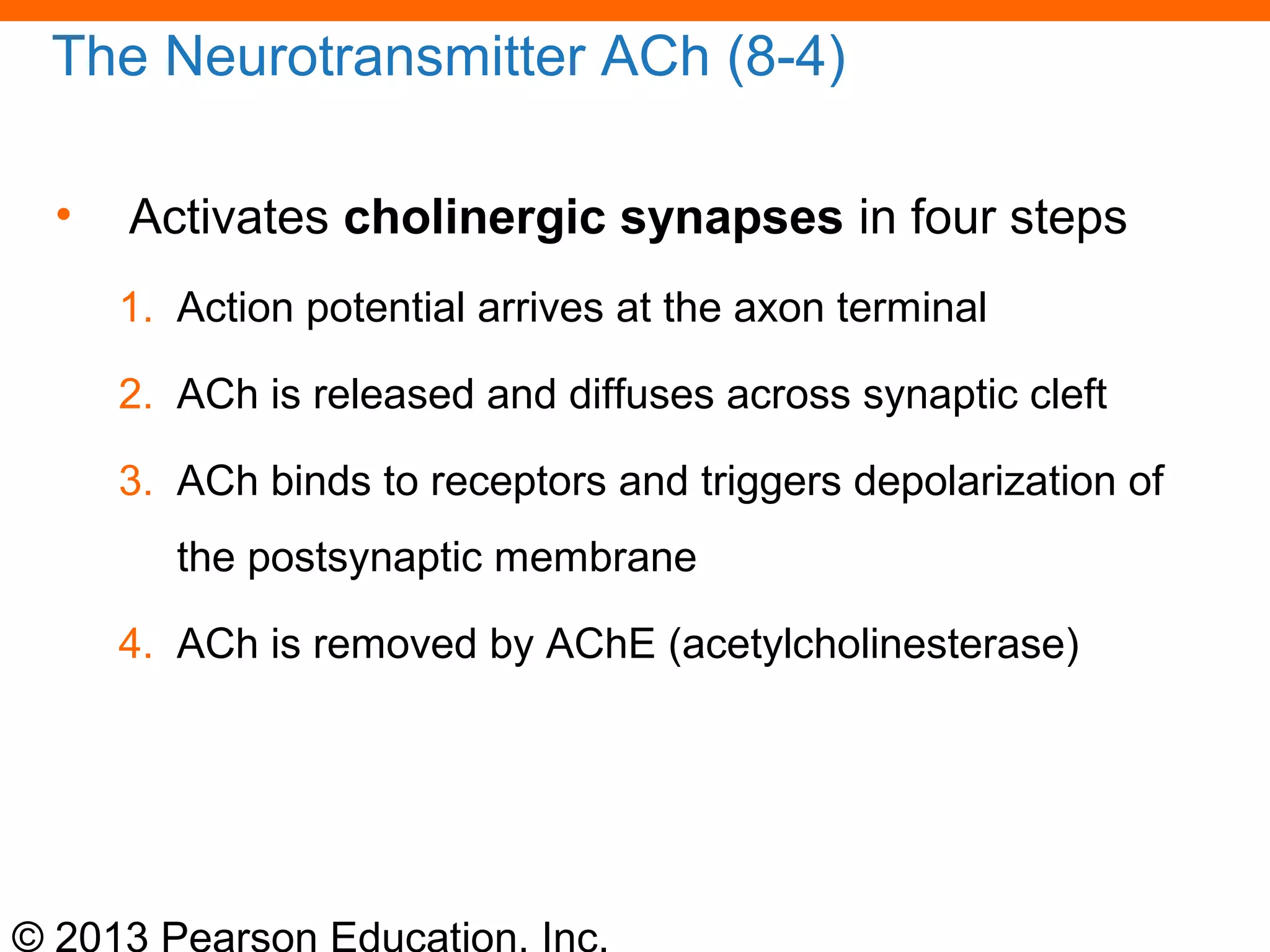
The Neurotransmitter ACh (8-4)
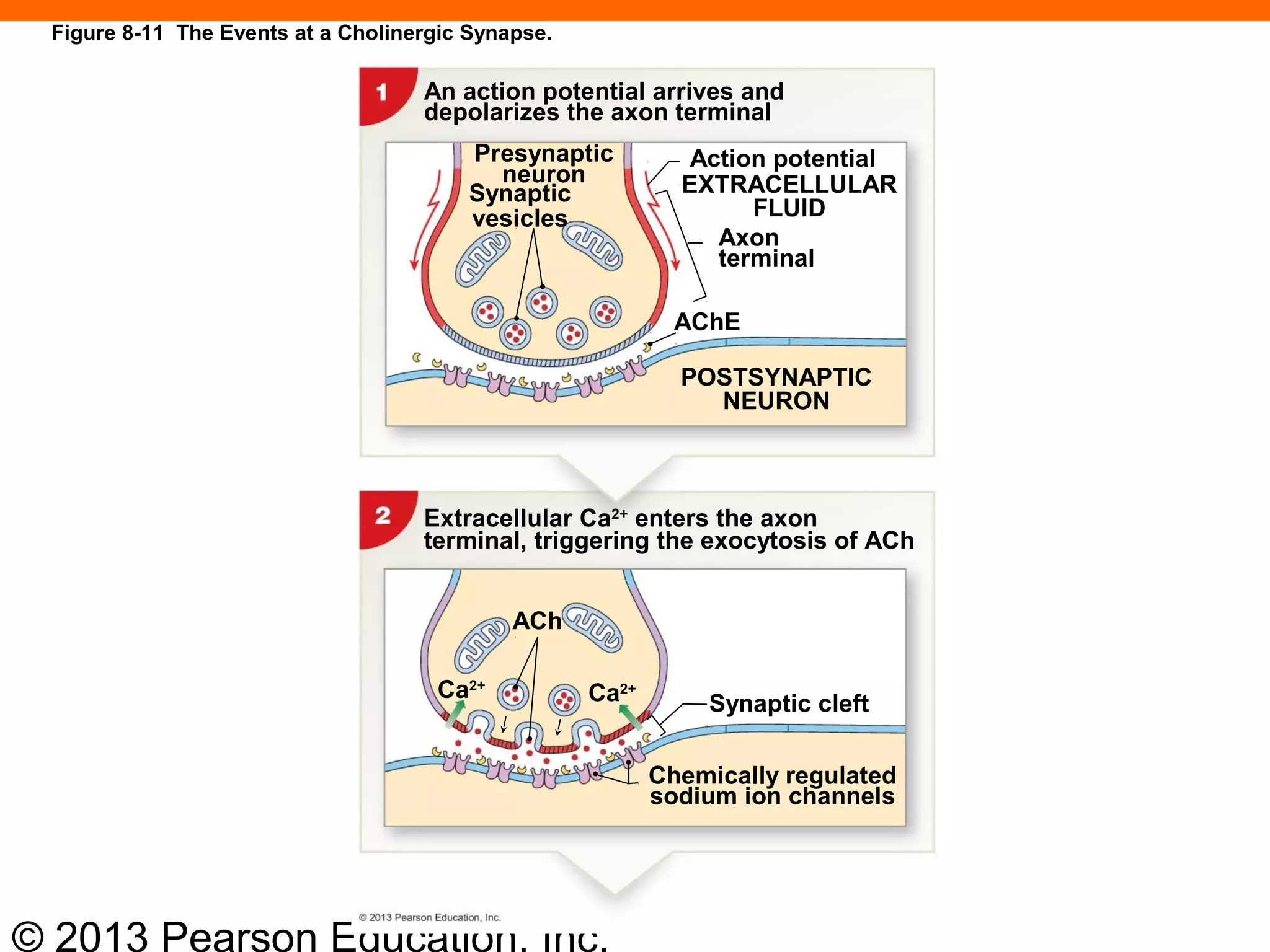
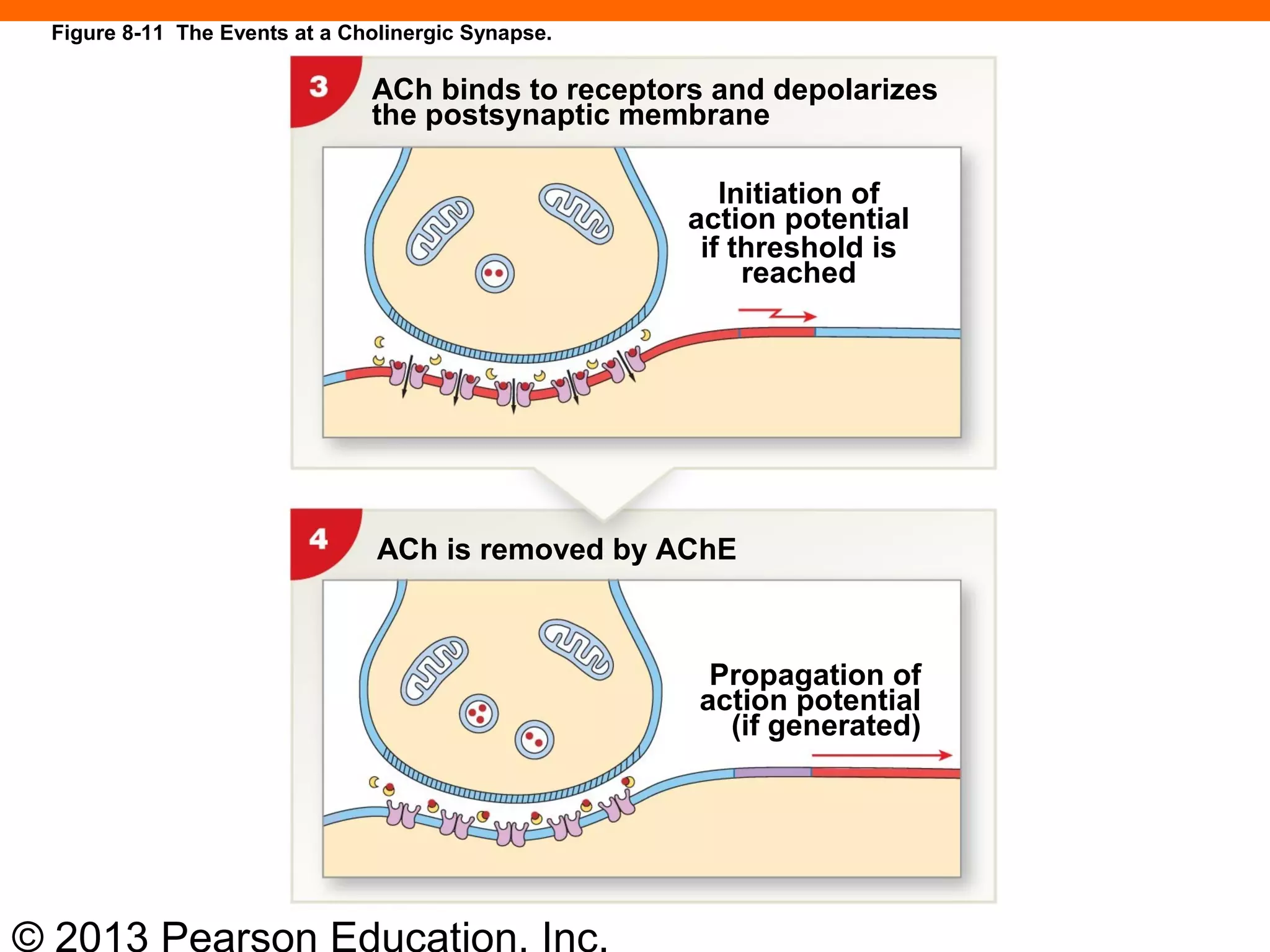
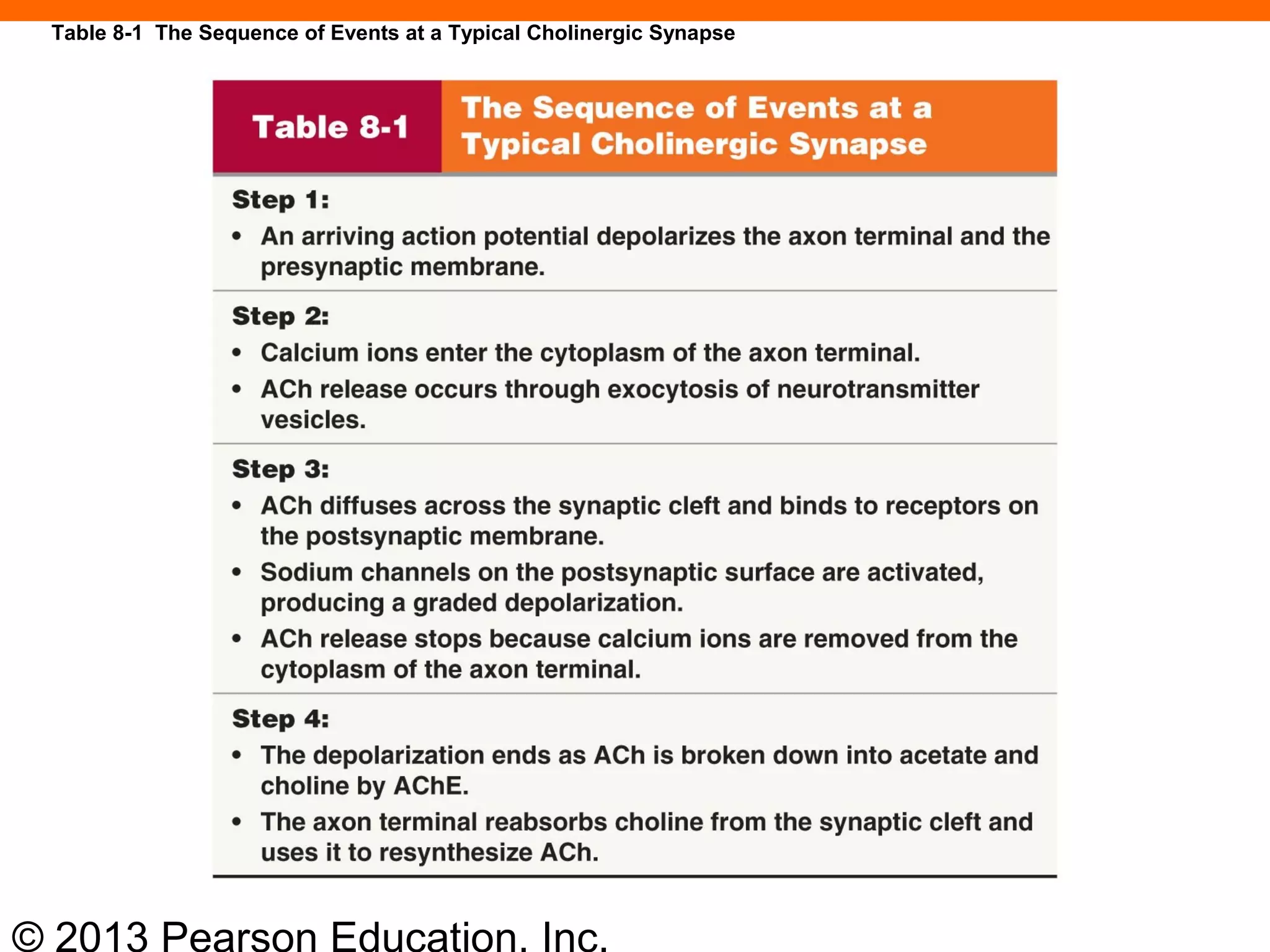
• Activates cholinergic synapses in four steps
1. Action potential arrives at the axon terminal
2. ACh is released and diffuses across synaptic cleft
3. ACh binds to receptors and triggers depolarization of
the postsynaptic membrane
4. ACh is removed by AChE (acetylcholinesterase)
© 2013 Pearson Education, Inc.
Figure 8-11 The Events at a Cholinergic Synapse.
An action potential arrives and
depolarizes the axon terminal
Presynaptic
neuron
Synaptic
vesicles
Action potential
EXTRACELLULAR
FLUID
Axon
terminal
AChE
POSTSYNAPTIC
NEURON
Extracellular Ca2+
enters the axon
terminal, triggering the exocytosis of ACh
Ca2+
Synaptic cleftCa2+
ACh
Chemically regulated
sodium ion channels
© 2013 Pearson Education, Inc.
Figure 8-11 The Events at a Cholinergic Synapse.
ACh binds to receptors and depolarizes
the postsynaptic membrane
Initiation of
action potential
if threshold is
reached
ACh is removed by AChE
Propagation of
action potential
(if generated)
© 2013 Pearson Education, Inc.
Table 8-1 The Sequence of Events at a Typical Cholinergic Synapse
© 2013 Pearson Education, Inc.
Other Important Neurotransmitters (8-4)
• Norepinephrine (NE)
• In the brain and part of the ANS, is found in adrenergic
synapses
• Dopamine, GABA, and serotonin
• Are CNS neurotransmitters
• At least 50 less-understood neurotransmitters
• NO and CO
• Are gases that act as neurotransmitters
© 2013 Pearson Education, Inc.
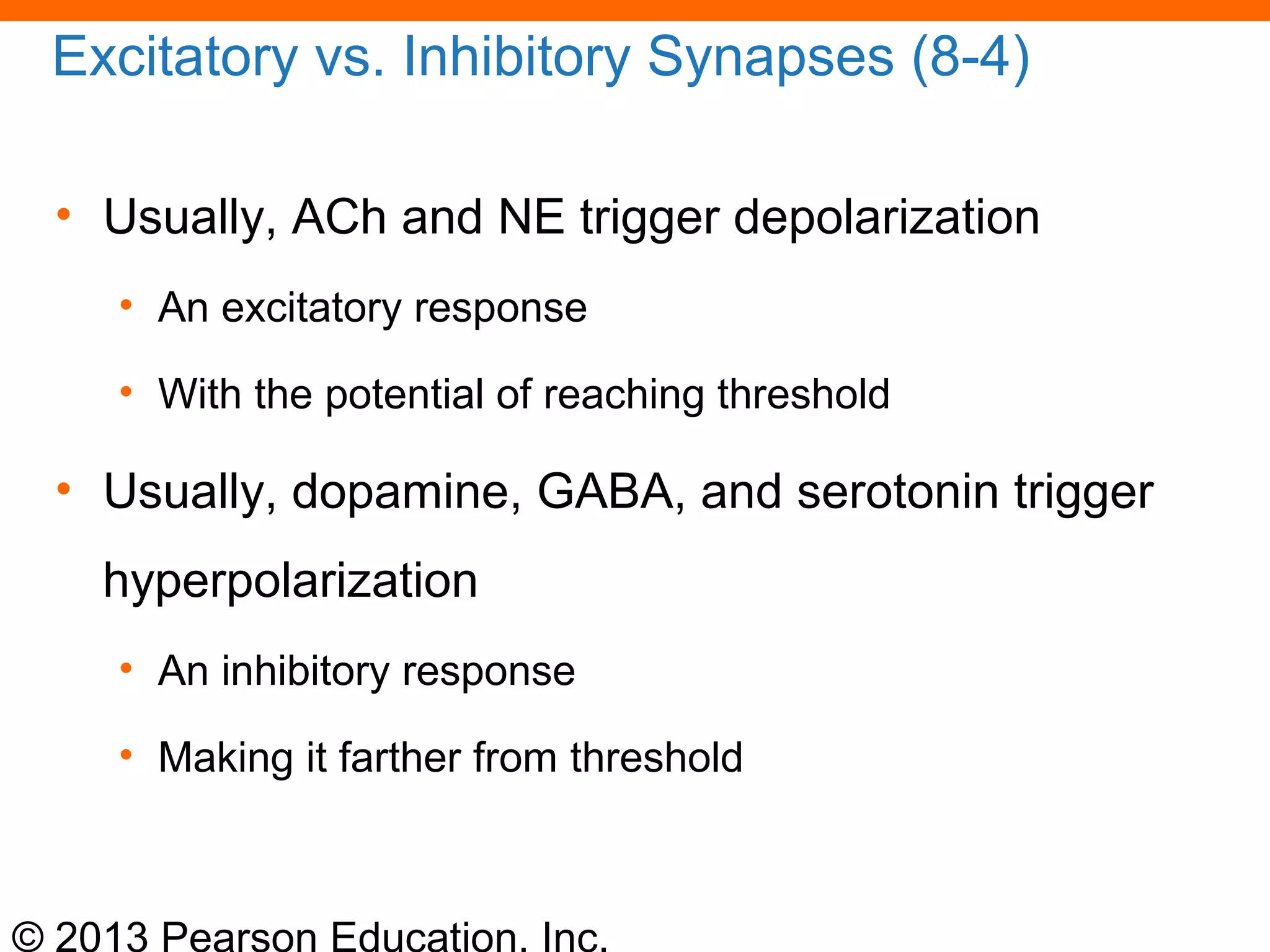
Excitatory vs. Inhibitory Synapses (8-4)
• Usually, ACh and NE trigger depolarization
• An excitatory response
• With the potential of reaching threshold
• Usually, dopamine, GABA, and serotonin trigger
hyperpolarization
• An inhibitory response
• Making it farther from threshold
© 2013 Pearson Education, Inc.
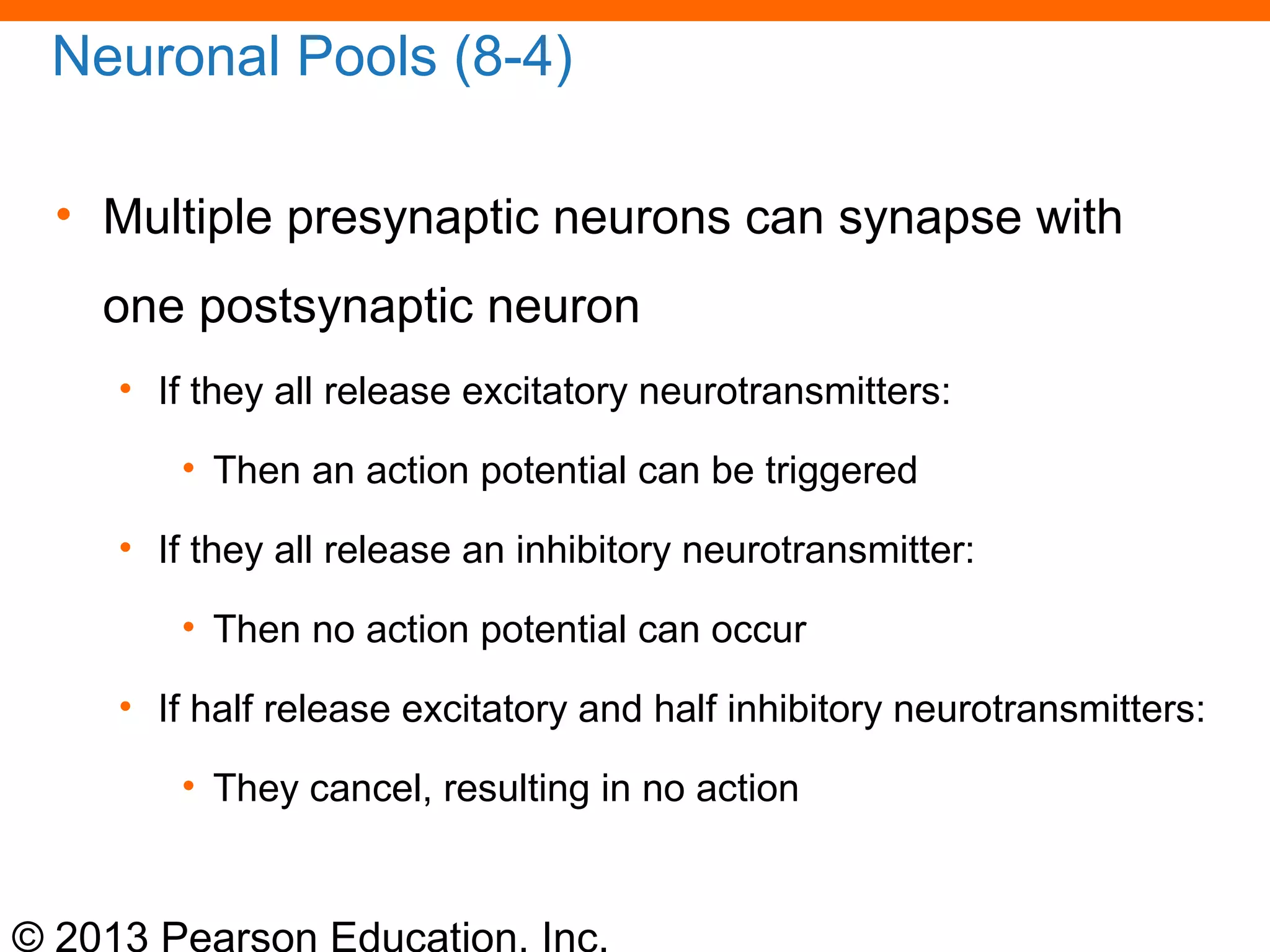
Neuronal Pools (8-4)
• Multiple presynaptic neurons can synapse with
one postsynaptic neuron
• If they all release excitatory neurotransmitters:
• Then an action potential can be triggered
• If they all release an inhibitory neurotransmitter:
• Then no action potential can occur
• If half release excitatory and half inhibitory neurotransmitters:
• They cancel, resulting in no action
© 2013 Pearson Education, Inc.
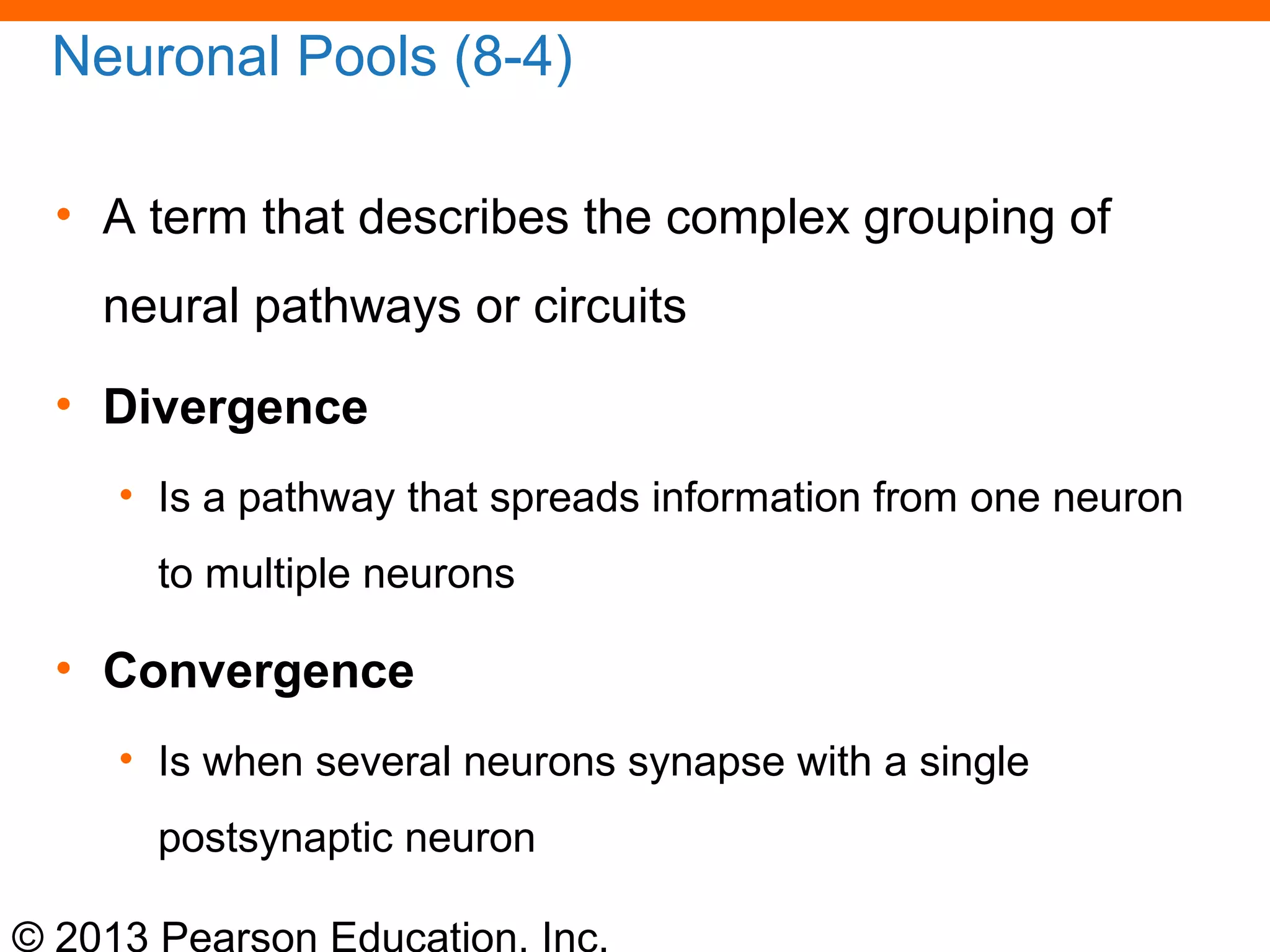
Neuronal Pools (8-4)
• A term that describes the complex grouping of
neural pathways or circuits
• Divergence
• Is a pathway that spreads information from one neuron
to multiple neurons
• Convergence
• Is when several neurons synapse with a single
postsynaptic neuron
© 2013 Pearson Education, Inc.
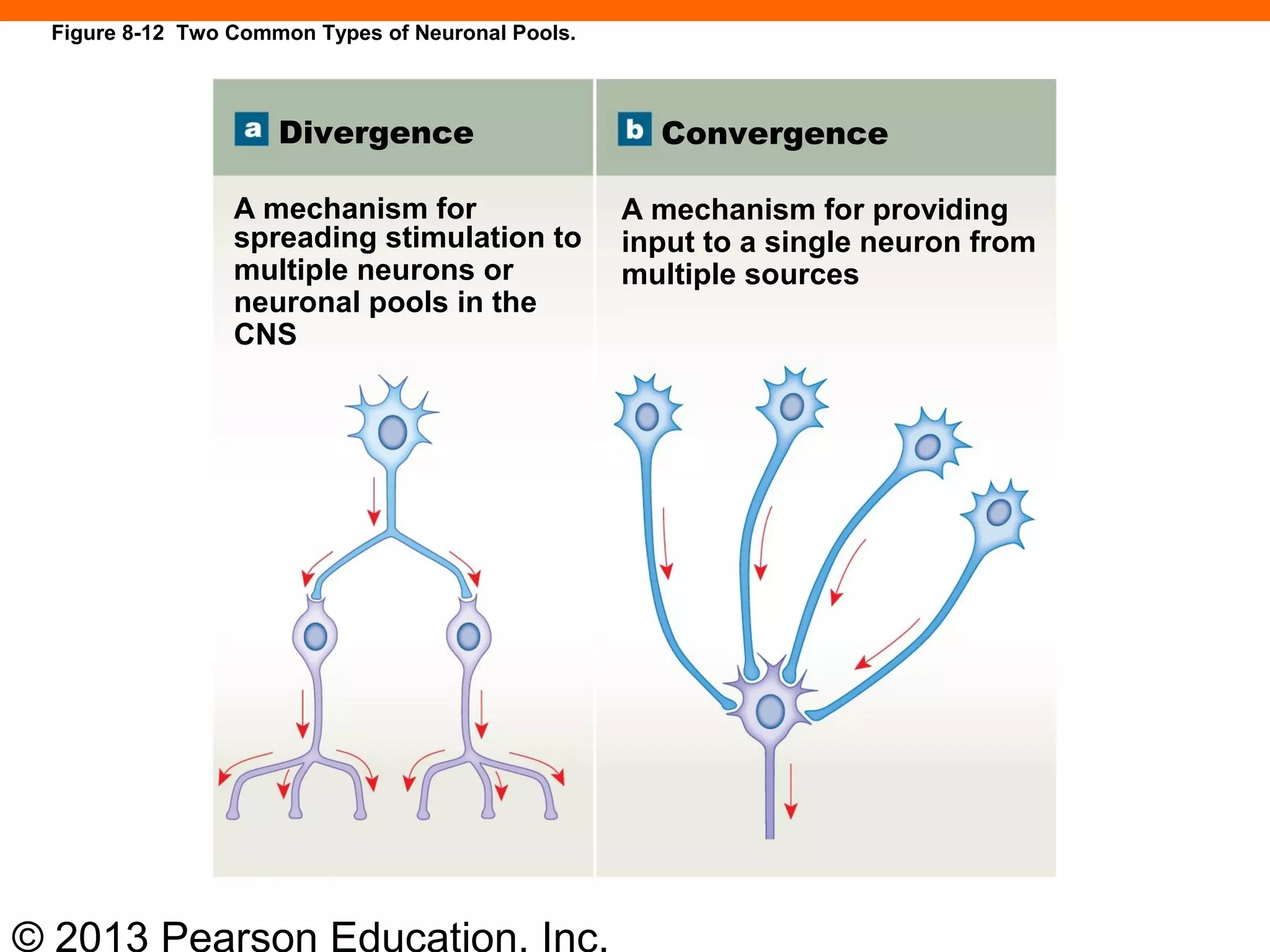
Divergence Convergence
A mechanism for
spreading stimulation to
multiple neurons or
neuronal pools in the
CNS
A mechanism for providing
input to a single neuron from
multiple sources
Figure 8-12 Two Common Types of Neuronal Pools.
© 2013 Pearson Education, Inc.
Checkpoint (8-4)
13. Describe the general structure of a synapse.
14. What effect would blocking calcium channels at
a cholinergic synapse have on synapse
function?
15. What type of neural circuit permits both
conscious and subconscious control of the
same motor neurons?
© 2013 Pearson Education, Inc.
The Meninges (8-5)
• The neural tissue in the CNS is protected by
three layers of specialized membranes
1. Dura mater
2. Arachnoid
3. Pia mater
© 2013 Pearson Education, Inc.
The Dura Mater (8-5)
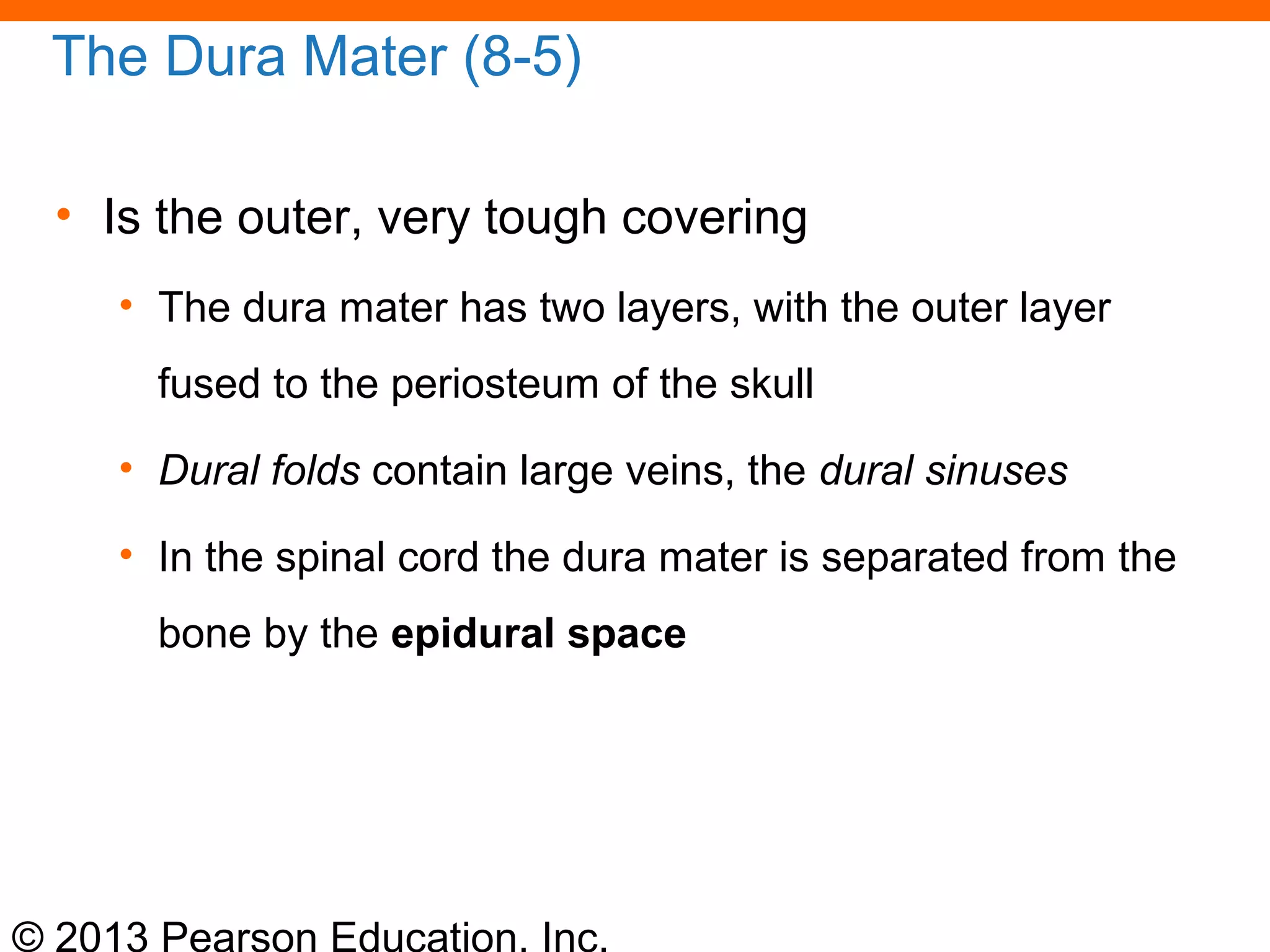
• Is the outer, very tough covering
• The dura mater has two layers, with the outer layer
fused to the periosteum of the skull
• Dural folds contain large veins, the dural sinuses
• In the spinal cord the dura mater is separated from the
bone by the epidural space
© 2013 Pearson Education, Inc.
The Arachnoid
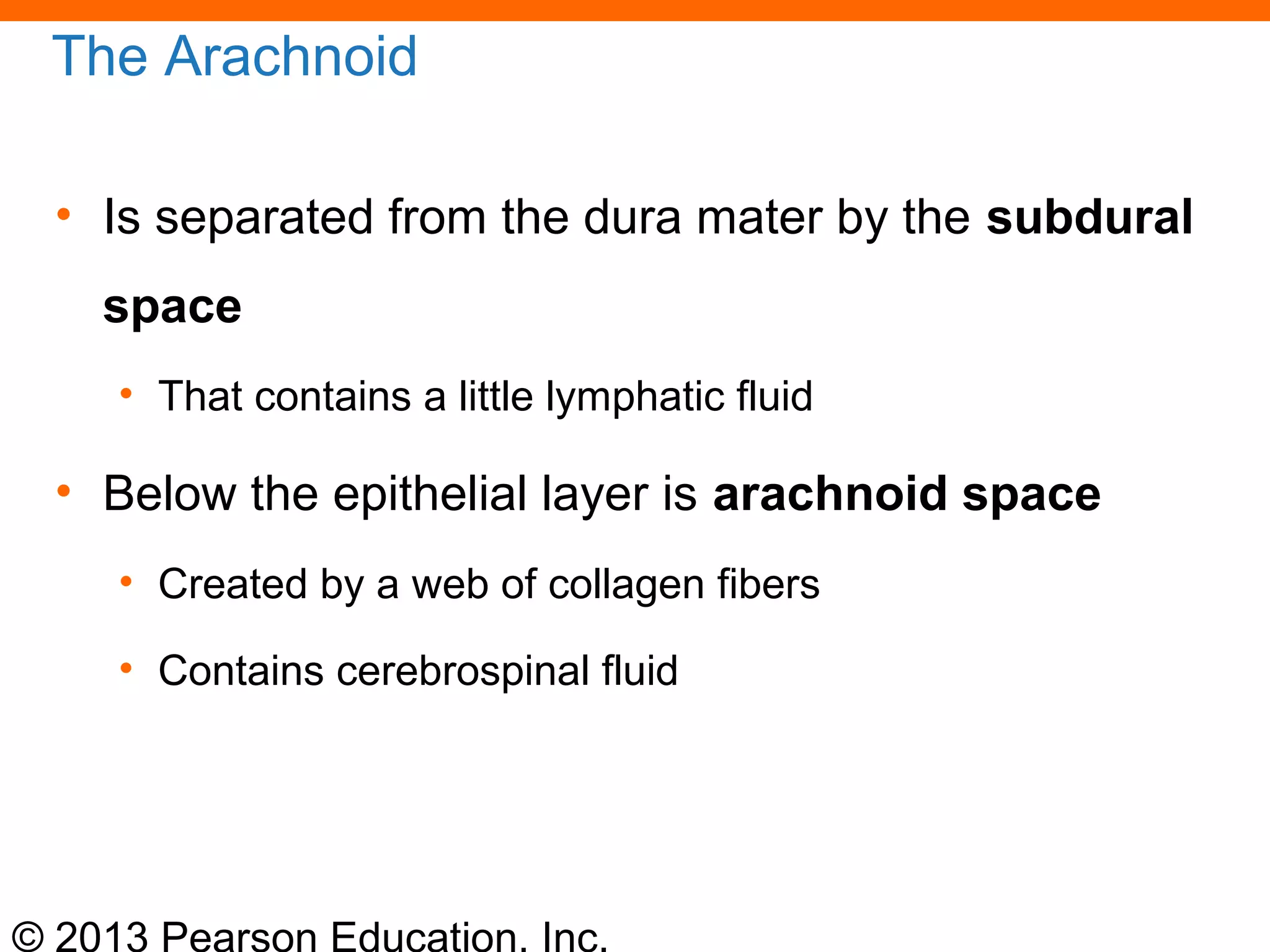
• Is separated from the dura mater by the subdural
space
• That contains a little lymphatic fluid
• Below the epithelial layer is arachnoid space
• Created by a web of collagen fibers
• Contains cerebrospinal fluid
© 2013 Pearson Education, Inc.
The Pia Mater
• Is the innermost layer
• Firmly bound to the neural tissue underneath
• Highly vascularized
• Providing needed oxygen and nutrients
© 2013 Pearson Education, Inc.
Checkpoint (8-5)
16. Identify the three meninges surrounding the
CNS.
© 2013 Pearson Education, Inc.
Spinal Cord Structure (8-6)
• The major neural pathway between the brain and
the PNS
• Can also act as an integrator in the spinal reflexes
• Involving the 31 pairs of spinal nerves
• Consistent in diameter except for the cervical
enlargement and lumbar enlargement
• Where numerous nerves supply upper and lower limbs
© 2013 Pearson Education, Inc.
Spinal Cord Structure (8-6)
• Central canal
• A narrow passage containing cerebrospinal fluid
• Surface of the spinal cord is indented by the:
• Posterior median sulcus
• Deeper anterior median fissure
© 2013 Pearson Education, Inc.
31 Spinal Segments (8-6)
• Identified by a letter and number relating to the
nearby vertebrae
• Each has a pair of dorsal root ganglia
• Containing the cell bodies of sensory neurons with
axons in dorsal root
• Ventral roots contain motor neuron axons
• Roots are contained in one spinal nerve
© 2013 Pearson Education, Inc.
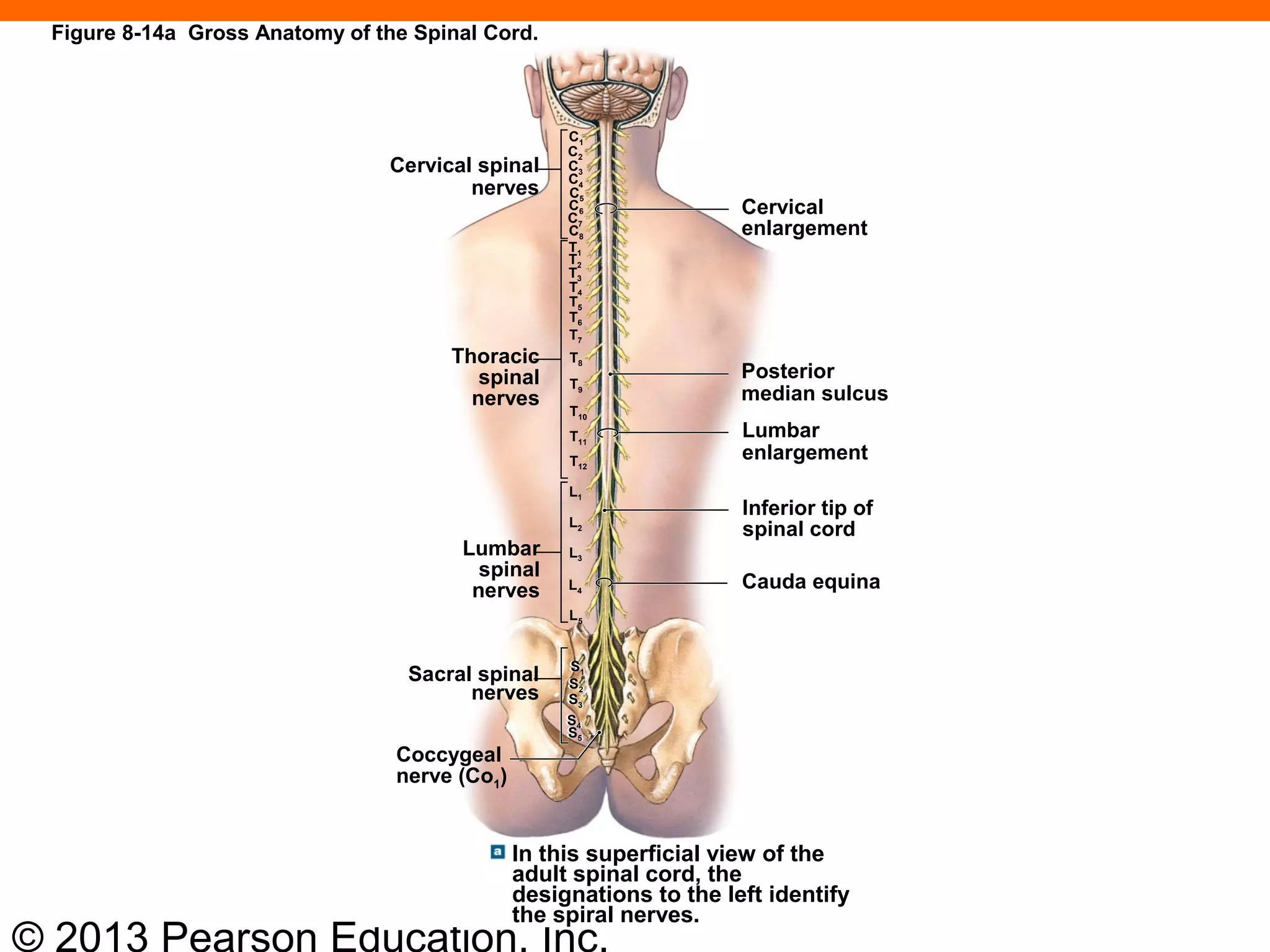
Figure 8-14a Gross Anatomy of the Spinal Cord.
Cervical
enlargement
Posterior
median sulcus
Lumbar
enlargement
Inferior tip of
spinal cord
Cauda equina
Cervical spinal
nerves
Thoracic
spinal
nerves
Lumbar
spinal
nerves
Sacral spinal
nerves
Coccygeal
nerve (Co1)
In this superficial view of the
adult spinal cord, the
designations to the left identify
the spiral nerves.
C1
C2
C3
C4
C5
C6
C7
C8
T1
T2
T3
T4
T5
T6
T7
T8
T9
T10
T11
T12
L1
L2
L3
L4
L5
S5S5
S1S1
S2S2
S3S3
S4S4
© 2013 Pearson Education, Inc.
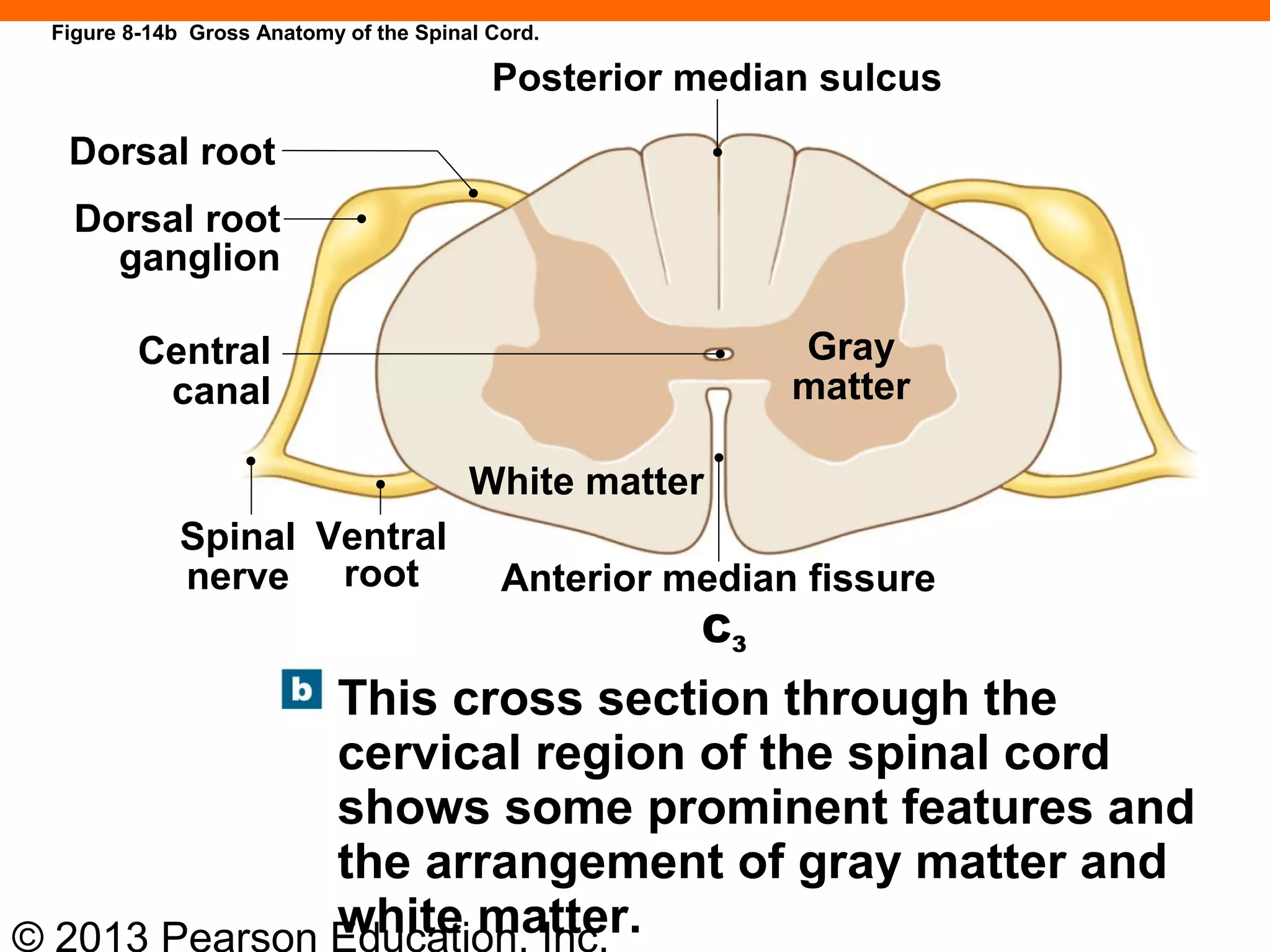
Figure 8-14b Gross Anatomy of the Spinal Cord.
This cross section through the
cervical region of the spinal cord
shows some prominent features and
the arrangement of gray matter and
white matter.
C3
Dorsal root
Dorsal root
ganglion
Central
canal
Spinal
nerve
Ventral
root
Posterior median sulcus
White matter
Gray
matter
Anterior median fissure
© 2013 Pearson Education, Inc.
Sectional Anatomy of the Spinal Cord (8-6)
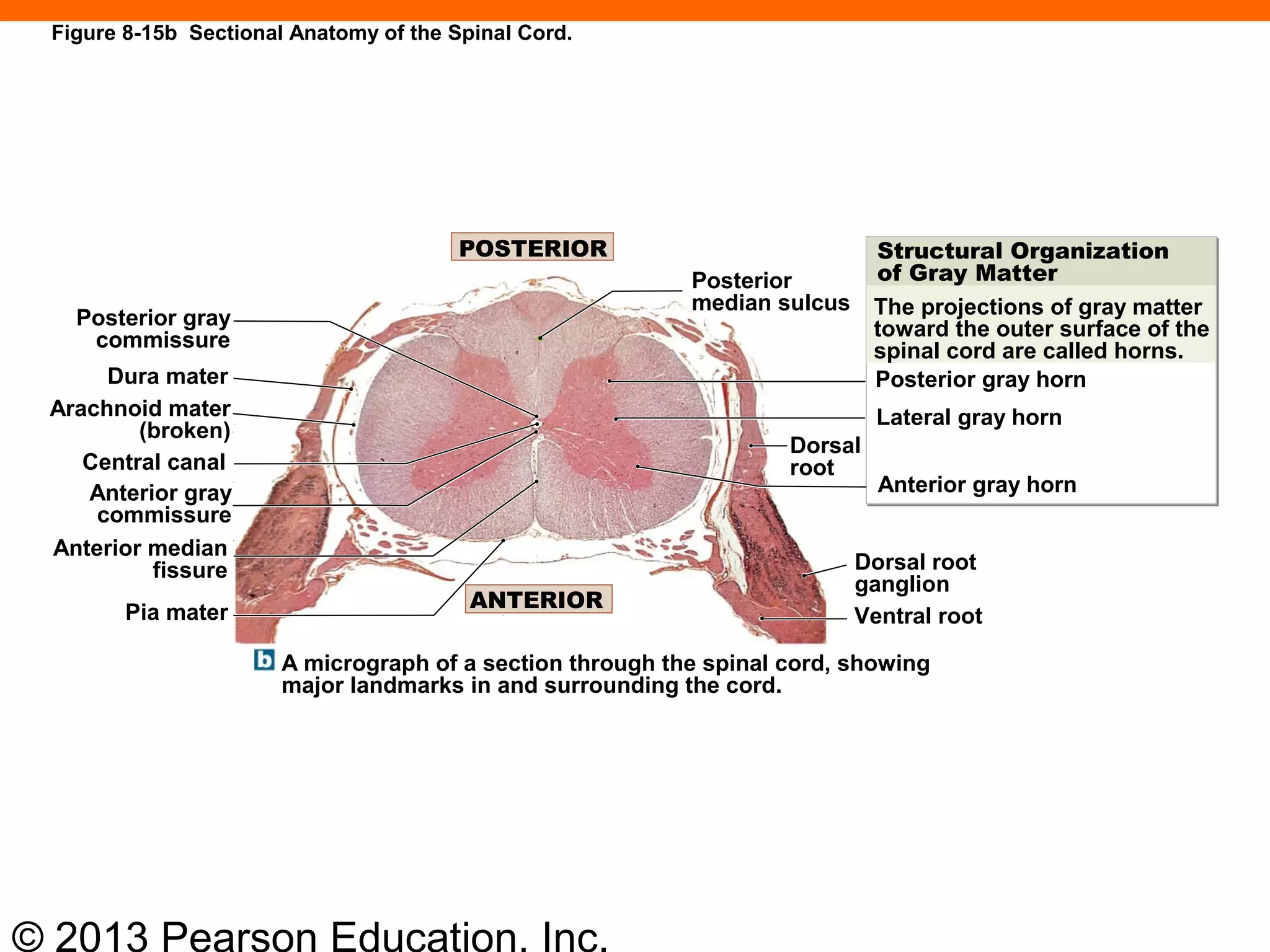
• The central gray matter is made up of glial cells
and nerve cell bodies
• Projections of gray matter are called horns
• Which extend out into the white matter
• White matter is myelinated and unmyelinated
axons
• The location of cell bodies in specific nuclei of the
gray matter relate to their function
© 2013 Pearson Education, Inc.
Sectional Anatomy of the Spinal Cord (8-6)
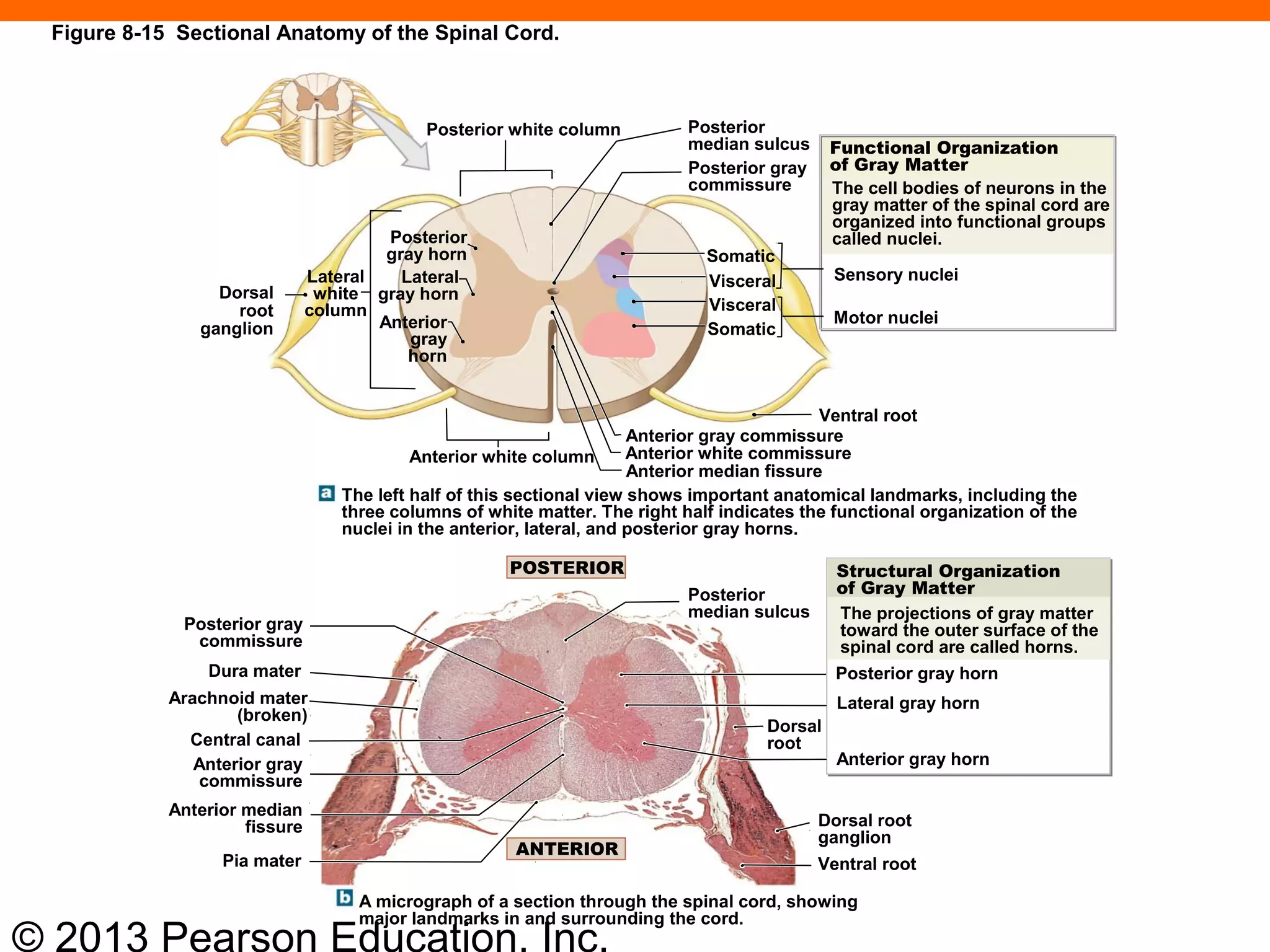
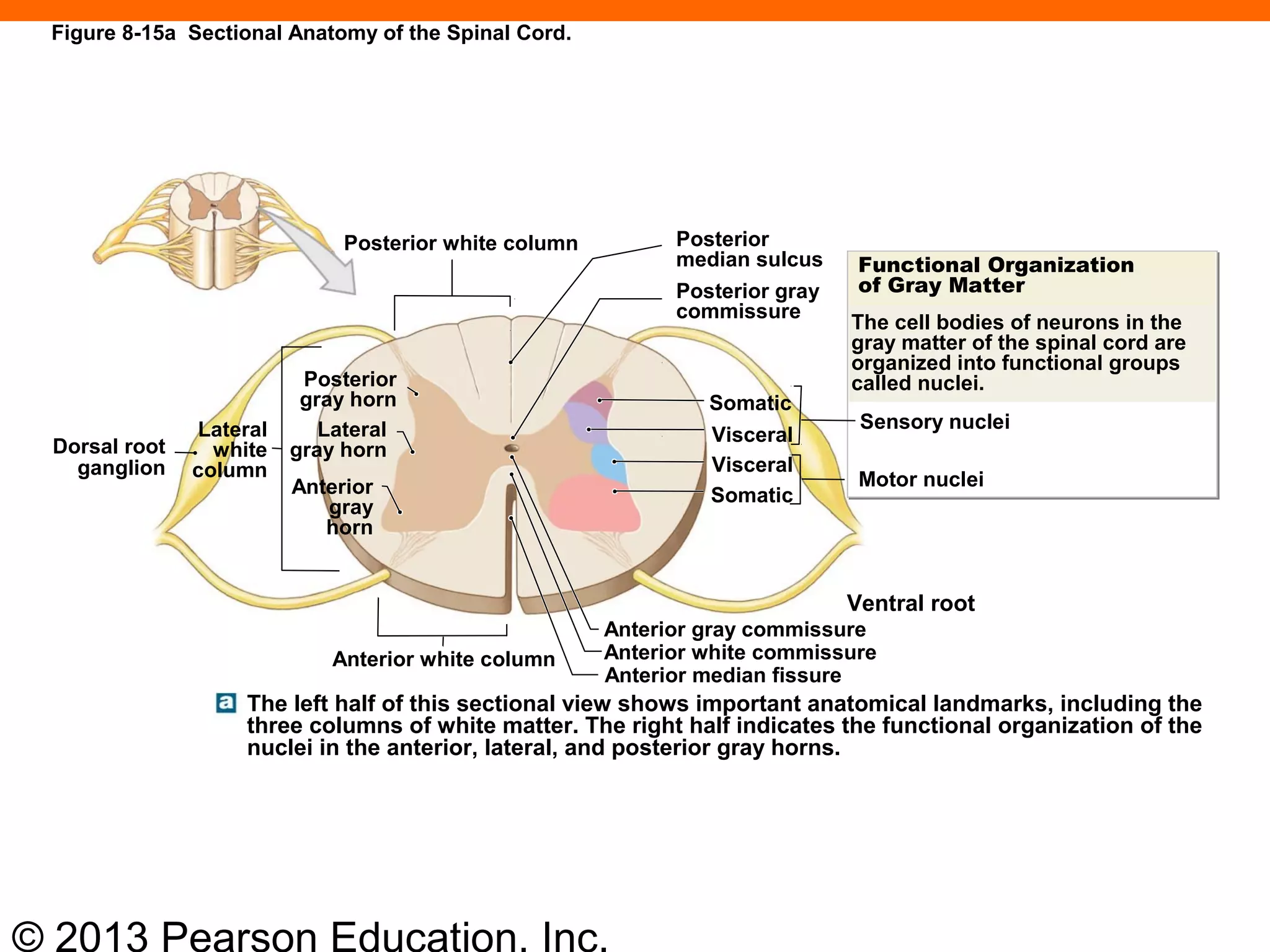
• Posterior gray horns are somatic and visceral
sensory nuclei
• Lateral gray horns are visceral (ANS) motor nuclei
• The anterior gray horns are somatic motor nuclei
• White matter can be organized into three columns
• Which contain either ascending tracts to the brain, or
descending tracts from the brain to the PNS
© 2013 Pearson Education, Inc.
Posterior white column
Dorsal
root
ganglion
Lateral
white
column
Posterior
gray horn
Lateral
gray horn
Anterior
gray
horn
Posterior
median sulcus
Posterior gray
commissure
Somatic
Visceral
Visceral
Somatic
Functional Organization
of Gray Matter
The cell bodies of neurons in the
gray matter of the spinal cord are
organized into functional groups
called nuclei.
Sensory nuclei
Motor nuclei
Ventral root
Anterior gray commissure
Anterior white commissure
Anterior median fissure
Anterior white column
The left half of this sectional view shows important anatomical landmarks, including the
three columns of white matter. The right half indicates the functional organization of the
nuclei in the anterior, lateral, and posterior gray horns.
Posterior
median sulcus
POSTERIOR Structural Organization
of Gray Matter
The projections of gray matter
toward the outer surface of the
spinal cord are called horns.
Posterior gray horn
Lateral gray horn
Anterior gray horn
Dorsal
root
Dorsal root
ganglion
Ventral root
Posterior gray
commissure
Dura mater
Arachnoid mater
(broken)
Central canal
Anterior gray
commissure
Anterior median
fissure
Pia mater
A micrograph of a section through the spinal cord, showing
major landmarks in and surrounding the cord.
ANTERIOR
Figure 8-15 Sectional Anatomy of the Spinal Cord.
© 2013 Pearson Education, Inc.
Figure 8-15a Sectional Anatomy of the Spinal Cord.
Posterior white column Posterior
median sulcus
Posterior gray
commissure
Posterior
gray horn
Dorsal root
ganglion
Lateral
white
column
Lateral
gray horn
Anterior
gray
horn
Somatic
Visceral
Visceral
Somatic
Functional Organization
of Gray Matter
The cell bodies of neurons in the
gray matter of the spinal cord are
organized into functional groups
called nuclei.
Sensory nuclei
Motor nuclei
Ventral root
Anterior gray commissure
Anterior white commissure
Anterior median fissure
Anterior white column
The left half of this sectional view shows important anatomical landmarks, including the
three columns of white matter. The right half indicates the functional organization of the
nuclei in the anterior, lateral, and posterior gray horns.
© 2013 Pearson Education, Inc.
Figure 8-15b Sectional Anatomy of the Spinal Cord.
A micrograph of a section through the spinal cord, showing
major landmarks in and surrounding the cord.
Pia mater
Anterior median
fissure
Anterior gray
commissure
Central canal
Arachnoid mater
(broken)
Dura mater
Posterior gray
commissure
POSTERIOR
ANTERIOR
Posterior
median sulcus
Dorsal
root
Dorsal root
ganglion
Ventral root
Structural Organization
of Gray Matter
Posterior gray horn
Lateral gray horn
Anterior gray horn
The projections of gray matter
toward the outer surface of the
spinal cord are called horns.
© 2013 Pearson Education, Inc.
Checkpoint (8-6)
17. Damage to which root of a spinal nerve would
interfere with motor function?
18. A person with polio has lost the use of his leg
muscles. In which areas of his spinal cord could
you locate virus-infected neurons?
19. Why are spinal nerves also called mixed nerves?
© 2013 Pearson Education, Inc.
Six Major Regions of the Brain (8-7)
1. The cerebrum
2. The diencephalon
3. The midbrain
4. The pons
5. The medulla oblongata
6. The cerebellum
© 2013 Pearson Education, Inc.
Major Structures of the Brain (8-7)
• The cerebrum
• Is divided into paired cerebral hemispheres
• Deep to the cerebrum is the diencephalon
• Which is divided into the thalamus, the hypothalamus,
and the epithalamus
• The brain stem
• Contains the midbrain, pons, and medulla oblongata
• The cerebellum
• Is the most inferior/posterior part
© 2013 Pearson Education, Inc.
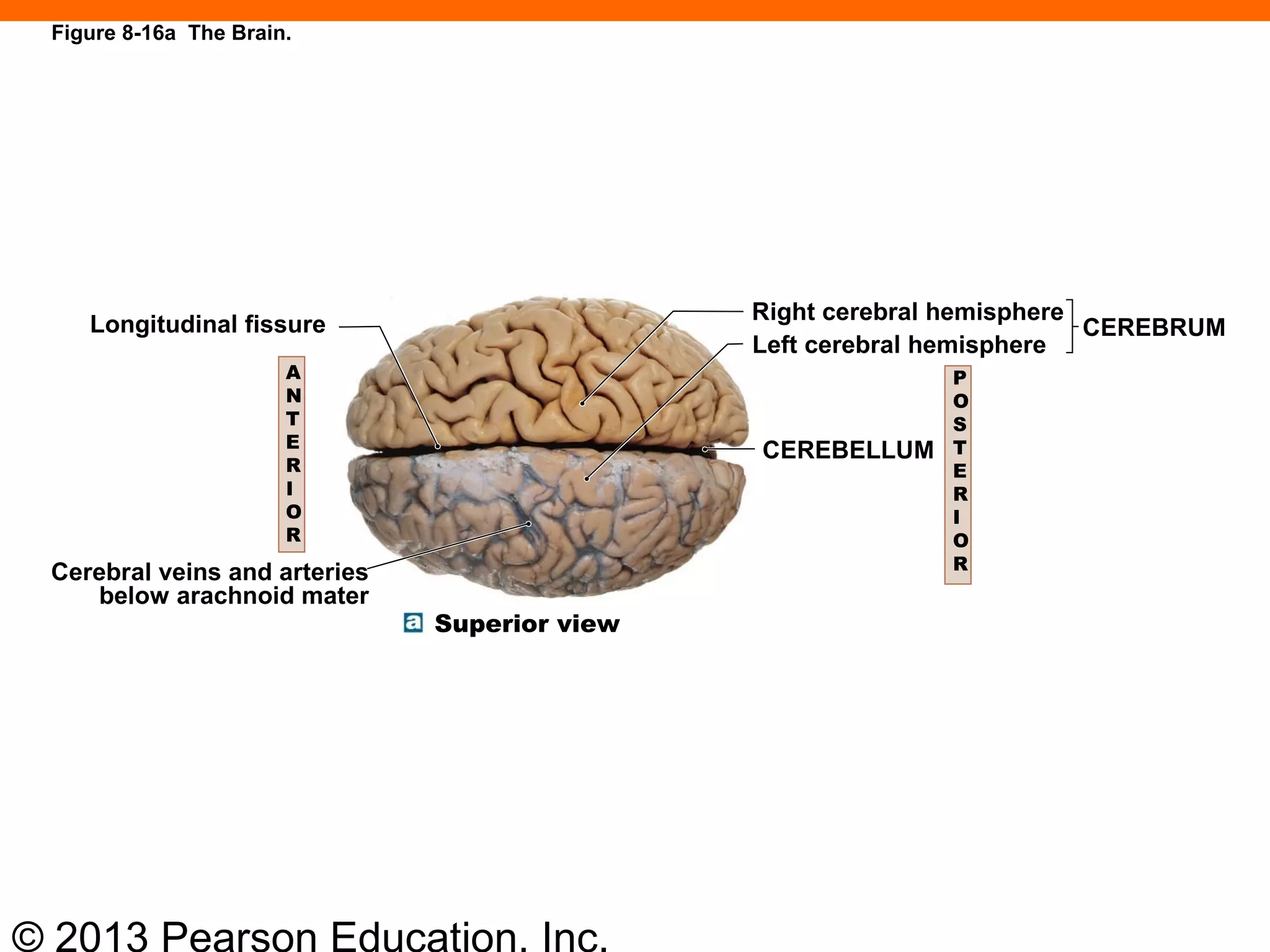
Figure 8-16a The Brain.
Longitudinal fissure
Cerebral veins and arteries
below arachnoid mater
Right cerebral hemisphere
Left cerebral hemisphere
CEREBRUM
CEREBELLUM
A
N
T
E
R
I
O
R
P
O
S
T
E
R
I
O
R
Superior view
© 2013 Pearson Education, Inc.
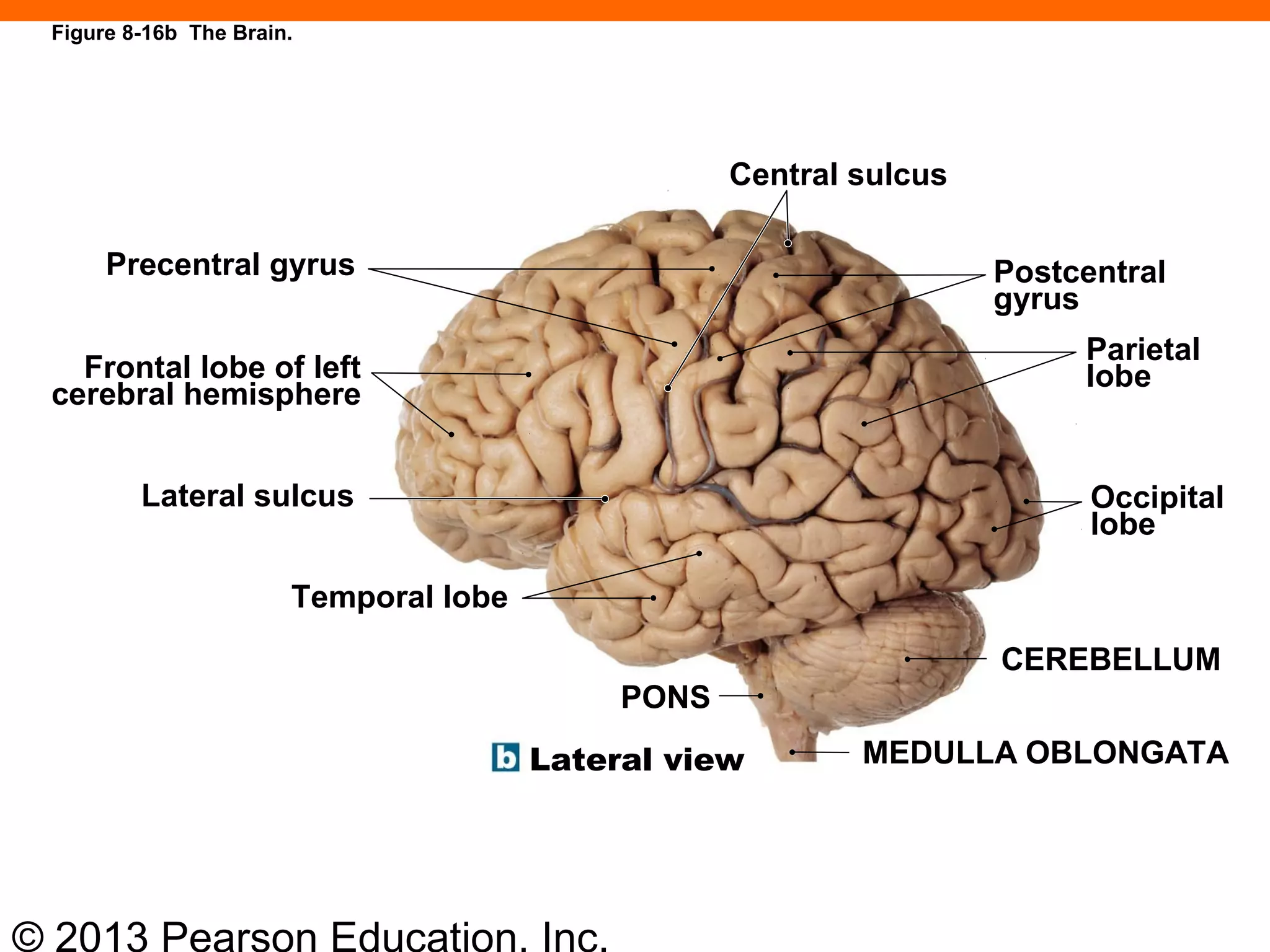
Figure 8-16b The Brain.
Precentral gyrus
Frontal lobe of left
cerebral hemisphere
Lateral sulcus
Temporal lobe
PONS
Central sulcus
Postcentral
gyrus
Parietal
lobe
Occipital
lobe
CEREBELLUM
MEDULLA OBLONGATALateral view
© 2013 Pearson Education, Inc.
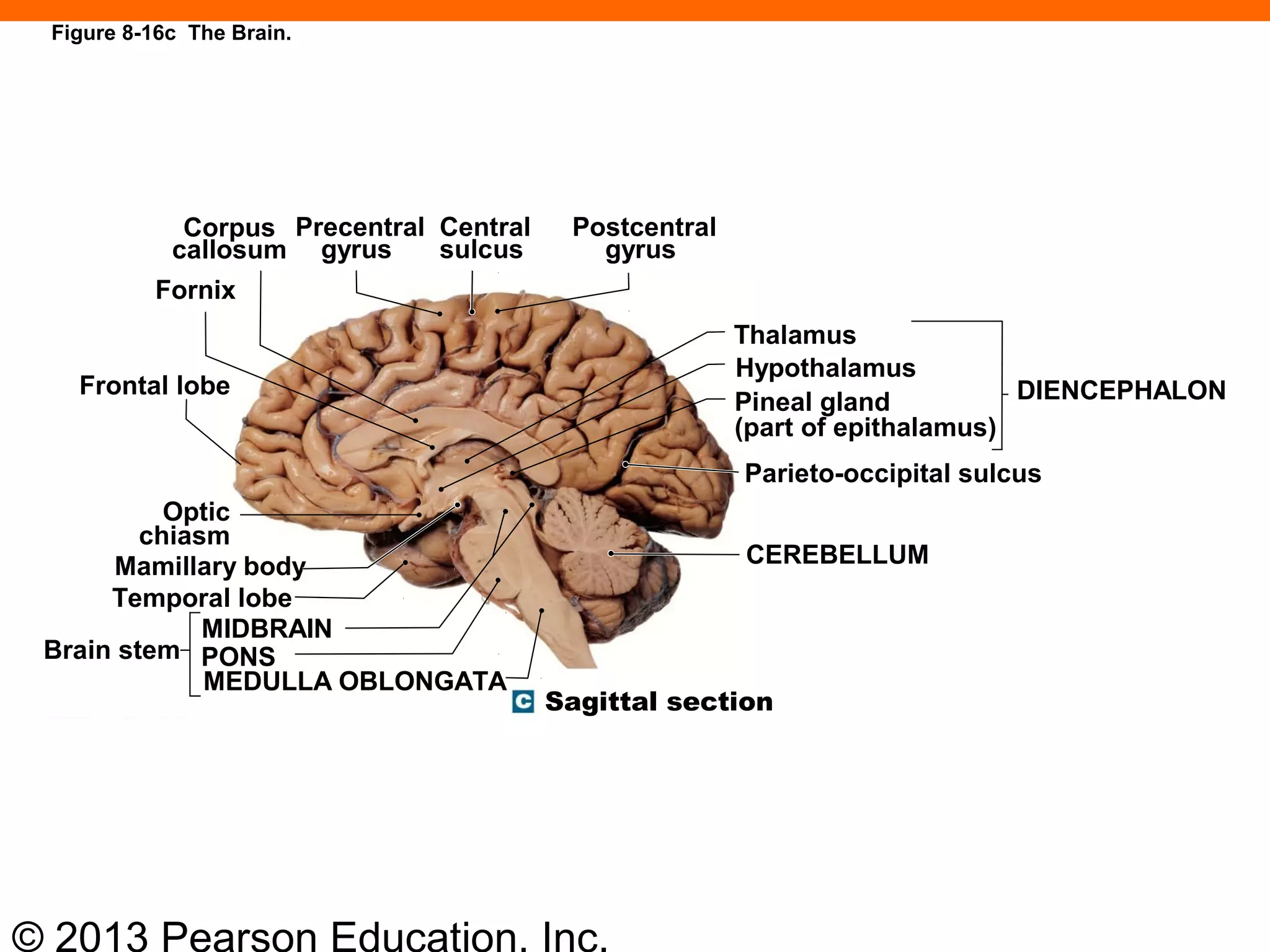
Figure 8-16c The Brain.
Corpus
callosum
Precentral
gyrus
Central
sulcus
Postcentral
gyrus
Thalamus
Hypothalamus
Pineal gland
(part of epithalamus)
Parieto-occipital sulcus
CEREBELLUM
Sagittal section
MEDULLA OBLONGATA
PONS
MIDBRAIN
Brain stem
Temporal lobe
Fornix
Frontal lobe
Optic
chiasm
Mamillary body
DIENCEPHALON
© 2013 Pearson Education, Inc.
The Ventricles of the Brain (8-7)
• Filled with cerebrospinal fluid and lined with
ependymal cells
• The two lateral ventricles within each cerebral
hemisphere drain through the:
• Interventricular foramen into the:
• Third ventricle in the diencephalon, which drains
through the cerebral aqueduct into the:
• Fourth ventricle, which drains into the central canal
© 2013 Pearson Education, Inc.
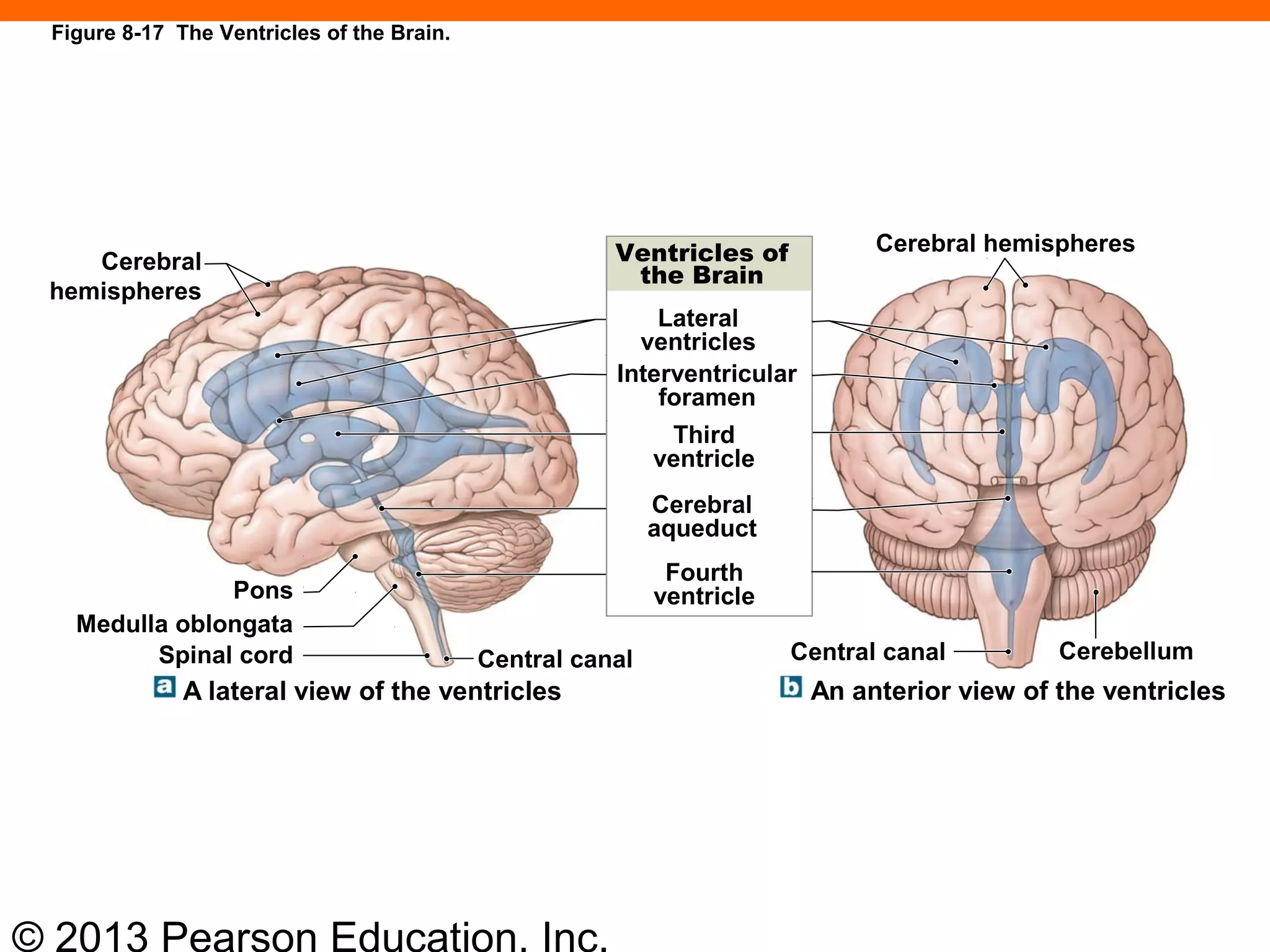
Cerebral
hemispheres
Pons
Medulla oblongata
Spinal cord
A lateral view of the ventricles
Central canal
Lateral
ventricles
Interventricular
foramen
Third
ventricle
Cerebral
aqueduct
Fourth
ventricle
Cerebral hemispheres
Central canal Cerebellum
An anterior view of the ventricles
Ventricles of
the Brain
Figure 8-17 The Ventricles of the Brain.
© 2013 Pearson Education, Inc.
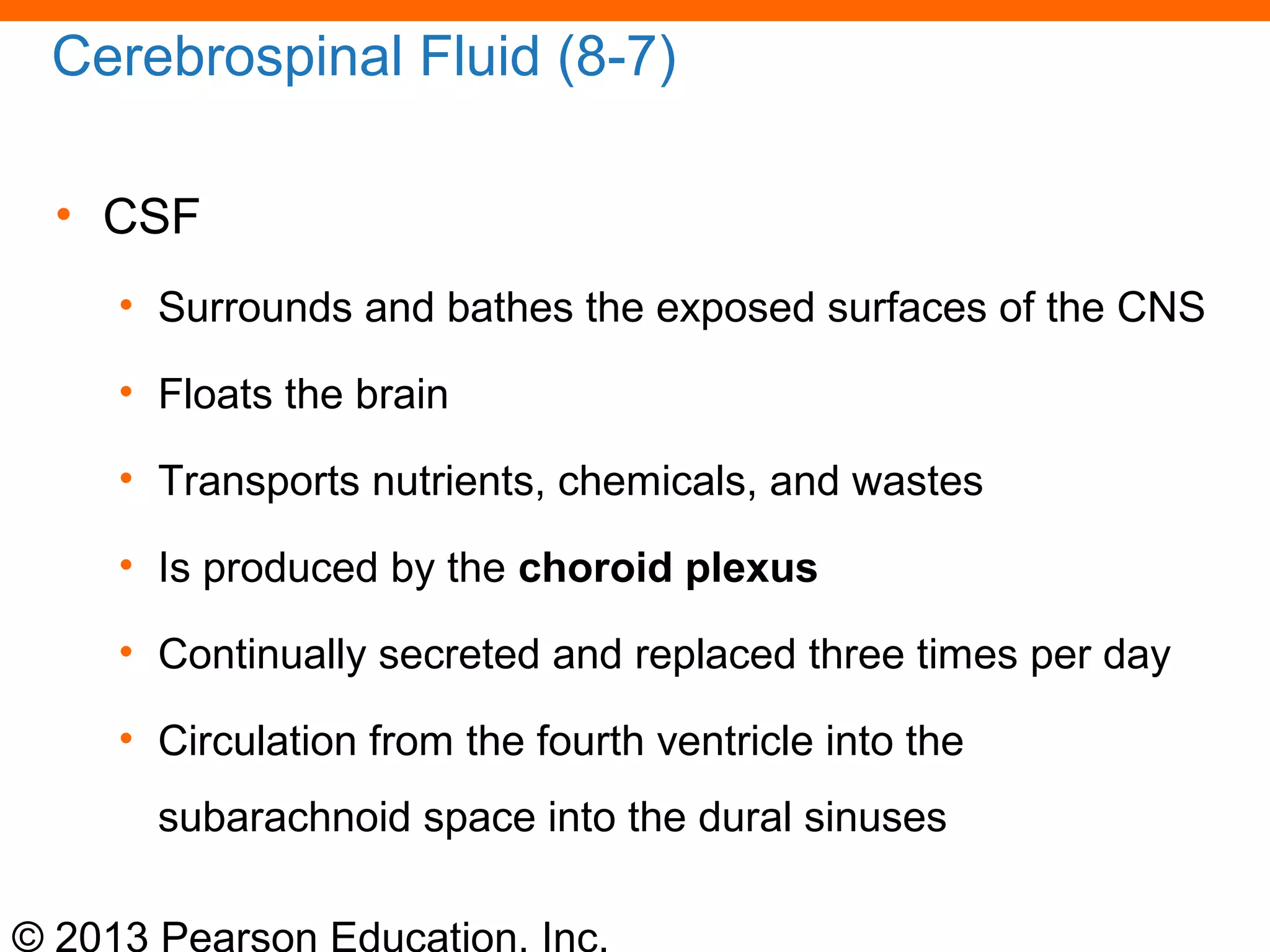
Cerebrospinal Fluid (8-7)
• CSF
• Surrounds and bathes the exposed surfaces of the CNS
• Floats the brain
• Transports nutrients, chemicals, and wastes
• Is produced by the choroid plexus
• Continually secreted and replaced three times per day
• Circulation from the fourth ventricle into the
subarachnoid space into the dural sinuses
© 2013 Pearson Education, Inc.
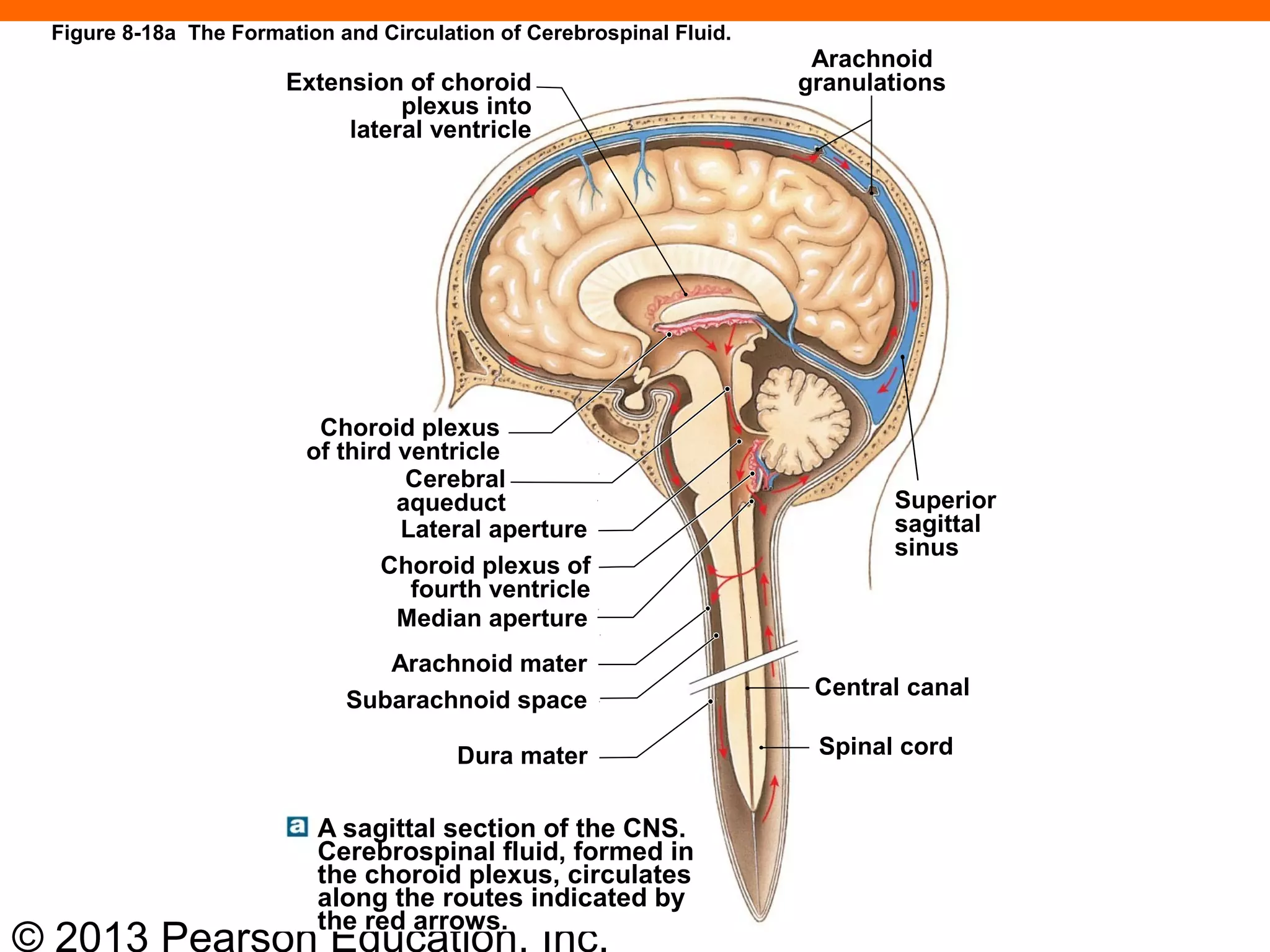
Figure 8-18a The Formation and Circulation of Cerebrospinal Fluid.
A sagittal section of the CNS.
Cerebrospinal fluid, formed in
the choroid plexus, circulates
along the routes indicated by
the red arrows.
Spinal cord
Central canal
Superior
sagittal
sinus
Arachnoid
granulationsExtension of choroid
plexus into
lateral ventricle
Choroid plexus
of third ventricle
Cerebral
aqueduct
Lateral aperture
Choroid plexus of
fourth ventricle
Median aperture
Arachnoid mater
Subarachnoid space
Dura mater
© 2013 Pearson Education, Inc.
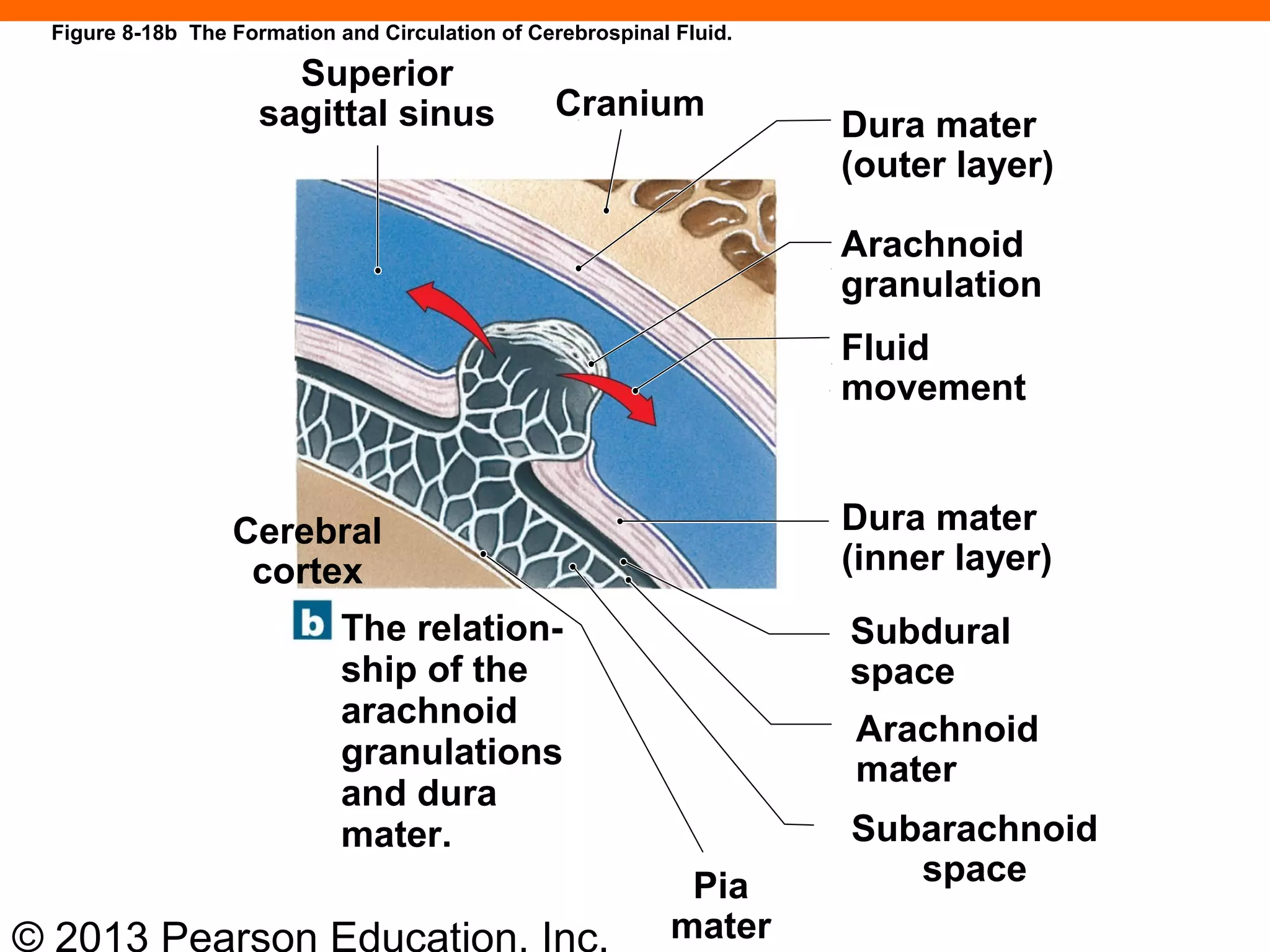
Figure 8-18b The Formation and Circulation of Cerebrospinal Fluid.
The relation-
ship of the
arachnoid
granulations
and dura
mater.
Pia
mater
Subarachnoid
space
Arachnoid
mater
Subdural
space
Dura mater
(inner layer)
Fluid
movement
Arachnoid
granulation
Dura mater
(outer layer)
Cranium
Superior
sagittal sinus
Cerebral
cortex
© 2013 Pearson Education, Inc.
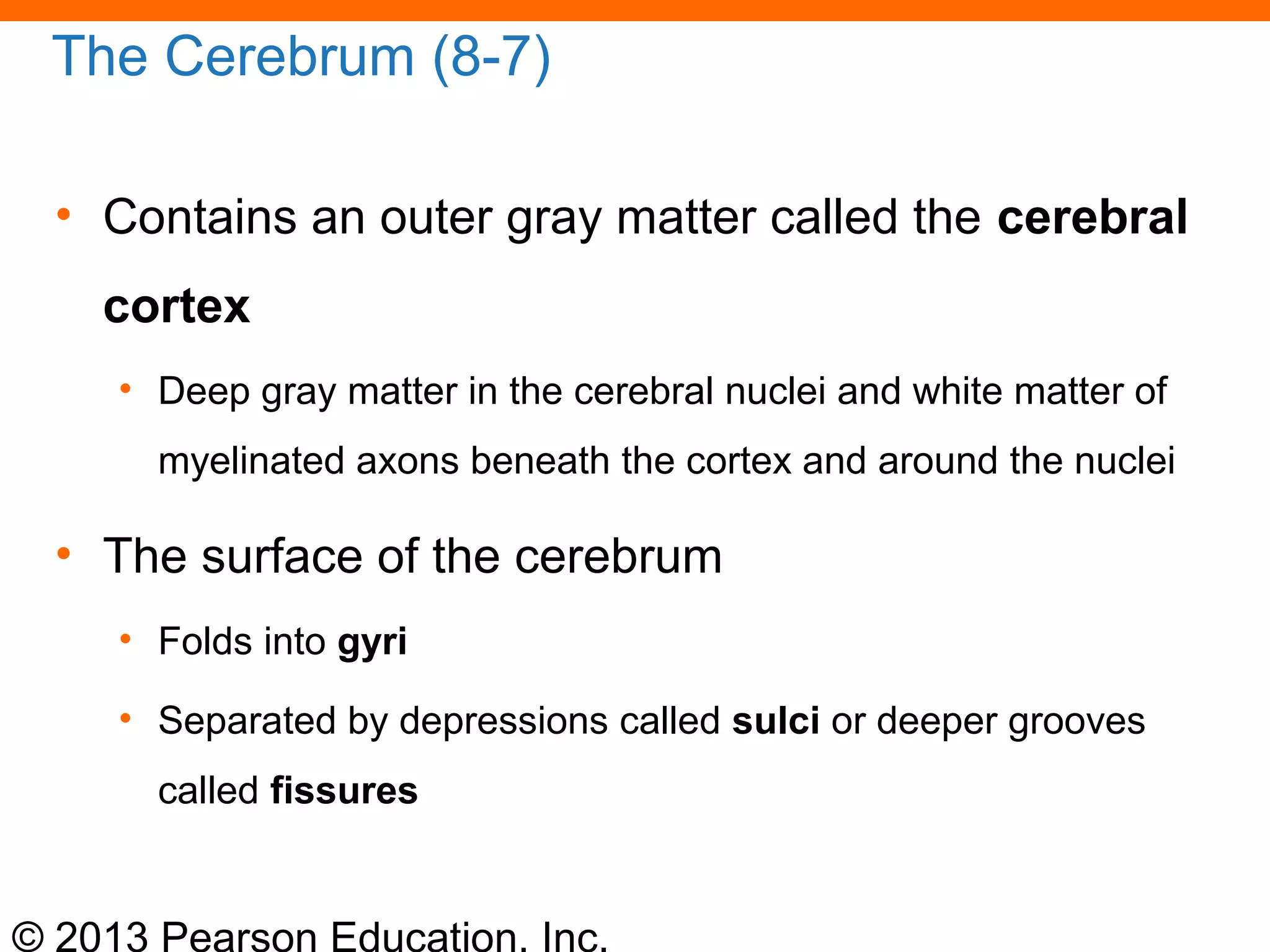
The Cerebrum (8-7)
• Contains an outer gray matter called the cerebral
cortex
• Deep gray matter in the cerebral nuclei and white matter of
myelinated axons beneath the cortex and around the nuclei
• The surface of the cerebrum
• Folds into gyri
• Separated by depressions called sulci or deeper grooves
called fissures
© 2013 Pearson Education, Inc.
The Cerebral Hemispheres (8-7)
• Are separated by the longitudinal fissure
• The central sulcus
• Extends laterally from the longitudinal fissure
• The frontal lobe
• Is anterior to the central sulcus
• Is bordered inferiorly by the lateral sulcus
© 2013 Pearson Education, Inc.
The Cerebral Hemispheres (8-7)
• The temporal lobe
• Inferior to the lateral sulcus
• Overlaps the insula
• The parietal lobe
• Extends between the central sulcus and the parieto-
occipital sulcus
© 2013 Pearson Education, Inc.
The Cerebral Hemispheres (8-7)
• The occipital lobe
• Located most posteriorly
• The lobes are named for the cranial bone above it
• Each lobe has sensory regions and motor regions
• Each hemisphere sends and receives information
from the opposite side of the body
© 2013 Pearson Education, Inc.
Motor and Sensory Areas of the Cortex (8-7)
• Are divided by the central sulcus
• The precentral gyrus of the frontal lobe
• Contains the primary motor cortex
• The postcentral gyrus of the parietal lobe
• Contains the primary sensory cortex
© 2013 Pearson Education, Inc.
Motor and Sensory Areas of Cortex (8-7)
• The visual cortex is in the occipital lobe
• The gustatory, auditory, and olfactory cortexes
are in the temporal lobe
© 2013 Pearson Education, Inc.
Association Areas (8-7)
• Interpret incoming information
• Coordinate a motor response, integrating the
sensory and motor cortexes
• The somatic sensory association area
• Helps to recognize touch
• The somatic motor association area
• Is responsible for coordinating movement
© 2013 Pearson Education, Inc.
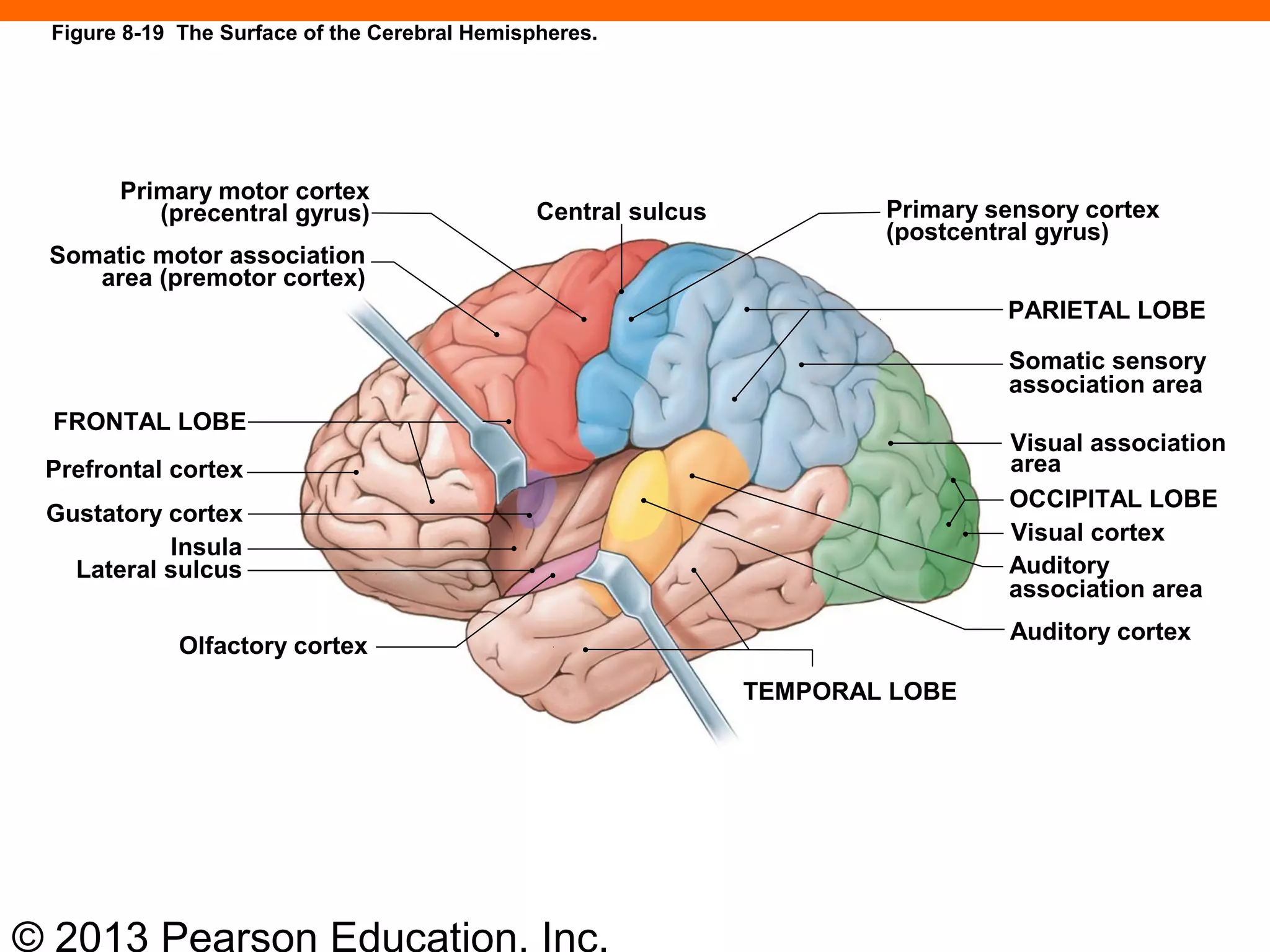
Primary motor cortex
(precentral gyrus)
Somatic motor association
area (premotor cortex)
FRONTAL LOBE
Prefrontal cortex
Gustatory cortex
Insula
Lateral sulcus
Olfactory cortex
TEMPORAL LOBE
Auditory cortex
Auditory
association area
Visual cortex
OCCIPITAL LOBE
Visual association
area
Somatic sensory
association area
PARIETAL LOBE
Primary sensory cortex
(postcentral gyrus)
Central sulcus
Figure 8-19 The Surface of the Cerebral Hemispheres.
© 2013 Pearson Education, Inc.
Cortical Connections (8-7)
• Regions of the cortex are linked by the deeper
white matter
• The left and right hemispheres are linked across
the corpus callosum
• Other axons link the cortex with:
• The diencephalon, brain stem, cerebellum, and spinal
cord
© 2013 Pearson Education, Inc.
Higher-Order Centers (8-7)
• Integrative areas, usually only in the left
hemisphere
• The general interpretive area or Wernicke's area
• Integrates sensory information to form visual and auditory
memory
• The speech center or Broca's area
• Regulates breathing and vocalization, the motor skills
needed for speaking
© 2013 Pearson Education, Inc.
The Prefrontal Cortex (8-7)
• In the frontal lobe
• Coordinates information from the entire cortex
• Skills such as:
• Predicting time lines
• Making judgments
• Feelings such as:
• Frustration, tension, and anxiety
© 2013 Pearson Education, Inc.
Hemispheric Lateralization (8-7)
• The concept that different brain functions can and
do occur on one side of the brain
• The left hemisphere tends to be involved in language
skills, analytical tasks, and logic
• The right hemisphere tends to be involved in analyzing
sensory input and relating it to the body, as well as
analyzing emotional content
© 2013 Pearson Education, Inc.
General interpretive
center (language and
mathematical calculation)
Auditory cortex
(right ear)
Writing
Speech center
Prefrontal
cortex
LEFT HAND RIGHT HAND
Prefrontal
cortex
Anterior commissure
Analysis by touch
Auditory cortex
(left ear)
Spatial visualization
and analysis
Visual cortex
(left visual field)
Visual cortex
(right visual field)
C
O
R
P
U
S
C
A
L
L
O
S
U
M
RIGHT
HEMISPHERE
LEFT
HEMISPHERE
Figure 8-20 Hemispheric Lateralization.
© 2013 Pearson Education, Inc.
The Electroencephalogram (8-7)
• EEG
• A printed record of brain wave activity
• Can be interpreted to diagnose brain disorders
• More modern techniques
• Brain imaging, using the PET scan and MRIs, has
allowed extensive "mapping" of the brain's functional
areas
© 2013 Pearson Education, Inc.
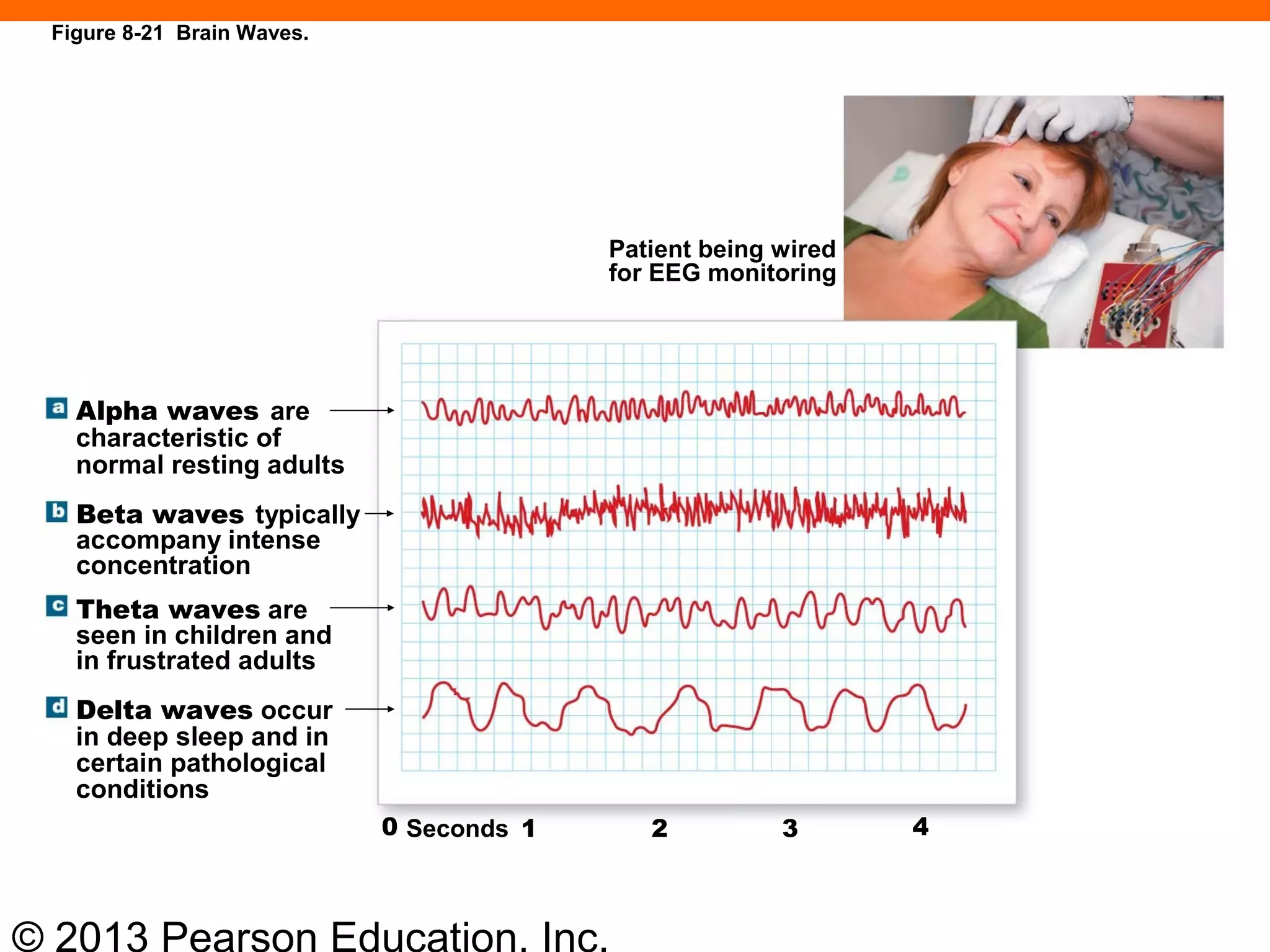
Patient being wired
for EEG monitoring
Alpha waves are
characteristic of
normal resting adults
Beta waves typically
accompany intense
concentration
Theta waves are
seen in children and
in frustrated adults
Delta waves occur
in deep sleep and in
certain pathological
conditions
0 1 2 3 4Seconds
Figure 8-21 Brain Waves.
© 2013 Pearson Education, Inc.
Memory (8-7)
• Fact memory
• The recall of bits of information
• Skill memory
• Learned motor skill that can become incorporated into unconscious
memory
• Short-term memory
• Doesn't last long unless rehearsed
• Converting into long-term memory through memory consolidation
• Long-term memory
• Remains for long periods, sometimes an entire lifetime
• Amnesia
• Memory loss as a result of disease or trauma
© 2013 Pearson Education, Inc.
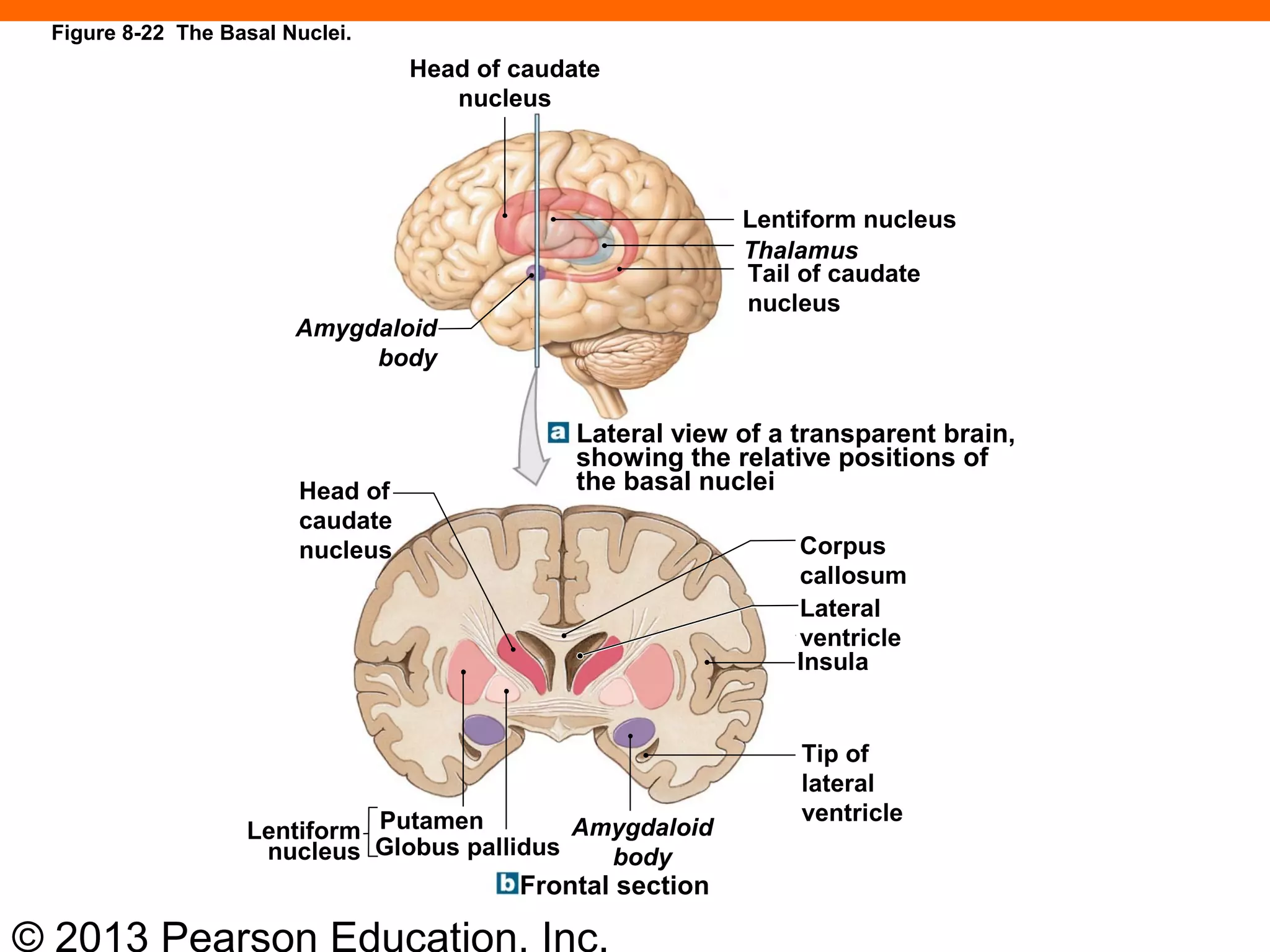
The Basal Nuclei (8-7)
• Masses of gray matter
• Caudate nucleus
• Lies anterior to the lentiform nucleus
• Which contains the medial globus pallidus and the lateral
putamen
• Inferior to the caudate and lentiform nuclei is the amygdaloid body
or amygdala
• Basal nuclei
• Subconscious control of skeletal muscle tone
© 2013 Pearson Education, Inc.
Lateral view of a transparent brain,
showing the relative positions of
the basal nuclei
Lentiform nucleus
Thalamus
Tail of caudate
nucleus
Amygdaloid
body
Head of caudate
nucleus
Head of
caudate
nucleus Corpus
callosum
Lateral
ventricle
Insula
Tip of
lateral
ventricle
Amygdaloid
bodyGlobus pallidus
PutamenLentiform
nucleus
Frontal section
Figure 8-22 The Basal Nuclei.
© 2013 Pearson Education, Inc.
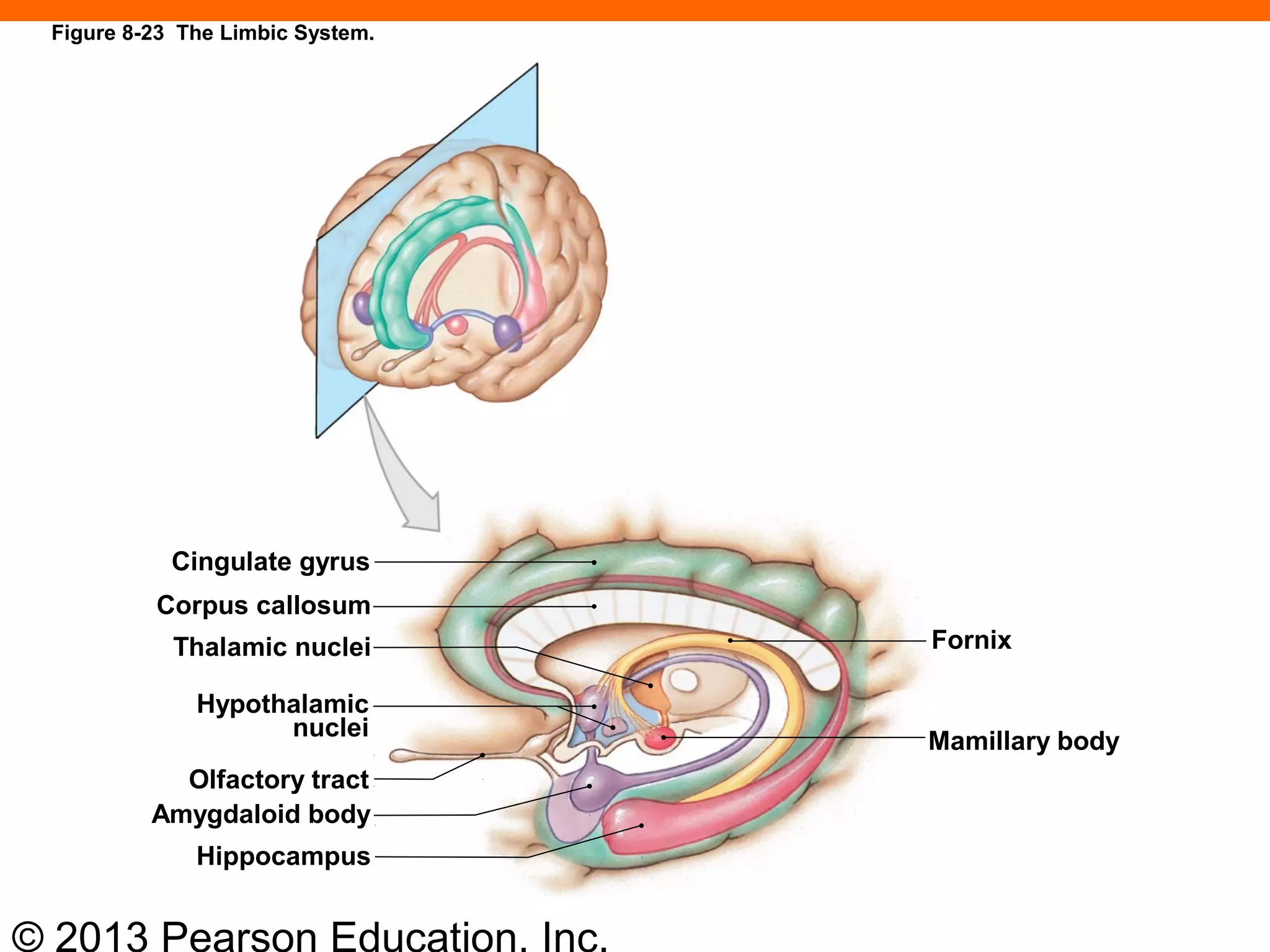
The Limbic System (8-7)
• Includes the olfactory cortex, basal nuclei, gyri, and
tracts between the cerebrum and diencephalon
• A functional grouping, rather than an anatomical one
• Establishes the emotional states
• Links the conscious with the unconscious
• Aids in long-term memory with help of the
hippocampus
© 2013 Pearson Education, Inc.
Cingulate gyrus
Corpus callosum
Thalamic nuclei
Hypothalamic
nuclei
Olfactory tract
Amygdaloid body
Hippocampus
Fornix
Mamillary body
Figure 8-23 The Limbic System.
© 2013 Pearson Education, Inc.
The Diencephalon (8-7)
• Contains switching and relay centers
• Centers integrate conscious and unconscious sensory
information and motor commands
• Surround third ventricle
• Three components
1. Epithalamus
2. Thalamus
3. Hypothalamus
© 2013 Pearson Education, Inc.
The Epithalamus (8-7)
• Lies superior to the third ventricle and forms the
roof of the diencephalon
• The anterior part contains choroid plexus
• The posterior part contains the pineal gland that
is endocrine and secretes melatonin
© 2013 Pearson Education, Inc.
The Thalamus (8-7)
• The left and right thalamus are separated by the
third ventricle
• The final relay point for sensory information
• Only a small part of this input is sent on to the
primary sensory cortex
© 2013 Pearson Education, Inc.
The Hypothalamus (8-7)
• Lies inferior to the third ventricle
• The subconscious control of skeletal muscle
contractions is associated with strong emotion
• Adjusts the pons and medulla functions
• Coordinates the nervous and endocrine systems
© 2013 Pearson Education, Inc.
The Hypothalamus (8-7)
• Secretes hormones
• Produces sensations of thirst and hunger
• Coordinates voluntary and ANS function
• Regulates body temperature
• Coordinates daily cycles
© 2013 Pearson Education, Inc.
The Midbrain (8-7)
• Contains various nuclei
• Two pairs involved in visual and auditory processing, the colliculi
• Contains motor nuclei for cranial nerves III and IV
• Cerebral peduncles contain descending fibers
• Reticular formation is a network of nuclei related to the
state of wakefulness
• The substantia nigra influence muscle tone
© 2013 Pearson Education, Inc.
The Pons (8-7)
• Links the cerebellum with the midbrain,
diencephalon, cerebrum, and spinal cord
• Contains sensory and motor nuclei for cranial
nerves V, VI, VII, and VIII
• Other nuclei influence rate and depth of respiration
© 2013 Pearson Education, Inc.
The Cerebellum (8-7)
• An automatic processing center
• Which adjusts postural muscles to maintain balance
• Programs and fine-tunes movements
• The cerebellar peduncles
• Are tracts that link the cerebral cortex, basal nuclei, and brain stem
• Ataxia
• Is disturbance of coordination
• Can be caused by damage to the cerebellum
© 2013 Pearson Education, Inc.
The Medulla Oblongata (8-7)
• Connects the brain with the spinal cord
• Contains sensory and motor nuclei for cranial nerves VIII,
IX, X, XI, and XII
• Contains reflex centers
• Cardiovascular centers
• Adjust heart rate and arteriolar diameter
• Respiratory rhythmicity centers
• Regulate respiratory rate
© 2013 Pearson Education, Inc.
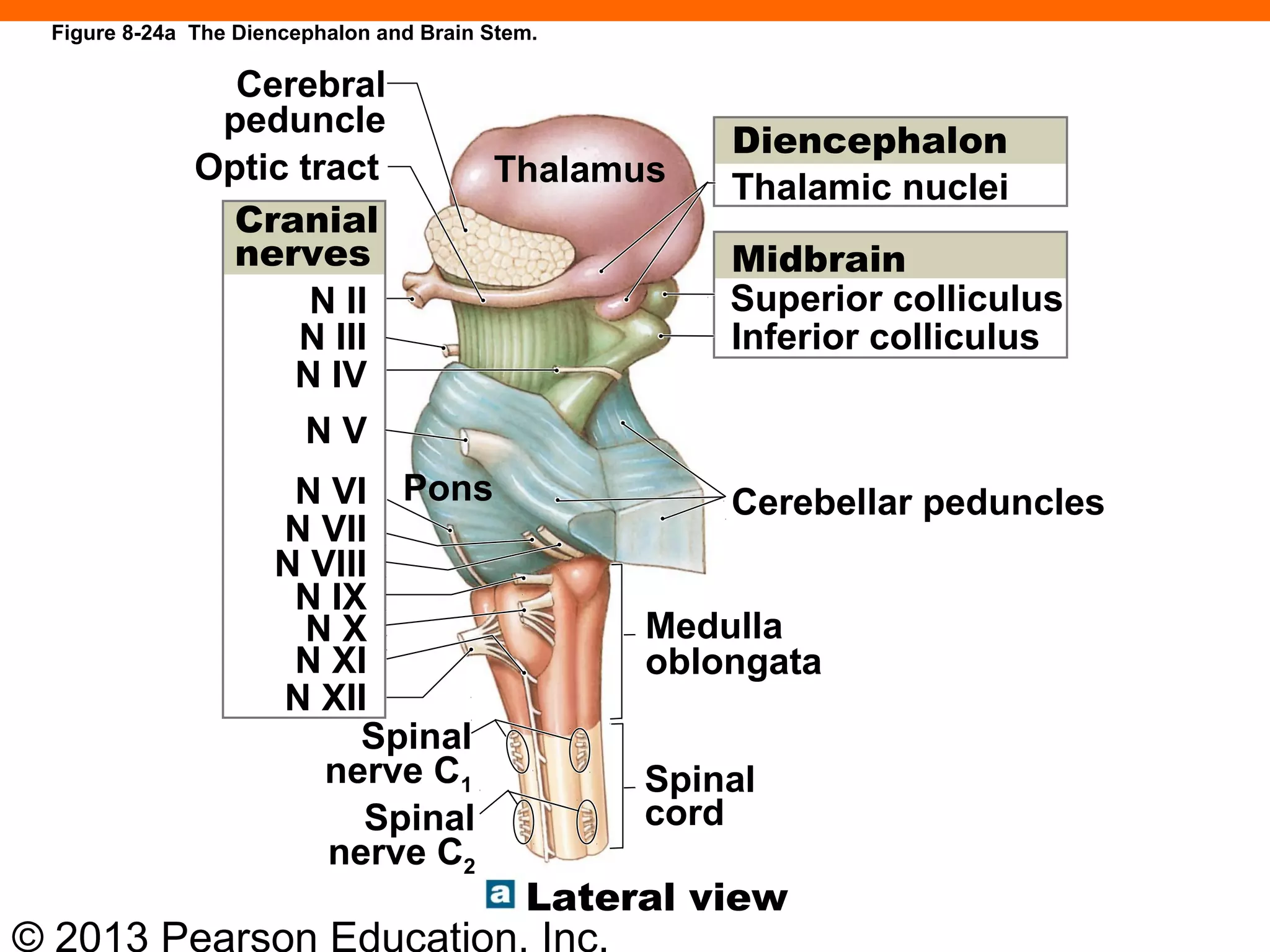
Figure 8-24a The Diencephalon and Brain Stem.
Cerebral
peduncle
Optic tract
Cranial
nerves
Thalamus
Diencephalon
Thalamic nuclei
Midbrain
Superior colliculus
Inferior colliculus
Cerebellar peduncles
Medulla
oblongata
Spinal
cord
Lateral view
Spinal
nerve C2
Spinal
nerve C1
N XII
N XI
N X
N IX
N II
N III
N V
N IV
N VI
N VII
N VIII
Pons
© 2013 Pearson Education, Inc.
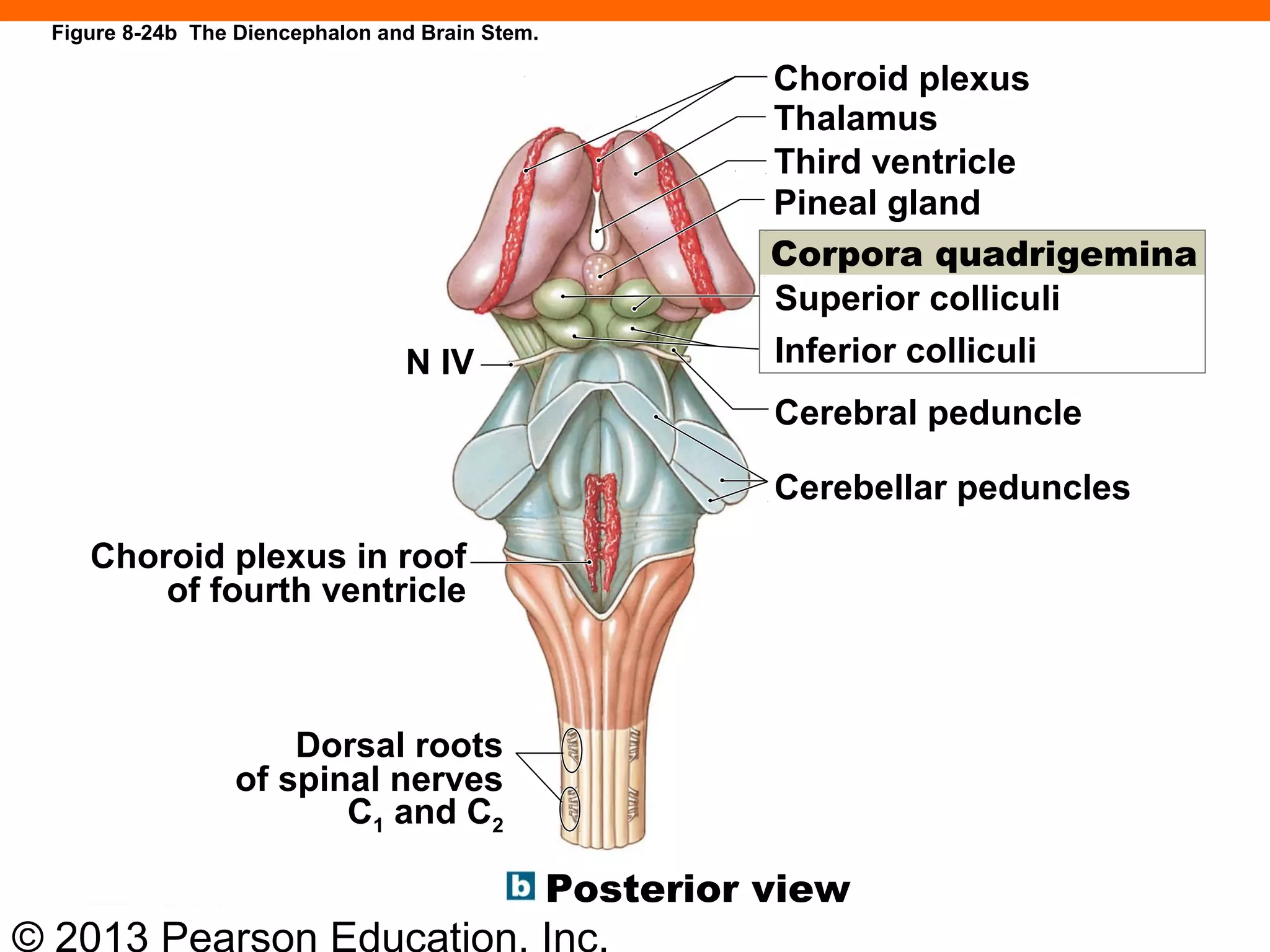
Figure 8-24b The Diencephalon and Brain Stem.
N IV
Choroid plexus
Thalamus
Third ventricle
Pineal gland
Corpora quadrigemina
Superior colliculi
Inferior colliculi
Cerebral peduncle
Cerebellar peduncles
Posterior view
Dorsal roots
of spinal nerves
C1 and C2
Choroid plexus in roof
of fourth ventricle
© 2013 Pearson Education, Inc.
Checkpoint (8-7)
20. Describe one major function of each of the six regions of
the brain.
21. The pituitary gland links the nervous and endocrine
systems. To which portion of the diencephalon is it
attached?
22. How would decreased diffusion across the arachnoid
granulations affect the volume of cerebrospinal fluid in the
ventricles?
23. Mary suffers a head injury that damages her primary
motor cortex. Where is this area located?
© 2013 Pearson Education, Inc.
Checkpoint (8-7)
24. What senses would be affected by damage to the
temporal lobes of the cerebrum?
25. The thalamus acts as a relay point for all but what type of
sensory information?
26. Changes in body temperature stimulate which area of the
diencephalon?
27. The medulla oblongata is one of the smallest sections of
the brain. Why can damage to it cause death, whereas
similar damage in the cerebrum might go unnoticed?
© 2013 Pearson Education, Inc.
Peripheral Nervous System (8-8)
• Links the CNS to the rest of the body through
peripheral nerves
• They include the cranial nerves and the spinal
nerves
• The cell bodies of sensory and motor neurons are
contained in the ganglia
© 2013 Pearson Education, Inc.
The Cranial Nerves (8-8)
• 12 pairs, noted as Roman numerals I through XII
• Some are:
• Only motor pathways
• Only sensory pathways
• Mixed having both sensory and motor neurons
• Often remembered with a mnemonic
• "Oh, Once One Takes The Anatomy Final, Very Good
Vacations Are Heavenly"
© 2013 Pearson Education, Inc.
The Cranial Nerves (8-8)
• The olfactory nerves (N I)
• Are connected to the cerebrum
• Carry information concerning the sense of smell
• The optic nerves (N II)
• Carry visual information from the eyes, through the
optic foramina of the orbits to the optic chiasm
• Continue as the optic tracts to the nuclei of the thalamus
© 2013 Pearson Education, Inc.
The Cranial Nerves (8-8)
• The oculomotor nerves (N III)
• Motor only, arising in the midbrain
• Innervate four of six extrinsic eye muscles and the
intrinsic eye muscles that control the size of the pupil
• The trochlear nerves (N IV)
• Smallest, also arise in the midbrain
• Innervate the superior oblique extrinsic muscles of the
eyes
© 2013 Pearson Education, Inc.
The Cranial Nerves (8-8)
• The trigeminal nerves (N V)
• Have nuclei in the pons, are the largest cranial nerves
• Have three branches
1. The ophthalmic
• From the orbit, sinuses, nasal cavity, skin of
forehead, nose, and eyes
2. The maxillary
• From the lower eyelid, upper lip, cheek, nose, upper
gums, and teeth
• The mandibular
• From salivary glands and tongue
© 2013 Pearson Education, Inc.
The Cranial Nerves (8-8)
• The abducens nerves (N VI)
• Innervate only the lateral rectus extrinsic eye muscle,
with the nucleus in the pons
• The facial nerves (N VII)
• Mixed, and emerge from the pons
• Sensory fibers monitor proprioception in the face
• Motor fibers provide facial expressions; control tear and
salivary glands
© 2013 Pearson Education, Inc.
The Cranial Nerves (8-8)
• The vestibulocochlear nerves (N VIII)
• Respond to sensory receptors in the inner ear
• There are two components
1. The vestibular nerve
• Conveys information about balance and position
2. The cochlear nerve
• Responds to sound waves for the sense of hearing
• Their nuclei are in the pons and medulla oblongata
© 2013 Pearson Education, Inc.
The Cranial Nerves (8-8)
• The glossopharyngeal nerves (N IX)
• Mixed nerves innervating the tongue and pharynx
• Their nuclei are in the medulla oblongata
• The sensory portion monitors taste on the posterior third
of the tongue and monitors BP and blood gases
• The motor portion controls pharyngeal muscles used in
swallowing, and fibers to salivary glands
© 2013 Pearson Education, Inc.
The Cranial Nerves (8-8)
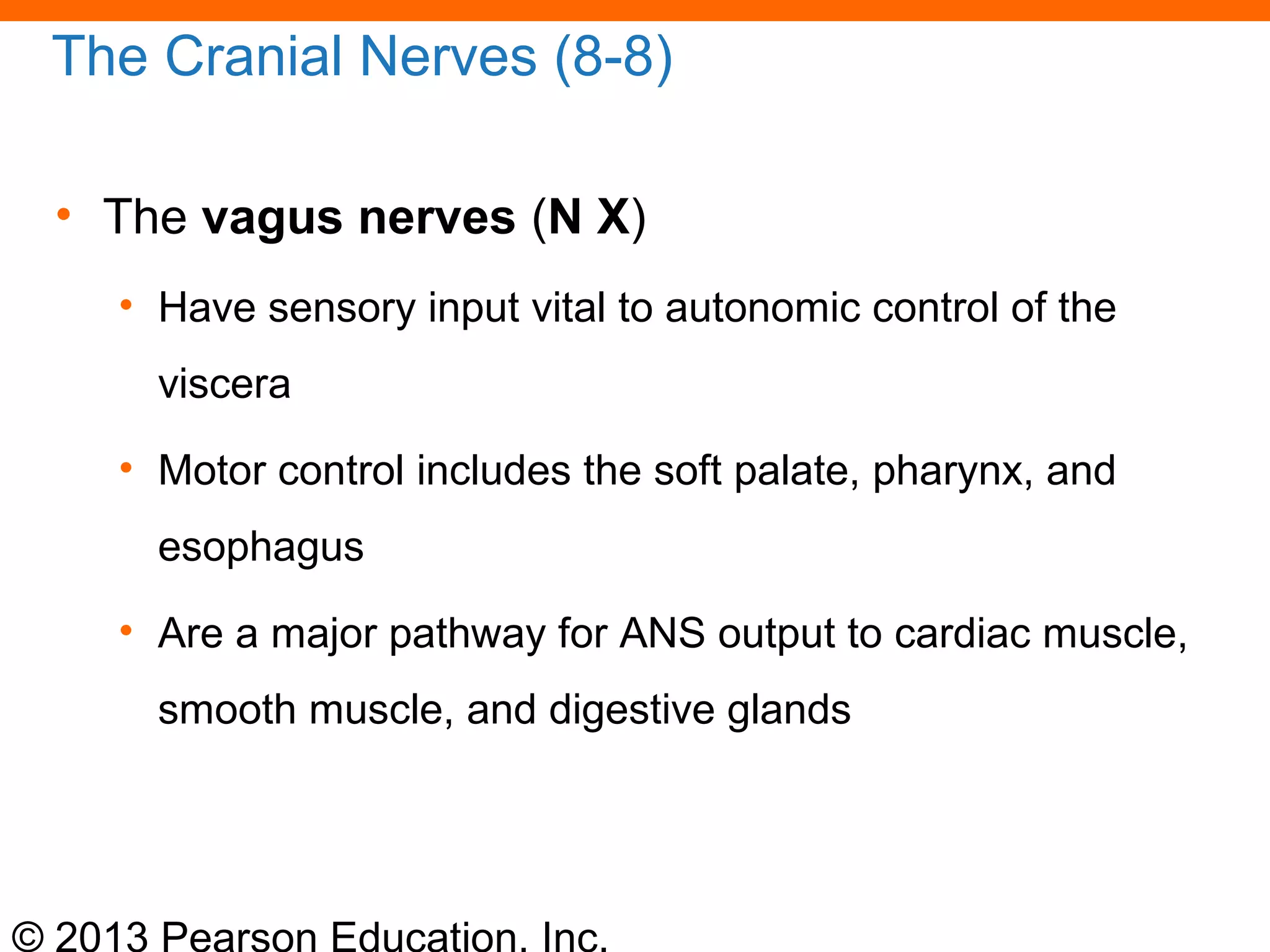
• The vagus nerves (N X)
• Have sensory input vital to autonomic control of the
viscera
• Motor control includes the soft palate, pharynx, and
esophagus
• Are a major pathway for ANS output to cardiac muscle,
smooth muscle, and digestive glands
© 2013 Pearson Education, Inc.
The Cranial Nerves (8-8)
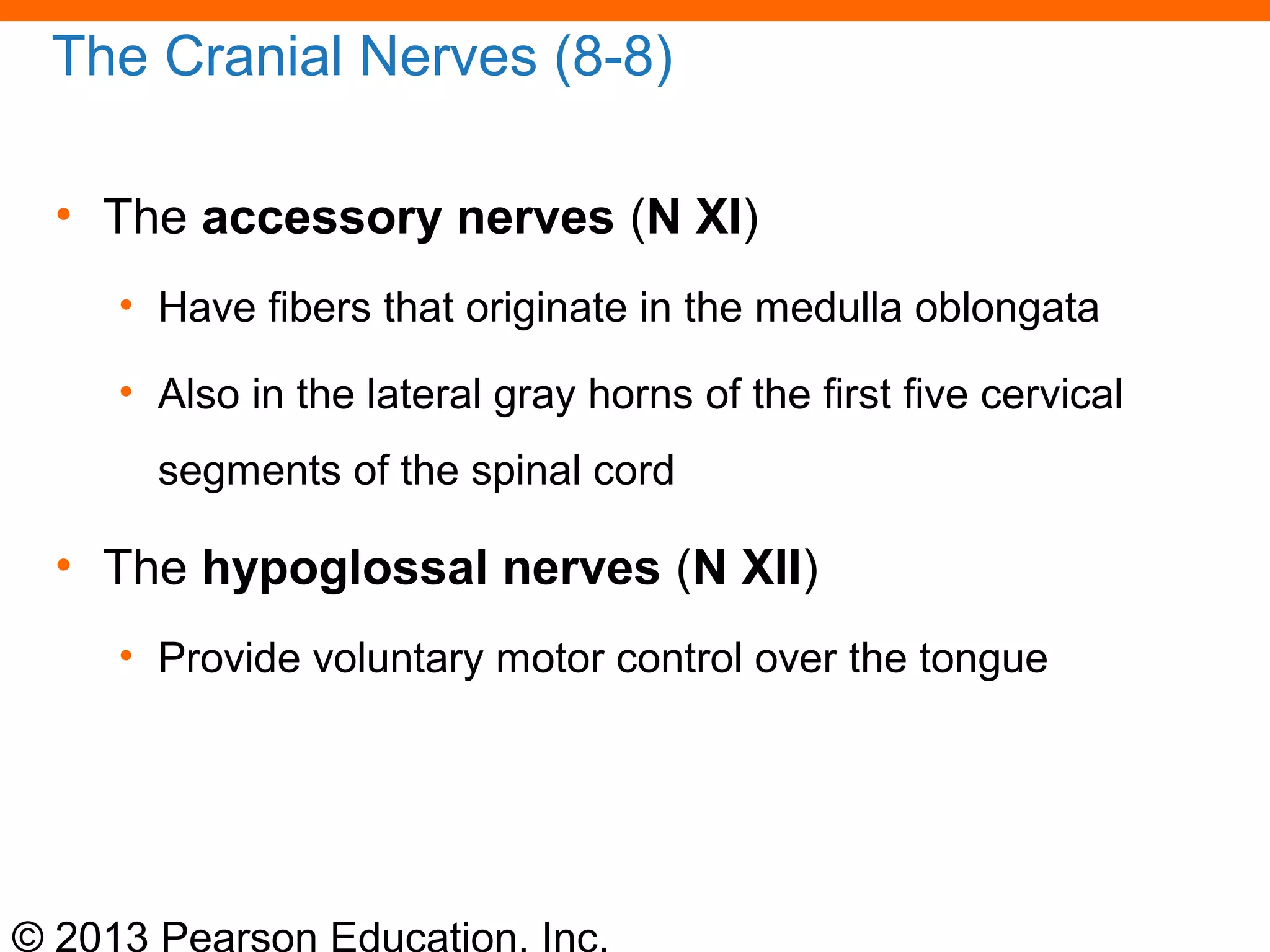
• The accessory nerves (N XI)
• Have fibers that originate in the medulla oblongata
• Also in the lateral gray horns of the first five cervical
segments of the spinal cord
• The hypoglossal nerves (N XII)
• Provide voluntary motor control over the tongue
© 2013 Pearson Education, Inc.
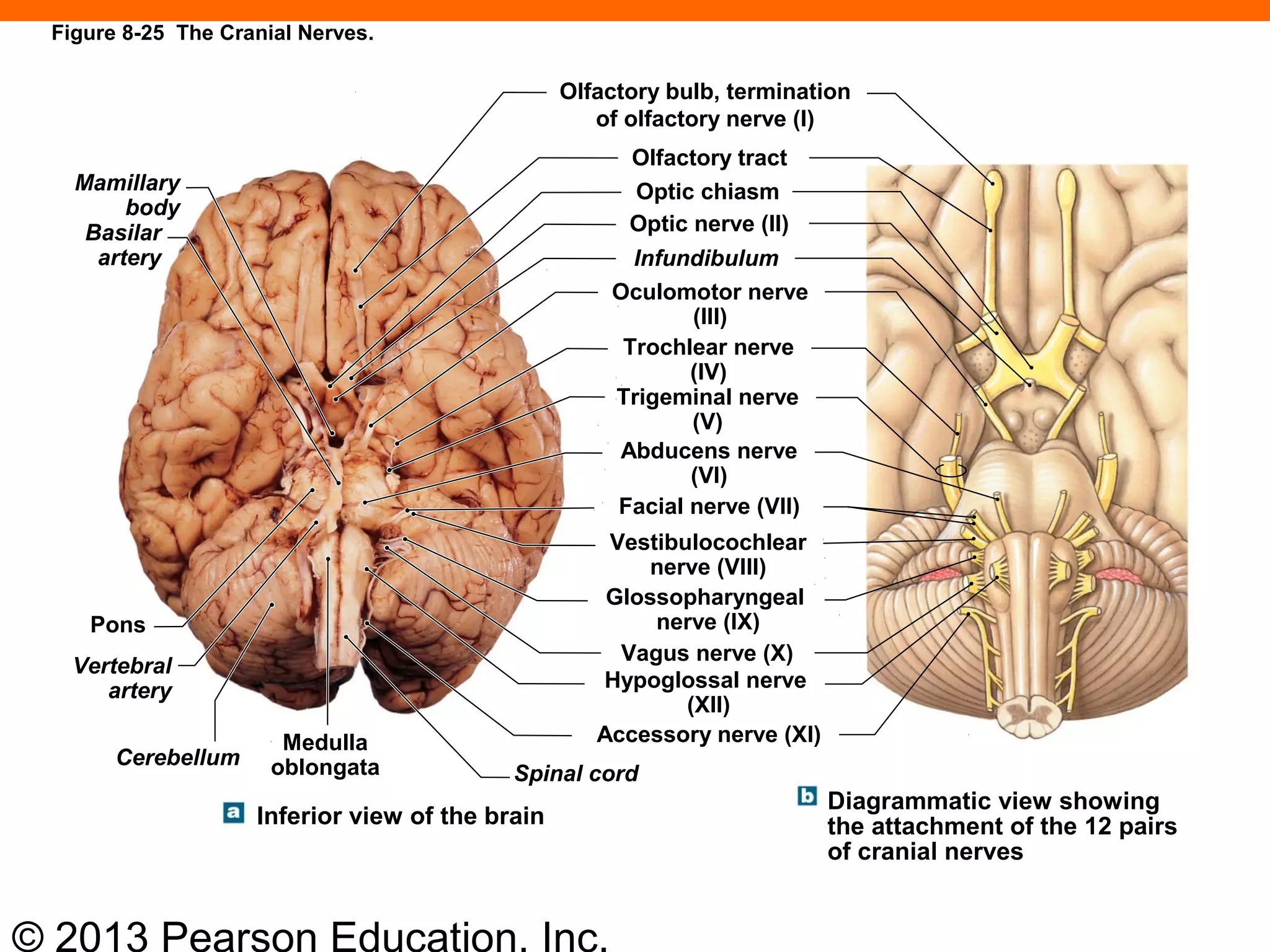
Mamillary
body
Basilar
artery
Olfactory bulb, termination
of olfactory nerve (I)
Olfactory tract
Optic chiasm
Optic nerve (II)
Infundibulum
Oculomotor nerve
(III)
Trochlear nerve
(IV)
Trigeminal nerve
(V)
Abducens nerve
(VI)
Facial nerve (VII)
Vestibulocochlear
nerve (VIII)
Glossopharyngeal
nerve (IX)
Vagus nerve (X)
Hypoglossal nerve
(XII)
Accessory nerve (XI)
Diagrammatic view showing
the attachment of the 12 pairs
of cranial nerves
Spinal cord
Medulla
oblongataCerebellum
Inferior view of the brain
Vertebral
artery
Pons
Figure 8-25 The Cranial Nerves.
© 2013 Pearson Education, Inc.
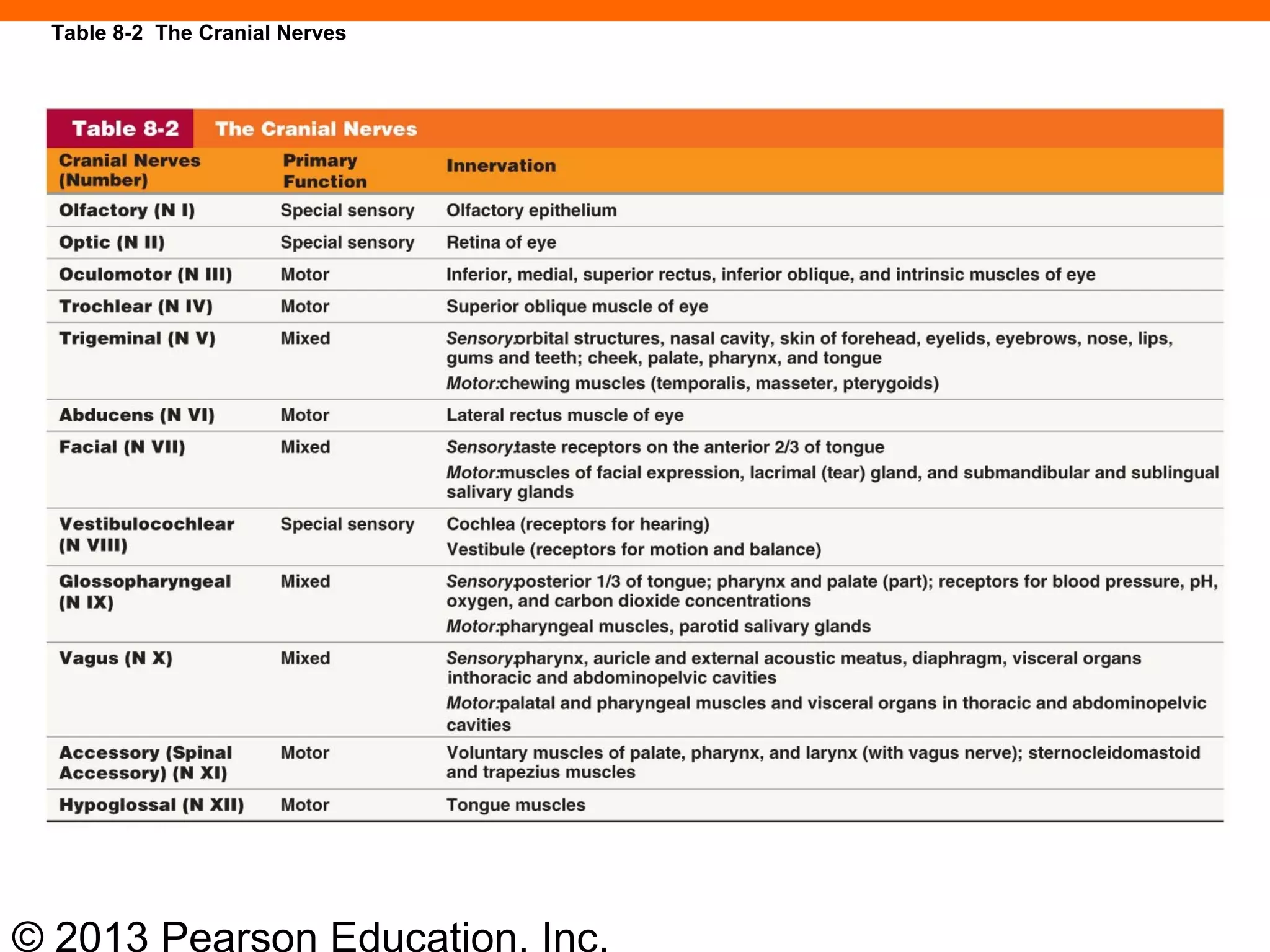
Table 8-2 The Cranial Nerves
© 2013 Pearson Education, Inc.
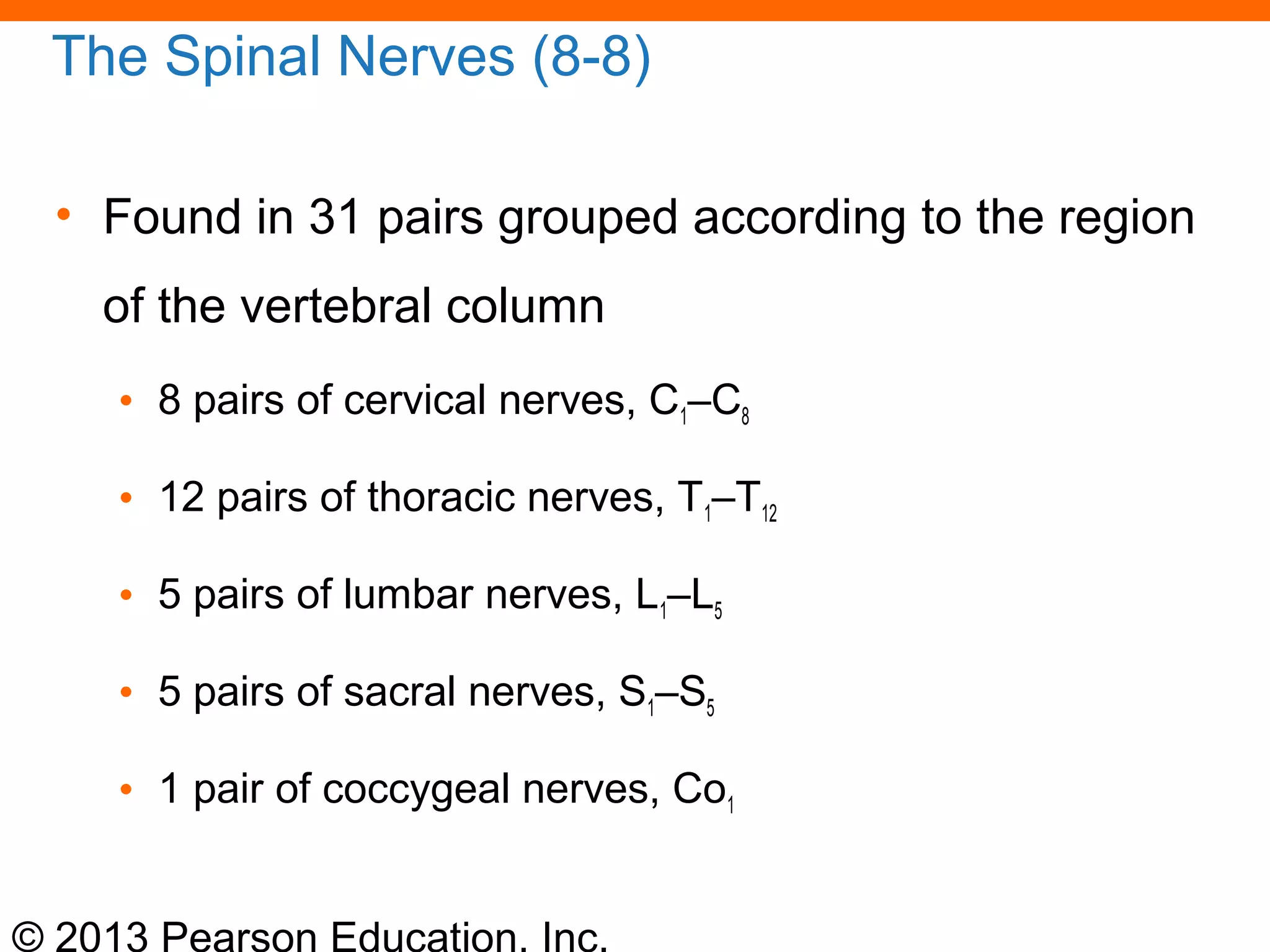
The Spinal Nerves (8-8)
• Found in 31 pairs grouped according to the region
of the vertebral column
• 8 pairs of cervical nerves, C1–C8
• 12 pairs of thoracic nerves, T1–T12
• 5 pairs of lumbar nerves, L1–L5
• 5 pairs of sacral nerves, S1–S5
• 1 pair of coccygeal nerves, Co1
© 2013 Pearson Education, Inc.
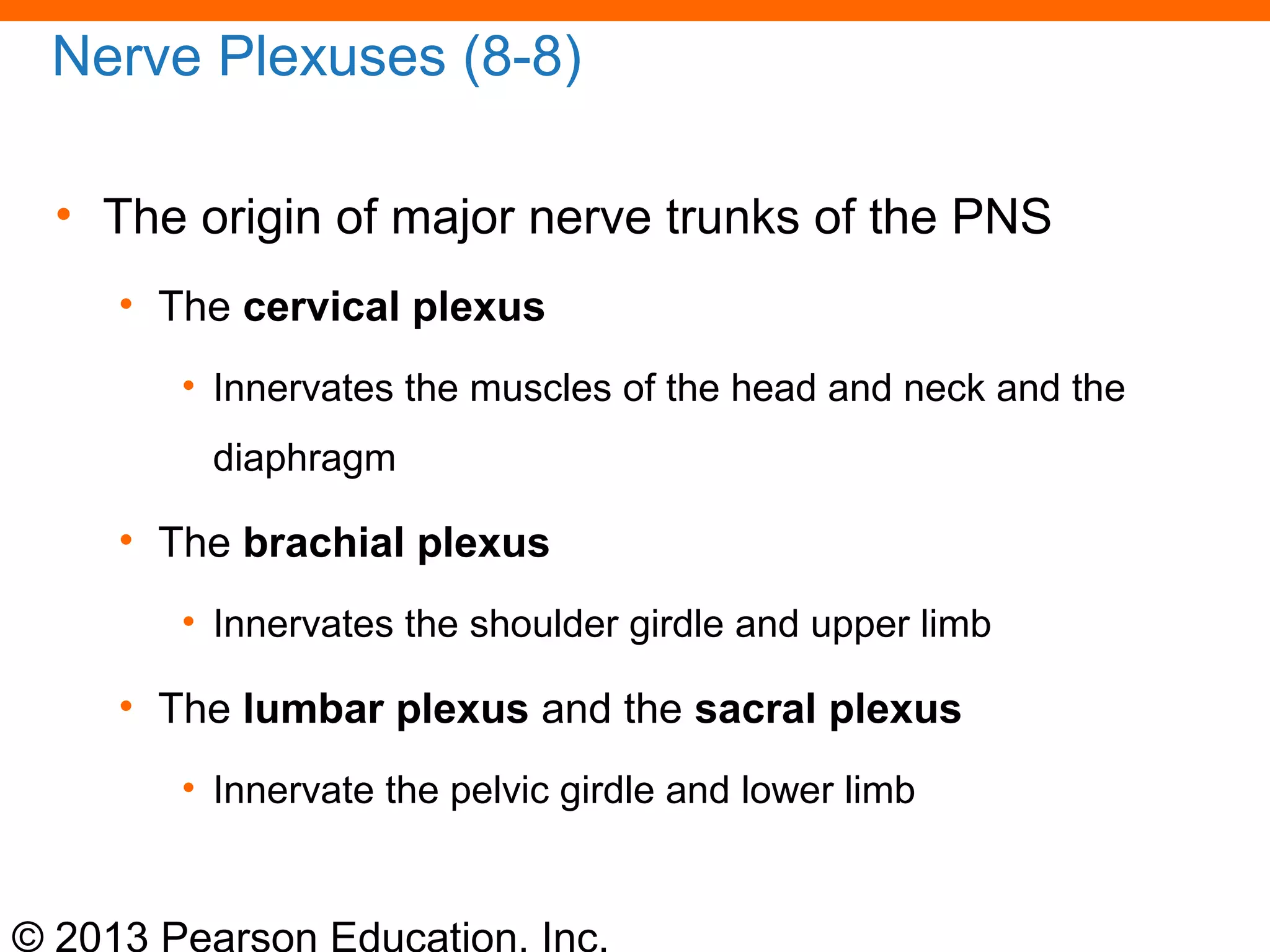
Nerve Plexuses (8-8)
• The origin of major nerve trunks of the PNS
• The cervical plexus
• Innervates the muscles of the head and neck and the
diaphragm
• The brachial plexus
• Innervates the shoulder girdle and upper limb
• The lumbar plexus and the sacral plexus
• Innervate the pelvic girdle and lower limb
© 2013 Pearson Education, Inc.
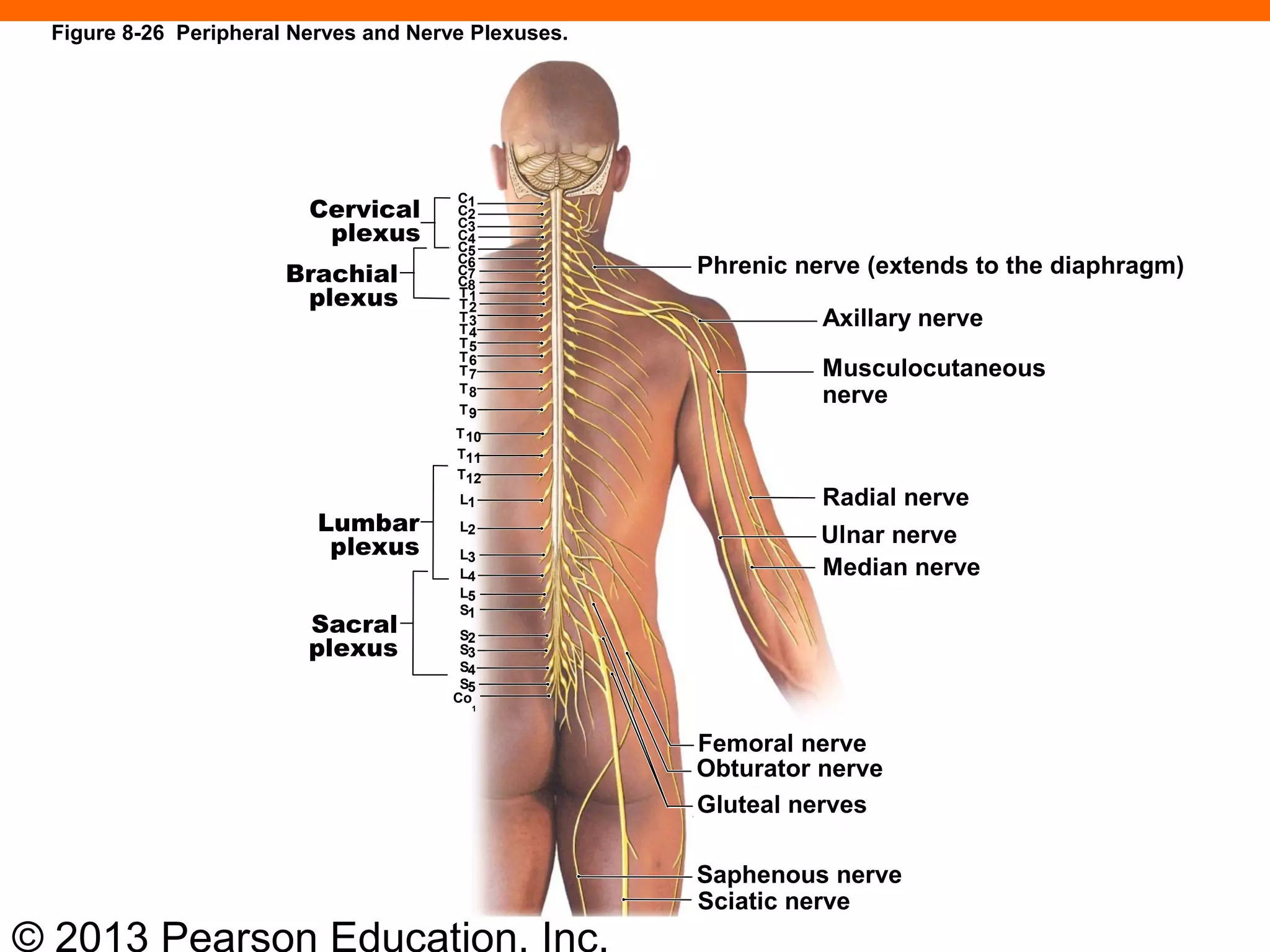
Figure 8-26 Peripheral Nerves and Nerve Plexuses.
Phrenic nerve (extends to the diaphragm)
Axillary nerve
Musculocutaneous
nerve
Radial nerve
Ulnar nerve
Median nerve
Femoral nerve
Obturator nerve
Gluteal nerves
Saphenous nerve
Sacral
plexus
Lumbar
plexus
Brachial
plexus
Cervical
plexus
C1
Sciatic nerve
C2
C3
C4
C5
C6
C7
C8
T1
T2
T3
T4
T5
T6
T7
T8
T9
T10
T11
T12
L1
L2
L3
L4
L5
S1
S2
S3
S4
S5
Co
1
© 2013 Pearson Education, Inc.
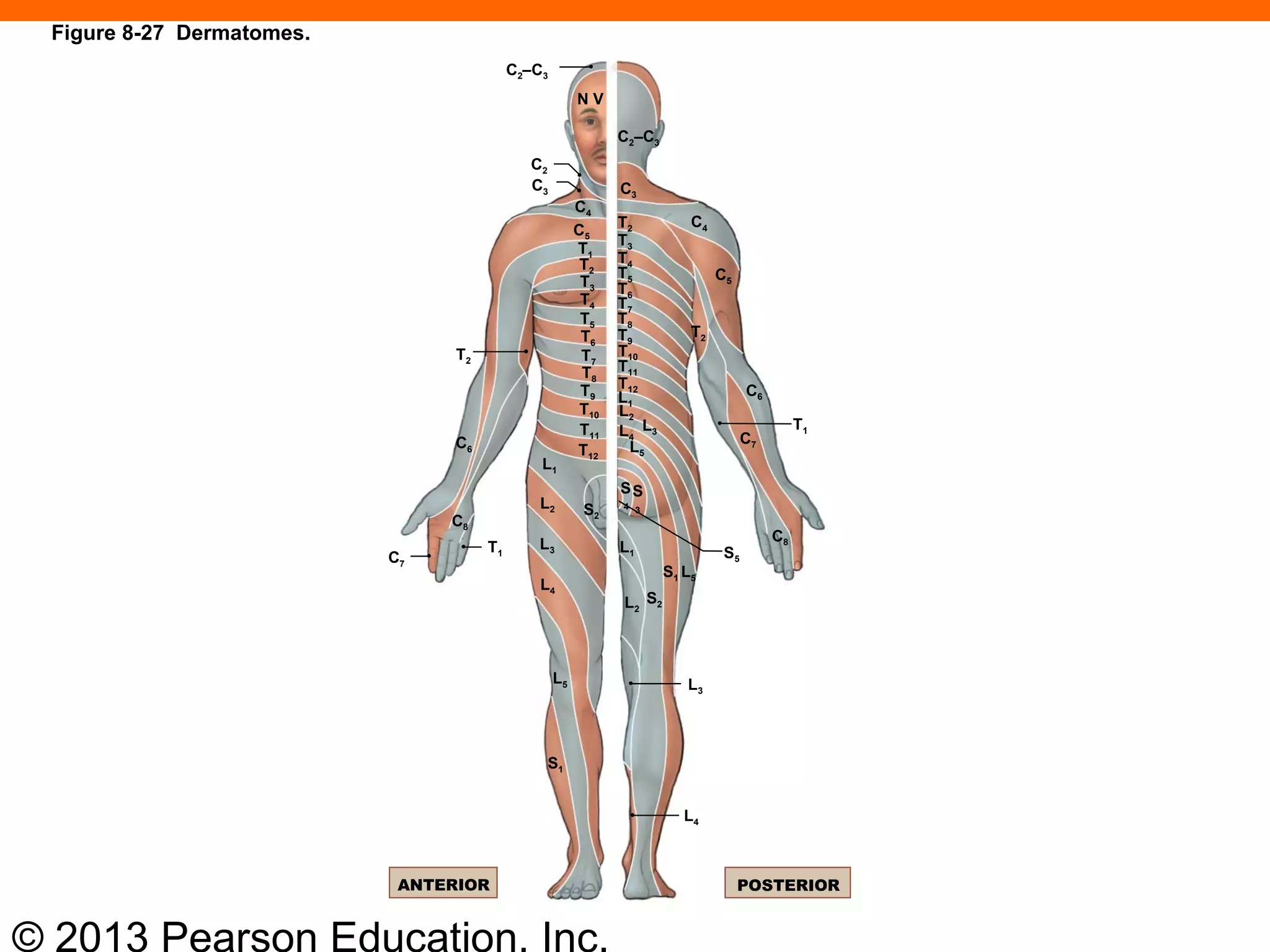
Dermatome (8-8)
• A clinically important area monitored by a specific
spinal nerve
© 2013 Pearson Education, Inc.
C2–C3
C2
C2–C3
N V
C3
C4
C3
C5
C4
C5
C6
C7C6
C8
C8
C7
T1
T2
T3
T4
T5
T6
T7
T8
T9
T10
T11
T12
T2
T3
T4
T5
T6
T7
T8
T9
T10
T11
T12
T2
T2
T1
T1
L1
L1
L2
L2
L3L4
L5
L1
L2
L3
L4
L5 L3
S2
S1 L5
S5
SS
4 3
S2
S1
L4
ANTERIOR POSTERIOR
Figure 8-27 Dermatomes.
© 2013 Pearson Education, Inc.
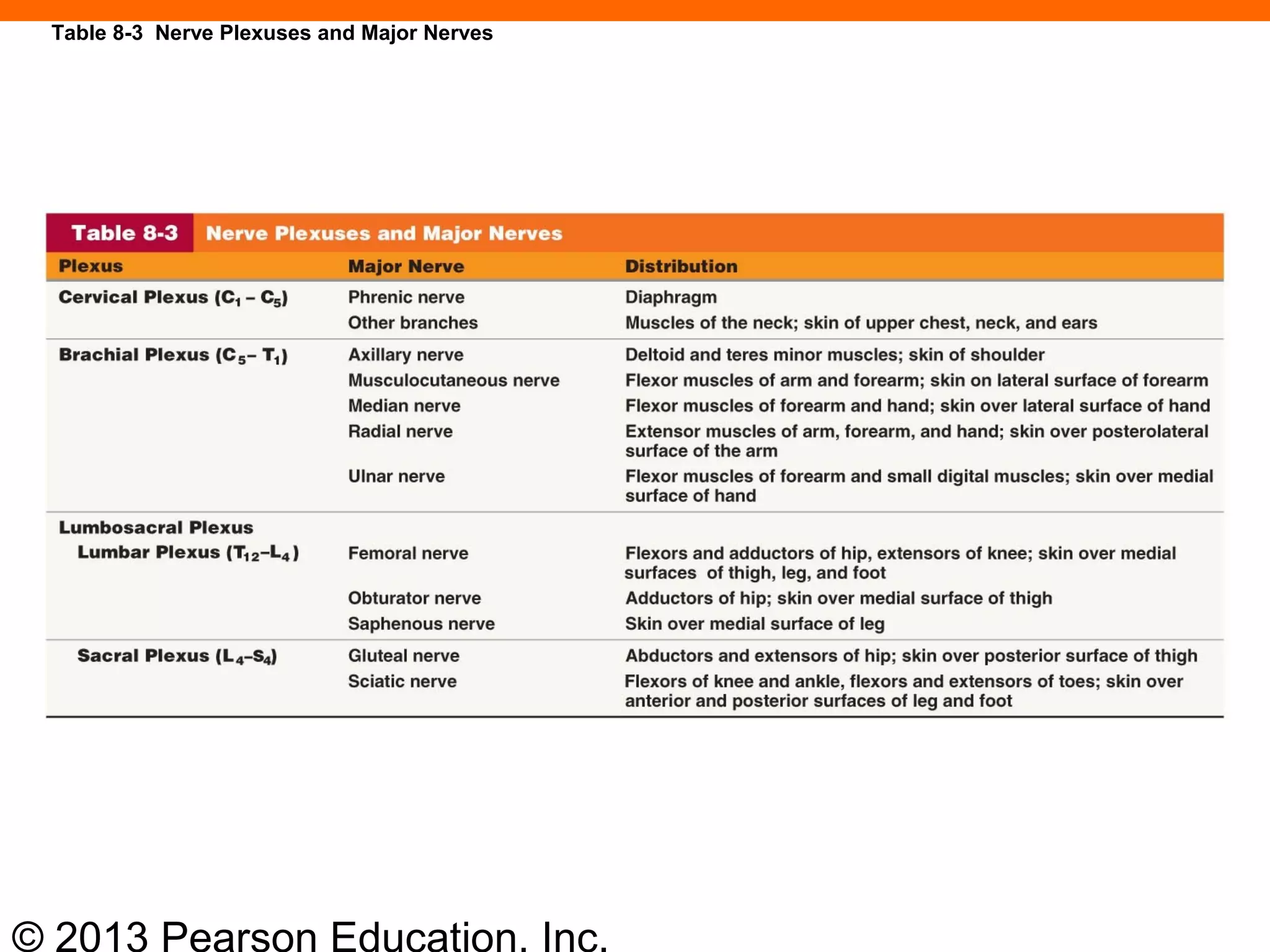
Table 8-3 Nerve Plexuses and Major Nerves
© 2013 Pearson Education, Inc.
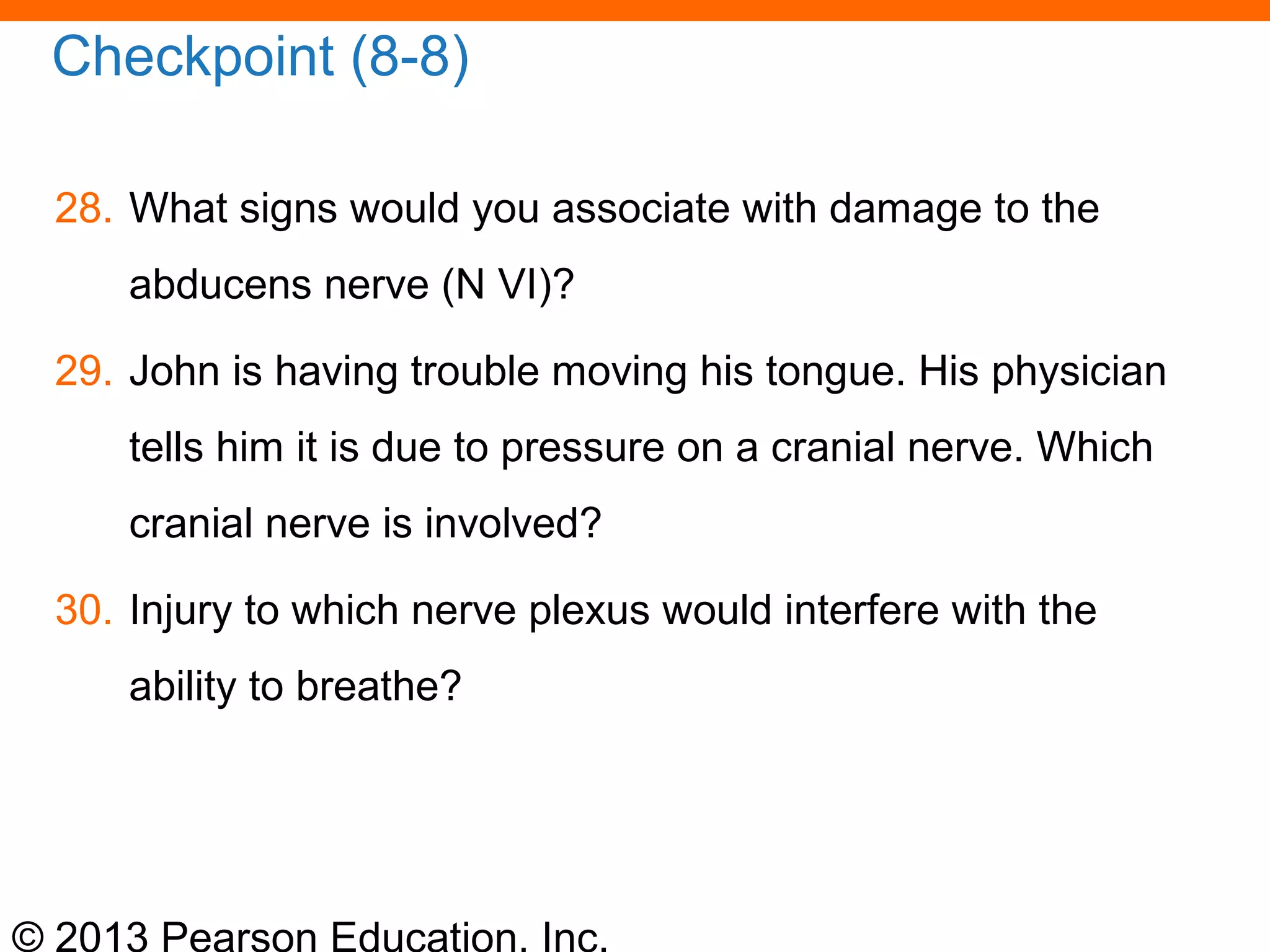
Checkpoint (8-8)
28. What signs would you associate with damage to the
abducens nerve (N VI)?
29. John is having trouble moving his tongue. His physician
tells him it is due to pressure on a cranial nerve. Which
cranial nerve is involved?
30. Injury to which nerve plexus would interfere with the
ability to breathe?
© 2013 Pearson Education, Inc.
Reflexes (8-9)
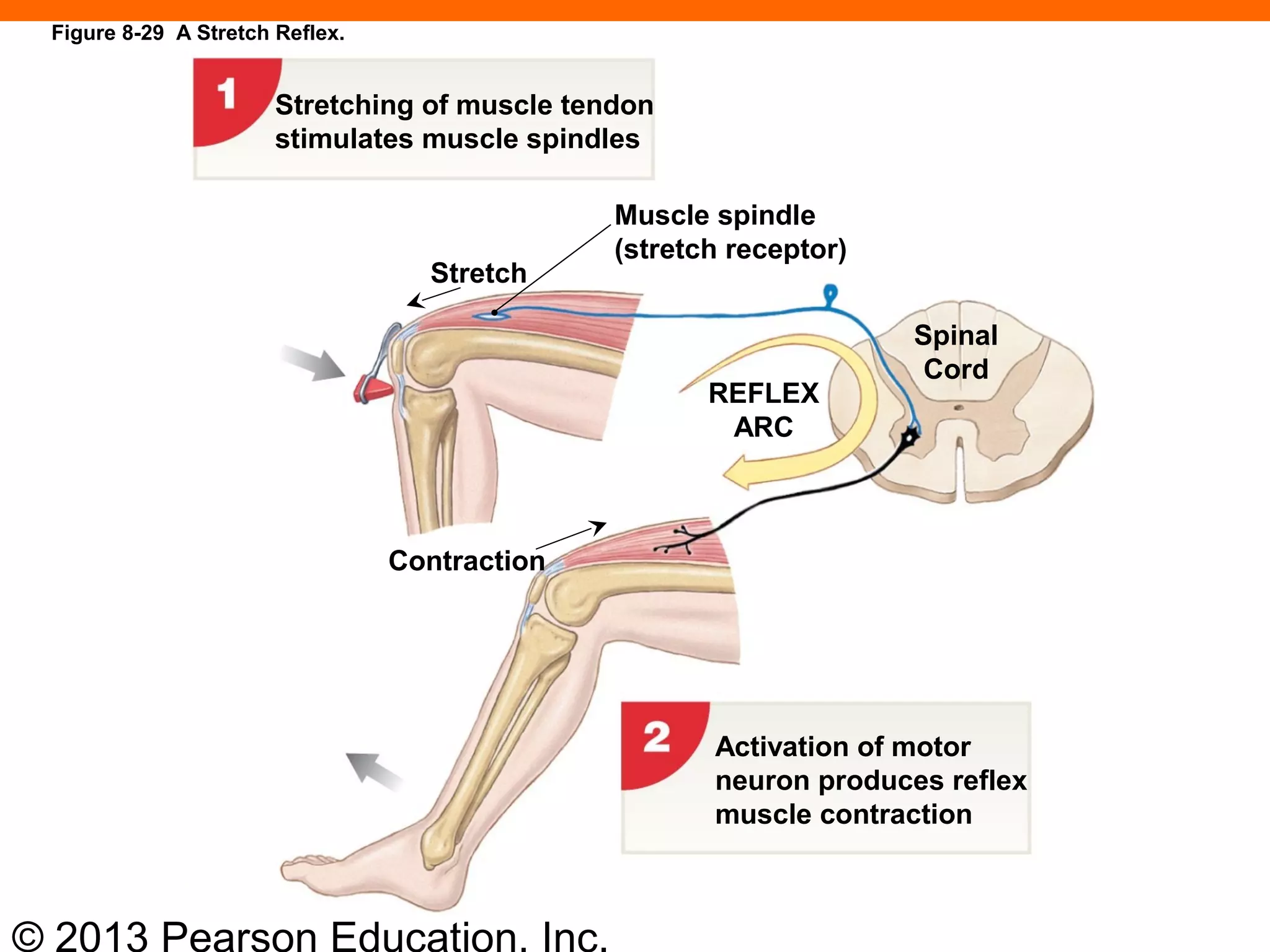
• Rapid, automatic, unlearned motor response to a stimulus
• Usually removes or opposes the original stimulus
• Monosynaptic reflexes
• For example, the stretch reflex
• Which responds to muscle spindles, is the simplest with only
one synapse
• The best known stretch reflex is probably the knee jerk reflex
© 2013 Pearson Education, Inc.
Simple Reflexes (8-9)
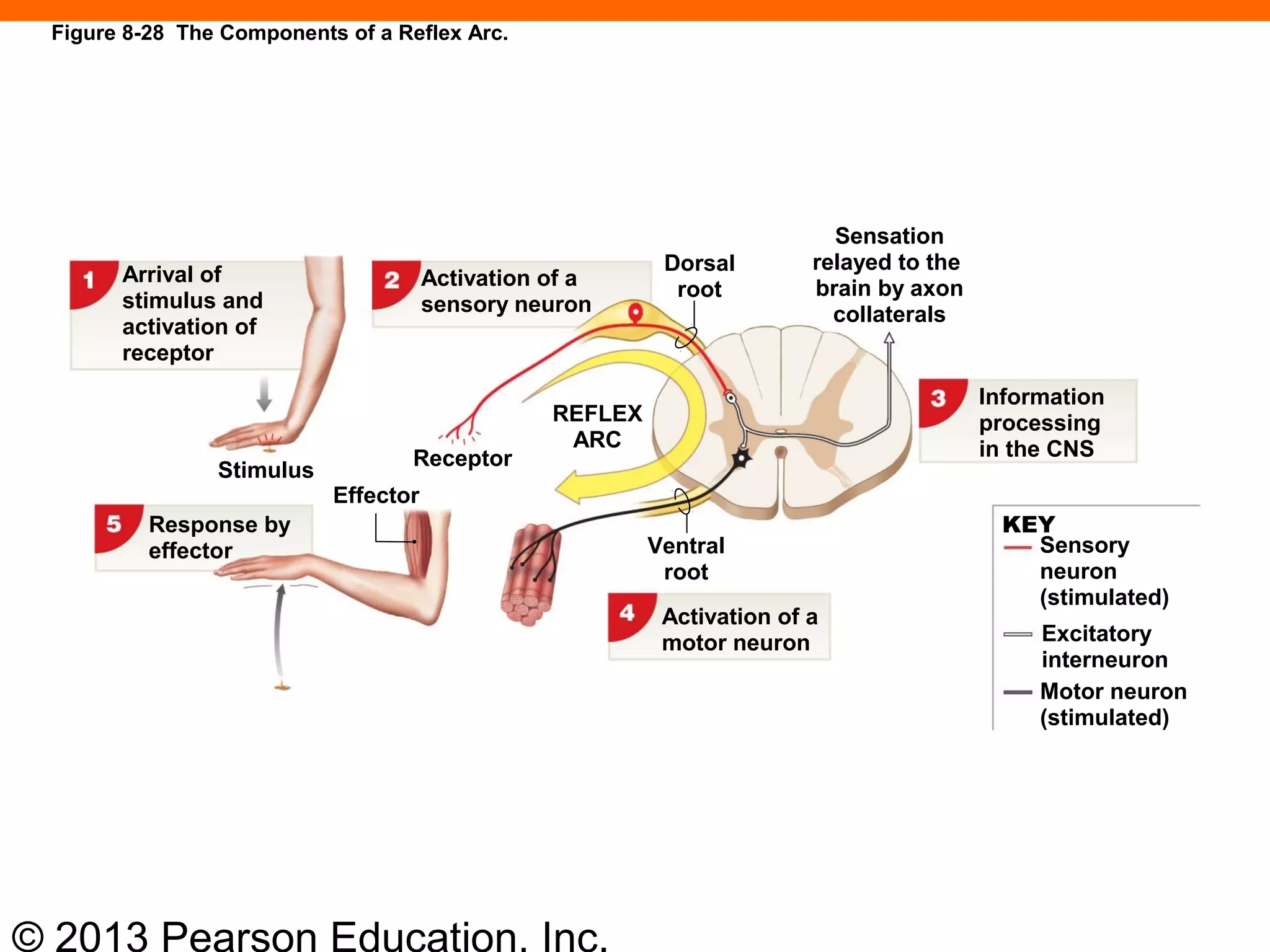
• Are wired in a reflex arc
• A stimulus activates a sensory receptor
• An action potential travels down an afferent neuron
• Information processing occurs with the interneuron
• An action potential travels down an efferent neuron
• The effector organ responds
© 2013 Pearson Education, Inc.
Arrival of
stimulus and
activation of
receptor
Activation of a
sensory neuron
Dorsal
root
Sensation
relayed to the
brain by axon
collaterals
Information
processing
in the CNS
REFLEX
ARC
Receptor
Stimulus
Effector
Response by
effector Ventral
root
Activation of a
motor neuron
KEY
Sensory
neuron
(stimulated)
Excitatory
interneuron
Motor neuron
(stimulated)
Figure 8-28 The Components of a Reflex Arc.
© 2013 Pearson Education, Inc.
Stretching of muscle tendon
stimulates muscle spindles
Muscle spindle
(stretch receptor)
Spinal
Cord
REFLEX
ARC
Contraction
Stretch
Activation of motor
neuron produces reflex
muscle contraction
Figure 8-29 A Stretch Reflex.
© 2013 Pearson Education, Inc.
Complex Reflexes (8-9)
• Polysynaptic reflexes
• With at least one interneuron
• Are slower than monosynaptic reflexes, but can activate
more than one effector
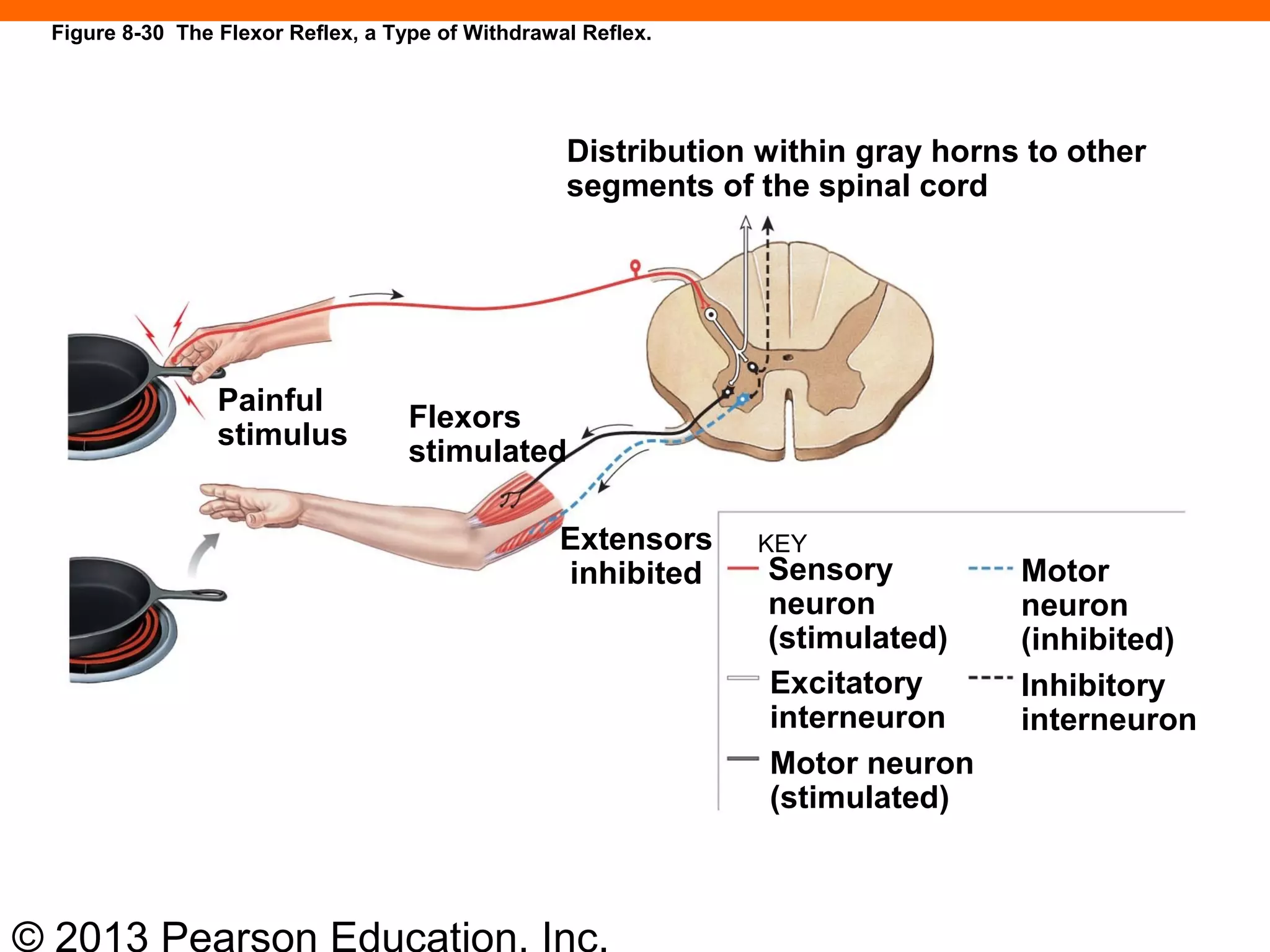
• Withdrawal reflexes
• Like the flexor reflex, move a body part away from the
stimulation
• Like touching a hot stove
• Reciprocal inhibition
• Blocks the flexor's antagonist
• To ensure that flexion is in no way interfered with
© 2013 Pearson Education, Inc.
Distribution within gray horns to other
segments of the spinal cord
Painful
stimulus
Flexors
stimulated
Extensors
inhibited
KEY
Sensory
neuron
(stimulated)
Excitatory
interneuron
Motor neuron
(stimulated)
Motor
neuron
(inhibited)
Inhibitory
interneuron
Figure 8-30 The Flexor Reflex, a Type of Withdrawal Reflex.
© 2013 Pearson Education, Inc.
Input to Modify Reflexes (8-9)
• Reflexes are automatic, but higher brain centers
can influence or modify them
• The Babinski sign
• Triggered by stroking an infant's sole, resulting in a
fanning of the toes
• As descending inhibitory synapses develop, an adult will
respond by curling the toes instead, called the plantar
reflex
© 2013 Pearson Education, Inc.
Checkpoint (8-9)
31. Define reflex.
32. Which common reflex do physicians use to test the
general condition of the spinal cord, peripheral nerves,
and muscles?
33. Why can polysynaptic reflexes produce more involved
responses than can monosynaptic reflexes?
34. After injuring his back lifting a sofa, Tom exhibits a
positive Babinski reflex. What does this imply about
Tom's injury?
© 2013 Pearson Education, Inc.
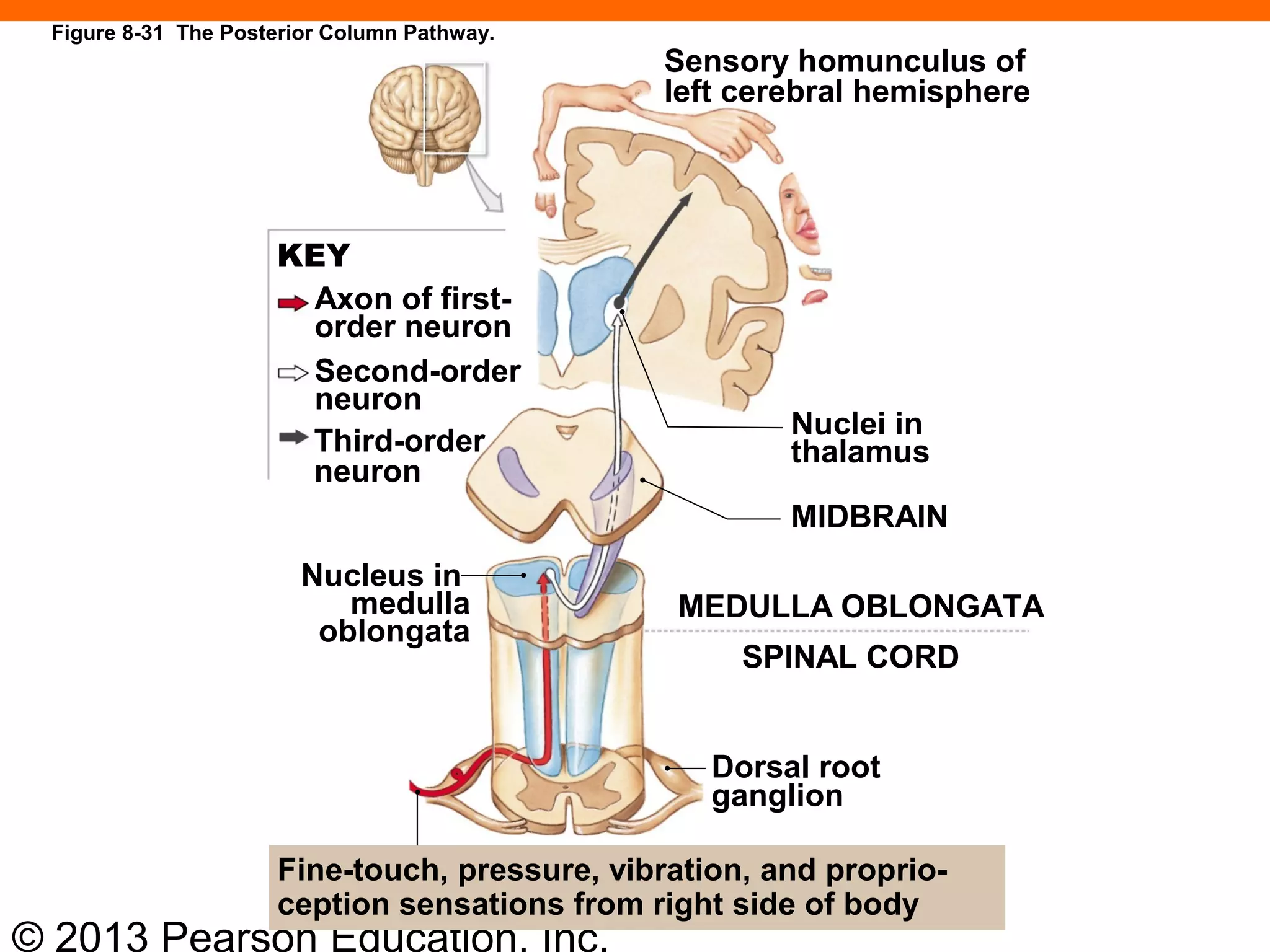
Sensory Pathways (8-10)
• Are ascending pathways
• Posterior column pathway
• Spinothalamic pathway
• Spinocerebellar pathway
• A sensory homunculus
• A mapping of the area of the cortex dedicated to the
number of sensory receptors, not the size of the body
area
© 2013 Pearson Education, Inc.
Sensory homunculus of
left cerebral hemisphere
KEY
Axon of first-
order neuron
Second-order
neuron
Third-order
neuron
Nucleus in
medulla
oblongata
Nuclei in
thalamus
MIDBRAIN
MEDULLA OBLONGATA
SPINAL CORD
Dorsal root
ganglion
Fine-touch, pressure, vibration, and proprio-
ception sensations from right side of body
Figure 8-31 The Posterior Column Pathway.
© 2013 Pearson Education, Inc.
Motor Pathways (8-10)
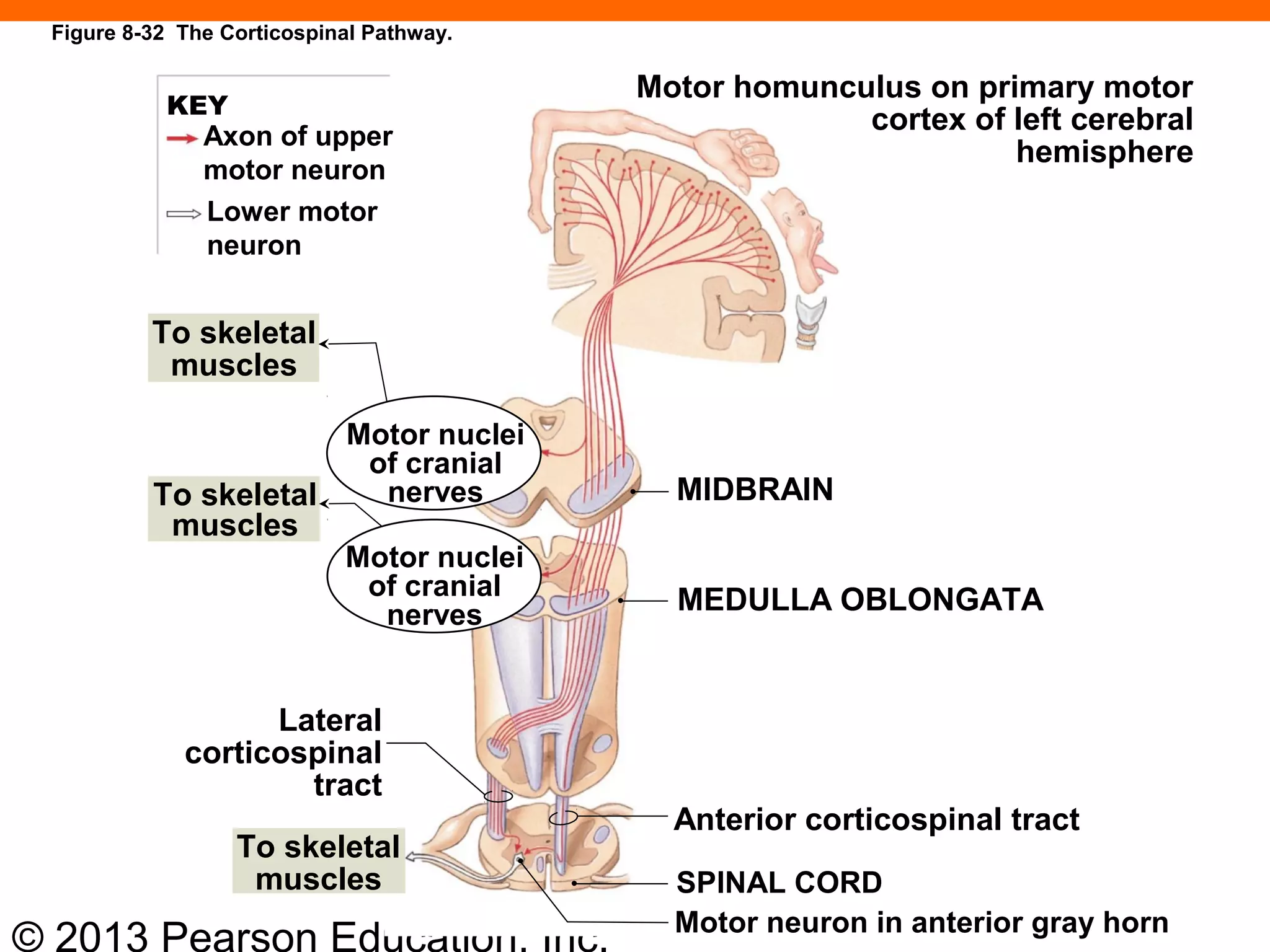
• Are descending pathways
• Corticospinal pathway
• Also called pyramidal system
• Medial and lateral pathways
• Also called extrapyramidal system
• A motor homunculus
• Represents the distribution of somatic and ANS motor
innervation
© 2013 Pearson Education, Inc.
Motor homunculus on primary motor
cortex of left cerebral
hemisphere
Axon of upper
motor neuron
Lower motor
neuron
To skeletal
muscles
To skeletal
muscles
Motor nuclei
of cranial
nerves
MIDBRAIN
MEDULLA OBLONGATA
Lateral
corticospinal
tract
To skeletal
muscles
Anterior corticospinal tract
KEY
SPINAL CORD
Motor neuron in anterior gray horn
Motor nuclei
of cranial
nerves
Figure 8-32 The Corticospinal Pathway.
© 2013 Pearson Education, Inc.
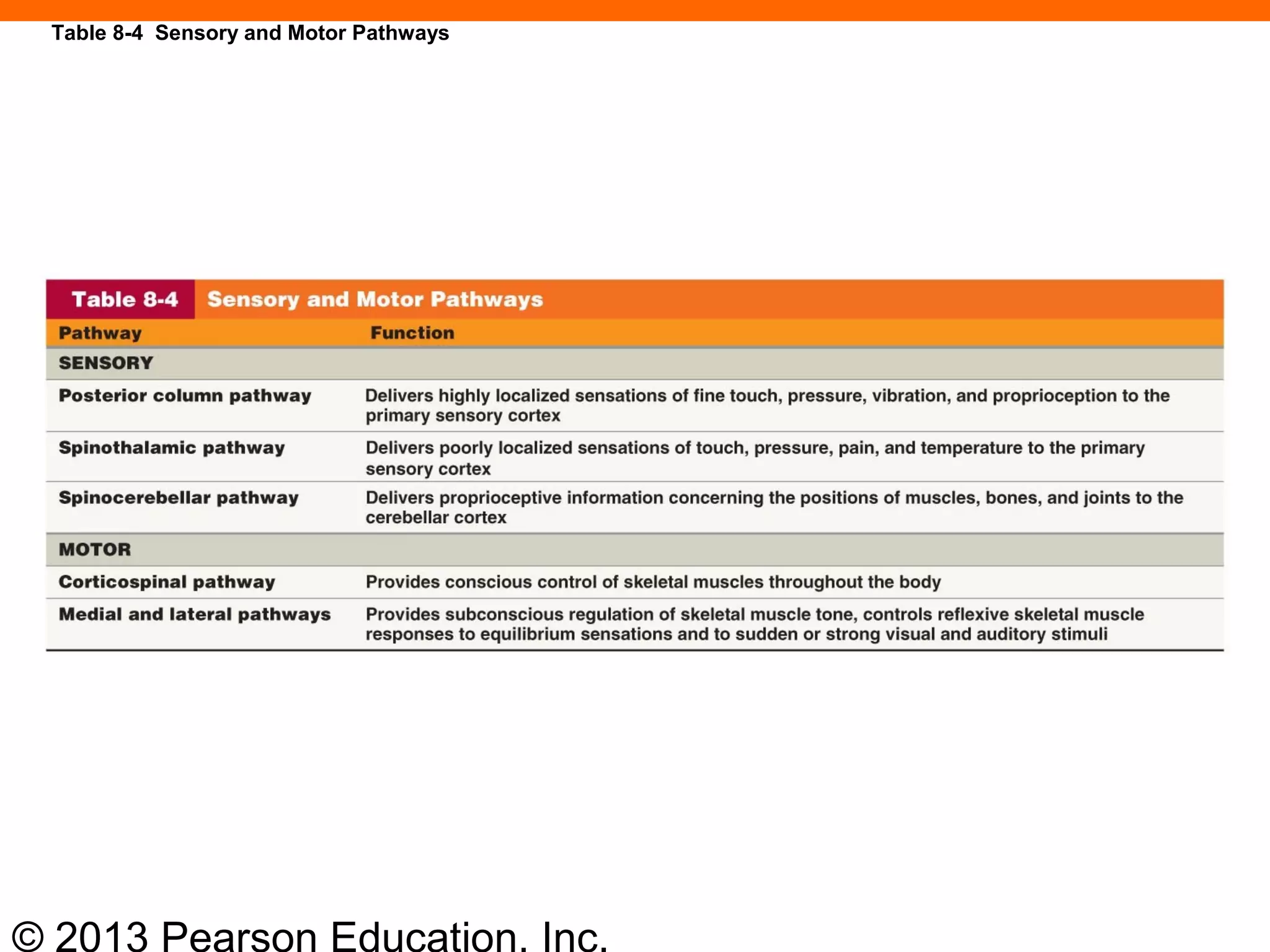
Table 8-4 Sensory and Motor Pathways
© 2013 Pearson Education, Inc.
Checkpoint (8-10)
35. As a result of pressure on her spinal cord, Jill cannot feel
touch or pressure on her legs. What sensory pathway is
being compressed?
36. The primary motor cortex of the right cerebral hemisphere
controls motor function on which side of the body?
37. An injury to the superior portion of the motor cortex
would affect the ability to control muscles of which parts
of the body?
© 2013 Pearson Education, Inc.
The Autonomic Nervous System (8-11)
• Unconscious adjustment of homeostatically essential
visceral responses
• Sympathetic division
• Parasympathetic division
• The somatic NS and ANS are anatomically different
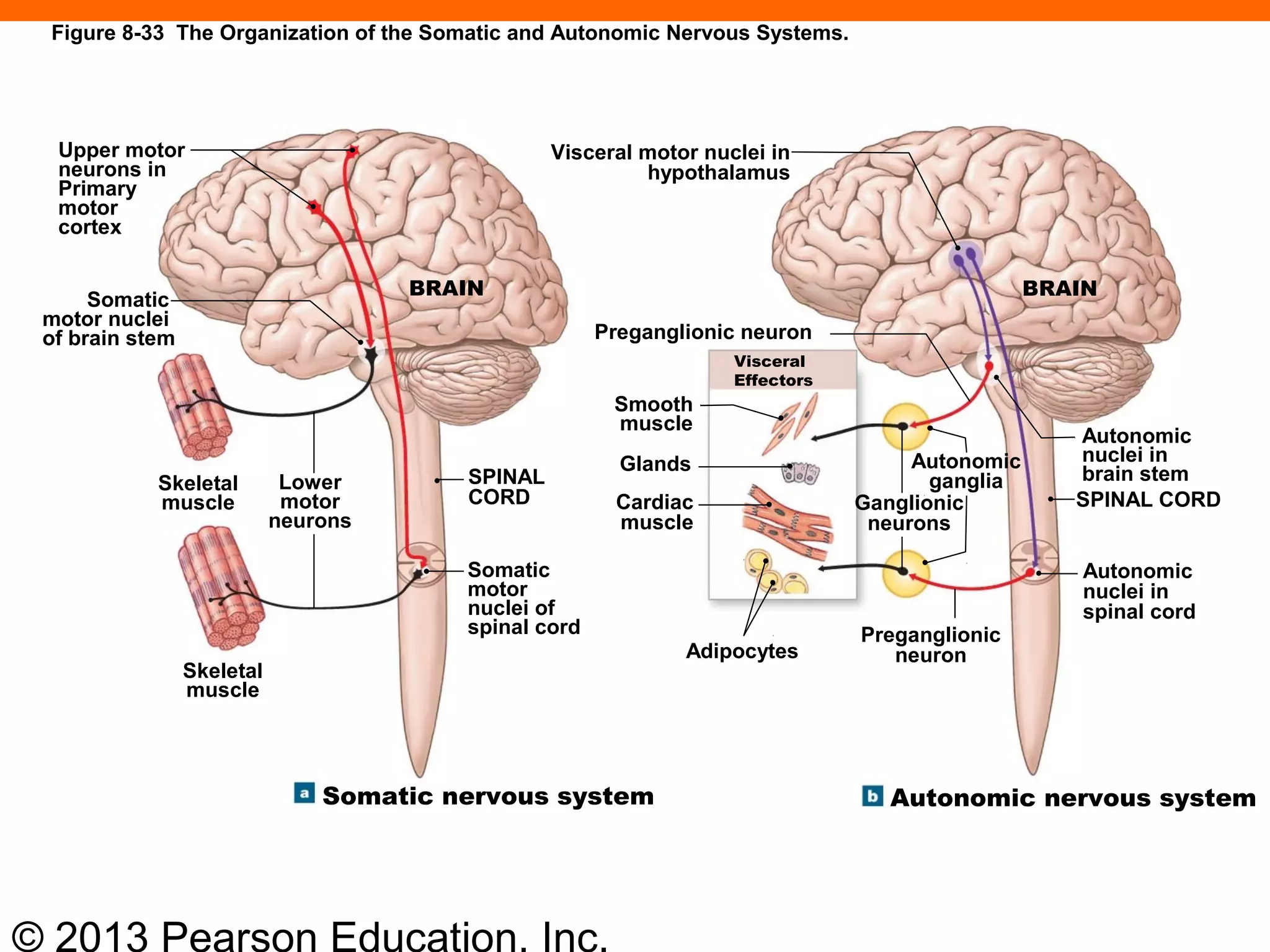
• SNS: one neuron to skeletal muscle
• ANS: two neurons to cardiac and smooth muscle, glands, and fat
cells
© 2013 Pearson Education, Inc.
Two Neuron Pathways of the ANS (8-11)
• Preganglionic neuron
• Has cell body in spinal cord, synapses at the ganglion with the
postganglionic neuron
• In sympathetic division
• Preganglionic fibers are short
• Postganglionic fibers are long
• In parasympathetic division
• Preganglionic fibers are long
• Postganglionic fibers are "short"
© 2013 Pearson Education, Inc.
Upper motor
neurons in
Primary
motor
cortex
Somatic
motor nuclei
of brain stem
Skeletal
muscle
Lower
motor
neurons
BRAIN
Preganglionic neuron
Visceral
Effectors
Smooth
muscle
Glands
Cardiac
muscle
Adipocytes
Visceral motor nuclei in
hypothalamus
BRAIN
Autonomic
nuclei in
brain stem
SPINAL CORD
Autonomic
nuclei in
spinal cord
Preganglionic
neuron
Autonomic nervous systemSomatic nervous system
Somatic
motor
nuclei of
spinal cord
SPINAL
CORD
Skeletal
muscle
Autonomic
ganglia
Ganglionic
neurons
Figure 8-33 The Organization of the Somatic and Autonomic Nervous Systems.
© 2013 Pearson Education, Inc.
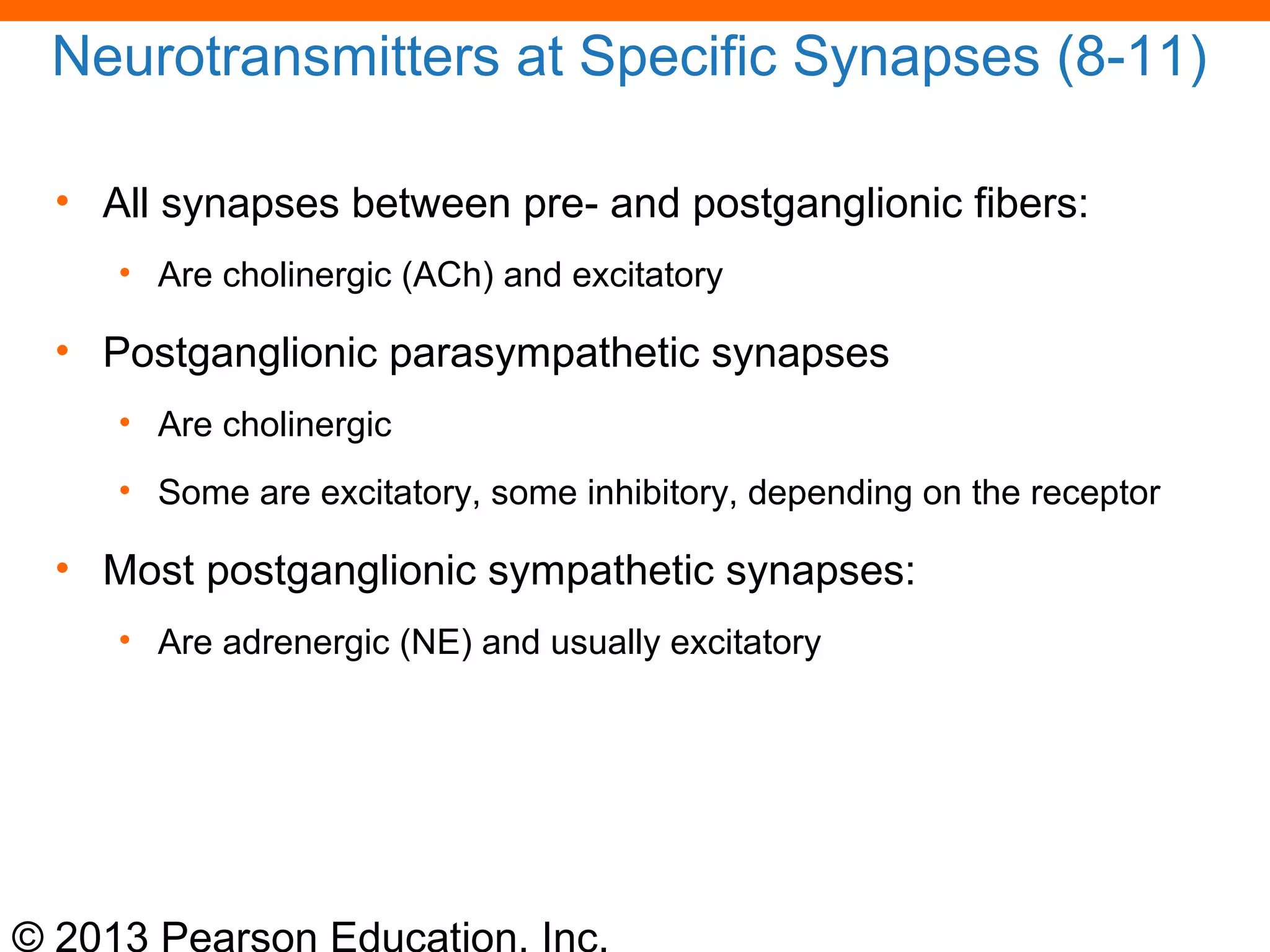
Neurotransmitters at Specific Synapses (8-11)
• All synapses between pre- and postganglionic fibers:
• Are cholinergic (ACh) and excitatory
• Postganglionic parasympathetic synapses
• Are cholinergic
• Some are excitatory, some inhibitory, depending on the receptor
• Most postganglionic sympathetic synapses:
• Are adrenergic (NE) and usually excitatory
© 2013 Pearson Education, Inc.
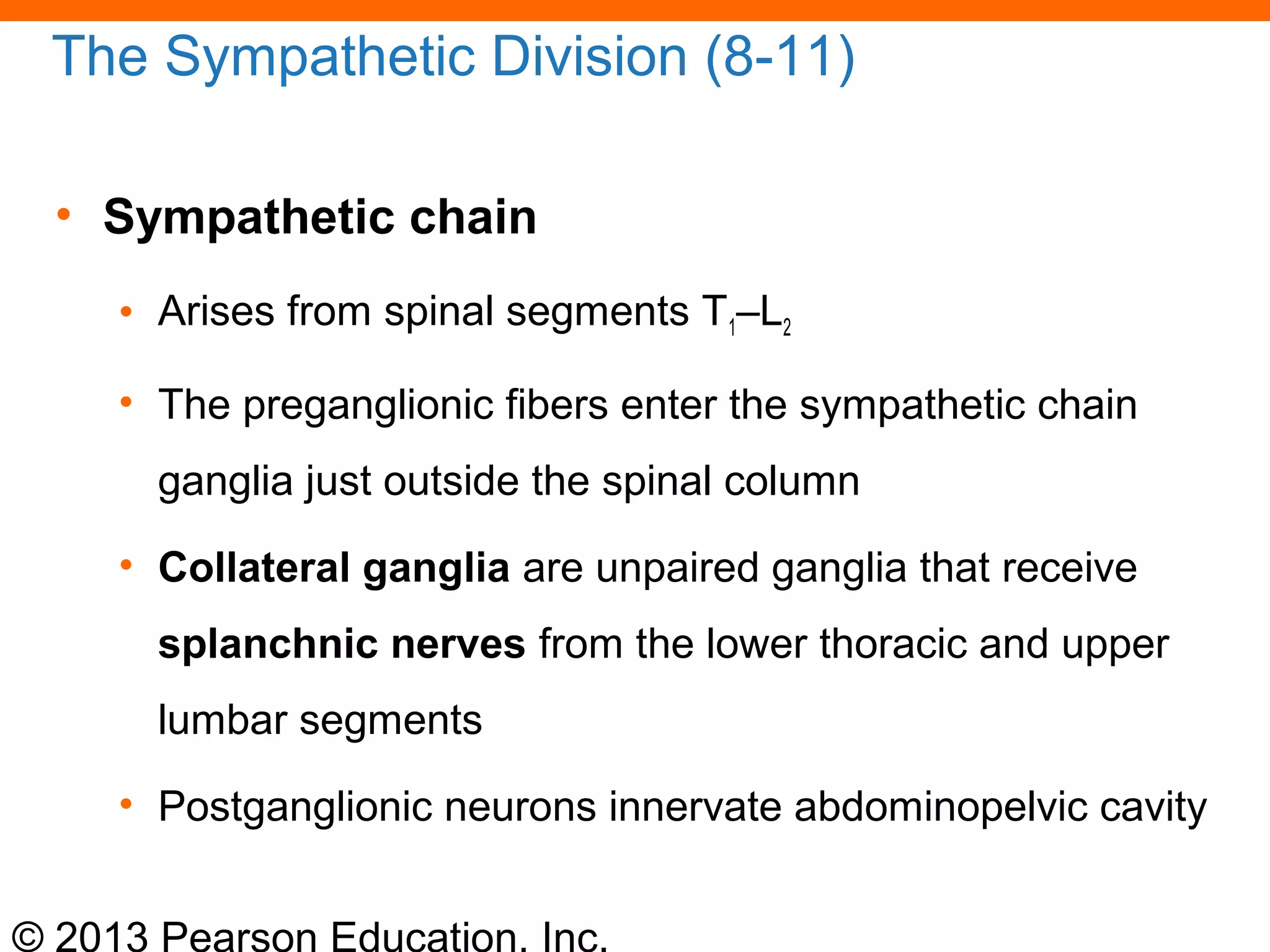
The Sympathetic Division (8-11)
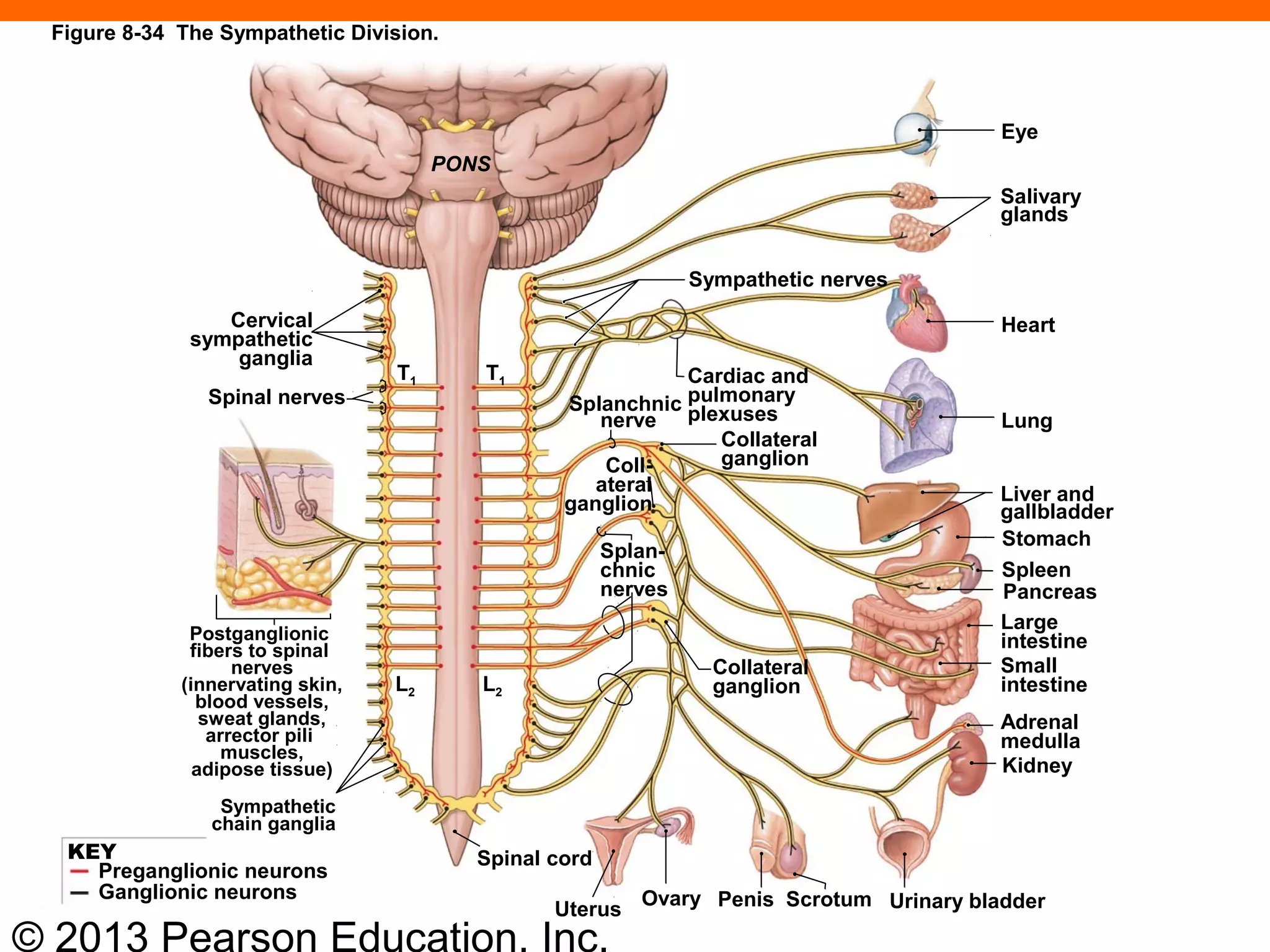
• Sympathetic chain
• Arises from spinal segments T1–L2
• The preganglionic fibers enter the sympathetic chain
ganglia just outside the spinal column
• Collateral ganglia are unpaired ganglia that receive
splanchnic nerves from the lower thoracic and upper
lumbar segments
• Postganglionic neurons innervate abdominopelvic cavity
© 2013 Pearson Education, Inc.
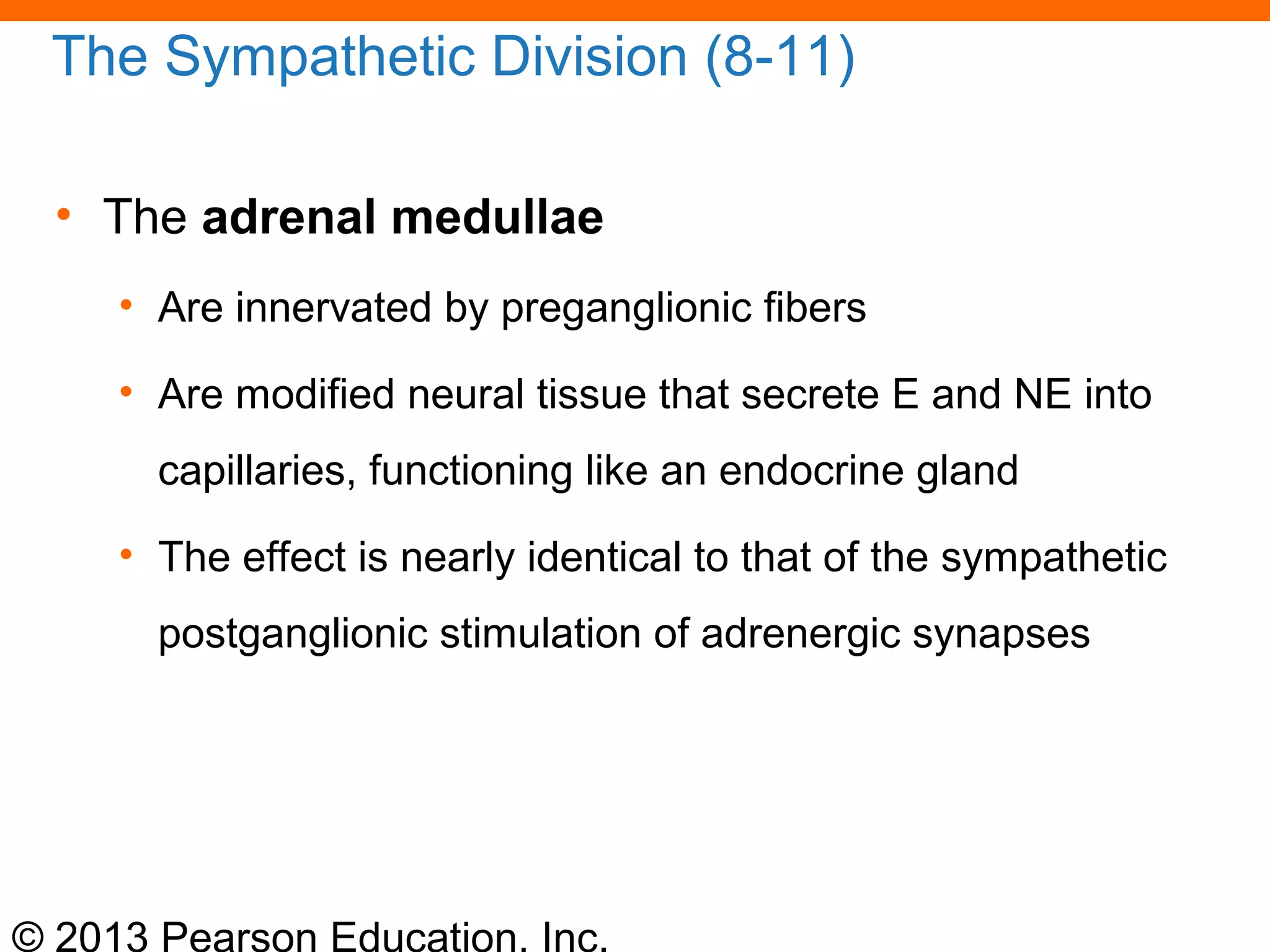
The Sympathetic Division (8-11)
• The adrenal medullae
• Are innervated by preganglionic fibers
• Are modified neural tissue that secrete E and NE into
capillaries, functioning like an endocrine gland
• The effect is nearly identical to that of the sympathetic
postganglionic stimulation of adrenergic synapses
© 2013 Pearson Education, Inc.
Eye
Salivary
glands
Heart
Lung
Liver and
gallbladder
Stomach
Pancreas
Large
intestine
Spleen
Small
intestine
Adrenal
medulla
Kidney
Sympathetic
chain ganglia
Postganglionic
fibers to spinal
nerves
(innervating skin,
blood vessels,
sweat glands,
arrector pili
muscles,
adipose tissue)
Collateral
ganglion
Splanchnic
nerve
Coll-
ateral
ganglion
Splan-
chnic
nerves
Collateral
ganglion
Cardiac and
pulmonary
plexuses
Cervical
sympathetic
ganglia
Spinal nerves
Spinal cord
Urinary bladderOvary
Uterus ScrotumPenis
Sympathetic nerves
PONS
L2L2
T1 T1
Figure 8-34 The Sympathetic Division.
Ganglionic neurons
Preganglionic neurons
KEY
© 2013 Pearson Education, Inc.
The Sympathetic Division (8-11)
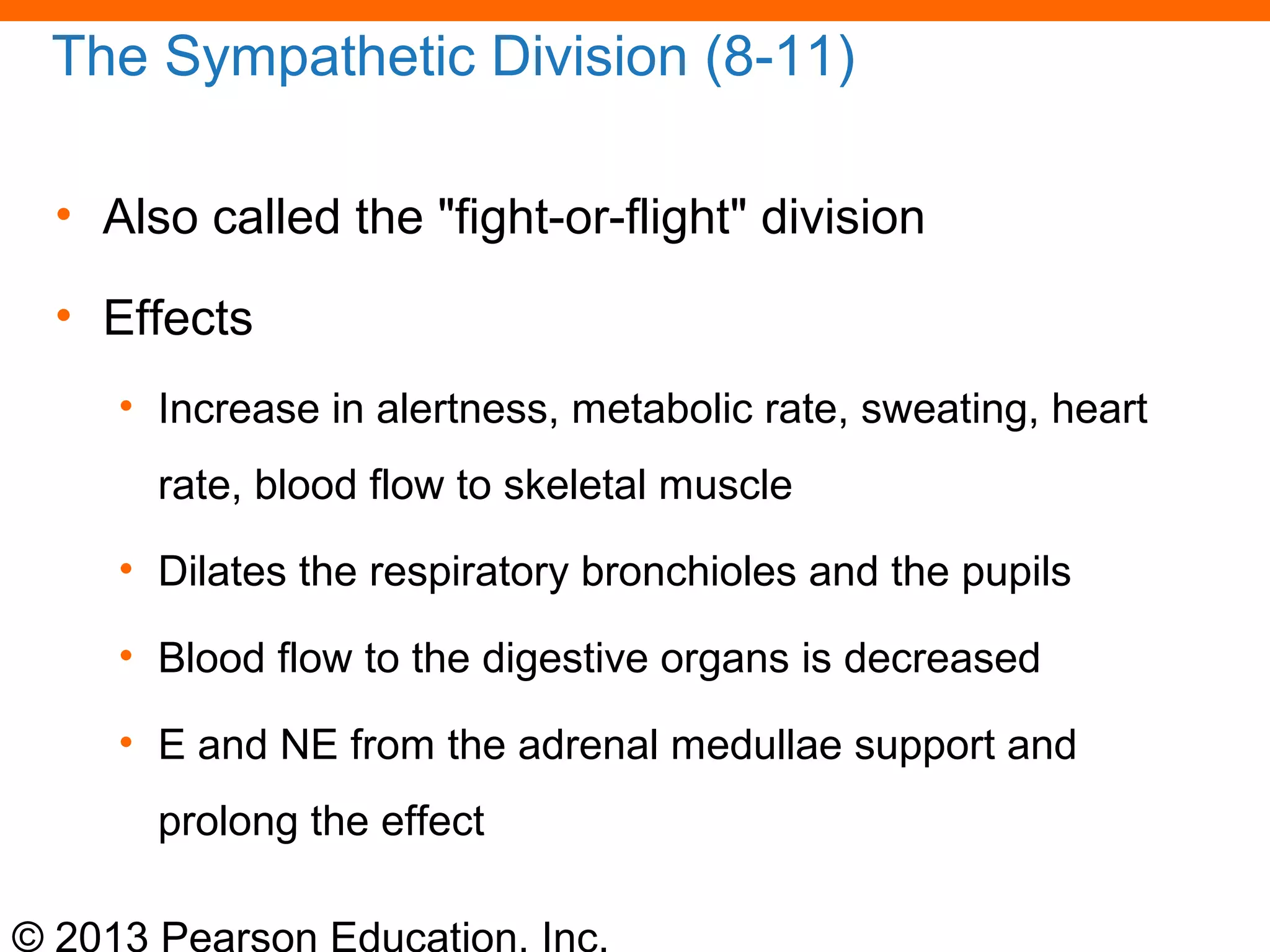
• Also called the "fight-or-flight" division
• Effects
• Increase in alertness, metabolic rate, sweating, heart
rate, blood flow to skeletal muscle
• Dilates the respiratory bronchioles and the pupils
• Blood flow to the digestive organs is decreased
• E and NE from the adrenal medullae support and
prolong the effect
© 2013 Pearson Education, Inc.
The Parasympathetic Division (8-11)
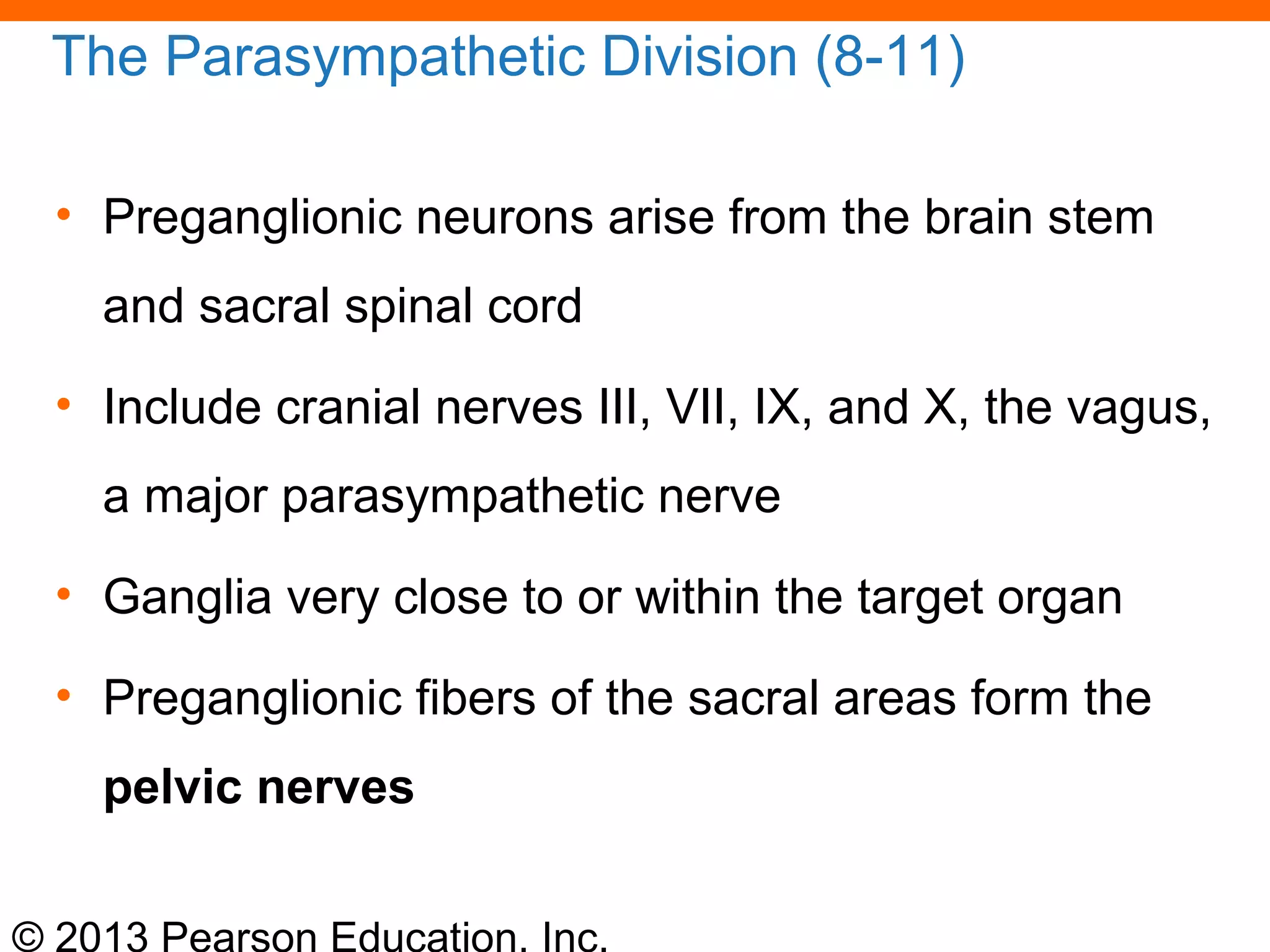
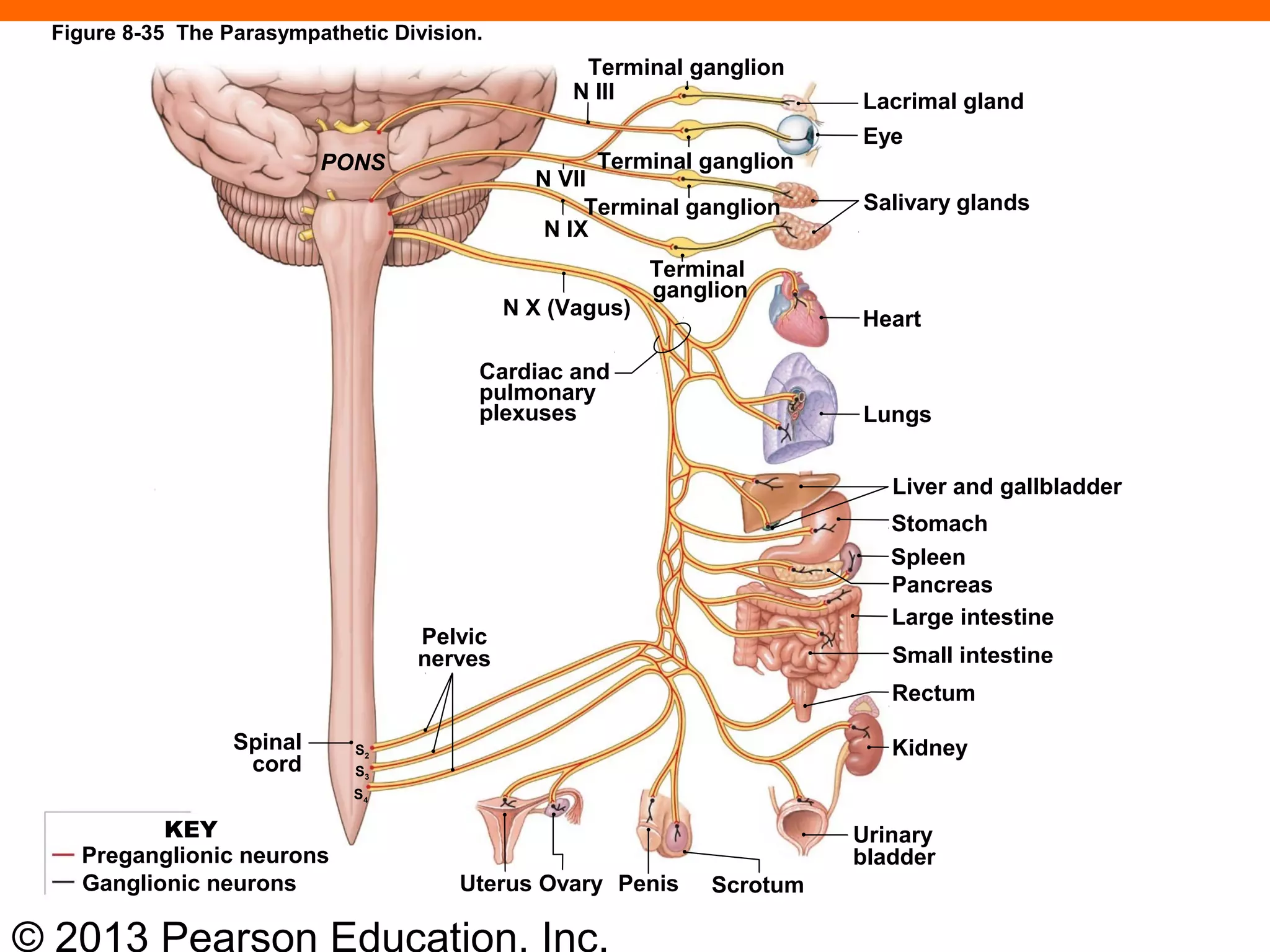
• Preganglionic neurons arise from the brain stem
and sacral spinal cord
• Include cranial nerves III, VII, IX, and X, the vagus,
a major parasympathetic nerve
• Ganglia very close to or within the target organ
• Preganglionic fibers of the sacral areas form the
pelvic nerves
© 2013 Pearson Education, Inc.
The Parasympathetic Division (8-11)
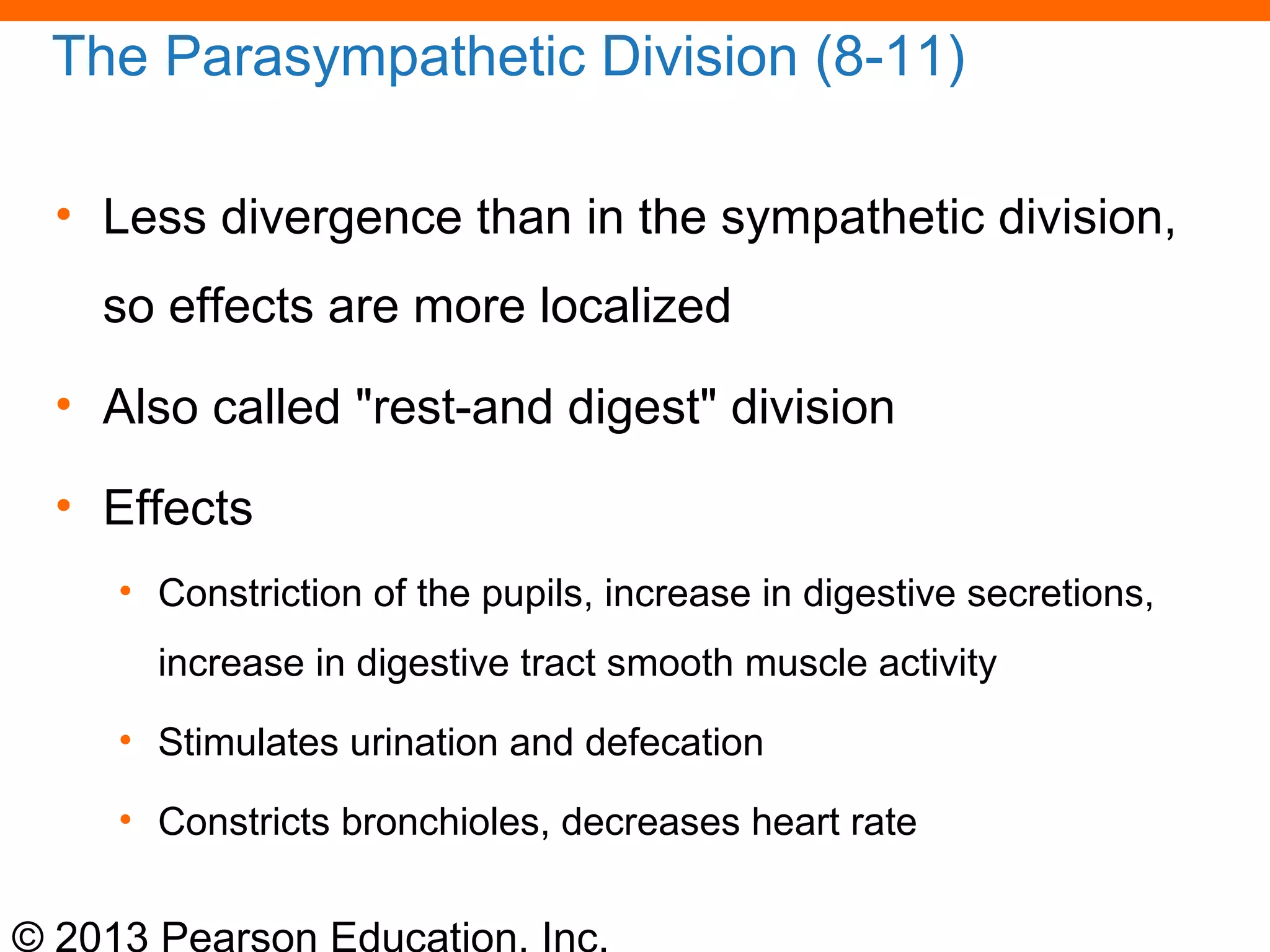
• Less divergence than in the sympathetic division,
so effects are more localized
• Also called "rest-and digest" division
• Effects
• Constriction of the pupils, increase in digestive secretions,
increase in digestive tract smooth muscle activity
• Stimulates urination and defecation
• Constricts bronchioles, decreases heart rate
© 2013 Pearson Education, Inc.
PONS
Terminal ganglion
N III Lacrimal gland
Eye
Salivary glands
Terminal ganglion
N VII
Terminal ganglion
Terminal
ganglion
N IX
N X (Vagus) Heart
Lungs
Cardiac and
pulmonary
plexuses
Liver and gallbladder
Stomach
Spleen
Pancreas
Large intestine
Small intestine
Rectum
Kidney
Urinary
bladder
ScrotumPenisOvaryUterus
Spinal
cord
Pelvic
nerves
S2
S3
S4
Figure 8-35 The Parasympathetic Division.
KEY
Preganglionic neurons
Ganglionic neurons
© 2013 Pearson Education, Inc.
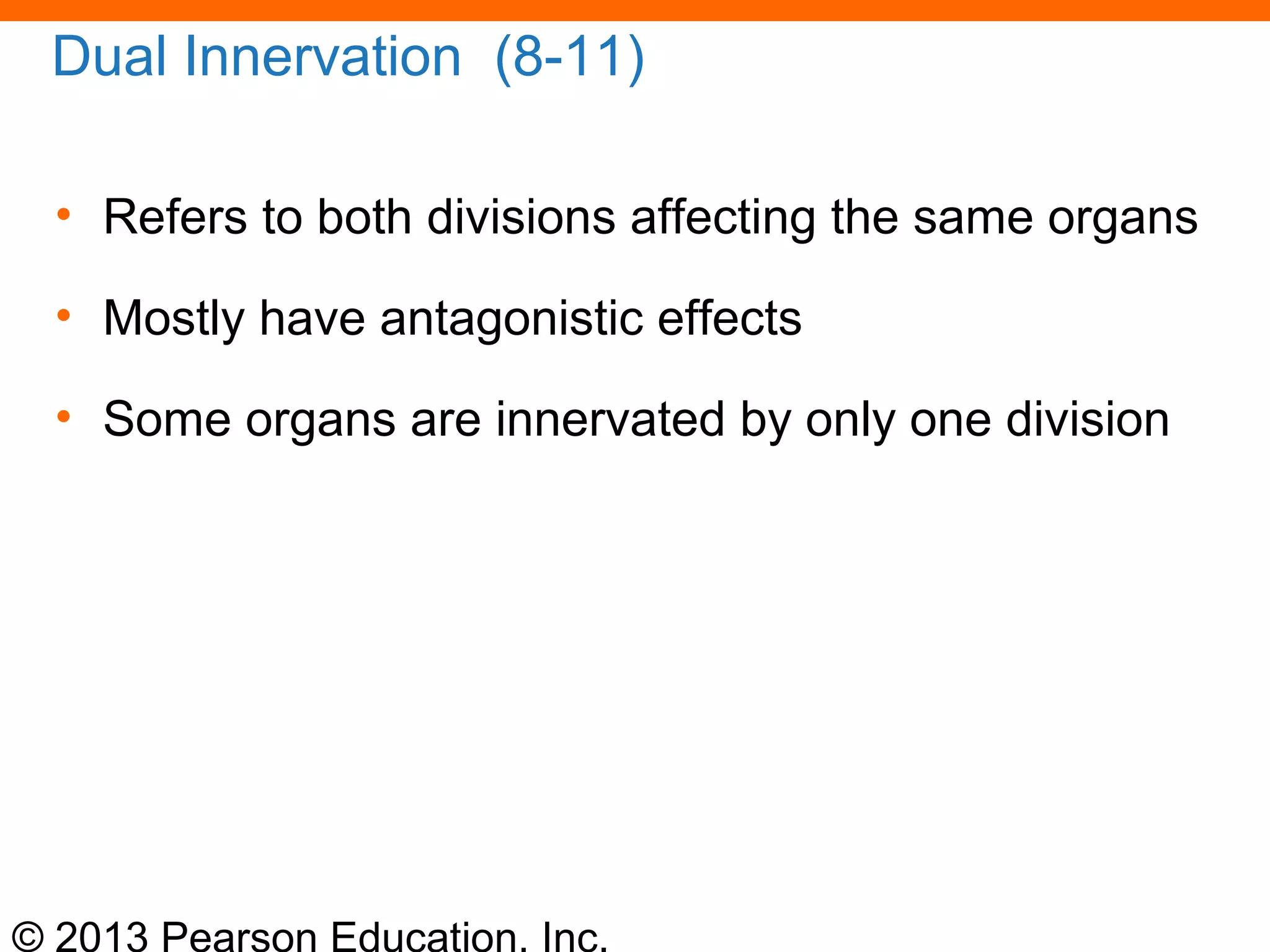
Dual Innervation (8-11)
• Refers to both divisions affecting the same organs
• Mostly have antagonistic effects
• Some organs are innervated by only one division
© 2013 Pearson Education, Inc.
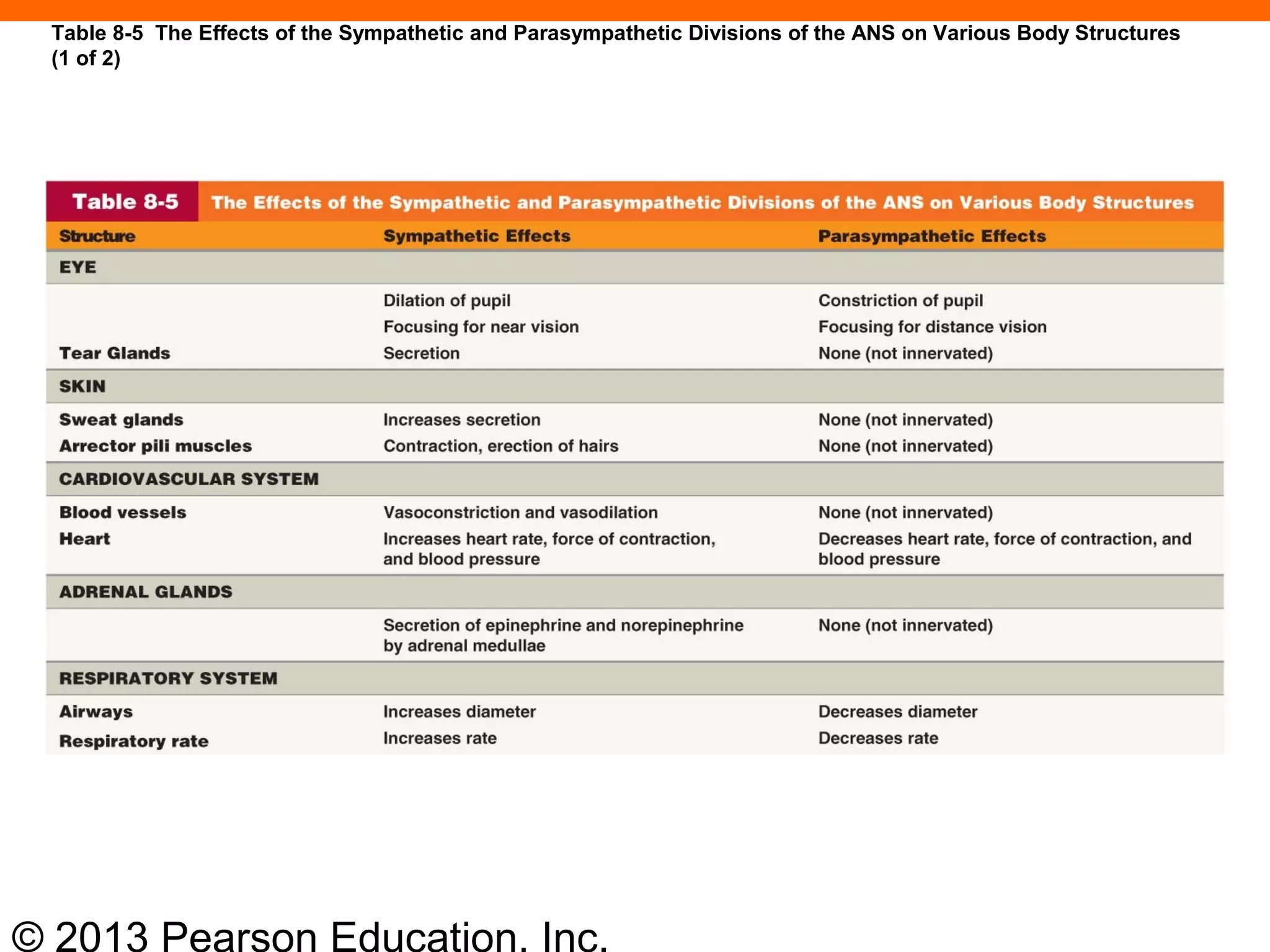
Table 8-5 The Effects of the Sympathetic and Parasympathetic Divisions of the ANS on Various Body Structures
(1 of 2)
© 2013 Pearson Education, Inc.
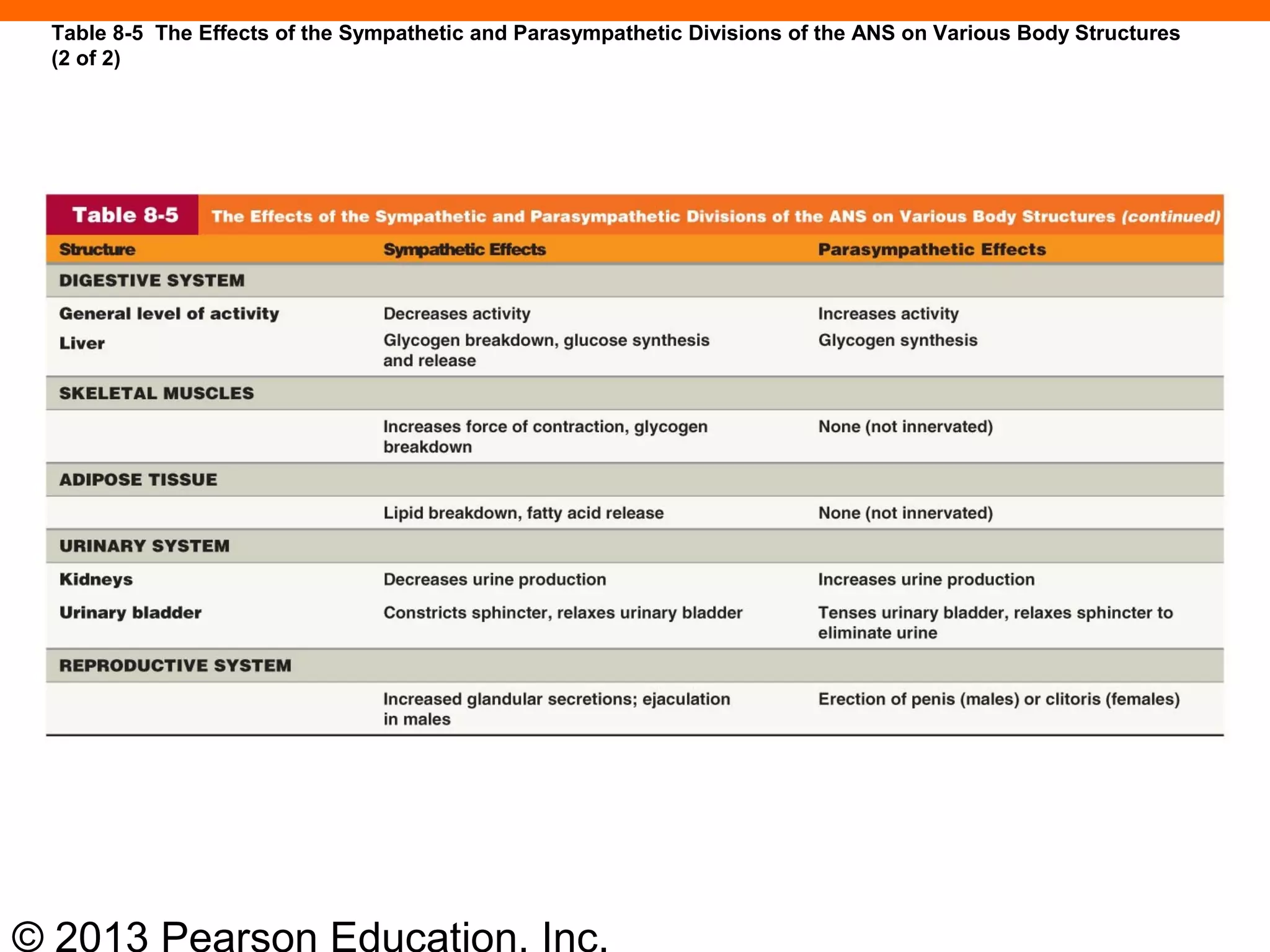
Table 8-5 The Effects of the Sympathetic and Parasympathetic Divisions of the ANS on Various Body Structures
(2 of 2)
© 2013 Pearson Education, Inc.
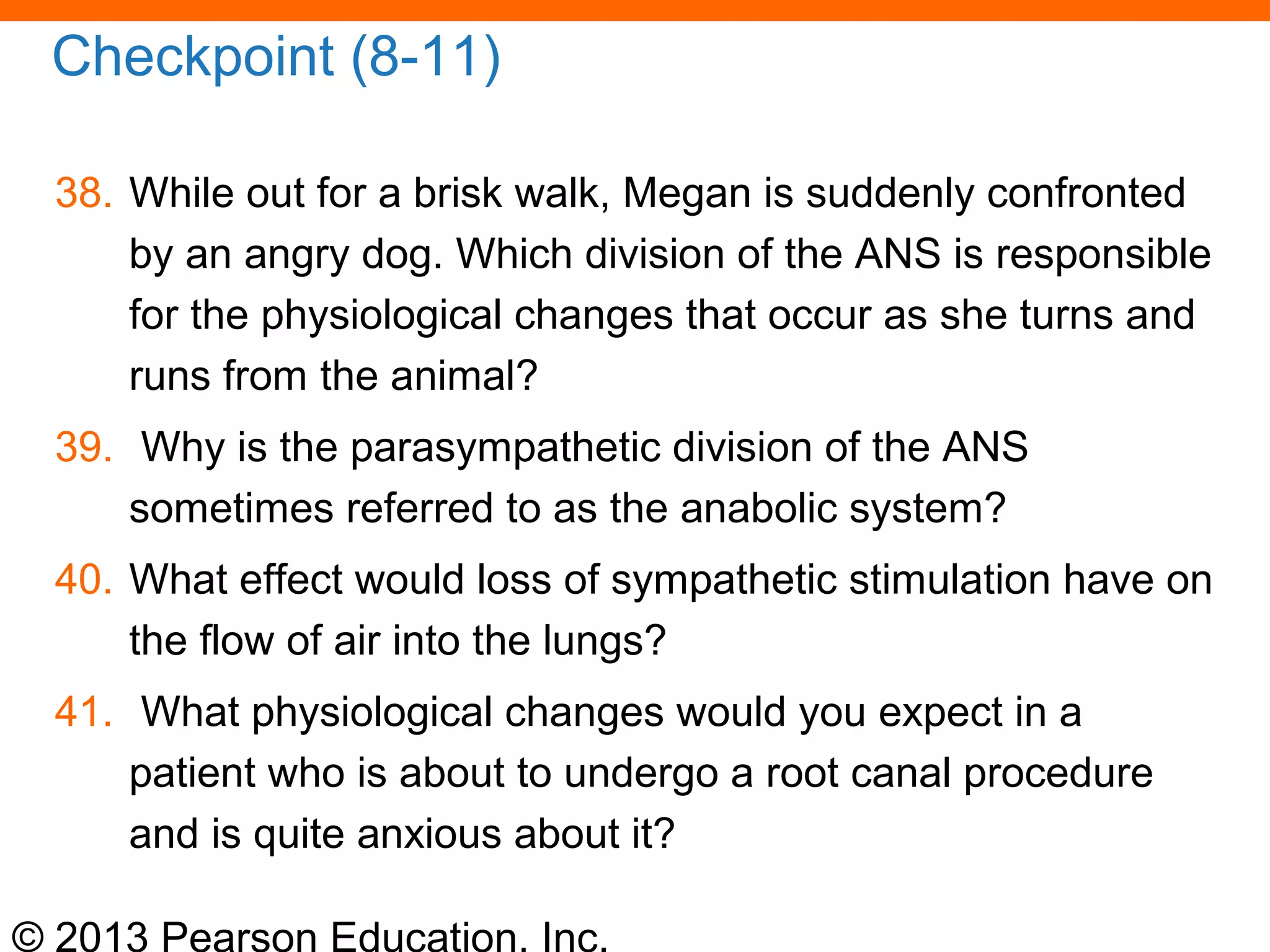
Checkpoint (8-11)
38. While out for a brisk walk, Megan is suddenly confronted
by an angry dog. Which division of the ANS is responsible
for the physiological changes that occur as she turns and
runs from the animal?
39. Why is the parasympathetic division of the ANS
sometimes referred to as the anabolic system?
40. What effect would loss of sympathetic stimulation have on
the flow of air into the lungs?
41. What physiological changes would you expect in a
patient who is about to undergo a root canal procedure
and is quite anxious about it?
© 2013 Pearson Education, Inc.
Aging and the Nervous System (8-12)
• Common changes
• Reduction in brain size and weight and reduction in
number of neurons
• Reduction in blood flow to the brain
• Change in synaptic organization of the brain
• Increase in intracellular deposits and extracellular
plaques
• Senility can be a result of all these changes
© 2013 Pearson Education, Inc.
Checkpoint (8-12)
42. What is the major cause of age-related
shrinkage of the brain?
© 2013 Pearson Education, Inc.
The nervous system is closely
integrated with other body systems.
Every moment of your life, billions
of neurons in your nervous system
are exchanging information
across trillions of synapses
and performing the most
complex integrative
functions in the body. As
part of this process, the
nervous system monitors all
other systems and issues
commands that adjust their
activities. However, the
impact of these commands
varies greatly from one
system to another. The normal
functions of the muscular system,
for example, simply cannot be
performed without instructions from the
nervous system. By contrast, the
cardiovascular system is relatively
independent—the nervous system
merely coordinates and adjusts
cardiovascular activities to meet the
circulatory demands of other systems. In
the final analysis, the nervous system is
like the conductor of an orchestra,
directing the rhythm and balancing the
performances of each section to
produce a symphony, instead of simply
a very loud noise.
The NERVOUS System
Provides sensations of touch, pressure,
pain, vibration, and temperature; hair
provides some protection and insulation
for skull and brain; protects peripheral
nerves
Provides calcium for neural function;
protects brain and spinal cord
Facial muscles express emotional
state; intrinsic laryngeal muscles
permit communication; muscle
spindles provide proprioceptive
sensations
Controls contraction of arrector pili
muscles and secretion of sweat glands
Controls skeletal muscle
contractions that results in bone
thickening and maintenance and
determine bone position
Controls skeletal muscle contractions;
coordinates respiratory and
cardiovascular activities
SYSTEM INTEGRATORBody System Nervous System Nervous System Body System
IntegumentarySkeletalMuscular
Integumentary
(Page138)
Skeletal
(Page188)
Muscular
(Page241)
Endocrine
(Page376)
Cardiovascular
(Page467)
Lymphatic
(Page500)
Respiratory
(Page532)
Digestive
(Page572)
Urinary
(Page637)
Reproductive
(Page671)
Figure 8-36
© 2013 Pearson Education, Inc.
Checkpoint (8-13)
43. Identify the relationships between the nervous
system and the body systems studied so far.

163 ch 08_lecture_presentation

  • 1.
    © 2013 PearsonEducation, Inc. PowerPoint® Lecture Slides prepared by Meg Flemming Austin Community College C H A P T E R 8 The Nervous System
  • 2.
    © 2013 PearsonEducation, Inc. Chapter 8 Learning Outcomes • 8-1 • Describe the anatomical and functional divisions of the nervous system. • 8-2 • Distinguish between neurons and neuroglia on the basis of structure and function. • 8-3 • Describe the events involved in the generation and propagation of an action potential. • 8-4 • Describe the structure of a synapse, and explain the mechanism of nerve impulse transmission at a synapse. • 8-5 • Describe the three meningeal layers that surround the central nervous system.
  • 3.
    © 2013 PearsonEducation, Inc. Chapter 8 Learning Outcomes • 8-6 • Discuss the roles of gray matter and white matter in the spinal cord. • 8-7 • Name the major regions of the brain, and describe the locations and functions of each. • 8-8 • Name the cranial nerves, relate each pair of cranial nerves to its principal functions, and relate the distribution pattern of spinal nerves to the regions they innervate. • 8-9 • Describe the steps in a reflex arc. • 8-10 • Identify the principal sensory and motor pathways, and explain how it is possible to distinguish among sensations that originate in different areas of the body.
  • 4.
    © 2013 PearsonEducation, Inc. Chapter 8 Learning Outcomes • 8-11 • Describe the structures and functions of the sympathetic and parasympathetic divisions of the autonomic nervous system. • 8-12 • Summarize the effects of aging on the nervous system. • 8-13 • Give examples of interactions between the nervous system and other organ systems.
  • 5.
    © 2013 PearsonEducation, Inc. The Nervous System and the Endocrine System (Introduction) • The nervous system and endocrine system coordinate other organ systems to maintain homeostasis • The nervous system is fast, short acting • The endocrine system is slower, but longer lasting • The nervous system is the most complex system in the body
  • 6.
    © 2013 PearsonEducation, Inc. Functions of the Nervous System (8-1) • Monitors the body's internal and external environments • Integrates sensory information • Coordinates voluntary and involuntary responses
  • 7.
    © 2013 PearsonEducation, Inc. Divisions of the Nervous System (8-1) • Anatomical divisions are: • The central nervous system (CNS) • Made up of the brain and spinal cord • Integrates and coordinates input and output • The peripheral nervous system (PNS) • All the neural tissues outside of the CNS • The connection between the CNS and the organs
  • 8.
    © 2013 PearsonEducation, Inc. Divisions of the Nervous System (8-1) • Functional divisions are: • The afferent division • Includes sensory receptors and neurons that send information to the CNS • The efferent division • Includes neurons that send information to the effectors, which are the muscles and glands
  • 9.
    © 2013 PearsonEducation, Inc. Efferent Division of the Nervous System (8-1) • Further divided into: • The somatic nervous system (SNS) • Controls skeletal muscle • The autonomic nervous system (ANS) • Controls smooth and cardiac muscle, and glands • Has two parts 1. Sympathetic division 2. Parasympathetic division
  • 10.
    © 2013 PearsonEducation, Inc. Figure 8-1 A Functional Overview of the Nervous System. CENTRAL NERVOUS SYSTEM PERIPHERAL NERVOUS SYSTEM Sensory information within afferent division Information processing Motor commands within efferent division includes Somatic nervous system Autonomic nervous system Parasympathetic division Sympathetic division Receptors Effectors Somatic sensory receptors (monitor the outside world and our position in it) Visceral sensory receptors (monitor internal conditions and the status of other organ systems) Skeletal muscle Smooth muscle Glands Cardiac muscle
  • 11.
    © 2013 PearsonEducation, Inc. Checkpoint (8-1) 1. Identify the two anatomical divisions of the nervous system. 2. Identify the two functional divisions of the peripheral nervous system, and describe their primary functions. 3. What would be the effect of damage to the afferent division of the PNS?
  • 12.
    © 2013 PearsonEducation, Inc. Neurons (8-2) • Cells that communicate with one another and other cells • Basic structure of a neuron includes: • Cell body • Dendrites • Which receive signals • Axons • Which carry signals to the next cell • Axon terminals • Bulb-shaped endings that form a synapse with the next cell
  • 13.
    © 2013 PearsonEducation, Inc. Neurons (8-2) • Have a very limited ability to regenerate when damaged or destroyed • Cell bodies contain: • Mitochondria, free and fixed ribosomes, and rough endoplasmic reticulum • Free ribosomes and RER form Nissl bodies and give the tissue a gray color (gray matter) • The axon hillock • Where electrical signal begins
  • 14.
    © 2013 PearsonEducation, Inc. Cell body Mitochondrion Golgi apparatus Axon hillock Dendrite Nucleus Nucleolus Nissl bodies Axon (may be myelinated) Collateral Axon terminals Nucleolus Nucleus Axon hillock Nissl bodies Nerve cell body Nerve cell body LM x 1500 Figure 8-2 The Anatomy of a Representative Neuron.
  • 15.
    © 2013 PearsonEducation, Inc. Structural Classification of Neurons (8-2) • Based on the relationship of the dendrites to the cell body • Multipolar neurons • Are the most common in the CNS and have two or more dendrites and one axon • Unipolar neurons • Have the cell body off to one side, most abundant in the afferent division • Bipolar neurons • Have one dendrite and one axon with the cell body in the middle, and are rare
  • 16.
    © 2013 PearsonEducation, Inc. Multipolar neuron Unipolar neuron Bipolar neuron Figure 8-3 A Structural Classification of Neurons.
  • 17.
    © 2013 PearsonEducation, Inc. Sensory Neurons (8-2) • Also called afferent neurons • Total 10 million or more • Receive information from sensory receptors • Somatic sensory receptors • Detect stimuli concerning the outside world, in the form of external receptors • And our position in it, in the form of proprioceptors • Visceral or internal receptors • Monitor the internal organs
  • 18.
    © 2013 PearsonEducation, Inc. Motor Neurons (8-2) • Also called efferent neurons • Total about half a million in number • Carry information to peripheral targets called effectors • Somatic motor neurons • Innervate skeletal muscle • Visceral motor neurons • Innervate cardiac muscle, smooth muscle, and glands
  • 19.
    © 2013 PearsonEducation, Inc. Interneurons (8-2) • Also called association neurons • By far the most numerous type at about 20 billion • Are located in the CNS • Function as links between sensory and motor processes • Have higher functions • Such as memory, planning, and learning
  • 20.
    © 2013 PearsonEducation, Inc. Neuroglial Cells (8-2) • Are supportive cells and make up about half of all neural tissue • Four types are found in the CNS 1. Astrocytes 2. Oligodendrocytes 3. Microglia 4. Ependymal cells • Two types in the PNS 1. Satellite cells 2. Schwann cells
  • 21.
    © 2013 PearsonEducation, Inc. Astrocytes (8-2) • Large and numerous neuroglia in the CNS • Maintain the blood–brain barrier
  • 22.
    © 2013 PearsonEducation, Inc. Oligodendrocytes (8-2) • Found in the CNS • Produce an insulating membranous wrapping around axons called myelin • Small gaps between the wrappings called nodes of Ranvier • Myelinated axons constitute the white matter of the CNS • Where cell bodies are gray matter • Some axons are unmyelinated
  • 23.
    © 2013 PearsonEducation, Inc. Microglia (8-2) • The smallest and least numerous • Phagocytic cells derived from white blood cells • Perform essential protective functions such as engulfing pathogens and cellular waste
  • 24.
    © 2013 PearsonEducation, Inc. Ependymal Cells (8-2) • Line the fluid-filled central canal of the spinal cord and the ventricles of the brain • The endothelial lining is called the ependyma • It is involved in producing and circulating cerebrospinal fluid around the CNS
  • 25.
    © 2013 PearsonEducation, Inc. Gray matter White matter Gray matter Neurons Myelinated axons Ependymal cells CENTRAL CANAL Microglial cell Inter- node White matter Axon Node Oligoden- drocyte Astrocyte Capillary Basement membrane Myelin (cut) Figure 8-4 Neuroglia in the CNS.
  • 26.
    © 2013 PearsonEducation, Inc. Neuroglial Cells in PNS (8-2) • Satellite cells • Surround and support neuron cell bodies • Similar in function to the astrocytes in the CNS • Schwann cells • Cover every axon in PNS • The surface is the neurilemma • Produce myelin
  • 27.
    © 2013 PearsonEducation, Inc. Schwann cell nucleus Axons Neurilemma Myelin covering internode Schwann cell nucleus Nodes Myelinated axon Unmyelinated axon A myelinated axon in the PNS is covered by several Schwann cells, each of which forms a myelin sheath around a portion of the axon. This arrangement differs from the way myelin forms in the CNS; compare with Figure 8-4. A single Schwann cell can encircle several unmy- elinated axons. Every axon in the PNS is completely enclosed by Schwann cells. TEM x 14,048 TEM x 14,048 Figure 8-5 Schwann Cells and Peripheral Axons.
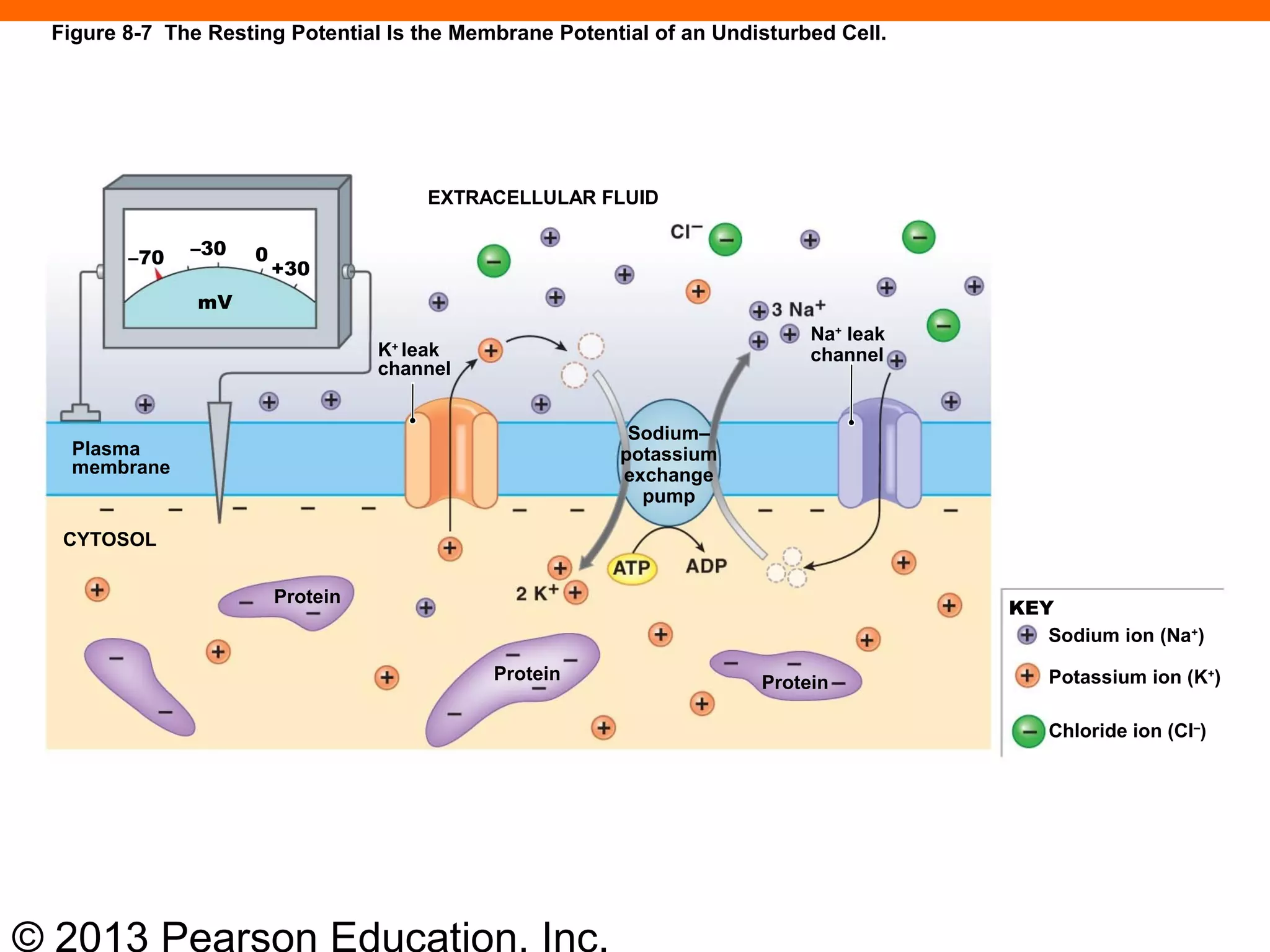
  • 28.
    © 2013 PearsonEducation, Inc. Organization of the Nervous System (8-2) • In the PNS: • Collections of nerve cell bodies are ganglia • Bundled axons are nerves • Including spinal nerves and cranial nerves • Can have both sensory and motor components
  • 29.
    © 2013 PearsonEducation, Inc. Organization of the Nervous System (8-2) • In the CNS: • Collections of neuron cell bodies are found in centers, or nuclei • Neural cortex is a thick layer of gray matter • White matter in the CNS is formed by bundles of axons called tracts, and in the spinal cord, form columns • Pathways are either sensory or ascending tracts, or motor or descending tracts
  • 30.
    © 2013 PearsonEducation, Inc. PERIPHERAL NERVOUS SYSTEM GRAY MATTER Ganglia Collections of neuron cell bodies in the PNS WHITE MATTER Nerves Bundles of axons in the PNS RECEPTORS EFFECTORS PATHWAYS Centers and tracts that connect the brain with other organs and systems in the body Ascending (sensory) pathway Descending (motor) pathway CENTRAL NERVOUS SYSTEM GRAY MATTER ORGANIZATION Neural Cortex Gray matter on the surface of the brain Centers Collections of neuron cell bodies in the CNS; each center has specific processing functionsNuclei Collections of neuron cell bodies in the interior of the CNS Higher Centers The most complex centers in the brain WHITE MATTER ORGANIZATION Tracts Bundles of CNS axons that share a common origin, destination, and function Columns Several tracts that form an anatomically distinct mass Figure 8-6 The Anatomical Organization of the Nervous System.
  • 31.
    © 2013 PearsonEducation, Inc. Checkpoint (8-2) 4. Name the structural components of a typical neuron. 5. Examination of a tissue sample reveals unipolar neurons. Are these more likely to be sensory neurons or motor neurons? 6. Identify the neuroglia of the central nervous system. 7. Which type of glial cell would increase in number in the brain tissue of a person with a CNS infection? 8. In the PNS, neuron cell bodies are located in ________ and surrounded by neuroglial cells called ________ cells.
  • 32.
    © 2013 PearsonEducation, Inc. The Membrane Potential (8-3) • A membrane potential exists because of: • Excessive positive ionic charges on the outside of the cell • Excessive negative charges on the inside, creating a polarized membrane • An undisturbed cell has a resting membrane potential measured in the inside of the cell in millivolts • The resting membrane potential of neurons is –70 mV
  • 33.
    © 2013 PearsonEducation, Inc. Factors Determining Membrane Potential (8-3) • Extracellular fluid (ECF) is high in Na+ and CI– • Intracellular fluid (ICF) is high in K+ and negatively charged proteins (Pr – ) • Proteins are non-permeating, staying in the ICF • Some ion channels are always open • Called leak channels • Some are open or closed • Called gated channels
  • 34.
    © 2013 PearsonEducation, Inc. Factors Determining Membrane Potential (8-3) • Na+ can leak in • But the membrane is more permeable to K+ • Allowing K+ to leak out faster • Na+ /K+ exchange pump exchanges 3 Na+ for every 2 K+ • Moving Na+ out as fast as it leaks in • Cell experiences a net loss of positive ions • Resulting in a resting membrane charge of –70 mV
  • 35.
    © 2013 PearsonEducation, Inc. EXTRACELLULAR FLUID K+ leak channel Sodium– potassium exchange pump Na+ leak channel Plasma membrane CYTOSOL Protein Protein Sodium ion (Na+ ) Potassium ion (K+ ) Chloride ion (Cl– ) Protein –70 –30 +30 0 mV KEY Figure 8-7 The Resting Potential Is the Membrane Potential of an Undisturbed Cell.
  • 36.
    © 2013 PearsonEducation, Inc. Changes in Membrane Potential (8-3) • Stimuli alter membrane permeability to Na+ or K+ • Or alter activity of the exchange pump • Types include: • Cellular exposure to chemicals • Mechanical pressure • Temperature changes • Changes in the ECF ion concentration • Result is opening of a gated channel • Increasing the movement of ions across the membrane
  • 37.
    © 2013 PearsonEducation, Inc. Changes in Membrane Potential (8-3) • Opening of Na+ channels results in an influx of Na+ • Moving the membrane toward 0 mV, a shift called depolarization • Opening of K+ channels results in an efflux of K+ • Moving the membrane further away from 0 mV, a shift called hyperpolarization • Return to resting from depolarization: repolarizing
  • 38.
    © 2013 PearsonEducation, Inc. Graded Potentials (8-3) • Local changes in the membrane that fade over distance • All cells experience graded potentials when stimulated • And can result in the activation of smaller cells • Graded potentials by themselves cannot trigger activation of large neurons and muscle fibers • Referred to as having excitable membranes
  • 39.
    © 2013 PearsonEducation, Inc. Action Potentials (8-3) • A change in the membrane that travels the entire length of neurons • A nerve impulse • If a combination of graded potentials causes the membrane to reach a critical point of depolarization, it is called the threshold • Then an action potential will occur
  • 40.
    © 2013 PearsonEducation, Inc. Action Potentials (8-3) • Are all-or-none and will propagate down the length of the neuron • From the time the voltage-gated channels open until repolarization is finished: • The membrane cannot respond to further stimulation • This period of time is the refractory period • And limits the rate of response by neurons
  • 41.
    © 2013 PearsonEducation, Inc. A graded depolarization brings an area of excitable membrane to threshold (–60 mV). Voltage-gated sodium channels open and sodium ions move into the cell. The membrane potential rises to +30 mV. Potassium channels close, and both sodium and potassium channels return to their normal states. Sodium channels close, voltage-gated potassium channels open, and potassium ions move out of the cell. Repolarization begins. D E P O L A R I Z A T I O N R E P O L A R I Z A T I O N Resting potential Threshold During the refractory period, the membrane cannot respond to further stimulation. Axon hillock First part of axon to reach threshold +30 0 –40 –60 –70 Membranepotential(mV) REFRACTORY PERIOD Time (msec)0 21 2 3 4 1 The Generation of an Action PotentialSPOTLIGHT FIGURE 8-8 Closing of Potassium Channels Inactivation of Sodium Channels and Activation of Potassium Channels Activation of Sodium Channels and Rapid Depolarization Depolarization to ThresholdResting Potential Resting Potential 4321 –60 mV +10 mV +30 mV –70 mV –90 mV –70 mV Local current The axon membrane contains both voltage-gated sodium channels and voltage-gated potassium channels that are closed when the membrane is at the resting potential. The stimulus that begins an action potential is a graded depolarization large enough to open voltage-gated sodium channels. The opening of the channels occurs at a membrane potential known as the threshold. When the voltage-gated sodium channels open, sodium ions rush into the cytoplasm, and rapid depolarization occurs. The inner membrane surface now contains more positive ions than negative ones, and the membrane potential has changed from –60 mV to a positive value. As the membrane potential approaches +30 mV, voltage-gated sodium channels close. This step coincides with the opening of voltage- gated potassium channels. Positively charged potassium ions move out of the cytosol, shifting the membrane potential back toward resting levels. Repolariza- tion now begins. The voltage-gated sodium channels remain inactivated until the membrane has repolar- ized to near threshold levels. The voltage-gated potassium channels begin closing as the membrane reaches the normal resting potential (about –70 mV). Until all have closed, potassium ions continue to leave the cell. This produces a brief hyperpolarization. As the voltage-gated potassium channels close, the membrane potential returns to normal resting levels. The action potential is now over, and the membrane is once again at the resting potential. = Sodium ion = Potassium ion Figure 8-8 The Generation of an Action Potential
  • 42.
    © 2013 PearsonEducation, Inc. Sodium channels close, voltage- gated potassium channels open, and potassium ions move out of the cell. Repolarization begins. D E P O L A R I Z AT I O N R E P O L A R I Z AT I O N Resting potential Threshold Voltage-gated sodium channels open and sodium ions move into the cell. The membrane potential rises to +30 mV. Potassium channels close, and both sodium and potassium chan- nels return to their normal states. A graded depolarization brings an area of excitable membrane to thresh- old (–60 mV). During the refractory period, the membrane cannot respond to further stimulation. REFRACTORY PERIOD Time (msec) Membranepotential(mV) +30 0 –40 –60 –70 1 2 3 4 0 1 2 Figure 8-8 The Generation of an Action Potential
  • 43.
    © 2013 PearsonEducation, Inc. Figure 8-8 The Generation of an Action Potential The axon membrane contains both voltage-gated sodium channels and voltage-gated potassium channels that are closed when the membrane is at the resting potential. = Sodium ion = Potassium ion –70 mV Resting Potential The stimulus that begins an action potential is a graded depolarization large enough to open voltage-gated sodium channels. The opening of the channels occurs at a membrane potential known as the threshold. Local current –60 mV Depolarization to Threshold When the voltage-gated sodium channels open, sodium ions rush into the cytoplasm, and rapid depolarization occurs. The inner membrane surface now contains more positive ions than negative ones, and the membrane potential has changed from –60 mV to a positive value. Activation of Sodium Channels and Rapid Depolarization +10 mV
  • 44.
    © 2013 PearsonEducation, Inc. Figure 8-8 The Generation of an Action Potential Resting Potential +30 mV –90 mV –70 mV Inactivation of Sodium Channels and Activation of Potassium Channels As the membrane potential approaches +30 mV, voltage-gated sodium channels close. This step coincides with the opening of voltage- gated potassium channels. Positively charged potassium ions move out of the cytosol, shifting the membrane potential back toward resting levels. Repolariza- tion now begins. Closing of Potas- sium Channels The voltage-gated sodium channels remain inactivated until the membrane has repolar- ized to near threshold levels. The voltage-gated potassium channels begin closing as the membrane reaches the normal resting potential (about –70 mV). Until all have closed, potassium ions continue to leave the cell. This produces a brief hyperpolarization. As the voltage-gated potassium channels close, the mem- brane potential re- turns to normal rest- ing levels. The action potential is now over, and the membrane is once again at the resting potential.
  • 45.
    © 2013 PearsonEducation, Inc. Propagation of an Action Potential (8-3) • Occurs when local changes in the membrane in one site: • Result in the activation of voltage-gated channels in the next adjacent site of the membrane • This causes a wave of membrane potential changes • Continuous propagation • Occurs in unmyelinated fibers and is relatively slow • Saltatory propagation • Is in myelinated axons and is faster
  • 46.
    © 2013 PearsonEducation, Inc. Action potential propagation along an unmyelinated axon Action potential propagation along a myelinated axon Stimulus depolarizes membrane to threshold Stimulus depolarizes membrane to threshold EXTRACELLULAR FLUID Plasma membrane CYTOSOL CYTOSOLPlasma membrane EXTRACELLULAR FLUID Repolarization (refractory period) Repolarization (refractory period) Myelinated Internode Internode Internode Myelinated Myelinated MyelinatedMyelinatedMyelinated Internode Internode Internode InternodeInternodeInternode Myelinated Myelinated Myelinated Local current Local current Figure 8-9 The Propagation of Action Potentials over Unmyelinated and Myelinated Axons.
  • 47.
    © 2013 PearsonEducation, Inc. Checkpoint (8-3) 9. What effect would a chemical that blocks the voltage-gated sodium channels in a neuron's plasma membrane have on the neuron's ability to depolarize? 10. What effect would decreasing the concentration of extracellular potassium have on the membrane potential of a neuron? 11. List the steps involved in the generation and propagation of an action potential. 12. Two axons are tested for propagation velocities. One carries action potentials at 50 meters per second, the other at 1 meter per second. Which axon is myelinated?
  • 48.
    © 2013 PearsonEducation, Inc. The Synapse (8-4) • A junction between a neuron and another cell • Occurs because of chemical messengers called neurotransmitters • Communication happens in one direction only • Between a neuron and another cell type is a neuroeffector junction • Such as the neuromuscular junction or neuroglandular junction
  • 49.
    © 2013 PearsonEducation, Inc. A Synapse between Two Neurons (8-4) • Occurs: • Between the axon terminals of the presynaptic neuron • Across the synaptic cleft • To the dendrite or cell body of the postsynaptic neuron • Neurotransmitters • Stored in vesicles of the axon terminals • Released into the cleft and bind to receptors on the postsynaptic membrane PLAYPLAY ANIMATION Neurophysiology: Synapse
  • 50.
    © 2013 PearsonEducation, Inc. Axon of presynaptic cell Axon terminal Mitochondrion Synaptic vesicles Presynaptic membrane Postsynaptic membrane Synaptic cleft Figure 8-10 The Structure of a Typical Synapse.
  • 51.
    © 2013 PearsonEducation, Inc. The Neurotransmitter ACh (8-4) • Activates cholinergic synapses in four steps 1. Action potential arrives at the axon terminal 2. ACh is released and diffuses across synaptic cleft 3. ACh binds to receptors and triggers depolarization of the postsynaptic membrane 4. ACh is removed by AChE (acetylcholinesterase)
  • 52.
    © 2013 PearsonEducation, Inc. Figure 8-11 The Events at a Cholinergic Synapse. An action potential arrives and depolarizes the axon terminal Presynaptic neuron Synaptic vesicles Action potential EXTRACELLULAR FLUID Axon terminal AChE POSTSYNAPTIC NEURON Extracellular Ca2+ enters the axon terminal, triggering the exocytosis of ACh Ca2+ Synaptic cleftCa2+ ACh Chemically regulated sodium ion channels
  • 53.
    © 2013 PearsonEducation, Inc. Figure 8-11 The Events at a Cholinergic Synapse. ACh binds to receptors and depolarizes the postsynaptic membrane Initiation of action potential if threshold is reached ACh is removed by AChE Propagation of action potential (if generated)
  • 54.
    © 2013 PearsonEducation, Inc. Table 8-1 The Sequence of Events at a Typical Cholinergic Synapse
  • 55.
    © 2013 PearsonEducation, Inc. Other Important Neurotransmitters (8-4) • Norepinephrine (NE) • In the brain and part of the ANS, is found in adrenergic synapses • Dopamine, GABA, and serotonin • Are CNS neurotransmitters • At least 50 less-understood neurotransmitters • NO and CO • Are gases that act as neurotransmitters
  • 56.
    © 2013 PearsonEducation, Inc. Excitatory vs. Inhibitory Synapses (8-4) • Usually, ACh and NE trigger depolarization • An excitatory response • With the potential of reaching threshold • Usually, dopamine, GABA, and serotonin trigger hyperpolarization • An inhibitory response • Making it farther from threshold
  • 57.
    © 2013 PearsonEducation, Inc. Neuronal Pools (8-4) • Multiple presynaptic neurons can synapse with one postsynaptic neuron • If they all release excitatory neurotransmitters: • Then an action potential can be triggered • If they all release an inhibitory neurotransmitter: • Then no action potential can occur • If half release excitatory and half inhibitory neurotransmitters: • They cancel, resulting in no action
  • 58.
    © 2013 PearsonEducation, Inc. Neuronal Pools (8-4) • A term that describes the complex grouping of neural pathways or circuits • Divergence • Is a pathway that spreads information from one neuron to multiple neurons • Convergence • Is when several neurons synapse with a single postsynaptic neuron
  • 59.
    © 2013 PearsonEducation, Inc. Divergence Convergence A mechanism for spreading stimulation to multiple neurons or neuronal pools in the CNS A mechanism for providing input to a single neuron from multiple sources Figure 8-12 Two Common Types of Neuronal Pools.
  • 60.
    © 2013 PearsonEducation, Inc. Checkpoint (8-4) 13. Describe the general structure of a synapse. 14. What effect would blocking calcium channels at a cholinergic synapse have on synapse function? 15. What type of neural circuit permits both conscious and subconscious control of the same motor neurons?
  • 61.
    © 2013 PearsonEducation, Inc. The Meninges (8-5) • The neural tissue in the CNS is protected by three layers of specialized membranes 1. Dura mater 2. Arachnoid 3. Pia mater
  • 62.
    © 2013 PearsonEducation, Inc. The Dura Mater (8-5) • Is the outer, very tough covering • The dura mater has two layers, with the outer layer fused to the periosteum of the skull • Dural folds contain large veins, the dural sinuses • In the spinal cord the dura mater is separated from the bone by the epidural space
  • 63.
    © 2013 PearsonEducation, Inc. The Arachnoid • Is separated from the dura mater by the subdural space • That contains a little lymphatic fluid • Below the epithelial layer is arachnoid space • Created by a web of collagen fibers • Contains cerebrospinal fluid
  • 64.
    © 2013 PearsonEducation, Inc. The Pia Mater • Is the innermost layer • Firmly bound to the neural tissue underneath • Highly vascularized • Providing needed oxygen and nutrients
  • 65.
    © 2013 PearsonEducation, Inc. Checkpoint (8-5) 16. Identify the three meninges surrounding the CNS.
  • 66.
    © 2013 PearsonEducation, Inc. Spinal Cord Structure (8-6) • The major neural pathway between the brain and the PNS • Can also act as an integrator in the spinal reflexes • Involving the 31 pairs of spinal nerves • Consistent in diameter except for the cervical enlargement and lumbar enlargement • Where numerous nerves supply upper and lower limbs
  • 67.
    © 2013 PearsonEducation, Inc. Spinal Cord Structure (8-6) • Central canal • A narrow passage containing cerebrospinal fluid • Surface of the spinal cord is indented by the: • Posterior median sulcus • Deeper anterior median fissure
  • 68.
    © 2013 PearsonEducation, Inc. 31 Spinal Segments (8-6) • Identified by a letter and number relating to the nearby vertebrae • Each has a pair of dorsal root ganglia • Containing the cell bodies of sensory neurons with axons in dorsal root • Ventral roots contain motor neuron axons • Roots are contained in one spinal nerve
  • 69.
    © 2013 PearsonEducation, Inc. Figure 8-14a Gross Anatomy of the Spinal Cord. Cervical enlargement Posterior median sulcus Lumbar enlargement Inferior tip of spinal cord Cauda equina Cervical spinal nerves Thoracic spinal nerves Lumbar spinal nerves Sacral spinal nerves Coccygeal nerve (Co1) In this superficial view of the adult spinal cord, the designations to the left identify the spiral nerves. C1 C2 C3 C4 C5 C6 C7 C8 T1 T2 T3 T4 T5 T6 T7 T8 T9 T10 T11 T12 L1 L2 L3 L4 L5 S5S5 S1S1 S2S2 S3S3 S4S4
  • 70.
    © 2013 PearsonEducation, Inc. Figure 8-14b Gross Anatomy of the Spinal Cord. This cross section through the cervical region of the spinal cord shows some prominent features and the arrangement of gray matter and white matter. C3 Dorsal root Dorsal root ganglion Central canal Spinal nerve Ventral root Posterior median sulcus White matter Gray matter Anterior median fissure
  • 71.
    © 2013 PearsonEducation, Inc. Sectional Anatomy of the Spinal Cord (8-6) • The central gray matter is made up of glial cells and nerve cell bodies • Projections of gray matter are called horns • Which extend out into the white matter • White matter is myelinated and unmyelinated axons • The location of cell bodies in specific nuclei of the gray matter relate to their function
  • 72.
    © 2013 PearsonEducation, Inc. Sectional Anatomy of the Spinal Cord (8-6) • Posterior gray horns are somatic and visceral sensory nuclei • Lateral gray horns are visceral (ANS) motor nuclei • The anterior gray horns are somatic motor nuclei • White matter can be organized into three columns • Which contain either ascending tracts to the brain, or descending tracts from the brain to the PNS
  • 73.
    © 2013 PearsonEducation, Inc. Posterior white column Dorsal root ganglion Lateral white column Posterior gray horn Lateral gray horn Anterior gray horn Posterior median sulcus Posterior gray commissure Somatic Visceral Visceral Somatic Functional Organization of Gray Matter The cell bodies of neurons in the gray matter of the spinal cord are organized into functional groups called nuclei. Sensory nuclei Motor nuclei Ventral root Anterior gray commissure Anterior white commissure Anterior median fissure Anterior white column The left half of this sectional view shows important anatomical landmarks, including the three columns of white matter. The right half indicates the functional organization of the nuclei in the anterior, lateral, and posterior gray horns. Posterior median sulcus POSTERIOR Structural Organization of Gray Matter The projections of gray matter toward the outer surface of the spinal cord are called horns. Posterior gray horn Lateral gray horn Anterior gray horn Dorsal root Dorsal root ganglion Ventral root Posterior gray commissure Dura mater Arachnoid mater (broken) Central canal Anterior gray commissure Anterior median fissure Pia mater A micrograph of a section through the spinal cord, showing major landmarks in and surrounding the cord. ANTERIOR Figure 8-15 Sectional Anatomy of the Spinal Cord.
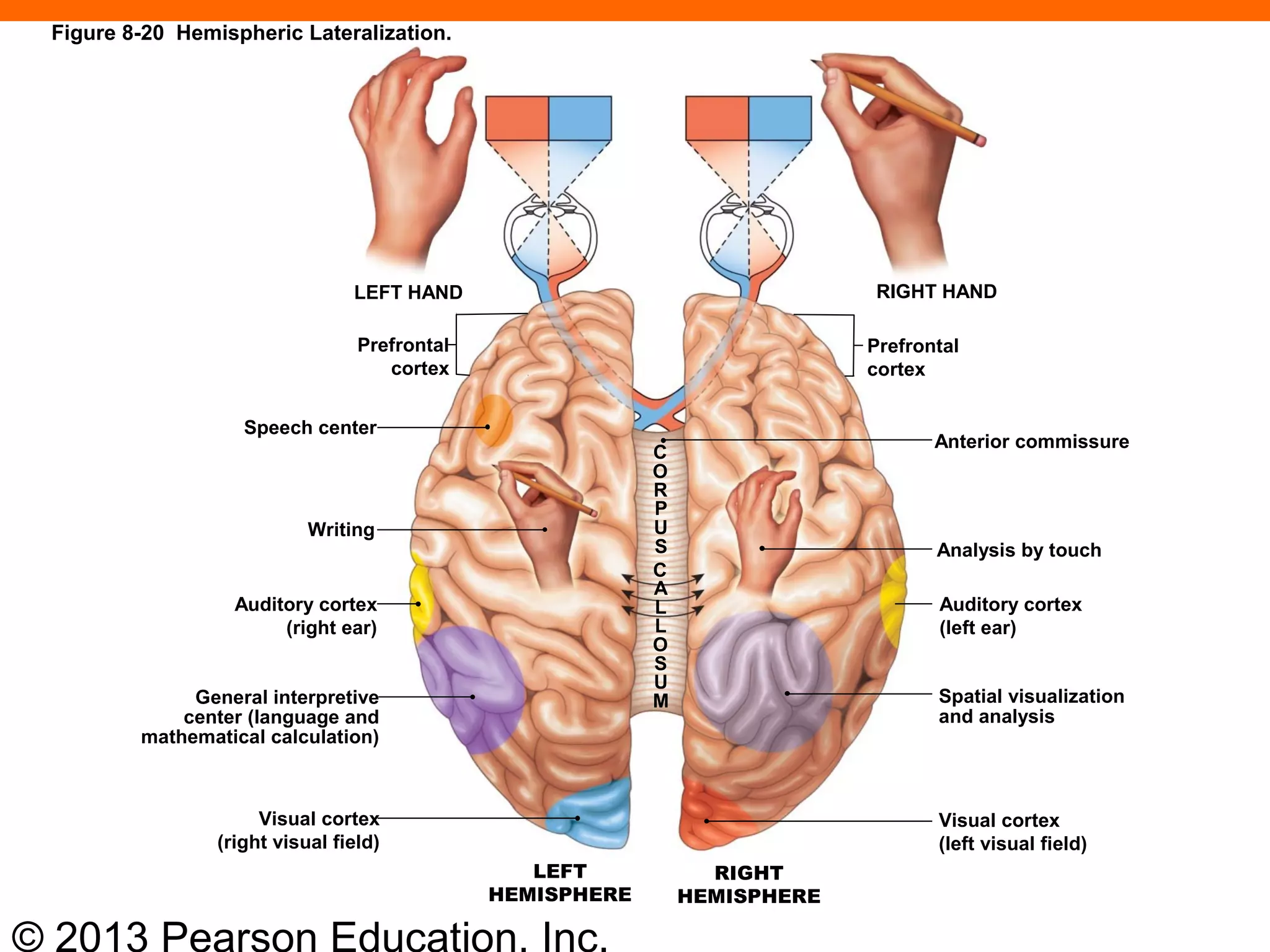
  • 74.
    © 2013 PearsonEducation, Inc. Figure 8-15a Sectional Anatomy of the Spinal Cord. Posterior white column Posterior median sulcus Posterior gray commissure Posterior gray horn Dorsal root ganglion Lateral white column Lateral gray horn Anterior gray horn Somatic Visceral Visceral Somatic Functional Organization of Gray Matter The cell bodies of neurons in the gray matter of the spinal cord are organized into functional groups called nuclei. Sensory nuclei Motor nuclei Ventral root Anterior gray commissure Anterior white commissure Anterior median fissure Anterior white column The left half of this sectional view shows important anatomical landmarks, including the three columns of white matter. The right half indicates the functional organization of the nuclei in the anterior, lateral, and posterior gray horns.
  • 75.
    © 2013 PearsonEducation, Inc. Figure 8-15b Sectional Anatomy of the Spinal Cord. A micrograph of a section through the spinal cord, showing major landmarks in and surrounding the cord. Pia mater Anterior median fissure Anterior gray commissure Central canal Arachnoid mater (broken) Dura mater Posterior gray commissure POSTERIOR ANTERIOR Posterior median sulcus Dorsal root Dorsal root ganglion Ventral root Structural Organization of Gray Matter Posterior gray horn Lateral gray horn Anterior gray horn The projections of gray matter toward the outer surface of the spinal cord are called horns.
  • 76.
    © 2013 PearsonEducation, Inc. Checkpoint (8-6) 17. Damage to which root of a spinal nerve would interfere with motor function? 18. A person with polio has lost the use of his leg muscles. In which areas of his spinal cord could you locate virus-infected neurons? 19. Why are spinal nerves also called mixed nerves?
  • 77.
    © 2013 PearsonEducation, Inc. Six Major Regions of the Brain (8-7) 1. The cerebrum 2. The diencephalon 3. The midbrain 4. The pons 5. The medulla oblongata 6. The cerebellum
  • 78.
    © 2013 PearsonEducation, Inc. Major Structures of the Brain (8-7) • The cerebrum • Is divided into paired cerebral hemispheres • Deep to the cerebrum is the diencephalon • Which is divided into the thalamus, the hypothalamus, and the epithalamus • The brain stem • Contains the midbrain, pons, and medulla oblongata • The cerebellum • Is the most inferior/posterior part
  • 79.
    © 2013 PearsonEducation, Inc. Figure 8-16a The Brain. Longitudinal fissure Cerebral veins and arteries below arachnoid mater Right cerebral hemisphere Left cerebral hemisphere CEREBRUM CEREBELLUM A N T E R I O R P O S T E R I O R Superior view
  • 80.
    © 2013 PearsonEducation, Inc. Figure 8-16b The Brain. Precentral gyrus Frontal lobe of left cerebral hemisphere Lateral sulcus Temporal lobe PONS Central sulcus Postcentral gyrus Parietal lobe Occipital lobe CEREBELLUM MEDULLA OBLONGATALateral view
  • 81.
    © 2013 PearsonEducation, Inc. Figure 8-16c The Brain. Corpus callosum Precentral gyrus Central sulcus Postcentral gyrus Thalamus Hypothalamus Pineal gland (part of epithalamus) Parieto-occipital sulcus CEREBELLUM Sagittal section MEDULLA OBLONGATA PONS MIDBRAIN Brain stem Temporal lobe Fornix Frontal lobe Optic chiasm Mamillary body DIENCEPHALON
  • 82.
    © 2013 PearsonEducation, Inc. The Ventricles of the Brain (8-7) • Filled with cerebrospinal fluid and lined with ependymal cells • The two lateral ventricles within each cerebral hemisphere drain through the: • Interventricular foramen into the: • Third ventricle in the diencephalon, which drains through the cerebral aqueduct into the: • Fourth ventricle, which drains into the central canal
  • 83.
    © 2013 PearsonEducation, Inc. Cerebral hemispheres Pons Medulla oblongata Spinal cord A lateral view of the ventricles Central canal Lateral ventricles Interventricular foramen Third ventricle Cerebral aqueduct Fourth ventricle Cerebral hemispheres Central canal Cerebellum An anterior view of the ventricles Ventricles of the Brain Figure 8-17 The Ventricles of the Brain.
  • 84.
    © 2013 PearsonEducation, Inc. Cerebrospinal Fluid (8-7) • CSF • Surrounds and bathes the exposed surfaces of the CNS • Floats the brain • Transports nutrients, chemicals, and wastes • Is produced by the choroid plexus • Continually secreted and replaced three times per day • Circulation from the fourth ventricle into the subarachnoid space into the dural sinuses
  • 85.
    © 2013 PearsonEducation, Inc. Figure 8-18a The Formation and Circulation of Cerebrospinal Fluid. A sagittal section of the CNS. Cerebrospinal fluid, formed in the choroid plexus, circulates along the routes indicated by the red arrows. Spinal cord Central canal Superior sagittal sinus Arachnoid granulationsExtension of choroid plexus into lateral ventricle Choroid plexus of third ventricle Cerebral aqueduct Lateral aperture Choroid plexus of fourth ventricle Median aperture Arachnoid mater Subarachnoid space Dura mater
  • 86.
    © 2013 PearsonEducation, Inc. Figure 8-18b The Formation and Circulation of Cerebrospinal Fluid. The relation- ship of the arachnoid granulations and dura mater. Pia mater Subarachnoid space Arachnoid mater Subdural space Dura mater (inner layer) Fluid movement Arachnoid granulation Dura mater (outer layer) Cranium Superior sagittal sinus Cerebral cortex
  • 87.
    © 2013 PearsonEducation, Inc. The Cerebrum (8-7) • Contains an outer gray matter called the cerebral cortex • Deep gray matter in the cerebral nuclei and white matter of myelinated axons beneath the cortex and around the nuclei • The surface of the cerebrum • Folds into gyri • Separated by depressions called sulci or deeper grooves called fissures
  • 88.
    © 2013 PearsonEducation, Inc. The Cerebral Hemispheres (8-7) • Are separated by the longitudinal fissure • The central sulcus • Extends laterally from the longitudinal fissure • The frontal lobe • Is anterior to the central sulcus • Is bordered inferiorly by the lateral sulcus
  • 89.
    © 2013 PearsonEducation, Inc. The Cerebral Hemispheres (8-7) • The temporal lobe • Inferior to the lateral sulcus • Overlaps the insula • The parietal lobe • Extends between the central sulcus and the parieto- occipital sulcus
  • 90.
    © 2013 PearsonEducation, Inc. The Cerebral Hemispheres (8-7) • The occipital lobe • Located most posteriorly • The lobes are named for the cranial bone above it • Each lobe has sensory regions and motor regions • Each hemisphere sends and receives information from the opposite side of the body
  • 91.
    © 2013 PearsonEducation, Inc. Motor and Sensory Areas of the Cortex (8-7) • Are divided by the central sulcus • The precentral gyrus of the frontal lobe • Contains the primary motor cortex • The postcentral gyrus of the parietal lobe • Contains the primary sensory cortex
  • 92.
    © 2013 PearsonEducation, Inc. Motor and Sensory Areas of Cortex (8-7) • The visual cortex is in the occipital lobe • The gustatory, auditory, and olfactory cortexes are in the temporal lobe
  • 93.
    © 2013 PearsonEducation, Inc. Association Areas (8-7) • Interpret incoming information • Coordinate a motor response, integrating the sensory and motor cortexes • The somatic sensory association area • Helps to recognize touch • The somatic motor association area • Is responsible for coordinating movement
  • 94.
    © 2013 PearsonEducation, Inc. Primary motor cortex (precentral gyrus) Somatic motor association area (premotor cortex) FRONTAL LOBE Prefrontal cortex Gustatory cortex Insula Lateral sulcus Olfactory cortex TEMPORAL LOBE Auditory cortex Auditory association area Visual cortex OCCIPITAL LOBE Visual association area Somatic sensory association area PARIETAL LOBE Primary sensory cortex (postcentral gyrus) Central sulcus Figure 8-19 The Surface of the Cerebral Hemispheres.
  • 95.
    © 2013 PearsonEducation, Inc. Cortical Connections (8-7) • Regions of the cortex are linked by the deeper white matter • The left and right hemispheres are linked across the corpus callosum • Other axons link the cortex with: • The diencephalon, brain stem, cerebellum, and spinal cord
  • 96.
    © 2013 PearsonEducation, Inc. Higher-Order Centers (8-7) • Integrative areas, usually only in the left hemisphere • The general interpretive area or Wernicke's area • Integrates sensory information to form visual and auditory memory • The speech center or Broca's area • Regulates breathing and vocalization, the motor skills needed for speaking
  • 97.
    © 2013 PearsonEducation, Inc. The Prefrontal Cortex (8-7) • In the frontal lobe • Coordinates information from the entire cortex • Skills such as: • Predicting time lines • Making judgments • Feelings such as: • Frustration, tension, and anxiety
  • 98.
    © 2013 PearsonEducation, Inc. Hemispheric Lateralization (8-7) • The concept that different brain functions can and do occur on one side of the brain • The left hemisphere tends to be involved in language skills, analytical tasks, and logic • The right hemisphere tends to be involved in analyzing sensory input and relating it to the body, as well as analyzing emotional content
  • 99.
    © 2013 PearsonEducation, Inc. General interpretive center (language and mathematical calculation) Auditory cortex (right ear) Writing Speech center Prefrontal cortex LEFT HAND RIGHT HAND Prefrontal cortex Anterior commissure Analysis by touch Auditory cortex (left ear) Spatial visualization and analysis Visual cortex (left visual field) Visual cortex (right visual field) C O R P U S C A L L O S U M RIGHT HEMISPHERE LEFT HEMISPHERE Figure 8-20 Hemispheric Lateralization.
  • 100.
    © 2013 PearsonEducation, Inc. The Electroencephalogram (8-7) • EEG • A printed record of brain wave activity • Can be interpreted to diagnose brain disorders • More modern techniques • Brain imaging, using the PET scan and MRIs, has allowed extensive "mapping" of the brain's functional areas
  • 101.
    © 2013 PearsonEducation, Inc. Patient being wired for EEG monitoring Alpha waves are characteristic of normal resting adults Beta waves typically accompany intense concentration Theta waves are seen in children and in frustrated adults Delta waves occur in deep sleep and in certain pathological conditions 0 1 2 3 4Seconds Figure 8-21 Brain Waves.
  • 102.
    © 2013 PearsonEducation, Inc. Memory (8-7) • Fact memory • The recall of bits of information • Skill memory • Learned motor skill that can become incorporated into unconscious memory • Short-term memory • Doesn't last long unless rehearsed • Converting into long-term memory through memory consolidation • Long-term memory • Remains for long periods, sometimes an entire lifetime • Amnesia • Memory loss as a result of disease or trauma
  • 103.
    © 2013 PearsonEducation, Inc. The Basal Nuclei (8-7) • Masses of gray matter • Caudate nucleus • Lies anterior to the lentiform nucleus • Which contains the medial globus pallidus and the lateral putamen • Inferior to the caudate and lentiform nuclei is the amygdaloid body or amygdala • Basal nuclei • Subconscious control of skeletal muscle tone
  • 104.
    © 2013 PearsonEducation, Inc. Lateral view of a transparent brain, showing the relative positions of the basal nuclei Lentiform nucleus Thalamus Tail of caudate nucleus Amygdaloid body Head of caudate nucleus Head of caudate nucleus Corpus callosum Lateral ventricle Insula Tip of lateral ventricle Amygdaloid bodyGlobus pallidus PutamenLentiform nucleus Frontal section Figure 8-22 The Basal Nuclei.
  • 105.
    © 2013 PearsonEducation, Inc. The Limbic System (8-7) • Includes the olfactory cortex, basal nuclei, gyri, and tracts between the cerebrum and diencephalon • A functional grouping, rather than an anatomical one • Establishes the emotional states • Links the conscious with the unconscious • Aids in long-term memory with help of the hippocampus
  • 106.
    © 2013 PearsonEducation, Inc. Cingulate gyrus Corpus callosum Thalamic nuclei Hypothalamic nuclei Olfactory tract Amygdaloid body Hippocampus Fornix Mamillary body Figure 8-23 The Limbic System.
  • 107.
    © 2013 PearsonEducation, Inc. The Diencephalon (8-7) • Contains switching and relay centers • Centers integrate conscious and unconscious sensory information and motor commands • Surround third ventricle • Three components 1. Epithalamus 2. Thalamus 3. Hypothalamus
  • 108.
    © 2013 PearsonEducation, Inc. The Epithalamus (8-7) • Lies superior to the third ventricle and forms the roof of the diencephalon • The anterior part contains choroid plexus • The posterior part contains the pineal gland that is endocrine and secretes melatonin
  • 109.
    © 2013 PearsonEducation, Inc. The Thalamus (8-7) • The left and right thalamus are separated by the third ventricle • The final relay point for sensory information • Only a small part of this input is sent on to the primary sensory cortex
  • 110.
    © 2013 PearsonEducation, Inc. The Hypothalamus (8-7) • Lies inferior to the third ventricle • The subconscious control of skeletal muscle contractions is associated with strong emotion • Adjusts the pons and medulla functions • Coordinates the nervous and endocrine systems
  • 111.
    © 2013 PearsonEducation, Inc. The Hypothalamus (8-7) • Secretes hormones • Produces sensations of thirst and hunger • Coordinates voluntary and ANS function • Regulates body temperature • Coordinates daily cycles
  • 112.
    © 2013 PearsonEducation, Inc. The Midbrain (8-7) • Contains various nuclei • Two pairs involved in visual and auditory processing, the colliculi • Contains motor nuclei for cranial nerves III and IV • Cerebral peduncles contain descending fibers • Reticular formation is a network of nuclei related to the state of wakefulness • The substantia nigra influence muscle tone
  • 113.
    © 2013 PearsonEducation, Inc. The Pons (8-7) • Links the cerebellum with the midbrain, diencephalon, cerebrum, and spinal cord • Contains sensory and motor nuclei for cranial nerves V, VI, VII, and VIII • Other nuclei influence rate and depth of respiration
  • 114.
    © 2013 PearsonEducation, Inc. The Cerebellum (8-7) • An automatic processing center • Which adjusts postural muscles to maintain balance • Programs and fine-tunes movements • The cerebellar peduncles • Are tracts that link the cerebral cortex, basal nuclei, and brain stem • Ataxia • Is disturbance of coordination • Can be caused by damage to the cerebellum
  • 115.
    © 2013 PearsonEducation, Inc. The Medulla Oblongata (8-7) • Connects the brain with the spinal cord • Contains sensory and motor nuclei for cranial nerves VIII, IX, X, XI, and XII • Contains reflex centers • Cardiovascular centers • Adjust heart rate and arteriolar diameter • Respiratory rhythmicity centers • Regulate respiratory rate
  • 116.
    © 2013 PearsonEducation, Inc. Figure 8-24a The Diencephalon and Brain Stem. Cerebral peduncle Optic tract Cranial nerves Thalamus Diencephalon Thalamic nuclei Midbrain Superior colliculus Inferior colliculus Cerebellar peduncles Medulla oblongata Spinal cord Lateral view Spinal nerve C2 Spinal nerve C1 N XII N XI N X N IX N II N III N V N IV N VI N VII N VIII Pons
  • 117.
    © 2013 PearsonEducation, Inc. Figure 8-24b The Diencephalon and Brain Stem. N IV Choroid plexus Thalamus Third ventricle Pineal gland Corpora quadrigemina Superior colliculi Inferior colliculi Cerebral peduncle Cerebellar peduncles Posterior view Dorsal roots of spinal nerves C1 and C2 Choroid plexus in roof of fourth ventricle
  • 118.
    © 2013 PearsonEducation, Inc. Checkpoint (8-7) 20. Describe one major function of each of the six regions of the brain. 21. The pituitary gland links the nervous and endocrine systems. To which portion of the diencephalon is it attached? 22. How would decreased diffusion across the arachnoid granulations affect the volume of cerebrospinal fluid in the ventricles? 23. Mary suffers a head injury that damages her primary motor cortex. Where is this area located?
  • 119.
    © 2013 PearsonEducation, Inc. Checkpoint (8-7) 24. What senses would be affected by damage to the temporal lobes of the cerebrum? 25. The thalamus acts as a relay point for all but what type of sensory information? 26. Changes in body temperature stimulate which area of the diencephalon? 27. The medulla oblongata is one of the smallest sections of the brain. Why can damage to it cause death, whereas similar damage in the cerebrum might go unnoticed?
  • 120.
    © 2013 PearsonEducation, Inc. Peripheral Nervous System (8-8) • Links the CNS to the rest of the body through peripheral nerves • They include the cranial nerves and the spinal nerves • The cell bodies of sensory and motor neurons are contained in the ganglia
  • 121.
    © 2013 PearsonEducation, Inc. The Cranial Nerves (8-8) • 12 pairs, noted as Roman numerals I through XII • Some are: • Only motor pathways • Only sensory pathways • Mixed having both sensory and motor neurons • Often remembered with a mnemonic • "Oh, Once One Takes The Anatomy Final, Very Good Vacations Are Heavenly"
  • 122.
    © 2013 PearsonEducation, Inc. The Cranial Nerves (8-8) • The olfactory nerves (N I) • Are connected to the cerebrum • Carry information concerning the sense of smell • The optic nerves (N II) • Carry visual information from the eyes, through the optic foramina of the orbits to the optic chiasm • Continue as the optic tracts to the nuclei of the thalamus
  • 123.
    © 2013 PearsonEducation, Inc. The Cranial Nerves (8-8) • The oculomotor nerves (N III) • Motor only, arising in the midbrain • Innervate four of six extrinsic eye muscles and the intrinsic eye muscles that control the size of the pupil • The trochlear nerves (N IV) • Smallest, also arise in the midbrain • Innervate the superior oblique extrinsic muscles of the eyes
  • 124.
    © 2013 PearsonEducation, Inc. The Cranial Nerves (8-8) • The trigeminal nerves (N V) • Have nuclei in the pons, are the largest cranial nerves • Have three branches 1. The ophthalmic • From the orbit, sinuses, nasal cavity, skin of forehead, nose, and eyes 2. The maxillary • From the lower eyelid, upper lip, cheek, nose, upper gums, and teeth • The mandibular • From salivary glands and tongue
  • 125.
    © 2013 PearsonEducation, Inc. The Cranial Nerves (8-8) • The abducens nerves (N VI) • Innervate only the lateral rectus extrinsic eye muscle, with the nucleus in the pons • The facial nerves (N VII) • Mixed, and emerge from the pons • Sensory fibers monitor proprioception in the face • Motor fibers provide facial expressions; control tear and salivary glands
  • 126.
    © 2013 PearsonEducation, Inc. The Cranial Nerves (8-8) • The vestibulocochlear nerves (N VIII) • Respond to sensory receptors in the inner ear • There are two components 1. The vestibular nerve • Conveys information about balance and position 2. The cochlear nerve • Responds to sound waves for the sense of hearing • Their nuclei are in the pons and medulla oblongata
  • 127.
    © 2013 PearsonEducation, Inc. The Cranial Nerves (8-8) • The glossopharyngeal nerves (N IX) • Mixed nerves innervating the tongue and pharynx • Their nuclei are in the medulla oblongata • The sensory portion monitors taste on the posterior third of the tongue and monitors BP and blood gases • The motor portion controls pharyngeal muscles used in swallowing, and fibers to salivary glands
  • 128.
    © 2013 PearsonEducation, Inc. The Cranial Nerves (8-8) • The vagus nerves (N X) • Have sensory input vital to autonomic control of the viscera • Motor control includes the soft palate, pharynx, and esophagus • Are a major pathway for ANS output to cardiac muscle, smooth muscle, and digestive glands
  • 129.
    © 2013 PearsonEducation, Inc. The Cranial Nerves (8-8) • The accessory nerves (N XI) • Have fibers that originate in the medulla oblongata • Also in the lateral gray horns of the first five cervical segments of the spinal cord • The hypoglossal nerves (N XII) • Provide voluntary motor control over the tongue
  • 130.
    © 2013 PearsonEducation, Inc. Mamillary body Basilar artery Olfactory bulb, termination of olfactory nerve (I) Olfactory tract Optic chiasm Optic nerve (II) Infundibulum Oculomotor nerve (III) Trochlear nerve (IV) Trigeminal nerve (V) Abducens nerve (VI) Facial nerve (VII) Vestibulocochlear nerve (VIII) Glossopharyngeal nerve (IX) Vagus nerve (X) Hypoglossal nerve (XII) Accessory nerve (XI) Diagrammatic view showing the attachment of the 12 pairs of cranial nerves Spinal cord Medulla oblongataCerebellum Inferior view of the brain Vertebral artery Pons Figure 8-25 The Cranial Nerves.
  • 131.
    © 2013 PearsonEducation, Inc. Table 8-2 The Cranial Nerves
  • 132.
    © 2013 PearsonEducation, Inc. The Spinal Nerves (8-8) • Found in 31 pairs grouped according to the region of the vertebral column • 8 pairs of cervical nerves, C1–C8 • 12 pairs of thoracic nerves, T1–T12 • 5 pairs of lumbar nerves, L1–L5 • 5 pairs of sacral nerves, S1–S5 • 1 pair of coccygeal nerves, Co1
  • 133.
    © 2013 PearsonEducation, Inc. Nerve Plexuses (8-8) • The origin of major nerve trunks of the PNS • The cervical plexus • Innervates the muscles of the head and neck and the diaphragm • The brachial plexus • Innervates the shoulder girdle and upper limb • The lumbar plexus and the sacral plexus • Innervate the pelvic girdle and lower limb
  • 134.
    © 2013 PearsonEducation, Inc. Figure 8-26 Peripheral Nerves and Nerve Plexuses. Phrenic nerve (extends to the diaphragm) Axillary nerve Musculocutaneous nerve Radial nerve Ulnar nerve Median nerve Femoral nerve Obturator nerve Gluteal nerves Saphenous nerve Sacral plexus Lumbar plexus Brachial plexus Cervical plexus C1 Sciatic nerve C2 C3 C4 C5 C6 C7 C8 T1 T2 T3 T4 T5 T6 T7 T8 T9 T10 T11 T12 L1 L2 L3 L4 L5 S1 S2 S3 S4 S5 Co 1
  • 135.
    © 2013 PearsonEducation, Inc. Dermatome (8-8) • A clinically important area monitored by a specific spinal nerve
  • 136.
    © 2013 PearsonEducation, Inc. C2–C3 C2 C2–C3 N V C3 C4 C3 C5 C4 C5 C6 C7C6 C8 C8 C7 T1 T2 T3 T4 T5 T6 T7 T8 T9 T10 T11 T12 T2 T3 T4 T5 T6 T7 T8 T9 T10 T11 T12 T2 T2 T1 T1 L1 L1 L2 L2 L3L4 L5 L1 L2 L3 L4 L5 L3 S2 S1 L5 S5 SS 4 3 S2 S1 L4 ANTERIOR POSTERIOR Figure 8-27 Dermatomes.
  • 137.
    © 2013 PearsonEducation, Inc. Table 8-3 Nerve Plexuses and Major Nerves
  • 138.
    © 2013 PearsonEducation, Inc. Checkpoint (8-8) 28. What signs would you associate with damage to the abducens nerve (N VI)? 29. John is having trouble moving his tongue. His physician tells him it is due to pressure on a cranial nerve. Which cranial nerve is involved? 30. Injury to which nerve plexus would interfere with the ability to breathe?
  • 139.
    © 2013 PearsonEducation, Inc. Reflexes (8-9) • Rapid, automatic, unlearned motor response to a stimulus • Usually removes or opposes the original stimulus • Monosynaptic reflexes • For example, the stretch reflex • Which responds to muscle spindles, is the simplest with only one synapse • The best known stretch reflex is probably the knee jerk reflex
  • 140.
    © 2013 PearsonEducation, Inc. Simple Reflexes (8-9) • Are wired in a reflex arc • A stimulus activates a sensory receptor • An action potential travels down an afferent neuron • Information processing occurs with the interneuron • An action potential travels down an efferent neuron • The effector organ responds
  • 141.
    © 2013 PearsonEducation, Inc. Arrival of stimulus and activation of receptor Activation of a sensory neuron Dorsal root Sensation relayed to the brain by axon collaterals Information processing in the CNS REFLEX ARC Receptor Stimulus Effector Response by effector Ventral root Activation of a motor neuron KEY Sensory neuron (stimulated) Excitatory interneuron Motor neuron (stimulated) Figure 8-28 The Components of a Reflex Arc.
  • 142.
    © 2013 PearsonEducation, Inc. Stretching of muscle tendon stimulates muscle spindles Muscle spindle (stretch receptor) Spinal Cord REFLEX ARC Contraction Stretch Activation of motor neuron produces reflex muscle contraction Figure 8-29 A Stretch Reflex.
  • 143.
    © 2013 PearsonEducation, Inc. Complex Reflexes (8-9) • Polysynaptic reflexes • With at least one interneuron • Are slower than monosynaptic reflexes, but can activate more than one effector • Withdrawal reflexes • Like the flexor reflex, move a body part away from the stimulation • Like touching a hot stove • Reciprocal inhibition • Blocks the flexor's antagonist • To ensure that flexion is in no way interfered with
  • 144.
    © 2013 PearsonEducation, Inc. Distribution within gray horns to other segments of the spinal cord Painful stimulus Flexors stimulated Extensors inhibited KEY Sensory neuron (stimulated) Excitatory interneuron Motor neuron (stimulated) Motor neuron (inhibited) Inhibitory interneuron Figure 8-30 The Flexor Reflex, a Type of Withdrawal Reflex.
  • 145.
    © 2013 PearsonEducation, Inc. Input to Modify Reflexes (8-9) • Reflexes are automatic, but higher brain centers can influence or modify them • The Babinski sign • Triggered by stroking an infant's sole, resulting in a fanning of the toes • As descending inhibitory synapses develop, an adult will respond by curling the toes instead, called the plantar reflex
  • 146.
    © 2013 PearsonEducation, Inc. Checkpoint (8-9) 31. Define reflex. 32. Which common reflex do physicians use to test the general condition of the spinal cord, peripheral nerves, and muscles? 33. Why can polysynaptic reflexes produce more involved responses than can monosynaptic reflexes? 34. After injuring his back lifting a sofa, Tom exhibits a positive Babinski reflex. What does this imply about Tom's injury?
  • 147.
    © 2013 PearsonEducation, Inc. Sensory Pathways (8-10) • Are ascending pathways • Posterior column pathway • Spinothalamic pathway • Spinocerebellar pathway • A sensory homunculus • A mapping of the area of the cortex dedicated to the number of sensory receptors, not the size of the body area
  • 148.
    © 2013 PearsonEducation, Inc. Sensory homunculus of left cerebral hemisphere KEY Axon of first- order neuron Second-order neuron Third-order neuron Nucleus in medulla oblongata Nuclei in thalamus MIDBRAIN MEDULLA OBLONGATA SPINAL CORD Dorsal root ganglion Fine-touch, pressure, vibration, and proprio- ception sensations from right side of body Figure 8-31 The Posterior Column Pathway.
  • 149.
    © 2013 PearsonEducation, Inc. Motor Pathways (8-10) • Are descending pathways • Corticospinal pathway • Also called pyramidal system • Medial and lateral pathways • Also called extrapyramidal system • A motor homunculus • Represents the distribution of somatic and ANS motor innervation
  • 150.
    © 2013 PearsonEducation, Inc. Motor homunculus on primary motor cortex of left cerebral hemisphere Axon of upper motor neuron Lower motor neuron To skeletal muscles To skeletal muscles Motor nuclei of cranial nerves MIDBRAIN MEDULLA OBLONGATA Lateral corticospinal tract To skeletal muscles Anterior corticospinal tract KEY SPINAL CORD Motor neuron in anterior gray horn Motor nuclei of cranial nerves Figure 8-32 The Corticospinal Pathway.
  • 151.
    © 2013 PearsonEducation, Inc. Table 8-4 Sensory and Motor Pathways
  • 152.
    © 2013 PearsonEducation, Inc. Checkpoint (8-10) 35. As a result of pressure on her spinal cord, Jill cannot feel touch or pressure on her legs. What sensory pathway is being compressed? 36. The primary motor cortex of the right cerebral hemisphere controls motor function on which side of the body? 37. An injury to the superior portion of the motor cortex would affect the ability to control muscles of which parts of the body?
  • 153.
    © 2013 PearsonEducation, Inc. The Autonomic Nervous System (8-11) • Unconscious adjustment of homeostatically essential visceral responses • Sympathetic division • Parasympathetic division • The somatic NS and ANS are anatomically different • SNS: one neuron to skeletal muscle • ANS: two neurons to cardiac and smooth muscle, glands, and fat cells
  • 154.
    © 2013 PearsonEducation, Inc. Two Neuron Pathways of the ANS (8-11) • Preganglionic neuron • Has cell body in spinal cord, synapses at the ganglion with the postganglionic neuron • In sympathetic division • Preganglionic fibers are short • Postganglionic fibers are long • In parasympathetic division • Preganglionic fibers are long • Postganglionic fibers are "short"
  • 155.
    © 2013 PearsonEducation, Inc. Upper motor neurons in Primary motor cortex Somatic motor nuclei of brain stem Skeletal muscle Lower motor neurons BRAIN Preganglionic neuron Visceral Effectors Smooth muscle Glands Cardiac muscle Adipocytes Visceral motor nuclei in hypothalamus BRAIN Autonomic nuclei in brain stem SPINAL CORD Autonomic nuclei in spinal cord Preganglionic neuron Autonomic nervous systemSomatic nervous system Somatic motor nuclei of spinal cord SPINAL CORD Skeletal muscle Autonomic ganglia Ganglionic neurons Figure 8-33 The Organization of the Somatic and Autonomic Nervous Systems.
  • 156.
    © 2013 PearsonEducation, Inc. Neurotransmitters at Specific Synapses (8-11) • All synapses between pre- and postganglionic fibers: • Are cholinergic (ACh) and excitatory • Postganglionic parasympathetic synapses • Are cholinergic • Some are excitatory, some inhibitory, depending on the receptor • Most postganglionic sympathetic synapses: • Are adrenergic (NE) and usually excitatory
  • 157.
    © 2013 PearsonEducation, Inc. The Sympathetic Division (8-11) • Sympathetic chain • Arises from spinal segments T1–L2 • The preganglionic fibers enter the sympathetic chain ganglia just outside the spinal column • Collateral ganglia are unpaired ganglia that receive splanchnic nerves from the lower thoracic and upper lumbar segments • Postganglionic neurons innervate abdominopelvic cavity
  • 158.
    © 2013 PearsonEducation, Inc. The Sympathetic Division (8-11) • The adrenal medullae • Are innervated by preganglionic fibers • Are modified neural tissue that secrete E and NE into capillaries, functioning like an endocrine gland • The effect is nearly identical to that of the sympathetic postganglionic stimulation of adrenergic synapses
  • 159.
    © 2013 PearsonEducation, Inc. Eye Salivary glands Heart Lung Liver and gallbladder Stomach Pancreas Large intestine Spleen Small intestine Adrenal medulla Kidney Sympathetic chain ganglia Postganglionic fibers to spinal nerves (innervating skin, blood vessels, sweat glands, arrector pili muscles, adipose tissue) Collateral ganglion Splanchnic nerve Coll- ateral ganglion Splan- chnic nerves Collateral ganglion Cardiac and pulmonary plexuses Cervical sympathetic ganglia Spinal nerves Spinal cord Urinary bladderOvary Uterus ScrotumPenis Sympathetic nerves PONS L2L2 T1 T1 Figure 8-34 The Sympathetic Division. Ganglionic neurons Preganglionic neurons KEY
  • 160.
    © 2013 PearsonEducation, Inc. The Sympathetic Division (8-11) • Also called the "fight-or-flight" division • Effects • Increase in alertness, metabolic rate, sweating, heart rate, blood flow to skeletal muscle • Dilates the respiratory bronchioles and the pupils • Blood flow to the digestive organs is decreased • E and NE from the adrenal medullae support and prolong the effect
  • 161.
    © 2013 PearsonEducation, Inc. The Parasympathetic Division (8-11) • Preganglionic neurons arise from the brain stem and sacral spinal cord • Include cranial nerves III, VII, IX, and X, the vagus, a major parasympathetic nerve • Ganglia very close to or within the target organ • Preganglionic fibers of the sacral areas form the pelvic nerves
  • 162.
    © 2013 PearsonEducation, Inc. The Parasympathetic Division (8-11) • Less divergence than in the sympathetic division, so effects are more localized • Also called "rest-and digest" division • Effects • Constriction of the pupils, increase in digestive secretions, increase in digestive tract smooth muscle activity • Stimulates urination and defecation • Constricts bronchioles, decreases heart rate
  • 163.
    © 2013 PearsonEducation, Inc. PONS Terminal ganglion N III Lacrimal gland Eye Salivary glands Terminal ganglion N VII Terminal ganglion Terminal ganglion N IX N X (Vagus) Heart Lungs Cardiac and pulmonary plexuses Liver and gallbladder Stomach Spleen Pancreas Large intestine Small intestine Rectum Kidney Urinary bladder ScrotumPenisOvaryUterus Spinal cord Pelvic nerves S2 S3 S4 Figure 8-35 The Parasympathetic Division. KEY Preganglionic neurons Ganglionic neurons
  • 164.
    © 2013 PearsonEducation, Inc. Dual Innervation (8-11) • Refers to both divisions affecting the same organs • Mostly have antagonistic effects • Some organs are innervated by only one division
  • 165.
    © 2013 PearsonEducation, Inc. Table 8-5 The Effects of the Sympathetic and Parasympathetic Divisions of the ANS on Various Body Structures (1 of 2)
  • 166.
    © 2013 PearsonEducation, Inc. Table 8-5 The Effects of the Sympathetic and Parasympathetic Divisions of the ANS on Various Body Structures (2 of 2)
  • 167.
    © 2013 PearsonEducation, Inc. Checkpoint (8-11) 38. While out for a brisk walk, Megan is suddenly confronted by an angry dog. Which division of the ANS is responsible for the physiological changes that occur as she turns and runs from the animal? 39. Why is the parasympathetic division of the ANS sometimes referred to as the anabolic system? 40. What effect would loss of sympathetic stimulation have on the flow of air into the lungs? 41. What physiological changes would you expect in a patient who is about to undergo a root canal procedure and is quite anxious about it?
  • 168.
    © 2013 PearsonEducation, Inc. Aging and the Nervous System (8-12) • Common changes • Reduction in brain size and weight and reduction in number of neurons • Reduction in blood flow to the brain • Change in synaptic organization of the brain • Increase in intracellular deposits and extracellular plaques • Senility can be a result of all these changes
  • 169.
    © 2013 PearsonEducation, Inc. Checkpoint (8-12) 42. What is the major cause of age-related shrinkage of the brain?
  • 170.
    © 2013 PearsonEducation, Inc. The nervous system is closely integrated with other body systems. Every moment of your life, billions of neurons in your nervous system are exchanging information across trillions of synapses and performing the most complex integrative functions in the body. As part of this process, the nervous system monitors all other systems and issues commands that adjust their activities. However, the impact of these commands varies greatly from one system to another. The normal functions of the muscular system, for example, simply cannot be performed without instructions from the nervous system. By contrast, the cardiovascular system is relatively independent—the nervous system merely coordinates and adjusts cardiovascular activities to meet the circulatory demands of other systems. In the final analysis, the nervous system is like the conductor of an orchestra, directing the rhythm and balancing the performances of each section to produce a symphony, instead of simply a very loud noise. The NERVOUS System Provides sensations of touch, pressure, pain, vibration, and temperature; hair provides some protection and insulation for skull and brain; protects peripheral nerves Provides calcium for neural function; protects brain and spinal cord Facial muscles express emotional state; intrinsic laryngeal muscles permit communication; muscle spindles provide proprioceptive sensations Controls contraction of arrector pili muscles and secretion of sweat glands Controls skeletal muscle contractions that results in bone thickening and maintenance and determine bone position Controls skeletal muscle contractions; coordinates respiratory and cardiovascular activities SYSTEM INTEGRATORBody System Nervous System Nervous System Body System IntegumentarySkeletalMuscular Integumentary (Page138) Skeletal (Page188) Muscular (Page241) Endocrine (Page376) Cardiovascular (Page467) Lymphatic (Page500) Respiratory (Page532) Digestive (Page572) Urinary (Page637) Reproductive (Page671) Figure 8-36
  • 171.
    © 2013 PearsonEducation, Inc. Checkpoint (8-13) 43. Identify the relationships between the nervous system and the body systems studied so far.