Acute and Chronic
Inflammation
Referrence
 Chapter 2, “Acute and Chronic
Inflammation” in Robbins’ Basic
Pathology, pages 31-57
Introduction
 Inflammation is a defensive host
response to foreign invaders and
necrotic tissue.
 Can be acute or chronic.
Acute inflammation
Acute inflammation
 Immediate and early response to tissue
injury (physical, chemical, microbiologic, etc.)
 Acute inflammation has two major components :
 Vascular changes
 Cellular events
Vascular change
Vascular change
 The main vascular reactions of acute
inflammation are increased blood flow
followed by vasodilation and increased
vascular permeability:
 warmth and redness
 Opens microvascular beds and protein-rich
fluid moves into extravascular tissues
 Migration of leukocytes (principally neutrophils)
Increased vascular permeability
 This will leads to the movement of
protein-rich fluid and blood cells into the
extravascular tissue.
 The resulting protein-rich accumulation is
called an exudate.
 Increases interstitial osmotic pressure
contributing to edema.
Vascular leakage
 several mechanisms may contribute to
increased vascular permeablity:
 Endothelial cell contraction that leading to
intracellular gaps of venules
This occur after binding of histamines and
bradykinins, and many other mediators and
is usually short-lived (15 – 30 min.)
Vascular leakage
 Cytokine mediators (TNF, IL-1) induce
endothelial cell junction retraction through
cytoskeleton reorganization
 This reaction may take 4 – 6 hrs to develop
,and lasting for 24 hrs or more
Vascular leakage
 Endothelial injuries result in vascular
leakage by causing direct endothelial cell
necrosis, detachment making them leaky
until they are repaired or may cause
delayed damage as in thermal, certain
bacterial toxins or Ultraviolet injury.
Vascular leakage
 Certain mediators such as vascular
endothelial growth factor (VEGF) may
cause increased transcytosis via
intracellular vesicles which travel from the
luminal to basement membrane surface of
the endothelial cell
 All or any combination of these events
may occur in response to a given
stimulus
Leukocyte cellular events
 Leukocytes leave the vascular lumen to the
extravascular space through the following
sequence of events:
 Margination and rolling along the vessel wall
 Firm adhesion and transmigration between
endothelial cells
 Chemotaxis and activation
Margination and Rolling
 With increased vascular permeability, fluid
leaves the vessel causing leukocytes to
settle-out of the central flow column and
“marginate” along the endothelial surface
 Endothelial cells and leukocytes have
complementary surface adhesion molecules
which briefly stick and release causing the
leukocyte to roll along the endothelium until it
eventually comes to a stop as mutual
adhesion reaches a peak
Margination and Rolling
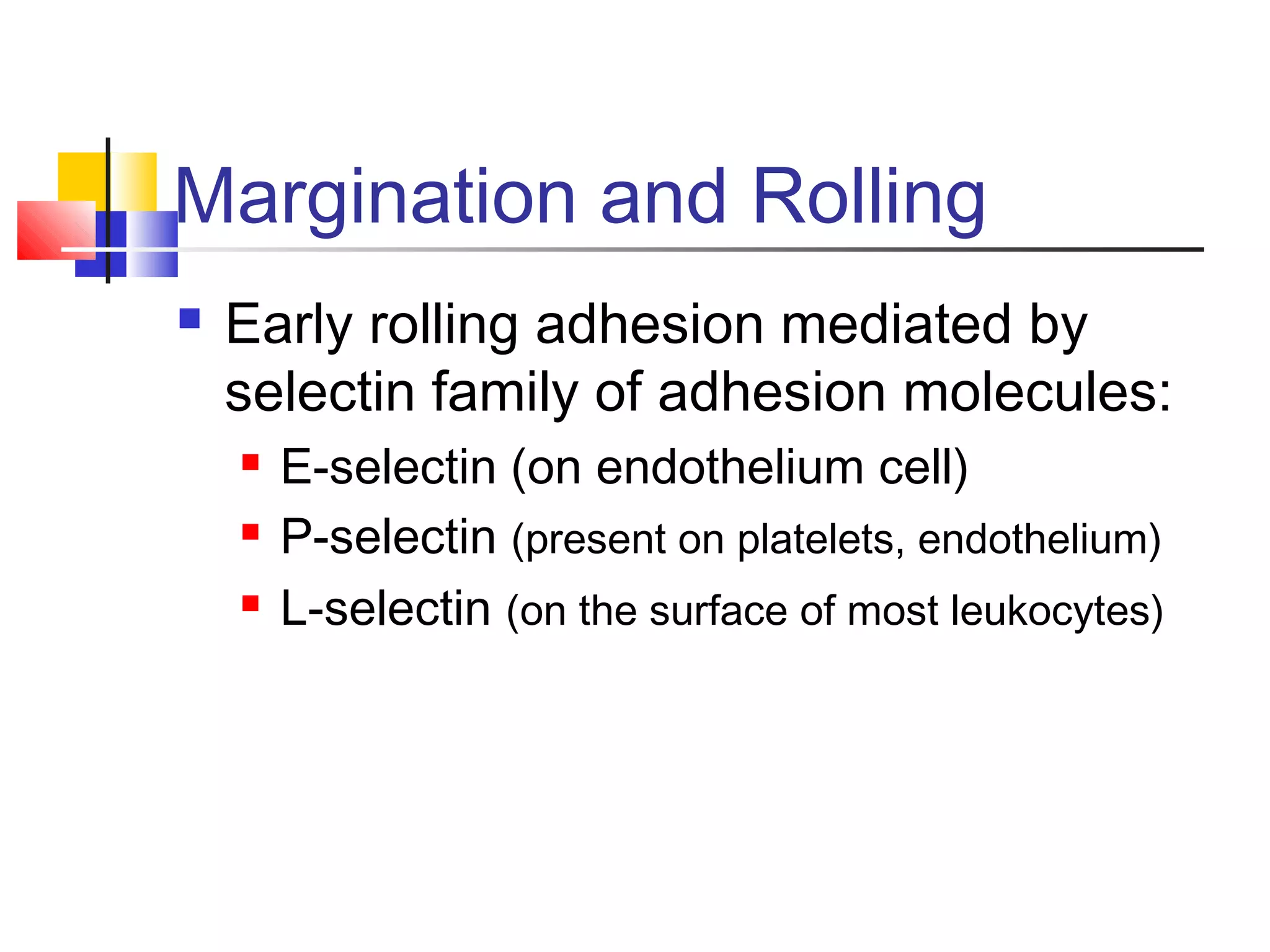
 Early rolling adhesion mediated by
selectin family of adhesion molecules:
 E-selectin (on endothelium cell)
 P-selectin (present on platelets, endothelium)
 L-selectin (on the surface of most leukocytes)
Adhesion
 The rolling leukocytes are able to sense
change on the endothelium that initiate the
next step in the reaction of leukocytes, which
is firm adhesion to endothelial surface
 Occur as leukocytes adhere to the endothelial
surface and is mediated by the interaction of
integrins on leukocytes binding to IG-family
adhesion proteins on the endothelium.
Transmigration (diapedesis)
 Is the movement of leukocyte across
the endothelial surface
 Occurs after firm adhesion and
mediated by palatelete endothelial cell
adhesion molecules-1 (PECAM –1)
on both leukocyte and endothelium
Chemotaxis
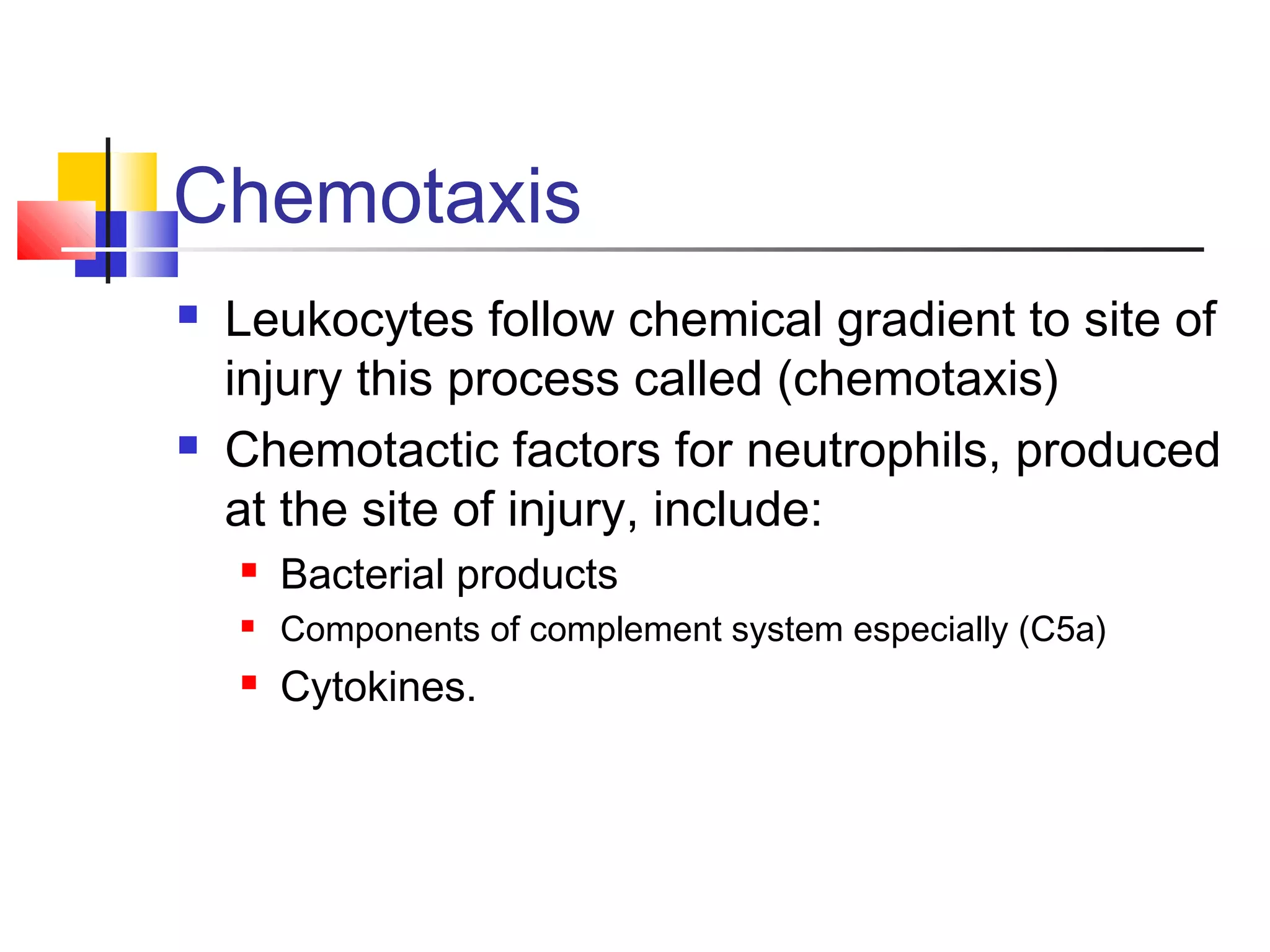
 Leukocytes follow chemical gradient to site of
injury this process called (chemotaxis)
 Chemotactic factors for neutrophils, produced
at the site of injury, include:
 Bacterial products
 Components of complement system especially (C5a)
 Cytokines.
Phagocytosis
 Phagocytosis is the ingestion of
particulate material by phagocytic cell
 neutrophils and monocytes-macrophages
are the most important phagocytic cells
 Phagocytosis consists of three steps:
 Recognition and attachment of the particle
 Engulfment (form phagocytic vacuole)
 Killing and degradation of the ingested
materials.
Defects of leukocyte function
 Defects of leukocyte adhesion:
 Leukocyte adhesion deficiency type I :
is associated with recurrent bacterial
infections.
 Leukocyte adhesion deficiency type 2 :
is associated with recurrent bacterial
infections and result from mutations in the
gene that required for the synthesis of
sialyl-lewis X on neutrophils.
Defects of leukocyte function
 Defects of chemotaxis/phagocytosis:
 Microtubule assembly defect leads to
impaired locomotion and lysosomal
degranulation (Chediak-Higashi Syndrome)
Possible outcomes of acute
inflammation
Possible outcomes of acute
inflammation
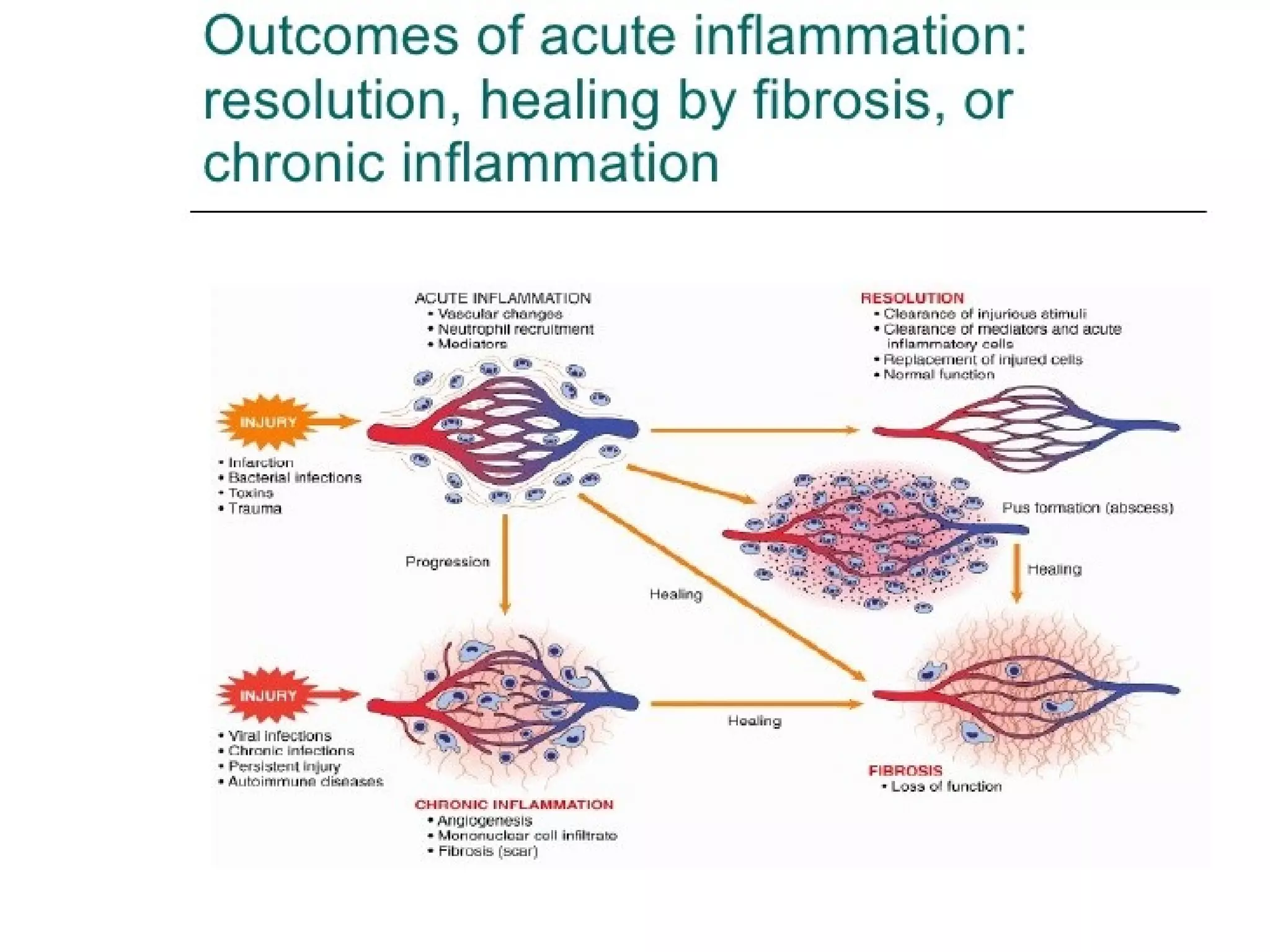
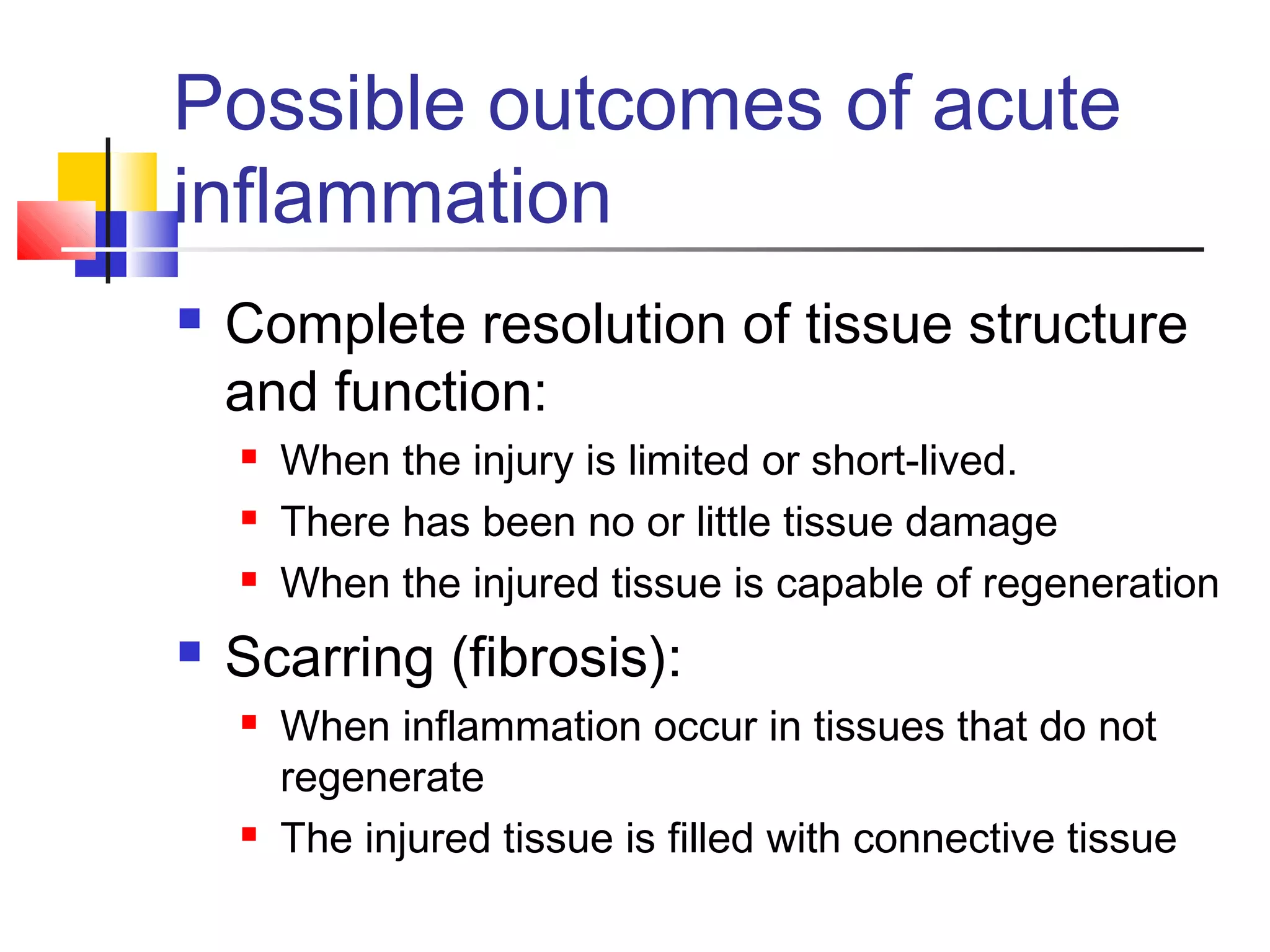
 Complete resolution of tissue structure
and function:
 When the injury is limited or short-lived.
 There has been no or little tissue damage
 When the injured tissue is capable of regeneration
 Scarring (fibrosis):
 When inflammation occur in tissues that do not
regenerate
 The injured tissue is filled with connective tissue
Outcomes (cont’d)
 Abscess formation occurs with some
bacterial or fungal infections
 Progression to chronic inflammation.
Chronic inflammation
 Is inflammation of prolonged duration (week
to years) in which continuing inflammation,
tissue injury, and healing, often by fibrosis,
proceed simultaneously.
Chronic inflammation
 Is characterized by a different set of
reactions:
 Lymphocyte, macrophage, plasma cell
(mononuclear cell) infiltration
 Tissue destruction by inflammatory cells
 Repair with fibrosis and angiogenesis (new
vessel formation)
 Chronic inflammation may arise in the
following setting :
 Persistent injury or infection (ulcer, TB)
 Prolonged toxic agent exposure (silica)
 Autoimmune disease states (RA, SLE)
Chronic inflammatory cells
and mediators
Chronic inflammatory cells
and mediators
 Macrophages
 The dominant cells.
 Scattered all over (Kupffer cells, sinus
histiocytes, alveolar macrophages, etc.
 Derived from circulating blood monocytes
and reach site of injury within 24 – 48 hrs
and transform to macrophages.
Chronic inflammatory cells
and mediators
 Two majors pathways of macrophage
activation:
 Classical macrophage activation:
induced byT cell-derived cytokines, endotoxins, and other products of
inflammation
 Alternative macrophage activation:
induced by cytokines produced by T lymphocytes and other cell including
mast cell and eosinophils
Chronic inflammatory cells
and mediators
 Macrophages have several roles in host
defense and inflammatory reaction:
 Ingest and eliminate microbes and dead
tissue.
 Initiate the process of tissue repair.
 Secrete mediators of inflammation such as
cytokines.
Chronic inflammatory cells
and mediators
 Lymphocytes (T - B )
 Antigen-activated (via macrophages and dendritic
cells)
 Lymphocytes and macrophages interact in
a bidirectional way and these interaction play an
important role in propagating chronic inflammation
lymphocyte release macrophage-activating
cytokines (in turn, macrophages release
lymphocyte-activating cytokines until inflammatory
stimulus is removed)
Chronic inflammatory cells
and mediators
 Eosinophils
 Found especially at sites of parasitic
infections, and as part of immune reaction
mediated by IgE
 Typically associated with allergies.
Granulomatous Inflammation
 Is a distinctive pattern of chronic
inflammation characterized by
aggregates of activated macrophages
and scattered lymphocytes.
 Granulomatous Inflammation can form
under three setting :
 Persistance T-cell response to certain
microbes (such as TB)
 In some immune mediated inflammatory
diseases (Crohn disease)
 In sarcoidosis disease in response to
relatively inert foreign bodies(suture or
splinter)
Systemic effects
Systemic effects
 Fever
 The most prominent manifestation of acute-phase
response.
 Fever is produced in response to pyrogens which
stimulate prostoglandine synthesis.
 PGE stimulate the production of neurotransmitters
to reset the temperature at a higher level.
Systemic effects (cont’d)
 Leukocytosis
 Is a common feature of inflammatory reaction,
espicially those induced by bacterial infection
 Elevated white blood cell count.
 Other manifestations include:
 Increased heart rate and blood pressure.
 Decreased sweating.
 Sepsis in severe bacterial infection.
Thank you

Acute and chronic inflammation

  • 1.
  • 2.
    Referrence  Chapter 2,“Acute and Chronic Inflammation” in Robbins’ Basic Pathology, pages 31-57
  • 3.
    Introduction  Inflammation isa defensive host response to foreign invaders and necrotic tissue.  Can be acute or chronic.
  • 4.
  • 5.
    Acute inflammation  Immediateand early response to tissue injury (physical, chemical, microbiologic, etc.)  Acute inflammation has two major components :  Vascular changes  Cellular events
  • 6.
  • 7.
    Vascular change  Themain vascular reactions of acute inflammation are increased blood flow followed by vasodilation and increased vascular permeability:  warmth and redness  Opens microvascular beds and protein-rich fluid moves into extravascular tissues  Migration of leukocytes (principally neutrophils)
  • 8.
    Increased vascular permeability This will leads to the movement of protein-rich fluid and blood cells into the extravascular tissue.  The resulting protein-rich accumulation is called an exudate.  Increases interstitial osmotic pressure contributing to edema.
  • 10.
    Vascular leakage  severalmechanisms may contribute to increased vascular permeablity:  Endothelial cell contraction that leading to intracellular gaps of venules This occur after binding of histamines and bradykinins, and many other mediators and is usually short-lived (15 – 30 min.)
  • 11.
    Vascular leakage  Cytokinemediators (TNF, IL-1) induce endothelial cell junction retraction through cytoskeleton reorganization  This reaction may take 4 – 6 hrs to develop ,and lasting for 24 hrs or more
  • 12.
    Vascular leakage  Endothelialinjuries result in vascular leakage by causing direct endothelial cell necrosis, detachment making them leaky until they are repaired or may cause delayed damage as in thermal, certain bacterial toxins or Ultraviolet injury.
  • 13.
    Vascular leakage  Certainmediators such as vascular endothelial growth factor (VEGF) may cause increased transcytosis via intracellular vesicles which travel from the luminal to basement membrane surface of the endothelial cell  All or any combination of these events may occur in response to a given stimulus
  • 14.
  • 15.
    Leukocyte cellular events Leukocytes leave the vascular lumen to the extravascular space through the following sequence of events:  Margination and rolling along the vessel wall  Firm adhesion and transmigration between endothelial cells  Chemotaxis and activation
  • 17.
    Margination and Rolling With increased vascular permeability, fluid leaves the vessel causing leukocytes to settle-out of the central flow column and “marginate” along the endothelial surface  Endothelial cells and leukocytes have complementary surface adhesion molecules which briefly stick and release causing the leukocyte to roll along the endothelium until it eventually comes to a stop as mutual adhesion reaches a peak
  • 18.
    Margination and Rolling Early rolling adhesion mediated by selectin family of adhesion molecules:  E-selectin (on endothelium cell)  P-selectin (present on platelets, endothelium)  L-selectin (on the surface of most leukocytes)
  • 19.
    Adhesion  The rollingleukocytes are able to sense change on the endothelium that initiate the next step in the reaction of leukocytes, which is firm adhesion to endothelial surface  Occur as leukocytes adhere to the endothelial surface and is mediated by the interaction of integrins on leukocytes binding to IG-family adhesion proteins on the endothelium.
  • 20.
    Transmigration (diapedesis)  Isthe movement of leukocyte across the endothelial surface  Occurs after firm adhesion and mediated by palatelete endothelial cell adhesion molecules-1 (PECAM –1) on both leukocyte and endothelium
  • 21.
    Chemotaxis  Leukocytes followchemical gradient to site of injury this process called (chemotaxis)  Chemotactic factors for neutrophils, produced at the site of injury, include:  Bacterial products  Components of complement system especially (C5a)  Cytokines.
  • 22.
    Phagocytosis  Phagocytosis isthe ingestion of particulate material by phagocytic cell  neutrophils and monocytes-macrophages are the most important phagocytic cells
  • 23.
     Phagocytosis consistsof three steps:  Recognition and attachment of the particle  Engulfment (form phagocytic vacuole)  Killing and degradation of the ingested materials.
  • 24.
    Defects of leukocytefunction  Defects of leukocyte adhesion:  Leukocyte adhesion deficiency type I : is associated with recurrent bacterial infections.  Leukocyte adhesion deficiency type 2 : is associated with recurrent bacterial infections and result from mutations in the gene that required for the synthesis of sialyl-lewis X on neutrophils.
  • 25.
    Defects of leukocytefunction  Defects of chemotaxis/phagocytosis:  Microtubule assembly defect leads to impaired locomotion and lysosomal degranulation (Chediak-Higashi Syndrome)
  • 27.
    Possible outcomes ofacute inflammation
  • 28.
    Possible outcomes ofacute inflammation  Complete resolution of tissue structure and function:  When the injury is limited or short-lived.  There has been no or little tissue damage  When the injured tissue is capable of regeneration  Scarring (fibrosis):  When inflammation occur in tissues that do not regenerate  The injured tissue is filled with connective tissue
  • 29.
    Outcomes (cont’d)  Abscessformation occurs with some bacterial or fungal infections  Progression to chronic inflammation.
  • 30.
  • 31.
    Chronic inflammation  Isinflammation of prolonged duration (week to years) in which continuing inflammation, tissue injury, and healing, often by fibrosis, proceed simultaneously.
  • 32.
    Chronic inflammation  Ischaracterized by a different set of reactions:  Lymphocyte, macrophage, plasma cell (mononuclear cell) infiltration  Tissue destruction by inflammatory cells  Repair with fibrosis and angiogenesis (new vessel formation)
  • 33.
     Chronic inflammationmay arise in the following setting :  Persistent injury or infection (ulcer, TB)  Prolonged toxic agent exposure (silica)  Autoimmune disease states (RA, SLE)
  • 34.
  • 35.
    Chronic inflammatory cells andmediators  Macrophages  The dominant cells.  Scattered all over (Kupffer cells, sinus histiocytes, alveolar macrophages, etc.  Derived from circulating blood monocytes and reach site of injury within 24 – 48 hrs and transform to macrophages.
  • 36.
    Chronic inflammatory cells andmediators  Two majors pathways of macrophage activation:  Classical macrophage activation: induced byT cell-derived cytokines, endotoxins, and other products of inflammation  Alternative macrophage activation: induced by cytokines produced by T lymphocytes and other cell including mast cell and eosinophils
  • 37.
    Chronic inflammatory cells andmediators  Macrophages have several roles in host defense and inflammatory reaction:  Ingest and eliminate microbes and dead tissue.  Initiate the process of tissue repair.  Secrete mediators of inflammation such as cytokines.
  • 38.
    Chronic inflammatory cells andmediators  Lymphocytes (T - B )  Antigen-activated (via macrophages and dendritic cells)  Lymphocytes and macrophages interact in a bidirectional way and these interaction play an important role in propagating chronic inflammation lymphocyte release macrophage-activating cytokines (in turn, macrophages release lymphocyte-activating cytokines until inflammatory stimulus is removed)
  • 39.
    Chronic inflammatory cells andmediators  Eosinophils  Found especially at sites of parasitic infections, and as part of immune reaction mediated by IgE  Typically associated with allergies.
  • 40.
  • 41.
    Granulomatous Inflammation  Isa distinctive pattern of chronic inflammation characterized by aggregates of activated macrophages and scattered lymphocytes.
  • 42.
     Granulomatous Inflammationcan form under three setting :  Persistance T-cell response to certain microbes (such as TB)  In some immune mediated inflammatory diseases (Crohn disease)  In sarcoidosis disease in response to relatively inert foreign bodies(suture or splinter)
  • 43.
  • 44.
    Systemic effects  Fever The most prominent manifestation of acute-phase response.  Fever is produced in response to pyrogens which stimulate prostoglandine synthesis.  PGE stimulate the production of neurotransmitters to reset the temperature at a higher level.
  • 45.
    Systemic effects (cont’d) Leukocytosis  Is a common feature of inflammatory reaction, espicially those induced by bacterial infection  Elevated white blood cell count.  Other manifestations include:  Increased heart rate and blood pressure.  Decreased sweating.  Sepsis in severe bacterial infection.
  • 46.