Geodesy, GE 202
Kutubuddin ANSARI
kutubuddin.ansari@ikc.edu.tr
Lecture 1, Sep 27, 2016
Basic of Geodesy
Geodesy :- Geo - Earth desy - The
study of
“The study of the Earth”
Geodesy is the science of the
measurement and mapping of the earth’s
surface
Merriam-Webster:a branch of
applied mathematics concerned with the
determination of the size and shape of
the earth and the exact positions of
points on its surface and with the
description of variations of its gravity
field.
• Geometrical geodesy is concerned with describing
locations in terms of geometry. Consequently, coordinate
systems are one of the primary products of geometrical
geodesy.
•Physical geodesy is concerned with determining the
Earth’s gravity field, which is necessary for establishing
heights.
•Satellite geodesy is concerned with using orbiting
satellites to obtain data for geodetic purposes.
Types of Geodesy
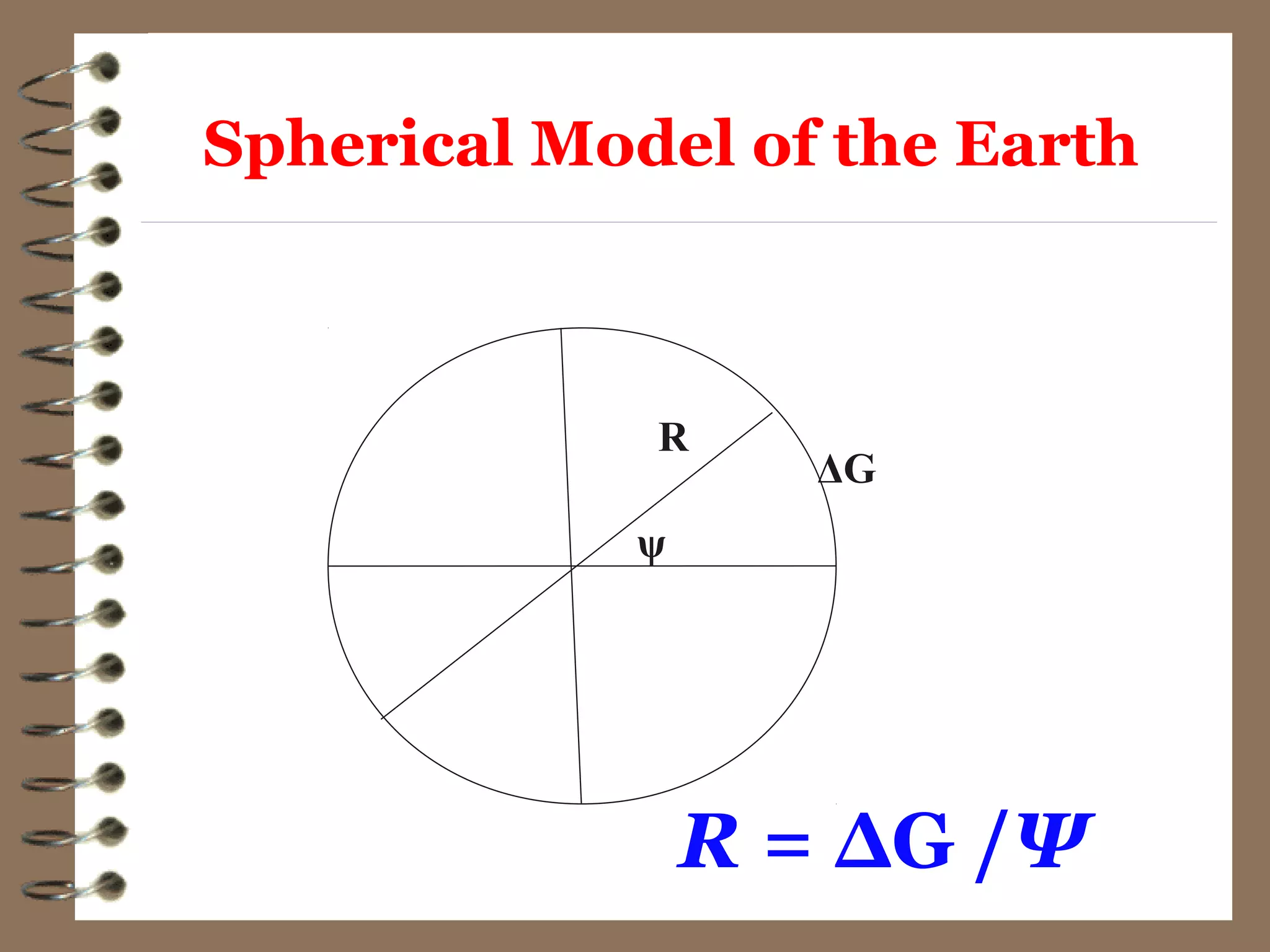
R
ψ
ΔG
R = ΔG /Ψ
Spherical Model of the Earth
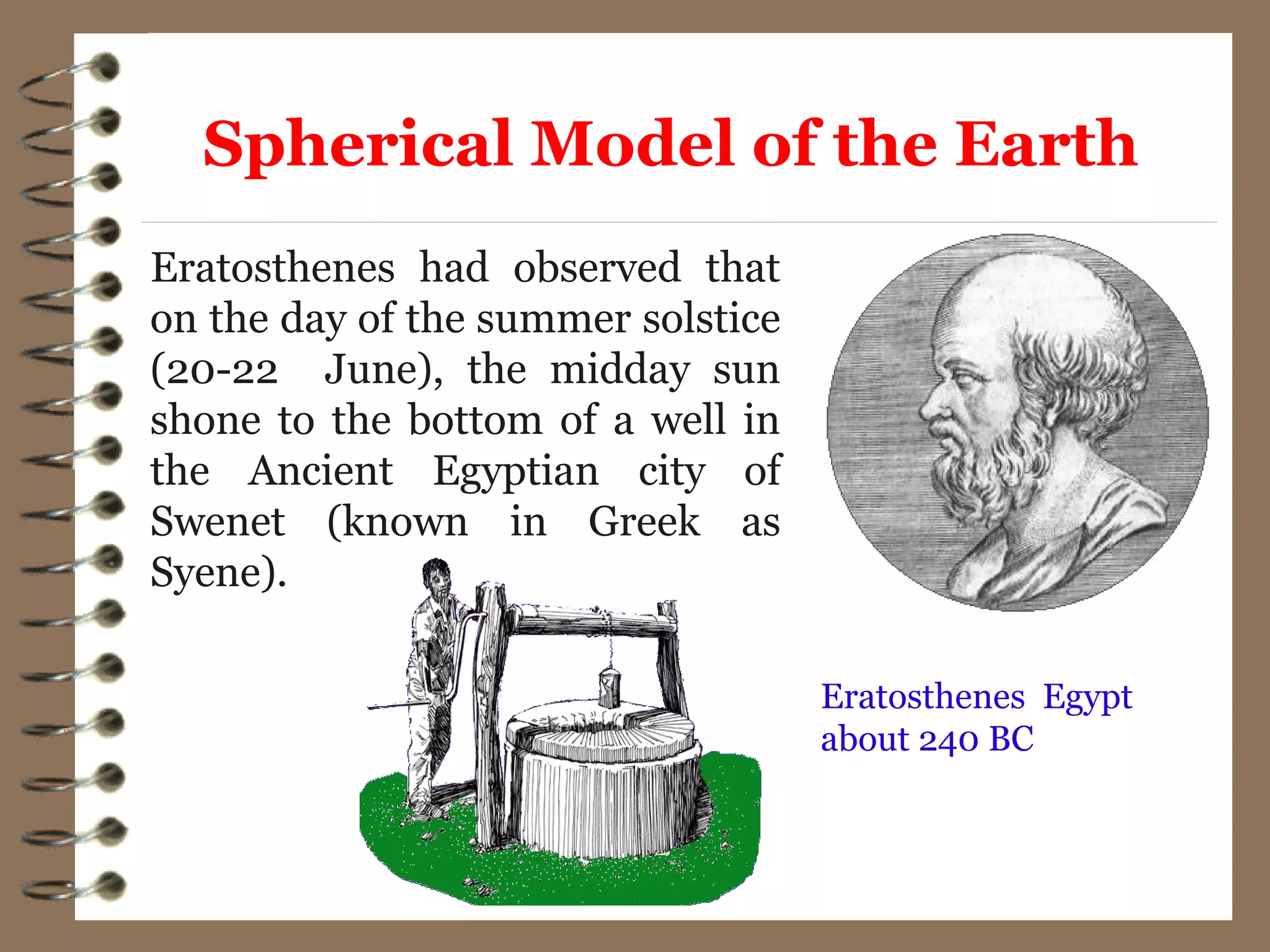
Eratosthenes had observed that
on the day of the summer solstice
(20-22 June), the midday sun
shone to the bottom of a well in
the Ancient Egyptian city of
Swenet (known in Greek as
Syene).
Eratosthenes Egypt
about 240 BC
Spherical Model of the Earth
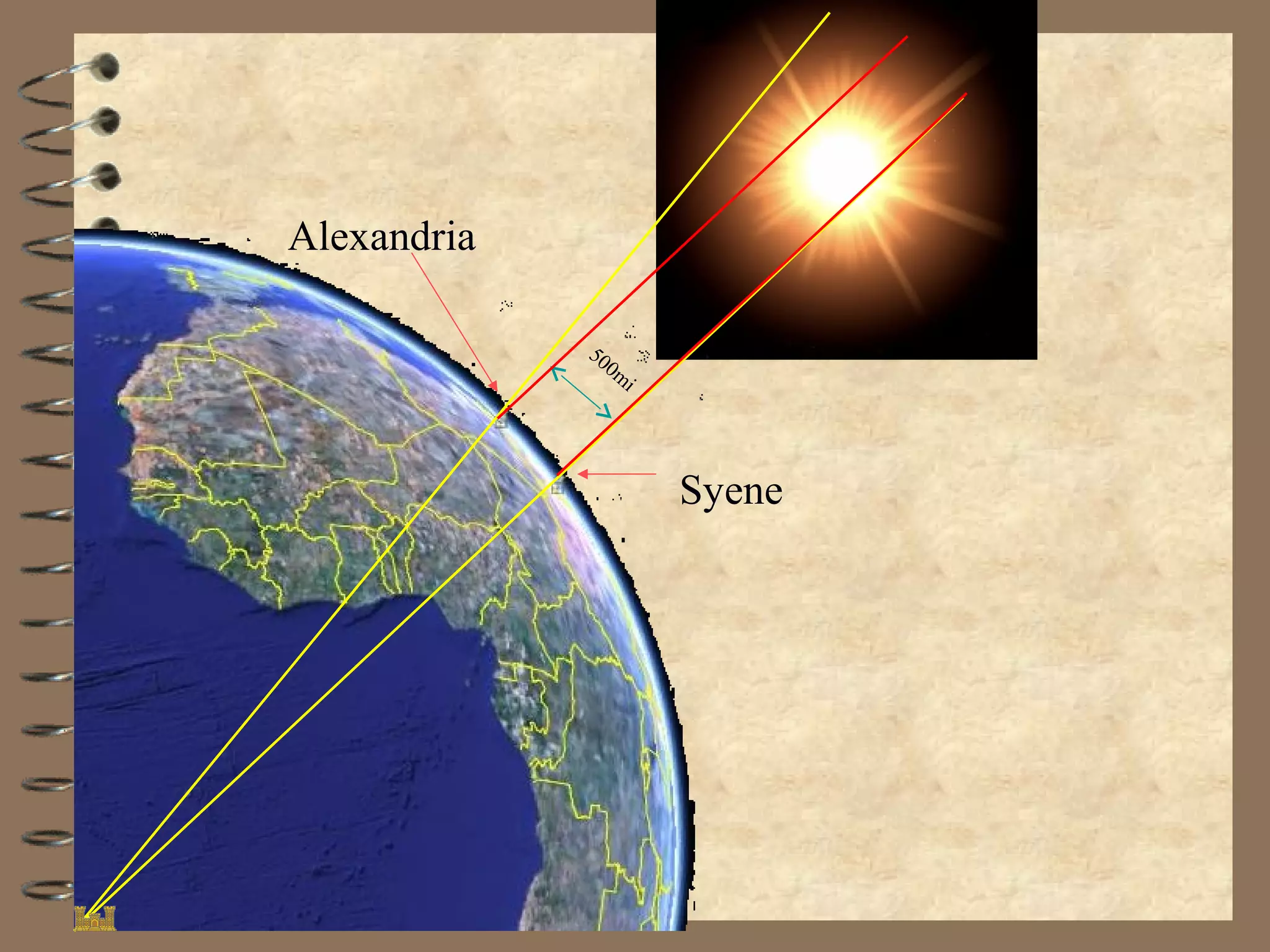
Syene
Alexandria
500m
i
•He knew that at the same time, the sun was not
directly overhead at Alexandria; instead, it cast a
shadow with the vertical equal to 1/50th of a circle (7°
12').
•He also knew that Alexandria and Syene were 500
miles apart
•To these observations, Eratosthenes concluded that
the circumference of the earth was 50 x 500 miles, or
25000 miles.
Spherical Model of the Earth
•The accepted value along the equator is 24,902 miles,
but, if you measure the earth through the poles the value
is 24,860 miles
•He was within 1% of today’s accepted value
•Eratosthenes' conclusions were highly regarded at the
time, and his estimate of the Earth’s size was accepted
for hundreds of years afterwards.
Spherical Model of the Earth
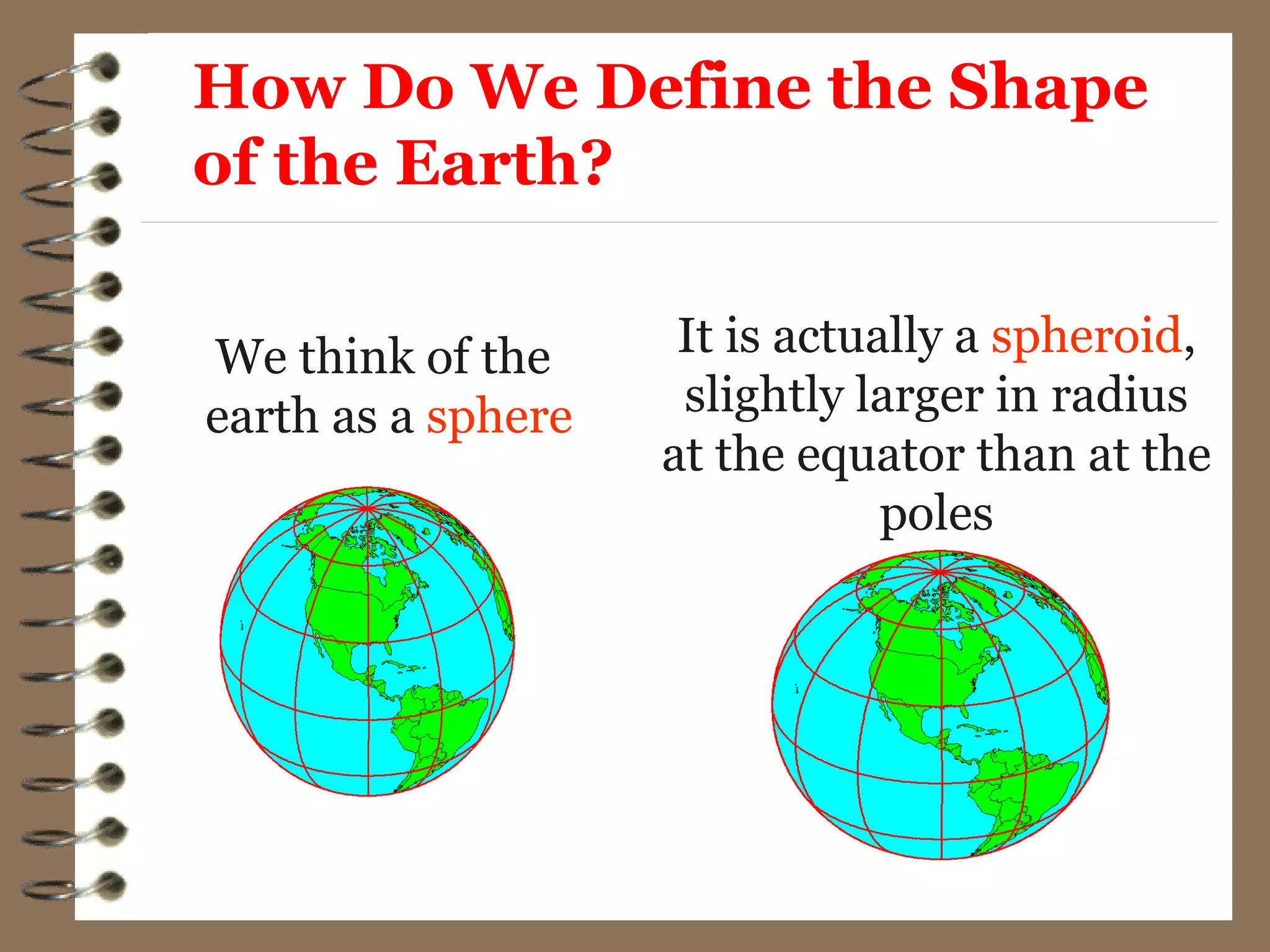
How Do We Define the Shape
of the Earth?
We think of the
earth as a sphere
It is actually a spheroid,
slightly larger in radius
at the equator than at the
poles
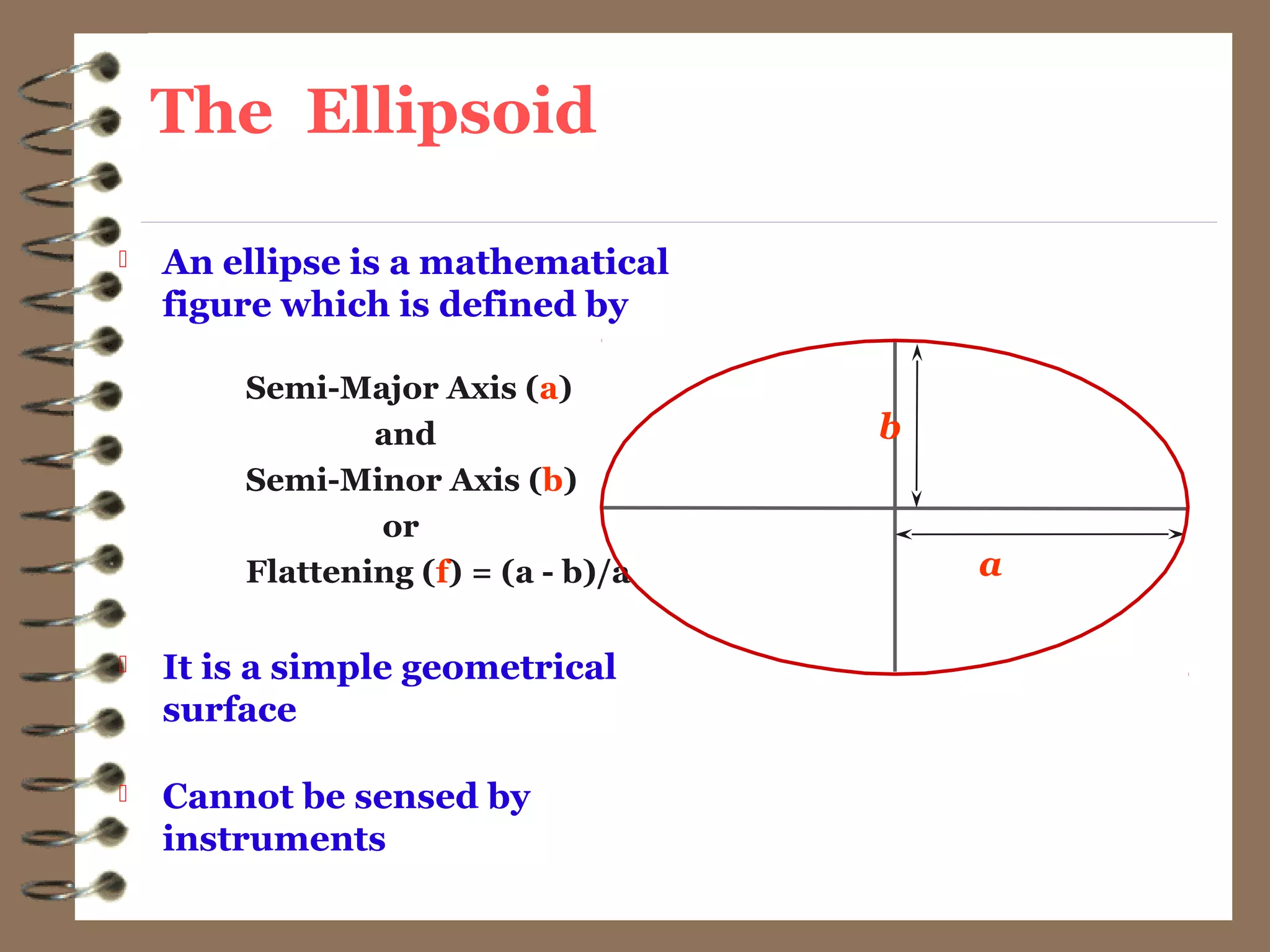
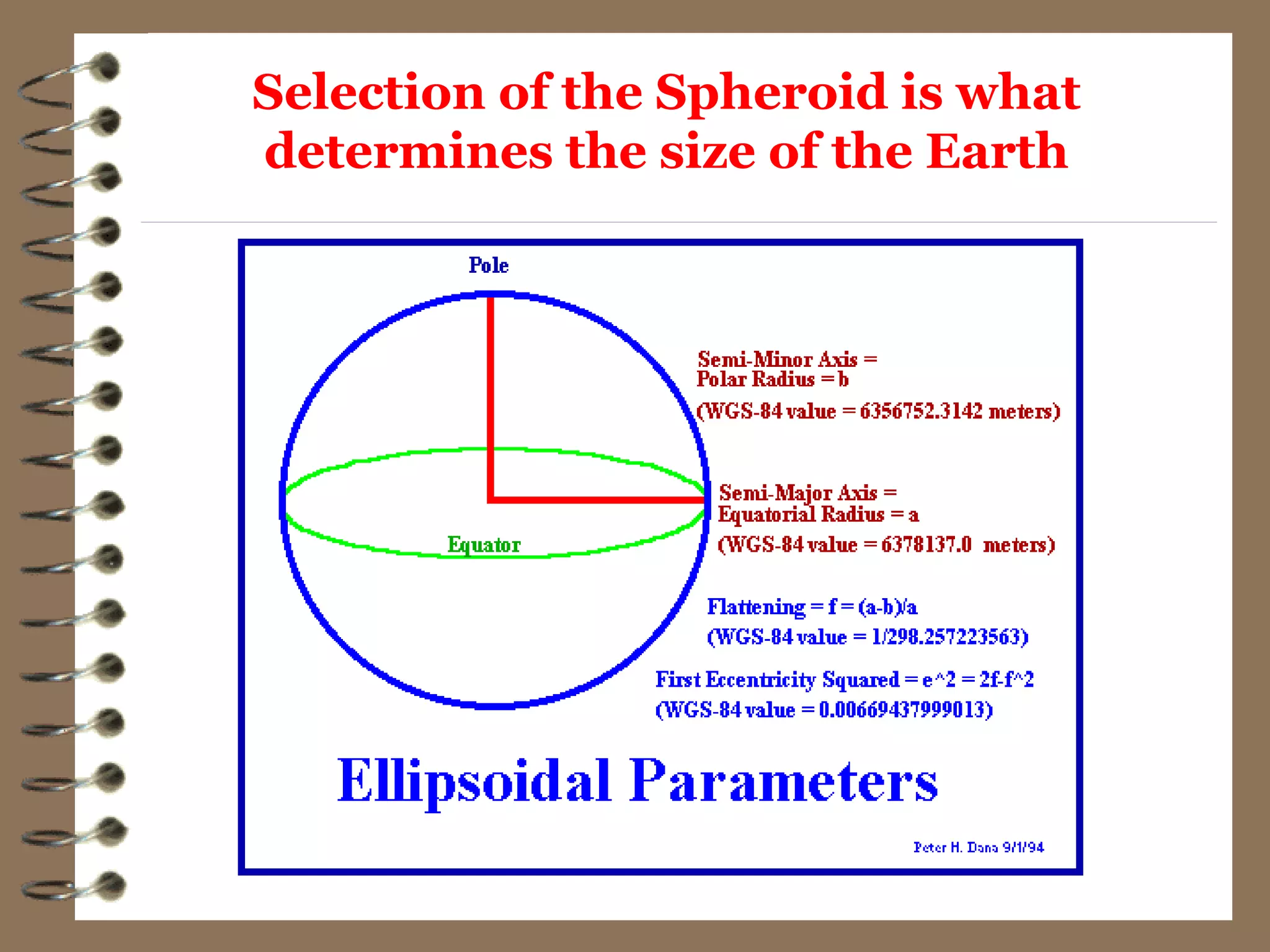
The Ellipsoid
 An ellipse is a mathematical
figure which is defined by
Semi-Major Axis (a)
and
Semi-Minor Axis (b)
or
Flattening (f) = (a - b)/a
 It is a simple geometrical
surface
 Cannot be sensed by
instruments
b
a
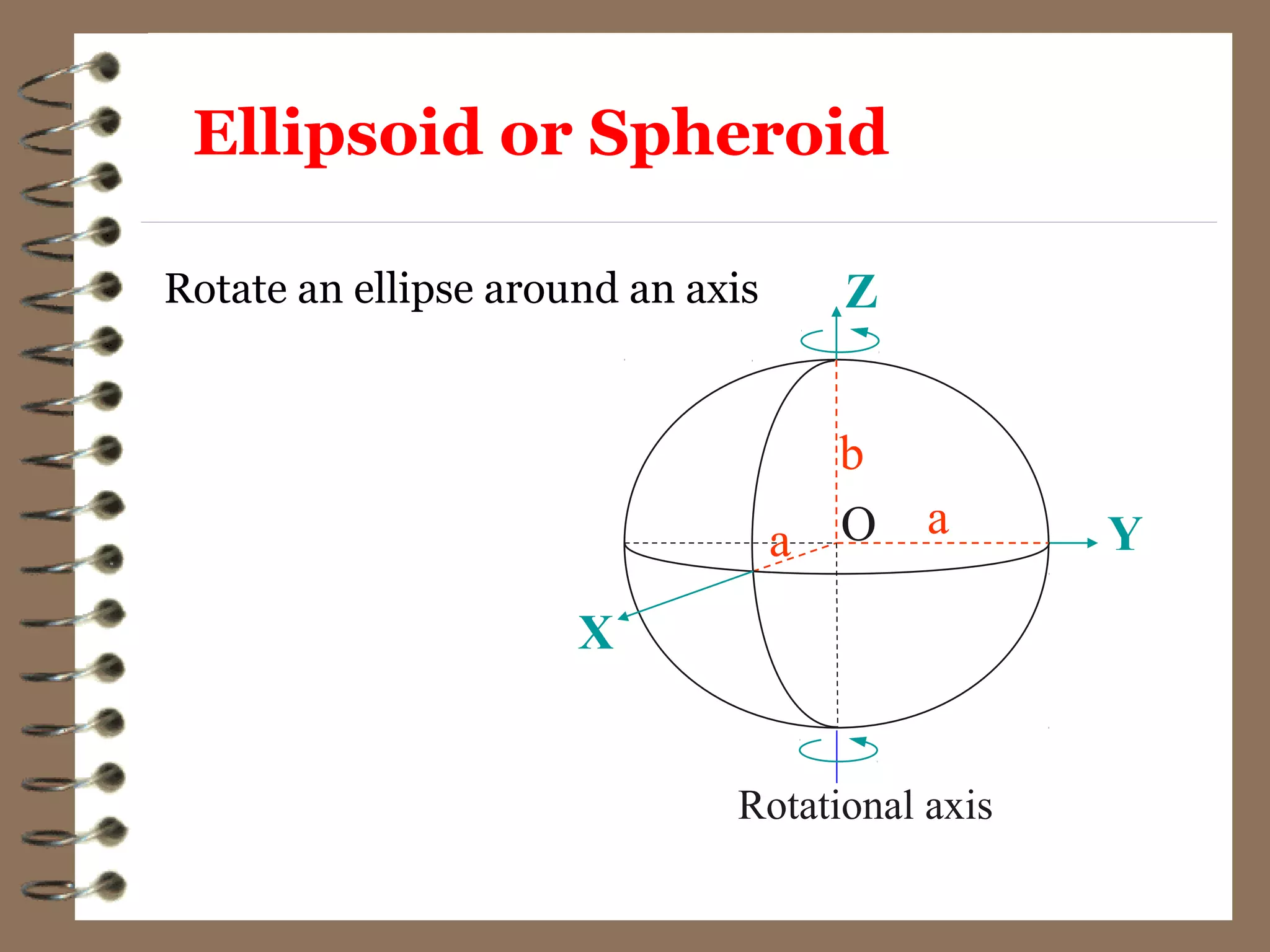
Ellipsoid or Spheroid
O
X
Z
Ya a
b
Rotational axis
Rotate an ellipse around an axis
Selection of the Spheroid is what
determines the size of the Earth
The Real Earth
(The Geoid)
EuropeN. America
S. America Africa
Topography
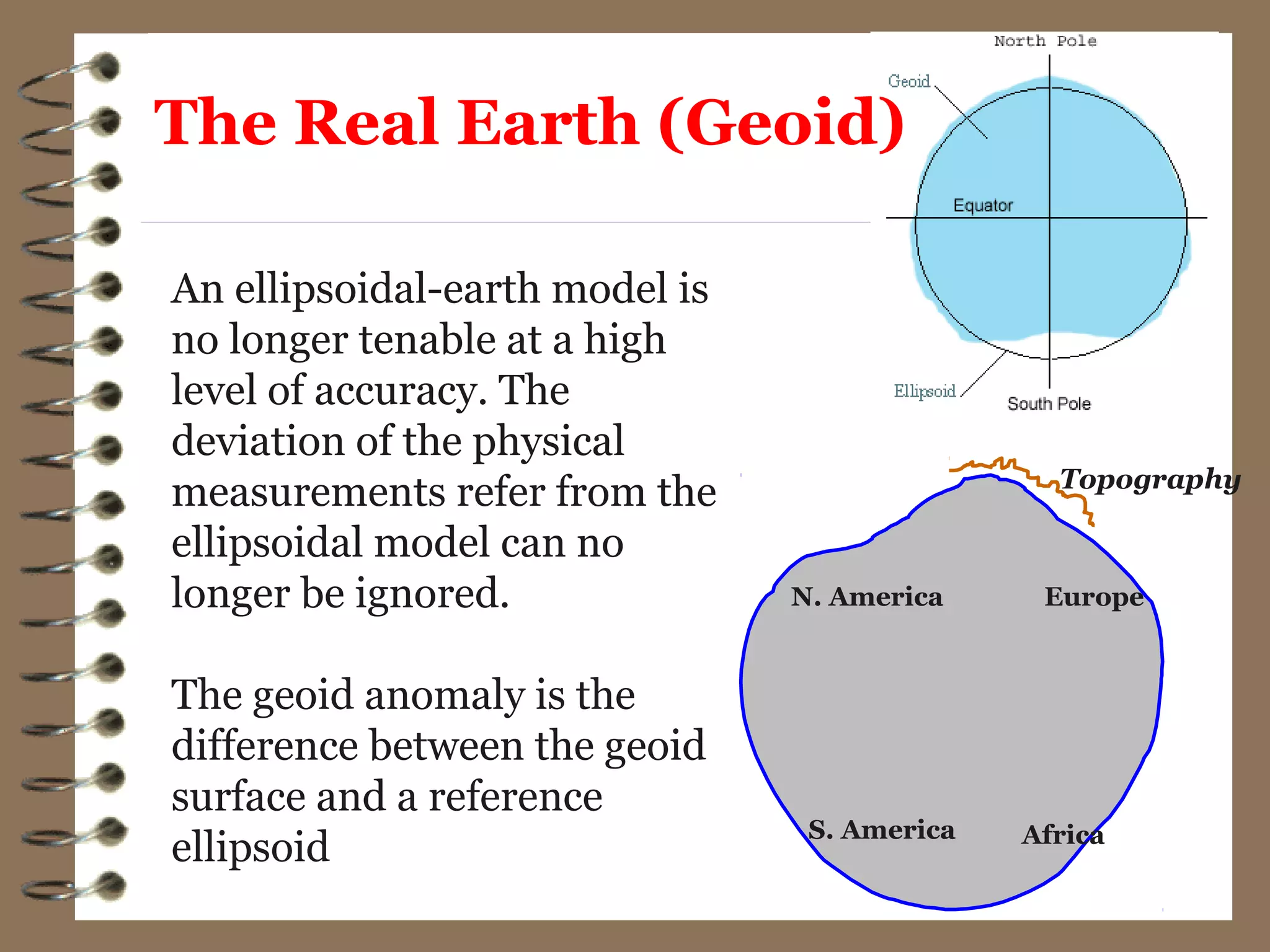
An ellipsoidal-earth model is
no longer tenable at a high
level of accuracy. The
deviation of the physical
measurements refer from the
ellipsoidal model can no
longer be ignored.
The geoid anomaly is the
difference between the geoid
surface and a reference
ellipsoid
The Real Earth (Geoid)
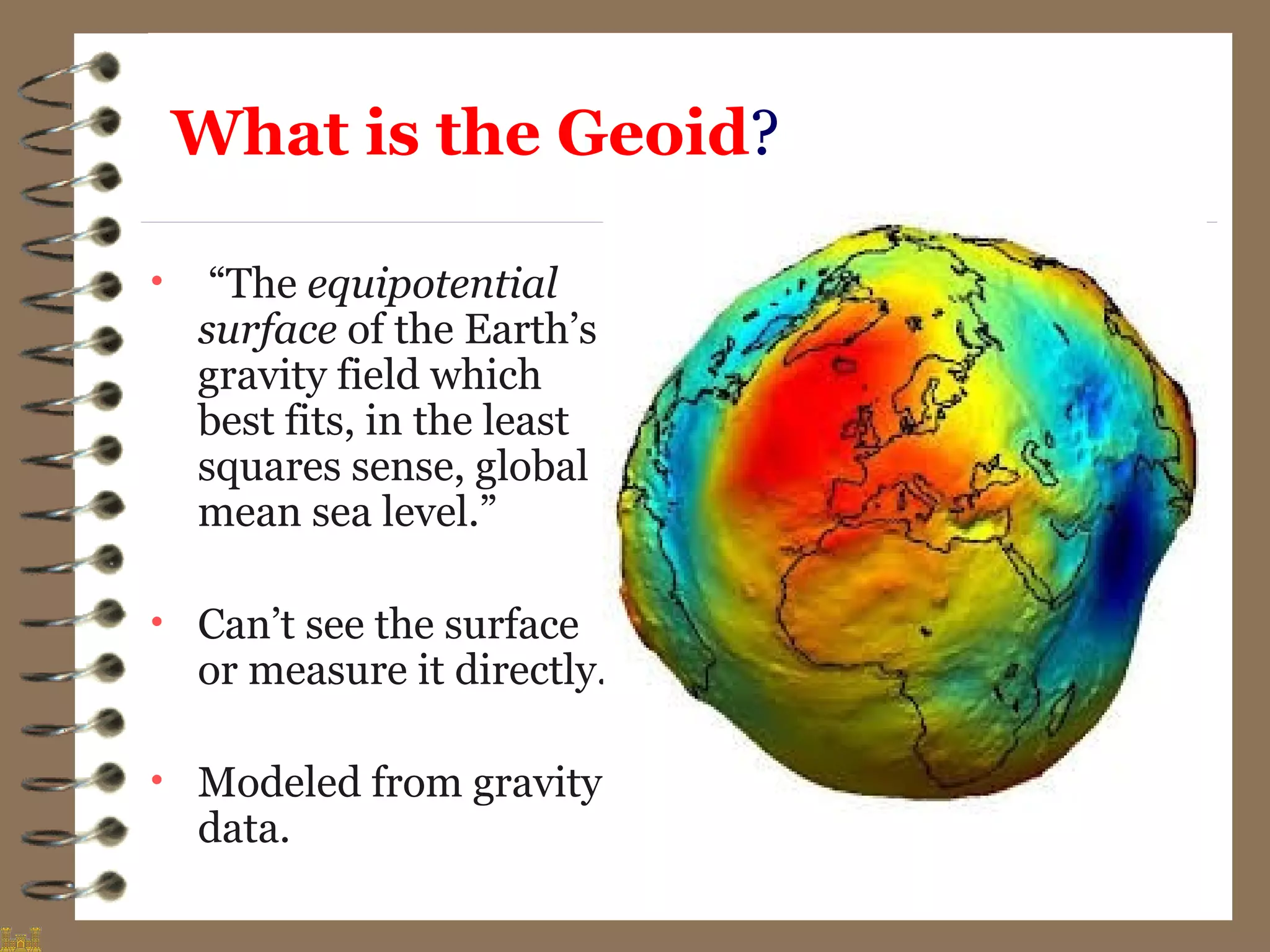
What is the Geoid?
• “The equipotential
surface of the Earth’s
gravity field which
best fits, in the least
squares sense, global
mean sea level.”
• Can’t see the surface
or measure it directly.
• Modeled from gravity
data.
Ellipsoid and Geoid
 Ellipsoid
• Simple Mathematical Definition
• Described by Two Parameters
• Cannot be 'Sensed' by Instruments
 Geoid
• Complicated Physical Definition
• Described by Infinite Number of
Parameters
• Can be 'Sensed' by Instruments
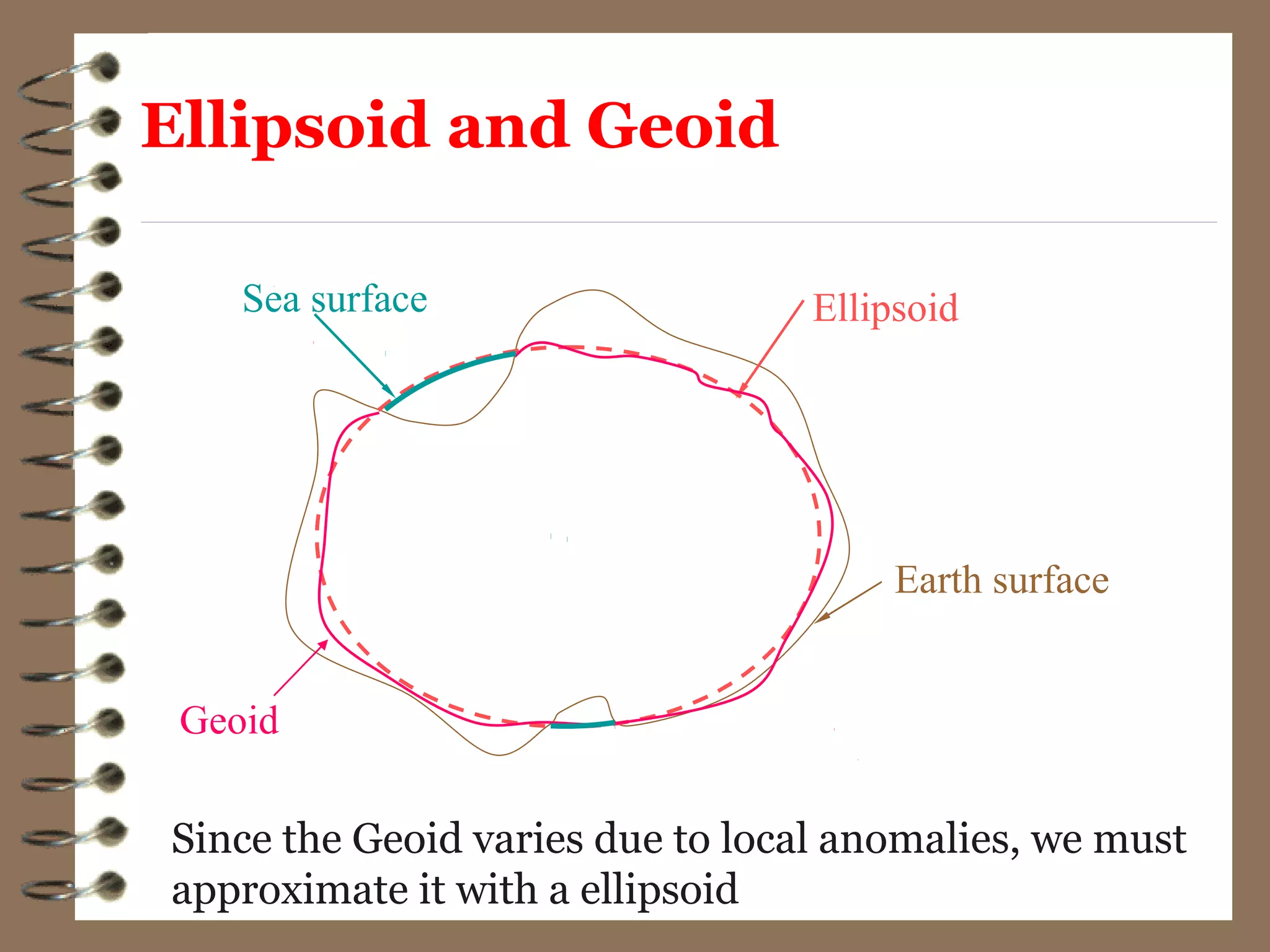
Earth surface
EllipsoidSea surface
Geoid
Since the Geoid varies due to local anomalies, we must
approximate it with a ellipsoid
Ellipsoid and Geoid
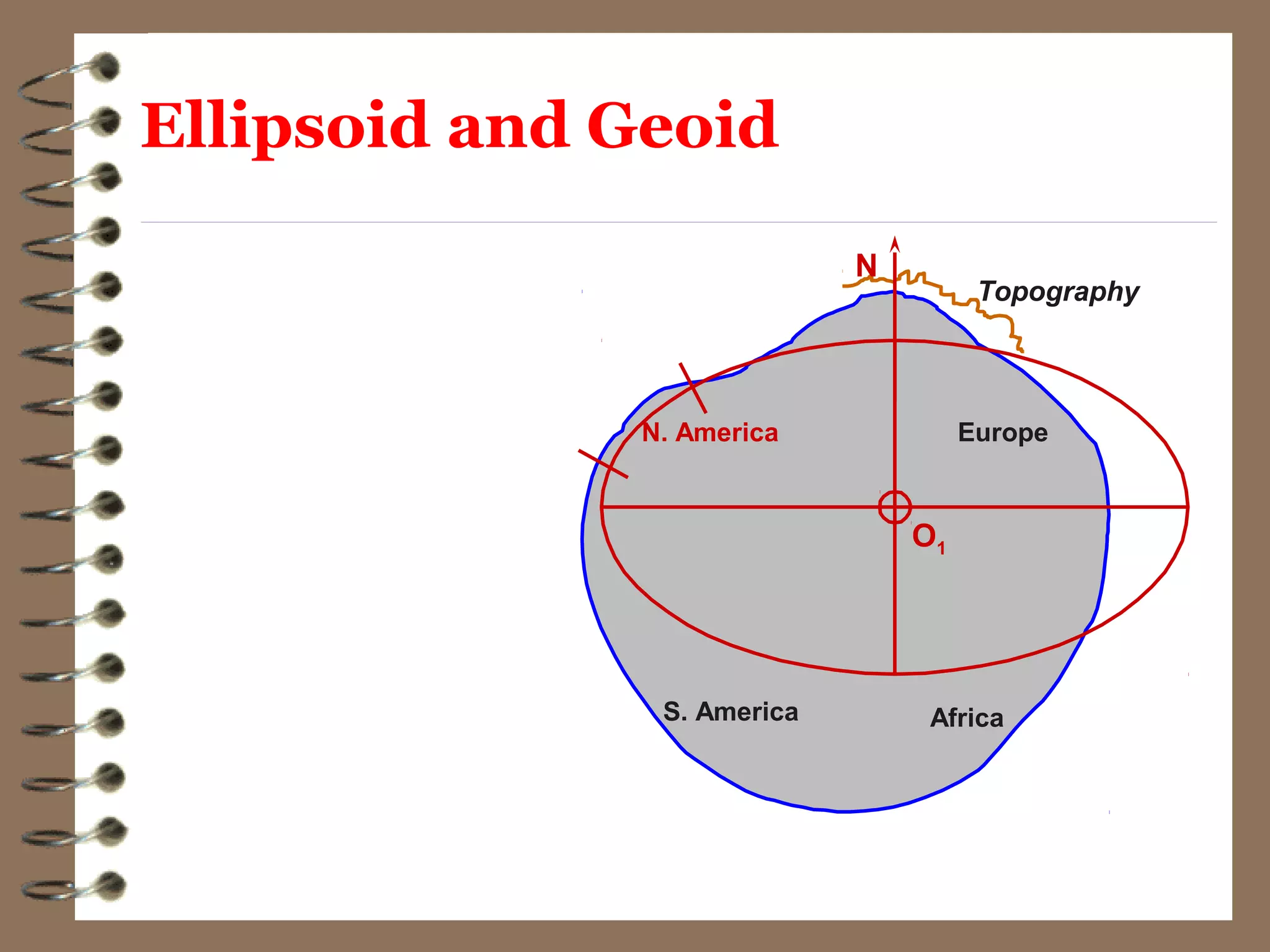
O1
EuropeN. America
S. America Africa
Topography
N
Ellipsoid and Geoid
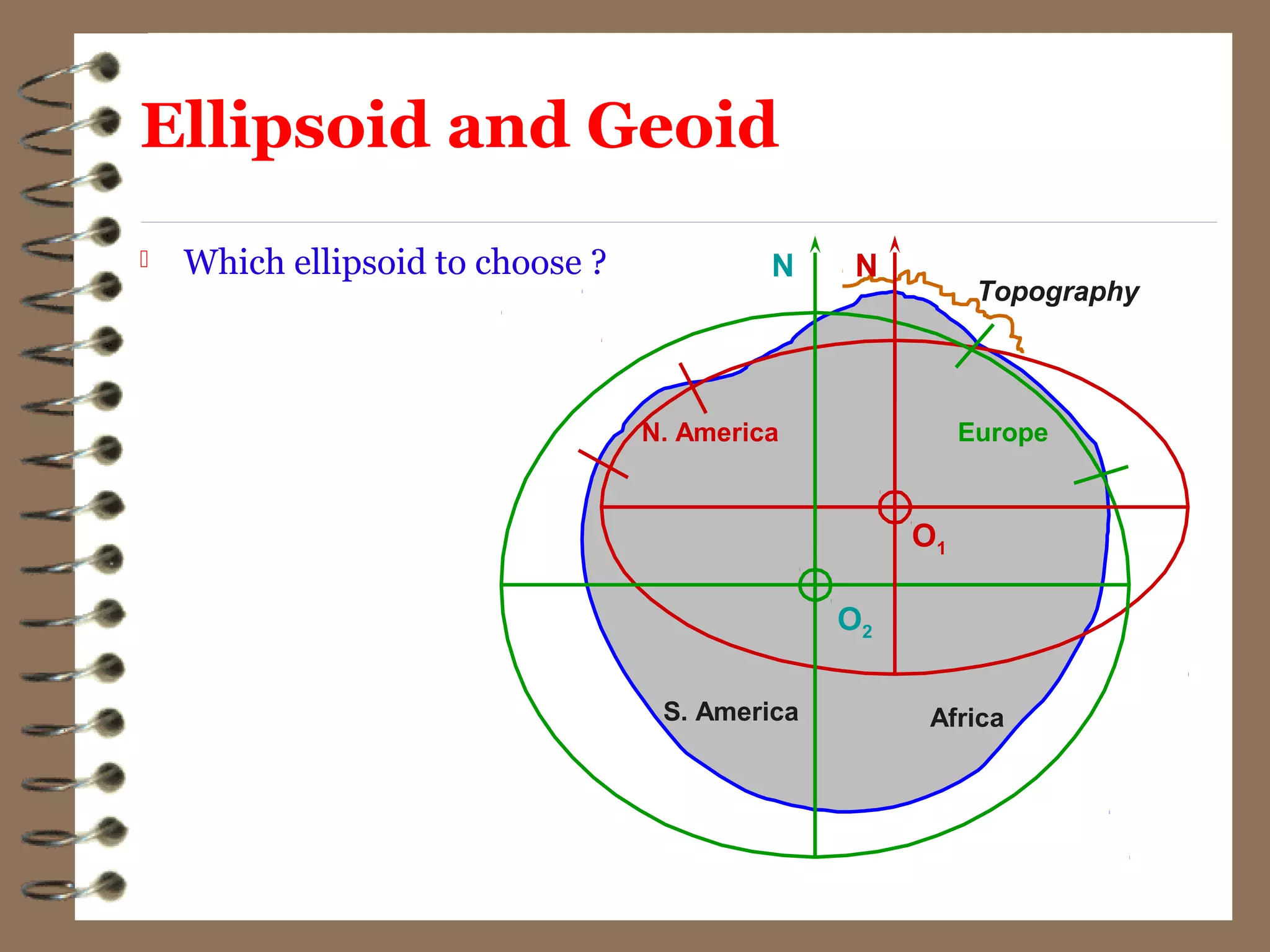
 Which ellipsoid to choose ?
O2
O1
EuropeN. America
S. America Africa
N
Topography
N
Ellipsoid and Geoid
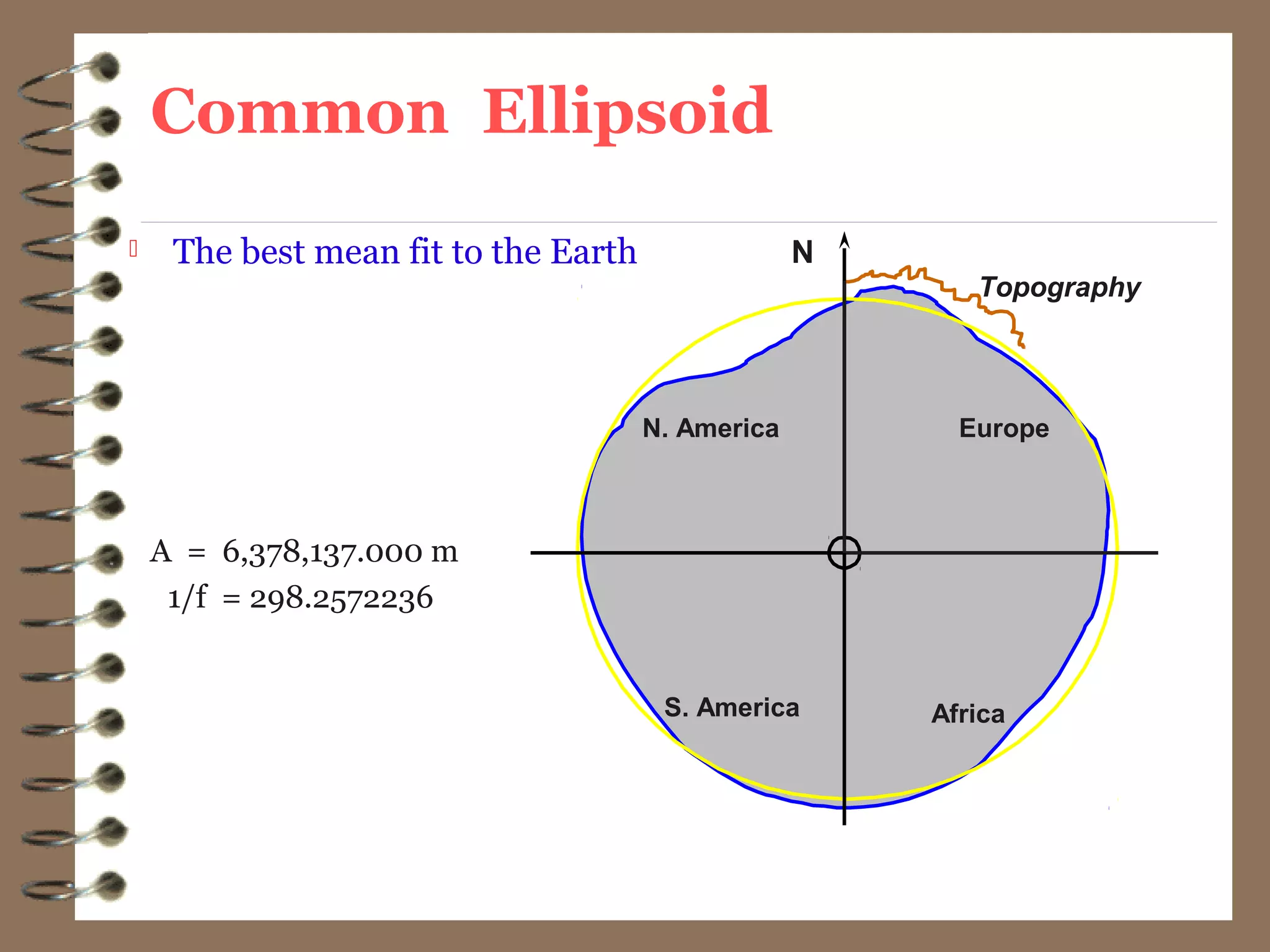
Common Ellipsoid
 The best mean fit to the Earth
EuropeN. America
S. America Africa
N
Topography
A = 6,378,137.000 m
1/f = 298.2572236
Unfortunately, the density of the earth’s crust is not uniformly the
same. Heavy rock, such as an iron ore deposit, will have a stronger
attraction than lighter materials. Therefore, the geoid (or any
equipotential surface) will not be a simple mathematical surface.
Ellipsoid and Geoid Heights
Heighting
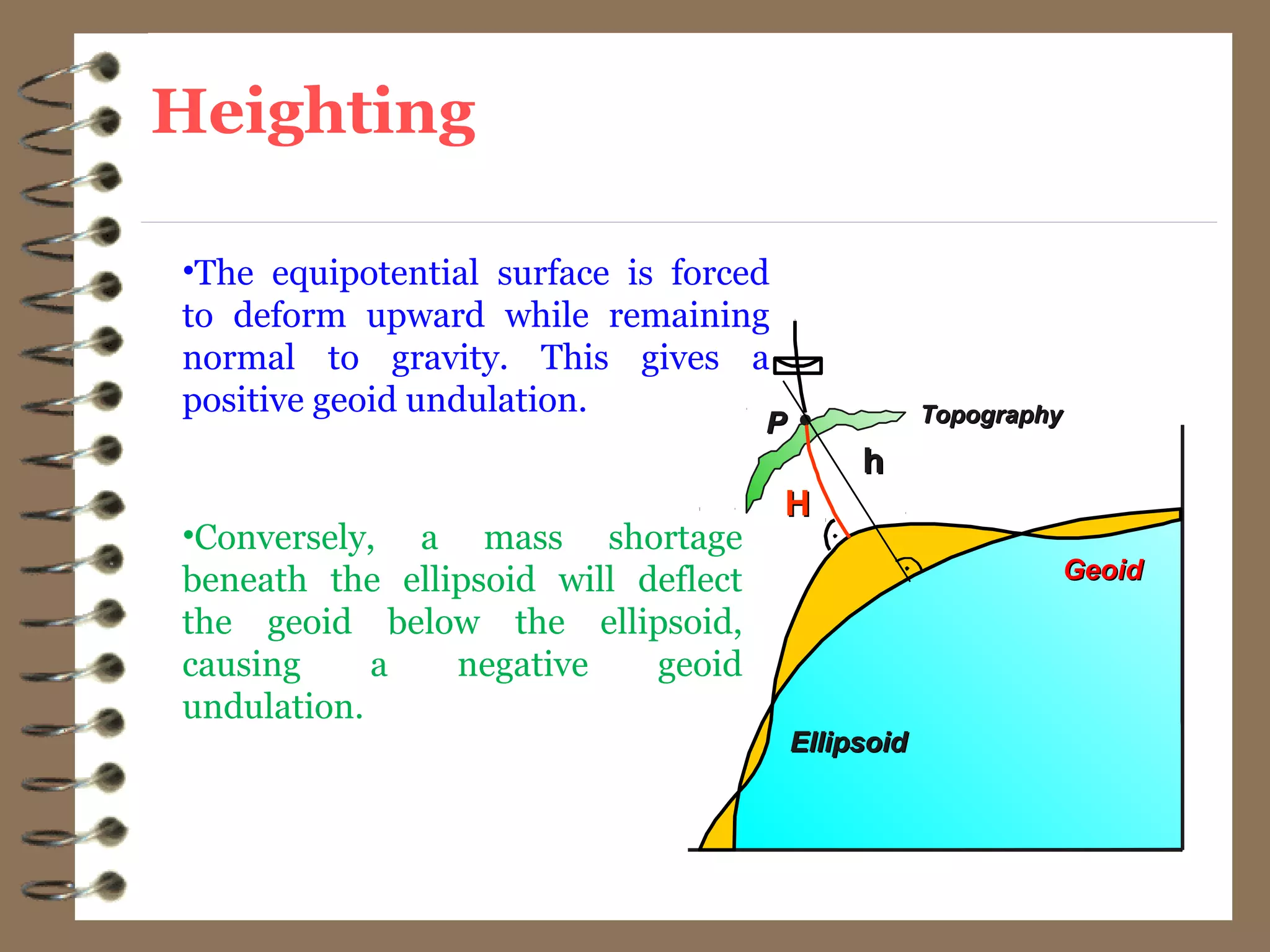
•The equipotential surface is forced
to deform upward while remaining
normal to gravity. This gives a
positive geoid undulation.
•Conversely, a mass shortage
beneath the ellipsoid will deflect
the geoid below the ellipsoid,
causing a negative geoid
undulation.
EllipsoidEllipsoid
PP
HH
GeoidGeoid
hh
TopographyTopography
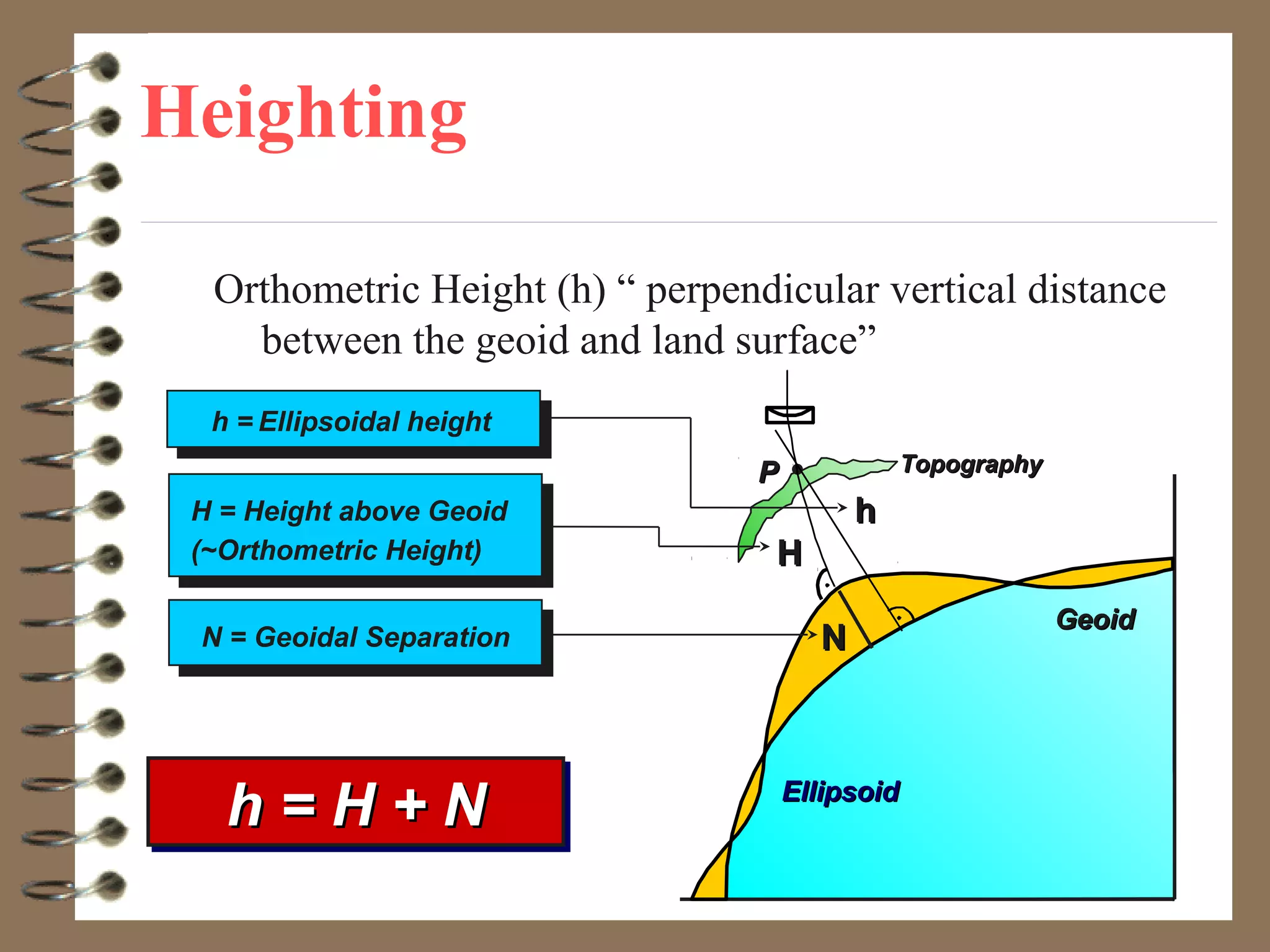
h = H + Nh = H + Nh = H + Nh = H + N EllipsoidEllipsoid
hh
PP TopographyTopography
HH
GeoidGeoid
NNN = Geoidal Separation
H = Height above Geoid
(~Orthometric Height)
h = Ellipsoidal height
Heighting
Orthometric Height (h) “ perpendicular vertical distance
between the geoid and land surface”
Heighting
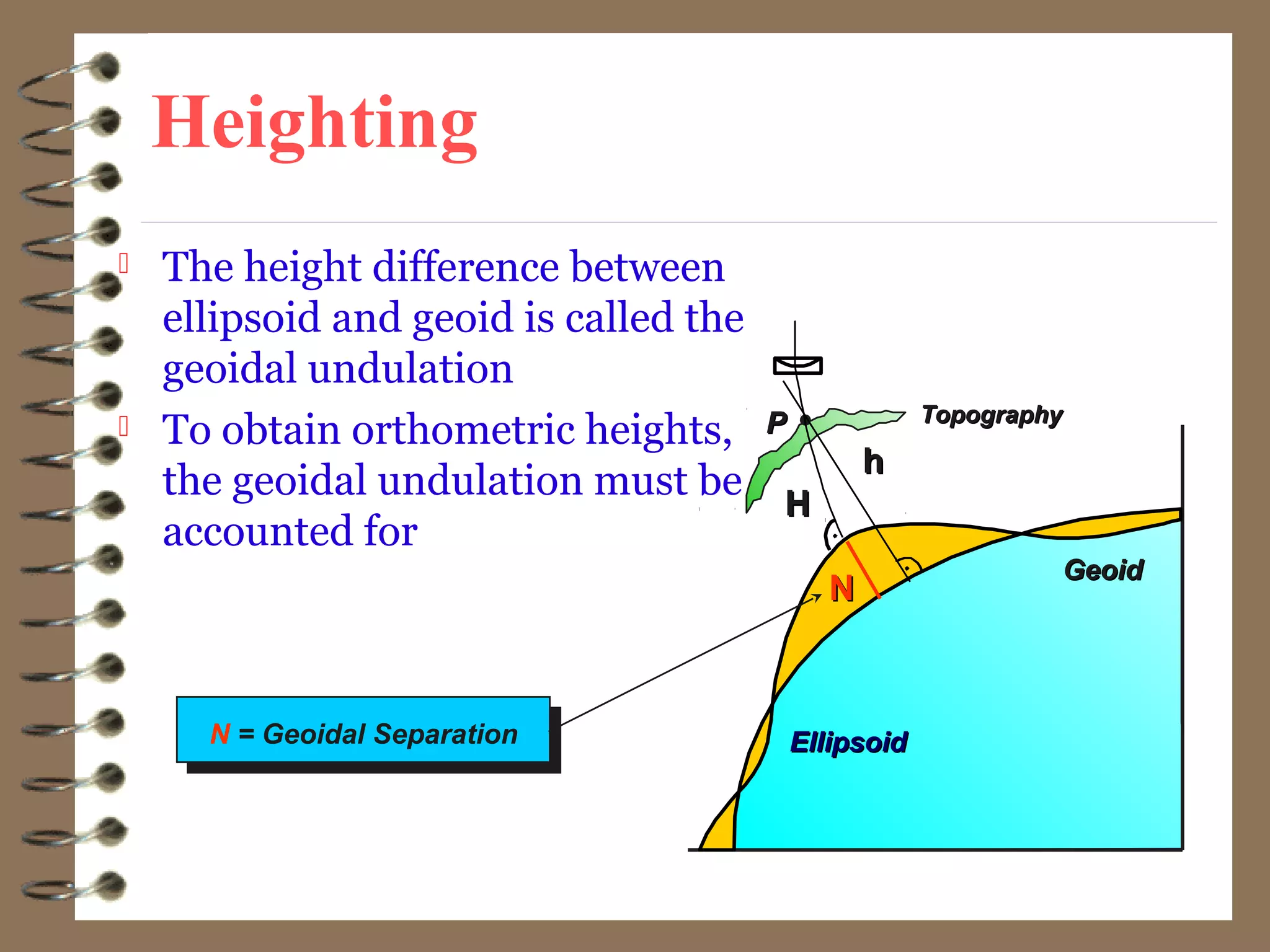
 The height difference between
ellipsoid and geoid is called the
geoidal undulation
 To obtain orthometric heights,
the geoidal undulation must be
accounted for
EllipsoidEllipsoid
PP
HH
GeoidGeoid
NN
N = Geoidal Separation
hh
TopographyTopography
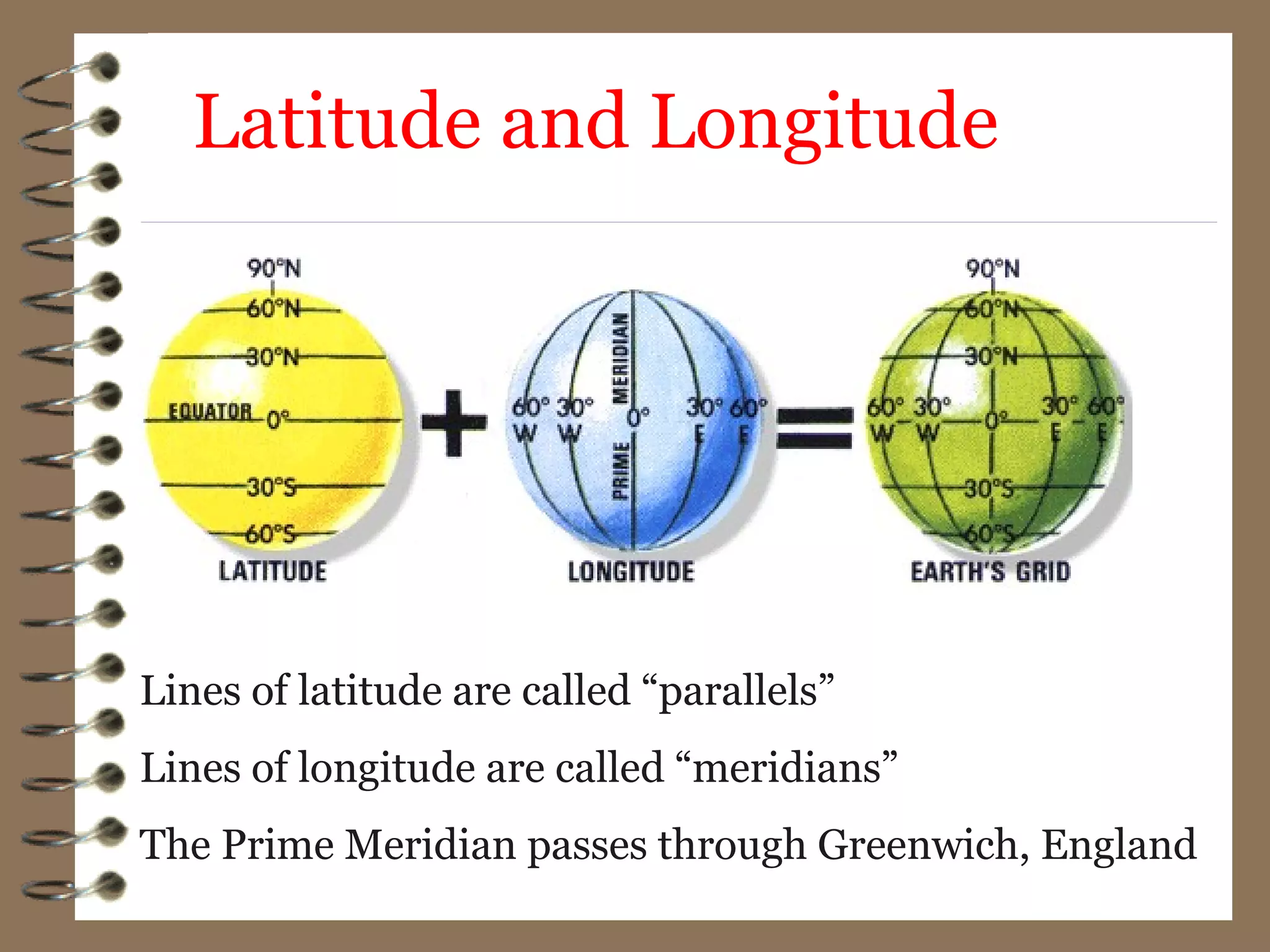
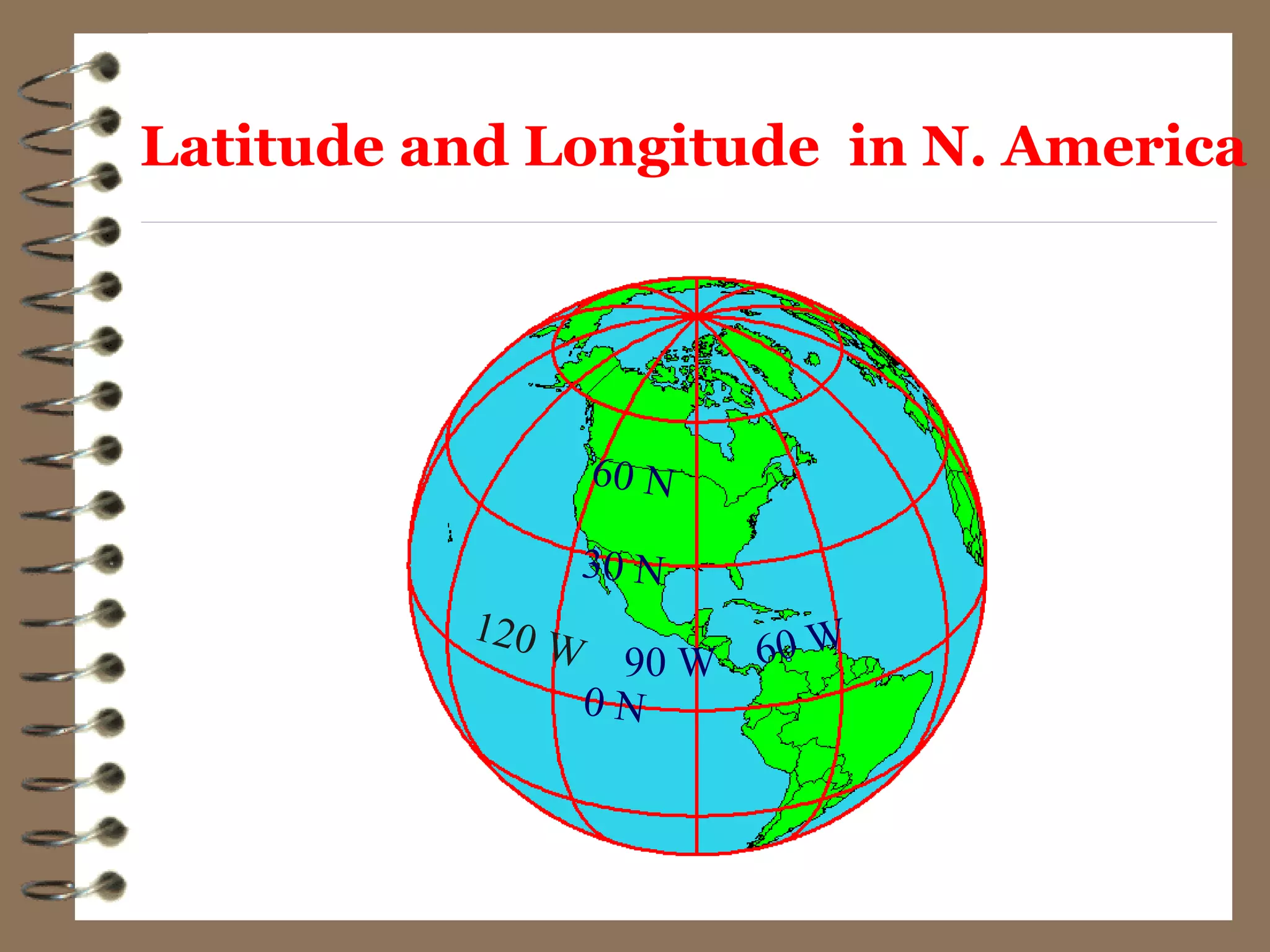
Latitude and Longitude
Lines of latitude are called “parallels”
Lines of longitude are called “meridians”
The Prime Meridian passes through Greenwich, England
Latitude and Longitude in N. America
90 W
120 W 60 W
30 N
0 N
60 N
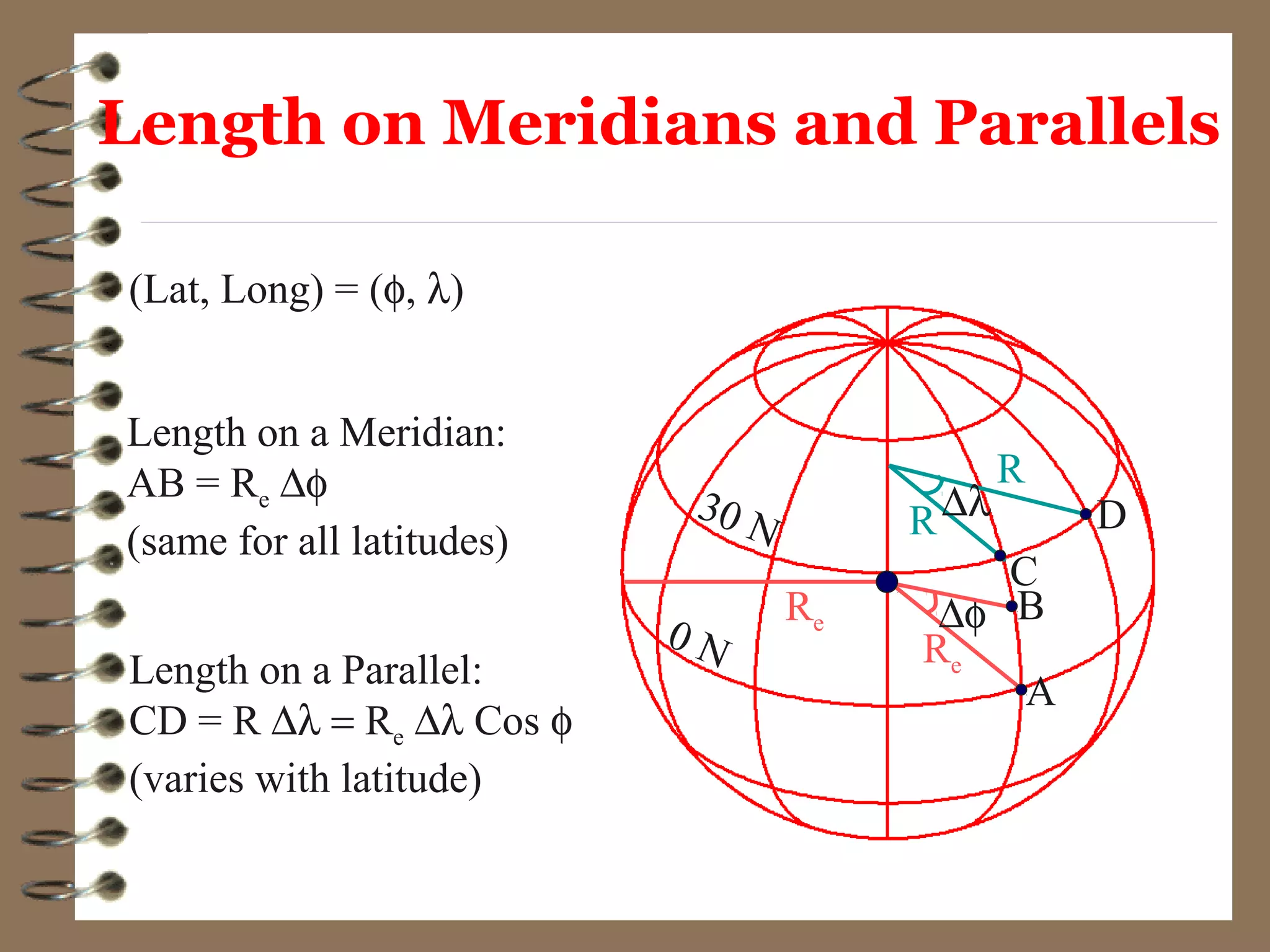
Length on Meridians and Parallels
0 N
30 N
∆φ
Re
Re
R
R
A
B
C
∆λ
(Lat, Long) = (φ, λ)
Length on a Meridian:
AB = Re ∆φ
(same for all latitudes)
Length on a Parallel:
CD = R ∆λ = Re ∆λ Cos φ
(varies with latitude)
D
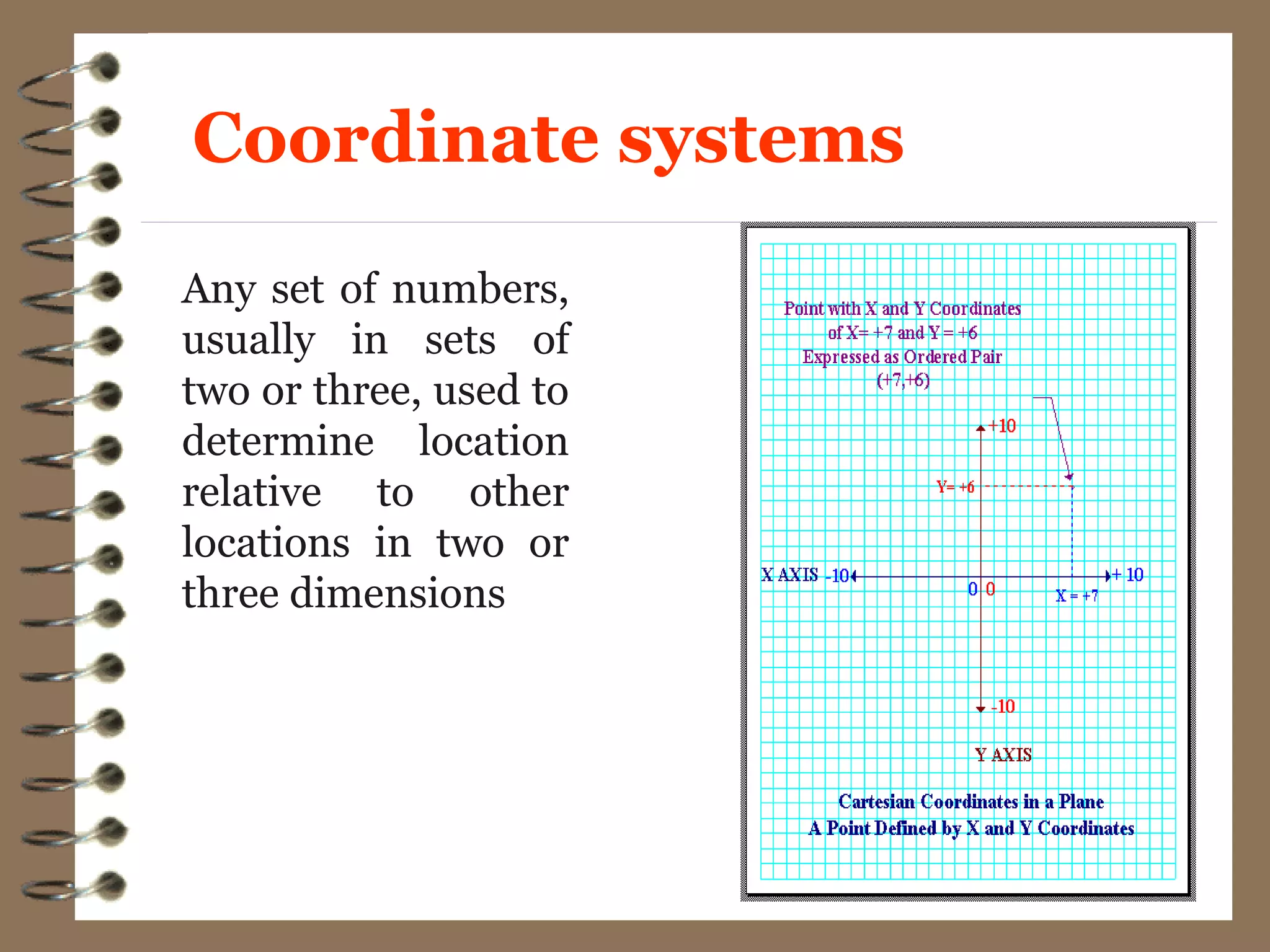
Any set of numbers,
usually in sets of
two or three, used to
determine location
relative to other
locations in two or
three dimensions
Coordinate systems
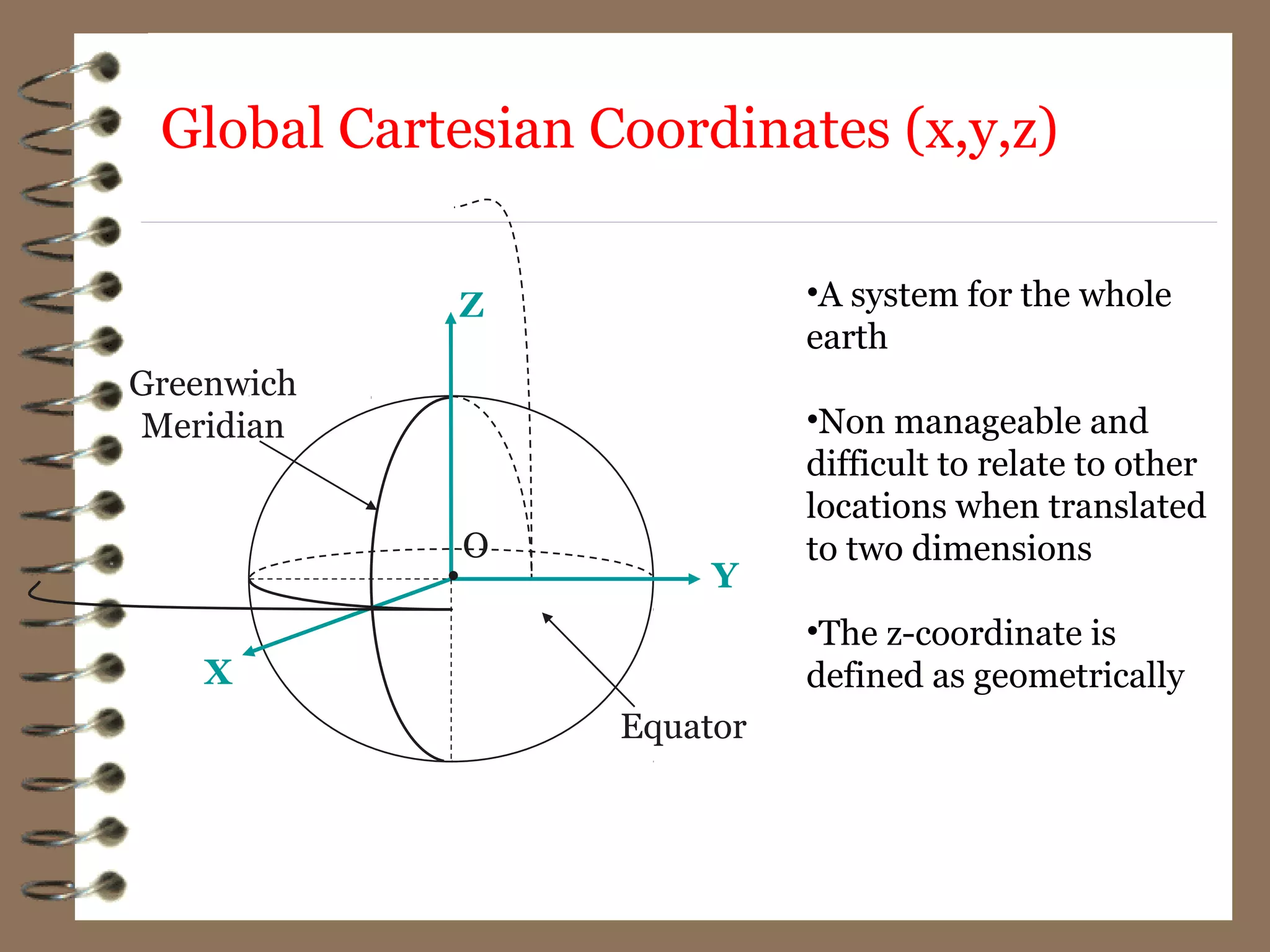
Global Cartesian Coordinates (x,y,z)
O
X
Z
Y
Greenwich
Meridian
Equator
•
•A system for the whole
earth
•Non manageable and
difficult to relate to other
locations when translated
to two dimensions
•The z-coordinate is
defined as geometrically
Geographic Coordinates (φ, λ, z)
• Latitude (φ) and Longitude (λ) defined using an
ellipsoid, an ellipse rotated about an axis
• Elevation (z) defined using geoid, a surface of
constant gravitational potential
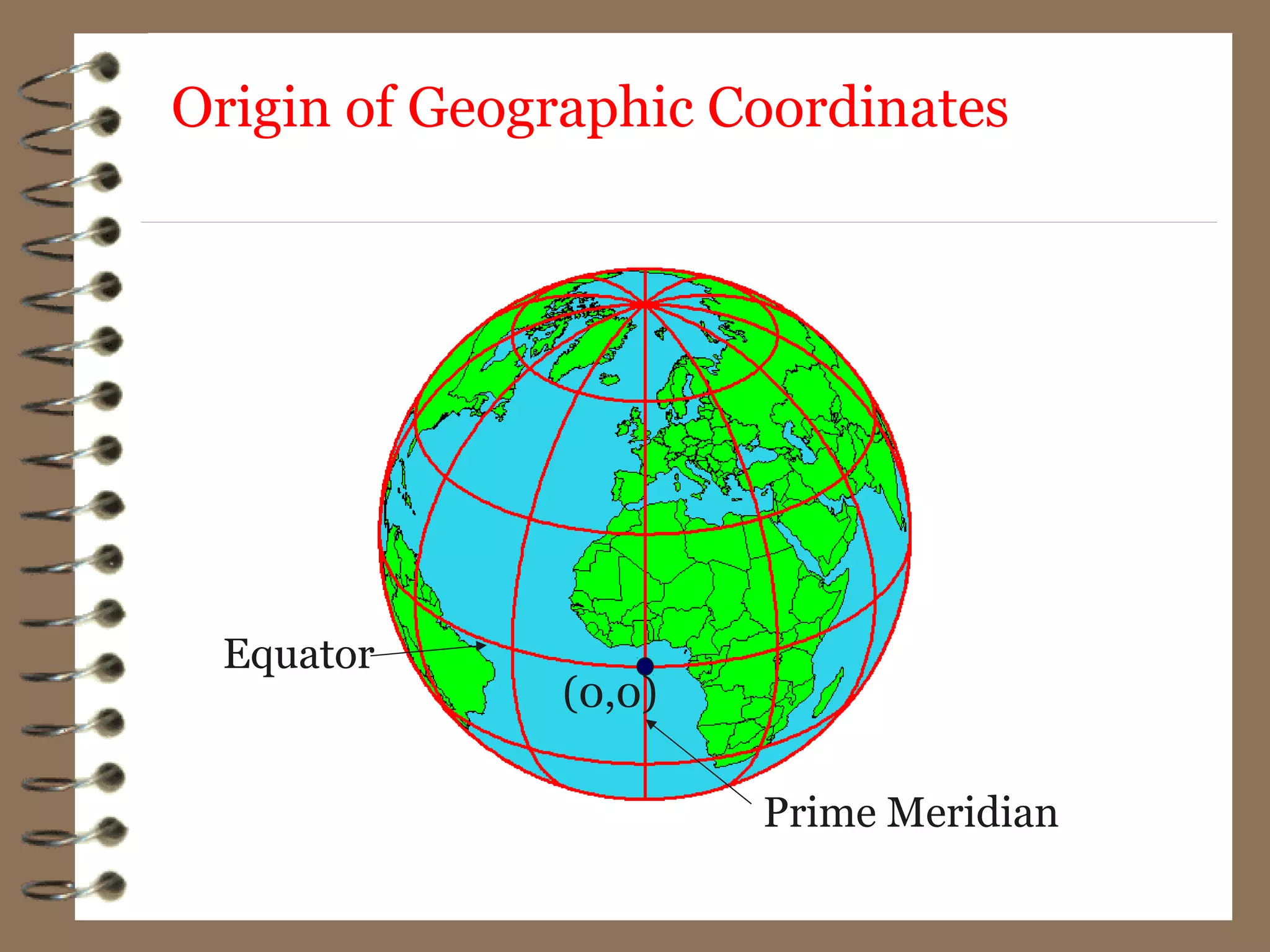
Origin of Geographic Coordinates
(0,0)
Equator
Prime Meridian
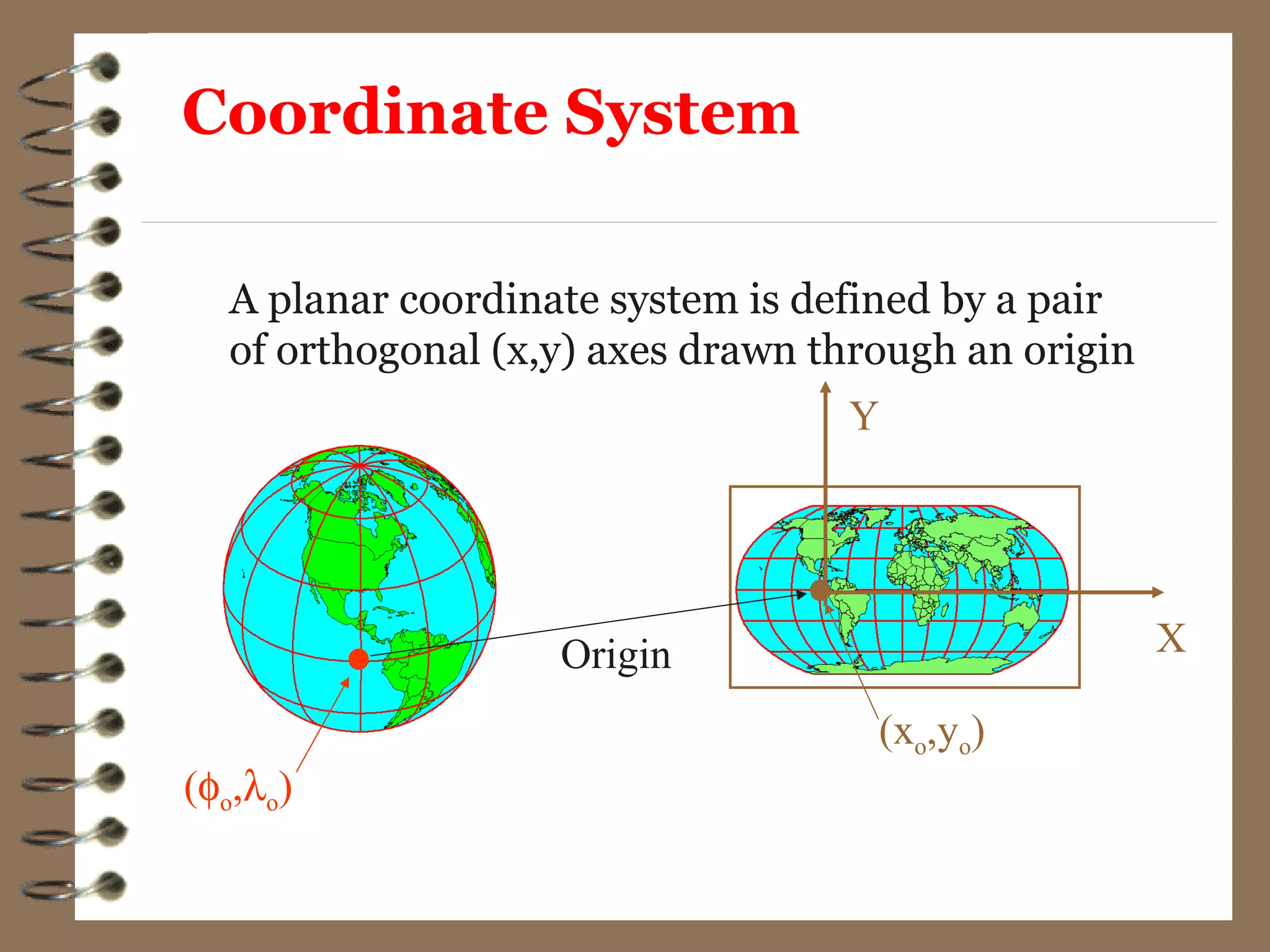
Coordinate System
(φo,λo)
(xo,yo)
X
Y
Origin
A planar coordinate system is defined by a pair
of orthogonal (x,y) axes drawn through an origin
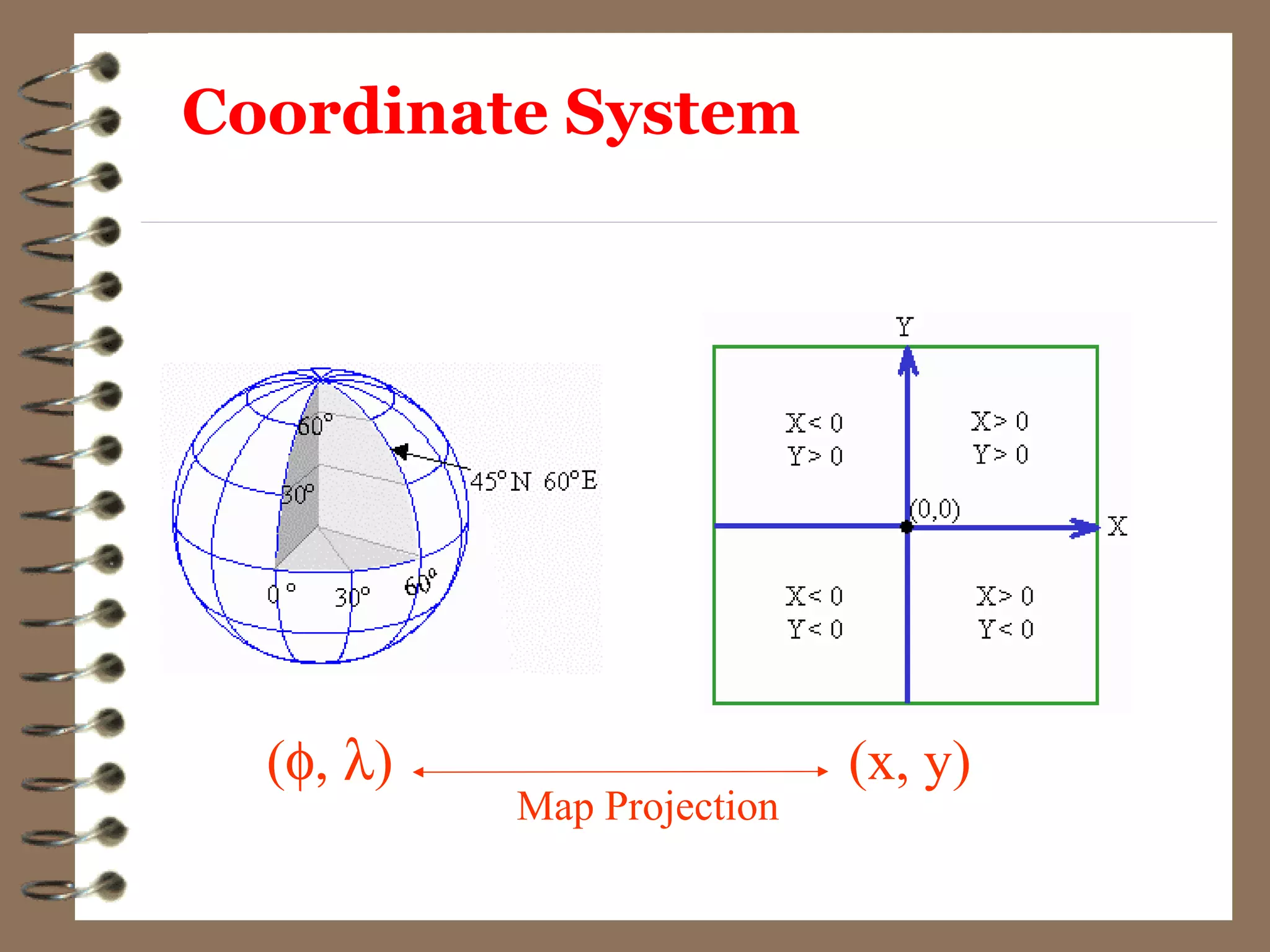
(φ, λ) (x, y)
Map Projection
Coordinate System
Basic of Geodesy

Basic of Geodesy

  • 1.
    Geodesy, GE 202 KutubuddinANSARI kutubuddin.ansari@ikc.edu.tr Lecture 1, Sep 27, 2016 Basic of Geodesy
  • 2.
    Geodesy :- Geo- Earth desy - The study of “The study of the Earth” Geodesy is the science of the measurement and mapping of the earth’s surface
  • 3.
    Merriam-Webster:a branch of appliedmathematics concerned with the determination of the size and shape of the earth and the exact positions of points on its surface and with the description of variations of its gravity field.
  • 4.
    • Geometrical geodesyis concerned with describing locations in terms of geometry. Consequently, coordinate systems are one of the primary products of geometrical geodesy. •Physical geodesy is concerned with determining the Earth’s gravity field, which is necessary for establishing heights. •Satellite geodesy is concerned with using orbiting satellites to obtain data for geodetic purposes. Types of Geodesy
  • 5.
    R ψ ΔG R = ΔG/Ψ Spherical Model of the Earth
  • 6.
    Eratosthenes had observedthat on the day of the summer solstice (20-22 June), the midday sun shone to the bottom of a well in the Ancient Egyptian city of Swenet (known in Greek as Syene). Eratosthenes Egypt about 240 BC Spherical Model of the Earth
  • 7.
  • 8.
    •He knew thatat the same time, the sun was not directly overhead at Alexandria; instead, it cast a shadow with the vertical equal to 1/50th of a circle (7° 12'). •He also knew that Alexandria and Syene were 500 miles apart •To these observations, Eratosthenes concluded that the circumference of the earth was 50 x 500 miles, or 25000 miles. Spherical Model of the Earth
  • 9.
    •The accepted valuealong the equator is 24,902 miles, but, if you measure the earth through the poles the value is 24,860 miles •He was within 1% of today’s accepted value •Eratosthenes' conclusions were highly regarded at the time, and his estimate of the Earth’s size was accepted for hundreds of years afterwards. Spherical Model of the Earth
  • 10.
    How Do WeDefine the Shape of the Earth? We think of the earth as a sphere It is actually a spheroid, slightly larger in radius at the equator than at the poles
  • 11.
    The Ellipsoid  Anellipse is a mathematical figure which is defined by Semi-Major Axis (a) and Semi-Minor Axis (b) or Flattening (f) = (a - b)/a  It is a simple geometrical surface  Cannot be sensed by instruments b a
  • 12.
    Ellipsoid or Spheroid O X Z Yaa b Rotational axis Rotate an ellipse around an axis
  • 13.
    Selection of theSpheroid is what determines the size of the Earth
  • 14.
  • 15.
    EuropeN. America S. AmericaAfrica Topography An ellipsoidal-earth model is no longer tenable at a high level of accuracy. The deviation of the physical measurements refer from the ellipsoidal model can no longer be ignored. The geoid anomaly is the difference between the geoid surface and a reference ellipsoid The Real Earth (Geoid)
  • 16.
    What is theGeoid? • “The equipotential surface of the Earth’s gravity field which best fits, in the least squares sense, global mean sea level.” • Can’t see the surface or measure it directly. • Modeled from gravity data.
  • 17.
    Ellipsoid and Geoid Ellipsoid • Simple Mathematical Definition • Described by Two Parameters • Cannot be 'Sensed' by Instruments  Geoid • Complicated Physical Definition • Described by Infinite Number of Parameters • Can be 'Sensed' by Instruments
  • 18.
    Earth surface EllipsoidSea surface Geoid Sincethe Geoid varies due to local anomalies, we must approximate it with a ellipsoid Ellipsoid and Geoid
  • 19.
    O1 EuropeN. America S. AmericaAfrica Topography N Ellipsoid and Geoid
  • 20.
     Which ellipsoidto choose ? O2 O1 EuropeN. America S. America Africa N Topography N Ellipsoid and Geoid
  • 21.
    Common Ellipsoid  Thebest mean fit to the Earth EuropeN. America S. America Africa N Topography A = 6,378,137.000 m 1/f = 298.2572236
  • 22.
    Unfortunately, the densityof the earth’s crust is not uniformly the same. Heavy rock, such as an iron ore deposit, will have a stronger attraction than lighter materials. Therefore, the geoid (or any equipotential surface) will not be a simple mathematical surface. Ellipsoid and Geoid Heights
  • 23.
    Heighting •The equipotential surfaceis forced to deform upward while remaining normal to gravity. This gives a positive geoid undulation. •Conversely, a mass shortage beneath the ellipsoid will deflect the geoid below the ellipsoid, causing a negative geoid undulation. EllipsoidEllipsoid PP HH GeoidGeoid hh TopographyTopography
  • 24.
    h = H+ Nh = H + Nh = H + Nh = H + N EllipsoidEllipsoid hh PP TopographyTopography HH GeoidGeoid NNN = Geoidal Separation H = Height above Geoid (~Orthometric Height) h = Ellipsoidal height Heighting Orthometric Height (h) “ perpendicular vertical distance between the geoid and land surface”
  • 25.
    Heighting  The heightdifference between ellipsoid and geoid is called the geoidal undulation  To obtain orthometric heights, the geoidal undulation must be accounted for EllipsoidEllipsoid PP HH GeoidGeoid NN N = Geoidal Separation hh TopographyTopography
  • 26.
    Latitude and Longitude Linesof latitude are called “parallels” Lines of longitude are called “meridians” The Prime Meridian passes through Greenwich, England
  • 27.
    Latitude and Longitudein N. America 90 W 120 W 60 W 30 N 0 N 60 N
  • 28.
    Length on Meridiansand Parallels 0 N 30 N ∆φ Re Re R R A B C ∆λ (Lat, Long) = (φ, λ) Length on a Meridian: AB = Re ∆φ (same for all latitudes) Length on a Parallel: CD = R ∆λ = Re ∆λ Cos φ (varies with latitude) D
  • 29.
    Any set ofnumbers, usually in sets of two or three, used to determine location relative to other locations in two or three dimensions Coordinate systems
  • 30.
    Global Cartesian Coordinates(x,y,z) O X Z Y Greenwich Meridian Equator • •A system for the whole earth •Non manageable and difficult to relate to other locations when translated to two dimensions •The z-coordinate is defined as geometrically
  • 31.
    Geographic Coordinates (φ,λ, z) • Latitude (φ) and Longitude (λ) defined using an ellipsoid, an ellipse rotated about an axis • Elevation (z) defined using geoid, a surface of constant gravitational potential
  • 32.
    Origin of GeographicCoordinates (0,0) Equator Prime Meridian
  • 33.
    Coordinate System (φo,λo) (xo,yo) X Y Origin A planarcoordinate system is defined by a pair of orthogonal (x,y) axes drawn through an origin
  • 34.
    (φ, λ) (x,y) Map Projection Coordinate System