Nodular Patternitie
By
Gamal Rabie Agmy , MD , FCCP
Professor of Chest Diseases ,Assiut University
Nodular Pattern
Nodular pattern
 A nodular pattern consists of multiple round opacities,
generally ranging in diameter from 1 mm to 1 cm
 Nodular opacities may be described as miliary (1 to 2 mm,
the size of millet seeds), small, medium, or large, as the
diameter of the opacities increases
 A nodular pattern, especially with predominant distribution,
suggests a specific differential diagnosis
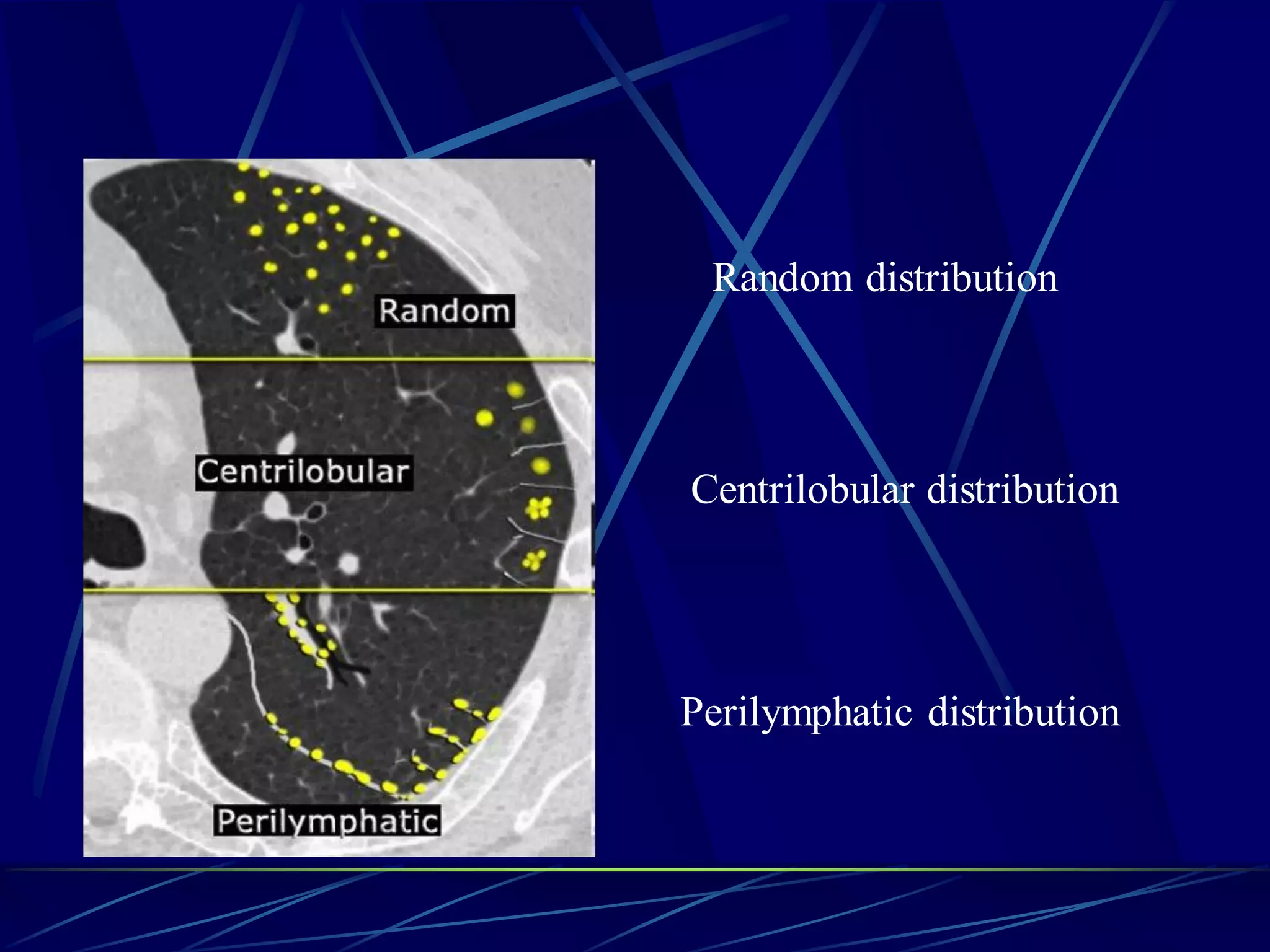
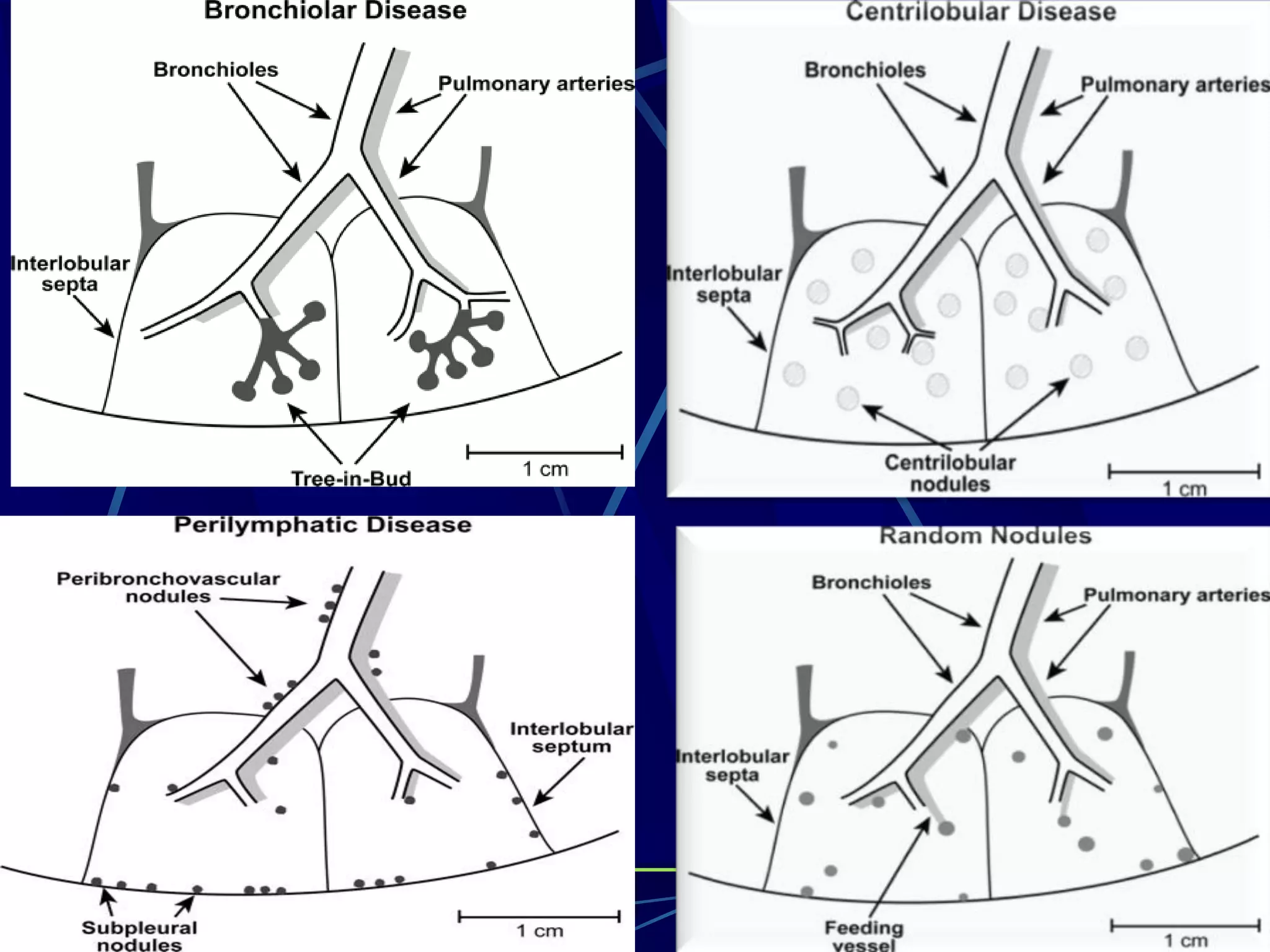
Perilymphatic distribution
Centrilobular distribution
Random distribution
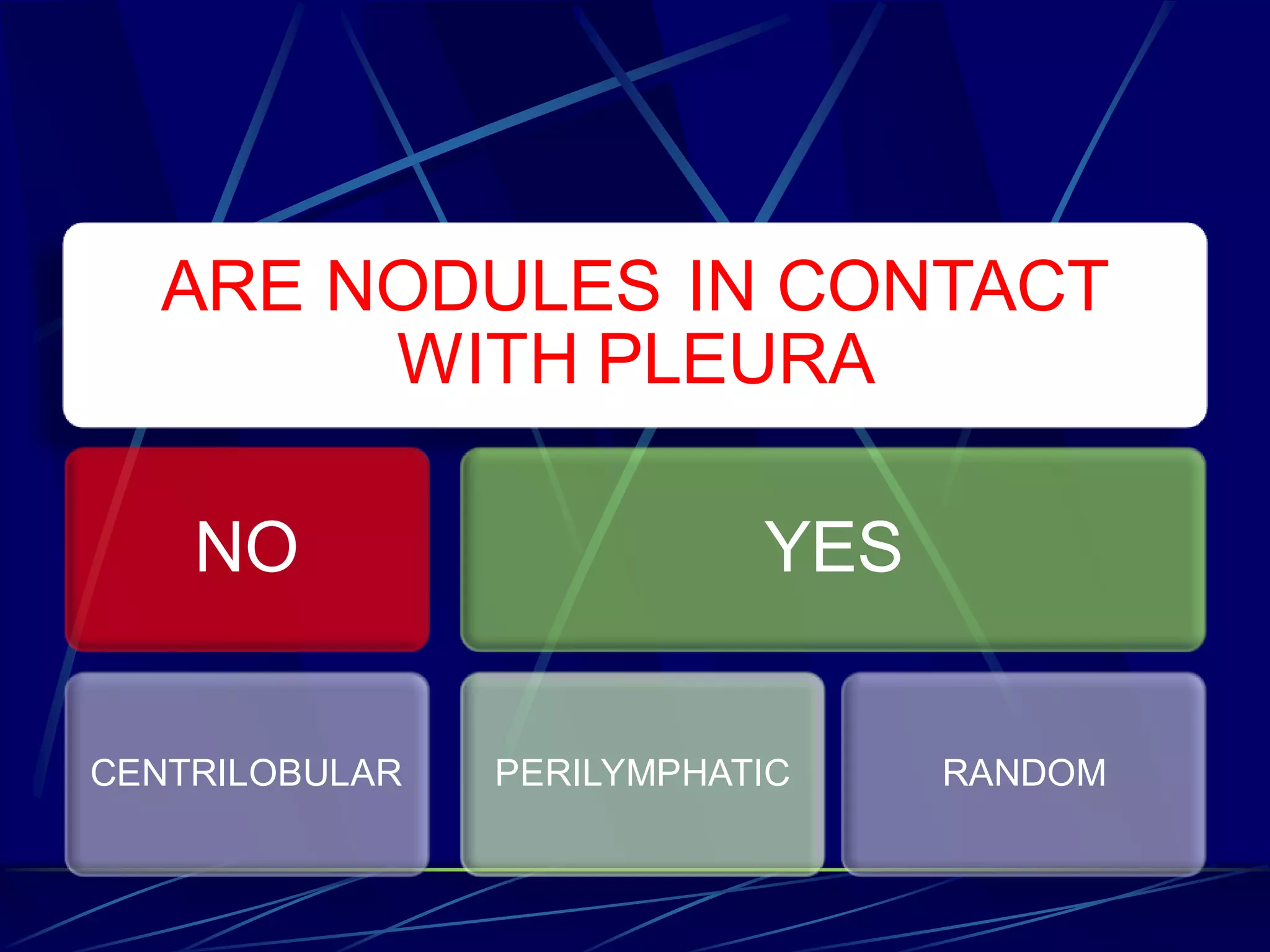
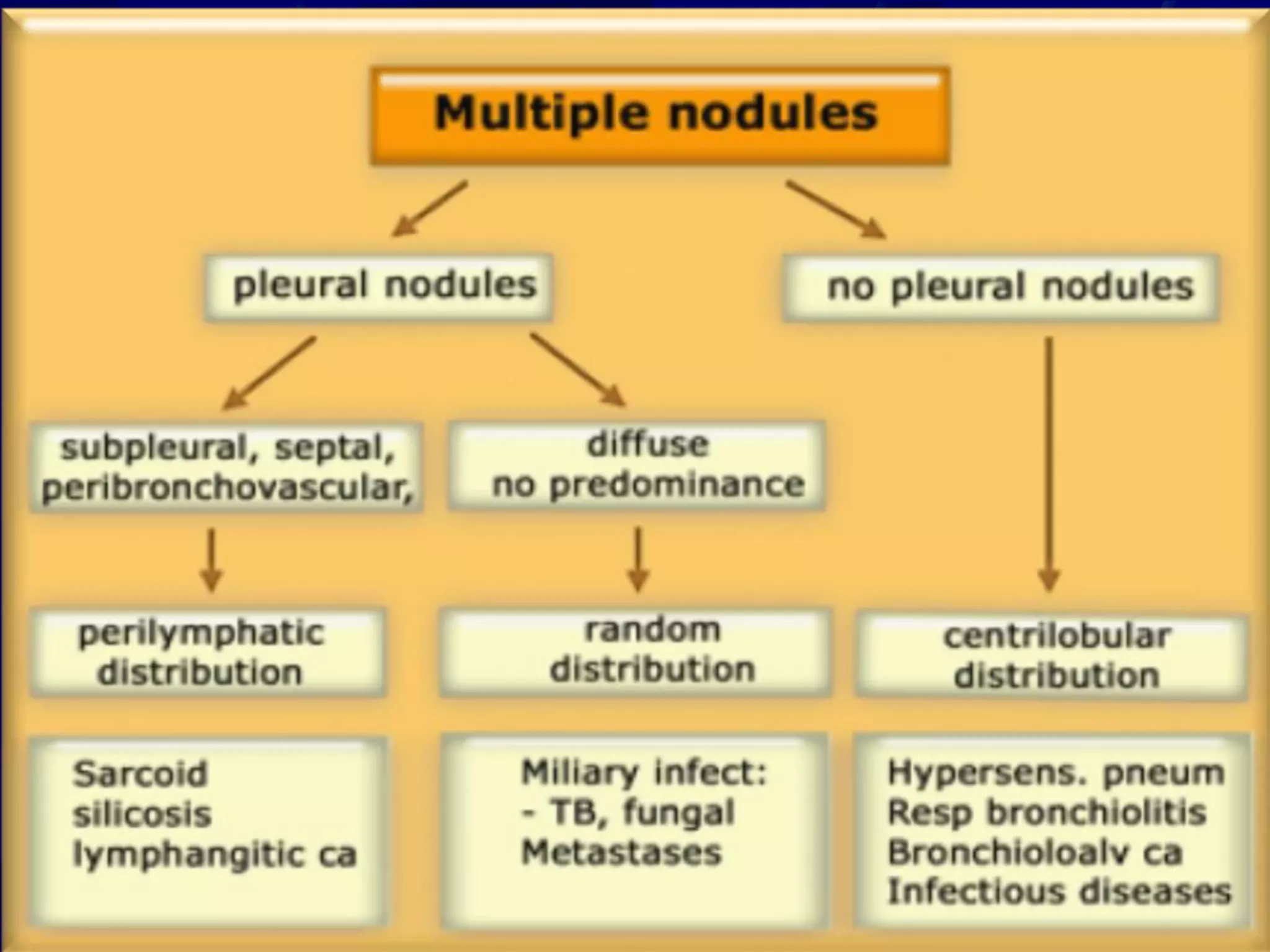
ARE NODULES IN CONTACT
WITH PLEURA
NO
CENTRILOBULAR
YES
PERILYMPHATIC RANDOM
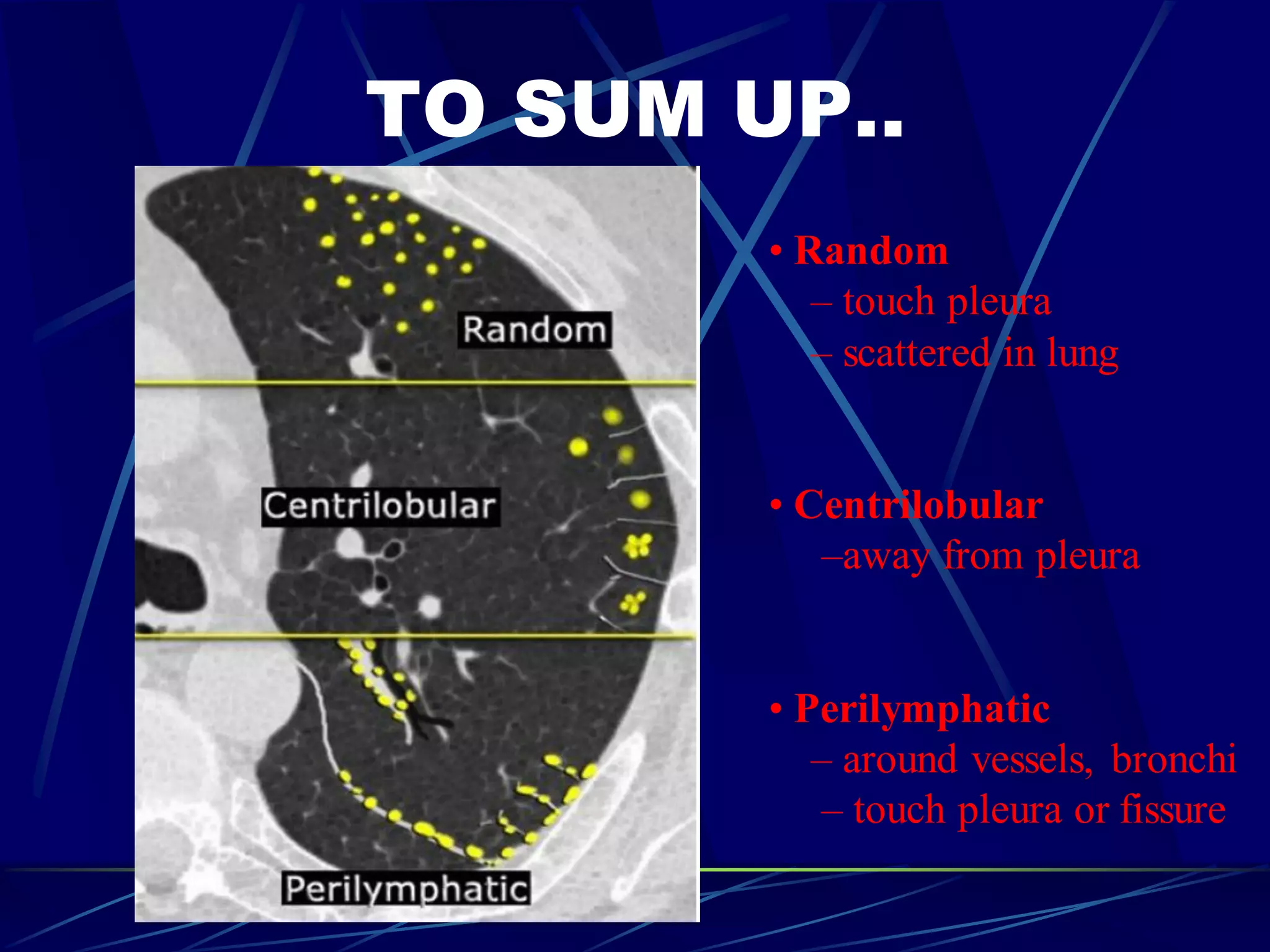
TO SUM UP..
• Random
– touch pleura
– scattered in lung
• Centrilobular
–away from pleura
• Perilymphatic
– around vessels, bronchi
– touch pleura or fissure
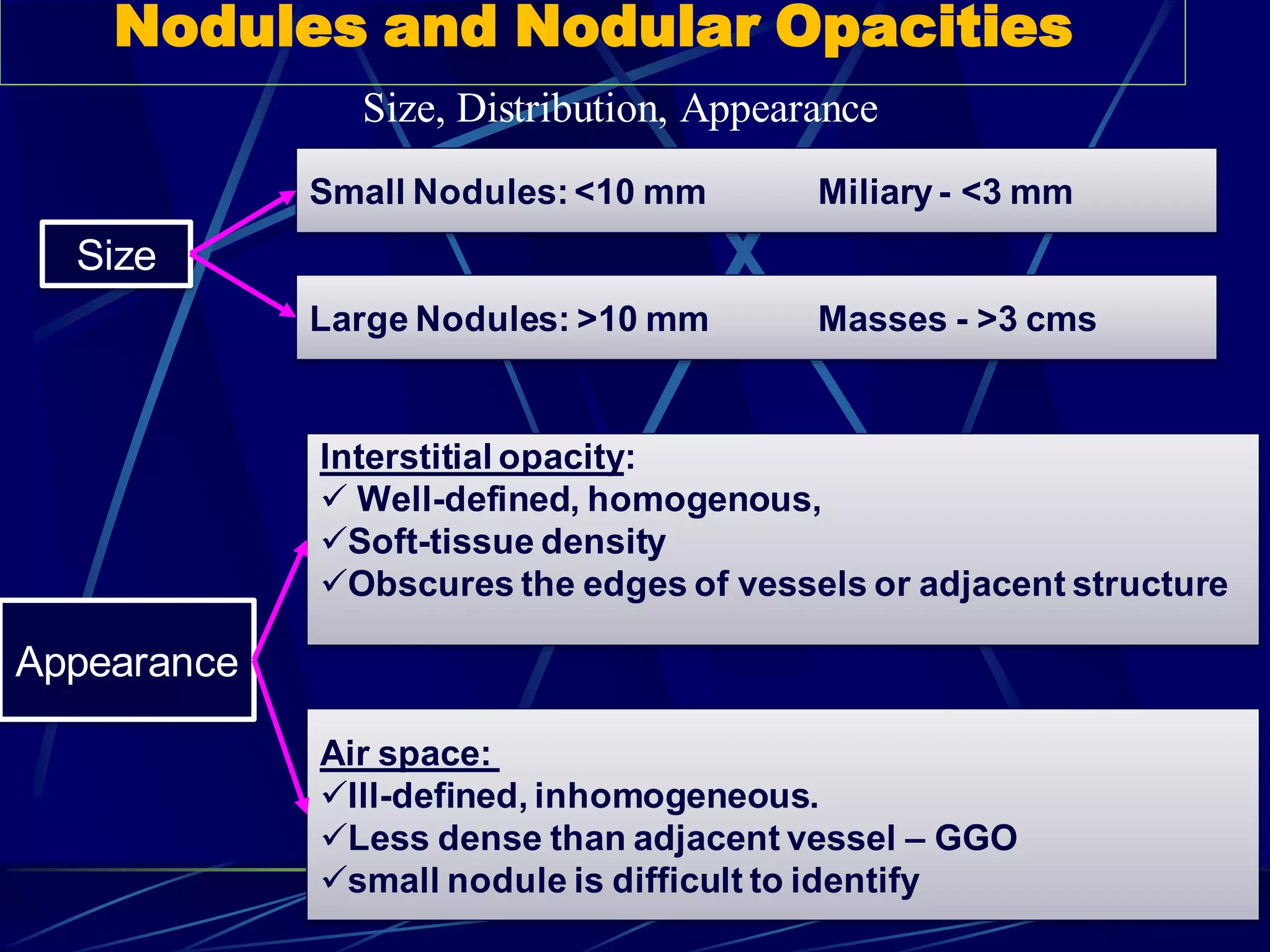
Size, Distribution, Appearance
Nodules and Nodular Opacities
Size
Small Nodules:<10 mm Miliary - <3 mm
Large Nodules: >10 mm Masses - >3 cms
Appearance
Interstitial opacity:
 Well-defined, homogenous,
Soft-tissue density
Obscures the edges of vessels or adjacent structure
Air space:
Ill-defined, inhomogeneous.
Less dense than adjacent vessel – GGO
small nodule is difficult to identify
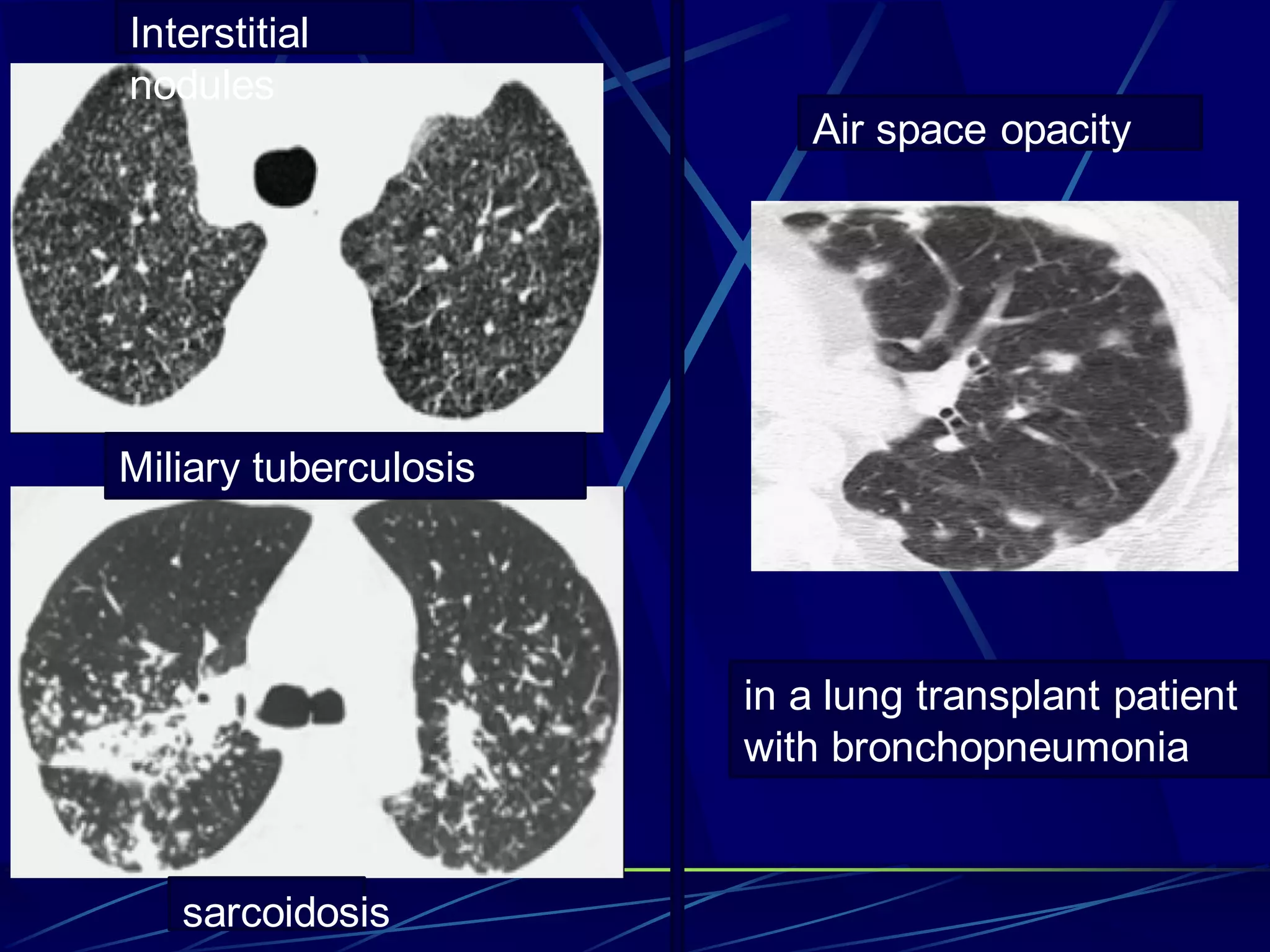
Interstitial
nodules
Air space opacity
Miliary tuberculosis
sarcoidosis
in a lung transplant patient
with bronchopneumonia
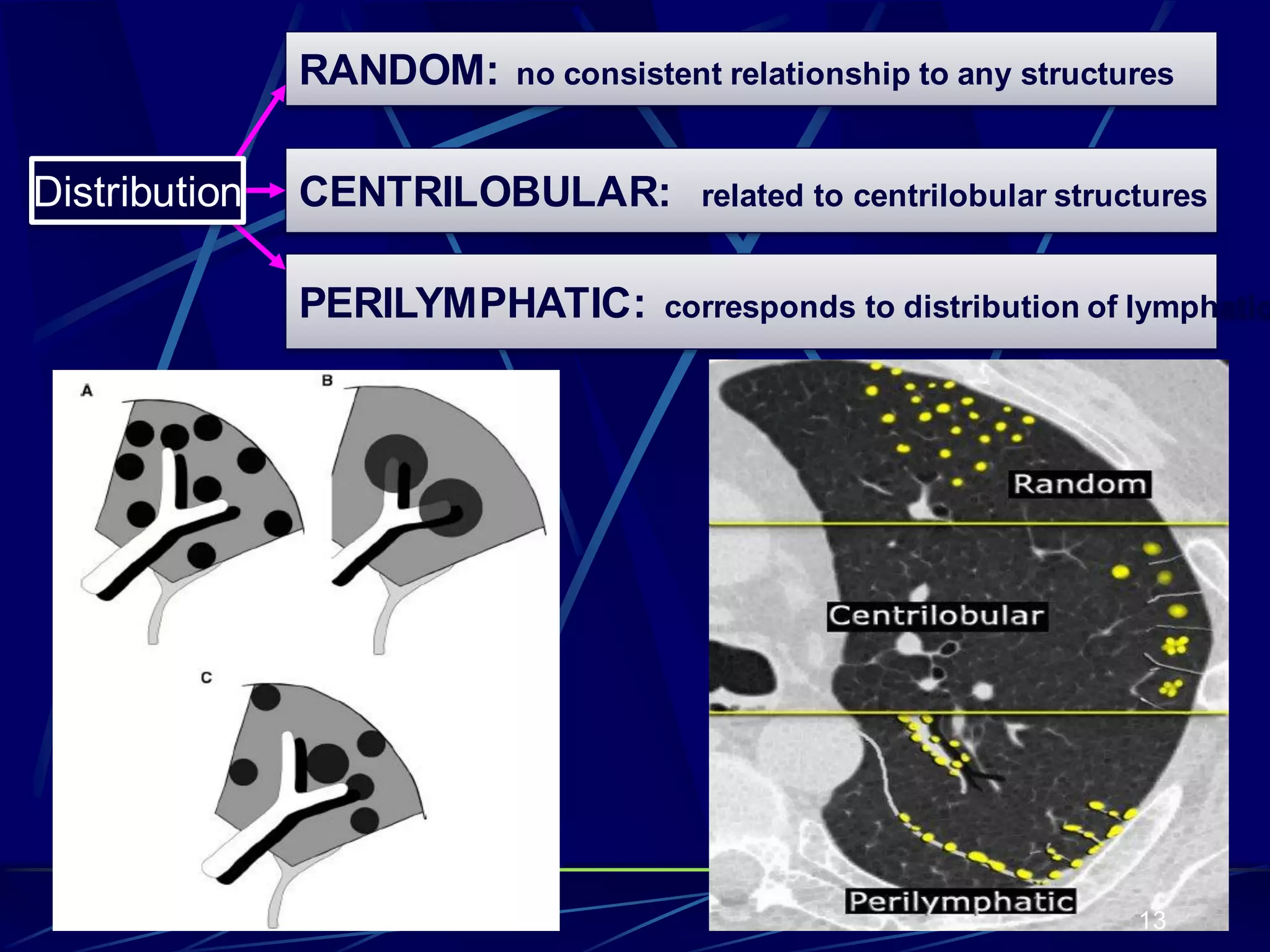
RANDOM: no consistent relationship to any structures
PERILYMPHATIC: corresponds to distribution of lymphatic
CENTRILOBULAR: related to centrilobular structuresDistribution
13
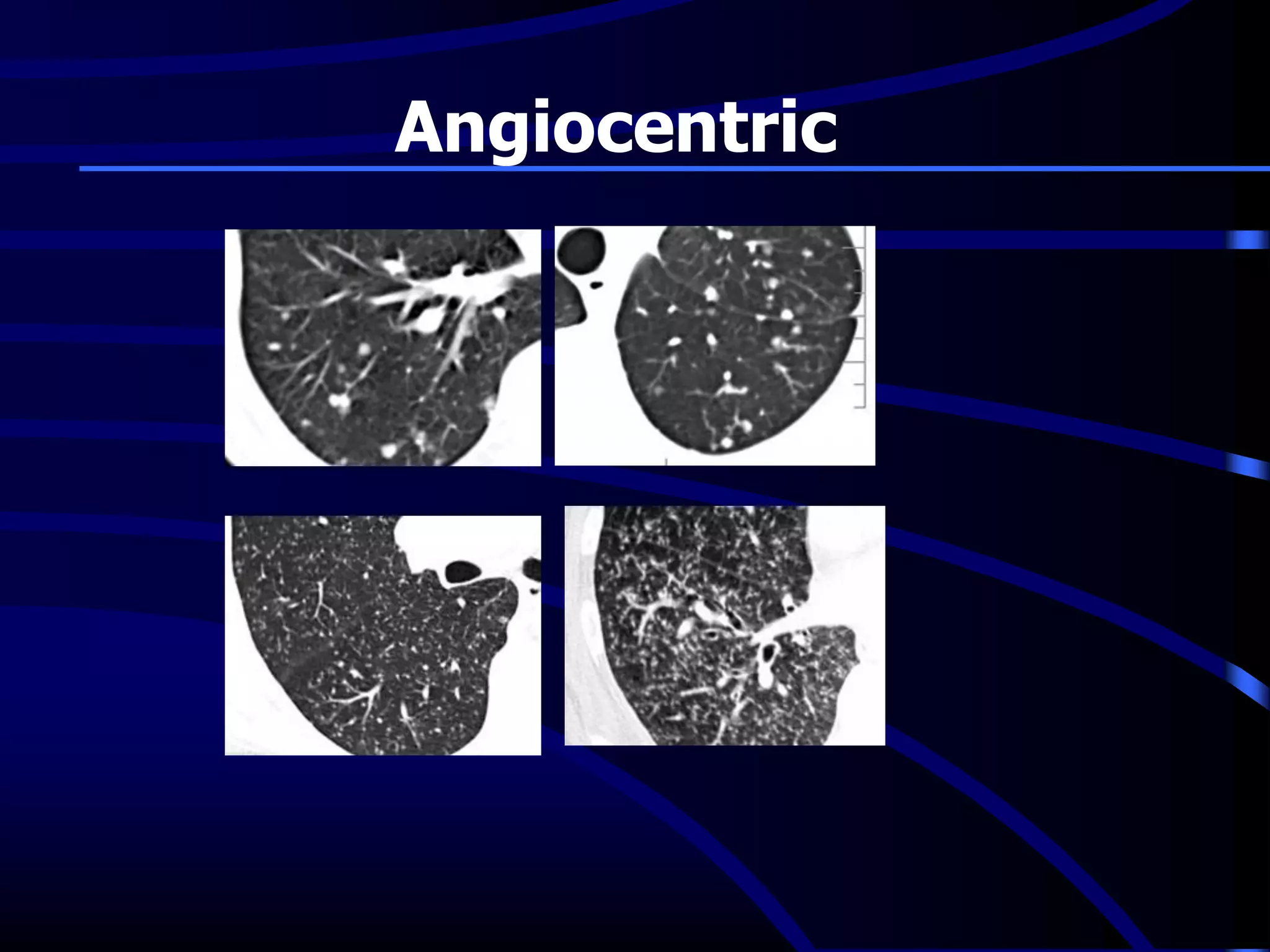
Angiocentric
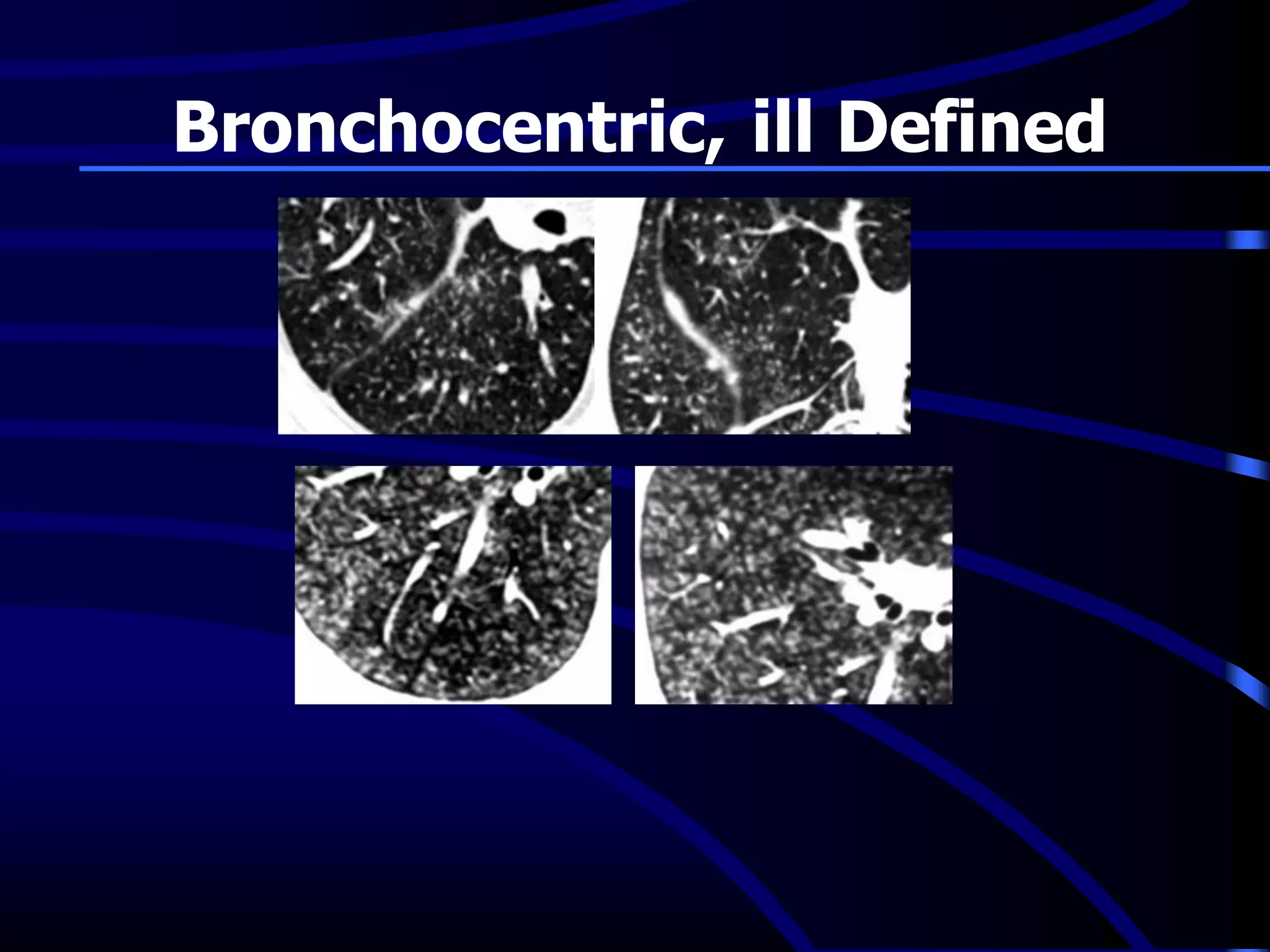
Bronchocentric, ill Defined
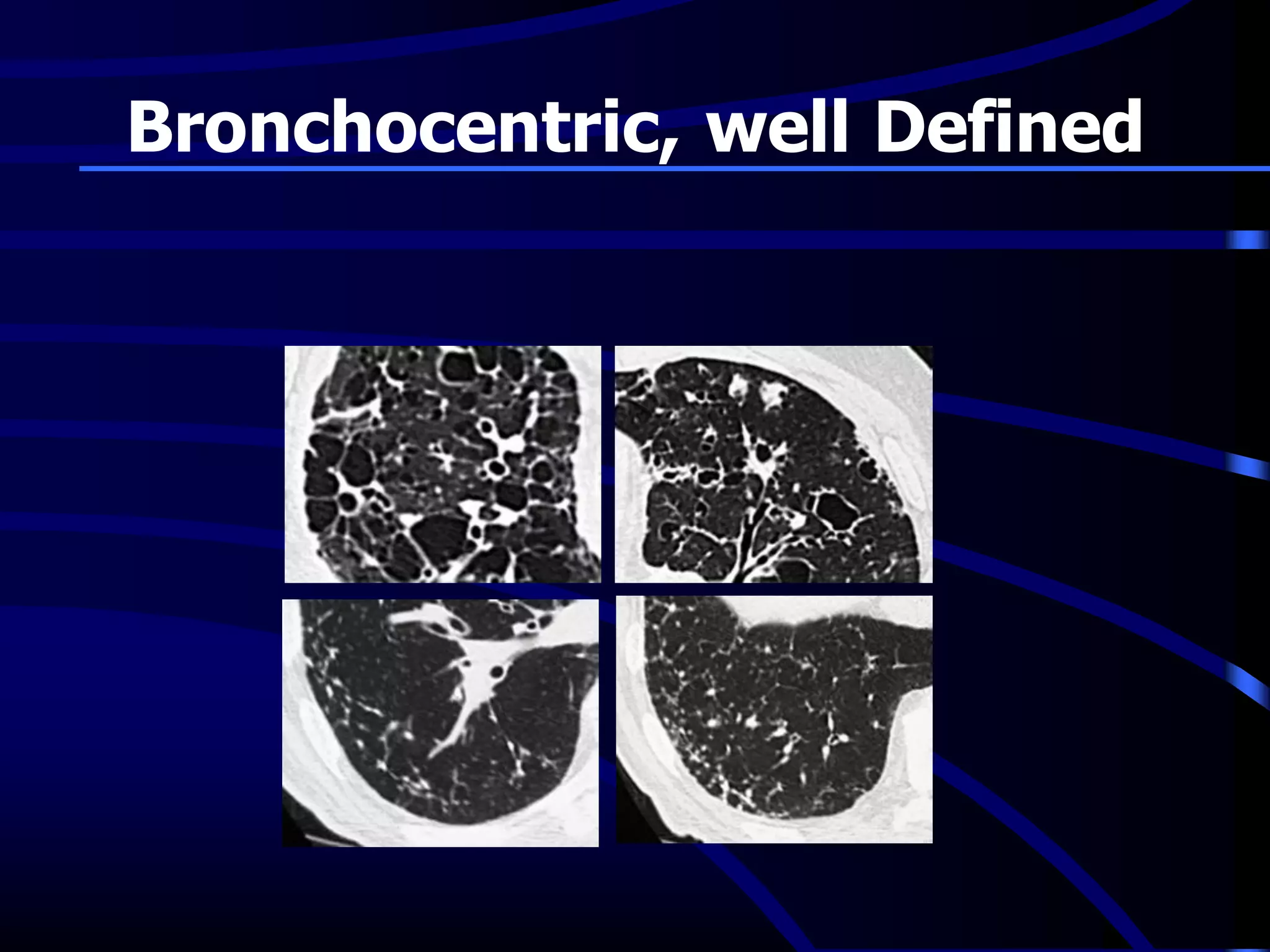
Bronchocentric, well Defined
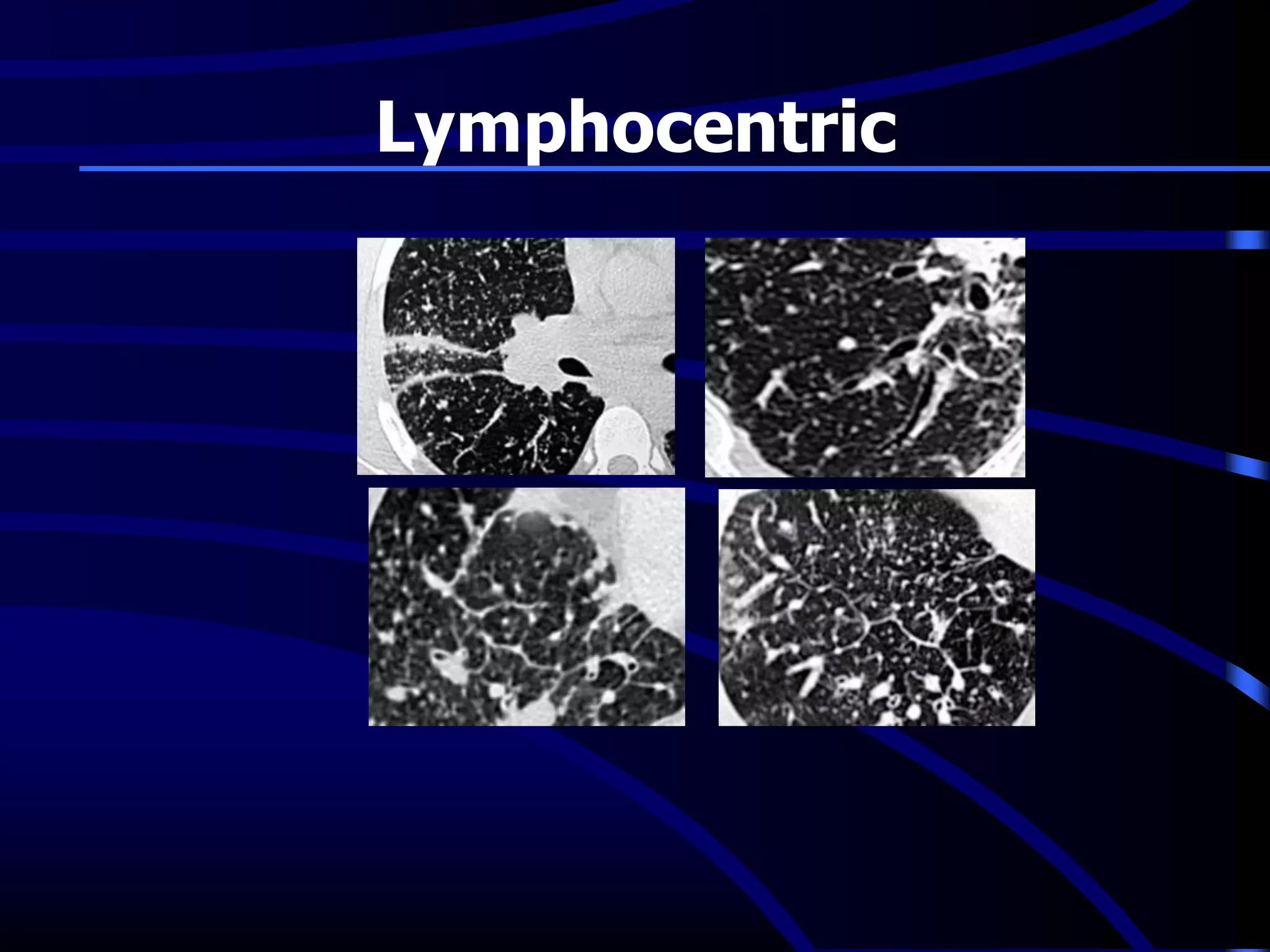
Lymphocentric
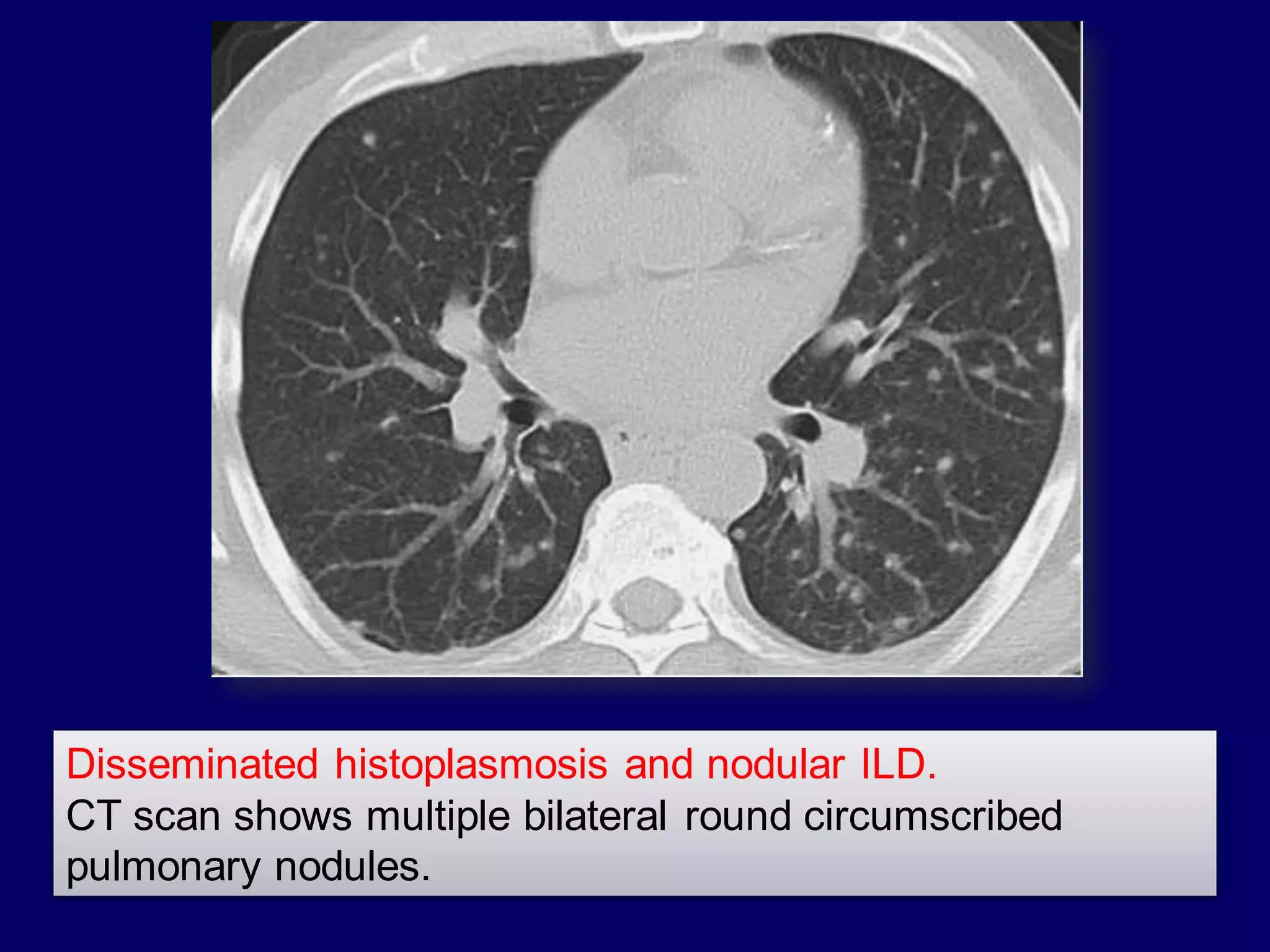
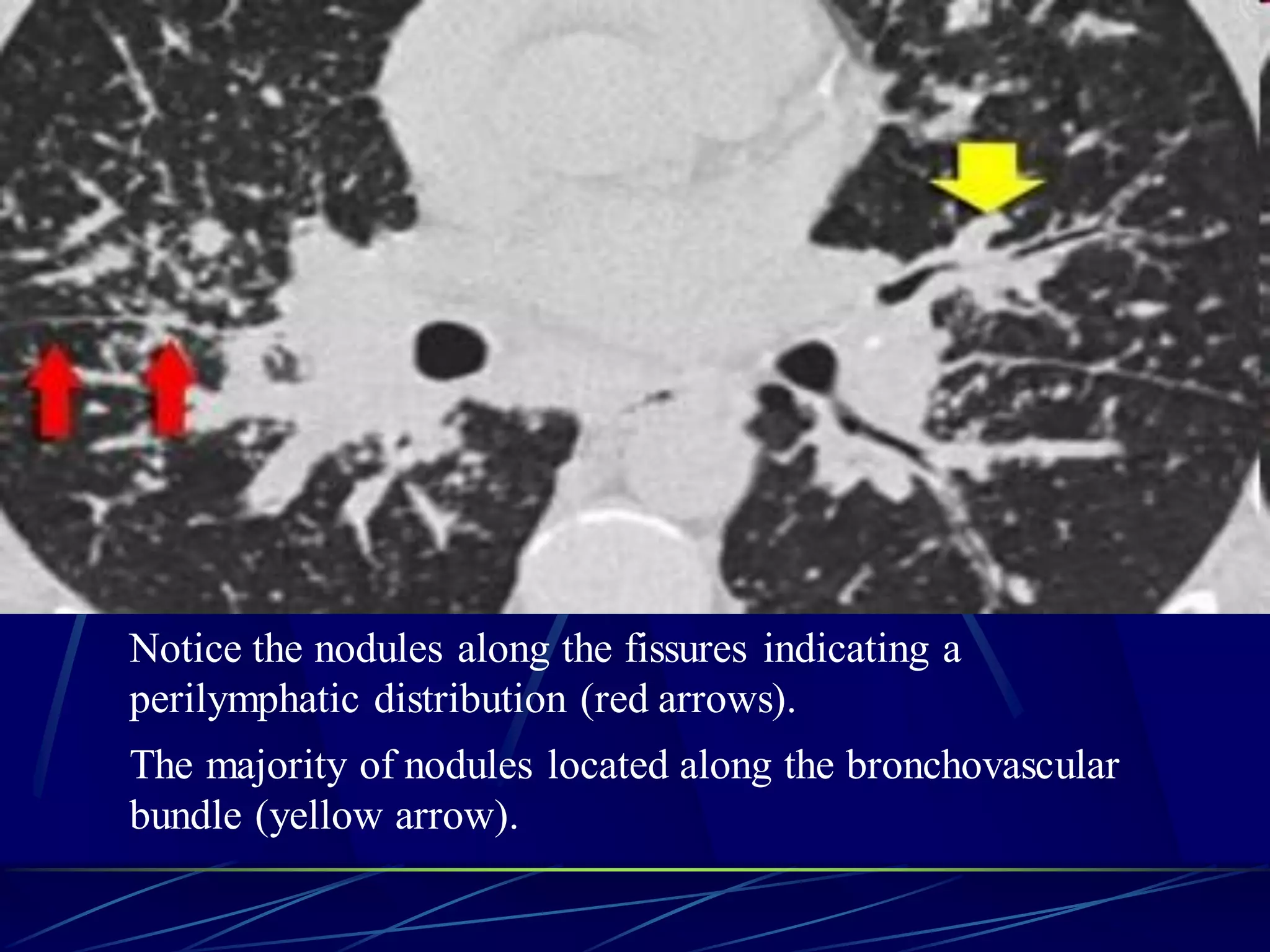
Disseminated histoplasmosis and nodular ILD.
CT scan shows multiple bilateral round circumscribed
pulmonary nodules.
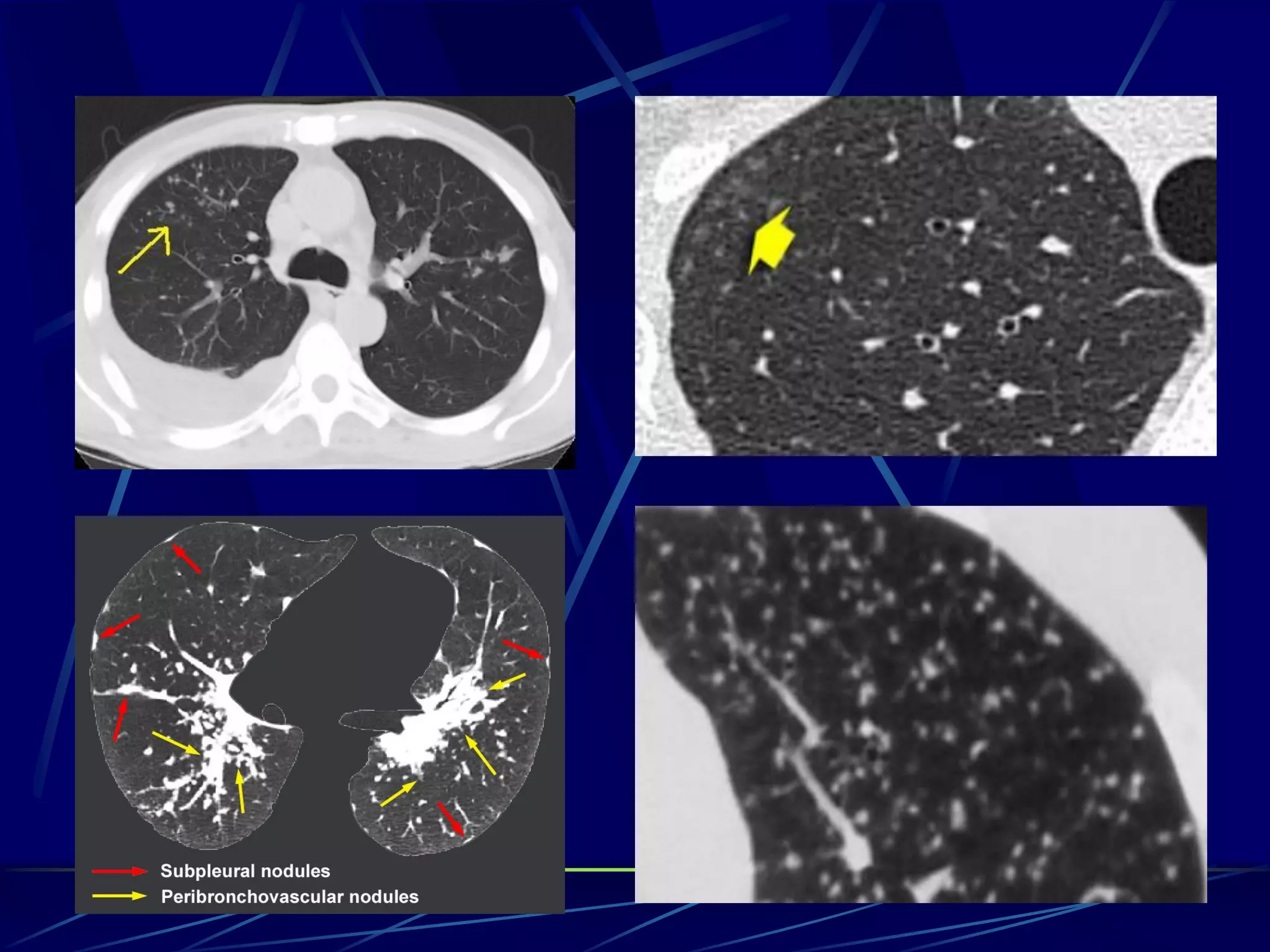
Notice the nodules along the fissures indicating a
perilymphatic distribution (red arrows).
The majority of nodules located along the bronchovascular
bundle (yellow arrow).
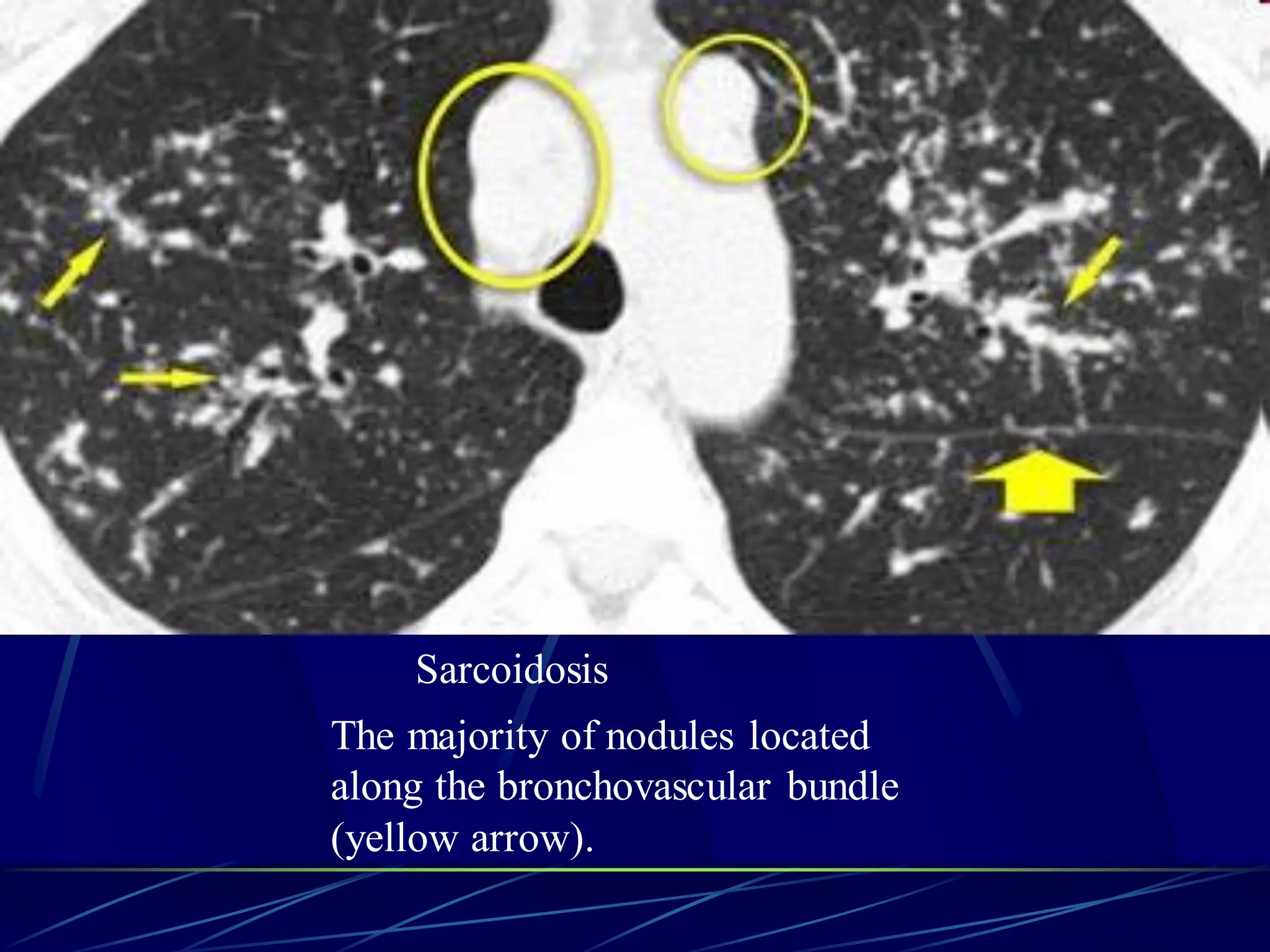
Sarcoidosis
The majority of nodules located
along the bronchovascular bundle
(yellow arrow).
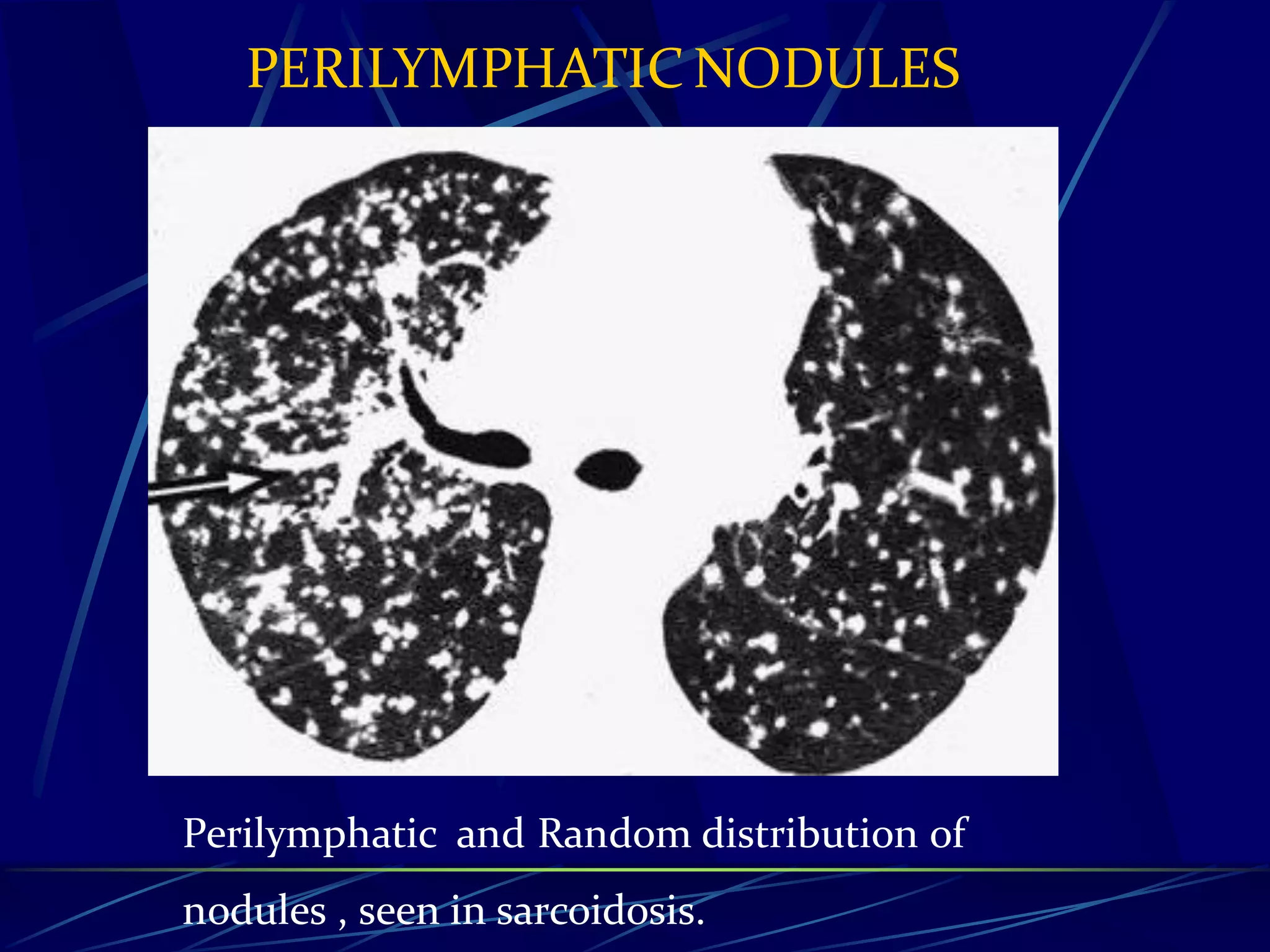
PERILYMPHATIC NODULES
Perilymphatic and Random distribution of
nodules , seen in sarcoidosis.
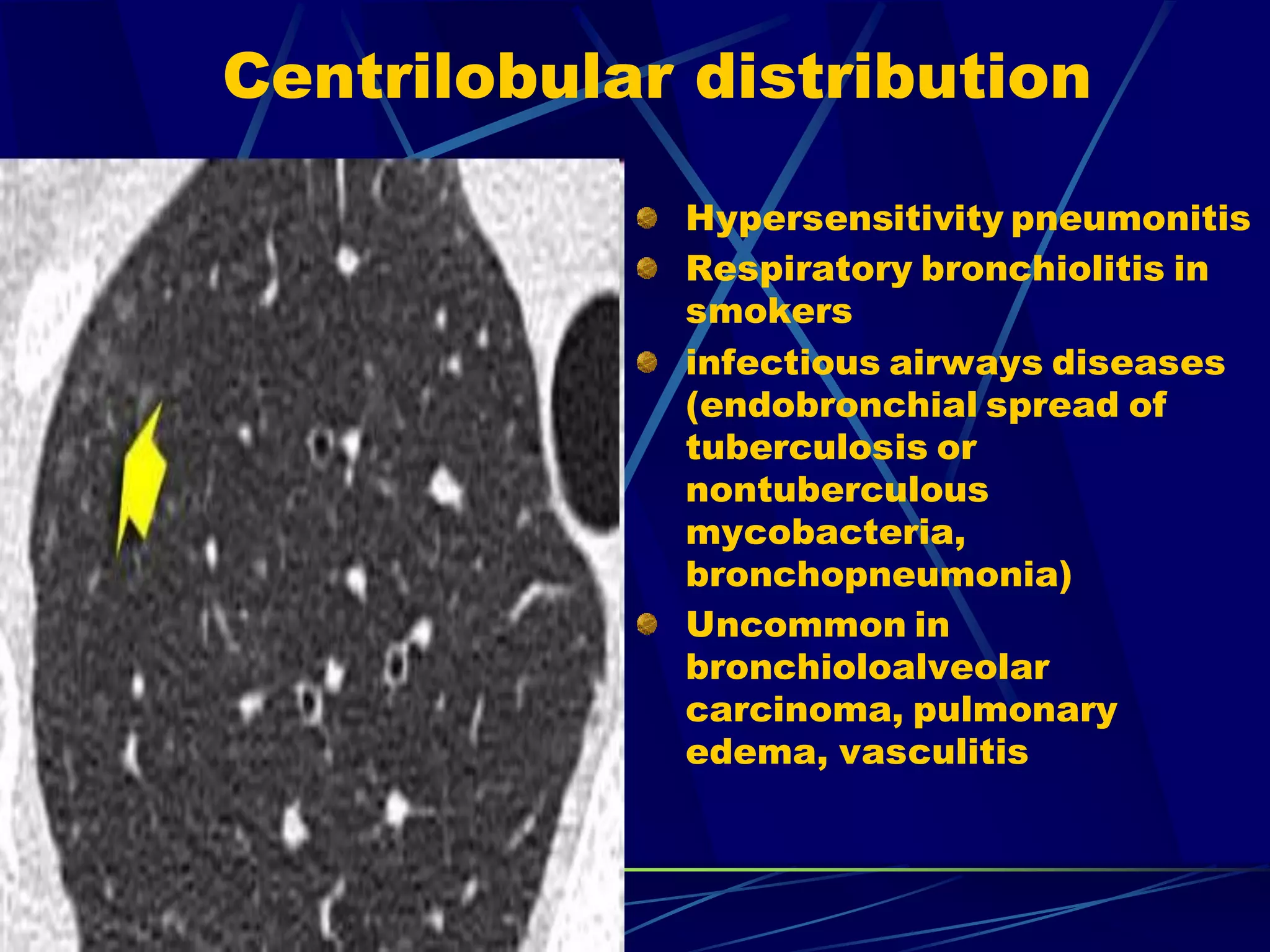
Centrilobular distribution
Hypersensitivity pneumonitis
Respiratory bronchiolitis in
smokers
infectious airways diseases
(endobronchial spread of
tuberculosis or
nontuberculous
mycobacteria,
bronchopneumonia)
Uncommon in
bronchioloalveolar
carcinoma, pulmonary
edema, vasculitis
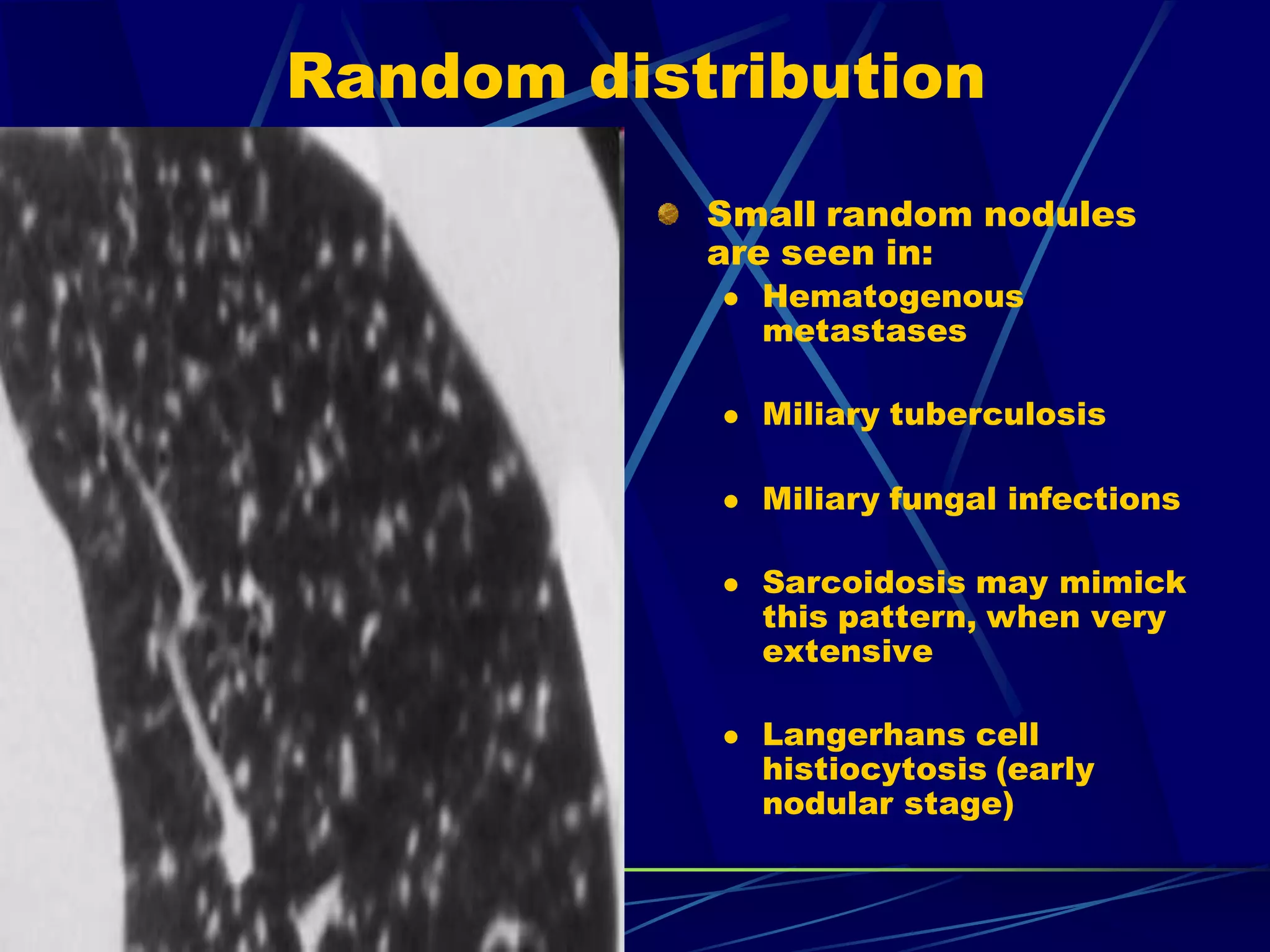
Random distribution
Small random nodules
are seen in:
 Hematogenous
metastases
 Miliary tuberculosis
 Miliary fungal infections
 Sarcoidosis may mimick
this pattern, when very
extensive
 Langerhans cell
histiocytosis (early
nodular stage)
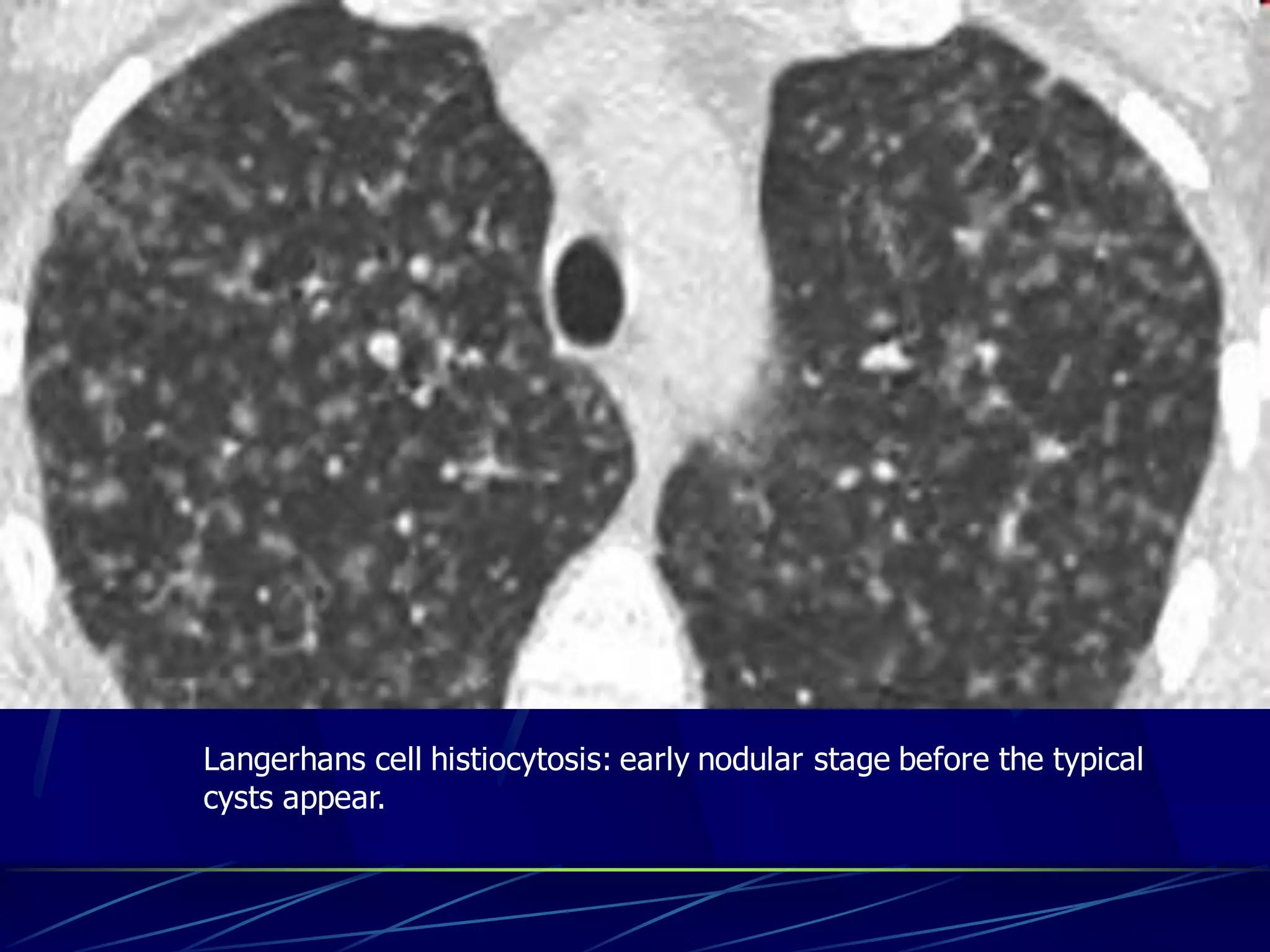
Langerhans cell histiocytosis: early nodular stage before the typical
cysts appear.
Differential diagnosis of a nodular
pattern of interstitial lung disease
SHRIMP
Sarcoidosis
Histiocytosis (Langerhan cell
histiocytosis)
Hypersensitivity pneumonitis
Rheumatoid nodules
Infection (mycobacterial, fungal, viral)
Metastases, Miliary TB
Microlithiasis, alveolar
Pneumoconioses (silicosis, coal
worker's, berylliosis)
Reticulonodular pattern
A reticulonodular pattern results from a
combination of reticular and nodular opacities.
This pattern is often difficult to distinguish from
a purely reticular or nodular pattern, and in
such a case a differential diagnosis should be
developed based on the predominant pattern.
If there is no predominant pattern, causes of both
nodular and reticular patterns should be
considered.
Nodular pattern

Nodular pattern

  • 2.
    Nodular Patternitie By Gamal RabieAgmy , MD , FCCP Professor of Chest Diseases ,Assiut University
  • 3.
  • 4.
    Nodular pattern  Anodular pattern consists of multiple round opacities, generally ranging in diameter from 1 mm to 1 cm  Nodular opacities may be described as miliary (1 to 2 mm, the size of millet seeds), small, medium, or large, as the diameter of the opacities increases  A nodular pattern, especially with predominant distribution, suggests a specific differential diagnosis
  • 5.
  • 6.
    ARE NODULES INCONTACT WITH PLEURA NO CENTRILOBULAR YES PERILYMPHATIC RANDOM
  • 9.
    TO SUM UP.. •Random – touch pleura – scattered in lung • Centrilobular –away from pleura • Perilymphatic – around vessels, bronchi – touch pleura or fissure
  • 11.
    Size, Distribution, Appearance Nodulesand Nodular Opacities Size Small Nodules:<10 mm Miliary - <3 mm Large Nodules: >10 mm Masses - >3 cms Appearance Interstitial opacity:  Well-defined, homogenous, Soft-tissue density Obscures the edges of vessels or adjacent structure Air space: Ill-defined, inhomogeneous. Less dense than adjacent vessel – GGO small nodule is difficult to identify
  • 12.
    Interstitial nodules Air space opacity Miliarytuberculosis sarcoidosis in a lung transplant patient with bronchopneumonia
  • 13.
    RANDOM: no consistentrelationship to any structures PERILYMPHATIC: corresponds to distribution of lymphatic CENTRILOBULAR: related to centrilobular structuresDistribution 13
  • 14.
  • 15.
  • 16.
  • 17.
  • 18.
    Disseminated histoplasmosis andnodular ILD. CT scan shows multiple bilateral round circumscribed pulmonary nodules.
  • 19.
    Notice the nodulesalong the fissures indicating a perilymphatic distribution (red arrows). The majority of nodules located along the bronchovascular bundle (yellow arrow).
  • 20.
    Sarcoidosis The majority ofnodules located along the bronchovascular bundle (yellow arrow).
  • 21.
    PERILYMPHATIC NODULES Perilymphatic andRandom distribution of nodules , seen in sarcoidosis.
  • 22.
    Centrilobular distribution Hypersensitivity pneumonitis Respiratorybronchiolitis in smokers infectious airways diseases (endobronchial spread of tuberculosis or nontuberculous mycobacteria, bronchopneumonia) Uncommon in bronchioloalveolar carcinoma, pulmonary edema, vasculitis
  • 23.
    Random distribution Small randomnodules are seen in:  Hematogenous metastases  Miliary tuberculosis  Miliary fungal infections  Sarcoidosis may mimick this pattern, when very extensive  Langerhans cell histiocytosis (early nodular stage)
  • 24.
    Langerhans cell histiocytosis:early nodular stage before the typical cysts appear.
  • 25.
    Differential diagnosis ofa nodular pattern of interstitial lung disease SHRIMP Sarcoidosis Histiocytosis (Langerhan cell histiocytosis) Hypersensitivity pneumonitis Rheumatoid nodules Infection (mycobacterial, fungal, viral) Metastases, Miliary TB Microlithiasis, alveolar Pneumoconioses (silicosis, coal worker's, berylliosis)
  • 26.
    Reticulonodular pattern A reticulonodularpattern results from a combination of reticular and nodular opacities. This pattern is often difficult to distinguish from a purely reticular or nodular pattern, and in such a case a differential diagnosis should be developed based on the predominant pattern. If there is no predominant pattern, causes of both nodular and reticular patterns should be considered.