This document discusses several key concepts related to deviance:
1. It defines deviance as violating social norms, whether formal rules or informal expectations.
2. Positive deviance refers to behaviors that help individuals find better solutions than peers despite facing similar challenges.
3. The determination of what is deviant depends on the observer, the actor, and the situation.
4. Social control mechanisms aim to ensure people behave in approved ways through internalization, social sanctions, or societal structures.
It is thereorganized violation of cultural
norms.
It describes actions or behaviours that
violate social norms, including formally-
enacted rules (e.g., crime),as
well as informal violations of
social norms (e.g., rejecting
folkways and mores).
3.
Involves behavior that
failsto meet accepted
norms.
It occurs when people
either
reject, misinterpret, or
are unaware of the
norms.
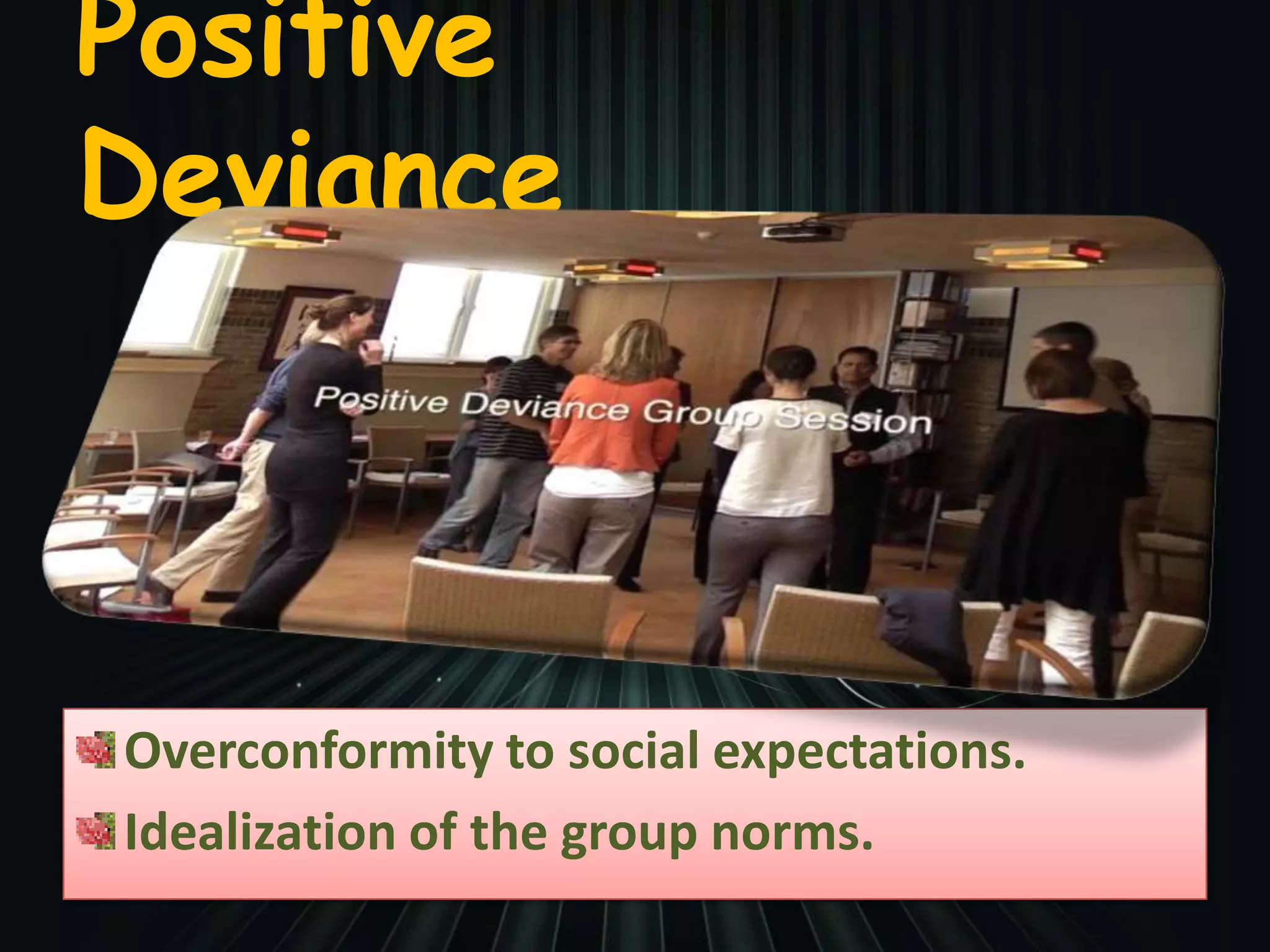
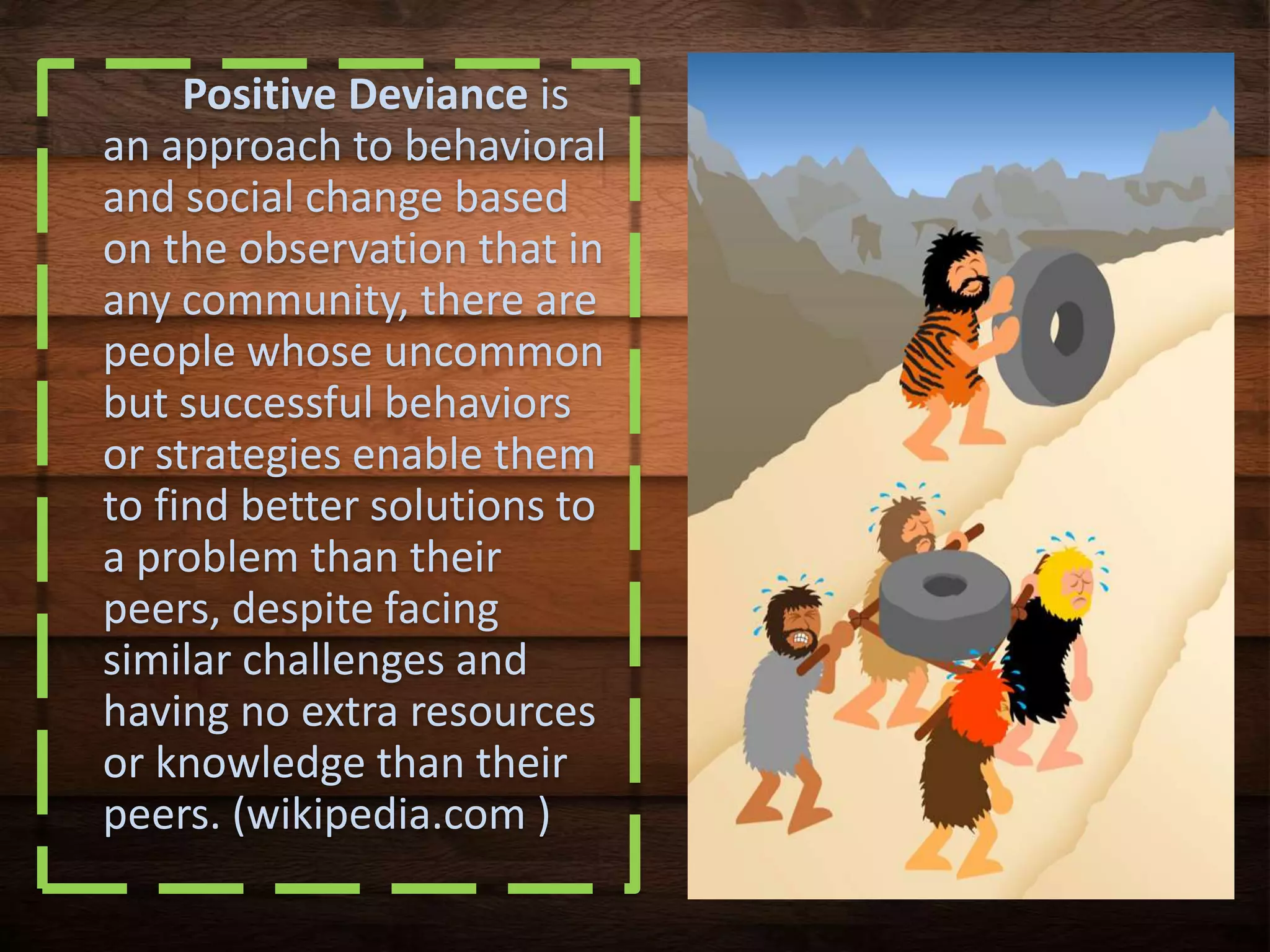
Positive Deviance is
anapproach to behavioral
and social change based
on the observation that in
any community, there are
people whose uncommon
but successful behaviors
or strategies enable them
to find better solutions to
a problem than their
peers, despite facing
similar challenges and
having no extra resources
or knowledge than their
peers. (wikipedia.com )
6.
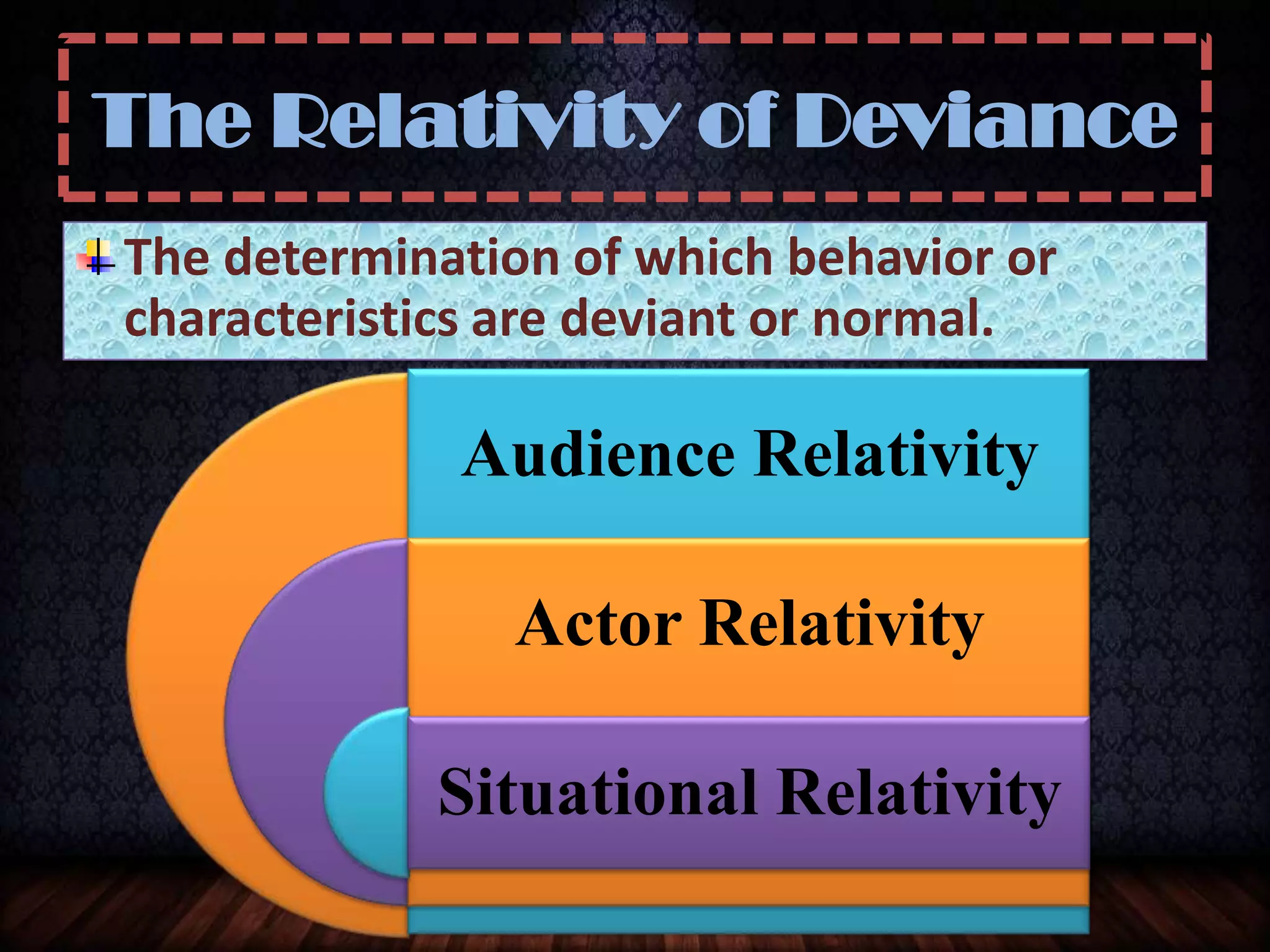
The Relativity ofDeviance
The determination of which behavior or
characteristics are deviant or normal.
Audience Relativity
Actor Relativity
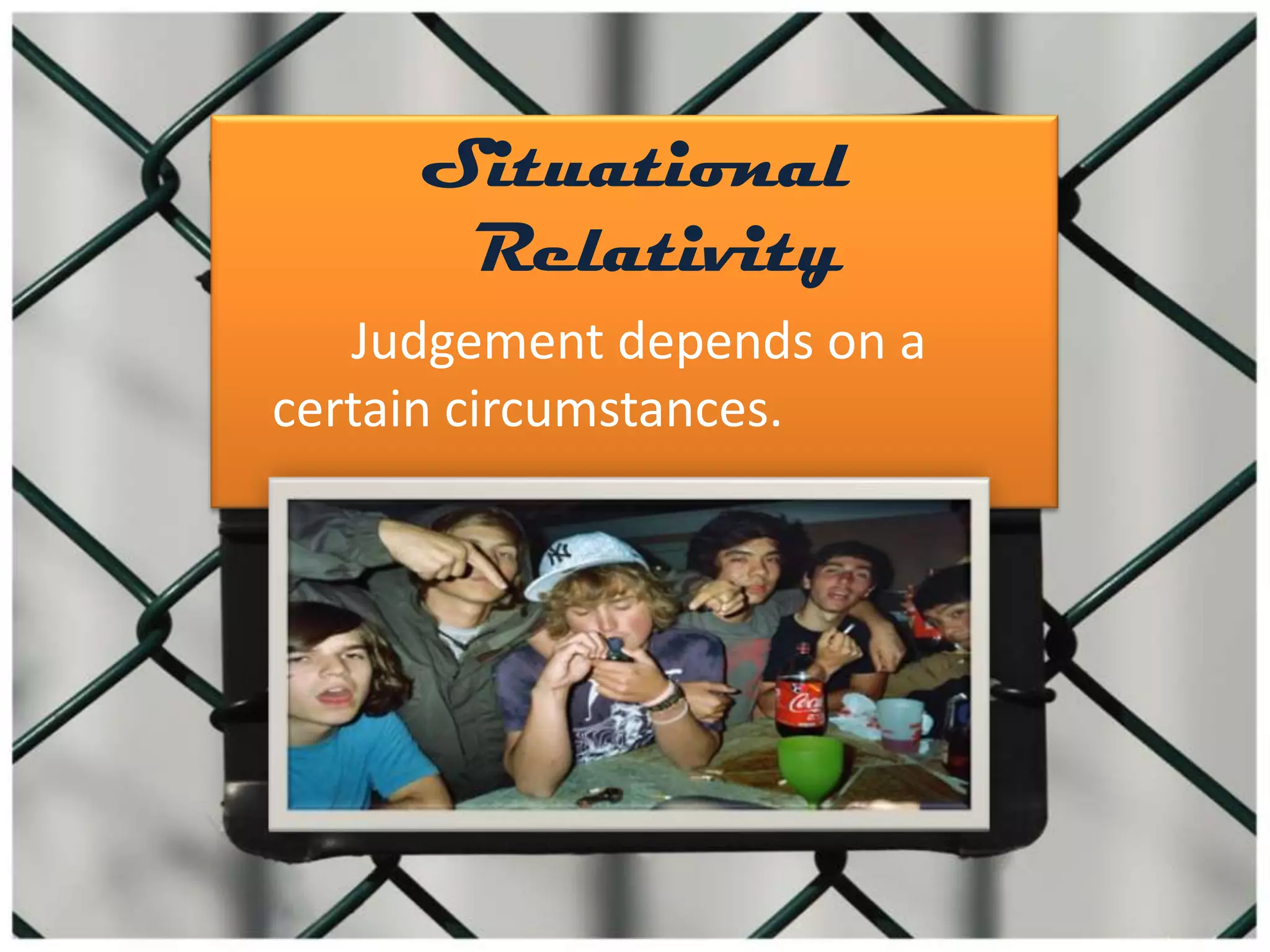
Situational Relativity
7.
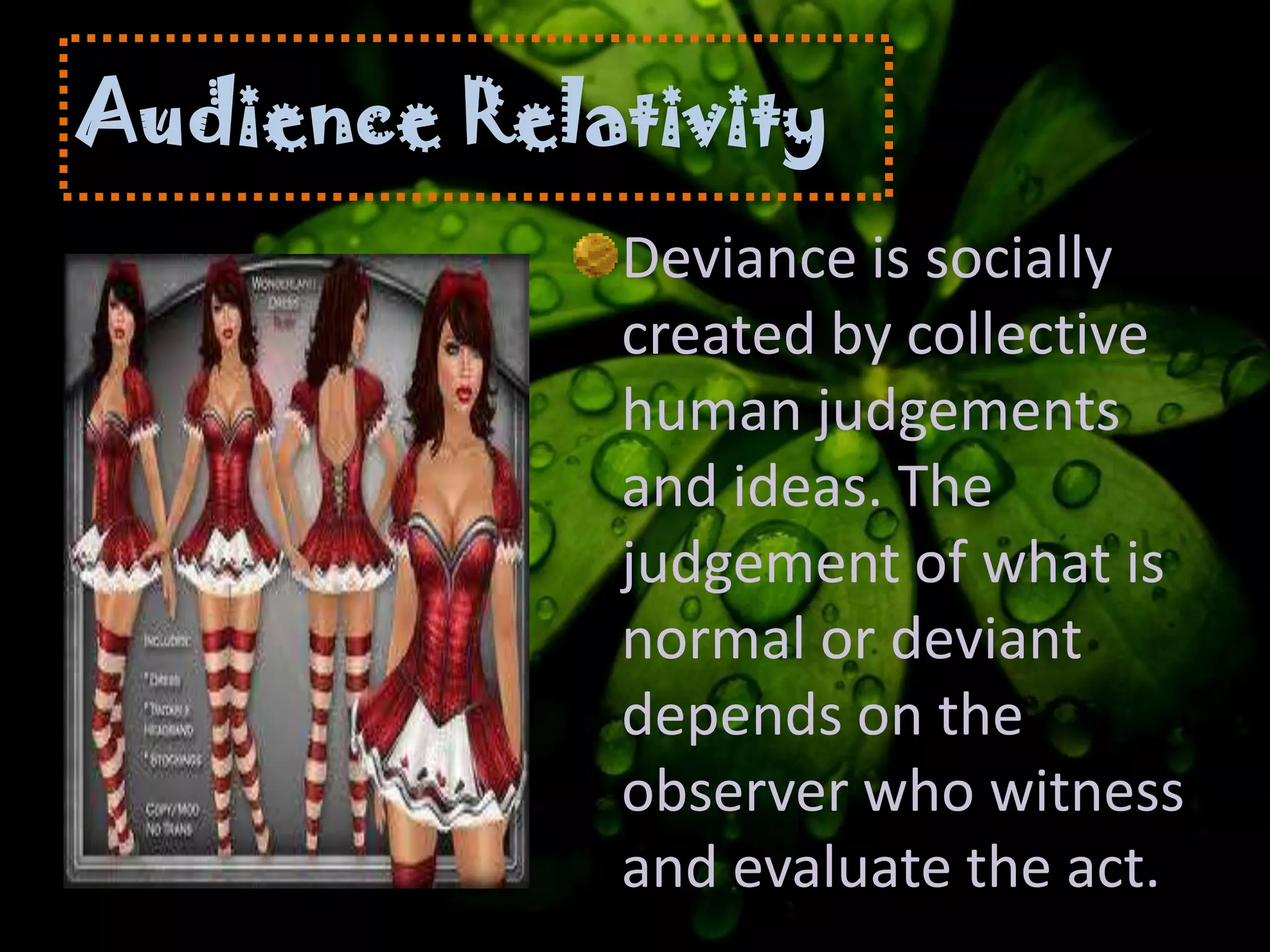
Audience Relativity
Deviance issocially
created by collective
human judgements
and ideas. The
judgement of what is
normal or deviant
depends on the
observer who witness
and evaluate the act.
8.
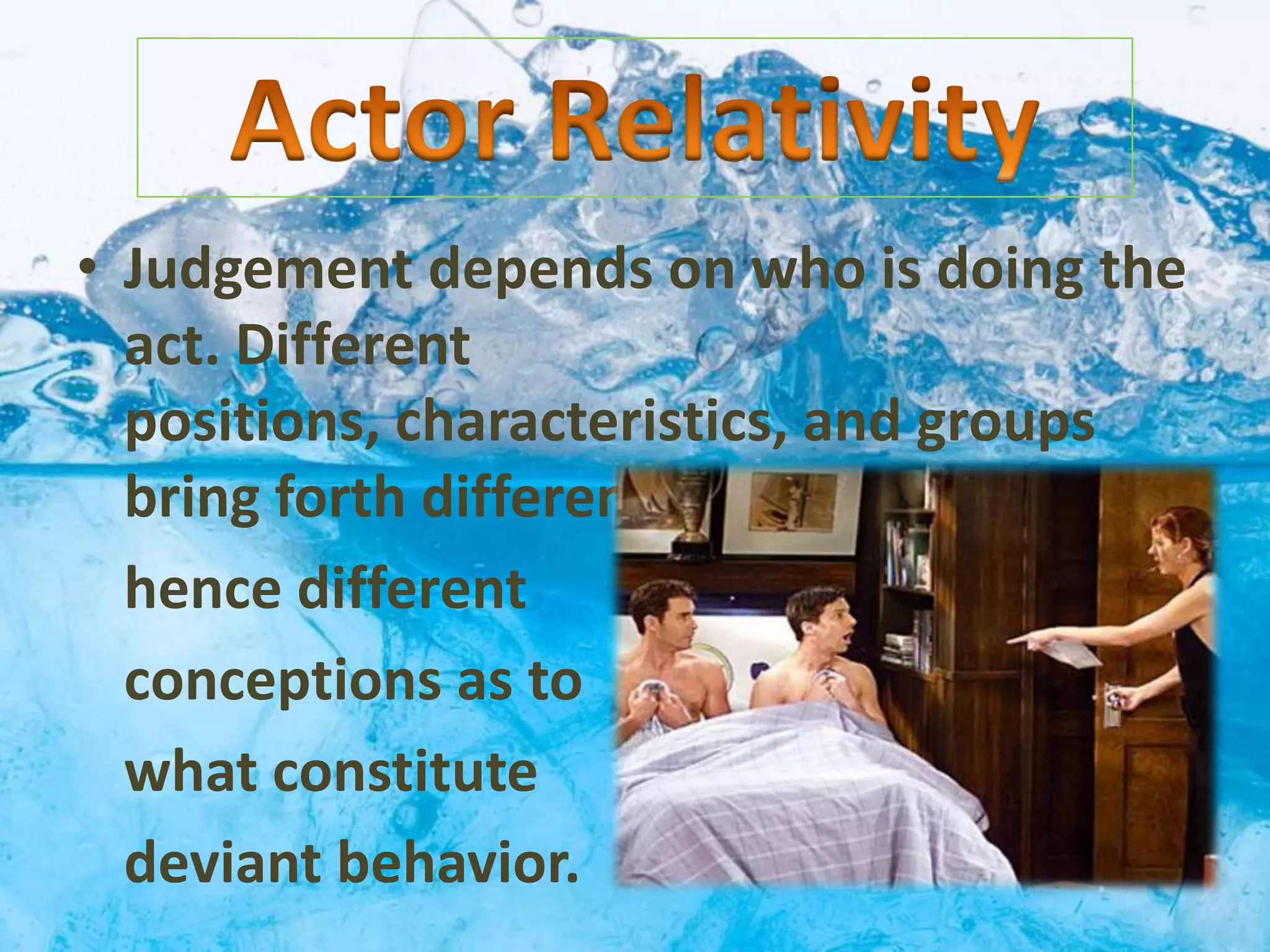
• Judgement dependson who is doing the
act. Different
positions, characteristics, and groups
bring forth different expectations, and
hence different
conceptions as to
what constitute
deviant behavior.
– There mustexist a behavioral
expectation, a norm that defines
appropriate, acceptable behavior, ideas or
characteristics.
– some sort of violation of the norm
must occur.
–
Avoiding, criticism, warnings, punishment or
treatment to the violation.
11.
The set ofmeans of ensuring that
people generally behave in expected
and approve ways.
12.
Types of Social
Control–lies within the individual that
developed during the socialization process. It is
practising social control because it is the right
thing to do.
– is based on social sanctions, or the
system of rewards and punishments designed to
encourage desired behavior.
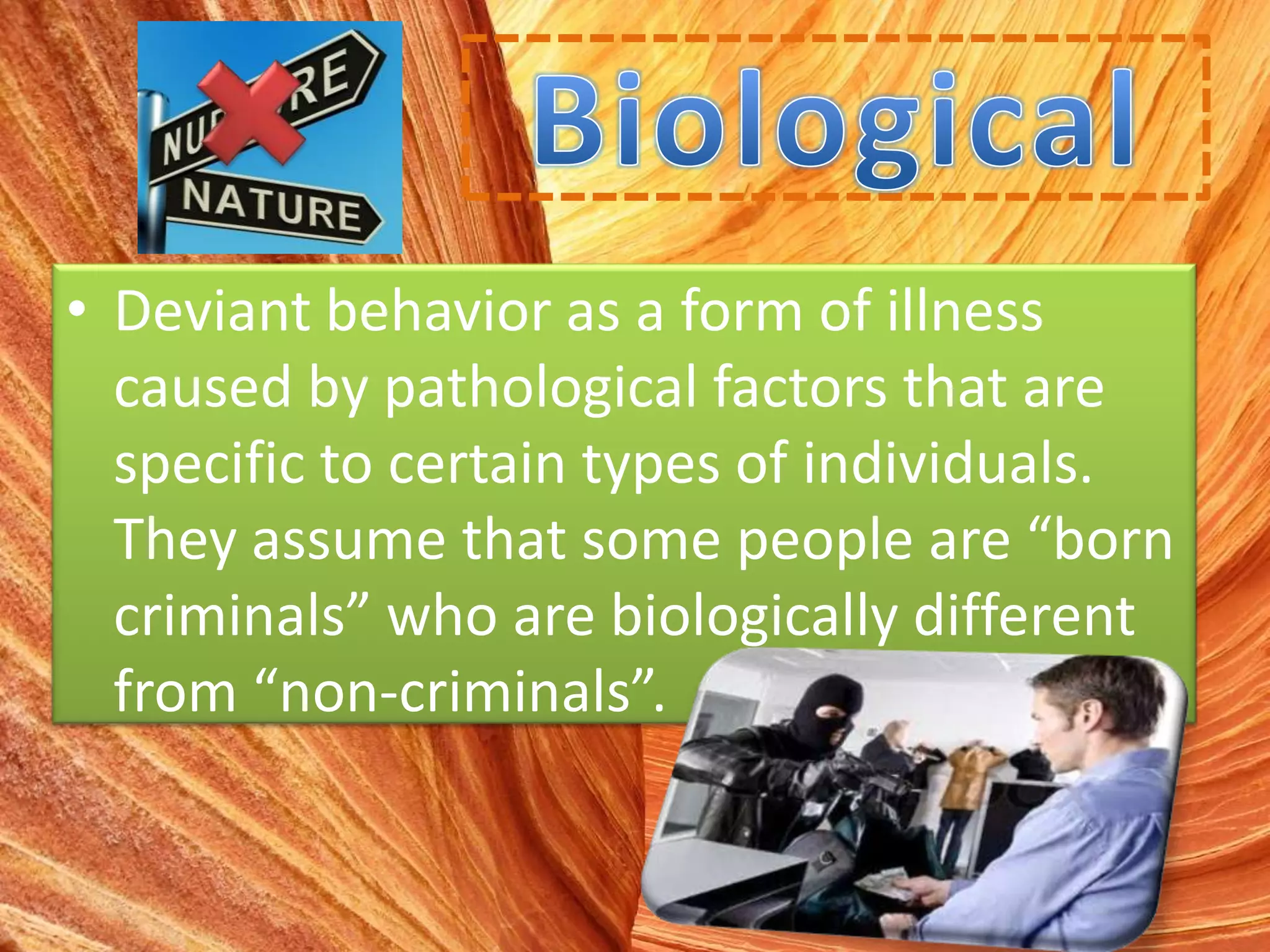
• Deviant behavioras a form of illness
caused by pathological factors that are
specific to certain types of individuals.
They assume that some people are “born
criminals” who are biologically different
from “non-criminals”.
15.
Explained that certain
peopleare born
criminals.
He described criminals
as having low
foreheads, prominent
jaws and
cheekbones, lots of
body hair, and
unusually long arms.
16.
William Sheldon
Suggested thatbody types predict
criminality.
Concluded that the muscular and athletic
builds are more likely to commit crimes.
18.
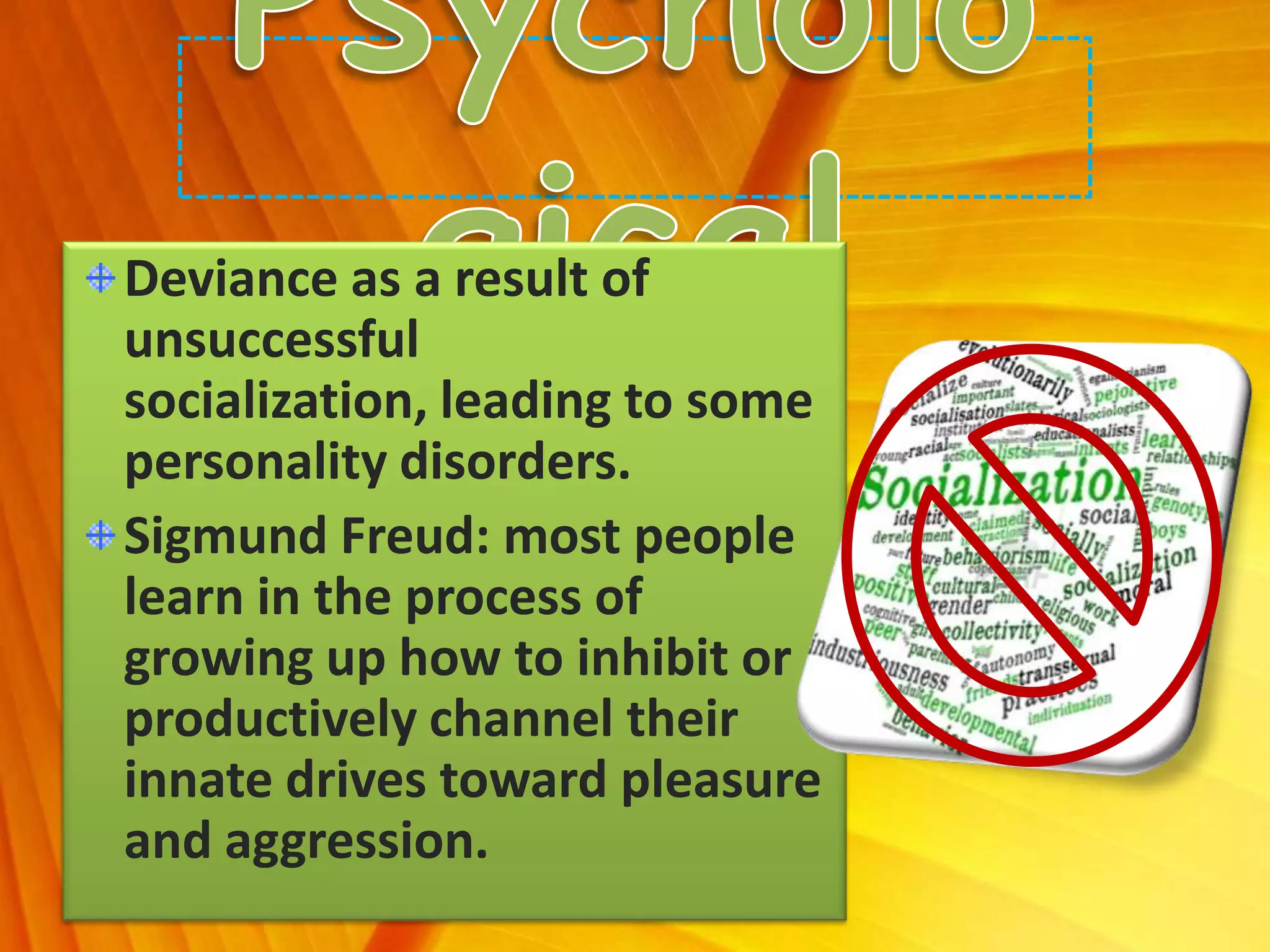
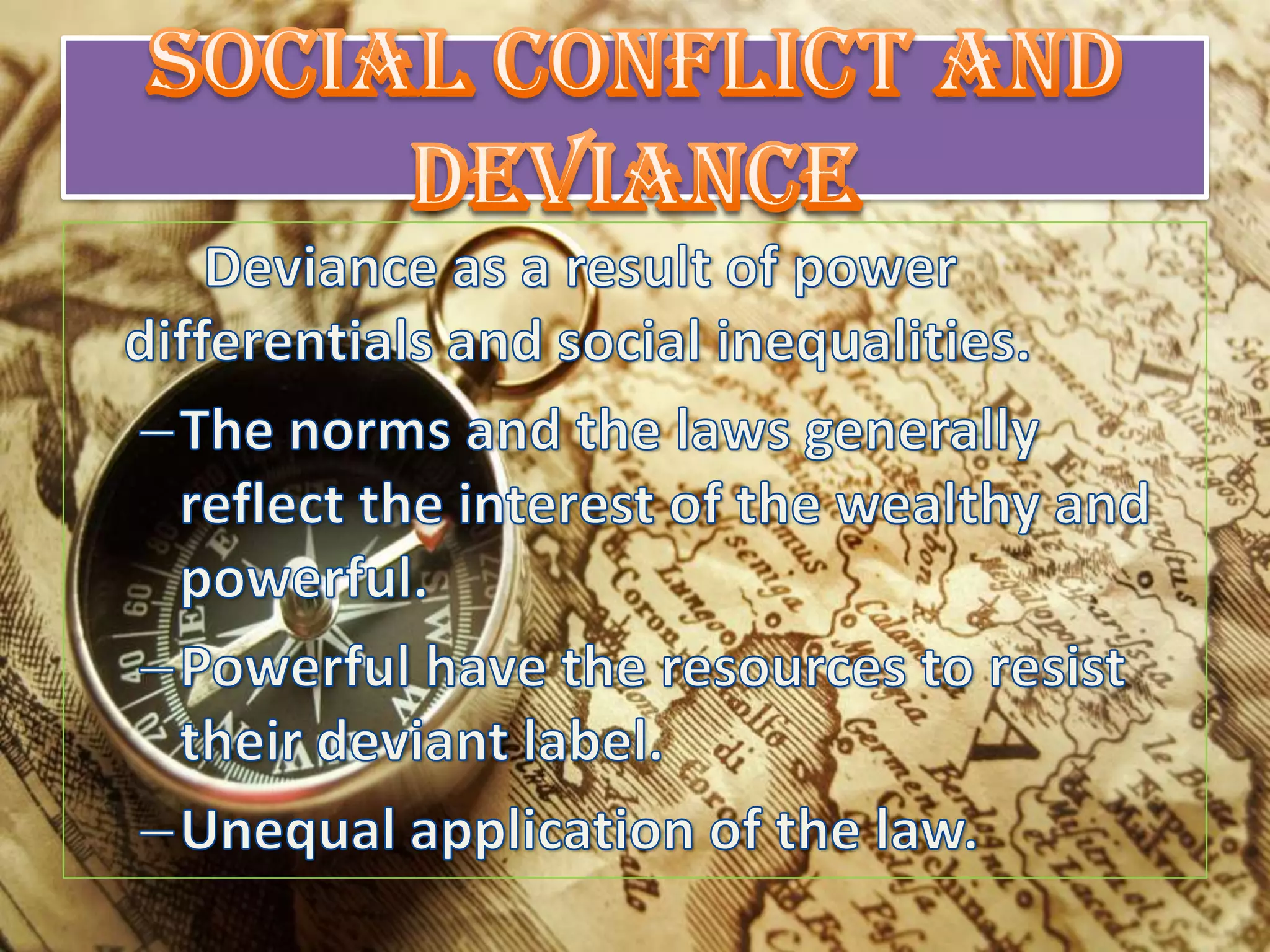
Deviance as aresult of
unsuccessful
socialization, leading to some
personality disorders.
Sigmund Freud: most people
learn in the process of
growing up how to inhibit or
productively channel their
innate drives toward pleasure
and aggression.
19.
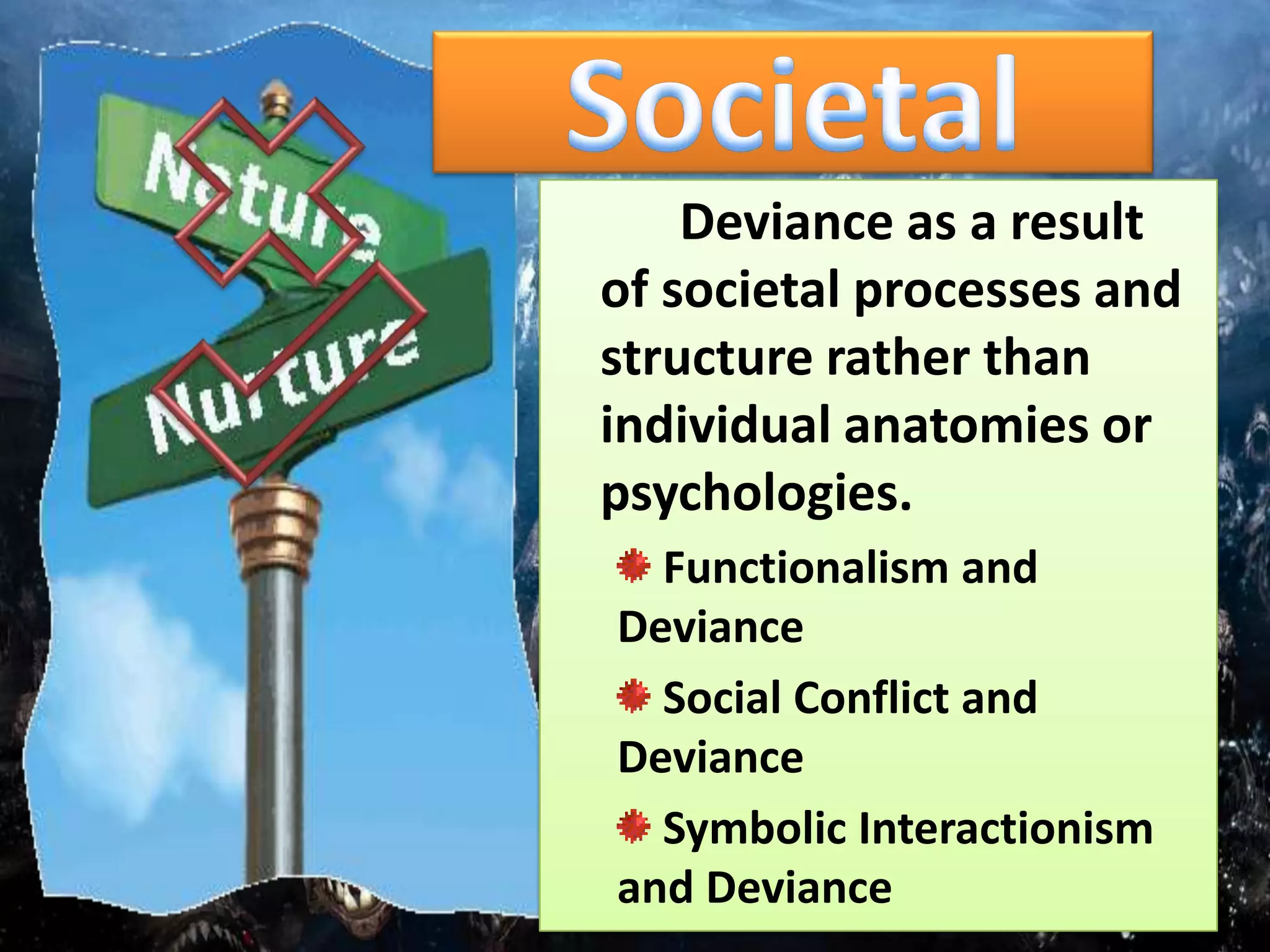
Deviance as aresult
of societal processes and
structure rather than
individual anatomies or
psychologies.
Functionalism and
Deviance
Social Conflict and
Deviance
Symbolic Interactionism
and Deviance
20.
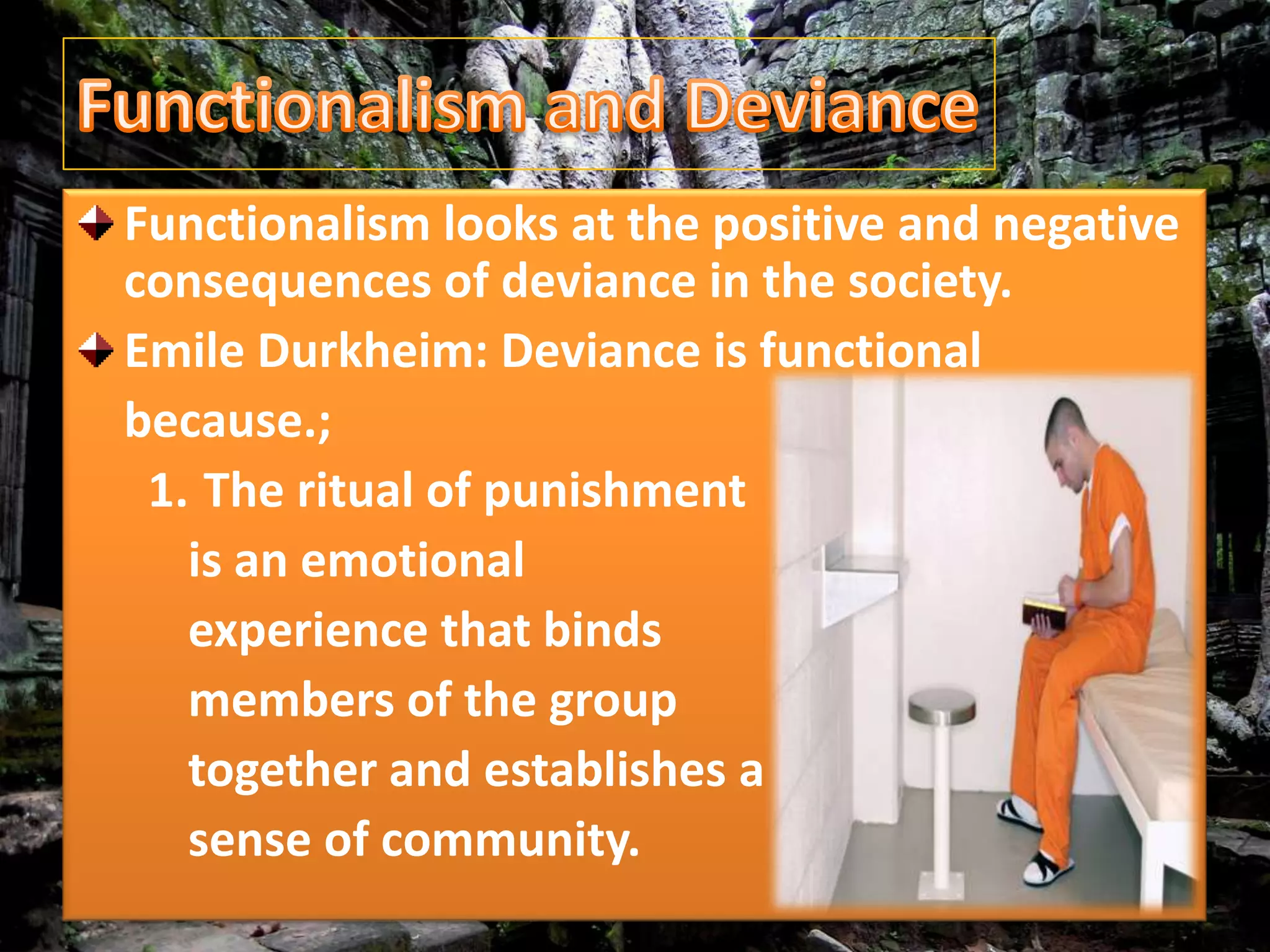
Functionalism looks atthe positive and negative
consequences of deviance in the society.
Emile Durkheim: Deviance is functional
because.;
1. The ritual of punishment
is an emotional
experience that binds
members of the group
together and establishes a
sense of community.
21.
2. It isuseful in making necessary
changes and in preparing people for
change.
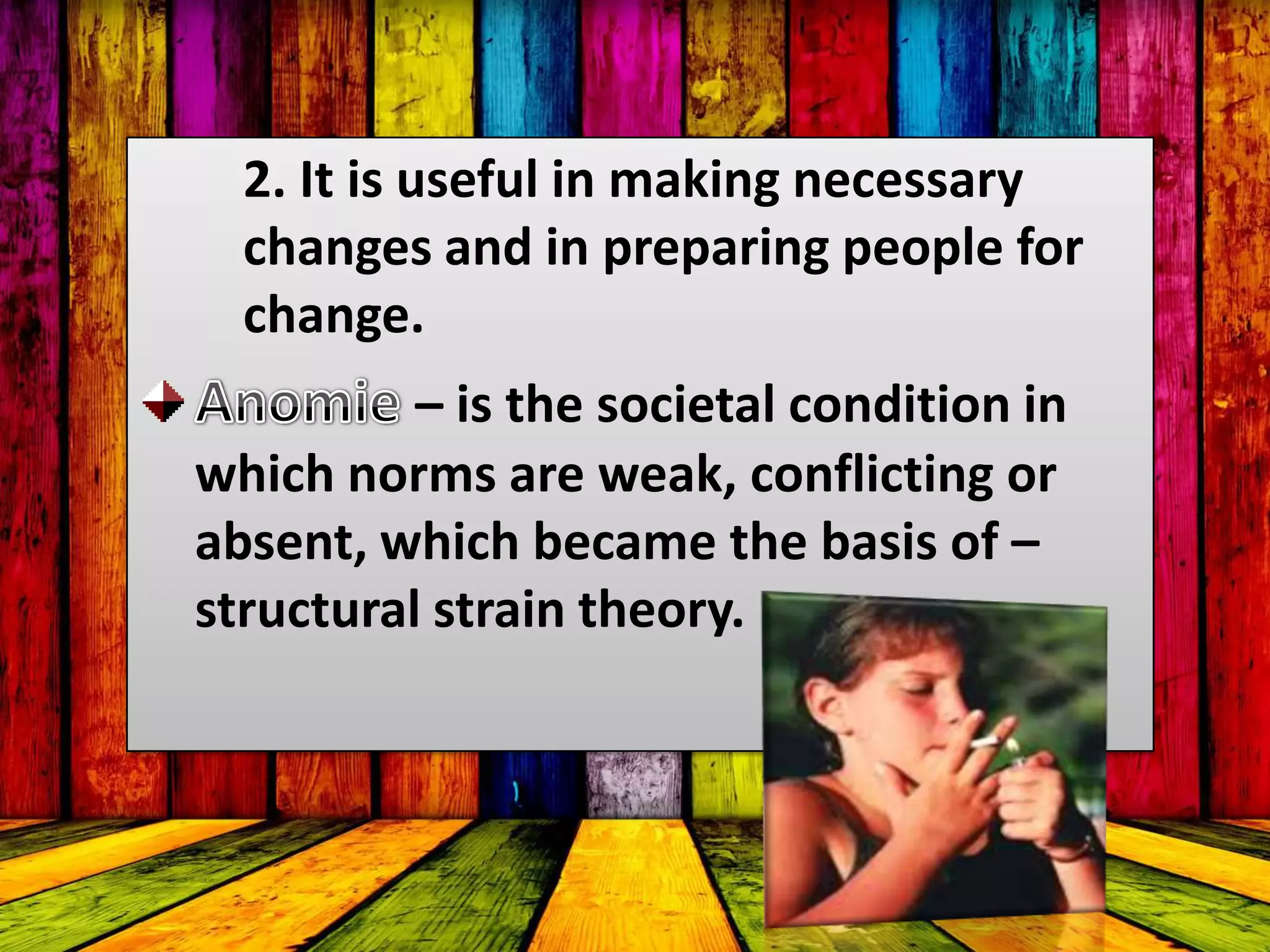
– is the societal condition in
which norms are weak, conflicting or
absent, which became the basis of –
structural strain theory.
24.
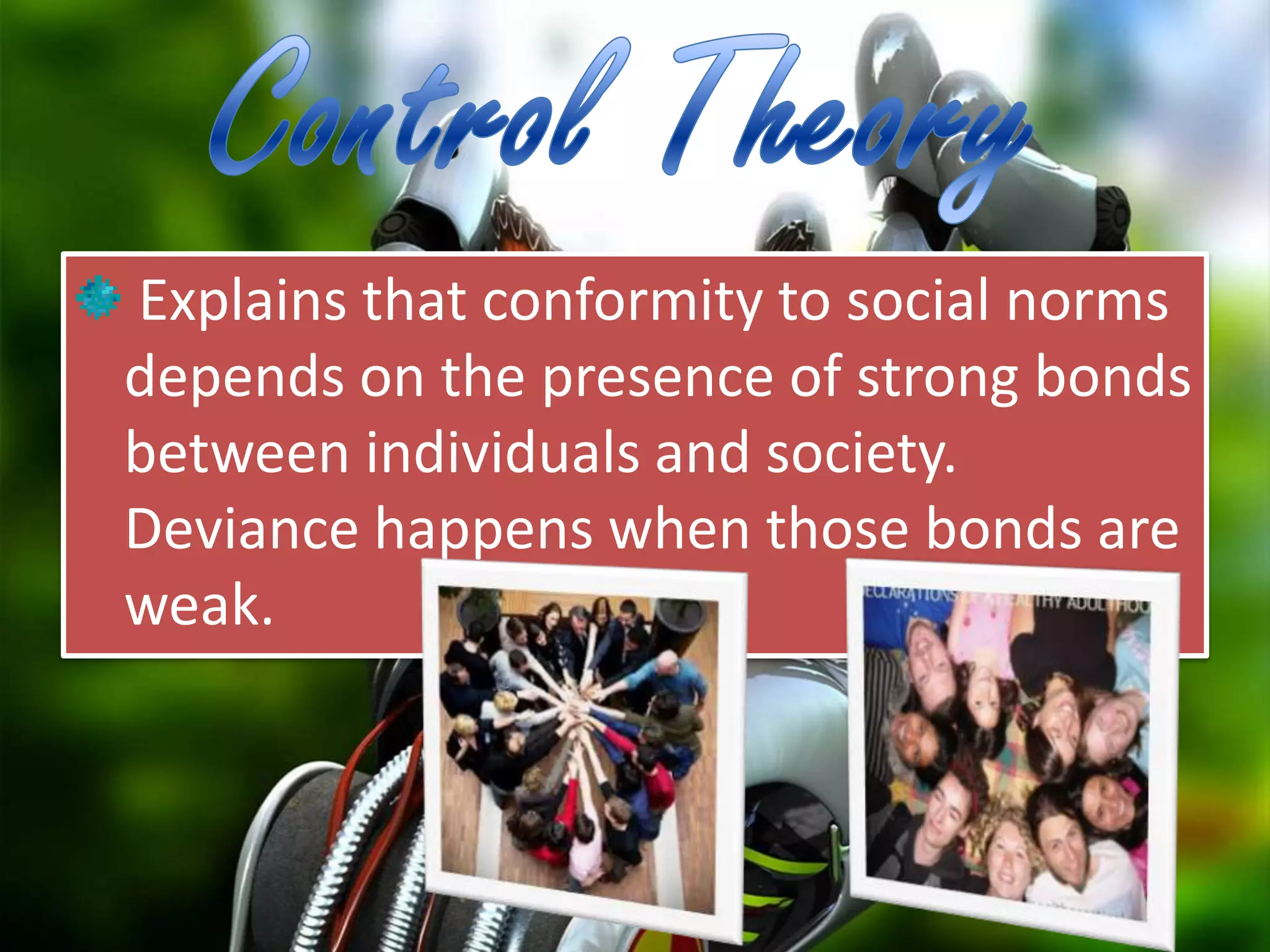
Explains that conformityto social norms
depends on the presence of strong bonds
between individuals and society.
Deviance happens when those bonds are
weak.
25.
– the tiesof the individuals to
their families, friends and institutions.
– embracing conventional
activities.
– the expenditure of time and
energy to conventional behavior.
– bonds the individual to the rules of
the larger society
27.
Explains how peopledefine deviance in
everyday situations.
Differential Association Theory
-deviance is transmitted
through socialization the same way
as nondeviant behavior is learn