WHY DO PEOPLE BREAK
THE RULES?
DEFINING DEVIANCE
SSC 04: SOCIETY & CULTURE
DR. VIVENCIO “VEN” O. BALLANO
DEFINING DEVIANCE OR RULE-
BREAKING BEHAVIOR
ABSOLUTIST
DEFINITION
( Popularly espoused in religion,
ethics, morality, especially by
conservatives, “moral
entrepreneurs”)
1. DEVIANCE RESIDES IN THE ACT
ITSELF, THE “EVILNESS” OF AN
ACT IS IN THE NATURE OF THE
ACT ITSELF.
2. DEVIANCE IS ALWAYS
DEVIANCE REGARDLESS OF
TIME, PLACE & MOTIVATION
EXAMPLES
• Abortion is always evil.
• Issue: How about aborting the fetus
to save the life of the mother
• Pope Paul VI: “Masturbation is
intrinsically evil, therefore it is
always a mortal sin”
• Issue: How about masturbation for
purposes of scientific research? Is
it still a serious sin if the intention is
good?
• This definition is obviously
inadequate.
DEFINING DEVIANCE
STATISTICAL DEFINITION
• (Popularly used by people to
label the disabled or people
with peculiar
physical/personal traits
1. AN ACT, PERSON OR TRAIT IS
DEVIANT IF IT IS DIFFERENT
FROM THE AVERAGE
STANDARDS SET BY SOCIETY.
2. The law on averages is the
norm to judge an act/person
as deviant or not.
EXAMPLES
• A person is deviant if
his/her height is below the
average Filipino height, like
a woman standing 3 feet
tall.
• A person with 11 fingers is
deviant.
• Issue: Is there a positive
deviance? Like a person
with very high IQ?
DEFINING DEVIANCE
POSITIVE DEFINITION
• AN ACT/PERSON/ TRAIT IS
DEVIANT IF IT/S/HE IS
EXTRAORDINARY AND
DIFFERENT FROM THE
MAJORITY
• ISSUE: IS POSSESSING
POSITIVE QUALITIES
DEVIANT?
EXAMPLES
• A WOMAN WHO IS
CONSIDERED EXTREMELY
BEAUTIFUL.
• BEING THE TALLEST
PERSON WITH A HEIGHT OF
7 FEET.
• IN GUINNESS BOOK OF
RECORDS
• BEING A ‘KURYENTE KING’
DEFINING DEVIANCE
RELATIVIST DEFINITION
1. DEFINING AN ACT AS
DEVIANT OR CRIMINAL
DEPENDS ON THE
SITUATION, MOTIVATION
OF THE PERSON.
2. AN ACT WHICH IS DEFINED
AS DEVIANT TODAY MAY
NOT BE SO IN THE FUTURE
EXAMPLES
• TATTOOING ONE’S BODY IS
CONSIDERED A MARK OF
CRIMINALITY OR CONVICTION
OF A CRIME, SAVAGERY—BUT
FOR SOME PEOPLE TODAY
CONSIDER TATTOOES AS
COOL AND SMART.
• BEING A MEMBER IN
FREEMASONRY TODAY IS NOT
AS STRONGLY CONDEMNED
AS BEING A MEMBER IN 19TH
CENTURY.
DEFINING DEVIANCE
REACTIVIST DEFINITION
1. AN ACT IS DEVIANT IF
THERE IS A DISCOVERY &
CONDEMNATION BY THE
COMMUNITY.
2. IF THERE IS NO NEGATIVE
REACTION TO THE ACT,
THERE IS NO DEVIANCE.
3. ONE IS NOT A SINNER OR
CRIMINAL IF S/HE IS NOT
CAUGHT
EXAMPLES
• 1. A BANK TELLER IS NOT
DEVIANT IF S/HE IS NOT
CAUGHT STEALING MONEY.
• 2. A POLITICIAN IS NOT
CORRUPT IF S/HE IS NOT
CAUGHT OR CONVICTED IN
COURT.
• This is still inadequate. A
person may not be publicly
known as deviant but s/he
still broke a social norm.
DEFINING DEVIANCE
NORMATIVE DEFINITION
• A ACT, PERSON OR TRAIT IS
DEVIANT IF IT/SHE/
VIOLATES THE SOCIAL
NORMS IN SOCIETY.
• SOCIAL NORMS IN SOCIETY
CAN BE INFORMAL
(CUSTOMS, TRADITIONS)
OR FORMAL (LAWS, RULES)
EXAMPLES
• RAPE IS DEVIANT & CRIMINAL BECAUSE IT
VIOLATES THE LAW ON RAPE.
• USING HANDS IN A FORMAL DINNER IN A
HOTEL IS DEVIANT. WHY?
• ISSUE: A MARRIED WOMAN HAVING
INTERCOURSE WITH ANOTHER WOMAN IS
NOT GUILTY OF ADULTERY? WHY?
• This definition is more acceptable and
scientific. But some powerful people broke
social norms and yet they are not condemned
as deviant. E.g. Pres. Erap Estrada is a known
womanizer and yet he is not always
condemned for this publicly.
• White-collar crimes of CEOs or corporate
officials are rarely condemned for breaking
corporate laws in their discretionary powers.
SOCIOLOGICAL DEFINITION OF DEVIANCE
• The sociological definition considers both the
normative and reactive definition.
• Deviance or rule-breaking behavior or
character is one that breaks social norms
and/or generate public condemnation.
• Thus criminals are deviants because they
break the criminal law and their acts generate
public condemnation.
OVERVIEW
1. Deviance is any behavior that violates social norms, and is usually
of sufficient severity to warrant disapproval from the majority of
society. Deviance can be criminal or non-criminal.
2. The sociological discipline that deals with crime (behavior that
violates laws) is criminology (also known as criminal justice).
Today… such activities as alcoholism, excessive gambling, being
nude in public places, playing with fire, stealing, lying, refusing to
bathe, purchasing the services of prostitutes, and cross-dressing—to
name only a few—as deviant.
3. People who engage in deviant behavior are referred to as
deviants
Source: (http://www.cliffsnotes.com/WileyCDA/CliffsReviewTopic/Theories-of-
Deviance.topicArticleId-26957,articleId-26873.html)
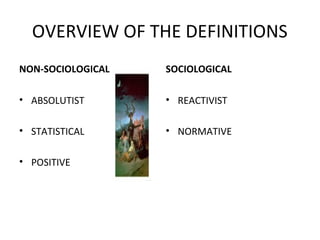
OVERVIEW OF THE DEFINITIONS
NON-SOCIOLOGICAL
• ABSOLUTIST
• STATISTICAL
• POSITIVE
SOCIOLOGICAL
• REACTIVIST
• NORMATIVE
TYPES OF SOCIAL NORMS
FORMAL NORMS
• WRITTEN
• OFFICIAL
• SYSTEMATICALLY
ENFORCED BY AUTHORITY
(government, church, other
organizations)
Examples
• RULES
• REGULATIONS
• LAWS, like:
• Constitutional Law
• Civil Law
• Criminal Law
• Tax Laws
• Legal Ethics
• Commercial Laws, etc.
TYPES OF SOCIAL NORMS
INFORMAL NORMS
• UNWRITTEN
• UNOFFICIAL, HANDED
DOWN BY TRADITION
• ENFORCED
PYSCHOLOGICALLY
• WITH INFORMAL
PUNISHMENT
EXAMPLES
• CUSTOMS: EXISTING
PRACTICES
• FOLKWAYS
• TRADITIONS
• MORES
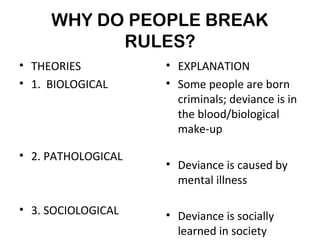
WHY DO PEOPLE BREAK
RULES?
• THEORIES
• 1. BIOLOGICAL
• 2. PATHOLOGICAL
• 3. SOCIOLOGICAL
• EXPLANATION
• Some people are born
criminals; deviance is in
the blood/biological
make-up
• Deviance is caused by
mental illness
• Deviance is socially
learned in society
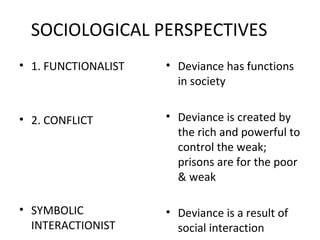
SOCIOLOGICAL PERSPECTIVES
• 1. FUNCTIONALIST
• 2. CONFLICT
• SYMBOLIC
INTERACTIONIST
• Deviance has functions
in society
• Deviance is created by
the rich and powerful to
control the weak;
prisons are for the poor
& weak
• Deviance is a result of
social interaction
SOCIOLOGICAL THEORIES
ON WHY PEOPLE BECOME
RULE-BREAKERS
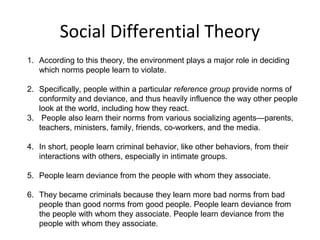
Social Differential Theory
1. According to this theory, the environment plays a major role in deciding
which norms people learn to violate.
2. Specifically, people within a particular reference group provide norms of
conformity and deviance, and thus heavily influence the way other people
look at the world, including how they react.
3. People also learn their norms from various socializing agents—parents,
teachers, ministers, family, friends, co-workers, and the media.
4. In short, people learn criminal behavior, like other behaviors, from their
interactions with others, especially in intimate groups.
5. People learn deviance from the people with whom they associate.
6. They became criminals because they learn more bad norms from bad
people than good norms from good people. People learn deviance from
the people with whom they associate. People learn deviance from the
people with whom they associate.
ANOMIE THEORY
ORIGINATOR: ROBERT K.
MERTON
1. Anomie refers to the confusion that arises when social norms conflict or don't
even exist.
2. In the 1960s, Robert Merton used the term to describe the differences
between socially accepted goals and the availability of means to achieve those
goals. Merton stressed, for instance, that attaining wealth is a major goal of
Americans, but not all Americans possess the means to do this, especially
members of minority and disadvantaged groups. Those who find the “road to
riches” closed to them experience anomie, because an obstacle has thwarted
their pursuit of a socially approved goal. When this happens, these individuals
may employ deviant behaviors to attain their goals, retaliate against society, or
merely “make a point.”
3. People become criminals if they are social expectations are high but the
legitimate means to attain them are limited.
4. Example: A poor father is forced to steal to fulfill his obligation to his sick
child.
Control Theory
Originator: Travis Hirschi
1. According to Walter Reckless's control theory, both inner and
outer controls work against deviant tendencies.
2. People may want—at least some of the time—to act in deviant
ways, but most do not. They have various restraints: internal
controls, such as conscience, values, integrity, morality, and the
desire to be a “good person”; and outer controls, such as police,
family, friends, and religious authorities.
3. Travis Hirschi noted that these inner and outer restraints form a
person's self-control, which prevents acting against social norms.
The key to developing self-control is proper socialization, especially
early in childhood. Children who lack this self-control, then, may
grow up to commit crimes and other deviant behaviors.
Labeling Theory
1. A type of symbolic interaction, labeling theory concerns the meanings
people derive from one another's labels, symbols, actions, and reactions.
2. This theory holds that behaviors are deviant only when society labels them
as deviant. As such, conforming members of society, who interpret certain
behaviors as deviant and then attach this label to individuals, determine the
distinction between deviance and non-deviance.
3. Labeling theory questions who applies what label to whom, why they do
this, and what happens as a result of this labeling.
4. Powerful individuals within society—politicians, judges, police officers,
medical doctors, and so forth—typically impose the most significant labels.
Labeled persons may include drug addicts, alcoholics, criminals, delinquents,
prostitutes, sex offenders, retarded people, and psychiatric patients, to
mention a few.
5. Social research indicates that those who have negative labels usually have
lower self-images, are more likely to reject themselves, and may even act
more deviantly as a result of the label.
CONCLUDING REMARKS
ALWAYS REMEMBER THAT PEOPLE ARE NOT
BORN CRIMINALS OR RULE-BREAKERS.
CRIMINALITY OR RULE-BREAKING
BEHAVIOR IS SOCIALLY LEARNED FROM THE
ENVIRONMENT OR CULTURE.
ONLY 10% OF PEOPLE’S BEHAVIOR IS INFLUENCED
BY HEREDITY OR BIOLOGY.
IF PARENTS ARE CRIMINALS, IT DOESN’T FOLLOW
THAT THEIR CHILDREN ARE ALSO CRIMINALS,
UNLESS THEY ARE INFLUENCED BY CRIMINAL
SOCIAL ENVIRONMENT

Deviance and Society:Why Do People Break the Rules (Follow me on Twitter@detectivebogart)

  • 1.
    WHY DO PEOPLEBREAK THE RULES? DEFINING DEVIANCE SSC 04: SOCIETY & CULTURE DR. VIVENCIO “VEN” O. BALLANO
  • 2.
    DEFINING DEVIANCE ORRULE- BREAKING BEHAVIOR ABSOLUTIST DEFINITION ( Popularly espoused in religion, ethics, morality, especially by conservatives, “moral entrepreneurs”) 1. DEVIANCE RESIDES IN THE ACT ITSELF, THE “EVILNESS” OF AN ACT IS IN THE NATURE OF THE ACT ITSELF. 2. DEVIANCE IS ALWAYS DEVIANCE REGARDLESS OF TIME, PLACE & MOTIVATION EXAMPLES • Abortion is always evil. • Issue: How about aborting the fetus to save the life of the mother • Pope Paul VI: “Masturbation is intrinsically evil, therefore it is always a mortal sin” • Issue: How about masturbation for purposes of scientific research? Is it still a serious sin if the intention is good? • This definition is obviously inadequate.
  • 3.
    DEFINING DEVIANCE STATISTICAL DEFINITION •(Popularly used by people to label the disabled or people with peculiar physical/personal traits 1. AN ACT, PERSON OR TRAIT IS DEVIANT IF IT IS DIFFERENT FROM THE AVERAGE STANDARDS SET BY SOCIETY. 2. The law on averages is the norm to judge an act/person as deviant or not. EXAMPLES • A person is deviant if his/her height is below the average Filipino height, like a woman standing 3 feet tall. • A person with 11 fingers is deviant. • Issue: Is there a positive deviance? Like a person with very high IQ?
  • 4.
    DEFINING DEVIANCE POSITIVE DEFINITION •AN ACT/PERSON/ TRAIT IS DEVIANT IF IT/S/HE IS EXTRAORDINARY AND DIFFERENT FROM THE MAJORITY • ISSUE: IS POSSESSING POSITIVE QUALITIES DEVIANT? EXAMPLES • A WOMAN WHO IS CONSIDERED EXTREMELY BEAUTIFUL. • BEING THE TALLEST PERSON WITH A HEIGHT OF 7 FEET. • IN GUINNESS BOOK OF RECORDS • BEING A ‘KURYENTE KING’
  • 5.
    DEFINING DEVIANCE RELATIVIST DEFINITION 1.DEFINING AN ACT AS DEVIANT OR CRIMINAL DEPENDS ON THE SITUATION, MOTIVATION OF THE PERSON. 2. AN ACT WHICH IS DEFINED AS DEVIANT TODAY MAY NOT BE SO IN THE FUTURE EXAMPLES • TATTOOING ONE’S BODY IS CONSIDERED A MARK OF CRIMINALITY OR CONVICTION OF A CRIME, SAVAGERY—BUT FOR SOME PEOPLE TODAY CONSIDER TATTOOES AS COOL AND SMART. • BEING A MEMBER IN FREEMASONRY TODAY IS NOT AS STRONGLY CONDEMNED AS BEING A MEMBER IN 19TH CENTURY.
  • 6.
    DEFINING DEVIANCE REACTIVIST DEFINITION 1.AN ACT IS DEVIANT IF THERE IS A DISCOVERY & CONDEMNATION BY THE COMMUNITY. 2. IF THERE IS NO NEGATIVE REACTION TO THE ACT, THERE IS NO DEVIANCE. 3. ONE IS NOT A SINNER OR CRIMINAL IF S/HE IS NOT CAUGHT EXAMPLES • 1. A BANK TELLER IS NOT DEVIANT IF S/HE IS NOT CAUGHT STEALING MONEY. • 2. A POLITICIAN IS NOT CORRUPT IF S/HE IS NOT CAUGHT OR CONVICTED IN COURT. • This is still inadequate. A person may not be publicly known as deviant but s/he still broke a social norm.
  • 7.
    DEFINING DEVIANCE NORMATIVE DEFINITION •A ACT, PERSON OR TRAIT IS DEVIANT IF IT/SHE/ VIOLATES THE SOCIAL NORMS IN SOCIETY. • SOCIAL NORMS IN SOCIETY CAN BE INFORMAL (CUSTOMS, TRADITIONS) OR FORMAL (LAWS, RULES) EXAMPLES • RAPE IS DEVIANT & CRIMINAL BECAUSE IT VIOLATES THE LAW ON RAPE. • USING HANDS IN A FORMAL DINNER IN A HOTEL IS DEVIANT. WHY? • ISSUE: A MARRIED WOMAN HAVING INTERCOURSE WITH ANOTHER WOMAN IS NOT GUILTY OF ADULTERY? WHY? • This definition is more acceptable and scientific. But some powerful people broke social norms and yet they are not condemned as deviant. E.g. Pres. Erap Estrada is a known womanizer and yet he is not always condemned for this publicly. • White-collar crimes of CEOs or corporate officials are rarely condemned for breaking corporate laws in their discretionary powers.
  • 8.
    SOCIOLOGICAL DEFINITION OFDEVIANCE • The sociological definition considers both the normative and reactive definition. • Deviance or rule-breaking behavior or character is one that breaks social norms and/or generate public condemnation. • Thus criminals are deviants because they break the criminal law and their acts generate public condemnation.
  • 9.
    OVERVIEW 1. Deviance isany behavior that violates social norms, and is usually of sufficient severity to warrant disapproval from the majority of society. Deviance can be criminal or non-criminal. 2. The sociological discipline that deals with crime (behavior that violates laws) is criminology (also known as criminal justice). Today… such activities as alcoholism, excessive gambling, being nude in public places, playing with fire, stealing, lying, refusing to bathe, purchasing the services of prostitutes, and cross-dressing—to name only a few—as deviant. 3. People who engage in deviant behavior are referred to as deviants Source: (http://www.cliffsnotes.com/WileyCDA/CliffsReviewTopic/Theories-of- Deviance.topicArticleId-26957,articleId-26873.html)
  • 10.
    OVERVIEW OF THEDEFINITIONS NON-SOCIOLOGICAL • ABSOLUTIST • STATISTICAL • POSITIVE SOCIOLOGICAL • REACTIVIST • NORMATIVE
  • 11.
    TYPES OF SOCIALNORMS FORMAL NORMS • WRITTEN • OFFICIAL • SYSTEMATICALLY ENFORCED BY AUTHORITY (government, church, other organizations) Examples • RULES • REGULATIONS • LAWS, like: • Constitutional Law • Civil Law • Criminal Law • Tax Laws • Legal Ethics • Commercial Laws, etc.
  • 12.
    TYPES OF SOCIALNORMS INFORMAL NORMS • UNWRITTEN • UNOFFICIAL, HANDED DOWN BY TRADITION • ENFORCED PYSCHOLOGICALLY • WITH INFORMAL PUNISHMENT EXAMPLES • CUSTOMS: EXISTING PRACTICES • FOLKWAYS • TRADITIONS • MORES
  • 13.
    WHY DO PEOPLEBREAK RULES? • THEORIES • 1. BIOLOGICAL • 2. PATHOLOGICAL • 3. SOCIOLOGICAL • EXPLANATION • Some people are born criminals; deviance is in the blood/biological make-up • Deviance is caused by mental illness • Deviance is socially learned in society
  • 14.
    SOCIOLOGICAL PERSPECTIVES • 1.FUNCTIONALIST • 2. CONFLICT • SYMBOLIC INTERACTIONIST • Deviance has functions in society • Deviance is created by the rich and powerful to control the weak; prisons are for the poor & weak • Deviance is a result of social interaction
  • 15.
    SOCIOLOGICAL THEORIES ON WHYPEOPLE BECOME RULE-BREAKERS
  • 16.
    Social Differential Theory 1.According to this theory, the environment plays a major role in deciding which norms people learn to violate. 2. Specifically, people within a particular reference group provide norms of conformity and deviance, and thus heavily influence the way other people look at the world, including how they react. 3. People also learn their norms from various socializing agents—parents, teachers, ministers, family, friends, co-workers, and the media. 4. In short, people learn criminal behavior, like other behaviors, from their interactions with others, especially in intimate groups. 5. People learn deviance from the people with whom they associate. 6. They became criminals because they learn more bad norms from bad people than good norms from good people. People learn deviance from the people with whom they associate. People learn deviance from the people with whom they associate.
  • 17.
    ANOMIE THEORY ORIGINATOR: ROBERTK. MERTON 1. Anomie refers to the confusion that arises when social norms conflict or don't even exist. 2. In the 1960s, Robert Merton used the term to describe the differences between socially accepted goals and the availability of means to achieve those goals. Merton stressed, for instance, that attaining wealth is a major goal of Americans, but not all Americans possess the means to do this, especially members of minority and disadvantaged groups. Those who find the “road to riches” closed to them experience anomie, because an obstacle has thwarted their pursuit of a socially approved goal. When this happens, these individuals may employ deviant behaviors to attain their goals, retaliate against society, or merely “make a point.” 3. People become criminals if they are social expectations are high but the legitimate means to attain them are limited. 4. Example: A poor father is forced to steal to fulfill his obligation to his sick child.
  • 18.
    Control Theory Originator: TravisHirschi 1. According to Walter Reckless's control theory, both inner and outer controls work against deviant tendencies. 2. People may want—at least some of the time—to act in deviant ways, but most do not. They have various restraints: internal controls, such as conscience, values, integrity, morality, and the desire to be a “good person”; and outer controls, such as police, family, friends, and religious authorities. 3. Travis Hirschi noted that these inner and outer restraints form a person's self-control, which prevents acting against social norms. The key to developing self-control is proper socialization, especially early in childhood. Children who lack this self-control, then, may grow up to commit crimes and other deviant behaviors.
  • 19.
    Labeling Theory 1. Atype of symbolic interaction, labeling theory concerns the meanings people derive from one another's labels, symbols, actions, and reactions. 2. This theory holds that behaviors are deviant only when society labels them as deviant. As such, conforming members of society, who interpret certain behaviors as deviant and then attach this label to individuals, determine the distinction between deviance and non-deviance. 3. Labeling theory questions who applies what label to whom, why they do this, and what happens as a result of this labeling. 4. Powerful individuals within society—politicians, judges, police officers, medical doctors, and so forth—typically impose the most significant labels. Labeled persons may include drug addicts, alcoholics, criminals, delinquents, prostitutes, sex offenders, retarded people, and psychiatric patients, to mention a few. 5. Social research indicates that those who have negative labels usually have lower self-images, are more likely to reject themselves, and may even act more deviantly as a result of the label.
  • 20.
    CONCLUDING REMARKS ALWAYS REMEMBERTHAT PEOPLE ARE NOT BORN CRIMINALS OR RULE-BREAKERS. CRIMINALITY OR RULE-BREAKING BEHAVIOR IS SOCIALLY LEARNED FROM THE ENVIRONMENT OR CULTURE. ONLY 10% OF PEOPLE’S BEHAVIOR IS INFLUENCED BY HEREDITY OR BIOLOGY. IF PARENTS ARE CRIMINALS, IT DOESN’T FOLLOW THAT THEIR CHILDREN ARE ALSO CRIMINALS, UNLESS THEY ARE INFLUENCED BY CRIMINAL SOCIAL ENVIRONMENT