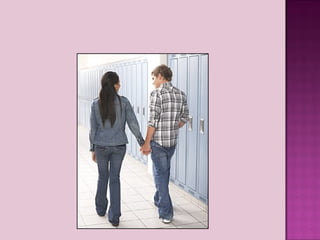
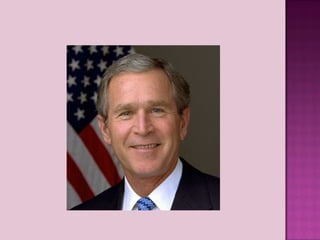
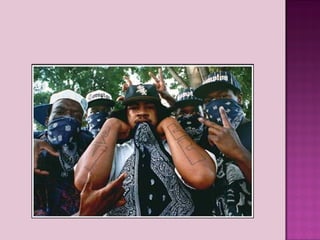
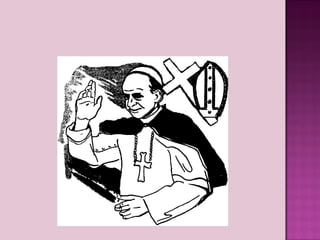
Deviance  is behavior that departs from societal or group norms Norms   are shared rules of conduct that tell people how to act in specific situations in order to enforce cultural values
Positive Deviance:  involves behavior that over-conforms to social expectations  Negative Deviance:  involves behavior under-conforms to accepted norms
A  deviant  is a person who has violated one or more of society’s most highly valued norms  Acting with  deviance  does not always make someone a  deviant .
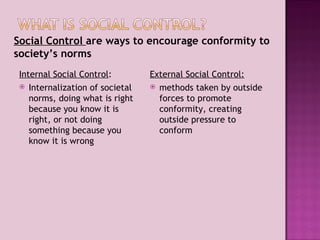
Internal Social Control : Internalization of societal norms, doing what is right because you know it is right, or not doing something because you know it is wrong External Social Control: methods taken by outside forces to promote conformity, creating outside pressure to conform Social Control  are ways to encourage conformity to society’s norms
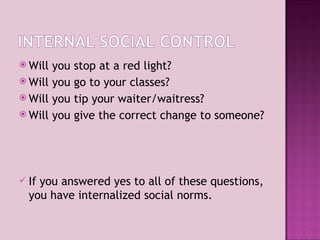
Will you stop at a red light? Will you go to your classes? Will you tip your waiter/waitress? Will you give the correct change to someone? If you answered yes to all of these questions, you have internalized social norms.
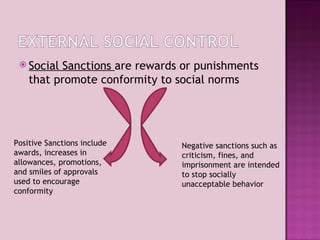
Social Sanctions  are rewards or punishments that promote conformity to social norms Positive Sanctions include awards, increases in allowances, promotions, and smiles of approvals used to encourage conformity Negative sanctions such as criticism, fines, and imprisonment are intended to stop socially unacceptable behavior
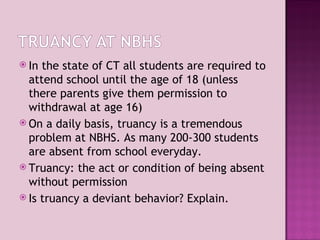
In the state of CT all students are required to attend school until the age of 18 (unless there parents give them permission to withdrawal at age 16) On a daily basis, truancy is a tremendous problem at NBHS. As many 200-300 students are absent from school everyday. Truancy: the act or condition of being absent without permission Is truancy a deviant behavior? Explain.
Create a positive and negative sanction that would encourage conformity for each of the following acts of deviance: Child will not clean room. Student is caught writing graffiti on school walls. A man is caught repeatedly shoplifting. A woman is a habitual drug user.
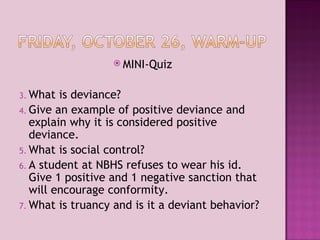
MINI-Quiz What is deviance? Give an example of positive deviance and explain why it is considered positive deviance. What is social control? A student at NBHS refuses to wear his id. Give 1 positive and 1 negative sanction that will encourage conformity. What is truancy and is it a deviant behavior?
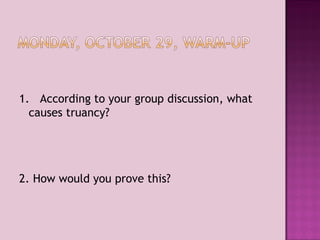
1.  According to your group discussion, what causes truancy? 2. How would you prove this?
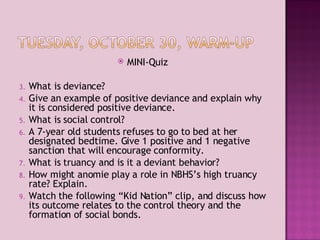
MINI-Quiz What is deviance? Give an example of positive deviance and explain why it is considered positive deviance. What is social control? A 7-year old students refuses to go to bed at her designated bedtime. Give 1 positive and 1 negative sanction that will encourage conformity. What is truancy and is it a deviant behavior? How might anomie play a role in NBHS’s high truancy rate? Explain. Watch the following “Kid Nation” clip, and discuss how its outcome relates to the control theory and the formation of social bonds.
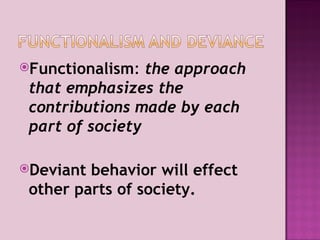
Functionalism :  the approach that emphasizes the contributions made by each part of society Deviant behavior will effect other parts of society.
What are examples, either positive or negative, of how deviant behavior impacts society?
In the United States, how has deviance allowed for social change?
Anomie – a social condition in which norms are weak, conflicting, or absent Strain Theory – theory that deviance more likely to occur when a gap exists between  cultural goals and the ability to achieve them by legitimate means
Strain Theory – theory that deviance more likely to occur when a gap exists between  cultural goals and the ability to achieve them by legitimate means Innovation – the individual accepts the goal of success but uses illegal means to achieve it Ritualism – the individual rejects the goal but continues to use legitimate means; acts as if he wants to achieve goal, but does not exert effort to achieve it  Retreatism—rejects both the goals of society and legitimate means to achieve it Rebellion – people reject both accepted goal and approved means for achieving it; creates new set of goals
Strain Theory: Apply to Deviant Students  What will they look like? How will they behave?
What will happen to a society where the cultural norms are only achievable by the few?
Social bonds are the relationships between individuals and society Attachment – the stronger your attachment to groups or individuals, the more likely you are to conform; likelihood of conformity varies with the strength of ties Commitment –the greater your commitment to social goals, the more likely you are to conform  Involvement—participation in approved social activities increases the probability of conformity Belief—belief in the norms and values of society promotes conformity
How can improving social bonds decrease truancy at NBHS?
What should be the purpose of the US criminal justice system to (choose below): Creating a deterrence for crime to remind others to adhere to norms and promote conformity Seek retribution against deviants to provide punishing sanctions against those who do not conform Rehabilitate deviants to promote social conformity and increase social bonds Explain your reasoning for your choice
Criminal justice system – system comprising institutions and processes responsible for enforcing criminal statutes If people are deviants because of their lack of social bonds with their community, how does the criminal justice system improve these bonds? If people are deviants because they feel stress to conform to unattainable social norms, as suggested in the strain theory, how do you remove that stress?
Should the criminal justice system: Act as a means of  deterrence ,  or discouragement for committing criminal acts by threatening punishments,  by using one deviant as an example to others Act as a form of  retribution, solely as a form of punishment intended to make criminals pay compensation for their acts Act as a means of  rehabilitation, or process of changing or reforming a criminal through socialization Always  incarcerate, a method of protecting society from criminals by keeping them in prison
When creating your summation, or deliberating to arrive at a verdict, consider: Am I going to give/ask for a guilty or not guilty verdict What type of sanction will I give/ask for? Soley retribution? Rehabilitation? Incarceration? Where will this incarceration take place?

Ch7 Deviance and Social Control

  • 1.
  • 2.
  • 3.
  • 4.
  • 5.
  • 6.
  • 7.
  • 8.
  • 9.
  • 10.
  • 11.
  • 12.
  • 13.
  • 14.
    Deviance isbehavior that departs from societal or group norms Norms are shared rules of conduct that tell people how to act in specific situations in order to enforce cultural values
  • 15.
    Positive Deviance: involves behavior that over-conforms to social expectations Negative Deviance: involves behavior under-conforms to accepted norms
  • 16.
    A deviant is a person who has violated one or more of society’s most highly valued norms Acting with deviance does not always make someone a deviant .
  • 17.
    Internal Social Control: Internalization of societal norms, doing what is right because you know it is right, or not doing something because you know it is wrong External Social Control: methods taken by outside forces to promote conformity, creating outside pressure to conform Social Control are ways to encourage conformity to society’s norms
  • 18.
    Will you stopat a red light? Will you go to your classes? Will you tip your waiter/waitress? Will you give the correct change to someone? If you answered yes to all of these questions, you have internalized social norms.
  • 19.
    Social Sanctions are rewards or punishments that promote conformity to social norms Positive Sanctions include awards, increases in allowances, promotions, and smiles of approvals used to encourage conformity Negative sanctions such as criticism, fines, and imprisonment are intended to stop socially unacceptable behavior
  • 20.
    In the stateof CT all students are required to attend school until the age of 18 (unless there parents give them permission to withdrawal at age 16) On a daily basis, truancy is a tremendous problem at NBHS. As many 200-300 students are absent from school everyday. Truancy: the act or condition of being absent without permission Is truancy a deviant behavior? Explain.
  • 21.
    Create a positiveand negative sanction that would encourage conformity for each of the following acts of deviance: Child will not clean room. Student is caught writing graffiti on school walls. A man is caught repeatedly shoplifting. A woman is a habitual drug user.
  • 22.
    MINI-Quiz What isdeviance? Give an example of positive deviance and explain why it is considered positive deviance. What is social control? A student at NBHS refuses to wear his id. Give 1 positive and 1 negative sanction that will encourage conformity. What is truancy and is it a deviant behavior?
  • 23.
    1. Accordingto your group discussion, what causes truancy? 2. How would you prove this?
  • 24.
    MINI-Quiz What isdeviance? Give an example of positive deviance and explain why it is considered positive deviance. What is social control? A 7-year old students refuses to go to bed at her designated bedtime. Give 1 positive and 1 negative sanction that will encourage conformity. What is truancy and is it a deviant behavior? How might anomie play a role in NBHS’s high truancy rate? Explain. Watch the following “Kid Nation” clip, and discuss how its outcome relates to the control theory and the formation of social bonds.
  • 25.
    Functionalism : the approach that emphasizes the contributions made by each part of society Deviant behavior will effect other parts of society.
  • 26.
    What are examples,either positive or negative, of how deviant behavior impacts society?
  • 27.
    In the UnitedStates, how has deviance allowed for social change?
  • 28.
    Anomie – asocial condition in which norms are weak, conflicting, or absent Strain Theory – theory that deviance more likely to occur when a gap exists between cultural goals and the ability to achieve them by legitimate means
  • 29.
    Strain Theory –theory that deviance more likely to occur when a gap exists between cultural goals and the ability to achieve them by legitimate means Innovation – the individual accepts the goal of success but uses illegal means to achieve it Ritualism – the individual rejects the goal but continues to use legitimate means; acts as if he wants to achieve goal, but does not exert effort to achieve it Retreatism—rejects both the goals of society and legitimate means to achieve it Rebellion – people reject both accepted goal and approved means for achieving it; creates new set of goals
  • 30.
    Strain Theory: Applyto Deviant Students What will they look like? How will they behave?
  • 31.
    Strain Theory: Applyto Deviant Students What will they look like? How will they behave?
  • 32.
    What will happento a society where the cultural norms are only achievable by the few?
  • 33.
    Social bonds arethe relationships between individuals and society Attachment – the stronger your attachment to groups or individuals, the more likely you are to conform; likelihood of conformity varies with the strength of ties Commitment –the greater your commitment to social goals, the more likely you are to conform Involvement—participation in approved social activities increases the probability of conformity Belief—belief in the norms and values of society promotes conformity
  • 34.
    How can improvingsocial bonds decrease truancy at NBHS?
  • 35.
    What should bethe purpose of the US criminal justice system to (choose below): Creating a deterrence for crime to remind others to adhere to norms and promote conformity Seek retribution against deviants to provide punishing sanctions against those who do not conform Rehabilitate deviants to promote social conformity and increase social bonds Explain your reasoning for your choice
  • 36.
    Criminal justice system– system comprising institutions and processes responsible for enforcing criminal statutes If people are deviants because of their lack of social bonds with their community, how does the criminal justice system improve these bonds? If people are deviants because they feel stress to conform to unattainable social norms, as suggested in the strain theory, how do you remove that stress?
  • 37.
    Should the criminaljustice system: Act as a means of deterrence , or discouragement for committing criminal acts by threatening punishments, by using one deviant as an example to others Act as a form of retribution, solely as a form of punishment intended to make criminals pay compensation for their acts Act as a means of rehabilitation, or process of changing or reforming a criminal through socialization Always incarcerate, a method of protecting society from criminals by keeping them in prison
  • 38.
    When creating yoursummation, or deliberating to arrive at a verdict, consider: Am I going to give/ask for a guilty or not guilty verdict What type of sanction will I give/ask for? Soley retribution? Rehabilitation? Incarceration? Where will this incarceration take place?