DEVIANCY Deviancy is a Violation of Social Norms Norms are behavioral codes and scripts conforming to acceptable standards that guide our actions and self-presentations  Who Defines Deviance? - The “Everyman” - The “majority” in almost every group
WILLIAM SUMNER’S (1906) THREE BROAD CATAGORIES FOLKWAYS - refers to simple everyday norms based on customs, traditions, or etiquette MORES - norms based on broad social morals whose infraction would generate more serious social condemnation LAWS - the strongest social norms supported by codified social sanctions
More Norm Types PRESCRIPTIVE Tell us what to do PROSCRIPTIVE Tell us what not to do ROLES A bundle of norms governing a “position” in society
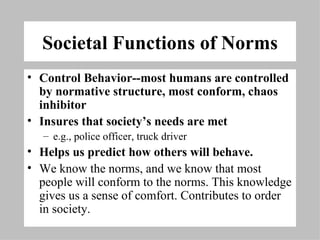
Societal Functions of Norms Control Behavior--most humans are controlled by normative structure, most conform, chaos inhibitor  Insures that society’s needs are met  e.g., police officer, truck driver  Helps us predict how others will behave.  We know the norms, and we know that most people will conform to the norms. This knowledge gives us a sense of comfort. Contributes to order in society.
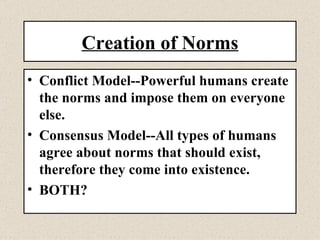
Creation of Norms Conflict Model--Powerful humans create the norms and impose them on everyone else.  Consensus Model--All types of humans agree about norms that should exist, therefore they come into existence.  BOTH?
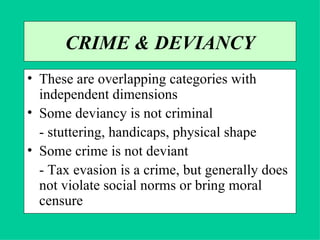
CRIME & DEVIANCY These are overlapping categories with independent dimensions Some deviancy is not criminal - stuttering, handicaps, physical shape Some crime is not deviant - Tax evasion is a crime, but generally does not violate social norms or bring moral censure
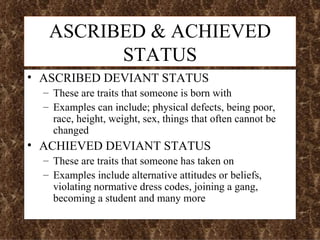
ASCRIBED & ACHIEVED STATUS ASCRIBED DEVIANT STATUS These are traits that someone is born with Examples can include; physical defects, being poor, race, height, weight, sex, things that often cannot be changed ACHIEVED DEVIANT STATUS These are traits that someone has taken on Examples include alternative attitudes or beliefs, violating normative dress codes, joining a gang, becoming a student and many more

Sociology of Deviance

  • 1.
    DEVIANCY Deviancy isa Violation of Social Norms Norms are behavioral codes and scripts conforming to acceptable standards that guide our actions and self-presentations Who Defines Deviance? - The “Everyman” - The “majority” in almost every group
  • 2.
    WILLIAM SUMNER’S (1906)THREE BROAD CATAGORIES FOLKWAYS - refers to simple everyday norms based on customs, traditions, or etiquette MORES - norms based on broad social morals whose infraction would generate more serious social condemnation LAWS - the strongest social norms supported by codified social sanctions
  • 3.
    More Norm TypesPRESCRIPTIVE Tell us what to do PROSCRIPTIVE Tell us what not to do ROLES A bundle of norms governing a “position” in society
  • 4.
    Societal Functions ofNorms Control Behavior--most humans are controlled by normative structure, most conform, chaos inhibitor Insures that society’s needs are met e.g., police officer, truck driver Helps us predict how others will behave. We know the norms, and we know that most people will conform to the norms. This knowledge gives us a sense of comfort. Contributes to order in society.
  • 5.
    Creation of NormsConflict Model--Powerful humans create the norms and impose them on everyone else. Consensus Model--All types of humans agree about norms that should exist, therefore they come into existence. BOTH?
  • 6.
    CRIME & DEVIANCYThese are overlapping categories with independent dimensions Some deviancy is not criminal - stuttering, handicaps, physical shape Some crime is not deviant - Tax evasion is a crime, but generally does not violate social norms or bring moral censure
  • 7.
    ASCRIBED & ACHIEVEDSTATUS ASCRIBED DEVIANT STATUS These are traits that someone is born with Examples can include; physical defects, being poor, race, height, weight, sex, things that often cannot be changed ACHIEVED DEVIANT STATUS These are traits that someone has taken on Examples include alternative attitudes or beliefs, violating normative dress codes, joining a gang, becoming a student and many more