Chapter Four Socialization
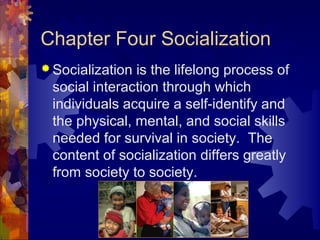
 Socialization is the lifelong process of
social interaction through which
individuals acquire a self-identify and
the physical, mental, and social skills
needed for survival in society. The
content of socialization differs greatly
from society to society.
Human Development:
Biology and Society
 Every human being is a product of
biology, society , and personal
experiences, or heredity and
environment.
 Sociobiology is the systematic study of
how biology affects social behavior
Social Isolation
 Social environment is a crucial part of an
individual’s socialization; people need social
contact with other in order to develop
properly.
 Researchers have attempted to demonstrate
the effects of social isolation on non-human
primates that are raised without contact with
other of their own species
Social Isolation
 Isolated children illustrate the
importance of socialization
 The most frequent for of child
maltreatment is child neglect
Social Psychological Theories
of Human Development
 Freud and the Psychoanalytical
Perspective
 Human behavior and personality originate
from subconscious forces within the
individual
 At this time biological explanations for human
behavior were prevalent
 An era of extreme sexual repression and male
dominance
Social Psychological Theories
of Human Development
 Freud and the Psychoanalytical
Perspective
 Freud’s theory based on the notion that
people have two basic tendencies
 The urge to survive
 The urge to procreate
Social Psychological Theories
of Human Development
 Freud and the Psychoanalytical Perspective
 Human Development Occurs in three states that
reflect different levels of personality
 The id is the component of the personality that
includes all of the individual’s basic biological
drives and needs that demand immediate
gratifications
 The ego is the rational, reality-oriented
component of personality that imposes
restrictions on the innate pleasure-seeking
drives of the id
 The superego, or conscience consists of the
moral and ethical aspects of personality
Social Psychological Theories
of Human Development
 Piaget and Cognitive Theory of Human
Development
 In each state of human development
children’s activities are governed by
their perceptions of the world around
them
 When age appropriate tasks are
complete, new mental abilities allow the
the transition the the next stage
Social Psychological Theories
of Human Development
 Piaget and Cognitive Theory of Human
Development
 Four Stages of Cognitive Development
 Sensorimotor (0-2) children develop object
permanence
 Preoperational (2-7) children develop ability to use
words are mental symbols and to form mental
images
 Concrete Operational (7-11) children learn to
reason and take the role of the other
 Formal Operational (12-adolescence) children
develop the ability to think in highly abstract
thought
Social Psychological Theories
of Human Development
 Piaget and Cognitive Theory of Human
Development
 Criticisms of Piaget’s Theory
 Does not address individual differences
 Says little about cultural differences
 Does not address how gender impacts
cognitive development
Social Psychological Theories
of Human Development
 Kohlberg and stages of Moral
Development
 Presented subjects with moral dilemmas to
learn about moral reasoning
 Preconventional (7-10) punishment and
obedience
 Conventional (10-adulthood) peer approval and
conformity to rules
 Postconventional (few adults reach this stage)
individual and human rights that transcend
government and laws
Social Psychological Theories
of Human Development
 Kohlberg and stages of Moral
Development
 Criticisms of Kohlberg’s Theory
 Some Challenge the universality of his stages
 Use of moral dilemmas too abstract for children
Social Psychological Theories
of Human Development
 Gilligan’s View on Gender and Moral
Development
 Her theory is based on a critical
response to Kohlberg’s methodology
and findings
 Kohlberg used men in his study—
production biased results
Social Psychological Theories
of Human Development
 Gilligan found differences in the ways
that men and women think about moral
problems
 Female Moral Development in three
stages
 Motivated by selfish concerns
 Recognizes responsibility in others
 Makes decisions based on desire to do
good for herself and others
Sociological Theories of
Human Development
 Cooley and the Looking Glass Self – sense of
self is developed from the perceptions of
others through a three step process
 We imagine how our personality and appearance
will look to other people
 We imagine how other people judge the
appearance and personality we think we represent
 We develop a self-concept
Sociological Theories of
Human Development
 George Herbert Meade linked the idea
of self-concept to role-taking—the
process by which a person mentally
assumes the role of another person in
order to understand the world from that
person’s point of view
Sociological Theories of
Human Development
 G. H. Meade
 Significant Others are those persons
whose care, affection, and approval are
especially desired and who are most
important the the development of the
self; these individuals are extremely
important in the socialization process
Sociological Theories of
Human Development
 G. H. Meade
 Mead divided the self into the “I” and “me”
 “I” is the subjective element of the self that
represents the spontaneous and unique traits
of each person
 “me” is the objective element of self, which is
composed of he internalized attitudes and
demands of other members of society and
the individual’s awareness of those demands
 G. H. Meade outlined three stages of self-
development
 Preparatory stage – children largely imitate the
people around them
 Play stage (3-5) – children learn to use language
and other symbols, thus making it possible for
them to pretend to take the roles of specific people
 Game stage – children understand not only their
own social position but also the positions of those
around them.
 At this time the child develop a generalized other – an
awareness of the demands and expectations of the
society as a whole or of the child’s subculture.
Sociological Theories of
Human Development
 Interactionist theories such as Meade’s
and Cooley’s contribute to how the self
develops….but
 These theories do not take into account
differences in people’s experiences based
on race, ethnicity, class, religion, gender or
other social factors
Self-Concept and Child
Maltreatment
 Child maltreatment occurs when there
is an extreme imbalance in positive and
negative social interactions
 Dynamic interplay between social
factors related to past events and
present situations
Agents of Socialization
 Agents of socialization are the persons,
groups, or institutions that teach us
what we need to know in order to
participate in society. These are the
most pervasive agents of socialization
in childhood
The Family as an Agent of
Socialization
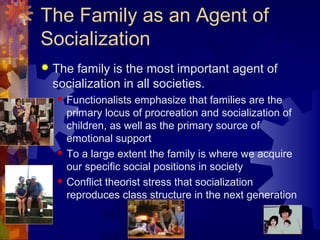
 The family is the most important agent of
socialization in all societies.
 Functionalists emphasize that families are the
primary locus of procreation and socialization of
children, as well as the primary source of
emotional support
 To a large extent the family is where we acquire
our specific social positions in society
 Conflict theorist stress that socialization
reproduces class structure in the next generation
Schools as Agents of
Socialization
 Schools have played an increasingly
important role in the socialization
process as the amount of specialized
technical and scientific knowledge has
expanded rapidly
 Schools teach specific knowledge and
skills and they also have a profound effect
on a child’s self-image, beliefs and values
Schools as Agents of Socialization
 From a functionalist perspective
schools are responsible for:
 Socialization—teaching students to be
productive members of society
 Transmission of culture
 Social control and personal development
 The selection, training, and placement of
individuals on different rungs in society
Schools as Agents of
Socialization
 According to Conflict Theorists much of
what happens at schools is a hidden
curriculum
 Working class and low income children
learn to be neat, on time, wait their turn,
and remain attentive to work
 These are attributes that make them more
easily manipulated in the workforce
Peer Groups as Agents of
Socialization
 A peer group is a group of people who are
linked by common interests, equal social
positions, and (usually) a similar age
 Peer groups function as agents of socialization by
contributing to our sense of belonging and our
feelings of self-worth
 Individuals must earn their acceptance with their
peers by meeting the group’s demands for high
level of conformity to its own norms, attitudes,
speech, and dress codes
Mass Media as an Agent of
Socialization
 The mass media function as socialization
agents for children and adults in several
ways:
 They inform us about events
 They introduce us to a wide variety of people
 They provide an array of viewpoints on current
issues
 They make us aware of products and services that
if we purchase them, supposedly will help us to be
accepted by others
 They entertain us by providing the opportunity to
live vicariously
Mass Media as an Agent of
Socialization
 Television is the most pervasive form of
media
 98% of all homes in the U.S. have at least on
television set.
 There is some evidence that television is
potentially harmful to:
 Literacy
 Rampant consumerism
 Increases in violence and violent crime
Gender, Race, and Ethnicity
Socialization
 Gender socialization is the aspect of
socialization that contains specific
messages and practices concerning the
nature of being female of male in a
specific group or society
 Families, Schools, and sports tend to
reinforce traditional gender roles
Gender Socialization
Gender, Race, and Ethnicity
Socialization
 Racial Socialization is the aspect of
socialization that contains specific
messages and practices concerning the
nature of one’s racial or ethnic status as
it relates to:
 Personal and group identity
 Inter-group and inter-individual
relationships
 Position in social hierarchy
Socialization Throughout the
Life Course
 Socialization is a lifelong process, each time
we experience a change in status, we learn a
new set of rules, roles, and relationships
 Even before we enter a new status, we often
participate in anticipatory socialization – the
process by which knowledge and skills are
learned for future roles.
 The most common categories of age are
infancy, childhood, adolescences, and
adulthood (young, middle, old)
Socialization Throughout the Life Course
 During infancy and early childhood,
family support and guidance are
crucial to a child’s developing self-
concept
 Some families reflect the discrepancy
between cultural ideals and reality
where children grow up in settings of
fear, danger and risks that are created
by parental neglect, emotional
maltreatment, or premature economic
and sexual demands
Socialization Throughout the
Life Course
 Anticipatory socialization for adult roles
often is associated with adolescence,
however, some young people may
plunge in adult responsibilities at this
time
Socialization Throughout the
Life Course
 In early adulthood (until about 40) people
work toward their won goals of creating
meaningful relationships with others, finding
employment, seeking personal fulfillment.
Occupational Socialization has 4 phases:
 Career choice
 Anticipatory socialization
 Conditioninign and commitment
 Continous commitment
Socialization Throughout the
Life Course
 Between the ages of 40 & 60 people enter
middle adulthood and many begin to compare
their accomplishments with their earlier
expectations.
 In older adulthood some people are quite
happy and content, other are not:
 Difficult changes in attitudes and behavior may
occur in the last years of life when people
experience decreased physical ability and social
devaluation
 Late adulthood is a time when many people
experience ageism, prejudice and
discrimination against people on the basis of
age
 Negative images contribute to the view that women are
older ten or fifteen years sooner than men
 Many buffer themselves against ageism by continuing to
view themselves as being in middle adulthood
 It is important to note that everyone does not
go through these passages or stages and
that race, ethnicity, class and gender strongly
influence these stages
Resocialization
 Resocialization is the process of learning a
new and different set of attitudes, values ,and
behaviors from the ones previously held.
 Voluntary Resocialization – occurs when we
enter a new status of our own free will
 Involuntary Resocialization – occurs against a
persons wishers an generally takes place
within a total institution
Socialization in the Future
 Families are likely to remain the institution
that most fundamentally shapes and nurtures
personal values and self-identity
 Parents increasingly feel overburdened by
this responsibility, especially without societal
support, such as high-quality day care and
some education on parenting skills
 A central issue facing parents and teachers
as they socialize children is the growing
dominance of the media and other forms of
technology.

Socialization

  • 1.
    Chapter Four Socialization Socialization is the lifelong process of social interaction through which individuals acquire a self-identify and the physical, mental, and social skills needed for survival in society. The content of socialization differs greatly from society to society.
  • 2.
    Human Development: Biology andSociety  Every human being is a product of biology, society , and personal experiences, or heredity and environment.  Sociobiology is the systematic study of how biology affects social behavior
  • 3.
    Social Isolation  Socialenvironment is a crucial part of an individual’s socialization; people need social contact with other in order to develop properly.  Researchers have attempted to demonstrate the effects of social isolation on non-human primates that are raised without contact with other of their own species
  • 4.
    Social Isolation  Isolatedchildren illustrate the importance of socialization  The most frequent for of child maltreatment is child neglect
  • 5.
    Social Psychological Theories ofHuman Development  Freud and the Psychoanalytical Perspective  Human behavior and personality originate from subconscious forces within the individual  At this time biological explanations for human behavior were prevalent  An era of extreme sexual repression and male dominance
  • 6.
    Social Psychological Theories ofHuman Development  Freud and the Psychoanalytical Perspective  Freud’s theory based on the notion that people have two basic tendencies  The urge to survive  The urge to procreate
  • 8.
    Social Psychological Theories ofHuman Development  Freud and the Psychoanalytical Perspective  Human Development Occurs in three states that reflect different levels of personality  The id is the component of the personality that includes all of the individual’s basic biological drives and needs that demand immediate gratifications  The ego is the rational, reality-oriented component of personality that imposes restrictions on the innate pleasure-seeking drives of the id  The superego, or conscience consists of the moral and ethical aspects of personality
  • 9.
    Social Psychological Theories ofHuman Development  Piaget and Cognitive Theory of Human Development  In each state of human development children’s activities are governed by their perceptions of the world around them  When age appropriate tasks are complete, new mental abilities allow the the transition the the next stage
  • 11.
    Social Psychological Theories ofHuman Development  Piaget and Cognitive Theory of Human Development  Four Stages of Cognitive Development  Sensorimotor (0-2) children develop object permanence  Preoperational (2-7) children develop ability to use words are mental symbols and to form mental images  Concrete Operational (7-11) children learn to reason and take the role of the other  Formal Operational (12-adolescence) children develop the ability to think in highly abstract thought
  • 12.
    Social Psychological Theories ofHuman Development  Piaget and Cognitive Theory of Human Development  Criticisms of Piaget’s Theory  Does not address individual differences  Says little about cultural differences  Does not address how gender impacts cognitive development
  • 13.
    Social Psychological Theories ofHuman Development  Kohlberg and stages of Moral Development  Presented subjects with moral dilemmas to learn about moral reasoning  Preconventional (7-10) punishment and obedience  Conventional (10-adulthood) peer approval and conformity to rules  Postconventional (few adults reach this stage) individual and human rights that transcend government and laws
  • 14.
    Social Psychological Theories ofHuman Development  Kohlberg and stages of Moral Development  Criticisms of Kohlberg’s Theory  Some Challenge the universality of his stages  Use of moral dilemmas too abstract for children
  • 15.
    Social Psychological Theories ofHuman Development  Gilligan’s View on Gender and Moral Development  Her theory is based on a critical response to Kohlberg’s methodology and findings  Kohlberg used men in his study— production biased results
  • 16.
    Social Psychological Theories ofHuman Development  Gilligan found differences in the ways that men and women think about moral problems  Female Moral Development in three stages  Motivated by selfish concerns  Recognizes responsibility in others  Makes decisions based on desire to do good for herself and others
  • 17.
    Sociological Theories of HumanDevelopment  Cooley and the Looking Glass Self – sense of self is developed from the perceptions of others through a three step process  We imagine how our personality and appearance will look to other people  We imagine how other people judge the appearance and personality we think we represent  We develop a self-concept
  • 19.
    Sociological Theories of HumanDevelopment  George Herbert Meade linked the idea of self-concept to role-taking—the process by which a person mentally assumes the role of another person in order to understand the world from that person’s point of view
  • 20.
    Sociological Theories of HumanDevelopment  G. H. Meade  Significant Others are those persons whose care, affection, and approval are especially desired and who are most important the the development of the self; these individuals are extremely important in the socialization process
  • 21.
    Sociological Theories of HumanDevelopment  G. H. Meade  Mead divided the self into the “I” and “me”  “I” is the subjective element of the self that represents the spontaneous and unique traits of each person  “me” is the objective element of self, which is composed of he internalized attitudes and demands of other members of society and the individual’s awareness of those demands
  • 22.
     G. H.Meade outlined three stages of self- development  Preparatory stage – children largely imitate the people around them  Play stage (3-5) – children learn to use language and other symbols, thus making it possible for them to pretend to take the roles of specific people  Game stage – children understand not only their own social position but also the positions of those around them.  At this time the child develop a generalized other – an awareness of the demands and expectations of the society as a whole or of the child’s subculture.
  • 23.
    Sociological Theories of HumanDevelopment  Interactionist theories such as Meade’s and Cooley’s contribute to how the self develops….but  These theories do not take into account differences in people’s experiences based on race, ethnicity, class, religion, gender or other social factors
  • 24.
    Self-Concept and Child Maltreatment Child maltreatment occurs when there is an extreme imbalance in positive and negative social interactions  Dynamic interplay between social factors related to past events and present situations
  • 25.
    Agents of Socialization Agents of socialization are the persons, groups, or institutions that teach us what we need to know in order to participate in society. These are the most pervasive agents of socialization in childhood
  • 26.
    The Family asan Agent of Socialization  The family is the most important agent of socialization in all societies.  Functionalists emphasize that families are the primary locus of procreation and socialization of children, as well as the primary source of emotional support  To a large extent the family is where we acquire our specific social positions in society  Conflict theorist stress that socialization reproduces class structure in the next generation
  • 30.
    Schools as Agentsof Socialization  Schools have played an increasingly important role in the socialization process as the amount of specialized technical and scientific knowledge has expanded rapidly  Schools teach specific knowledge and skills and they also have a profound effect on a child’s self-image, beliefs and values
  • 31.
    Schools as Agentsof Socialization  From a functionalist perspective schools are responsible for:  Socialization—teaching students to be productive members of society  Transmission of culture  Social control and personal development  The selection, training, and placement of individuals on different rungs in society
  • 32.
    Schools as Agentsof Socialization  According to Conflict Theorists much of what happens at schools is a hidden curriculum  Working class and low income children learn to be neat, on time, wait their turn, and remain attentive to work  These are attributes that make them more easily manipulated in the workforce
  • 33.
    Peer Groups asAgents of Socialization  A peer group is a group of people who are linked by common interests, equal social positions, and (usually) a similar age  Peer groups function as agents of socialization by contributing to our sense of belonging and our feelings of self-worth  Individuals must earn their acceptance with their peers by meeting the group’s demands for high level of conformity to its own norms, attitudes, speech, and dress codes
  • 34.
    Mass Media asan Agent of Socialization  The mass media function as socialization agents for children and adults in several ways:  They inform us about events  They introduce us to a wide variety of people  They provide an array of viewpoints on current issues  They make us aware of products and services that if we purchase them, supposedly will help us to be accepted by others  They entertain us by providing the opportunity to live vicariously
  • 35.
    Mass Media asan Agent of Socialization  Television is the most pervasive form of media  98% of all homes in the U.S. have at least on television set.  There is some evidence that television is potentially harmful to:  Literacy  Rampant consumerism  Increases in violence and violent crime
  • 36.
    Gender, Race, andEthnicity Socialization  Gender socialization is the aspect of socialization that contains specific messages and practices concerning the nature of being female of male in a specific group or society  Families, Schools, and sports tend to reinforce traditional gender roles
  • 37.
  • 38.
  • 39.
  • 40.
    Gender, Race, andEthnicity Socialization  Racial Socialization is the aspect of socialization that contains specific messages and practices concerning the nature of one’s racial or ethnic status as it relates to:  Personal and group identity  Inter-group and inter-individual relationships  Position in social hierarchy
  • 42.
    Socialization Throughout the LifeCourse  Socialization is a lifelong process, each time we experience a change in status, we learn a new set of rules, roles, and relationships  Even before we enter a new status, we often participate in anticipatory socialization – the process by which knowledge and skills are learned for future roles.  The most common categories of age are infancy, childhood, adolescences, and adulthood (young, middle, old)
  • 43.
    Socialization Throughout theLife Course  During infancy and early childhood, family support and guidance are crucial to a child’s developing self- concept  Some families reflect the discrepancy between cultural ideals and reality where children grow up in settings of fear, danger and risks that are created by parental neglect, emotional maltreatment, or premature economic and sexual demands
  • 44.
    Socialization Throughout the LifeCourse  Anticipatory socialization for adult roles often is associated with adolescence, however, some young people may plunge in adult responsibilities at this time
  • 45.
    Socialization Throughout the LifeCourse  In early adulthood (until about 40) people work toward their won goals of creating meaningful relationships with others, finding employment, seeking personal fulfillment. Occupational Socialization has 4 phases:  Career choice  Anticipatory socialization  Conditioninign and commitment  Continous commitment
  • 46.
    Socialization Throughout the LifeCourse  Between the ages of 40 & 60 people enter middle adulthood and many begin to compare their accomplishments with their earlier expectations.  In older adulthood some people are quite happy and content, other are not:  Difficult changes in attitudes and behavior may occur in the last years of life when people experience decreased physical ability and social devaluation
  • 47.
     Late adulthoodis a time when many people experience ageism, prejudice and discrimination against people on the basis of age  Negative images contribute to the view that women are older ten or fifteen years sooner than men  Many buffer themselves against ageism by continuing to view themselves as being in middle adulthood  It is important to note that everyone does not go through these passages or stages and that race, ethnicity, class and gender strongly influence these stages
  • 49.
    Resocialization  Resocialization isthe process of learning a new and different set of attitudes, values ,and behaviors from the ones previously held.  Voluntary Resocialization – occurs when we enter a new status of our own free will  Involuntary Resocialization – occurs against a persons wishers an generally takes place within a total institution
  • 50.
    Socialization in theFuture  Families are likely to remain the institution that most fundamentally shapes and nurtures personal values and self-identity  Parents increasingly feel overburdened by this responsibility, especially without societal support, such as high-quality day care and some education on parenting skills  A central issue facing parents and teachers as they socialize children is the growing dominance of the media and other forms of technology.