Inguinal hernia
Schwartz’s Principles of Surgery 2015
Chapter 37
By Dr Tayebe rahimi ,MD
Epidemiology
• Inguinal hernia repair is the most commonly performed operation in the
United States.
• Approximately 75% of abdominal wall hernias occur in the groin.
• Of inguinal hernia repairs, 90% are performed in men and 10% in women.
• The incidence of inguinal hernias in males has a bimodal distribution.
– before the first year of age
– after age 40
• Approximately 70% of femoral hernia repairs are performed in women;
however, inguinal hernias are five times more common than femoral hernias.
• The most common subtype of groin hernia in men and women is the indirect
inguinal hernia
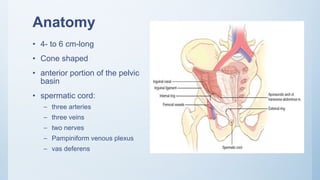
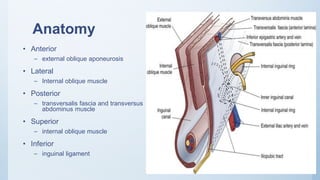
Anatomy
• 4- to 6 cm-long
• Cone shaped
• anterior portion of the pelvic
basin
• spermatic cord:
– three arteries
– three veins
– two nerves
– Pampiniform venous plexus
– vas deferens
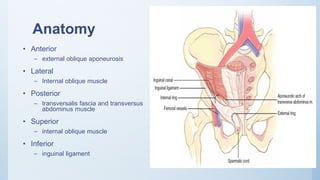
Anatomy
• Anterior
– external oblique aponeurosis
• Lateral
– Internal oblique muscle
• Posterior
– transversalis fascia and transversus
abdominus muscle
• Superior
– internal oblique muscle
• Inferior
– inguinal ligament
Anatomy
• Anterior
– external oblique aponeurosis
• Lateral
– Internal oblique muscle
• Posterior
– transversalis fascia and transversus
abdominus muscle
• Superior
– internal oblique muscle
• Inferior
– inguinal ligament
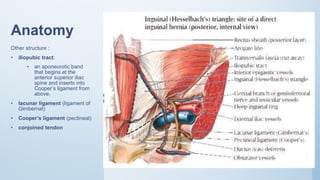
Anatomy
Other structure :
• iliopubic tract:
• an aponeurotic band
that begins at the
anterior superior iliac
spine and inserts into
Cooper’s ligament from
above.
• lacunar ligament (ligament of
Gimbernat)
• Cooper’s ligament (pectineal)
• conjoined tendon
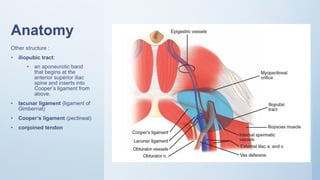
Anatomy
Other structure :
• iliopubic tract:
• an aponeurotic band
that begins at the
anterior superior iliac
spine and inserts into
Cooper’s ligament from
above.
• lacunar ligament (ligament of
Gimbernat)
• Cooper’s ligament (pectineal)
• conjoined tendon
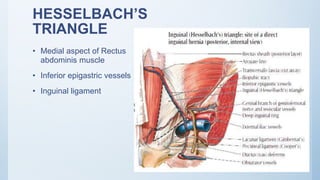
HESSELBACH’S
TRIANGLE
• Medial aspect of Rectus
abdominis muscle
• Inferior epigastric vessels
• Inguinal ligament
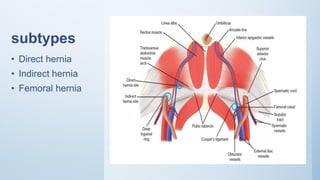
subtypes
• Direct hernia
• Indirect hernia
• Femoral hernia
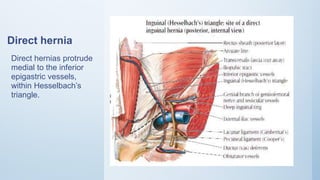
Direct hernia
Direct hernias protrude
medial to the inferior
epigastric vessels,
within Hesselbach’s
triangle.
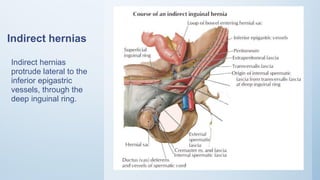
Indirect hernias
Indirect hernias
protrude lateral to the
inferior epigastric
vessels, through the
deep inguinal ring.
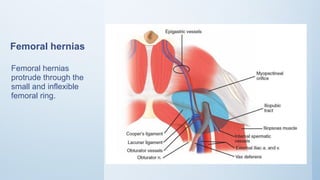
Femoral hernias
Femoral hernias
protrude through the
small and inflexible
femoral ring.
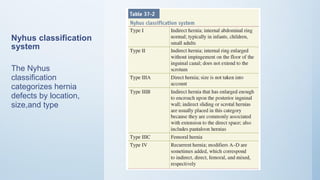
Nyhus classification
system
The Nyhus
classification
categorizes hernia
defects by location,
size,and type
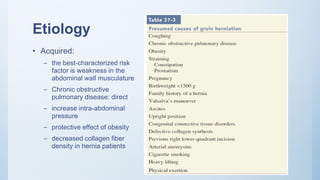
Etiology
• Acquired:
– the best-characterized risk
factor is weakness in the
abdominal wall musculature
– Chronic obstructive
pulmonary disease: direct
– increase intra-abdominal
pressure
– protective effect of obesity
– decreased collagen fiber
density in hernia patients
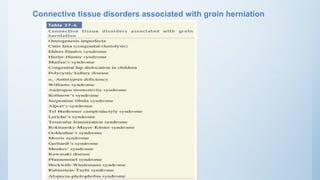
Connective tissue disorders associated with groin herniation
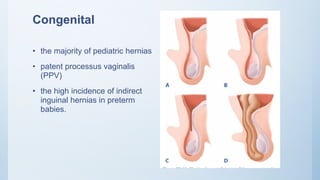
Congenital
• the majority of pediatric hernias
• patent processus vaginalis
(PPV)
• the high incidence of indirect
inguinal hernias in preterm
babies.
DIAGNOSIS
• History:
– groin pain
– Extrainguinal symptoms such as a change in bowel habits or urinary symptoms
– generalized pressure, localized sharp pain, and referred pain
– Pressure or heaviness in the groin , following prolonged activity
• Sharp pain tends to indicate an impinged nerve and may not be related to the
extent of physical activity performed by the patient.
• Neurogenic pain may be referred to the scrotum,testicle, or inner thigh.
• the patient’s history include the duration and timing of symptoms.
• Hernias will often increase in size and content over a protracted time.
• Patients will often reduce the hernia by pushing the contents back into the
abdomen, thereby providing temporary relief.
Physical Examination
• Ideally, the patient should be examined in a standing position to
increase intra-abdominal pressure, with the groin and scrotum fully
exposed.
• Inspection: an abnormal bulge along the groin or within the scrotum
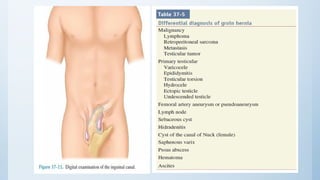
• Palpation: advancing the index finger through the scrotum toward the
external inguinal ring. → Valsalva’s maneuver
• diagnosing the type of hernia
• Femoral hernias should be palpable below the inguinal ligament,
lateral to the pubic tubercle.
• femoral pseudohernia
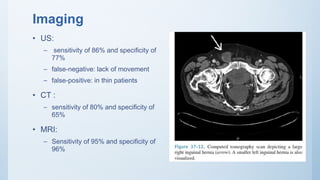
Imaging
• US:
– sensitivity of 86% and specificity of
77%
– false-negative: lack of movement
– false-positive: in thin patients
• CT :
– sensitivity of 80% and specificity of
65%
• MRI:
– Sensitivity of 95% and specificity of
96%
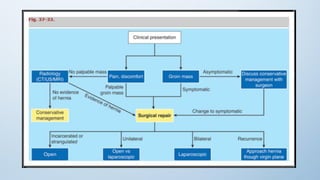
TREATMENT
• Surgical repair is the definitive treatment of inguinal hernias
1. Surgical:
– Mesh
– Laparoscopy
2. Conservative
Conservative Treatment
• When the patient’s medical condition confers an unacceptable level of
operative risk, elective surgery should be deferred until the condition
resolves, and operations reserved for lifethreatening emergencies.
• A nonoperative strategy is safe for minimally symptomatic inguinal
hernia patients, and it does not increase the risk of developing hernia
complications.
• no difference in intent-to-treat outcomes, quality of life, or cost-
effectiveness between nonoperative management and elective repair
among healthy inguinal hernia patients.
• A 2012 systematic reviewfound that 72% of asymptomatic inguinal
hernia patients developed symptoms (mostly pain) and had surgical
repair within 7.5 years of diagnosis.
Conservative Treatment
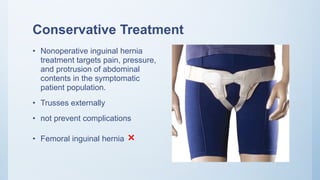
• Nonoperative inguinal hernia
treatment targets pain, pressure,
and protrusion of abdominal
contents in the symptomatic
patient population.
• Trusses externally
• not prevent complications
• Femoral inguinal hernia ⨯
Emergent Operation
• Incarcerated hernias
• Strangulated hernias
• Sliding hernias
 Pre Operation:
 Hydration
 Anti biotic
 NG tube
INCARCERATED HERNIA
• Reasons for incarceration
– large amount of intestinal contents within the hernia sac
– dense and chronic adhesions of hernia contents to the sac
– small neck of the hernia defect in relation to the sac contents
• An incarcerated inguinal hernia without the sequelae of a bowel
obstruction is not necessarily a surgical emergency.
• Reduction should be attempted before definitive surgical intervention.
• Hernias that are not strangulated and do not reduce with gentle
pressure should undergo taxis.
TAXIS
• To perform taxis, analgesics and light sedatives are administered, and
the patient is placed in the Trendelenburg position.
• The hernia sac is elongated with both hands, and the contents are
compressed in a milking fashion to ease their reduction into the
abdomen.
STRANGULATED HERNIA
• Femoral > Indirect > Direct
• Fever, leukocytosis, and hemodynamic instability, bowel obstraction.
• The hernia bulge usually is very tender, warm, and may exhibit red
discoloration.
• Taxis should not be applied to strangulated hernias as a potentially
gangrenous portion of bowel may be reduced into the abdomen
without being addressed
Laparascopic hernia repair
1. Trans abdominal Preperitoneal Procedure (TAPP)
2. Totally Extraperitoneal (TEP) Repair
• Indications include bilateral inguinal hernia, recurring hernia, need for
early recovery
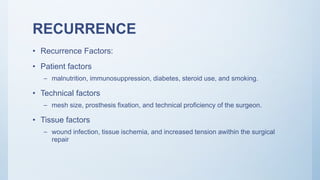
RECURRENCE
• Recurrence Factors:
• Patient factors
– malnutrition, immunosuppression, diabetes, steroid use, and smoking.
• Technical factors
– mesh size, prosthesis fixation, and technical proficiency of the surgeon.
• Tissue factors
– wound infection, tissue ischemia, and increased tension awithin the surgical
repair
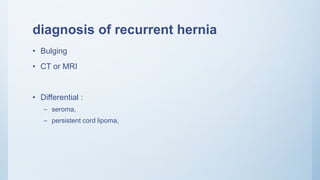
diagnosis of recurrent hernia
• Bulging
• CT or MRI
• Differential :
– seroma,
– persistent cord lipoma,
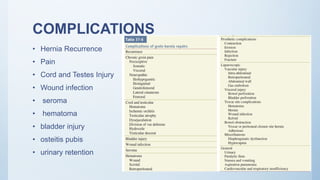
COMPLICATIONS
• Hernia Recurrence
• Pain
• Cord and Testes Injury
• Wound infection
• seroma
• hematoma
• bladder injury
• osteitis pubis
• urinary retention
Thank you
6/17/2018

Inguinal hernia presentation

  • 1.
    Inguinal hernia Schwartz’s Principlesof Surgery 2015 Chapter 37 By Dr Tayebe rahimi ,MD
  • 2.
    Epidemiology • Inguinal herniarepair is the most commonly performed operation in the United States. • Approximately 75% of abdominal wall hernias occur in the groin. • Of inguinal hernia repairs, 90% are performed in men and 10% in women. • The incidence of inguinal hernias in males has a bimodal distribution. – before the first year of age – after age 40 • Approximately 70% of femoral hernia repairs are performed in women; however, inguinal hernias are five times more common than femoral hernias. • The most common subtype of groin hernia in men and women is the indirect inguinal hernia
  • 3.
    Anatomy • 4- to6 cm-long • Cone shaped • anterior portion of the pelvic basin • spermatic cord: – three arteries – three veins – two nerves – Pampiniform venous plexus – vas deferens
  • 4.
    Anatomy • Anterior – externaloblique aponeurosis • Lateral – Internal oblique muscle • Posterior – transversalis fascia and transversus abdominus muscle • Superior – internal oblique muscle • Inferior – inguinal ligament
  • 5.
    Anatomy • Anterior – externaloblique aponeurosis • Lateral – Internal oblique muscle • Posterior – transversalis fascia and transversus abdominus muscle • Superior – internal oblique muscle • Inferior – inguinal ligament
  • 6.
    Anatomy Other structure : •iliopubic tract: • an aponeurotic band that begins at the anterior superior iliac spine and inserts into Cooper’s ligament from above. • lacunar ligament (ligament of Gimbernat) • Cooper’s ligament (pectineal) • conjoined tendon
  • 7.
    Anatomy Other structure : •iliopubic tract: • an aponeurotic band that begins at the anterior superior iliac spine and inserts into Cooper’s ligament from above. • lacunar ligament (ligament of Gimbernat) • Cooper’s ligament (pectineal) • conjoined tendon
  • 8.
    HESSELBACH’S TRIANGLE • Medial aspectof Rectus abdominis muscle • Inferior epigastric vessels • Inguinal ligament
  • 9.
    subtypes • Direct hernia •Indirect hernia • Femoral hernia
  • 10.
    Direct hernia Direct herniasprotrude medial to the inferior epigastric vessels, within Hesselbach’s triangle.
  • 11.
    Indirect hernias Indirect hernias protrudelateral to the inferior epigastric vessels, through the deep inguinal ring.
  • 12.
    Femoral hernias Femoral hernias protrudethrough the small and inflexible femoral ring.
  • 13.
  • 14.
    Etiology • Acquired: – thebest-characterized risk factor is weakness in the abdominal wall musculature – Chronic obstructive pulmonary disease: direct – increase intra-abdominal pressure – protective effect of obesity – decreased collagen fiber density in hernia patients
  • 15.
    Connective tissue disordersassociated with groin herniation
  • 16.
    Congenital • the majorityof pediatric hernias • patent processus vaginalis (PPV) • the high incidence of indirect inguinal hernias in preterm babies.
  • 17.
    DIAGNOSIS • History: – groinpain – Extrainguinal symptoms such as a change in bowel habits or urinary symptoms – generalized pressure, localized sharp pain, and referred pain – Pressure or heaviness in the groin , following prolonged activity • Sharp pain tends to indicate an impinged nerve and may not be related to the extent of physical activity performed by the patient. • Neurogenic pain may be referred to the scrotum,testicle, or inner thigh. • the patient’s history include the duration and timing of symptoms. • Hernias will often increase in size and content over a protracted time. • Patients will often reduce the hernia by pushing the contents back into the abdomen, thereby providing temporary relief.
  • 18.
    Physical Examination • Ideally,the patient should be examined in a standing position to increase intra-abdominal pressure, with the groin and scrotum fully exposed. • Inspection: an abnormal bulge along the groin or within the scrotum • Palpation: advancing the index finger through the scrotum toward the external inguinal ring. → Valsalva’s maneuver • diagnosing the type of hernia • Femoral hernias should be palpable below the inguinal ligament, lateral to the pubic tubercle. • femoral pseudohernia
  • 20.
    Imaging • US: – sensitivityof 86% and specificity of 77% – false-negative: lack of movement – false-positive: in thin patients • CT : – sensitivity of 80% and specificity of 65% • MRI: – Sensitivity of 95% and specificity of 96%
  • 21.
    TREATMENT • Surgical repairis the definitive treatment of inguinal hernias 1. Surgical: – Mesh – Laparoscopy 2. Conservative
  • 22.
    Conservative Treatment • Whenthe patient’s medical condition confers an unacceptable level of operative risk, elective surgery should be deferred until the condition resolves, and operations reserved for lifethreatening emergencies. • A nonoperative strategy is safe for minimally symptomatic inguinal hernia patients, and it does not increase the risk of developing hernia complications. • no difference in intent-to-treat outcomes, quality of life, or cost- effectiveness between nonoperative management and elective repair among healthy inguinal hernia patients. • A 2012 systematic reviewfound that 72% of asymptomatic inguinal hernia patients developed symptoms (mostly pain) and had surgical repair within 7.5 years of diagnosis.
  • 23.
    Conservative Treatment • Nonoperativeinguinal hernia treatment targets pain, pressure, and protrusion of abdominal contents in the symptomatic patient population. • Trusses externally • not prevent complications • Femoral inguinal hernia ⨯
  • 24.
    Emergent Operation • Incarceratedhernias • Strangulated hernias • Sliding hernias  Pre Operation:  Hydration  Anti biotic  NG tube
  • 25.
    INCARCERATED HERNIA • Reasonsfor incarceration – large amount of intestinal contents within the hernia sac – dense and chronic adhesions of hernia contents to the sac – small neck of the hernia defect in relation to the sac contents • An incarcerated inguinal hernia without the sequelae of a bowel obstruction is not necessarily a surgical emergency. • Reduction should be attempted before definitive surgical intervention. • Hernias that are not strangulated and do not reduce with gentle pressure should undergo taxis.
  • 26.
    TAXIS • To performtaxis, analgesics and light sedatives are administered, and the patient is placed in the Trendelenburg position. • The hernia sac is elongated with both hands, and the contents are compressed in a milking fashion to ease their reduction into the abdomen.
  • 27.
    STRANGULATED HERNIA • Femoral> Indirect > Direct • Fever, leukocytosis, and hemodynamic instability, bowel obstraction. • The hernia bulge usually is very tender, warm, and may exhibit red discoloration. • Taxis should not be applied to strangulated hernias as a potentially gangrenous portion of bowel may be reduced into the abdomen without being addressed
  • 28.
    Laparascopic hernia repair 1.Trans abdominal Preperitoneal Procedure (TAPP) 2. Totally Extraperitoneal (TEP) Repair • Indications include bilateral inguinal hernia, recurring hernia, need for early recovery
  • 30.
    RECURRENCE • Recurrence Factors: •Patient factors – malnutrition, immunosuppression, diabetes, steroid use, and smoking. • Technical factors – mesh size, prosthesis fixation, and technical proficiency of the surgeon. • Tissue factors – wound infection, tissue ischemia, and increased tension awithin the surgical repair
  • 31.
    diagnosis of recurrenthernia • Bulging • CT or MRI • Differential : – seroma, – persistent cord lipoma,
  • 32.
    COMPLICATIONS • Hernia Recurrence •Pain • Cord and Testes Injury • Wound infection • seroma • hematoma • bladder injury • osteitis pubis • urinary retention
  • 33.