Secondary Two
Topic: Bones and Joints
Sub Topic: Bone Growth
• Students will understand the how bone
grow.
• Students will learn the concepts behind
growing tall.
• Growth plates
• Osteoblasts
• Osteoclasts
• One conversation
• No sleeping
• Putting of palm on whiteboard
• Class too noisy and need to quieten
down
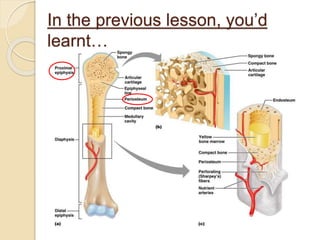
In the previous lesson, you’d
learnt…
BONE GROWTH FROM
BIRTH
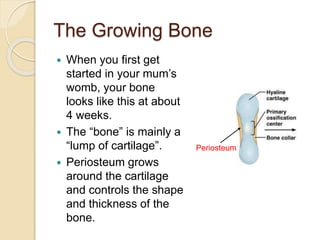
The Growing Bone
 When you first get
started in your mum’s
womb, your bone
looks like this at about
4 weeks.
 The “bone” is mainly a
“lump of cartilage”.
 Periosteum grows
around the cartilage
and controls the shape
and thickness of the
bone.
Periosteum
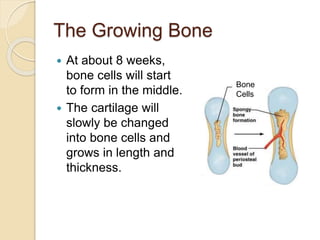
The Growing Bone
 At about 8 weeks,
bone cells will start
to form in the middle.
 The cartilage will
slowly be changed
into bone cells and
grows in length and
thickness.
Bone
Cells
The Growing Bone
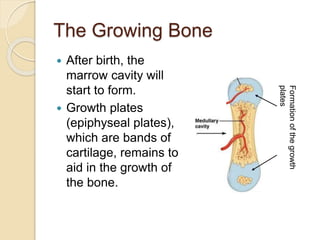
 After birth, the
marrow cavity will
start to form.
 Growth plates
(epiphyseal plates),
which are bands of
cartilage, remains to
aid in the growth of
the bone.
Formationofthegrowth
plates
The Growing Bone
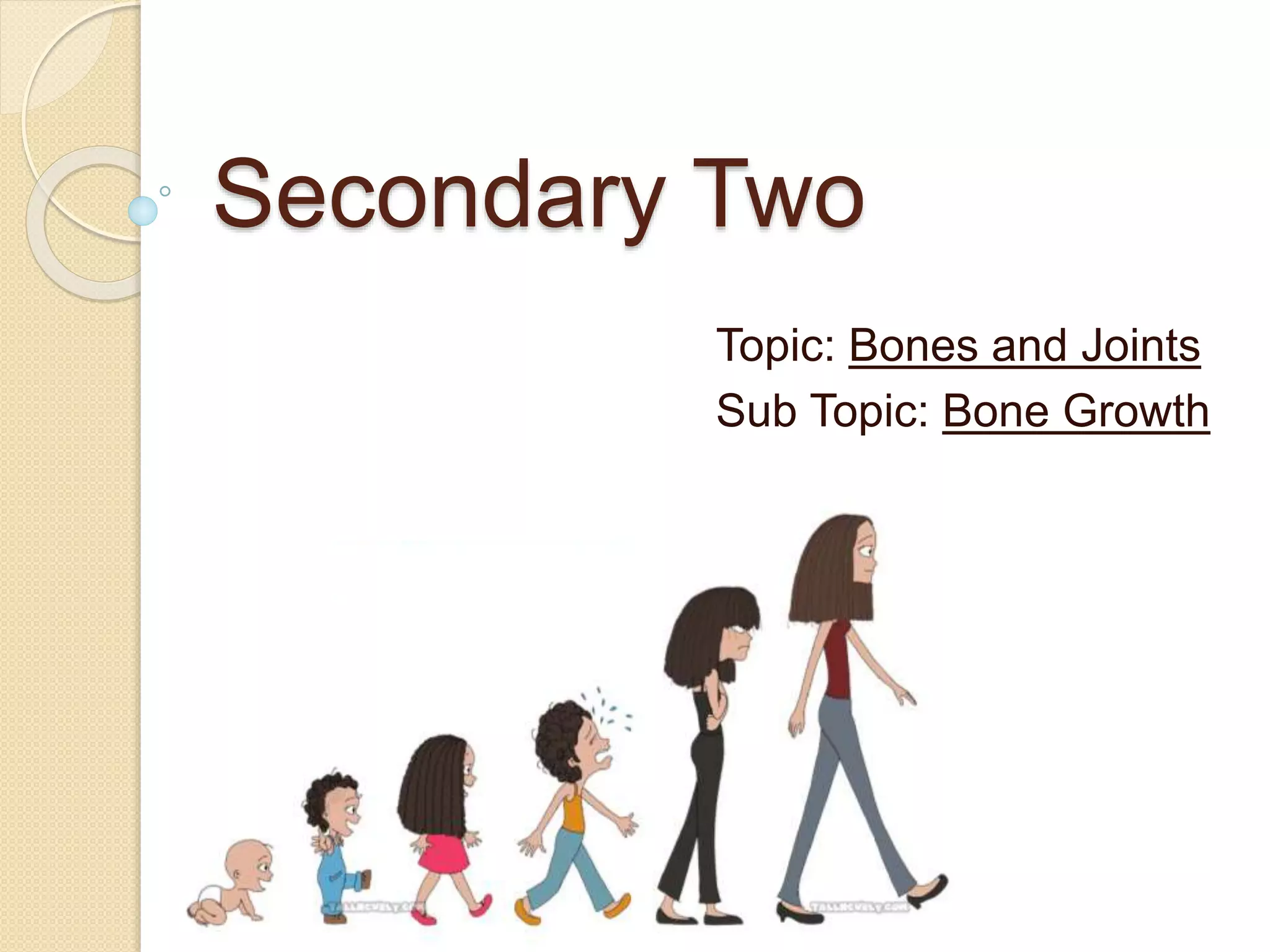
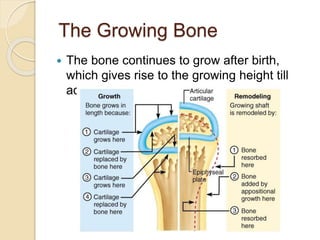
 The bone continues to grow after birth,
which gives rise to the growing height till
adulthood.
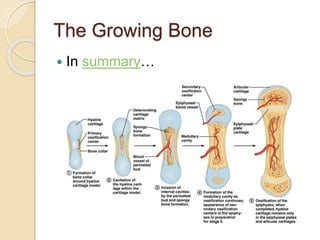
The Growing Bone
 In summary…
Feeling Lost?
 Not biology class
 Only required to have a rough idea
that:
◦ Bone started as one whole piece of
cartilage
◦ After birth, the bone continues to grow at
the Growth Plate (medical name known
as Epiphyseal Plate)
◦ One stops growing when the Growth Plate
is “fused”
GROWING TALLER…
What do you know about growing tall?
Question
 Which bone in your body determines a
large portion of your height?
◦ Femur (thigh bone) and tibia (shin bone)
Growth Plates
 Recall:
◦ The presence of the growth plates in the
bone aids the growing of the length of the
bones (eg. Femur and tibia)
 Growth plates will not be present in
your bones forever
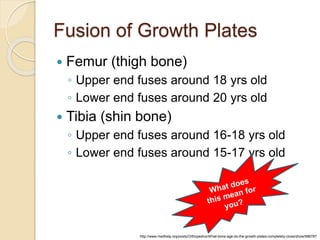
Fusion of Growth Plates
 Femur (thigh bone)
◦ Upper end fuses around 18 yrs old
◦ Lower end fuses around 20 yrs old
 Tibia (shin bone)
◦ Upper end fuses around 16-18 yrs old
◦ Lower end fuses around 15-17 yrs old
http://www.medhelp.org/posts/Orthopedics/What-bone-age-do-the-growth-plates-completely-close/show/996787
You still can grow taller
How?
Factors Affecting Height
 Genes
◦ Determined by parents
 Diet
 Exercising
 Lifestyle
Determined by you
Factors: Genes
 Height is a polygenic trait
◦ Influenced by several different genes
 Estimated height
◦ Boys: (Sum of height of both parents + 13cm) /
2
◦ Girls: (Sum of height of both parents - 13cm) / 2
◦ +/- about 10cm
 Genes determines your maximum
possible height You can’t grow taller
than what your body
genes had decided for
you
Factors: Diet
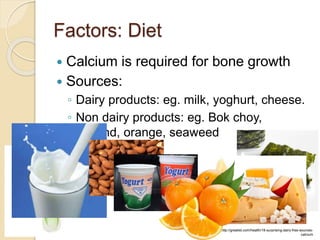
 Calcium is required for bone growth
 Sources:
◦ Dairy products: eg. milk, yoghurt, cheese.
◦ Non dairy products: eg. Bok choy,
almond, orange, seaweed
Source: http://greatist.com/health/18-surprising-dairy-free-sources-
calcium
Factors: Diet
 𝐷𝑟𝑖𝑛𝑘 𝑚𝑖𝑙𝑘 𝑒𝑣𝑒𝑟𝑦𝑑𝑎𝑦 = 𝑆𝑡𝑟𝑜𝑛𝑔 𝑏𝑜𝑛𝑒𝑠?
 Have you ever wonder:
◦ Why I drank so much milk and I never grow
tall?
 Reasons are:
◦ Genetic reasons; or
◦ Lack of vitamin D
 Vitamin D
◦ Vital to promote the body absorption of the
calcium that we take in
◦ Best source: Sun
◦ Lead an active lifestyle, go under the sun!
Factors: Exercising
 Increases the rate of the process of
osteoclast and osteoblast (elaborated
later)
◦ In turn increases the speed of bone growth
 Weight bearing exercises
◦ Exercises that makes one goes against
gravity
◦ Eg. Running, jumping, climbing of stairs
 Helps not only in length growth of bone
◦ Also helps in maintaining strong bones in
adults
◦ Often prescribed for elderlies to maintain
Factors: Lifestyle
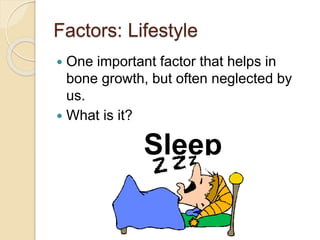
 One important factor that helps in
bone growth, but often neglected by
us.
 What is it?
Sleep
Factors: Lifestyle
 Why sleeping helps in growing taller?
 Body undergoes repair and building /
rebuilding when at rest
 Similar in bone growth
 Recommended at least 8 continuous
hours of sleep
 Not to disturb bio-clock to “confuse”
body
◦ i.e. you do not sleep the 8 hours during
daytime
BONE GROWTH IN
ADULTHOOD
Osteoblasts vs. Osteoclasts
 In adulthood, bones continue to
undergo process of building and re-
modelling
 Why?
◦ Strengthening of bones
◦ Damaging of bones via stress / impact
◦ Need to re-build bones
◦ Similar to maintenance of buildings:
 Need to replace older parts with newer parts
Osteoblasts vs. Osteoclasts
 Osteoblasts
◦ Cells that are responsible to make new
bone cells
 Osteoclasts
◦ Cells that are responsible to breakdown
bone cells
 Let’s watch a video for better
illustration
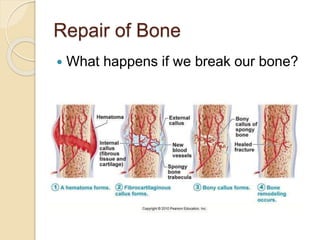
Repair of Bone
 What happens if we break our bone?
As we age…
 Our bones get
◦ Lighter (less dense)
◦ More brittle
◦ Grow shorter
 Common bone issues when old
◦ Osteoporosis
 Important to exercise and eat healthily
in order to keep bones healthy
Lets Recap!
 What is growth plate (epiphyseal
plates)?
Refers to the 2 bands of cartilage at the
end of the bone. It is responsible for the
length growth of long bones before 16-
20 years old.
Lets Recap!
 What is osteoblasts?
Cells that are responsible to make new
bone cells.
Lets Recap!
 What is osteoclasts?
Cells that are responsible to make
breakdown bone cells.
Lets Recap
 What is important in the diet for bone
growth?
Calcium + Vitamin D

5.3 bone growth

  • 1.
    Secondary Two Topic: Bonesand Joints Sub Topic: Bone Growth
  • 2.
    • Students willunderstand the how bone grow. • Students will learn the concepts behind growing tall.
  • 3.
    • Growth plates •Osteoblasts • Osteoclasts
  • 4.
    • One conversation •No sleeping • Putting of palm on whiteboard • Class too noisy and need to quieten down
  • 5.
    In the previouslesson, you’d learnt…
  • 6.
  • 7.
    The Growing Bone When you first get started in your mum’s womb, your bone looks like this at about 4 weeks.  The “bone” is mainly a “lump of cartilage”.  Periosteum grows around the cartilage and controls the shape and thickness of the bone. Periosteum
  • 8.
    The Growing Bone At about 8 weeks, bone cells will start to form in the middle.  The cartilage will slowly be changed into bone cells and grows in length and thickness. Bone Cells
  • 9.
    The Growing Bone After birth, the marrow cavity will start to form.  Growth plates (epiphyseal plates), which are bands of cartilage, remains to aid in the growth of the bone. Formationofthegrowth plates
  • 10.
    The Growing Bone The bone continues to grow after birth, which gives rise to the growing height till adulthood.
  • 11.
    The Growing Bone In summary…
  • 12.
    Feeling Lost?  Notbiology class  Only required to have a rough idea that: ◦ Bone started as one whole piece of cartilage ◦ After birth, the bone continues to grow at the Growth Plate (medical name known as Epiphyseal Plate) ◦ One stops growing when the Growth Plate is “fused”
  • 13.
    GROWING TALLER… What doyou know about growing tall?
  • 14.
    Question  Which bonein your body determines a large portion of your height? ◦ Femur (thigh bone) and tibia (shin bone)
  • 15.
    Growth Plates  Recall: ◦The presence of the growth plates in the bone aids the growing of the length of the bones (eg. Femur and tibia)  Growth plates will not be present in your bones forever
  • 16.
    Fusion of GrowthPlates  Femur (thigh bone) ◦ Upper end fuses around 18 yrs old ◦ Lower end fuses around 20 yrs old  Tibia (shin bone) ◦ Upper end fuses around 16-18 yrs old ◦ Lower end fuses around 15-17 yrs old http://www.medhelp.org/posts/Orthopedics/What-bone-age-do-the-growth-plates-completely-close/show/996787
  • 17.
    You still cangrow taller How?
  • 18.
    Factors Affecting Height Genes ◦ Determined by parents  Diet  Exercising  Lifestyle Determined by you
  • 19.
    Factors: Genes  Heightis a polygenic trait ◦ Influenced by several different genes  Estimated height ◦ Boys: (Sum of height of both parents + 13cm) / 2 ◦ Girls: (Sum of height of both parents - 13cm) / 2 ◦ +/- about 10cm  Genes determines your maximum possible height You can’t grow taller than what your body genes had decided for you
  • 20.
    Factors: Diet  Calciumis required for bone growth  Sources: ◦ Dairy products: eg. milk, yoghurt, cheese. ◦ Non dairy products: eg. Bok choy, almond, orange, seaweed Source: http://greatist.com/health/18-surprising-dairy-free-sources- calcium
  • 21.
    Factors: Diet  𝐷𝑟𝑖𝑛𝑘𝑚𝑖𝑙𝑘 𝑒𝑣𝑒𝑟𝑦𝑑𝑎𝑦 = 𝑆𝑡𝑟𝑜𝑛𝑔 𝑏𝑜𝑛𝑒𝑠?  Have you ever wonder: ◦ Why I drank so much milk and I never grow tall?  Reasons are: ◦ Genetic reasons; or ◦ Lack of vitamin D  Vitamin D ◦ Vital to promote the body absorption of the calcium that we take in ◦ Best source: Sun ◦ Lead an active lifestyle, go under the sun!
  • 22.
    Factors: Exercising  Increasesthe rate of the process of osteoclast and osteoblast (elaborated later) ◦ In turn increases the speed of bone growth  Weight bearing exercises ◦ Exercises that makes one goes against gravity ◦ Eg. Running, jumping, climbing of stairs  Helps not only in length growth of bone ◦ Also helps in maintaining strong bones in adults ◦ Often prescribed for elderlies to maintain
  • 23.
    Factors: Lifestyle  Oneimportant factor that helps in bone growth, but often neglected by us.  What is it? Sleep
  • 24.
    Factors: Lifestyle  Whysleeping helps in growing taller?  Body undergoes repair and building / rebuilding when at rest  Similar in bone growth  Recommended at least 8 continuous hours of sleep  Not to disturb bio-clock to “confuse” body ◦ i.e. you do not sleep the 8 hours during daytime
  • 25.
  • 26.
    Osteoblasts vs. Osteoclasts In adulthood, bones continue to undergo process of building and re- modelling  Why? ◦ Strengthening of bones ◦ Damaging of bones via stress / impact ◦ Need to re-build bones ◦ Similar to maintenance of buildings:  Need to replace older parts with newer parts
  • 27.
    Osteoblasts vs. Osteoclasts Osteoblasts ◦ Cells that are responsible to make new bone cells  Osteoclasts ◦ Cells that are responsible to breakdown bone cells  Let’s watch a video for better illustration
  • 28.
    Repair of Bone What happens if we break our bone?
  • 29.
    As we age… Our bones get ◦ Lighter (less dense) ◦ More brittle ◦ Grow shorter  Common bone issues when old ◦ Osteoporosis  Important to exercise and eat healthily in order to keep bones healthy
  • 30.
    Lets Recap!  Whatis growth plate (epiphyseal plates)? Refers to the 2 bands of cartilage at the end of the bone. It is responsible for the length growth of long bones before 16- 20 years old.
  • 31.
    Lets Recap!  Whatis osteoblasts? Cells that are responsible to make new bone cells.
  • 32.
    Lets Recap!  Whatis osteoclasts? Cells that are responsible to make breakdown bone cells.
  • 33.
    Lets Recap  Whatis important in the diet for bone growth? Calcium + Vitamin D

Editor's Notes

  • #9 For the teachers only: The process of the formation of bone cells in fetus is known as (primary) ossification. It is the degeneration of the cartilage.
  • #11 Click the diagram to access a webpage with animation on bone growth in young children.