
Scapholunate Tears:
The Importance Of Early
Diagnosis
Aaron Venouziou, MD
Orthopaedic, Hand and Upper Extremity Surgeon
St. Luke’s Hospital
Thessaloniki
www.handsurgery.gr
www.handsurgery.gr
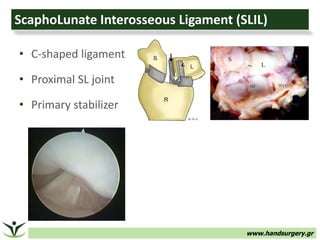
ScaphoLunate Interosseous Ligament (SLIL)
• C-shaped ligament
• Proximal SL joint
• Primary stabilizer
www.handsurgery.gr
ScaphoLunate Interosseous Ligament (SLIL)
• C-shaped ligament
• Proximal SL joint
• Primary stabilizer
www.handsurgery.gr
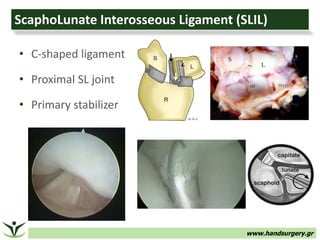
ScaphoLunate Interosseous Ligament (SLIL)
• C-shaped ligament
• Proximal SL joint
• Primary stabilizer
www.handsurgery.gr
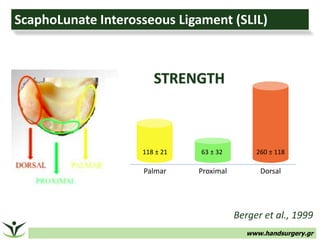
ScaphoLunate Interosseous Ligament (SLIL)
STRENGTH
Berger et al., 1999
Palmar DorsalProximal
118 ± 21 63 ± 32 260 ± 118
www.handsurgery.gr
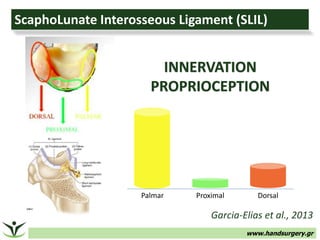
ScaphoLunate Interosseous Ligament (SLIL)
INNERVATION
PROPRIOCEPTION
Garcia-Elias et al., 2013
Palmar DorsalProximal
www.handsurgery.gr
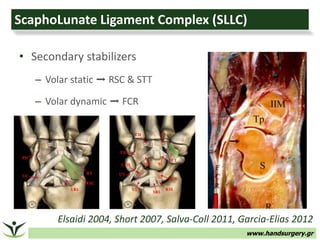
ScaphoLunate Ligament Complex (SLLC)
• Secondary stabilizers
– Volar static ➡ RSC & STT
– Volar dynamic ➡ FCR
Elsaidi 2004, Short 2007, Salva-Coll 2011, Garcia-Elias 2012
www.handsurgery.gr
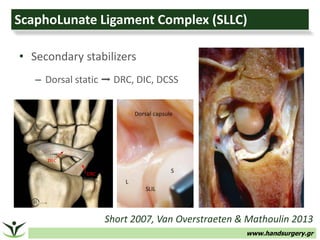
ScaphoLunate Ligament Complex (SLLC)
• Secondary stabilizers
– Dorsal static ➡ DRC, DIC, DCSS
Short 2007, Van Overstraeten & Mathoulin 2013
DRC
www.handsurgery.gr
The extent of injury required to disrupt the
normal kinematics of the scapholunate interval
is not well understood and is controversial
A spectrum of injury to the SLIL is seen
Scapholunate Injury
www.handsurgery.gr
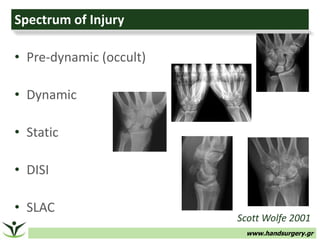
Spectrum of Injury
• Pre-dynamic (occult)
• Dynamic
• Static
• DISI
• SLAC
Scott Wolfe 2001
www.handsurgery.gr
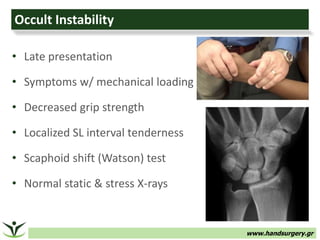
Occult Instability
• Late presentation
• Symptoms w/ mechanical loading
• Decreased grip strength
• Localized SL interval tenderness
• Scaphoid shift (Watson) test
• Normal static & stress X-rays
www.handsurgery.gr
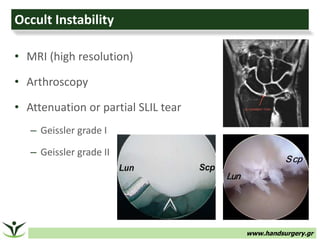
Occult Instability
• MRI (high resolution)
• Arthroscopy
• Attenuation or partial SLIL tear
– Geissler grade I
– Geissler grade II
www.handsurgery.gr
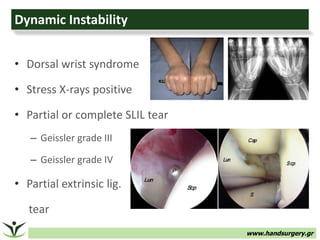
Dynamic Instability
• Dorsal wrist syndrome
• Stress X-rays positive
• Partial or complete SLIL tear
– Geissler grade III
– Geissler grade IV
• Partial extrinsic lig.
tear
www.handsurgery.gr
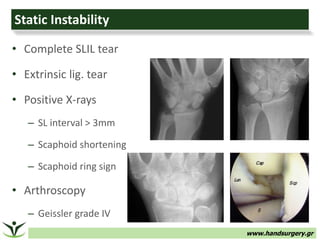
Static Instability
• Complete SLIL tear
• Extrinsic lig. tear
• Positive X-rays
– SL interval > 3mm
– Scaphoid shortening
– Scaphoid ring sign
• Arthroscopy
– Geissler grade IV
www.handsurgery.gr
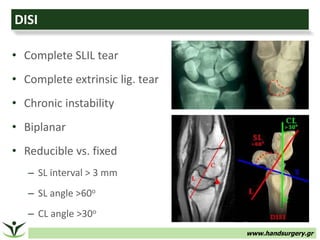
DISI
• Complete SLIL tear
• Complete extrinsic lig. tear
• Chronic instability
• Biplanar
• Reducible vs. fixed
– SL interval > 3 mm
– SL angle >60o
– CL angle >30o
www.handsurgery.gr
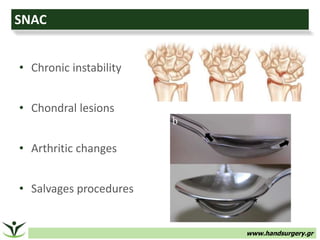
SNAC
• Chronic instability
• Chondral lesions
• Arthritic changes
• Salvages procedures
www.handsurgery.gr
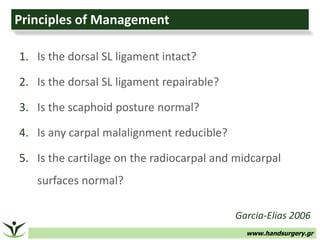
Principles of Management
1. Is the dorsal SL ligament intact?
2. Is the dorsal SL ligament repairable?
3. Is the scaphoid posture normal?
4. Is any carpal malalignment reducible?
5. Is the cartilage on the radiocarpal and midcarpal
surfaces normal?
Garcia-Elias 2006
www.handsurgery.gr
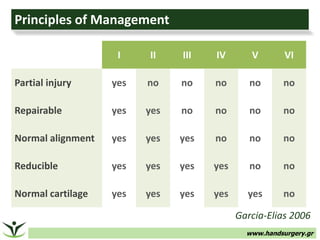
Principles of Management
Garcia-Elias 2006
I II III IV V VI
Partial injury yes no no no no no
Repairable yes yes no no no no
Normal alignment yes yes yes no no no
Reducible yes yes yes yes no no
Normal cartilage yes yes yes yes yes no
www.handsurgery.gr
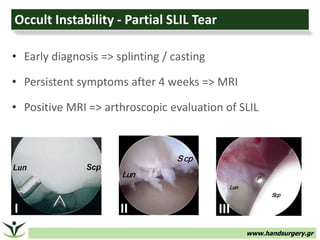
Occult Instability - Partial SLIL Tear
• Early diagnosis => splinting / casting
• Persistent symptoms after 4 weeks => MRI
• Positive MRI => arthroscopic evaluation of SLIL
I II III
www.handsurgery.gr
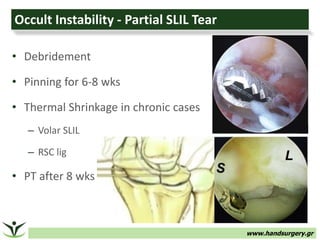
Occult Instability - Partial SLIL Tear
• Debridement
• Pinning for 6-8 wks
• Thermal Shrinkage in chronic cases
– Volar SLIL
– RSC lig
• PT after 8 wks
www.handsurgery.gr
Occult Instability - Partial SLIL Tear
GROUP I
symptoms <3 m
SL interval <3 mm
• 83% of the pts were
symptom-free
GROUP II
symptoms >3 m
SL interval >3 mm
• 53% of the pts were
symptom-free
Whipple TL, 1995
Chronicity and static instability
are negative prognostic factors
www.handsurgery.gr
Occult Instability - Partial SLIL Tear
• Ruch and Poehling, 1996 Arthroscopic Debridement
Good results in all pts with partial SLIL tears
No progression to instability (min. FU 2 yrs)
• Weiss et al, 1997 Arthroscopic Debridement
11/13 pts (85%) good results @ mean FU of 27 mo.
10/15 (67%) good results for complete tears
• Darlis et al, 2005 Thermal Shrinkage
14/16 good results (mean FU 19 mo.)
No signs of arthritis or instability during the FU
www.handsurgery.gr
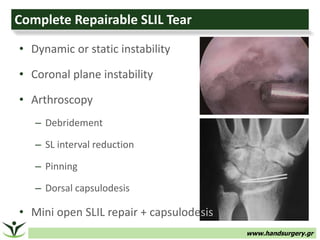
• Dynamic or static instability
• Coronal plane instability
• Arthroscopy
– Debridement
– SL interval reduction
– Pinning
– Dorsal capsulodesis
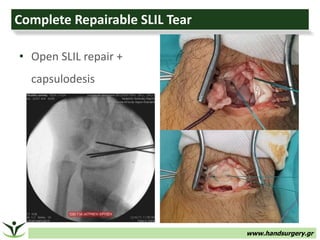
• Mini open SLIL repair + capsulodesis
Complete Repairable SLIL Tear
www.handsurgery.gr
Complete Repairable SLIL Tear
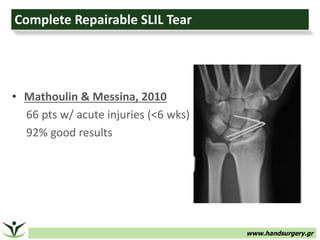
• Mathoulin & Messina, 2010
66 pts w/ acute injuries (<6 wks)
92% good results
www.handsurgery.gr
Complete Repairable SLIL Tear
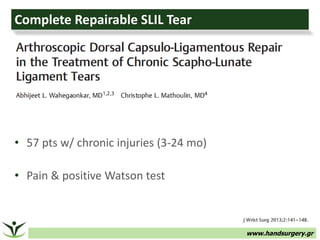
• 57 pts w/ chronic injuries (3-24 mo)
• Pain & positive Watson test
www.handsurgery.gr
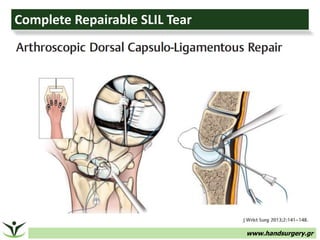
Complete Repairable SLIL Tear
www.handsurgery.gr
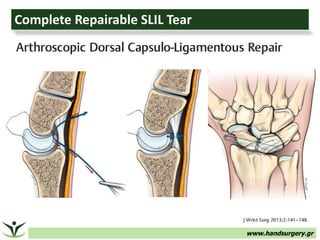
Complete Repairable SLIL Tear
www.handsurgery.gr
Complete Repairable SLIL Tear
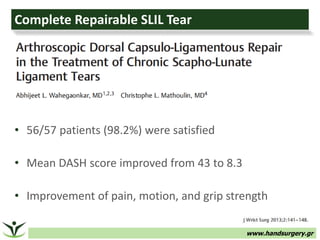
• 56/57 patients (98.2%) were satisfied
• Mean DASH score improved from 43 to 8.3
• Improvement of pain, motion, and grip strength
www.handsurgery.gr
Complete Repairable SLIL Tear
• Open SLIL repair +
capsulodesis
www.handsurgery.gr
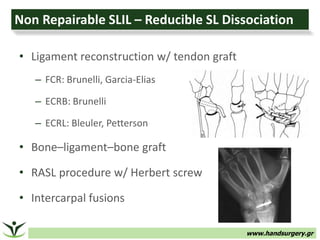
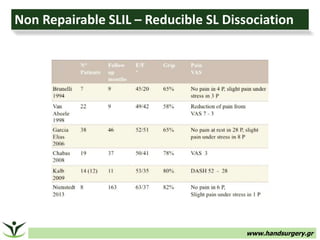
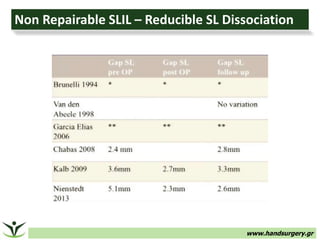
Non Repairable SLIL – Reducible SL Dissociation
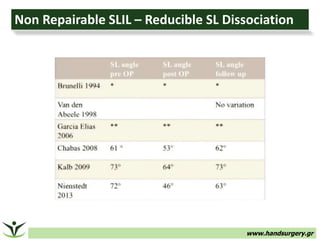
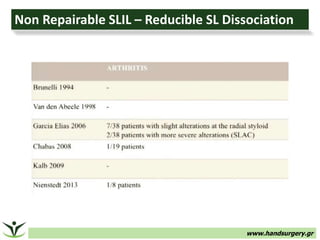
• Ligament reconstruction w/ tendon graft
– FCR: Brunelli, Garcia-Elias
– ECRB: Brunelli
– ECRL: Bleuler, Petterson
• Bone–ligament–bone graft
• RASL procedure w/ Herbert screw
• Intercarpal fusions
www.handsurgery.gr
Non Repairable SLIL – Reducible SL Dissociation
www.handsurgery.gr
Non Repairable SLIL – Reducible SL Dissociation
www.handsurgery.gr
Non Repairable SLIL – Reducible SL Dissociation
www.handsurgery.gr
Non Repairable SLIL – Reducible SL Dissociation
www.handsurgery.gr
Non Repairable SLIL – Reducible SL Dissociation
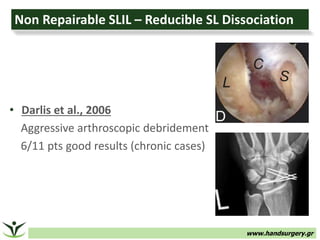
• Darlis et al., 2006
Aggressive arthroscopic debridement
6/11 pts good results (chronic cases)
www.handsurgery.gr
DISI
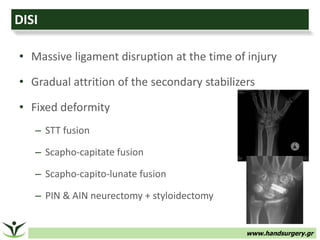
• Massive ligament disruption at the time of injury
• Gradual attrition of the secondary stabilizers
• Fixed deformity
– STT fusion
– Scapho-capitate fusion
– Scapho-capito-lunate fusion
– PIN & AIN neurectomy + styloidectomy
www.handsurgery.gr
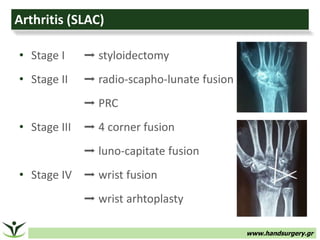
Arthritis (SLAC)
• Stage I ➡ styloidectomy
• Stage II ➡ radio-scapho-lunate fusion
➡ PRC
• Stage III ➡ 4 corner fusion
➡ luno-capitate fusion
• Stage IV ➡ wrist fusion
➡ wrist arhtoplasty
www.handsurgery.gr
• SLIL is the critical stabilizer
• Carpal alignment may be maintained acutely after
disruption of SLIL because of secondary stabilizers
• Any injured wrist that is symptomatic during
mechanical and load-bearing activities should be
considered as scapholunate instability
Conclusions
www.handsurgery.gr
• High resolution MRI is mandatory in this cases
• Each case is unique and therefore should be treated
with tissue specific repairs
• Treatment of acute injuries have good to excellent
prognosis
Conclusions
www.handsurgery.gr
www.handsurgery.gr

SL tears

Editor's Notes

  • #22 Whipple TL, Hand Clin 1995 Diagnosis of scapholunate instability is made using clinical provocative maneuvers such as the Watson test and a two-compartment arthrogram. The history of treatment options for this instability pattern is reviewed. A technique for arthroscopic treatment is described in which anatomic reduction and multiple pin fixation precipitate fibrous ankylosis to stabilize the joint. 40 patients were treated with ARIF. Follow up was from 1 year up to 3 years. Best results were seen in patients with less than 3 months' symptom duration and less than 3-mm side-to-side gap difference. This treatment offers less loss of motion and minimal surgical surgical trauma to the wrist than other techniques currently in use.
  • #29 technique appears to be a reliable method to stabilize Stage 2, 3 and 4 scapholunate dissociations without the issue of wrist stiffness due to extensive open dissection techniques as reported in most of the studies.
  • #35 there is no technique that consistently provides long-term carpal stability to this challenging patient cohort.