Let’s start with  autonomous teachers:   Multiliteracies and the inculcation of strategies for lifelong learning Vance Stevens Learner Autonomy SIG  Pre-conference event  IATEFL Conference, Exeter   April 7, 2008 –  Updated April 9, 2008
From Leni Dam’s talk “…teachers will hardly be prepared or able to administer autonomous learning processes in their students if their own learning is not geared to the same principles.” - Edelrhof, 1984:189   (Referenced in Leni Dam's talk at this symposium) Edelhoff, C. (1984). Purposes and needs for teacher training” in van Ek and J. Trim (eds.) Across the threshold: readings from the modern languages projects of the Council of Europe. Oxford: Pergamon.  http://iateflexeter2008.blogspot.com/2008/04/teacher-education-for-learner-autonomy.html
Multiliteracies:  New Landscapes for Learning Notions of  multiliteracies  (Stevens, 2006) emerging to characterize competencies required for effectively coping and communicating in the 21st century, Stevens, Vance. (2006). Revisiting multiliteracies in collaborative learning environments, TESL-EJ,.:  http://www.tesl-ej.org/ej38/int.html .   “ Digital immigrant” teachers not keeping up (from  Prensky, M. (2001). Digital Natives, Digital Immigrants.  On the Horizon 9 , 5.  http://tinyurl.com/69gotc ) Still conceptualize technology as working along the lines of an  expert system Might work in some cases for short-term learning goals but not as a strategy towards attaining competencies directed at lifelong learning. Now that Internet is for the fortunate few 'always on' the greatest potentials for technology in learning are rapidly shifting to  connectionist/connectivist models .
Connectivism George Siemens Proponent of the theory of connectivism The “pipe” is more important than its content  Siemens, G. (2005). Connectivism: Learning as network-creation.  http://www.learningcircuits.org/2005/nov2005/seimens.htm .  Knowledge resides at nodes in network Maintaining connections is primary to accessing it Essential elements  to accessing knowledge in the 21 st  or read-write century RSS  http://en.wikipedia.org/wiki/Rss Aggregation  http://en.wikipedia.org/wiki/Aggregator   Folksonomies  http://en.wikipedia.org/wiki/Folksonomy   Tagging  http://en.wikipedia.org/wiki/Tag_%28metadata%29   David Weinberger explains it here:  http://conversationhub.com/2007/07/09/video-david-weinberger-and-andrew-keen/
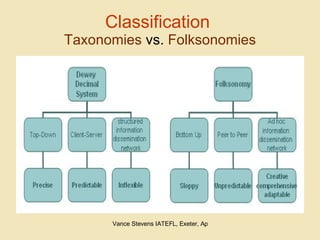
Classification   Taxonomies  vs.  Folksonomies
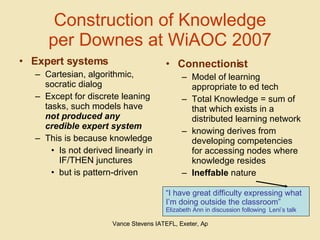
Construction of Knowledge per Downes at WiAOC 2007 Expert systems Cartesian, algorithmic, socratic dialog Except for discrete leaning tasks, such models have  not produced any credible expert system This is because knowledge  Is not derived linearly in IF/THEN junctures  but is pattern-driven Connectionist Model of learning appropriate to ed tech Total Knowledge = sum of that which exists in a distributed learning network knowing derives from developing competencies for accessing nodes where knowledge resides Ineffable  nature “ I have great difficulty expressing what I’m doing outside the classroom” Elizabeth Ann in discussion following  Leni’s talk
Ineffability Expert model intuitively understood  by those brought up on western scientific logic such logic does not readily suggest nor accept network solutions .   To Cartesian-logical minds, network solutions might appear counter-intuitive  until experienced .   E.g. how  Wikipedia  works unregulated 'bottom up' to create an encyclopedia that is in many ways superior to the traditional 'top down' authoritatively published ones Illustration: Jon Udell’s Heavy Metal Umlaut Screencast: http://weblog.infoworld.com/udell/gems/umlaut.html Ryerson University  student, Toronto, charged with 150 counts of  plagiarism , one for each peer in his  Facebook  study group. http://tinyurl.com/3r6vk9 Social networking tools have had startling impacts on constructivist learning when applied appropriately in educational contexts.  Their benefit to learning, says Downes, is beyond articulation or description, but is rather,  ineffable .
Stephen Downes - WiAOC 2007 Teaching  is Modeling Demonstrating Learning  is Practice Reflection From Personal Learning the Web 2.0 Way Slides:  http://www.slideshare.net/Downes/personal-learning-the-web-20-way   Audio Part 1:  http://streamarchives.net/node/84   Audio Part 2:  http://streamarchives.net/node/83
Paradigm Shift New Learners:  Some of Marc Prensky’s mantras Referenced at:   http://www.learnerautonomy.org/VanceStevens.pdf Digital immigrants vs. digital natives Enrage me or engage me Cater to learners accustomed to Twitch Speed Challenge for teachers  whose use of technology has lagged behind latest developments, is  being able to switch mindsets  away from the expectation that computers should provide solutions to problems in education in algorithmic ways To  connectivist  models  taking advantage of  social networking
Ten aspects of paradigm shift Pedagogy :  Didactic --> constructivist and  conversational Modeling :  Do as I say --> AND as I do Sharing :  Copyrighted -->  creative commons Trepidation : Will they find out? -->  ok to say I don’t know Literacy :  Print literacy --> multiliteracies Heuristics : Client server -->peer to peer Transfer :  Informal technology F.U.N. -->  applied to professional  practice Directionality : Push --> pull Ownership : Proprietary --> open source  Classification :  Taxonomies --> folksonomies Here, I first suggested multiple aspects of paradigm shift required   http://www.homestead.com/prosites-vstevens/files/efi/papers/2007alexandria/web20arabia.htm
Relating this to Learner Autonomy Teachers need to both teach (model and demonstrate)  learn (practice and reflect)  To do these things they must LEARN from their peers who model and demonstrate and encourage them to reflect and practice,  In turn MODEL the outcomes they expect with students There is evidence that when teachers do not model connectivist methods then their learners express or display discomfort with them. See:   http://www.learnerautonomy.org/VanceStevens.pdf
Blogging: a model application Blogging inculcates all 4 principles.  by nature a tool for reflection  bloggers practice principles of social networking by connecting through comments and trackbacks with other bloggers and readers of blogs In order for teachers to teach blogging they really need to be bloggers themselves.  Or at the very least, be model readers of blogs  Be aware of what is going on in their niche of the blogosphere Know how to extract information from the blogosphere by using tools such as Google blog search and Technorati  http://technorati.com
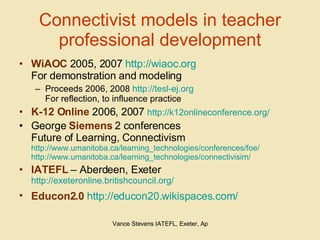
Connectivist models in teacher professional development WiAOC  2005, 2007  http://wiaoc.org For demonstration and modeling Proceeds 2006, 2008  http://tesl-ej.org For reflection, to influence practice K-12 Online  2006, 2007  http://k12onlineconference.org/   George  Siemens  2 conferences Future of Learning, Connectivism http://www.umanitoba.ca/learning_technologies/conferences/foe/ http://www.umanitoba.ca/learning_technologies/connectivisim/ IATEFL  – Aberdeen, Exeter  http://exeteronline.britishcouncil.org/ Educon2.0   http://educon20.wikispaces.com/
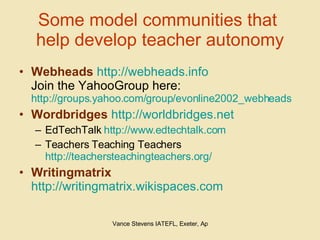
Some model communities that  help develop teacher autonomy Webheads   http://webheads.info Join the YahooGroup here:  http://groups.yahoo.com/group/evonline2002_webheads Wordbridges   http://worldbridges.net EdTechTalk  http://www.edtechtalk.com Teachers Teaching Teachers http://teachersteachingteachers.org/ Writingmatrix   http://writingmatrix.wikispaces.com
Some Web 2.0 tools promoting autonomy via connectivism VoiceThread Ustream Slideshare Authorstream Gabcast Twitter WiZiQ Skype Chinswing Yakpack This list was started at the TESOL 2008 conference in New York and suggestions were taken from the audience to flesh out the list. URL’s should be pretty easy to find.  Do you have any to add?
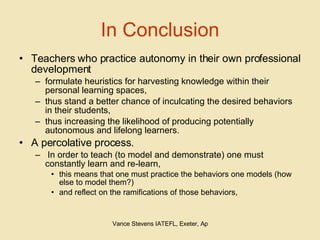
In Conclusion Teachers who practice autonomy in their own professional development  formulate heuristics for harvesting knowledge within their personal learning spaces,  thus stand a better chance of inculcating the desired behaviors in their students,  thus increasing the likelihood of producing potentially autonomous and lifelong learners.  A percolative process. In order to teach (to model and demonstrate) one must constantly learn and re-learn,  this means that one must practice the behaviors one models (how else to model them?)  and reflect on the ramifications of those behaviors,
Thank you …   This presentation derives from: Stevens, Vance. (2007). The Multiliterate Autonomous Learner: Teacher Attitudes and the Inculcation of Strategies for Lifelong Learning, in  Independence , Winter 2007 (Issue 42) pp 27-29.  http://www.learnerautonomy.org/VanceStevens.pdf .  Today’s handout soon to be at http :// www.slideshare.net/vances Vance Stevens , IATEFL 2008 Exeter, UK
Further notes For my friends at IATEFL I hope you enjoyed the talk.  I recorded the session but found out at the end that no recording was made.  However, I’m due to give this again in Abu Dhabi on April 12 and I’ll try and get a definitive recording then.  Also I’m thinking to make the slideshare from that presentation a definitiive mashup of my TESOL and IATEFL presentations, so you might check back here after that date and see if there is an even better talking version of this slide show posted at  http://slideshare.net/vances Meanwhile, I’ll be interacting with some of you at  http://exeteronline.britishcouncil.org/  .  Cheers from UAE! Find me on my blog  at  http://adVancEducation.blogspot.com

Let's start with teacher autonomy: Multiliteracies and Lifelong Learning

  • 1.
    Let’s start with autonomous teachers: Multiliteracies and the inculcation of strategies for lifelong learning Vance Stevens Learner Autonomy SIG Pre-conference event IATEFL Conference, Exeter April 7, 2008 – Updated April 9, 2008
  • 2.
    From Leni Dam’stalk “…teachers will hardly be prepared or able to administer autonomous learning processes in their students if their own learning is not geared to the same principles.” - Edelrhof, 1984:189 (Referenced in Leni Dam's talk at this symposium) Edelhoff, C. (1984). Purposes and needs for teacher training” in van Ek and J. Trim (eds.) Across the threshold: readings from the modern languages projects of the Council of Europe. Oxford: Pergamon. http://iateflexeter2008.blogspot.com/2008/04/teacher-education-for-learner-autonomy.html
  • 3.
    Multiliteracies: NewLandscapes for Learning Notions of multiliteracies (Stevens, 2006) emerging to characterize competencies required for effectively coping and communicating in the 21st century, Stevens, Vance. (2006). Revisiting multiliteracies in collaborative learning environments, TESL-EJ,.: http://www.tesl-ej.org/ej38/int.html . “ Digital immigrant” teachers not keeping up (from Prensky, M. (2001). Digital Natives, Digital Immigrants. On the Horizon 9 , 5. http://tinyurl.com/69gotc ) Still conceptualize technology as working along the lines of an expert system Might work in some cases for short-term learning goals but not as a strategy towards attaining competencies directed at lifelong learning. Now that Internet is for the fortunate few 'always on' the greatest potentials for technology in learning are rapidly shifting to connectionist/connectivist models .
  • 4.
    Connectivism George SiemensProponent of the theory of connectivism The “pipe” is more important than its content Siemens, G. (2005). Connectivism: Learning as network-creation. http://www.learningcircuits.org/2005/nov2005/seimens.htm . Knowledge resides at nodes in network Maintaining connections is primary to accessing it Essential elements to accessing knowledge in the 21 st or read-write century RSS http://en.wikipedia.org/wiki/Rss Aggregation http://en.wikipedia.org/wiki/Aggregator Folksonomies http://en.wikipedia.org/wiki/Folksonomy Tagging http://en.wikipedia.org/wiki/Tag_%28metadata%29 David Weinberger explains it here: http://conversationhub.com/2007/07/09/video-david-weinberger-and-andrew-keen/
  • 5.
    Classification Taxonomies vs. Folksonomies
  • 6.
    Construction of Knowledgeper Downes at WiAOC 2007 Expert systems Cartesian, algorithmic, socratic dialog Except for discrete leaning tasks, such models have not produced any credible expert system This is because knowledge Is not derived linearly in IF/THEN junctures but is pattern-driven Connectionist Model of learning appropriate to ed tech Total Knowledge = sum of that which exists in a distributed learning network knowing derives from developing competencies for accessing nodes where knowledge resides Ineffable nature “ I have great difficulty expressing what I’m doing outside the classroom” Elizabeth Ann in discussion following Leni’s talk
  • 7.
    Ineffability Expert modelintuitively understood by those brought up on western scientific logic such logic does not readily suggest nor accept network solutions . To Cartesian-logical minds, network solutions might appear counter-intuitive until experienced . E.g. how Wikipedia works unregulated 'bottom up' to create an encyclopedia that is in many ways superior to the traditional 'top down' authoritatively published ones Illustration: Jon Udell’s Heavy Metal Umlaut Screencast: http://weblog.infoworld.com/udell/gems/umlaut.html Ryerson University student, Toronto, charged with 150 counts of plagiarism , one for each peer in his Facebook study group. http://tinyurl.com/3r6vk9 Social networking tools have had startling impacts on constructivist learning when applied appropriately in educational contexts. Their benefit to learning, says Downes, is beyond articulation or description, but is rather, ineffable .
  • 8.
    Stephen Downes -WiAOC 2007 Teaching is Modeling Demonstrating Learning is Practice Reflection From Personal Learning the Web 2.0 Way Slides: http://www.slideshare.net/Downes/personal-learning-the-web-20-way Audio Part 1: http://streamarchives.net/node/84 Audio Part 2: http://streamarchives.net/node/83
  • 9.
    Paradigm Shift NewLearners: Some of Marc Prensky’s mantras Referenced at: http://www.learnerautonomy.org/VanceStevens.pdf Digital immigrants vs. digital natives Enrage me or engage me Cater to learners accustomed to Twitch Speed Challenge for teachers whose use of technology has lagged behind latest developments, is being able to switch mindsets away from the expectation that computers should provide solutions to problems in education in algorithmic ways To connectivist models taking advantage of social networking
  • 10.
    Ten aspects ofparadigm shift Pedagogy : Didactic --> constructivist and conversational Modeling : Do as I say --> AND as I do Sharing : Copyrighted --> creative commons Trepidation : Will they find out? --> ok to say I don’t know Literacy : Print literacy --> multiliteracies Heuristics : Client server -->peer to peer Transfer : Informal technology F.U.N. --> applied to professional practice Directionality : Push --> pull Ownership : Proprietary --> open source Classification : Taxonomies --> folksonomies Here, I first suggested multiple aspects of paradigm shift required http://www.homestead.com/prosites-vstevens/files/efi/papers/2007alexandria/web20arabia.htm
  • 11.
    Relating this toLearner Autonomy Teachers need to both teach (model and demonstrate) learn (practice and reflect) To do these things they must LEARN from their peers who model and demonstrate and encourage them to reflect and practice, In turn MODEL the outcomes they expect with students There is evidence that when teachers do not model connectivist methods then their learners express or display discomfort with them. See: http://www.learnerautonomy.org/VanceStevens.pdf
  • 12.
    Blogging: a modelapplication Blogging inculcates all 4 principles. by nature a tool for reflection bloggers practice principles of social networking by connecting through comments and trackbacks with other bloggers and readers of blogs In order for teachers to teach blogging they really need to be bloggers themselves. Or at the very least, be model readers of blogs Be aware of what is going on in their niche of the blogosphere Know how to extract information from the blogosphere by using tools such as Google blog search and Technorati http://technorati.com
  • 13.
    Connectivist models inteacher professional development WiAOC 2005, 2007 http://wiaoc.org For demonstration and modeling Proceeds 2006, 2008 http://tesl-ej.org For reflection, to influence practice K-12 Online 2006, 2007 http://k12onlineconference.org/ George Siemens 2 conferences Future of Learning, Connectivism http://www.umanitoba.ca/learning_technologies/conferences/foe/ http://www.umanitoba.ca/learning_technologies/connectivisim/ IATEFL – Aberdeen, Exeter http://exeteronline.britishcouncil.org/ Educon2.0 http://educon20.wikispaces.com/
  • 14.
    Some model communitiesthat help develop teacher autonomy Webheads http://webheads.info Join the YahooGroup here: http://groups.yahoo.com/group/evonline2002_webheads Wordbridges http://worldbridges.net EdTechTalk http://www.edtechtalk.com Teachers Teaching Teachers http://teachersteachingteachers.org/ Writingmatrix http://writingmatrix.wikispaces.com
  • 15.
    Some Web 2.0tools promoting autonomy via connectivism VoiceThread Ustream Slideshare Authorstream Gabcast Twitter WiZiQ Skype Chinswing Yakpack This list was started at the TESOL 2008 conference in New York and suggestions were taken from the audience to flesh out the list. URL’s should be pretty easy to find. Do you have any to add?
  • 16.
    In Conclusion Teacherswho practice autonomy in their own professional development formulate heuristics for harvesting knowledge within their personal learning spaces, thus stand a better chance of inculcating the desired behaviors in their students, thus increasing the likelihood of producing potentially autonomous and lifelong learners. A percolative process. In order to teach (to model and demonstrate) one must constantly learn and re-learn, this means that one must practice the behaviors one models (how else to model them?) and reflect on the ramifications of those behaviors,
  • 17.
    Thank you … This presentation derives from: Stevens, Vance. (2007). The Multiliterate Autonomous Learner: Teacher Attitudes and the Inculcation of Strategies for Lifelong Learning, in Independence , Winter 2007 (Issue 42) pp 27-29. http://www.learnerautonomy.org/VanceStevens.pdf . Today’s handout soon to be at http :// www.slideshare.net/vances Vance Stevens , IATEFL 2008 Exeter, UK
  • 18.
    Further notes Formy friends at IATEFL I hope you enjoyed the talk. I recorded the session but found out at the end that no recording was made. However, I’m due to give this again in Abu Dhabi on April 12 and I’ll try and get a definitive recording then. Also I’m thinking to make the slideshare from that presentation a definitiive mashup of my TESOL and IATEFL presentations, so you might check back here after that date and see if there is an even better talking version of this slide show posted at http://slideshare.net/vances Meanwhile, I’ll be interacting with some of you at http://exeteronline.britishcouncil.org/ . Cheers from UAE! Find me on my blog at http://adVancEducation.blogspot.com