AUTONOMOUS
LEARNING
AUTONOMOUS LEARNING
Autonomous learning is seen as any study form
in which individuals have primary responsibility
for planning, implementing, and even evaluating
the effort. Most people, when asked, will
proclaim a preference for assuming such
responsibility whenever possible.
LEARNING STRATEGIES
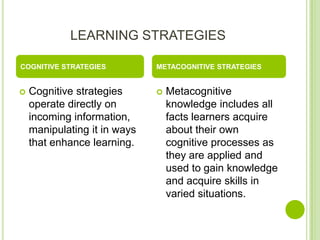
 Cognitive strategies
operate directly on
incoming information,
manipulating it in ways
that enhance learning.
 Metacognitive
knowledge includes all
facts learners acquire
about their own
cognitive processes as
they are applied and
used to gain knowledge
and acquire skills in
varied situations.
COGNITIVE STRATEGIES METACOGNITIVE STRATEGIES
COGNITIVE STRATEGIES
1. REPETITION 2. RESOURCING 3. TRASLATION
4. NOTE-TAKING 5. DEDUCTION
6. CONTEXTUALISATION 7. TRANSFER 8. INFERENCING
9. QUESTION FOR
CLARIFICATION
*REPETITION: Is when imitating others' speech.
* RESOURCING: Having recourse to dictionaries and other materials.
*TRASLATION: Using their mother tongue as a basis for understanding
and/or producing the target language.
*NOTE-TAKING: Is to note the information.
*DEDUCTION: Conscious application of L2 rules.
**CONTEXTUALISATION: When embedding a word or phrase in a
meaningful sequence.
*TRANSFER: Using knowledge acquired in the L1 to remember and
understand facts and sequences in the L2.
*INFERENCING: When matching an unfamiliar word against available
information (a new word etc).
* QUESTION FOR CLASIFICATION: When asking the teacher to
explain, etc.
METACOGNITIVE STRATEGIES
1. DIRECTED
ATENTION
2. SELECTIVE
ATENTION
3. SELF
MONITORING
4. SELF
EVALUATION
5. SELF
REINFORCEMENT
*DIRECTED ATTENTION: When deciding in advance to
concentrate on general aspects of a task.
*SELECTIVE ATTENTION: Paying attention to specific aspects of
a task.
*SELF-MONITORING:Checking one's performance as one speaks.
*SELF-EVALUATION: Appraising one's performance in relation to
one's own standards.
*SELF-REINFORCEMENT: Rewarding oneself for success.
THANKS!

Autonomous learning

  • 1.
  • 2.
    AUTONOMOUS LEARNING Autonomous learningis seen as any study form in which individuals have primary responsibility for planning, implementing, and even evaluating the effort. Most people, when asked, will proclaim a preference for assuming such responsibility whenever possible.
  • 3.
    LEARNING STRATEGIES  Cognitivestrategies operate directly on incoming information, manipulating it in ways that enhance learning.  Metacognitive knowledge includes all facts learners acquire about their own cognitive processes as they are applied and used to gain knowledge and acquire skills in varied situations. COGNITIVE STRATEGIES METACOGNITIVE STRATEGIES
  • 4.
    COGNITIVE STRATEGIES 1. REPETITION2. RESOURCING 3. TRASLATION 4. NOTE-TAKING 5. DEDUCTION 6. CONTEXTUALISATION 7. TRANSFER 8. INFERENCING 9. QUESTION FOR CLARIFICATION
  • 5.
    *REPETITION: Is whenimitating others' speech. * RESOURCING: Having recourse to dictionaries and other materials. *TRASLATION: Using their mother tongue as a basis for understanding and/or producing the target language.
  • 6.
    *NOTE-TAKING: Is tonote the information. *DEDUCTION: Conscious application of L2 rules. **CONTEXTUALISATION: When embedding a word or phrase in a meaningful sequence. *TRANSFER: Using knowledge acquired in the L1 to remember and understand facts and sequences in the L2. *INFERENCING: When matching an unfamiliar word against available information (a new word etc). * QUESTION FOR CLASIFICATION: When asking the teacher to explain, etc.
  • 7.
    METACOGNITIVE STRATEGIES 1. DIRECTED ATENTION 2.SELECTIVE ATENTION 3. SELF MONITORING 4. SELF EVALUATION 5. SELF REINFORCEMENT
  • 8.
    *DIRECTED ATTENTION: Whendeciding in advance to concentrate on general aspects of a task. *SELECTIVE ATTENTION: Paying attention to specific aspects of a task. *SELF-MONITORING:Checking one's performance as one speaks.
  • 9.
    *SELF-EVALUATION: Appraising one'sperformance in relation to one's own standards. *SELF-REINFORCEMENT: Rewarding oneself for success.
  • 10.