Input, interaction, and the
roles of Japanese teachers
of English
Ken Urano, Hokkai-Gakuen University
urano@hgu.jp
September 15–16, 2013
@ Shinshu University, Nagano
—A second language acquisition perspective—
Before we begin...
• Please consider this talk as a
proposal, rather than a
lecture.
• Your questions and comments
are welcome at any time.
About me...
• I was born in Yokohama.
• And grew up in Nagano.
• I studied at Shinshu Univ.
• Also at the Univ. of Hawaii.
• I now work at Hokkai-
Gakuen University, Sapporo.
• I teach English to business
students.
• I’m a teacher of English.
• I’m a researcher in second
language acquisition.
• I’m a teacher of English.
• I’m a researcher in second
language acquisition.
Researchers’roles,
teachers’roles
• Researcher
• Making guidelines
• Teacher
• Adapting the guidelines
What we know
from research
We know...
• Importance of input
• No input, no language
learning
Importance of input
• Limited input sources
• Outside the classroom
• Textbook
• Teachers’role as a main
source of input
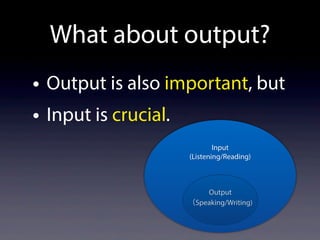
What about output?
• Output is also important, but
• Input is crucial.
Input
(Listening/Reading)
Output
(Speaking/Writing)
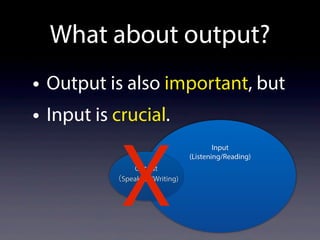
What about output?
• Output is also important, but
• Input is crucial.
Input
(Listening/Reading)
Output
(Speaking/Writing)
X
But...
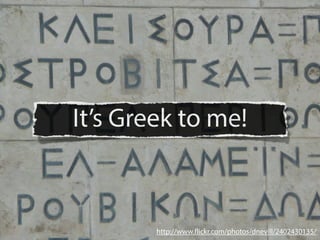
Not all input is good.
It’s Greek to me!
http://www.flickr.com/photos/dnevill/2402430135/
Comprehensible input
• Input needs to be
understood by the learner.
By the way...
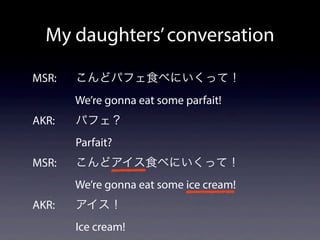
I have two daughters.
MSR: こんどパフェ食べにいくって!
We’re gonna eat some parfait!
AKR: パフェ?
Parfait?
MSR: こんどアイス食べにいくって!
We’re gonna eat some ice cream!
AKR: アイス!
Ice cream!
My daughters’conversation
Even a 6-year-old knows
how to adjust her talk
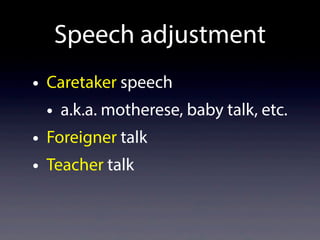
Speech adjustment
• Caretaker speech
• a.k.a. motherese, baby talk, etc.
• Foreigner talk
• Teacher talk
Question
How would you adjust
your speech?
Group work (1)
• Make a list of ways to adjust
your speech when talking to
your students.
What we know
from research (2)
• Language learning takes place
• When learners understand the
meaning of the input, and
• When they pay some attention
to the form,
• At the same time.
We know...
Form-meaning
mapping
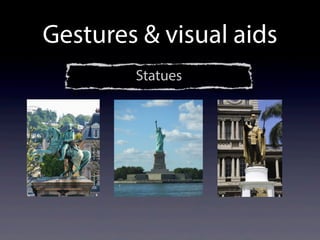
Gestures & visual aids
Statue of Liberty
Gestures & visual aids
http://www.flickr.com/photos/philofphotos/249220155/
Gestures & visual aids
• They are useful, but
• They need to be used with
caution
• Because students may not
pay attention to the form.
Gestures & visual aids
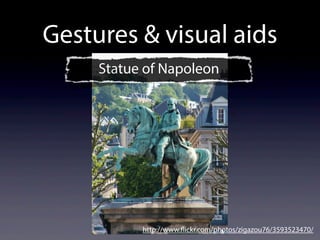
http://www.flickr.com/photos/zigazou76/3593523470/
Statue of Napoleon
Gestures & visual aids
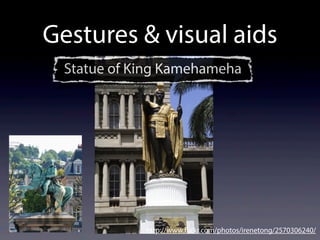
http://www.flickr.com/photos/irenetong/2570306240/
Statue of King Kamehameha
Gestures & visual aids
Statue of Liberty
Gestures & visual aids
Statues
• Everybody knows that Mike
is diligent.
Suppose your students
don’t know this word.
To simplify or not to
simplify...
• Everybody knows that Mike
is diligent.
To simplify or not to
simplify...
hard-working
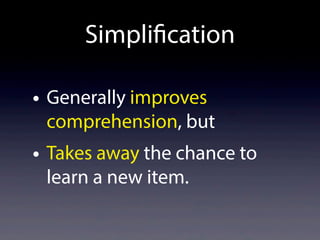
Simplification
• Replacing difficult items
with easy ones.
Simplification
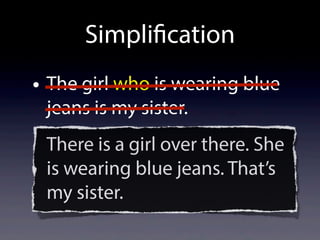
• The girl who is wearing blue
jeans is my sister.
There is a girl over there. She
is wearing blue jeans. That’s
my sister.
Simplification
• Generally improves
comprehension, but
• Takes away the chance to
learn a new item.
Instead of simplifying...
Elaborate!
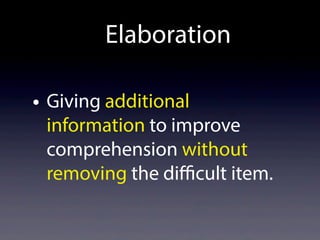
Elaboration
• Giving additional
information to improve
comprehension without
removing the difficult item.
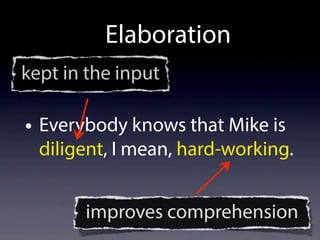
• Everybody knows that Mike is
diligent, I mean, hard-working.
improves comprehension
kept in the input
Elaboration
Or...
You can interact!
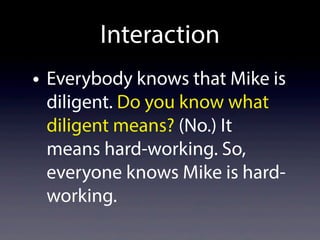
• Everybody knows that Mike is
diligent. Do you know what
diligent means? (No.) It
means hard-working. So,
everyone knows Mike is hard-
working.
Interaction
We know...
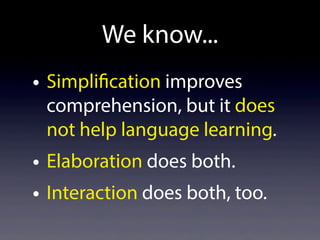
• Simplification improves
comprehension, but it does
not help language learning.
• Elaboration does both.
• Interaction does both, too.
Group work (2)
• Create a dialog between a
student and a teacher which
includes an example of
elaboration and/or
interaction.
What we know
from research (3)
Feedback
We know...
• Students need to pay some
attention to form.
• Providing corrective
feedback helps increase
their awareness.
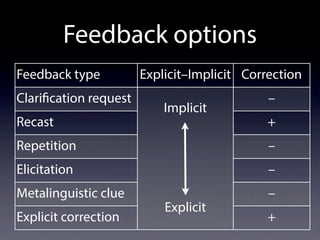
Feedback options
• +/- Explicit
• +/- Correction
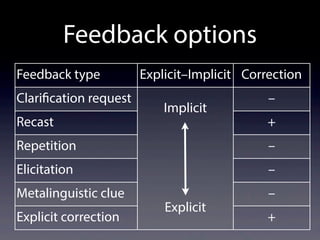
Feedback options
Feedback type Explicit–Implicit Correction
Clarification request
Implicit
Explicit
–
Recast
Implicit
Explicit
+
Repetition
Implicit
Explicit
–
Elicitation
Implicit
Explicit
–
Metalinguistic clue
Implicit
Explicit
–
Explicit correction
Implicit
Explicit
+
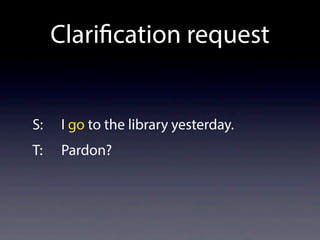
Clarification request
S: I go to the library yesterday.
T: Pardon?
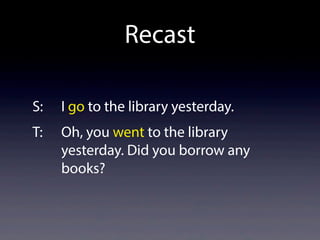
Recast
S: I go to the library yesterday.
T: Oh, you went to the library
yesterday. Did you borrow any
books?
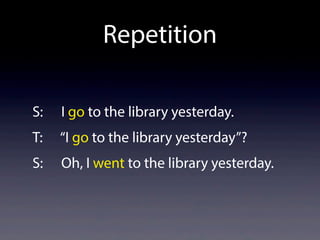
Repetition
S: I go to the library yesterday.
T: “I go to the library yesterday”?
S: Oh, I went to the library yesterday.
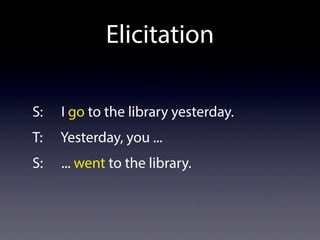
Elicitation
S: I go to the library yesterday.
T: Yesterday, you ...
S: ... went to the library.
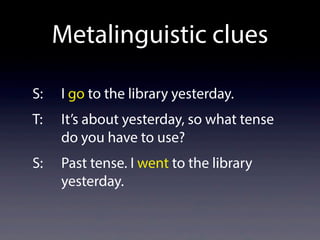
Metalinguistic clues
S: I go to the library yesterday.
T: It’s about yesterday, so what tense
do you have to use?
S: Past tense. I went to the library
yesterday.
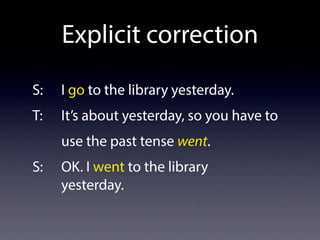
Explicit correction
S: I go to the library yesterday.
T: It’s about yesterday, so you have to
use the past tense went.
S: OK. I went to the library
yesterday.
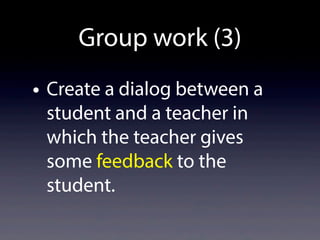
Group work (3)
• Create a dialog between a
student and a teacher in
which the teacher gives
some feedback to the
student.
Feedback options
Feedback type Explicit–Implicit Correction
Clarification request
Implicit
Explicit
–
Recast
Implicit
Explicit
+
Repetition
Implicit
Explicit
–
Elicitation
Implicit
Explicit
–
Metalinguistic clue
Implicit
Explicit
–
Explicit correction
Implicit
Explicit
+
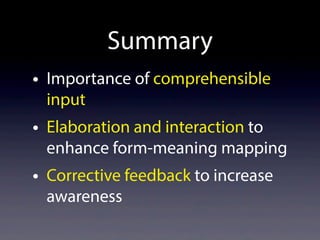
Summary
• Importance of comprehensible
input
• Elaboration and interaction to
enhance form-meaning mapping
• Corrective feedback to increase
awareness
My last question
• How will you incorporate
today’s ideas into your
teaching?
My last question
Fin

Input, interaction, and the roles of Japanese teachers of English: A second language acquisition perspective