X-based language teaching  西北师范大学 武和平 [email_address] http://www.engengine.net 兰化一中  2007
Key points highlighted Pendulum Phenomenon: a historical perspective Focus on what?  Based on what?
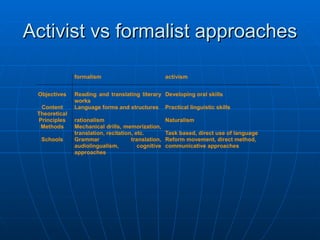
Pendulum Phenomenon: a historical perspective  The need of language teaching arose at the time when there was communication between two people  The Tower of Babel Classic languages and modern languages  The pendulum phenomenon  Activist vs formalist approaches
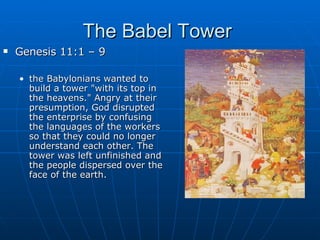
The Babel Tower  Genesis 11:1 – 9 the Babylonians wanted to build a tower "with its top in the heavens." Angry at their presumption, God disrupted the enterprise by confusing the languages of the workers so that they could no longer understand each other. The tower was left unfinished and the people dispersed over the face of the earth.
The classic languages and modern languages Classic languages Latin & Greek Renaissance Movement: revival of the Classical Works Part of noble education: aristocracy Reading and translation  Modern Languages English, German and French Industrial revolution Public education  Communicative skills
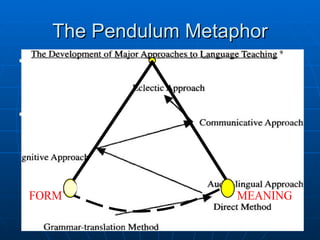
The Pendulum Metaphor History of language teaching shows it swinging like a pendulum between extremes of method as teachers have searched for different solutions.  We have seen a pendulum swing in grammar teaching, from the well-established Grammar-Translation Method and its many variants, to pure meaning-based language teaching during the 1980s; and the pendulum is now on its return swing.
Activist vs formalist approaches
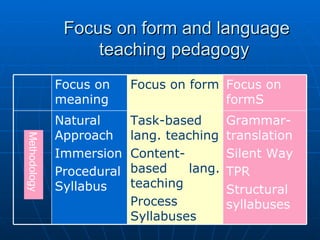
Focus on what?  The greatest difficulty confronting language teachers is to handle the conflict between  form  and  meaning .  Focus on meaning?  Focus on forms? or Focus on form
Focus on form and language teaching pedagogy   Methodology Grammar-translation Silent Way TPR Structural syllabuses   Task-based  lang. teaching Content-based lang. teaching Process Syllabuses   Natural Approach Immersion Procedural Syllabus   Focus on formS   Focus on form   Focus on meaning
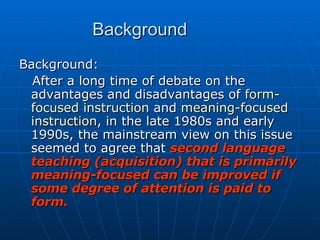
Background   Background: After a long time of debate on the advantages and disadvantages of  form-focused instruction  and  meaning-focused instruction , in the late 1980s and early 1990s, the mainstream view on this issue seemed to agree that  second language teaching (acquisition) that is primarily meaning-focused can be improved if some degree of attention is paid to form.

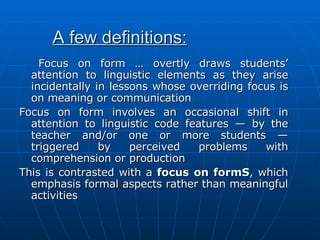
A few definitions: Focus on form … overtly draws students’ attention to linguistic elements as they arise incidentally in lessons whose overriding focus is on meaning or communication Focus on form involves an occasional shift in attention to linguistic code features — by the teacher and/or one or more students — triggered by perceived problems with comprehension or production This is contrasted with a  focus on formS , which emphasis formal aspects rather than meaningful activities
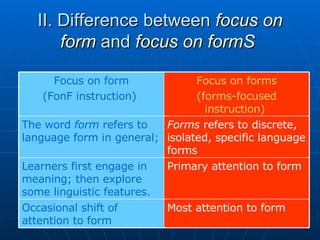
II. Difference between  focus on form  and  focus on formS   Most attention to form   Occasional shift of attention to form   Primary attention to form   Learners first engage in meaning; then explore some linguistic features.   Forms  refers to discrete, isolated, specific language forms   The word  form  refers to language form in general;   Focus on forms (forms-focused instruction)   Focus on form (FonF instruction)
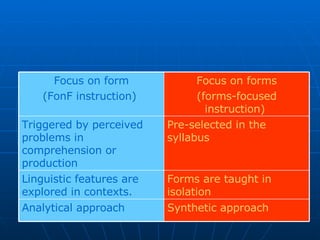
Synthetic approach   Analytical approach   Forms are taught in isolation   Linguistic features are explored in contexts.   Pre-selected in the syllabus   Triggered by perceived problems in comprehension or production   Focus on forms (forms-focused instruction)   Focus on form (FonF instruction)
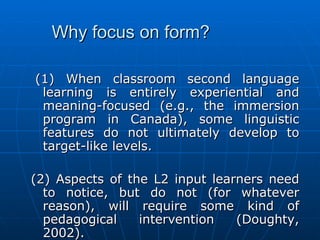
Why focus on form?   (1) When classroom second language learning is entirely experiential and meaning-focused (e.g., the immersion program in Canada), some linguistic features do not ultimately develop to target-like levels.   (2) Aspects of the L2 input learners need to notice, but do not (for whatever reason), will require some kind of pedagogical intervention (Doughty, 2002).
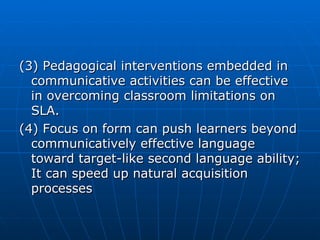
(3) Pedagogical interventions embedded in communicative activities can be effective in overcoming classroom limitations on SLA. (4) Focus on form can push learners beyond communicatively effective language toward target-like second language ability; It can speed up natural acquisition processes
Ways of focusing on form Conscious reflection Noticing the gap Hypothesis formulation and testing Meta-talk recasting Typographical (visual) input enhancement: manipulation of italics, bolding, enlargement, underlining, colouring,
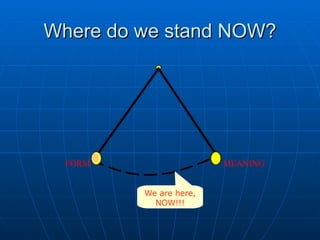
Where do we stand NOW? We are here, NOW!!!
What to base on?  Task-based approach Project-based approach Theme-based approach Content-based approach X-based approach
Task-based approach Tasks vs. exercises What are tasks?  What is task-based language teaching Examples Components of a task Pedagogical goals of task-based teaching
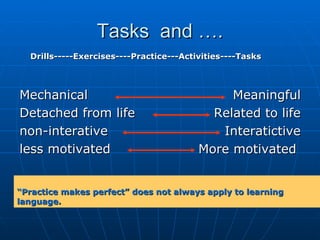
Tasks  and …. Mechanical Detached from life non-interative  less motivated Meaningful Related to life Interatictive More motivated  Drills-----Exercises----Practice---Activities----Tasks “ Practice makes perfect” does not always apply to learning language.
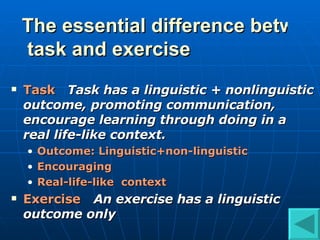
The essential difference between   task and exercise Task  Task has a linguistic + nonlinguistic outcome, promoting communication, encourage learning through doing in a real life-like context.  Outcome: Linguistic+non-linguistic  Encouraging Real-life-like  context Exercise   An exercise has a linguistic outcome only
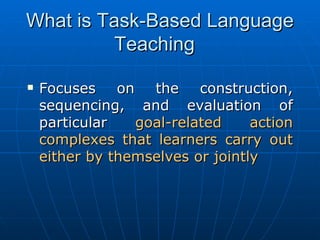
What is Task-Based Language Teaching  Focuses on the construction, sequencing, and evaluation of particular  goal-related action complexes that learners carry out either by themselves   or jointly
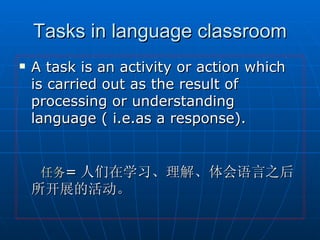
Tasks in language classroom A task is an activity or action which is carried out as the result of processing or understanding language ( i.e.as a response).   任务 = 人们在学习、理解、体会语言之后所开展的活动。
Success in the task is evaluated in terms of achievement of an outcome, and tasks generally  bear some resemblance to real-life language use .  A task-based approach sees the language process as one of  learning through doing --- it is primarily engaging in meaning that the learner’s system is encouraged to develop.
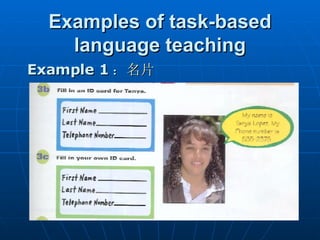
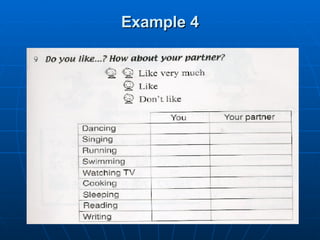
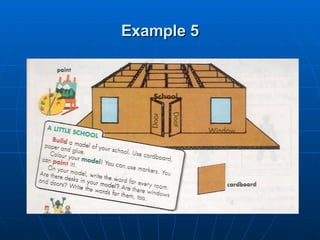
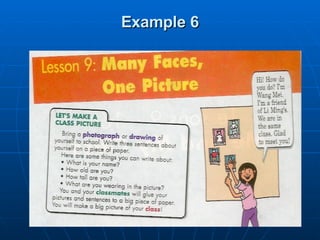
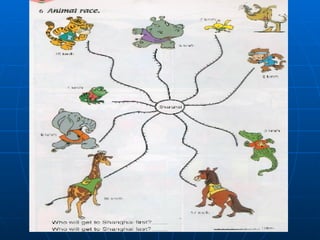
Examples of task-based language teaching Example 1 : 名片
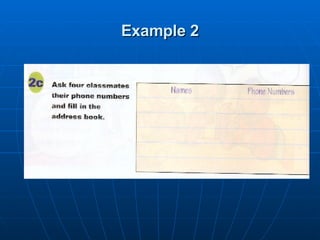
Example 2
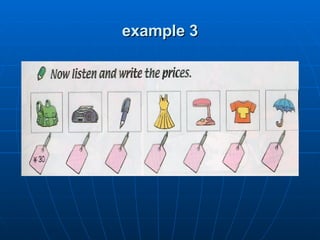
example 3
Example 4
Example 5
Example 6
Example 7
Example 8
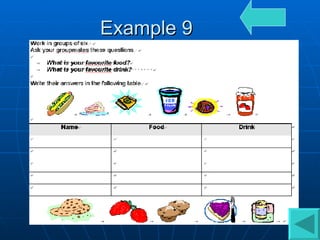
Example 9
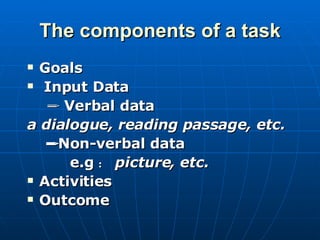
The components of a task Goals Input Data    Verbal data a dialogue, reading passage, etc.    Non-verbal data e.g : picture, etc. Activities Outcome
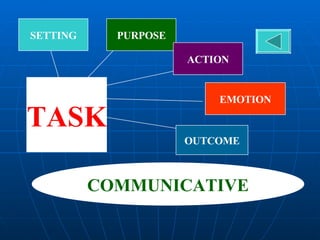
TASK COMMUNICATIVE SETTING PURPOSE ACTION EMOTION OUTCOME
Identify the objectives, input, activities and outcome of the demonstrative classroom teaching Watch the clips of the following demonstrative task-based teaching,  and answer the following questions.  What are the objectives of this task? What input data are provided, both linguistically and non-linguistically What are the activities? What is (are) the outcome(s( of the task? Pre-task ,  while-task    Post-task
Final tasks in which the students in the classroom interact There is a tangible end product :  posters, letters to penfriends, pool information on everybody’s birthdays and produce a poster to be kept in the classroom. Make a plan for a school outing and carry out plans and go on an outing. Carry out a class survey on ‘who does the housework at home?’
Content-based instruction CBI is "...the integration of particular content with language teaching aims...the concurrent teaching of academic subject matter and second language skills" CBI approaches "...view the target language largely as the vehicle   through which subject matter content is learned rather than as the immediate object of study"  CBI is "...an approach to language instruction that integrates the presentation of topics or tasks from subject matter classes (e.g., math, social studies) within the context of teaching a second or foreign language"
Theme-based instruction Theme-based instruction is organized around the theme while integrating language objectives into the unit.  Using themes to teach English language learners promotes automaticity, meaningful learning, intrinsic motivation and communicative competence.
Project based learning Project-based learning asks a question or poses a problem that each student can answer. Project-based learning asks students to investigate issues and topics addressing real-world problems while integrating subjects across the curriculum. Project-based learning is a method that fosters abstract, intellectual tasks to explore complex issues.
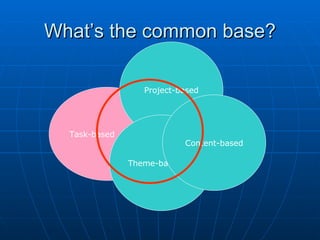
What’s the common base? Task-based Project-based Theme-based Content-based
X-based ELT: what’s the common base?  Priority given to meaning  Closely related with learners’ life experience Supported by a rich supply of accessible resources Students greatly motivated  Just-in-case vs. just-in-need
Thanks a great deal

X-based language teaching approaches

  • 1.
    X-based language teaching 西北师范大学 武和平 [email_address] http://www.engengine.net 兰化一中 2007
  • 2.
    Key points highlightedPendulum Phenomenon: a historical perspective Focus on what? Based on what?
  • 3.
    Pendulum Phenomenon: ahistorical perspective The need of language teaching arose at the time when there was communication between two people The Tower of Babel Classic languages and modern languages The pendulum phenomenon Activist vs formalist approaches
  • 4.
    The Babel Tower Genesis 11:1 – 9 the Babylonians wanted to build a tower "with its top in the heavens." Angry at their presumption, God disrupted the enterprise by confusing the languages of the workers so that they could no longer understand each other. The tower was left unfinished and the people dispersed over the face of the earth.
  • 5.
    The classic languagesand modern languages Classic languages Latin & Greek Renaissance Movement: revival of the Classical Works Part of noble education: aristocracy Reading and translation Modern Languages English, German and French Industrial revolution Public education Communicative skills
  • 6.
    The Pendulum MetaphorHistory of language teaching shows it swinging like a pendulum between extremes of method as teachers have searched for different solutions. We have seen a pendulum swing in grammar teaching, from the well-established Grammar-Translation Method and its many variants, to pure meaning-based language teaching during the 1980s; and the pendulum is now on its return swing.
  • 7.
  • 8.
    Focus on what? The greatest difficulty confronting language teachers is to handle the conflict between form and meaning . Focus on meaning? Focus on forms? or Focus on form
  • 9.
    Focus on formand language teaching pedagogy Methodology Grammar-translation Silent Way TPR Structural syllabuses Task-based lang. teaching Content-based lang. teaching Process Syllabuses Natural Approach Immersion Procedural Syllabus Focus on formS Focus on form Focus on meaning
  • 10.
    Background Background: After a long time of debate on the advantages and disadvantages of form-focused instruction and meaning-focused instruction , in the late 1980s and early 1990s, the mainstream view on this issue seemed to agree that second language teaching (acquisition) that is primarily meaning-focused can be improved if some degree of attention is paid to form.
  • 11.
    A few definitions:Focus on form … overtly draws students’ attention to linguistic elements as they arise incidentally in lessons whose overriding focus is on meaning or communication Focus on form involves an occasional shift in attention to linguistic code features — by the teacher and/or one or more students — triggered by perceived problems with comprehension or production This is contrasted with a focus on formS , which emphasis formal aspects rather than meaningful activities
  • 12.
    II. Difference between focus on form and focus on formS Most attention to form Occasional shift of attention to form Primary attention to form Learners first engage in meaning; then explore some linguistic features. Forms refers to discrete, isolated, specific language forms The word form refers to language form in general; Focus on forms (forms-focused instruction) Focus on form (FonF instruction)
  • 13.
    Synthetic approach Analytical approach Forms are taught in isolation Linguistic features are explored in contexts. Pre-selected in the syllabus Triggered by perceived problems in comprehension or production Focus on forms (forms-focused instruction) Focus on form (FonF instruction)
  • 14.
    Why focus onform?   (1) When classroom second language learning is entirely experiential and meaning-focused (e.g., the immersion program in Canada), some linguistic features do not ultimately develop to target-like levels.   (2) Aspects of the L2 input learners need to notice, but do not (for whatever reason), will require some kind of pedagogical intervention (Doughty, 2002).
  • 15.
    (3) Pedagogical interventionsembedded in communicative activities can be effective in overcoming classroom limitations on SLA. (4) Focus on form can push learners beyond communicatively effective language toward target-like second language ability; It can speed up natural acquisition processes
  • 16.
    Ways of focusingon form Conscious reflection Noticing the gap Hypothesis formulation and testing Meta-talk recasting Typographical (visual) input enhancement: manipulation of italics, bolding, enlargement, underlining, colouring,
  • 17.
    Where do westand NOW? We are here, NOW!!!
  • 18.
    What to baseon? Task-based approach Project-based approach Theme-based approach Content-based approach X-based approach
  • 19.
    Task-based approach Tasksvs. exercises What are tasks? What is task-based language teaching Examples Components of a task Pedagogical goals of task-based teaching
  • 20.
    Tasks and…. Mechanical Detached from life non-interative less motivated Meaningful Related to life Interatictive More motivated Drills-----Exercises----Practice---Activities----Tasks “ Practice makes perfect” does not always apply to learning language.
  • 21.
    The essential differencebetween task and exercise Task Task has a linguistic + nonlinguistic outcome, promoting communication, encourage learning through doing in a real life-like context. Outcome: Linguistic+non-linguistic Encouraging Real-life-like context Exercise An exercise has a linguistic outcome only
  • 22.
    What is Task-BasedLanguage Teaching Focuses on the construction, sequencing, and evaluation of particular goal-related action complexes that learners carry out either by themselves or jointly
  • 23.
    Tasks in languageclassroom A task is an activity or action which is carried out as the result of processing or understanding language ( i.e.as a response). 任务 = 人们在学习、理解、体会语言之后所开展的活动。
  • 24.
    Success in thetask is evaluated in terms of achievement of an outcome, and tasks generally bear some resemblance to real-life language use . A task-based approach sees the language process as one of learning through doing --- it is primarily engaging in meaning that the learner’s system is encouraged to develop.
  • 25.
    Examples of task-basedlanguage teaching Example 1 : 名片
  • 26.
  • 27.
  • 28.
  • 29.
  • 30.
  • 31.
  • 32.
  • 33.
  • 34.
    The components ofa task Goals Input Data  Verbal data a dialogue, reading passage, etc.  Non-verbal data e.g : picture, etc. Activities Outcome
  • 35.
    TASK COMMUNICATIVE SETTINGPURPOSE ACTION EMOTION OUTCOME
  • 36.
    Identify the objectives,input, activities and outcome of the demonstrative classroom teaching Watch the clips of the following demonstrative task-based teaching, and answer the following questions. What are the objectives of this task? What input data are provided, both linguistically and non-linguistically What are the activities? What is (are) the outcome(s( of the task? Pre-task , while-task Post-task
  • 37.
    Final tasks inwhich the students in the classroom interact There is a tangible end product : posters, letters to penfriends, pool information on everybody’s birthdays and produce a poster to be kept in the classroom. Make a plan for a school outing and carry out plans and go on an outing. Carry out a class survey on ‘who does the housework at home?’
  • 38.
    Content-based instruction CBIis "...the integration of particular content with language teaching aims...the concurrent teaching of academic subject matter and second language skills" CBI approaches "...view the target language largely as the vehicle through which subject matter content is learned rather than as the immediate object of study" CBI is "...an approach to language instruction that integrates the presentation of topics or tasks from subject matter classes (e.g., math, social studies) within the context of teaching a second or foreign language"
  • 39.
    Theme-based instruction Theme-basedinstruction is organized around the theme while integrating language objectives into the unit. Using themes to teach English language learners promotes automaticity, meaningful learning, intrinsic motivation and communicative competence.
  • 40.
    Project based learningProject-based learning asks a question or poses a problem that each student can answer. Project-based learning asks students to investigate issues and topics addressing real-world problems while integrating subjects across the curriculum. Project-based learning is a method that fosters abstract, intellectual tasks to explore complex issues.
  • 41.
    What’s the commonbase? Task-based Project-based Theme-based Content-based
  • 42.
    X-based ELT: what’sthe common base? Priority given to meaning Closely related with learners’ life experience Supported by a rich supply of accessible resources Students greatly motivated Just-in-case vs. just-in-need
  • 43.