




Noticing and acquiring
lexical bundles with
schematic linguistic
representation
Haidee Thomson | MA TESOL candidate
Victoria University of Wellington, New Zealand
Fuji Women’s University, Japan
1

Slides available at www.haideethomson.com
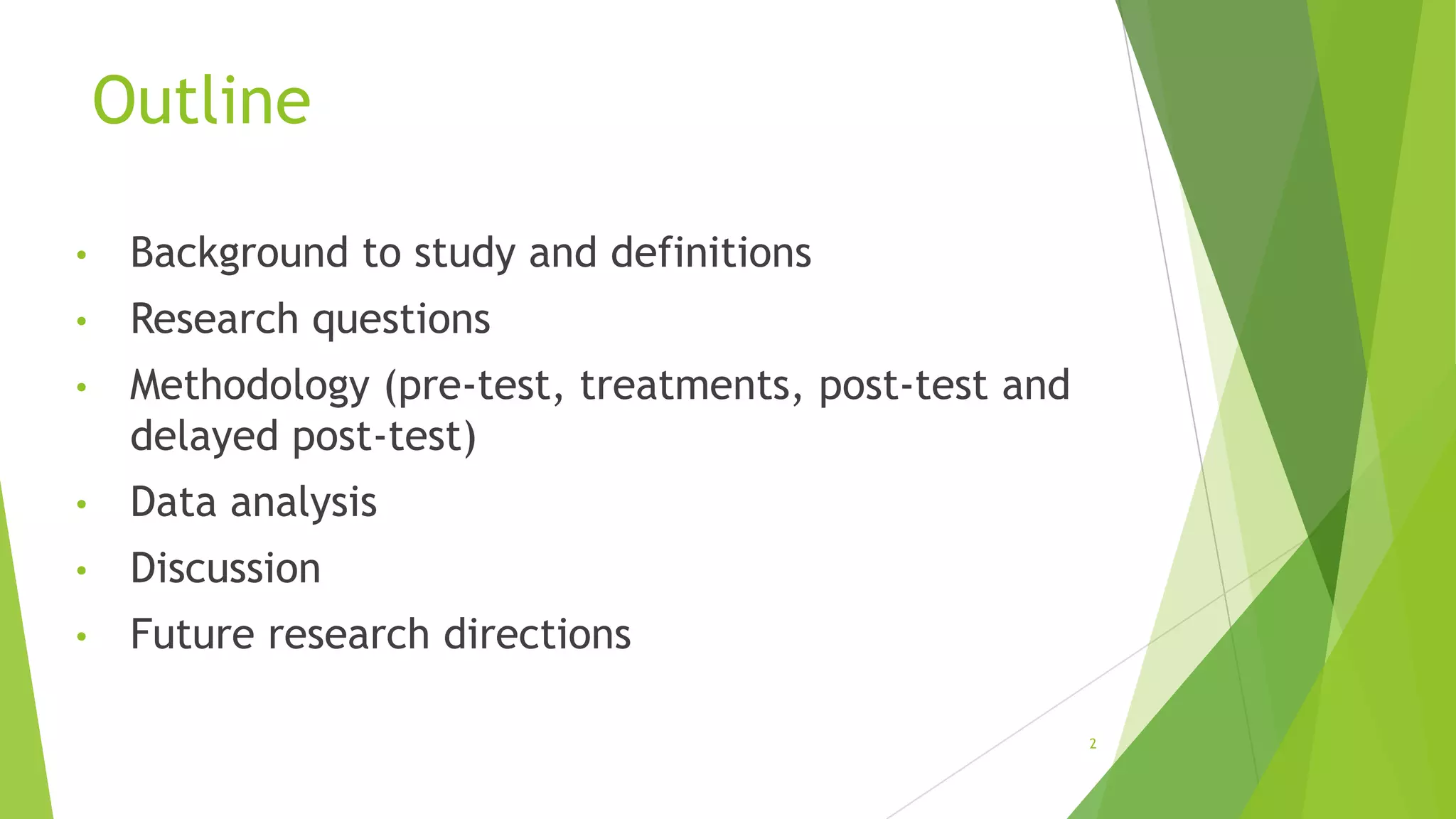
Outline
•

Background to study and definitions

•

Research questions

•

Methodology (pre-test, treatments, post-test and
delayed post-test)

•

Data analysis

•

Discussion

•

Future research directions
2
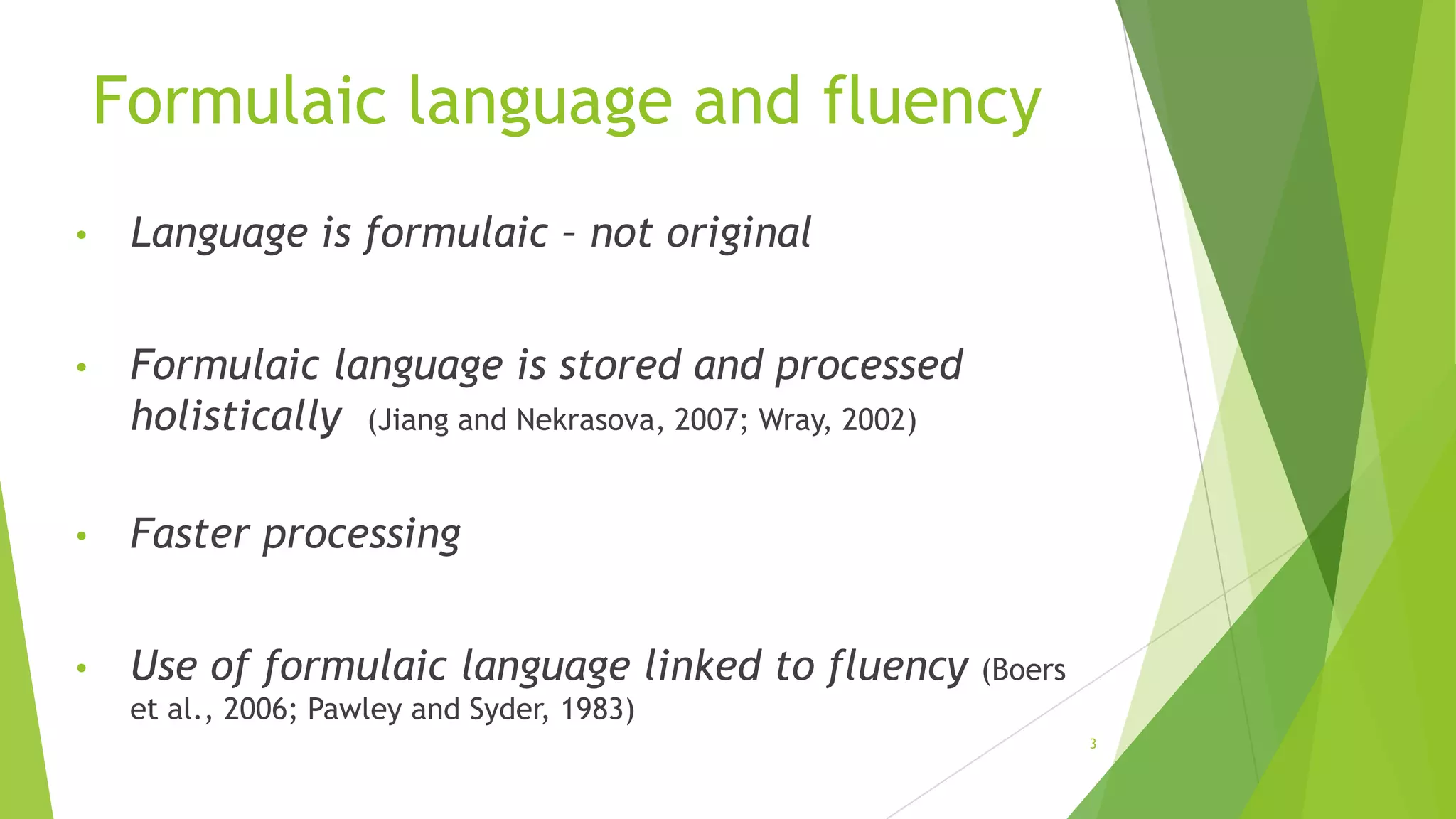
Formulaic language and fluency
•

Language is formulaic – not original

•

Formulaic language is stored and processed
holistically (Jiang and Nekrasova, 2007; Wray, 2002)

•

Faster processing

•

Use of formulaic language linked to fluency

(Boers

et al., 2006; Pawley and Syder, 1983)
3
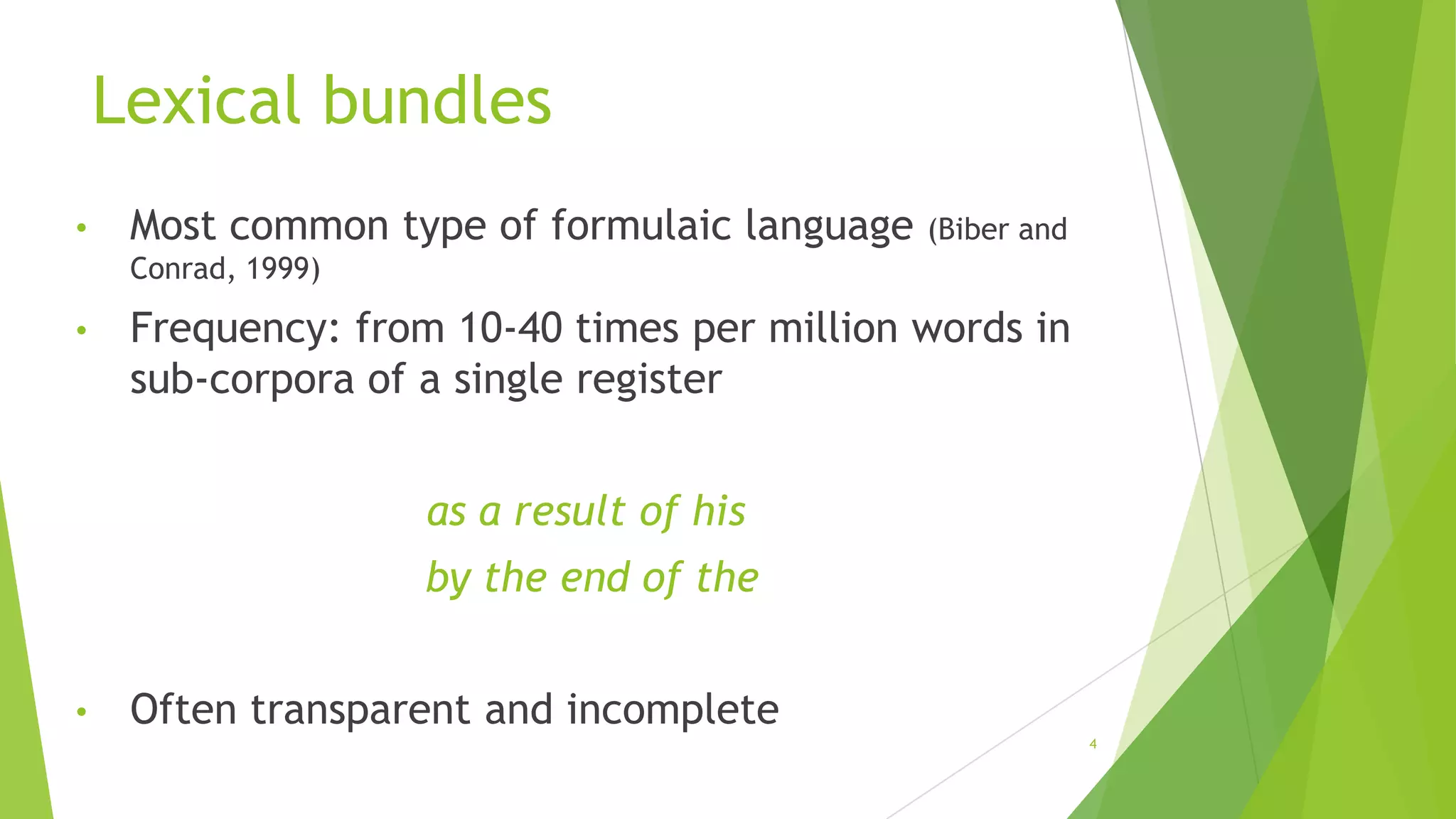
Lexical bundles
•

Most common type of formulaic language

(Biber and

Conrad, 1999)

•

Frequency: from 10-40 times per million words in
sub-corpora of a single register
as a result of his

by the end of the
•

Often transparent and incomplete
4
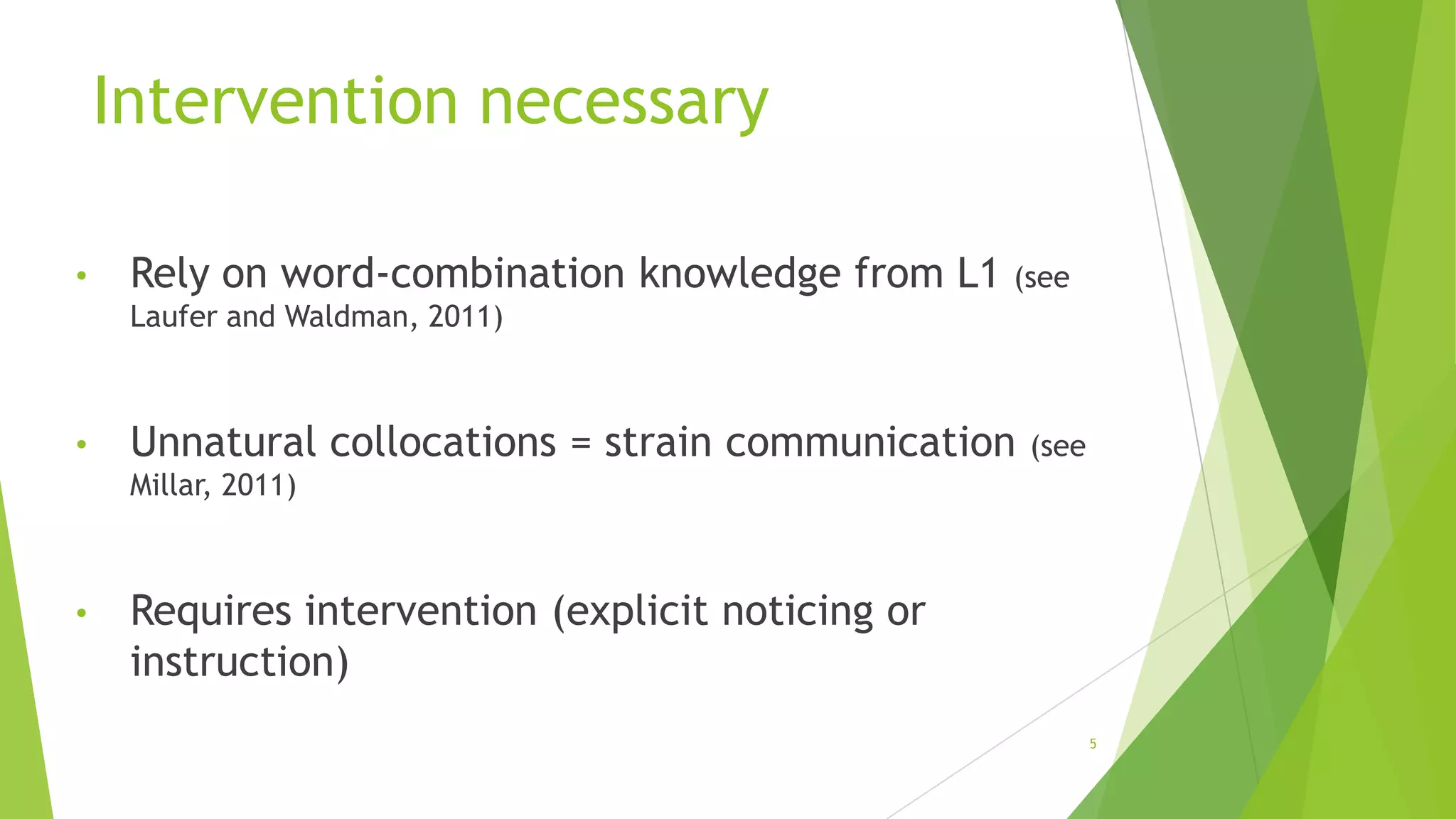
Intervention necessary
•

Rely on word-combination knowledge from L1 (see
Laufer and Waldman, 2011)

•

Unnatural collocations = strain communication

(see

Millar, 2011)

•

Requires intervention (explicit noticing or
instruction)
5
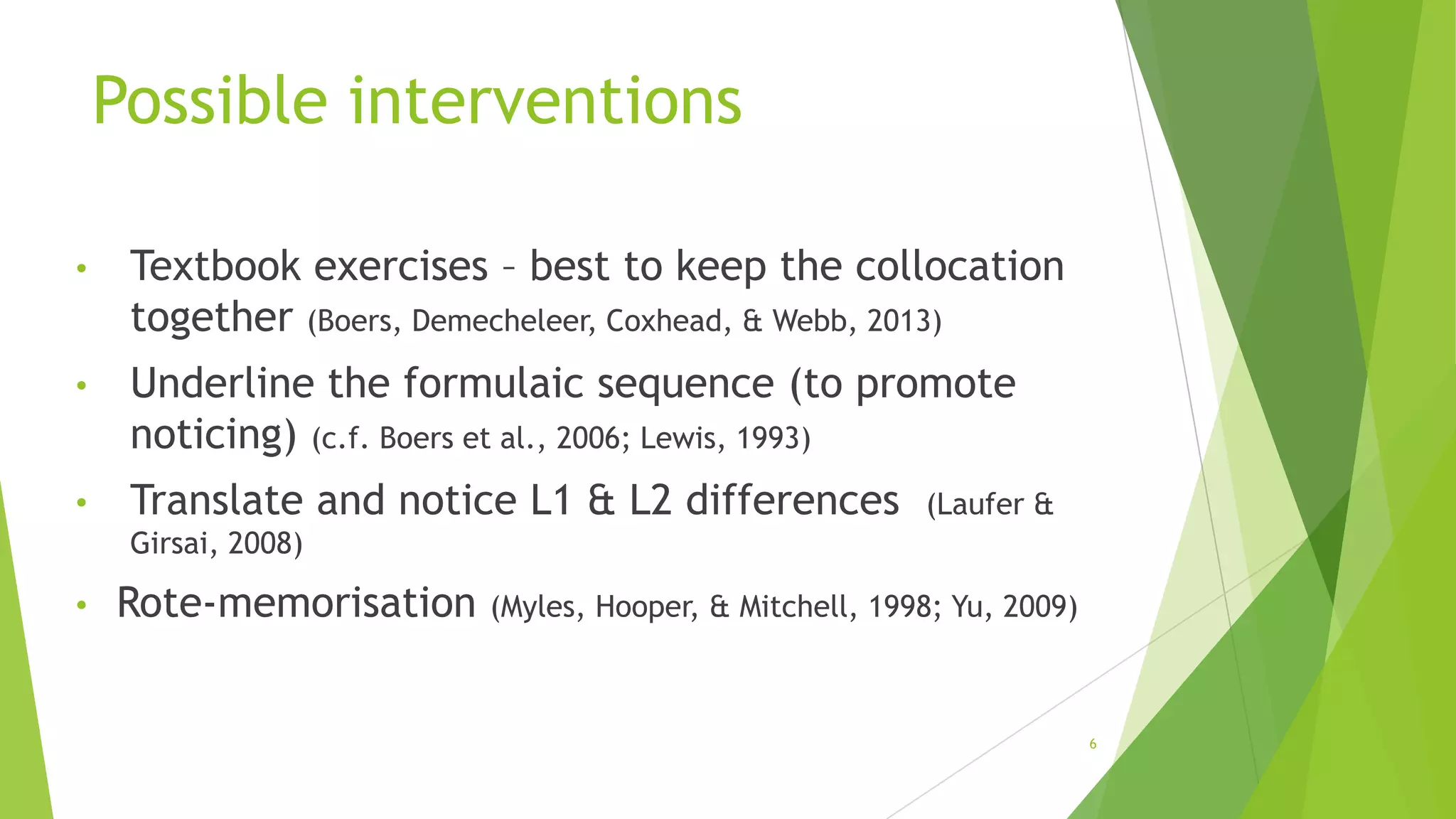
Possible interventions
•

Textbook exercises – best to keep the collocation
together (Boers, Demecheleer, Coxhead, & Webb, 2013)

•

Underline the formulaic sequence (to promote
noticing) (c.f. Boers et al., 2006; Lewis, 1993)

•

Translate and notice L1 & L2 differences

(Laufer &

Girsai, 2008)

•

Rote-memorisation

(Myles, Hooper, & Mitchell, 1998; Yu, 2009)

6
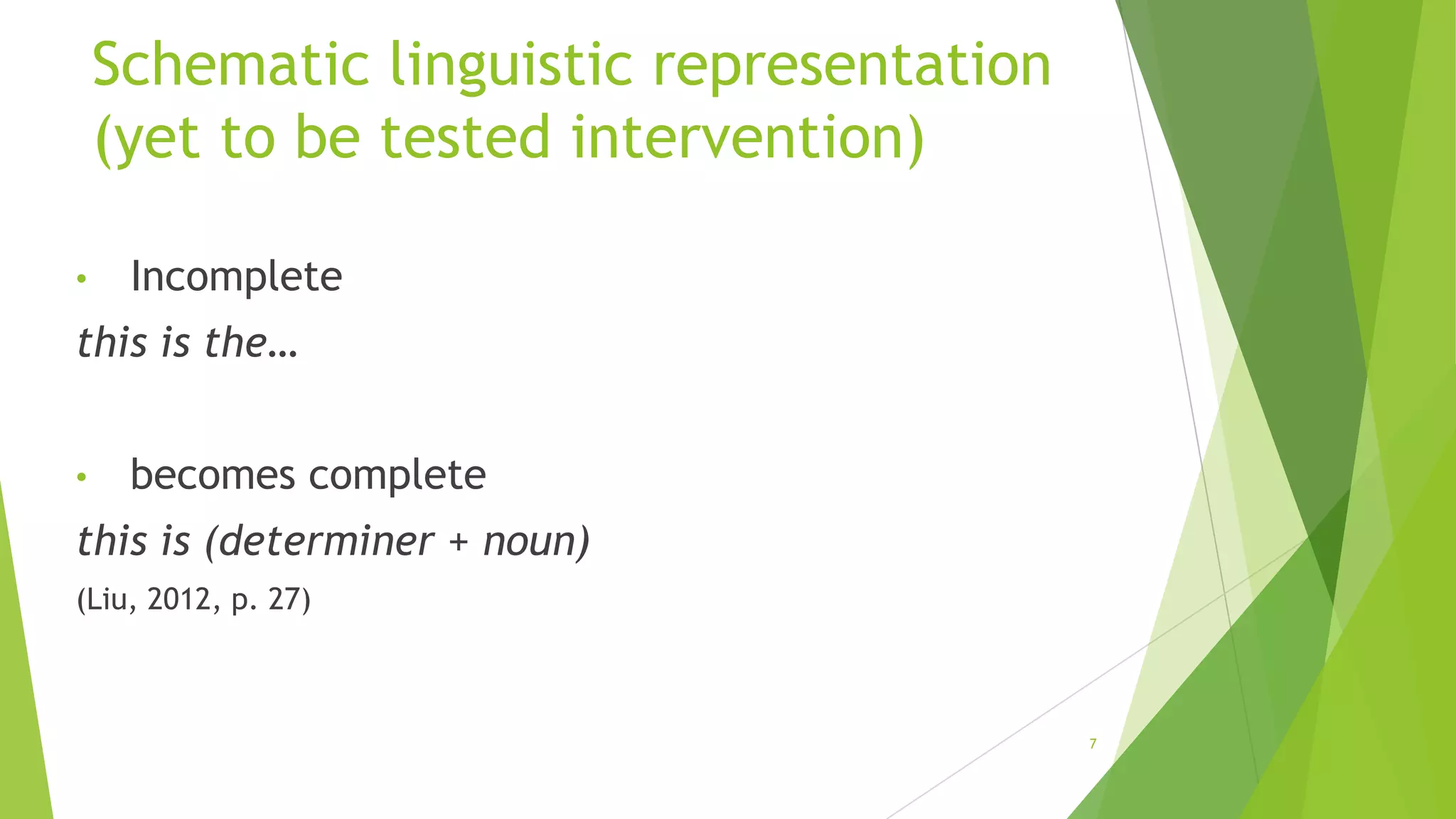
Schematic linguistic representation
(yet to be tested intervention)
•

Incomplete

this is the…
•

becomes complete

this is (determiner + noun)
(Liu, 2012, p. 27)

7
Research question
•

Can non-major EFL learners in a Japanese university produce more
lexical bundles after they have been noticed with schematic
linguistic representation in a text?

•

Compared to previous methods, how effective is noticing with
schematic linguistic representation for learning lexical bundles?

8
Methodology
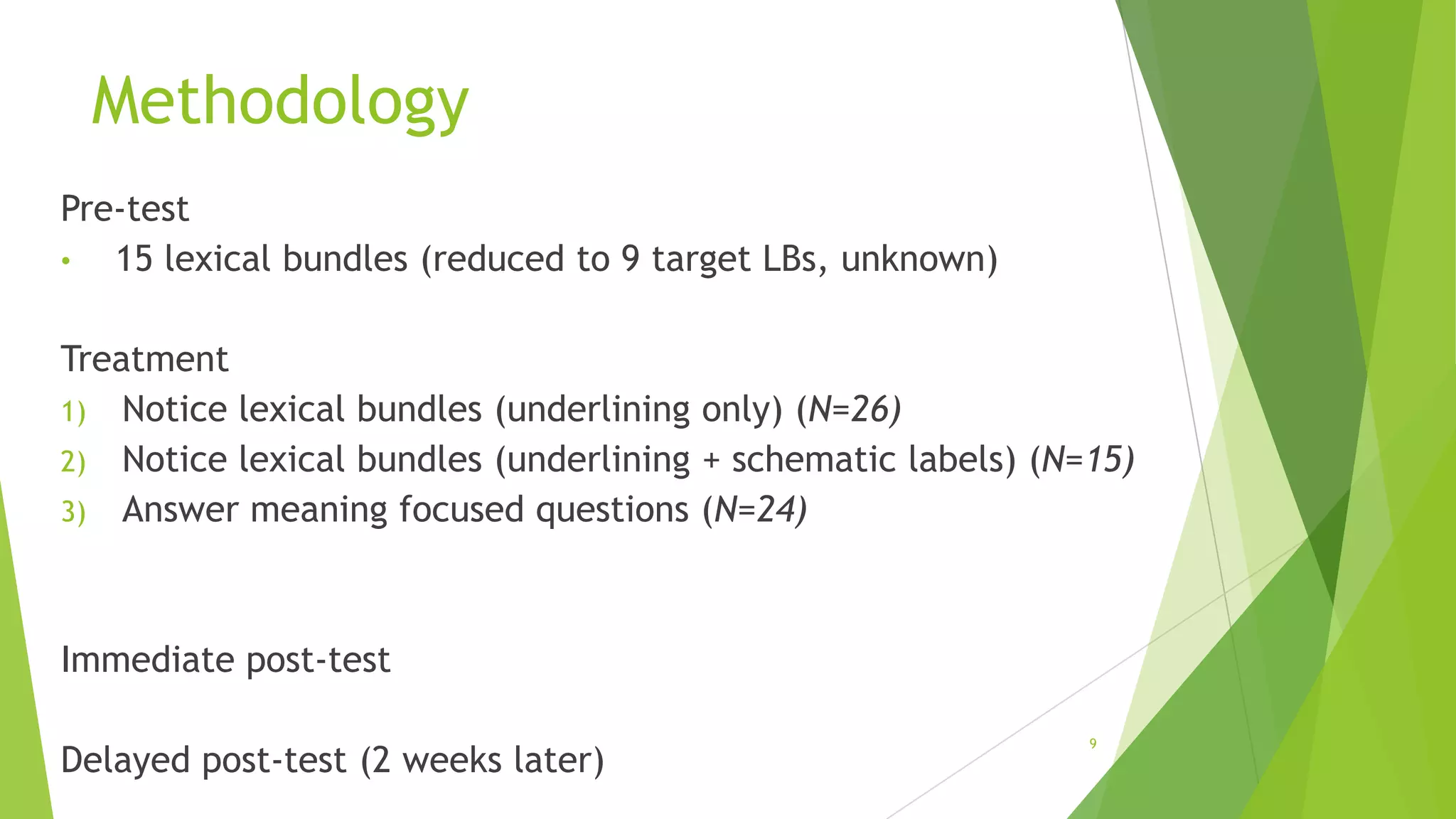
Pre-test
•
15 lexical bundles (reduced to 9 target LBs, unknown)
Treatment
1) Notice lexical bundles (underlining only) (N=26)
2) Notice lexical bundles (underlining + schematic labels) (N=15)
3) Answer meaning focused questions (N=24)

Immediate post-test
Delayed post-test (2 weeks later)

9
Participants

•

3 intact classes at a private university in Japan

•

Share Japanese as L1

•

Completed high school and 1st year English classes

•

Second year mixed proficiency classes

•

N=65
10
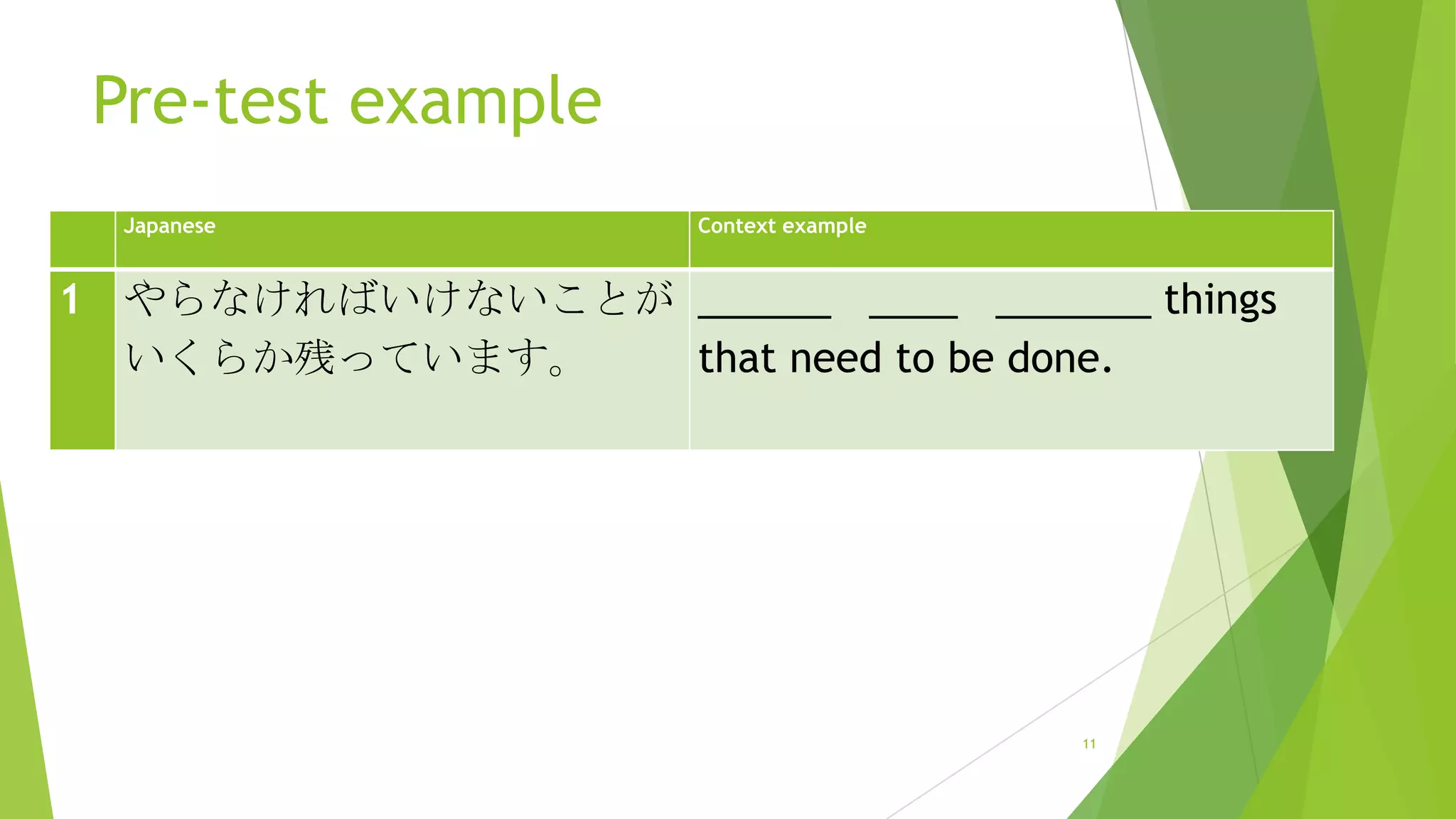
Pre-test example
Japanese

Context example

1 やらなければいけないことが ______ ____ _______ things
いくらか残っています。
that need to be done.

11
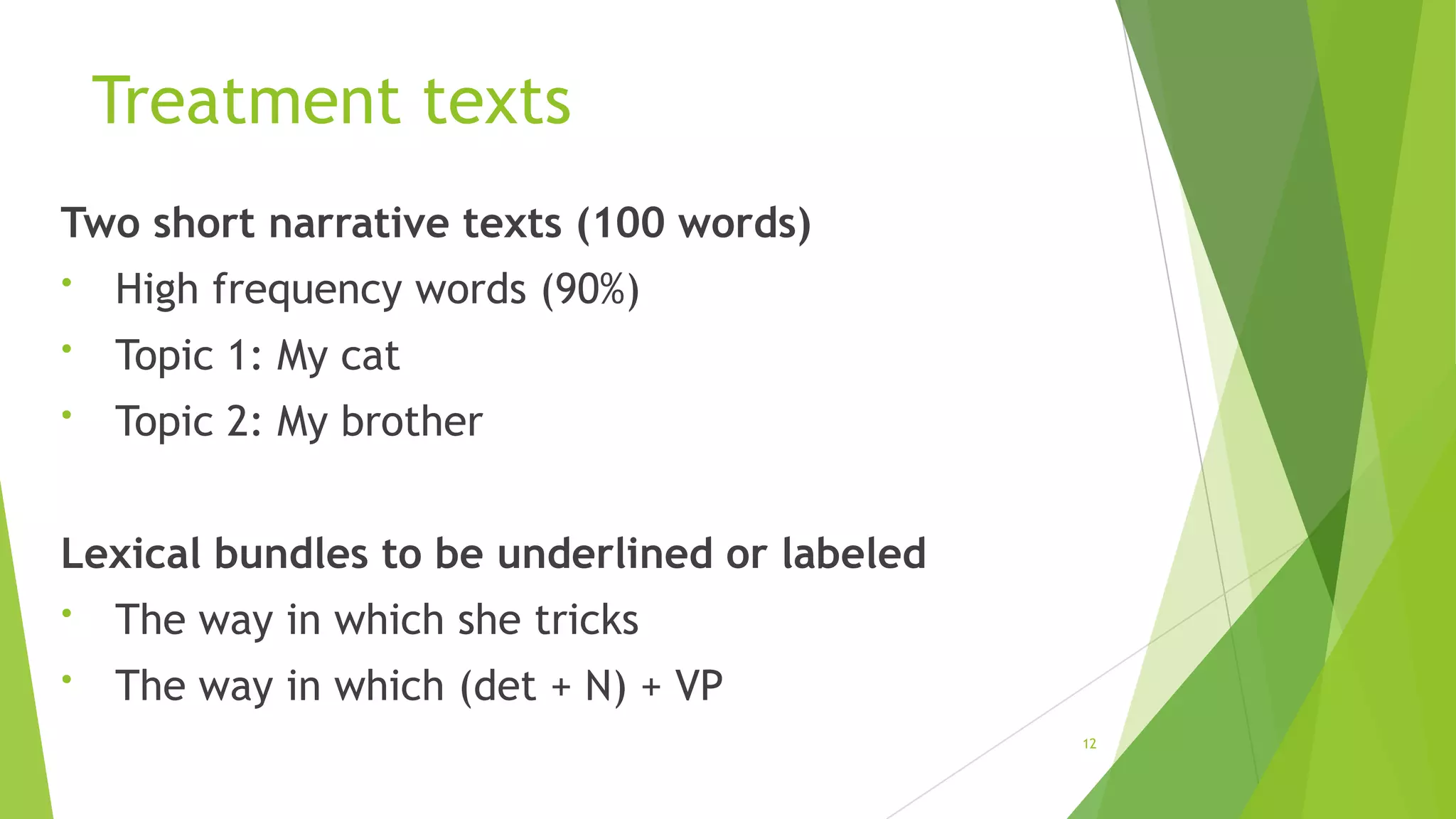
Treatment texts
Two short narrative texts (100 words)
•

High frequency words (90%)

•

Topic 1: My cat

•

Topic 2: My brother

Lexical bundles to be underlined or labeled
•

The way in which she tricks

•

The way in which (det + N) + VP
12
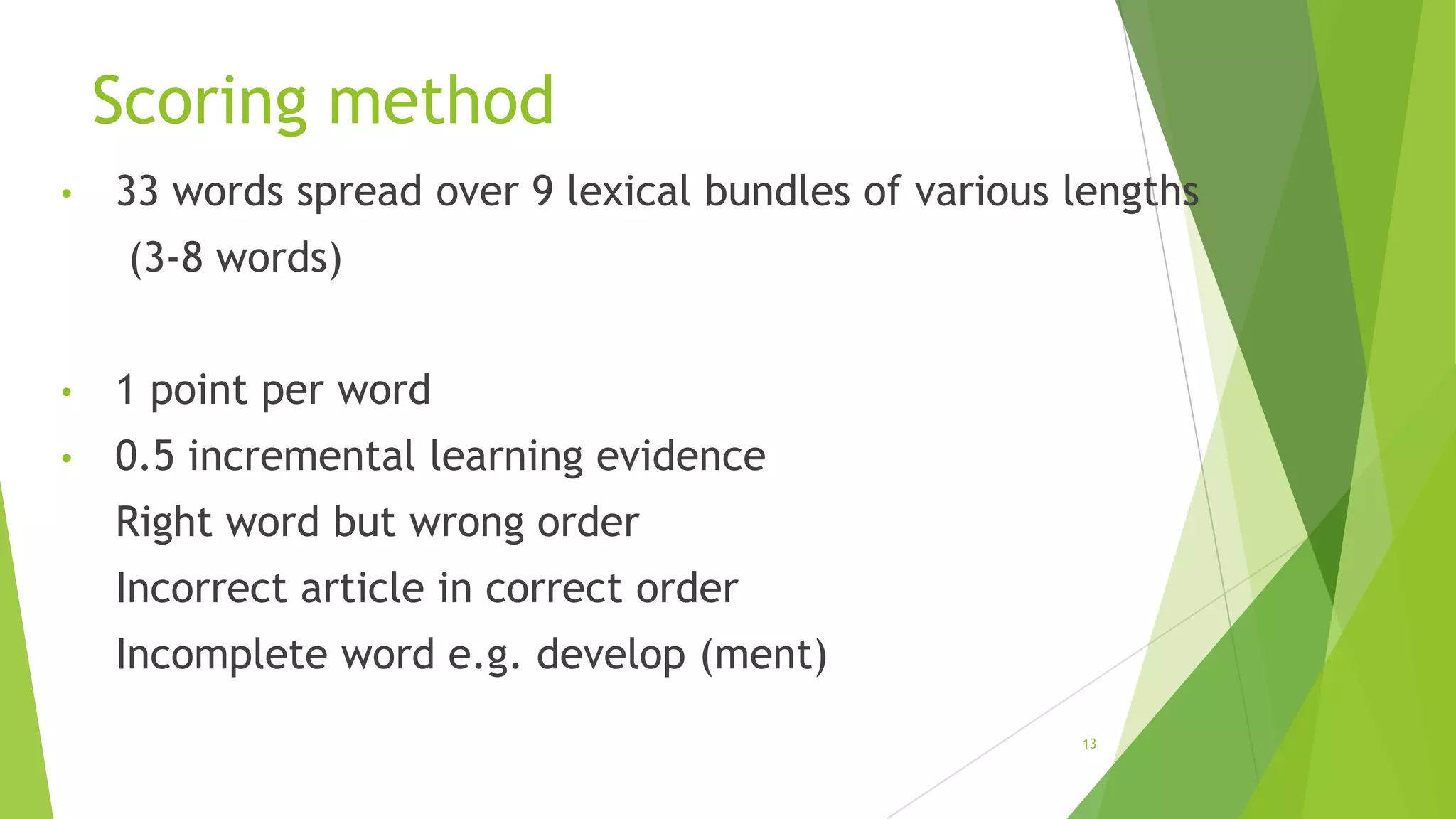
Scoring method
•

33 words spread over 9 lexical bundles of various lengths
(3-8 words)

•

1 point per word

•

0.5 incremental learning evidence
Right word but wrong order

Incorrect article in correct order
Incomplete word e.g. develop (ment)
13
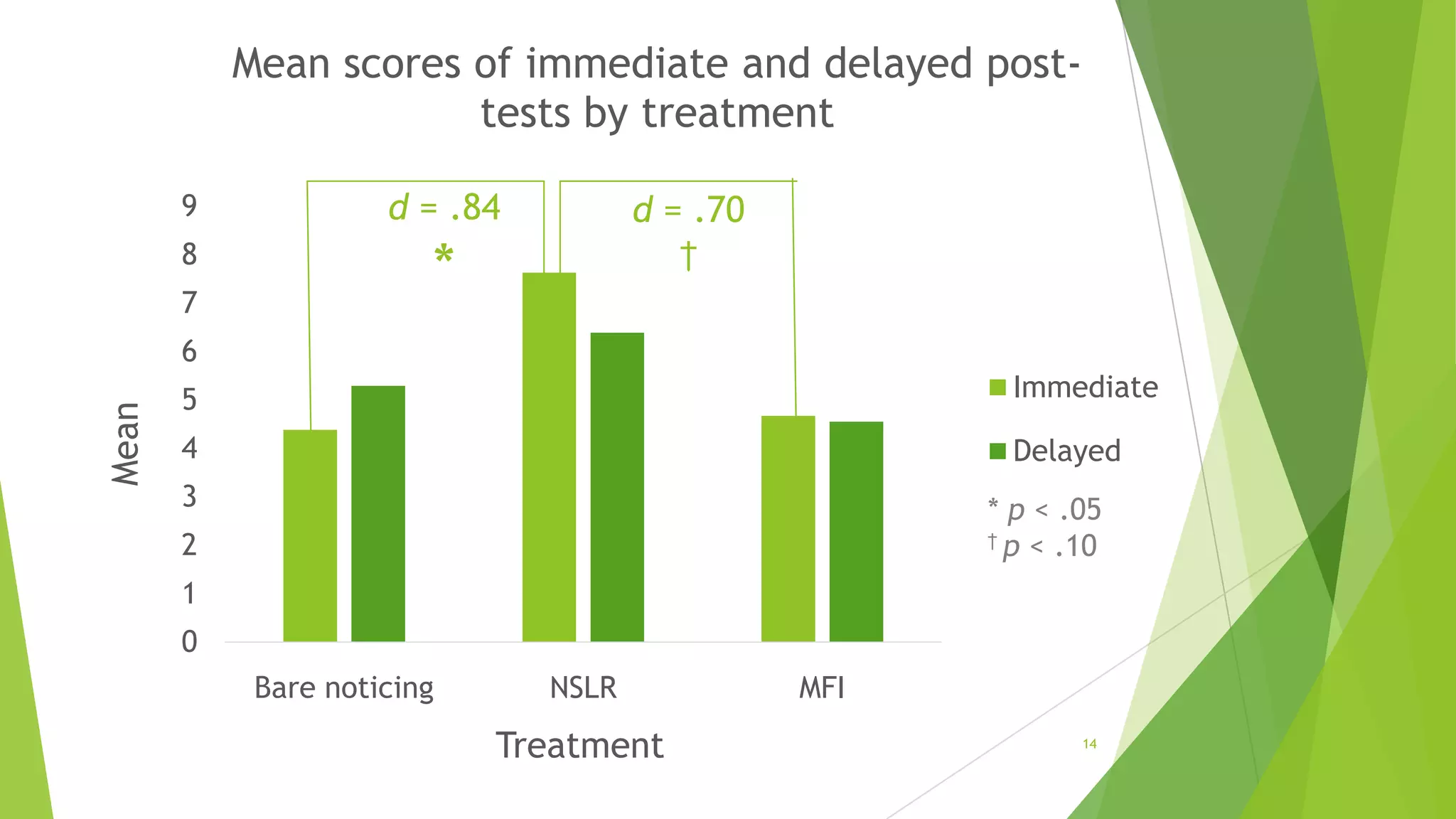
Mean scores of immediate and delayed posttests by treatment
9

d = .84

8

*

7

d = .70
†

Mean

6

5

Immediate

4

Delayed

3

* p < .05
† p < .10

2

1
0
Bare noticing

NSLR

Treatment

MFI
14
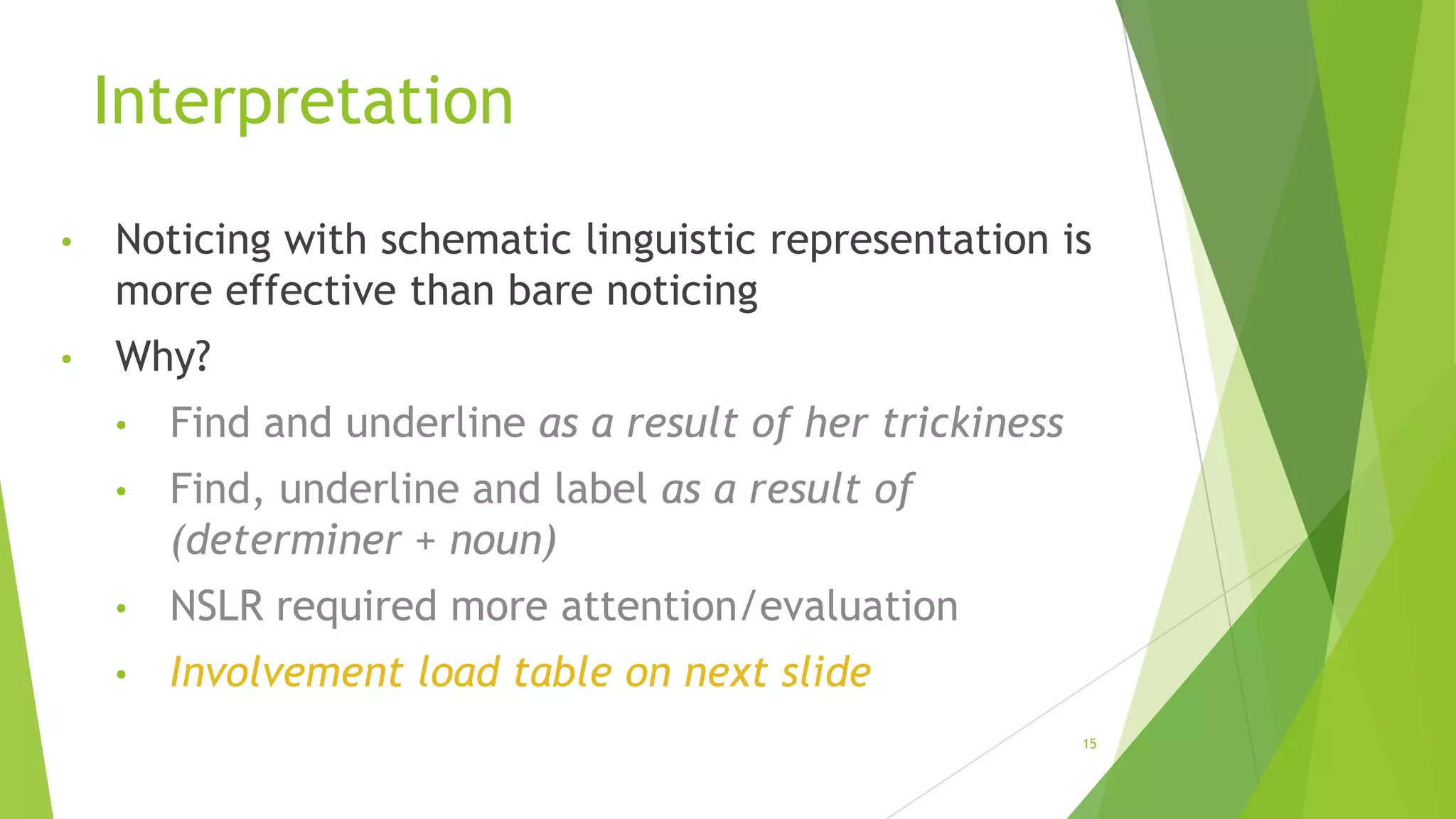
Interpretation
•

Noticing with schematic linguistic representation is
more effective than bare noticing

•

Why?
•

Find and underline as a result of her trickiness

•

Find, underline and label as a result of
(determiner + noun)

•

NSLR required more attention/evaluation

•

Involvement load table on next slide
15
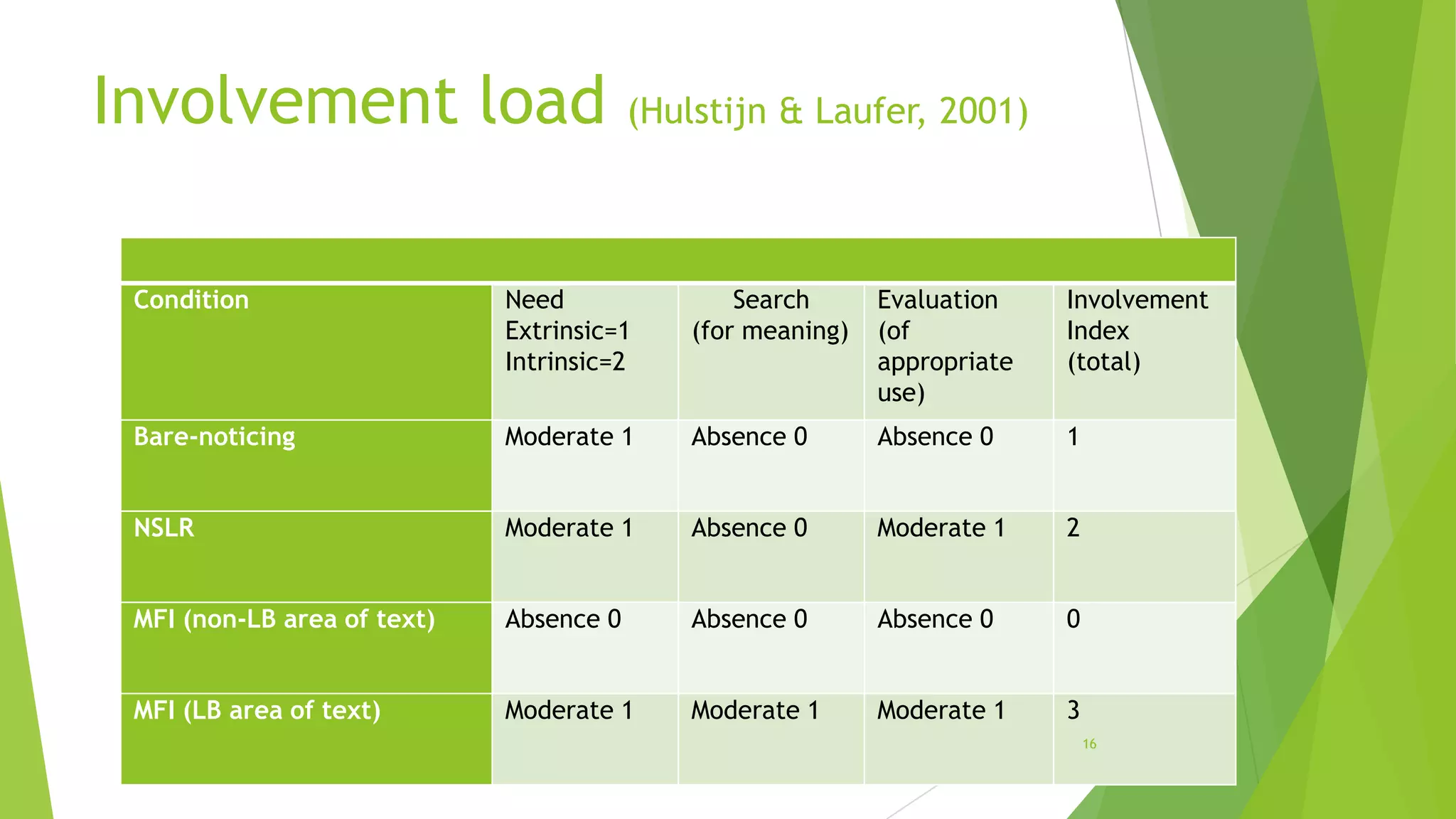
Involvement load

(Hulstijn & Laufer, 2001)

Condition

Need
Extrinsic=1
Intrinsic=2

Search
(for meaning)

Evaluation
(of
appropriate
use)

Involvement
Index
(total)

Bare-noticing

Moderate 1

Absence 0

Absence 0

1

NSLR

Moderate 1

Absence 0

Moderate 1

2

MFI (non-LB area of text)

Absence 0

Absence 0

Absence 0

0

MFI (LB area of text)

Moderate 1

Moderate 1

Moderate 1

3
16
Limitations

•

Participation was not constant

•

Lack of time with texts

•

Context sentences different in pre and post–tests

17
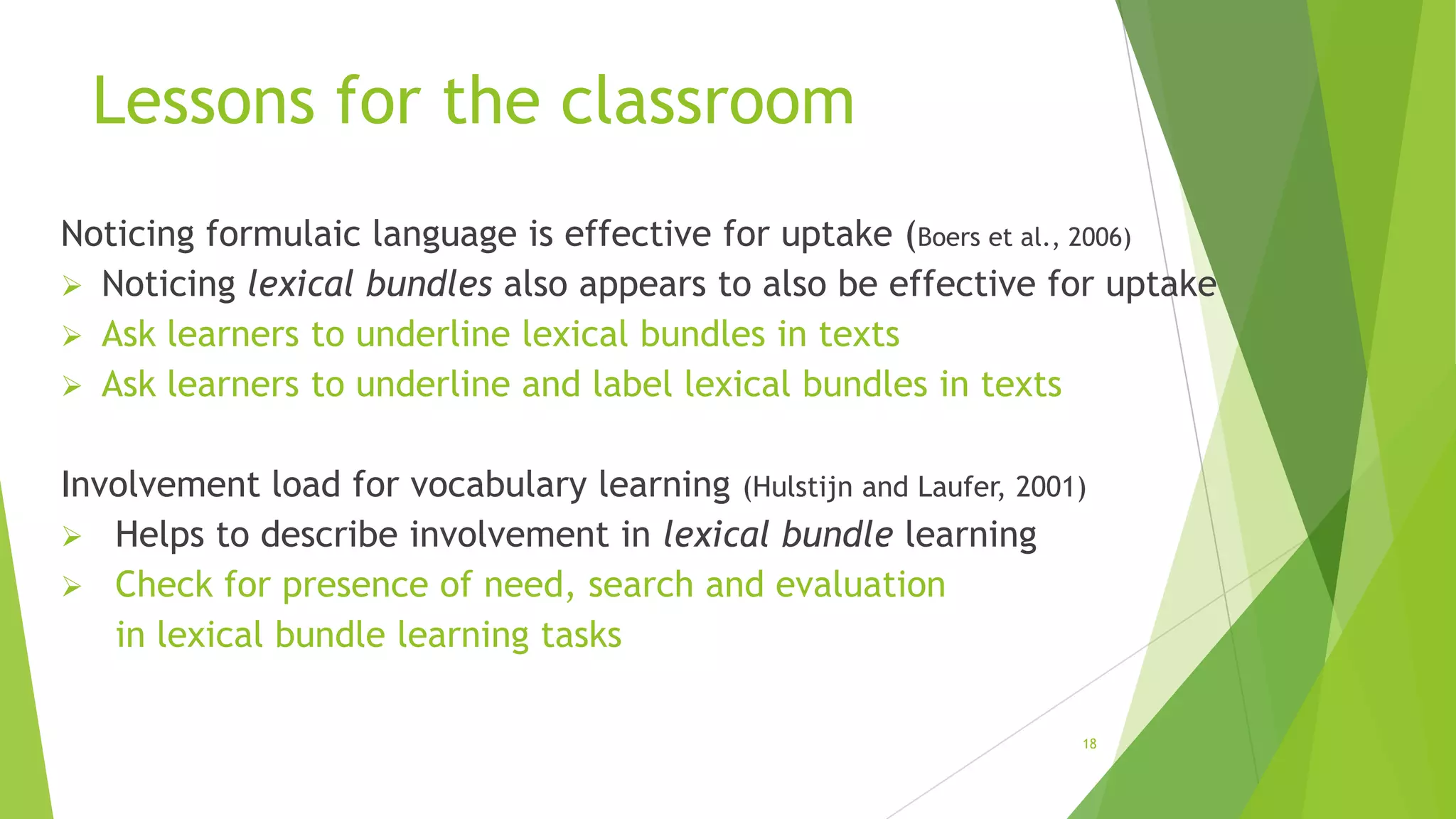
Lessons for the classroom
Noticing formulaic language is effective for uptake (Boers et al., 2006)
 Noticing lexical bundles also appears to also be effective for uptake
 Ask learners to underline lexical bundles in texts
 Ask learners to underline and label lexical bundles in texts
Involvement load for vocabulary learning (Hulstijn and Laufer, 2001)
 Helps to describe involvement in lexical bundle learning
 Check for presence of need, search and evaluation
in lexical bundle learning tasks
18
Future research directions
•

Ecologically valid classroom methods
(give list of lexical bundles, experiment with various
learning methods, analyse free production in writing
or speech)

•

Longitudinal study
One semester, one year etc.

•

Triangulate with survey asking about intentional
study or noticing target language outside of class

19
Thanks for listening!
•

Questions are welcome

Haidee Thomson
Email: haidee.thomson@gmail.com
Website: haideethomson.com
Sapporo, Japan

Biber, D., & Conrad, S. (1999). Lexical bundles in conversation and academic prose. In H. Hasselgård & S. Oksefjell (Eds.), Out of Corpora: Studies in Honour of Stig Johansson (pp. 181–190). Amsterdam: Rodopi.
Biber, Douglas, Conrad, S., & Cortes, V. (2004). If you look at …: Lexical bundles in university teaching and textbooks. Applied Linguistics, 25(3), 371–405. doi:10.1093/applin/25.3.371
Biber, Douglas, Conrad, S., & Leech, G. N. (2002). Longman Student Grammar of Spoken and Written English. Harlow: Longman.
Boers, F., Demecheleer, M., Coxhead, A., & Webb, S. (2013). Gauging the effects of exercises on verb-noun collocations. Language Teaching Research.
Boers, F., Eyckmans, J., Kappel, J., Stengers, H., & Demecheleer, M. (2006). Formulaic sequences and perceived oral proficiency: Putting a lexical approach to the test. Language Teaching Research, 10(3), 245–261.
Hulstijn, J., & Laufer, B. (2001). Some empirical evidence for the involvement load hypothesis in vocabulary acquisition. Language Learning, 51(3), 539–58.
Hyland, K. (2008). As can be seen: Lexical bundles and disciplinary variation. English for Specific Purposes, 27(1), 4–21. doi:10.1016/j.esp.2007.06.001
Jiang, N., & Nekrasova, T. M. (2007). The Processing of Formulaic Sequences by Second Language Speakers. The Modern Language Journal, 91(3), 433–445. doi:10.1111/j.1540-4781.2007.00589.x
Laufer, B., & Girsai, N. (2008). Form-Focused Instruction in Second Language Vocabulary Learning: A Case for Contrastive Analysis and Translation. Applied Linguistics, 29(4), 694–716. doi:10.1093/applin/amn018
Laufer, B., & Waldman, T. (2011). Verb‐Noun Collocations in Second Language Writing: A Corpus Analysis of Learners’ English. Language Learning, 61(2), 647–672. doi:10.1111/j.1467-9922.2010.00621.x
Lewis, M. (1993). The lexical approach: The state of ELT and a way forward. London: Language Teaching Publications.
Liu, D. (2012). The most frequently-used multi-word constructions in academic written English: A multi-corpus study. English for Specific Purposes, 31(1), 25–35. doi:10.1016/j.esp.2011.07.002
Millar, N. (2011). The processing of malformed formulaic language. Applied Linguistics, 32(2), 129–148. doi:10.1093/applin/amq035
Myles, F., Hooper, J., & Mitchell, R. (1998). Rote or rule? Exploring the role of formulaic language in classroom foreign language learning. Language Learning, 48(3), 323–364. doi:10.1111/0023-8333.00045
Pawley, A., & Syder, F. H. (1983). Two puzzles for linguistic theory: Nativelike selection and nativelike fluency. In J. C. Richards & R. W. Schmidt (Eds.), Language and Communication (pp. 191–225). London: Longman.
Simpson-Vlach, R., & Ellis, N. C. (2010). An academic formulas list: New methods in phraseology research. Applied Linguistics, 31(4), 487–512. doi:10.1093/applin/amp058
Wray, A. (2002). Formulaic Language and the Lexicon. Cambridge: Cambridge University Press.
Yu, X. (2009). A formal criterion for identifying lexical phrases: Implication from a classroom experiment. System: An International Journal of Educational Technology and Applied Linguistics, 37(4), 689–699.

20

Slideshare haidee thomson noticing and acquiring lexical bundles with schematic linguistic representation

  • 1.
    Noticing and acquiring lexicalbundles with schematic linguistic representation Haidee Thomson | MA TESOL candidate Victoria University of Wellington, New Zealand Fuji Women’s University, Japan 1 Slides available at www.haideethomson.com
  • 2.
    Outline • Background to studyand definitions • Research questions • Methodology (pre-test, treatments, post-test and delayed post-test) • Data analysis • Discussion • Future research directions 2
  • 3.
    Formulaic language andfluency • Language is formulaic – not original • Formulaic language is stored and processed holistically (Jiang and Nekrasova, 2007; Wray, 2002) • Faster processing • Use of formulaic language linked to fluency (Boers et al., 2006; Pawley and Syder, 1983) 3
  • 4.
    Lexical bundles • Most commontype of formulaic language (Biber and Conrad, 1999) • Frequency: from 10-40 times per million words in sub-corpora of a single register as a result of his by the end of the • Often transparent and incomplete 4
  • 5.
    Intervention necessary • Rely onword-combination knowledge from L1 (see Laufer and Waldman, 2011) • Unnatural collocations = strain communication (see Millar, 2011) • Requires intervention (explicit noticing or instruction) 5
  • 6.
    Possible interventions • Textbook exercises– best to keep the collocation together (Boers, Demecheleer, Coxhead, & Webb, 2013) • Underline the formulaic sequence (to promote noticing) (c.f. Boers et al., 2006; Lewis, 1993) • Translate and notice L1 & L2 differences (Laufer & Girsai, 2008) • Rote-memorisation (Myles, Hooper, & Mitchell, 1998; Yu, 2009) 6
  • 7.
    Schematic linguistic representation (yetto be tested intervention) • Incomplete this is the… • becomes complete this is (determiner + noun) (Liu, 2012, p. 27) 7
  • 8.
    Research question • Can non-majorEFL learners in a Japanese university produce more lexical bundles after they have been noticed with schematic linguistic representation in a text? • Compared to previous methods, how effective is noticing with schematic linguistic representation for learning lexical bundles? 8
  • 9.
    Methodology Pre-test • 15 lexical bundles(reduced to 9 target LBs, unknown) Treatment 1) Notice lexical bundles (underlining only) (N=26) 2) Notice lexical bundles (underlining + schematic labels) (N=15) 3) Answer meaning focused questions (N=24) Immediate post-test Delayed post-test (2 weeks later) 9
  • 10.
    Participants • 3 intact classesat a private university in Japan • Share Japanese as L1 • Completed high school and 1st year English classes • Second year mixed proficiency classes • N=65 10
  • 11.
    Pre-test example Japanese Context example 1やらなければいけないことが ______ ____ _______ things いくらか残っています。 that need to be done. 11
  • 12.
    Treatment texts Two shortnarrative texts (100 words) • High frequency words (90%) • Topic 1: My cat • Topic 2: My brother Lexical bundles to be underlined or labeled • The way in which she tricks • The way in which (det + N) + VP 12
  • 13.
    Scoring method • 33 wordsspread over 9 lexical bundles of various lengths (3-8 words) • 1 point per word • 0.5 incremental learning evidence Right word but wrong order Incorrect article in correct order Incomplete word e.g. develop (ment) 13
  • 14.
    Mean scores ofimmediate and delayed posttests by treatment 9 d = .84 8 * 7 d = .70 † Mean 6 5 Immediate 4 Delayed 3 * p < .05 † p < .10 2 1 0 Bare noticing NSLR Treatment MFI 14
  • 15.
    Interpretation • Noticing with schematiclinguistic representation is more effective than bare noticing • Why? • Find and underline as a result of her trickiness • Find, underline and label as a result of (determiner + noun) • NSLR required more attention/evaluation • Involvement load table on next slide 15
  • 16.
    Involvement load (Hulstijn &Laufer, 2001) Condition Need Extrinsic=1 Intrinsic=2 Search (for meaning) Evaluation (of appropriate use) Involvement Index (total) Bare-noticing Moderate 1 Absence 0 Absence 0 1 NSLR Moderate 1 Absence 0 Moderate 1 2 MFI (non-LB area of text) Absence 0 Absence 0 Absence 0 0 MFI (LB area of text) Moderate 1 Moderate 1 Moderate 1 3 16
  • 17.
    Limitations • Participation was notconstant • Lack of time with texts • Context sentences different in pre and post–tests 17
  • 18.
    Lessons for theclassroom Noticing formulaic language is effective for uptake (Boers et al., 2006)  Noticing lexical bundles also appears to also be effective for uptake  Ask learners to underline lexical bundles in texts  Ask learners to underline and label lexical bundles in texts Involvement load for vocabulary learning (Hulstijn and Laufer, 2001)  Helps to describe involvement in lexical bundle learning  Check for presence of need, search and evaluation in lexical bundle learning tasks 18
  • 19.
    Future research directions • Ecologicallyvalid classroom methods (give list of lexical bundles, experiment with various learning methods, analyse free production in writing or speech) • Longitudinal study One semester, one year etc. • Triangulate with survey asking about intentional study or noticing target language outside of class 19
  • 20.
    Thanks for listening! • Questionsare welcome Haidee Thomson Email: haidee.thomson@gmail.com Website: haideethomson.com Sapporo, Japan Biber, D., & Conrad, S. (1999). Lexical bundles in conversation and academic prose. In H. Hasselgård & S. Oksefjell (Eds.), Out of Corpora: Studies in Honour of Stig Johansson (pp. 181–190). Amsterdam: Rodopi. Biber, Douglas, Conrad, S., & Cortes, V. (2004). If you look at …: Lexical bundles in university teaching and textbooks. Applied Linguistics, 25(3), 371–405. doi:10.1093/applin/25.3.371 Biber, Douglas, Conrad, S., & Leech, G. N. (2002). Longman Student Grammar of Spoken and Written English. Harlow: Longman. Boers, F., Demecheleer, M., Coxhead, A., & Webb, S. (2013). Gauging the effects of exercises on verb-noun collocations. Language Teaching Research. Boers, F., Eyckmans, J., Kappel, J., Stengers, H., & Demecheleer, M. (2006). Formulaic sequences and perceived oral proficiency: Putting a lexical approach to the test. Language Teaching Research, 10(3), 245–261. Hulstijn, J., & Laufer, B. (2001). Some empirical evidence for the involvement load hypothesis in vocabulary acquisition. Language Learning, 51(3), 539–58. Hyland, K. (2008). As can be seen: Lexical bundles and disciplinary variation. English for Specific Purposes, 27(1), 4–21. doi:10.1016/j.esp.2007.06.001 Jiang, N., & Nekrasova, T. M. (2007). The Processing of Formulaic Sequences by Second Language Speakers. The Modern Language Journal, 91(3), 433–445. doi:10.1111/j.1540-4781.2007.00589.x Laufer, B., & Girsai, N. (2008). Form-Focused Instruction in Second Language Vocabulary Learning: A Case for Contrastive Analysis and Translation. Applied Linguistics, 29(4), 694–716. doi:10.1093/applin/amn018 Laufer, B., & Waldman, T. (2011). Verb‐Noun Collocations in Second Language Writing: A Corpus Analysis of Learners’ English. Language Learning, 61(2), 647–672. doi:10.1111/j.1467-9922.2010.00621.x Lewis, M. (1993). The lexical approach: The state of ELT and a way forward. London: Language Teaching Publications. Liu, D. (2012). The most frequently-used multi-word constructions in academic written English: A multi-corpus study. English for Specific Purposes, 31(1), 25–35. doi:10.1016/j.esp.2011.07.002 Millar, N. (2011). The processing of malformed formulaic language. Applied Linguistics, 32(2), 129–148. doi:10.1093/applin/amq035 Myles, F., Hooper, J., & Mitchell, R. (1998). Rote or rule? Exploring the role of formulaic language in classroom foreign language learning. Language Learning, 48(3), 323–364. doi:10.1111/0023-8333.00045 Pawley, A., & Syder, F. H. (1983). Two puzzles for linguistic theory: Nativelike selection and nativelike fluency. In J. C. Richards & R. W. Schmidt (Eds.), Language and Communication (pp. 191–225). London: Longman. Simpson-Vlach, R., & Ellis, N. C. (2010). An academic formulas list: New methods in phraseology research. Applied Linguistics, 31(4), 487–512. doi:10.1093/applin/amp058 Wray, A. (2002). Formulaic Language and the Lexicon. Cambridge: Cambridge University Press. Yu, X. (2009). A formal criterion for identifying lexical phrases: Implication from a classroom experiment. System: An International Journal of Educational Technology and Applied Linguistics, 37(4), 689–699. 20