目標言語を使った外国語の授業:
効果的なインプット・
インタラクション・フィードバック
浦野 研(北海学園大学)
urano@hgu.jp
2016/07/02
ポーアイ4大学合同 FD 講演会∼外国語による教授法の理論と実践∼
@ 神戸学院大学ポートアイランドキャンパス
はじめに
• 画一的な答えを提示するより
選択肢を増やすことを目指し
ます。
• 質問やコメントはいつでも歓
迎します。
教師の役割、研究者の役割
• 研究者の役割
• ガイドラインの整備
• 教師の役割
• ガイドラインの適応
• 教師の役割
• 研究者の役割
• 研究者の役割
Second Language Acquisition
第二言語習得
第二言語習得
• 唯一の指標というわけではないが
• 参考になる知見も多い
• 今日は根幹部分を紹介
第二言語習得研究とは
• 第一言語(母語)以外の言語を身につける
プロセスを解明しようとする分野
第二言語習得研究とは
• 第一言語習得と比べ第二言語の習得は

とても難しい
• なぜ難しいのかを解き明かすことが目標
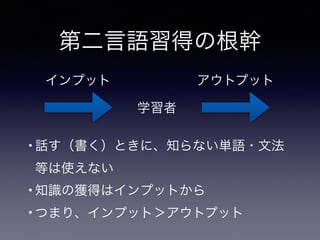
第二言語習得の根幹
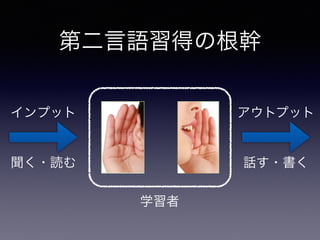
第二言語習得の根幹
学習者
インプット アウトプット
聞く・読む 話す・書く
第二言語習得の根幹
学習者
インプット アウトプット
• 話す(書く)ときに、知らない単語・文法
等は使えない
• 知識の獲得はインプットから
• つまり、インプット>アウトプット
• インプットなしでは言語習得は不可能
インプットの重要性
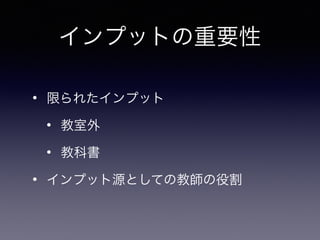
インプットの重要性
• 限られたインプット
• 教室外
• 教科書
• インプット源としての教師の役割
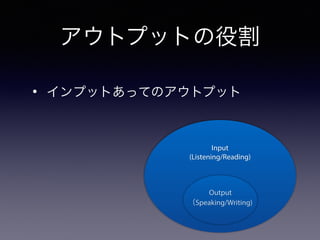
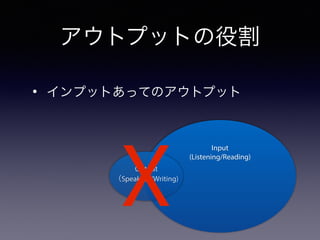
アウトプットの役割
• インプットあってのアウトプット
Input
(Listening/Reading)
Output
(Speaking/Writing)
Input
(Listening/Reading)
Output
(Speaking/Writing)
X
• インプットあってのアウトプット
アウトプットの役割
しかし...
実例
なんでもインプットに

なるわけではない
It’s Greek to me!
http://www.flickr.com/photos/dnevill/2402430135/
理解可能なインプット
第二言語習得の根幹
• 第二言語習得は、聞いた(読んだ)意味

内容を理解することによって生じる
• 理解できないものはインプットにならない
• 理解を助ける工夫を
第二言語習得の根幹
• 視覚情報は理解の助けになる
• ただしそれだけでは不十分
• 他にも様々な手だてがある
ところで...
私には娘がふたりいます
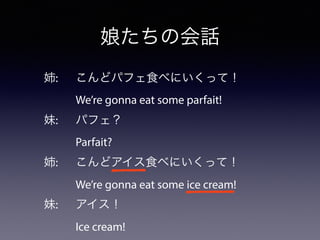
姉: こんどパフェ食べにいくって!
We’re gonna eat some parfait!
妹: パフェ?
Parfait?
姉: こんどアイス食べにいくって!
We’re gonna eat some ice cream!
妹: アイス!
Ice cream!
娘たちの会話
6歳児でも発話調整が

できる
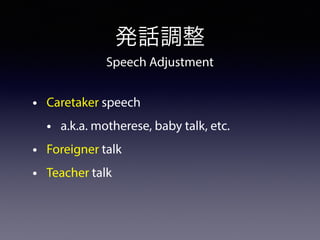
発話調整
発話調整
• Caretaker speech
• a.k.a. motherese, baby talk, etc.
• Foreigner talk
• Teacher talk
Speech Adjustment
Question
Question
How would you adjust
your speech?
これまでの研究から

言えること
• 学習者がインプットの意味を理解し、
• 同時に
• 言語形式にも注意が向くときに起こる。
第二言語習得は…
Form-meaning mapping
視覚情報(再)
視覚情報(再)
Statue of Liberty
http://www.flickr.com/photos/philofphotos/249220155/
視覚情報(再)
• 意味理解に有効だが、
• 使用には注意が必要。
• なぜなら形式に意識が向かないから。
視覚情報(再)
視覚情報(再)
Statue of Liberty
http://www.flickr.com/photos/philofphotos/249220155/
視覚情報(再)
視覚情報(再)
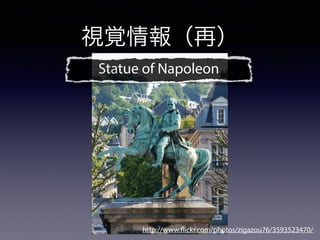
「自由の女神だ!」
「あれ?英語はなんだったっけ?」
http://www.flickr.com/photos/zigazou76/3593523470/
Statue of Napoleon
視覚情報(再)
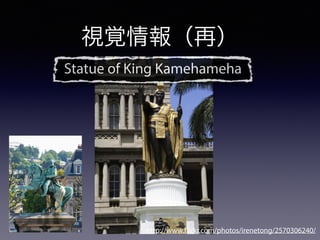
http://www.flickr.com/photos/irenetong/2570306240/
Statue of King Kamehameha
視覚情報(再)
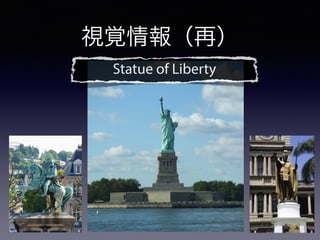
Statue of Liberty
視覚情報(再)
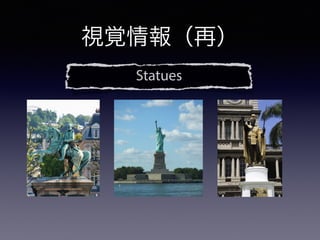
Statues
視覚情報(再)
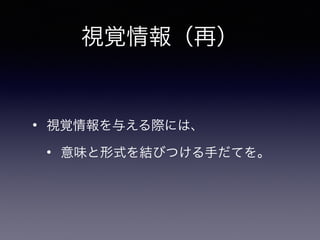
• 視覚情報を与える際には、
• 意味と形式を結びつける手だてを。
視覚情報(再)
発話調整(再)
To simplify or not to
simplify...
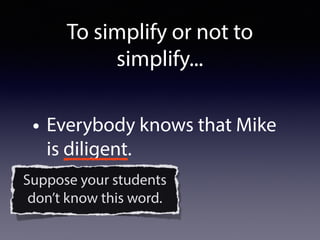
• Everybody knows that Mike
is diligent.
Suppose your students
don’t know this word.
To simplify or not to
simplify...
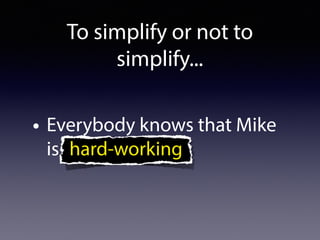
• Everybody knows that Mike
is diligent.
To simplify or not to
simplify...
hard-working
Simplification
• 難しい(未知の)言語項目を
• 簡単な(既知の)言語項目に置き換える。
簡略化
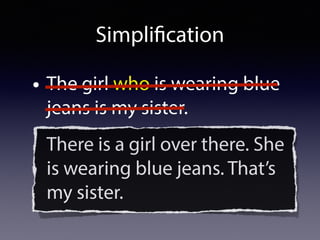
Simplification
• The girl who is wearing blue
jeans is my sister.
There is a girl over there. She
is wearing blue jeans. That’s
my sister.
Simplification
• インプット理解の助けになるが、
• 未知の言語項目に出会う機会を奪う。
• 第二言語習得は、インプット中の未知の

言語項目に出会ったとき、
• その意味と形式の結びつきに気づくこと
で起こる。
• Simplification はその機会を奪う。
Simplification
Instead of simplifying...
Elaborate!
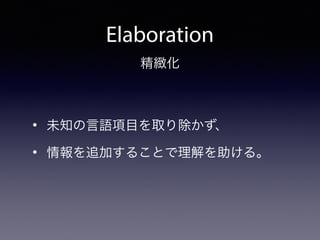
Elaboration
• 未知の言語項目を取り除かず、
• 情報を追加することで理解を助ける。
精緻化
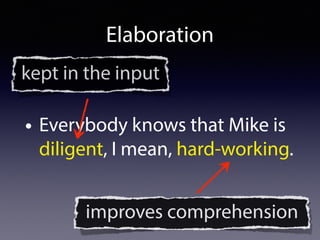
• Everybody knows that Mike is
diligent, I mean, hard-working.
improves comprehension
kept in the input
Elaboration
Or...
You can interact!
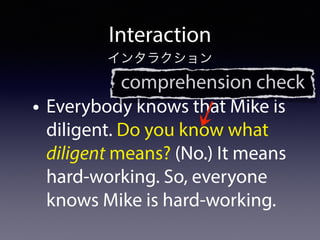
• Everybody knows that Mike is
diligent. Do you know what
diligent means? (No.) It means
hard-working. So, everyone
knows Mike is hard-working.
Interaction
インタラクション
comprehension check
これまでの研究から

言えること
これまでの研究から…
• 簡略化はインプット理解を助けるが、
• 第二言語習得には貢献しない。
• 精緻化は理解を助けると同時に、
• 第二言語習得にも貢献しうる。
• インタラクションも同様である。
Question 2
Question 2
How would you adjust
your speech?
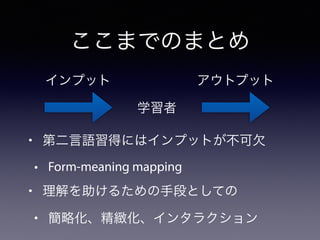
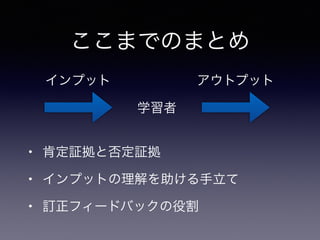
ここまでのまとめ
学習者
インプット アウトプット
• 第二言語習得にはインプットが不可欠
• Form-meaning mapping
• 理解を助けるための手段としての
• 簡略化、精緻化、インタラクション
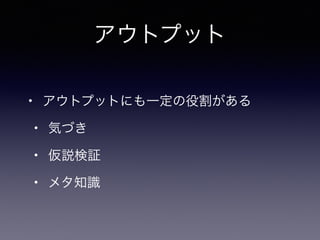
• アウトプットにも一定の役割がある
• 気づき
• 仮説検証
• メタ知識
アウトプット
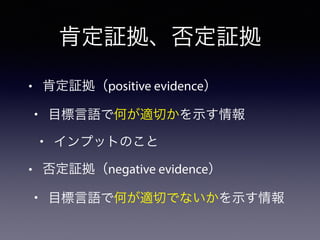
• 肯定証拠(positive evidence)
• 目標言語で何が適切かを示す情報
• インプットのこと
• 否定証拠(negative evidence)
• 目標言語で何が適切でないかを示す情報
肯定証拠、否定証拠
• 肯定証拠だけでは第二言語習得には

不十分という主張がある
• 否定証拠の役割
肯定証拠、否定証拠
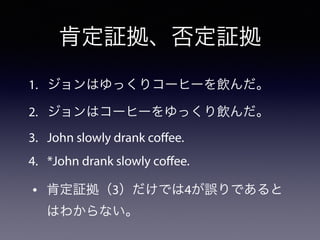
1. ジョンはゆっくりコーヒーを飲んだ。
2. ジョンはコーヒーをゆっくり飲んだ。
3. John slowly drank coffee.
4. *John drank slowly coffee.
肯定証拠、否定証拠
• 肯定証拠(3)だけでは4が誤りであると
はわからない。
肯定証拠、否定証拠
否定証拠を示す手段としての
訂正フィードバック
Corrective Feedback
Corrective Feedback
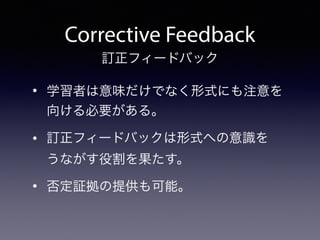
• 学習者は意味だけでなく形式にも注意を
向ける必要がある。
• 訂正フィードバックは形式への意識を

うながす役割を果たす。
• 否定証拠の提供も可能。
訂正フィードバック
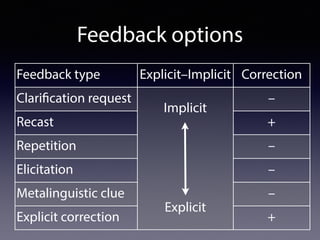
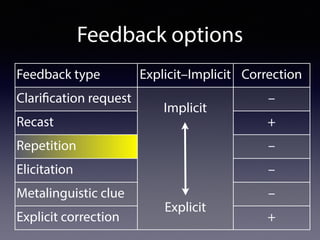
Feedback options
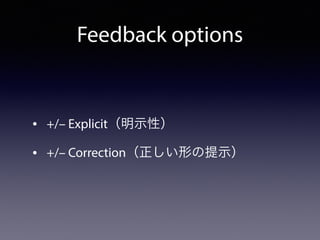
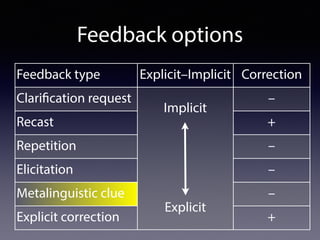
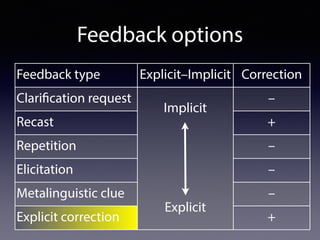
• +/– Explicit(明示性)
• +/– Correction(正しい形の提示)
Feedback options
Feedback type Explicit–Implicit Correction
Clarification request
Implicit
Explicit
–
Recast +
Repetition –
Elicitation –
Metalinguistic clue –
Explicit correction +
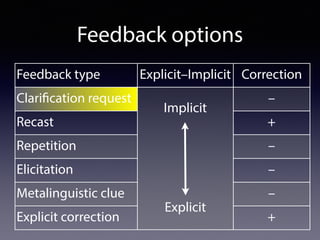
Feedback options
Feedback type Explicit–Implicit Correction
Clarification request
Implicit
Explicit
–
Recast +
Repetition –
Elicitation –
Metalinguistic clue –
Explicit correction +
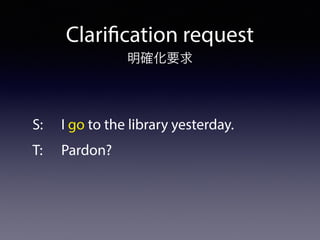
Clarification request
S: I go to the library yesterday.
T: Pardon?
明確化要求
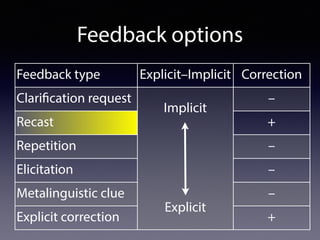
Feedback options
Feedback type Explicit–Implicit Correction
Clarification request
Implicit
Explicit
–
Recast +
Repetition –
Elicitation –
Metalinguistic clue –
Explicit correction +
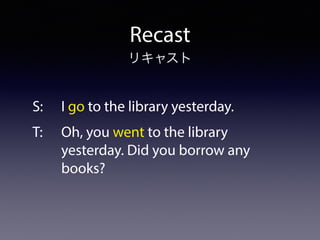
Recast
S: I go to the library yesterday.
T: Oh, you went to the library

yesterday. Did you borrow any 

books?
リキャスト
Feedback options
Feedback type Explicit–Implicit Correction
Clarification request
Implicit
Explicit
–
Recast +
Repetition –
Elicitation –
Metalinguistic clue –
Explicit correction +
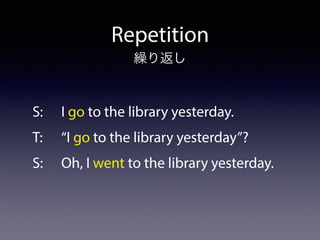
Repetition
S: I go to the library yesterday.
T: “I go to the library yesterday”?
S: Oh, I went to the library yesterday.
繰り返し
Feedback options
Feedback type Explicit–Implicit Correction
Clarification request
Implicit
Explicit
–
Recast +
Repetition –
Elicitation –
Metalinguistic clue –
Explicit correction +
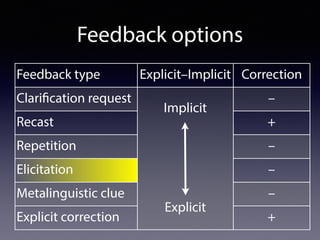
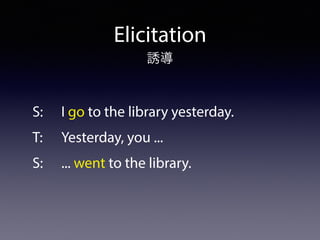
Elicitation
S: I go to the library yesterday.
T: Yesterday, you ...
S: ... went to the library.
誘導
Feedback options
Feedback type Explicit–Implicit Correction
Clarification request
Implicit
Explicit
–
Recast +
Repetition –
Elicitation –
Metalinguistic clue –
Explicit correction +
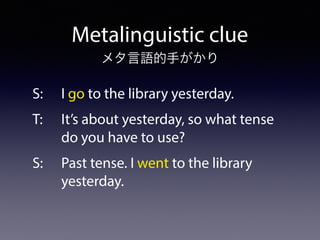
Metalinguistic clue
S: I go to the library yesterday.
T: It’s about yesterday, so what tense 

do you have to use?
S: Past tense. I went to the library 

yesterday.
メタ言語的手がかり
Feedback options
Feedback type Explicit–Implicit Correction
Clarification request
Implicit
Explicit
–
Recast +
Repetition –
Elicitation –
Metalinguistic clue –
Explicit correction +
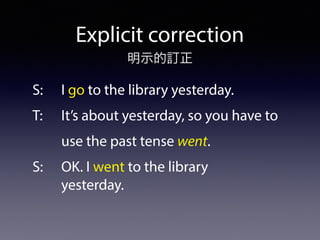
Explicit correction
S: I go to the library yesterday.
T: It’s about yesterday, so you have to
use the past tense went.
S: OK. I went to the library 

yesterday.
明示的訂正
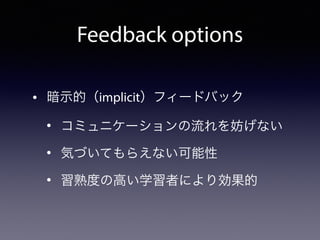
Feedback options
• 暗示的(implicit)フィードバック
• コミュニケーションの流れを妨げない
• 気づいてもらえない可能性
• 習熟度の高い学習者により効果的
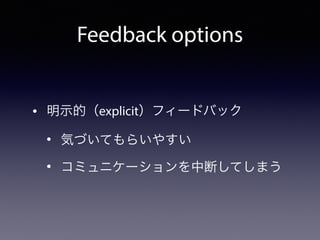
Feedback options
• 明示的(explicit)フィードバック
• 気づいてもらいやすい
• コミュニケーションを中断してしまう
Feedback options
学習者や誤りの種類を勘案し、

教師ひとりひとりが適切と思う

フィードバックを与える
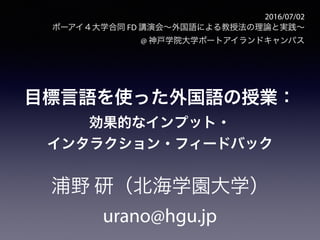
ここまでのまとめ
学習者
インプット アウトプット
• 肯定証拠と否定証拠
• インプットの理解を助ける手立て
• 訂正フィードバックの役割
教師の役割、研究者の役割
• 研究者の役割
• ガイドラインの整備
• 教師の役割
• ガイドラインの適応
• 教師の役割
• 研究者の役割
ガイドライン
ガイドライン
これまでの研究をまとめ、

わかりやすく整理した指標
ガイドライン
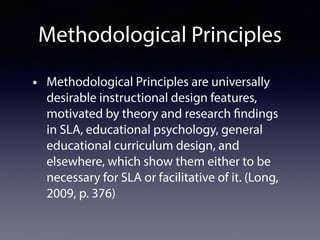
Methodological Principles
• Methodological Principles are universally
desirable instructional design features,
motivated by theory and research findings
in SLA, educational psychology, general
educational curriculum design, and
elsewhere, which show them either to be
necessary for SLA or facilitative of it. (Long,
2009, p. 376)
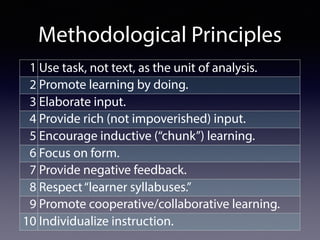
Methodological Principles
1 Use task, not text, as the unit of analysis.
2 Promote learning by doing.
3 Elaborate input.
4 Provide rich (not impoverished) input.
5 Encourage inductive (“chunk”) learning.
6 Focus on form.
7 Provide negative feedback.
8 Respect“learner syllabuses.”
9 Promote cooperative/collaborative learning.
10 Individualize instruction.
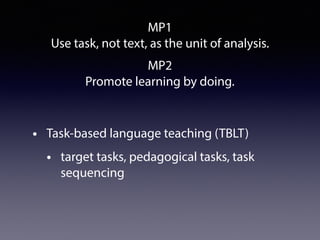
MP1
Use task, not text, as the unit of analysis.
• Task-based language teaching (TBLT)
• target tasks, pedagogical tasks, task
sequencing
MP2
Promote learning by doing.
MP3
Elaborate input.
• Do not simplify.
• Do not rely solely on“authentic”texts.
MP4
Provide rich (not impoverished) input.
• Exposure to varied input sources
MP5
Encourage inductive (“chunk”) learning.
• Implicit instruction
MP6
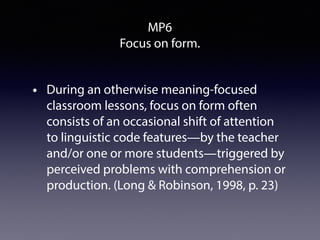
Focus on form.
• During an otherwise meaning-focused
classroom lessons, focus on form often
consists of an occasional shift of attention
to linguistic code features—by the teacher
and/or one or more students—triggered by
perceived problems with comprehension or
production. (Long & Robinson, 1998, p. 23)
MP6
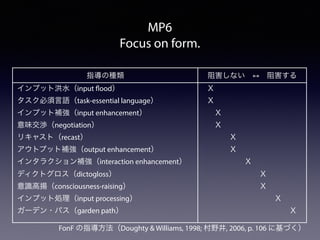
Focus on form.
指導の種類 阻害しない   阻害する
インプット洪水(input flood)
タスク必須言語(task-essential language)
インプット補強(input enhancement)
意味交渉(negotiation)
リキャスト(recast)
アウトプット補強(output enhancement)
インタラクション補強(interaction enhancement)
ディクトグロス(dictogloss)
意識高揚(consciousness-raising)
インプット処理(input processing)
ガーデン・パス(garden path)
 X
 X
  X
  X
    X
    X
      X
        X
        X
          X
            X
FonF の指導方法(Doughty & Williams, 1998; 村野井, 2006, p. 106 に基づく)
MP7
Provide negative feedback.
• Feedback on error (e.g., recasts)
• Error“correction”
MP8
Respect“learner syllabuses.”
• Timing of pedagogical intervention to
developmental readiness
• 「教える」≠「習得する」
• いつ習得するかは決められない
• 「 をまく」「肥料を与える」
MP9
Promote cooperative/collaborative learning.
• Negotiation of meaning
• Interactional modification
MP10
Individualize instruction.
• Needs analysis
• Consideration of individual differences (e.g.,
memory and aptitude) and learning
strategies
文献紹介
• Methodological Principles (MPs)
• Doughty, C. J., & Long, M. H. (2003). Optimal psycholinguistic
environments for distance foreign language learning.
Language Learning & Technology, 7, 50-80. Retrieved from
http://llt.msu.edu/vol7num3/doughty/
• Long, M. H. (2009). Methodological principles for language
teaching. In M. H. Long & C. J. Doughty (Eds.), The handbook of
language teaching (pp. 373-394). Oxford: Wiley-Blackwell.
文献紹介
• インプット
• Long, M. H. (1996). The role of the linguistics environment in
second language acquisition. In W. C. Ritchie & T. K. Bhatia
(Eds.), Handbook of second language acquisition (pp. 413-468).
New York: Academic Press.
• Long, M. H. (2007). Problems in SLA. Mahwah, NJ: Lawrence
Erlbaum.
文献紹介
• フィードバック
• 大関浩美・名部井敏代・森博英・田中真理・原田三千代.
(2015). 『フィードバック研究への招待: 第二言語習得と
フィードバック』 東京: くろしお出版.
文献紹介
• その他
• Doughty, C., & Williams, J. (Eds.) (1998). Focus on form in classroom
second language acquisition. Cambridge University Press.
• 和泉伸一. (2009). 『「フォーカス・オン・フォーム」を取り入
れた新しい英語教育』. 東京: 大修館書店.
• Long, M. H., & Robinson, P. (1998). Focus on form: Theory, research,
and practice. In C. Doughty & J. Williams (1998).
• 松村昌紀. (2009). 『英語教育を知る58の 』. 東京: 大修館書店.
• 村野井仁. (2006). 『第二言語習得研究から見た効果的な英語学
習法・指導法』. 東京: 大修館書店.
まとめ
学習者
インプット アウトプット
• 肯定証拠と否定証拠
• インプットの理解を助ける手立て
• 訂正フィードバックの役割
• ガイドラインとしてのMPs Fin

目標言語を使った外国語の授業: 効果的なインプット・インタラクション・フィードバック