Orthopedic Conference
Peerapon S.
6th Year Medical Cadet
Phramongkutklao College of Medicine
Case
 ผู้ป่ วยหญิงไทย อายุ 67 ปี
 อาชีพ แม่บ้าน
 ภูมิลาเนา นครราชสีมา
Chief complaint
ปวดไหล่ซ้าย 2 ชั่วโมง
Present illness
2 hrs. PTA ผู้ป่ วยขี่ MC เฉี่ยวกับ MC
เสียหลัก ล้ม ไหล่และแขนซ้ายกระแทก
พื้น ปวดไหล่ซ้ายและต้นแขน ซ้าย
ขยับไหล่ซ้ายไม่ได้ ไม่มีศีรษะกระแทก
พื้น ไม่ สลบ จาเหตุการณ์ได้
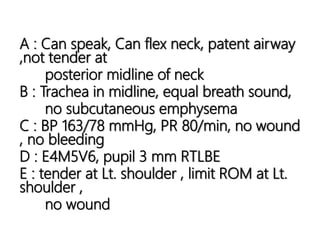
Primary Survey at MNRH
A : Can speak, Can flex neck, patent airway
,not tender at
posterior midline of neck
B : Trachea in midline, equal breath sound,
no subcutaneous emphysema
C : BP 163/78 mmHg, PR 80/min, no wound
, no bleeding
D : E4M5V6, pupil 3 mm RTLBE
E : tender at Lt. shoulder , limit ROM at Lt.
shoulder ,
no wound
Secondary Survey
A : No history of food and drug
allergy
M : No current medication
P : Underlying : DM , HT , No
history of surgery
L : Last meal 14.00
E : As present illness
Secondary Survey
Head to Toe Examination
General appearance :
Good consciousness, well
cooperated
HEENT :
Not pale conjunctivae, anicteric
sclerae, no external wound at face and
neck, no abnormal mass, no
lympadenopathy
Heart :
Normal S1S2, no murmur
Lung
Clear ,equal breath sound
Abdomen
Soft , not tender , no guarding ,
no rebound
Neuro
E4V5M6 , pupil 3 mm RTLBE
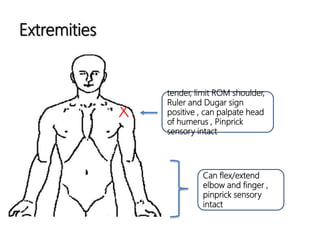
Extremities
tender, limit ROM shoulder,
Ruler and Dugar sign
positive , can palpate head
of humerus , Pinprick
sensory intact
Can flex/extend
elbow and finger ,
pinprick sensory
intact
Investigation
Film X-Ray
Left anterior shoulder
dislocation with Greater
tuberosity fracture
Film X-Ray
Anatomy of abdomen
• Valium 10 mg IV stat
• Morphine 4 mg IV stat
• Closed reduction
• On Lt. arm sling
Management
Shoulder Dislocation
Anatomy of shoulder
Anatomy of shoulder
Anatomy of shoulder
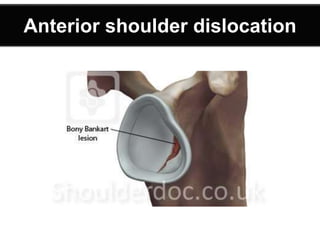
• Anterior shoulder dislocation
• Posterior shoulder dislocation
• Superior shoulder dislocation
• Inferior shoulder dislocation
Shoulder Dislocation
Radiological evaluation
Anterior shoulder
dislocation
Radiological evaluation
Posterior shoulder
dislocation
• Most common shoulder injuries
• Mechanism : anteriorly directed force on
the arm when the shoulder is abducted
and externally rotated
• Associated injury
–Axillary nerve
–Hill Sachs defect
–Bony Bankart lesion
–Greater tuberosity fracture
Anterior shoulder dislocation
Clinical presentation & Physical
examination
• Pain [severe]
• Hold limb with normal limb by side
of body.
• Abduction and external rotation.
• Pt can’t touch apposite shoulder
[Dugar test]
Clinical presentation
Physical examination
• Load and shift test
– Grade I - increased translation, no subluxation
– Grade II - subluxation of humeral head to, but
over, glenoid rim
– Grade III - dislocation of humeral head over
glenoid rim
• Apprehension sign
• Relocation sign
• Reduction
• simple traction-countertraction is
most commonly used.
• relaxation of patient with sedation
and analgesics.
• Immobilization for 3-4 weeks after
shoulder dislocation does NOT change
the prognosis compared with
immediate mobilization
Management
Reduction Maneuvers
• Most Common Techniques
–Kocher (71-100%)
–External Rotation (78-90%)
–Milch (70-89%)
–Stimson (91-96%)
–Traction/Countertraction
–Scapular Manipulation (79-96%)
Reduction Maneuvers
Reduction Maneuvers
• More missed diagnosis .
• Mechanism : flexed, adducted, and
internally rotated arm is a high-risk
position.
Posterior shoulder dislocation
Clinical presentation
• Internal rotation
• Flat front of shoulder
• Prominent coracoid
• Prominent post aspect of shoulder
Management
• Under GA reduction by pulling arm in
adduction to disengage head then
lateraly rotate while pushing head
anteriorly.
• Immobilization in external rotation and
abduction for 3 wks.
Thank you

Shoulderdislocation