SHRI RAMDEOBABA COLLEGE OF
    ENGINEERING AND MANAGEMENT
                    Technical seminar on


MODIFICATIONS IN GASOLINE ENGINES
       FOR USE OF ETHANOL

  Guided by:                         Presented by:
  Prof. M. P. Joshi                  Sughosh Deshmukh
  Mechanical Engg. Dept              V sem Mechanical Engg.
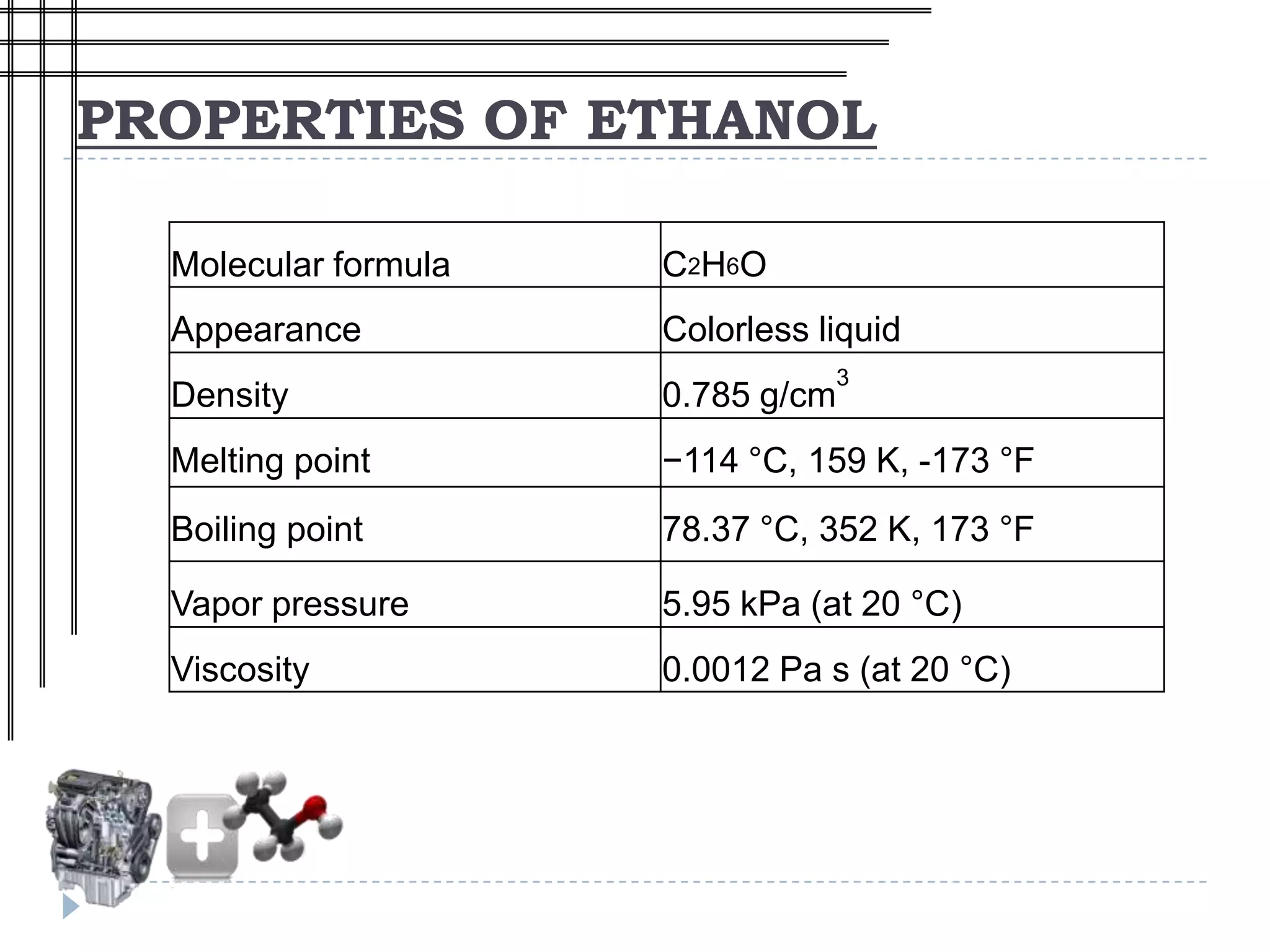
PROPERTIES OF ETHANOL

  Molecular formula   C 2H 6O
  Appearance          Colorless liquid
                                   3
  Density             0.785 g/cm
  Melting point       −114 °C, 159 K, -173 °F
  Boiling point       78.37 °C, 352 K, 173 °F

  Vapor pressure      5.95 kPa (at 20 °C)
  Viscosity           0.0012 Pa s (at 20 °C)
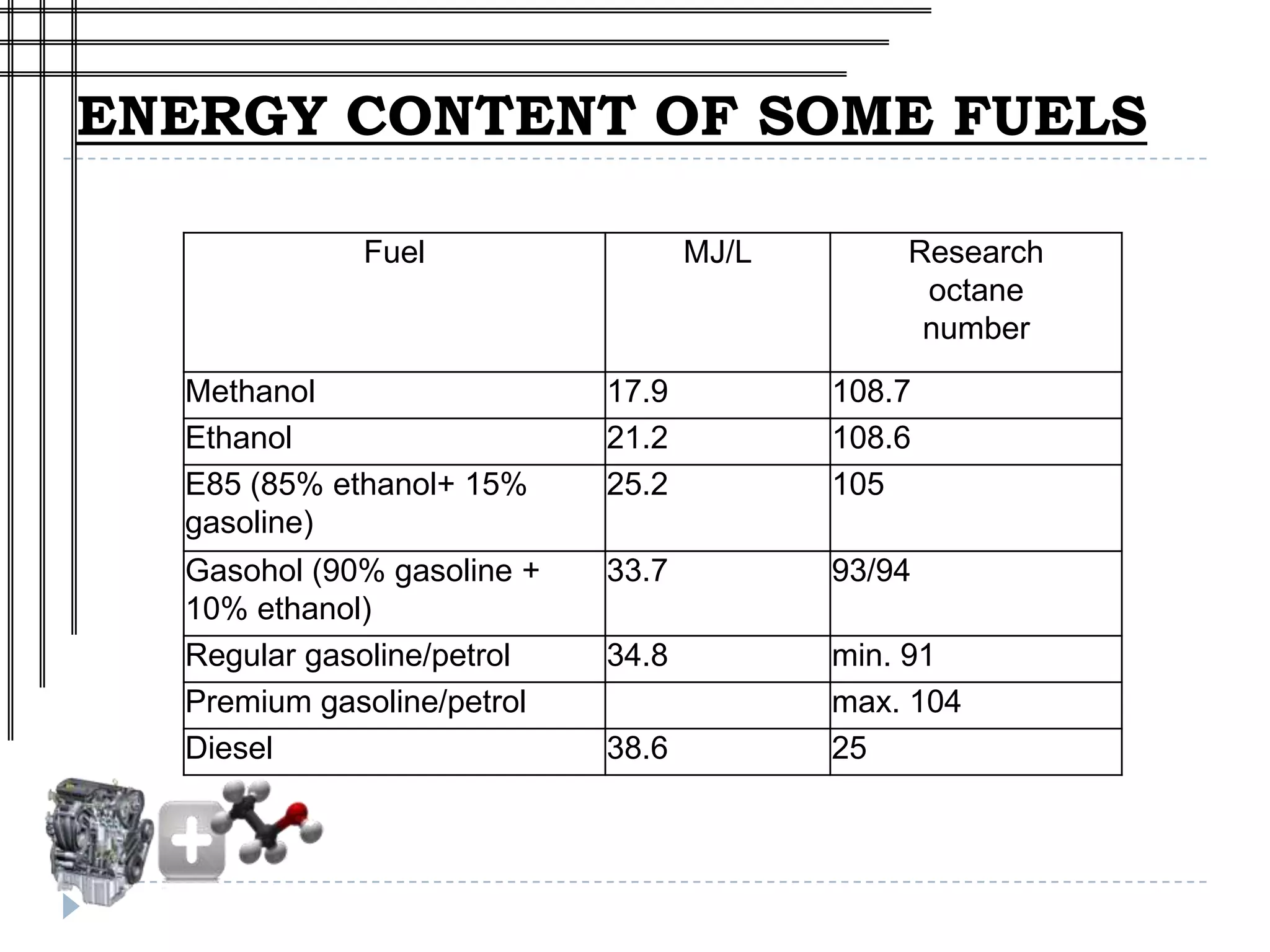
ENERGY CONTENT OF SOME FUELS

             Fuel                  MJ/L       Research
                                               octane
                                               number
  Methanol                  17.9          108.7
  Ethanol                   21.2          108.6
  E85 (85% ethanol+ 15%     25.2          105
  gasoline)
  Gasohol (90% gasoline +   33.7          93/94
  10% ethanol)
  Regular gasoline/petrol   34.8          min. 91
  Premium gasoline/petrol                 max. 104
  Diesel                    38.6          25
Properties of ethanol

   High auto ignition temp.: 326o C (petrol 240-280o C,
    diesel 210o C)
   Corrosive in nature.
   High octane rating.
   Lesser energy content than gasoline /diesel.
   Contains more oxygen
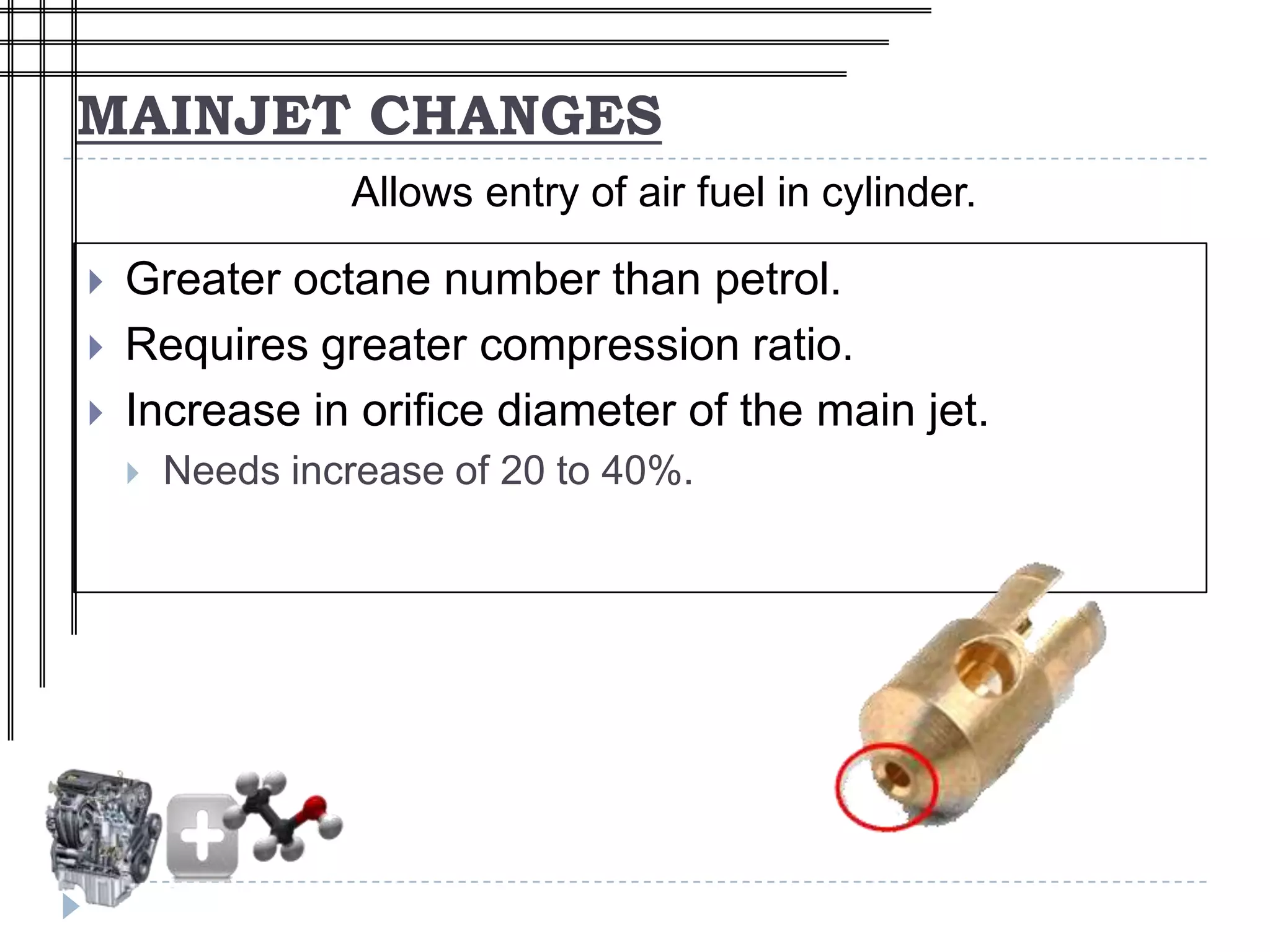
MAINJET CHANGES
                 Allows entry of air fuel in cylinder.

   Greater octane number than petrol.
   Requires greater compression ratio.
   Increase in orifice diameter of the main jet.
       Needs increase of 20 to 40%.
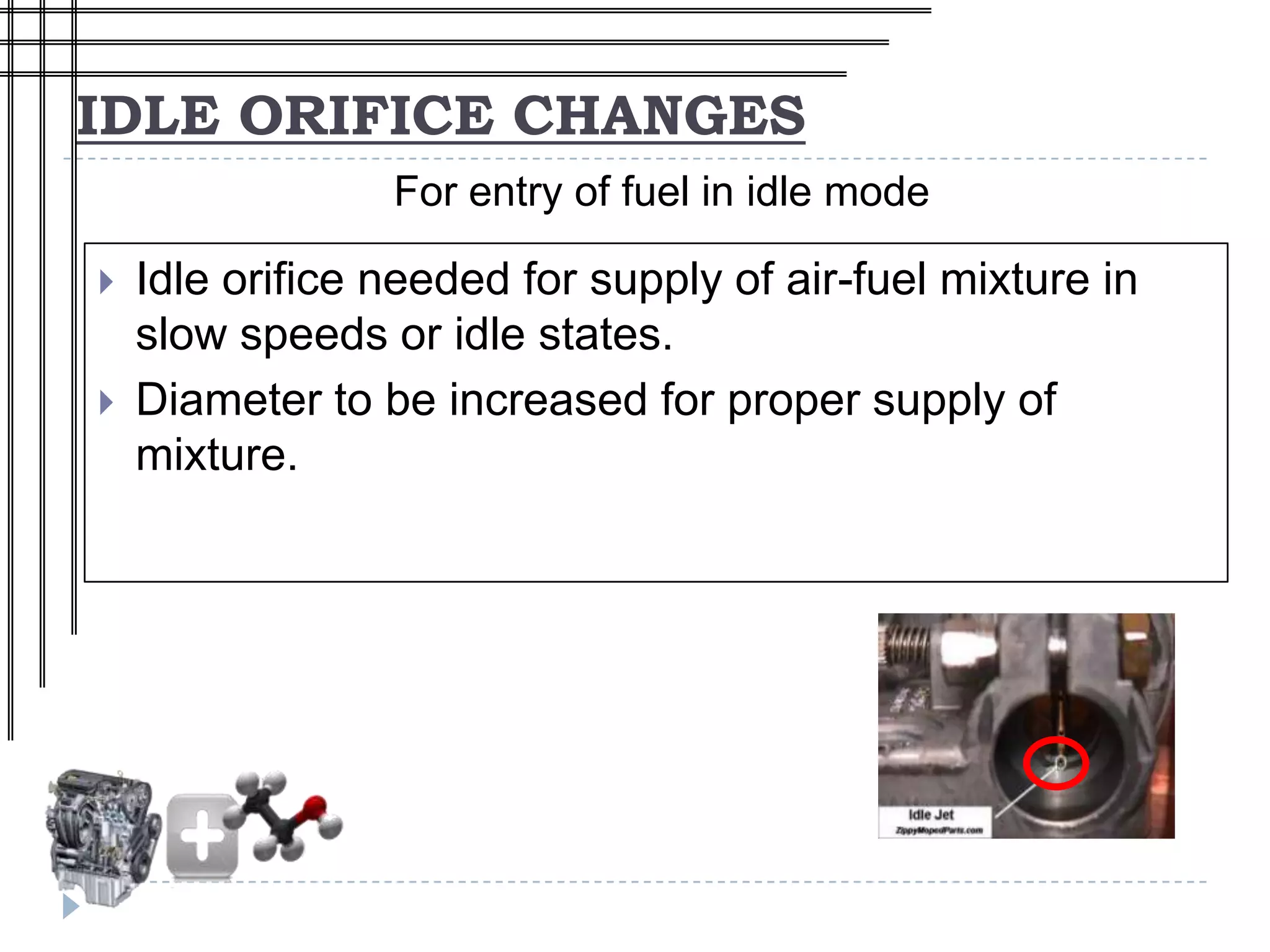
IDLE ORIFICE CHANGES
                 For entry of fuel in idle mode

   Idle orifice needed for supply of air-fuel mixture in
    slow speeds or idle states.
   Diameter to be increased for proper supply of
    mixture.
POWER VALVE CHANGES
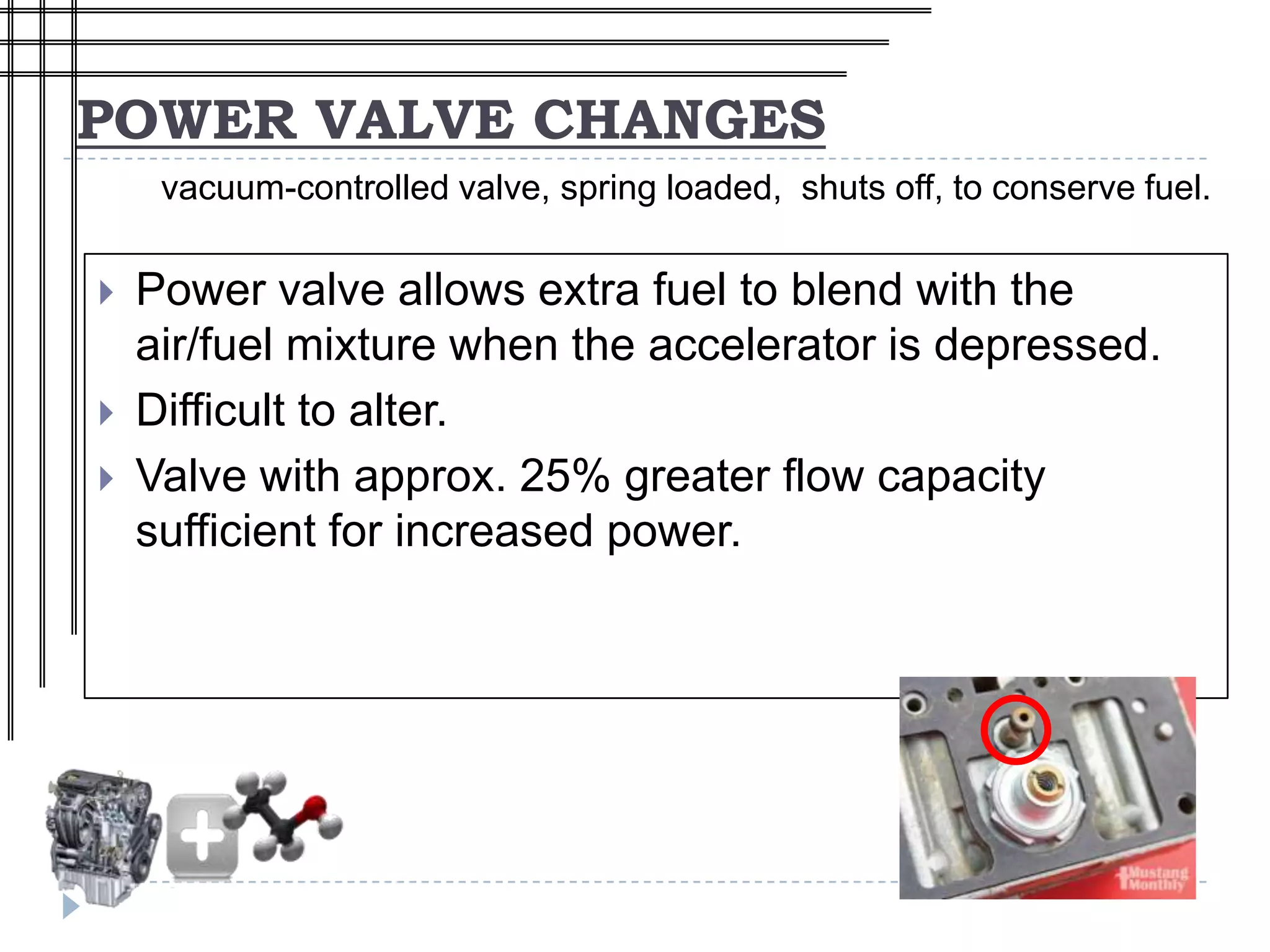
     vacuum-controlled valve, spring loaded, shuts off, to conserve fuel.

   Power valve allows extra fuel to blend with the
    air/fuel mixture when the accelerator is depressed.
   Difficult to alter.
   Valve with approx. 25% greater flow capacity
    sufficient for increased power.
ACCELERATOR PUMP CHANGES
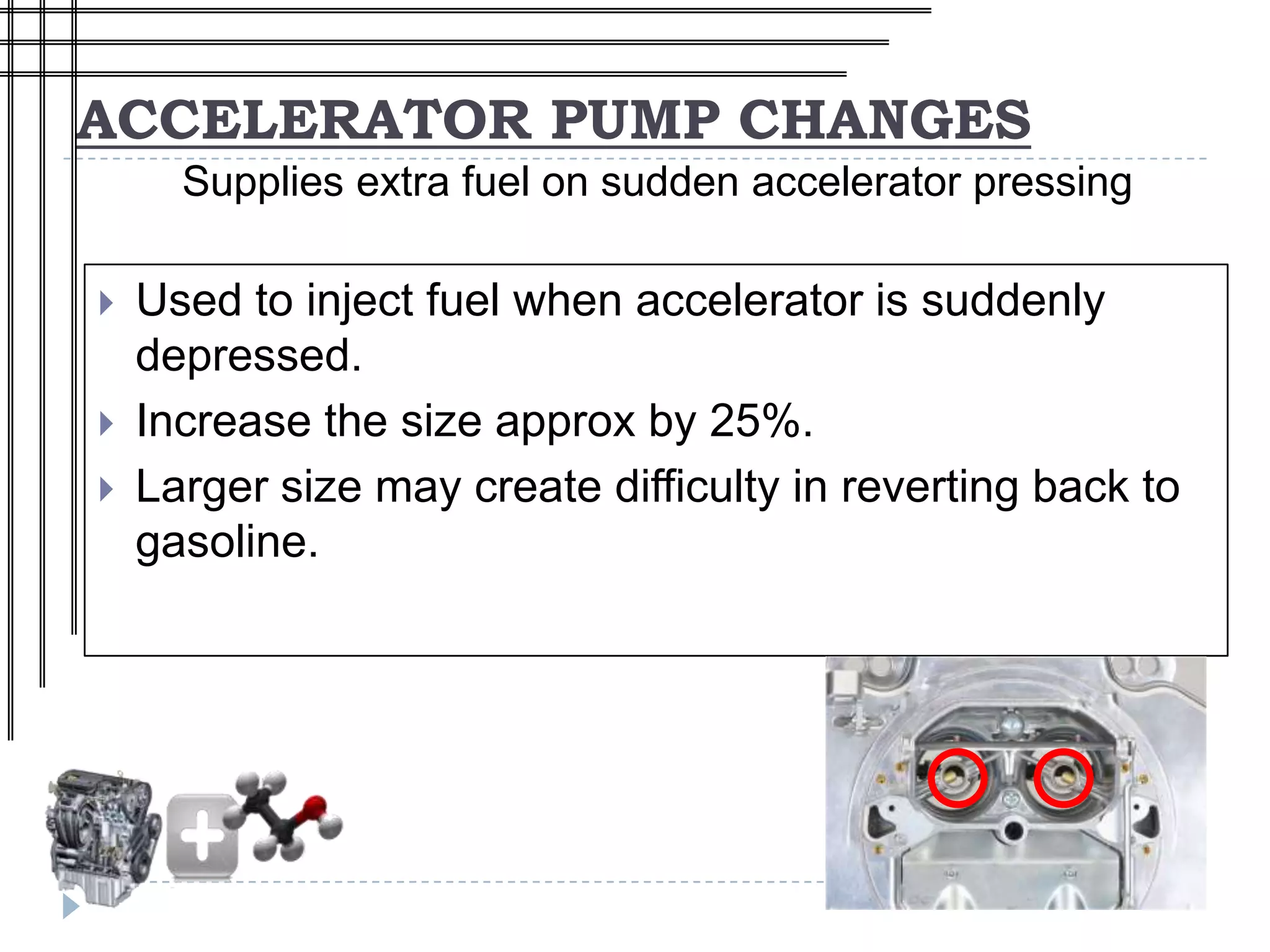
      Supplies extra fuel on sudden accelerator pressing

   Used to inject fuel when accelerator is suddenly
    depressed.
   Increase the size approx by 25%.
   Larger size may create difficulty in reverting back to
    gasoline.
A SMALL GIST

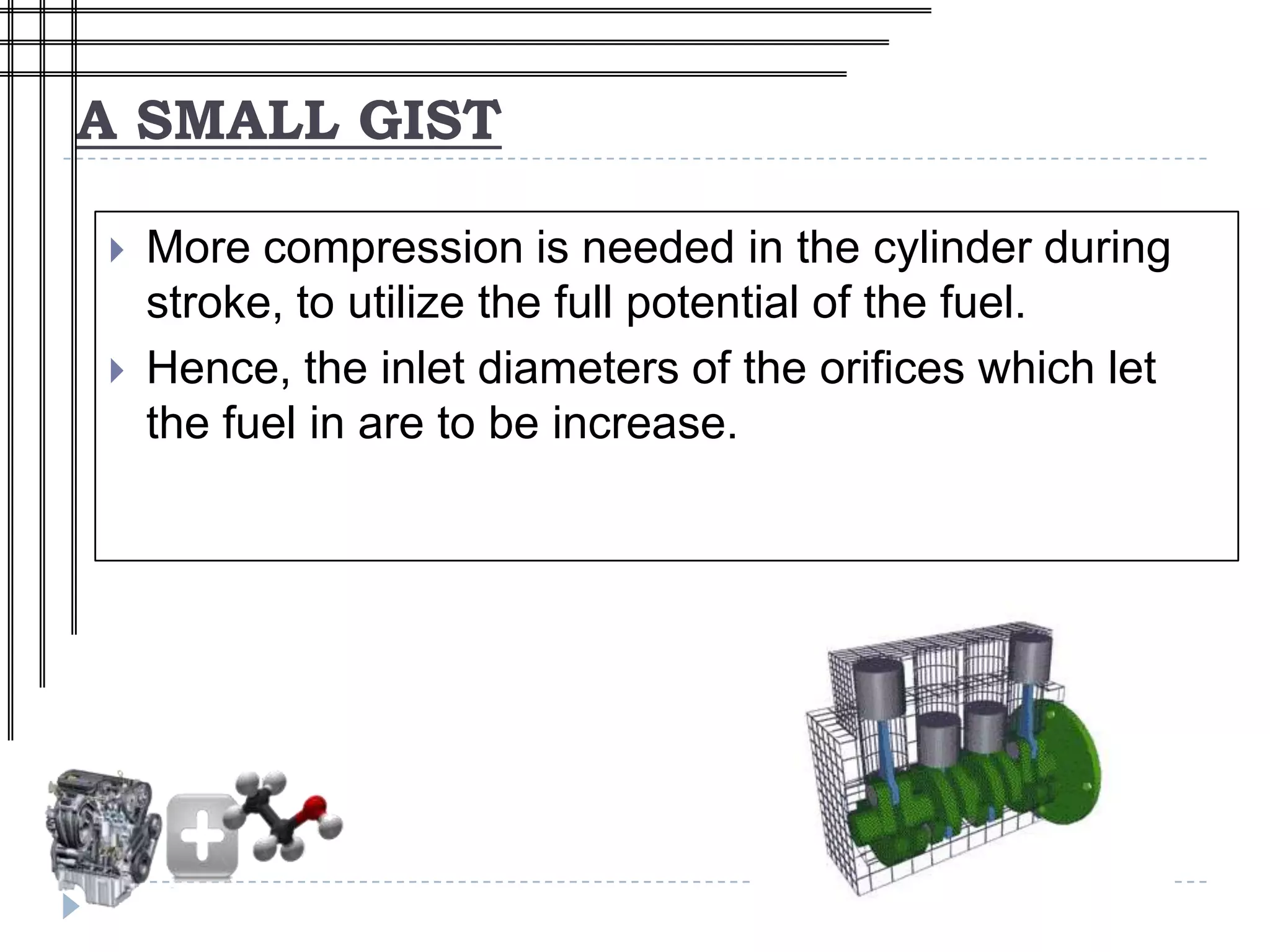
   More compression is needed in the cylinder during
    stroke, to utilize the full potential of the fuel.
   Hence, the inlet diameters of the orifices which let
    the fuel in are to be increase.
COMPRESSION RATIO CHANGES

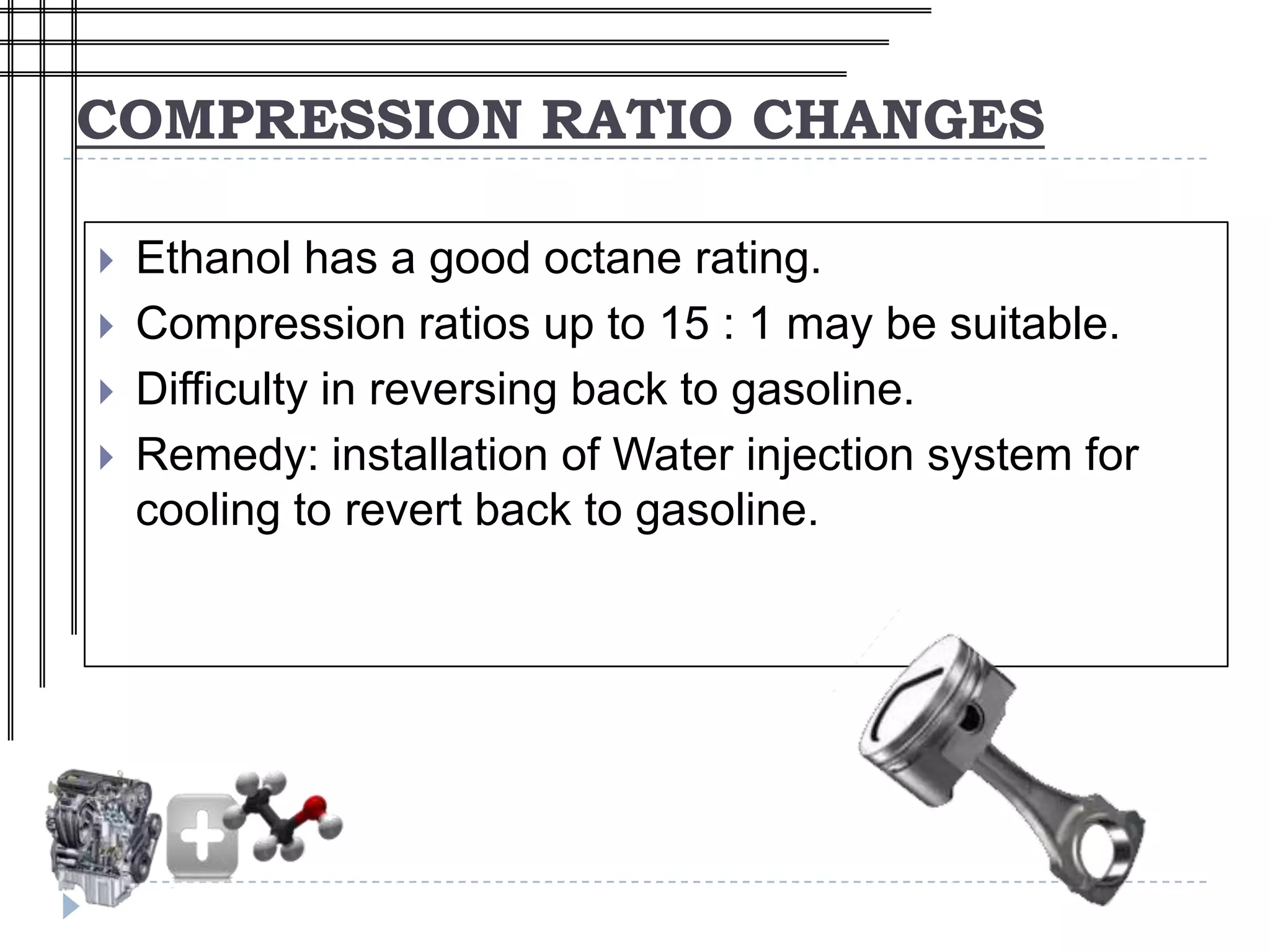
   Ethanol has a good octane rating.
   Compression ratios up to 15 : 1 may be suitable.
   Difficulty in reversing back to gasoline.
   Remedy: installation of Water injection system for
    cooling to revert back to gasoline.
COMPRESSION RATIO CHANGES
                                              ……continued

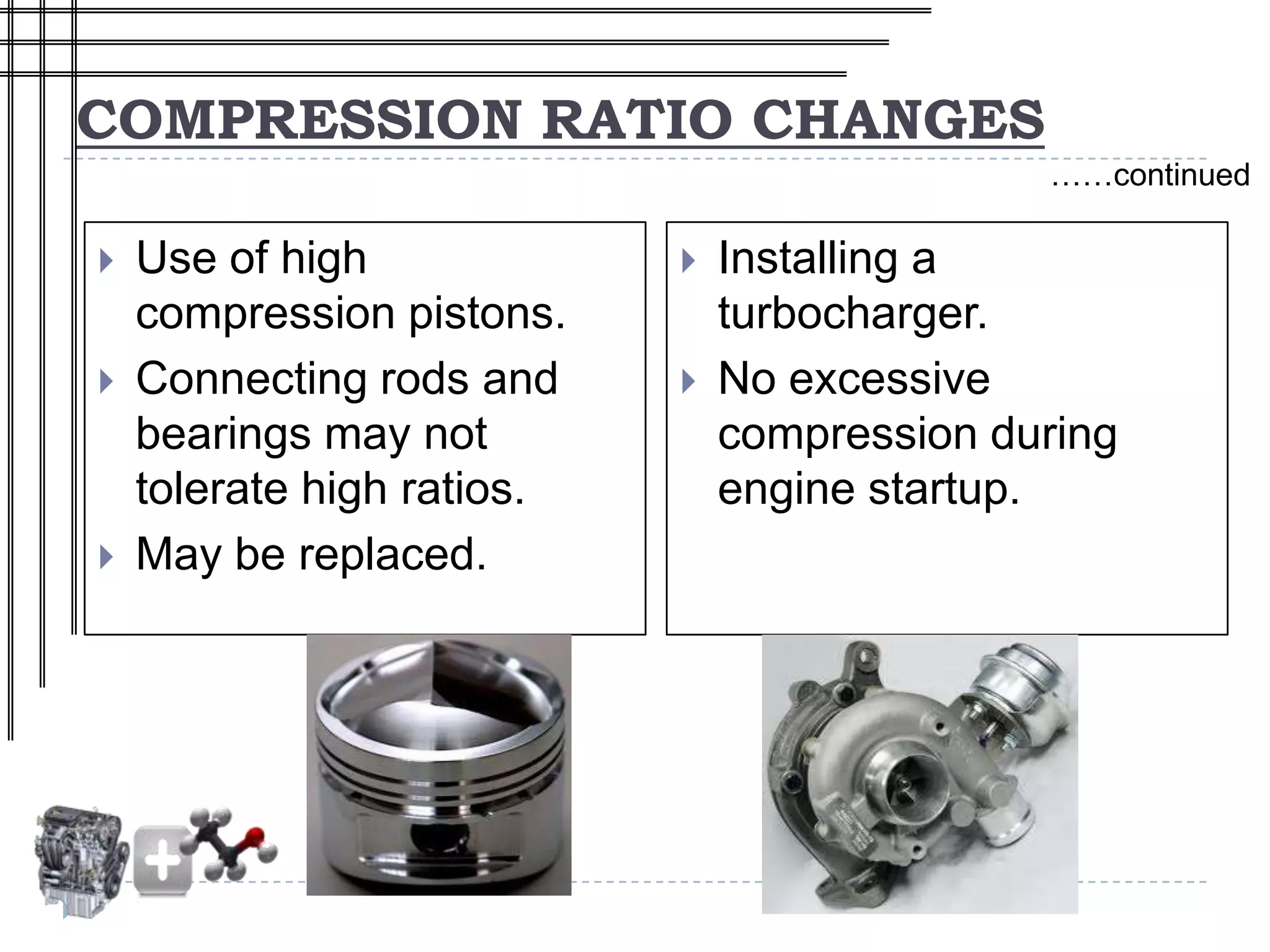
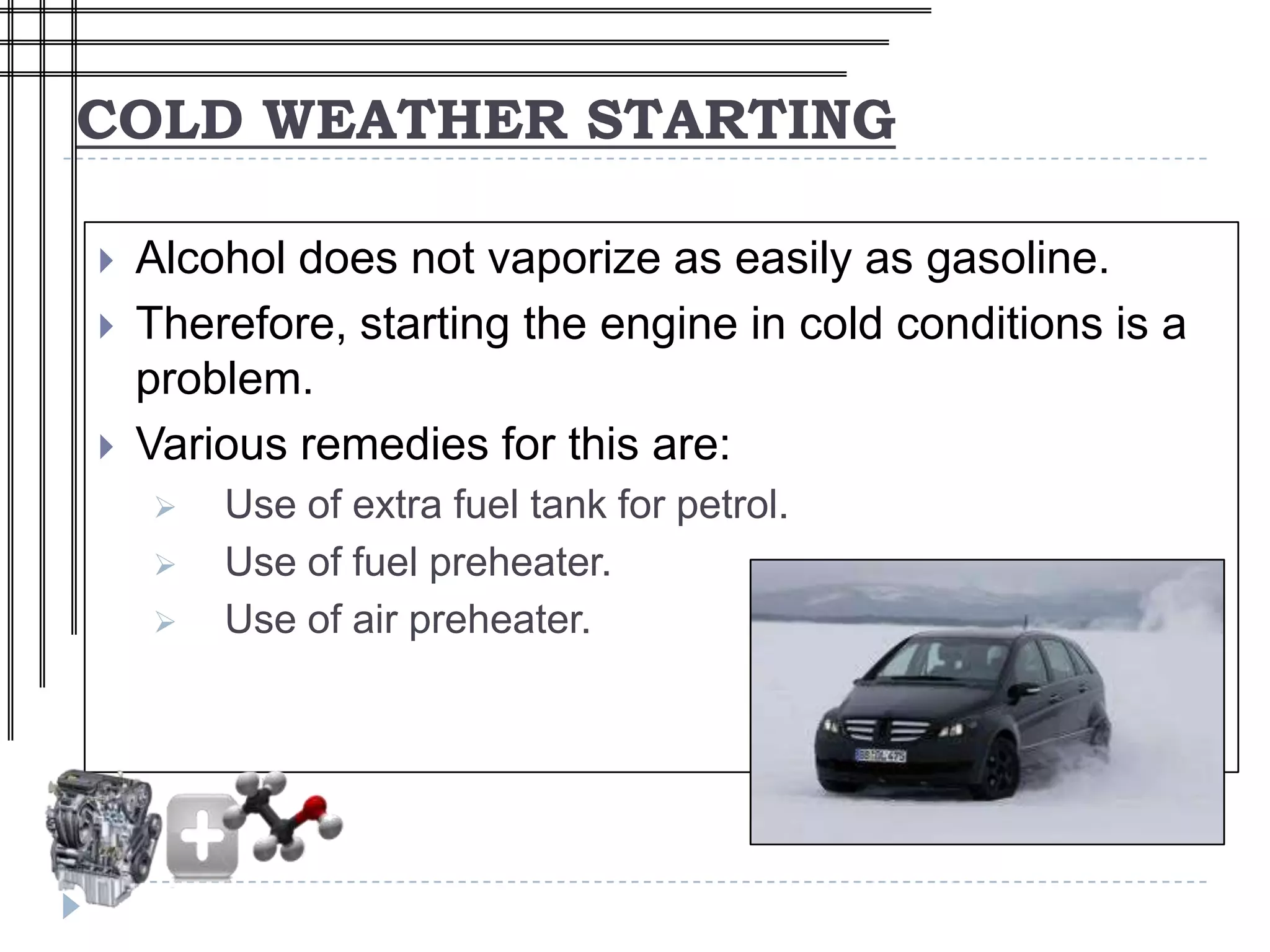
   Use of high                Installing a
    compression pistons.        turbocharger.
   Connecting rods and        No excessive
    bearings may not            compression during
    tolerate high ratios.       engine startup.
   May be replaced.
COLD WEATHER STARTING

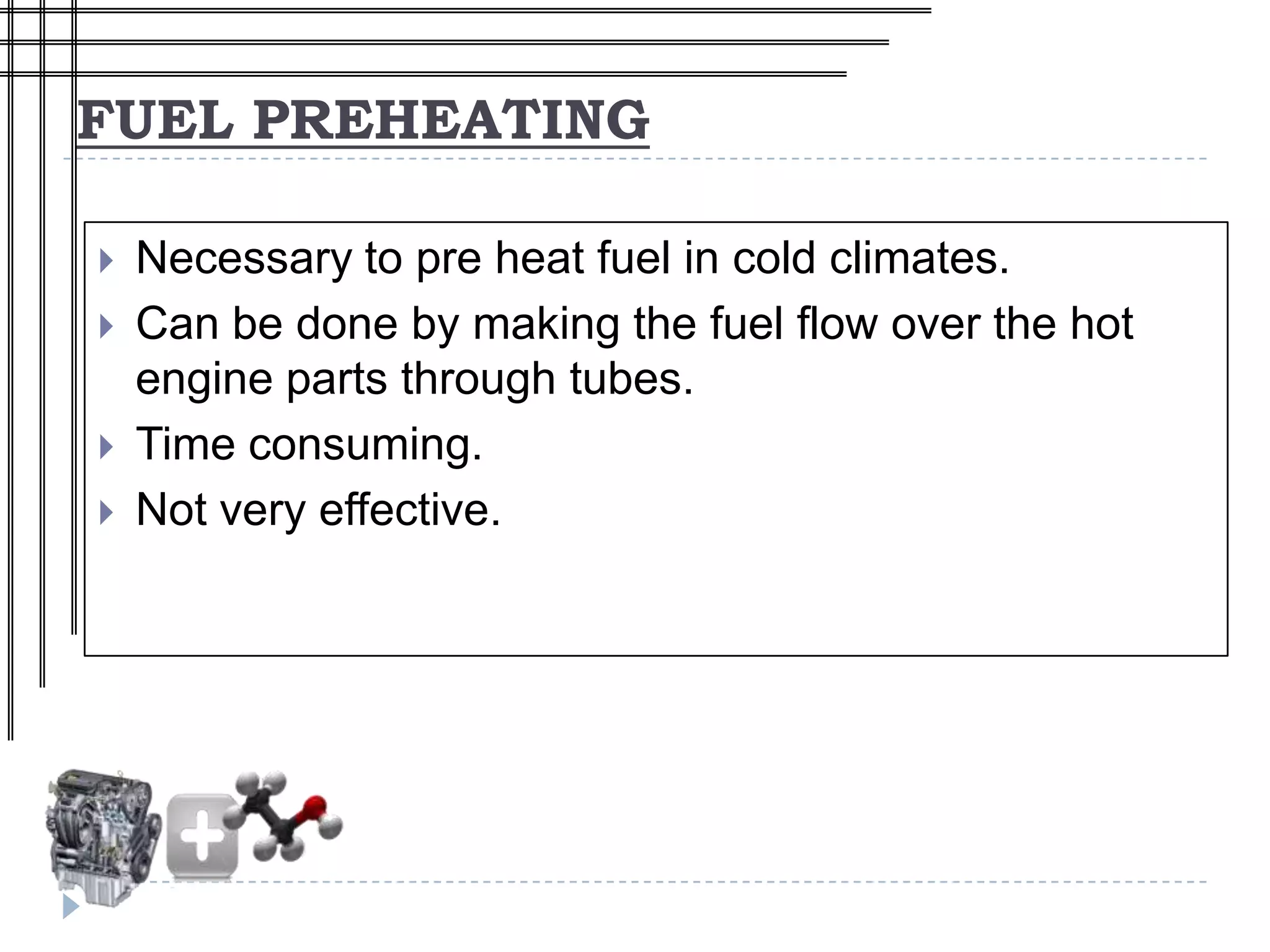
   Alcohol does not vaporize as easily as gasoline.
   Therefore, starting the engine in cold conditions is a
    problem.
   Various remedies for this are:
       Use of extra fuel tank for petrol.
       Use of fuel preheater.
       Use of air preheater.
FUEL PREHEATING

   Necessary to pre heat fuel in cold climates.
   Can be done by making the fuel flow over the hot
    engine parts through tubes.
   Time consuming.
   Not very effective.
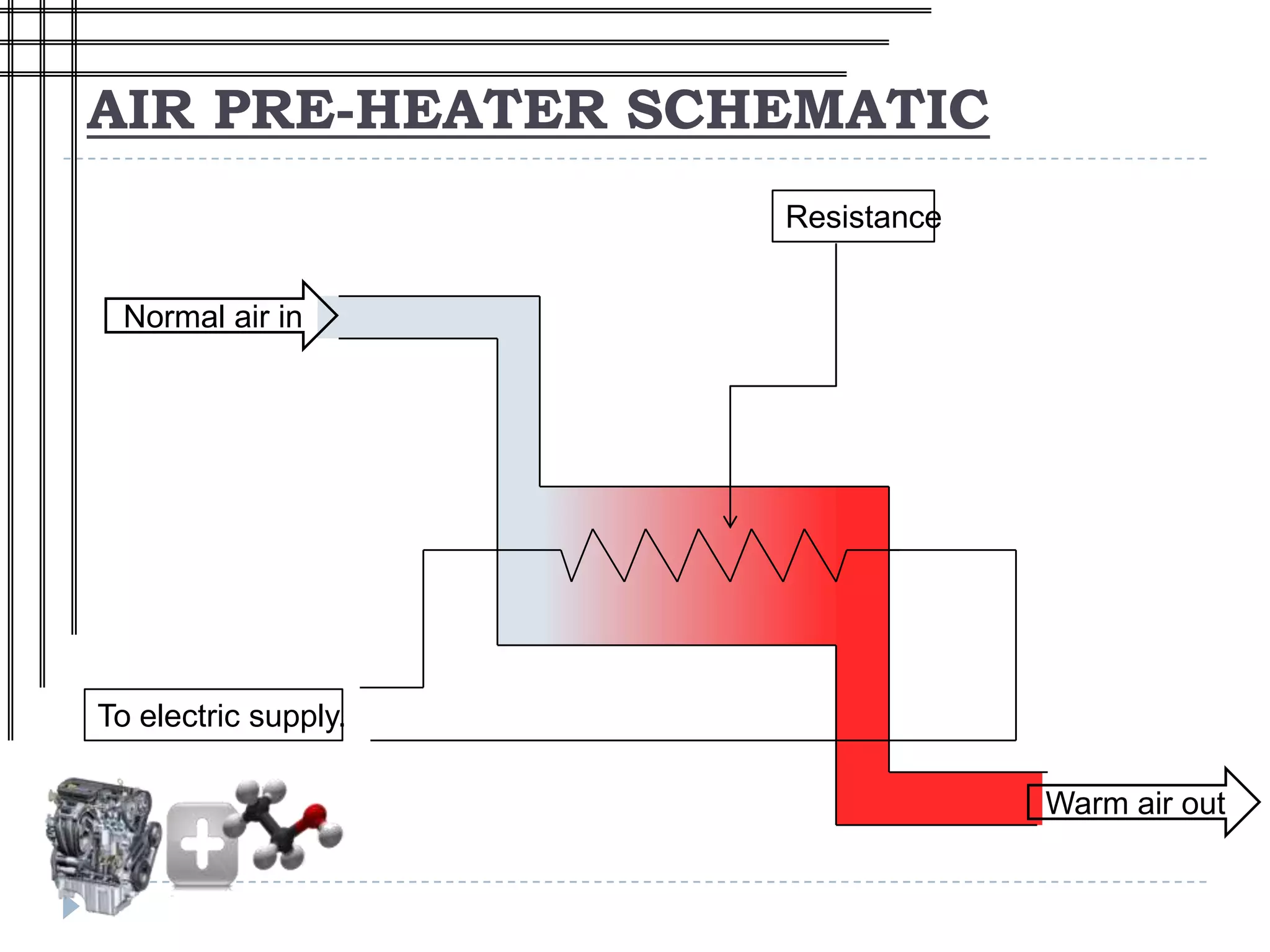
AIR PREHEATING
   Air from around the exhaust manifold is let in the air
    fuel mix through ducts.
   A flap within the air cleaner "snorkel" shuts off this
    supply when engine warms up and allows ambient
    air enter.
   This flap is usually either thermostatically or vacuum
    controlled .
   External type resistance air heater may also be
    used.
AIR PRE-HEATER SCHEMATIC
                      Resistance


 Normal air in


To electric supply.

                                   Warm air out
THERMOSTAT CHANGE

   Used to hold the coolant in the cylinder head until it
    reaches a certain temperature.
   Thermostat decides the temperature at which the
    coolant will enter the cylinder head.
   Ethanol engine works at less temperature than petrol
    engine of same horsepower.
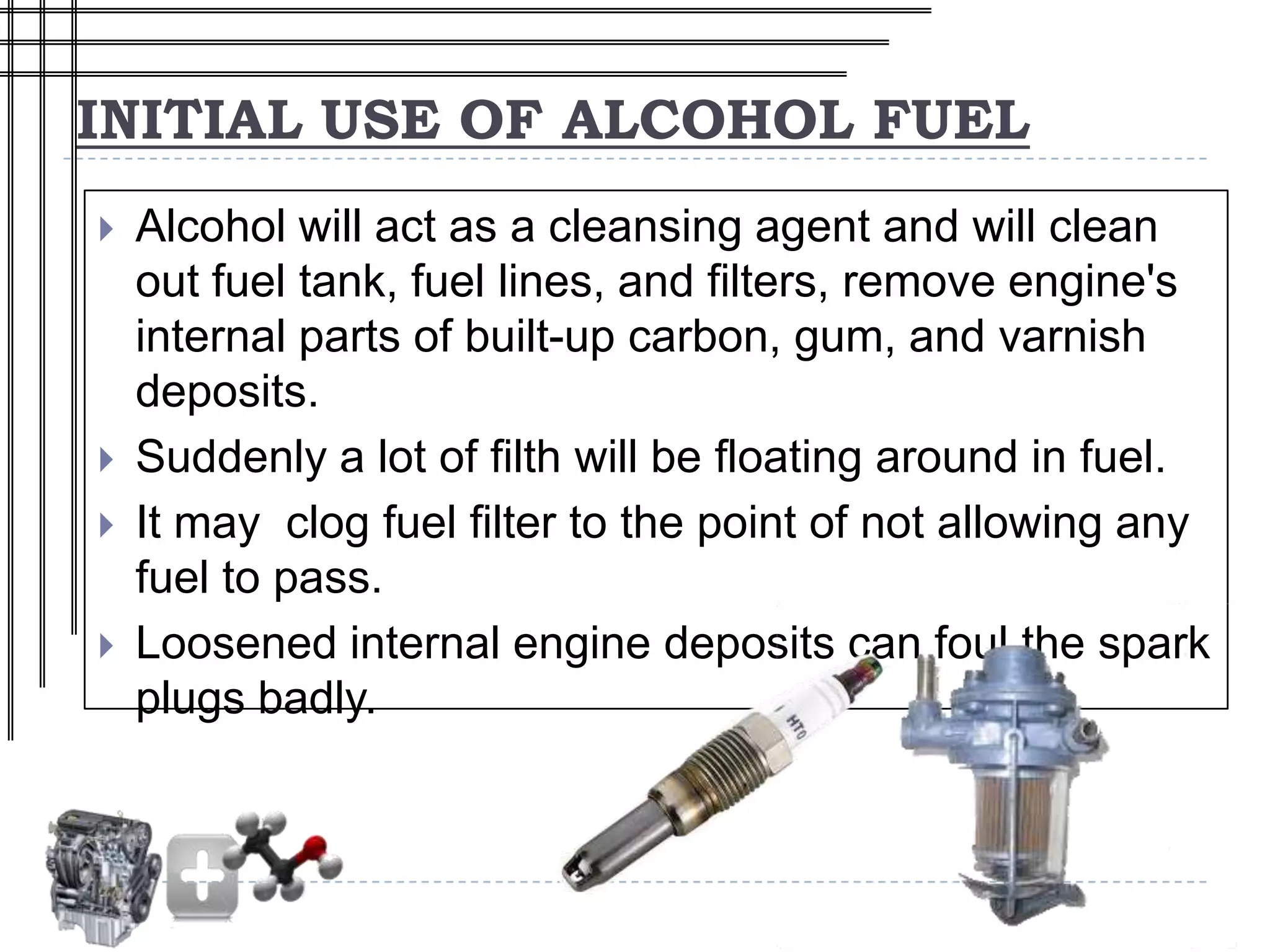
INITIAL USE OF ALCOHOL FUEL
   Alcohol will act as a cleansing agent and will clean
    out fuel tank, fuel lines, and filters, remove engine's
    internal parts of built-up carbon, gum, and varnish
    deposits.
   Suddenly a lot of filth will be floating around in fuel.
   It may clog fuel filter to the point of not allowing any
    fuel to pass.
   Loosened internal engine deposits can foul the spark
    plugs badly.
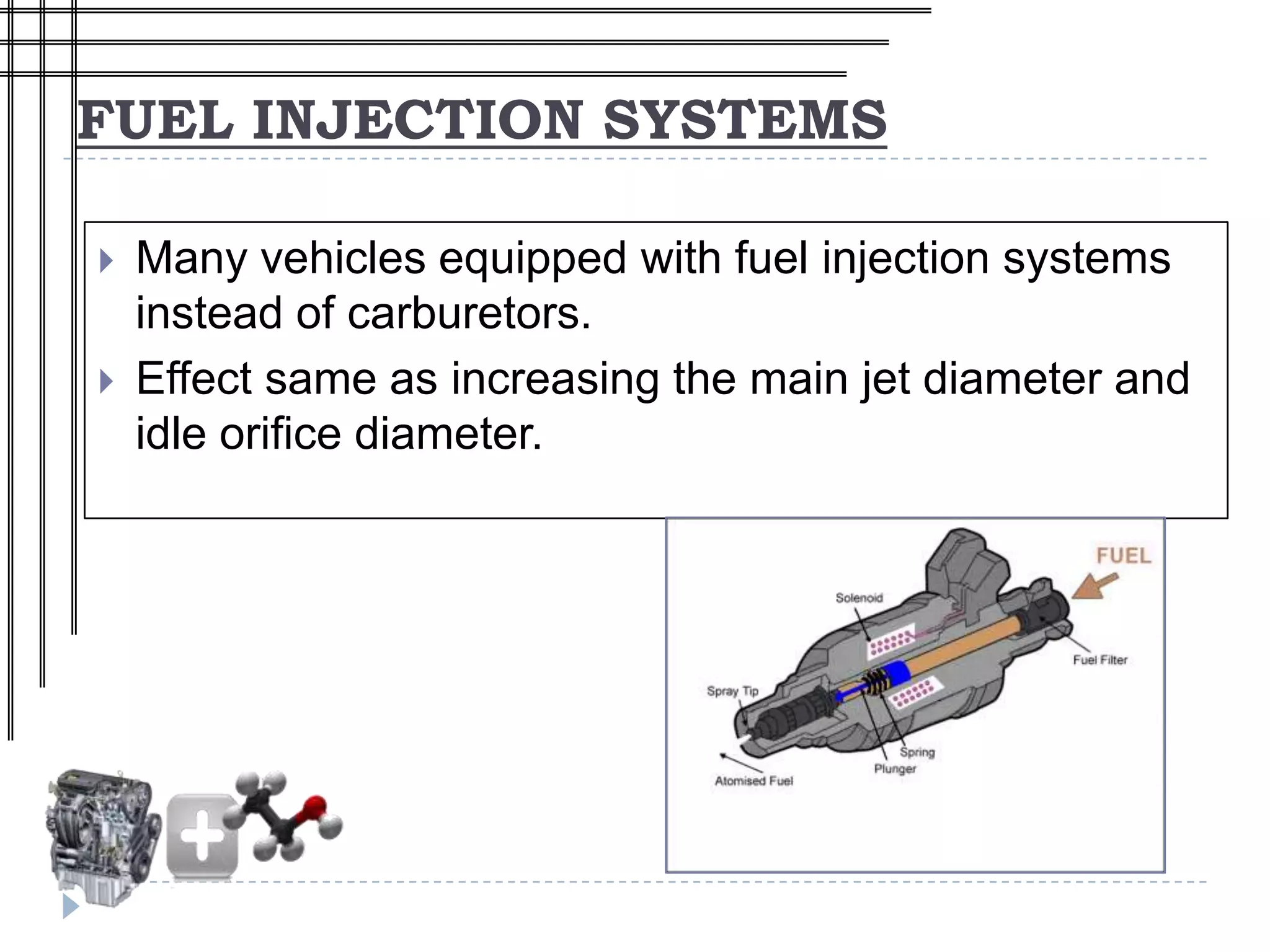
FUEL INJECTION SYSTEMS

   Many vehicles equipped with fuel injection systems
    instead of carburetors.
   Effect same as increasing the main jet diameter and
    idle orifice diameter.
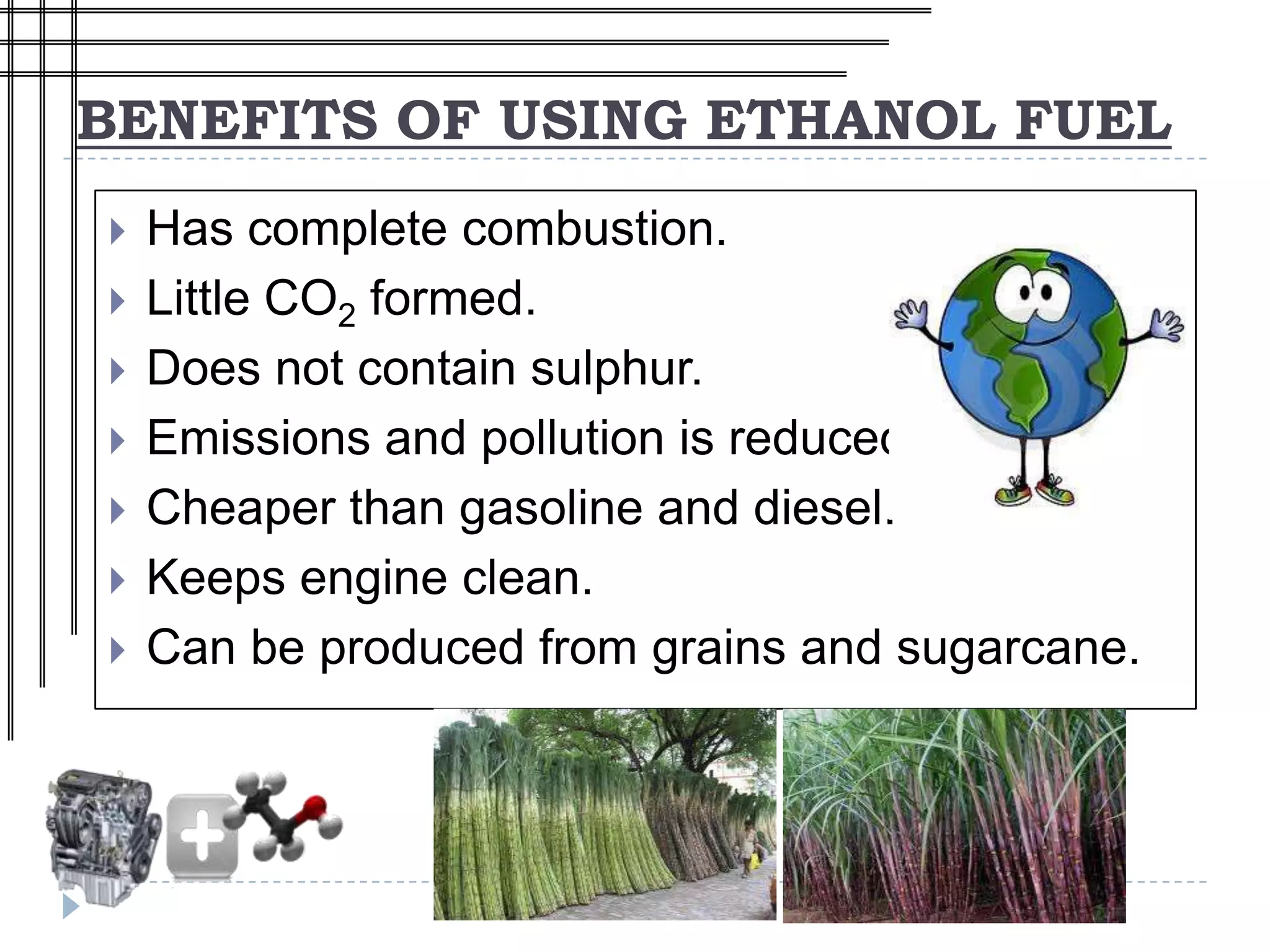
BENEFITS OF USING ETHANOL FUEL
   Has complete combustion.
   Little CO2 formed.
   Does not contain sulphur.
   Emissions and pollution is reduced.
   Cheaper than gasoline and diesel.
   Keeps engine clean.
   Can be produced from grains and sugarcane.
DISADVANTAGES OF ETHANOL FUEL
  Has low energy content.
  More fuel needed to obtain same
   energy as obtained by petrol.
  Has poor ignition characteristics.
  Has almost invisible flames.
  Odour is very offensive.
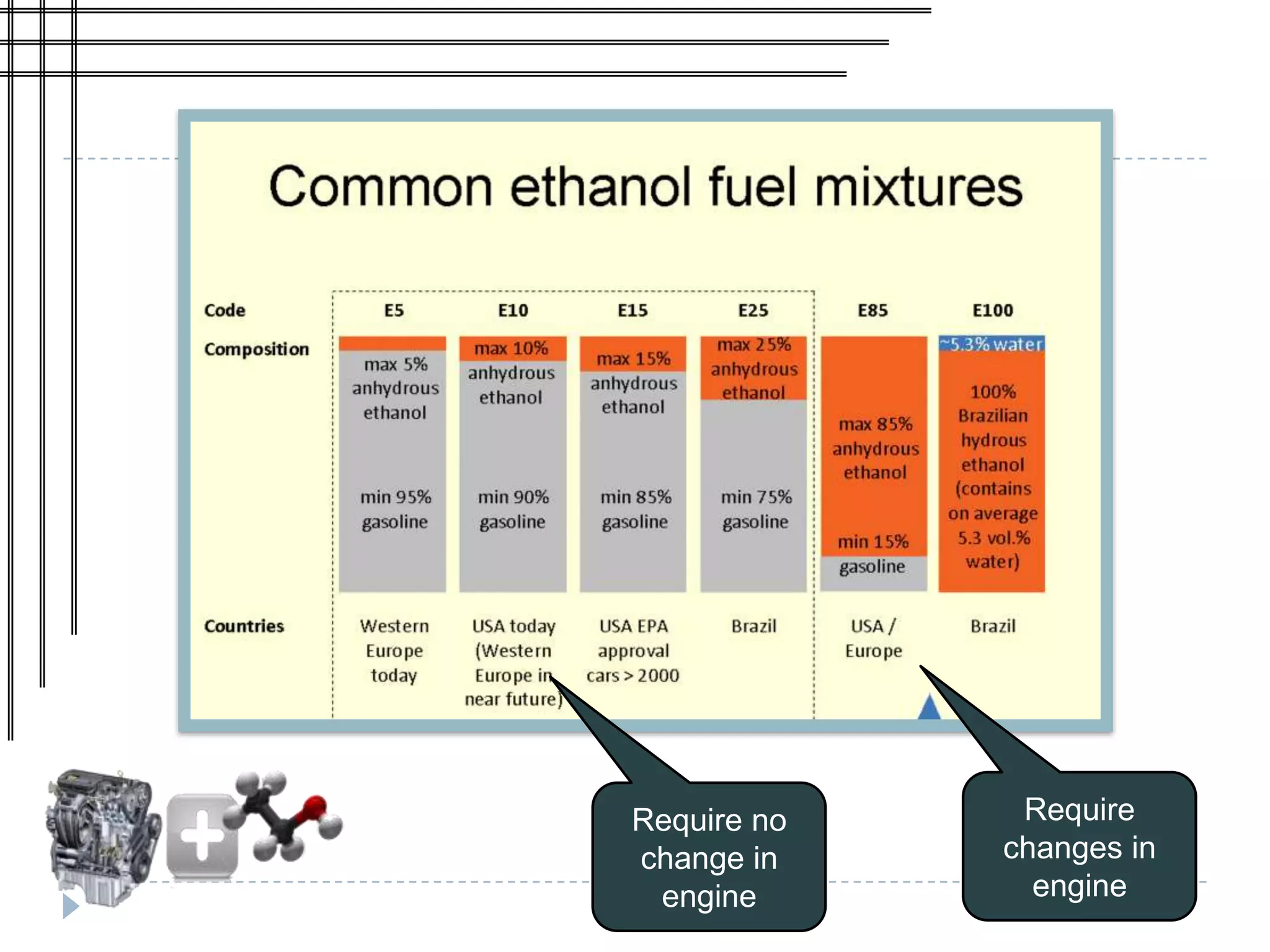
Require no    Require
change in    changes in
 engine        engine
[edit]


           CONCLUSION
         Required adjustments in gasoline engines to cope up with different blends of
         ethanol fuel
         Carburet


                                                            syste


                                                                              Motor oil


                                                                                          manifold
                     injection


                                                                                                     Exhaust
                                    pum


                                               filter


                                                                       tank
         Ethanol


                                 Fuel pr.


                                                        Ignition


                                                                                                     system
                                 Device


                                                                                          Intake
         blend


                                                            m
                                    p


                                                                                                     Cold

                                                                                                     syst.
                                                                                                     start
                     Fuel


                                 Fuel


                                            Fuel


                                                                    Fuel
         or


                                                                                                     0
         ≤5%
      E5-
      E10
     E10-E25

     E25-E85

     E85-E100

             Modifications needed                                   No modifications needed
REFERENCES
   Internal Combustion engines- V Ganesan, 4th edition TMH
    publications.
   "Sustainable bio-fuels: prospects and challenges”
    Joseph (2007) in The Royal Society (2008) journal.

   Hydrous ethanol vs. gasoline-ethanol blend: Engine
    performance and emissions- Rodrigo C. Costa, José R.
    Sodré Pontifical Catholic University of Minas Gerais, Department of
    Mechanical Engineering, MG, Brazil.
   en.wikipedia.org/wiki/Ethanol
   running_on_alcohol.tripod.com
   Image source: Google.

ethanol engine modifications

  • 1.
    SHRI RAMDEOBABA COLLEGEOF ENGINEERING AND MANAGEMENT Technical seminar on MODIFICATIONS IN GASOLINE ENGINES FOR USE OF ETHANOL Guided by: Presented by: Prof. M. P. Joshi Sughosh Deshmukh Mechanical Engg. Dept V sem Mechanical Engg.
  • 2.
    PROPERTIES OF ETHANOL Molecular formula C 2H 6O Appearance Colorless liquid 3 Density 0.785 g/cm Melting point −114 °C, 159 K, -173 °F Boiling point 78.37 °C, 352 K, 173 °F Vapor pressure 5.95 kPa (at 20 °C) Viscosity 0.0012 Pa s (at 20 °C)
  • 3.
    ENERGY CONTENT OFSOME FUELS Fuel MJ/L Research octane number Methanol 17.9 108.7 Ethanol 21.2 108.6 E85 (85% ethanol+ 15% 25.2 105 gasoline) Gasohol (90% gasoline + 33.7 93/94 10% ethanol) Regular gasoline/petrol 34.8 min. 91 Premium gasoline/petrol max. 104 Diesel 38.6 25
  • 4.
    Properties of ethanol  High auto ignition temp.: 326o C (petrol 240-280o C, diesel 210o C)  Corrosive in nature.  High octane rating.  Lesser energy content than gasoline /diesel.  Contains more oxygen
  • 6.
    MAINJET CHANGES Allows entry of air fuel in cylinder.  Greater octane number than petrol.  Requires greater compression ratio.  Increase in orifice diameter of the main jet.  Needs increase of 20 to 40%.
  • 7.
    IDLE ORIFICE CHANGES For entry of fuel in idle mode  Idle orifice needed for supply of air-fuel mixture in slow speeds or idle states.  Diameter to be increased for proper supply of mixture.
  • 8.
    POWER VALVE CHANGES vacuum-controlled valve, spring loaded, shuts off, to conserve fuel.  Power valve allows extra fuel to blend with the air/fuel mixture when the accelerator is depressed.  Difficult to alter.  Valve with approx. 25% greater flow capacity sufficient for increased power.
  • 9.
    ACCELERATOR PUMP CHANGES Supplies extra fuel on sudden accelerator pressing  Used to inject fuel when accelerator is suddenly depressed.  Increase the size approx by 25%.  Larger size may create difficulty in reverting back to gasoline.
  • 10.
    A SMALL GIST  More compression is needed in the cylinder during stroke, to utilize the full potential of the fuel.  Hence, the inlet diameters of the orifices which let the fuel in are to be increase.
  • 11.
    COMPRESSION RATIO CHANGES  Ethanol has a good octane rating.  Compression ratios up to 15 : 1 may be suitable.  Difficulty in reversing back to gasoline.  Remedy: installation of Water injection system for cooling to revert back to gasoline.
  • 12.
    COMPRESSION RATIO CHANGES ……continued  Use of high  Installing a compression pistons. turbocharger.  Connecting rods and  No excessive bearings may not compression during tolerate high ratios. engine startup.  May be replaced.
  • 13.
    COLD WEATHER STARTING  Alcohol does not vaporize as easily as gasoline.  Therefore, starting the engine in cold conditions is a problem.  Various remedies for this are:  Use of extra fuel tank for petrol.  Use of fuel preheater.  Use of air preheater.
  • 14.
    FUEL PREHEATING  Necessary to pre heat fuel in cold climates.  Can be done by making the fuel flow over the hot engine parts through tubes.  Time consuming.  Not very effective.
  • 15.
    AIR PREHEATING  Air from around the exhaust manifold is let in the air fuel mix through ducts.  A flap within the air cleaner "snorkel" shuts off this supply when engine warms up and allows ambient air enter.  This flap is usually either thermostatically or vacuum controlled .  External type resistance air heater may also be used.
  • 16.
    AIR PRE-HEATER SCHEMATIC Resistance Normal air in To electric supply. Warm air out
  • 17.
    THERMOSTAT CHANGE  Used to hold the coolant in the cylinder head until it reaches a certain temperature.  Thermostat decides the temperature at which the coolant will enter the cylinder head.  Ethanol engine works at less temperature than petrol engine of same horsepower.
  • 18.
    INITIAL USE OFALCOHOL FUEL  Alcohol will act as a cleansing agent and will clean out fuel tank, fuel lines, and filters, remove engine's internal parts of built-up carbon, gum, and varnish deposits.  Suddenly a lot of filth will be floating around in fuel.  It may clog fuel filter to the point of not allowing any fuel to pass.  Loosened internal engine deposits can foul the spark plugs badly.
  • 19.
    FUEL INJECTION SYSTEMS  Many vehicles equipped with fuel injection systems instead of carburetors.  Effect same as increasing the main jet diameter and idle orifice diameter.
  • 20.
    BENEFITS OF USINGETHANOL FUEL  Has complete combustion.  Little CO2 formed.  Does not contain sulphur.  Emissions and pollution is reduced.  Cheaper than gasoline and diesel.  Keeps engine clean.  Can be produced from grains and sugarcane.
  • 21.
    DISADVANTAGES OF ETHANOLFUEL  Has low energy content.  More fuel needed to obtain same energy as obtained by petrol.  Has poor ignition characteristics.  Has almost invisible flames.  Odour is very offensive.
  • 22.
    Require no Require change in changes in engine engine
  • 23.
    [edit] CONCLUSION Required adjustments in gasoline engines to cope up with different blends of ethanol fuel Carburet syste Motor oil manifold injection Exhaust pum filter tank Ethanol Fuel pr. Ignition system Device Intake blend m p Cold syst. start Fuel Fuel Fuel Fuel or 0 ≤5% E5- E10 E10-E25 E25-E85 E85-E100 Modifications needed No modifications needed
  • 24.
    REFERENCES  Internal Combustion engines- V Ganesan, 4th edition TMH publications.  "Sustainable bio-fuels: prospects and challenges” Joseph (2007) in The Royal Society (2008) journal.  Hydrous ethanol vs. gasoline-ethanol blend: Engine performance and emissions- Rodrigo C. Costa, José R. Sodré Pontifical Catholic University of Minas Gerais, Department of Mechanical Engineering, MG, Brazil.  en.wikipedia.org/wiki/Ethanol  running_on_alcohol.tripod.com  Image source: Google.