XJ                                                                            FUEL SYSTEM—2.5L DIESEL ENGINE              14 - 1


                          FUEL SYSTEM—2.5L DIESEL ENGINE
                                                             CONTENTS

                                                              page                                                         page

FUEL DELIVERY SYSTEM—2.5L DIESEL                                        GENERAL INFORMATION . . . . . . . . . . . . . . . . . . 1
 ENGINE . . . . . . . . . . . . . . . . . . . . . . . . . . . . . . 3
FUEL INJECTION SYSTEM—2.5L DIESEL
 ENGINE . . . . . . . . . . . . . . . . . . . . . . . . . . . . . 25


                                             GENERAL INFORMATION

                                                                   INDEX
                                                              page                                                         page

GENERAL INFORMATION                                                        INTRODUCTION—2.5L DIESEL . . . . . . . . . . . . . 1
 FUEL REQUIREMENTS—2.5L DIESEL . . . . . . . . 2

GENERAL INFORMATION
INTRODUCTION—2.5L DIESEL
  Certain sensors that are part of the 2.5L diesel
engine fuel system are monitored by the Bosch
engine controller (MSA). Based on inputs recieved
from these sensors, the MSA controls the amount of
fuel and the timing of when it is delivered to the
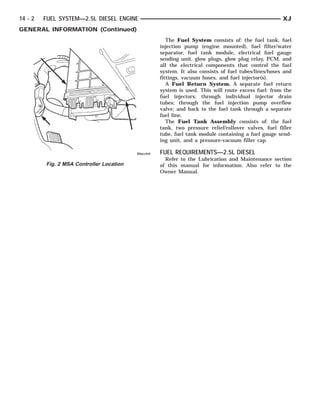
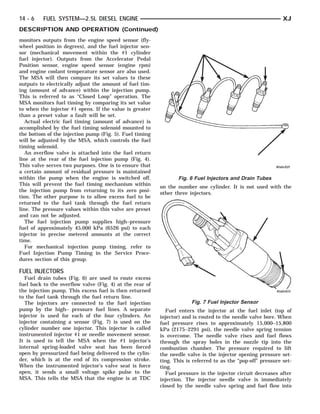
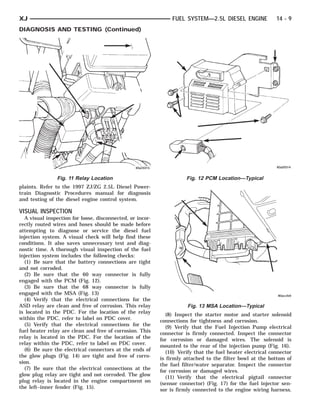
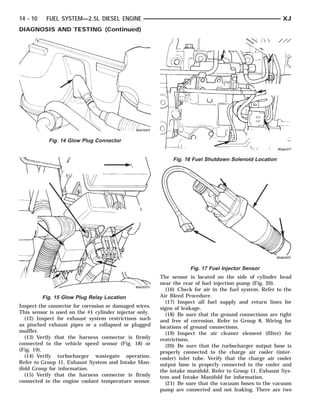
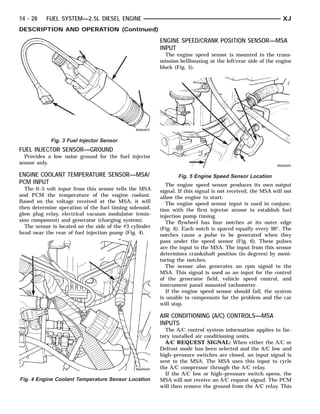
engine. The MSA controller is located under the left
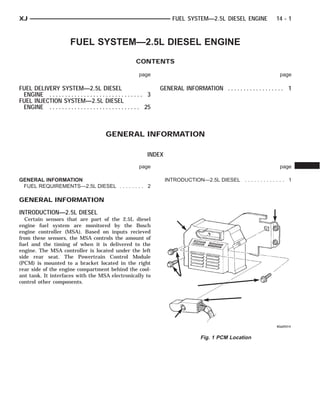
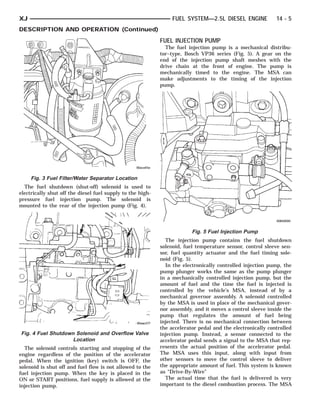
side rear seat. The Powertrain Control Module
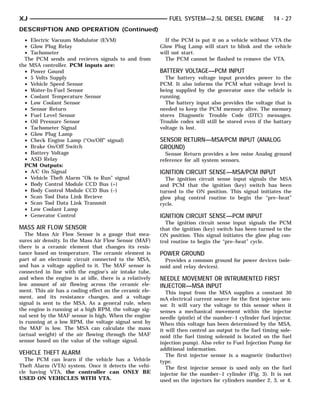
(PCM) is mounted to a bracket located in the right
rear side of the engine compartment behind the cool-
ant tank. It interfaces with the MSA electronically to
control other components.


                                                                                         Fig. 1 PCM Location
14 - 2   FUEL SYSTEM—2.5L DIESEL ENGINE                                                     XJ
GENERAL INFORMATION (Continued)
                                             The Fuel System consists of: the fuel tank, fuel
                                          injection pump (engine mounted), fuel filter/water
                                          separator, fuel tank module, electrical fuel gauge
                                          sending unit, glow plugs, glow plug relay, PCM, and
                                          all the electrical components that control the fuel
                                          system. It also consists of fuel tubes/lines/hoses and
                                          fittings, vacuum hoses, and fuel injector(s).
                                             A Fuel Return System. A separate fuel return
                                          system is used. This will route excess fuel: from the
                                          fuel injectors; through individual injector drain
                                          tubes; through the fuel injection pump overflow
                                          valve; and back to the fuel tank through a separate
                                          fuel line.
                                             The Fuel Tank Assembly consists of: the fuel
                                          tank, two pressure relief/rollover valves, fuel filler
                                          tube, fuel tank module containing a fuel gauge send-
                                          ing unit, and a pressure-vacuum filler cap.

                                          FUEL REQUIREMENTS—2.5L DIESEL
                                            Refer to the Lubrication and Maintenance section
         Fig. 2 MSA Controller Location   of this manual for information. Also refer to the
                                          Owner Manual.
XJ                                                                               FUEL SYSTEM—2.5L DIESEL ENGINE                        14 - 3


                      FUEL DELIVERY SYSTEM—2.5L DIESEL ENGINE

                                                                      INDEX
                                                                page                                                                    page

DESCRIPTION AND OPERATION                                                   FUEL SUPPLY RESTRICTIONS . . . . . . . . . . . .                  13
  FUEL DRAIN TUBES . . . . . . . . . . . . . . . . . . . . .          7     GENERAL INFORMATION . . . . . . . . . . . . . . . . .              9
  FUEL FILTER/WATER SEPARATOR . . . . . . . . . .                     4     HIGH-PRESSURE FUEL LINE LEAK TEST . . . .                         13
  FUEL GAUGE SENDING UNIT . . . . . . . . . . . . . .                 4     VISUAL INSPECTION . . . . . . . . . . . . . . . . . . . . .        9
  FUEL HEATER RELAY . . . . . . . . . . . . . . . . . . . .           8     WASTEGATE (TURBOCHARGER) . . . . . . . . . .                      14
  FUEL HEATER . . . . . . . . . . . . . . . . . . . . . . . . . .     8    SERVICE PROCEDURES
  FUEL INJECTION PUMP . . . . . . . . . . . . . . . . . .             5     AIR BLEED PROCEDURES . . . . . . . . . . . . . . .                14
  FUEL INJECTORS . . . . . . . . . . . . . . . . . . . . . . .        6     FUEL INJECTION PUMP TIMING . . . . . . . . . . .                  15
  FUEL SHUTDOWN SOLENOID . . . . . . . . . . . . .                    5    REMOVAL AND INSTALLATION
  FUEL SYSTEM PRESSURE WARNING . . . . . . .                          3     ACCELERATOR PEDAL . . . . . . . . . . . . . . . . . .             15
  FUEL TANK MODULE . . . . . . . . . . . . . . . . . . . .            4     AIR CLEANER ELEMENT . . . . . . . . . . . . . . . . .             15
  FUEL TANK . . . . . . . . . . . . . . . . . . . . . . . . . . . .   3     FUEL DRAIN TUBES . . . . . . . . . . . . . . . . . . . .          16
  FUEL TUBES/LINES/HOSES AND CLAMPS—                                        FUEL FILTER/WATER SEPARATOR . . . . . . . . .                     16
    LOW-PRESSURE TYPE . . . . . . . . . . . . . . . . .               6     FUEL HEATER RELAY . . . . . . . . . . . . . . . . . . .           17
  HIGH-PRESSURE FUEL LINES . . . . . . . . . . . . .                  7     FUEL HEATER . . . . . . . . . . . . . . . . . . . . . . . . .     17
  INTRODUCTION . . . . . . . . . . . . . . . . . . . . . . . .        3     FUEL INJECTION PUMP . . . . . . . . . . . . . . . . .             18
  QUICK-CONNECT FITTINGS—                                                   FUEL INJECTORS . . . . . . . . . . . . . . . . . . . . . .        21
    LOW PRESSURE TYPE . . . . . . . . . . . . . . . . .               7     FUEL LEVEL SENSOR . . . . . . . . . . . . . . . . . . .           17
  WASTEGATE (TURBOCHARGER) . . . . . . . . . . .                      8     FUEL RESERVOIR MODULE . . . . . . . . . . . . . .                 23
DIAGNOSIS AND TESTING                                                       FUEL TANK . . . . . . . . . . . . . . . . . . . . . . . . . . .   21
  AIR IN FUEL SYSTEM . . . . . . . . . . . . . . . . . . .            12    HIGH-PRESSURE LINES . . . . . . . . . . . . . . . . .             23
  FUEL HEATER RELAY TEST . . . . . . . . . . . . . .                  12   SPECIFICATIONS
  FUEL INJECTION PUMP TEST . . . . . . . . . . . . .                  12    FUEL INJECTOR FIRING SEQUENCE . . . . . . .                       24
  FUEL INJECTOR SENSOR TEST . . . . . . . . . . .                     12    FUEL SYSTEM PRESSURE . . . . . . . . . . . . . . .                24
  FUEL INJECTOR TEST . . . . . . . . . . . . . . . . . .              12    FUEL TANK CAPACITY . . . . . . . . . . . . . . . . . .            24
  FUEL SHUTDOWN SOLENOID TEST . . . . . . . .                         13    IDLE SPEED . . . . . . . . . . . . . . . . . . . . . . . . . .    24

DESCRIPTION AND OPERATION                                                  FUEL SYSTEM PRESSURE WARNING
INTRODUCTION                                                               WARNING: HIGH–PRESSURE FUEL LINES DELIVER
  This Fuel Delivery section will cover components                         DIESEL FUEL UNDER EXTREME PRESSURE FROM
not controlled by the PCM. For components con-                             THE INJECTION PUMP TO THE FUEL INJECTORS.
trolled by the PCM, refer to the Fuel Injection Sys-                       THIS MAY BE AS HIGH AS 45,000 KPA (6526 PSI).
tem—2.5L Diesel Engine section of this group.                              USE EXTREME CAUTION WHEN INSPECTING FOR
  The fuel heater relay, fuel heater and fuel gauge                        HIGH–PRESSURE FUEL LEAKS. INSPECT FOR
are not operated by the PCM. These components are                          HIGH–PRESSURE FUEL LEAKS WITH A SHEET OF
controlled by the ignition (key) switch. All other fuel                    CARDBOARD (Fig. 1). HIGH FUEL INJECTION
system electrical components necessary to operate                          PRESSURE CAN CAUSE PERSONAL INJURY IF
the engine are controlled or regulated by the PCM.                         CONTACT IS MADE WITH THE SKIN.
14 - 4    FUEL SYSTEM—2.5L DIESEL ENGINE                                                                       XJ
DESCRIPTION AND OPERATION (Continued)


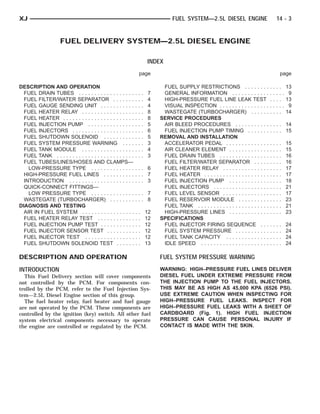
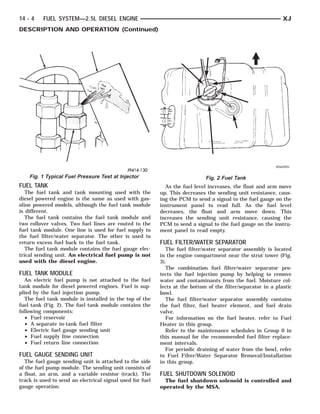
    Fig. 1 Typical Fuel Pressure Test at Injector                             Fig. 2 Fuel Tank
FUEL TANK                                                    As the fuel level increases, the float and arm move
   The fuel tank and tank mounting used with the           up. This decreases the sending unit resistance, caus-
diesel powered engine is the same as used with gas-        ing the PCM to send a signal to the fuel gauge on the
oline powered models, although the fuel tank module        instrument panel to read full. As the fuel level
is different.                                              decreases, the float and arm move down. This
   The fuel tank contains the fuel tank module and         increases the sending unit resistance, causing the
two rollover valves. Two fuel lines are routed to the      PCM to send a signal to the fuel gauge on the instru-
fuel tank module. One line is used for fuel supply to      ment panel to read empty.
the fuel filter/water separator. The other is used to
return excess fuel back to the fuel tank.                  FUEL FILTER/WATER SEPARATOR
   The fuel tank module contains the fuel gauge elec-        The fuel filter/water separator assembly is located
trical sending unit. An electrical fuel pump is not        in the engine compartment near the strut tower (Fig.
used with the diesel engine.                               3).
                                                             The combination fuel filter/water separator pro-
FUEL TANK MODULE                                           tects the fuel injection pump by helping to remove
   An electric fuel pump is not attached to the fuel       water and contaminants from the fuel. Moisture col-
tank module for diesel powered engines. Fuel is sup-       lects at the bottom of the filter/separator in a plastic
plied by the fuel injection pump.                          bowl.
   The fuel tank module is installed in the top of the       The fuel filter/water separator assembly contains
fuel tank (Fig. 2). The fuel tank module contains the      the fuel filter, fuel heater element, and fuel drain
following components:                                      valve.
   • Fuel reservoir                                          For information on the fuel heater, refer to Fuel
   • A separate in-tank fuel filter                        Heater in this group.
   • Electric fuel gauge sending unit                        Refer to the maintenance schedules in Group 0 in
   • Fuel supply line connection                           this manual for the recommended fuel filter replace-
   • Fuel return line connection                           ment intervals.
                                                             For periodic draining of water from the bowl, refer
FUEL GAUGE SENDING UNIT                                    to Fuel Filter/Water Separator Removal/Installation
   The fuel gauge sending unit is attached to the side     in this group.
of the fuel pump module. The sending unit consists of
a float, an arm, and a variable resistor (track). The      FUEL SHUTDOWN SOLENOID
track is used to send an electrical signal used for fuel     The fuel shutdown solenoid is controlled and
gauge operation.                                           operated by the MSA.
XJ                                                               FUEL SYSTEM—2.5L DIESEL ENGINE             14 - 5
DESCRIPTION AND OPERATION (Continued)
                                                            FUEL INJECTION PUMP
                                                              The fuel injection pump is a mechanical distribu-
                                                            tor–type, Bosch VP36 series (Fig. 5). A gear on the
                                                            end of the injection pump shaft meshes with the
                                                            drive chain at the front of engine. The pump is
                                                            mechanically timed to the engine. The MSA can
                                                            make adjustments to the timing of the injection
                                                            pump.


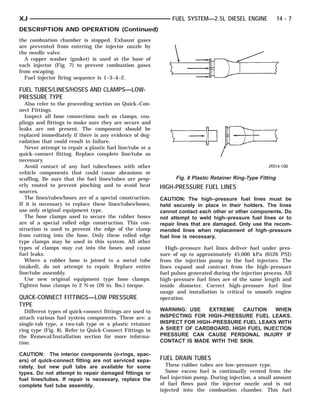
     Fig. 3 Fuel Filter/Water Separator Location
  The fuel shutdown (shut-off) solenoid is used to
electrically shut off the diesel fuel supply to the high-
pressure fuel injection pump. The solenoid is
mounted to the rear of the injection pump (Fig. 4).


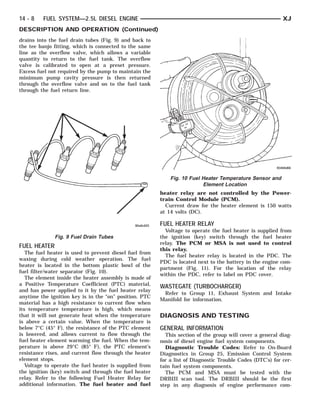
                                                                         Fig. 5 Fuel Injection Pump
                                                              The injection pump contains the fuel shutdown
                                                            solenoid, fuel temperature sensor, control sleeve sen-
                                                            sor, fuel quantity actuator and the fuel timing sole-
                                                            noid (Fig. 5).
                                                              In the electronically controlled injection pump, the
                                                            pump plunger works the same as the pump plunger
                                                            in a mechanically controlled injection pump, but the
                                                            amount of fuel and the time the fuel is injected is
                                                            controlled by the vehicle’s MSA, instead of by a
                                                            mechanical governor assembly. A solenoid controlled
                                                            by the MSA is used in place of the mechanical gover-
                                                            nor assembly, and it moves a control sleeve inside the
                                                            pump that regulates the amount of fuel being
                                                            injected. There is no mechanical connection between
                                                            the accelerator pedal and the electronically controlled
Fig. 4 Fuel Shutdown Solenoid and Overflow Valve            injection pump. Instead, a sensor connected to the
                    Location                                accelerator pedal sends a signal to the MSA that rep-
  The solenoid controls starting and stopping of the        resents the actual position of the accelerator pedal.
engine regardless of the position of the accelerator        The MSA uses this input, along with input from
pedal. When the ignition (key) switch is OFF, the           other sensors to move the control sleeve to deliver
solenoid is shut off and fuel flow is not allowed to the    the appropriate amount of fuel. This system is known
fuel injection pump. When the key is placed in the          as “Drive-By-Wire”
ON or START positions, fuel supply is allowed at the          The actual time that the fuel is delivered is very
injection pump.                                             important to the diesel combustion process. The MSA
14 - 6    FUEL SYSTEM—2.5L DIESEL ENGINE                                                                      XJ
DESCRIPTION AND OPERATION (Continued)
monitors outputs from the engine speed sensor (fly-
wheel position in degrees), and the fuel injector sen-
sor (mechanical movement within the #1 cylinder
fuel injector). Outputs from the Accelerator Pedal
Position sensor, engine speed sensor (engine rpm)
and engine coolant temperature sensor are also used.
The MSA will then compare its set values to these
outputs to electrically adjust the amount of fuel tim-
ing (amount of advance) within the injection pump.
This is referred to as “Closed Loop” operation. The
MSA monitors fuel timing by comparing its set value
to when the injector #1 opens. If the value is greater
than a preset value a fault will be set.
   Actual electric fuel timing (amount of advance) is
accomplished by the fuel timing solenoid mounted to
the bottom of the injection pump (Fig. 5). Fuel timing
will be adjusted by the MSA, which controls the fuel
timing solenoid.
   An overflow valve is attached into the fuel return
line at the rear of the fuel injection pump (Fig. 4).
This valve serves two purposes. One is to ensure that
a certain amount of residual pressure is maintained
within the pump when the engine is switched off.                 Fig. 6 Fuel Injectors and Drain Tubes
This will prevent the fuel timing mechanism within
                                                          on the number one cylinder. It is not used with the
the injection pump from returning to its zero posi-
                                                          other three injectors.
tion. The other purpose is to allow excess fuel to be
returned to the fuel tank through the fuel return
line. The pressure values within this valve are preset
and can not be adjusted.
   The fuel injection pump supplies high–pressure
fuel of approximately 45,000 kPa (6526 psi) to each
injector in precise metered amounts at the correct
time.
   For mechanical injection pump timing, refer to
Fuel Injection Pump Timing in the Service Proce-
dures section of this group.

FUEL INJECTORS
  Fuel drain tubes (Fig. 6) are used to route excess
fuel back to the overflow valve (Fig. 4) at the rear of
the injection pump. This excess fuel is then returned
to the fuel tank through the fuel return line.
  The injectors are connected to the fuel injection                    Fig. 7 Fuel Injector Sensor
pump by the high– pressure fuel lines. A separate           Fuel enters the injector at the fuel inlet (top of
injector is used for each of the four cylinders. An       injector) and is routed to the needle valve bore. When
injector containing a sensor (Fig. 7) is used on the      fuel pressure rises to approximately 15,000–15,800
cylinder number one injector. This injector is called     kPa (2175–2291 psi), the needle valve spring tension
instrumented injector #1 or needle movement sensor.       is overcome. The needle valve rises and fuel flows
It is used to tell the MSA when the #1 injector’s         through the spray holes in the nozzle tip into the
internal spring-loaded valve seat has been forced         combustion chamber. The pressure required to lift
open by pressurized fuel being delivered to the cylin-    the needle valve is the injector opening pressure set-
der, which is at the end of its compression stroke.       ting. This is referred to as the “pop-off” pressure set-
When the instrumented injector’s valve seat is force      ting.
open, it sends a small voltage spike pulse to the           Fuel pressure in the injector circuit decreases after
MSA. This tells the MSA that the engine is at TDC         injection. The injector needle valve is immediately
                                                          closed by the needle valve spring and fuel flow into
XJ                                                              FUEL SYSTEM—2.5L DIESEL ENGINE               14 - 7
DESCRIPTION AND OPERATION (Continued)
the combustion chamber is stopped. Exhaust gases
are prevented from entering the injector nozzle by
the needle valve.
  A copper washer (gasket) is used at the base of
each injector (Fig. 7) to prevent combustion gases
from escaping.
  Fuel injector firing sequence is 1–3–4–2.

FUEL TUBES/LINES/HOSES AND CLAMPS—LOW-
PRESSURE TYPE
   Also refer to the proceeding section on Quick–Con-
nect Fittings.
   Inspect all hose connections such as clamps, cou-
plings and fittings to make sure they are secure and
leaks are not present. The component should be
replaced immediately if there is any evidence of deg-
radation that could result in failure.
   Never attempt to repair a plastic fuel line/tube or a
quick–connect fitting. Replace complete line/tube as
necessary.
   Avoid contact of any fuel tubes/hoses with other
vehicle components that could cause abrasions or
scuffing. Be sure that the fuel lines/tubes are prop-            Fig. 8 Plastic Retainer Ring-Type Fitting
erly routed to prevent pinching and to avoid heat          HIGH-PRESSURE FUEL LINES
sources.
   The lines/tubes/hoses are of a special construction.    CAUTION: The high–pressure fuel lines must be
If it is necessary to replace these lines/tubes/hoses,     held securely in place in their holders. The lines
use only original equipment type.                          cannot contact each other or other components. Do
   The hose clamps used to secure the rubber hoses         not attempt to weld high–pressure fuel lines or to
are of a special rolled edge construction. This con-       repair lines that are damaged. Only use the recom-
struction is used to prevent the edge of the clamp         mended lines when replacement of high–pressure
from cutting into the hose. Only these rolled edge         fuel line is necessary.
type clamps may be used in this system. All other
types of clamps may cut into the hoses and cause              High–pressure fuel lines deliver fuel under pres-
fuel leaks.                                                sure of up to approximately 45,000 kPa (6526 PSI)
   Where a rubber hose is joined to a metal tube           from the injection pump to the fuel injectors. The
(staked), do not attempt to repair. Replace entire         lines expand and contract from the high–pressure
line/tube assembly.                                        fuel pulses generated during the injection process. All
   Use new original equipment type hose clamps.            high–pressure fuel lines are of the same length and
Tighten hose clamps to 2 N·m (20 in. lbs.) torque.         inside diameter. Correct high–pressure fuel line
                                                           usage and installation is critical to smooth engine
QUICK-CONNECT FITTINGS—LOW PRESSURE                        operation.
TYPE
   Different types of quick-connect fittings are used to   WARNING: USE    EXTREME   CAUTION   WHEN
attach various fuel system components. These are: a        INSPECTING FOR HIGH–PRESSURE FUEL LEAKS.
single-tab type, a two-tab type or a plastic retainer      INSPECT FOR HIGH–PRESSURE FUEL LEAKS WITH
ring type (Fig. 8). Refer to Quick-Connect Fittings in     A SHEET OF CARDBOARD. HIGH FUEL INJECTION
the Removal/Installation section for more informa-         PRESSURE CAN CAUSE PERSONAL INJURY IF
tion.                                                      CONTACT IS MADE WITH THE SKIN.

CAUTION: The interior components (o-rings, spac-
ers) of quick-connect fitting are not serviced sepa-       FUEL DRAIN TUBES
rately, but new pull tabs are available for some             These rubber tubes are low–pressure type.
types. Do not attempt to repair damaged fittings or          Some excess fuel is continually vented from the
fuel lines/tubes. If repair is necessary, replace the      fuel injection pump. During injection, a small amount
complete fuel tube assembly.                               of fuel flows past the injector nozzle and is not
                                                           injected into the combustion chamber. This fuel
14 - 8   FUEL SYSTEM—2.5L DIESEL ENGINE                                                                     XJ
DESCRIPTION AND OPERATION (Continued)
drains into the fuel drain tubes (Fig. 9) and back to
the tee banjo fitting, which is connected to the same
line as the overflow valve, which allows a variable
quantity to return to the fuel tank. The overflow
valve is calibrated to open at a preset pressure.
Excess fuel not required by the pump to maintain the
minimum pump cavity pressure is then returned
through the overflow valve and on to the fuel tank
through the fuel return line.


                                                             Fig. 10 Fuel Heater Temperature Sensor and
                                                                          Element Location
                                                         heater relay are not controlled by the Power-
                                                         train Control Module (PCM).
                                                           Current draw for the heater element is 150 watts
                                                         at 14 volts (DC).

                                                         FUEL HEATER RELAY
                                                           Voltage to operate the fuel heater is supplied from
              Fig. 9 Fuel Drain Tubes                    the ignition (key) switch through the fuel heater
                                                         relay. The PCM or MSA is not used to control
FUEL HEATER
                                                         this relay.
   The fuel heater is used to prevent diesel fuel from
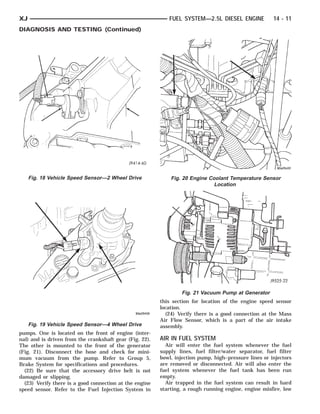
                                                           The fuel heater relay is located in the PDC. The
waxing during cold weather operation. The fuel
                                                         PDC is located next to the battery in the engine com-
heater is located in the bottom plastic bowl of the
                                                         partment (Fig. 11). For the location of the relay
fuel filter/water separator (Fig. 10).
                                                         within the PDC, refer to label on PDC cover.
   The element inside the heater assembly is made of
a Positive Temperature Coefficient (PTC) material,
                                                         WASTEGATE (TURBOCHARGER)
and has power applied to it by the fuel heater relay
                                                          Refer to Group 11, Exhaust System and Intake
anytime the ignition key is in the “on” position. PTC
                                                         Manifold for information.
material has a high resistance to current flow when
its temperature temperature is high, which means
that it will not generate heat when the temperature      DIAGNOSIS AND TESTING
is above a certain value. When the temperature is
below 7°C (45° F), the resistance of the PTC element     GENERAL INFORMATION
is lowered, and allows current to flow through the         This section of the group will cover a general diag-
fuel heater element warming the fuel. When the tem-      nosis of diesel engine fuel system components.
perature is above 29°C (85° F), the PTC element’s          Diagnostic Trouble Codes: Refer to On-Board
resistance rises, and current flow through the heater    Diagnostics in Group 25, Emission Control System
element stops.                                           for a list of Diagnostic Trouble Codes (DTC’s) for cer-
   Voltage to operate the fuel heater is supplied from   tain fuel system components.
the ignition (key) switch and through the fuel heater      The PCM and MSA must be tested with the
relay. Refer to the following Fuel Heater Relay for      DRBIII scan tool. The DRBIII should be the first
additional information. The fuel heater and fuel         step in any diagnosis of engine performance com-
XJ                                                              FUEL SYSTEM—2.5L DIESEL ENGINE              14 - 9
DIAGNOSIS AND TESTING (Continued)


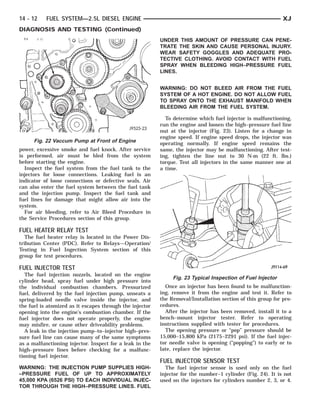
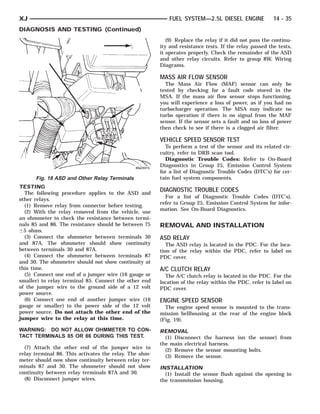
                Fig. 11 Relay Location                                Fig. 12 PCM Location—Typical
plaints. Refer to the 1997 ZJ/ZG 2.5L Diesel Power-
train Diagnostic Procedures manual for diagnosis
and testing of the diesel engine control system.

VISUAL INSPECTION
  A visual inspection for loose, disconnected, or incor-
rectly routed wires and hoses should be made before
attempting to diagnose or service the diesel fuel
injection system. A visual check will help find these
conditions. It also saves unnecessary test and diag-
nostic time. A thorough visual inspection of the fuel
injection system includes the following checks:
  (1) Be sure that the battery connections are tight
and not corroded.
  (2) Be sure that the 60 way connector is fully
engaged with the PCM (Fig. 12).
  (3) Be sure that the 68 way connector is fully
engaged with the MSA (Fig. 13)
  (4) Verify that the electrical connections for the
ASD relay are clean and free of corrosion. This relay                 Fig. 13 MSA Location—Typical
is located in the PDC. For the location of the relay          (8) Inspect the starter motor and starter solenoid
within the PDC, refer to label on PDC cover.               connections for tightness and corrosion.
  (5) Verify that the electrical connections for the          (9) Verify that the Fuel Injection Pump electrical
fuel heater relay are clean and free of corrosion. This    connector is firmly connected. Inspect the connector
relay is located in the PDC. For the location of the       for corrosion or damaged wires. The solenoid is
relay within the PDC, refer to label on PDC cover.         mounted to the rear of the injection pump (Fig. 16).
  (6) Be sure the electrical connectors at the ends of        (10) Verify that the fuel heater electrical connector
the glow plugs (Fig. 14) are tight and free of corro-      is firmly attached to the filter bowl at the bottom of
sion.                                                      the fuel filter/water separator. Inspect the connector
  (7) Be sure that the electrical connections at the       for corrosion or damaged wires.
glow plug relay are tight and not corroded. The glow          (11) Verify that the electrical pigtail connector
plug relay is located in the engine compartment on         (sensor connector) (Fig. 17) for the fuel injector sen-
the left–inner fender (Fig. 15).                           sor is firmly connected to the engine wiring harness.
14 - 10    FUEL SYSTEM—2.5L DIESEL ENGINE                                                                XJ
DIAGNOSIS AND TESTING (Continued)


            Fig. 14 Glow Plug Connector


                                                             Fig. 16 Fuel Shutdown Solenoid Location


                                                                    Fig. 17 Fuel Injector Sensor
                                                        The sensor is located on the side of cylinder head
                                                        near the rear of fuel injection pump (Fig. 20).
                                                          (16) Check for air in the fuel system. Refer to the
          Fig. 15 Glow Plug Relay Location              Air Bleed Procedure.
                                                          (17) Inspect all fuel supply and return lines for
Inspect the connector for corrosion or damaged wires.   signs of leakage.
This sensor is used on the #1 cylinder injector only.     (18) Be sure that the ground connections are tight
   (12) Inspect for exhaust system restrictions such    and free of corrosion. Refer to Group 8, Wiring for
as pinched exhaust pipes or a collapsed or plugged      locations of ground connections.
muffler.                                                  (19) Inspect the air cleaner element (filter) for
   (13) Verify that the harness connector is firmly     restrictions.
connected to the vehicle speed sensor (Fig. 18) or        (20) Be sure that the turbocharger output hose is
(Fig. 19).                                              properly connected to the charge air cooler (inter-
   (14) Verify turbocharger wastegate operation.        cooler) inlet tube. Verify that the charge air cooler
Refer to Group 11, Exhaust System and Intake Man-       output hose is properly connected to the cooler and
ifold Group for information.                            the intake manifold. Refer to Group 11, Exhaust Sys-
   (15) Verify that the harness connector is firmly     tem and Intake Manifold for information.
connected to the engine coolant temperature sensor.       (21) Be sure that the vacuum hoses to the vacuum
                                                        pump are connected and not leaking. There are two
XJ                                                          FUEL SYSTEM—2.5L DIESEL ENGINE             14 - 11
DIAGNOSIS AND TESTING (Continued)


     Fig. 18 Vehicle Speed Sensor—2 Wheel Drive              Fig. 20 Engine Coolant Temperature Sensor
                                                                              Location


                                                                 Fig. 21 Vacuum Pump at Generator
                                                         this section for location of the engine speed sensor
                                                         location.
                                                           (24) Verify there is a good connection at the Mass
                                                         Air Flow Sensor, which is a part of the air intake
     Fig. 19 Vehicle Speed Sensor—4 Wheel Drive          assembly.
pumps. One is located on the front of engine (inter-
nal) and is driven from the crankshaft gear (Fig. 22).   AIR IN FUEL SYSTEM
The other is mounted to the front of the generator         Air will enter the fuel system whenever the fuel
(Fig. 21). Disconnect the hose and check for mini-       supply lines, fuel filter/water separator, fuel filter
mum vacuum from the pump. Refer to Group 5,              bowl, injection pump, high–pressure lines or injectors
Brake System for specifications and procedures.          are removed or disconnected. Air will also enter the
  (22) Be sure that the accessory drive belt is not      fuel system whenever the fuel tank has been run
damaged or slipping.                                     empty.
  (23) Verify there is a good connection at the engine     Air trapped in the fuel system can result in hard
speed sensor. Refer to the Fuel Injection System in      starting, a rough running engine, engine misfire, low
14 - 12    FUEL SYSTEM—2.5L DIESEL ENGINE                                                                    XJ
DIAGNOSIS AND TESTING (Continued)
                                                          UNDER THIS AMOUNT OF PRESSURE CAN PENE-
                                                          TRATE THE SKIN AND CAUSE PERSONAL INJURY.
                                                          WEAR SAFETY GOGGLES AND ADEQUATE PRO-
                                                          TECTIVE CLOTHING. AVOID CONTACT WITH FUEL
                                                          SPRAY WHEN BLEEDING HIGH–PRESSURE FUEL
                                                          LINES.


                                                          WARNING: DO NOT BLEED AIR FROM THE FUEL
                                                          SYSTEM OF A HOT ENGINE. DO NOT ALLOW FUEL
                                                          TO SPRAY ONTO THE EXHAUST MANIFOLD WHEN
                                                          BLEEDING AIR FROM THE FUEL SYSTEM.

                                                            To determine which fuel injector is malfunctioning,
                                                          run the engine and loosen the high–pressure fuel line
                                                          nut at the injector (Fig. 23). Listen for a change in
                                                          engine speed. If engine speed drops, the injector was
      Fig. 22 Vaccum Pump at Front of Engine              operating normally. If engine speed remains the
power, excessive smoke and fuel knock. After service      same, the injector may be malfunctioning. After test-
is performed, air must be bled from the system            ing, tighten the line nut to 30 N·m (22 ft. lbs.)
before starting the engine.                               torque. Test all injectors in the same manner one at
  Inspect the fuel system from the fuel tank to the       a time.
injectors for loose connections. Leaking fuel is an
indicator of loose connections or defective seals. Air
can also enter the fuel system between the fuel tank
and the injection pump. Inspect the fuel tank and
fuel lines for damage that might allow air into the
system.
  For air bleeding, refer to Air Bleed Procedure in
the Service Procedures section of this group.

FUEL HEATER RELAY TEST
   The fuel heater relay is located in the Power Dis-
tribution Center (PDC). Refer to Relays—Operation/
Testing in Fuel Ingection System section of this
group for test procedures.

FUEL INJECTOR TEST
   The fuel injection nozzels, located on the engine
                                                               Fig. 23 Typical Inspection of Fuel Injector
cylinder head, spray fuel under high pressure into
the individual combustion chambers. Pressurized             Once an injector has been found to be malfunction-
fuel, delivered by the fuel injection pump, unseats a     ing, remove it from the engine and test it. Refer to
spring-loaded needle valve inside the injector, and       the Removal/Installation section of this group for pro-
the fuel is atomized as it escapes through the injector   cedures.
opening into the engine’s combustion chamber. If the        After the injector has been removed, install it to a
fuel injector does not operate properly, the engine       bench–mount injector tester. Refer to operating
may misfire, or cause other driveability problems.        instructions supplied with tester for procedures.
   A leak in the injection pump–to–injector high–pres-      The opening pressure or “pop” pressure should be
sure fuel line can cause many of the same symptoms        15,000–15,800 kPa (2175–2291 psi). If the fuel injec-
as a malfunctioning injector. Inspect for a leak in the   tor needle valve is opening (“popping”) to early or to
high–pressure lines before checking for a malfunc-        late, replace the injector.
tioning fuel injector.
                                                          FUEL INJECTOR SENSOR TEST
WARNING: THE INJECTION PUMP SUPPLIES HIGH-                  The fuel injector sensor is used only on the fuel
–PRESSURE FUEL OF UP TO APPROXIMATELY                     injector for the number–1 cylinder (Fig. 24). It is not
45,000 KPA (6526 PSI) TO EACH INDIVIDUAL INJEC-           used on the injectors for cylinders number 2, 3, or 4.
TOR THROUGH THE HIGH–PRESSURE LINES. FUEL
XJ                                                          FUEL SYSTEM—2.5L DIESEL ENGINE               14 - 13
DIAGNOSIS AND TESTING (Continued)
                                                         FUEL SUPPLY RESTRICTIONS
                                                         LOW–PRESSURE LINES
                                                            Restricted or Plugged supply lines or fuel filter can
                                                         cause a timing fault that will cause the PCM to oper-
                                                         ate the engine in a “Limp Home” mode. See the
                                                         introduction of the Fuel Injection System in this
                                                         group for more information on the Limp Home mode.
                                                         Fuel supply line restrictions can cause starting prob-
                                                         lems and prevent the engine from revving up. The
                                                         starting problems include; low power and blue or
                                                         white fog like exhaust. Test all fuel supply lines for
                                                         restrictions or blockage. Flush or replace as neces-
                                                         sary. Bleed the fuel system of air once a fuel supply
                                                         line has been replaced. Refer to the Air Bleed Proce-
                                                         dure section of this group for procedures.
       Fig. 24 Fuel Injector Sensor Location
                                                         HIGH–PRESSURE LINES
  To test the sensor, unplug the sensor connector
                                                           Restricted (kinked or bent) high–pressure lines can
(Fig. 24) from the engine wiring harness. Check
                                                         cause starting problems, poor engine performance
resistance across terminals. Resistance should be 110
                                                         and black smoke from exhaust.
ohms Ϯ 10 ohms at 20°C (68°F). Replace sensor if
                                                           Examine all high–pressure lines for any damage.
specification cannot be met.
                                                         Each radius on each high–pressure line must be
                                                         smooth and free of any bends or kinks.
FUEL INJECTION PUMP TEST                                   Replace damaged, restricted or leaking high–pres-
  The injection pump is not to be serviced or
                                                         sure fuel lines with the correct replacement line.
the warranty may be voided. If the injection
pump requires service, the complete assembly             CAUTION: The high–pressure fuel lines must be
must be replaced.                                        clamped securely in place in the holders. The lines
  Incorrect injection pump timing (mechanical or         cannot contact each other or other components. Do
electrical) can cause poor performance, excessive        not attempt to weld high–pressure fuel lines or to
smoke and emissions and poor fuel economy.               repair lines that are damaged. Only use the recom-
  A defective fuel injection pump, defective fuel tim-   mended lines when replacement of high–pressure
ing solenoid or misadjusted mechanical pump timing       fuel line is necessary.
can cause starting problems or prevent the engine
from revving up. It can also cause:
  • Engine surge at idle                                 FUEL SHUTDOWN SOLENOID TEST
  • Rough idle (warm engine)                               Refer to 1997 ZJ/ZG 2.5L Diesel Powertrain Diag-
  • Low power                                            nostic Manual for the Fuel Shutdown Solenoid test.
  • Excessive fuel consumption
  • Poor performance                                     HIGH-PRESSURE FUEL LINE LEAK TEST
  • Low power                                              High–pressure fuel line leaks can cause starting
  • Black smoke from the exhaust                         problems and poor engine performance.
  • Blue or white fog like exhaust
  • Incorrect idle or maximum speed                      WARNING: DUE TO EXTREME FUEL PRESSURES
  The electronically controlled fuel pump has no         OF UP TO 45,000 KPA (6526 PSI), USE EXTREME
mechanical governor like older mechanically con-         CAUTION WHEN INSPECTING FOR HIGH–PRES-
trolled fuel pumps. Do not remove the top cover of       SURE FUEL LEAKS. DO NOT GET YOUR HAND, OR
the fuel pump, or the screws fastening the wiring        ANY PART OF YOUR BODY NEAR A SUSPECTED
pigtail to the side of the pump. The warranty of         LEAK. INSPECT FOR HIGH–PRESSURE FUEL
the injection pump and the engine may be void            LEAKS WITH A SHEET OF CARDBOARD. HIGH
if those seals have been removed or tampered             FUEL INJECTION PRESSURE CAN CAUSE PER-
with.                                                    SONAL INJURY IF CONTACT IS MADE WITH THE
                                                         SKIN.

                                                           Start the engine. Move the cardboard over the
                                                         high–pressure fuel lines and check for fuel spray onto
14 - 14   FUEL SYSTEM—2.5L DIESEL ENGINE                                                                    XJ
DIAGNOSIS AND TESTING (Continued)
the cardboard (Fig. 25). If a high–pressure line con-   TO SPRAY ONTO THE EXHAUST MANIFOLD WHEN
nection is leaking, bleed the system and tighten the    BLEEDING AIR FROM THE FUEL SYSTEM.
connection. Refer to the Air Bleed Procedure in this
group for procedures. Replace damaged, restricted or        Some air enters the fuel system when the fuel fil-
leaking high–pressure fuel lines with the correct       ter or injection pump supply line is changed. This
replacement line.                                       small amount of air is vented automatically from the
                                                        injection pump through the fuel drain manifold tubes
                                                        if the filter was changed according to instructions.
                                                        Ensure the bowl of the fuel filter/water separator is
                                                        full of fuel
                                                            It may be necessary to manually bleed the system
                                                        if:
                                                            • The bowl of the fuel filter/water separator is not
                                                        partially filled before installation of a new filter
                                                            • The injection pump is replaced
                                                            • High–pressure fuel line connections are loosened
                                                        or lines replaced
                                                            • Initial engine start–up or start–up after an
                                                        extended period of no engine operation
                                                            • Running fuel tank empty

                                                        FUEL INJECTION PUMP BLEEDING
                                                          (1) If the fuel injection pump has been replaced,
                                                        air should be bled at the overflow valve before
                                                        attempting to start engine.
                                                            (a) Loosen the overflow valve (Fig. 26) at the
                                                          rear of the injection pump.
                                                            (b) Place a towel below the valve.

   Fig. 25 Typical Test for Leaks with Cardboard
CAUTION: The high–pressure fuel lines must be
clamped securely in place in the holders. The lines
cannot contact each other or other components. Do
not attempt to weld high–pressure fuel lines or to
repair lines that are damaged. Only use the recom-
mended lines when replacement of high–pressure
fuel line is necessary.


WASTEGATE (TURBOCHARGER)
 Refer to Group 11, Exhaust System and Intake
Manifold for information.


SERVICE PROCEDURES
AIR BLEED PROCEDURES
AIR BLEEDING AT FUEL FILTER                                            Fig. 26 Overflow Valve
  A certain amount of air may become trapped in the     WARNING: WHEN CRANKING THE ENGINE TO
fuel system when fuel system components are ser-        BLEED AIR FROM THE INJECTION PUMP, THE
viced or replaced. Bleed the system as needed after     ENGINE MAY START. PLACE THE TRANSMISSION
fuel system service according to the following proce-   IN NEUTRAL OR PARK AND SET PARKING BRAKE
dures.                                                  BEFORE ENGAGING THE STARTER MOTOR.
WARNING: DO NOT BLEED AIR FROM THE FUEL
SYSTEM OF A HOT ENGINE. DO NOT ALLOW FUEL
XJ                                                          FUEL SYSTEM—2.5L DIESEL ENGINE             14 - 15
SERVICE PROCEDURES (Continued)
CAUTION: Do not engage the starter motor for             FUEL INJECTION PUMP TIMING
more than 30 seconds at a time. Allow 2 minutes            Refer to Removal/Installation and Adjusting Fuel
between cranking intervals.                              Pump Timing in this Group.

  (2) Crank the engine for 30 seconds at a time to
allow air trapped in the injection pump to vent out      REMOVAL AND INSTALLATION
the fuel injector drain tubes. Continue this procedure
until the engine starts. Observe the previous WARN-      ACCELERATOR PEDAL
ING and CAUTION.
  (3) Tighten overflow valve.                            REMOVAL

HIGH–PRESSURE FUEL LINE BLEEDING

WARNING: THE INJECTION PUMP SUPPLIES HIGH-
–PRESSURE FUEL OF APPROXIMATELY 59,000 KPA
(8,557 PSI) TO EACH INDIVIDUAL INJECTOR
THROUGH THE HIGH–PRESSURE LINES. FUEL
UNDER THIS AMOUNT OF PRESSURE CAN PENE-
TRATE THE SKIN AND CAUSE PERSONAL INJURY.
WEAR SAFETY GOGGLES AND ADEQUATE PRO-
TECTIVE CLOTHING AND AVOID CONTACT WITH
FUEL SPRAY WHEN BLEEDING HIGH–PRESSURE
FUEL LINES.


WARNING: DO NOT BLEED AIR FROM THE FUEL
SYSTEM OF A HOT ENGINE. DO NOT ALLOW FUEL
TO SPRAY ONTO THE EXHAUST MANIFOLD WHEN
BLEEDING AIR FROM THE FUEL SYSTEM.

  Bleed air from one injector at time.
  (1) Loosen the high–pressure fuel line fitting at
the injector (Fig. 27).


                                                             Fig. 28 Accelerator Pedal Mounting-Typical
                                                           (1) Disconnect electrical connector.
                                                           (2) Remove accelerator pedal mounting bracket
                                                         nuts. Remove accelerator pedal assembly.

                                                         INSTALLATION
                                                           (1) Place accelerator pedal assembly over studs
                                                         protruding from floor pan. Tighten mounting nuts to
                                                         5 N·m (46 in. lbs.) torque.
                                                           (2) Connect electrical connector.
Fig. 27 Bleeding High–Pressure Fuel Line—Typical           (3) Before starting the engine, operate the acceler-
                                                         ator pedal to check for any binding.
  (2) Crank the engine until all air has been bled
from the line. Do not operate the starter motor
                                                         AIR CLEANER ELEMENT
for longer than 30 seconds. Wait 2 minutes
between cranking intervals.                              REMOVAL
  (3) Start the engine and bleed one injector at a        (1) Remove hose clamp at Mass Air Flow Sensor.
time until the engine runs smoothly.                      (2) Remove hose from Mass Air Flow Sensor.
14 - 16    FUEL SYSTEM—2.5L DIESEL ENGINE                                                                     XJ
REMOVAL AND INSTALLATION (Continued)
  (3) Loosen 2 clamps holding air cleaner housing
halves together.
  (4) Remove left side of air cleaner housing.
  (5) Remove element from air cleaner housing.

INSTALLATION
  (1) Install a new element in housing.
  (2) Position left side of housing.
  (3) Snap clamps into place.
  (4) Install hoses and clamps.

FUEL DRAIN TUBES
  The fuel drain tubes (Fig. 29) are low–pressure
type.
  Pull each tube from the injector for removal. Push
on for installation. Clamps are not required for these
tubes.


                                                               Fig. 30 Fuel Filter/Water Separator Location
                                                           WARNING: DO NOT ATTEMPT TO DRAIN WATER
                                                           FROM THE FILTER/SEPARATOR WITH THE ENGINE
                                                           HOT.

                                                              (1) The bottom of the filter/separator bowl is
                                                           equipped with a drain valve (Fig. 30). The drain
                                                           valve is equipped with a fitting. Attach a piece of
                                                           rubber hose to this fitting. This hose is to be used as
                                                           a drain hose.
                                                              (2) Place a drain pan under the drain hose.
                                                              (3) With the engine not running, open the drain
                                                           valve (unscrew—drain valve has right hand threads)
                                                           from the filter/separator bowl. To gain access to this
                                                           fitting, the two filter–to–mounting bracket nuts (Fig.
                                                           30) may have to be loosened a few turns.
                                                              (4) Hold the drain open until clean fuel exits the
              Fig. 29 Fuel Drain Tubes                     drain.
                                                              (5) After draining, close drain valve.
FUEL FILTER/WATER SEPARATOR
                                                              (6) Remove rubber drain hose.
  The fuel filter/water separator is located in the
                                                              (7) Dispose of mixture in drain pan according to
engine compartment on the right side near the shock
                                                           applicable local or federal regulations.
tower. (Fig. 30).
  The fuel filter/water separator assembly contains        FUEL FILTER REMOVAL
the fuel filter, fuel heater element, and fuel drain         (1) Drain all fuel and/or water from fuel filter/wa-
valve (Fig. 30).                                           ter separator assembly. Refer to the previous Drain-
                                                           ing Water From Filter Bowl.
DRAINING WATER FROM FILTER BOWL
                                                             (2) Unplug the electrical connectors at bottom of
  Moisture (water) collects at the bottom of the filter/
                                                           plastic bowl.
separator in a plastic bowl. Water entering the fuel
                                                             (3) Remove plastic bowl from bottom of fuel filter
injection pump can cause serious damage to the
                                                           (unscrews).
pump. Note that the bulb will be illuminated for
                                                             (4) Remove fuel filter from bottom of filter base
approximately 2 seconds each time the key is
                                                           (unscrews).
initially placed in the ON position. This is done
for a bulb check.
XJ                                                             FUEL SYSTEM—2.5L DIESEL ENGINE            14 - 17
REMOVAL AND INSTALLATION (Continued)
FUEL FILTER INSTALLATION                                    FUEL LEVEL SENSOR
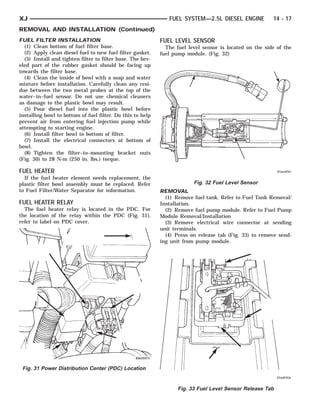
  (1) Clean bottom of fuel filter base.                       The fuel level sensor is located on the side of the
  (2) Apply clean diesel fuel to new fuel filter gasket.    fuel pump module. (Fig. 32)
  (3) Install and tighten filter to filter base. The bev-
eled part of the rubber gasket should be facing up
towards the filter base.
  (4) Clean the inside of bowl with a soap and water
mixture before installation. Carefully clean any resi-
due between the two metal probes at the top of the
water–in–fuel sensor. Do not use chemical cleaners
as damage to the plastic bowl may result.
  (5) Pour diesel fuel into the plastic bowl before
installing bowl to bottom of fuel filter. Do this to help
prevent air from entering fuel injection pump while
attempting to starting engine.
  (6) Install filter bowl to bottom of filter.
  (7) Install the electrical connectors at bottom of
bowl.
  (8) Tighten the filter–to–mounting bracket nuts
(Fig. 30) to 28 N·m (250 in. lbs.) torque.

FUEL HEATER
  If the fuel heater element needs replacement, the
plastic filter bowl assembly must be replaced. Refer                     Fig. 32 Fuel Level Sensor
to Fuel Filter/Water Separator for information.             REMOVAL
                                                              (1) Remove fuel tank. Refer to Fuel Tank Removal/
FUEL HEATER RELAY                                           Installation.
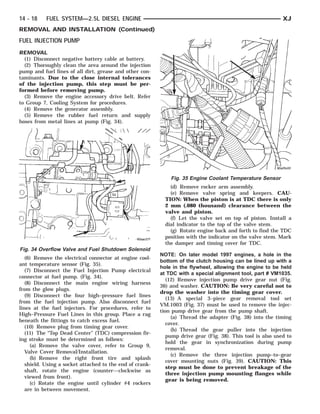
  The fuel heater relay is located in the PDC. For            (2) Remove fuel pump module. Refer to Fuel Pump
the location of the relay within the PDC (Fig. 31),         Module Removal/Installation
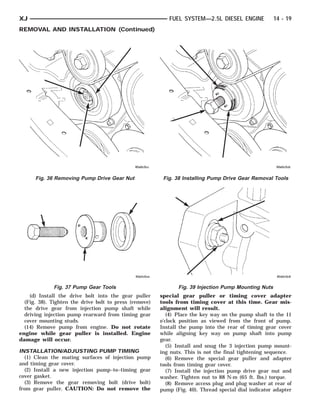
refer to label on PDC cover.                                  (3) Remove electrical wire connector at sending
                                                            unit terminals.
                                                              (4) Press on release tab (Fig. 33) to remove send-
                                                            ing unit from pump module.


 Fig. 31 Power Distribution Center (PDC) Location


                                                                   Fig. 33 Fuel Level Sensor Release Tab
14 - 18    FUEL SYSTEM—2.5L DIESEL ENGINE                                                                    XJ
REMOVAL AND INSTALLATION (Continued)
FUEL INJECTION PUMP
REMOVAL
  (1) Disconnect negative battery cable at battery.
  (2) Thoroughly clean the area around the injection
pump and fuel lines of all dirt, grease and other con-
taminants. Due to the close internal tolerances
of the injection pump, this step must be per-
formed before removing pump.
  (3) Remove the engine accessory drive belt. Refer
to Group 7, Cooling System for procedures.
  (4) Remove the generator assembly.
  (5) Remove the rubber fuel return and supply
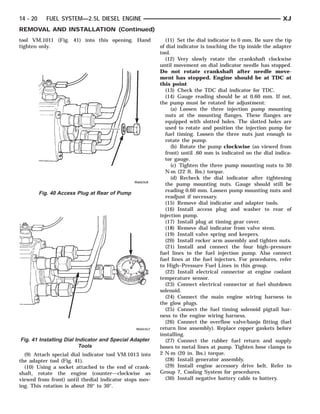
hoses from metal lines at pump (Fig. 34).


                                                              Fig. 35 Engine Coolant Temperature Sensor
                                                              (d) Remove rocker arm assembly.
                                                              (e) Remove valve spring and keepers. CAU-
                                                            TION: When the piston is at TDC there is only
                                                            2 mm (.080 thousand) clearance between the
                                                            valve and piston.
                                                              (f) Let the valve set on top of piston. Install a
                                                            dial indicator to the top of the valve stem.
                                                              (g) Rotate engine back and forth to find the TDC
                                                            position with the indicator on the valve stem. Mark
                                                            the damper and timing cover for TDC.
Fig. 34 Overflow Valve and Fuel Shutdown Solenoid
                                                          NOTE: On later model 1997 engines, a hole in the
   (6) Remove the electrical connector at engine cool-
                                                          bottom of the clutch housing can be lined up with a
ant temperature sensor (Fig. 35).
                                                          hole in the flywheel, allowing the engine to be held
   (7) Disconnect the Fuel Injection Pump electrical
                                                          at TDC with a special alignment tool, part # VM1035.
connector at fuel pump. (Fig. 34).
                                                             (12) Remove injection pump drive gear nut (Fig.
   (8) Disconnect the main engine wiring harness
                                                          36) and washer. CAUTION: Be very careful not to
from the glow plugs.
                                                          drop the washer into the timing gear cover.
   (9) Disconnect the four high–pressure fuel lines
                                                             (13) A special 3–piece gear removal tool set
from the fuel injection pump. Also disconnect fuel
                                                          VM.1003 (Fig. 37) must be used to remove the injec-
lines at the fuel injectors. For procedures, refer to
                                                          tion pump drive gear from the pump shaft.
High–Pressure Fuel Lines in this group. Place a rag
                                                               (a) Thread the adapter (Fig. 38) into the timing
beneath the fittings to catch excess fuel.
                                                             cover.
   (10) Remove plug from timing gear cover.
                                                               (b) Thread the gear puller into the injection
   (11) The “Top Dead Center” (TDC) compression fir-
                                                             pump drive gear (Fig. 38). This tool is also used to
ing stroke must be determined as follows:
                                                             hold the gear in synchronization during pump
     (a) Remove the valve cover, refer to Group 9,
                                                             removal.
   Valve Cover Removal/Installation.
                                                               (c) Remove the three injection pump–to–gear
     (b) Remove the right front tire and splash
                                                             cover mounting nuts (Fig. 39). CAUTION: This
   shield. Using a socket attached to the end of crank-
                                                             step must be done to prevent breakage of the
   shaft, rotate the engine (counter—clockwise as
                                                             three injection pump mounting flanges while
   viewed from front).
                                                             gear is being removed.
     (c) Rotate the engine until cylinder #4 rockers
   are in between movement.
XJ                                                         FUEL SYSTEM—2.5L DIESEL ENGINE             14 - 19
REMOVAL AND INSTALLATION (Continued)


      Fig. 36 Removing Pump Drive Gear Nut               Fig. 38 Installing Pump Drive Gear Removal Tools


             Fig. 37 Pump Gear Tools                           Fig. 39 Injection Pump Mounting Nuts
    (d) Install the drive bolt into the gear puller     special gear puller or timing cover adapter
  (Fig. 38). Tighten the drive bolt to press (remove)   tools from timing cover at this time. Gear mis-
  the drive gear from injection pump shaft while        alignment will result.
  driving injection pump rearward from timing gear         (4) Place the key way on the pump shaft to the 11
  cover mounting studs.                                 o’clock position as viewed from the front of pump.
  (14) Remove pump from engine. Do not rotate           Install the pump into the rear of timing gear cover
engine while gear puller is installed. Engine           while aligning key way on pump shaft into pump
damage will occur.                                      gear.
                                                           (5) Install and snug the 3 injection pump mount-
INSTALLATION/ADJUSTING PUMP TIMING                      ing nuts. This is not the final tightening sequence.
  (1) Clean the mating surfaces of injection pump          (6) Remove the special gear puller and adapter
and timing gear cover.                                  tools from timing gear cover.
  (2) Install a new injection pump–to–timing gear          (7) Install the injection pump drive gear nut and
cover gasket.                                           washer. Tighten nut to 88 N·m (65 ft. lbs.) torque.
  (3) Remove the gear removing bolt (drive bolt)           (8) Remove access plug and plug washer at rear of
from gear puller. CAUTION: Do not remove the            pump (Fig. 40). Thread special dial indicator adapter
14 - 20     FUEL SYSTEM—2.5L DIESEL ENGINE                                                                  XJ
REMOVAL AND INSTALLATION (Continued)
tool VM.1011 (Fig. 41) into this opening. Hand            (11) Set the dial indicator to 0 mm. Be sure the tip
tighten only.                                           of dial indicator is touching the tip inside the adapter
                                                        tool.
                                                          (12) Very slowly rotate the crankshaft clockwise
                                                        until movement on dial indicator needle has stopped.
                                                        Do not rotate crankshaft after needle move-
                                                        ment has stopped. Engine should be at TDC at
                                                        this point
                                                          (13) Check the TDC dial indicator for TDC.
                                                          (14) Gauge reading should be at 0.60 mm. If not,
                                                        the pump must be rotated for adjustment:
                                                              (a) Loosen the three injection pump mounting
                                                          nuts at the mounting flanges. These flanges are
                                                          equipped with slotted holes. The slotted holes are
                                                          used to rotate and position the injection pump for
                                                          fuel timing. Loosen the three nuts just enough to
                                                          rotate the pump.
                                                              (b) Rotate the pump clockwise (as viewed from
                                                          front) until .60 mm is indicated on the dial indica-
                                                          tor gauge.
                                                              (c) Tighten the three pump mounting nuts to 30
                                                          N·m (22 ft. lbs.) torque.
                                                              (d) Recheck the dial indicator after tightening
                                                          the pump mounting nuts. Gauge should still be
                                                          reading 0.60 mm. Loosen pump mounting nuts and
          Fig. 40 Access Plug at Rear of Pump
                                                          readjust if necessary.
                                                          (15) Remove dial indicator and adapter tools.
                                                          (16) Install access plug and washer to rear of
                                                        injection pump.
                                                          (17) Install plug at timing gear cover.
                                                          (18) Remove dial indicator from valve stem.
                                                          (19) Install valve spring and keepers.
                                                          (20) Install rocker arm assembly and tighten nuts.
                                                          (21) Install and connect the four high–pressure
                                                        fuel lines to the fuel injection pump. Also connect
                                                        fuel lines at the fuel injectors. For procedures, refer
                                                        to High–Pressure Fuel Lines in this group.
                                                          (22) Install electrical connector at engine coolant
                                                        temperature sensor.
                                                          (23) Connect electrical connector at fuel shutdown
                                                        solenoid.
                                                          (24) Connect the main engine wiring harness to
                                                        the glow plugs.
                                                          (25) Connect the fuel timing solenoid pigtail har-
                                                        ness to the engine wiring harness.
                                                          (26) Connect the overflow valve/banjo fitting (fuel
                                                        return line assembly). Replace copper gaskets before
                                                        installing.
Fig. 41 Installing Dial Indicator and Special Adapter     (27) Connect the rubber fuel return and supply
                         Tools                          hoses to metal lines at pump. Tighten hose clamps to
  (9) Attach special dial indicator tool VM.1013 into   2 N·m (20 in. lbs.) torque.
the adapter tool (Fig. 41).                               (28) Install generator assembly.
  (10) Using a socket attached to the end of crank-       (29) Install engine accessory drive belt. Refer to
shaft, rotate the engine (counter—clockwise as          Group 7, Cooling System for procedures.
viewed from front) until thedial indicator stops mov-     (30) Install negative battery cable to battery.
ing. This rotation is about 20° to 30°.
XJ                                                            FUEL SYSTEM—2.5L DIESEL ENGINE              14 - 21
REMOVAL AND INSTALLATION (Continued)
  (31) Start the engine and bring to normal operat-
ing temperature.
  (32) Check for fuel leaks.

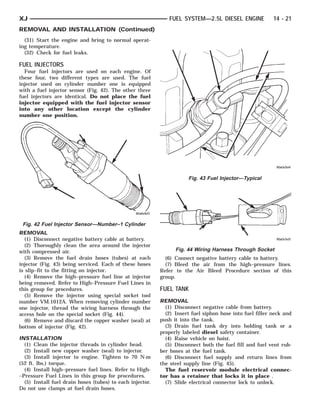
FUEL INJECTORS
  Four fuel injectors are used on each engine. Of
these four, two different types are used. The fuel
injector used on cylinder number one is equipped
with a fuel injector sensor (Fig. 42). The other three
fuel injectors are identical. Do not place the fuel
injector equipped with the fuel injector sensor
into any other location except the cylinder
number one position.


                                                                      Fig. 43 Fuel Injector—Typical


 Fig. 42 Fuel Injector Sensor—Number–1 Cylinder
REMOVAL
   (1) Disconnect negative battery cable at battery.
   (2) Thoroughly clean the area around the injector
with compressed air.                                             Fig. 44 Wiring Harness Through Socket
   (3) Remove the fuel drain hoses (tubes) at each           (6) Connect negative battery cable to battery.
injector (Fig. 43) being serviced. Each of these hoses       (7) Bleed the air from the high–pressure lines.
is slip–fit to the fitting on injector.                    Refer to the Air Bleed Procedure section of this
   (4) Remove the high–pressure fuel line at injector      group.
being removed. Refer to High–Pressure Fuel Lines in
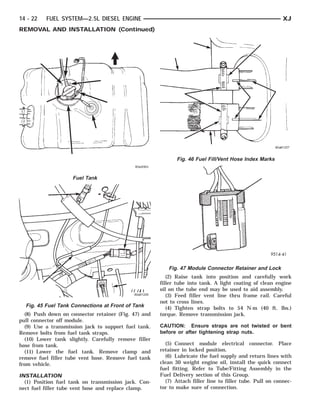
this group for procedures.                                 FUEL TANK
   (5) Remove the injector using special socket tool
number VM.1012A. When removing cylinder number             REMOVAL
one injector, thread the wiring harness through the          (1) Disconnect negative cable from battery.
access hole on the special socket (Fig. 44).                 (2) Insert fuel siphon hose into fuel filler neck and
   (6) Remove and discard the copper washer (seal) at      push it into the tank.
bottom of injector (Fig. 42).                                (3) Drain fuel tank dry into holding tank or a
                                                           properly labeled diesel safety container.
INSTALLATION                                                 (4) Raise vehicle on hoist.
  (1) Clean the injector threads in cylinder head.           (5) Disconnect both the fuel fill and fuel vent rub-
  (2) Install new copper washer (seal) to injector.        ber hoses at the fuel tank.
  (3) Install injector to engine. Tighten to 70 N·m          (6) Disconnect fuel supply and return lines from
(52 ft. lbs.) torque.                                      the steel supply line (Fig. 45).
  (4) Install high–pressure fuel lines. Refer to High-       The fuel reservoir module electrical connec-
–Pressure Fuel Lines in this group for procedures.         tor has a retainer that locks it in place .
  (5) Install fuel drain hoses (tubes) to each injector.     (7) Slide electrical connector lock to unlock.
Do not use clamps at fuel drain hoses.
14 - 22   FUEL SYSTEM—2.5L DIESEL ENGINE                                                                  XJ
REMOVAL AND INSTALLATION (Continued)


                                                             Fig. 46 Fuel Fill/Vent Hose Index Marks


                    Fuel Tank


                                                         Fig. 47 Module Connector Retainer and Lock
                                                         (2) Raise tank into position and carefully work
                                                      filler tube into tank. A light coating of clean engine
                                                      oil on the tube end may be used to aid assembly.
                                                         (3) Feed filler vent line thru frame rail. Careful
                                                      not to cross lines.
  Fig. 45 Fuel Tank Connections at Front of Tank         (4) Tighten strap bolts to 54 N·m (40 ft. lbs.)
  (8) Push down on connector retainer (Fig. 47) and   torque. Remove transmission jack.
pull connector off module.
  (9) Use a transmission jack to support fuel tank.   CAUTION: Ensure straps are not twisted or bent
Remove bolts from fuel tank straps.                   before or after tightening strap nuts.
  (10) Lower tank slightly. Carefully remove filler
hose from tank.                                         (5) Connect module electrical connector. Place
  (11) Lower the fuel tank. Remove clamp and          retainer in locked position.
remove fuel filler tube vent hose. Remove fuel tank     (6) Lubricate the fuel supply and return lines with
from vehicle.                                         clean 30 weight engine oil, install the quick connect
                                                      fuel fitting. Refer to Tube/Fitting Assembly in the
INSTALLATION                                          Fuel Delivery section of this Group.
  (1) Position fuel tank on transmission jack. Con-     (7) Attach filler line to filler tube. Pull on connec-
nect fuel filler tube vent hose and replace clamp.    tor to make sure of connection.
XJ                                                          FUEL SYSTEM—2.5L DIESEL ENGINE             14 - 23
REMOVAL AND INSTALLATION (Continued)
  (8) Fill fuel tank, replace cap, and connect battery
negative cable.

FUEL RESERVOIR MODULE
REMOVAL

WARNING: THE FUEL RESERVOIR OF THE FUEL
MODULE DOES NOT EMPTY OUT WHEN THE TANK
IS DRAINED. THE FUEL IN THE RESERVOIR WILL
SPILL OUT WHEN THE MODULE IS REMOVED.

  (1) Disconnect negative cable from battery.
  (2) Drain fuel tank dry into holding tank or a
properly labeled diesel safety container.
  (3) Raise vehicle on hoist.
  (4) Use a transmission jack to support the fuel
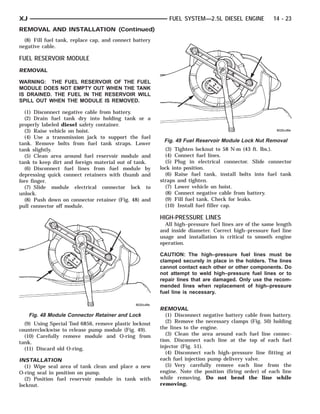
                                                          Fig. 49 Fuel Reservoir Module Lock Nut Removal
tank. Remove bolts from fuel tank straps. Lower
tank slightly.                                             (3) Tighten locknut to 58 N·m (43 ft. lbs.).
  (5) Clean area around fuel reservoir module and          (4) Connect fuel lines.
tank to keep dirt and foreign material out of tank.        (5) Plug in electrical connector. Slide connector
  (6) Disconnect fuel lines from fuel module by          lock into position.
depressing quick connect retainers with thumb and          (6) Raise fuel tank, install bolts into fuel tank
fore finger.                                             straps and tighten.
  (7) Slide module electrical connector lock to            (7) Lower vehicle on hoist.
unlock.                                                    (8) Connect negative cable from battery.
  (8) Push down on connector retainer (Fig. 48) and        (9) Fill fuel tank. Check for leaks.
pull connector off module.                                 (10) Install fuel filler cap.

                                                         HIGH-PRESSURE LINES
                                                           All high–pressure fuel lines are of the same length
                                                         and inside diameter. Correct high–pressure fuel line
                                                         usage and installation is critical to smooth engine
                                                         operation.

                                                         CAUTION: The high–pressure fuel lines must be
                                                         clamped securely in place in the holders. The lines
                                                         cannot contact each other or other components. Do
                                                         not attempt to weld high–pressure fuel lines or to
                                                         repair lines that are damaged. Only use the recom-
                                                         mended lines when replacement of high–pressure
                                                         fuel line is necessary.


                                                         REMOVAL
     Fig. 48 Module Connector Retainer and Lock             (1) Disconnect negative battery cable from battery.
  (9) Using Special Tool 6856, remove plastic locknut       (2) Remove the necessary clamps (Fig. 50) holding
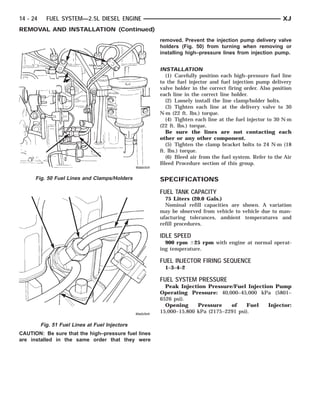
counterclockwise to release pump module (Fig. 49).       the lines to the engine.
  (10) Carefully remove module and O-ring from              (3) Clean the area around each fuel line connec-
tank.                                                    tion. Disconnect each line at the top of each fuel
  (11) Discard old O-ring.                               injector (Fig. 51).
                                                            (4) Disconnect each high–pressure line fitting at
INSTALLATION                                             each fuel injection pump delivery valve.
  (1) Wipe seal area of tank clean and place a new          (5) Very carefully remove each line from the
O-ring seal in position on pump.                         engine. Note the position (firing order) of each line
  (2) Position fuel reservoir module in tank with        while removing. Do not bend the line while
locknut.                                                 removing.
14 - 24     FUEL SYSTEM—2.5L DIESEL ENGINE                                                              XJ
REMOVAL AND INSTALLATION (Continued)
                                                     removed. Prevent the injection pump delivery valve
                                                     holders (Fig. 50) from turning when removing or
                                                     installing high–pressure lines from injection pump.


                                                     INSTALLATION
                                                        (1) Carefully position each high–pressure fuel line
                                                     to the fuel injector and fuel injection pump delivery
                                                     valve holder in the correct firing order. Also position
                                                     each line in the correct line holder.
                                                        (2) Loosely install the line clamp/holder bolts.
                                                        (3) Tighten each line at the delivery valve to 30
                                                     N·m (22 ft. lbs.) torque.
                                                        (4) Tighten each line at the fuel injector to 30 N·m
                                                     (22 ft. lbs.) torque.
                                                        Be sure the lines are not contacting each
                                                     other or any other component.
                                                        (5) Tighten the clamp bracket bolts to 24 N·m (18
                                                     ft. lbs.) torque.
                                                        (6) Bleed air from the fuel system. Refer to the Air
                                                     Bleed Procedure section of this group.

      Fig. 50 Fuel Lines and Clamps/Holders          SPECIFICATIONS
                                                     FUEL TANK CAPACITY
                                                       75 Liters (20.0 Gals.)
                                                       Nominal refill capacities are shown. A variation
                                                     may be observed from vehicle to vehicle due to man-
                                                     ufacturing tolerances, ambient temperatures and
                                                     refill procedures.

                                                     IDLE SPEED
                                                       900 rpm Ϯ25 rpm with engine at normal operat-
                                                     ing temperature.

                                                     FUEL INJECTOR FIRING SEQUENCE
                                                       1–3–4–2

                                                     FUEL SYSTEM PRESSURE
                                                       Peak Injection Pressure/Fuel Injection Pump
                                                     Operating Pressure: 40,000–45,000 kPa (5801–
                                                     6526 psi).
                                                       Opening     Pressure    of    Fuel   Injector:
                                                     15,000–15,800 kPa (2175–2291 psi).

          Fig. 51 Fuel Lines at Fuel Injectors
CAUTION: Be sure that the high–pressure fuel lines
are installed in the same order that they were
XJ                                                                          FUEL SYSTEM—2.5L DIESEL ENGINE                          14 - 25


                    FUEL INJECTION SYSTEM—2.5L DIESEL ENGINE

                                                                   INDEX
                                                               page                                                                       page

GENERAL INFORMATION                                                       POWERTRAIN CONTROL MODULE (PCM) . .                             . 26
 INTRODUCTION . . . . . . . . . . . . . . . . . . . . . . .        25     SENSOR RETURN—MSA/PCM INPUT
DESCRIPTION AND OPERATION                                                   (ANALOG GROUND) . . . . . . . . . . . . . . . . . .           .   27
 AIR CONDITIONING (A/C) CONTROLS—                                         SPEED CONTROL—MSA INPUT . . . . . . . . . .                     .   29
   MSA INPUTS . . . . . . . . . . . . . . . . . . . . . . . . .    28     SPEED CONTROL—PCM OUTPUTS . . . . . . .                         .   30
 AIR CONDITIONING RELAY—MSA OUTPUT . .                             30     TACHOMETER—PCM OUTPUT . . . . . . . . . . .                     .   31
 ASD RELAY—MSA INPUT . . . . . . . . . . . . . . . .               30     VEHICLE SPEED SENSOR—MSA INPUT . . . .                          .   29
 BATTERY VOLTAGE—PCM INPUT . . . . . . . . . .                     27     VEHICLE THEFT ALARM . . . . . . . . . . . . . . . .             .   27
 BRAKE SWITCH—MSA INPUT . . . . . . . . . . . . .                  29   DIAGNOSIS AND TESTING
 DATA LINK CONNECTOR—PCM AND MSA                                          ASD RELAY TEST . . . . . . . . . . . . . . . . . . . . .        . 32
   INPUT AND OUTPUT . . . . . . . . . . . . . . . . . .            29     DIAGNOSTIC TROUBLE CODES . . . . . . . . . .                    . 35
 ELECTRIC VACUUM MODULATOR (EVM)—                                         DIESEL DIAGONSTICS . . . . . . . . . . . . . . . . .            . 32
   MSA OUTPUT . . . . . . . . . . . . . . . . . . . . . . . .      32     ENGINE COOLANT TEMPERATURE
 ENGINE COOLANT GAUGE—PCM OUTPUT . .                               30       SENSOR TEST . . . . . . . . . . . . . . . . . . . . . .       .   32
 ENGINE COOLANT TEMPERATURE SENSOR—                                       ENGINE SPEED SENSOR TEST . . . . . . . . . .                    .   32
   MSA/PCM INPUT . . . . . . . . . . . . . . . . . . . . .         28     GLOW PLUG RELAY TEST . . . . . . . . . . . . . .                .   33
 ENGINE OIL PRESSURE GAUGE—                                               GLOW PLUG TEST . . . . . . . . . . . . . . . . . . . .          .   33
   PCM OUTPUT . . . . . . . . . . . . . . . . . . . . . . . .      30     MASS AIR FLOW SENSOR . . . . . . . . . . . . . .                .   35
 ENGINE SPEED/CRANK POSITION SENSOR—                                      RELAYS—OPERATION/TESTING . . . . . . . . . .                    .   34
   MSA INPUT . . . . . . . . . . . . . . . . . . . . . . . . . .   28     VEHICLE SPEED SENSOR TEST . . . . . . . . . .                   .   35
 FIVE VOLT POWER—MSA/PCM OUTPUT . . . .                            30   REMOVAL AND INSTALLATION
 FUEL INJECTOR SENSOR—GROUND . . . . . .                           28     A/C CLUTCH RELAY . . . . . . . . . . . . . . . . . . .          .   35
 FUEL TIMING SOLENOID—MSA OUTPUT . . . .                           30     ASD RELAY . . . . . . . . . . . . . . . . . . . . . . . . . .   .   35
 GLOW PLUG LAMP—PCM OUTPUT . . . . . . . .                         30     ENGINE COOLANT TEMPERATURE SENSOR                               .   36
 GLOW PLUG RELAY—MSA OUTPUT . . . . . . . .                        31     ENGINE SPEED SENSOR . . . . . . . . . . . . . . .               .   35
 GLOW PLUGS . . . . . . . . . . . . . . . . . . . . . . . . .      31     GLOW PLUG RELAY . . . . . . . . . . . . . . . . . . .           .   37
 IGNITION CIRCUIT SENSE—MSA/                                              GLOW PLUGS . . . . . . . . . . . . . . . . . . . . . . . .      .   36
   PCM INPUT . . . . . . . . . . . . . . . . . . . . . . . . .     27     POWERTRAIN CONTROL MODULE (PCM) . .                             .   37
 IGNITION CIRCUIT SENSE—PCM INPUT . . . .                          27     VEHICLE SPEED SENSOR . . . . . . . . . . . . . .                .   38
 MASS AIR FLOW SENSOR . . . . . . . . . . . . . . .                27   SPECIFICATIONS
 NEEDLE MOVEMENT OR INTRUMENTED                                           GLOW PLUG CURRENT DRAW . . . . . . . . . . .                    . 38
   FIRST INJECTOR—MSA INPUT . . . . . . . . . .                    27     TORQUE CHART—2.5L DIESEL . . . . . . . . . . .                  . 39
 POWER GROUND . . . . . . . . . . . . . . . . . . . . . .          27

GENERAL INFORMATION                                                     important to know that the MSA has a feature
                                                                        where, if possible, it will ignore the failed sensor, set
INTRODUCTION                                                            a code related to the sensor, and operate the engine
   This section will cover components either regulated                  in a “Limp Home” mode. When the MSA is operating
or controlled by the MSA controller and the Power-                      in a “Limp Home” mode, the Check Engine Lamp on
train Control Module (PCM). The fuel heater relay                       the instrument panel may be constantly illuminated,
and fuel heater are not operated by the MSA control-                    and the engine will most likely have a noticeable loss
ler or the PCM. These components are controlled by                      of performance. An example of this would be an
the ignition (key) switch. All other fuel system elec-                  Accelerator Pedal Position Sensor failure, and in that
trical components necessary to operate the engine                       situation, the engine would run at a constant 1100
are controlled or regulated by the MSA controller,                      RPM, regardless of the actual position of the pedal.
which interfaces with the PCM. Refer to the follow-                     This is the most extreme of the three “Limp Home”
ing description for more information.                                   modes.
   Certain fuel system component failures may cause                        When the Check Engine Lamp is illuminated con-
a no start, or prevent the engine from running. It is                   stantly with the key on and the engine running,, it
14 - 26   FUEL SYSTEM—2.5L DIESEL ENGINE                                                                XJ
GENERAL INFORMATION (Continued)
usually indicates a problem has been detected some-     The MSA Controller is a pre–programmed, digital
where within the fuel system. The DRBIII scan tool    computer. It will either directly operate or partially
is the best method for communicating with the MSA     regulate the:
and PCM to diagnose faults within the system.           • Speed Control
                                                        • Speed Control lamp
                                                        • Fuel Timing Solenoid
DESCRIPTION AND OPERATION                               • Check Engine Light
                                                        • Glow Plug Relay
POWERTRAIN CONTROL MODULE (PCM)                         • Glow Plugs
  The MSA controller is mounted under the left side     • Glow Plug Lamp
rear seat (Fig. 1). The Powertrain Control Module       • ASD Relay
(PCM) is mounted in the engine compartment. (Fig.       • Air Conditioning
2).                                                     • Tachometer
                                                        • Electric Vacuum Modulator (EVM)
                                                        The MSA can adapt its programming to meet
                                                      changing operating conditions.
                                                        The MSA receives input signals from various
                                                      switches and sensors. Based on these inputs, the
                                                      MSA regulates various engine and vehicle operations
                                                      through different system components. These compo-
                                                      nents are referred to as MSA Outputs. The sensors
                                                      and switches that provide inputs to the MSA are con-
                                                      sidered MSA Inputs.
                                                        MSA Inputs are:
                                                        • Air Conditioning Selection
                                                        • Theft Alarm
                                                        • ASD Relay
                                                        • Control Sleeve Position Sensor
                                                        • Fuel Temperature Sensor
                                                        • Mass Air Flow Sensor
                                                        • Accelerator Pedal Position Sensor
                                                        • Engine Coolant Temperature Sensor
          Fig. 1 MSA Controller Location                • Low Idle Position Switch
                                                        • 5 Volt Supply
                                                        • Vehicle Speed Sensor
                                                        • Engine Speed/Crank Position Sensor (rpm)
                                                        • Needle Movement Sensor
                                                        • Starter Signal
                                                        • Brake Switch
                                                        • Speed Control Switch
                                                        • Power Ground
                                                        • Ignition (key) Switch Sense
                                                        MSA Outputs:
                                                        After inputs are received by the MSA and PCM,
                                                      certain sensors, switches and components are con-
                                                      trolled or regulated by the MSA and PCM. These are
                                                      considered MSA Outputs. These outputs are for:
                                                        • A/C Clutch Relay (for A/C clutch operation)
                                                        • Speed Control Lamp
                                                        • ASD Relay
                                                        • 5 Volts Supply
                                                        • Fuel Quantity Actuator
                                                        • Fuel Timing Solenoid
                                                        • Fuel Shutdown Solenoid
                                                        • Glow Plug Lamp
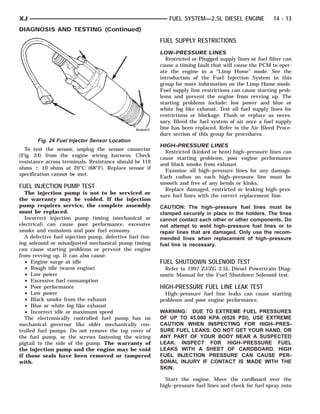
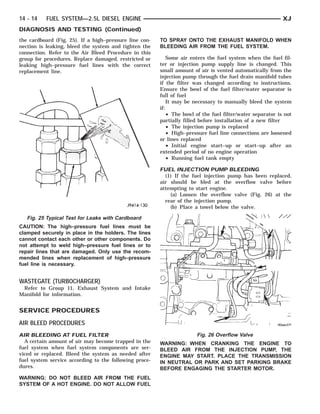
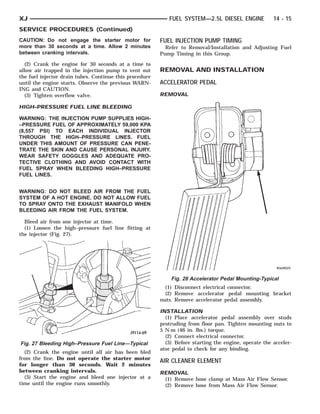
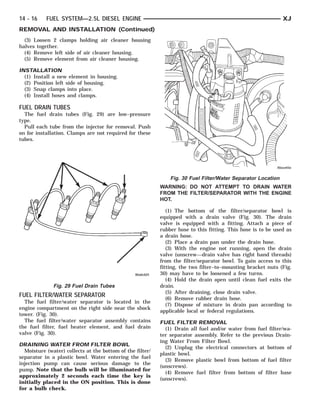
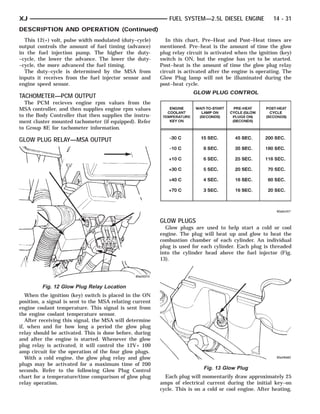
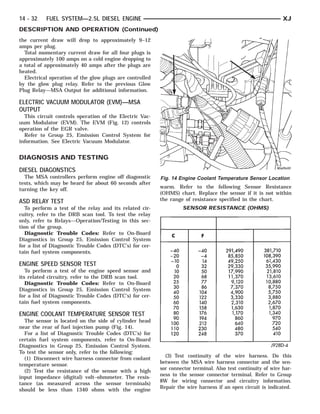
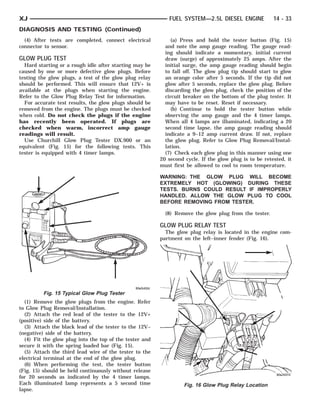
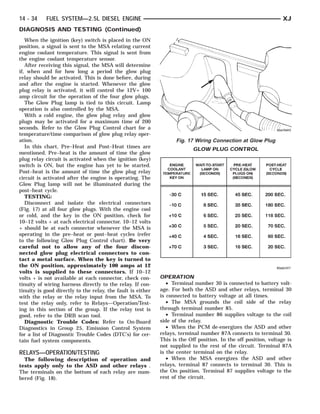
                                                        • Check Engine Lamp (“On/Off” signal)
               Fig. 2 PCM Location
XJ                                                           FUEL SYSTEM—2.5L DIESEL ENGINE               14 - 27
DESCRIPTION AND OPERATION (Continued)
  • Electric Vacuum Modulator (EVM)                         If the PCM is put it on a vehicle without VTA the
  • Glow Plug Relay                                       Glow Plug Lamp will start to blink and the vehicle
  • Tachometer                                            will not start.
  The PCM sends and recieves signals to and from            The PCM cannot be flashed to remove the VTA.
the MSA controller. PCM inputs are:
  • Power Gound                                           BATTERY VOLTAGE—PCM INPUT
  • 5 Volts Supply                                          The battery voltage input provides power to the
  • Vehicle Speed Sensor                                  PCM. It also informs the PCM what voltage level is
  • Water-In-Fuel Sensor                                  being supplied by the generator once the vehicle is
  • Coolant Temperature Sensor                            running.
  • Low Coolant Sensor                                      The battery input also provides the voltage that is
  • Sensor Return                                         needed to keep the PCM memory alive. The memory
  • Fuel Level Sensor                                     stores Diagnostic Trouble Code (DTC) messages.
  • Oil Pressure Sensor                                   Trouble codes will still be stored even if the battary
  • Tachometer Signal                                     voltage is lost.
  • Glow Plug Lamp
  • Check Engine Lamp (“On/Off” signal)                   SENSOR RETURN—MSA/PCM INPUT (ANALOG
  • Brake On/Off Switch                                   GROUND)
  • Battery Voltage                                         Sensor Return provides a low noise Analog ground
  • ASD Relay                                             reference for all system sensors.
  PCM Outputs:
  • A/C On Signal                                         IGNITION CIRCUIT SENSE—MSA/PCM INPUT
  • Vehicle Theft Alarm “Ok to Run” signal                  The ignition circuit sense input signals the MSA
  • Body Control Module CCD Bus (+)                       and PCM that the ignition (key) switch has been
  • Body Control Module CCD Bus (–)                       turned to the ON position. This signal initiates the
  • Scan Tool Data Link Recieve                           glow plug control routine to begin the “pre–heat”
  • Scan Tool Data Link Transmit                          cycle.
  • Low Coolant Lamp
  • Generator Control                                     IGNITION CIRCUIT SENSE—PCM INPUT
                                                            The ignition circuit sense input signals the PCM
MASS AIR FLOW SENSOR                                      that the ignition (key) switch has been turned to the
   The Mass Air Flow Sensor is a gauge that mea-          ON position. This signal initiates the glow plug con-
sures air density. In the Mass Air Flow Sensor (MAF)      trol routine to begin the “pre–heat” cycle.
there is a ceramic element that changes its resis-
tance based on temperature. The ceramic element is        POWER GROUND
part of an electronic circuit connected to the MSA,         Provides a common ground for power devices (sole-
and has a voltage applied to it. The MAF sensor is        noid and relay devices).
connected in line with the engine’s air intake tube,
and when the engine is at idle, there is a relatively     NEEDLE MOVEMENT OR INTRUMENTED FIRST
low amount of air flowing across the ceramic ele-         INJECTOR—MSA INPUT
ment. This air has a cooling effect on the ceramic ele-      This input from the MSA supplies a constant 30
ment, and its resistance changes, and a voltage           mA electrical current source for the first injector sen-
signal is sent to the MSA. As a general rule, when        sor. It will vary the voltage to this sensor when it
the engine is running at a high RPM, the voltage sig-     senses a mechanical movement within the injector
nal sent by the MAF sensor is high. When the engine       needle (pintle) of the number–1 cylinder fuel injector.
is running at a low RPM, the voltage signal sent by       When this voltage has been determined by the MSA,
the MAF is low. The MSA can calculate the mass            it will then control an output to the fuel timing sole-
(actual weight) of the air flowing through the MAF        noid (the fuel timing solenoid is located on the fuel
sensor based on the value of the voltage signal.          injection pump). Also refer to Fuel Injection Pump for
                                                          additional information.
VEHICLE THEFT ALARM                                          The first injector sensor is a magnetic (inductive)
  The PCM can learn if the vehicle has a Vehicle          type.
Theft Alarm (VTA) system. Once it detects the vehi-          The first injector sensor is used only on the fuel
cle having VTA, the controller can ONLY BE                injector for the number–1 cylinder (Fig. 3). It is not
USED ON VEHICLES WITH VTA.                                used on the injectors for cylinders number 2, 3, or 4.
14 - 28    FUEL SYSTEM—2.5L DIESEL ENGINE                                                                    XJ
DESCRIPTION AND OPERATION (Continued)
                                                         ENGINE SPEED/CRANK POSITION SENSOR—MSA
                                                         INPUT
                                                           The engine speed sensor is mounted to the trans-
                                                         mission bellhousing at the left/rear side of the engine
                                                         block (Fig. 5).


            Fig. 3 Fuel Injector Sensor
FUEL INJECTOR SENSOR—GROUND
  Provides a low noise ground for the fuel injector
sensor only.

ENGINE COOLANT TEMPERATURE SENSOR—MSA/                          Fig. 5 Engine Speed Sensor Location
PCM INPUT                                                   The engine speed sensor produces its own output
  The 0–5 volt input from this sensor tells the MSA      signal. If this signal is not received, the MSA will not
and PCM the temperature of the engine coolant.           allow the engine to start.
Based on the voltage received at the MSA, it will           The engine speed sensor input is used in conjunc-
then determine operation of the fuel timing solenoid,    tion with the first injector sensor to establish fuel
glow plug relay, electrical vacuum modulator (emis-      injection pump timing.
sion component) and generator (charging system).            The flywheel has four notches at its outer edge
  The sensor is located on the side of the #3 cylinder   (Fig. 6). Each notch is spaced equally every 90°. The
head near the rear of fuel injection pump (Fig. 4).      notches cause a pulse to be generated when they
                                                         pass under the speed sensor (Fig. 6). These pulses
                                                         are the input to the MSA. The input from this sensor
                                                         determines crankshaft position (in degrees) by moni-
                                                         toring the notches.
                                                            The sensor also generates an rpm signal to the
                                                         MSA. This signal is used as an input for the control
                                                         of the generator field, vehicle speed control, and
                                                         instrument panel mounted tachometer.
                                                            If the engine speed sensor should fail, the system
                                                         is unable to compensate for the problem and the car
                                                         will stop.

                                                         AIR CONDITIONING (A/C) CONTROLS—MSA
                                                         INPUTS
                                                           The A/C control system information applies to fac-
                                                         tory installed air conditioning units.
                                                           A/C REQUEST SIGNAL: When either the A/C or
                                                         Defrost mode has been selected and the A/C low and
                                                         high–pressure switches are closed, an input signal is
                                                         sent to the MSA. The MSA uses this input to cycle
                                                         the A/C compressor through the A/C relay.
                                                           If the A/C low or high–pressure switch opens, the
Fig. 4 Engine Coolant Temperature Sensor Location        MSA will not receive an A/C request signal. The PCM
                                                         will then remove the ground from the A/C relay. This
XJ                                                           FUEL SYSTEM—2.5L DIESEL ENGINE             14 - 29
DESCRIPTION AND OPERATION (Continued)


                                                                  Fig. 7 Data Link Connector Location


           Fig. 6 Speed Sensor Operation
will deactivate the A/C compressor clutch. Also, if the
engine coolant reaches a temperature outside normal
of its normal range, or it overheats, the MSA will
deactivate the A/C clutch.

BRAKE SWITCH—MSA INPUT
  When the brake light switch is activated, the MSA
receives an input indicating that the brakes are being
applied. After receiving this input, the MSA is used to
control the speed control system. There is a Primary
and a Secondary brake switch. The Secondary brake
switch is closed until the brake pedal is pressed.

DATA LINK CONNECTOR—PCM AND MSA INPUT
AND OUTPUT
   The 16–way data link connector (diagnostic scan
tool connector) links the Diagnostic Readout Box
(DRB) scan tool with the PCM and MSA. The data
link connector is located under the instrument panel
near the bottom of steering column. (Fig. 7).                    Fig. 8 Vehicle Speed Sensor—Typical
                                                            In addition to determining distance and vehicle
VEHICLE SPEED SENSOR—MSA INPUT                            speed, the output from the sensor is used to control
   The vehicle speed sensor is located in the extension   speed control operation.
housing of the transmission (2WD) (Fig. 8) or on the
transfer case extension housing. The sensor input is      SPEED CONTROL—MSA INPUT
used by the MSA to determine vehicle speed and dis-         The speed control system provides five separate
tance traveled.                                           inputs to the MSA: On/Off, Set, Resume/Accel, Cancel,
   The speed sensor generates 8 pulses per sensor         and Decel.. The On/Off input informs the MSA that the
revolution. These signals, in conjunction with a          speed control system has been activated. The Set input
closed throttle signal from the accelerator pedal posi-   informs the MSA that a fixed vehicle speed has been
tion sensor, indicate an idle deceleration to the MSA.    selected. The Resume input indicates to the MSA that
When the vehicle is stopped at idle, a released pedal     the previous fixed speed is requested.
signal is received by the MSA (but a speed sensor           Speed control operation will start at 50 km/h–142
signal is not received).                                  km/h (35–85 mph). The upper range of operation is
14 - 30    FUEL SYSTEM—2.5L DIESEL ENGINE                                                                    XJ
DESCRIPTION AND OPERATION (Continued)
                                                          tion (key) switch is turned on. It will stay on for
                                                          about two seconds as a bulb test.
                                                             If the PCM receives an incorrect signal, or no sig-
                                                          nal from certain sensors or components, the lamp
                                                          BLINKS. This is a warning that the PCM has
                                                          recorded a system or sensor malfunction. It signals
                                                          an immediate need for service. There are only 5
                                                          HARD faults that can turn on this lamp to make it
                                                          blink.


                                                                    Fig. 10 Glow Plug Lamp Symbol
                                                          SPEED CONTROL—PCM OUTPUTS
                                                            These two circuits control the fuel quantity actua-
                                                          tor to regulate vehicle speed. Refer to Group 8H for
                                                          Speed Control information.

                                                          AIR CONDITIONING RELAY—MSA OUTPUT
    Fig. 9 Vehicle Speed Sensor—4 Wheel Drive                This circuit controls a ground signal for operation
                                                          of the A/C clutch relay. Also refer to Air Conditioning
not restricted by vehicle speed. Inputs that effect       (A/C) Controls—MSA Input for additional informa-
speed control operation are vehicle speed sensor and      tion.
accelerator pedal position sensor.                           The A/C relay is located in the Power Distribution
  Refer to Group 8H for further speed control infor-      Center (PDC). The PDC is located next to the battery
mation.                                                   in the engine compartment. For the location of the
                                                          relay within the PDC, refer to label on PDC cover.
ASD RELAY—MSA INPUT
   A 12 volt signal at this input indicates to the MSA    FUEL TIMING SOLENOID—MSA OUTPUT
that the ASD relay has been activated. The ASD              The fuel timing solenoid is located on the bottom of
relay is located in the PDC. The PDC is located next      the fuel injection pump (Fig. 11).
to the battery in the engine compartment. For the
location of the relay within the PDC, refer to label on
PDC cover.
   This input is used only to sense that the ASD relay
is energized. If the MSA does not see 12 volts (+) at
this input when the ASD relay should be activated, it
will set a Diagnostic Trouble Code (DTC).

FIVE VOLT POWER—MSA/PCM OUTPUT
  This circuit supplies approximately 5 volts to
power the Accelerator Pedal Postion Sensor, and
Mass Air Flow Sensor.

ENGINE COOLANT GAUGE—PCM OUTPUT
  Refer to the Instrument Panel and Gauges group
for additional information.

ENGINE OIL PRESSURE GAUGE—PCM OUTPUT
  Refer to the Instrument Panel and Gauges group
for additional information.

GLOW PLUG LAMP—PCM OUTPUT
   The Glow Plug lamp (malfunction indicator lamp)
illuminates on the message center each time the igni-                 Fig. 11 Fuel Timing Solenoid
XJ                                                            FUEL SYSTEM—2.5L DIESEL ENGINE              14 - 31
DESCRIPTION AND OPERATION (Continued)
  This    12(+) volt, pulse width modulated (duty–cycle)      In this chart, Pre–Heat and Post–Heat times are
output    controls the amount of fuel timing (advance)     mentioned. Pre–heat is the amount of time the glow
in the     fuel injection pump. The higher the duty-       plug relay circuit is activated when the ignition (key)
–cycle,   the lower the advance. The lower the duty-       switch is ON, but the engine has yet to be started.
–cycle,   the more advanced the fuel timing.               Post–heat is the amount of time the glow plug relay
  The     duty–cycle is determined by the MSA from         circuit is activated after the engine is operating. The
inputs    it receives from the fuel injector sensor and    Glow Plug lamp will not be illuminated during the
engine    speed sensor.                                    post–heat cycle.
                                                                        GLOW PLUG CONTROL
TACHOMETER—PCM OUTPUT
  The PCM recieves engine rpm values from the
MSA controller, and then supplies engine rpm values
to the Body Controller that then supplies the instru-
ment cluster mounted tachometer (if equipped). Refer
to Group 8E for tachometer information.

GLOW PLUG RELAY—MSA OUTPUT


                                                           GLOW PLUGS
                                                             Glow plugs are used to help start a cold or cool
                                                           engine. The plug will heat up and glow to heat the
                                                           combustion chamber of each cylinder. An individual
                                                           plug is used for each cylinder. Each plug is threaded
                                                           into the cylinder head above the fuel injector (Fig.
                                                           13).


            Fig. 12 Glow Plug Relay Location
   When the ignition (key) switch is placed in the ON
position, a signal is sent to the MSA relating current
engine coolant temperature. This signal is sent from
the engine coolant temperature sensor.
   After receiving this signal, the MSA will determine
if, when and for how long a period the glow plug
relay should be activated. This is done before, during
and after the engine is started. Whenever the glow
plug relay is activated, it will control the 12V+ 100
amp circuit for the operation of the four glow plugs.
   With a cold engine, the glow plug relay and glow
plugs may be activated for a maximum time of 200
seconds. Refer to the following Glow Plug Control                            Fig. 13 Glow Plug
chart for a temperature/time comparison of glow plug         Each plug will momentarily draw approximately 25
relay operation.                                           amps of electrical current during the initial key–on
                                                           cycle. This is on a cold or cool engine. After heating,
14 - 32    FUEL SYSTEM—2.5L DIESEL ENGINE                                                                      XJ
DESCRIPTION AND OPERATION (Continued)
the current draw will drop to approximately 9–12
amps per plug.
  Total momentary current draw for all four plugs is
approximately 100 amps on a cold engine dropping to
a total of approximately 40 amps after the plugs are
heated.
  Electrical operation of the glow plugs are controlled
by the glow plug relay. Refer to the previous Glow
Plug Relay—MSA Output for additional information.

ELECTRIC VACUUM MODULATOR (EVM)—MSA
OUTPUT
  This circuit controls operation of the Electric Vac-
uum Modulator (EVM). The EVM (Fig. 12) controls
operation of the EGR valve.
  Refer to Group 25, Emission Control System for
information. See Electric Vacuum Modulator.


DIAGNOSIS AND TESTING
DIESEL DIAGONSTICS
  The MSA controllers perform engine off diagonstic       Fig. 14 Engine Coolant Temperature Sensor Location
tests, which may be heard for about 60 seconds after
turning the key off.                                      warm. Refer to the following Sensor Resistance
                                                          (OHMS) chart. Replace the sensor if it is not within
ASD RELAY TEST                                            the range of resistance specified in the chart.
   To perform a test of the relay and its related cir-             SENSOR RESISTANCE (OHMS)
cuitry, refer to the DRB scan tool. To test the relay
only, refer to Relays—Operation/Testing in this sec-
tion of the group.
   Diagnostic Trouble Codes: Refer to On-Board
Diagnostics in Group 25, Emission Control System
for a list of Diagnostic Trouble Codes (DTC’s) for cer-
tain fuel system components.

ENGINE SPEED SENSOR TEST
   To perform a test of the engine speed sensor and
its related circuitry, refer to the DRB scan tool.
   Diagnostic Trouble Codes: Refer to On-Board
Diagnostics in Group 25, Emission Control System
for a list of Diagnostic Trouble Codes (DTC’s) for cer-
tain fuel system components.

ENGINE COOLANT TEMPERATURE SENSOR TEST
  The sensor is located on the side of cylinder head
near the rear of fuel injection pump (Fig. 14).
  For a list of Diagnostic Trouble Codes (DTC’s) for
certain fuel system components, refer to On-Board
Diagnostics in Group 25, Emission Control System.
To test the sensor only, refer to the following:
                                                            (3) Test continuity of the wire harness. Do this
  (1) Disconnect wire harness connector from coolant
                                                          between the MSA wire harness connector and the sen-
temperature sensor.
                                                          sor connector terminal. Also test continuity of wire har-
  (2) Test the resistance of the sensor with a high
                                                          ness to the sensor connector terminal. Refer to Group
input impedance (digital) volt–ohmmeter. The resis-
                                                          8W for wiring connector and circuitry information.
tance (as measured across the sensor terminals)
                                                          Repair the wire harness if an open circuit is indicated.
should be less than 1340 ohms with the engine
XJ                                                          FUEL SYSTEM—2.5L DIESEL ENGINE              14 - 33
DIAGNOSIS AND TESTING (Continued)
  (4) After tests are completed, connect electrical           (a) Press and hold the tester button (Fig. 15)
connector to sensor.                                       and note the amp gauge reading. The gauge read-
                                                           ing should indicate a momentary, initial current
GLOW PLUG TEST                                             draw (surge) of approximately 25 amps. After the
  Hard starting or a rough idle after starting may be      initial surge, the amp gauge reading should begin
caused by one or more defective glow plugs. Before         to fall off. The glow plug tip should start to glow
testing the glow plugs, a test of the glow plug relay      an orange color after 5 seconds. If the tip did not
should be performed. This will ensure that 12V+ is         glow after 5 seconds, replace the glow plug. Before
available at the plugs when starting the engine.           discarding the glow plug, check the position of the
Refer to the Glow Plug Relay Test for information.         circuit breaker on the bottom of the plug tester. It
  For accurate test results, the glow plugs should be      may have to be reset. Reset if necessary.
removed from the engine. The plugs must be checked            (b) Continue to hold the tester button while
when cold. Do not check the plugs if the engine            observing the amp gauge and the 4 timer lamps.
has recently been operated. If plugs are                   When all 4 lamps are illuminated, indicating a 20
checked when warm, incorrect amp gauge                     second time lapse, the amp gauge reading should
readings will result.                                      indicate a 9–12 amp current draw. If not, replace
  Use Churchill Glow Plug Tester DX.900 or an              the glow plug. Refer to Glow Plug Removal/Instal-
equivalent (Fig. 15) for the following tests. This         lation.
tester is equipped with 4 timer lamps.                     (7) Check each glow plug in this manner using one
                                                         20 second cycle. If the glow plug is to be retested, it
                                                         must first be allowed to cool to room temperature.

                                                         WARNING: THE GLOW PLUG WILL BECOME
                                                         EXTREMELY HOT (GLOWING) DURING THESE
                                                         TESTS. BURNS COULD RESULT IF IMPROPERLY
                                                         HANDLED. ALLOW THE GLOW PLUG TO COOL
                                                         BEFORE REMOVING FROM TESTER.

                                                           (8) Remove the glow plug from the tester.

                                                         GLOW PLUG RELAY TEST
                                                           The glow plug relay is located in the engine com-
                                                         partment on the left–inner fender (Fig. 16).


         Fig. 15 Typical Glow Plug Tester
  (1) Remove the glow plugs from the engine. Refer
to Glow Plug Removal/Installation.
  (2) Attach the red lead of the tester to the 12V+
(positive) side of the battery.
  (3) Attach the black lead of the tester to the 12V–
(negative) side of the battery.
  (4) Fit the glow plug into the top of the tester and
secure it with the spring loaded bar (Fig. 15).
  (5) Attach the third lead wire of the tester to the
electrical terminal at the end of the glow plug.
  (6) When performing the test, the tester button
(Fig. 15) should be held continuously without release
for 20 seconds as indicated by the 4 timer lamps.
Each illuminated lamp represents a 5 second time                   Fig. 16 Glow Plug Relay Location
lapse.
14 - 34     FUEL SYSTEM—2.5L DIESEL ENGINE                                                                        XJ
DIAGNOSIS AND TESTING (Continued)
   When the ignition (key) switch is placed in the ON
position, a signal is sent to the MSA relating current
engine coolant temperature. This signal is sent from
the engine coolant temperature sensor.
   After receiving this signal, the MSA will determine
if, when and for how long a period the glow plug
relay should be activated. This is done before, during
and after the engine is started. Whenever the glow
plug relay is activated, it will control the 12V+ 100
amp circuit for the operation of the four glow plugs.
   The Glow Plug lamp is tied to this circuit. Lamp
operation is also controlled by the MSA.
   With a cold engine, the glow plug relay and glow
plugs may be activated for a maximum time of 200
seconds. Refer to the Glow Plug Control chart for a
temperature/time comparison of glow plug relay oper-
ation.                                                              Fig. 17 Wiring Connection at Glow Plug
   In this chart, Pre–Heat and Post–Heat times are                         GLOW PLUG CONTROL
mentioned. Pre–heat is the amount of time the glow
plug relay circuit is activated when the ignition (key)
switch is ON, but the engine has yet to be started.
Post–heat is the amount of time the glow plug relay
circuit is activated after the engine is operating. The
Glow Plug lamp will not be illuminated during the
post–heat cycle.
   TESTING:
   Disconnect and isolate the electrical connectors
(Fig. 17) at all four glow plugs. With the engine cool
or cold, and the key in the ON position, check for
10–12 volts + at each electrical connector. 10–12 volts
+ should be at each connector whenever the MSA is
operating in the pre–heat or post–heat cycles (refer
to the following Glow Plug Control chart). Be very
careful not to allow any of the four discon-
nected glow plug electrical connectors to con-
tact a metal surface. When the key is turned to
the ON position, approximately 100 amps at 12
volts is supplied to these connectors. If 10–12
volts + is not available at each connector, check con-       OPERATION
tinuity of wiring harness directly to the relay. If con-        • Terminal number 30 is connected to battery volt-
tinuity is good directly to the relay, the fault is either   age. For both the ASD and other relays, terminal 30
with the relay or the relay input from the MSA. To           is connected to battery voltage at all times.
test the relay only, refer to Relays—Operation/Test-            • The MSA grounds the coil side of the relay
ing in this section of the group. If the relay test is       through terminal number 85.
good, refer to the DRB scan tool.                               • Terminal number 86 supplies voltage to the coil
   Diagnostic Trouble Codes: Refer to On-Board               side of the relay.
Diagnostics in Group 25, Emission Control System                • When the PCM de-energizes the ASD and other
for a list of Diagnostic Trouble Codes (DTC’s) for cer-      relays, terminal number 87A connects to terminal 30.
tain fuel system components.                                 This is the Off position. In the off position, voltage is
                                                             not supplied to the rest of the circuit. Terminal 87A
RELAYS—OPERATION/TESTING                                     is the center terminal on the relay.
  The following description of operation and                    • When the MSA energizes the ASD and other
tests apply only to the ASD and other relays .               relays, terminal 87 connects to terminal 30. This is
The terminals on the bottom of each relay are num-           the On position. Terminal 87 supplies voltage to the
bered (Fig. 18).                                             rest of the circuit.
XJ                                                         FUEL SYSTEM—2.5L DIESEL ENGINE               14 - 35
DIAGNOSIS AND TESTING (Continued)
                                                           (9) Replace the relay if it did not pass the continu-
                                                        ity and resistance tests. If the relay passed the tests,
                                                        it operates properly. Check the remainder of the ASD
                                                        and other relay circuits. Refer to group 8W, Wiring
                                                        Diagrams.

                                                        MASS AIR FLOW SENSOR
                                                          The Mass Air Flow (MAF) sensor can only be
                                                        tested by checking for a fault code stored in the
                                                        MSA. If the mass air flow sensor stops functioning,
                                                        you will experience a loss of power, as if you had no
                                                        turbocharger operation. The MSA may indicate no
                                                        turbo operation if there is no signal from the MAF
                                                        sensor. If the sensor sets a fault and no loss of power
                                                        then check to see if there is a clogged air filter.

                                                        VEHICLE SPEED SENSOR TEST
                                                          To perform a test of the sensor and its related cir-
                                                        cuitry, refer to DRB scan tool.
                                                          Diagnostic Trouble Codes: Refer to On-Board
                                                        Diagnostics in Group 25, Emission Control System
                                                        for a list of Diagnostic Trouble Codes (DTC’s) for cer-
      Fig. 18 ASD and Other Relay Terminals             tain fuel system components.
TESTING
  The following procedure applies to the ASD and
                                                        DIAGNOSTIC TROUBLE CODES
                                                          For a list of Diagnostic Trouble Codes (DTC’s),
other relays.
                                                        refer to Group 25, Emission Control System for infor-
  (1) Remove relay from connector before testing.
                                                        mation. See On-Board Diagnostics.
  (2) With the relay removed from the vehicle, use
an ohmmeter to check the resistance between termi-
nals 85 and 86. The resistance should be between 75     REMOVAL AND INSTALLATION
Ϯ5 ohms.
  (3) Connect the ohmmeter between terminals 30         ASD RELAY
and 87A. The ohmmeter should show continuity               The ASD relay is located in the PDC. For the loca-
between terminals 30 and 87A.                           tion of the relay within the PDC, refer to label on
  (4) Connect the ohmmeter between terminals 87         PDC cover.
and 30. The ohmmeter should not show continuity at
this time.                                              A/C CLUTCH RELAY
  (5) Connect one end of a jumper wire (16 gauge or       The A/C clutch relay is located in the PDC. For the
smaller) to relay terminal 85. Connect the other end    location of the relay within the PDC, refer to label on
of the jumper wire to the ground side of a 12 volt      PDC cover.
power source.
  (6) Connect one end of another jumper wire (16        ENGINE SPEED SENSOR
gauge or smaller) to the power side of the 12 volt        The engine speed sensor is mounted to the trans-
power source. Do not attach the other end of the        mission bellhousing at the rear of the engine block
jumper wire to the relay at this time.                  (Fig. 19).
WARNING: DO NOT ALLOW OHMMETER TO CON-                  REMOVAL
TACT TERMINALS 85 OR 86 DURING THIS TEST.                 (1) Disconnect the harness (on the sensor) from
                                                        the main electrical harness.
  (7) Attach the other end of the jumper wire to          (2) Remove the sensor mounting bolts.
relay terminal 86. This activates the relay. The ohm-     (3) Remove the sensor.
meter should now show continuity between relay ter-
minals 87 and 30. The ohmmeter should not show          INSTALLATION
continuity between relay terminals 87A and 30.            (1) Install the sensor flush against the opening in
  (8) Disconnect jumper wires.                          the transmission housing.
14 - 36   FUEL SYSTEM—2.5L DIESEL ENGINE                                                                 XJ
REMOVAL AND INSTALLATION (Continued)
                                                          (1) Partially drain cooling system. Refer to Group
                                                        7, Cooling.
                                                          (2) Disconnect electrical connector from sensor.
                                                          (3) Remove sensor from cylinder head.

                                                        INSTALLATION
                                                          (1) Install a new copper gasket to sensor.
                                                          (2) Install sensor to cylinder head.
                                                          (3) Tighten sensor to 18 N·m (13 ft. lbs.) torque.
                                                          (4) Connect electrical connector to sensor.
                                                          (5) Replace any lost engine coolant. Refer to Group
                                                        7, Cooling System.

                                                        GLOW PLUGS
                                                          The glow plugs are located above each fuel injector
                                                        (Fig. 21). Four individual plugs are used.
           Fig. 19 Engine Speed Sensor
  (2) Install and tighten the sensor mounting bolt to
19 N·m (14 ft. lbs.) torque.
  (3) Connect the electrical connector to the sensor.

ENGINE COOLANT TEMPERATURE SENSOR
  The sensor is located on the side of cylinder head
near the rear of fuel injection pump (Fig. 20).


                                                                         Fig. 21 Glow Plug


    Fig. 20 Engine Coolant Temperature Sensor
                     Location
REMOVAL
                                                              Fig. 22 Glow Plug Electrical Connector
WARNING: HOT, PRESSURIZED COOLANT CAN                   REMOVAL
CAUSE INJURY BY SCALDING. COOLING SYSTEM                  (1) Disconnect the negative battery cable at the
MUST BE PARTIALLY DRAINED BEFORE REMOV-                 battery.
ING THE COOLANT TEMPERATURE SENSOR.                       (2) Clean the area around the glow plug with com-
REFER TO GROUP 7, COOLING.                              pressed air before removal.
XJ                                                           FUEL SYSTEM—2.5L DIESEL ENGINE           14 - 37
REMOVAL AND INSTALLATION (Continued)
  (3) Disconnect electrical connector (Fig. 22) at glow     (3) Install relay to inner fender.
plug.                                                       (4) Connect battery cable to battery.
  (4) Remove the glow plug (Fig. 21) from cylinder
head.                                                     POWERTRAIN CONTROL MODULE (PCM)
                                                            The PCM is mounted to a bracket located in the
INSTALLATION                                              center console in front of the air bag module (Fig.
  (1) Apply high–temperature anti–seize compound          24).
to glow plug threads before installation
  (2) Install the glow plug into the cylinder head.
Tighten to 23 N·m (203 in. lbs.) torque.
  (3) Connect battery cable to battery.

GLOW PLUG RELAY
  The glow plug relay is located in the engine com-
partment on the left–inner fender (Fig. 23).


                                                                         Fig. 24 PCM Location
                                                          REMOVAL
                                                            (1) Disconnect the negative battery cable at the
                                                          battery.
                                                            (2) Loosen the 60–Way connector (Fig. 24). The
                                                          electrical connector has a sliding bar which moves
                                                          inward to lock or outward to unlock.
                                                            (3) Remove the electrical connector by pulling
         Fig. 23 Glow Plug Relay Location
                                                          straight out.
REMOVAL                                                     (4) Remove PCM.
  (1) Disconnect the negative battery cable at the
battery.                                                  INSTALLATION
  (2) Remove relay mounting bolt.                            (1) After the PCM electrical connector has been
  (3) Disconnect electrical connector at relay and        separated from the PCM, inspect the pins for corro-
remove relay.                                             sion, being spread apart, bent or misaligned. Also
                                                          inspect the pin heights in the connector. If the pin
INSTALLATION                                              heights are different, this would indicate a pin has
  (1) Check condition of electrical connector for dam-    separated from the connector. Repair as necessary.
age or corrosion. Repair as necessary.                       (2) Engage 60–way connector into PCM. Move
  (2) Install electrical connector to relay.              slide bar to lock connector.
                                                             (3) Connect negative cable to battery.
14 - 38    FUEL SYSTEM—2.5L DIESEL ENGINE                                                                 XJ
REMOVAL AND INSTALLATION (Continued)
VEHICLE SPEED SENSOR                                     REMOVAL
  The vehicle speed sensor (Fig. 25) is located on the     (1) Raise and support vehicle.
extension housing of the transmission for 2 wheel          (2) Clean the area around the sensor before
drive vehicle, or on the transfer case housing for 4     removal.
wheel drive vehicles (Fig. 26).                            (3) Disconnect the electrical connector from the
                                                         sensor (Fig. 27).


 Fig. 25 Vehicle Speed Sensor Location—2 Wheel
                      Drive                                 Fig. 27 Sensor Removal/Installation—Typical
                                                           (4) Remove the sensor mounting bolt (Fig. 27).
                                                           (5) Pull the sensor from the speedometer pinion
                                                         gear adapter for removal.

                                                         INSTALLATION
                                                           (1) Install new sensor into speedometer gear
                                                         adapter.
                                                           (2) Tighten sensor mounting bolt. To prevent dam-
                                                         age to sensor or speedometer adapter, be sure the
                                                         sensor is mounted flush to the adapter before tight-
                                                         ening.
                                                           (3) Connect electrical connector to sensor.


                                                         SPECIFICATIONS
                                                         GLOW PLUG CURRENT DRAW
                                                           Initial Current Draw: Approximately 22–25
                                                         amps per plug.
                                                           After 20 seconds of operation: Approximately
                                                         9–12 amps per plug.


   Fig. 26 Vehicle Speed Sensor Location—4WD
XJ                           FUEL SYSTEM—2.5L DIESEL ENGINE   14 - 39
SPECIFICATIONS (Continued)
TORQUE CHART—2.5L DIESEL
Exj 14 a

Exj 14 a

  • 1.
    XJ FUEL SYSTEM—2.5L DIESEL ENGINE 14 - 1 FUEL SYSTEM—2.5L DIESEL ENGINE CONTENTS page page FUEL DELIVERY SYSTEM—2.5L DIESEL GENERAL INFORMATION . . . . . . . . . . . . . . . . . . 1 ENGINE . . . . . . . . . . . . . . . . . . . . . . . . . . . . . . 3 FUEL INJECTION SYSTEM—2.5L DIESEL ENGINE . . . . . . . . . . . . . . . . . . . . . . . . . . . . . 25 GENERAL INFORMATION INDEX page page GENERAL INFORMATION INTRODUCTION—2.5L DIESEL . . . . . . . . . . . . . 1 FUEL REQUIREMENTS—2.5L DIESEL . . . . . . . . 2 GENERAL INFORMATION INTRODUCTION—2.5L DIESEL Certain sensors that are part of the 2.5L diesel engine fuel system are monitored by the Bosch engine controller (MSA). Based on inputs recieved from these sensors, the MSA controls the amount of fuel and the timing of when it is delivered to the engine. The MSA controller is located under the left side rear seat. The Powertrain Control Module (PCM) is mounted to a bracket located in the right rear side of the engine compartment behind the cool- ant tank. It interfaces with the MSA electronically to control other components. Fig. 1 PCM Location
  • 2.
    14 - 2 FUEL SYSTEM—2.5L DIESEL ENGINE XJ GENERAL INFORMATION (Continued) The Fuel System consists of: the fuel tank, fuel injection pump (engine mounted), fuel filter/water separator, fuel tank module, electrical fuel gauge sending unit, glow plugs, glow plug relay, PCM, and all the electrical components that control the fuel system. It also consists of fuel tubes/lines/hoses and fittings, vacuum hoses, and fuel injector(s). A Fuel Return System. A separate fuel return system is used. This will route excess fuel: from the fuel injectors; through individual injector drain tubes; through the fuel injection pump overflow valve; and back to the fuel tank through a separate fuel line. The Fuel Tank Assembly consists of: the fuel tank, two pressure relief/rollover valves, fuel filler tube, fuel tank module containing a fuel gauge send- ing unit, and a pressure-vacuum filler cap. FUEL REQUIREMENTS—2.5L DIESEL Refer to the Lubrication and Maintenance section Fig. 2 MSA Controller Location of this manual for information. Also refer to the Owner Manual.
  • 3.
    XJ FUEL SYSTEM—2.5L DIESEL ENGINE 14 - 3 FUEL DELIVERY SYSTEM—2.5L DIESEL ENGINE INDEX page page DESCRIPTION AND OPERATION FUEL SUPPLY RESTRICTIONS . . . . . . . . . . . . 13 FUEL DRAIN TUBES . . . . . . . . . . . . . . . . . . . . . 7 GENERAL INFORMATION . . . . . . . . . . . . . . . . . 9 FUEL FILTER/WATER SEPARATOR . . . . . . . . . . 4 HIGH-PRESSURE FUEL LINE LEAK TEST . . . . 13 FUEL GAUGE SENDING UNIT . . . . . . . . . . . . . . 4 VISUAL INSPECTION . . . . . . . . . . . . . . . . . . . . . 9 FUEL HEATER RELAY . . . . . . . . . . . . . . . . . . . . 8 WASTEGATE (TURBOCHARGER) . . . . . . . . . . 14 FUEL HEATER . . . . . . . . . . . . . . . . . . . . . . . . . . 8 SERVICE PROCEDURES FUEL INJECTION PUMP . . . . . . . . . . . . . . . . . . 5 AIR BLEED PROCEDURES . . . . . . . . . . . . . . . 14 FUEL INJECTORS . . . . . . . . . . . . . . . . . . . . . . . 6 FUEL INJECTION PUMP TIMING . . . . . . . . . . . 15 FUEL SHUTDOWN SOLENOID . . . . . . . . . . . . . 5 REMOVAL AND INSTALLATION FUEL SYSTEM PRESSURE WARNING . . . . . . . 3 ACCELERATOR PEDAL . . . . . . . . . . . . . . . . . . 15 FUEL TANK MODULE . . . . . . . . . . . . . . . . . . . . 4 AIR CLEANER ELEMENT . . . . . . . . . . . . . . . . . 15 FUEL TANK . . . . . . . . . . . . . . . . . . . . . . . . . . . . 3 FUEL DRAIN TUBES . . . . . . . . . . . . . . . . . . . . 16 FUEL TUBES/LINES/HOSES AND CLAMPS— FUEL FILTER/WATER SEPARATOR . . . . . . . . . 16 LOW-PRESSURE TYPE . . . . . . . . . . . . . . . . . 6 FUEL HEATER RELAY . . . . . . . . . . . . . . . . . . . 17 HIGH-PRESSURE FUEL LINES . . . . . . . . . . . . . 7 FUEL HEATER . . . . . . . . . . . . . . . . . . . . . . . . . 17 INTRODUCTION . . . . . . . . . . . . . . . . . . . . . . . . 3 FUEL INJECTION PUMP . . . . . . . . . . . . . . . . . 18 QUICK-CONNECT FITTINGS— FUEL INJECTORS . . . . . . . . . . . . . . . . . . . . . . 21 LOW PRESSURE TYPE . . . . . . . . . . . . . . . . . 7 FUEL LEVEL SENSOR . . . . . . . . . . . . . . . . . . . 17 WASTEGATE (TURBOCHARGER) . . . . . . . . . . . 8 FUEL RESERVOIR MODULE . . . . . . . . . . . . . . 23 DIAGNOSIS AND TESTING FUEL TANK . . . . . . . . . . . . . . . . . . . . . . . . . . . 21 AIR IN FUEL SYSTEM . . . . . . . . . . . . . . . . . . . 12 HIGH-PRESSURE LINES . . . . . . . . . . . . . . . . . 23 FUEL HEATER RELAY TEST . . . . . . . . . . . . . . 12 SPECIFICATIONS FUEL INJECTION PUMP TEST . . . . . . . . . . . . . 12 FUEL INJECTOR FIRING SEQUENCE . . . . . . . 24 FUEL INJECTOR SENSOR TEST . . . . . . . . . . . 12 FUEL SYSTEM PRESSURE . . . . . . . . . . . . . . . 24 FUEL INJECTOR TEST . . . . . . . . . . . . . . . . . . 12 FUEL TANK CAPACITY . . . . . . . . . . . . . . . . . . 24 FUEL SHUTDOWN SOLENOID TEST . . . . . . . . 13 IDLE SPEED . . . . . . . . . . . . . . . . . . . . . . . . . . 24 DESCRIPTION AND OPERATION FUEL SYSTEM PRESSURE WARNING INTRODUCTION WARNING: HIGH–PRESSURE FUEL LINES DELIVER This Fuel Delivery section will cover components DIESEL FUEL UNDER EXTREME PRESSURE FROM not controlled by the PCM. For components con- THE INJECTION PUMP TO THE FUEL INJECTORS. trolled by the PCM, refer to the Fuel Injection Sys- THIS MAY BE AS HIGH AS 45,000 KPA (6526 PSI). tem—2.5L Diesel Engine section of this group. USE EXTREME CAUTION WHEN INSPECTING FOR The fuel heater relay, fuel heater and fuel gauge HIGH–PRESSURE FUEL LEAKS. INSPECT FOR are not operated by the PCM. These components are HIGH–PRESSURE FUEL LEAKS WITH A SHEET OF controlled by the ignition (key) switch. All other fuel CARDBOARD (Fig. 1). HIGH FUEL INJECTION system electrical components necessary to operate PRESSURE CAN CAUSE PERSONAL INJURY IF the engine are controlled or regulated by the PCM. CONTACT IS MADE WITH THE SKIN.
  • 4.
    14 - 4 FUEL SYSTEM—2.5L DIESEL ENGINE XJ DESCRIPTION AND OPERATION (Continued) Fig. 1 Typical Fuel Pressure Test at Injector Fig. 2 Fuel Tank FUEL TANK As the fuel level increases, the float and arm move The fuel tank and tank mounting used with the up. This decreases the sending unit resistance, caus- diesel powered engine is the same as used with gas- ing the PCM to send a signal to the fuel gauge on the oline powered models, although the fuel tank module instrument panel to read full. As the fuel level is different. decreases, the float and arm move down. This The fuel tank contains the fuel tank module and increases the sending unit resistance, causing the two rollover valves. Two fuel lines are routed to the PCM to send a signal to the fuel gauge on the instru- fuel tank module. One line is used for fuel supply to ment panel to read empty. the fuel filter/water separator. The other is used to return excess fuel back to the fuel tank. FUEL FILTER/WATER SEPARATOR The fuel tank module contains the fuel gauge elec- The fuel filter/water separator assembly is located trical sending unit. An electrical fuel pump is not in the engine compartment near the strut tower (Fig. used with the diesel engine. 3). The combination fuel filter/water separator pro- FUEL TANK MODULE tects the fuel injection pump by helping to remove An electric fuel pump is not attached to the fuel water and contaminants from the fuel. Moisture col- tank module for diesel powered engines. Fuel is sup- lects at the bottom of the filter/separator in a plastic plied by the fuel injection pump. bowl. The fuel tank module is installed in the top of the The fuel filter/water separator assembly contains fuel tank (Fig. 2). The fuel tank module contains the the fuel filter, fuel heater element, and fuel drain following components: valve. • Fuel reservoir For information on the fuel heater, refer to Fuel • A separate in-tank fuel filter Heater in this group. • Electric fuel gauge sending unit Refer to the maintenance schedules in Group 0 in • Fuel supply line connection this manual for the recommended fuel filter replace- • Fuel return line connection ment intervals. For periodic draining of water from the bowl, refer FUEL GAUGE SENDING UNIT to Fuel Filter/Water Separator Removal/Installation The fuel gauge sending unit is attached to the side in this group. of the fuel pump module. The sending unit consists of a float, an arm, and a variable resistor (track). The FUEL SHUTDOWN SOLENOID track is used to send an electrical signal used for fuel The fuel shutdown solenoid is controlled and gauge operation. operated by the MSA.
  • 5.
    XJ FUEL SYSTEM—2.5L DIESEL ENGINE 14 - 5 DESCRIPTION AND OPERATION (Continued) FUEL INJECTION PUMP The fuel injection pump is a mechanical distribu- tor–type, Bosch VP36 series (Fig. 5). A gear on the end of the injection pump shaft meshes with the drive chain at the front of engine. The pump is mechanically timed to the engine. The MSA can make adjustments to the timing of the injection pump. Fig. 3 Fuel Filter/Water Separator Location The fuel shutdown (shut-off) solenoid is used to electrically shut off the diesel fuel supply to the high- pressure fuel injection pump. The solenoid is mounted to the rear of the injection pump (Fig. 4). Fig. 5 Fuel Injection Pump The injection pump contains the fuel shutdown solenoid, fuel temperature sensor, control sleeve sen- sor, fuel quantity actuator and the fuel timing sole- noid (Fig. 5). In the electronically controlled injection pump, the pump plunger works the same as the pump plunger in a mechanically controlled injection pump, but the amount of fuel and the time the fuel is injected is controlled by the vehicle’s MSA, instead of by a mechanical governor assembly. A solenoid controlled by the MSA is used in place of the mechanical gover- nor assembly, and it moves a control sleeve inside the pump that regulates the amount of fuel being injected. There is no mechanical connection between the accelerator pedal and the electronically controlled Fig. 4 Fuel Shutdown Solenoid and Overflow Valve injection pump. Instead, a sensor connected to the Location accelerator pedal sends a signal to the MSA that rep- The solenoid controls starting and stopping of the resents the actual position of the accelerator pedal. engine regardless of the position of the accelerator The MSA uses this input, along with input from pedal. When the ignition (key) switch is OFF, the other sensors to move the control sleeve to deliver solenoid is shut off and fuel flow is not allowed to the the appropriate amount of fuel. This system is known fuel injection pump. When the key is placed in the as “Drive-By-Wire” ON or START positions, fuel supply is allowed at the The actual time that the fuel is delivered is very injection pump. important to the diesel combustion process. The MSA
  • 6.
    14 - 6 FUEL SYSTEM—2.5L DIESEL ENGINE XJ DESCRIPTION AND OPERATION (Continued) monitors outputs from the engine speed sensor (fly- wheel position in degrees), and the fuel injector sen- sor (mechanical movement within the #1 cylinder fuel injector). Outputs from the Accelerator Pedal Position sensor, engine speed sensor (engine rpm) and engine coolant temperature sensor are also used. The MSA will then compare its set values to these outputs to electrically adjust the amount of fuel tim- ing (amount of advance) within the injection pump. This is referred to as “Closed Loop” operation. The MSA monitors fuel timing by comparing its set value to when the injector #1 opens. If the value is greater than a preset value a fault will be set. Actual electric fuel timing (amount of advance) is accomplished by the fuel timing solenoid mounted to the bottom of the injection pump (Fig. 5). Fuel timing will be adjusted by the MSA, which controls the fuel timing solenoid. An overflow valve is attached into the fuel return line at the rear of the fuel injection pump (Fig. 4). This valve serves two purposes. One is to ensure that a certain amount of residual pressure is maintained within the pump when the engine is switched off. Fig. 6 Fuel Injectors and Drain Tubes This will prevent the fuel timing mechanism within on the number one cylinder. It is not used with the the injection pump from returning to its zero posi- other three injectors. tion. The other purpose is to allow excess fuel to be returned to the fuel tank through the fuel return line. The pressure values within this valve are preset and can not be adjusted. The fuel injection pump supplies high–pressure fuel of approximately 45,000 kPa (6526 psi) to each injector in precise metered amounts at the correct time. For mechanical injection pump timing, refer to Fuel Injection Pump Timing in the Service Proce- dures section of this group. FUEL INJECTORS Fuel drain tubes (Fig. 6) are used to route excess fuel back to the overflow valve (Fig. 4) at the rear of the injection pump. This excess fuel is then returned to the fuel tank through the fuel return line. The injectors are connected to the fuel injection Fig. 7 Fuel Injector Sensor pump by the high– pressure fuel lines. A separate Fuel enters the injector at the fuel inlet (top of injector is used for each of the four cylinders. An injector) and is routed to the needle valve bore. When injector containing a sensor (Fig. 7) is used on the fuel pressure rises to approximately 15,000–15,800 cylinder number one injector. This injector is called kPa (2175–2291 psi), the needle valve spring tension instrumented injector #1 or needle movement sensor. is overcome. The needle valve rises and fuel flows It is used to tell the MSA when the #1 injector’s through the spray holes in the nozzle tip into the internal spring-loaded valve seat has been forced combustion chamber. The pressure required to lift open by pressurized fuel being delivered to the cylin- the needle valve is the injector opening pressure set- der, which is at the end of its compression stroke. ting. This is referred to as the “pop-off” pressure set- When the instrumented injector’s valve seat is force ting. open, it sends a small voltage spike pulse to the Fuel pressure in the injector circuit decreases after MSA. This tells the MSA that the engine is at TDC injection. The injector needle valve is immediately closed by the needle valve spring and fuel flow into
  • 7.
    XJ FUEL SYSTEM—2.5L DIESEL ENGINE 14 - 7 DESCRIPTION AND OPERATION (Continued) the combustion chamber is stopped. Exhaust gases are prevented from entering the injector nozzle by the needle valve. A copper washer (gasket) is used at the base of each injector (Fig. 7) to prevent combustion gases from escaping. Fuel injector firing sequence is 1–3–4–2. FUEL TUBES/LINES/HOSES AND CLAMPS—LOW- PRESSURE TYPE Also refer to the proceeding section on Quick–Con- nect Fittings. Inspect all hose connections such as clamps, cou- plings and fittings to make sure they are secure and leaks are not present. The component should be replaced immediately if there is any evidence of deg- radation that could result in failure. Never attempt to repair a plastic fuel line/tube or a quick–connect fitting. Replace complete line/tube as necessary. Avoid contact of any fuel tubes/hoses with other vehicle components that could cause abrasions or scuffing. Be sure that the fuel lines/tubes are prop- Fig. 8 Plastic Retainer Ring-Type Fitting erly routed to prevent pinching and to avoid heat HIGH-PRESSURE FUEL LINES sources. The lines/tubes/hoses are of a special construction. CAUTION: The high–pressure fuel lines must be If it is necessary to replace these lines/tubes/hoses, held securely in place in their holders. The lines use only original equipment type. cannot contact each other or other components. Do The hose clamps used to secure the rubber hoses not attempt to weld high–pressure fuel lines or to are of a special rolled edge construction. This con- repair lines that are damaged. Only use the recom- struction is used to prevent the edge of the clamp mended lines when replacement of high–pressure from cutting into the hose. Only these rolled edge fuel line is necessary. type clamps may be used in this system. All other types of clamps may cut into the hoses and cause High–pressure fuel lines deliver fuel under pres- fuel leaks. sure of up to approximately 45,000 kPa (6526 PSI) Where a rubber hose is joined to a metal tube from the injection pump to the fuel injectors. The (staked), do not attempt to repair. Replace entire lines expand and contract from the high–pressure line/tube assembly. fuel pulses generated during the injection process. All Use new original equipment type hose clamps. high–pressure fuel lines are of the same length and Tighten hose clamps to 2 N·m (20 in. lbs.) torque. inside diameter. Correct high–pressure fuel line usage and installation is critical to smooth engine QUICK-CONNECT FITTINGS—LOW PRESSURE operation. TYPE Different types of quick-connect fittings are used to WARNING: USE EXTREME CAUTION WHEN attach various fuel system components. These are: a INSPECTING FOR HIGH–PRESSURE FUEL LEAKS. single-tab type, a two-tab type or a plastic retainer INSPECT FOR HIGH–PRESSURE FUEL LEAKS WITH ring type (Fig. 8). Refer to Quick-Connect Fittings in A SHEET OF CARDBOARD. HIGH FUEL INJECTION the Removal/Installation section for more informa- PRESSURE CAN CAUSE PERSONAL INJURY IF tion. CONTACT IS MADE WITH THE SKIN. CAUTION: The interior components (o-rings, spac- ers) of quick-connect fitting are not serviced sepa- FUEL DRAIN TUBES rately, but new pull tabs are available for some These rubber tubes are low–pressure type. types. Do not attempt to repair damaged fittings or Some excess fuel is continually vented from the fuel lines/tubes. If repair is necessary, replace the fuel injection pump. During injection, a small amount complete fuel tube assembly. of fuel flows past the injector nozzle and is not injected into the combustion chamber. This fuel
  • 8.
    14 - 8 FUEL SYSTEM—2.5L DIESEL ENGINE XJ DESCRIPTION AND OPERATION (Continued) drains into the fuel drain tubes (Fig. 9) and back to the tee banjo fitting, which is connected to the same line as the overflow valve, which allows a variable quantity to return to the fuel tank. The overflow valve is calibrated to open at a preset pressure. Excess fuel not required by the pump to maintain the minimum pump cavity pressure is then returned through the overflow valve and on to the fuel tank through the fuel return line. Fig. 10 Fuel Heater Temperature Sensor and Element Location heater relay are not controlled by the Power- train Control Module (PCM). Current draw for the heater element is 150 watts at 14 volts (DC). FUEL HEATER RELAY Voltage to operate the fuel heater is supplied from Fig. 9 Fuel Drain Tubes the ignition (key) switch through the fuel heater relay. The PCM or MSA is not used to control FUEL HEATER this relay. The fuel heater is used to prevent diesel fuel from The fuel heater relay is located in the PDC. The waxing during cold weather operation. The fuel PDC is located next to the battery in the engine com- heater is located in the bottom plastic bowl of the partment (Fig. 11). For the location of the relay fuel filter/water separator (Fig. 10). within the PDC, refer to label on PDC cover. The element inside the heater assembly is made of a Positive Temperature Coefficient (PTC) material, WASTEGATE (TURBOCHARGER) and has power applied to it by the fuel heater relay Refer to Group 11, Exhaust System and Intake anytime the ignition key is in the “on” position. PTC Manifold for information. material has a high resistance to current flow when its temperature temperature is high, which means that it will not generate heat when the temperature DIAGNOSIS AND TESTING is above a certain value. When the temperature is below 7°C (45° F), the resistance of the PTC element GENERAL INFORMATION is lowered, and allows current to flow through the This section of the group will cover a general diag- fuel heater element warming the fuel. When the tem- nosis of diesel engine fuel system components. perature is above 29°C (85° F), the PTC element’s Diagnostic Trouble Codes: Refer to On-Board resistance rises, and current flow through the heater Diagnostics in Group 25, Emission Control System element stops. for a list of Diagnostic Trouble Codes (DTC’s) for cer- Voltage to operate the fuel heater is supplied from tain fuel system components. the ignition (key) switch and through the fuel heater The PCM and MSA must be tested with the relay. Refer to the following Fuel Heater Relay for DRBIII scan tool. The DRBIII should be the first additional information. The fuel heater and fuel step in any diagnosis of engine performance com-
  • 9.
    XJ FUEL SYSTEM—2.5L DIESEL ENGINE 14 - 9 DIAGNOSIS AND TESTING (Continued) Fig. 11 Relay Location Fig. 12 PCM Location—Typical plaints. Refer to the 1997 ZJ/ZG 2.5L Diesel Power- train Diagnostic Procedures manual for diagnosis and testing of the diesel engine control system. VISUAL INSPECTION A visual inspection for loose, disconnected, or incor- rectly routed wires and hoses should be made before attempting to diagnose or service the diesel fuel injection system. A visual check will help find these conditions. It also saves unnecessary test and diag- nostic time. A thorough visual inspection of the fuel injection system includes the following checks: (1) Be sure that the battery connections are tight and not corroded. (2) Be sure that the 60 way connector is fully engaged with the PCM (Fig. 12). (3) Be sure that the 68 way connector is fully engaged with the MSA (Fig. 13) (4) Verify that the electrical connections for the ASD relay are clean and free of corrosion. This relay Fig. 13 MSA Location—Typical is located in the PDC. For the location of the relay (8) Inspect the starter motor and starter solenoid within the PDC, refer to label on PDC cover. connections for tightness and corrosion. (5) Verify that the electrical connections for the (9) Verify that the Fuel Injection Pump electrical fuel heater relay are clean and free of corrosion. This connector is firmly connected. Inspect the connector relay is located in the PDC. For the location of the for corrosion or damaged wires. The solenoid is relay within the PDC, refer to label on PDC cover. mounted to the rear of the injection pump (Fig. 16). (6) Be sure the electrical connectors at the ends of (10) Verify that the fuel heater electrical connector the glow plugs (Fig. 14) are tight and free of corro- is firmly attached to the filter bowl at the bottom of sion. the fuel filter/water separator. Inspect the connector (7) Be sure that the electrical connections at the for corrosion or damaged wires. glow plug relay are tight and not corroded. The glow (11) Verify that the electrical pigtail connector plug relay is located in the engine compartment on (sensor connector) (Fig. 17) for the fuel injector sen- the left–inner fender (Fig. 15). sor is firmly connected to the engine wiring harness.
  • 10.
    14 - 10 FUEL SYSTEM—2.5L DIESEL ENGINE XJ DIAGNOSIS AND TESTING (Continued) Fig. 14 Glow Plug Connector Fig. 16 Fuel Shutdown Solenoid Location Fig. 17 Fuel Injector Sensor The sensor is located on the side of cylinder head near the rear of fuel injection pump (Fig. 20). (16) Check for air in the fuel system. Refer to the Fig. 15 Glow Plug Relay Location Air Bleed Procedure. (17) Inspect all fuel supply and return lines for Inspect the connector for corrosion or damaged wires. signs of leakage. This sensor is used on the #1 cylinder injector only. (18) Be sure that the ground connections are tight (12) Inspect for exhaust system restrictions such and free of corrosion. Refer to Group 8, Wiring for as pinched exhaust pipes or a collapsed or plugged locations of ground connections. muffler. (19) Inspect the air cleaner element (filter) for (13) Verify that the harness connector is firmly restrictions. connected to the vehicle speed sensor (Fig. 18) or (20) Be sure that the turbocharger output hose is (Fig. 19). properly connected to the charge air cooler (inter- (14) Verify turbocharger wastegate operation. cooler) inlet tube. Verify that the charge air cooler Refer to Group 11, Exhaust System and Intake Man- output hose is properly connected to the cooler and ifold Group for information. the intake manifold. Refer to Group 11, Exhaust Sys- (15) Verify that the harness connector is firmly tem and Intake Manifold for information. connected to the engine coolant temperature sensor. (21) Be sure that the vacuum hoses to the vacuum pump are connected and not leaking. There are two
  • 11.
    XJ FUEL SYSTEM—2.5L DIESEL ENGINE 14 - 11 DIAGNOSIS AND TESTING (Continued) Fig. 18 Vehicle Speed Sensor—2 Wheel Drive Fig. 20 Engine Coolant Temperature Sensor Location Fig. 21 Vacuum Pump at Generator this section for location of the engine speed sensor location. (24) Verify there is a good connection at the Mass Air Flow Sensor, which is a part of the air intake Fig. 19 Vehicle Speed Sensor—4 Wheel Drive assembly. pumps. One is located on the front of engine (inter- nal) and is driven from the crankshaft gear (Fig. 22). AIR IN FUEL SYSTEM The other is mounted to the front of the generator Air will enter the fuel system whenever the fuel (Fig. 21). Disconnect the hose and check for mini- supply lines, fuel filter/water separator, fuel filter mum vacuum from the pump. Refer to Group 5, bowl, injection pump, high–pressure lines or injectors Brake System for specifications and procedures. are removed or disconnected. Air will also enter the (22) Be sure that the accessory drive belt is not fuel system whenever the fuel tank has been run damaged or slipping. empty. (23) Verify there is a good connection at the engine Air trapped in the fuel system can result in hard speed sensor. Refer to the Fuel Injection System in starting, a rough running engine, engine misfire, low
  • 12.
    14 - 12 FUEL SYSTEM—2.5L DIESEL ENGINE XJ DIAGNOSIS AND TESTING (Continued) UNDER THIS AMOUNT OF PRESSURE CAN PENE- TRATE THE SKIN AND CAUSE PERSONAL INJURY. WEAR SAFETY GOGGLES AND ADEQUATE PRO- TECTIVE CLOTHING. AVOID CONTACT WITH FUEL SPRAY WHEN BLEEDING HIGH–PRESSURE FUEL LINES. WARNING: DO NOT BLEED AIR FROM THE FUEL SYSTEM OF A HOT ENGINE. DO NOT ALLOW FUEL TO SPRAY ONTO THE EXHAUST MANIFOLD WHEN BLEEDING AIR FROM THE FUEL SYSTEM. To determine which fuel injector is malfunctioning, run the engine and loosen the high–pressure fuel line nut at the injector (Fig. 23). Listen for a change in engine speed. If engine speed drops, the injector was Fig. 22 Vaccum Pump at Front of Engine operating normally. If engine speed remains the power, excessive smoke and fuel knock. After service same, the injector may be malfunctioning. After test- is performed, air must be bled from the system ing, tighten the line nut to 30 N·m (22 ft. lbs.) before starting the engine. torque. Test all injectors in the same manner one at Inspect the fuel system from the fuel tank to the a time. injectors for loose connections. Leaking fuel is an indicator of loose connections or defective seals. Air can also enter the fuel system between the fuel tank and the injection pump. Inspect the fuel tank and fuel lines for damage that might allow air into the system. For air bleeding, refer to Air Bleed Procedure in the Service Procedures section of this group. FUEL HEATER RELAY TEST The fuel heater relay is located in the Power Dis- tribution Center (PDC). Refer to Relays—Operation/ Testing in Fuel Ingection System section of this group for test procedures. FUEL INJECTOR TEST The fuel injection nozzels, located on the engine Fig. 23 Typical Inspection of Fuel Injector cylinder head, spray fuel under high pressure into the individual combustion chambers. Pressurized Once an injector has been found to be malfunction- fuel, delivered by the fuel injection pump, unseats a ing, remove it from the engine and test it. Refer to spring-loaded needle valve inside the injector, and the Removal/Installation section of this group for pro- the fuel is atomized as it escapes through the injector cedures. opening into the engine’s combustion chamber. If the After the injector has been removed, install it to a fuel injector does not operate properly, the engine bench–mount injector tester. Refer to operating may misfire, or cause other driveability problems. instructions supplied with tester for procedures. A leak in the injection pump–to–injector high–pres- The opening pressure or “pop” pressure should be sure fuel line can cause many of the same symptoms 15,000–15,800 kPa (2175–2291 psi). If the fuel injec- as a malfunctioning injector. Inspect for a leak in the tor needle valve is opening (“popping”) to early or to high–pressure lines before checking for a malfunc- late, replace the injector. tioning fuel injector. FUEL INJECTOR SENSOR TEST WARNING: THE INJECTION PUMP SUPPLIES HIGH- The fuel injector sensor is used only on the fuel –PRESSURE FUEL OF UP TO APPROXIMATELY injector for the number–1 cylinder (Fig. 24). It is not 45,000 KPA (6526 PSI) TO EACH INDIVIDUAL INJEC- used on the injectors for cylinders number 2, 3, or 4. TOR THROUGH THE HIGH–PRESSURE LINES. FUEL
  • 13.
    XJ FUEL SYSTEM—2.5L DIESEL ENGINE 14 - 13 DIAGNOSIS AND TESTING (Continued) FUEL SUPPLY RESTRICTIONS LOW–PRESSURE LINES Restricted or Plugged supply lines or fuel filter can cause a timing fault that will cause the PCM to oper- ate the engine in a “Limp Home” mode. See the introduction of the Fuel Injection System in this group for more information on the Limp Home mode. Fuel supply line restrictions can cause starting prob- lems and prevent the engine from revving up. The starting problems include; low power and blue or white fog like exhaust. Test all fuel supply lines for restrictions or blockage. Flush or replace as neces- sary. Bleed the fuel system of air once a fuel supply line has been replaced. Refer to the Air Bleed Proce- dure section of this group for procedures. Fig. 24 Fuel Injector Sensor Location HIGH–PRESSURE LINES To test the sensor, unplug the sensor connector Restricted (kinked or bent) high–pressure lines can (Fig. 24) from the engine wiring harness. Check cause starting problems, poor engine performance resistance across terminals. Resistance should be 110 and black smoke from exhaust. ohms Ϯ 10 ohms at 20°C (68°F). Replace sensor if Examine all high–pressure lines for any damage. specification cannot be met. Each radius on each high–pressure line must be smooth and free of any bends or kinks. FUEL INJECTION PUMP TEST Replace damaged, restricted or leaking high–pres- The injection pump is not to be serviced or sure fuel lines with the correct replacement line. the warranty may be voided. If the injection pump requires service, the complete assembly CAUTION: The high–pressure fuel lines must be must be replaced. clamped securely in place in the holders. The lines Incorrect injection pump timing (mechanical or cannot contact each other or other components. Do electrical) can cause poor performance, excessive not attempt to weld high–pressure fuel lines or to smoke and emissions and poor fuel economy. repair lines that are damaged. Only use the recom- A defective fuel injection pump, defective fuel tim- mended lines when replacement of high–pressure ing solenoid or misadjusted mechanical pump timing fuel line is necessary. can cause starting problems or prevent the engine from revving up. It can also cause: • Engine surge at idle FUEL SHUTDOWN SOLENOID TEST • Rough idle (warm engine) Refer to 1997 ZJ/ZG 2.5L Diesel Powertrain Diag- • Low power nostic Manual for the Fuel Shutdown Solenoid test. • Excessive fuel consumption • Poor performance HIGH-PRESSURE FUEL LINE LEAK TEST • Low power High–pressure fuel line leaks can cause starting • Black smoke from the exhaust problems and poor engine performance. • Blue or white fog like exhaust • Incorrect idle or maximum speed WARNING: DUE TO EXTREME FUEL PRESSURES The electronically controlled fuel pump has no OF UP TO 45,000 KPA (6526 PSI), USE EXTREME mechanical governor like older mechanically con- CAUTION WHEN INSPECTING FOR HIGH–PRES- trolled fuel pumps. Do not remove the top cover of SURE FUEL LEAKS. DO NOT GET YOUR HAND, OR the fuel pump, or the screws fastening the wiring ANY PART OF YOUR BODY NEAR A SUSPECTED pigtail to the side of the pump. The warranty of LEAK. INSPECT FOR HIGH–PRESSURE FUEL the injection pump and the engine may be void LEAKS WITH A SHEET OF CARDBOARD. HIGH if those seals have been removed or tampered FUEL INJECTION PRESSURE CAN CAUSE PER- with. SONAL INJURY IF CONTACT IS MADE WITH THE SKIN. Start the engine. Move the cardboard over the high–pressure fuel lines and check for fuel spray onto
  • 14.
    14 - 14 FUEL SYSTEM—2.5L DIESEL ENGINE XJ DIAGNOSIS AND TESTING (Continued) the cardboard (Fig. 25). If a high–pressure line con- TO SPRAY ONTO THE EXHAUST MANIFOLD WHEN nection is leaking, bleed the system and tighten the BLEEDING AIR FROM THE FUEL SYSTEM. connection. Refer to the Air Bleed Procedure in this group for procedures. Replace damaged, restricted or Some air enters the fuel system when the fuel fil- leaking high–pressure fuel lines with the correct ter or injection pump supply line is changed. This replacement line. small amount of air is vented automatically from the injection pump through the fuel drain manifold tubes if the filter was changed according to instructions. Ensure the bowl of the fuel filter/water separator is full of fuel It may be necessary to manually bleed the system if: • The bowl of the fuel filter/water separator is not partially filled before installation of a new filter • The injection pump is replaced • High–pressure fuel line connections are loosened or lines replaced • Initial engine start–up or start–up after an extended period of no engine operation • Running fuel tank empty FUEL INJECTION PUMP BLEEDING (1) If the fuel injection pump has been replaced, air should be bled at the overflow valve before attempting to start engine. (a) Loosen the overflow valve (Fig. 26) at the rear of the injection pump. (b) Place a towel below the valve. Fig. 25 Typical Test for Leaks with Cardboard CAUTION: The high–pressure fuel lines must be clamped securely in place in the holders. The lines cannot contact each other or other components. Do not attempt to weld high–pressure fuel lines or to repair lines that are damaged. Only use the recom- mended lines when replacement of high–pressure fuel line is necessary. WASTEGATE (TURBOCHARGER) Refer to Group 11, Exhaust System and Intake Manifold for information. SERVICE PROCEDURES AIR BLEED PROCEDURES AIR BLEEDING AT FUEL FILTER Fig. 26 Overflow Valve A certain amount of air may become trapped in the WARNING: WHEN CRANKING THE ENGINE TO fuel system when fuel system components are ser- BLEED AIR FROM THE INJECTION PUMP, THE viced or replaced. Bleed the system as needed after ENGINE MAY START. PLACE THE TRANSMISSION fuel system service according to the following proce- IN NEUTRAL OR PARK AND SET PARKING BRAKE dures. BEFORE ENGAGING THE STARTER MOTOR. WARNING: DO NOT BLEED AIR FROM THE FUEL SYSTEM OF A HOT ENGINE. DO NOT ALLOW FUEL
  • 15.
    XJ FUEL SYSTEM—2.5L DIESEL ENGINE 14 - 15 SERVICE PROCEDURES (Continued) CAUTION: Do not engage the starter motor for FUEL INJECTION PUMP TIMING more than 30 seconds at a time. Allow 2 minutes Refer to Removal/Installation and Adjusting Fuel between cranking intervals. Pump Timing in this Group. (2) Crank the engine for 30 seconds at a time to allow air trapped in the injection pump to vent out REMOVAL AND INSTALLATION the fuel injector drain tubes. Continue this procedure until the engine starts. Observe the previous WARN- ACCELERATOR PEDAL ING and CAUTION. (3) Tighten overflow valve. REMOVAL HIGH–PRESSURE FUEL LINE BLEEDING WARNING: THE INJECTION PUMP SUPPLIES HIGH- –PRESSURE FUEL OF APPROXIMATELY 59,000 KPA (8,557 PSI) TO EACH INDIVIDUAL INJECTOR THROUGH THE HIGH–PRESSURE LINES. FUEL UNDER THIS AMOUNT OF PRESSURE CAN PENE- TRATE THE SKIN AND CAUSE PERSONAL INJURY. WEAR SAFETY GOGGLES AND ADEQUATE PRO- TECTIVE CLOTHING AND AVOID CONTACT WITH FUEL SPRAY WHEN BLEEDING HIGH–PRESSURE FUEL LINES. WARNING: DO NOT BLEED AIR FROM THE FUEL SYSTEM OF A HOT ENGINE. DO NOT ALLOW FUEL TO SPRAY ONTO THE EXHAUST MANIFOLD WHEN BLEEDING AIR FROM THE FUEL SYSTEM. Bleed air from one injector at time. (1) Loosen the high–pressure fuel line fitting at the injector (Fig. 27). Fig. 28 Accelerator Pedal Mounting-Typical (1) Disconnect electrical connector. (2) Remove accelerator pedal mounting bracket nuts. Remove accelerator pedal assembly. INSTALLATION (1) Place accelerator pedal assembly over studs protruding from floor pan. Tighten mounting nuts to 5 N·m (46 in. lbs.) torque. (2) Connect electrical connector. Fig. 27 Bleeding High–Pressure Fuel Line—Typical (3) Before starting the engine, operate the acceler- ator pedal to check for any binding. (2) Crank the engine until all air has been bled from the line. Do not operate the starter motor AIR CLEANER ELEMENT for longer than 30 seconds. Wait 2 minutes between cranking intervals. REMOVAL (3) Start the engine and bleed one injector at a (1) Remove hose clamp at Mass Air Flow Sensor. time until the engine runs smoothly. (2) Remove hose from Mass Air Flow Sensor.
  • 16.
    14 - 16 FUEL SYSTEM—2.5L DIESEL ENGINE XJ REMOVAL AND INSTALLATION (Continued) (3) Loosen 2 clamps holding air cleaner housing halves together. (4) Remove left side of air cleaner housing. (5) Remove element from air cleaner housing. INSTALLATION (1) Install a new element in housing. (2) Position left side of housing. (3) Snap clamps into place. (4) Install hoses and clamps. FUEL DRAIN TUBES The fuel drain tubes (Fig. 29) are low–pressure type. Pull each tube from the injector for removal. Push on for installation. Clamps are not required for these tubes. Fig. 30 Fuel Filter/Water Separator Location WARNING: DO NOT ATTEMPT TO DRAIN WATER FROM THE FILTER/SEPARATOR WITH THE ENGINE HOT. (1) The bottom of the filter/separator bowl is equipped with a drain valve (Fig. 30). The drain valve is equipped with a fitting. Attach a piece of rubber hose to this fitting. This hose is to be used as a drain hose. (2) Place a drain pan under the drain hose. (3) With the engine not running, open the drain valve (unscrew—drain valve has right hand threads) from the filter/separator bowl. To gain access to this fitting, the two filter–to–mounting bracket nuts (Fig. 30) may have to be loosened a few turns. (4) Hold the drain open until clean fuel exits the Fig. 29 Fuel Drain Tubes drain. (5) After draining, close drain valve. FUEL FILTER/WATER SEPARATOR (6) Remove rubber drain hose. The fuel filter/water separator is located in the (7) Dispose of mixture in drain pan according to engine compartment on the right side near the shock applicable local or federal regulations. tower. (Fig. 30). The fuel filter/water separator assembly contains FUEL FILTER REMOVAL the fuel filter, fuel heater element, and fuel drain (1) Drain all fuel and/or water from fuel filter/wa- valve (Fig. 30). ter separator assembly. Refer to the previous Drain- ing Water From Filter Bowl. DRAINING WATER FROM FILTER BOWL (2) Unplug the electrical connectors at bottom of Moisture (water) collects at the bottom of the filter/ plastic bowl. separator in a plastic bowl. Water entering the fuel (3) Remove plastic bowl from bottom of fuel filter injection pump can cause serious damage to the (unscrews). pump. Note that the bulb will be illuminated for (4) Remove fuel filter from bottom of filter base approximately 2 seconds each time the key is (unscrews). initially placed in the ON position. This is done for a bulb check.
  • 17.
    XJ FUEL SYSTEM—2.5L DIESEL ENGINE 14 - 17 REMOVAL AND INSTALLATION (Continued) FUEL FILTER INSTALLATION FUEL LEVEL SENSOR (1) Clean bottom of fuel filter base. The fuel level sensor is located on the side of the (2) Apply clean diesel fuel to new fuel filter gasket. fuel pump module. (Fig. 32) (3) Install and tighten filter to filter base. The bev- eled part of the rubber gasket should be facing up towards the filter base. (4) Clean the inside of bowl with a soap and water mixture before installation. Carefully clean any resi- due between the two metal probes at the top of the water–in–fuel sensor. Do not use chemical cleaners as damage to the plastic bowl may result. (5) Pour diesel fuel into the plastic bowl before installing bowl to bottom of fuel filter. Do this to help prevent air from entering fuel injection pump while attempting to starting engine. (6) Install filter bowl to bottom of filter. (7) Install the electrical connectors at bottom of bowl. (8) Tighten the filter–to–mounting bracket nuts (Fig. 30) to 28 N·m (250 in. lbs.) torque. FUEL HEATER If the fuel heater element needs replacement, the plastic filter bowl assembly must be replaced. Refer Fig. 32 Fuel Level Sensor to Fuel Filter/Water Separator for information. REMOVAL (1) Remove fuel tank. Refer to Fuel Tank Removal/ FUEL HEATER RELAY Installation. The fuel heater relay is located in the PDC. For (2) Remove fuel pump module. Refer to Fuel Pump the location of the relay within the PDC (Fig. 31), Module Removal/Installation refer to label on PDC cover. (3) Remove electrical wire connector at sending unit terminals. (4) Press on release tab (Fig. 33) to remove send- ing unit from pump module. Fig. 31 Power Distribution Center (PDC) Location Fig. 33 Fuel Level Sensor Release Tab
  • 18.
    14 - 18 FUEL SYSTEM—2.5L DIESEL ENGINE XJ REMOVAL AND INSTALLATION (Continued) FUEL INJECTION PUMP REMOVAL (1) Disconnect negative battery cable at battery. (2) Thoroughly clean the area around the injection pump and fuel lines of all dirt, grease and other con- taminants. Due to the close internal tolerances of the injection pump, this step must be per- formed before removing pump. (3) Remove the engine accessory drive belt. Refer to Group 7, Cooling System for procedures. (4) Remove the generator assembly. (5) Remove the rubber fuel return and supply hoses from metal lines at pump (Fig. 34). Fig. 35 Engine Coolant Temperature Sensor (d) Remove rocker arm assembly. (e) Remove valve spring and keepers. CAU- TION: When the piston is at TDC there is only 2 mm (.080 thousand) clearance between the valve and piston. (f) Let the valve set on top of piston. Install a dial indicator to the top of the valve stem. (g) Rotate engine back and forth to find the TDC position with the indicator on the valve stem. Mark the damper and timing cover for TDC. Fig. 34 Overflow Valve and Fuel Shutdown Solenoid NOTE: On later model 1997 engines, a hole in the (6) Remove the electrical connector at engine cool- bottom of the clutch housing can be lined up with a ant temperature sensor (Fig. 35). hole in the flywheel, allowing the engine to be held (7) Disconnect the Fuel Injection Pump electrical at TDC with a special alignment tool, part # VM1035. connector at fuel pump. (Fig. 34). (12) Remove injection pump drive gear nut (Fig. (8) Disconnect the main engine wiring harness 36) and washer. CAUTION: Be very careful not to from the glow plugs. drop the washer into the timing gear cover. (9) Disconnect the four high–pressure fuel lines (13) A special 3–piece gear removal tool set from the fuel injection pump. Also disconnect fuel VM.1003 (Fig. 37) must be used to remove the injec- lines at the fuel injectors. For procedures, refer to tion pump drive gear from the pump shaft. High–Pressure Fuel Lines in this group. Place a rag (a) Thread the adapter (Fig. 38) into the timing beneath the fittings to catch excess fuel. cover. (10) Remove plug from timing gear cover. (b) Thread the gear puller into the injection (11) The “Top Dead Center” (TDC) compression fir- pump drive gear (Fig. 38). This tool is also used to ing stroke must be determined as follows: hold the gear in synchronization during pump (a) Remove the valve cover, refer to Group 9, removal. Valve Cover Removal/Installation. (c) Remove the three injection pump–to–gear (b) Remove the right front tire and splash cover mounting nuts (Fig. 39). CAUTION: This shield. Using a socket attached to the end of crank- step must be done to prevent breakage of the shaft, rotate the engine (counter—clockwise as three injection pump mounting flanges while viewed from front). gear is being removed. (c) Rotate the engine until cylinder #4 rockers are in between movement.
  • 19.
    XJ FUEL SYSTEM—2.5L DIESEL ENGINE 14 - 19 REMOVAL AND INSTALLATION (Continued) Fig. 36 Removing Pump Drive Gear Nut Fig. 38 Installing Pump Drive Gear Removal Tools Fig. 37 Pump Gear Tools Fig. 39 Injection Pump Mounting Nuts (d) Install the drive bolt into the gear puller special gear puller or timing cover adapter (Fig. 38). Tighten the drive bolt to press (remove) tools from timing cover at this time. Gear mis- the drive gear from injection pump shaft while alignment will result. driving injection pump rearward from timing gear (4) Place the key way on the pump shaft to the 11 cover mounting studs. o’clock position as viewed from the front of pump. (14) Remove pump from engine. Do not rotate Install the pump into the rear of timing gear cover engine while gear puller is installed. Engine while aligning key way on pump shaft into pump damage will occur. gear. (5) Install and snug the 3 injection pump mount- INSTALLATION/ADJUSTING PUMP TIMING ing nuts. This is not the final tightening sequence. (1) Clean the mating surfaces of injection pump (6) Remove the special gear puller and adapter and timing gear cover. tools from timing gear cover. (2) Install a new injection pump–to–timing gear (7) Install the injection pump drive gear nut and cover gasket. washer. Tighten nut to 88 N·m (65 ft. lbs.) torque. (3) Remove the gear removing bolt (drive bolt) (8) Remove access plug and plug washer at rear of from gear puller. CAUTION: Do not remove the pump (Fig. 40). Thread special dial indicator adapter
  • 20.
    14 - 20 FUEL SYSTEM—2.5L DIESEL ENGINE XJ REMOVAL AND INSTALLATION (Continued) tool VM.1011 (Fig. 41) into this opening. Hand (11) Set the dial indicator to 0 mm. Be sure the tip tighten only. of dial indicator is touching the tip inside the adapter tool. (12) Very slowly rotate the crankshaft clockwise until movement on dial indicator needle has stopped. Do not rotate crankshaft after needle move- ment has stopped. Engine should be at TDC at this point (13) Check the TDC dial indicator for TDC. (14) Gauge reading should be at 0.60 mm. If not, the pump must be rotated for adjustment: (a) Loosen the three injection pump mounting nuts at the mounting flanges. These flanges are equipped with slotted holes. The slotted holes are used to rotate and position the injection pump for fuel timing. Loosen the three nuts just enough to rotate the pump. (b) Rotate the pump clockwise (as viewed from front) until .60 mm is indicated on the dial indica- tor gauge. (c) Tighten the three pump mounting nuts to 30 N·m (22 ft. lbs.) torque. (d) Recheck the dial indicator after tightening the pump mounting nuts. Gauge should still be reading 0.60 mm. Loosen pump mounting nuts and Fig. 40 Access Plug at Rear of Pump readjust if necessary. (15) Remove dial indicator and adapter tools. (16) Install access plug and washer to rear of injection pump. (17) Install plug at timing gear cover. (18) Remove dial indicator from valve stem. (19) Install valve spring and keepers. (20) Install rocker arm assembly and tighten nuts. (21) Install and connect the four high–pressure fuel lines to the fuel injection pump. Also connect fuel lines at the fuel injectors. For procedures, refer to High–Pressure Fuel Lines in this group. (22) Install electrical connector at engine coolant temperature sensor. (23) Connect electrical connector at fuel shutdown solenoid. (24) Connect the main engine wiring harness to the glow plugs. (25) Connect the fuel timing solenoid pigtail har- ness to the engine wiring harness. (26) Connect the overflow valve/banjo fitting (fuel return line assembly). Replace copper gaskets before installing. Fig. 41 Installing Dial Indicator and Special Adapter (27) Connect the rubber fuel return and supply Tools hoses to metal lines at pump. Tighten hose clamps to (9) Attach special dial indicator tool VM.1013 into 2 N·m (20 in. lbs.) torque. the adapter tool (Fig. 41). (28) Install generator assembly. (10) Using a socket attached to the end of crank- (29) Install engine accessory drive belt. Refer to shaft, rotate the engine (counter—clockwise as Group 7, Cooling System for procedures. viewed from front) until thedial indicator stops mov- (30) Install negative battery cable to battery. ing. This rotation is about 20° to 30°.
  • 21.
    XJ FUEL SYSTEM—2.5L DIESEL ENGINE 14 - 21 REMOVAL AND INSTALLATION (Continued) (31) Start the engine and bring to normal operat- ing temperature. (32) Check for fuel leaks. FUEL INJECTORS Four fuel injectors are used on each engine. Of these four, two different types are used. The fuel injector used on cylinder number one is equipped with a fuel injector sensor (Fig. 42). The other three fuel injectors are identical. Do not place the fuel injector equipped with the fuel injector sensor into any other location except the cylinder number one position. Fig. 43 Fuel Injector—Typical Fig. 42 Fuel Injector Sensor—Number–1 Cylinder REMOVAL (1) Disconnect negative battery cable at battery. (2) Thoroughly clean the area around the injector with compressed air. Fig. 44 Wiring Harness Through Socket (3) Remove the fuel drain hoses (tubes) at each (6) Connect negative battery cable to battery. injector (Fig. 43) being serviced. Each of these hoses (7) Bleed the air from the high–pressure lines. is slip–fit to the fitting on injector. Refer to the Air Bleed Procedure section of this (4) Remove the high–pressure fuel line at injector group. being removed. Refer to High–Pressure Fuel Lines in this group for procedures. FUEL TANK (5) Remove the injector using special socket tool number VM.1012A. When removing cylinder number REMOVAL one injector, thread the wiring harness through the (1) Disconnect negative cable from battery. access hole on the special socket (Fig. 44). (2) Insert fuel siphon hose into fuel filler neck and (6) Remove and discard the copper washer (seal) at push it into the tank. bottom of injector (Fig. 42). (3) Drain fuel tank dry into holding tank or a properly labeled diesel safety container. INSTALLATION (4) Raise vehicle on hoist. (1) Clean the injector threads in cylinder head. (5) Disconnect both the fuel fill and fuel vent rub- (2) Install new copper washer (seal) to injector. ber hoses at the fuel tank. (3) Install injector to engine. Tighten to 70 N·m (6) Disconnect fuel supply and return lines from (52 ft. lbs.) torque. the steel supply line (Fig. 45). (4) Install high–pressure fuel lines. Refer to High- The fuel reservoir module electrical connec- –Pressure Fuel Lines in this group for procedures. tor has a retainer that locks it in place . (5) Install fuel drain hoses (tubes) to each injector. (7) Slide electrical connector lock to unlock. Do not use clamps at fuel drain hoses.
  • 22.
    14 - 22 FUEL SYSTEM—2.5L DIESEL ENGINE XJ REMOVAL AND INSTALLATION (Continued) Fig. 46 Fuel Fill/Vent Hose Index Marks Fuel Tank Fig. 47 Module Connector Retainer and Lock (2) Raise tank into position and carefully work filler tube into tank. A light coating of clean engine oil on the tube end may be used to aid assembly. (3) Feed filler vent line thru frame rail. Careful not to cross lines. Fig. 45 Fuel Tank Connections at Front of Tank (4) Tighten strap bolts to 54 N·m (40 ft. lbs.) (8) Push down on connector retainer (Fig. 47) and torque. Remove transmission jack. pull connector off module. (9) Use a transmission jack to support fuel tank. CAUTION: Ensure straps are not twisted or bent Remove bolts from fuel tank straps. before or after tightening strap nuts. (10) Lower tank slightly. Carefully remove filler hose from tank. (5) Connect module electrical connector. Place (11) Lower the fuel tank. Remove clamp and retainer in locked position. remove fuel filler tube vent hose. Remove fuel tank (6) Lubricate the fuel supply and return lines with from vehicle. clean 30 weight engine oil, install the quick connect fuel fitting. Refer to Tube/Fitting Assembly in the INSTALLATION Fuel Delivery section of this Group. (1) Position fuel tank on transmission jack. Con- (7) Attach filler line to filler tube. Pull on connec- nect fuel filler tube vent hose and replace clamp. tor to make sure of connection.
  • 23.
    XJ FUEL SYSTEM—2.5L DIESEL ENGINE 14 - 23 REMOVAL AND INSTALLATION (Continued) (8) Fill fuel tank, replace cap, and connect battery negative cable. FUEL RESERVOIR MODULE REMOVAL WARNING: THE FUEL RESERVOIR OF THE FUEL MODULE DOES NOT EMPTY OUT WHEN THE TANK IS DRAINED. THE FUEL IN THE RESERVOIR WILL SPILL OUT WHEN THE MODULE IS REMOVED. (1) Disconnect negative cable from battery. (2) Drain fuel tank dry into holding tank or a properly labeled diesel safety container. (3) Raise vehicle on hoist. (4) Use a transmission jack to support the fuel Fig. 49 Fuel Reservoir Module Lock Nut Removal tank. Remove bolts from fuel tank straps. Lower tank slightly. (3) Tighten locknut to 58 N·m (43 ft. lbs.). (5) Clean area around fuel reservoir module and (4) Connect fuel lines. tank to keep dirt and foreign material out of tank. (5) Plug in electrical connector. Slide connector (6) Disconnect fuel lines from fuel module by lock into position. depressing quick connect retainers with thumb and (6) Raise fuel tank, install bolts into fuel tank fore finger. straps and tighten. (7) Slide module electrical connector lock to (7) Lower vehicle on hoist. unlock. (8) Connect negative cable from battery. (8) Push down on connector retainer (Fig. 48) and (9) Fill fuel tank. Check for leaks. pull connector off module. (10) Install fuel filler cap. HIGH-PRESSURE LINES All high–pressure fuel lines are of the same length and inside diameter. Correct high–pressure fuel line usage and installation is critical to smooth engine operation. CAUTION: The high–pressure fuel lines must be clamped securely in place in the holders. The lines cannot contact each other or other components. Do not attempt to weld high–pressure fuel lines or to repair lines that are damaged. Only use the recom- mended lines when replacement of high–pressure fuel line is necessary. REMOVAL Fig. 48 Module Connector Retainer and Lock (1) Disconnect negative battery cable from battery. (9) Using Special Tool 6856, remove plastic locknut (2) Remove the necessary clamps (Fig. 50) holding counterclockwise to release pump module (Fig. 49). the lines to the engine. (10) Carefully remove module and O-ring from (3) Clean the area around each fuel line connec- tank. tion. Disconnect each line at the top of each fuel (11) Discard old O-ring. injector (Fig. 51). (4) Disconnect each high–pressure line fitting at INSTALLATION each fuel injection pump delivery valve. (1) Wipe seal area of tank clean and place a new (5) Very carefully remove each line from the O-ring seal in position on pump. engine. Note the position (firing order) of each line (2) Position fuel reservoir module in tank with while removing. Do not bend the line while locknut. removing.
  • 24.
    14 - 24 FUEL SYSTEM—2.5L DIESEL ENGINE XJ REMOVAL AND INSTALLATION (Continued) removed. Prevent the injection pump delivery valve holders (Fig. 50) from turning when removing or installing high–pressure lines from injection pump. INSTALLATION (1) Carefully position each high–pressure fuel line to the fuel injector and fuel injection pump delivery valve holder in the correct firing order. Also position each line in the correct line holder. (2) Loosely install the line clamp/holder bolts. (3) Tighten each line at the delivery valve to 30 N·m (22 ft. lbs.) torque. (4) Tighten each line at the fuel injector to 30 N·m (22 ft. lbs.) torque. Be sure the lines are not contacting each other or any other component. (5) Tighten the clamp bracket bolts to 24 N·m (18 ft. lbs.) torque. (6) Bleed air from the fuel system. Refer to the Air Bleed Procedure section of this group. Fig. 50 Fuel Lines and Clamps/Holders SPECIFICATIONS FUEL TANK CAPACITY 75 Liters (20.0 Gals.) Nominal refill capacities are shown. A variation may be observed from vehicle to vehicle due to man- ufacturing tolerances, ambient temperatures and refill procedures. IDLE SPEED 900 rpm Ϯ25 rpm with engine at normal operat- ing temperature. FUEL INJECTOR FIRING SEQUENCE 1–3–4–2 FUEL SYSTEM PRESSURE Peak Injection Pressure/Fuel Injection Pump Operating Pressure: 40,000–45,000 kPa (5801– 6526 psi). Opening Pressure of Fuel Injector: 15,000–15,800 kPa (2175–2291 psi). Fig. 51 Fuel Lines at Fuel Injectors CAUTION: Be sure that the high–pressure fuel lines are installed in the same order that they were
  • 25.
    XJ FUEL SYSTEM—2.5L DIESEL ENGINE 14 - 25 FUEL INJECTION SYSTEM—2.5L DIESEL ENGINE INDEX page page GENERAL INFORMATION POWERTRAIN CONTROL MODULE (PCM) . . . 26 INTRODUCTION . . . . . . . . . . . . . . . . . . . . . . . 25 SENSOR RETURN—MSA/PCM INPUT DESCRIPTION AND OPERATION (ANALOG GROUND) . . . . . . . . . . . . . . . . . . . 27 AIR CONDITIONING (A/C) CONTROLS— SPEED CONTROL—MSA INPUT . . . . . . . . . . . 29 MSA INPUTS . . . . . . . . . . . . . . . . . . . . . . . . . 28 SPEED CONTROL—PCM OUTPUTS . . . . . . . . 30 AIR CONDITIONING RELAY—MSA OUTPUT . . 30 TACHOMETER—PCM OUTPUT . . . . . . . . . . . . 31 ASD RELAY—MSA INPUT . . . . . . . . . . . . . . . . 30 VEHICLE SPEED SENSOR—MSA INPUT . . . . . 29 BATTERY VOLTAGE—PCM INPUT . . . . . . . . . . 27 VEHICLE THEFT ALARM . . . . . . . . . . . . . . . . . 27 BRAKE SWITCH—MSA INPUT . . . . . . . . . . . . . 29 DIAGNOSIS AND TESTING DATA LINK CONNECTOR—PCM AND MSA ASD RELAY TEST . . . . . . . . . . . . . . . . . . . . . . 32 INPUT AND OUTPUT . . . . . . . . . . . . . . . . . . 29 DIAGNOSTIC TROUBLE CODES . . . . . . . . . . . 35 ELECTRIC VACUUM MODULATOR (EVM)— DIESEL DIAGONSTICS . . . . . . . . . . . . . . . . . . 32 MSA OUTPUT . . . . . . . . . . . . . . . . . . . . . . . . 32 ENGINE COOLANT TEMPERATURE ENGINE COOLANT GAUGE—PCM OUTPUT . . 30 SENSOR TEST . . . . . . . . . . . . . . . . . . . . . . . 32 ENGINE COOLANT TEMPERATURE SENSOR— ENGINE SPEED SENSOR TEST . . . . . . . . . . . 32 MSA/PCM INPUT . . . . . . . . . . . . . . . . . . . . . 28 GLOW PLUG RELAY TEST . . . . . . . . . . . . . . . 33 ENGINE OIL PRESSURE GAUGE— GLOW PLUG TEST . . . . . . . . . . . . . . . . . . . . . 33 PCM OUTPUT . . . . . . . . . . . . . . . . . . . . . . . . 30 MASS AIR FLOW SENSOR . . . . . . . . . . . . . . . 35 ENGINE SPEED/CRANK POSITION SENSOR— RELAYS—OPERATION/TESTING . . . . . . . . . . . 34 MSA INPUT . . . . . . . . . . . . . . . . . . . . . . . . . . 28 VEHICLE SPEED SENSOR TEST . . . . . . . . . . . 35 FIVE VOLT POWER—MSA/PCM OUTPUT . . . . 30 REMOVAL AND INSTALLATION FUEL INJECTOR SENSOR—GROUND . . . . . . 28 A/C CLUTCH RELAY . . . . . . . . . . . . . . . . . . . . 35 FUEL TIMING SOLENOID—MSA OUTPUT . . . . 30 ASD RELAY . . . . . . . . . . . . . . . . . . . . . . . . . . . 35 GLOW PLUG LAMP—PCM OUTPUT . . . . . . . . 30 ENGINE COOLANT TEMPERATURE SENSOR . 36 GLOW PLUG RELAY—MSA OUTPUT . . . . . . . . 31 ENGINE SPEED SENSOR . . . . . . . . . . . . . . . . 35 GLOW PLUGS . . . . . . . . . . . . . . . . . . . . . . . . . 31 GLOW PLUG RELAY . . . . . . . . . . . . . . . . . . . . 37 IGNITION CIRCUIT SENSE—MSA/ GLOW PLUGS . . . . . . . . . . . . . . . . . . . . . . . . . 36 PCM INPUT . . . . . . . . . . . . . . . . . . . . . . . . . 27 POWERTRAIN CONTROL MODULE (PCM) . . . 37 IGNITION CIRCUIT SENSE—PCM INPUT . . . . 27 VEHICLE SPEED SENSOR . . . . . . . . . . . . . . . 38 MASS AIR FLOW SENSOR . . . . . . . . . . . . . . . 27 SPECIFICATIONS NEEDLE MOVEMENT OR INTRUMENTED GLOW PLUG CURRENT DRAW . . . . . . . . . . . . 38 FIRST INJECTOR—MSA INPUT . . . . . . . . . . 27 TORQUE CHART—2.5L DIESEL . . . . . . . . . . . . 39 POWER GROUND . . . . . . . . . . . . . . . . . . . . . . 27 GENERAL INFORMATION important to know that the MSA has a feature where, if possible, it will ignore the failed sensor, set INTRODUCTION a code related to the sensor, and operate the engine This section will cover components either regulated in a “Limp Home” mode. When the MSA is operating or controlled by the MSA controller and the Power- in a “Limp Home” mode, the Check Engine Lamp on train Control Module (PCM). The fuel heater relay the instrument panel may be constantly illuminated, and fuel heater are not operated by the MSA control- and the engine will most likely have a noticeable loss ler or the PCM. These components are controlled by of performance. An example of this would be an the ignition (key) switch. All other fuel system elec- Accelerator Pedal Position Sensor failure, and in that trical components necessary to operate the engine situation, the engine would run at a constant 1100 are controlled or regulated by the MSA controller, RPM, regardless of the actual position of the pedal. which interfaces with the PCM. Refer to the follow- This is the most extreme of the three “Limp Home” ing description for more information. modes. Certain fuel system component failures may cause When the Check Engine Lamp is illuminated con- a no start, or prevent the engine from running. It is stantly with the key on and the engine running,, it
  • 26.
    14 - 26 FUEL SYSTEM—2.5L DIESEL ENGINE XJ GENERAL INFORMATION (Continued) usually indicates a problem has been detected some- The MSA Controller is a pre–programmed, digital where within the fuel system. The DRBIII scan tool computer. It will either directly operate or partially is the best method for communicating with the MSA regulate the: and PCM to diagnose faults within the system. • Speed Control • Speed Control lamp • Fuel Timing Solenoid DESCRIPTION AND OPERATION • Check Engine Light • Glow Plug Relay POWERTRAIN CONTROL MODULE (PCM) • Glow Plugs The MSA controller is mounted under the left side • Glow Plug Lamp rear seat (Fig. 1). The Powertrain Control Module • ASD Relay (PCM) is mounted in the engine compartment. (Fig. • Air Conditioning 2). • Tachometer • Electric Vacuum Modulator (EVM) The MSA can adapt its programming to meet changing operating conditions. The MSA receives input signals from various switches and sensors. Based on these inputs, the MSA regulates various engine and vehicle operations through different system components. These compo- nents are referred to as MSA Outputs. The sensors and switches that provide inputs to the MSA are con- sidered MSA Inputs. MSA Inputs are: • Air Conditioning Selection • Theft Alarm • ASD Relay • Control Sleeve Position Sensor • Fuel Temperature Sensor • Mass Air Flow Sensor • Accelerator Pedal Position Sensor • Engine Coolant Temperature Sensor Fig. 1 MSA Controller Location • Low Idle Position Switch • 5 Volt Supply • Vehicle Speed Sensor • Engine Speed/Crank Position Sensor (rpm) • Needle Movement Sensor • Starter Signal • Brake Switch • Speed Control Switch • Power Ground • Ignition (key) Switch Sense MSA Outputs: After inputs are received by the MSA and PCM, certain sensors, switches and components are con- trolled or regulated by the MSA and PCM. These are considered MSA Outputs. These outputs are for: • A/C Clutch Relay (for A/C clutch operation) • Speed Control Lamp • ASD Relay • 5 Volts Supply • Fuel Quantity Actuator • Fuel Timing Solenoid • Fuel Shutdown Solenoid • Glow Plug Lamp • Check Engine Lamp (“On/Off” signal) Fig. 2 PCM Location
  • 27.
    XJ FUEL SYSTEM—2.5L DIESEL ENGINE 14 - 27 DESCRIPTION AND OPERATION (Continued) • Electric Vacuum Modulator (EVM) If the PCM is put it on a vehicle without VTA the • Glow Plug Relay Glow Plug Lamp will start to blink and the vehicle • Tachometer will not start. The PCM sends and recieves signals to and from The PCM cannot be flashed to remove the VTA. the MSA controller. PCM inputs are: • Power Gound BATTERY VOLTAGE—PCM INPUT • 5 Volts Supply The battery voltage input provides power to the • Vehicle Speed Sensor PCM. It also informs the PCM what voltage level is • Water-In-Fuel Sensor being supplied by the generator once the vehicle is • Coolant Temperature Sensor running. • Low Coolant Sensor The battery input also provides the voltage that is • Sensor Return needed to keep the PCM memory alive. The memory • Fuel Level Sensor stores Diagnostic Trouble Code (DTC) messages. • Oil Pressure Sensor Trouble codes will still be stored even if the battary • Tachometer Signal voltage is lost. • Glow Plug Lamp • Check Engine Lamp (“On/Off” signal) SENSOR RETURN—MSA/PCM INPUT (ANALOG • Brake On/Off Switch GROUND) • Battery Voltage Sensor Return provides a low noise Analog ground • ASD Relay reference for all system sensors. PCM Outputs: • A/C On Signal IGNITION CIRCUIT SENSE—MSA/PCM INPUT • Vehicle Theft Alarm “Ok to Run” signal The ignition circuit sense input signals the MSA • Body Control Module CCD Bus (+) and PCM that the ignition (key) switch has been • Body Control Module CCD Bus (–) turned to the ON position. This signal initiates the • Scan Tool Data Link Recieve glow plug control routine to begin the “pre–heat” • Scan Tool Data Link Transmit cycle. • Low Coolant Lamp • Generator Control IGNITION CIRCUIT SENSE—PCM INPUT The ignition circuit sense input signals the PCM MASS AIR FLOW SENSOR that the ignition (key) switch has been turned to the The Mass Air Flow Sensor is a gauge that mea- ON position. This signal initiates the glow plug con- sures air density. In the Mass Air Flow Sensor (MAF) trol routine to begin the “pre–heat” cycle. there is a ceramic element that changes its resis- tance based on temperature. The ceramic element is POWER GROUND part of an electronic circuit connected to the MSA, Provides a common ground for power devices (sole- and has a voltage applied to it. The MAF sensor is noid and relay devices). connected in line with the engine’s air intake tube, and when the engine is at idle, there is a relatively NEEDLE MOVEMENT OR INTRUMENTED FIRST low amount of air flowing across the ceramic ele- INJECTOR—MSA INPUT ment. This air has a cooling effect on the ceramic ele- This input from the MSA supplies a constant 30 ment, and its resistance changes, and a voltage mA electrical current source for the first injector sen- signal is sent to the MSA. As a general rule, when sor. It will vary the voltage to this sensor when it the engine is running at a high RPM, the voltage sig- senses a mechanical movement within the injector nal sent by the MAF sensor is high. When the engine needle (pintle) of the number–1 cylinder fuel injector. is running at a low RPM, the voltage signal sent by When this voltage has been determined by the MSA, the MAF is low. The MSA can calculate the mass it will then control an output to the fuel timing sole- (actual weight) of the air flowing through the MAF noid (the fuel timing solenoid is located on the fuel sensor based on the value of the voltage signal. injection pump). Also refer to Fuel Injection Pump for additional information. VEHICLE THEFT ALARM The first injector sensor is a magnetic (inductive) The PCM can learn if the vehicle has a Vehicle type. Theft Alarm (VTA) system. Once it detects the vehi- The first injector sensor is used only on the fuel cle having VTA, the controller can ONLY BE injector for the number–1 cylinder (Fig. 3). It is not USED ON VEHICLES WITH VTA. used on the injectors for cylinders number 2, 3, or 4.
  • 28.
    14 - 28 FUEL SYSTEM—2.5L DIESEL ENGINE XJ DESCRIPTION AND OPERATION (Continued) ENGINE SPEED/CRANK POSITION SENSOR—MSA INPUT The engine speed sensor is mounted to the trans- mission bellhousing at the left/rear side of the engine block (Fig. 5). Fig. 3 Fuel Injector Sensor FUEL INJECTOR SENSOR—GROUND Provides a low noise ground for the fuel injector sensor only. ENGINE COOLANT TEMPERATURE SENSOR—MSA/ Fig. 5 Engine Speed Sensor Location PCM INPUT The engine speed sensor produces its own output The 0–5 volt input from this sensor tells the MSA signal. If this signal is not received, the MSA will not and PCM the temperature of the engine coolant. allow the engine to start. Based on the voltage received at the MSA, it will The engine speed sensor input is used in conjunc- then determine operation of the fuel timing solenoid, tion with the first injector sensor to establish fuel glow plug relay, electrical vacuum modulator (emis- injection pump timing. sion component) and generator (charging system). The flywheel has four notches at its outer edge The sensor is located on the side of the #3 cylinder (Fig. 6). Each notch is spaced equally every 90°. The head near the rear of fuel injection pump (Fig. 4). notches cause a pulse to be generated when they pass under the speed sensor (Fig. 6). These pulses are the input to the MSA. The input from this sensor determines crankshaft position (in degrees) by moni- toring the notches. The sensor also generates an rpm signal to the MSA. This signal is used as an input for the control of the generator field, vehicle speed control, and instrument panel mounted tachometer. If the engine speed sensor should fail, the system is unable to compensate for the problem and the car will stop. AIR CONDITIONING (A/C) CONTROLS—MSA INPUTS The A/C control system information applies to fac- tory installed air conditioning units. A/C REQUEST SIGNAL: When either the A/C or Defrost mode has been selected and the A/C low and high–pressure switches are closed, an input signal is sent to the MSA. The MSA uses this input to cycle the A/C compressor through the A/C relay. If the A/C low or high–pressure switch opens, the Fig. 4 Engine Coolant Temperature Sensor Location MSA will not receive an A/C request signal. The PCM will then remove the ground from the A/C relay. This
  • 29.
    XJ FUEL SYSTEM—2.5L DIESEL ENGINE 14 - 29 DESCRIPTION AND OPERATION (Continued) Fig. 7 Data Link Connector Location Fig. 6 Speed Sensor Operation will deactivate the A/C compressor clutch. Also, if the engine coolant reaches a temperature outside normal of its normal range, or it overheats, the MSA will deactivate the A/C clutch. BRAKE SWITCH—MSA INPUT When the brake light switch is activated, the MSA receives an input indicating that the brakes are being applied. After receiving this input, the MSA is used to control the speed control system. There is a Primary and a Secondary brake switch. The Secondary brake switch is closed until the brake pedal is pressed. DATA LINK CONNECTOR—PCM AND MSA INPUT AND OUTPUT The 16–way data link connector (diagnostic scan tool connector) links the Diagnostic Readout Box (DRB) scan tool with the PCM and MSA. The data link connector is located under the instrument panel near the bottom of steering column. (Fig. 7). Fig. 8 Vehicle Speed Sensor—Typical In addition to determining distance and vehicle VEHICLE SPEED SENSOR—MSA INPUT speed, the output from the sensor is used to control The vehicle speed sensor is located in the extension speed control operation. housing of the transmission (2WD) (Fig. 8) or on the transfer case extension housing. The sensor input is SPEED CONTROL—MSA INPUT used by the MSA to determine vehicle speed and dis- The speed control system provides five separate tance traveled. inputs to the MSA: On/Off, Set, Resume/Accel, Cancel, The speed sensor generates 8 pulses per sensor and Decel.. The On/Off input informs the MSA that the revolution. These signals, in conjunction with a speed control system has been activated. The Set input closed throttle signal from the accelerator pedal posi- informs the MSA that a fixed vehicle speed has been tion sensor, indicate an idle deceleration to the MSA. selected. The Resume input indicates to the MSA that When the vehicle is stopped at idle, a released pedal the previous fixed speed is requested. signal is received by the MSA (but a speed sensor Speed control operation will start at 50 km/h–142 signal is not received). km/h (35–85 mph). The upper range of operation is
  • 30.
    14 - 30 FUEL SYSTEM—2.5L DIESEL ENGINE XJ DESCRIPTION AND OPERATION (Continued) tion (key) switch is turned on. It will stay on for about two seconds as a bulb test. If the PCM receives an incorrect signal, or no sig- nal from certain sensors or components, the lamp BLINKS. This is a warning that the PCM has recorded a system or sensor malfunction. It signals an immediate need for service. There are only 5 HARD faults that can turn on this lamp to make it blink. Fig. 10 Glow Plug Lamp Symbol SPEED CONTROL—PCM OUTPUTS These two circuits control the fuel quantity actua- tor to regulate vehicle speed. Refer to Group 8H for Speed Control information. AIR CONDITIONING RELAY—MSA OUTPUT Fig. 9 Vehicle Speed Sensor—4 Wheel Drive This circuit controls a ground signal for operation of the A/C clutch relay. Also refer to Air Conditioning not restricted by vehicle speed. Inputs that effect (A/C) Controls—MSA Input for additional informa- speed control operation are vehicle speed sensor and tion. accelerator pedal position sensor. The A/C relay is located in the Power Distribution Refer to Group 8H for further speed control infor- Center (PDC). The PDC is located next to the battery mation. in the engine compartment. For the location of the relay within the PDC, refer to label on PDC cover. ASD RELAY—MSA INPUT A 12 volt signal at this input indicates to the MSA FUEL TIMING SOLENOID—MSA OUTPUT that the ASD relay has been activated. The ASD The fuel timing solenoid is located on the bottom of relay is located in the PDC. The PDC is located next the fuel injection pump (Fig. 11). to the battery in the engine compartment. For the location of the relay within the PDC, refer to label on PDC cover. This input is used only to sense that the ASD relay is energized. If the MSA does not see 12 volts (+) at this input when the ASD relay should be activated, it will set a Diagnostic Trouble Code (DTC). FIVE VOLT POWER—MSA/PCM OUTPUT This circuit supplies approximately 5 volts to power the Accelerator Pedal Postion Sensor, and Mass Air Flow Sensor. ENGINE COOLANT GAUGE—PCM OUTPUT Refer to the Instrument Panel and Gauges group for additional information. ENGINE OIL PRESSURE GAUGE—PCM OUTPUT Refer to the Instrument Panel and Gauges group for additional information. GLOW PLUG LAMP—PCM OUTPUT The Glow Plug lamp (malfunction indicator lamp) illuminates on the message center each time the igni- Fig. 11 Fuel Timing Solenoid
  • 31.
    XJ FUEL SYSTEM—2.5L DIESEL ENGINE 14 - 31 DESCRIPTION AND OPERATION (Continued) This 12(+) volt, pulse width modulated (duty–cycle) In this chart, Pre–Heat and Post–Heat times are output controls the amount of fuel timing (advance) mentioned. Pre–heat is the amount of time the glow in the fuel injection pump. The higher the duty- plug relay circuit is activated when the ignition (key) –cycle, the lower the advance. The lower the duty- switch is ON, but the engine has yet to be started. –cycle, the more advanced the fuel timing. Post–heat is the amount of time the glow plug relay The duty–cycle is determined by the MSA from circuit is activated after the engine is operating. The inputs it receives from the fuel injector sensor and Glow Plug lamp will not be illuminated during the engine speed sensor. post–heat cycle. GLOW PLUG CONTROL TACHOMETER—PCM OUTPUT The PCM recieves engine rpm values from the MSA controller, and then supplies engine rpm values to the Body Controller that then supplies the instru- ment cluster mounted tachometer (if equipped). Refer to Group 8E for tachometer information. GLOW PLUG RELAY—MSA OUTPUT GLOW PLUGS Glow plugs are used to help start a cold or cool engine. The plug will heat up and glow to heat the combustion chamber of each cylinder. An individual plug is used for each cylinder. Each plug is threaded into the cylinder head above the fuel injector (Fig. 13). Fig. 12 Glow Plug Relay Location When the ignition (key) switch is placed in the ON position, a signal is sent to the MSA relating current engine coolant temperature. This signal is sent from the engine coolant temperature sensor. After receiving this signal, the MSA will determine if, when and for how long a period the glow plug relay should be activated. This is done before, during and after the engine is started. Whenever the glow plug relay is activated, it will control the 12V+ 100 amp circuit for the operation of the four glow plugs. With a cold engine, the glow plug relay and glow plugs may be activated for a maximum time of 200 seconds. Refer to the following Glow Plug Control Fig. 13 Glow Plug chart for a temperature/time comparison of glow plug Each plug will momentarily draw approximately 25 relay operation. amps of electrical current during the initial key–on cycle. This is on a cold or cool engine. After heating,
  • 32.
    14 - 32 FUEL SYSTEM—2.5L DIESEL ENGINE XJ DESCRIPTION AND OPERATION (Continued) the current draw will drop to approximately 9–12 amps per plug. Total momentary current draw for all four plugs is approximately 100 amps on a cold engine dropping to a total of approximately 40 amps after the plugs are heated. Electrical operation of the glow plugs are controlled by the glow plug relay. Refer to the previous Glow Plug Relay—MSA Output for additional information. ELECTRIC VACUUM MODULATOR (EVM)—MSA OUTPUT This circuit controls operation of the Electric Vac- uum Modulator (EVM). The EVM (Fig. 12) controls operation of the EGR valve. Refer to Group 25, Emission Control System for information. See Electric Vacuum Modulator. DIAGNOSIS AND TESTING DIESEL DIAGONSTICS The MSA controllers perform engine off diagonstic Fig. 14 Engine Coolant Temperature Sensor Location tests, which may be heard for about 60 seconds after turning the key off. warm. Refer to the following Sensor Resistance (OHMS) chart. Replace the sensor if it is not within ASD RELAY TEST the range of resistance specified in the chart. To perform a test of the relay and its related cir- SENSOR RESISTANCE (OHMS) cuitry, refer to the DRB scan tool. To test the relay only, refer to Relays—Operation/Testing in this sec- tion of the group. Diagnostic Trouble Codes: Refer to On-Board Diagnostics in Group 25, Emission Control System for a list of Diagnostic Trouble Codes (DTC’s) for cer- tain fuel system components. ENGINE SPEED SENSOR TEST To perform a test of the engine speed sensor and its related circuitry, refer to the DRB scan tool. Diagnostic Trouble Codes: Refer to On-Board Diagnostics in Group 25, Emission Control System for a list of Diagnostic Trouble Codes (DTC’s) for cer- tain fuel system components. ENGINE COOLANT TEMPERATURE SENSOR TEST The sensor is located on the side of cylinder head near the rear of fuel injection pump (Fig. 14). For a list of Diagnostic Trouble Codes (DTC’s) for certain fuel system components, refer to On-Board Diagnostics in Group 25, Emission Control System. To test the sensor only, refer to the following: (3) Test continuity of the wire harness. Do this (1) Disconnect wire harness connector from coolant between the MSA wire harness connector and the sen- temperature sensor. sor connector terminal. Also test continuity of wire har- (2) Test the resistance of the sensor with a high ness to the sensor connector terminal. Refer to Group input impedance (digital) volt–ohmmeter. The resis- 8W for wiring connector and circuitry information. tance (as measured across the sensor terminals) Repair the wire harness if an open circuit is indicated. should be less than 1340 ohms with the engine
  • 33.
    XJ FUEL SYSTEM—2.5L DIESEL ENGINE 14 - 33 DIAGNOSIS AND TESTING (Continued) (4) After tests are completed, connect electrical (a) Press and hold the tester button (Fig. 15) connector to sensor. and note the amp gauge reading. The gauge read- ing should indicate a momentary, initial current GLOW PLUG TEST draw (surge) of approximately 25 amps. After the Hard starting or a rough idle after starting may be initial surge, the amp gauge reading should begin caused by one or more defective glow plugs. Before to fall off. The glow plug tip should start to glow testing the glow plugs, a test of the glow plug relay an orange color after 5 seconds. If the tip did not should be performed. This will ensure that 12V+ is glow after 5 seconds, replace the glow plug. Before available at the plugs when starting the engine. discarding the glow plug, check the position of the Refer to the Glow Plug Relay Test for information. circuit breaker on the bottom of the plug tester. It For accurate test results, the glow plugs should be may have to be reset. Reset if necessary. removed from the engine. The plugs must be checked (b) Continue to hold the tester button while when cold. Do not check the plugs if the engine observing the amp gauge and the 4 timer lamps. has recently been operated. If plugs are When all 4 lamps are illuminated, indicating a 20 checked when warm, incorrect amp gauge second time lapse, the amp gauge reading should readings will result. indicate a 9–12 amp current draw. If not, replace Use Churchill Glow Plug Tester DX.900 or an the glow plug. Refer to Glow Plug Removal/Instal- equivalent (Fig. 15) for the following tests. This lation. tester is equipped with 4 timer lamps. (7) Check each glow plug in this manner using one 20 second cycle. If the glow plug is to be retested, it must first be allowed to cool to room temperature. WARNING: THE GLOW PLUG WILL BECOME EXTREMELY HOT (GLOWING) DURING THESE TESTS. BURNS COULD RESULT IF IMPROPERLY HANDLED. ALLOW THE GLOW PLUG TO COOL BEFORE REMOVING FROM TESTER. (8) Remove the glow plug from the tester. GLOW PLUG RELAY TEST The glow plug relay is located in the engine com- partment on the left–inner fender (Fig. 16). Fig. 15 Typical Glow Plug Tester (1) Remove the glow plugs from the engine. Refer to Glow Plug Removal/Installation. (2) Attach the red lead of the tester to the 12V+ (positive) side of the battery. (3) Attach the black lead of the tester to the 12V– (negative) side of the battery. (4) Fit the glow plug into the top of the tester and secure it with the spring loaded bar (Fig. 15). (5) Attach the third lead wire of the tester to the electrical terminal at the end of the glow plug. (6) When performing the test, the tester button (Fig. 15) should be held continuously without release for 20 seconds as indicated by the 4 timer lamps. Each illuminated lamp represents a 5 second time Fig. 16 Glow Plug Relay Location lapse.
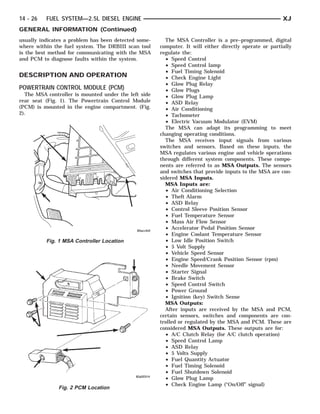
  • 34.
    14 - 34 FUEL SYSTEM—2.5L DIESEL ENGINE XJ DIAGNOSIS AND TESTING (Continued) When the ignition (key) switch is placed in the ON position, a signal is sent to the MSA relating current engine coolant temperature. This signal is sent from the engine coolant temperature sensor. After receiving this signal, the MSA will determine if, when and for how long a period the glow plug relay should be activated. This is done before, during and after the engine is started. Whenever the glow plug relay is activated, it will control the 12V+ 100 amp circuit for the operation of the four glow plugs. The Glow Plug lamp is tied to this circuit. Lamp operation is also controlled by the MSA. With a cold engine, the glow plug relay and glow plugs may be activated for a maximum time of 200 seconds. Refer to the Glow Plug Control chart for a temperature/time comparison of glow plug relay oper- ation. Fig. 17 Wiring Connection at Glow Plug In this chart, Pre–Heat and Post–Heat times are GLOW PLUG CONTROL mentioned. Pre–heat is the amount of time the glow plug relay circuit is activated when the ignition (key) switch is ON, but the engine has yet to be started. Post–heat is the amount of time the glow plug relay circuit is activated after the engine is operating. The Glow Plug lamp will not be illuminated during the post–heat cycle. TESTING: Disconnect and isolate the electrical connectors (Fig. 17) at all four glow plugs. With the engine cool or cold, and the key in the ON position, check for 10–12 volts + at each electrical connector. 10–12 volts + should be at each connector whenever the MSA is operating in the pre–heat or post–heat cycles (refer to the following Glow Plug Control chart). Be very careful not to allow any of the four discon- nected glow plug electrical connectors to con- tact a metal surface. When the key is turned to the ON position, approximately 100 amps at 12 volts is supplied to these connectors. If 10–12 volts + is not available at each connector, check con- OPERATION tinuity of wiring harness directly to the relay. If con- • Terminal number 30 is connected to battery volt- tinuity is good directly to the relay, the fault is either age. For both the ASD and other relays, terminal 30 with the relay or the relay input from the MSA. To is connected to battery voltage at all times. test the relay only, refer to Relays—Operation/Test- • The MSA grounds the coil side of the relay ing in this section of the group. If the relay test is through terminal number 85. good, refer to the DRB scan tool. • Terminal number 86 supplies voltage to the coil Diagnostic Trouble Codes: Refer to On-Board side of the relay. Diagnostics in Group 25, Emission Control System • When the PCM de-energizes the ASD and other for a list of Diagnostic Trouble Codes (DTC’s) for cer- relays, terminal number 87A connects to terminal 30. tain fuel system components. This is the Off position. In the off position, voltage is not supplied to the rest of the circuit. Terminal 87A RELAYS—OPERATION/TESTING is the center terminal on the relay. The following description of operation and • When the MSA energizes the ASD and other tests apply only to the ASD and other relays . relays, terminal 87 connects to terminal 30. This is The terminals on the bottom of each relay are num- the On position. Terminal 87 supplies voltage to the bered (Fig. 18). rest of the circuit.
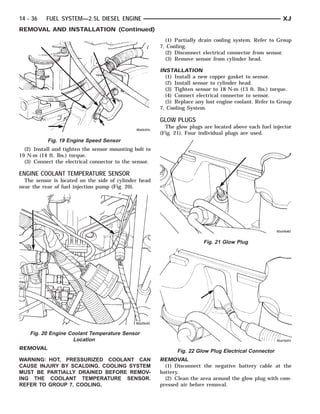
  • 35.
    XJ FUEL SYSTEM—2.5L DIESEL ENGINE 14 - 35 DIAGNOSIS AND TESTING (Continued) (9) Replace the relay if it did not pass the continu- ity and resistance tests. If the relay passed the tests, it operates properly. Check the remainder of the ASD and other relay circuits. Refer to group 8W, Wiring Diagrams. MASS AIR FLOW SENSOR The Mass Air Flow (MAF) sensor can only be tested by checking for a fault code stored in the MSA. If the mass air flow sensor stops functioning, you will experience a loss of power, as if you had no turbocharger operation. The MSA may indicate no turbo operation if there is no signal from the MAF sensor. If the sensor sets a fault and no loss of power then check to see if there is a clogged air filter. VEHICLE SPEED SENSOR TEST To perform a test of the sensor and its related cir- cuitry, refer to DRB scan tool. Diagnostic Trouble Codes: Refer to On-Board Diagnostics in Group 25, Emission Control System for a list of Diagnostic Trouble Codes (DTC’s) for cer- Fig. 18 ASD and Other Relay Terminals tain fuel system components. TESTING The following procedure applies to the ASD and DIAGNOSTIC TROUBLE CODES For a list of Diagnostic Trouble Codes (DTC’s), other relays. refer to Group 25, Emission Control System for infor- (1) Remove relay from connector before testing. mation. See On-Board Diagnostics. (2) With the relay removed from the vehicle, use an ohmmeter to check the resistance between termi- nals 85 and 86. The resistance should be between 75 REMOVAL AND INSTALLATION Ϯ5 ohms. (3) Connect the ohmmeter between terminals 30 ASD RELAY and 87A. The ohmmeter should show continuity The ASD relay is located in the PDC. For the loca- between terminals 30 and 87A. tion of the relay within the PDC, refer to label on (4) Connect the ohmmeter between terminals 87 PDC cover. and 30. The ohmmeter should not show continuity at this time. A/C CLUTCH RELAY (5) Connect one end of a jumper wire (16 gauge or The A/C clutch relay is located in the PDC. For the smaller) to relay terminal 85. Connect the other end location of the relay within the PDC, refer to label on of the jumper wire to the ground side of a 12 volt PDC cover. power source. (6) Connect one end of another jumper wire (16 ENGINE SPEED SENSOR gauge or smaller) to the power side of the 12 volt The engine speed sensor is mounted to the trans- power source. Do not attach the other end of the mission bellhousing at the rear of the engine block jumper wire to the relay at this time. (Fig. 19). WARNING: DO NOT ALLOW OHMMETER TO CON- REMOVAL TACT TERMINALS 85 OR 86 DURING THIS TEST. (1) Disconnect the harness (on the sensor) from the main electrical harness. (7) Attach the other end of the jumper wire to (2) Remove the sensor mounting bolts. relay terminal 86. This activates the relay. The ohm- (3) Remove the sensor. meter should now show continuity between relay ter- minals 87 and 30. The ohmmeter should not show INSTALLATION continuity between relay terminals 87A and 30. (1) Install the sensor flush against the opening in (8) Disconnect jumper wires. the transmission housing.
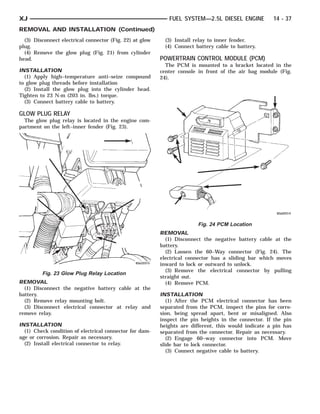
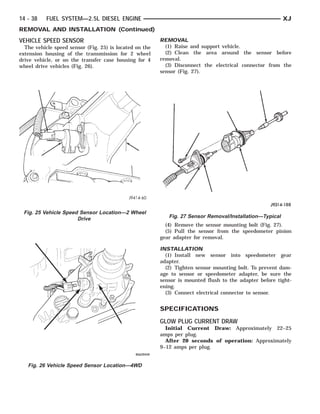
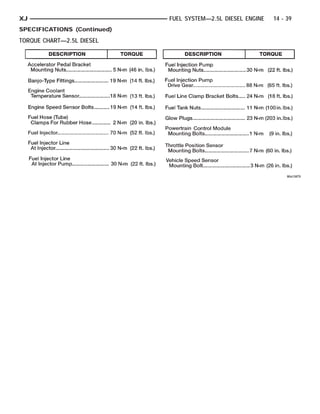
  • 36.
    14 - 36 FUEL SYSTEM—2.5L DIESEL ENGINE XJ REMOVAL AND INSTALLATION (Continued) (1) Partially drain cooling system. Refer to Group 7, Cooling. (2) Disconnect electrical connector from sensor. (3) Remove sensor from cylinder head. INSTALLATION (1) Install a new copper gasket to sensor. (2) Install sensor to cylinder head. (3) Tighten sensor to 18 N·m (13 ft. lbs.) torque. (4) Connect electrical connector to sensor. (5) Replace any lost engine coolant. Refer to Group 7, Cooling System. GLOW PLUGS The glow plugs are located above each fuel injector (Fig. 21). Four individual plugs are used. Fig. 19 Engine Speed Sensor (2) Install and tighten the sensor mounting bolt to 19 N·m (14 ft. lbs.) torque. (3) Connect the electrical connector to the sensor. ENGINE COOLANT TEMPERATURE SENSOR The sensor is located on the side of cylinder head near the rear of fuel injection pump (Fig. 20). Fig. 21 Glow Plug Fig. 20 Engine Coolant Temperature Sensor Location REMOVAL Fig. 22 Glow Plug Electrical Connector WARNING: HOT, PRESSURIZED COOLANT CAN REMOVAL CAUSE INJURY BY SCALDING. COOLING SYSTEM (1) Disconnect the negative battery cable at the MUST BE PARTIALLY DRAINED BEFORE REMOV- battery. ING THE COOLANT TEMPERATURE SENSOR. (2) Clean the area around the glow plug with com- REFER TO GROUP 7, COOLING. pressed air before removal.
  • 37.
    XJ FUEL SYSTEM—2.5L DIESEL ENGINE 14 - 37 REMOVAL AND INSTALLATION (Continued) (3) Disconnect electrical connector (Fig. 22) at glow (3) Install relay to inner fender. plug. (4) Connect battery cable to battery. (4) Remove the glow plug (Fig. 21) from cylinder head. POWERTRAIN CONTROL MODULE (PCM) The PCM is mounted to a bracket located in the INSTALLATION center console in front of the air bag module (Fig. (1) Apply high–temperature anti–seize compound 24). to glow plug threads before installation (2) Install the glow plug into the cylinder head. Tighten to 23 N·m (203 in. lbs.) torque. (3) Connect battery cable to battery. GLOW PLUG RELAY The glow plug relay is located in the engine com- partment on the left–inner fender (Fig. 23). Fig. 24 PCM Location REMOVAL (1) Disconnect the negative battery cable at the battery. (2) Loosen the 60–Way connector (Fig. 24). The electrical connector has a sliding bar which moves inward to lock or outward to unlock. (3) Remove the electrical connector by pulling Fig. 23 Glow Plug Relay Location straight out. REMOVAL (4) Remove PCM. (1) Disconnect the negative battery cable at the battery. INSTALLATION (2) Remove relay mounting bolt. (1) After the PCM electrical connector has been (3) Disconnect electrical connector at relay and separated from the PCM, inspect the pins for corro- remove relay. sion, being spread apart, bent or misaligned. Also inspect the pin heights in the connector. If the pin INSTALLATION heights are different, this would indicate a pin has (1) Check condition of electrical connector for dam- separated from the connector. Repair as necessary. age or corrosion. Repair as necessary. (2) Engage 60–way connector into PCM. Move (2) Install electrical connector to relay. slide bar to lock connector. (3) Connect negative cable to battery.
  • 38.
    14 - 38 FUEL SYSTEM—2.5L DIESEL ENGINE XJ REMOVAL AND INSTALLATION (Continued) VEHICLE SPEED SENSOR REMOVAL The vehicle speed sensor (Fig. 25) is located on the (1) Raise and support vehicle. extension housing of the transmission for 2 wheel (2) Clean the area around the sensor before drive vehicle, or on the transfer case housing for 4 removal. wheel drive vehicles (Fig. 26). (3) Disconnect the electrical connector from the sensor (Fig. 27). Fig. 25 Vehicle Speed Sensor Location—2 Wheel Drive Fig. 27 Sensor Removal/Installation—Typical (4) Remove the sensor mounting bolt (Fig. 27). (5) Pull the sensor from the speedometer pinion gear adapter for removal. INSTALLATION (1) Install new sensor into speedometer gear adapter. (2) Tighten sensor mounting bolt. To prevent dam- age to sensor or speedometer adapter, be sure the sensor is mounted flush to the adapter before tight- ening. (3) Connect electrical connector to sensor. SPECIFICATIONS GLOW PLUG CURRENT DRAW Initial Current Draw: Approximately 22–25 amps per plug. After 20 seconds of operation: Approximately 9–12 amps per plug. Fig. 26 Vehicle Speed Sensor Location—4WD
  • 39.
    XJ FUEL SYSTEM—2.5L DIESEL ENGINE 14 - 39 SPECIFICATIONS (Continued) TORQUE CHART—2.5L DIESEL