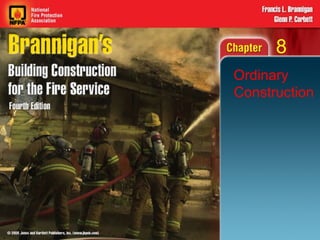
8  Ordinary Construction
Objectives  (1 of 2) Understand the details of ordinary construction Understand how the structural stability of a masonry wall is compromised Identify specific wall and wall component problems Recognize collapse indicators 8
Objectives  (2 of 2) Identify the problems associated with interior structural elements Explain how masonry walls act as fire barriers  Understand fire spread through void spaces of ordinary construction 8
Introduction Many of the book’s examples were taken west of the continental divide—not just from “back East” Learn from the bad experiences of others Prepare for your next job 8
Classifying Ordinary Construction Common characteristic of ordinary construction is exterior walls made of masonry Exterior walls are noncombustible or limited combustible, but the interior floors and walls are made of combustible materials Today, the term has multiple meanings 8
Know the Pronunciation Masonry (not masonARY) Lintel (not LENtil) Spalling (not spalDING) 8
Classification Type III construction  Can be described as “Main Street, USA”  Strip mall with lightweight wood roof trusses and concrete block walls 8
Masonry Walls May consist of brick, stone, concrete block, terra cotta tile, adobe, precast, or cast-in-place concrete Cast-in-place concrete includes different types of concrete May or may not be of one material 8
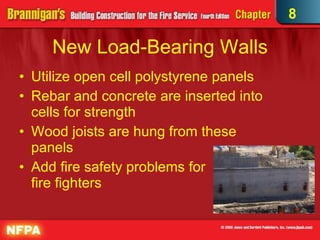
New Load-Bearing Walls Utilize open cell polystyrene panels Rebar and concrete are inserted into cells for strength Wood joists are hung from these panels Add fire safety problems for  fire fighters 8
Fire Limits Older code provision that would not allow a structure to be built without the use of exterior masonry walls Wood frame buildings were banned inside the fire limits 8
Exclusive Classes Codes and standards divide buildings into various classes Sometimes, what was used was what was available Often, little or no thought was given to types of construction 8
Characteristics of Ordinary Construction Masonry bearing walls Wood joists Roof often similar to the floor in construction Cockloft 8
Bearing and Nonbearing Walls Use similar construction materials  Often identical in appearance  8
Wood Beam Floor Wider buildings need a column, girder, and beam system Connection systems come in many forms.  Connection weakness creates collapse potential 8
Void Spaces Inherent part of ordinary construction Fire protection included embossed metal or tin ceilings Ceilings can be fire fighter barriers once fire penetrates the void space 8
Effective Fire Separation Not within an ordinary construction building Often are imperfect or nonexistent in attic spaces 8
Height of Masonry Buildings Inherent limits  Need to increase the thickness of the wall as the height increases 8
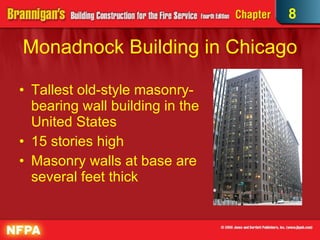
Monadnock Building in Chicago Tallest old-style masonry-bearing wall building in the United States  15 stories high Masonry walls at base are several feet thick 8
Newer Buildings High-rise buildings with no wall thicker than 12 inches Medium-rise brick buildings with no wall thicker than 8 inches  8
Masonry Construction Terms  (1 of 4) Adobe Ashlar masonry Cantilever wall Cavity walls Composite wall  8
Masonry Construction Terms  (2 of 4) Concrete masonry unit (CMU) Course Cross wall Flying buttress Header or bond course 8
Masonry Construction Terms   (3 of 4) Hollow masonry walls Masonry columns Parging (or pargetting) Rubble masonry Rubble masonry wall 8
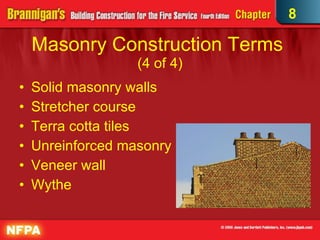
Masonry Construction Terms  (4 of 4) Solid masonry walls Stretcher course Terra cotta tiles Unreinforced masonry Veneer wall Wythe 8
Renovation and Restoration of Ordinary Construction Modifications Most old buildings have undergone extensive modifications Modifications usually have a detrimental effect on the fire suppression 8
Historical Case Example:  Brown Merrill Building 1890 fire Some interior walls on the first floor had been removed Iron poles supported the upper floors An arch in the basement had been removed 8
Renovations in  Existing Buildings Result of alterations  One part of a building can be different from another Interior alterations and finish can make determining the true nature of the building difficult 8
Preservation Undeniable historic value Architectural heritage Fire safety seems a low priority  8
The Owner’s Rights Fundamental right anchored in our legal system Only clear public danger will force repair or demolition 8
Fire Resistance Building development is evolutionary Piecemeal provisions of fire-resistive features are less than ideal Concrete topping creates dead weight 8
Recent Construction  Departs from ordinary construction Not necessarily an improvement Noncombustible voids Lightweight wood trusses and wooden  I-beams can contribute to the accumulations of explosive carbon monoxide 8
Wood Flourishes Use of flourishes over masonry has left few truly noncombustible buildings 8
Desire for Wider Spans Widespread use of unprotected steel for roof framing 8
General Problems of  Ordinary Construction Structural stability of the masonry wall Stability of the interior column, girder, and beam system Void spaces Masonry wall as a barrier to fire extension  8
Discovery of Hazard  (1 of 2) Indications of building failure Smoke or water flowing through walls Soft floors A small partial collapse Walls out of plumb  8
Discovery of Hazard  (2 of 2) Key texts Construction Failures  Building Failures  8
Ordinary Constructed Buildings In most cities, have been around a long time Ample opportunity to study buildings and establish preplanned tactics  8
Clues to Disaster Some are evident from the street Others require detailed examination 8
Problems with Specific Types of Walls and Wall Components Hollow or Cavity Walls Hollow or cavity walls, including hollow terra cotta walls  Sheet or foamed-in-place plastic insulation Masonry walls Cast iron Lintels Imitation Brick 8
Hollow or Cavity Walls Limited penetration by rain  Carbon monoxide can accumulate in the hollow space or cavity and explode disastrously 8
Sheet or Foamed-In-Place Plastic Insulation Often placed in hollow walls Has various ignition characteristics Produces large quantities of smoke  8
Hollow Walls of Hollow  Terra Cotta Tile Present a special hazard Exterior and interior wythes connected with steel ties If wythes move, clay tile has no tensile strength 8
Masonry Walls Used to be built only of bricks Now made using concrete block Uneven settlement Masonry wire trusses 8
Cast Iron Cast-iron columns and wrought- or cast-iron arches or lintels Allowed walls to be made of prefabricated cast-iron sections Front may separate from side walls Columns may transmit fire vertically 8
Lintels Beams carry the wall above an opening The steel “L” lintel is common today Steel lintels are tied into the masonry wall When heated, they elongate and the masonry can fail 8
Imitation Brick Made by spreading a coat of gray concrete on lath Coat of red concrete is then applied Another method is to cement thin slices of brick onto panels of gypsum board 8
Structural Stability of  Exterior Masonry Walls Little in traditional firefighting training on this subject Flying bricks hazardous 8
General Collapse Indicators  (1 of 2) Inherent structural instability Failure of a nonmasonry supporting element Increase in the live load Collapse of a floor or roof 8
General Collapse Indicators (2 of 2) Impact load of an explosion Collapse of a masonry unit Collapse of another building onto the building in question 8
Bricks and Mortar  Poorly made bricks deteriorate readily Mortar can force masonry out of alignment Sand-lime mortar is  water-soluble Restored buildings are  still suspect 8
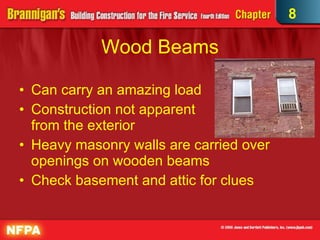
Wood Beams Can carry an amazing load Construction not apparent  from the exterior Heavy masonry walls are carried over openings on wooden beams Check basement and attic for clues 8
Cracks Indicate weakness in a wall  Horizontal cracks 8
Arches A brick or stone may fall out of an arch If any arch unit is out, there is no arch 8
Wall Weaknesses  (1 of 2) All walls are inherently unstable Often, front and side walls are designed to brace one another Different materials expand and contract at different rates 8
Wall Weaknesses  (2 of 2) Stabilization of walls Holes cut through walls create a serious weakness Construction of additional openings should be supervised by a structural engineer 8
Steel Lintels Used without any protection for the steel Steel lintels can deform and throw bricks Reinforced-concrete lintels are commonly used in masonry walls Bottom concrete may spall off exposing the reinforcing rods 8
Bracing Can be a sign that a wall is in distress  Braces are not always an indication of instability, especially if used with spreaders in a regular pattern Bracing upgrades the  earthquake resistance  of unreinforced masonry  walls 8
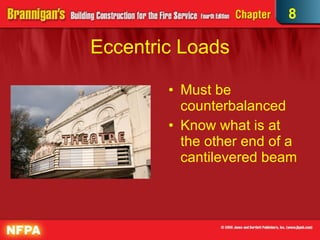
Eccentric Loads Must be counterbalanced Know what is at the other end of a cantilevered beam 8
Unvented Voids Carbon monoxide gas in unvented voids can detonate violently Masonry walls are not designed to resist lateral impact loads 8
Planes of Weakness Floor beams are difficult to level Leveling with a wood beam creates a plane of weakness Horizontal planes of weakness  Vertical planes of weakness 8
Effects of Interior Structural Elements and Building Contents on an Exterior Wall  (1 of 2) Pushing down a wall Tightly fitted wooden floor beams may act as a series of levers Floor beams placed with an upward camber or rise 8
Effects of Interior Structural Elements and Building Contents on an Exterior Wall  (2 of 2) Beams can be corbelled out from the wall Be wary of curtain walls 8
Effect of Fire Streams  on Brick Walls  Cold water hitting a hot wall has little effect Wooden components more significant in the collapse A heavy stream can penetrate brick veneer Heavy streams can rip loosened bricks Very heavy streams can smash brick walls 8
Interior Structural Stability Interior collapse of an overloaded floor can cause the walls to collapse  Collapse of an exterior wall may cause an interior collapse 8
Planning for Collapses Design connections to permit easy collapse of girders Design easy collapse of floors to prevent collapse of walls with fire-cut joists There is opposition to these points of view 8
Fire-Resistive  Combustible Assemblies Combustible floor and wall assemblies have achieved fire-resistance ratings  Used to produce code-classified protected combustible structures 8
Inherent Defects Balloon-frame wall-carrying interior loads Stone walls and interior walls  Interior Structural Support Systems of Columns, Beams, and Girders  (1 of 2) 8
Interior Structural Support Systems of Columns, Beams, and Girders  (2 of 2) Adjustable steel jack posts Water pipe used incorrectly Openings in interior masonry bearing walls  8
Deficiencies of Material  (1 of 2) Addition of unprotected steel Sometimes apparent, but is often fully concealed Steel bar joists can be installed between each pair of wood joists to strengthen a building 8
Deficiencies of Material  (2 of 2) Wood beams May be trussed initially or at a later date  8
Connections in  Ordinary Construction Beam-to-girder Beam-to-beam Beam-to-column Cast-iron columns Interior suspended loads 8
Beam-to-Girder Connections Set the beams atop the girder Add height to the walls Connection methods reduce the size of the wood Effective strength is determined by the size of the thinnest portion 8
Beam-to-Beam Connections Made when an opening is made in wooden floor Mortise and tenon joints Metal joist hangers Lightweight hangers 8
Beam-to-Column Connections Self-releasing floors Girders Dog iron Transfer beams 8
Cast-Iron Columns Pintles transfer loads of columns on upper floors Use of pintles and cast-iron columns can cause a collapse due to unsafe connections 8
Interior Suspended Loads Balconies and mezzanines are hazardous  Interior designers like to hang heavy loads from the overhead 8
Floors When a stairway is relocated, old opening is usually covered over Closure is lighter than the floor Opening can cause collapse Sheet of metal over the opening can also collapse 8
Light Well  Vertical shaft with windows that provides light and ventilation to enclosed rooms Often floored over 8
Flooring Construction Used to consist of subflooring and a finished floor Now often a single thickness of plywood and carpeting 8
Floor Collapse Can occur early in the fire 8
Roofs  Equipment failure can cost lives, but roof also can fail A roof is not designed or constructed as a fire department working platform 8
Fire Characteristics of Conventional Wood Roofs (1 of 2) Roofs supported on solid sawn rafters and beams Structural characteristics must be known, not just “type” Solid-sawn wood contains “fat” wood 8
Fire Characteristics of Conventional Wood Roofs  (2 of 2) Beam gradually weakens in a fire, and the roof becomes spongy  NFPA 251 standard fire exposure tests 8
Roof Hazards Best roof is one in which the roof beams rest on girders Hangars or other metal connections make the roof more vulnerable to failure  8
Roofs Supported on  Heavy Wood Beams Can be much less reliable than they appear Apparent long beams are often several beams spliced together  8
Energy Conservation and  Rapid Completion Important considerations in today’s buildings Foamed plastic is sandwiched between sheets of plywood Plastic may melt away in a fire, allowing the roof panel to fall 8
Making Use of Natural Light Corrugated glass-fiber-reinforced plastic panels are made to the same dimensions as corrugated steel Fire fighter could easily step through the plastic 8
Ventilation Tactics Can accelerate collapse  No such thing as zero impact 8
Excess Live Loads Can accelerate collapse  Water trapped on a flat roof can cause a collapse 8
Equipment Often mounted on roofs Grillage is affected by the fire Supporting beams should be watched for overheating 8
Modern Roofs Have little or no inherent fire resistance to early failure Typical non-fire-resistive roof has elements that are susceptible to failure Additional roofs built over an original roof, causing additional failure risks  8
Lightweight Wood Truss Roofs  (1 of 2) Case Study: Fire in the gable end of a truss roof restaurant. Heavy equipment had been on the roof; the construction made the fire impervious to an interior attack. 8
Lightweight Wood Truss Roofs  (2 of 2) Case Study: Collapse of a lightweight wood truss church roof in Lake Worth, Texas. Heavy fire involvement of the trussloft led to extremely rapid failure of the trusses.  8
Bowstring Truss Roofs Name comes from the curved shape of the top chord Tied arches Popular during the mid-20 th  century 8
Treated Plywood Roofs Builders object to the cost and leakage problems Many accepted the use of fireresistant treated plywood (FRTP) roofing extending to the underside of the roof Some chemicals used in FRTP react and deteriorate in ordinary temperatures 8
Void Spaces Voids or concealed spaces inherent part of buildings of ordinary construction Requirements for firestopping may not have existed or may have been ignored Major firefighting problem  8
Interior Sheathing A protective interior sheathing or finish for a structure contributes to a building’s fire safety True as long as the sheathing keeps fire out of the structure 8
Light Smoke Showing A misleading expression  Light smoke often signals a disaster Tremendous fire threat can be concealed in voids 8
Ceiling Spaces  Older buildings have higher ceilings than those built today False ceilings conserve heating and cooling Lowering the ceiling rarely includes firestopping Usual construction methods create a huge three-dimensional void across the ceilings 8
Joist Spaces Protected from hose streams by their construction and the ceiling below Wood truss floors have immeasurably increased this problem 8
Combustible Gases  in Void Spaces Can provide the fuel for a devastating explosion Generation of carbon monoxide 8
Large Voids Public buildings often include vast void spaces Access for heavy-caliber streams is limited Fire-loaded upper floors become inaccessible concealed spaces Require sprinkler protection if above first floor 8
Fire Extension Rarely is provision made to prevent the extension of fire through the stairways and halls Often there are many bypasses Interconnected voids provide fire paths  8
Interior Walls Balloon-frame construction in older buildings Masonry walls do load-carrying Walls not carried into attic, creating combustible space 8
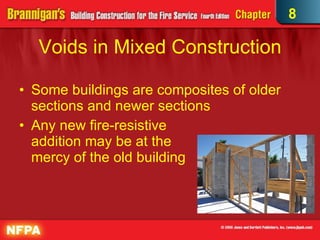
Voids in Mixed Construction Some buildings are composites of older sections and newer sections  Any new fire­resistive  addition may be at the  mercy of the old building 8
Cornices and Canopies Cornice is a structure that tops the wall and projects from it Collapse of cornices has caused many fire fighter fatalities and injuries Coming back into style Sidewalk canopy 8
Fire Barriers  Masonry bearing walls as fire barriers Conditions make a bearing wall less than a fire wall If buildings have a 12- or 16-inch unpierced bearing wall, these walls form a barrier to the passage of any fire 8
Fire Doors Additional openings often made without proper protection  Fire fighters need to be trained to inspect a fire door for proper operation  8
Protection from Exposure  (1 of 4) Adjacent buildings Fire coming through the lower roof may extend to the adjacent building Burning material may fall out of the upper windows onto the adjacent roof 8
Protection from Exposure  (2 of 4) Windows Side windows may provide fire path to adjacent building Hidden windows may provide a surprise path for fire to travel 8
Protection from Exposure  (3 of 4) Narrow alleys Present difficult defense problems against exposures  Windows facing the alley are usually protected Wired glass is of limited value against radiant heat 8
Protection from Exposure  (4 of 4) Outside sprinklers or spray systems Installed to protect against exposure fires Fire department should be fully familiar with their operation 8
Party Walls Structural walls that are common to two buildings  Established by mutual contract between the owners  Are thinner than two separate walls 8
Fire-Ground Safety Fire fighter safety is critical Set up a Board of Building Review Survey major buildings Establish time limits for staying in buildings Prefire planning helps determine the boundary between building stability and instability 8
Summary  (1 of 2) Ordinary construction describes an almost infinite variety of buildings Exterior walls are made of masonry with combustible frame members Modifications can have a detrimental effect on the structure 8
Summary  (2 of 2) Many fire texts cite indications of building failure that may be observed on the fire ground There is one working platform fire fighters use that has cost many lives — the roof 8

Ch 8 Ordinary Construction

  • 1.
    8 OrdinaryConstruction
  • 2.
    Objectives (1of 2) Understand the details of ordinary construction Understand how the structural stability of a masonry wall is compromised Identify specific wall and wall component problems Recognize collapse indicators 8
  • 3.
    Objectives (2of 2) Identify the problems associated with interior structural elements Explain how masonry walls act as fire barriers Understand fire spread through void spaces of ordinary construction 8
  • 4.
    Introduction Many ofthe book’s examples were taken west of the continental divide—not just from “back East” Learn from the bad experiences of others Prepare for your next job 8
  • 5.
    Classifying Ordinary ConstructionCommon characteristic of ordinary construction is exterior walls made of masonry Exterior walls are noncombustible or limited combustible, but the interior floors and walls are made of combustible materials Today, the term has multiple meanings 8
  • 6.
    Know the PronunciationMasonry (not masonARY) Lintel (not LENtil) Spalling (not spalDING) 8
  • 7.
    Classification Type IIIconstruction Can be described as “Main Street, USA” Strip mall with lightweight wood roof trusses and concrete block walls 8
  • 8.
    Masonry Walls Mayconsist of brick, stone, concrete block, terra cotta tile, adobe, precast, or cast-in-place concrete Cast-in-place concrete includes different types of concrete May or may not be of one material 8
  • 9.
    New Load-Bearing WallsUtilize open cell polystyrene panels Rebar and concrete are inserted into cells for strength Wood joists are hung from these panels Add fire safety problems for fire fighters 8
  • 10.
    Fire Limits Oldercode provision that would not allow a structure to be built without the use of exterior masonry walls Wood frame buildings were banned inside the fire limits 8
  • 11.
    Exclusive Classes Codesand standards divide buildings into various classes Sometimes, what was used was what was available Often, little or no thought was given to types of construction 8
  • 12.
    Characteristics of OrdinaryConstruction Masonry bearing walls Wood joists Roof often similar to the floor in construction Cockloft 8
  • 13.
    Bearing and NonbearingWalls Use similar construction materials Often identical in appearance 8
  • 14.
    Wood Beam FloorWider buildings need a column, girder, and beam system Connection systems come in many forms. Connection weakness creates collapse potential 8
  • 15.
    Void Spaces Inherentpart of ordinary construction Fire protection included embossed metal or tin ceilings Ceilings can be fire fighter barriers once fire penetrates the void space 8
  • 16.
    Effective Fire SeparationNot within an ordinary construction building Often are imperfect or nonexistent in attic spaces 8
  • 17.
    Height of MasonryBuildings Inherent limits Need to increase the thickness of the wall as the height increases 8
  • 18.
    Monadnock Building inChicago Tallest old-style masonry-bearing wall building in the United States 15 stories high Masonry walls at base are several feet thick 8
  • 19.
    Newer Buildings High-risebuildings with no wall thicker than 12 inches Medium-rise brick buildings with no wall thicker than 8 inches 8
  • 20.
    Masonry Construction Terms (1 of 4) Adobe Ashlar masonry Cantilever wall Cavity walls Composite wall 8
  • 21.
    Masonry Construction Terms (2 of 4) Concrete masonry unit (CMU) Course Cross wall Flying buttress Header or bond course 8
  • 22.
    Masonry Construction Terms (3 of 4) Hollow masonry walls Masonry columns Parging (or pargetting) Rubble masonry Rubble masonry wall 8
  • 23.
    Masonry Construction Terms (4 of 4) Solid masonry walls Stretcher course Terra cotta tiles Unreinforced masonry Veneer wall Wythe 8
  • 24.
    Renovation and Restorationof Ordinary Construction Modifications Most old buildings have undergone extensive modifications Modifications usually have a detrimental effect on the fire suppression 8
  • 25.
    Historical Case Example: Brown Merrill Building 1890 fire Some interior walls on the first floor had been removed Iron poles supported the upper floors An arch in the basement had been removed 8
  • 26.
    Renovations in Existing Buildings Result of alterations One part of a building can be different from another Interior alterations and finish can make determining the true nature of the building difficult 8
  • 27.
    Preservation Undeniable historicvalue Architectural heritage Fire safety seems a low priority 8
  • 28.
    The Owner’s RightsFundamental right anchored in our legal system Only clear public danger will force repair or demolition 8
  • 29.
    Fire Resistance Buildingdevelopment is evolutionary Piecemeal provisions of fire-resistive features are less than ideal Concrete topping creates dead weight 8
  • 30.
    Recent Construction Departs from ordinary construction Not necessarily an improvement Noncombustible voids Lightweight wood trusses and wooden I-beams can contribute to the accumulations of explosive carbon monoxide 8
  • 31.
    Wood Flourishes Useof flourishes over masonry has left few truly noncombustible buildings 8
  • 32.
    Desire for WiderSpans Widespread use of unprotected steel for roof framing 8
  • 33.
    General Problems of Ordinary Construction Structural stability of the masonry wall Stability of the interior column, girder, and beam system Void spaces Masonry wall as a barrier to fire extension 8
  • 34.
    Discovery of Hazard (1 of 2) Indications of building failure Smoke or water flowing through walls Soft floors A small partial collapse Walls out of plumb 8
  • 35.
    Discovery of Hazard (2 of 2) Key texts Construction Failures Building Failures 8
  • 36.
    Ordinary Constructed BuildingsIn most cities, have been around a long time Ample opportunity to study buildings and establish preplanned tactics 8
  • 37.
    Clues to DisasterSome are evident from the street Others require detailed examination 8
  • 38.
    Problems with SpecificTypes of Walls and Wall Components Hollow or Cavity Walls Hollow or cavity walls, including hollow terra cotta walls Sheet or foamed-in-place plastic insulation Masonry walls Cast iron Lintels Imitation Brick 8
  • 39.
    Hollow or CavityWalls Limited penetration by rain Carbon monoxide can accumulate in the hollow space or cavity and explode disastrously 8
  • 40.
    Sheet or Foamed-In-PlacePlastic Insulation Often placed in hollow walls Has various ignition characteristics Produces large quantities of smoke 8
  • 41.
    Hollow Walls ofHollow Terra Cotta Tile Present a special hazard Exterior and interior wythes connected with steel ties If wythes move, clay tile has no tensile strength 8
  • 42.
    Masonry Walls Usedto be built only of bricks Now made using concrete block Uneven settlement Masonry wire trusses 8
  • 43.
    Cast Iron Cast-ironcolumns and wrought- or cast-iron arches or lintels Allowed walls to be made of prefabricated cast-iron sections Front may separate from side walls Columns may transmit fire vertically 8
  • 44.
    Lintels Beams carrythe wall above an opening The steel “L” lintel is common today Steel lintels are tied into the masonry wall When heated, they elongate and the masonry can fail 8
  • 45.
    Imitation Brick Madeby spreading a coat of gray concrete on lath Coat of red concrete is then applied Another method is to cement thin slices of brick onto panels of gypsum board 8
  • 46.
    Structural Stability of Exterior Masonry Walls Little in traditional firefighting training on this subject Flying bricks hazardous 8
  • 47.
    General Collapse Indicators (1 of 2) Inherent structural instability Failure of a nonmasonry supporting element Increase in the live load Collapse of a floor or roof 8
  • 48.
    General Collapse Indicators(2 of 2) Impact load of an explosion Collapse of a masonry unit Collapse of another building onto the building in question 8
  • 49.
    Bricks and Mortar Poorly made bricks deteriorate readily Mortar can force masonry out of alignment Sand-lime mortar is water-soluble Restored buildings are still suspect 8
  • 50.
    Wood Beams Cancarry an amazing load Construction not apparent from the exterior Heavy masonry walls are carried over openings on wooden beams Check basement and attic for clues 8
  • 51.
    Cracks Indicate weaknessin a wall Horizontal cracks 8
  • 52.
    Arches A brickor stone may fall out of an arch If any arch unit is out, there is no arch 8
  • 53.
    Wall Weaknesses (1 of 2) All walls are inherently unstable Often, front and side walls are designed to brace one another Different materials expand and contract at different rates 8
  • 54.
    Wall Weaknesses (2 of 2) Stabilization of walls Holes cut through walls create a serious weakness Construction of additional openings should be supervised by a structural engineer 8
  • 55.
    Steel Lintels Usedwithout any protection for the steel Steel lintels can deform and throw bricks Reinforced-concrete lintels are commonly used in masonry walls Bottom concrete may spall off exposing the reinforcing rods 8
  • 56.
    Bracing Can bea sign that a wall is in distress Braces are not always an indication of instability, especially if used with spreaders in a regular pattern Bracing upgrades the earthquake resistance of unreinforced masonry walls 8
  • 57.
    Eccentric Loads Mustbe counterbalanced Know what is at the other end of a cantilevered beam 8
  • 58.
    Unvented Voids Carbonmonoxide gas in unvented voids can detonate violently Masonry walls are not designed to resist lateral impact loads 8
  • 59.
    Planes of WeaknessFloor beams are difficult to level Leveling with a wood beam creates a plane of weakness Horizontal planes of weakness Vertical planes of weakness 8
  • 60.
    Effects of InteriorStructural Elements and Building Contents on an Exterior Wall (1 of 2) Pushing down a wall Tightly fitted wooden floor beams may act as a series of levers Floor beams placed with an upward camber or rise 8
  • 61.
    Effects of InteriorStructural Elements and Building Contents on an Exterior Wall (2 of 2) Beams can be corbelled out from the wall Be wary of curtain walls 8
  • 62.
    Effect of FireStreams on Brick Walls Cold water hitting a hot wall has little effect Wooden components more significant in the collapse A heavy stream can penetrate brick veneer Heavy streams can rip loosened bricks Very heavy streams can smash brick walls 8
  • 63.
    Interior Structural StabilityInterior collapse of an overloaded floor can cause the walls to collapse Collapse of an exterior wall may cause an interior collapse 8
  • 64.
    Planning for CollapsesDesign connections to permit easy collapse of girders Design easy collapse of floors to prevent collapse of walls with fire-cut joists There is opposition to these points of view 8
  • 65.
    Fire-Resistive CombustibleAssemblies Combustible floor and wall assemblies have achieved fire-resistance ratings Used to produce code-classified protected combustible structures 8
  • 66.
    Inherent Defects Balloon-framewall-carrying interior loads Stone walls and interior walls Interior Structural Support Systems of Columns, Beams, and Girders (1 of 2) 8
  • 67.
    Interior Structural SupportSystems of Columns, Beams, and Girders (2 of 2) Adjustable steel jack posts Water pipe used incorrectly Openings in interior masonry bearing walls 8
  • 68.
    Deficiencies of Material (1 of 2) Addition of unprotected steel Sometimes apparent, but is often fully concealed Steel bar joists can be installed between each pair of wood joists to strengthen a building 8
  • 69.
    Deficiencies of Material (2 of 2) Wood beams May be trussed initially or at a later date 8
  • 70.
    Connections in Ordinary Construction Beam-to-girder Beam-to-beam Beam-to-column Cast-iron columns Interior suspended loads 8
  • 71.
    Beam-to-Girder Connections Setthe beams atop the girder Add height to the walls Connection methods reduce the size of the wood Effective strength is determined by the size of the thinnest portion 8
  • 72.
    Beam-to-Beam Connections Madewhen an opening is made in wooden floor Mortise and tenon joints Metal joist hangers Lightweight hangers 8
  • 73.
    Beam-to-Column Connections Self-releasingfloors Girders Dog iron Transfer beams 8
  • 74.
    Cast-Iron Columns Pintles transferloads of columns on upper floors Use of pintles and cast-iron columns can cause a collapse due to unsafe connections 8
  • 75.
    Interior Suspended LoadsBalconies and mezzanines are hazardous Interior designers like to hang heavy loads from the overhead 8
  • 76.
    Floors When astairway is relocated, old opening is usually covered over Closure is lighter than the floor Opening can cause collapse Sheet of metal over the opening can also collapse 8
  • 77.
    Light Well Vertical shaft with windows that provides light and ventilation to enclosed rooms Often floored over 8
  • 78.
    Flooring Construction Usedto consist of subflooring and a finished floor Now often a single thickness of plywood and carpeting 8
  • 79.
    Floor Collapse Canoccur early in the fire 8
  • 80.
    Roofs Equipmentfailure can cost lives, but roof also can fail A roof is not designed or constructed as a fire department working platform 8
  • 81.
    Fire Characteristics ofConventional Wood Roofs (1 of 2) Roofs supported on solid sawn rafters and beams Structural characteristics must be known, not just “type” Solid-sawn wood contains “fat” wood 8
  • 82.
    Fire Characteristics ofConventional Wood Roofs (2 of 2) Beam gradually weakens in a fire, and the roof becomes spongy NFPA 251 standard fire exposure tests 8
  • 83.
    Roof Hazards Bestroof is one in which the roof beams rest on girders Hangars or other metal connections make the roof more vulnerable to failure 8
  • 84.
    Roofs Supported on Heavy Wood Beams Can be much less reliable than they appear Apparent long beams are often several beams spliced together 8
  • 85.
    Energy Conservation and Rapid Completion Important considerations in today’s buildings Foamed plastic is sandwiched between sheets of plywood Plastic may melt away in a fire, allowing the roof panel to fall 8
  • 86.
    Making Use ofNatural Light Corrugated glass-fiber-reinforced plastic panels are made to the same dimensions as corrugated steel Fire fighter could easily step through the plastic 8
  • 87.
    Ventilation Tactics Canaccelerate collapse No such thing as zero impact 8
  • 88.
    Excess Live LoadsCan accelerate collapse Water trapped on a flat roof can cause a collapse 8
  • 89.
    Equipment Often mountedon roofs Grillage is affected by the fire Supporting beams should be watched for overheating 8
  • 90.
    Modern Roofs Havelittle or no inherent fire resistance to early failure Typical non-fire-resistive roof has elements that are susceptible to failure Additional roofs built over an original roof, causing additional failure risks 8
  • 91.
    Lightweight Wood TrussRoofs (1 of 2) Case Study: Fire in the gable end of a truss roof restaurant. Heavy equipment had been on the roof; the construction made the fire impervious to an interior attack. 8
  • 92.
    Lightweight Wood TrussRoofs (2 of 2) Case Study: Collapse of a lightweight wood truss church roof in Lake Worth, Texas. Heavy fire involvement of the trussloft led to extremely rapid failure of the trusses. 8
  • 93.
    Bowstring Truss RoofsName comes from the curved shape of the top chord Tied arches Popular during the mid-20 th century 8
  • 94.
    Treated Plywood RoofsBuilders object to the cost and leakage problems Many accepted the use of fireresistant treated plywood (FRTP) roofing extending to the underside of the roof Some chemicals used in FRTP react and deteriorate in ordinary temperatures 8
  • 95.
    Void Spaces Voidsor concealed spaces inherent part of buildings of ordinary construction Requirements for firestopping may not have existed or may have been ignored Major firefighting problem 8
  • 96.
    Interior Sheathing Aprotective interior sheathing or finish for a structure contributes to a building’s fire safety True as long as the sheathing keeps fire out of the structure 8
  • 97.
    Light Smoke ShowingA misleading expression Light smoke often signals a disaster Tremendous fire threat can be concealed in voids 8
  • 98.
    Ceiling Spaces Older buildings have higher ceilings than those built today False ceilings conserve heating and cooling Lowering the ceiling rarely includes firestopping Usual construction methods create a huge three-dimensional void across the ceilings 8
  • 99.
    Joist Spaces Protectedfrom hose streams by their construction and the ceiling below Wood truss floors have immeasurably increased this problem 8
  • 100.
    Combustible Gases in Void Spaces Can provide the fuel for a devastating explosion Generation of carbon monoxide 8
  • 101.
    Large Voids Publicbuildings often include vast void spaces Access for heavy-caliber streams is limited Fire-loaded upper floors become inaccessible concealed spaces Require sprinkler protection if above first floor 8
  • 102.
    Fire Extension Rarelyis provision made to prevent the extension of fire through the stairways and halls Often there are many bypasses Interconnected voids provide fire paths 8
  • 103.
    Interior Walls Balloon-frameconstruction in older buildings Masonry walls do load-carrying Walls not carried into attic, creating combustible space 8
  • 104.
    Voids in MixedConstruction Some buildings are composites of older sections and newer sections Any new fire­resistive addition may be at the mercy of the old building 8
  • 105.
    Cornices and CanopiesCornice is a structure that tops the wall and projects from it Collapse of cornices has caused many fire fighter fatalities and injuries Coming back into style Sidewalk canopy 8
  • 106.
    Fire Barriers Masonry bearing walls as fire barriers Conditions make a bearing wall less than a fire wall If buildings have a 12- or 16-inch unpierced bearing wall, these walls form a barrier to the passage of any fire 8
  • 107.
    Fire Doors Additionalopenings often made without proper protection Fire fighters need to be trained to inspect a fire door for proper operation 8
  • 108.
    Protection from Exposure (1 of 4) Adjacent buildings Fire coming through the lower roof may extend to the adjacent building Burning material may fall out of the upper windows onto the adjacent roof 8
  • 109.
    Protection from Exposure (2 of 4) Windows Side windows may provide fire path to adjacent building Hidden windows may provide a surprise path for fire to travel 8
  • 110.
    Protection from Exposure (3 of 4) Narrow alleys Present difficult defense problems against exposures Windows facing the alley are usually protected Wired glass is of limited value against radiant heat 8
  • 111.
    Protection from Exposure (4 of 4) Outside sprinklers or spray systems Installed to protect against exposure fires Fire department should be fully familiar with their operation 8
  • 112.
    Party Walls Structuralwalls that are common to two buildings Established by mutual contract between the owners Are thinner than two separate walls 8
  • 113.
    Fire-Ground Safety Firefighter safety is critical Set up a Board of Building Review Survey major buildings Establish time limits for staying in buildings Prefire planning helps determine the boundary between building stability and instability 8
  • 114.
    Summary (1of 2) Ordinary construction describes an almost infinite variety of buildings Exterior walls are made of masonry with combustible frame members Modifications can have a detrimental effect on the structure 8
  • 115.
    Summary (2of 2) Many fire texts cite indications of building failure that may be observed on the fire ground There is one working platform fire fighters use that has cost many lives — the roof 8

Editor's Notes

  • #10 © Richard Thornton/ShutterStock, Inc.
  • #19 Photo courtesy of David K. Staub
  • #21 © Photos.com
  • #24 © Photos.com
  • #47 © REUTERS/Chip East/Landov
  • #50 © MitarArt/ShutterStock, Inc.
  • #51 © Naomi Marois/ShutterStock, Inc.
  • #52 © zastavkin/ShutterStock, Inc.
  • #57 © tatiana sayig/ShutterStock, Inc.
  • #58 © Thomas Nord/ShutterStock, Inc.
  • #105 © Albert Barr/ShutterStock, Inc.