SCADA Vs BMS
SCADA System
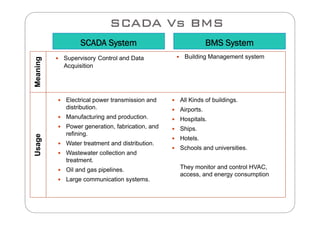
ď‚— Supervisory Control and Data
BMS System
ď‚— Building Management system
g
Acquisition
Meanin
ď‚— Electrical power transmission and
distribution.
ď‚— All Kinds of buildings.
ď‚— Airports.
ge
ď‚— Manufacturing and production.
ď‚— Power generation, fabrication, and
refining.
ď‚— Hospitals.
ď‚— Ships.
ď‚— Hotels
Usag
ď‚— Water treatment and distribution.
ď‚— Wastewater collection and
treatment.
ď‚— Hotels.
ď‚— Schools and universities.
ď‚— Oil and gas pipelines.
ď‚— Large communication systems.
They monitor and control HVAC,
access, and energy consumption
SCADA Vs BMS
SCADA System BMS System
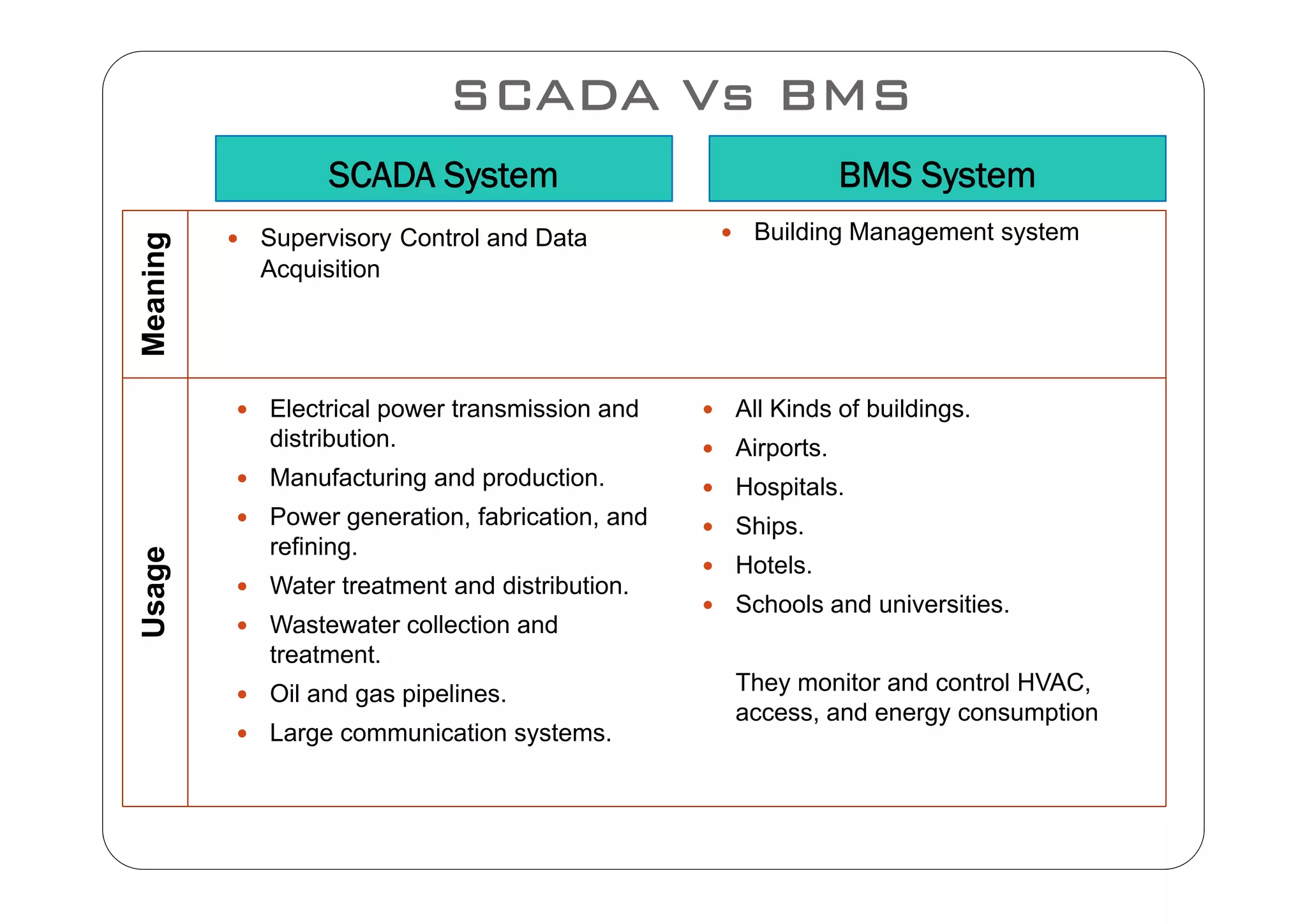
ď‚— A Human-Machine Interface (HMI) ď‚— A Human-Machine Interface (HMI)( )
which is the apparatus that
presents the process data to a
human operator to monitor and
control the process
ď‚— A Human-Machine Interface (HMI)
which is the apparatus that
presents the process data to a
human operator to monitor and
onents
control the process.
ď‚— A supervisory (computer) system,
gathering (acquiring) data on the
process and sending commands
control the process.
ď‚— A supervisory (computer) system,
gathering (acquiring) data from the
Pl t d di d
mCompo
process and sending commands
(control) to the process.
ď‚— Remote Terminal Units (RTUs)
connecting to sensors in the
Plant and sending commands
(control) to field devices.
( C)
System
g
process, converting sensor signals
to digital data and sending digital
data to the supervisory system.
ď‚— Direct digital controllers (DDC)
with remote I/O modules.
ď‚— Programmable Logic Controller
(PLCs) are used because they are
more economical, versatile,
flexible and configurable thanflexible, and configurable than
special-purpose RTUs.
SCADA Vs BMS
SCADA System BMS System
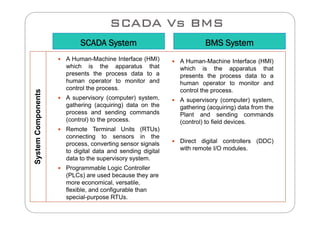
ď‚— Life time 12-15 Years ď‚— Life Time 7-10 years
ď‚— More robust material
ď‚— Control actions is taken by the
RTU’s and PLc’s in max 250
y
ď‚— Economical material.
ď‚— Control actions is taken by the
DDC within 2 to 2.5 seconds.
nce
RTU s and PLc s in max 250
millisec.
ď‚— Redundancy is a standard in the
HMI computers.
DDC within 2 to 2.5 seconds.
ď‚— Redundancy is optional.
Alarms performance ithin 40 50
rforman
ď‚— Alarms performance within 15 sec.
ď‚— Very fast trending and logging of
historical data and alarms.
ď‚— Alarms performance within 40-50
sec and depends on the alarm
Que.
ď‚— Trending and logging happens
Per
ď‚— Trending and logging happens
with normal speed and aso
depends on each vendor.
SCADA Vs BMS
SCADA System BMS System
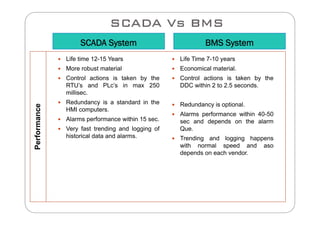
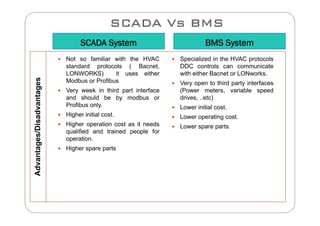
ď‚— Not so familiar with the HVAC ď‚— Specialized in the HVAC protocols
ges
standard protocols ( Bacnet,
LONWORKS) it uses either
Modbus or Profibus
p p
DDC controls can communicate
with either Bacnet or LONworks.
ď‚— Very open to third party interfaces
dvantag
ď‚— Very week in third part interface
and should be by modbus or
Profibus only.
Hi h i iti l t
(Power meters, variable speed
drives, ..etc)
ď‚— Lower initial cost.
es/Disad
ď‚— Higher initial cost.
ď‚— Higher operation cost as it needs
qualified and trained people for
operation
ď‚— Lower operating cost.
ď‚— Lower spare parts.
vantage
operation.
ď‚— Higher spare parts
Adv

scada VS bms

  • 1.
    SCADA Vs BMS SCADASystem ď‚— Supervisory Control and Data BMS System ď‚— Building Management system g Acquisition Meanin ď‚— Electrical power transmission and distribution. ď‚— All Kinds of buildings. ď‚— Airports. ge ď‚— Manufacturing and production. ď‚— Power generation, fabrication, and refining. ď‚— Hospitals. ď‚— Ships. ď‚— Hotels Usag ď‚— Water treatment and distribution. ď‚— Wastewater collection and treatment. ď‚— Hotels. ď‚— Schools and universities. ď‚— Oil and gas pipelines. ď‚— Large communication systems. They monitor and control HVAC, access, and energy consumption
  • 2.
    SCADA Vs BMS SCADASystem BMS System ď‚— A Human-Machine Interface (HMI) ď‚— A Human-Machine Interface (HMI)( ) which is the apparatus that presents the process data to a human operator to monitor and control the process ď‚— A Human-Machine Interface (HMI) which is the apparatus that presents the process data to a human operator to monitor and onents control the process. ď‚— A supervisory (computer) system, gathering (acquiring) data on the process and sending commands control the process. ď‚— A supervisory (computer) system, gathering (acquiring) data from the Pl t d di d mCompo process and sending commands (control) to the process. ď‚— Remote Terminal Units (RTUs) connecting to sensors in the Plant and sending commands (control) to field devices. ( C) System g process, converting sensor signals to digital data and sending digital data to the supervisory system. ď‚— Direct digital controllers (DDC) with remote I/O modules. ď‚— Programmable Logic Controller (PLCs) are used because they are more economical, versatile, flexible and configurable thanflexible, and configurable than special-purpose RTUs.
  • 3.
    SCADA Vs BMS SCADASystem BMS System  Life time 12-15 Years  Life Time 7-10 years  More robust material  Control actions is taken by the RTU’s and PLc’s in max 250 y  Economical material.  Control actions is taken by the DDC within 2 to 2.5 seconds. nce RTU s and PLc s in max 250 millisec.  Redundancy is a standard in the HMI computers. DDC within 2 to 2.5 seconds.  Redundancy is optional. Alarms performance ithin 40 50 rforman  Alarms performance within 15 sec.  Very fast trending and logging of historical data and alarms.  Alarms performance within 40-50 sec and depends on the alarm Que.  Trending and logging happens Per  Trending and logging happens with normal speed and aso depends on each vendor.
  • 4.
    SCADA Vs BMS SCADASystem BMS System ď‚— Not so familiar with the HVAC ď‚— Specialized in the HVAC protocols ges standard protocols ( Bacnet, LONWORKS) it uses either Modbus or Profibus p p DDC controls can communicate with either Bacnet or LONworks. ď‚— Very open to third party interfaces dvantag ď‚— Very week in third part interface and should be by modbus or Profibus only. Hi h i iti l t (Power meters, variable speed drives, ..etc) ď‚— Lower initial cost. es/Disad ď‚— Higher initial cost. ď‚— Higher operation cost as it needs qualified and trained people for operation ď‚— Lower operating cost. ď‚— Lower spare parts. vantage operation. ď‚— Higher spare parts Adv