Overview and State of the Current
Pandemic
March 24, 2016
Kristine Oaks and Kimberly Treier
Albany College of Pharmacy and Health Sciences
PharmD Candidates, Class of 2016
Zika Virus:
Outline
}  Epidemiology
}  ZikaVirus Disease
}  Guillain-Barré syndrome
}  Microcephaly
}  Zika & Pregnancy
}  Global Response and Guidance
}  Current Developments
2
DidYou Know…
There are about 2,700
species of mosquito.
There are 176 species in
the United States.
American Mosquito Control Association
3
4
“The level of concern is high, as is
the level of uncertainty. Questions
abound. We need to get some
answers quickly.”
– Dr. Margaret Chan,
Director-General of the World Health
Organization
(January 28, 2016)
Public Health Concern
}  Concomitant rise in Zika virus (ZIKV) infection and
unexplained neurologic abnormalities
}  Global concern:
}  Spread of the two primary mosquito species known to
transmit the ZIKV
}  Increased global connectivity – “[R]isk of a global spread of
Zika virus…is significant” (WHO, 2016)
}  Currently no vaccine is available
5
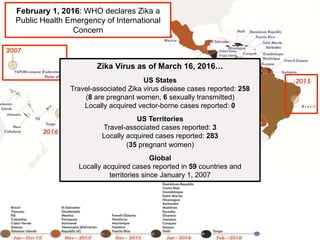
Epidemiology 1947-2016
February 1, 2016: WHO declares Zika a
Public Health Emergency of International
Concern
Zika Virus as of March 16, 2016…
US States
Travel-associated Zika virus disease cases reported: 258
(8 are pregnant women, 6 sexually transmitted)
Locally acquired vector-borne cases reported: 0
US Territories
Travel-associated cases reported: 3
Locally acquired cases reported: 283
(35 pregnant women)
Global
Locally acquired cases reported in 59 countries and
territories since January 1, 2007
DidYou Know…
Mosquitoes lay ~ 100
eggs at a time?
Mosquito eggs can stick
to surfaces like glue and
survive drying out for 8
months
American Mosquito Control Association
8
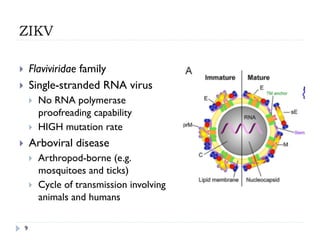
ZIKV
9
}  Flaviviridae family
}  Single-stranded RNA virus
}  No RNA polymerase
proofreading capability
}  HIGH mutation rate
}  Arboviral disease
}  Arthropod-borne (e.g.
mosquitoes and ticks)
}  Cycle of transmission involving
animals and humans
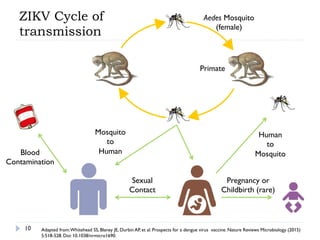
ZIKV Cycle of
transmission
10
Blood
Contamination
Mosquito
to
Human
Sexual
Contact
Human
to
Mosquito
Pregnancy or
Childbirth (rare)
Primate
Aedes Mosquito
(female)
Adapted from:Whitehead SS, Blaney JE, Durbin AP, et al. Prospects for a dengue virus vaccine. Nature Reviews Microbiology (2015)
5:518-528. Doi: 10.1038/nrmicro1690.
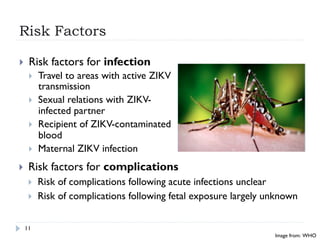
Risk Factors
11
}  Risk factors for infection
}  Travel to areas with active ZIKV
transmission
}  Sexual relations with ZIKV-
infected partner
}  Recipient of ZIKV-contaminated
blood
}  Maternal ZIKV infection
}  Risk factors for complications
}  Risk of complications following acute infections unclear
}  Risk of complications following fetal exposure largely unknown
Image from: WHO
Diagnosis
12
}  Detection of viral nucleic acid and/or virus-specific antibodies
}  Plasma or serum
}  Urine
}  Differential diagnoses
}  Other flavivirus infections
}  West Nile
}  Yellow fever
}  Dengue
}  Considerations
}  Clinical presentation
}  Travel history
}  Activities related to potential transmission
Lab Tests
13
}  Molecular testing
}  Reverse transcription polymerase chain reaction (RT-PCR)
}  Identify viral RNA
}  Best results ≤7 days of symptom onset
}  Antibody testing
}  Enzyme-linked immunoabsorbent assay (ELISA)
}  Detect viral IgM
}  Best results >7 days of symptom onset
High risk of cross-reactivity with other flaviviruses – only identifies
presence of recent flavivirus infection
Plaque-reduction neutralization test (PRNT) may be able to distinguish
type of flavivirus infection if no prior flaviviridae infection or vaccination
FDA Emergency Use Authorization
14
}  No commercially available diagnostic test FDA approved
for ZIKV
}  Tests distributed to qualified laboratories in the
Laboratory Response Network
}  Not available in US hospitals or other primary care settings
}  February 26, 2016
}  CDC Zika IgM Antibody Capture Enzyme-Linked
Immunosorbent Assay (Zika MAC-ELISA)
}  March 18, 2016
}  Trioplex real-time RT-PCR assay
DidYou Know…
Only female mosquitoes
are able to suck blood.
While biting, they stab 2
tubes into the skin: one to
inject an anti-clotting
enzyme, and another to
suck blood.
National Geographic
15
Acute Infection
16
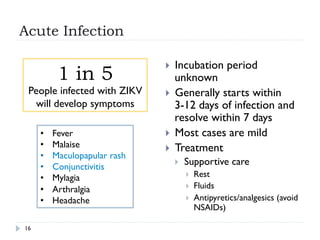
}  Incubation period
unknown
}  Generally starts within
3-12 days of infection and
resolve within 7 days
}  Most cases are mild
}  Treatment
}  Supportive care
}  Rest
}  Fluids
}  Antipyretics/analgesics (avoid
NSAIDs)
•  Fever
•  Malaise
•  Maculopapular rash
•  Conjunctivitis
•  Mylagia
•  Arthralgia
•  Headache
1 in 5
People infected with ZIKV
will develop symptoms
Complications
17
}  Adults
}  Guillain-Barré (gee-YAN) syndrome
}  Meningitis
}  Meningoencephalitis
}  Myelitis
}  Fetuses/Neonates
}  Microcephaly
}  Fetal death
}  Placental insufficiency
}  Neurologic abnormalities
Guillain-Barré Syndrome
18
}  Symptoms
}  Usually symmetrical
}  May last a few weeks to several
months
}  About 20% of patients do not fully
recover
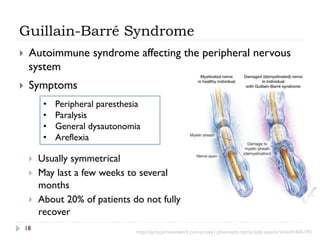
}  Autoimmune syndrome affecting the peripheral nervous
system
•  Peripheral paresthesia
•  Paralysis
•  General dysautonomia
•  Areflexia
http://jama.jamanetwork.com.proxy1.athensams.net/article.aspx?articleid=645193
Guillain-Barré Syndrome
19
}  Other causes
}  Bacterial infection (Campylobacter jejuni)
}  Viral infection (HIV, influenza, dengue)
}  Immunization (rare)
}  Surgery/trauma General incidence:
1-2 per 100,000 people per
year in the US}  General treatment approach
}  Supportive care
}  Removal of auto-antibodies from the bloodstream
}  Plasma exchange
}  Intravenous immunoglobulin (IVIG)
}  Thromboprophylaxis
}  Heart rate and rhythm control
}  Mechanical ventilation
Incidence of Guillain-Barré Syndrome
during ZIKV Outbreaks
20
}  Global annual incidence estimated between 0.4 and 4.0
cases per 100,000 inhabitants per year
Region (timeframe) GBS cases reported Yearly average
Brazil (2015) 1,708 1,439 (2014)
Colombia (Jan. 1-30, 2016) 86 242
El Salvador (Dec. 1, 2015-Jan. 6, 2016) 46 169
Suriname (2015,
Jan. 2016)
10 (2015)
3 (Jan. 2016)
4
GBS, Guillain-Barré syndrome
Microcephaly
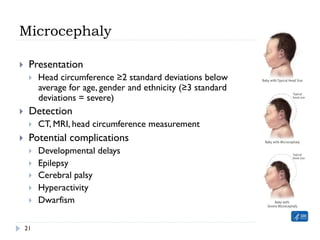
}  Presentation
}  Head circumference ≥2 standard deviations below
average for age, gender and ethnicity (≥3 standard
deviations = severe)
}  Detection
}  CT, MRI, head circumference measurement
}  Potential complications
}  Developmental delays
}  Epilepsy
}  Cerebral palsy
}  Hyperactivity
}  Dwarfism
21
Microcephaly
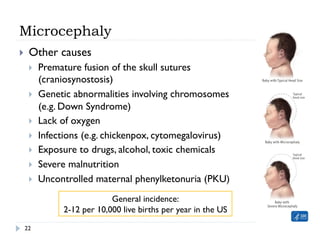
}  Other causes
}  Premature fusion of the skull sutures
(craniosynostosis)
}  Genetic abnormalities involving chromosomes
(e.g. Down Syndrome)
}  Lack of oxygen
}  Infections (e.g. chickenpox, cytomegalovirus)
}  Exposure to drugs, alcohol, toxic chemicals
}  Severe malnutrition
}  Uncontrolled maternal phenylketonuria (PKU)
22
General incidence:
2-12 per 10,000 live births per year in the US
Microcephaly
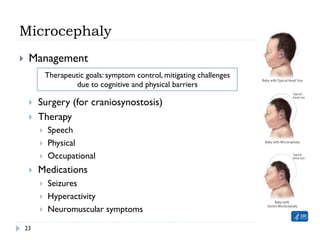
}  Management
}  Surgery (for craniosynostosis)
}  Therapy
}  Speech
}  Physical
}  Occupational
}  Medications
}  Seizures
}  Hyperactivity
}  Neuromuscular symptoms
Therapeutic goals: symptom control, mitigating challenges
due to cognitive and physical barriers
23
DidYou Know…
Mosquitoes find hosts by
movement, infra-red
radiation from warm
bodies, and by chemicals
(CO2, lactic acid, etc.) at
distances of 25-35
meters.
American Mosquito Control Association
24
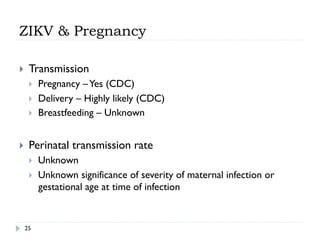
ZIKV & Pregnancy
}  Transmission
}  Pregnancy –Yes (CDC)
}  Delivery – Highly likely (CDC)
}  Breastfeeding – Unknown
}  Perinatal transmission rate
}  Unknown
}  Unknown significance of severity of maternal infection or
gestational age at time of infection
25
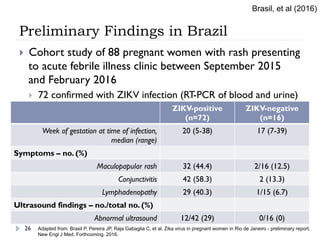
Preliminary Findings in Brazil
}  Cohort study of 88 pregnant women with rash presenting
to acute febrile illness clinic between September 2015
and February 2016
}  72 confirmed with ZIKV infection (RT-PCR of blood and urine)
Brasil, et al (2016)
Adapted from: Brasil P, Pereira JP, Raja Gabaglia C, et al. Zika virus in pregnant women in Rio de Janeiro - preliminary report.
New Engl J Med. Forthcoming. 2016.
ZIKV-positive
(n=72)
ZIKV-negative
(n=16)
Week of gestation at time of infection,
median (range)
20 (5-38) 17 (7-39)
Symptoms – no. (%)
Maculopapular rash 32 (44.4) 2/16 (12.5)
Conjunctivitis 42 (58.3) 2 (13.3)
Lymphadenopathy 29 (40.3) 1/15 (6.7)
Ultrasound findings – no./total no. (%)
Abnormal ultrasound 12/42 (29) 0/16 (0)
26
Pregnancy Outcomes
Brasil, et al (2016)
Adapted from: Brasil P, Pereira JP, Raja Gabaglia C, et al. Zika virus in pregnant women in Rio de Janeiro - preliminary report.
New Engl J Med. Forthcoming. 2016.
Infant Ultrasound findings Findings at birth Week of gestational
age at infection
19 Microcephaly, cerebral
calcifications, abnormal middle
cerebral artery, intrauterine
growth restriction
Microcephaly, cerebral
calcifications, global cerebral
atrophy, macular lesions
8
12 Microcephaly, placental
insufficiency, oligohydramnios,
intrauterine growth restriction
Small for gestational age, head
circumference proportional to
body size, macular lesions
22
10 Fetal death detected at 36 weeks Stillborn 25
36 Microcephaly, abnormal
umbilical artery flow,
intrauterine growth restriction
Small for gestational age, head
circumference proportional to
body size
26
2 Normal Normal 30
3 Normal Normal 31
53 Fetal death detected at 38 weeks Stillborn 32
23 Anhydramnios, intrauterine
growth restriction
Normal growth measure, poor
sucking reflex, EEG abnormalities
35
27
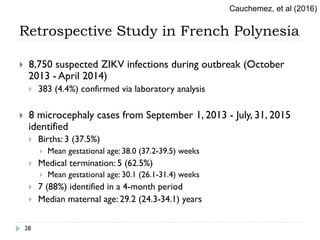
Retrospective Study in French Polynesia
}  8,750 suspected ZIKV infections during outbreak (October
2013 - April 2014)
}  383 (4.4%) confirmed via laboratory analysis
}  8 microcephaly cases from September 1, 2013 - July, 31, 2015
identified
}  Births: 3 (37.5%)
}  Mean gestational age: 38.0 (37.2-39.5) weeks
}  Medical termination: 5 (62.5%)
}  Mean gestational age: 30.1 (26.1-31.4) weeks
}  7 (88%) identified in a 4-month period
}  Median maternal age: 29.2 (24.3-34.1) years
Cauchemez, et al (2016)
28
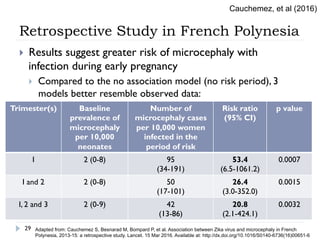
Retrospective Study in French Polynesia
}  Results suggest greater risk of microcephaly with
infection during early pregnancy
}  Compared to the no association model (no risk period), 3
models better resemble observed data:
Trimester(s) Baseline
prevalence of
microcephaly
per 10,000
neonates
Number of
microcephaly cases
per 10,000 women
infected in the
period of risk
Risk ratio
(95% CI)
p value
1 2 (0-8) 95
(34-191)
53.4
(6.5-1061.2)
0.0007
I and 2 2 (0-8) 50
(17-101)
26.4
(3.0-352.0)
0.0015
I, 2 and 3 2 (0-9) 42
(13-86)
20.8
(2.1-424.1)
0.0032
Adapted from: Cauchemez S, Besnarad M, Bompard P, et al. Association between Zika virus and microcephaly in French
Polynesia, 2013-15: a retrospective study. Lancet. 15 Mar 2016. Available at: http://dx.doi.org/10.1016/S0140-6736(16)00651-6
Cauchemez, et al (2016)
29
WHO Position Statement
30
-­‐	
  Dr.	
  Margaret	
  Chan,	
  	
  
Director-­‐General	
  of	
  the	
  World	
  Health	
  Organization	
  
Other outcomes include fetal death, placental insufficiency,
abnormal fetal growth and neurologic abnormalities
"We	
  can	
  now	
  conclude	
  that	
  
Zika	
  virus	
  is	
  neurotropic,	
  
preferentially	
  affecting	
  
tissues	
  in	
  the	
  brain	
  and	
  
brain	
  stem	
  of	
  the	
  developing	
  
fetus.”	
  
March	
  8,	
  2016	
  
“Evidence	
  supports	
  the	
  
likelihood	
  that	
  Zika	
  infection	
  
during	
  pregnancy	
  will	
  have	
  
a	
  broad	
  range	
  of	
  effects	
  on	
  
the	
  developing	
  fetus,	
  beyond	
  
microcephaly.”	
  
March	
  22,	
  2016	
  
DidYou Know…
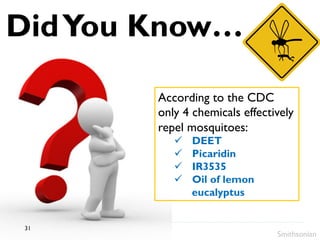
According to the CDC
only 4 chemicals effectively
repel mosquitoes:
ü  DEET
ü  Picaridin
ü  IR3535
ü  Oil of lemon
eucalyptus
Smithsonian
31
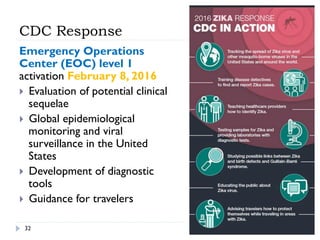
CDC Response
Emergency Operations
Center (EOC) level 1
activation February 8, 2016
}  Evaluation of potential clinical
sequelae
}  Global epidemiological
monitoring and viral
surveillance in the United
States
}  Development of diagnostic
tools
}  Guidance for travelers
32
WHO Response
WHO declares Zika a Public Health Emergency of
International Concern on February 1, 2016
}  Zika: Strategic Response Framework & Joint Operations
Plan (February 2016)
}  Pregnancy management in the context of ZikaVirus:
Interim Guidance (March 2, 2016)
}  Resources for:
}  Situation reports
}  Latest updates
}  Guidance
33
34
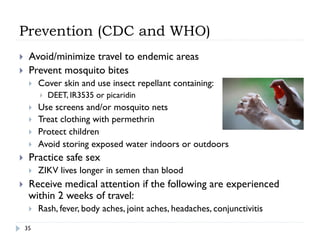
Prevention (CDC and WHO)
}  Avoid/minimize travel to endemic areas
}  Prevent mosquito bites
}  Cover skin and use insect repellant containing:
}  DEET, IR3535 or picaridin
}  Use screens and/or mosquito nets
}  Treat clothing with permethrin
}  Protect children
}  Avoid storing exposed water indoors or outdoors
}  Practice safe sex
}  ZIKV lives longer in semen than blood
}  Receive medical attention if the following are experienced
within 2 weeks of travel:
}  Rash, fever, body aches, joint aches, headaches, conjunctivitis
35
Vector Control (CDC and WHO)
}  Community efforts
}  Use of insecticides and/or larvicides outdoors and around large
water supplies
}  Elimination of standing water sources
}  National efforts
}  Fogging
}  Genetically modified sterile male mosquitoes
}  Males carrying Wolbachia bacteria
}  Effectively used to fight DengueVirus
}  Unknown agricultural/ecological impact
36
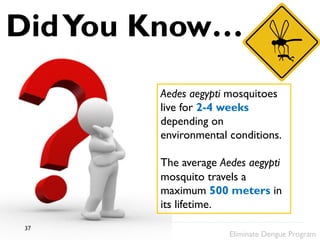
DidYou Know…
Aedes aegypti mosquitoes
live for 2-4 weeks
depending on
environmental conditions.
The average Aedes aegypti
mosquito travels a
maximum 500 meters in
its lifetime.
Eliminate Dengue Program
37
Special Populations - Pregnancy
38
}  Breastfeeding
}  No reported cases of ZIKV transmission via breastfeeding – CDC
continues to recommend
}  Future pregnancy
}  Currently not believed to pose a risk after ZIKV cleared from blood
}  Public health officials in Brazil, Colombia, Ecuador, El Salvador and
Jamaica recommend delaying pregnancy
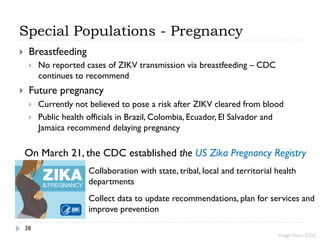
On March 21, the CDC established the US Zika Pregnancy Registry
Collaboration with state, tribal, local and territorial health
departments
Collect data to update recommendations, plan for services and
improve prevention
Image from: CDC
Zika & Pregnancy: Interim Guidance (WHO)
}  Special precautions for pregnant women or those of
childbearing age
}  Avoid/reduce travel to endemic area(s)
}  Protect against mosquito bites
}  Environmental Protection Agency (EPA)-registered insect repellent
proven safe and effective in pregnancy and breastfeeding
}  Practice safe sex – consider birth control or delay pregnancy if
appropriate
}  Duration of risk with sexual contact unknown
}  ZIKV isolated in semen of patient who was no longer viremic
}  Receive appropriate perinatal care
39
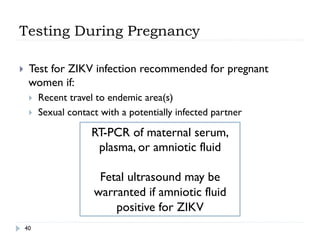
Testing During Pregnancy
40
}  Test for ZIKV infection recommended for pregnant
women if:
}  Recent travel to endemic area(s)
}  Sexual contact with a potentially infected partner
RT-PCR of maternal serum,
plasma, or amniotic fluid
Fetal ultrasound may be
warranted if amniotic fluid
positive for ZIKV
Special Populations – Sexual Transmission
41
}  On February 5, 2016, CDC released the Interim Guidelines
for Prevention of SexualTransmission of ZikaVirus – United
States 2016
}  Pregnant partner: Abstinence or consistent and correct use of
condoms
}  Non-pregnant partner: Consider abstinence or condoms
}  ZIKV testing for risk of sexual transmission not currently
recommended
Key findings
Case 1 – Transmission from man to woman prior to symptom onset
Case 2 – Currently under investigation
Case 3 – ZIKV identified in semen 2-10 weeks after illness onset (ZIKV
no present in blood)
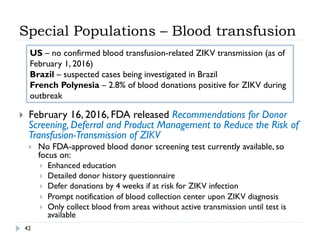
Special Populations – Blood transfusion
42
}  February 16, 2016, FDA released Recommendations for Donor
Screening, Deferral and Product Management to Reduce the Risk of
Transfusion-Transmission of ZIKV
}  No FDA-approved blood donor screening test currently available, so
focus on:
}  Enhanced education
}  Detailed donor history questionnaire
}  Defer donations by 4 weeks if at risk for ZIKV infection
}  Prompt notification of blood collection center upon ZIKV diagnosis
}  Only collect blood from areas without active transmission until test is
available
US – no confirmed blood transfusion-related ZIKV transmission (as of
February 1, 2016)
Brazil – suspected cases being investigated in Brazil
French Polynesia – 2.8% of blood donations positive for ZIKV during
outbreak
DidYou Know…
The Aedes aegypti
mosquito prefers to bite
humans. They bite
primarily during the day
and indoors.
Centers for Disease Control and Prevention
Current Developments
44
}  Puerto Rico
}  February 5, 2016 - San Juan governor declared a health emergency
}  CDC estimates 25% of Puerto Rico’s 3.5 million residents will be
infected with ZIKV within a year
}  Active efforts by CDC and local government
}  US
}  March 16, 2016 – NCAR estimated that 50 US cities will experience
Zika outbreaks this summer due to warmer weather, travel, and
poverty conditions.
}  CaboVerde
}  March 18, 2016 – WHO sends a team to investigate microcephaly
potentially linked to ZIKV outbreak
}  Cuba
}  March 19, 2016 – CDC issued a level 2 travel notice (Practice
Enhanced Precautions)
NCAR; National Center for Atmospheric Research
ZIKV Vaccine
45
}  Unknowns
}  Infection → lifelong protection from vaccine?
}  Prior exposure to other flavivirus vaccines → complication of ZIKV
vaccine evaluation?
}  Considerations
}  Adaptation of existing flavivirus vaccines (yellow fever, Japanese
encephalitis)
}  Inactivated vaccine for pregnant patients
NIAID, National Institute of Allergy and Infectious Diseases
ZIKV Vaccine and Timeframe
46
}  Developments
}  23 vaccine development projects are being worked on by 14 vaccine
developers in the US, France, Brazil, India, and Austria
}  National Institute of Allergy and Infectious Disease (NIAID):
}  A DNA-based ZIKV vaccine (same technique as West Nile vaccine in
development) – may begin phase 1 this year
}  Antiviral drugs used to treat other flaviviral infections
}  A live attenuated vaccine (same technique as a Dengue vaccine)
}  A vaccine using a recombinant virus expressing a Zika E glycoprotein
Trials expected to begin summer of 2016:
DNA vaccines: NIH (US), Inovio (Canada)
Inactivated virus: Bharat Biotech (India)
47
Questions?
References
48
ZikaVirus:At A Glance – Zika in the U.S. (as of March 16, 2016). Centers for Disease Control and Prevention. http://www.cdc.gov/zika/.Accessed 21 March 2016.
Zika virus and potential complications.World Health Organization. http://www.who.int/emergencies/zika-virus/en/.Accessed 21 March 2016.
Arboviral Disease -- United States, 1994 MMWR. Centers for Disease Control and Prevention Website. http://www.cdc.gov/mmwr/preview/mmwrhtml/00038641.htm.
Published 8 September 1995.Accessed 17 February 2016.
Surveillance and Control of Aedes aegypti and Aedes albopictus in the United States. Centers for Disease Control and Prevention Website.
http://www.cdc.gov/chikungunya/resources/vector-control.html. Updated 25 January 2016.Accessed 17 February 2016.
Zika virus infection - United States of America.World Health Organization Website. http://www.who.int/csr/don/12-february-2016-zika-usa/en/. Published 12 February 2016.
Accessed 17 February 2016.
ZikaVirus Spreads to New Areas - Region of the Americas, May 2015 - January 2016 MMWR. Centers for Disease Control and Prevention Website.
http://www.cdc.gov/mmwr/volumes/65/wr/mm6503e1.htm?s_cid=mm6503e1.htm_w. Published 29 January 2016.Accessed 17 February 2016.
ZikaVirus Fact Sheet.World Health Organization Website. http://www.who.int/mediacentre/factsheets/zika/en/. Updated February 2016.Accessed 17 February 2016.
Musso D, Roche C, Robin E, Nhan T,Teissier A, Cao-LormeauV-M. Potential Sexual Transmission of ZikaVirus. Emerging Infectious Diseases. 2015;21(2):359-361. doi:10.3201/
eid2102.141363.
Foy BD, Kobylinski KC, Foy JLC, et al. Probable non–vector-borne transmission of Zika virus, Colorado, USA. Emerg Infect Dis. 2011 May; [Epub ahead of print].
Ioos S, Mallet HP, Leparc Goffart I, et al. Current zika virus epidemiology and recent epidemics. Med Maladies Infect. 2014; 44: 302-307.
Women in the context of microencephaly and Zika virus disease.World Health Organization Website. http://www.who.int/features/qa/zika-pregnancy/en/. Published 10
February 2016.Accessed 17 February 2016.
Guillain-Barré Syndrome Fact Sheet.World Health Organization Website. http://www.who.int/mediacentre/factsheets/guillain-barre-syndrome/en/. Published February 2016.
Accessed 17 February 2016.
Oehler E,Watrin L, Larre P , et al. Zika virus infection complicated by Guillain-Barré syndrome – case report, French Polynesia, December 2013. Euro Surveill.
2014;19(9):pii=20720.
Revised diagnostic testing for Zika, chikungunya, and dengue viruses in US Public Health Laboratories Memorandum. CDC, Division ofVector-Borne Diseases.Available from:
http://www.cdc.gov/zika/index.html. Published 7 February 2016.Accessed 17 February 2016.
ZikaVirus Transmission. Centers for Disease Control and Prevention Website. http://www.cdc.gov/zika/transmission/index.html. Updated 12 February 2016.Accessed 17
February 2016. Zika situation report: Neurological syndrome and congenital anomalies.WHO [Internet]. 5 Feb. 2016.Available from:
http://apps.who.int/iris/bitstream/10665/204348/1/zikasitrep_5Feb2016_eng.pdf?ua=1.
Broutet N, Krauer F, Riesen M, et al. Zika virus as a cause of neurologic disorders. New Engl J Med. Forthcoming. 2016.
References
49
Brasil P, Pereira JP, Raja Gabaglia C, et al. Zika virus in pregnant women in Rio de Janeiro - preliminary report. New Engl J Med. Forthcoming. 2016.
ZikaVirus Prevention. Centers for Disease Control and Prevention Website. http://www.cdc.gov/zika/prevention/index.html. Updated 5 February 2016.Accessed 17 February
2016.
Duffy MR, Chen TH, Hancock WT, et. al. ZikaVirus Outbreak onYap Island, Federated States of Micronesia. N Engl J Med. 2009 Jun 11; 360: 2536-2543.
Epidemiological Update Neurological syndrome, congenital anomalies, and Zika virus infection. Pan American Health Organization Website.
file:///C:/Users/Kristine%20Oaks/Downloads/2016-jan-17-cha-epi-update-zika-virus.pdf. 2016 Jan 17.
Epidemiological Alert Increase of microcephaly in the northeast of Brazil 17 November 2015. Pan American Health Organization Website. file:///C:/Users/Kristine%20Oaks/
Downloads/2015-nov-17-cha-microcephaly-epi-alert.pdf. 2015 Nov 15.
World Health Organization.WHO research and development on Zika. 2016.Available at: http://www.who.int/mediacentre/commentaries/zika-research-development/en/.
Accessed February 24, 2016.
Washington Post. NIH officials accelerate timeline for human trials of Zika vaccine, saying they will now begin in the summer. 2016.Available at: https://
www.washingtonpost.com/news/to-your-health/wp/2016/02/11/nih-officials-accelerate-timeline-for-human-trials-of-zika-vaccine-saying-they-will-now-begin-in-the-summer/.
Accessed February 24, 2016.
Nlm.nih.gov. In Fight Against ZikaVirus, Officials Consider Genetically Modified Mosquitoes: MedlinePlus. 2016.Available at: https://www.nlm.nih.gov/medlineplus/news/
fullstory_157279.html.Accessed February 24, 2016.
Hamel R, Dejarnac O,Wichit S, Ekchariyawat P, Neyret A, Luplertlop N, Perera-Lecoin M, Surasombatpattana P,Talignani L,Thomas F, Cao-LormeauV-M, ChoumetV, Briant L,
Desprès P,Amara A,Yssel H, Missé D. 2015. Biology of Zika virus infection in human skin cells. JVirol 89:8880 –8896. doi:10.1128/JVI.00354-15.s
Musso D., Roche C., Nhan T.-X., Robin E.,Teissier A., Cao-LormeauV.-M.. Detection of Zika virus in saliva. J. Clin.Virol.. 2015;68:53-55. doi:10.1016/j.jcv.2015.04.021
Gourinat A.-C., O'Connor O., Calvez E., Goarant C., Dupont-Rouzeyrol M.. Detection of zika virus in urine. Emerg. Infect. Dis.. 2015;21(1):84-86. doi:10.3201/
eid2101.140894
Soares de Araújo JS, Regis CT, Gomes RGS,Tavares TR, Rocha dos Santos C,Assunção PM, et al. Microcephaly in northeast Brazil: a review of 16 208 births between 2012 and
2015 [Submitted]. Bull World Health Organ E-pub: 4 Feb 2016. doi: http://dx.doi.org/10.2471/BLT.16.170639
Chan M. Statement by WHO Director-General Dr. Margaret Chan.WHO; 28 Jan 2016.
Zika virus in Cuba [Internet]. CDC; 19 Mar. 2016 [cited 21 Mar. 2016).Available from: http://wwwnc.cdc.gov/travel/notices/alert/zika-virus-cuba
Monaghan AJ, Morin CW, Steinhoff DF,Wilhelmi O, Hayden M, Quattrochi DA, Reiskind M, Lloyd AL, Smith K, Schmidt CA, Scalf PE, Ernst K. On the Seasonal Occurrence and
Abundance of the ZikaVirusVector Mosquito Aedes Aegypti in the Contiguous United States. PLOS Currents Outbreaks. 2016 Mar 16
Elena SF, Sanjuán R.AdaptiveValue of High Mutation Rates of RNAViruses: Separating Causes from Consequences . Journal ofVirology. 2005;79(18):11555-11558. doi:10.1128/
JVI.79.18.11555-11558.2005.
References
50
Heinz FX, Stiasny Karin. Flaviviruses and flavivirus vaccines.Vaccine (2012) 30:4301-4306. Doi: 10.1016/j.vaccine.2011.09.114
Chan M. Statement by WHO Director-General Dr. Margaret Chan.WHO; 8 Mar 2016.
New CDC Laboratory Test for ZikaVirus Authorized for Emergency Use by FDA. Centers for Disease Control and Prevention Website. http://www.cdc.gov/media/releases/
2016/s0226-laboratory-test-for-zika-virus.html. Updated 26 February 2016.Accessed 21 March 2016.
Chan M. Statement by WHO Director-General Dr. Margaret Chan.WHO; 22 Mar 2016.
Zika and Blood Transfusion. http://www.cdc.gov/zika/transmission/blood-transfusion.html. Centers for Disease Control and Prevention.Accessed 21 Mar 2016.
Oster AM, Brooks JT, Stryker JE, et al. Interim Guidelines for Prevention of Sexual Transmission of ZikaVirus — United States, 2016. MMWR Morb Mortal Wkly Rep
2016;65place_Holder_For_Early_Release:120–121. DOI: http://dx.doi.org/10.15585/mmwr.mm6505e1.
ZikaVirus: Zika and Pregnancy. Centers for Disease Control and Prevention. http://www.cdc.gov/zika/pregnancy/question-answers.html.Accessed 23 Mar 2016
ZikaVirus: US Zika Pregnancy Registry. Centers for Disease Control and Prevention. http://www.cdc.gov/zika/hc-providers/registry.html.Accessed 23 Mar 2016
Jacob JA. Researchers Focus on Solving the Zika Riddles. JAMA. 15 Mar 2016; (315)11:1097-1099
WHO supports CaboVerde in managing zika risk: Note for the media.World Health Organization;18 Mar, 2016 [accessed 23 Mar, 2016].
Available from: http//www.who.int/mediacentre/news/notes/2016/cabo-verde-zika/en/
Aedes Aegypti. Eliminate Dengue Program [Internet].Accessed 23 Mar, 2016.Available from: http://www.eliminatedengue.com/faqs/index/type/aedes-aegypti
Case Report – Guillain-Barré Syndrome
51
A woman in her 40’s presents to the ED with paresthesia of
all four limbs. She was admitted to a neurological unit the
next day with ascendant muscular weakness. By day 3, she
had developed tetra-paresthesia, diffuse myalgia, bilateral,
asymmetric, peripheral facial palsy, and lacked deep
tendon reflexes. She developed sustained ventricular
tachycardia and orthostatic hypotension suggestive of
dysautonomia. ECG was normal, electromyogram
confirmed diffused demyelinating disorder. She was treated
with intravenous polyvalent immunoglobulin and discharged
home on day 13. Paresthesia and facial palsy improved
slowly and she was able to walk without assistance on day
40. Retrospective chart review revealed flu-like illness 7
days prior to presentation with myalgia, febricula,
cutaneous rash, and conjunctivitis. Past medical history
was significant only for rheumatoid arthritis.
Case Report – Guillain-Barré Syndrome
52
}  Laboratory findings
}  CBC WNL
}  Inflammatory markers WNL
}  CSF: 1.66 g/L protein (normal 0.28-0.52),WBC 7 cells/mL
(normal <10)
}  Negative for HIV, Hepatitis B/C, C. jejuni, Leptospira
}  Resolute infections: cytomegalovirus, Epstein-Barr virus, and
Herpes simplex 1 and 2
}  Blood samples 8 and 28 days after beginning of flu-like illness:
positive for ZIKV specific IgM and ZIKV and dengue 1-4
specific IgG
}  PRNT (day 28): confirmed Ab against ZIKV and dengue 1-4
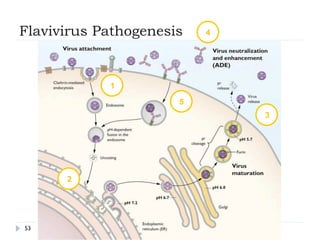
Flavivirus Pathogenesis
53
1
2
3
4
5
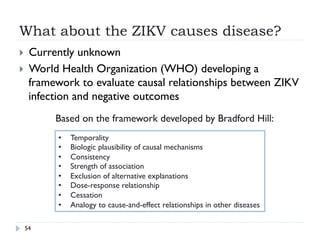
What about the ZIKV causes disease?
54
}  Currently unknown
}  World Health Organization (WHO) developing a
framework to evaluate causal relationships between ZIKV
infection and negative outcomes
Based on the framework developed by Bradford Hill:
•  Temporality
•  Biologic plausibility of causal mechanisms
•  Consistency
•  Strength of association
•  Exclusion of alternative explanations
•  Dose-response relationship
•  Cessation
•  Analogy to cause-and-effect relationships in other diseases
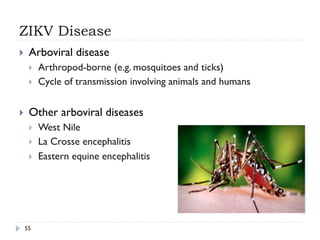
ZIKV Disease
55
}  Arboviral disease
}  Arthropod-borne (e.g. mosquitoes and ticks)
}  Cycle of transmission involving animals and humans
}  Other arboviral diseases
}  West Nile
}  La Crosse encephalitis
}  Eastern equine encephalitis
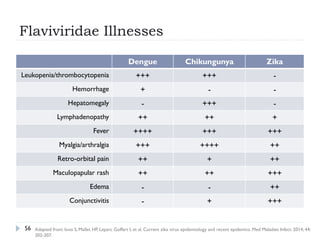
Flaviviridae Illnesses
56
Dengue Chikungunya Zika
Leukopenia/thrombocytopenia +++ +++ -
Hemorrhage + - -
Hepatomegaly - +++ -
Lymphadenopathy ++ ++ +
Fever ++++ +++ +++
Myalgia/arthralgia +++ ++++ ++
Retro-orbital pain ++ + ++
Maculopapular rash ++ ++ +++
Edema - - ++
Conjunctivitis - + +++
Adapted from: Ioos S, Mallet HP, Leparc Goffart I, et al. Current zika virus epidemiology and recent epidemics. Med Maladies Infect. 2014; 44:
302-307.
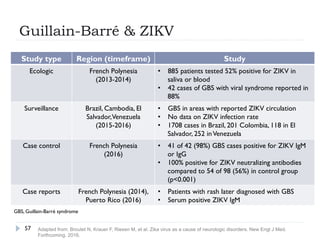
Guillain-Barré & ZIKV
Study type Region (timeframe) Study
Ecologic French Polynesia
(2013-2014)
•  885 patients tested 52% positive for ZIKV in
saliva or blood
•  42 cases of GBS with viral syndrome reported in
88%
Surveillance Brazil, Cambodia, El
Salvador,Venezuela
(2015-2016)
•  GBS in areas with reported ZIKV circulation
•  No data on ZIKV infection rate
•  1708 cases in Brazil, 201 Colombia, 118 in El
Salvador, 252 inVenezuela
Case control French Polynesia
(2016)
•  41 of 42 (98%) GBS cases positive for ZIKV IgM
or IgG
•  100% positive for ZIKV neutralizing antibodies
compared to 54 of 98 (56%) in control group
(p<0.001)
Case reports French Polynesia (2014),
Puerto Rico (2016)
•  Patients with rash later diagnosed with GBS
•  Serum positive ZIKV IgM
GBS, Guillain-Barré syndrome
Adapted from: Broutet N, Krauer F, Riesen M, et al. Zika virus as a cause of neurologic disorders. New Engl J Med.
Forthcoming. 2016.
57
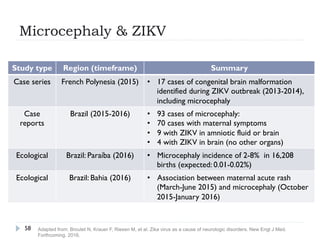
Microcephaly & ZIKV
Adapted from: Broutet N, Krauer F, Riesen M, et al. Zika virus as a cause of neurologic disorders. New Engl J Med.
Forthcoming. 2016.
Study type Region (timeframe) Summary
Case series French Polynesia (2015) •  17 cases of congenital brain malformation
identified during ZIKV outbreak (2013-2014),
including microcephaly
Case
reports
Brazil (2015-2016) •  93 cases of microcephaly:
•  70 cases with maternal symptoms
•  9 with ZIKV in amniotic fluid or brain
•  4 with ZIKV in brain (no other organs)
Ecological Brazil: Paraíba (2016) •  Microcephaly incidence of 2-8% in 16,208
births (expected: 0.01-0.02%)
Ecological Brazil: Bahia (2016) •  Association between maternal acute rash
(March-June 2015) and microcephaly (October
2015-January 2016)
58
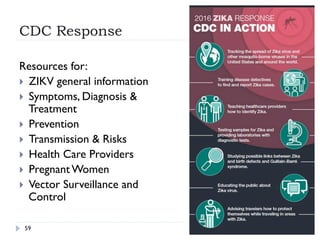
CDC Response
Resources for:
}  ZIKV general information
}  Symptoms, Diagnosis &
Treatment
}  Prevention
}  Transmission & Risks
}  Health Care Providers
}  Pregnant Women
}  Vector Surveillance and
Control
59
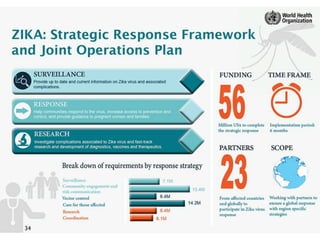
Zika: Strategic Response Framework & Joint
Operations Plan (WHO)
Objectives
Surveillance
●  Establish a global system approach to understand the ZIKV threat
(distribution, spread, nature of infection and outcome trends)
●  Enhance laboratory and diagnostic requirements, facilitate collaboration
●  Facilitate national response methods
Response
●  Disseminate systematically updated information
●  Combat false or misleading information
●  Engage community involvement
●  Train and equip health care workers
●  Rigorously pursue vector control and prevention efforts
●  Establish clinical guidance and protocols
●  Facilitate and enhance patient care
Research
●  Investigate increase in microcephaly and neurologic syndromes and
possible associations to ZIKV
●  Fast-track research and developments
Viral Characterization
}  Characterization of ZIKV method of infection and
immune system interactions
}  Identification of human cells susceptible to ZIKV infection
}  Dermal fibroblasts, epidermal keratinocytes and immature dendritic
cells
}  Identification of cell receptors involved in ZIKV infection
}  DC-SIGN,AXL,Tyro3,TIM-1
}  ZIKV induced apoptosis
}  Possibly to evade immune system and mode of dissemination
}  Increased expression of specific antiviral genes suggest that
method of immune system stimulated mediated by specific
flavivirus (i.e. versus those of dengue, yellow fever, etc.)
61
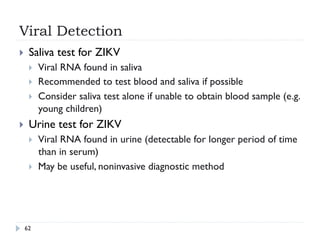
Viral Detection
}  Saliva test for ZIKV
}  Viral RNA found in saliva
}  Recommended to test blood and saliva if possible
}  Consider saliva test alone if unable to obtain blood sample (e.g.
young children)
}  Urine test for ZIKV
}  Viral RNA found in urine (detectable for longer period of time
than in serum)
}  May be useful, noninvasive diagnostic method
62
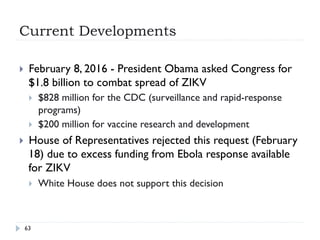
Current Developments
63
}  February 8, 2016 - President Obama asked Congress for
$1.8 billion to combat spread of ZIKV
}  $828 million for the CDC (surveillance and rapid-response
programs)
}  $200 million for vaccine research and development
}  House of Representatives rejected this request (February
18) due to excess funding from Ebola response available
for ZIKV
}  White House does not support this decision
DidYou Know…
Mosquitoes fly an
estimated 1-1.5 mph.
American Mosquito Control Association
64
DidYou Know…
Smelly feet are
attractive to certain
species of mosquitoes.
American Mosquito Control Association
65
DidYou Know…
The average mosquito
weighs about 2.5
milligrams.
American Mosquito Control Association
DidYou Know…
Dark clothing and
smelly feet have been
shown to attract some
species of mosquitoes.
American Mosquito Control Association
67

Zika Final Draft

  • 1.
    Overview and Stateof the Current Pandemic March 24, 2016 Kristine Oaks and Kimberly Treier Albany College of Pharmacy and Health Sciences PharmD Candidates, Class of 2016 Zika Virus:
  • 2.
    Outline }  Epidemiology }  ZikaVirusDisease }  Guillain-Barré syndrome }  Microcephaly }  Zika & Pregnancy }  Global Response and Guidance }  Current Developments 2
  • 3.
    DidYou Know… There areabout 2,700 species of mosquito. There are 176 species in the United States. American Mosquito Control Association 3
  • 4.
    4 “The level ofconcern is high, as is the level of uncertainty. Questions abound. We need to get some answers quickly.” – Dr. Margaret Chan, Director-General of the World Health Organization (January 28, 2016)
  • 5.
    Public Health Concern } Concomitant rise in Zika virus (ZIKV) infection and unexplained neurologic abnormalities }  Global concern: }  Spread of the two primary mosquito species known to transmit the ZIKV }  Increased global connectivity – “[R]isk of a global spread of Zika virus…is significant” (WHO, 2016) }  Currently no vaccine is available 5
  • 6.
  • 7.
    February 1, 2016:WHO declares Zika a Public Health Emergency of International Concern Zika Virus as of March 16, 2016… US States Travel-associated Zika virus disease cases reported: 258 (8 are pregnant women, 6 sexually transmitted) Locally acquired vector-borne cases reported: 0 US Territories Travel-associated cases reported: 3 Locally acquired cases reported: 283 (35 pregnant women) Global Locally acquired cases reported in 59 countries and territories since January 1, 2007
  • 8.
    DidYou Know… Mosquitoes lay~ 100 eggs at a time? Mosquito eggs can stick to surfaces like glue and survive drying out for 8 months American Mosquito Control Association 8
  • 9.
    ZIKV 9 }  Flaviviridae family } Single-stranded RNA virus }  No RNA polymerase proofreading capability }  HIGH mutation rate }  Arboviral disease }  Arthropod-borne (e.g. mosquitoes and ticks) }  Cycle of transmission involving animals and humans
  • 10.
    ZIKV Cycle of transmission 10 Blood Contamination Mosquito to Human Sexual Contact Human to Mosquito Pregnancyor Childbirth (rare) Primate Aedes Mosquito (female) Adapted from:Whitehead SS, Blaney JE, Durbin AP, et al. Prospects for a dengue virus vaccine. Nature Reviews Microbiology (2015) 5:518-528. Doi: 10.1038/nrmicro1690.
  • 11.
    Risk Factors 11 }  Riskfactors for infection }  Travel to areas with active ZIKV transmission }  Sexual relations with ZIKV- infected partner }  Recipient of ZIKV-contaminated blood }  Maternal ZIKV infection }  Risk factors for complications }  Risk of complications following acute infections unclear }  Risk of complications following fetal exposure largely unknown Image from: WHO
  • 12.
    Diagnosis 12 }  Detection ofviral nucleic acid and/or virus-specific antibodies }  Plasma or serum }  Urine }  Differential diagnoses }  Other flavivirus infections }  West Nile }  Yellow fever }  Dengue }  Considerations }  Clinical presentation }  Travel history }  Activities related to potential transmission
  • 13.
    Lab Tests 13 }  Moleculartesting }  Reverse transcription polymerase chain reaction (RT-PCR) }  Identify viral RNA }  Best results ≤7 days of symptom onset }  Antibody testing }  Enzyme-linked immunoabsorbent assay (ELISA) }  Detect viral IgM }  Best results >7 days of symptom onset High risk of cross-reactivity with other flaviviruses – only identifies presence of recent flavivirus infection Plaque-reduction neutralization test (PRNT) may be able to distinguish type of flavivirus infection if no prior flaviviridae infection or vaccination
  • 14.
    FDA Emergency UseAuthorization 14 }  No commercially available diagnostic test FDA approved for ZIKV }  Tests distributed to qualified laboratories in the Laboratory Response Network }  Not available in US hospitals or other primary care settings }  February 26, 2016 }  CDC Zika IgM Antibody Capture Enzyme-Linked Immunosorbent Assay (Zika MAC-ELISA) }  March 18, 2016 }  Trioplex real-time RT-PCR assay
  • 15.
    DidYou Know… Only femalemosquitoes are able to suck blood. While biting, they stab 2 tubes into the skin: one to inject an anti-clotting enzyme, and another to suck blood. National Geographic 15
  • 16.
    Acute Infection 16 }  Incubationperiod unknown }  Generally starts within 3-12 days of infection and resolve within 7 days }  Most cases are mild }  Treatment }  Supportive care }  Rest }  Fluids }  Antipyretics/analgesics (avoid NSAIDs) •  Fever •  Malaise •  Maculopapular rash •  Conjunctivitis •  Mylagia •  Arthralgia •  Headache 1 in 5 People infected with ZIKV will develop symptoms
  • 17.
    Complications 17 }  Adults }  Guillain-Barré(gee-YAN) syndrome }  Meningitis }  Meningoencephalitis }  Myelitis }  Fetuses/Neonates }  Microcephaly }  Fetal death }  Placental insufficiency }  Neurologic abnormalities
  • 18.
    Guillain-Barré Syndrome 18 }  Symptoms } Usually symmetrical }  May last a few weeks to several months }  About 20% of patients do not fully recover }  Autoimmune syndrome affecting the peripheral nervous system •  Peripheral paresthesia •  Paralysis •  General dysautonomia •  Areflexia http://jama.jamanetwork.com.proxy1.athensams.net/article.aspx?articleid=645193
  • 19.
    Guillain-Barré Syndrome 19 }  Othercauses }  Bacterial infection (Campylobacter jejuni) }  Viral infection (HIV, influenza, dengue) }  Immunization (rare) }  Surgery/trauma General incidence: 1-2 per 100,000 people per year in the US}  General treatment approach }  Supportive care }  Removal of auto-antibodies from the bloodstream }  Plasma exchange }  Intravenous immunoglobulin (IVIG) }  Thromboprophylaxis }  Heart rate and rhythm control }  Mechanical ventilation
  • 20.
    Incidence of Guillain-BarréSyndrome during ZIKV Outbreaks 20 }  Global annual incidence estimated between 0.4 and 4.0 cases per 100,000 inhabitants per year Region (timeframe) GBS cases reported Yearly average Brazil (2015) 1,708 1,439 (2014) Colombia (Jan. 1-30, 2016) 86 242 El Salvador (Dec. 1, 2015-Jan. 6, 2016) 46 169 Suriname (2015, Jan. 2016) 10 (2015) 3 (Jan. 2016) 4 GBS, Guillain-Barré syndrome
  • 21.
    Microcephaly }  Presentation }  Headcircumference ≥2 standard deviations below average for age, gender and ethnicity (≥3 standard deviations = severe) }  Detection }  CT, MRI, head circumference measurement }  Potential complications }  Developmental delays }  Epilepsy }  Cerebral palsy }  Hyperactivity }  Dwarfism 21
  • 22.
    Microcephaly }  Other causes } Premature fusion of the skull sutures (craniosynostosis) }  Genetic abnormalities involving chromosomes (e.g. Down Syndrome) }  Lack of oxygen }  Infections (e.g. chickenpox, cytomegalovirus) }  Exposure to drugs, alcohol, toxic chemicals }  Severe malnutrition }  Uncontrolled maternal phenylketonuria (PKU) 22 General incidence: 2-12 per 10,000 live births per year in the US
  • 23.
    Microcephaly }  Management }  Surgery(for craniosynostosis) }  Therapy }  Speech }  Physical }  Occupational }  Medications }  Seizures }  Hyperactivity }  Neuromuscular symptoms Therapeutic goals: symptom control, mitigating challenges due to cognitive and physical barriers 23
  • 24.
    DidYou Know… Mosquitoes findhosts by movement, infra-red radiation from warm bodies, and by chemicals (CO2, lactic acid, etc.) at distances of 25-35 meters. American Mosquito Control Association 24
  • 25.
    ZIKV & Pregnancy } Transmission }  Pregnancy –Yes (CDC) }  Delivery – Highly likely (CDC) }  Breastfeeding – Unknown }  Perinatal transmission rate }  Unknown }  Unknown significance of severity of maternal infection or gestational age at time of infection 25
  • 26.
    Preliminary Findings inBrazil }  Cohort study of 88 pregnant women with rash presenting to acute febrile illness clinic between September 2015 and February 2016 }  72 confirmed with ZIKV infection (RT-PCR of blood and urine) Brasil, et al (2016) Adapted from: Brasil P, Pereira JP, Raja Gabaglia C, et al. Zika virus in pregnant women in Rio de Janeiro - preliminary report. New Engl J Med. Forthcoming. 2016. ZIKV-positive (n=72) ZIKV-negative (n=16) Week of gestation at time of infection, median (range) 20 (5-38) 17 (7-39) Symptoms – no. (%) Maculopapular rash 32 (44.4) 2/16 (12.5) Conjunctivitis 42 (58.3) 2 (13.3) Lymphadenopathy 29 (40.3) 1/15 (6.7) Ultrasound findings – no./total no. (%) Abnormal ultrasound 12/42 (29) 0/16 (0) 26
  • 27.
    Pregnancy Outcomes Brasil, etal (2016) Adapted from: Brasil P, Pereira JP, Raja Gabaglia C, et al. Zika virus in pregnant women in Rio de Janeiro - preliminary report. New Engl J Med. Forthcoming. 2016. Infant Ultrasound findings Findings at birth Week of gestational age at infection 19 Microcephaly, cerebral calcifications, abnormal middle cerebral artery, intrauterine growth restriction Microcephaly, cerebral calcifications, global cerebral atrophy, macular lesions 8 12 Microcephaly, placental insufficiency, oligohydramnios, intrauterine growth restriction Small for gestational age, head circumference proportional to body size, macular lesions 22 10 Fetal death detected at 36 weeks Stillborn 25 36 Microcephaly, abnormal umbilical artery flow, intrauterine growth restriction Small for gestational age, head circumference proportional to body size 26 2 Normal Normal 30 3 Normal Normal 31 53 Fetal death detected at 38 weeks Stillborn 32 23 Anhydramnios, intrauterine growth restriction Normal growth measure, poor sucking reflex, EEG abnormalities 35 27
  • 28.
    Retrospective Study inFrench Polynesia }  8,750 suspected ZIKV infections during outbreak (October 2013 - April 2014) }  383 (4.4%) confirmed via laboratory analysis }  8 microcephaly cases from September 1, 2013 - July, 31, 2015 identified }  Births: 3 (37.5%) }  Mean gestational age: 38.0 (37.2-39.5) weeks }  Medical termination: 5 (62.5%) }  Mean gestational age: 30.1 (26.1-31.4) weeks }  7 (88%) identified in a 4-month period }  Median maternal age: 29.2 (24.3-34.1) years Cauchemez, et al (2016) 28
  • 29.
    Retrospective Study inFrench Polynesia }  Results suggest greater risk of microcephaly with infection during early pregnancy }  Compared to the no association model (no risk period), 3 models better resemble observed data: Trimester(s) Baseline prevalence of microcephaly per 10,000 neonates Number of microcephaly cases per 10,000 women infected in the period of risk Risk ratio (95% CI) p value 1 2 (0-8) 95 (34-191) 53.4 (6.5-1061.2) 0.0007 I and 2 2 (0-8) 50 (17-101) 26.4 (3.0-352.0) 0.0015 I, 2 and 3 2 (0-9) 42 (13-86) 20.8 (2.1-424.1) 0.0032 Adapted from: Cauchemez S, Besnarad M, Bompard P, et al. Association between Zika virus and microcephaly in French Polynesia, 2013-15: a retrospective study. Lancet. 15 Mar 2016. Available at: http://dx.doi.org/10.1016/S0140-6736(16)00651-6 Cauchemez, et al (2016) 29
  • 30.
    WHO Position Statement 30 -­‐  Dr.  Margaret  Chan,     Director-­‐General  of  the  World  Health  Organization   Other outcomes include fetal death, placental insufficiency, abnormal fetal growth and neurologic abnormalities "We  can  now  conclude  that   Zika  virus  is  neurotropic,   preferentially  affecting   tissues  in  the  brain  and   brain  stem  of  the  developing   fetus.”   March  8,  2016   “Evidence  supports  the   likelihood  that  Zika  infection   during  pregnancy  will  have   a  broad  range  of  effects  on   the  developing  fetus,  beyond   microcephaly.”   March  22,  2016  
  • 31.
    DidYou Know… According tothe CDC only 4 chemicals effectively repel mosquitoes: ü  DEET ü  Picaridin ü  IR3535 ü  Oil of lemon eucalyptus Smithsonian 31
  • 32.
    CDC Response Emergency Operations Center(EOC) level 1 activation February 8, 2016 }  Evaluation of potential clinical sequelae }  Global epidemiological monitoring and viral surveillance in the United States }  Development of diagnostic tools }  Guidance for travelers 32
  • 33.
    WHO Response WHO declaresZika a Public Health Emergency of International Concern on February 1, 2016 }  Zika: Strategic Response Framework & Joint Operations Plan (February 2016) }  Pregnancy management in the context of ZikaVirus: Interim Guidance (March 2, 2016) }  Resources for: }  Situation reports }  Latest updates }  Guidance 33
  • 34.
  • 35.
    Prevention (CDC andWHO) }  Avoid/minimize travel to endemic areas }  Prevent mosquito bites }  Cover skin and use insect repellant containing: }  DEET, IR3535 or picaridin }  Use screens and/or mosquito nets }  Treat clothing with permethrin }  Protect children }  Avoid storing exposed water indoors or outdoors }  Practice safe sex }  ZIKV lives longer in semen than blood }  Receive medical attention if the following are experienced within 2 weeks of travel: }  Rash, fever, body aches, joint aches, headaches, conjunctivitis 35
  • 36.
    Vector Control (CDCand WHO) }  Community efforts }  Use of insecticides and/or larvicides outdoors and around large water supplies }  Elimination of standing water sources }  National efforts }  Fogging }  Genetically modified sterile male mosquitoes }  Males carrying Wolbachia bacteria }  Effectively used to fight DengueVirus }  Unknown agricultural/ecological impact 36
  • 37.
    DidYou Know… Aedes aegyptimosquitoes live for 2-4 weeks depending on environmental conditions. The average Aedes aegypti mosquito travels a maximum 500 meters in its lifetime. Eliminate Dengue Program 37
  • 38.
    Special Populations -Pregnancy 38 }  Breastfeeding }  No reported cases of ZIKV transmission via breastfeeding – CDC continues to recommend }  Future pregnancy }  Currently not believed to pose a risk after ZIKV cleared from blood }  Public health officials in Brazil, Colombia, Ecuador, El Salvador and Jamaica recommend delaying pregnancy On March 21, the CDC established the US Zika Pregnancy Registry Collaboration with state, tribal, local and territorial health departments Collect data to update recommendations, plan for services and improve prevention Image from: CDC
  • 39.
    Zika & Pregnancy:Interim Guidance (WHO) }  Special precautions for pregnant women or those of childbearing age }  Avoid/reduce travel to endemic area(s) }  Protect against mosquito bites }  Environmental Protection Agency (EPA)-registered insect repellent proven safe and effective in pregnancy and breastfeeding }  Practice safe sex – consider birth control or delay pregnancy if appropriate }  Duration of risk with sexual contact unknown }  ZIKV isolated in semen of patient who was no longer viremic }  Receive appropriate perinatal care 39
  • 40.
    Testing During Pregnancy 40 } Test for ZIKV infection recommended for pregnant women if: }  Recent travel to endemic area(s) }  Sexual contact with a potentially infected partner RT-PCR of maternal serum, plasma, or amniotic fluid Fetal ultrasound may be warranted if amniotic fluid positive for ZIKV
  • 41.
    Special Populations –Sexual Transmission 41 }  On February 5, 2016, CDC released the Interim Guidelines for Prevention of SexualTransmission of ZikaVirus – United States 2016 }  Pregnant partner: Abstinence or consistent and correct use of condoms }  Non-pregnant partner: Consider abstinence or condoms }  ZIKV testing for risk of sexual transmission not currently recommended Key findings Case 1 – Transmission from man to woman prior to symptom onset Case 2 – Currently under investigation Case 3 – ZIKV identified in semen 2-10 weeks after illness onset (ZIKV no present in blood)
  • 42.
    Special Populations –Blood transfusion 42 }  February 16, 2016, FDA released Recommendations for Donor Screening, Deferral and Product Management to Reduce the Risk of Transfusion-Transmission of ZIKV }  No FDA-approved blood donor screening test currently available, so focus on: }  Enhanced education }  Detailed donor history questionnaire }  Defer donations by 4 weeks if at risk for ZIKV infection }  Prompt notification of blood collection center upon ZIKV diagnosis }  Only collect blood from areas without active transmission until test is available US – no confirmed blood transfusion-related ZIKV transmission (as of February 1, 2016) Brazil – suspected cases being investigated in Brazil French Polynesia – 2.8% of blood donations positive for ZIKV during outbreak
  • 43.
    DidYou Know… The Aedesaegypti mosquito prefers to bite humans. They bite primarily during the day and indoors. Centers for Disease Control and Prevention
  • 44.
    Current Developments 44 }  PuertoRico }  February 5, 2016 - San Juan governor declared a health emergency }  CDC estimates 25% of Puerto Rico’s 3.5 million residents will be infected with ZIKV within a year }  Active efforts by CDC and local government }  US }  March 16, 2016 – NCAR estimated that 50 US cities will experience Zika outbreaks this summer due to warmer weather, travel, and poverty conditions. }  CaboVerde }  March 18, 2016 – WHO sends a team to investigate microcephaly potentially linked to ZIKV outbreak }  Cuba }  March 19, 2016 – CDC issued a level 2 travel notice (Practice Enhanced Precautions) NCAR; National Center for Atmospheric Research
  • 45.
    ZIKV Vaccine 45 }  Unknowns } Infection → lifelong protection from vaccine? }  Prior exposure to other flavivirus vaccines → complication of ZIKV vaccine evaluation? }  Considerations }  Adaptation of existing flavivirus vaccines (yellow fever, Japanese encephalitis) }  Inactivated vaccine for pregnant patients NIAID, National Institute of Allergy and Infectious Diseases
  • 46.
    ZIKV Vaccine andTimeframe 46 }  Developments }  23 vaccine development projects are being worked on by 14 vaccine developers in the US, France, Brazil, India, and Austria }  National Institute of Allergy and Infectious Disease (NIAID): }  A DNA-based ZIKV vaccine (same technique as West Nile vaccine in development) – may begin phase 1 this year }  Antiviral drugs used to treat other flaviviral infections }  A live attenuated vaccine (same technique as a Dengue vaccine) }  A vaccine using a recombinant virus expressing a Zika E glycoprotein Trials expected to begin summer of 2016: DNA vaccines: NIH (US), Inovio (Canada) Inactivated virus: Bharat Biotech (India)
  • 47.
  • 48.
    References 48 ZikaVirus:At A Glance– Zika in the U.S. (as of March 16, 2016). Centers for Disease Control and Prevention. http://www.cdc.gov/zika/.Accessed 21 March 2016. Zika virus and potential complications.World Health Organization. http://www.who.int/emergencies/zika-virus/en/.Accessed 21 March 2016. Arboviral Disease -- United States, 1994 MMWR. Centers for Disease Control and Prevention Website. http://www.cdc.gov/mmwr/preview/mmwrhtml/00038641.htm. Published 8 September 1995.Accessed 17 February 2016. Surveillance and Control of Aedes aegypti and Aedes albopictus in the United States. Centers for Disease Control and Prevention Website. http://www.cdc.gov/chikungunya/resources/vector-control.html. Updated 25 January 2016.Accessed 17 February 2016. Zika virus infection - United States of America.World Health Organization Website. http://www.who.int/csr/don/12-february-2016-zika-usa/en/. Published 12 February 2016. Accessed 17 February 2016. ZikaVirus Spreads to New Areas - Region of the Americas, May 2015 - January 2016 MMWR. Centers for Disease Control and Prevention Website. http://www.cdc.gov/mmwr/volumes/65/wr/mm6503e1.htm?s_cid=mm6503e1.htm_w. Published 29 January 2016.Accessed 17 February 2016. ZikaVirus Fact Sheet.World Health Organization Website. http://www.who.int/mediacentre/factsheets/zika/en/. Updated February 2016.Accessed 17 February 2016. Musso D, Roche C, Robin E, Nhan T,Teissier A, Cao-LormeauV-M. Potential Sexual Transmission of ZikaVirus. Emerging Infectious Diseases. 2015;21(2):359-361. doi:10.3201/ eid2102.141363. Foy BD, Kobylinski KC, Foy JLC, et al. Probable non–vector-borne transmission of Zika virus, Colorado, USA. Emerg Infect Dis. 2011 May; [Epub ahead of print]. Ioos S, Mallet HP, Leparc Goffart I, et al. Current zika virus epidemiology and recent epidemics. Med Maladies Infect. 2014; 44: 302-307. Women in the context of microencephaly and Zika virus disease.World Health Organization Website. http://www.who.int/features/qa/zika-pregnancy/en/. Published 10 February 2016.Accessed 17 February 2016. Guillain-Barré Syndrome Fact Sheet.World Health Organization Website. http://www.who.int/mediacentre/factsheets/guillain-barre-syndrome/en/. Published February 2016. Accessed 17 February 2016. Oehler E,Watrin L, Larre P , et al. Zika virus infection complicated by Guillain-Barré syndrome – case report, French Polynesia, December 2013. Euro Surveill. 2014;19(9):pii=20720. Revised diagnostic testing for Zika, chikungunya, and dengue viruses in US Public Health Laboratories Memorandum. CDC, Division ofVector-Borne Diseases.Available from: http://www.cdc.gov/zika/index.html. Published 7 February 2016.Accessed 17 February 2016. ZikaVirus Transmission. Centers for Disease Control and Prevention Website. http://www.cdc.gov/zika/transmission/index.html. Updated 12 February 2016.Accessed 17 February 2016. Zika situation report: Neurological syndrome and congenital anomalies.WHO [Internet]. 5 Feb. 2016.Available from: http://apps.who.int/iris/bitstream/10665/204348/1/zikasitrep_5Feb2016_eng.pdf?ua=1. Broutet N, Krauer F, Riesen M, et al. Zika virus as a cause of neurologic disorders. New Engl J Med. Forthcoming. 2016.
  • 49.
    References 49 Brasil P, PereiraJP, Raja Gabaglia C, et al. Zika virus in pregnant women in Rio de Janeiro - preliminary report. New Engl J Med. Forthcoming. 2016. ZikaVirus Prevention. Centers for Disease Control and Prevention Website. http://www.cdc.gov/zika/prevention/index.html. Updated 5 February 2016.Accessed 17 February 2016. Duffy MR, Chen TH, Hancock WT, et. al. ZikaVirus Outbreak onYap Island, Federated States of Micronesia. N Engl J Med. 2009 Jun 11; 360: 2536-2543. Epidemiological Update Neurological syndrome, congenital anomalies, and Zika virus infection. Pan American Health Organization Website. file:///C:/Users/Kristine%20Oaks/Downloads/2016-jan-17-cha-epi-update-zika-virus.pdf. 2016 Jan 17. Epidemiological Alert Increase of microcephaly in the northeast of Brazil 17 November 2015. Pan American Health Organization Website. file:///C:/Users/Kristine%20Oaks/ Downloads/2015-nov-17-cha-microcephaly-epi-alert.pdf. 2015 Nov 15. World Health Organization.WHO research and development on Zika. 2016.Available at: http://www.who.int/mediacentre/commentaries/zika-research-development/en/. Accessed February 24, 2016. Washington Post. NIH officials accelerate timeline for human trials of Zika vaccine, saying they will now begin in the summer. 2016.Available at: https:// www.washingtonpost.com/news/to-your-health/wp/2016/02/11/nih-officials-accelerate-timeline-for-human-trials-of-zika-vaccine-saying-they-will-now-begin-in-the-summer/. Accessed February 24, 2016. Nlm.nih.gov. In Fight Against ZikaVirus, Officials Consider Genetically Modified Mosquitoes: MedlinePlus. 2016.Available at: https://www.nlm.nih.gov/medlineplus/news/ fullstory_157279.html.Accessed February 24, 2016. Hamel R, Dejarnac O,Wichit S, Ekchariyawat P, Neyret A, Luplertlop N, Perera-Lecoin M, Surasombatpattana P,Talignani L,Thomas F, Cao-LormeauV-M, ChoumetV, Briant L, Desprès P,Amara A,Yssel H, Missé D. 2015. Biology of Zika virus infection in human skin cells. JVirol 89:8880 –8896. doi:10.1128/JVI.00354-15.s Musso D., Roche C., Nhan T.-X., Robin E.,Teissier A., Cao-LormeauV.-M.. Detection of Zika virus in saliva. J. Clin.Virol.. 2015;68:53-55. doi:10.1016/j.jcv.2015.04.021 Gourinat A.-C., O'Connor O., Calvez E., Goarant C., Dupont-Rouzeyrol M.. Detection of zika virus in urine. Emerg. Infect. Dis.. 2015;21(1):84-86. doi:10.3201/ eid2101.140894 Soares de Araújo JS, Regis CT, Gomes RGS,Tavares TR, Rocha dos Santos C,Assunção PM, et al. Microcephaly in northeast Brazil: a review of 16 208 births between 2012 and 2015 [Submitted]. Bull World Health Organ E-pub: 4 Feb 2016. doi: http://dx.doi.org/10.2471/BLT.16.170639 Chan M. Statement by WHO Director-General Dr. Margaret Chan.WHO; 28 Jan 2016. Zika virus in Cuba [Internet]. CDC; 19 Mar. 2016 [cited 21 Mar. 2016).Available from: http://wwwnc.cdc.gov/travel/notices/alert/zika-virus-cuba Monaghan AJ, Morin CW, Steinhoff DF,Wilhelmi O, Hayden M, Quattrochi DA, Reiskind M, Lloyd AL, Smith K, Schmidt CA, Scalf PE, Ernst K. On the Seasonal Occurrence and Abundance of the ZikaVirusVector Mosquito Aedes Aegypti in the Contiguous United States. PLOS Currents Outbreaks. 2016 Mar 16 Elena SF, Sanjuán R.AdaptiveValue of High Mutation Rates of RNAViruses: Separating Causes from Consequences . Journal ofVirology. 2005;79(18):11555-11558. doi:10.1128/ JVI.79.18.11555-11558.2005.
  • 50.
    References 50 Heinz FX, StiasnyKarin. Flaviviruses and flavivirus vaccines.Vaccine (2012) 30:4301-4306. Doi: 10.1016/j.vaccine.2011.09.114 Chan M. Statement by WHO Director-General Dr. Margaret Chan.WHO; 8 Mar 2016. New CDC Laboratory Test for ZikaVirus Authorized for Emergency Use by FDA. Centers for Disease Control and Prevention Website. http://www.cdc.gov/media/releases/ 2016/s0226-laboratory-test-for-zika-virus.html. Updated 26 February 2016.Accessed 21 March 2016. Chan M. Statement by WHO Director-General Dr. Margaret Chan.WHO; 22 Mar 2016. Zika and Blood Transfusion. http://www.cdc.gov/zika/transmission/blood-transfusion.html. Centers for Disease Control and Prevention.Accessed 21 Mar 2016. Oster AM, Brooks JT, Stryker JE, et al. Interim Guidelines for Prevention of Sexual Transmission of ZikaVirus — United States, 2016. MMWR Morb Mortal Wkly Rep 2016;65place_Holder_For_Early_Release:120–121. DOI: http://dx.doi.org/10.15585/mmwr.mm6505e1. ZikaVirus: Zika and Pregnancy. Centers for Disease Control and Prevention. http://www.cdc.gov/zika/pregnancy/question-answers.html.Accessed 23 Mar 2016 ZikaVirus: US Zika Pregnancy Registry. Centers for Disease Control and Prevention. http://www.cdc.gov/zika/hc-providers/registry.html.Accessed 23 Mar 2016 Jacob JA. Researchers Focus on Solving the Zika Riddles. JAMA. 15 Mar 2016; (315)11:1097-1099 WHO supports CaboVerde in managing zika risk: Note for the media.World Health Organization;18 Mar, 2016 [accessed 23 Mar, 2016]. Available from: http//www.who.int/mediacentre/news/notes/2016/cabo-verde-zika/en/ Aedes Aegypti. Eliminate Dengue Program [Internet].Accessed 23 Mar, 2016.Available from: http://www.eliminatedengue.com/faqs/index/type/aedes-aegypti
  • 51.
    Case Report –Guillain-Barré Syndrome 51 A woman in her 40’s presents to the ED with paresthesia of all four limbs. She was admitted to a neurological unit the next day with ascendant muscular weakness. By day 3, she had developed tetra-paresthesia, diffuse myalgia, bilateral, asymmetric, peripheral facial palsy, and lacked deep tendon reflexes. She developed sustained ventricular tachycardia and orthostatic hypotension suggestive of dysautonomia. ECG was normal, electromyogram confirmed diffused demyelinating disorder. She was treated with intravenous polyvalent immunoglobulin and discharged home on day 13. Paresthesia and facial palsy improved slowly and she was able to walk without assistance on day 40. Retrospective chart review revealed flu-like illness 7 days prior to presentation with myalgia, febricula, cutaneous rash, and conjunctivitis. Past medical history was significant only for rheumatoid arthritis.
  • 52.
    Case Report –Guillain-Barré Syndrome 52 }  Laboratory findings }  CBC WNL }  Inflammatory markers WNL }  CSF: 1.66 g/L protein (normal 0.28-0.52),WBC 7 cells/mL (normal <10) }  Negative for HIV, Hepatitis B/C, C. jejuni, Leptospira }  Resolute infections: cytomegalovirus, Epstein-Barr virus, and Herpes simplex 1 and 2 }  Blood samples 8 and 28 days after beginning of flu-like illness: positive for ZIKV specific IgM and ZIKV and dengue 1-4 specific IgG }  PRNT (day 28): confirmed Ab against ZIKV and dengue 1-4
  • 53.
  • 54.
    What about theZIKV causes disease? 54 }  Currently unknown }  World Health Organization (WHO) developing a framework to evaluate causal relationships between ZIKV infection and negative outcomes Based on the framework developed by Bradford Hill: •  Temporality •  Biologic plausibility of causal mechanisms •  Consistency •  Strength of association •  Exclusion of alternative explanations •  Dose-response relationship •  Cessation •  Analogy to cause-and-effect relationships in other diseases
  • 55.
    ZIKV Disease 55 }  Arboviraldisease }  Arthropod-borne (e.g. mosquitoes and ticks) }  Cycle of transmission involving animals and humans }  Other arboviral diseases }  West Nile }  La Crosse encephalitis }  Eastern equine encephalitis
  • 56.
    Flaviviridae Illnesses 56 Dengue ChikungunyaZika Leukopenia/thrombocytopenia +++ +++ - Hemorrhage + - - Hepatomegaly - +++ - Lymphadenopathy ++ ++ + Fever ++++ +++ +++ Myalgia/arthralgia +++ ++++ ++ Retro-orbital pain ++ + ++ Maculopapular rash ++ ++ +++ Edema - - ++ Conjunctivitis - + +++ Adapted from: Ioos S, Mallet HP, Leparc Goffart I, et al. Current zika virus epidemiology and recent epidemics. Med Maladies Infect. 2014; 44: 302-307.
  • 57.
    Guillain-Barré & ZIKV Studytype Region (timeframe) Study Ecologic French Polynesia (2013-2014) •  885 patients tested 52% positive for ZIKV in saliva or blood •  42 cases of GBS with viral syndrome reported in 88% Surveillance Brazil, Cambodia, El Salvador,Venezuela (2015-2016) •  GBS in areas with reported ZIKV circulation •  No data on ZIKV infection rate •  1708 cases in Brazil, 201 Colombia, 118 in El Salvador, 252 inVenezuela Case control French Polynesia (2016) •  41 of 42 (98%) GBS cases positive for ZIKV IgM or IgG •  100% positive for ZIKV neutralizing antibodies compared to 54 of 98 (56%) in control group (p<0.001) Case reports French Polynesia (2014), Puerto Rico (2016) •  Patients with rash later diagnosed with GBS •  Serum positive ZIKV IgM GBS, Guillain-Barré syndrome Adapted from: Broutet N, Krauer F, Riesen M, et al. Zika virus as a cause of neurologic disorders. New Engl J Med. Forthcoming. 2016. 57
  • 58.
    Microcephaly & ZIKV Adaptedfrom: Broutet N, Krauer F, Riesen M, et al. Zika virus as a cause of neurologic disorders. New Engl J Med. Forthcoming. 2016. Study type Region (timeframe) Summary Case series French Polynesia (2015) •  17 cases of congenital brain malformation identified during ZIKV outbreak (2013-2014), including microcephaly Case reports Brazil (2015-2016) •  93 cases of microcephaly: •  70 cases with maternal symptoms •  9 with ZIKV in amniotic fluid or brain •  4 with ZIKV in brain (no other organs) Ecological Brazil: Paraíba (2016) •  Microcephaly incidence of 2-8% in 16,208 births (expected: 0.01-0.02%) Ecological Brazil: Bahia (2016) •  Association between maternal acute rash (March-June 2015) and microcephaly (October 2015-January 2016) 58
  • 59.
    CDC Response Resources for: } ZIKV general information }  Symptoms, Diagnosis & Treatment }  Prevention }  Transmission & Risks }  Health Care Providers }  Pregnant Women }  Vector Surveillance and Control 59
  • 60.
    Zika: Strategic ResponseFramework & Joint Operations Plan (WHO) Objectives Surveillance ●  Establish a global system approach to understand the ZIKV threat (distribution, spread, nature of infection and outcome trends) ●  Enhance laboratory and diagnostic requirements, facilitate collaboration ●  Facilitate national response methods Response ●  Disseminate systematically updated information ●  Combat false or misleading information ●  Engage community involvement ●  Train and equip health care workers ●  Rigorously pursue vector control and prevention efforts ●  Establish clinical guidance and protocols ●  Facilitate and enhance patient care Research ●  Investigate increase in microcephaly and neurologic syndromes and possible associations to ZIKV ●  Fast-track research and developments
  • 61.
    Viral Characterization }  Characterizationof ZIKV method of infection and immune system interactions }  Identification of human cells susceptible to ZIKV infection }  Dermal fibroblasts, epidermal keratinocytes and immature dendritic cells }  Identification of cell receptors involved in ZIKV infection }  DC-SIGN,AXL,Tyro3,TIM-1 }  ZIKV induced apoptosis }  Possibly to evade immune system and mode of dissemination }  Increased expression of specific antiviral genes suggest that method of immune system stimulated mediated by specific flavivirus (i.e. versus those of dengue, yellow fever, etc.) 61
  • 62.
    Viral Detection }  Salivatest for ZIKV }  Viral RNA found in saliva }  Recommended to test blood and saliva if possible }  Consider saliva test alone if unable to obtain blood sample (e.g. young children) }  Urine test for ZIKV }  Viral RNA found in urine (detectable for longer period of time than in serum) }  May be useful, noninvasive diagnostic method 62
  • 63.
    Current Developments 63 }  February8, 2016 - President Obama asked Congress for $1.8 billion to combat spread of ZIKV }  $828 million for the CDC (surveillance and rapid-response programs) }  $200 million for vaccine research and development }  House of Representatives rejected this request (February 18) due to excess funding from Ebola response available for ZIKV }  White House does not support this decision
  • 64.
    DidYou Know… Mosquitoes flyan estimated 1-1.5 mph. American Mosquito Control Association 64
  • 65.
    DidYou Know… Smelly feetare attractive to certain species of mosquitoes. American Mosquito Control Association 65
  • 66.
    DidYou Know… The averagemosquito weighs about 2.5 milligrams. American Mosquito Control Association
  • 67.
    DidYou Know… Dark clothingand smelly feet have been shown to attract some species of mosquitoes. American Mosquito Control Association 67