Z- TEST
CHERYL M. ASIA
DISCUSSANT
DEAN MELCHOR JULLANES
PROFESSOR
SEPTEMBER 8, 2019
Z-TEST
Z-Test is a statistical procedure used to test an
alternative hypothesis against null hypothesis.
Z-Test is any statistical hypothesis used to determine
whether tow samples’ means are different when the
variances are known and sample is large (n ≥ 30 ).
Z- Test is a comparison of the means of two
independent group samples, taken from one
populations with known variance.
Null Hypothesis vs.
Alternative Hypothesis
The null hypothesis ( H0 ) is a hypothesis which a
researcher tries to disprove, reject or nullify.The refers
often to the common view of something;
While, the alternative hypothesis ( Ha ) is what the
researcher really thinks in the cause of a phenomenon.
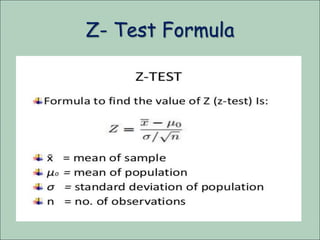
Z- Test Formula
Z- Test is used…
 When samples are drawn from random.
When the samples are taken from population are
independent.
When standard deviation is known.
When the number of population is large (n ≥ 30 ).
Large Sample is used…
When we perform the statistical test we are trying to
judge the validity of the null hypothesis.We are
doing so with an incomplete view of population. Our
sample is our window into the population.The larger
the sample size the bigger the window. However
without the full view of population there is always
the chance that our sample will lead us to wrong
conclusion.
Problem
• A principal at Maria Clara High school claims that the
students in the school are above average
intelligence.
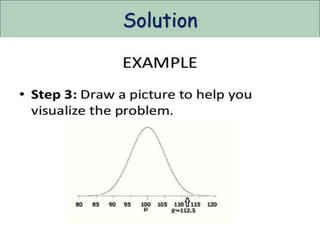
• A random sample of 30 students’ IQ scores have the
mean score of 112. 5. Is there sufficient evidence to
support the principal’s claim?
• The mean population IQ is 100 with standard
deviation of 15.
Solution
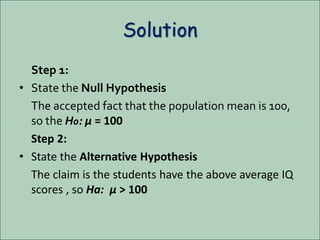
Step 1:
• State the Null Hypothesis
The accepted fact that the population mean is 100,
so the H0: µ = 100
Step 2:
• State the Alternative Hypothesis
The claim is the students have the above average IQ
scores , so Ha: µ > 100
Solution
Solution
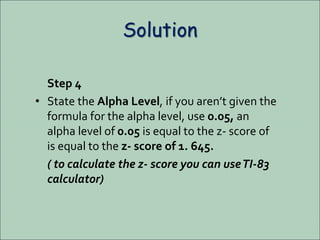
Step 4
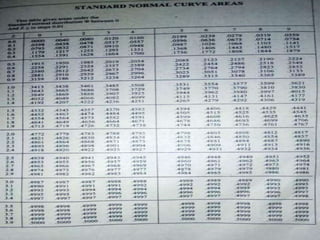
• State the Alpha Level, if you aren’t given the
formula for the alpha level, use 0.05, an
alpha level of 0.05 is equal to the z- score of
is equal to the z- score of 1. 645.
( to calculate the z- score you can useTI-83
calculator)
Solution
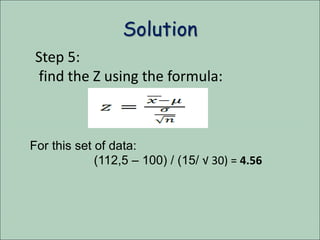
Step 5:
find the Z using the formula:
For this set of data:
(112,5 – 100) / (15/ √ 30) = 4.56
Solution
Step 6:Interpret the result
If step 5 result is (4.56) is greater than step 4
( 1.645) , reject the null hypothesis. If it’s less
than step 4, you cannot reject the
hypothesis. In this case it is greater, so you
can reject the null and principals claim is
right.
Z-Test for TWO SAMPLES
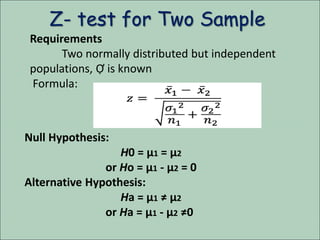
• Requirements
Two normally distributed but independent
populations, Ợ is known
Formula:
Where: X1 and X2 are the means of two samples
µ1 - µ2 , hypothesized difference between the
population mean
Ợ1 and Ợ2 are the standard deviation of two
population
n1 and n2 are the size of the two samples
Z-Test for Two Sample
Problem
• The amount of certain trace element in blood is
known to vary with the standard deviation of 14.1
ppm ( parts per million) for male blood donors, and
9.5 ppm for female donors.
• Random samples of 75 male and 50 female yield
concentration means of 28 and 33 ppm respectively.
What is the likelihood of populations means of
concentration of the element are the same for men
and women?
Z- test for Two Sample
Requirements
Two normally distributed but independent
populations, Ợ is known
Formula:
Null Hypothesis:
H0 = µ1 = µ2
or Ho = µ1 - µ2 = 0
Alternative Hypothesis:
Ha = µ1 ≠ µ2
or Ha = µ1 - µ2 ≠0
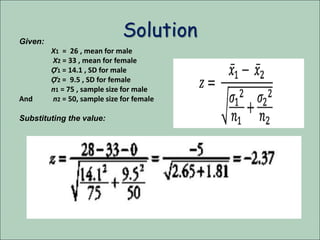
SolutionGiven:
X1 = 26 , mean for male
X2 = 33 , mean for female
Ợ1 = 14.1 , SD for male
Ợ2 = 9.5 , SD for female
n1 = 75 , sample size for male
And n2 = 50, sample size for female
Substituting the value:
Interpretation
• The computed Z- value is negative because the
mean of female was subtracted from the mean of
males.
• But the order of the samples in this computation is
arbitrary – it could be in opposite order, in which
case z will be 2.37 instead of – 2.37. an extreme z-
score from alpha level ( which is 5% = + 1.654 or
– 1.654) will lead to rejection to the null hypothesis.
Z test asia

Z test asia

  • 1.
    Z- TEST CHERYL M.ASIA DISCUSSANT DEAN MELCHOR JULLANES PROFESSOR SEPTEMBER 8, 2019
  • 2.
    Z-TEST Z-Test is astatistical procedure used to test an alternative hypothesis against null hypothesis. Z-Test is any statistical hypothesis used to determine whether tow samples’ means are different when the variances are known and sample is large (n ≥ 30 ). Z- Test is a comparison of the means of two independent group samples, taken from one populations with known variance.
  • 3.
    Null Hypothesis vs. AlternativeHypothesis The null hypothesis ( H0 ) is a hypothesis which a researcher tries to disprove, reject or nullify.The refers often to the common view of something; While, the alternative hypothesis ( Ha ) is what the researcher really thinks in the cause of a phenomenon.
  • 4.
  • 5.
    Z- Test isused…  When samples are drawn from random. When the samples are taken from population are independent. When standard deviation is known. When the number of population is large (n ≥ 30 ).
  • 6.
    Large Sample isused… When we perform the statistical test we are trying to judge the validity of the null hypothesis.We are doing so with an incomplete view of population. Our sample is our window into the population.The larger the sample size the bigger the window. However without the full view of population there is always the chance that our sample will lead us to wrong conclusion.
  • 7.
    Problem • A principalat Maria Clara High school claims that the students in the school are above average intelligence. • A random sample of 30 students’ IQ scores have the mean score of 112. 5. Is there sufficient evidence to support the principal’s claim? • The mean population IQ is 100 with standard deviation of 15.
  • 8.
    Solution Step 1: • Statethe Null Hypothesis The accepted fact that the population mean is 100, so the H0: µ = 100 Step 2: • State the Alternative Hypothesis The claim is the students have the above average IQ scores , so Ha: µ > 100
  • 9.
  • 10.
    Solution Step 4 • Statethe Alpha Level, if you aren’t given the formula for the alpha level, use 0.05, an alpha level of 0.05 is equal to the z- score of is equal to the z- score of 1. 645. ( to calculate the z- score you can useTI-83 calculator)
  • 11.
    Solution Step 5: find theZ using the formula: For this set of data: (112,5 – 100) / (15/ √ 30) = 4.56
  • 12.
    Solution Step 6:Interpret theresult If step 5 result is (4.56) is greater than step 4 ( 1.645) , reject the null hypothesis. If it’s less than step 4, you cannot reject the hypothesis. In this case it is greater, so you can reject the null and principals claim is right.
  • 14.
    Z-Test for TWOSAMPLES • Requirements Two normally distributed but independent populations, Ợ is known Formula: Where: X1 and X2 are the means of two samples µ1 - µ2 , hypothesized difference between the population mean Ợ1 and Ợ2 are the standard deviation of two population n1 and n2 are the size of the two samples
  • 15.
    Z-Test for TwoSample Problem • The amount of certain trace element in blood is known to vary with the standard deviation of 14.1 ppm ( parts per million) for male blood donors, and 9.5 ppm for female donors. • Random samples of 75 male and 50 female yield concentration means of 28 and 33 ppm respectively. What is the likelihood of populations means of concentration of the element are the same for men and women?
  • 16.
    Z- test forTwo Sample Requirements Two normally distributed but independent populations, Ợ is known Formula: Null Hypothesis: H0 = µ1 = µ2 or Ho = µ1 - µ2 = 0 Alternative Hypothesis: Ha = µ1 ≠ µ2 or Ha = µ1 - µ2 ≠0
  • 17.
    SolutionGiven: X1 = 26, mean for male X2 = 33 , mean for female Ợ1 = 14.1 , SD for male Ợ2 = 9.5 , SD for female n1 = 75 , sample size for male And n2 = 50, sample size for female Substituting the value:
  • 18.
    Interpretation • The computedZ- value is negative because the mean of female was subtracted from the mean of males. • But the order of the samples in this computation is arbitrary – it could be in opposite order, in which case z will be 2.37 instead of – 2.37. an extreme z- score from alpha level ( which is 5% = + 1.654 or – 1.654) will lead to rejection to the null hypothesis.