McGraw-Hill/Irwin © 2005 The McGraw-Hill Companies, Inc. All rights reserved.
1-1
ORGANIZATIONAL BEHAVIOR
MANAGEMENT
Prepared by: Cheryl M. Asia
McGraw-Hill/Irwin © 2005 The McGraw-Hill Companies, Inc. All rights reserved.
1-2
Chapter
Introduction to Organizational
Behavior
1
McGraw-Hill/Irwin © 2005 The McGraw-Hill Companies, Inc. All rights reserved.
1-3
Introduction
• Organizations are much more than only a
means for providing goods and service
• They create the settings in which most of us
spend our lives
• They have profound influence on employee
behavior
McGraw-Hill/Irwin © 2005 The McGraw-Hill Companies, Inc. All rights reserved.
1-4
The core 21st
century qualities
needed to create the ideal
work atmosphere begin with
intelligence, passion, a strong
work ethic, and a genuine
concern for people.
McGraw-Hill/Irwin © 2005 The McGraw-Hill Companies, Inc. All rights reserved.
1-5
Managing and Working Today and in the
Future:
• Managers must become agile and
flexible to help their firms develop and
sustain competitive advantage
• To be successful, managers will need to
harness the powers of:
• information technology
• human capital
McGraw-Hill/Irwin © 2005 The McGraw-Hill Companies, Inc. All rights reserved.
1-6
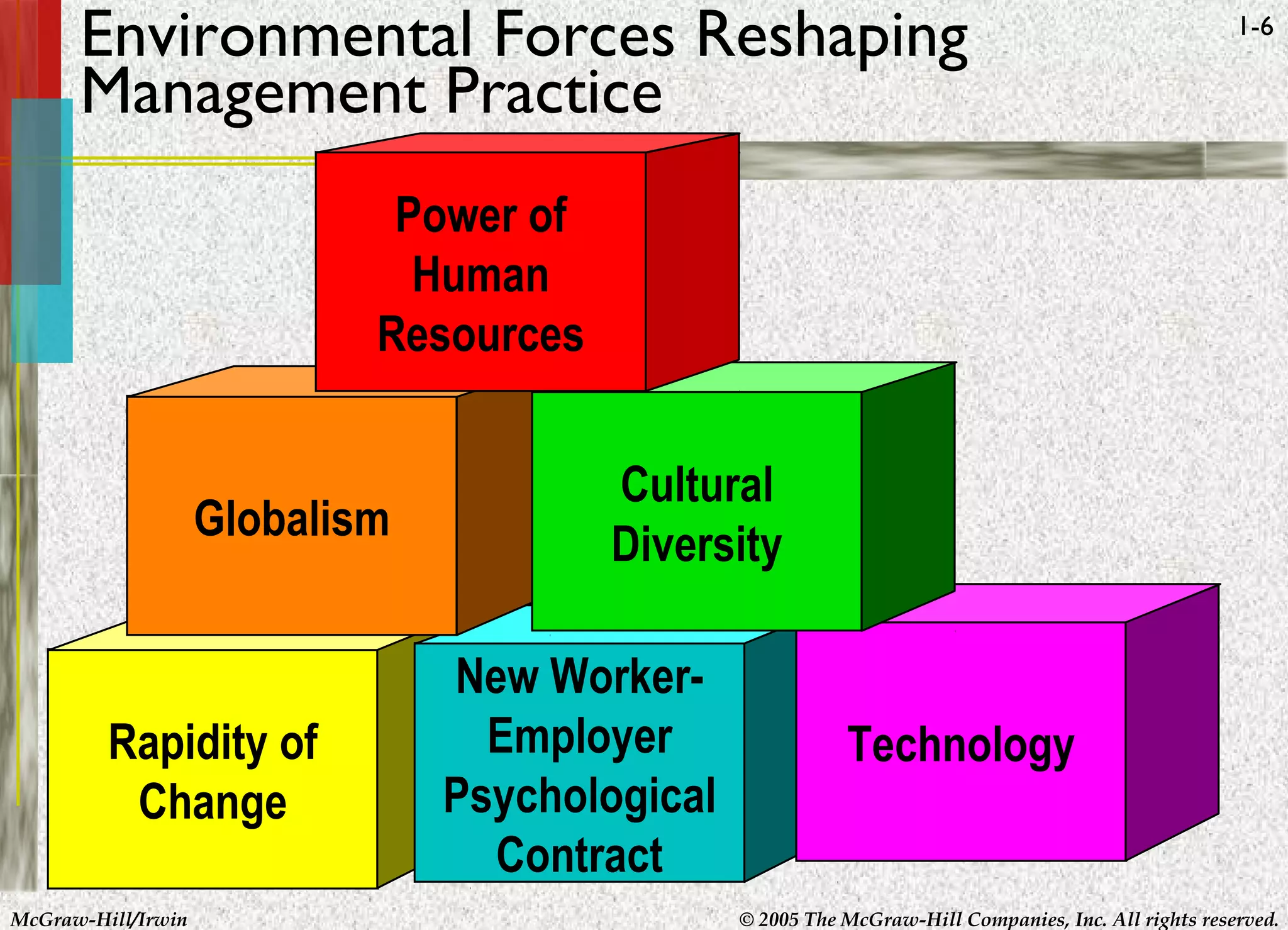
Rapidity of
Change
New Worker-
Employer
Psychological
Contract
Technology
Globalism
Cultural
Diversity
Power of
Human
Resources
Environmental Forces Reshaping
Management Practice
McGraw-Hill/Irwin © 2005 The McGraw-Hill Companies, Inc. All rights reserved.
1-7
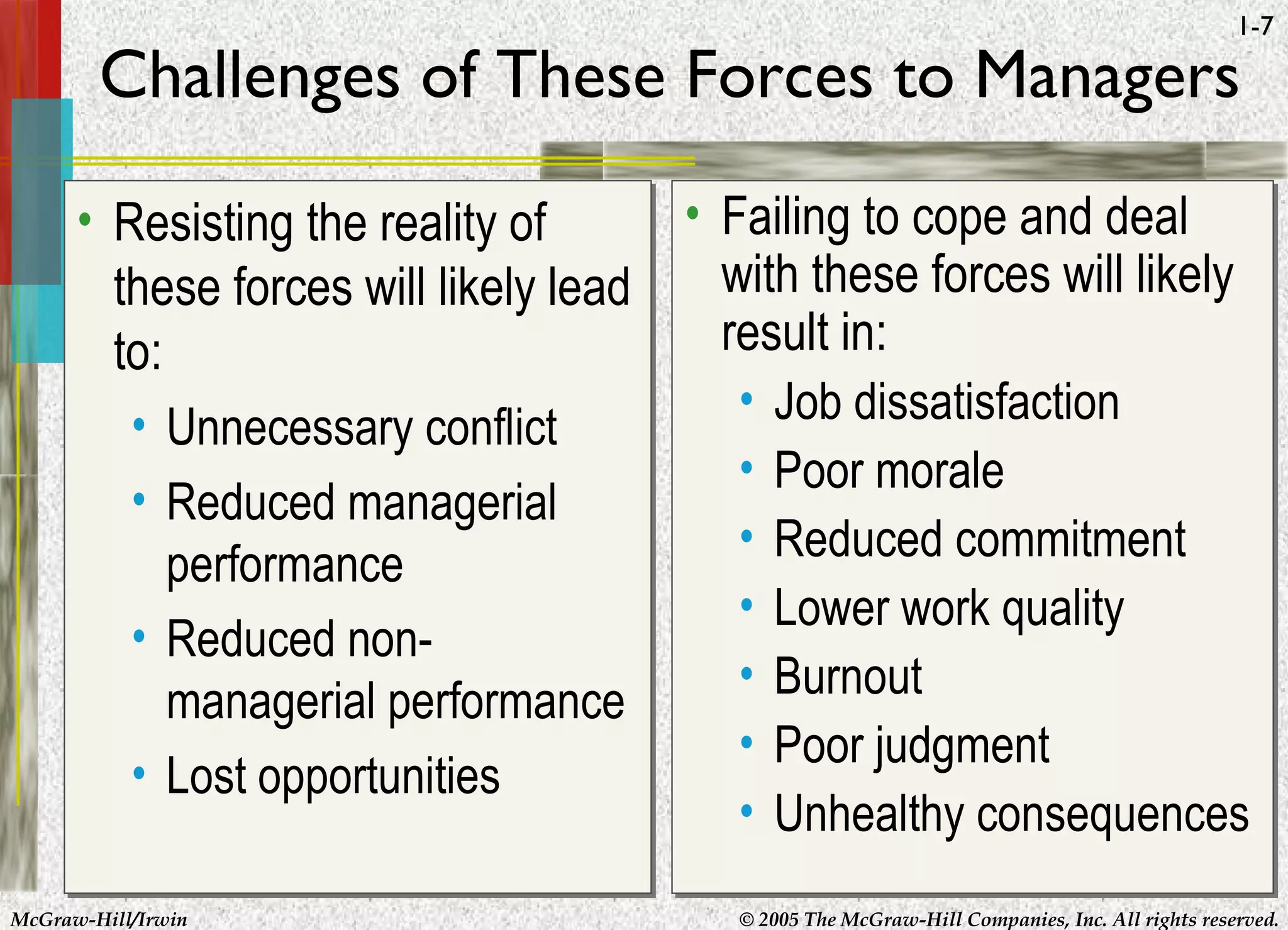
Challenges of These Forces to Managers
• Resisting the reality of
these forces will likely lead
to:
• Unnecessary conflict
• Reduced managerial
performance
• Reduced non-
managerial performance
• Lost opportunities
• Resisting the reality of
these forces will likely lead
to:
• Unnecessary conflict
• Reduced managerial
performance
• Reduced non-
managerial performance
• Lost opportunities
• Failing to cope and deal
with these forces will likely
result in:
• Job dissatisfaction
• Poor morale
• Reduced commitment
• Lower work quality
• Burnout
• Poor judgment
• Unhealthy consequences
• Failing to cope and deal
with these forces will likely
result in:
• Job dissatisfaction
• Poor morale
• Reduced commitment
• Lower work quality
• Burnout
• Poor judgment
• Unhealthy consequences
McGraw-Hill/Irwin © 2005 The McGraw-Hill Companies, Inc. All rights reserved.
1-8
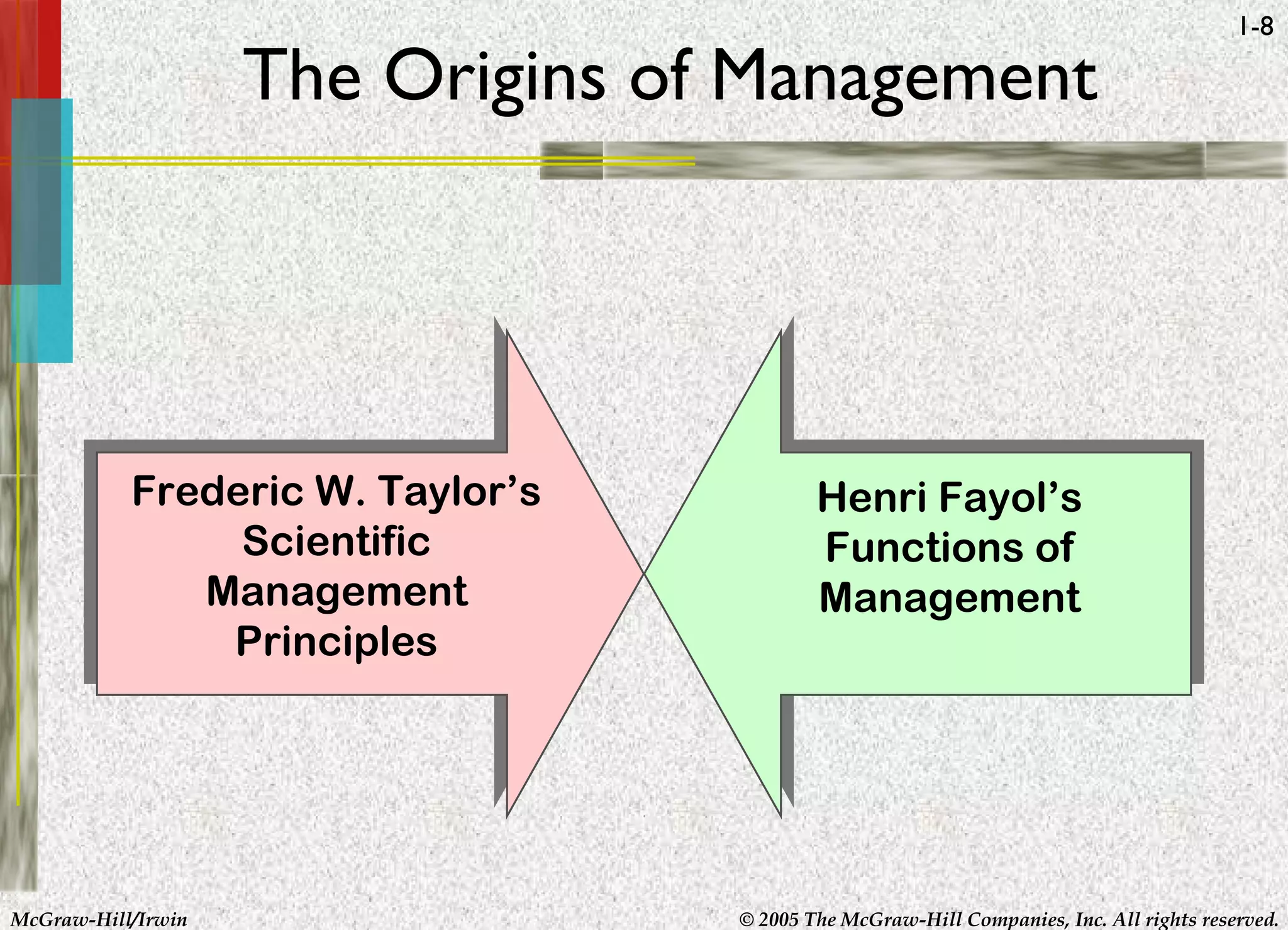
The Origins of Management
Frederic W. Taylor’s
Scientific
Management
Principles
Henri Fayol’s
Functions of
Management
McGraw-Hill/Irwin © 2005 The McGraw-Hill Companies, Inc. All rights reserved.
1-9
Taylor’s Scientific Management Principles
(1 of 2)
• Develop a science for each element of an
employee’s work
• which replaces the old rule-of-thumb
method
• Scientifically select and then train, teach,
and develop the worker
• whereas in the past a worker chose the
work to do and was self-trained
McGraw-Hill/Irwin © 2005 The McGraw-Hill Companies, Inc. All rights reserved.
1-10
Taylor’s Scientific Management Principles
(2 of 2)
• Heartily cooperate with each other to
insure that all work was done in
accordance with the principles of science
• There is an almost equal division of the
work and the responsibility between
management and non-managers
McGraw-Hill/Irwin © 2005 The McGraw-Hill Companies, Inc. All rights reserved.
1-11
Impact of Fayol’s Functions of Management
• Emphasized the
importance of carefully
practicing efficient:
• planning
• organizing
• commanding
• coordinating
• controlling
• Emphasized the
importance of carefully
practicing efficient:
• planning
• organizing
• commanding
• coordinating
• controlling
• Management is a separate
body of knowledge that can
be applied in any type of
organization
• A theory of management
that can be learned and
taught
• There is a need for
teaching management in
colleges
• Management is a separate
body of knowledge that can
be applied in any type of
organization
• A theory of management
that can be learned and
taught
• There is a need for
teaching management in
colleges
McGraw-Hill/Irwin © 2005 The McGraw-Hill Companies, Inc. All rights reserved.
1-12
Definition of Organizational Behavior (OB)
• The study of human behavior, attitudes,
and performance within an organizational
setting
• drawing on theory, methods, and principles from
such disciplines as psychology, sociology, political
science, and cultural anthropology
• to learn about individual, groups, structure, and
processes
McGraw-Hill/Irwin © 2005 The McGraw-Hill Companies, Inc. All rights reserved.
1-13
Key Points About OB
1. OB is a way of thinking
2. OB is multidisciplinary
3. There is a distinctly humanistic orientation
within OB
4. The field of OB is performance-oriented
5. The role of the scientific method is important in
studying variables and relationships
6. OB has a distinctive applications orientation
1. OB is a way of thinking
2. OB is multidisciplinary
3. There is a distinctly humanistic orientation
within OB
4. The field of OB is performance-oriented
5. The role of the scientific method is important in
studying variables and relationships
6. OB has a distinctive applications orientation
McGraw-Hill/Irwin © 2005 The McGraw-Hill Companies, Inc. All rights reserved.
1-14
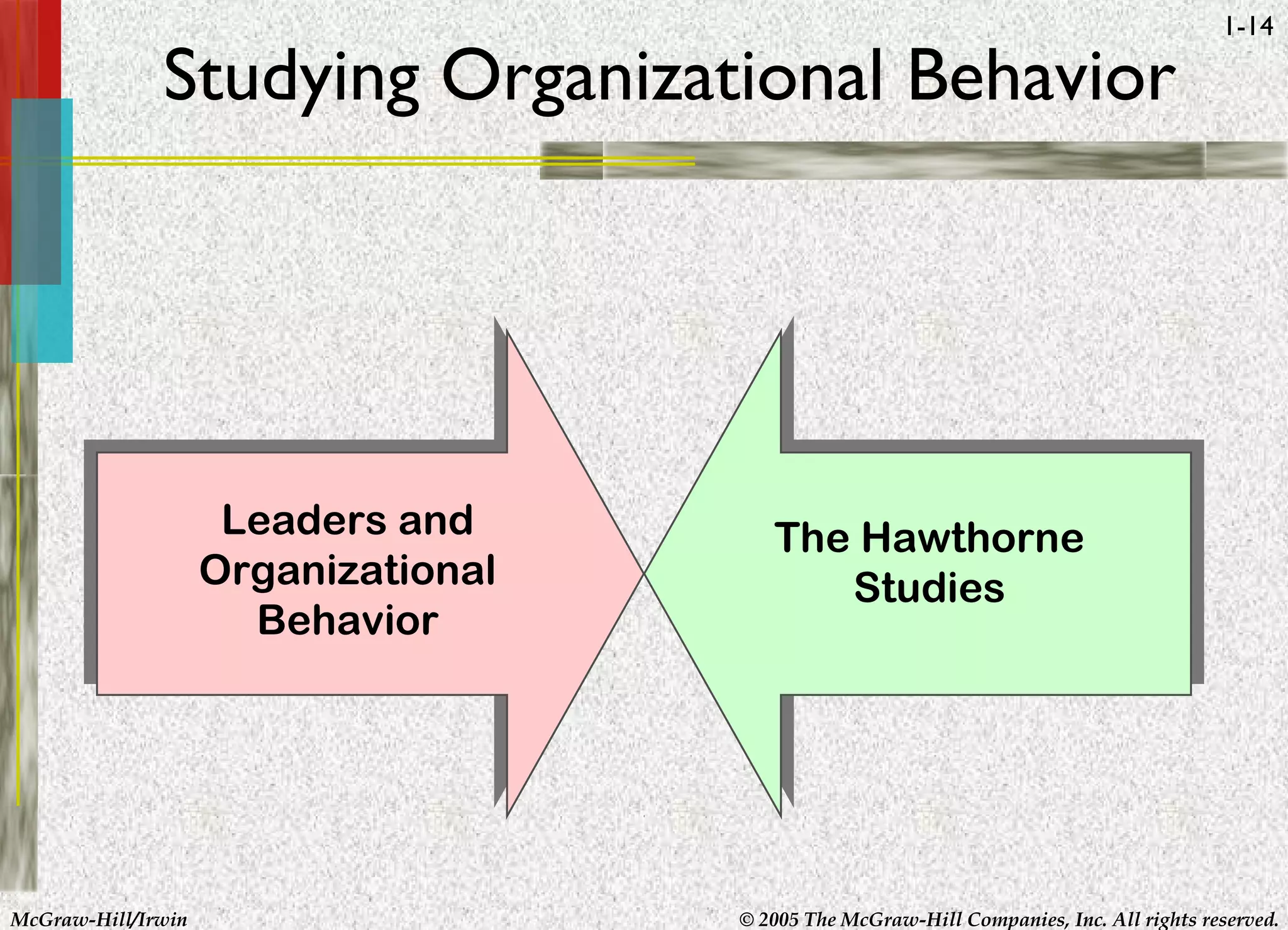
Studying Organizational Behavior
Leaders and
Organizational
Behavior
The Hawthorne
Studies
McGraw-Hill/Irwin © 2005 The McGraw-Hill Companies, Inc. All rights reserved.
1-15
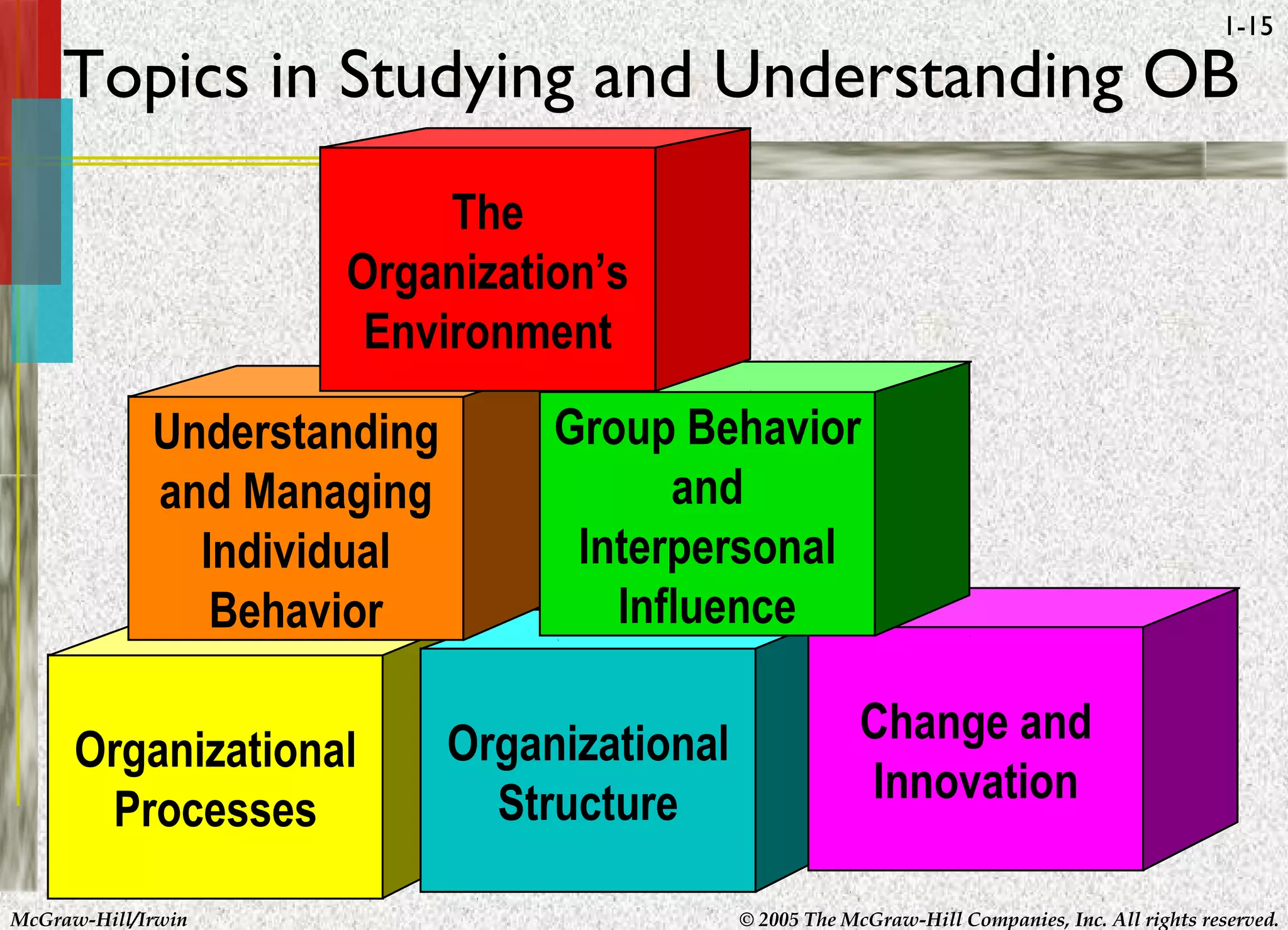
Organizational
Processes
Organizational
Structure
Change and
Innovation
Understanding
and Managing
Individual
Behavior
Group Behavior
and
Interpersonal
Influence
The
Organization’s
Environment
Topics in Studying and Understanding OB
McGraw-Hill/Irwin © 2005 The McGraw-Hill Companies, Inc. All rights reserved.
1-16
Key Points (1 of 2)
• The key to an organization’s success is
its human resources
• Organizations need human resources
that:
• work hard
• think creatively
• perform excellently
McGraw-Hill/Irwin © 2005 The McGraw-Hill Companies, Inc. All rights reserved.
1-17
Key Points (2 of 2)
• Rewarding, encouraging, and nurturing
the human resources in a timely and
meaningful manner is what is required
• The behavior of employees is the key to
achieving effectiveness

Organizational Behavior Management (introduction)

  • 1.
    McGraw-Hill/Irwin © 2005The McGraw-Hill Companies, Inc. All rights reserved. 1-1 ORGANIZATIONAL BEHAVIOR MANAGEMENT Prepared by: Cheryl M. Asia
  • 2.
    McGraw-Hill/Irwin © 2005The McGraw-Hill Companies, Inc. All rights reserved. 1-2 Chapter Introduction to Organizational Behavior 1
  • 3.
    McGraw-Hill/Irwin © 2005The McGraw-Hill Companies, Inc. All rights reserved. 1-3 Introduction • Organizations are much more than only a means for providing goods and service • They create the settings in which most of us spend our lives • They have profound influence on employee behavior
  • 4.
    McGraw-Hill/Irwin © 2005The McGraw-Hill Companies, Inc. All rights reserved. 1-4 The core 21st century qualities needed to create the ideal work atmosphere begin with intelligence, passion, a strong work ethic, and a genuine concern for people.
  • 5.
    McGraw-Hill/Irwin © 2005The McGraw-Hill Companies, Inc. All rights reserved. 1-5 Managing and Working Today and in the Future: • Managers must become agile and flexible to help their firms develop and sustain competitive advantage • To be successful, managers will need to harness the powers of: • information technology • human capital
  • 6.
    McGraw-Hill/Irwin © 2005The McGraw-Hill Companies, Inc. All rights reserved. 1-6 Rapidity of Change New Worker- Employer Psychological Contract Technology Globalism Cultural Diversity Power of Human Resources Environmental Forces Reshaping Management Practice
  • 7.
    McGraw-Hill/Irwin © 2005The McGraw-Hill Companies, Inc. All rights reserved. 1-7 Challenges of These Forces to Managers • Resisting the reality of these forces will likely lead to: • Unnecessary conflict • Reduced managerial performance • Reduced non- managerial performance • Lost opportunities • Resisting the reality of these forces will likely lead to: • Unnecessary conflict • Reduced managerial performance • Reduced non- managerial performance • Lost opportunities • Failing to cope and deal with these forces will likely result in: • Job dissatisfaction • Poor morale • Reduced commitment • Lower work quality • Burnout • Poor judgment • Unhealthy consequences • Failing to cope and deal with these forces will likely result in: • Job dissatisfaction • Poor morale • Reduced commitment • Lower work quality • Burnout • Poor judgment • Unhealthy consequences
  • 8.
    McGraw-Hill/Irwin © 2005The McGraw-Hill Companies, Inc. All rights reserved. 1-8 The Origins of Management Frederic W. Taylor’s Scientific Management Principles Henri Fayol’s Functions of Management
  • 9.
    McGraw-Hill/Irwin © 2005The McGraw-Hill Companies, Inc. All rights reserved. 1-9 Taylor’s Scientific Management Principles (1 of 2) • Develop a science for each element of an employee’s work • which replaces the old rule-of-thumb method • Scientifically select and then train, teach, and develop the worker • whereas in the past a worker chose the work to do and was self-trained
  • 10.
    McGraw-Hill/Irwin © 2005The McGraw-Hill Companies, Inc. All rights reserved. 1-10 Taylor’s Scientific Management Principles (2 of 2) • Heartily cooperate with each other to insure that all work was done in accordance with the principles of science • There is an almost equal division of the work and the responsibility between management and non-managers
  • 11.
    McGraw-Hill/Irwin © 2005The McGraw-Hill Companies, Inc. All rights reserved. 1-11 Impact of Fayol’s Functions of Management • Emphasized the importance of carefully practicing efficient: • planning • organizing • commanding • coordinating • controlling • Emphasized the importance of carefully practicing efficient: • planning • organizing • commanding • coordinating • controlling • Management is a separate body of knowledge that can be applied in any type of organization • A theory of management that can be learned and taught • There is a need for teaching management in colleges • Management is a separate body of knowledge that can be applied in any type of organization • A theory of management that can be learned and taught • There is a need for teaching management in colleges
  • 12.
    McGraw-Hill/Irwin © 2005The McGraw-Hill Companies, Inc. All rights reserved. 1-12 Definition of Organizational Behavior (OB) • The study of human behavior, attitudes, and performance within an organizational setting • drawing on theory, methods, and principles from such disciplines as psychology, sociology, political science, and cultural anthropology • to learn about individual, groups, structure, and processes
  • 13.
    McGraw-Hill/Irwin © 2005The McGraw-Hill Companies, Inc. All rights reserved. 1-13 Key Points About OB 1. OB is a way of thinking 2. OB is multidisciplinary 3. There is a distinctly humanistic orientation within OB 4. The field of OB is performance-oriented 5. The role of the scientific method is important in studying variables and relationships 6. OB has a distinctive applications orientation 1. OB is a way of thinking 2. OB is multidisciplinary 3. There is a distinctly humanistic orientation within OB 4. The field of OB is performance-oriented 5. The role of the scientific method is important in studying variables and relationships 6. OB has a distinctive applications orientation
  • 14.
    McGraw-Hill/Irwin © 2005The McGraw-Hill Companies, Inc. All rights reserved. 1-14 Studying Organizational Behavior Leaders and Organizational Behavior The Hawthorne Studies
  • 15.
    McGraw-Hill/Irwin © 2005The McGraw-Hill Companies, Inc. All rights reserved. 1-15 Organizational Processes Organizational Structure Change and Innovation Understanding and Managing Individual Behavior Group Behavior and Interpersonal Influence The Organization’s Environment Topics in Studying and Understanding OB
  • 16.
    McGraw-Hill/Irwin © 2005The McGraw-Hill Companies, Inc. All rights reserved. 1-16 Key Points (1 of 2) • The key to an organization’s success is its human resources • Organizations need human resources that: • work hard • think creatively • perform excellently
  • 17.
    McGraw-Hill/Irwin © 2005The McGraw-Hill Companies, Inc. All rights reserved. 1-17 Key Points (2 of 2) • Rewarding, encouraging, and nurturing the human resources in a timely and meaningful manner is what is required • The behavior of employees is the key to achieving effectiveness

Editor's Notes

  • #7 Break-even Analysis identifies profit or loss at various sales volumes Return on Investment measures productivity of assets Marginal Analysis compares the additional cost in a particular decision rather than average cost Game Theory mathematical models that analyze multi-party decision contexts Linear Programming for optimally solving resource allocation problems Queuing Theory for calculating waiting lines
  • #16 Break-even Analysis identifies profit or loss at various sales volumes Return on Investment measures productivity of assets Marginal Analysis compares the additional cost in a particular decision rather than average cost Game Theory mathematical models that analyze multi-party decision contexts Linear Programming for optimally solving resource allocation problems Queuing Theory for calculating waiting lines