

Critical Theory
For Panel Discussion
By:
Cheryl M. Asia, MAED
What are the underlying principle of
Critical Theory?
 The early critical theory has been variously
characterized as a radical social theory (or sociology).
Ingram and Simon-Ingram (1991)
 Science had become an ideology, a culturally produced
and socially supported, unexamined way of seeing the
world which shapes and guides social action.
What are the underlying principle
of Critical Theory?
 The intellectual project of critical theory thus
required recovering from early philosophy the
elements of social thought which uniquely
concerned the values, judgments, and
interests of humankind, and integrating them
into a framework of thought which could
provide a new and justifiable approach to
social science (Carr & Kenunis, 1986, p. 132).
What are the underlying principle
of Critical Theory?
 The critical theorists were concerned not only with
disclaiming rationality, science, and the technical
altogether but rather with returning them to balance with
other aspects of life, such as moral perspectives.
 The capitalism remains an important issue for many
critical theorists. Habermas, for example, believes that
capitalist societies oppose democracy, partly by
discouraging rational communication and encouraging
destructive beliefs in "bourgeois ideologies revolving
around competitive achievement, possessive
individualism, familial privatism, and consumerism"
(Ingram & Simon-Ingram, 1991, p. xxxii).
What are the underlying principle
of Critical Theory?
 Critical theorists also suggest that modem
social crises, say in education or government,
are related to the intrusion of overly rational
(scientific, analytical, technological),
instrumental, means-ends philosophies that
detract from reflection on our ultimate ends--
ends related to good and bad, right and
wrong. Habermas (1983/1990)
What are the underlying principle
of Critical Theory?
 Associated with the work of critical theorists
(Popkewitz, 1990)
1. "immanent critique, which proceeds through
forcing existing views to their systematic
conclusions, bringing them face to face with their
incompleteness and contradictions, and,
ultimately, with the social conditions of their
existence" (Young, 1990, p. 18)
2. strands of methods from disciplines such as
psychology, economics, history, sociology, and
philosophy.
Proponents of Critical Theory
 Critical theory maintains that ideology is the
principal obstacle to human liberation.
 Critical theory was established as a school
of thought primarily by the Frankfurt School
theoreticians Herbert Marcuse, Theodor
Adorno, Max Horkheimer, Walter Benjamin,
and Erich Fromm.
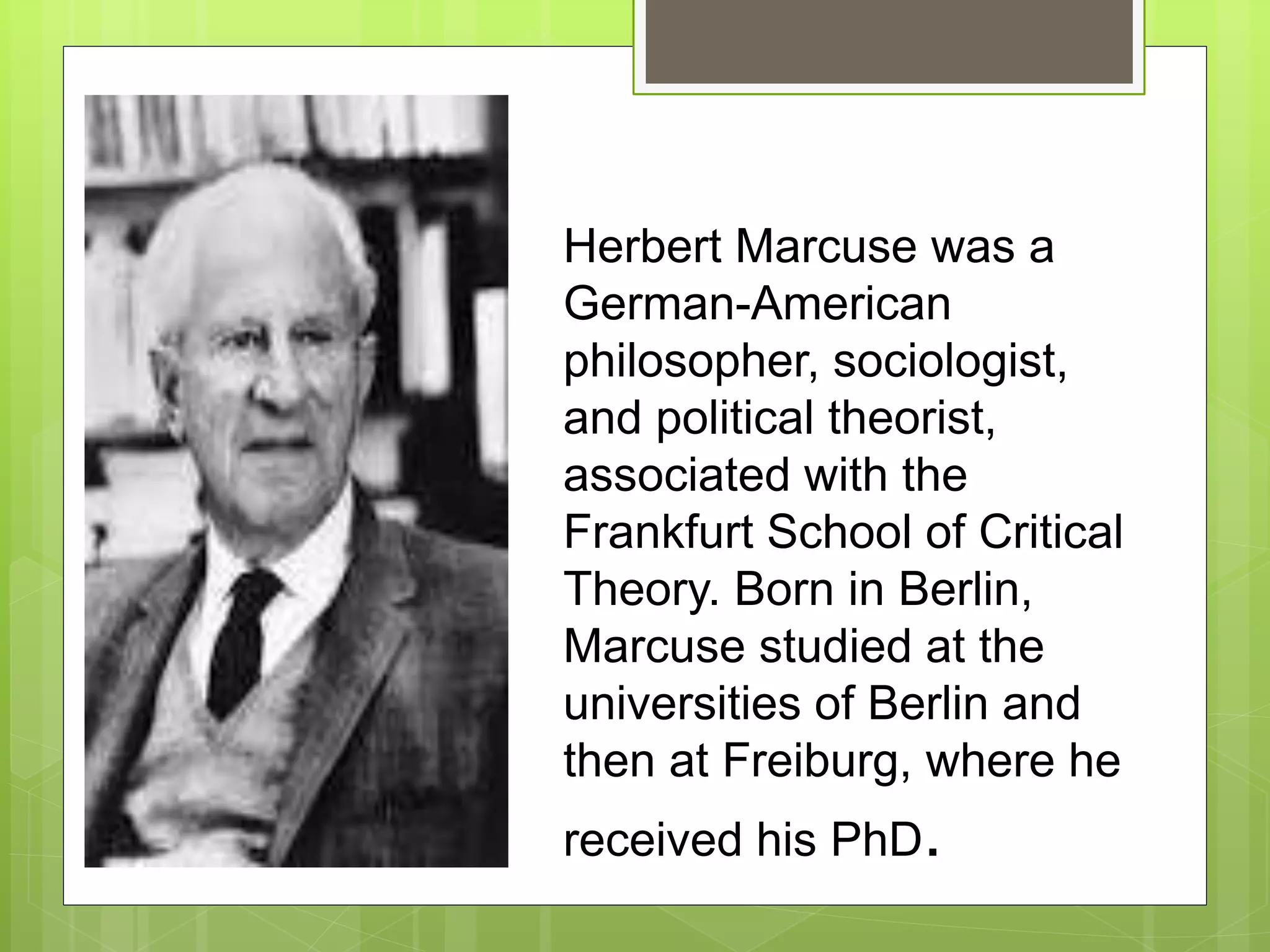
Herbert Marcuse was a
German-American
philosopher, sociologist,
and political theorist,
associated with the
Frankfurt School of Critical
Theory. Born in Berlin,
Marcuse studied at the
universities of Berlin and
then at Freiburg, where he
received his PhD.
Theodor W. Adorno
was a German
philosopher,
sociologist,
psychologist and
composer known
for his critical
theory of society.
Max Horkheimer was
a German
philosopher and
sociologist who was
famous for his work in
critical theory as a
member of the
'Frankfurt School' of
social research.
Walter Bendix Schönflies
Benjamin was a German
Jewish philosopher,
cultural critic and essayist.
An eclectic thinker,
combining elements of
German idealism,
Romanticism, Western
Marxism, and Jewish
Erich Seligmann
Fromm was a
German-born
American social
psychologist,
psychoanalyst,
sociologist,
humanistic
philosopher, and
democratic socialist.
How Critical Theory is
Implemented or integrated to
educational system?
 Critical Theory in our educational system was
integrated through our social learning like
practices of using Web we characterized
online networks to support knowledge
development are that they are diverse, open,
autonomous and connected.
 As a teacher, E-learning literature increasingly
perceives the role of a teacher as facilitator .
Critical theory

Critical theory

  • 1.
    Critical Theory For PanelDiscussion By: Cheryl M. Asia, MAED
  • 2.
    What are theunderlying principle of Critical Theory?  The early critical theory has been variously characterized as a radical social theory (or sociology). Ingram and Simon-Ingram (1991)  Science had become an ideology, a culturally produced and socially supported, unexamined way of seeing the world which shapes and guides social action.
  • 3.
    What are theunderlying principle of Critical Theory?  The intellectual project of critical theory thus required recovering from early philosophy the elements of social thought which uniquely concerned the values, judgments, and interests of humankind, and integrating them into a framework of thought which could provide a new and justifiable approach to social science (Carr & Kenunis, 1986, p. 132).
  • 4.
    What are theunderlying principle of Critical Theory?  The critical theorists were concerned not only with disclaiming rationality, science, and the technical altogether but rather with returning them to balance with other aspects of life, such as moral perspectives.  The capitalism remains an important issue for many critical theorists. Habermas, for example, believes that capitalist societies oppose democracy, partly by discouraging rational communication and encouraging destructive beliefs in "bourgeois ideologies revolving around competitive achievement, possessive individualism, familial privatism, and consumerism" (Ingram & Simon-Ingram, 1991, p. xxxii).
  • 5.
    What are theunderlying principle of Critical Theory?  Critical theorists also suggest that modem social crises, say in education or government, are related to the intrusion of overly rational (scientific, analytical, technological), instrumental, means-ends philosophies that detract from reflection on our ultimate ends-- ends related to good and bad, right and wrong. Habermas (1983/1990)
  • 6.
    What are theunderlying principle of Critical Theory?  Associated with the work of critical theorists (Popkewitz, 1990) 1. "immanent critique, which proceeds through forcing existing views to their systematic conclusions, bringing them face to face with their incompleteness and contradictions, and, ultimately, with the social conditions of their existence" (Young, 1990, p. 18) 2. strands of methods from disciplines such as psychology, economics, history, sociology, and philosophy.
  • 7.
    Proponents of CriticalTheory  Critical theory maintains that ideology is the principal obstacle to human liberation.  Critical theory was established as a school of thought primarily by the Frankfurt School theoreticians Herbert Marcuse, Theodor Adorno, Max Horkheimer, Walter Benjamin, and Erich Fromm.
  • 8.
    Herbert Marcuse wasa German-American philosopher, sociologist, and political theorist, associated with the Frankfurt School of Critical Theory. Born in Berlin, Marcuse studied at the universities of Berlin and then at Freiburg, where he received his PhD.
  • 9.
    Theodor W. Adorno wasa German philosopher, sociologist, psychologist and composer known for his critical theory of society.
  • 10.
    Max Horkheimer was aGerman philosopher and sociologist who was famous for his work in critical theory as a member of the 'Frankfurt School' of social research.
  • 11.
    Walter Bendix Schönflies Benjaminwas a German Jewish philosopher, cultural critic and essayist. An eclectic thinker, combining elements of German idealism, Romanticism, Western Marxism, and Jewish
  • 12.
    Erich Seligmann Fromm wasa German-born American social psychologist, psychoanalyst, sociologist, humanistic philosopher, and democratic socialist.
  • 13.
    How Critical Theoryis Implemented or integrated to educational system?  Critical Theory in our educational system was integrated through our social learning like practices of using Web we characterized online networks to support knowledge development are that they are diverse, open, autonomous and connected.  As a teacher, E-learning literature increasingly perceives the role of a teacher as facilitator .