Adjetivos posesivos
Possessive Adjectives
Showing Possession
 InSpanish there are NO apostrophes!
 You cannot say, for example,

              Jorge’s dog
 (using an apostrophe s)
Showing Posession
 You  must say,
         “The dog of Jorge”
 In Spanish,

         “El perro de Jorge”
Object + DE + Owner
 Thisconcept of showing
 possession is using the formula:
       object + DE + owner
 For example:
         El perro de Jorge
Object + De + owner
 Tengo el cuaderno              de Felipe.
   (I have Felipe’s notebook)

 La hermana de Maria              es amable.
   (Maria’s sister is nice.)


   Don’t forget – DE + EL = DEL
            The boy’s mom = la madre DEL chico
You try it!
Práctica A: Translate these to Spanish.
Ex. the girl’s cat = the cat of the girl =
                   El gato de la chica
1. The boy’s dog

2. The uncle’s wife

3. The cousin’s parents

4. Roberto’s grandparents

5. Juana’s aunt
Possessive Adjectives
 Adjectives   DESCRIBE nouns,
  correct?
 Well, they can also show
  possession.
Possessive Adjectives
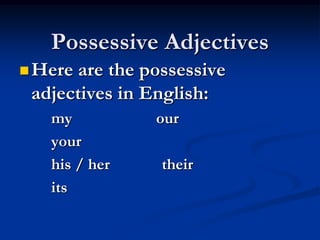
 Here are the possessive
 adjectives in English:
   my           our
   your
   his / her     their
   its
Posessive Adjectives

 For example: “my dog, your
  house, his notebook, etc.”
 We don’t have to keep repeating
  the person over and over!
Make a GRAMMAR CARD for these! (lined side)

         Posessive Adjectives
      singular                                    plural
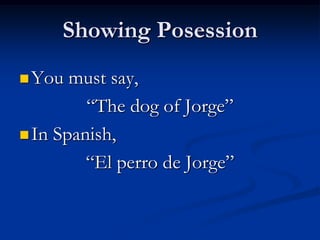
mi / mis (my)                            nuestro a, os, as
                                                           (our)
tu / tus (your)                          vuestro, a, os, as
                                                  (your informal)
su / sus (his,her)                       su / sus      (their)
      or (your formal)                          or (your formal)
Note: TU does NOT have an accent mark!
Put these notes on the front of the GRAMMAR card.

         Possessive Adjectives
   Must agree with the OBJECT.
     OBJECT is singular, possessive adjective is
      singular.
     OBJECT is plural, possessive adjective is plural.


   Do NOT use the articles with the noun:
       (el, la, los, las, un, una, unos, unas)
Possessive Adjectives
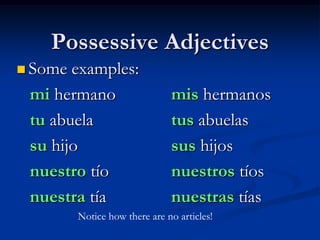
 Some examples:
 mi hermano                    mis hermanos
 tu abuela                     tus abuelas
 su hijo                       sus hijos
 nuestro tío                   nuestros tíos
 nuestra tía                   nuestras tías
         Notice how there are no articles!
Posessive Adjectives
 Mi   prima es alta.
 Prima    is singular, so MI is too!
 Todas   mis primas son altas.
 Primas    is plural, so MIS is plural
  also.
 Notice, no ARTICLES!!
You try it!
Práctica B: Complete with the correct possessive adjective.
1.   (my) tíos
2.   (our) abuelos
3.   (his) primas
4.   (their) madre
5.   (your-informal) esposo
6.   (her) sobrino
7.   (my) hija
8.   (our) nieta
Posessive Adjectives
     are great to use when answering questions
  to eliminate the LONG possessive construction.


 ¿Son  rubios los hermanos de
  Rafael? (Are Rafael’s brothers blond?)
 No, sus hermanos son
  pelirrojos. (No, his brothers are red-headed.)
 Whose “hermanos”? 
  Rafael’s = HIS (so SUS means his)
SU and SUS
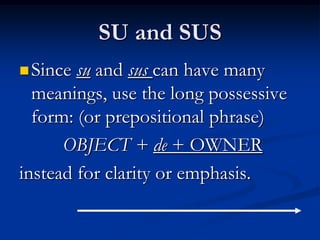
 Since su and sus can have many
  meanings, use the long possessive
  form: (or prepositional phrase)
      OBJECT + de + OWNER
instead for clarity or emphasis.
Example:
 Sus   pantalones son elegantes.
     Whose pants?
     His?       Hers?    Yours? Theirs?
 To clarify, use the long possessive form:
  Los pantalones de Rosa son elegantes.
 In this case, SUS pantalones = her pants
More examples:
   His mother is a doctor.
     Su madre es médica.
     La madre de él es médica.

    (note: don’t combine DE + ÉL because of the accent mark!)


   Their children are daring.
     Sus hijos son altos.
     Los hijos de ellos son altos.
Práctica C: You try it!
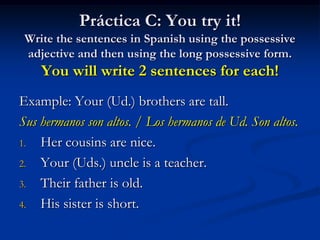
 Write the sentences in Spanish using the possessive
 adjective and then using the long possessive form.
    You will write 2 sentences for each!
Example: Your (Ud.) brothers are tall.
Sus hermanos son altos. / Los hermanos de Ud. Son altos.
1. Her cousins are nice.

2. Your (Uds.) uncle is a teacher.

3. Their father is old.

4. His sister is short.

Possessive adjectives -Esp.1

  • 1.
  • 2.
    Showing Possession  InSpanishthere are NO apostrophes!  You cannot say, for example, Jorge’s dog (using an apostrophe s)
  • 3.
    Showing Posession  You must say, “The dog of Jorge”  In Spanish, “El perro de Jorge”
  • 4.
    Object + DE+ Owner  Thisconcept of showing possession is using the formula: object + DE + owner For example: El perro de Jorge
  • 5.
    Object + De+ owner  Tengo el cuaderno de Felipe.  (I have Felipe’s notebook)  La hermana de Maria es amable.  (Maria’s sister is nice.)  Don’t forget – DE + EL = DEL The boy’s mom = la madre DEL chico
  • 6.
    You try it! PrácticaA: Translate these to Spanish. Ex. the girl’s cat = the cat of the girl = El gato de la chica 1. The boy’s dog 2. The uncle’s wife 3. The cousin’s parents 4. Roberto’s grandparents 5. Juana’s aunt
  • 7.
    Possessive Adjectives  Adjectives DESCRIBE nouns, correct?  Well, they can also show possession.
  • 8.
    Possessive Adjectives  Hereare the possessive adjectives in English: my our your his / her their its
  • 9.
    Posessive Adjectives  Forexample: “my dog, your house, his notebook, etc.”  We don’t have to keep repeating the person over and over!
  • 10.
    Make a GRAMMARCARD for these! (lined side) Posessive Adjectives singular plural mi / mis (my) nuestro a, os, as (our) tu / tus (your) vuestro, a, os, as (your informal) su / sus (his,her) su / sus (their) or (your formal) or (your formal) Note: TU does NOT have an accent mark!
  • 11.
    Put these noteson the front of the GRAMMAR card. Possessive Adjectives  Must agree with the OBJECT.  OBJECT is singular, possessive adjective is singular.  OBJECT is plural, possessive adjective is plural.  Do NOT use the articles with the noun:  (el, la, los, las, un, una, unos, unas)
  • 12.
    Possessive Adjectives  Someexamples: mi hermano mis hermanos tu abuela tus abuelas su hijo sus hijos nuestro tío nuestros tíos nuestra tía nuestras tías Notice how there are no articles!
  • 13.
    Posessive Adjectives  Mi prima es alta. Prima is singular, so MI is too!  Todas mis primas son altas. Primas is plural, so MIS is plural also. Notice, no ARTICLES!!
  • 14.
    You try it! PrácticaB: Complete with the correct possessive adjective. 1. (my) tíos 2. (our) abuelos 3. (his) primas 4. (their) madre 5. (your-informal) esposo 6. (her) sobrino 7. (my) hija 8. (our) nieta
  • 15.
    Posessive Adjectives are great to use when answering questions to eliminate the LONG possessive construction.  ¿Son rubios los hermanos de Rafael? (Are Rafael’s brothers blond?)  No, sus hermanos son pelirrojos. (No, his brothers are red-headed.)  Whose “hermanos”?  Rafael’s = HIS (so SUS means his)
  • 16.
    SU and SUS Since su and sus can have many meanings, use the long possessive form: (or prepositional phrase) OBJECT + de + OWNER instead for clarity or emphasis.
  • 17.
    Example:  Sus pantalones son elegantes. Whose pants? His? Hers? Yours? Theirs?  To clarify, use the long possessive form: Los pantalones de Rosa son elegantes.  In this case, SUS pantalones = her pants
  • 18.
    More examples:  His mother is a doctor.  Su madre es médica.  La madre de él es médica. (note: don’t combine DE + ÉL because of the accent mark!)  Their children are daring.  Sus hijos son altos.  Los hijos de ellos son altos.
  • 19.
    Práctica C: Youtry it! Write the sentences in Spanish using the possessive adjective and then using the long possessive form. You will write 2 sentences for each! Example: Your (Ud.) brothers are tall. Sus hermanos son altos. / Los hermanos de Ud. Son altos. 1. Her cousins are nice. 2. Your (Uds.) uncle is a teacher. 3. Their father is old. 4. His sister is short.